Agile for Project
                                                                       Managers
                                                                    A sailor’s look at Agile

                                                                        A presentation for


                                                                 2012 GE Agile Conference

                                                                            Produced by
                                                                     Square Peg Consulting, LLC
                                                                        Orlando, Florida USA
                                                                       www.sqpegconsulting.com


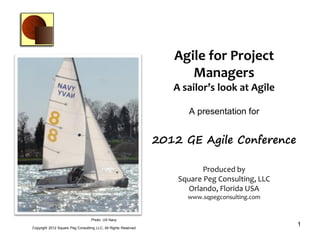
                                   Photo: US Navy

Copyright 2012 Square Peg Consultiing LLC, All Rights Reserved
                                                                                                  1
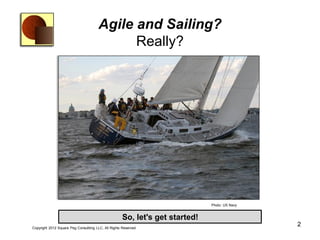
Agile and Sailing?
                                             Really?


                                                                              Photo: US Navy


                                                     So, let's get started!
Copyright 2012 Square Peg Consultiing LLC, All Rights Reserved
                                                                                               2
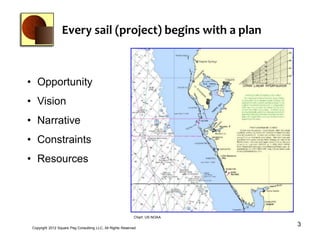
Every sail (project) begins with a plan


• Opportunity
• Vision
• Narrative
• Constraints
• Resources


                                                             Chart: US NOAA


 Copyright 2012 Square Peg Consultiing LLC, All Rights Reserved
                                                                              3
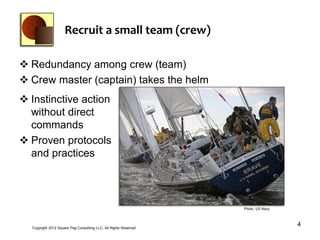
Recruit a small team (crew)

 Redundancy among crew (team)
 Crew master (captain) takes the helm
 Instinctive action
  without direct
  commands
 Proven protocols
  and practices


                                                                   Photo: US Navy


  Copyright 2012 Square Peg Consultiing LLC, All Rights Reserved
                                                                                    4
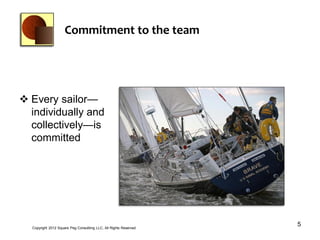
Commitment to the team


 Every sailor—
  individually and
  collectively—is
  committed


  Copyright 2012 Square Peg Consultiing LLC, All Rights Reserved
                                                                   5
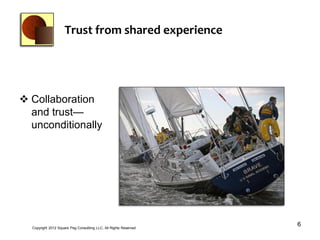
Trust from shared experience


 Collaboration
  and trust—
  unconditionally


  Copyright 2012 Square Peg Consultiing LLC, All Rights Reserved
                                                                   6
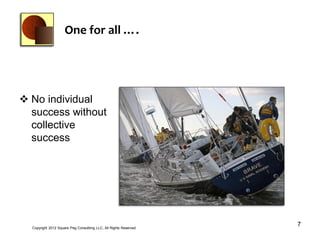
One for all ….


 No individual
  success without
  collective
  success


  Copyright 2012 Square Peg Consultiing LLC, All Rights Reserved
                                                                   7
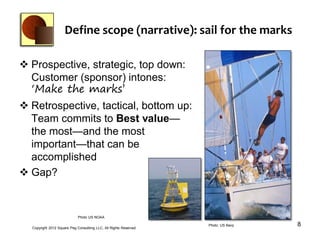
Define scope (narrative): sail for the marks

 Prospective, strategic, top down:
  Customer (sponsor) intones:
  ‘Make the marks’
 Retrospective, tactical, bottom up:
  Team commits to Best value—
  the most—and the most
  important—that can be
  accomplished
 Gap?


                             Photo US NOAA


  Copyright 2012 Square Peg Consultiing LLC, All Rights Reserved
                                                                   Photo: US Navy   8
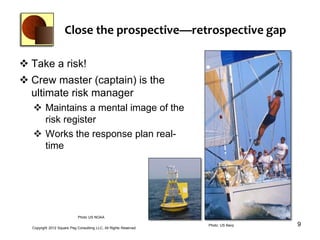
Close the prospective—retrospective gap

 Take a risk!
 Crew master (captain) is the
  ultimate risk manager
   Maintains a mental image of the
    risk register
   Works the response plan real-
    time


                             Photo US NOAA


  Copyright 2012 Square Peg Consultiing LLC, All Rights Reserved
                                                                   Photo: US Navy   9
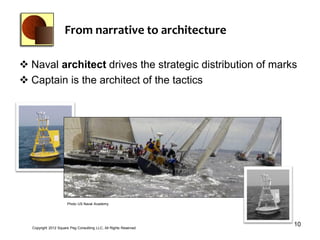
From narrative to architecture

 Naval architect drives the strategic distribution of marks
 Captain is the architect of the tactics


                      Photo US Naval Academy


  Copyright 2012 Square Peg Consultiing LLC, All Rights Reserved
                                                                   10
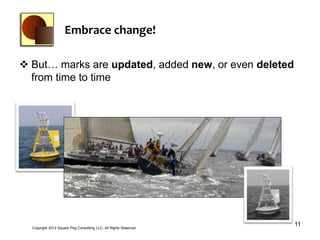
Embrace change!

 But… marks are updated, added new, or even deleted
  from time to time


  Copyright 2012 Square Peg Consultiing LLC, All Rights Reserved
                                                                   11
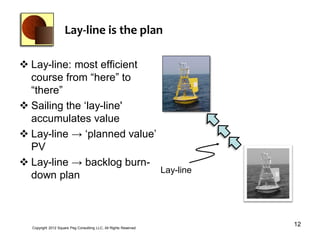
Lay-line is the plan

 Lay-line: most efficient
  course from “here” to
  “there”
 Sailing the ‘lay-line'
  accumulates value
 Lay-line → ‘planned value’
  PV
 Lay-line → backlog burn-
                             Lay-line
  down plan


  Copyright 2012 Square Peg Consultiing LLC, All Rights Reserved
                                                                   12
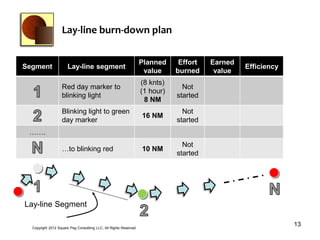
Lay-line burn-down plan

                                                                   Planned     Effort   Earned
Segment                Lay-line segment                                                          Efficiency
                                                                    value     burned     value
                                                                   (8 knts)
                   Red day marker to                                            Not
                                                                   (1 hour)
                   blinking light                                             started
                                                                    8 NM
                   Blinking light to green                                      Not
                                                                   16 NM
                   day marker                                                 started
 …….
                                                                                Not
                   …to blinking red                                10 NM
                                                                              started


Lay-line Segment

  Copyright 2012 Square Peg Consultiing LLC, All Rights Reserved
                                                                                                              13
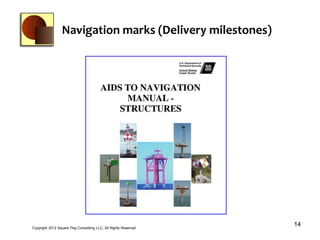
Navigation marks (Delivery milestones)


Copyright 2012 Square Peg Consultiing LLC, All Rights Reserved
                                                                 14
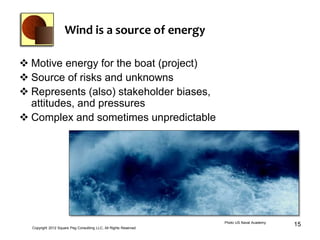
Wind is a source of energy

 Motive energy for the boat (project)
 Source of risks and unknowns
 Represents (also) stakeholder biases,
  attitudes, and pressures
 Complex and sometimes unpredictable


                                                                   Photo US Naval Academy
  Copyright 2012 Square Peg Consultiing LLC, All Rights Reserved
                                                                                            15
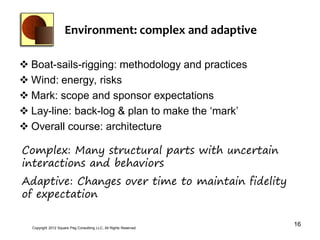
Environment: complex and adaptive

 Boat-sails-rigging: methodology and practices
 Wind: energy, risks
 Mark: scope and sponsor expectations
 Lay-line: back-log & plan to make the ‘mark’
 Overall course: architecture

Complex: Many structural parts with uncertain
interactions and behaviors
Adaptive: Changes over time to maintain fidelity
of expectation

  Copyright 2012 Square Peg Consultiing LLC, All Rights Reserved
                                                                   16
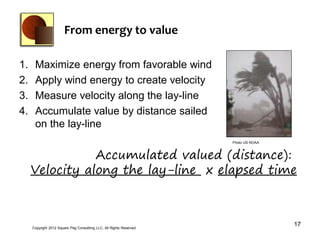
From energy to value

1.    Maximize energy from favorable wind
2.    Apply wind energy to create velocity
3.    Measure velocity along the lay-line
4.    Accumulate value by distance sailed
      on the lay-line
                                                                      Photo US NOAA


                Accumulated valued (distance):
     Velocity along the lay-line x elapsed time


     Copyright 2012 Square Peg Consultiing LLC, All Rights Reserved
                                                                                      17
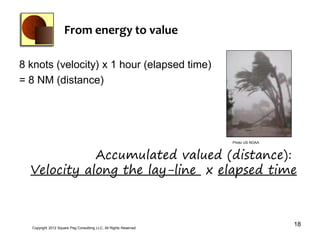
From energy to value

8 knots (velocity) x 1 hour (elapsed time)
= 8 NM (distance)


                                                                   Photo US NOAA


             Accumulated valued (distance):
  Velocity along the lay-line x elapsed time


  Copyright 2012 Square Peg Consultiing LLC, All Rights Reserved
                                                                                   18
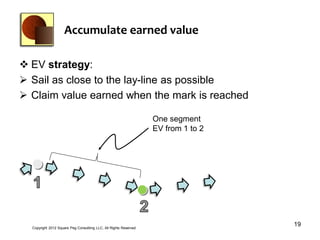
Accumulate earned value

 EV strategy:
 Sail as close to the lay-line as possible
 Claim value earned when the mark is reached

                                                                   One segment
                                                                   EV from 1 to 2


  Copyright 2012 Square Peg Consultiing LLC, All Rights Reserved
                                                                                    19
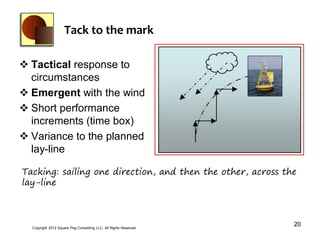
Tack to the mark

 Tactical response to
  circumstances
 Emergent with the wind
 Short performance
  increments (time box)
 Variance to the planned
  lay-line

Tacking: sailing one direction, and then the other, across the
lay-line


  Copyright 2012 Square Peg Consultiing LLC, All Rights Reserved
                                                                   20
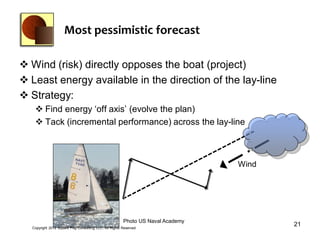
Most pessimistic forecast

 Wind (risk) directly opposes the boat (project)
 Least energy available in the direction of the lay-line
 Strategy:
    Find energy ‘off axis’ (evolve the plan)
    Tack (incremental performance) across the lay-line


                                                                                 Wind


                                                        Photo US Naval Academy
  Copyright 2012 Square Peg Consultiing LLC, All Rights Reserved
                                                                                        21
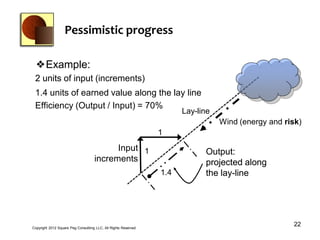
Pessimistic progress

 ❖Example:
 2 units of input (increments)
 1.4 units of earned value along the lay line
 Efficiency (Output / Input) = 70%
                                                                       Lay-line
                                                                                  Wind (energy and risk)
                                                                 1
                                           Input 1                           Output:
                                     increments                              projected along
                                                                 1.4         the lay-line


Copyright 2012 Square Peg Consultiing LLC, All Rights Reserved
                                                                                                     22
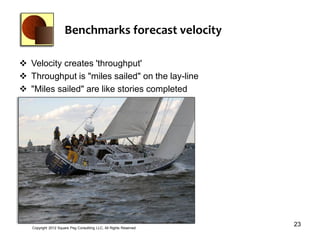
Benchmarks forecast velocity

 Velocity creates 'throughput'
 Throughput is "miles sailed" on the lay-line
 "Miles sailed" are like stories completed


   Copyright 2012 Square Peg Consultiing LLC, All Rights Reserved
                                                                    23
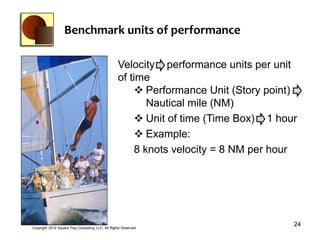
Benchmark units of performance

                                                   Velocity = performance units per unit
                                                   of time
                                                         Performance Unit (Story point) =
                                                           Nautical mile (NM)
                                                         Unit of time (Time Box) = 1 hour
                                                         Example:
                                                        8 knots velocity = 8 NM per hour


Copyright 2012 Square Peg Consultiing LLC, All Rights Reserved
                                                                                        24
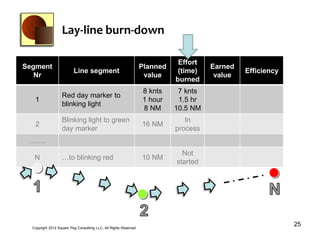
Lay-line burn-down

                                                                              Effort
Segment                                                            Planned             Earned
                          Line segment                                        (time)            Efficiency
   Nr                                                               value               value
                                                                             burned
                                                                   8 knts     7 knts
                   Red day marker to
   1                                                               1 hour     1.5 hr
                   blinking light
                                                                   8 NM      10.5 NM
                   Blinking light to green                                      In
   2                                                               16 NM
                   day marker                                                process
 …….
                                                                               Not
   N               …to blinking red                                10 NM
                                                                             started


  Copyright 2012 Square Peg Consultiing LLC, All Rights Reserved
                                                                                                             25
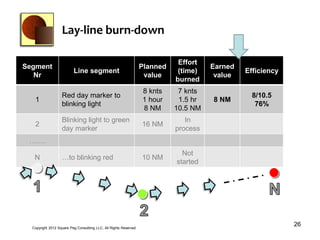
Lay-line burn-down

                                                                              Effort
Segment                                                            Planned             Earned
                          Line segment                                        (time)            Efficiency
   Nr                                                               value               value
                                                                             burned
                                                                   8 knts     7 knts
                   Red day marker to                                                              8/10.5
   1                                                               1 hour     1.5 hr   8 NM
                   blinking light                                                                  76%
                                                                   8 NM      10.5 NM
                   Blinking light to green                                      In
   2                                                               16 NM
                   day marker                                                process
 …….
                                                                               Not
   N               …to blinking red                                10 NM
                                                                             started


  Copyright 2012 Square Peg Consultiing LLC, All Rights Reserved
                                                                                                             26
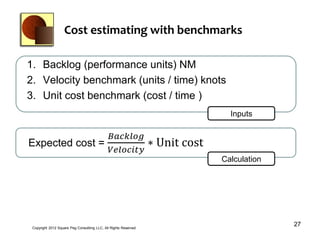
Cost estimating with benchmarks

1. Backlog (performance units) NM
2. Velocity benchmark (units / time) knots
3. Unit cost benchmark (cost / time )
                                                                                  Inputs

                𝐵𝑎𝑐𝑘𝑙𝑜𝑔
Expected cost =                                                   ∗ Unit cost
                𝑉𝑒𝑙𝑜𝑐𝑖𝑡𝑦
                                                                                Calculation


 Copyright 2012 Square Peg Consultiing LLC, All Rights Reserved
                                                                                              27
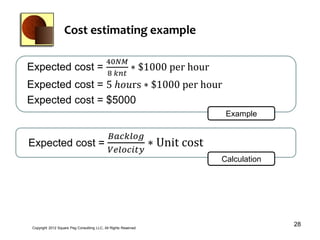
Cost estimating example

                                             40𝑁𝑀
Expected cost =                                            ∗ $1000 per hour
                                             8 𝑘𝑛𝑡
Expected cost = 5 ℎ𝑜𝑢rs ∗ $1000 per hour
Expected cost = $5000
                                                                                 Example

                𝐵𝑎𝑐𝑘𝑙𝑜𝑔
Expected cost =                                                   ∗ Unit cost
                𝑉𝑒𝑙𝑜𝑐𝑖𝑡𝑦
                                                                                Calculation


 Copyright 2012 Square Peg Consultiing LLC, All Rights Reserved
                                                                                              28
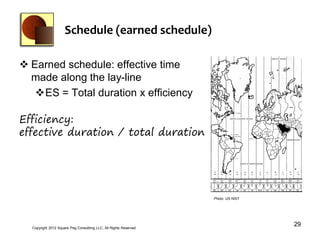
Schedule (earned schedule)

 Earned schedule: effective time
  made along the lay-line
   ES = Total duration x efficiency

Efficiency:
effective duration / total duration


                                                                   Photo: US NIST


  Copyright 2012 Square Peg Consultiing LLC, All Rights Reserved
                                                                                    29
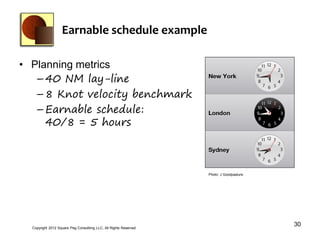
Earnable schedule example

• Planning metrics
   – 40 NM lay-line
   – 8 Knot velocity benchmark
   – Earnable schedule:
     40/8 = 5 hours


                                                                   Photo: J Goodpasture


  Copyright 2012 Square Peg Consultiing LLC, All Rights Reserved
                                                                                          30
Agile schedule heuristic

A schedule without slack is a hope, requiring
prayer….

But it’s unlikely to be an achievable schedule


  Copyright 2012 Square Peg Consultiing LLC, All Rights Reserved
                                                                   31
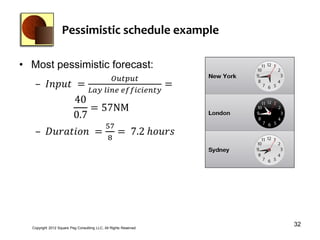
Pessimistic schedule example

• Most pessimistic forecast:
                                          𝑂𝑢𝑡𝑝𝑢𝑡
   – 𝐼𝑛𝑝𝑢𝑡 =                        𝐿𝑎𝑦 𝑙𝑖𝑛𝑒 𝑒𝑓𝑓𝑖𝑐𝑖𝑒𝑛𝑡𝑦
                                                                   =
           40
              = 57NM
          0.7
                                             57
   – 𝐷𝑢𝑟𝑎𝑡𝑖𝑜𝑛 =                                      = 7.2 ℎ𝑜𝑢𝑟𝑠
                                             8


  Copyright 2012 Square Peg Consultiing LLC, All Rights Reserved
                                                                       32
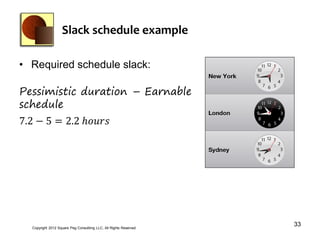
Slack schedule example

• Required schedule slack:

Pessimistic duration – Earnable
schedule
7.2 − 5 = 2.2 ℎ𝑜𝑢𝑟𝑠


  Copyright 2012 Square Peg Consultiing LLC, All Rights Reserved
                                                                   33
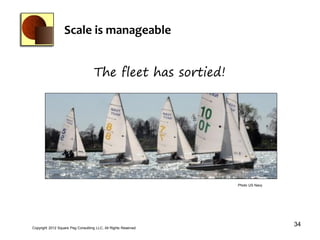
Scale is manageable

                                                 The fleet has sortied
                                    The fleet has sortied!


                                                                         Photo US Navy


Copyright 2012 Square Peg Consultiing LLC, All Rights Reserved
                                                                                         34
Scale is manageable

 Vision and strategic direction
    Conveyed from the fleet captain
 Each boat is a self-directing team,
    But learns from the performance of others
 Protocols observed
    For communication, sequencing, and
     coordination
 Each boat maintains situational awareness


  Copyright 2012 Square Peg Consultiing LLC, All Rights Reserved
                                                                   35
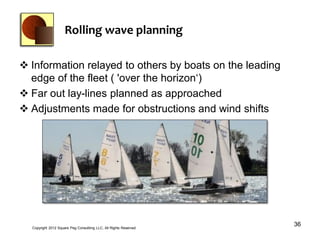
Rolling wave planning

 Information relayed to others by boats on the leading
  edge of the fleet ( 'over the horizon‘)
 Far out lay-lines planned as approached
 Adjustments made for obstructions and wind shifts


  Copyright 2012 Square Peg Consultiing LLC, All Rights Reserved
                                                                   36
There’s a lot more to know….

• Jim Highsmith: “Agile Project Management: Creating
  innovative products”
• Dean Leffingwell: “Agile Software Requirements: Lean
  requirements practices for Teams, Programs, and the
  Enterprise”
• Mike Cohn: “Agile Estimating and Planning”
• Lisa Crispin and Janet Gregory: “Agile Testing: A practical
  guide for Testers and Agile Teams”


  Copyright 2012 Square Peg Consultiing LLC, All Rights Reserved
                                                                   37
Read more…


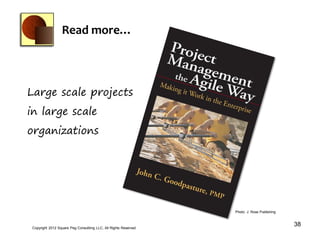
Large scale projects
in large scale
organizations


                                                                  Photo: J. Ross Publishing


 Copyright 2012 Square Peg Consultiing LLC, All Rights Reserved
                                                                                              38
Learn more…

PMI® eSeminarsWorldsm instructor

• Agile Project Management
• Advanced Risk Management
 and
• Understanding Organizational
   Change


                                                          39
  Copyright 2012 Square Peg Consultiing LLC, All Rights
                       Reserved
Stay in touch

John C Goodpasture, PMP
Program manager, author, and
instructor


 info@sqpegconsulting.com
    johngoodpasture.com


                                                          40
  Copyright 2012 Square Peg Consultiing LLC, All Rights
                       Reserved
All done and ready for questions!


Copyright 2012 Square Peg Consultiing LLC, All Rights Reserved
                                                                 41

Agile for project managers - a sailing analogy-UPDATE

  • 1.
    Agile for Project Managers A sailor’s look at Agile A presentation for 2012 GE Agile Conference Produced by Square Peg Consulting, LLC Orlando, Florida USA www.sqpegconsulting.com Photo: US Navy Copyright 2012 Square Peg Consultiing LLC, All Rights Reserved 1
  • 2.
    Agile and Sailing? Really? Photo: US Navy So, let's get started! Copyright 2012 Square Peg Consultiing LLC, All Rights Reserved 2
  • 3.
    Every sail (project)begins with a plan • Opportunity • Vision • Narrative • Constraints • Resources Chart: US NOAA Copyright 2012 Square Peg Consultiing LLC, All Rights Reserved 3
  • 4.
    Recruit a smallteam (crew)  Redundancy among crew (team)  Crew master (captain) takes the helm  Instinctive action without direct commands  Proven protocols and practices Photo: US Navy Copyright 2012 Square Peg Consultiing LLC, All Rights Reserved 4
  • 5.
    Commitment to theteam  Every sailor— individually and collectively—is committed Copyright 2012 Square Peg Consultiing LLC, All Rights Reserved 5
  • 6.
    Trust from sharedexperience  Collaboration and trust— unconditionally Copyright 2012 Square Peg Consultiing LLC, All Rights Reserved 6
  • 7.
    One for all….  No individual success without collective success Copyright 2012 Square Peg Consultiing LLC, All Rights Reserved 7
  • 8.
    Define scope (narrative):sail for the marks  Prospective, strategic, top down: Customer (sponsor) intones: ‘Make the marks’  Retrospective, tactical, bottom up: Team commits to Best value— the most—and the most important—that can be accomplished  Gap? Photo US NOAA Copyright 2012 Square Peg Consultiing LLC, All Rights Reserved Photo: US Navy 8
  • 9.
    Close the prospective—retrospectivegap  Take a risk!  Crew master (captain) is the ultimate risk manager  Maintains a mental image of the risk register  Works the response plan real- time Photo US NOAA Copyright 2012 Square Peg Consultiing LLC, All Rights Reserved Photo: US Navy 9
  • 10.
    From narrative toarchitecture  Naval architect drives the strategic distribution of marks  Captain is the architect of the tactics Photo US Naval Academy Copyright 2012 Square Peg Consultiing LLC, All Rights Reserved 10
  • 11.
    Embrace change!  But…marks are updated, added new, or even deleted from time to time Copyright 2012 Square Peg Consultiing LLC, All Rights Reserved 11
  • 12.
    Lay-line is theplan  Lay-line: most efficient course from “here” to “there”  Sailing the ‘lay-line' accumulates value  Lay-line → ‘planned value’ PV  Lay-line → backlog burn- Lay-line down plan Copyright 2012 Square Peg Consultiing LLC, All Rights Reserved 12
  • 13.
    Lay-line burn-down plan Planned Effort Earned Segment Lay-line segment Efficiency value burned value (8 knts) Red day marker to Not (1 hour) blinking light started 8 NM Blinking light to green Not 16 NM day marker started ……. Not …to blinking red 10 NM started Lay-line Segment Copyright 2012 Square Peg Consultiing LLC, All Rights Reserved 13
  • 14.
    Navigation marks (Deliverymilestones) Copyright 2012 Square Peg Consultiing LLC, All Rights Reserved 14
  • 15.
    Wind is asource of energy  Motive energy for the boat (project)  Source of risks and unknowns  Represents (also) stakeholder biases, attitudes, and pressures  Complex and sometimes unpredictable Photo US Naval Academy Copyright 2012 Square Peg Consultiing LLC, All Rights Reserved 15
  • 16.
    Environment: complex andadaptive  Boat-sails-rigging: methodology and practices  Wind: energy, risks  Mark: scope and sponsor expectations  Lay-line: back-log & plan to make the ‘mark’  Overall course: architecture Complex: Many structural parts with uncertain interactions and behaviors Adaptive: Changes over time to maintain fidelity of expectation Copyright 2012 Square Peg Consultiing LLC, All Rights Reserved 16
  • 17.
    From energy tovalue 1. Maximize energy from favorable wind 2. Apply wind energy to create velocity 3. Measure velocity along the lay-line 4. Accumulate value by distance sailed on the lay-line Photo US NOAA Accumulated valued (distance): Velocity along the lay-line x elapsed time Copyright 2012 Square Peg Consultiing LLC, All Rights Reserved 17
  • 18.
    From energy tovalue 8 knots (velocity) x 1 hour (elapsed time) = 8 NM (distance) Photo US NOAA Accumulated valued (distance): Velocity along the lay-line x elapsed time Copyright 2012 Square Peg Consultiing LLC, All Rights Reserved 18
  • 19.
    Accumulate earned value EV strategy:  Sail as close to the lay-line as possible  Claim value earned when the mark is reached One segment EV from 1 to 2 Copyright 2012 Square Peg Consultiing LLC, All Rights Reserved 19
  • 20.
    Tack to themark  Tactical response to circumstances  Emergent with the wind  Short performance increments (time box)  Variance to the planned lay-line Tacking: sailing one direction, and then the other, across the lay-line Copyright 2012 Square Peg Consultiing LLC, All Rights Reserved 20
  • 21.
    Most pessimistic forecast Wind (risk) directly opposes the boat (project)  Least energy available in the direction of the lay-line  Strategy:  Find energy ‘off axis’ (evolve the plan)  Tack (incremental performance) across the lay-line Wind Photo US Naval Academy Copyright 2012 Square Peg Consultiing LLC, All Rights Reserved 21
  • 22.
    Pessimistic progress ❖Example: 2 units of input (increments) 1.4 units of earned value along the lay line Efficiency (Output / Input) = 70% Lay-line Wind (energy and risk) 1 Input 1 Output: increments projected along 1.4 the lay-line Copyright 2012 Square Peg Consultiing LLC, All Rights Reserved 22
  • 23.
    Benchmarks forecast velocity Velocity creates 'throughput'  Throughput is "miles sailed" on the lay-line  "Miles sailed" are like stories completed Copyright 2012 Square Peg Consultiing LLC, All Rights Reserved 23
  • 24.
    Benchmark units ofperformance Velocity = performance units per unit of time  Performance Unit (Story point) = Nautical mile (NM)  Unit of time (Time Box) = 1 hour  Example: 8 knots velocity = 8 NM per hour Copyright 2012 Square Peg Consultiing LLC, All Rights Reserved 24
  • 25.
    Lay-line burn-down Effort Segment Planned Earned Line segment (time) Efficiency Nr value value burned 8 knts 7 knts Red day marker to 1 1 hour 1.5 hr blinking light 8 NM 10.5 NM Blinking light to green In 2 16 NM day marker process ……. Not N …to blinking red 10 NM started Copyright 2012 Square Peg Consultiing LLC, All Rights Reserved 25
  • 26.
    Lay-line burn-down Effort Segment Planned Earned Line segment (time) Efficiency Nr value value burned 8 knts 7 knts Red day marker to 8/10.5 1 1 hour 1.5 hr 8 NM blinking light 76% 8 NM 10.5 NM Blinking light to green In 2 16 NM day marker process ……. Not N …to blinking red 10 NM started Copyright 2012 Square Peg Consultiing LLC, All Rights Reserved 26
  • 27.
    Cost estimating withbenchmarks 1. Backlog (performance units) NM 2. Velocity benchmark (units / time) knots 3. Unit cost benchmark (cost / time ) Inputs 𝐵𝑎𝑐𝑘𝑙𝑜𝑔 Expected cost = ∗ Unit cost 𝑉𝑒𝑙𝑜𝑐𝑖𝑡𝑦 Calculation Copyright 2012 Square Peg Consultiing LLC, All Rights Reserved 27
  • 28.
    Cost estimating example 40𝑁𝑀 Expected cost = ∗ $1000 per hour 8 𝑘𝑛𝑡 Expected cost = 5 ℎ𝑜𝑢rs ∗ $1000 per hour Expected cost = $5000 Example 𝐵𝑎𝑐𝑘𝑙𝑜𝑔 Expected cost = ∗ Unit cost 𝑉𝑒𝑙𝑜𝑐𝑖𝑡𝑦 Calculation Copyright 2012 Square Peg Consultiing LLC, All Rights Reserved 28
  • 29.
    Schedule (earned schedule) Earned schedule: effective time made along the lay-line ES = Total duration x efficiency Efficiency: effective duration / total duration Photo: US NIST Copyright 2012 Square Peg Consultiing LLC, All Rights Reserved 29
  • 30.
    Earnable schedule example •Planning metrics – 40 NM lay-line – 8 Knot velocity benchmark – Earnable schedule: 40/8 = 5 hours Photo: J Goodpasture Copyright 2012 Square Peg Consultiing LLC, All Rights Reserved 30
  • 31.
    Agile schedule heuristic Aschedule without slack is a hope, requiring prayer…. But it’s unlikely to be an achievable schedule Copyright 2012 Square Peg Consultiing LLC, All Rights Reserved 31
  • 32.
    Pessimistic schedule example •Most pessimistic forecast: 𝑂𝑢𝑡𝑝𝑢𝑡 – 𝐼𝑛𝑝𝑢𝑡 = 𝐿𝑎𝑦 𝑙𝑖𝑛𝑒 𝑒𝑓𝑓𝑖𝑐𝑖𝑒𝑛𝑡𝑦 = 40 = 57NM 0.7 57 – 𝐷𝑢𝑟𝑎𝑡𝑖𝑜𝑛 = = 7.2 ℎ𝑜𝑢𝑟𝑠 8 Copyright 2012 Square Peg Consultiing LLC, All Rights Reserved 32
  • 33.
    Slack schedule example •Required schedule slack: Pessimistic duration – Earnable schedule 7.2 − 5 = 2.2 ℎ𝑜𝑢𝑟𝑠 Copyright 2012 Square Peg Consultiing LLC, All Rights Reserved 33
  • 34.
    Scale is manageable The fleet has sortied The fleet has sortied! Photo US Navy Copyright 2012 Square Peg Consultiing LLC, All Rights Reserved 34
  • 35.
    Scale is manageable Vision and strategic direction  Conveyed from the fleet captain  Each boat is a self-directing team,  But learns from the performance of others  Protocols observed  For communication, sequencing, and coordination  Each boat maintains situational awareness Copyright 2012 Square Peg Consultiing LLC, All Rights Reserved 35
  • 36.
    Rolling wave planning Information relayed to others by boats on the leading edge of the fleet ( 'over the horizon‘)  Far out lay-lines planned as approached  Adjustments made for obstructions and wind shifts Copyright 2012 Square Peg Consultiing LLC, All Rights Reserved 36
  • 37.
    There’s a lotmore to know…. • Jim Highsmith: “Agile Project Management: Creating innovative products” • Dean Leffingwell: “Agile Software Requirements: Lean requirements practices for Teams, Programs, and the Enterprise” • Mike Cohn: “Agile Estimating and Planning” • Lisa Crispin and Janet Gregory: “Agile Testing: A practical guide for Testers and Agile Teams” Copyright 2012 Square Peg Consultiing LLC, All Rights Reserved 37
  • 38.
    Read more… Large scaleprojects in large scale organizations Photo: J. Ross Publishing Copyright 2012 Square Peg Consultiing LLC, All Rights Reserved 38
  • 39.
    Learn more… PMI® eSeminarsWorldsminstructor • Agile Project Management • Advanced Risk Management and • Understanding Organizational Change 39 Copyright 2012 Square Peg Consultiing LLC, All Rights Reserved
  • 40.
    Stay in touch JohnC Goodpasture, PMP Program manager, author, and instructor info@sqpegconsulting.com johngoodpasture.com 40 Copyright 2012 Square Peg Consultiing LLC, All Rights Reserved
  • 41.
    All done andready for questions! Copyright 2012 Square Peg Consultiing LLC, All Rights Reserved 41