




European Confederation 
of Primary Care Paediatricians
CONTRIBUTORS 
María Aparicio Rodrigo 
Primary Care Paediatrician. Madrid, Spain 
Teresa Arana Navarro 
Primary Care Paediatrician. Zaragoza, Spain 
Josep Bras i Marquillas 
Primary Care Paediatrician. Barcelona, Spain 
José Emilio Callejas Pozo 
Primary Care Paediatrician. Granada, Spain 
Ákos Kóvacs 
Primary Care Paediatrician. Budapest, Hungary 
Gabriela Kubátová 
Primary Care Paediatrician. Spanielova, Chezc Republic 
Folkert Fehr 
Primary Care Paediatrician. Sinsheim, Germany 
Miguel Ángel Fernández-Cuesta Valcarce 
Primary Care Paediatrician. Madrid, Spain 
José Galbe Sánchez-Ventura 
Primary Care Paediatrician. Zaragoza, Spain 
Carmen García Rebollar 
Primary Care Paediatrician. Madrid, Spain 
M.ª Dolores Gutiérrez Sigler 
Primary Care Paediatrician. Valencia, Spain 
Francisco Hijano Bandera 
Primary Care Paediatrician. Madrid, Spain 
Gottfried Huss 
Primary Care Paediatrician. Rheinfelden, Germany 
Pilar Lafuente Mesanza 
Primary Care Paediatrician. Bilbao, Spain 
Juana M.ª Ledesma Albarrán 
Primary Care Paediatrician. Málaga, Spain 
Marilena Moretto 
Primary Care Paediatrician. Bruselles, Belgium 
Manuel Praena Crespo 
Primary Care Paediatrician. Sevilla, Spain 
Carmen Villaizán Pérez 
Primary Care Paediatrician. Toledo, Spain 
Chair ECPCP Curriculum Working Group 
3
CURRICULUM IN PRIMARY CARE PAEDIATRICS 
4 
ADVISORS 
Angel Carrasco Sanz 
Primary Care Paediatrician. Madrid, Spain 
Begoña Domínguez Aurrecoechea 
Primary Care Paediatrician. Oviedo, Spain 
Elke Jäger-Roman 
Primary Care Paediatrician. Berlin, Germany 
Concepción Sánchez Pina 
Primary Care Paediatrician. Madrid, Spain 
Luis Sánchez Santos 
Primary Care Paediatrician. Santiago de Compostela, Spain 
Wilhelm Sedack 
Primary Care Paediatrician. Linz, Austria 
REVIEWERS 
Yona Amitai 
Primary Care Paediatrician. Jerusalem, Israel 
Gilbert Danjou 
Primary Care Paediatrician. Vénissieux, France 
Gottfried Huss 
Primary Care Paediatrician. Rheinfelden, Germany 
Manuel Katz 
Primary Care Paediatrician. Beer Sheva, Israel 
Laura Reali 
Primary Care Paediatrician. Rome, Italy 
Margareta SeherZupancic 
Primary Care Paediatrician. Velenje, Slovenia 
Acknowledgements to: María Aparicio, Patrizia Calamita, Patrizia del Balzo, 
Anna Maria Falasconi, Remi Gatard, Innocenza Rafele, Marie Jo Simon 
and Andreas Werner for their contributions during the curriculum review.
INDEX 
Foreword ..................................................................................................................................... 7 
Introduction.................................................................................................................................. 9 
Specific Primary Care Areas...................................................................................................... 11 
Community and Preventive.................................................................................................. 12 
Developmental...................................................................................................................... 17 
Adolescence.......................................................................................................................... 23 
Abuse..................................................................................................................................... 26 
Abilities: attitude and behaviour......................................................................................... 27 
Competence Areas shared with Hospital Training 
and Necessary for Primary Care.............................................................................................. 35 
Organ-and Body System-based Issues............................................................................... 36 
Emergency Care.................................................................................................................... 75 
Neonatal Care....................................................................................................................... 79 
Palliative Care........................................................................................................................ 81 
Sports Medicine.................................................................................................................... 82 
Pharmacology....................................................................................................................... 84 
5
FOREWORD 
The European Confederation of Primary Care Paediatricians (ECPCP) is the voice of 
paediatricians in Europe, at a time when their work in primary health care (PC) is being ques-tioned 
by health politicians in several countries. 
ECPCP was founded in Berlin in November 2009 with the goal of advocating paediatri-cians 
as the best trained professionals to provide PC for children, young people and their 
families. ECPCP has grown since then and today embodies more than 20.000 PC paediatri-cians 
from 20 PC paediatric organizations in the European region. 
Two years ago, during the third meeting of ECPCP held in Strasbourg, a small group of 
enthusiastic PC paediatricians led by Carmen Villaizan from the Spanish Association of Pri-mary 
Care Paediatricians (AEPap), proposed the creation of a curriculum working group. This 
group was assigned the task of writing a curriculum for a competence based training in pae-diatric 
PC settings. The content of this curriculum should focus on effectiveness of interven-tions 
and patient safety attuned to the special requirements of PC for children and adoles-cents. 
During the last two years the group did excellent work, including a comprehensive re-view 
of the literature and studying different training programs and quality indicators for the 
elaboration of the curriculum written by and for PC paediatricians. 
The source for this curriculum is the world- wide standard post-graduate curriculum 
edited by the Global Pedi­atric 
Education Consortium (GPEC) whose chair is Alfred Tenore 
past president of European Academy of Paediatrics (EAP). He inspired us with his strong 
advocy for primary care paediatrics. 
Another impulse comes from the COSI project, coordinated by Got­tfried 
Huss, now 
President of ECPCP. The COSI project organized a search and broad European consensus of 
a core set of performance indicators for practicing PC paediatrics which will be applied in a 
pilot study in 13 countries soon 
As leaders of ECPCP, we are proud to introduce now the completed competence-based 
curriculum for PC paediatricians. 
The curriculum represents an essential framework for professionals working with chil-dren 
in primary care, and surely will be the reference not only for us in ECPCP, but also for 
Paediatricians working in non-European countries. We wish to pay tribute to everyone in-volved 
in this ambitious project, and in particular to the Group leader Carmen Villaizan. With-out 
her quiet and patient dedication, her commitment to methodology and her effectiveness, 
this long awaited curriculum would never have seen the light of day. 
Dr. Elke Jaeger-Roman Dr. Luis Sánchez 
Past President ECPCP President ECPCP 
7
INTRODUCTION 
Two years ago, the European Confederation of Primary Care Paediatricians (ECPCP) 
recognized the need to develop a common European primary care paediatric training pro-gram 
in order to promote self-reflection on the competences that primary care paediatricians 
need to provide care for their patients, and also to serve as a guide to assess training for 
paediatric residents in the primary care setting. 
The aim of this ECPCP curriculum is to be an open and living document, helpful as a 
training guide for paediatric residents and also as a tool for practicing primary care paediatri-cians. 
It identifies the learning objectives that together will build the framework of the sys-tematic 
training design. 
The ECPCP curriculum is structured in two chapters, with learning objectives divided 
into knowledges and skills, following Bloom’s taxonomy. 
The first chapter covers and broadly develops the specific competences of a primary 
care paediatrician. In the second chapter, we have included learning objectives of non-pri-mary 
care specific areas, competences shared with hospital practice, as needed by primary 
care paediatricians in their daily practice albeit with a different resource management and 
approach. Most of these competences will be trained in a hospital setting but the diversity of 
European training programs, and even farther, the diversity of teaching programs in different 
hospitals in the same country, determines that trainees have varied levels of knowledge when 
they arrive to their training in primary care. In that respect, we have designed a simple layout 
for this second part that allows to set apart the knowledge areas already acquired by the 
residents from those areas still not achieved, hence, the paediatric tutor will be able to point 
out solely those objectives which trainees need to learn in primary care setting. That is the 
reason that lies behind the small squares in front of every item of knowledge and skill; this 
symbol will make possible to tick off the competences already achieved and will provide a 
quick view of learning needs. 
I am very grateful to ECPCP Executive Committee who entrusted this project to the Cur-riculum 
Working Group and to the Global Pediatric Education Consortium (GPEC) for his 
support and receptiveness. 
I would like to extend my thanks to primary care paediatricians from different European 
countries who helped in the development and review of the curriculum contents. Together, 
they made this project became a reality. 
We hope this new Primary Care Curriculum will be a useful tool in the daily practice. 
Carmen Villaizán Pérez 
Chair ECPCP Curriculum Working Group 
9
Further changes, improvements will be made after a minimun time of two 
years of implementation in at least 5 europen countries
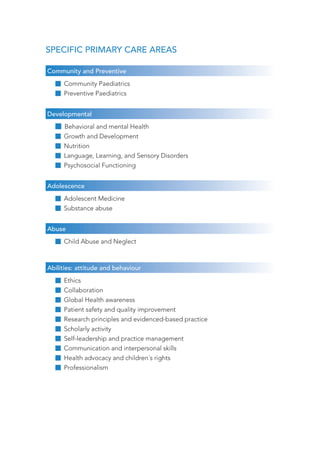
SPECIFIC PRIMARY CARE AREAS 
Community and Preventive 
Community Paediatrics 
Preventive Paediatrics 
Developmental 
Behavioral and mental Health 
Growth and Development 
Nutrition 
Language, Learning, and Sensory Disorders 
Psychosocial Functioning 
Adolescence 
Adolescent Medicine 
Substance abuse 
Abuse 
Child Abuse and Neglect 
Abilities: attitude and behaviour 
Ethics 
Collaboration 
Global Health awareness 
Patient safety and quality improvement 
Research principles and evidenced-based practice 
Scholarly activity 
Self-leadership and practice management 
Communication and interpersonal skills 
Health advocacy and children´s rights 
Professionalism
CURRICULUM IN PRIMARY CARE PAEDIATRICS 
12 
Community and preventive 
COMMUNITY PAEDIATRICS 
Knowledge and understanding 
Recognize health care systems approach and the variation in systems that exist across and 
between countries. 
Recognize that continuous quality improvement requires analysis of care process and out-come 
measures, as well as planned changes with measurement of results. 
Recognize importance of a primary care patient centered medical home in meeting child 
and adolescent needs for all children, and children with special health care needs. 
Identify role of support programs for families and children with special health care needs. 
Identify and mobilize community assets and resources toward preventing illness, injury, and 
related morbidity and mortality. 
Identify role of school health services within comprehensive school health programs and 
recognize importance of collaboration during early childhood education between schools 
and clinical care systems. 
Skills 
Be able to: 
Provide a medical home for all children and families, consisting of well-trained physicians 
who provide accessible, continuous, comprehensive, family-centred and coordinated med-ical 
care. 
Focus on youth at risk for poor health outcomes and those with special health care needs. 
Demonstrate advocacy skills to address relevant individual, community, and population 
health issues. 
The curriculum of Community Paediatrics should be complemented with the following ar-eas: 
Adolescent Medicine, Behavioral and Mental Disorders, Child Abuse and Neglect, 
Prevention Paediatrics, Psychosocial Functioning, Language and Learning Disorders.
SPECIFIC PRIMARY CARE AREAS 
13 
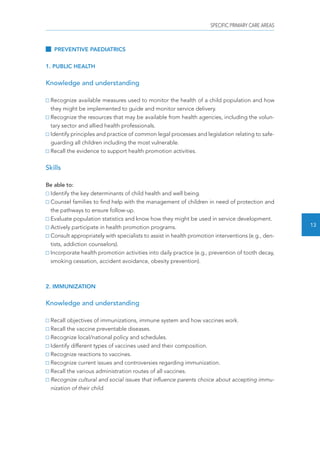
PREVENTIVE PAEDIATRICS 
1. PUBLIC HEALTH 
Knowledge and understanding 
Recognize available measures used to monitor the health of a child population and how 
they might be implemented to guide and monitor service delivery. 
Recognize the resources that may be available from health agencies, including the volun-tary 
sector and allied health professionals. 
Identify principles and practice of common legal processes and legislation relating to safe-guarding 
all children including the most vulnerable. 
Recall the evidence to support health promotion activities. 
Skills 
Be able to: 
Identify the key determinants of child health and well being. 
Counsel families to find help with the management of children in need of protection and 
the pathways to ensure follow-up. 
Evaluate population statistics and know how they might be used in service development. 
Actively participate in health promotion programs. 
Consult appropriately with specialists to assist in health promotion interventions (e.g., den-tists, 
addiction counselors). 
Incorporate health promotion activities into daily practice (e.g., prevention of tooth decay, 
smoking cessation, accident avoidance, obesity prevention). 
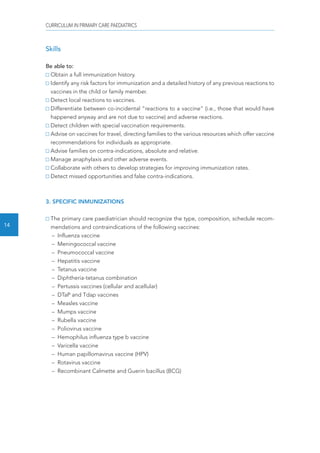
2. IMMUNIZATION 
Knowledge and understanding 
Recall objectives of immunizations, immune system and how vaccines work. 
Recall the vaccine preventable diseases. 
Recognize local/national policy and schedules. 
Identify different types of vaccines used and their composition. 
Recognize reactions to vaccines. 
Recognize current issues and controversies regarding immunization. 
Recall the various administration routes of all vaccines. 
Recognize cultural and social issues that influence parents choice about accepting immu-nization 
of their child.
CURRICULUM IN PRIMARY CARE PAEDIATRICS 
14 
Skills 
Be able to: 
Obtain a full immunization history. 
Identify any risk factors for immunization and a detailed history of any previous reactions to 
vaccines in the child or family member. 
Detect local reactions to vaccines. 
Differentiate between co-incidental “reactions to a vaccine” (i.e., those that would have 
happened anyway and are not due to vaccine) and adverse reactions. 
Detect children with special vaccination requirements. 
Advise on vaccines for travel, directing families to the various resources which offer vaccine 
recommendations for individuals as appropriate. 
Advise families on contra-indications, absolute and relative. 
Manage anaphylaxis and other adverse events. 
Collaborate with others to develop strategies for improving immunization rates. 
Detect missed opportunities and false contra-indications. 
3. SPECIFIC INMUNIZATIONS 
The primary care paediatrician should recognize the type, composition, schedule recom-mendations 
and contraindications of the following vaccines: 
– Influenza vaccine 
– Meningococcal vaccine 
– Pneumococcal vaccine 
– Hepatitis vaccine 
– Tetanus vaccine 
– Diphtheria-tetanus combination 
– Pertussis vaccines (cellular and acellular) 
– DTaP and Tdap vaccines 
– Measles vaccine 
– Mumps vaccine 
– Rubella vaccine 
– Poliovirus vaccine 
– Hemophilus influenza type b vaccine 
– Varicella vaccine 
– Human papillomavirus vaccine (HPV) 
– Rotavirus vaccine 
– Recombinant Calmette and Guerin bacillus (BCG)
SPECIFIC PRIMARY CARE AREAS 
15 
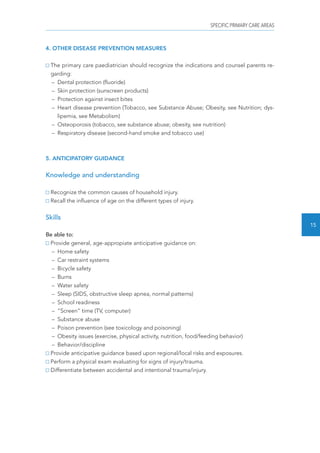
4. OTHER DISEASE PREVENTION MEASURES 
The primary care paediatrician should recognize the indications and counsel parents re-garding: 
– Dental protection (fluoride) 
– Skin protection (sunscreen products) 
– Protection against insect bites 
– Heart disease prevention (Tobacco, see Substance Abuse; Obesity, see Nutrition; dys-lipemia, 
see Metabolism) 
– Osteoporosis (tobacco, see substance abuse; obesity, see nutrition) 
– Respiratory disease (second-hand smoke and tobacco use) 
5. ANTICIPATORY GUIDANCE 
Knowledge and understanding 
Recognize the common causes of household injury. 
Recall the influence of age on the different types of injury. 
Skills 
Be able to: 
Provide general, age-appropiate anticipative guidance on: 
– Home safety 
– Car restraint systems 
– Bicycle safety 
– Burns 
– Water safety 
– Sleep (SIDS, obstructive sleep apnea, normal patterns) 
– School readiness 
– “Screen” time (TV, computer) 
– Substance abuse 
– Poison prevention (see toxicology and poisoning) 
– Obesity issues (exercise, physical activity, nutrition, food/feeding behavior) 
– Behavior/discipline 
Provide anticipative guidance based upon regional/local risks and exposures. 
Perform a physical exam evaluating for signs of injury/trauma. 
Differentiate between accidental and intentional trauma/injury.
CURRICULUM IN PRIMARY CARE PAEDIATRICS 
16 
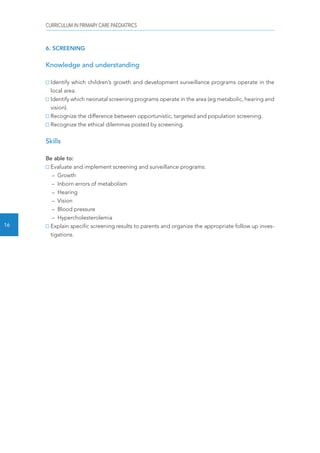
6. SCREENING 
Knowledge and understanding 
Identify which children’s growth and development surveillance programs operate in the 
local area. 
Identify which neonatal screening programs operate in the area (eg metabolic, hearing and 
vision). 
Recognize the difference between opportunistic, targeted and population screening. 
Recognize the ethical dilemmas posted by screening. 
Skills 
Be able to: 
Evaluate and implement screening and surveillance programs: 
– Growth 
– Inborn errors of metabolism 
– Hearing 
– Vision 
– Blood pressure 
– Hypercholesterolemia 
Explain specific screening results to parents and organize the appropriate follow up inves-tigations.
SPECIFIC PRIMARY CARE AREAS 
17 
Developmental 
BEHAVIORAL AND MENTAL HEALTH 
Knowledge and understanding 
Recall norms (percentiles) of normal emotional and behavioral development. 
Recognize signs and symptoms that indicate serious conditions such as ADHD, autistic 
spectrum or anxiety disorders or depression. 
Explain the criteria necessary to make a diagnosis (i.e., DSM). 
Recognice that observations in the physicians’ office may not reflect the symptoms dem-onstrated 
in other situations. 
Skills 
Be able to: 
Organize screening for behavioral problems and mental disorders. 
Establish a climate of mutual trust, informed consent and shared decision-making with 
children, adolescents, families and caregivers. 
Assess development and behavior (with the help of standardized tests). 
Identify resources and protective factors and collaborate with school, family, and commu-nity 
for support and management. 
Implement multi-modal treatment for complex disorders. 
Manage common behavior problems such as sleep problems, “the crying baby”, feeding 
disorders, enuresis and encopresis, oppositional behavior. 
Identify features in the history that may predispose to behavioral problems. 
Identify the need for specialized input and consult with specialists. 
Identify abnormal neonatal behavior. 
Classify mother-infant bonding. 
Recognize the range of symptoms with which depressive disorders present themselves. 
Promote nursing policies that allow early and frequent contact. 
Differentiate between rumination and GI Problems, normal and abnormal repetitive movements. 
Gain information on behavior and parent-child interaction through observation. 
Identify co-morbidities associated with behavioral problems. 
Advise families, school and/or childcare center on the probable causes and management 
of various forms of child behavior. 
Formulate a differential diagnosis of a child presenting problems at school. 
Explain the non-pharmacological and pharmacological treatment approaches of behavio-ral 
and mental disorders to children, adolescents, families and caregivers. 
Advocate for systems of intervention to address behavioral problems in children. 
React immediately to life-threatening behavioral and mental disorders. 
Evaluate for side effects of treatment on a regular basis. 
Provide relevant, age- and cultural appropriate written information to children, families and 
caregivers about behavioral and mental disorders. 
Provide timely and legible documentation for collaborators and handovers.
CURRICULUM IN PRIMARY CARE PAEDIATRICS 
18 
GROWTH AND DEVELOPMENT 
Knowledge and understanding 
Recall the effects of fetal growth restriction on long-term health. 
Identify prenatal factors and peri- and postpartum influences that can affect growth and 
development of the newborn. 
Recognize the normal developmental sequence for motor, adaptive, language, and social 
skills development from birth through childhood. 
List the meaning, uses, and limitations of bone age. 
Identify specific health issues, diseases and disorders related to the various stages of growth 
and development. 
Recognize warning signs that may signify the potential for abnormal development. 
Recognize relationship between physical, emotional, intellectual, and social factors and 
their influence on development and health. 
Skills 
Be able to: 
Assess growth at all stages of development using appropriate tools. 
Perform early detection of children with probable abnormal development. 
Formulate a differential diagnosis for a child presenting learning or social difficulties. 
Demonstrate the types of anthropometric measurements used in assessing nutritional sta-tus 
and discuss their value. 
Utilize body mass index in monitoring growth. 
Identify normal and abnormal variations in head shape. 
Identify the growth pattern of acquired microcephaly. 
Identify the growth pattern of familial macrocephaly. 
Distinguish between hydrocephaly and macrocephaly. 
Distinguish between normal growth and abnormal growth by evaluating plots on a growth 
chart. 
Identify the normal developmental achievements for the neonatal period. 
Identify the normal motor developmental milestones and identify the normal cognitive 
developmental milestones for key age of : 2,4,6,9,12,18,24 months 3,5,6-11 years ( 13,15,17 
years variability according countries). 
Initiate appropriate investigations to help make a diagnosis based upon the history and 
pattern of abnormal development observed. 
Communicate effectively with specialists. 
Determine service needs and select optimal methods to support parents of children with 
abnormal progress.
SPECIFIC PRIMARY CARE AREAS 
19 
NUTRITION 
Knowledge and understanding 
General 
Remember the physiological basis of nutrition and the recommendations for the nutri-tional 
requirements at each age. 
Recall the food guide pyramid of healthy foods. 
Identify dietary practices which place infants at risk for nutritional deficiency. 
List the principles and methods for alternative feeding (e.g., via gastrostomy, nasogastric 
tube) and the common problems that may arise from them. 
Specific items 
Infant feeding: 
– Remember the basic physiology of breast feeding, characteristics and advantages of 
human milk 
– Recall the common problems and solutions of feeding problems and maternal drugs 
that will be contraindicated to breast feeding 
– Recognize the indications for the use of protein hydrolysate formulas as well as other 
specific formulas 
– Identify the cultural influences on the timing of the introduction of solid foods and know 
the appropriate age for initiating solid food and the appropriate sequence 
Deficiency states: 
– Recall a selection of dietary sources of micronutrients, the functions of those micronutri-ents, 
and the effects of their deficiencies (iron, copper, zinc, calcium, phosphate, iodine, 
folate 12, vitamin D and other vitamins) 
– Identify the symptoms and clinical signs related to the main nutritional deficiencies 
– Recognize those clinical conditions that often require additional nutritional support and 
the complications of tube feeding 
Obesity: 
– Recall the genetic risk factors, etiology and health problems associated with obesity 
– Identify the lifestyle choices that may contribute to obesity, including inadequate physi-cal 
activity and excessive “screen” time, (e.g., TV, computer) 
– Recognize the changes in pubertal manifestations that may occur in obese children
CURRICULUM IN PRIMARY CARE PAEDIATRICS 
20 
Skills 
Be able to: 
General 
Take a detailed dietary history and identify dietary practices which place infants at risk for 
nutritional deficiency and features which may affect absorption of nutrients. 
Undertake an accurate anthropometric assessment using a full range of measurements in-cluding 
height, weight, body mass index (BMI), mid-arm circumference. 
Regularly utilize these measurements to track expected growth. 
Counsel families about age-appropriate dietary practices. 
Consult effectively with specialists. 
Specific items 
Infant feeding: 
– Communicate the importance of breast feeding to the mother 
– Make appropriate recommendations to address feeding problems 
– Counsel on breast feeding in premature, cleft lip /cleft palate and sick newborns 
– Advise a mother about appropriate complementary feeding 
– Recognize the signs of food allergy 
Deficiency states: 
– Check risk factors for the development of malnutrition (e.g., social, psychological, and 
medical) 
– Detect from a dietary history a diet that is likely to be deficient in a nutrient 
– Apply the principles of dietary supplementation in those with, or at risk of, dietary defi-ciencies 
Obesity: 
– Perform an accurate interview and physical examination in children with obesity (meas-ure 
blood pressure, identify acanthosis nigricans and clinical signs of genetic obesity 
syndromes) 
– Measure and interpret growth curves and BMI, evaluate abdominal vs. hip circumference 
and detail pattern of obesity (whether generalized or central) 
– Select investigations to rule out medical conditions associated with obesity and look at 
co-morbidities 
– Advise on interventional strategies involved in weight reduction 
– Counsel families on the long-term effects of obesity on health 
– Provide long-term follow-up and monitor the treatment using BMI charts 
– Refer a patient with obesity to a specialist when necessary
SPECIFIC PRIMARY CARE AREAS 
21 
LANGUAGE, LEARNING AND SENSORY DISORDERS 
Knowledge and understanding 
Recall the normal psychomotor and language development milestones. 
Recognize the alarm signals of psychomotor development abnormalities. 
Recognize the alarm signals of autism spectrum disorders (ASDs). 
Identify the DSM-V diagnostic categories for language disorders. 
Interpret differences between language disorders and speech disorders: 
– Language disorders: phonological, semantic, syntactic, pragmatic 
– Speech disorders: dysarthria, dislalia, diglossia, disfemia 
Skills 
Be able to: 
Perform an anamnesis to adequately assess language disorders or speech disorders. 
Perform a language evaluation to establish a diagnosis of language disorders or speech 
disorders. 
Perform a global evaluation of psychomotor development. 
Implement a specific evaluation of autism spectrum disorders (ASDs) by screening scales 
like M-CHAT or the use of alarm signals of ASDs. 
Implement hearing test such as evoked potentials, audiometry to evaluate language disor-ders 
or speech disorders and refer appropriately to the Otolaryngologic unit. 
Refer appropiately to the Neuropediatric unit to complete metabolic, genetic and neuro-imaging 
studies. 
Refer appropriately the language disorders or speech disorders to early attention, occupa-tional 
therapy or speech therapy. 
Carry out a psycosocial evaluation of the child with language disorders or speech disorders 
and refer if necessary to social work or mental health.
CURRICULUM IN PRIMARY CARE PAEDIATRICS 
22 
PSYCHOSOCIAL FUNCTIONING 
Knowledge and understanding 
Remember the methodology of clinical interview: individual and familiar. 
Recall the methodology of motivational interview. 
Recognize risk factors, alarm signals and indicators of child abuse. 
Identify valuation of social nets. 
Identify community resources. 
Identify community and school prevention programs of risk behaviors. 
Recall laws and legal norms about children and families. 
Recognize cultural and ethnic differences. 
Identify ethical principles: Autonomy, Confidentiality, Beneficence and Justice. 
Skills 
Be able to: 
Elaborate a psychosocial history: 
– Assessment of behavior of the children in the school 
– Assessment of familiar behavior (parenting, sibling rivalry, discipline, media, divorce, 
death, violence) 
– Assessment of social behavior with peers 
– Assessment of the free time behavior of the children (TV, internet, social networking) 
Detect psychosocial problems in children and families. 
Detect risk factors, alarm signals and indicators of child abuse. 
Elaborate a three generation map or “genogram”. 
Carry out a motivational interview. 
Counsel families with affective and socialization needs. 
Valuate psychological maturity. 
Execute ethic priorities of values such as autonomy, confidentiality, beneficence and justice 
and solve conflicts based on them.
SPECIFIC PRIMARY CARE AREAS 
23 
Adolescence 
ADOLESCENT MEDICINE 
Knowledge and understanding 
General 
Identify clinical changes related to adrenarche and gonadarche. 
Recognize that the interrelationships of adolescence involve a combination of biological, 
psychological and social development. 
Identify psychosocial risks of adolescence. 
Specific items 
Delayed puberty: 
– Recall pathological causes and natural history of delayed puberty. 
Psychological development: 
– Identify sources of stress and the modes of coping by adolescents and their families 
– Recognize social media use patterns and the importance of balance, boundaries, and 
parental involvement in monitoring use by adolescents 
Sexual development: 
– Identify that development and exploration of sexual feelings is a normal part of adoles-cent 
development 
– Recognize that same and opposite-sex sexual feelings and behaviors has a strong im-pact 
on defining an adolescents sexual identity 
Cognitive development of adolescence: 
– Recognize the limited ability of early adolescents to link cause and effect to the conse-quences 
of health behaviors 
– Identify that abstract reasoning develops late in adolescence 
Skills 
Be able to: 
General 
Assess accurately sexual maturity using SMR (Sexual Maturity Rating) stages 
Interpret the growth chart and bone age x-ray when evaluating constitutional delayed pu-berty. 
Interpret changing laboratory parameters through puberty. 
Interpret basal and stimulated levels of gonadotrophins and testosterone response to hu-man 
chorionic gonadotrophin(HCG). 
Utilize appropriate genetic testing.
CURRICULUM IN PRIMARY CARE PAEDIATRICS 
24 
Specific items 
Psychological development: 
– Conduct a psychosocial history using the HEADSS (Home, Education/employment, peer 
group Activities, Drugs, Sexuallity and Suicide/depression) framework 
– Elicit the family dynamics in any routine history and identify its potential impact on symp-toms 
– Detect an adolescent “loner“ who does not identify with any peers and who may have 
psychological difficulties 
– Detect an adolescent with a poor self-image which may correlate with many adolescent 
problems 
Sexual development: 
– Employ different strategies to be able to facilitate the exchange of information about 
inappropriate sexual behavior 
– Discuss sexual issues with adolescents in a sensitive and professional manner 
– Direct adolescent patients and their families to available confidential services 
Cognitive development of adolescence: 
– Determine the level of cognitive reasoning of adolescents 
– Utilize techniques to facilitate engaging effectively with adolescents appropriate to their 
level of cognitive development
SPECIFIC PRIMARY CARE AREAS 
25 
SUBSTANCE ABUSE 
Knowledge and understanding 
Recognice health consequences of substance abuse for individuals and society. 
Recall general trends in use and abuse of substances, and where to find information about it. 
Identify substance abuse predictors and risk factors. 
Retrieve concepts of tolerance of, dependence on and withdrawal from, addictive drugs. 
Recall major physiologic and behavioral consequences attributable to substance abuse, 
including the potential for physiologic addiction, specifically for alcohol, cannabis, tobacco, 
opiates, amphetamines, hallucinogens, cocaine and inhalants. 
Identify risk of abuse of cough and cold preparations (e.g., pseudoephedrine, dextrometho-rphan) 
and of alternative and herbal products. 
Identify role of the paediatrician in counseling youth and parents, and in education within 
the schools about the dangers of tobacco/alcohol and other substance abuse. 
Remember principles of brief motivational interviewing and other counseling techniques 
to promote healthy behavior change and prevent substance use/abuse. 
Skills 
Be able to: 
Obtain information from patients and parents about substance use/abuse, understanding 
the requisites for privacy and confidentiality. 
Counsel families about methods to minimize the dangers of substance use/abuse (e.g., 
abstinence, avoid peer groups with drug usage, appropriate parental support) and to pre-pare 
an adolescent and their family for referral for substance use/abuse treatment. 
Identify signs of ingestion/use and acute intoxication of specific substances like alcohol, 
cannabis, tobacco, opiates, amphetamines, hallucinogens, cocaine, inhalants or cough and 
cold preparations. 
Use toxicology screening results to identify substances used/abused. 
Refer for further management as appropriate.
CURRICULUM IN PRIMARY CARE PAEDIATRICS 
26 
Abuse 
CHILD ABUSE AND NEGLECT 
Knowledge and understanding 
Recall concept and types of neglect, abuse and factitious disorder by proxy. 
Recognize children, parents, family and social characteristics associated with increased risk 
of neglect, abuse or factitious disorder by proxy. 
Recognize indicators, manifestations and injuries possibly associated with abuse and ne-glect. 
Identify local/state/national requirements for reporting sexual abuse to law enforcement 
and/or child protection services and legal obligations for reporting suspected abuse. 
Identify intervention options for families and patients involved in child abuse and factitious 
disorder by proxy. 
Skills 
Be able to: 
Perform an accurate interview and physical examination in cases of suspected abuse or 
neglect. 
Identify the general signs and injuries related to child abuse and neglect and develop a 
differential diagnosis with conditions that can mimic them. 
Utilize the appropriate diagnostic procedures and referral to rule out the possibility of 
abuse or neglect. 
Provide the first medical care for abused children and adolescent in order to mitigate im-mediately 
the identified injuries and refer to appropriate specialist. 
Document and transmit a detailed report about the abuse or neglect suffered by a child or 
adolescent to the appropriate authority. 
Participate in a multidisciplinary team, contributing to joining their multiple roles for pro-tecting 
children and adolescent rights.
SPECIFIC PRIMARY CARE AREAS 
27 
Abilities: Attitudes and behaviour 
ETHICS 
Knowledge and understanding 
Identify the principles of ethics when dealing with patients and family members. 
Recall the principles of autonomy, beneficence, non.maleficence and justice. 
Identify the principles of research ethics applied to children and research publication. 
Recognize the need to be careful when interacting with the pharmaceutical industry (ie, 
conflict of interest). 
Recognize the differences between “emancipated minor” and “mature minor”. 
Recognize the importance of confidentiality in the doctor-patient relationship. 
Skills 
Be able to: 
Apply ethical principles and analysis to clinical care and research. 
Apply national legislation to clinical care and research. 
Demonstrate awareness of the main professional obligations of doctors. 
Critically analyze ethical issues commonly encountered in medical practice and formulate 
a framework within which such issues could be resolved. 
COLLABORATION 
Skills 
Be able to: 
Work effectively in multidisciplinary, inter-professional, and cross-cultural groups. 
Identify the level competence and skills of other health providers (eg, nurses, community 
health workers). 
Respect the diversity of roles, responsibilities, and competence of other professionals in 
relation to their own. 
Collaborate with teachers, social workers, community leaders, child protection workers, 
and other allied health professionals to assess, plan, review and provide health prevention, 
and interventions.
CURRICULUM IN PRIMARY CARE PAEDIATRICS 
28 
GLOBAL HEALTH AWARENESS 
Knowledge and understanding 
Recall United Nations Declaration of Human Rights and United Nations Convention of the 
Rights of the Child. 
Identify social determinants of health on children’s health, health care access, and health 
outcomes. 
Recognize the role of health organizations: WHO, UNICEF, GAVI, World Trade Organiza-tion, 
World Bank, International Monetary Fund, Non-Governmental Organizations and 
Governments (eg, Ministries of Health). 
Recognize the content and mechanisms for delivering cost-effective health promotion and 
disease prevention interventions to children globally or in under-resourced settings. 
Skills 
Be able to: 
Describe the structure of the health system and the roles and responsibilities of the various 
levels involved. 
Identify international goals and strategies for improving child and maternal health (eg, Mil-lennium 
Development Goals [MDGs]). 
Define and interpret key child health indicators such as: neonatal mortality rate, infant mor-tality 
rate, under five mortality rate, perinatal mortality rate, low birth weight rate, under-weight, 
stunting and wasting rates. 
Describe the burden of disease of major communicable and non-communicable diseases 
globally and nationally, including accidents and injuries.
SPECIFIC PRIMARY CARE AREAS 
29 
PATIENT SAFETY AND QUALITY IMPROVEMENT 
Knowledge and understanding 
Retrieve what a system is (structure, processes, result) and how each component of that 
system affects outcomes. 
Recall definitions used in discussions of patient safety including: medical error, near miss 
event, a sentinel event, preventable adverse events, non-preventable adverse events. 
Recognize that analysis of variation in data is critical in quality improvement , analyze how 
variation can be reduced for improvement . 
Identify the common causes of adverse events in medication and vaccination in pediatric 
patients in general and in your setting. 
Take into account the role of ancillary services such as the pharmacy in the prevention of 
medication errors and the impact of product naming and packaging on medication safety. 
Recall the epidemiology of medical error and harm in the paediatric ambulatory setting. 
Identify the off label drug use as a paediatric patient safety risk. 
Identify the contribution of adverse events to the morbidity and mortality of pediatric pa-tients. 
Recognize the relationship between the detection of a medical error and the ability to 
discover and effect improvements . 
Recall and apply the principle “Don’t Blame the People, Blame the Process” understand 
the relative role of processes in systems and individuals in producing medical error and 
harm . 
Skills 
Be able to: 
Take into account the importance of assessment and redesign of health care processes 
before error occurs (manage safety risks)- apply the principles of risk management. 
Detect and report adverse events internally in the practice and to Critical Incident Report 
Systems (CIRS). 
Use appropriate means to disclose medical errors to patients or their family 
Apply appropriate methods of support for patients and their families after an error produc-ing 
medical harm occurs. 
Apply the principles of cold chain and good maintenance of the refrigerator for the storage 
of vaccines. 
Keep your emergency equipment always ready –check regularly for expiry dates and re-placement 
. 
Apply the advantages of computerized order entry (where applicable) and dose –range 
checking in reducing medication errors. 
Use best practice guidelines to reduce medical adverse events. 
Use effective methods of communication in the paediatric team to reduce errors in the 
ambulatory paediatric setting.
CURRICULUM IN PRIMARY CARE PAEDIATRICS 
30 
Detect which interventions can reduce error in situations (e.g. stress, fatigue, distraction) 
at high risk for medical error. 
Promote open-mindedness towards any error- promote effective team functioning and 
mutual supervision in the prevention of medical error. 
Create and maintain a learning environment (eg, morning report, patient hand - offs, meet-ings 
with partners) in improving patient safety (optimize human and environmental factors). 
RESEARCH PRINCIPLES AND EVIDENCE-BASED PRACTICE 
Knowledge and understanding 
Recognize the strengths and limitations of the different types of statistical tests: chi-square 
test versus a t-test, analysis of variance (ANOVA) versus nonparametric (eg, Mann-Whitney 
U, Wilcoxon). 
Identify how disease prevalence affects the positive and negative predictive value of a test. 
Recognize the strengths and limitations of the following types of studies and/or analyses: 
retrospective, case series, cross-sectional studies, case-control studies, longitudinal stud-ies, 
cohort studies, randomized-controlled studies, before-after studies, crossover studies, 
open-label studies, post-hoc analyses, and subgroup analyses. 
Skills 
Be able to: 
Formulate a research question/hypothesis. 
Select and apply appropriate statistical and methodological tools to address the question. 
Interpret the results of the statistical tests: p-value and a confidence interval. 
Differentiate relative risk reduction from absolute risk reduction. 
Interpret sensitivity and specificity.
SPECIFIC PRIMARY CARE AREAS 
31 
SCHOLARLY ACTIVITY 
Knowledge and understanding 
Recognize the importance of self-assessment of professional competence and practice. 
Recall the principles of research, research ethics and scholarly inquiry. 
Skills 
Be able to: 
Develop, implement and monitor a personal continuing education strategy. 
Integrate new learning into practice. 
Maintain a questioning and inquisitive attitude towards medical information. 
Give an effective lecture or presentation. 
Manage sources of research publications and electronic literature databases. 
SELF-LEADERSHIP AND PRACTICE MANAGEMENT 
Knowledge and understanding 
Recall the concepts of managing a practice ethically and efficiently including finances and 
human resources. 
Skills 
Be able to: 
Demonstrate time-management, prioritization skills, effective delegation and follow-up 
skills. 
Demonstrate problem solving and management skills that enable independent decision 
making based upon best available evidence. 
Identify stressors and takes action to minimize their effects. 
Leadership in crisis resource management (problem solving, situational awareness, com-munication 
skills and resource management). 
Manage relationships effectively, including those with patients and their families, col-leagues, 
and the broader health care team. 
Give appropriate and helpful feedback to staff. 
Maintain comprehensive, timely, and legible medical records including patient documents, 
business applications, hospital documents, and legal documents.
CURRICULUM IN PRIMARY CARE PAEDIATRICS 
32 
COMMUNICATION AND INTERPERSONAL SKILLS 
Skills 
Be able to: 
Communicate effectively with patients (children and youth) and families in order to create 
and sustain appropriate therapeutic relationships. 
Take a family centered approach when communicating recommendations, alternatives and 
uncertainties, while demonstrating an understanding of patient/family anxieties and point of 
view. 
Empower parents (and for adolescents themselves) to be the primary caregiver for their 
children’s medical and social needs. 
Demonstrate active listening. 
Communicate effectively with other health care professionals, using appropriate commu-nication 
elements required for safe and effective transfer of care between: 
– Medical professionals within an institution 
– Inpatient and outpatient physicians 
– Primary and secondary care physicians 
– Different institutions 
– Hospital and home 
– Medical and non-medical caregivers
SPECIFIC PRIMARY CARE AREAS 
33 
HEALTH ADVOCACY AND CHILDREN’S RIGHTS 
Knowledge and understanding 
Recall the relevant key national policies, practices and laws, which affect specific groups of 
children. 
Identify the intersections between growth, development, health, illness, public policy and 
child well being. 
Recognize the essential role of the pediatrician within the family, community, school and 
political structures. 
Recognize the role of government, and non-governmental organizations and community 
groups in developing health policies and advocating for children and youth. 
Skills 
Be able to: 
Demonstrate an appreciation of the distinctiveness of health care needs of children and 
adults. 
Identify of the unique vulnerability of the child to social, resource and environmental disrup-tions 
or stress including war, refugee status, natural/manmade disasters. 
Detect vulnerable or marginalized populations and respond appropriately (e.g. homeless, 
children living in poverty, child trafficking, forced labour, forced marriage, and female gen-ital 
mutilation). 
Detect opportunities for advocacy, health promotion and disease prevention to individuals 
and the communities they provide care. 
Carry out strategies in advocacy including issue identification, data analysis, messaging, 
audience selection, persistence and evaluation. 
Responsive to vulnerable groups (eg, pre-term infants). 
Provide culturally sensitive child-centred and family-centred care and support to children 
and families from others countries. 
Strengthen functional links between primary care and other child and maternal public 
health efforts.
CURRICULUM IN PRIMARY CARE PAEDIATRICS 
34 
PROFESSIONALISM 
Knowledge and understanding 
Understand that medical professionalism is reflected in attitudes, behaviors, character, and 
standards of practice. 
Skills 
Be able to display: 
Honesty, probity and ethical commitment. 
Commitment to delivering the highest quality of care. 
Ability to maintain confidentiality of patients, particularly adolescents, as well as family 
members. 
Critical and self-critical abilities (reflective practice). 
Compassion, integrity and respect for others. 
Commitment in maintaining one’s competence through lifelong self-directed learning and 
continuous professional development. 
Be able to demonstrate: 
Capacity for applying knowledge in practice. 
Management skills and leadership in problem solving, independent decision making, com-munication 
skills and resource management. 
Work effectively in a multidisciplinary team. 
Teaching, research and leadership skills. 
Sensitivity and responsiveness to a diverse patient population, including but not limited to 
diversity in gender, age, culture, race, religion and disabilities. 
Accountability to patients, society and the profession.
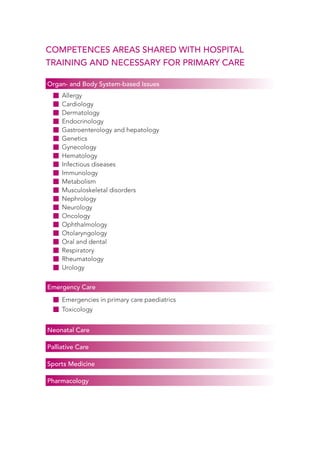
COMPETENCES AREAS SHARED WITH HOSPITAL 
TRAINING AND NECESSARY FOR PRIMARY CARE 
Organ- and Body System-based Issues 
Allergy 
Cardiology 
Dermatology 
Endocrinology 
Gastroenterology and hepatology 
Genetics 
Gynecology 
Hematology 
Infectious diseases 
Immunology 
Metabolism 
Musculoskeletal disorders 
Nephrology 
Neurology 
Oncology 
Ophthalmology 
Otolaryngology 
Oral and dental 
Respiratory 
Rheumatology 
Urology 
Emergency Care 
Emergencies in primary care paediatrics 
Toxicology 
Neonatal Care 
Palliative Care 
Sports Medicine 
Pharmacology
CURRICULUM IN PRIMARY CARE PAEDIATRICS 
36 
Organ- and Body System-based Issues 
ALLERGY 
Knowledge and understanding 
General 
Remember the four distinct allergy mechanisms (i.e., Gell and Coombs classification). 
Recall the natural history, symptoms and therapeutic options in allergic diseases. 
Recognize skin testing can be inaccurate if the patient is taking antihistamines at the time 
of skin testing. 
Recognize that in vitro testing is indicated when antihistamines cannot be stopped, when 
dermatographism is present and when severe anaphylaxis has occurred to the proposed 
testing agent. 
Recognize the importance of the patient education. 
Specific disorders 
Allergic rhinitis: 
– Recognize the association between allergic rhinitis and sinusitis with otitis media, asth-ma, 
urticaria, and eczema 
– Remember that perennial allergic rhinitis is usually caused by indoor allergens 
Urticaria, angioedema, anaphylaxis: 
– Recall the etiologic agents that commonly cause urticarial, angioedema and anaphy-laxis 
– Recognize that chronic urticaria does not warrant allergy testing 
Adverse reactions drugs, food, vaccines, insect stings and bites: 
– Recognize the mechanisms of IgE and non-IgE food allergy and food intolerance due to 
enzyme deficiencies 
– Recall the foods that commonly cause allergic reactions (e.g., milk, soy, eggs, peanuts, 
seafood, wheat, tree nuts) and that most milk, egg, and soy allergies are outgrown by 5 
years of age and most allergies to peanuts, tree nuts, and seafood are not outgrown in 
early childhood 
– Identify available tests for food allergy and their limitations 
– Remember that penicillin is the most common cause of serious allergic drug reactions in 
childhood 
– Recognize the various hypersensitivity reactions that penicillin allergy may manifest and 
know that reactions may be systemic (e.g., anaphylaxis), hematologic (e.g., hemolytic 
anemia) and renal (e.g., interstitial nephritis) 
– Recognize that allergic reactions to insect stings/bites cause significant morbidity and 
may manifest with anaphylaxis 
– Recall that vaccine components can be associated with allergic reactions 
Asthma. (see Respiratory)
COMPETENCES AREAS SHARED WITH HOSPITAL TRAINING AND NECESSARY FOR PRIMARY CARE 
37 
Skills 
Be able to: 
General 
Evaluate factors in the presentation which suggest underlying or serious pathology. 
Formulate a diagnosis based upon history and physical findings. 
Elicit likely allergens responsible for symptoms via a thorough history. 
Determine if there are any exacerbating factors (e.g., pollen, dust, animals, cigarette smoke, 
molds). 
Assess and initiate management of patients presenting with allergic problems in acute and 
outpatient settings. 
Manage the side effects of immunotherapy. 
Undertake long term management of allergic conditions. 
Provide preventive counselling on avoidance. 
Effectively coordinate advanced life support when necessary. 
Effectively collaborate with family, health team, and specialists regarding allergy issues. 
Specific disorders 
Allergic rhinitis: 
– Interpret the physical signs of allergic rhinitis: nasal discharge, presence of “allergic shin-ers”, 
(discoloration beneath eyes), Dennie-Morgan lines, “allergic salute,” (patient rubs 
nose with the palm of hand upward), transverse crease near the tip of the nose and/or 
edema in nasal mucosa, geographic tongue, abnormalities on palpebral conjunctiva 
– Distinguish between allergic rhinitis and non-allergic rhinitis by history and physical ex-amination 
Urticaria, angioedema, anaphylaxis: 
– Coordinate immediate and effective treatment for anaphylaxis, including epinephrine 
– Advise on the future risk of anaphylaxis and facilitate an appropriate anaphylaxis treat-ment 
and prevention care plan by collaborating with the child, parents, and community 
– Advise on the appropriate use of epinephrine (adrenalin) 
Adverse reactions drugs, food, vaccines, insect stings and bites. (See anaphylaxis): 
– Distinguish allergy from intolerance and be able to explain to parents 
– Interpret common symptoms associated with allergic reactions to vaccines: immediate 
localized reactions, systemic and delayed reactions that manifest with serum sickness-like 
reactions 
Asthma. (See Respiratory)
CURRICULUM IN PRIMARY CARE PAEDIATRICS 
38 
CARDIOLOGY 
Knowledges and understanding 
General 
Recognize the age-dependent cardiac symptoms of children. 
Remember rate and rhythm disorders. 
Identify the causes of congestive heart failure in infant and children. 
Recall the epidemiology of rheumatic fever. 
Recognize the risk factors for development of endocarditis. 
Recall the possible cardiac complications of other disorders: hyperthyroidism, Kawasaki 
disease. 
Recognize the importance of a family history of cardiovascular disease and familial hyper-lipidemia 
and hypercholesterolemia in children and evaluate appropriately. 
Specific disorders 
Hypertension (See Nephrology): 
– Recall prescription, over-the-counter, and illicit drugs likely to elevate the blood pressure 
– Recognize that coarctation of the aorta causes upper extremity hypertension 
Chest pain: 
– Recognize that chest pain in healthy children is generally not cardiopulmonary in origin 
– Recall the importance of cardiovascular evaluation in patients with chest pain associated 
with exercise 
– Recall the cardiovascular causes of chest pain 
Syncope: 
– Recognize the importance of cardiovascular evaluation in patients with syncopal or pre-syncopal 
episodes with exercise 
Murmur: 
– Recall the etiology of common heart murmurs and their hemodynamic implications 
Skills 
Be able to: 
Interpret correctly regular heart sounds, additional heart sounds, and heart murmurs. 
Identify common ECG abnormalities. 
Utilize appropriate imaging study of the chest to help diagnosis. 
Utilize appropriate the pulse oximeter measure of the oxygen saturation. 
Identify the clinical manifestations of congestive heart failure at all ages. 
Differentiate between cardiac and non-cardiac causes of cyanosis.
COMPETENCES AREAS SHARED WITH HOSPITAL TRAINING AND NECESSARY FOR PRIMARY CARE 
39 
Identify an innocent cardiac murmur and recognize when a child with an innocent murmur 
requires no further evaluation. 
Diagnose hypertension appropriately (use age-specific blood pressure tables, appropriate 
cuff size, and repeated measurements). 
Provide appropriate counseling for patients with: 
– Chest pain 
– Non cardiovascular syncope 
– Innocent heart murmurs 
Advise families appropriately about the effects of heart disease. 
Refer for specialist paediatric cardiology assessment for further management. 
Respond appropriately to cardiac arrest.
CURRICULUM IN PRIMARY CARE PAEDIATRICS 
40 
DERMATOLOGY 
Knowledges and understanding 
General 
Recognize the characteristics of common and serious rashes. 
Recall the causes of fever and erythematous rashes. 
Recognize the cutaneous and mucosal manifestations of systemic diseases. 
Recall the different potencies of topical steroids and their side effects. 
Identify the different patterns of drug reaction and of the common precipitants. 
Specific disorders 
Recognize the clinical manifestations, identify through a description with the age of ap-pearance 
or disappearance and understand the pathogenesis of: 
– Pigmentary and vascular lesions 
– Atopic dermatitis (eczema) 
– Infectious rashes and infestations 
– Acné 
– Seborrheic dermatitis 
– Urticaria 
– Erythema multiforme 
– Contact dermatitis 
– Pityriasis rosea 
– Pityriasis alba 
– Psoriasis 
Retrieve that sun damage to the skin. 
Skills 
Be able to: 
Accurately describe rashes that may be present. 
Implement a differential diagnosis for elementary skin lesions. 
Diagnose infectious rashes and infestations using appropriate diagnostic techniques when 
unable to make diagnosis by observation alone 
– Impetigo, cellulitis, abscess 
– Papular urticaria 
– Scabies 
– Fungal Infection 
– Molluscum contagiosum 
– Warts 
– Pediculosis 
Plan and manage common skin complaints. 
Counsel parents on the long term management of children with chronic dermatological 
diseases. 
Refer to a paediatric dermatologist when appropriate.
COMPETENCES AREAS SHARED WITH HOSPITAL TRAINING AND NECESSARY FOR PRIMARY CARE 
41 
ENDOCRINOLOGY 
Knowledge and understanding 
General 
Recognize the implications of endocrine complications of other diseases. 
Recall that many endocrine conditions are familial. 
Specific disorders 
Short stature: 
– Retrieve the developmental spectrum of normal growth velocity and the significance of 
a decreased growth velocity at any stage of development 
– Recall the most common causes of short stature 
– Identify the importance of parental stature and pubertal development in the evaluation 
of a child with short stature 
Precocious pubertal: 
– Recognize signs of telarche, pubarche and gynecomastia 
– Recall the difference between pseudopuberty and true precocious puberty 
– Recall the etiology of true/complete precocious puberty 
Delayed puberty (see Adolescence): 
– Recall the natural history of constitutional delayed puberty 
– Recognize the pathological causes of delayed puberty 
Obesity (see Nutrition) 
– Identify risk factors and parameters used in defining the metabolic syndrome in children 
– Recall the causes of the metabolic syndrome 
Recall the most common causes of endocrine conditions: polyuria, a thyroid enlargement, 
hypoglycemia in the various age groups and the basic etiologies of rickets. 
Identify the clinical signs suggestive of hyper or hypothyroidism and hypocalcemia at all 
ages. 
Recall the presentation and natural history of type 1 diabetes. 
Diabetes Mellitus: 
– Recognize the presentation and natural history of type 1 diabetes. 
Skills 
Be able to: 
Use growth charts to distinguish between constitutional short stature, genetic (familial) 
short stature, short stature related to chronic diseases, and short stature related to genetic, 
chromosomal, and syndromic causes. 
Assess accurately sexual maturity using SMR (Sexual Maturity Rating) stages. 
Distinguish between the variations of normal (e.g., thelarche, pubarche) and precocious 
puberty.
CURRICULUM IN PRIMARY CARE PAEDIATRICS 
42 
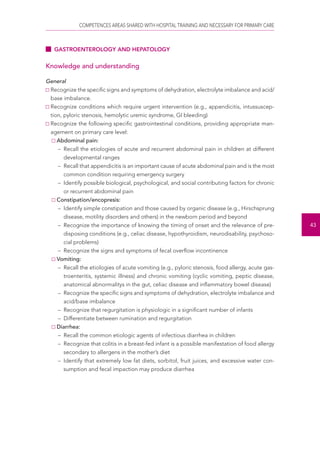
Obtain an accurate history of the timing of any signs of pubertal development and detect 
any abnormal sequence of changes. 
Identify signs that may be associated with endocrine disease (e.g., hirsuitism, hyperten-sion). 
Interpret bone age in relation to growth and pubertal development. 
Use laboratory tests appropriately according to presence or absence of physical signs. 
Differentiate between baseline and stimulated hormone values. 
Communicate effectively with patients (i.e., age appropriate) and their parents. 
Refer a patient to endocrinologist when necessary.
COMPETENCES AREAS SHARED WITH HOSPITAL TRAINING AND NECESSARY FOR PRIMARY CARE 
43 
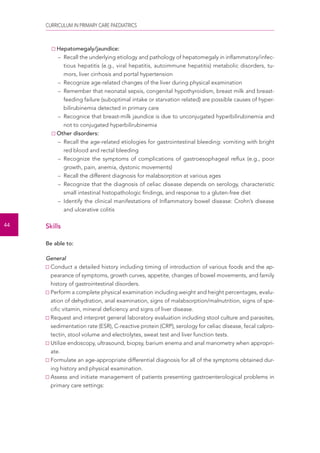
GASTROENTEROLOGY AND HEPATOLOGY 
Knowledge and understanding 
General 
Recognize the specific signs and symptoms of dehydration, electrolyte imbalance and acid/ 
base imbalance. 
Recognize conditions which require urgent intervention (e.g., appendicitis, intussuscep-tion, 
pyloric stenosis, hemolytic uremic syndrome, GI bleeding) 
Recognize the following specific gastrointestinal conditions, providing appropriate man-agement 
on primary care level: 
Abdominal pain: 
– Recall the etiologies of acute and recurrent abdominal pain in children at different 
developmental ranges 
– Recall that appendicitis is an important cause of acute abdominal pain and is the most 
common condition requiring emergency surgery 
– Identify possible biological, psychological, and social contributing factors for chronic 
or recurrent abdominal pain 
Constipation/encopresis: 
– Identify simple constipation and those caused by organic disease (e.g., Hirschsprung 
disease, motility disorders and others) in the newborn period and beyond 
– Recognize the importance of knowing the timing of onset and the relevance of pre-disposing 
conditions (e.g., celiac disease, hypothyroidism, neurodisability, psychoso-cial 
problems) 
– Recognize the signs and symptoms of fecal overflow incontinence 
Vomiting: 
– Recall the etiologies of acute vomiting (e.g., pyloric stenosis, food allergy, acute gas-troenteritis, 
systemic illness) and chronic vomiting (cyclic vomiting, peptic disease, 
anatomical abnormalitys in the gut, celiac disease and inflammatory bowel disease) 
– Recognize the specific signs and symptoms of dehydration, electrolyte imbalance and 
acid/base imbalance 
– Recognize that regurgitation is physiologic in a significant number of infants 
– Differentiate between rumination and regurgitation 
Diarrhea: 
– Recall the common etiologic agents of infectious diarrhea in children 
– Recognize that colitis in a breast-fed infant is a possible manifestation of food allergy 
secondary to allergens in the mother’s diet 
– Identify that extremely low fat diets, sorbitol, fruit juices, and excessive water con-sumption 
and fecal impaction may produce diarrhea
CURRICULUM IN PRIMARY CARE PAEDIATRICS 
44 
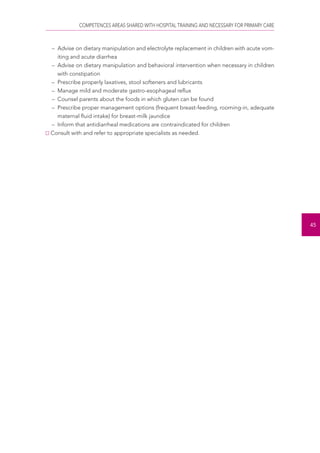
Hepatomegaly/jaundice: 
– Recall the underlying etiology and pathology of hepatomegaly in inflammatory/infec-tious 
hepatitis (e.g., viral hepatitis, autoimmune hepatitis) metabolic disorders, tu-mors, 
liver cirrhosis and portal hypertension 
– Recognize age-related changes of the liver during physical examination 
– Remember that neonatal sepsis, congenital hypothyroidism, breast milk and breast-feeding 
failure (suboptimal intake or starvation related) are possible causes of hyper-bilirubinemia 
detected in primary care 
– Recognice that breast-milk jaundice is due to unconjugated hyperbilirubinemia and 
not to conjugated hyperbilirubinemia 
Other disorders: 
– Recall the age-related etiologies for gastrointestinal bleeding: vomiting with bright 
red blood and rectal bleeding 
– Recognize the symptoms of complications of gastroesophageal reflux (e.g., poor 
growth, pain, anemia, dystonic movements) 
– Recall the different diagnosis for malabsorption at various ages 
– Recognize that the diagnosis of celiac disease depends on serology, characteristic 
small intestinal histopathologic findings, and response to a gluten-free diet 
– Identify the clinical manifestations of Inflammatory bowel disease: Crohn’s disease 
and ulcerative colitis 
Skills 
Be able to: 
General 
Conduct a detailed history including timing of introduction of various foods and the ap-pearance 
of symptoms, growth curves, appetite, changes of bowel movements, and family 
history of gastrointestinal disorders. 
Perform a complete physical examination including weight and height percentages, evalu-ation 
of dehydration, anal examination, signs of malabsorption/malnutrition, signs of spe-cific 
vitamin, mineral deficiency and signs of liver disease. 
Request and interpret general laboratory evaluation including stool culture and parasites, 
sedimentation rate (ESR), C-reactive protein (CRP), serology for celiac disease, fecal calpro-tectin, 
stool volume and electrolytes, sweat test and liver function tests. 
Utilize endoscopy, ultrasound, biopsy, barium enema and anal manometry when appropri-ate. 
Formulate an age-appropriate differential diagnosis for all of the symptoms obtained dur-ing 
history and physical examination. 
Assess and initiate management of patients presenting gastroenterological problems in 
primary care settings:
COMPETENCES AREAS SHARED WITH HOSPITAL TRAINING AND NECESSARY FOR PRIMARY CARE 
45 
– Advise on dietary manipulation and electrolyte replacement in children with acute vom-iting 
and acute diarrhea 
– Advise on dietary manipulation and behavioral intervention when necessary in children 
with constipation 
– Prescribe properly laxatives, stool softeners and lubricants 
– Manage mild and moderate gastro-esophageal reflux 
– Counsel parents about the foods in which gluten can be found 
– Prescribe proper management options (frequent breast-feeding, rooming-in, adequate 
maternal fluid intake) for breast-milk jaundice 
– Inform that antidiarrheal medications are contraindicated for children 
Consult with and refer to appropriate specialists as needed.
CURRICULUM IN PRIMARY CARE PAEDIATRICS 
46 
GENETICS 
Knowledge and understanding 
Identify the environmental factors which may affect prenatal development (e.g., role of 
folic acid and other nutritional supplements, maternal substance use, alcohol and drugs). 
Recall the most common abnormalities of chromosome number are trisomy conditions. 
Recall chondrodysplasias are the result of mutations in genes which are essential for skel-etal 
development and growth. 
Identify the risks and cultural issues posed by consanguinity. 
Skills 
Be able to: 
Detect features suggesting dysmorphic or genetic syndromes and associated anomalies 
(DiGeorge syndrome, Prader-Willi syndrome, Angelman syndrome, Turner syndrome, frag-ile 
X syndrome, Klinefelter syndrome). 
Detect and diagnose the prominent features of trisomy 13, 18, and 21 in a newborn infant. 
Obtain a detailed history of symptoms and signs present in affected members to determine 
the complete clinical spectrum. 
Consult with geneticists appropriately for both diagnosis and counselling to parents.
COMPETENCES AREAS SHARED WITH HOSPITAL TRAINING AND NECESSARY FOR PRIMARY CARE 
47 
GYNECOLOGY 
Knowledge and understanding 
General 
Recall hormonal and anatomical changes associated with pubertal development in girls. 
Recognize normal cycle duration, average blood loss, and duration of normal menstrual 
flow. 
Recall normal sexuality and sexual function. 
Identify common reasons for which sexually active adolescent males and females. do not 
use contraceptives 
Identify forms of contraception available to adolescents. 
Recall drugs which are teratogenic and contraindicated during pregnancy. 
Specific disorders 
Recognize etiology and understand the pathogenesis of: 
– Gynecologic acute and chronic abdominal pain 
– Vaginal discharge (e.g., trichomonas, candida, bacterial vaginosis, and foreign body) 
– Abnormal patterns of uterine bleeding 
– Amenorhea 
– Dysmenorrhea 
Skills 
Be able to: 
Perform a complete gynecologic history including menstrual, obstetric, sexual, and rele-vant 
family and social history. 
Conduct an appropriate private, confidential history when more accurate information about 
sexual behaviors and/or abuse is needed. 
Formulate differential diagnoses for common gynaecological problems. 
Consider pregnancy in differential diagnosis of amenorrhea and vaginal bleeding whether 
or not there is a history of sexual intercourse. 
Use proper laboratory and diagnostic studies in an initial approach to gynaecological dis-orders. 
Detect the physical findings of pregnancy. 
Plan the appropriate initial management and refer appropriately for further management. 
Counsel adolescents regarding responsible sexual behaviors to prevent unintended preg-nancy 
and sexually transmitted infections (STIs). 
Detect misconceptions about the use of contraceptives. 
Know the options for post-coital contraception for the female rape victim and recognize 
when they should be used.
CURRICULUM IN PRIMARY CARE PAEDIATRICS 
48 
HEMATOLOGY 
Knowledge and understanding 
General 
Recognize the signs of common hematologic disorders. 
Identify features in the presentation which suggest serious pathology, inheritance patterns 
or child abuse. 
Specific disorders 
Erythrocyte disorders: 
– Recognize the normal variation in hemoglobin concentration, and mean corpuscular 
volume during childhood, by age and gender 
– Recall the causes of iron deficiency anemia including poor diet, drinking of large amounts 
of cow’s milk, bleeding and malabsorption 
– Recognize population and ages at risk for developing iron deficiency anemia 
– Recall iron deficiency may be associated with later cognitive deficits, apathy, irritability, 
and behavior and learning disturbances 
– Recall that vitamin B12 or folate deficiency is a cause of macrocytic anemia and may pre-sent 
with neurologic symptoms including ataxia and parasthesias 
– Recognize that jaundice, dark urine, and a sudden change in exercise tolerance may 
indicate a hemolytic anemia (e.g., spherocytosis) 
– Recall that children with sickle cell disease are particularly susceptible to death from 
overwhelming bacterial sepsis and require early evaluation and treatment when febrile 
– Recognize pallor, jaundice, and splenomegaly as signs of autoimmune hemolytic anemia in children 
– Identify systemic illnesses that may manifest as anemia (e.g., chronic renal failure, ul-cerative 
colitis, celiac disease, chronic liver disease) 
– Identify the signs of polycythemia in the newborn and in childhood 
Leukocyte disorders: 
– Recall the causes of leukocytosis, neutropenia, lymphopenia, lymphocytosis, eosino-philia, 
monocytosis, and monocytopenia 
– Recognize that recurrent bacterial infections may be a manifestation of quantitative or 
qualitative leukocyte disorders 
– Recognize clinical signs of abnormal leukocyte function (e.g., periodontal disease, peri-rectal 
ulceration, delayed umbilical cord separation) 
Platelet disorders: 
– Recognize that thrombocytopenia or functional platelet disorders may cause bruising, 
petechiae, epistaxis, or gastrointestinal bleeding, but rarely cause deep muscle or joint 
bleeding 
Coagulation disorders: 
– Recognizel that the first manifestation of von Willebrand disease in girls may be heavy 
menstrual bleeding 
– Recall that bleeding in a coagulopathic patient into an enclosed space, such as the skull, 
chest, or fascial compartment, is an emergency 
– Recall intramuscular vaccination in children with coagulation disorders is safe and effec-tive 
and the risk of significant bleeding is minimal if certain guidelines are followed
COMPETENCES AREAS SHARED WITH HOSPITAL TRAINING AND NECESSARY FOR PRIMARY CARE 
49 
Skills 
Be able to: 
General 
Interpret a complete blood count: platelet count, total leukocyte and a leukocyte differen-tial, 
red blood cell indices and reticulocyte count. 
Utilize and interpret coagulation test (prothrombin time and partial thromboplastin time), 
factor levels and bleeding time to establish a diagnosis of a bleeding disorder. 
Specific disorders 
Erythrocyte disorders: 
– Determine severity of anemia through interpretation of hemoglobin and hematocrit 
level 
– Determine reticulocyte production index (RPI), which corrects reticulocyte count for de-gree 
of anemia, to indicate whether the bone marrow is responding appropriately 
– Select investigations to determine the type of anemia 
– Differentiate between iron deficiency and thalassemia traits 
– Perform a therapeutic trial of iron as it is the best diagnostic study for iron deficiency in 
an otherwise healthy child, provided the response is documented 
– Prescribe appropriate treatment to correct iron deficiency anemia and counsel parents 
and menstruating females about preventing dietary iron deficiency 
– Advise on appropriate vaccines in a child with hemolytic anemias and hemoglobinopa-thies 
Leukocyte disorders: 
– Interpret neutropenia, an absolute neutrophil count (ANC) <1500/μL, although neutro-phil 
counts vary with age 
Platelet disorders: 
– Interpret thrombocytopenia (platelet count <150,000/mm3) 
– Order a platelet count to check for thrombocytopenia in the presence of a rapidly en-larging 
hemangioma 
Coagulation disorders: 
– Advise families of a child with a coagulation or bleeding disorder regarding physical 
activities and sports participation
CURRICULUM IN PRIMARY CARE PAEDIATRICS 
50 
INFECTIOUS DISEASES 
Knowledge and understanding 
Recognize the epidemiology and pathogenic patterns of infectious diseases (the common 
ones in primary care, Annexe 1). 
Recall the common infectious diseases that are identifiable and the recommended control 
measures, and the immediate steps to take in event of a disease outbreak. 
Identify the possible causes of fever of unknown origin (FUO). 
Recall the most common pathogens causing fever without source in infants, toddlers, and 
children. 
Recognize indications and prescribe appropriate anti-microbials for therapy and prophy-laxis. 
Recognize the rational use of antibiotics with a view to minimizing abuse and development 
of resistance. 
Skills 
Be able to: 
General 
Perform a relevant focused history, recognizing the symptoms and signs suggestive of an 
infectious disease. 
Identify different fever patterns. 
Undertake a focused clinical examination and interpret the signs and symptoms. 
Recognize pathognomonic signs of infections. 
Perform a valid, targeted, and time efficient examination relevant to the presentation and 
risk factors. 
Formulate a differential diagnoses of many infectious diseases under the purview of the 
general paediatrician based on physical findings and using appropriate diagnostic tests. 
Select and interpret the appropriate investigations helpful for establishing a differential 
diagnosis. 
Recognize features in the clinical presentation or investigation findings which suggest seri-ous 
pathology. 
Follow local and national guidelines on notification of infectious diseases. 
Treat appropriately active infections in children. 
Plan the use of vaccination in the control of the infection and the use of chemoprophylaxis 
for the contacts of patients if necessary. 
Counsel families appropriately regarding treatments, and about prevention and recogni-tion 
of infections. 
Involve the multi-disciplinary team and other professionals when appropriate.
COMPETENCES AREAS SHARED WITH HOSPITAL TRAINING AND NECESSARY FOR PRIMARY CARE 
51 
Specific disorders 
Septic shock: 
– Identify symptoms consistent with septic shock, and that symptoms may vary with age 
– Lead the team when initiating resuscitation and treatment 
Public health considerations: prevention of infectious diseases (see also Preventive Paedi-atrics): 
– In childcare centers, advise on childcare exclusion criteria (positive or negative) for infec-tions 
in children 
– Advise on absolute and relative contraindications to breastfeeding 
– Implement the recommendations for screening for infectious diseases in internationally 
adopted children 
Annexe 1: Common Pathogens in Primary Care 
Common viral pathogens in primary care 
Varicella zoster Roseola 
Herpes simplex virus Parvovirus B19 
Measles (rubeola), mumps and rubella Respiratory syncytial virus 
Rotavirus Hepatitis viruses (A, B, C) 
Enteroviruses Human papillomavirus 
Rhinovirus Cytomegalovirus 
Epstein Barr virus 
Influenza, Parainfluenza virus – 
Common bacterial pathogens in primary care 
Anaerobes Escherichia coli 
Campylobacter species Neisseria gonorrhoeae (gonococcal infections) 
Bartonella henselae (cat-scratch disease) Hemophilus influenza 
Chlamydia infections Helicobacter pylori 
Corynebacterium diphtheriae (diphtheria) Borrelia burgdorferi (Lyme disease) 
Neisseria meningitidis (meningococcal infections) Shigella species (shigellosis) 
Mycobacterium tuberculosis Staphylococcus aureus (see also Dermatology) 
Mycoplasma pneumonia Streptococcus agalactiae (group B streptococcus) 
Bordetella pertussis Streptococcus pneumonia (pneumococcal 
infections) 
Pseudomonas species Streptococcus pyogenes (group A streptococcus) 
Salmonella species Yersinia enterocolitica 
Common fungal pathogens in primary care 
Candida species 
Common parasitic pathogens in primary care 
Giardia lamblia (giardiasis) Entamoeba histolytica and dispar (amebiasis) 
Toxoplasma gondii (toxoplasmosis) Taenia solium, Taenia saginata, Taenia asiática 
Enterobius vermicularis (pinworms) Leishmania 
Ascaris (ascariasis) –
CURRICULUM IN PRIMARY CARE PAEDIATRICS 
52 
IMMUNOLOGY 
Knowledges and understanding 
General 
Recall the basic immunology required in clinical practice and the development of the im-mune 
system with age. 
Recall the pathophysiology of common disorders affecting the immune system. 
Recognize symptoms that may be suggestive of an immune disorder or dysfunction: recur-rent 
infections, rashes or joint pain. 
Recognize the importance of the effect of viral infections in causing immunodeficiency. 
Recall the broad range of treatments used in immune disorders. 
Specific disorders 
Immune deficiency disorders. 
Recall the classification of immune-deficiencies. 
Recognize which children jusify investigation for immune deficiency (e.g., family history, 
single infection with unusual organism, multiple infections). 
Recall which medications may be associated with suppression of the immune response. 
Recognize the effect of malnutrition and disease on immune development. 
Skills 
Be able to: 
General 
Take a relevant focused history, recognizing the symptoms and signs suggestive of an un-derlying 
immune disorder. 
Undertake a focused clinical examination and interpret the signs and symptoms. 
Formulate a differential diagnosis based on physical findings and using appropriate diag-nostic 
tests. 
Counsel families appropriately regarding treatments. 
Consult with specialists appropriately about management. 
Involve the multi-disciplinary team and other professionals when appropriate. 
Specific disorders 
Immune deficiency disorders: 
– Determine factors that differentiate between primary and secondary disorders 
– Detect the clinical characteristics of cellular immunodeficiency present in the first few 
months after birth (e.g., failure to thrive, chronic diarrhea, overwhelming infections with 
viral, bacterial, and/or opportunistic infections) 
­
COMPETENCES AREAS SHARED WITH HOSPITAL TRAINING AND NECESSARY FOR PRIMARY CARE 
53 
– Detect clinical characteristics of antibody deficiency syndromes after 4 to 6 months of 
age (e.g., severe first infections and/or chronic and recurrent bacterial infections in more 
than one anatomic site 
Care of the immune-compromised child: 
– Advise parents on an appropriate immunization schedule 
– Counsel parents about prevention and recognition of infections 
– Prescribe appropriate treatment for active infection and prophylactic treatments
CURRICULUM IN PRIMARY CARE PAEDIATRICS 
54 
METABOLISM 
Knowledge and understanding 
General 
Identify current newborn screening for inborn error in the area. 
Recognice common clinical presentations of metabolic disease including encephalopathy, 
seizures, neurodevelopmental delay or regression, muscle weakness, learning difficulties, 
vomiting, failure to thrive, jaundice and hypoglycemia. 
Recall principles of dietary treatment of metabolic disorders. 
Specific disorders 
Disorders of amino-acid metabolism: 
– Recognize the importance to check results of phenylketonuria screening in any child 
presenting with neurodevelopmental delay 
Disorders of carbohydrate metabolism: 
– Recall children with galactosemia become sick soon after ingesting milk 
– Remember children with fructose intolerance usually present symptoms during weaning 
as breast milk and most infant formulae do not contain fructose 
– Recall children with glycogen storage diseases may present predominantly with prob-lems 
related to the liver (e.g., hypoglcemia, hepatomegaly, or liver dysfunction) or mus-cle 
(e.g., poor exercise tolerance, rhabdomyolisis) 
– Recognize the role of liver or muscle biopsy in establishing a diagnosis of a glycogen 
storage disease 
Disorders of lipid and lipoprotein metabolism: 
– Recall detection of dyslipidemia or early onset of cardiovascular disease in parents may 
be an indication for children to be screened 
Other disorders: 
– Recall lysosomal storage diseases should be considered in any child presenting with 
neurodevelopmental regression or coarsening of facial features 
– Recall fatty acid oxidation defect should be considered in any child presenting with fast-ing 
or illness induced hypoketotic hypoglycemia 
Skills 
Be able to: 
General 
Elicit the common signs seen in metabolic disease (e.g., visceromegaly, rickets, neurode-velopmental 
delay, seizures, dysmorphic features). 
Manage timely and effective referral to specialists for patients at risk of, or presenting a 
metabolic disorder.
COMPETENCES AREAS SHARED WITH HOSPITAL TRAINING AND NECESSARY FOR PRIMARY CARE 
55 
Work collaboratively with dieticians and metabolic specialists to plan for the chronic man-agement. 
Work collaboratively with a range of other specialists to provide long term care of complica-tions 
from inborn metabolism errors. 
Work with others in providing support in the community (e.g., special diets or avoidance of 
factors which may precipitate symptoms). 
Refer the family of a child with a metabolic disease for genetic counseling when necessary.
CURRICULUM IN PRIMARY CARE PAEDIATRICS 
56 
MUSCULOSKELETAL DISORDERS 
Knowledge and understanding 
General 
Recall normal stages in musculoskeletal growth and gait development in childhood. 
Recognize the most common signs and symptoms of musculoskeletal disorders in child-hood 
and identify their most frequent causes. 
Recall the association of musculoskeletal disorders with specific medicals conditions and 
treatments (drugs) and recognize the possible association of musculoskeletal disorders in 
childhood with neuromuscular diseases. 
Specific disorders 
Identify risk factors, natural history, clinical manifestations and therapeutic plan of muscu-loskeletal 
disorders in childhood at different stages of development: 
– Dysplasia and subluxation of the hips, coxa valgus, coxa vara. leg length discrepancy, 
femoral anteversion, tibial torsion 
– Feet disorders: Clubfoot, equinovarus, plano valgus, metatarso valgus, varus 
– Scoliosis, kyphosis, torticollis 
– Avascular necrosis (Legg-Calve-Perthes disease), apophysitis, slipped capital femoral 
epiphysis (SCFE) 
Recall differential diagnosis between acquired musculoskeletal disorders: osteomyelitis, 
pyogenic arthritis and toxic sinovitis. 
Recognize clinical manifestations of trauma conditions: dislocation, pronatio dolorosa an-tebrachii, 
sprains, deformities with common fractures in childhood. 
Recall risk factors and manifestation of metabolic bone disease: vitamin D deficiency, rick-ets 
and osteoporosis. 
Skills 
Be able to: 
General 
Perform a complete musculoskeletal examination of spine, hips, and all the joints of the 
limb. 
Distinguish the difference between non-specific musculoskeletal pain and pain from seri-ous 
causes. 
Differentiate the musculoskeletal conditions that may be a normal stage in development or 
may reflect underlying pathologic conditions. 
Use and interpret the main complementary test to diagnosis the common childhood mus-culoskeletal 
disorders: X-ray, ultrasound test.
COMPETENCES AREAS SHARED WITH HOSPITAL TRAINING AND NECESSARY FOR PRIMARY CARE 
57 
Provide a therapeutic plan, use of analgesic, anti-inflammatory, gastroprotective treatment, 
immobilization, appropriated emergency treatment and physiotherapeutic exercises. 
Perform recommendations in the well child visits to prevent musculoskeletal problems in 
the development of the child. 
Consult or refer to a specialist such as orthopedic surgeon, physiotherapist, orthopedist 
and rheumatologist and collaborate with them for diagnosis and treatment. 
Specific disorders 
Perform the diagnostic maneuvers and recognize the clinical signs of developmental dys-plasia 
of the hip. 
Establish a differential diagnosis of lameness in function of age and accompanying symp-toms. 
Formulate a differential diagnosis and a plan of management for back pain in children and 
adolescents. 
Interpret the early clinical findings and provide therapeutic plan in osteomyelitis, pyogenic 
arthritis and toxic synovitis. 
Prevent vitamin D deficiency and use of biochemical investigations and radiological fea-tures 
for differential diagnosing from other causes of rickets.
CURRICULUM IN PRIMARY CARE PAEDIATRICS 
58 
NEPHROLOGY 
Knowledge and understanding 
General 
Recall the common causes, signs and symptoms of proteinuria, hematuria, pre-renal acute 
renal failure, polyuria and arterial hypertension. 
Recognize that the pathological renal entities can be symptoms or may be associated with 
systemic diseases. 
Recognize the impact of kidney function on growth, nutritional status, bone metabolism, 
and hemoglobin levels. 
Identify the importance of family history for hereditary kidney diseases (e.g., persistent 
microscopic hematuria). 
Recall the indications for urinalysis, urine culture, and basic tests to assess kidney function. 
Recognize the special value of ultrasonography and imaging modalities and its limitations. 
Recall drugs that are nephrotoxic. 
Specific disorders 
Recall the etiology of dysuria (vaginitis, chemical irritation, urinary tract infection, sexual 
activity and trauma). 
Recall the bacteriology and epidemiology of urinary tract infection: differentiate cystitis and 
pyelonephritis. 
Recall the physiology and pattern of normal voiding and bladder capacity and the diseases 
causing abnormal voiding. 
Identify primary and secondary enuresis. 
Recall the commonest forms of acute glomerulonephritis: idiopathic, postinfectious, and in 
systemic disease. 
Identify intermittent hematuria as the most common sign of IgA nephropathy. 
Recognize the principal metabolic diseases (diabetes, Wilson’s disease, oxalosis, and cyst-inosis) 
and systemic diseases (lupus erythematosus, leukemia, and amyloidosis) with kidney 
involvement. 
Identify hemolytic-uremic syndrome, as the most common cause of acute renal failure in 
children. 
Recognize renal manifestations and the different degrees of renal involvement of the He-noch- 
Schöenlein purpura. 
Recall the natural history of vesicoureteral reflux.
COMPETENCES AREAS SHARED WITH HOSPITAL TRAINING AND NECESSARY FOR PRIMARY CARE 
59 
Skills 
Be able to: 
Complete a detailed voiding history. 
Conduct a full examination including 
– Hydration status, somatic growth parameters, and blood pressure 
– Early edema, ascites, pleural effusion, a palpable or distended bladder and a weak uri-nary 
stream 
– Perineal and genital inspection 
– Systemic diseases (e.g., skin alterations, vasculitis, arthritis, pulmonary symptoms) and 
dysmorphic features associated with renal diseases 
Formulate and interpret the basic diagnostic investigations, urinalysis and microbiology 
findings in the urine. 
Interpret blood pressure in different age groups. 
Guide the diagnose and perform therapeutic orientation of the most common pathological 
renal entities. 
Plan the appropriate initial management and follow-up management of recurrent urinary 
tract infection and primary enuresis. 
Refer for more detailed studies to paediatric nephrologist/urologist when necessary. 
Counsel parents and children appropriately regarding long term issues.
CURRICULUM IN PRIMARY CARE PAEDIATRICS 
60 
NEUROLOGY 
Knowledge and understanding 
General 
Recognize acute and chronic focal neurological signs. 
Recall the implications of acute focal neurological signs and those that should prompt im-mediate 
neuroimaging. 
Identify which historical and physical findings should lead to consideration of child abuse 
as a cause of an altered level of consciousness. 
Identify ingestions and intoxications likely to result in neurologic toxicity. 
Recall the common causes of disability. 
Identify multidisciplinary resources to provide the best care for children with neurologic and 
neuro-disabling conditions. 
Specific disorders 
Seizures: 
– Recall diagnostic criteria of febrile seizure and the risk factors related to later epilepsy 
– Recognice which drugs may precipitate or exacerbate seizures 
– Identify the medications that can be administered rectally to treat status epilepticus 
Headache: 
– Recall the pathophysiology and common causes of headaches 
– Recognize the possible biological, psychological, and social factors that can contribute 
to headache 
– Recognize the difference between paediatric migraines and adult migraines 
Other neurological disorders: 
– Recall the common causes of ataxia (e.g., post-infectious, genetic, cerebral palsy, and 
benign paroxysmal vertigo) 
– Recall the common causes of involuntary movement and movement disorders (including 
chorea, dystonia, myoclonus, tics, tremor) 
– Recall the common causes of hydrocephalus, macrocephaly and microcephaly 
– Recall the common causes of weakness and hypotonia 
– Recognize the range of disabilities associated with cerebral palsy 
Meningitis and Encephalitis: 
– Recall the etiologies and recognize the signs of meningitis in neonates, children, and 
adolescents
COMPETENCES AREAS SHARED WITH HOSPITAL TRAINING AND NECESSARY FOR PRIMARY CARE 
61 
Skills 
Be able to: 
Execute an accurate neurologic history. 
Examine the nervous system of a newborn baby, child, and adolescent. 
Perform a reliable assessment of neurodevelopmental status at key stages, including the 
newborn period, the first year of life, nursery age, school entry, and late primary education. 
Interpret abnormal neurological signs. 
Form a differential diagnosis of the child with suspected neurological disorder. 
Make appropriate use of neuroradiologic imaging and neurophysiologic tests. 
Manage simple cases of developmental disorders. 
Explain diagnosis and prognosis to parents. 
Plan the appropriate initial management and follow-up management. 
Identify the impact of developmental disorders on the life of child and family at different 
developmental stages. 
Consult effectively with specialists arranging timely and appropriate referral. 
Locate self-help and support groups and refer parents and children to them. 
Demonstrate a commitment to advocacy on behalf of disabled children and their families. 
Specific disorders 
Seizures: 
– Distinguish between epileptic seizures and paroxysmal non-epileptic events (e.g., 
breath-holding, tics, self- stimulation, syncope, gastroesophageal reflux, pseudosei-zures, 
sleep disturbances) 
– Provide appropriate counseling regarding activities and behavior of a child with a seizure 
disorder (e.g., athletics, school, driving, medications) 
Movement disorders: 
– Use video in assessing a patient with a movement disorder when symptoms are epi-sodic 
Microcephaly/macrocephaly: 
– Measure head circumference accurately 
– Plot and interpret a head growth chart 
– Identify normal and abnormal variations in head shape 
Meningitis encephalitis: 
– Ensure prophylactic therapy for contacts of meningitis
CURRICULUM IN PRIMARY CARE PAEDIATRICS 
62 
ONCOLOGY 
Knowledge and understanding 
Recognice that signs and symptoms of cancer are variable and non-specific in paediatric 
patients. 
Recall that hematopoietic malignancies (leukemia, lymphoma) are the most common child-hood 
cancers. 
Recognize the variability in the age-specific incidence of childhood cancers 
and the difference in incidence of childhood cancer in different ethnic groups. 
Recognize that general malignant masses are firm, fixed, and non-tender in contrast to in-fectious 
or inflammatory lumps. 
Recognize that some children have a genetic susceptibility to cancer and should be 
screened appropriately. 
Identify the common cancers occurring in your locality. 
Skills 
Be able to: 
Detect symptoms associated with the most common manifestations of childhood cancers 
(e.g., leukemias, lymphomas, brain tumors, solid tumors, soft tissue sarcomas and bone 
tumors) 
– Pain, cachexia, pallor, and/or respiratory distress 
– Measure palpable masses 
– Lymphadenopathy and organomegaly 
– Rashes, bruises, and petechiae 
– Neurologic and ophthalmologic examinations when headache or vomiting is present 
Discriminate predisposing or risk factors for development of selected childhood cancers 
(e.g., exposure to ionizing radiation or chemotherapy, race, family history, infections, im-munodeficiency, 
and congenital anomalies). 
Perform initial screening tests for common malignancies. 
Detect and rule out the infections that masquerade as a potential malignancy. 
Differenciate benign tumors that can be confused with childhood malignancies. 
Work effectively with specialist nurses and members of palliative care teams. 
Educate children and parents regarding means of preventing cancer such as immunization 
against hepatitis B and human papilloma virus. 
Encourage healthy life style very early to reduce risk of cancer (e.g., avoidance of tobacco 
and alcohol, high fat diets, and obesity).
COMPETENCES AREAS SHARED WITH HOSPITAL TRAINING AND NECESSARY FOR PRIMARY CARE 
63 
OPHTHALMOLOGY 
Knowledge and understanding 
General 
Identify the critical periods in development of visual function and binocular vision. 
Recognize the periods of critical and plastic visual development. 
Recall the common and preventable causes of visual impairment. 
Recognice that central nervous system disorders are the most common cause of visual 
impairment. 
Identify the common causes of red eye. 
Recall refractive errors and their correction. 
Identify educational approaches and recognize support at school and other resources for 
children with visual impairments. 
Specific disorders 
Alignment and movement disorders (including strabismus, amblyopia, nystagmus, ptosis): 
– Recall the terminology used in describing strabismus (e.g., convergent/divergent, la-tent/ 
manifest, incomitant/comitant) 
– Recognize the importance of the early detection of strabismus to prevent amblyopia 
and the importance of refraction correction in children with alignment and movement 
disorders 
– Recall the management of amblyopia with visual correction, patching and surgery when 
is needed 
Orbital and periorbital (preseptal) cellulitis: 
– Recall the microbiology, predisposing factors and pathogenesis of orbital and periorbi-tal 
cellulitis 
– Identify that orbital cellulitis is an ophthalmologic emergency and may cause visual and/ 
or life-threatening complications 
Conjunctivitis and uveitis: 
– Recall the microbiology of conjunctivitis in neonates and older children 
– Recognize signs of conjunctivitis and uveitis 
Recall the common causes, signs and symptoms of stye, chalazión, and nasolacrimal duct 
obstruction/dacrocystitis. 
Recall the causes of primary and secondary cataracts and childhood glaucoma. 
Trauma (including foreign bodies, corneal abrasions): 
Recognize the association between the use of contact lenses and corneal abrasions. 
Recognize that although corneal abrasions may be seen with an opthalmoscope, slit lamp 
examination with fluoroscopy may give more information.
CURRICULUM IN PRIMARY CARE PAEDIATRICS 
64 
Skills 
Be able to: 
General 
Elicit a relevant history for a child with suspected visual impairment including prenatal, birth 
and developmental history, drugs, family history, and educational concerns. 
Examine the eye of a child. 
Identify symptoms that suggest a child may have a visual impairment. 
Form a differential diagnosis of the child with suspected visual impairment and/or eye dis-ease. 
Provide treatment for common eye diseases. 
Identify abnormalities requiring urgent treatment. 
Consult and refer effectively to an ophthalmologist. 
Specific disorders 
Alignment and movement disorders: 
– Perform a cover test 
– Accurately describe the type of strabismus 
– Distinguish between pseudo-strabismus and true strabismus 
Nasolacrimal duct obstruction/dacrocystitis: 
– Differentiate between nasolacrimal duct obstruction and dacrocystitis 
Conjunctivitis and uveitis: 
– Distinguish between allergic and infectious conjunctivitis 
– Advise on methods of prevention of conjunctivitis (e.g., neonatal prophylaxis, hand 
washing) 
Trauma (including foreign bodies, corneal abrasions): 
– Obtain an accurate history of the type and timing of trauma 
– Remove foreign bodies
COMPETENCES AREAS SHARED WITH HOSPITAL TRAINING AND NECESSARY FOR PRIMARY CARE 
65 
OTOLARYNGOLOGY 
Knowledge and understanding 
General 
Recall congenital anomalies and the syndromes associated with the ear-nose-throat (ENT) 
system. 
Recognize bacteriology, epidemiology and pathogenesis of acute and chronic ENT dis-eases. 
Recall appropriate treatment options for ENT diseases. 
Specific disorders 
Ear: 
– Recognize predisposing factors for otitis media with effusion in children (ie: recurrent 
otitis media may be due to drinking from the bottle in lying position) 
– Identify pneumatic otoscopy as the preferred generally available method of diagnosis 
middle ear effusion 
– Recognize indications for myringotomy and insertion of ventilation tubes (grommets) 
– Recall the complications of middle ear disease (e.g., perforation of the tympanic mem-brane, 
acquired cholesteatoma, tympanomastoiditis, tympanosclerosis, CNS complica-tions) 
– Recall etiology of referred pain to the ear 
– Recognize the conditions that contribute to conductive and/or sensorineural hearing 
loss in children 
– Recall the techniques for hearing evaluation at different ages 
– Recognize the clinical presentation of benign paroxysmal vertigo and acute mastoiditis 
Nose and nasopharynx 
– Recall infectious agents responsible for acute tonsillitis complications (peritonsillar ab-scess, 
retropharyngeal abscess) 
– Identify the conditions associated with nasal polyps in children 
– Recognize the natural history of adenoidal hypertrophy, of tonsillar enlargement and the 
indications for tonsillectomy and adenoidectomy 
– Recognize the use and limitations of a lateral soft tissue x-ray, nasopharyngeal endos-copy 
and the use of sleep study monitoring in the evaluation of adenoidal hypertrophy 
Sinuses: 
– Recall the natural history of the development of the maxillary, ethmoid, and frontal si-nuses 
and the ages at which sinusitis is more likely to occur 
– Recognize the potential serious consequences of ethmoiditis and frontal sinusitis 
Larynx: 
– Recall croup scores 
– Recognize epiglottitis as a potentially lethal condition 
Neck: 
– Recall causes of acute and chronic cervical lymphadenopathy 
– Recall causes of neck masses not associated with enlarged cervical lymph nodes (e.g., thy-roglossal 
duct cysts, cystic hygroma, branchial cleft cysts, enlarged thyroid, thyroid masses)
CURRICULUM IN PRIMARY CARE PAEDIATRICS 
66 
Skills 
Be able to: 
General 
Elicit the symptoms and the signs of acute and chronic ENT disease and formulate a dif-ferential 
diagnosis. 
Perform the appropriate examination of the external, middle ear, nose and pharynx and 
interpret the signs. 
Select appropriate diagnostic tests. 
Develop a management plan and provide appropriate supportive and antimicrobial thera-py 
when indicated. 
Refer appropriately to an otolaryngologist as needed. 
Provide effective collaborative care with patient, family, and specialists as appropriate. 
Specific disorders 
Ear 
– Prescribe appropriate prophylaxis for children with otitis externa who swim frequently 
– Detect warning signs from the history and elicit any risk factors that may have predis-posed 
to the development of hearing loss 
– Detect a foreign body in the external ear canal 
Nose and nasopharynx: 
– Identify a hematoma if present of the nasal septum 
– Evaluate a child with epistaxis 
– Detect a nasal foreign body 
Pharynx: 
– Take a throat swab to identify tonsillar infection if indicated 
– Elicit symptoms suggestive of peritonsillar abscess, retropharyngeal abscess 
Larynx: 
– Distinguish between laryngomalacia and other causes of stridor 
– Rule out more serious diagnoses such as vascular ring or tumors 
– Elicit a history suggestive of inhalation of a foreign body 
– Integrate physical signs on observation suggestive of epiglottitis 
Neck: 
– Perform an appropriate examination of the masses neck
COMPETENCES AREAS SHARED WITH HOSPITAL TRAINING AND NECESSARY FOR PRIMARY CARE 
67 
ORAL AND DENTAL 
Knowledge and understanding 
General 
Recall the number of primary and permanent teeth and the disturbances in number, shape, 
eruption and shedding of teeth. 
Recognice the risk factors for the development of caries and dental erosions. 
Recall the principles of therapy for oral lesions and tumors. 
Identify when consultation and/or referral is appropriate. 
Recognize how to effectively collaborate with specialists and the family in treating these 
conditions. 
Specific disorders 
Recall the natural history, symptoms and therapeutic options of: 
– Primary herpetic gingivostomatitis 
– Gingivitis 
– Oral candidiasis (thrush) 
– Oral and peri-oral tissue lesions 
– Congenital anomalies (natal and neonatal teeth, maxillary lip frenulum, ankyloglossia) 
Skills 
Be able to: 
General 
Perform a complete clinical oral examination including teeth. 
Implement a diagnosis of common childhood oral/dental problems. 
Identify disturbances in number, shape, eruption and shedding of teeth at the appropriate 
age of the child. 
Interpret oral manifestations of general health problems. 
Manage common oral tissue lesions. 
Perform anticipatory guidance focused on oral health during well child visits. 
Provide recommendations in cases of chronic diseases. 
Refer to a dentist appropriately. 
Specific disorders 
Implement a differential diagnosis for: 
– Primary herpetic gingivostomatitis 
– Candidiasis 
– Gingivitis 
– White soft tissue lesions: chemical burn, palatal cystis of the newborn (Epstein’s pearls, 
Bohn’s nodules), gingival cysts of the newborn
CURRICULUM IN PRIMARY CARE PAEDIATRICS 
68 
– Dark soft tissue lesions: erythematous candidiasis, eruption hematoma and cyst, physi-ologic 
pigmentations, epulides 
– Ulcerative lesions: aphthous ulcer, secondary herpetic ulcer, angular chelitis, traumatic 
ulcer 
– Acute inflammatory lesions: abscess, cellulitis, mucocele, ranula 
Tumor and tumor like lesions: hemangioma, lymphangioma congenital epulis. 
Detect dental trauma, dental caries and erosion and anomalies of the teeth: 
Replant a permanent tooth in case of tooth avulsion. 
Detect congenital anomalies (natal and neonatal teeth, maxillary lip frenulum, ankyloglos-sia): 
– Assess the clinical problems associated with a cleft palate and/or a cleft lip in children 
(e.g., feeding, speech, dental, hearing, middle ear disease)
COMPETENCES AREAS SHARED WITH HOSPITAL TRAINING AND NECESSARY FOR PRIMARY CARE 
69 
RESPIRATORY 
Knowledges and understanding 
General 
Recognize the effect of pulmonary disease on normal growth and development. 
Recall the epidemiology of local respiratory pathogens. 
Identify predisposing factors, biological and environmental, to the development of respira-tory 
disease. 
Recognize that exercise intolerance may be a presenting symptom of chronic lung dis-eases 
but may also have a range of non-respiratory causes. 
Recognize that upper respiratory tract infection and airway obstruction in young infants 
lead to respiratory distress. 
Recall the normal respiratory rates for age and the variations that occur with sleep, eating, 
and activity in normal children. 
Recall the common causes of general respiratory signs and symptoms: 
– Stridor 
– Cough (acute and chronic) 
– Wheezing (see also asthma) 
– Tachypnea 
– Snoring or features of sleep obstruction 
Specific disorders 
Upper airway: 
– Recall the risk factors and age groups at risk for foreign body aspiration 
– Recognize the typical clinical course of tracheomalacia and bacterial tracheitis 
Lower airway: 
– Recognize that although the majority of bronchiolitis are associated with respiratory 
syncitial virus a wide range of other viruses cause a similar clinical picture 
– Identify factors that predispose to severe symptoms in bronchiolitis 
– Identify the long-term pulmonary complications of aspiration syndromes: foreign body 
aspiration and gastroesophageal reflux 
– Recall the conditions which may predispose to the development of bronchiectasis 
– Recall the etiologies of pneumonia in children of different ages and which organisms are 
likely to cause the pleural and parenchymal complications of pneumonia 
– Recognize the importance of immunization status of a child with pneumonia 
Asthma: 
– Recall that asthmatic patients may have bronchial hyper-responsiveness to exercise, viral 
upper respiratory infections, allergen exposure, weather changes, smoke pollutants and 
other irritants, aspirin, and beta adrenergic blocking drugs 
– Recognize that children with early-onset asthma (<3 years of age) who have a parental 
history of asthma, a confirmed diagnosis of atopic dermatitis, or sensitization to aeroal-lergens 
are least likely to outgrow asthma
CURRICULUM IN PRIMARY CARE PAEDIATRICS 
70 
– Recall the pathophysiology of asthma, patterns of asthma and its treatment 
– Recognize that exercised-induced asthma may be a sign of poorly controlled asthma 
– Identify the kinetics of short- and long-acting inhaled beta-adrenergic agonists, the risks 
and benefits of inhaled corticosteroids and the role of leukotriene antagonists in the 
management of asthma 
– Recognize the importance of self-assessment in a patient with asthma 
– Recognize the importance of patient education in asthma management 
Cystic fibrosis: 
– Recall the pathogenesis, genetics and natural history of cystic fibrosis 
– Identify uses and shortcomings of various testing modalities for cystic fibrosis, including 
antenatal and neonatal screening 
Sudden infant death syndrome/acute life threatening events: 
– Recognize the risk factors for sudden infant death syndrome (unexpected infant deaths) 
Other disorders: 
– Recognize that otitis media, recurrent sinusitis, dextrocardia, and/or bronchiectasis may 
be due to primary ciliary dyskinesia 
– Recall presenting symptoms of vascular airway anomalies 
– Recall that spontaneous pneumothorax occur and may recur in young asthenic boys 
– Identify the association between scoliosis and restrictive pulmonary disease 
– Recall that pectus excavatum is not usually associated with pulmonary disease or exer-cise 
limitation 
Skills 
Be able to: 
General 
Conduct a detailed history and detect features in the presentation which suggest serious 
or unusual pathology. 
Perform a complete examination of the upper airway and lungs. 
Formulate the differential diagnosis of acute and chronic respiratory problems in children 
of different ages and plan the initial screening evaluation. 
Order when is indicated and interpret the appropriate laboratory and radiologic tests: 
chest radiography. 
Measure and interpret peripheral oxygen saturation. 
Perform and interpret basic lung function tests (peak flow, spirometry). 
Assess and initiate age-appropriate management of patients presenting with respiratory 
problems in acute and outpatient settings. 
Undertake long term management of some chronic respiratory problems. 
Institute appropriate emergency treatment and ensure the child with asthma has access to 
emergency treatment at school and other settings.
COMPETENCES AREAS SHARED WITH HOSPITAL TRAINING AND NECESSARY FOR PRIMARY CARE 
71 
Work collaboratively with other specialists and refer those conditions that require specialty 
management. 
Implement methods of prevention. 
Initiate the appropriate supportive and familiar counseling. 
Specific disorders 
Manage diagnosis scores for bronchiolitis. 
Classify asthma based on frequency and severity of symptoms. 
Institute age-appropriate individualized management plan for asthma. 
Teach children with asthma how to use a peak flow meter, asthma journal, and to assess 
inhaler technique.
CURRICULUM IN PRIMARY CARE PAEDIATRICS 
72 
RHEUMATOLOGY 
Knowledge and understanding 
General 
Recall causes of joint swelling at single and multiple sites. 
Recognize common clinical presentations of a limp at different ages. 
Recognize normal patterns of leg alignment and foot posture at different ages (e.g., bow 
legs, knock knees, in-toeing, and flat feet). 
Recall the range of treatments used including steroids, other immunosuppressive agents, 
cytotoxic drugs, and biological therapies. 
Recognize the need for a comprehensive program for the management of rheumatologic 
disorders. 
Specific disorders 
Systemic Lupus Erythematosus: 
– Recognize the spectrum of clinical presentations 
Vasculitis: 
– Identify the features in the history which suggest an underlying vasculitis 
Kawasaki disease: 
– Recall the criteria for making a diagnosis of Kawasaki disease and the importance of 
cardiologic investigation 
Henoch-Shönlein purpura (HSP): 
– Identify the typical and atypical presentations of HSP(See nephrology) 
Juvenile rheumatoid (idiopathic) artritis (JIA): 
– Recognize major presentations of JIA (i.e., systemic, oligoarthritis, polyarthritis, psori-atic 
arthritis, enthesitis arthritis) 
– Recall common viral and bacterial infections that are associated with a reactive arthritis 
and post-infectious arthritis 
Periodic Fever Syndrome: 
– Recall the criteria for making the diagnosis of periodic fever syndrome 
Hypermobility syndromes (Ehlers Danlos and Marfan’s): 
– Recall the relationship between hypermobility and joint complaints 
– Recognize the clinical features of benign hypermobility syndrome, Marfan’s, and Ehlers 
Danlos syndrome 
– Recall the importance of taking a detailed family history
COMPETENCES AREAS SHARED WITH HOSPITAL TRAINING AND NECESSARY FOR PRIMARY CARE 
73 
Skills 
Be able to: 
General 
Perform a focused history recognizing features that may suggest rheumatologic disorders 
(rash, fever, and lymphadenopathy). 
Elicit a history of disease associations of rheumatologic conditions. 
Distinguish between inflammatory and mechanical conditions and functional pain. 
Recognize and manage benign causes of musculoskeletal pain (growing pains). 
Identify illnesses associated with arthritis and/or arthralgia syndromes (inflammatory bowel 
disease). 
Perform a musculoskeletal assessment. 
Select and interpret the appropriate investigations that are helpful in establishing a differ-ential 
diagnosis (between traumatic, infectious, inflammatory, malignant, neurologic, or 
other causes). 
Prescribe appropriate analgesia. 
Involve multi-disciplinary team and other professionals in the care of children with muscu-loskeletal 
conditions. 
Specific disorders 
Demonstrate features of joint hypermobility using Beighton’s criteria (Hypermobility syn-dromes 
Ehlers Danlos and Marfan’s).
CURRICULUM IN PRIMARY CARE PAEDIATRICS 
74 
UROLOGY 
Knowledge and understanding 
General 
Recall the basics of voiding patterns and anomalies. 
Specific disorders 
Recall the pathogenesis, etiology and the management of: 
– Cystitis 
– Neurogenic bladder 
– Congenital abnormalities: 
• Male: hypospadias, cryptorchidism , micropenis, phimosis and paraphimosis. 
• Female: imperforate hymen, labial adhesions 
– Acquired abnormalities: 
• Male: testicular torsion, orchitis/epididymitis, urethritis, balanitis, testicular masses, 
varicocele 
• Female: vulvovaginitis 
Skills 
Be able to: 
Identify major genital malformation. 
Identify normal and abnormal physical findings of the urogenital system: 
– Male genital examination 
• Undescended testes and retractile testes 
• Differentiate testicular masses 
• Testicular torsion 
• Orchitis-epididymitis 
• Varicocele 
• Hypospadias 
• Phimosis and paraphimosis 
– Female genital examination: 
• Labial adhesions 
• Imperforate hymen 
• Vulvovaginitis 
Carry out an accurate voiding history. 
Select ultrasonography and appropriate tests to assess bladder function. 
Propose a treatment plan of the main pathologies. 
Refer to an urologist when necessary and provide a prompt referral for surgical exploration 
of testicular torsion.
COMPETENCES AREAS SHARED WITH HOSPITAL TRAINING AND NECESSARY FOR PRIMARY CARE 
75 
Emergency Care 
EMERGENCIES IN PRIMARY CARE PAEDIATRICS 
Knowledge and understanding 
General 
Recall the commonest cause of cardiorespiratory arrest in children. 
Recall the correct method for cadiopulmonary resuscitation in children of all ages. 
Recognize the critical ill condition in children of all ages. 
Specific disorders 
Recall the different etiologies of 
– Acute respiratory distress 
– Acute abdomen 
– Diarrhea, vomiting and dehydration 
High fever: 
– Recognize the normal range of body temperature 
Pain: 
– Recall objective and visual tools used to assess pain 
– Recognize the advantages and disadvantages of the different pharmacologic medica-tions 
available for pain 
Febrile seizures: 
– Recall medications that can be administered rectally to treat a febrile seizure 
Acute abdomen: 
– Identify the plain x ray/ultrasound features of various acute abdominal conditions 
Burns: 
– Recall the problems associated with different forms of burns (e.g., electrical, contact) 
Wounds: 
– Recall wound´s classification and principles of wound cleansing 
Bites: 
– Recognize the characteristics of different types of bites (dog, cats..) 
– Identify the types of rabid species in your region and the kinds of bites that require ra-bies 
prophylaxis 
Foreing objects: 
– Recall the importance of the nature of the objects ingested (eg mercury, alkaline or silver 
cell batteries) 
– Recognize the need and limitations of imaging in patients with suspected foreign body 
ingestion
CURRICULUM IN PRIMARY CARE PAEDIATRICS 
76 
Skills 
Be able to: 
General 
Plan the initial management of different types of emergencies and refer to a hospital if in-dicated. 
Initiate appropriate investigations if necessary. 
Plan the initial evaluation of a patient requiring life support. 
Airway management: 
– Secure and check the airway of the patient 
– Use an oropharyngeal airway, an ambu-bag, choose the correct ventilator tube size for 
children of various ages, insert the ETT tube and provide an adequate mask-valve-bag 
positive pressure ventilation 
– Assess the adequacy of ventilation 
Cardiac and circulatory: 
– Provide adequate thoracic compressions 
– Recognize the value of an intraosseus device to provide fluids replacement in a critical 
ill child 
– Choose the correct drugs for the initial management of a shock 
Specific disorders 
Acute respiratory distress: 
– Assess an accurately record of the degree of respiratory distress 
– Correct interpretation of O2 saturation or X-ray 
– Initiate appropriated therapy based on the cause of respiratory distress 
Acute abdomen: 
– Make an appropriate abdomen evaluation and detect an acute “surgical abdomen” 
High fever: 
– Develop a differential diagnosis of fever without localizing signs in children of varying 
ages 
– Plan the management of children of varying ages with a high fever: local measures, 
medication, dosage and refer to a hospital if indicated 
Diarrhea/vomiting/dehydratation: 
– Assess the state of hydration 
Pain: 
– Assess effectively pain 
– Plan the management of pain in children of varying ages: medication and dosage, the 
route and ease of administration 
Febrile seizures: 
– Manage a child following a first seizure 
– Manage a child with recurring seizures
COMPETENCES AREAS SHARED WITH HOSPITAL TRAINING AND NECESSARY FOR PRIMARY CARE 
77 
Burns: 
– Elicit the mode of injury in children with burns and wounds 
– Assess the percentage of body surface area involved and establish the severity of the 
burns depending on the location 
– Classify burns on the basis of the depth of burns and distinguish between first-degree 
burns and more serious burns 
Wounds: 
– Distinguish the clinical manifestations of incise or puncture wounds (eg, penetrating nail 
injuries) related to the time since the injury occurred- 
– Plan the management of lacerations and puncture wounds depending on its type, 
cause, time and depth and account for possible complications 
– Use immune globulins and vaccine for tetanus prophylaxis appropriately 
Bites: 
– Differentiate human bites from other forms of bites and determine type, size, and depth 
of injury from bite 
Foreing objects: 
– Identify signs associated with complications of a foreign body ingestion (e.g., aspiration, 
perforation)
CURRICULUM IN PRIMARY CARE PAEDIATRICS 
78 
TOXICOLOGY 
Knowledge and understanding 
General 
Recall that the majority of unintentional poisoning events occur in young children (i.e., less 
than 6 years old). 
Recognize the locations where poisoning events are most likely to take place. 
Recognize the most common substances, and routes, seen in poisoning events in children 
in your area. 
Recognize the importance of time of ingestions. 
Recognize that poisoning may be a sign of child abuse. 
Recognize the importance of eliminated body fluids and clothing in identifying an unknown 
toxin. 
Recall the criteria to refer to a hospital. 
Specific disorders 
Exposure to toxic substances in the environment 
– Recognize common exposures and health problems that are associated with house ren-ovation 
and repair, the potential occupational exposures and the type of contaminants 
potentially found in drinking water, food sources and environment that can directly or 
indirectly affect the health of children 
– Recognize the role of public health professionals in dealing with control of exposure to 
environmental toxins 
Skills 
Be able to: 
General 
Use as many resources as available to obtain an ingestion history. 
Interpret signs associated with all common ingestions. 
Access poison control center if available, Identify on line resources to assist with poisoning 
management. 
Provide long term follow up as appropriate. 
Counsel families to prevent poisonings. 
Refer to a hospital if indicated. 
Specific disorders 
Exposure to toxic substances in the environment: 
– Obtain a history of exposure to toxic substances in the environment taking into considera-tion 
toxic substances in water, food, home, and local community 
– Detect any signs associated with chronic environmental exposure to toxins and consider 
exposure to toxic substances in the environment as a cause for symptoms 
– Apply awareness improvement, education, counselling and advocacy to prevent acute 
and chronic environmental exposures
COMPETENCES AREAS SHARED WITH HOSPITAL TRAINING AND NECESSARY FOR PRIMARY CARE 
79 
Neonatal Care 
Knowledge and understanding 
Recall relevant clinical implications for primary care practice regarding the following areas: 
– Fetal and perinatal physiology and pathophysiological events 
– Intrauterine growth retardation 
– Multiple gestation and birth 
– Preterm birth and specific conditions associated with prematurity 
– Mechanism and consequences of perinatal hypoxia and asphyxia 
– Birth trauma, perinatal complications and injuries 
– Congenital malformations and dysmorphism 
– Postnatal cardiopulmonary adaptation and stabilization 
– Neonatal hyperbilirubinaemia 
– Discharge policies and procedures for healthy and high-risk newborns 
– Routine neonatal screening procedures 
– Normal values of biochemical and hematological investigations in neonatal period 
– Nutritional requirements of the newborn, D and K vitamin prophylaxis 
– Early growth and development in postnatal period 
– Lactation and breastfeeding 
– Maternal mood disorders and depression 
– Drug withdrawal 
– Common specific neonatal conditions and disorders that present in newborns (see de-tailed 
list below, under “skills”) 
Skills 
Be able to: 
Take appropriate medical history (maternal health, family, past and current obstetric, social 
history, labour and delivery, resuscitation, stabilization, initial care, jaundice, feeding, lacta-tion, 
immunization, screening, and any other issues). 
Perform a comprehensive physical examination of the newborn infant. 
Analyze the results of biochemical and hematological investigations and correctly interpret 
normal and abnormal data. 
Assess the quality of newborn nutrition, encourage and promote breastfeeding, advise ap-propriate 
technique of breastfeeding and make recommendations on management of 
common breastfeeding problems. 
Perform clinical screening and diagnostic tests and order appropriate screenings and vita-min 
prophylaxis. 
Assess normal infant behaviours, safety, ability and readiness of the mother and her family 
to provide routine infant care, and healthy psychosocial environment.
CURRICULUM IN PRIMARY CARE PAEDIATRICS 
80 
Interact effectively and proactively with the parents and perform comprehensive and ap-propriate 
health education and anticipatory guidance for infant care. 
Manage adverse perinatal outcomes and helping parents and families to cope the infant’s 
with special needs or chronic disabilities. 
Recognize and manage early alarming signs of a serious disease in the newborn, like leth-argy, 
feeding intolerance, fever, vomiting, abdominal distension, excessive crying, central 
cyanosis, heart murmur, absent femoral pulses. 
Suspect and recognize the following specific neonatal conditions, providing appropriate 
management on primary care level: 
– Skin conditions: milia, sebaceous hyperplasia, erythema toxicum, naevus simplex, nae-vus 
flammeus, haemangioma, supernumerary nipples, thyreoglossal sinuses, skin infec-tions 
– Head, face and eye conditions: caput succedaneum, cephalhematoma, plagiocephaly, 
cleft lip and palate, congenital cataract, retinoblastoma, conjunctival infections 
– Respiratory problems: apnea, respiratory distress, pneumonia, aspiration, congenital 
stridor, choanal atresia 
– Cardiac conditions: central cyanosis, congestive heart failure, congenital heart diseases 
present in newborn period 
– Gastrointestinal conditions: tracheo-esophageal fistula, Hirschprung’s disease 
– Endocrine conditions: undescended testicles, congenital hypothyroidism, hypoglycae-mia 
– Orthopedic conditions: fractured clavicle, brachial palsy, Erb paresis, polydactyly, syn-dactyly, 
torticollis, developmental dysplasia of the hip 
– Hematologic conditions: jaundice 
– Infections: late on-set sepsis, meningitis 
– Drug exposition: fetal alcohol syndrome, cocaine, heroin and amphetamine exposure 
and withdrawal syndrome 
Recognize emergency situations, carry out rapid and effective resuscitation in case of the 
newborn fails to establish adequate cardiorespiratory functions. 
Manage Sudden Infant Death Syndrome and Apparent Life-Threating Events.
COMPETENCES AREAS SHARED WITH HOSPITAL TRAINING AND NECESSARY FOR PRIMARY CARE 
81 
Palliative Care 
Knowledge and understanding 
Recall the broad definition of palliative care in childhood. 
Recognize the changing role of palliative care over time, including extension to diseases 
other than cancer. 
Recall the varied coping mechanisms used by patients, families, and healthcare providers, 
including guilt, anger, and sadness. 
Recognize the needs of the dying child and their family including cultural and religious is-sues. 
Recognize the needs for relatives of a sick and dying child (i.e., siblings, parents, grandpar-ents) 
to talk about their experiences. 
Identify that children know they are seriously ill whether they are told or not and may feel 
abandoned and unloved when the adults around them do not offer to be open and to 
answer questions about their illness progression and prognosis. 
Recognize the impact of anxieties about death, hidden or overt, among professionals, 
patients, and families. 
Understand common family responses to impending death of a child. 
Identify the need for support when dealing with the pain of loss associated with the dete-rioration 
and death of patients and have appropriate personal and professional support 
mechanisms in place. 
Recall the legal and ethical issues related to medical decision making and withdrawing life 
support , euthanasia and physician-assisted suicide. 
Skills 
Be able to: 
Conduct a thorough history identifying all the agencies and professionals who are involved 
in the care of the child. 
Detect the child and families perceptions of the roles each of these agencies and profes-sionals 
play in the care of the child. 
Apply a family-centred approach. 
Provide seamless, coordinated care in the face of a chronic or complex condition. 
Counsel families appropriately regarding treatments used. 
Provide appropriate professional support to families after death of a child. 
Detect aspects of the history that may present ethical or legal dilemmas in the manage-ment.
CURRICULUM IN PRIMARY CARE PAEDIATRICS 
82 
Sports Medicine 
Knowledge and understanding 
General 
Recall basic exercise physiology including aerobic and anaerobic respiration and the en-ergy 
transfer systems releasing energy from carbohydrates, fats and proteins. 
Recognize the benefits of regular exercise on health and how health impacts upon a child’s 
ability to exercise. 
Have a basic understanding of the effects of environment on exercise (e.g., heat, cold, al-titude, 
pollen). 
Recognize the importance of skeletal maturity in determining the appropriate type of phys-ical 
training. 
Specific disorders 
Evaluation for sports participation: 
– Recognize when a detailed cardio-respiratory assessment is required 
– Recall standardized questionnaires used in evaluation for sports participation 
– Identify regulations regarding eligibility and limitations for sports participation among 
various medical conditions 
Skills 
Be able to: 
General 
Routinely make an assessment of the level of physical activity of a child whenever taking a 
history. 
Detect signs of evidence of excess or inadequate physical activity. 
Make an assessment of cardiovascular and respiratory function. 
Advise parents and children on healthy living and exercise in both fit children and those 
with chronic illness and disabilities. 
Identify any medications being taken by the child that may impact upon sports perfor-mance 
or participation. 
Identify any evidence of sudden death in the family which may indicate inherited cardiac 
disease. 
Advise on the effects of febrile illness on sports participation. 
Advise families of children with various conditions that have an effect on sports participa-tion 
(e.g., diabetes, epilepsy) and the precautions that may be required during exercise. 
Advise on the common sporting injuries associated with different sports.
COMPETENCES AREAS SHARED WITH HOSPITAL TRAINING AND NECESSARY FOR PRIMARY CARE 
83 
Provide advice about the suitability and side effects of using performance enhancing med-ications. 
Consult with specialists of children with chronic illnesses regarding their suitability for par-ticipation 
in sport where indicated. 
Counsel families on appropriate diet and fluid requirements for those participating in ex-ercise 
both for recreation and competitively. 
Know how to manage the more frequent pathology in regard to exercise: sprain, strain, 
contusions, knee injuries, ankle injuries, foot injuries. 
Specific disorders 
Evaluation for sports participation: 
– Elicit a history of any previous medical conditions that might limit a child’s participation 
in sports 
– Identify health problems associated with competitive female athletes (e.g., eating disor-ders, 
amenorrhea) 
– Assess musculoskeletal abnormalities that may have implications for participation in ex-ercise 
– Detect signs of anabolic steroid use 
– Detect any signs of injury resulting from sport 
– Select investigations to assess suitability for sports participation 
– Select investigations to assess for complications of sports participation (e.g., bone den-sitometry, 
if available, for competitive female athletes) 
Musculoskeletal injuries: 
– Take an accurate history of the event leading to injury 
– Detect the clinical manifestations of the more frequent pathology in regard to exercise: 
sprain, strain, contusions, knee injuries, ankle injuries, foot injuries 
– Use x-rays mainly to rule out bony injury 
– Plan for the acute management of the injuries 
– Appropriately use, and recommend the use of, ice packs in soft tissue injury, rest and 
anti-inflammatory drugs 
– Refer to the emergency department or to the specialist when indicated
CURRICULUM IN PRIMARY CARE PAEDIATRICS 
84 
Pharmacology 
Knowledge and understanding 
General 
Recall about the drug interactions of commonly used drugs and complementary therapies. 
Recognize which drugs should be taken with food or which should be taken on an empty 
stomach. 
Recall placental transfer and breast milk excretion of drugs. 
Identify factors affecting compliance. 
Identify the most frequent types of medication’s errors associated with drug prescribing for 
children (e.g., incorrect strength, duplicate dose, incorrect rate). 
Identify the role of reporting adverse drug reactions. 
Specific drug classes used in Primary Care 
Antibiotics: 
– Identify common antibiotic resistance patterns in your locality 
– Recognize serious adverse affects associated with the use of various antibiotic drugs 
(e.g., hypersensitive reaction, Stevens-Johnson syndrome, serum sickness) 
Diuretics: 
– Identify ototoxicity and nephrotoxicity as potential adverse dose-related effects of furo-semide 
Corticosteroids: 
– Recognize the special risks for chronically corticosteroid-dependent children (e.g., 
growth retardation, pathologic fractures, immunosuppression, cataracts, diabetes) 
– Recognize that if glucocorticoids with high-dose have been administered for ≥14 days, 
the recommended interval between discontinuation of treatment and life virus vaccines 
is one month 
Anti-inflammatory drugs: 
– Recall the common side effects associated with the use of non-steroidal anti-inflamma-tory 
drugs 
– Recall that vaccine recipients should avoid the use of salicylates for 6 weeks after receiv-ing 
varicella or MMRV vaccine because of the association between aspirin use and Reye 
syndrome 
Beta-agonists: 
– Recall the pharmacokinetics of short- and long-acting inhaled beta-agonists and the 
risks associated with their excessive use
COMPETENCES AREAS SHARED WITH HOSPITAL TRAINING AND NECESSARY FOR PRIMARY CARE 
85 
Anticonvulsants: 
– Recall the side effects, toxicities and laboratory abnormalities associated with anticon-vulsant 
therapy 
Antidepressant and stimulant drugs: 
– Identify the risks associated with the use of various antidepressant drugs 
– Recognize the common side effects of medications used to treat attention deficit hyper-activity 
disorder 
Skills 
Be able to: 
General 
Locate product names (brand, generic, chemical) and ingredients, as well as concentrations 
from patient and/or labels. 
Calculate dosages accurately based on weight, age and/or body surface area. 
Gather information necessary for prescribing through use of paediatric formularies and 
pharmacy consultation. 
Explain to parents how to properly administer medicine. 
Prescribe safely for the newborns, children, and breast feeding mothers. 
Prescribe safely for children with renal or liver failure. 
Respond appropriately to errors of prescription or administration and be able to talk to 
parents about errors. 
Specific drug classes used in Primary Care 
Antibiotics: 
– Prescribe appropriately antibiotics for antimicrobial prophylaxis (e.g., urinary tract infec-tion 
or to protect against endocarditis) 
– Prescribe appropriate antibiotics for infections prior to sensitivities being available 
Corticosteroids: 
– Manage patients with long time corticosteroids treatment and assess treatment will not 
be discontinued abruptly 
Analgesia: 
– Administer pain medication in a stepwise fashion using appropriate medications and 
routes of administration
Curriculum in Primary Care Paediatrics

Curriculum in Primary Care Paediatrics

  • 1.
    European Confederation ofPrimary Care Paediatricians
  • 5.
    CONTRIBUTORS María AparicioRodrigo Primary Care Paediatrician. Madrid, Spain Teresa Arana Navarro Primary Care Paediatrician. Zaragoza, Spain Josep Bras i Marquillas Primary Care Paediatrician. Barcelona, Spain José Emilio Callejas Pozo Primary Care Paediatrician. Granada, Spain Ákos Kóvacs Primary Care Paediatrician. Budapest, Hungary Gabriela Kubátová Primary Care Paediatrician. Spanielova, Chezc Republic Folkert Fehr Primary Care Paediatrician. Sinsheim, Germany Miguel Ángel Fernández-Cuesta Valcarce Primary Care Paediatrician. Madrid, Spain José Galbe Sánchez-Ventura Primary Care Paediatrician. Zaragoza, Spain Carmen García Rebollar Primary Care Paediatrician. Madrid, Spain M.ª Dolores Gutiérrez Sigler Primary Care Paediatrician. Valencia, Spain Francisco Hijano Bandera Primary Care Paediatrician. Madrid, Spain Gottfried Huss Primary Care Paediatrician. Rheinfelden, Germany Pilar Lafuente Mesanza Primary Care Paediatrician. Bilbao, Spain Juana M.ª Ledesma Albarrán Primary Care Paediatrician. Málaga, Spain Marilena Moretto Primary Care Paediatrician. Bruselles, Belgium Manuel Praena Crespo Primary Care Paediatrician. Sevilla, Spain Carmen Villaizán Pérez Primary Care Paediatrician. Toledo, Spain Chair ECPCP Curriculum Working Group 3
  • 6.
    CURRICULUM IN PRIMARYCARE PAEDIATRICS 4 ADVISORS Angel Carrasco Sanz Primary Care Paediatrician. Madrid, Spain Begoña Domínguez Aurrecoechea Primary Care Paediatrician. Oviedo, Spain Elke Jäger-Roman Primary Care Paediatrician. Berlin, Germany Concepción Sánchez Pina Primary Care Paediatrician. Madrid, Spain Luis Sánchez Santos Primary Care Paediatrician. Santiago de Compostela, Spain Wilhelm Sedack Primary Care Paediatrician. Linz, Austria REVIEWERS Yona Amitai Primary Care Paediatrician. Jerusalem, Israel Gilbert Danjou Primary Care Paediatrician. Vénissieux, France Gottfried Huss Primary Care Paediatrician. Rheinfelden, Germany Manuel Katz Primary Care Paediatrician. Beer Sheva, Israel Laura Reali Primary Care Paediatrician. Rome, Italy Margareta SeherZupancic Primary Care Paediatrician. Velenje, Slovenia Acknowledgements to: María Aparicio, Patrizia Calamita, Patrizia del Balzo, Anna Maria Falasconi, Remi Gatard, Innocenza Rafele, Marie Jo Simon and Andreas Werner for their contributions during the curriculum review.
  • 7.
    INDEX Foreword .....................................................................................................................................7 Introduction.................................................................................................................................. 9 Specific Primary Care Areas...................................................................................................... 11 Community and Preventive.................................................................................................. 12 Developmental...................................................................................................................... 17 Adolescence.......................................................................................................................... 23 Abuse..................................................................................................................................... 26 Abilities: attitude and behaviour......................................................................................... 27 Competence Areas shared with Hospital Training and Necessary for Primary Care.............................................................................................. 35 Organ-and Body System-based Issues............................................................................... 36 Emergency Care.................................................................................................................... 75 Neonatal Care....................................................................................................................... 79 Palliative Care........................................................................................................................ 81 Sports Medicine.................................................................................................................... 82 Pharmacology....................................................................................................................... 84 5
  • 9.
    FOREWORD The EuropeanConfederation of Primary Care Paediatricians (ECPCP) is the voice of paediatricians in Europe, at a time when their work in primary health care (PC) is being ques-tioned by health politicians in several countries. ECPCP was founded in Berlin in November 2009 with the goal of advocating paediatri-cians as the best trained professionals to provide PC for children, young people and their families. ECPCP has grown since then and today embodies more than 20.000 PC paediatri-cians from 20 PC paediatric organizations in the European region. Two years ago, during the third meeting of ECPCP held in Strasbourg, a small group of enthusiastic PC paediatricians led by Carmen Villaizan from the Spanish Association of Pri-mary Care Paediatricians (AEPap), proposed the creation of a curriculum working group. This group was assigned the task of writing a curriculum for a competence based training in pae-diatric PC settings. The content of this curriculum should focus on effectiveness of interven-tions and patient safety attuned to the special requirements of PC for children and adoles-cents. During the last two years the group did excellent work, including a comprehensive re-view of the literature and studying different training programs and quality indicators for the elaboration of the curriculum written by and for PC paediatricians. The source for this curriculum is the world- wide standard post-graduate curriculum edited by the Global Pedi­atric Education Consortium (GPEC) whose chair is Alfred Tenore past president of European Academy of Paediatrics (EAP). He inspired us with his strong advocy for primary care paediatrics. Another impulse comes from the COSI project, coordinated by Got­tfried Huss, now President of ECPCP. The COSI project organized a search and broad European consensus of a core set of performance indicators for practicing PC paediatrics which will be applied in a pilot study in 13 countries soon As leaders of ECPCP, we are proud to introduce now the completed competence-based curriculum for PC paediatricians. The curriculum represents an essential framework for professionals working with chil-dren in primary care, and surely will be the reference not only for us in ECPCP, but also for Paediatricians working in non-European countries. We wish to pay tribute to everyone in-volved in this ambitious project, and in particular to the Group leader Carmen Villaizan. With-out her quiet and patient dedication, her commitment to methodology and her effectiveness, this long awaited curriculum would never have seen the light of day. Dr. Elke Jaeger-Roman Dr. Luis Sánchez Past President ECPCP President ECPCP 7
  • 11.
    INTRODUCTION Two yearsago, the European Confederation of Primary Care Paediatricians (ECPCP) recognized the need to develop a common European primary care paediatric training pro-gram in order to promote self-reflection on the competences that primary care paediatricians need to provide care for their patients, and also to serve as a guide to assess training for paediatric residents in the primary care setting. The aim of this ECPCP curriculum is to be an open and living document, helpful as a training guide for paediatric residents and also as a tool for practicing primary care paediatri-cians. It identifies the learning objectives that together will build the framework of the sys-tematic training design. The ECPCP curriculum is structured in two chapters, with learning objectives divided into knowledges and skills, following Bloom’s taxonomy. The first chapter covers and broadly develops the specific competences of a primary care paediatrician. In the second chapter, we have included learning objectives of non-pri-mary care specific areas, competences shared with hospital practice, as needed by primary care paediatricians in their daily practice albeit with a different resource management and approach. Most of these competences will be trained in a hospital setting but the diversity of European training programs, and even farther, the diversity of teaching programs in different hospitals in the same country, determines that trainees have varied levels of knowledge when they arrive to their training in primary care. In that respect, we have designed a simple layout for this second part that allows to set apart the knowledge areas already acquired by the residents from those areas still not achieved, hence, the paediatric tutor will be able to point out solely those objectives which trainees need to learn in primary care setting. That is the reason that lies behind the small squares in front of every item of knowledge and skill; this symbol will make possible to tick off the competences already achieved and will provide a quick view of learning needs. I am very grateful to ECPCP Executive Committee who entrusted this project to the Cur-riculum Working Group and to the Global Pediatric Education Consortium (GPEC) for his support and receptiveness. I would like to extend my thanks to primary care paediatricians from different European countries who helped in the development and review of the curriculum contents. Together, they made this project became a reality. We hope this new Primary Care Curriculum will be a useful tool in the daily practice. Carmen Villaizán Pérez Chair ECPCP Curriculum Working Group 9
  • 12.
    Further changes, improvementswill be made after a minimun time of two years of implementation in at least 5 europen countries
  • 13.
    SPECIFIC PRIMARY CAREAREAS Community and Preventive Community Paediatrics Preventive Paediatrics Developmental Behavioral and mental Health Growth and Development Nutrition Language, Learning, and Sensory Disorders Psychosocial Functioning Adolescence Adolescent Medicine Substance abuse Abuse Child Abuse and Neglect Abilities: attitude and behaviour Ethics Collaboration Global Health awareness Patient safety and quality improvement Research principles and evidenced-based practice Scholarly activity Self-leadership and practice management Communication and interpersonal skills Health advocacy and children´s rights Professionalism
  • 14.
    CURRICULUM IN PRIMARYCARE PAEDIATRICS 12 Community and preventive COMMUNITY PAEDIATRICS Knowledge and understanding Recognize health care systems approach and the variation in systems that exist across and between countries. Recognize that continuous quality improvement requires analysis of care process and out-come measures, as well as planned changes with measurement of results. Recognize importance of a primary care patient centered medical home in meeting child and adolescent needs for all children, and children with special health care needs. Identify role of support programs for families and children with special health care needs. Identify and mobilize community assets and resources toward preventing illness, injury, and related morbidity and mortality. Identify role of school health services within comprehensive school health programs and recognize importance of collaboration during early childhood education between schools and clinical care systems. Skills Be able to: Provide a medical home for all children and families, consisting of well-trained physicians who provide accessible, continuous, comprehensive, family-centred and coordinated med-ical care. Focus on youth at risk for poor health outcomes and those with special health care needs. Demonstrate advocacy skills to address relevant individual, community, and population health issues. The curriculum of Community Paediatrics should be complemented with the following ar-eas: Adolescent Medicine, Behavioral and Mental Disorders, Child Abuse and Neglect, Prevention Paediatrics, Psychosocial Functioning, Language and Learning Disorders.
  • 15.
    SPECIFIC PRIMARY CAREAREAS 13 PREVENTIVE PAEDIATRICS 1. PUBLIC HEALTH Knowledge and understanding Recognize available measures used to monitor the health of a child population and how they might be implemented to guide and monitor service delivery. Recognize the resources that may be available from health agencies, including the volun-tary sector and allied health professionals. Identify principles and practice of common legal processes and legislation relating to safe-guarding all children including the most vulnerable. Recall the evidence to support health promotion activities. Skills Be able to: Identify the key determinants of child health and well being. Counsel families to find help with the management of children in need of protection and the pathways to ensure follow-up. Evaluate population statistics and know how they might be used in service development. Actively participate in health promotion programs. Consult appropriately with specialists to assist in health promotion interventions (e.g., den-tists, addiction counselors). Incorporate health promotion activities into daily practice (e.g., prevention of tooth decay, smoking cessation, accident avoidance, obesity prevention). 2. IMMUNIZATION Knowledge and understanding Recall objectives of immunizations, immune system and how vaccines work. Recall the vaccine preventable diseases. Recognize local/national policy and schedules. Identify different types of vaccines used and their composition. Recognize reactions to vaccines. Recognize current issues and controversies regarding immunization. Recall the various administration routes of all vaccines. Recognize cultural and social issues that influence parents choice about accepting immu-nization of their child.
  • 16.
    CURRICULUM IN PRIMARYCARE PAEDIATRICS 14 Skills Be able to: Obtain a full immunization history. Identify any risk factors for immunization and a detailed history of any previous reactions to vaccines in the child or family member. Detect local reactions to vaccines. Differentiate between co-incidental “reactions to a vaccine” (i.e., those that would have happened anyway and are not due to vaccine) and adverse reactions. Detect children with special vaccination requirements. Advise on vaccines for travel, directing families to the various resources which offer vaccine recommendations for individuals as appropriate. Advise families on contra-indications, absolute and relative. Manage anaphylaxis and other adverse events. Collaborate with others to develop strategies for improving immunization rates. Detect missed opportunities and false contra-indications. 3. SPECIFIC INMUNIZATIONS The primary care paediatrician should recognize the type, composition, schedule recom-mendations and contraindications of the following vaccines: – Influenza vaccine – Meningococcal vaccine – Pneumococcal vaccine – Hepatitis vaccine – Tetanus vaccine – Diphtheria-tetanus combination – Pertussis vaccines (cellular and acellular) – DTaP and Tdap vaccines – Measles vaccine – Mumps vaccine – Rubella vaccine – Poliovirus vaccine – Hemophilus influenza type b vaccine – Varicella vaccine – Human papillomavirus vaccine (HPV) – Rotavirus vaccine – Recombinant Calmette and Guerin bacillus (BCG)
  • 17.
    SPECIFIC PRIMARY CAREAREAS 15 4. OTHER DISEASE PREVENTION MEASURES The primary care paediatrician should recognize the indications and counsel parents re-garding: – Dental protection (fluoride) – Skin protection (sunscreen products) – Protection against insect bites – Heart disease prevention (Tobacco, see Substance Abuse; Obesity, see Nutrition; dys-lipemia, see Metabolism) – Osteoporosis (tobacco, see substance abuse; obesity, see nutrition) – Respiratory disease (second-hand smoke and tobacco use) 5. ANTICIPATORY GUIDANCE Knowledge and understanding Recognize the common causes of household injury. Recall the influence of age on the different types of injury. Skills Be able to: Provide general, age-appropiate anticipative guidance on: – Home safety – Car restraint systems – Bicycle safety – Burns – Water safety – Sleep (SIDS, obstructive sleep apnea, normal patterns) – School readiness – “Screen” time (TV, computer) – Substance abuse – Poison prevention (see toxicology and poisoning) – Obesity issues (exercise, physical activity, nutrition, food/feeding behavior) – Behavior/discipline Provide anticipative guidance based upon regional/local risks and exposures. Perform a physical exam evaluating for signs of injury/trauma. Differentiate between accidental and intentional trauma/injury.
  • 18.
    CURRICULUM IN PRIMARYCARE PAEDIATRICS 16 6. SCREENING Knowledge and understanding Identify which children’s growth and development surveillance programs operate in the local area. Identify which neonatal screening programs operate in the area (eg metabolic, hearing and vision). Recognize the difference between opportunistic, targeted and population screening. Recognize the ethical dilemmas posted by screening. Skills Be able to: Evaluate and implement screening and surveillance programs: – Growth – Inborn errors of metabolism – Hearing – Vision – Blood pressure – Hypercholesterolemia Explain specific screening results to parents and organize the appropriate follow up inves-tigations.
  • 19.
    SPECIFIC PRIMARY CAREAREAS 17 Developmental BEHAVIORAL AND MENTAL HEALTH Knowledge and understanding Recall norms (percentiles) of normal emotional and behavioral development. Recognize signs and symptoms that indicate serious conditions such as ADHD, autistic spectrum or anxiety disorders or depression. Explain the criteria necessary to make a diagnosis (i.e., DSM). Recognice that observations in the physicians’ office may not reflect the symptoms dem-onstrated in other situations. Skills Be able to: Organize screening for behavioral problems and mental disorders. Establish a climate of mutual trust, informed consent and shared decision-making with children, adolescents, families and caregivers. Assess development and behavior (with the help of standardized tests). Identify resources and protective factors and collaborate with school, family, and commu-nity for support and management. Implement multi-modal treatment for complex disorders. Manage common behavior problems such as sleep problems, “the crying baby”, feeding disorders, enuresis and encopresis, oppositional behavior. Identify features in the history that may predispose to behavioral problems. Identify the need for specialized input and consult with specialists. Identify abnormal neonatal behavior. Classify mother-infant bonding. Recognize the range of symptoms with which depressive disorders present themselves. Promote nursing policies that allow early and frequent contact. Differentiate between rumination and GI Problems, normal and abnormal repetitive movements. Gain information on behavior and parent-child interaction through observation. Identify co-morbidities associated with behavioral problems. Advise families, school and/or childcare center on the probable causes and management of various forms of child behavior. Formulate a differential diagnosis of a child presenting problems at school. Explain the non-pharmacological and pharmacological treatment approaches of behavio-ral and mental disorders to children, adolescents, families and caregivers. Advocate for systems of intervention to address behavioral problems in children. React immediately to life-threatening behavioral and mental disorders. Evaluate for side effects of treatment on a regular basis. Provide relevant, age- and cultural appropriate written information to children, families and caregivers about behavioral and mental disorders. Provide timely and legible documentation for collaborators and handovers.
  • 20.
    CURRICULUM IN PRIMARYCARE PAEDIATRICS 18 GROWTH AND DEVELOPMENT Knowledge and understanding Recall the effects of fetal growth restriction on long-term health. Identify prenatal factors and peri- and postpartum influences that can affect growth and development of the newborn. Recognize the normal developmental sequence for motor, adaptive, language, and social skills development from birth through childhood. List the meaning, uses, and limitations of bone age. Identify specific health issues, diseases and disorders related to the various stages of growth and development. Recognize warning signs that may signify the potential for abnormal development. Recognize relationship between physical, emotional, intellectual, and social factors and their influence on development and health. Skills Be able to: Assess growth at all stages of development using appropriate tools. Perform early detection of children with probable abnormal development. Formulate a differential diagnosis for a child presenting learning or social difficulties. Demonstrate the types of anthropometric measurements used in assessing nutritional sta-tus and discuss their value. Utilize body mass index in monitoring growth. Identify normal and abnormal variations in head shape. Identify the growth pattern of acquired microcephaly. Identify the growth pattern of familial macrocephaly. Distinguish between hydrocephaly and macrocephaly. Distinguish between normal growth and abnormal growth by evaluating plots on a growth chart. Identify the normal developmental achievements for the neonatal period. Identify the normal motor developmental milestones and identify the normal cognitive developmental milestones for key age of : 2,4,6,9,12,18,24 months 3,5,6-11 years ( 13,15,17 years variability according countries). Initiate appropriate investigations to help make a diagnosis based upon the history and pattern of abnormal development observed. Communicate effectively with specialists. Determine service needs and select optimal methods to support parents of children with abnormal progress.
  • 21.
    SPECIFIC PRIMARY CAREAREAS 19 NUTRITION Knowledge and understanding General Remember the physiological basis of nutrition and the recommendations for the nutri-tional requirements at each age. Recall the food guide pyramid of healthy foods. Identify dietary practices which place infants at risk for nutritional deficiency. List the principles and methods for alternative feeding (e.g., via gastrostomy, nasogastric tube) and the common problems that may arise from them. Specific items Infant feeding: – Remember the basic physiology of breast feeding, characteristics and advantages of human milk – Recall the common problems and solutions of feeding problems and maternal drugs that will be contraindicated to breast feeding – Recognize the indications for the use of protein hydrolysate formulas as well as other specific formulas – Identify the cultural influences on the timing of the introduction of solid foods and know the appropriate age for initiating solid food and the appropriate sequence Deficiency states: – Recall a selection of dietary sources of micronutrients, the functions of those micronutri-ents, and the effects of their deficiencies (iron, copper, zinc, calcium, phosphate, iodine, folate 12, vitamin D and other vitamins) – Identify the symptoms and clinical signs related to the main nutritional deficiencies – Recognize those clinical conditions that often require additional nutritional support and the complications of tube feeding Obesity: – Recall the genetic risk factors, etiology and health problems associated with obesity – Identify the lifestyle choices that may contribute to obesity, including inadequate physi-cal activity and excessive “screen” time, (e.g., TV, computer) – Recognize the changes in pubertal manifestations that may occur in obese children
  • 22.
    CURRICULUM IN PRIMARYCARE PAEDIATRICS 20 Skills Be able to: General Take a detailed dietary history and identify dietary practices which place infants at risk for nutritional deficiency and features which may affect absorption of nutrients. Undertake an accurate anthropometric assessment using a full range of measurements in-cluding height, weight, body mass index (BMI), mid-arm circumference. Regularly utilize these measurements to track expected growth. Counsel families about age-appropriate dietary practices. Consult effectively with specialists. Specific items Infant feeding: – Communicate the importance of breast feeding to the mother – Make appropriate recommendations to address feeding problems – Counsel on breast feeding in premature, cleft lip /cleft palate and sick newborns – Advise a mother about appropriate complementary feeding – Recognize the signs of food allergy Deficiency states: – Check risk factors for the development of malnutrition (e.g., social, psychological, and medical) – Detect from a dietary history a diet that is likely to be deficient in a nutrient – Apply the principles of dietary supplementation in those with, or at risk of, dietary defi-ciencies Obesity: – Perform an accurate interview and physical examination in children with obesity (meas-ure blood pressure, identify acanthosis nigricans and clinical signs of genetic obesity syndromes) – Measure and interpret growth curves and BMI, evaluate abdominal vs. hip circumference and detail pattern of obesity (whether generalized or central) – Select investigations to rule out medical conditions associated with obesity and look at co-morbidities – Advise on interventional strategies involved in weight reduction – Counsel families on the long-term effects of obesity on health – Provide long-term follow-up and monitor the treatment using BMI charts – Refer a patient with obesity to a specialist when necessary
  • 23.
    SPECIFIC PRIMARY CAREAREAS 21 LANGUAGE, LEARNING AND SENSORY DISORDERS Knowledge and understanding Recall the normal psychomotor and language development milestones. Recognize the alarm signals of psychomotor development abnormalities. Recognize the alarm signals of autism spectrum disorders (ASDs). Identify the DSM-V diagnostic categories for language disorders. Interpret differences between language disorders and speech disorders: – Language disorders: phonological, semantic, syntactic, pragmatic – Speech disorders: dysarthria, dislalia, diglossia, disfemia Skills Be able to: Perform an anamnesis to adequately assess language disorders or speech disorders. Perform a language evaluation to establish a diagnosis of language disorders or speech disorders. Perform a global evaluation of psychomotor development. Implement a specific evaluation of autism spectrum disorders (ASDs) by screening scales like M-CHAT or the use of alarm signals of ASDs. Implement hearing test such as evoked potentials, audiometry to evaluate language disor-ders or speech disorders and refer appropriately to the Otolaryngologic unit. Refer appropiately to the Neuropediatric unit to complete metabolic, genetic and neuro-imaging studies. Refer appropriately the language disorders or speech disorders to early attention, occupa-tional therapy or speech therapy. Carry out a psycosocial evaluation of the child with language disorders or speech disorders and refer if necessary to social work or mental health.
  • 24.
    CURRICULUM IN PRIMARYCARE PAEDIATRICS 22 PSYCHOSOCIAL FUNCTIONING Knowledge and understanding Remember the methodology of clinical interview: individual and familiar. Recall the methodology of motivational interview. Recognize risk factors, alarm signals and indicators of child abuse. Identify valuation of social nets. Identify community resources. Identify community and school prevention programs of risk behaviors. Recall laws and legal norms about children and families. Recognize cultural and ethnic differences. Identify ethical principles: Autonomy, Confidentiality, Beneficence and Justice. Skills Be able to: Elaborate a psychosocial history: – Assessment of behavior of the children in the school – Assessment of familiar behavior (parenting, sibling rivalry, discipline, media, divorce, death, violence) – Assessment of social behavior with peers – Assessment of the free time behavior of the children (TV, internet, social networking) Detect psychosocial problems in children and families. Detect risk factors, alarm signals and indicators of child abuse. Elaborate a three generation map or “genogram”. Carry out a motivational interview. Counsel families with affective and socialization needs. Valuate psychological maturity. Execute ethic priorities of values such as autonomy, confidentiality, beneficence and justice and solve conflicts based on them.
  • 25.
    SPECIFIC PRIMARY CAREAREAS 23 Adolescence ADOLESCENT MEDICINE Knowledge and understanding General Identify clinical changes related to adrenarche and gonadarche. Recognize that the interrelationships of adolescence involve a combination of biological, psychological and social development. Identify psychosocial risks of adolescence. Specific items Delayed puberty: – Recall pathological causes and natural history of delayed puberty. Psychological development: – Identify sources of stress and the modes of coping by adolescents and their families – Recognize social media use patterns and the importance of balance, boundaries, and parental involvement in monitoring use by adolescents Sexual development: – Identify that development and exploration of sexual feelings is a normal part of adoles-cent development – Recognize that same and opposite-sex sexual feelings and behaviors has a strong im-pact on defining an adolescents sexual identity Cognitive development of adolescence: – Recognize the limited ability of early adolescents to link cause and effect to the conse-quences of health behaviors – Identify that abstract reasoning develops late in adolescence Skills Be able to: General Assess accurately sexual maturity using SMR (Sexual Maturity Rating) stages Interpret the growth chart and bone age x-ray when evaluating constitutional delayed pu-berty. Interpret changing laboratory parameters through puberty. Interpret basal and stimulated levels of gonadotrophins and testosterone response to hu-man chorionic gonadotrophin(HCG). Utilize appropriate genetic testing.
  • 26.
    CURRICULUM IN PRIMARYCARE PAEDIATRICS 24 Specific items Psychological development: – Conduct a psychosocial history using the HEADSS (Home, Education/employment, peer group Activities, Drugs, Sexuallity and Suicide/depression) framework – Elicit the family dynamics in any routine history and identify its potential impact on symp-toms – Detect an adolescent “loner“ who does not identify with any peers and who may have psychological difficulties – Detect an adolescent with a poor self-image which may correlate with many adolescent problems Sexual development: – Employ different strategies to be able to facilitate the exchange of information about inappropriate sexual behavior – Discuss sexual issues with adolescents in a sensitive and professional manner – Direct adolescent patients and their families to available confidential services Cognitive development of adolescence: – Determine the level of cognitive reasoning of adolescents – Utilize techniques to facilitate engaging effectively with adolescents appropriate to their level of cognitive development
  • 27.
    SPECIFIC PRIMARY CAREAREAS 25 SUBSTANCE ABUSE Knowledge and understanding Recognice health consequences of substance abuse for individuals and society. Recall general trends in use and abuse of substances, and where to find information about it. Identify substance abuse predictors and risk factors. Retrieve concepts of tolerance of, dependence on and withdrawal from, addictive drugs. Recall major physiologic and behavioral consequences attributable to substance abuse, including the potential for physiologic addiction, specifically for alcohol, cannabis, tobacco, opiates, amphetamines, hallucinogens, cocaine and inhalants. Identify risk of abuse of cough and cold preparations (e.g., pseudoephedrine, dextrometho-rphan) and of alternative and herbal products. Identify role of the paediatrician in counseling youth and parents, and in education within the schools about the dangers of tobacco/alcohol and other substance abuse. Remember principles of brief motivational interviewing and other counseling techniques to promote healthy behavior change and prevent substance use/abuse. Skills Be able to: Obtain information from patients and parents about substance use/abuse, understanding the requisites for privacy and confidentiality. Counsel families about methods to minimize the dangers of substance use/abuse (e.g., abstinence, avoid peer groups with drug usage, appropriate parental support) and to pre-pare an adolescent and their family for referral for substance use/abuse treatment. Identify signs of ingestion/use and acute intoxication of specific substances like alcohol, cannabis, tobacco, opiates, amphetamines, hallucinogens, cocaine, inhalants or cough and cold preparations. Use toxicology screening results to identify substances used/abused. Refer for further management as appropriate.
  • 28.
    CURRICULUM IN PRIMARYCARE PAEDIATRICS 26 Abuse CHILD ABUSE AND NEGLECT Knowledge and understanding Recall concept and types of neglect, abuse and factitious disorder by proxy. Recognize children, parents, family and social characteristics associated with increased risk of neglect, abuse or factitious disorder by proxy. Recognize indicators, manifestations and injuries possibly associated with abuse and ne-glect. Identify local/state/national requirements for reporting sexual abuse to law enforcement and/or child protection services and legal obligations for reporting suspected abuse. Identify intervention options for families and patients involved in child abuse and factitious disorder by proxy. Skills Be able to: Perform an accurate interview and physical examination in cases of suspected abuse or neglect. Identify the general signs and injuries related to child abuse and neglect and develop a differential diagnosis with conditions that can mimic them. Utilize the appropriate diagnostic procedures and referral to rule out the possibility of abuse or neglect. Provide the first medical care for abused children and adolescent in order to mitigate im-mediately the identified injuries and refer to appropriate specialist. Document and transmit a detailed report about the abuse or neglect suffered by a child or adolescent to the appropriate authority. Participate in a multidisciplinary team, contributing to joining their multiple roles for pro-tecting children and adolescent rights.
  • 29.
    SPECIFIC PRIMARY CAREAREAS 27 Abilities: Attitudes and behaviour ETHICS Knowledge and understanding Identify the principles of ethics when dealing with patients and family members. Recall the principles of autonomy, beneficence, non.maleficence and justice. Identify the principles of research ethics applied to children and research publication. Recognize the need to be careful when interacting with the pharmaceutical industry (ie, conflict of interest). Recognize the differences between “emancipated minor” and “mature minor”. Recognize the importance of confidentiality in the doctor-patient relationship. Skills Be able to: Apply ethical principles and analysis to clinical care and research. Apply national legislation to clinical care and research. Demonstrate awareness of the main professional obligations of doctors. Critically analyze ethical issues commonly encountered in medical practice and formulate a framework within which such issues could be resolved. COLLABORATION Skills Be able to: Work effectively in multidisciplinary, inter-professional, and cross-cultural groups. Identify the level competence and skills of other health providers (eg, nurses, community health workers). Respect the diversity of roles, responsibilities, and competence of other professionals in relation to their own. Collaborate with teachers, social workers, community leaders, child protection workers, and other allied health professionals to assess, plan, review and provide health prevention, and interventions.
  • 30.
    CURRICULUM IN PRIMARYCARE PAEDIATRICS 28 GLOBAL HEALTH AWARENESS Knowledge and understanding Recall United Nations Declaration of Human Rights and United Nations Convention of the Rights of the Child. Identify social determinants of health on children’s health, health care access, and health outcomes. Recognize the role of health organizations: WHO, UNICEF, GAVI, World Trade Organiza-tion, World Bank, International Monetary Fund, Non-Governmental Organizations and Governments (eg, Ministries of Health). Recognize the content and mechanisms for delivering cost-effective health promotion and disease prevention interventions to children globally or in under-resourced settings. Skills Be able to: Describe the structure of the health system and the roles and responsibilities of the various levels involved. Identify international goals and strategies for improving child and maternal health (eg, Mil-lennium Development Goals [MDGs]). Define and interpret key child health indicators such as: neonatal mortality rate, infant mor-tality rate, under five mortality rate, perinatal mortality rate, low birth weight rate, under-weight, stunting and wasting rates. Describe the burden of disease of major communicable and non-communicable diseases globally and nationally, including accidents and injuries.
  • 31.
    SPECIFIC PRIMARY CAREAREAS 29 PATIENT SAFETY AND QUALITY IMPROVEMENT Knowledge and understanding Retrieve what a system is (structure, processes, result) and how each component of that system affects outcomes. Recall definitions used in discussions of patient safety including: medical error, near miss event, a sentinel event, preventable adverse events, non-preventable adverse events. Recognize that analysis of variation in data is critical in quality improvement , analyze how variation can be reduced for improvement . Identify the common causes of adverse events in medication and vaccination in pediatric patients in general and in your setting. Take into account the role of ancillary services such as the pharmacy in the prevention of medication errors and the impact of product naming and packaging on medication safety. Recall the epidemiology of medical error and harm in the paediatric ambulatory setting. Identify the off label drug use as a paediatric patient safety risk. Identify the contribution of adverse events to the morbidity and mortality of pediatric pa-tients. Recognize the relationship between the detection of a medical error and the ability to discover and effect improvements . Recall and apply the principle “Don’t Blame the People, Blame the Process” understand the relative role of processes in systems and individuals in producing medical error and harm . Skills Be able to: Take into account the importance of assessment and redesign of health care processes before error occurs (manage safety risks)- apply the principles of risk management. Detect and report adverse events internally in the practice and to Critical Incident Report Systems (CIRS). Use appropriate means to disclose medical errors to patients or their family Apply appropriate methods of support for patients and their families after an error produc-ing medical harm occurs. Apply the principles of cold chain and good maintenance of the refrigerator for the storage of vaccines. Keep your emergency equipment always ready –check regularly for expiry dates and re-placement . Apply the advantages of computerized order entry (where applicable) and dose –range checking in reducing medication errors. Use best practice guidelines to reduce medical adverse events. Use effective methods of communication in the paediatric team to reduce errors in the ambulatory paediatric setting.
  • 32.
    CURRICULUM IN PRIMARYCARE PAEDIATRICS 30 Detect which interventions can reduce error in situations (e.g. stress, fatigue, distraction) at high risk for medical error. Promote open-mindedness towards any error- promote effective team functioning and mutual supervision in the prevention of medical error. Create and maintain a learning environment (eg, morning report, patient hand - offs, meet-ings with partners) in improving patient safety (optimize human and environmental factors). RESEARCH PRINCIPLES AND EVIDENCE-BASED PRACTICE Knowledge and understanding Recognize the strengths and limitations of the different types of statistical tests: chi-square test versus a t-test, analysis of variance (ANOVA) versus nonparametric (eg, Mann-Whitney U, Wilcoxon). Identify how disease prevalence affects the positive and negative predictive value of a test. Recognize the strengths and limitations of the following types of studies and/or analyses: retrospective, case series, cross-sectional studies, case-control studies, longitudinal stud-ies, cohort studies, randomized-controlled studies, before-after studies, crossover studies, open-label studies, post-hoc analyses, and subgroup analyses. Skills Be able to: Formulate a research question/hypothesis. Select and apply appropriate statistical and methodological tools to address the question. Interpret the results of the statistical tests: p-value and a confidence interval. Differentiate relative risk reduction from absolute risk reduction. Interpret sensitivity and specificity.
  • 33.
    SPECIFIC PRIMARY CAREAREAS 31 SCHOLARLY ACTIVITY Knowledge and understanding Recognize the importance of self-assessment of professional competence and practice. Recall the principles of research, research ethics and scholarly inquiry. Skills Be able to: Develop, implement and monitor a personal continuing education strategy. Integrate new learning into practice. Maintain a questioning and inquisitive attitude towards medical information. Give an effective lecture or presentation. Manage sources of research publications and electronic literature databases. SELF-LEADERSHIP AND PRACTICE MANAGEMENT Knowledge and understanding Recall the concepts of managing a practice ethically and efficiently including finances and human resources. Skills Be able to: Demonstrate time-management, prioritization skills, effective delegation and follow-up skills. Demonstrate problem solving and management skills that enable independent decision making based upon best available evidence. Identify stressors and takes action to minimize their effects. Leadership in crisis resource management (problem solving, situational awareness, com-munication skills and resource management). Manage relationships effectively, including those with patients and their families, col-leagues, and the broader health care team. Give appropriate and helpful feedback to staff. Maintain comprehensive, timely, and legible medical records including patient documents, business applications, hospital documents, and legal documents.
  • 34.
    CURRICULUM IN PRIMARYCARE PAEDIATRICS 32 COMMUNICATION AND INTERPERSONAL SKILLS Skills Be able to: Communicate effectively with patients (children and youth) and families in order to create and sustain appropriate therapeutic relationships. Take a family centered approach when communicating recommendations, alternatives and uncertainties, while demonstrating an understanding of patient/family anxieties and point of view. Empower parents (and for adolescents themselves) to be the primary caregiver for their children’s medical and social needs. Demonstrate active listening. Communicate effectively with other health care professionals, using appropriate commu-nication elements required for safe and effective transfer of care between: – Medical professionals within an institution – Inpatient and outpatient physicians – Primary and secondary care physicians – Different institutions – Hospital and home – Medical and non-medical caregivers
  • 35.
    SPECIFIC PRIMARY CAREAREAS 33 HEALTH ADVOCACY AND CHILDREN’S RIGHTS Knowledge and understanding Recall the relevant key national policies, practices and laws, which affect specific groups of children. Identify the intersections between growth, development, health, illness, public policy and child well being. Recognize the essential role of the pediatrician within the family, community, school and political structures. Recognize the role of government, and non-governmental organizations and community groups in developing health policies and advocating for children and youth. Skills Be able to: Demonstrate an appreciation of the distinctiveness of health care needs of children and adults. Identify of the unique vulnerability of the child to social, resource and environmental disrup-tions or stress including war, refugee status, natural/manmade disasters. Detect vulnerable or marginalized populations and respond appropriately (e.g. homeless, children living in poverty, child trafficking, forced labour, forced marriage, and female gen-ital mutilation). Detect opportunities for advocacy, health promotion and disease prevention to individuals and the communities they provide care. Carry out strategies in advocacy including issue identification, data analysis, messaging, audience selection, persistence and evaluation. Responsive to vulnerable groups (eg, pre-term infants). Provide culturally sensitive child-centred and family-centred care and support to children and families from others countries. Strengthen functional links between primary care and other child and maternal public health efforts.
  • 36.
    CURRICULUM IN PRIMARYCARE PAEDIATRICS 34 PROFESSIONALISM Knowledge and understanding Understand that medical professionalism is reflected in attitudes, behaviors, character, and standards of practice. Skills Be able to display: Honesty, probity and ethical commitment. Commitment to delivering the highest quality of care. Ability to maintain confidentiality of patients, particularly adolescents, as well as family members. Critical and self-critical abilities (reflective practice). Compassion, integrity and respect for others. Commitment in maintaining one’s competence through lifelong self-directed learning and continuous professional development. Be able to demonstrate: Capacity for applying knowledge in practice. Management skills and leadership in problem solving, independent decision making, com-munication skills and resource management. Work effectively in a multidisciplinary team. Teaching, research and leadership skills. Sensitivity and responsiveness to a diverse patient population, including but not limited to diversity in gender, age, culture, race, religion and disabilities. Accountability to patients, society and the profession.
  • 37.
    COMPETENCES AREAS SHAREDWITH HOSPITAL TRAINING AND NECESSARY FOR PRIMARY CARE Organ- and Body System-based Issues Allergy Cardiology Dermatology Endocrinology Gastroenterology and hepatology Genetics Gynecology Hematology Infectious diseases Immunology Metabolism Musculoskeletal disorders Nephrology Neurology Oncology Ophthalmology Otolaryngology Oral and dental Respiratory Rheumatology Urology Emergency Care Emergencies in primary care paediatrics Toxicology Neonatal Care Palliative Care Sports Medicine Pharmacology
  • 38.
    CURRICULUM IN PRIMARYCARE PAEDIATRICS 36 Organ- and Body System-based Issues ALLERGY Knowledge and understanding General Remember the four distinct allergy mechanisms (i.e., Gell and Coombs classification). Recall the natural history, symptoms and therapeutic options in allergic diseases. Recognize skin testing can be inaccurate if the patient is taking antihistamines at the time of skin testing. Recognize that in vitro testing is indicated when antihistamines cannot be stopped, when dermatographism is present and when severe anaphylaxis has occurred to the proposed testing agent. Recognize the importance of the patient education. Specific disorders Allergic rhinitis: – Recognize the association between allergic rhinitis and sinusitis with otitis media, asth-ma, urticaria, and eczema – Remember that perennial allergic rhinitis is usually caused by indoor allergens Urticaria, angioedema, anaphylaxis: – Recall the etiologic agents that commonly cause urticarial, angioedema and anaphy-laxis – Recognize that chronic urticaria does not warrant allergy testing Adverse reactions drugs, food, vaccines, insect stings and bites: – Recognize the mechanisms of IgE and non-IgE food allergy and food intolerance due to enzyme deficiencies – Recall the foods that commonly cause allergic reactions (e.g., milk, soy, eggs, peanuts, seafood, wheat, tree nuts) and that most milk, egg, and soy allergies are outgrown by 5 years of age and most allergies to peanuts, tree nuts, and seafood are not outgrown in early childhood – Identify available tests for food allergy and their limitations – Remember that penicillin is the most common cause of serious allergic drug reactions in childhood – Recognize the various hypersensitivity reactions that penicillin allergy may manifest and know that reactions may be systemic (e.g., anaphylaxis), hematologic (e.g., hemolytic anemia) and renal (e.g., interstitial nephritis) – Recognize that allergic reactions to insect stings/bites cause significant morbidity and may manifest with anaphylaxis – Recall that vaccine components can be associated with allergic reactions Asthma. (see Respiratory)
  • 39.
    COMPETENCES AREAS SHAREDWITH HOSPITAL TRAINING AND NECESSARY FOR PRIMARY CARE 37 Skills Be able to: General Evaluate factors in the presentation which suggest underlying or serious pathology. Formulate a diagnosis based upon history and physical findings. Elicit likely allergens responsible for symptoms via a thorough history. Determine if there are any exacerbating factors (e.g., pollen, dust, animals, cigarette smoke, molds). Assess and initiate management of patients presenting with allergic problems in acute and outpatient settings. Manage the side effects of immunotherapy. Undertake long term management of allergic conditions. Provide preventive counselling on avoidance. Effectively coordinate advanced life support when necessary. Effectively collaborate with family, health team, and specialists regarding allergy issues. Specific disorders Allergic rhinitis: – Interpret the physical signs of allergic rhinitis: nasal discharge, presence of “allergic shin-ers”, (discoloration beneath eyes), Dennie-Morgan lines, “allergic salute,” (patient rubs nose with the palm of hand upward), transverse crease near the tip of the nose and/or edema in nasal mucosa, geographic tongue, abnormalities on palpebral conjunctiva – Distinguish between allergic rhinitis and non-allergic rhinitis by history and physical ex-amination Urticaria, angioedema, anaphylaxis: – Coordinate immediate and effective treatment for anaphylaxis, including epinephrine – Advise on the future risk of anaphylaxis and facilitate an appropriate anaphylaxis treat-ment and prevention care plan by collaborating with the child, parents, and community – Advise on the appropriate use of epinephrine (adrenalin) Adverse reactions drugs, food, vaccines, insect stings and bites. (See anaphylaxis): – Distinguish allergy from intolerance and be able to explain to parents – Interpret common symptoms associated with allergic reactions to vaccines: immediate localized reactions, systemic and delayed reactions that manifest with serum sickness-like reactions Asthma. (See Respiratory)
  • 40.
    CURRICULUM IN PRIMARYCARE PAEDIATRICS 38 CARDIOLOGY Knowledges and understanding General Recognize the age-dependent cardiac symptoms of children. Remember rate and rhythm disorders. Identify the causes of congestive heart failure in infant and children. Recall the epidemiology of rheumatic fever. Recognize the risk factors for development of endocarditis. Recall the possible cardiac complications of other disorders: hyperthyroidism, Kawasaki disease. Recognize the importance of a family history of cardiovascular disease and familial hyper-lipidemia and hypercholesterolemia in children and evaluate appropriately. Specific disorders Hypertension (See Nephrology): – Recall prescription, over-the-counter, and illicit drugs likely to elevate the blood pressure – Recognize that coarctation of the aorta causes upper extremity hypertension Chest pain: – Recognize that chest pain in healthy children is generally not cardiopulmonary in origin – Recall the importance of cardiovascular evaluation in patients with chest pain associated with exercise – Recall the cardiovascular causes of chest pain Syncope: – Recognize the importance of cardiovascular evaluation in patients with syncopal or pre-syncopal episodes with exercise Murmur: – Recall the etiology of common heart murmurs and their hemodynamic implications Skills Be able to: Interpret correctly regular heart sounds, additional heart sounds, and heart murmurs. Identify common ECG abnormalities. Utilize appropriate imaging study of the chest to help diagnosis. Utilize appropriate the pulse oximeter measure of the oxygen saturation. Identify the clinical manifestations of congestive heart failure at all ages. Differentiate between cardiac and non-cardiac causes of cyanosis.
  • 41.
    COMPETENCES AREAS SHAREDWITH HOSPITAL TRAINING AND NECESSARY FOR PRIMARY CARE 39 Identify an innocent cardiac murmur and recognize when a child with an innocent murmur requires no further evaluation. Diagnose hypertension appropriately (use age-specific blood pressure tables, appropriate cuff size, and repeated measurements). Provide appropriate counseling for patients with: – Chest pain – Non cardiovascular syncope – Innocent heart murmurs Advise families appropriately about the effects of heart disease. Refer for specialist paediatric cardiology assessment for further management. Respond appropriately to cardiac arrest.
  • 42.
    CURRICULUM IN PRIMARYCARE PAEDIATRICS 40 DERMATOLOGY Knowledges and understanding General Recognize the characteristics of common and serious rashes. Recall the causes of fever and erythematous rashes. Recognize the cutaneous and mucosal manifestations of systemic diseases. Recall the different potencies of topical steroids and their side effects. Identify the different patterns of drug reaction and of the common precipitants. Specific disorders Recognize the clinical manifestations, identify through a description with the age of ap-pearance or disappearance and understand the pathogenesis of: – Pigmentary and vascular lesions – Atopic dermatitis (eczema) – Infectious rashes and infestations – Acné – Seborrheic dermatitis – Urticaria – Erythema multiforme – Contact dermatitis – Pityriasis rosea – Pityriasis alba – Psoriasis Retrieve that sun damage to the skin. Skills Be able to: Accurately describe rashes that may be present. Implement a differential diagnosis for elementary skin lesions. Diagnose infectious rashes and infestations using appropriate diagnostic techniques when unable to make diagnosis by observation alone – Impetigo, cellulitis, abscess – Papular urticaria – Scabies – Fungal Infection – Molluscum contagiosum – Warts – Pediculosis Plan and manage common skin complaints. Counsel parents on the long term management of children with chronic dermatological diseases. Refer to a paediatric dermatologist when appropriate.
  • 43.
    COMPETENCES AREAS SHAREDWITH HOSPITAL TRAINING AND NECESSARY FOR PRIMARY CARE 41 ENDOCRINOLOGY Knowledge and understanding General Recognize the implications of endocrine complications of other diseases. Recall that many endocrine conditions are familial. Specific disorders Short stature: – Retrieve the developmental spectrum of normal growth velocity and the significance of a decreased growth velocity at any stage of development – Recall the most common causes of short stature – Identify the importance of parental stature and pubertal development in the evaluation of a child with short stature Precocious pubertal: – Recognize signs of telarche, pubarche and gynecomastia – Recall the difference between pseudopuberty and true precocious puberty – Recall the etiology of true/complete precocious puberty Delayed puberty (see Adolescence): – Recall the natural history of constitutional delayed puberty – Recognize the pathological causes of delayed puberty Obesity (see Nutrition) – Identify risk factors and parameters used in defining the metabolic syndrome in children – Recall the causes of the metabolic syndrome Recall the most common causes of endocrine conditions: polyuria, a thyroid enlargement, hypoglycemia in the various age groups and the basic etiologies of rickets. Identify the clinical signs suggestive of hyper or hypothyroidism and hypocalcemia at all ages. Recall the presentation and natural history of type 1 diabetes. Diabetes Mellitus: – Recognize the presentation and natural history of type 1 diabetes. Skills Be able to: Use growth charts to distinguish between constitutional short stature, genetic (familial) short stature, short stature related to chronic diseases, and short stature related to genetic, chromosomal, and syndromic causes. Assess accurately sexual maturity using SMR (Sexual Maturity Rating) stages. Distinguish between the variations of normal (e.g., thelarche, pubarche) and precocious puberty.
  • 44.
    CURRICULUM IN PRIMARYCARE PAEDIATRICS 42 Obtain an accurate history of the timing of any signs of pubertal development and detect any abnormal sequence of changes. Identify signs that may be associated with endocrine disease (e.g., hirsuitism, hyperten-sion). Interpret bone age in relation to growth and pubertal development. Use laboratory tests appropriately according to presence or absence of physical signs. Differentiate between baseline and stimulated hormone values. Communicate effectively with patients (i.e., age appropriate) and their parents. Refer a patient to endocrinologist when necessary.
  • 45.
    COMPETENCES AREAS SHAREDWITH HOSPITAL TRAINING AND NECESSARY FOR PRIMARY CARE 43 GASTROENTEROLOGY AND HEPATOLOGY Knowledge and understanding General Recognize the specific signs and symptoms of dehydration, electrolyte imbalance and acid/ base imbalance. Recognize conditions which require urgent intervention (e.g., appendicitis, intussuscep-tion, pyloric stenosis, hemolytic uremic syndrome, GI bleeding) Recognize the following specific gastrointestinal conditions, providing appropriate man-agement on primary care level: Abdominal pain: – Recall the etiologies of acute and recurrent abdominal pain in children at different developmental ranges – Recall that appendicitis is an important cause of acute abdominal pain and is the most common condition requiring emergency surgery – Identify possible biological, psychological, and social contributing factors for chronic or recurrent abdominal pain Constipation/encopresis: – Identify simple constipation and those caused by organic disease (e.g., Hirschsprung disease, motility disorders and others) in the newborn period and beyond – Recognize the importance of knowing the timing of onset and the relevance of pre-disposing conditions (e.g., celiac disease, hypothyroidism, neurodisability, psychoso-cial problems) – Recognize the signs and symptoms of fecal overflow incontinence Vomiting: – Recall the etiologies of acute vomiting (e.g., pyloric stenosis, food allergy, acute gas-troenteritis, systemic illness) and chronic vomiting (cyclic vomiting, peptic disease, anatomical abnormalitys in the gut, celiac disease and inflammatory bowel disease) – Recognize the specific signs and symptoms of dehydration, electrolyte imbalance and acid/base imbalance – Recognize that regurgitation is physiologic in a significant number of infants – Differentiate between rumination and regurgitation Diarrhea: – Recall the common etiologic agents of infectious diarrhea in children – Recognize that colitis in a breast-fed infant is a possible manifestation of food allergy secondary to allergens in the mother’s diet – Identify that extremely low fat diets, sorbitol, fruit juices, and excessive water con-sumption and fecal impaction may produce diarrhea
  • 46.
    CURRICULUM IN PRIMARYCARE PAEDIATRICS 44 Hepatomegaly/jaundice: – Recall the underlying etiology and pathology of hepatomegaly in inflammatory/infec-tious hepatitis (e.g., viral hepatitis, autoimmune hepatitis) metabolic disorders, tu-mors, liver cirrhosis and portal hypertension – Recognize age-related changes of the liver during physical examination – Remember that neonatal sepsis, congenital hypothyroidism, breast milk and breast-feeding failure (suboptimal intake or starvation related) are possible causes of hyper-bilirubinemia detected in primary care – Recognice that breast-milk jaundice is due to unconjugated hyperbilirubinemia and not to conjugated hyperbilirubinemia Other disorders: – Recall the age-related etiologies for gastrointestinal bleeding: vomiting with bright red blood and rectal bleeding – Recognize the symptoms of complications of gastroesophageal reflux (e.g., poor growth, pain, anemia, dystonic movements) – Recall the different diagnosis for malabsorption at various ages – Recognize that the diagnosis of celiac disease depends on serology, characteristic small intestinal histopathologic findings, and response to a gluten-free diet – Identify the clinical manifestations of Inflammatory bowel disease: Crohn’s disease and ulcerative colitis Skills Be able to: General Conduct a detailed history including timing of introduction of various foods and the ap-pearance of symptoms, growth curves, appetite, changes of bowel movements, and family history of gastrointestinal disorders. Perform a complete physical examination including weight and height percentages, evalu-ation of dehydration, anal examination, signs of malabsorption/malnutrition, signs of spe-cific vitamin, mineral deficiency and signs of liver disease. Request and interpret general laboratory evaluation including stool culture and parasites, sedimentation rate (ESR), C-reactive protein (CRP), serology for celiac disease, fecal calpro-tectin, stool volume and electrolytes, sweat test and liver function tests. Utilize endoscopy, ultrasound, biopsy, barium enema and anal manometry when appropri-ate. Formulate an age-appropriate differential diagnosis for all of the symptoms obtained dur-ing history and physical examination. Assess and initiate management of patients presenting gastroenterological problems in primary care settings:
  • 47.
    COMPETENCES AREAS SHAREDWITH HOSPITAL TRAINING AND NECESSARY FOR PRIMARY CARE 45 – Advise on dietary manipulation and electrolyte replacement in children with acute vom-iting and acute diarrhea – Advise on dietary manipulation and behavioral intervention when necessary in children with constipation – Prescribe properly laxatives, stool softeners and lubricants – Manage mild and moderate gastro-esophageal reflux – Counsel parents about the foods in which gluten can be found – Prescribe proper management options (frequent breast-feeding, rooming-in, adequate maternal fluid intake) for breast-milk jaundice – Inform that antidiarrheal medications are contraindicated for children Consult with and refer to appropriate specialists as needed.
  • 48.
    CURRICULUM IN PRIMARYCARE PAEDIATRICS 46 GENETICS Knowledge and understanding Identify the environmental factors which may affect prenatal development (e.g., role of folic acid and other nutritional supplements, maternal substance use, alcohol and drugs). Recall the most common abnormalities of chromosome number are trisomy conditions. Recall chondrodysplasias are the result of mutations in genes which are essential for skel-etal development and growth. Identify the risks and cultural issues posed by consanguinity. Skills Be able to: Detect features suggesting dysmorphic or genetic syndromes and associated anomalies (DiGeorge syndrome, Prader-Willi syndrome, Angelman syndrome, Turner syndrome, frag-ile X syndrome, Klinefelter syndrome). Detect and diagnose the prominent features of trisomy 13, 18, and 21 in a newborn infant. Obtain a detailed history of symptoms and signs present in affected members to determine the complete clinical spectrum. Consult with geneticists appropriately for both diagnosis and counselling to parents.
  • 49.
    COMPETENCES AREAS SHAREDWITH HOSPITAL TRAINING AND NECESSARY FOR PRIMARY CARE 47 GYNECOLOGY Knowledge and understanding General Recall hormonal and anatomical changes associated with pubertal development in girls. Recognize normal cycle duration, average blood loss, and duration of normal menstrual flow. Recall normal sexuality and sexual function. Identify common reasons for which sexually active adolescent males and females. do not use contraceptives Identify forms of contraception available to adolescents. Recall drugs which are teratogenic and contraindicated during pregnancy. Specific disorders Recognize etiology and understand the pathogenesis of: – Gynecologic acute and chronic abdominal pain – Vaginal discharge (e.g., trichomonas, candida, bacterial vaginosis, and foreign body) – Abnormal patterns of uterine bleeding – Amenorhea – Dysmenorrhea Skills Be able to: Perform a complete gynecologic history including menstrual, obstetric, sexual, and rele-vant family and social history. Conduct an appropriate private, confidential history when more accurate information about sexual behaviors and/or abuse is needed. Formulate differential diagnoses for common gynaecological problems. Consider pregnancy in differential diagnosis of amenorrhea and vaginal bleeding whether or not there is a history of sexual intercourse. Use proper laboratory and diagnostic studies in an initial approach to gynaecological dis-orders. Detect the physical findings of pregnancy. Plan the appropriate initial management and refer appropriately for further management. Counsel adolescents regarding responsible sexual behaviors to prevent unintended preg-nancy and sexually transmitted infections (STIs). Detect misconceptions about the use of contraceptives. Know the options for post-coital contraception for the female rape victim and recognize when they should be used.
  • 50.
    CURRICULUM IN PRIMARYCARE PAEDIATRICS 48 HEMATOLOGY Knowledge and understanding General Recognize the signs of common hematologic disorders. Identify features in the presentation which suggest serious pathology, inheritance patterns or child abuse. Specific disorders Erythrocyte disorders: – Recognize the normal variation in hemoglobin concentration, and mean corpuscular volume during childhood, by age and gender – Recall the causes of iron deficiency anemia including poor diet, drinking of large amounts of cow’s milk, bleeding and malabsorption – Recognize population and ages at risk for developing iron deficiency anemia – Recall iron deficiency may be associated with later cognitive deficits, apathy, irritability, and behavior and learning disturbances – Recall that vitamin B12 or folate deficiency is a cause of macrocytic anemia and may pre-sent with neurologic symptoms including ataxia and parasthesias – Recognize that jaundice, dark urine, and a sudden change in exercise tolerance may indicate a hemolytic anemia (e.g., spherocytosis) – Recall that children with sickle cell disease are particularly susceptible to death from overwhelming bacterial sepsis and require early evaluation and treatment when febrile – Recognize pallor, jaundice, and splenomegaly as signs of autoimmune hemolytic anemia in children – Identify systemic illnesses that may manifest as anemia (e.g., chronic renal failure, ul-cerative colitis, celiac disease, chronic liver disease) – Identify the signs of polycythemia in the newborn and in childhood Leukocyte disorders: – Recall the causes of leukocytosis, neutropenia, lymphopenia, lymphocytosis, eosino-philia, monocytosis, and monocytopenia – Recognize that recurrent bacterial infections may be a manifestation of quantitative or qualitative leukocyte disorders – Recognize clinical signs of abnormal leukocyte function (e.g., periodontal disease, peri-rectal ulceration, delayed umbilical cord separation) Platelet disorders: – Recognize that thrombocytopenia or functional platelet disorders may cause bruising, petechiae, epistaxis, or gastrointestinal bleeding, but rarely cause deep muscle or joint bleeding Coagulation disorders: – Recognizel that the first manifestation of von Willebrand disease in girls may be heavy menstrual bleeding – Recall that bleeding in a coagulopathic patient into an enclosed space, such as the skull, chest, or fascial compartment, is an emergency – Recall intramuscular vaccination in children with coagulation disorders is safe and effec-tive and the risk of significant bleeding is minimal if certain guidelines are followed
  • 51.
    COMPETENCES AREAS SHAREDWITH HOSPITAL TRAINING AND NECESSARY FOR PRIMARY CARE 49 Skills Be able to: General Interpret a complete blood count: platelet count, total leukocyte and a leukocyte differen-tial, red blood cell indices and reticulocyte count. Utilize and interpret coagulation test (prothrombin time and partial thromboplastin time), factor levels and bleeding time to establish a diagnosis of a bleeding disorder. Specific disorders Erythrocyte disorders: – Determine severity of anemia through interpretation of hemoglobin and hematocrit level – Determine reticulocyte production index (RPI), which corrects reticulocyte count for de-gree of anemia, to indicate whether the bone marrow is responding appropriately – Select investigations to determine the type of anemia – Differentiate between iron deficiency and thalassemia traits – Perform a therapeutic trial of iron as it is the best diagnostic study for iron deficiency in an otherwise healthy child, provided the response is documented – Prescribe appropriate treatment to correct iron deficiency anemia and counsel parents and menstruating females about preventing dietary iron deficiency – Advise on appropriate vaccines in a child with hemolytic anemias and hemoglobinopa-thies Leukocyte disorders: – Interpret neutropenia, an absolute neutrophil count (ANC) <1500/μL, although neutro-phil counts vary with age Platelet disorders: – Interpret thrombocytopenia (platelet count <150,000/mm3) – Order a platelet count to check for thrombocytopenia in the presence of a rapidly en-larging hemangioma Coagulation disorders: – Advise families of a child with a coagulation or bleeding disorder regarding physical activities and sports participation
  • 52.
    CURRICULUM IN PRIMARYCARE PAEDIATRICS 50 INFECTIOUS DISEASES Knowledge and understanding Recognize the epidemiology and pathogenic patterns of infectious diseases (the common ones in primary care, Annexe 1). Recall the common infectious diseases that are identifiable and the recommended control measures, and the immediate steps to take in event of a disease outbreak. Identify the possible causes of fever of unknown origin (FUO). Recall the most common pathogens causing fever without source in infants, toddlers, and children. Recognize indications and prescribe appropriate anti-microbials for therapy and prophy-laxis. Recognize the rational use of antibiotics with a view to minimizing abuse and development of resistance. Skills Be able to: General Perform a relevant focused history, recognizing the symptoms and signs suggestive of an infectious disease. Identify different fever patterns. Undertake a focused clinical examination and interpret the signs and symptoms. Recognize pathognomonic signs of infections. Perform a valid, targeted, and time efficient examination relevant to the presentation and risk factors. Formulate a differential diagnoses of many infectious diseases under the purview of the general paediatrician based on physical findings and using appropriate diagnostic tests. Select and interpret the appropriate investigations helpful for establishing a differential diagnosis. Recognize features in the clinical presentation or investigation findings which suggest seri-ous pathology. Follow local and national guidelines on notification of infectious diseases. Treat appropriately active infections in children. Plan the use of vaccination in the control of the infection and the use of chemoprophylaxis for the contacts of patients if necessary. Counsel families appropriately regarding treatments, and about prevention and recogni-tion of infections. Involve the multi-disciplinary team and other professionals when appropriate.
  • 53.
    COMPETENCES AREAS SHAREDWITH HOSPITAL TRAINING AND NECESSARY FOR PRIMARY CARE 51 Specific disorders Septic shock: – Identify symptoms consistent with septic shock, and that symptoms may vary with age – Lead the team when initiating resuscitation and treatment Public health considerations: prevention of infectious diseases (see also Preventive Paedi-atrics): – In childcare centers, advise on childcare exclusion criteria (positive or negative) for infec-tions in children – Advise on absolute and relative contraindications to breastfeeding – Implement the recommendations for screening for infectious diseases in internationally adopted children Annexe 1: Common Pathogens in Primary Care Common viral pathogens in primary care Varicella zoster Roseola Herpes simplex virus Parvovirus B19 Measles (rubeola), mumps and rubella Respiratory syncytial virus Rotavirus Hepatitis viruses (A, B, C) Enteroviruses Human papillomavirus Rhinovirus Cytomegalovirus Epstein Barr virus Influenza, Parainfluenza virus – Common bacterial pathogens in primary care Anaerobes Escherichia coli Campylobacter species Neisseria gonorrhoeae (gonococcal infections) Bartonella henselae (cat-scratch disease) Hemophilus influenza Chlamydia infections Helicobacter pylori Corynebacterium diphtheriae (diphtheria) Borrelia burgdorferi (Lyme disease) Neisseria meningitidis (meningococcal infections) Shigella species (shigellosis) Mycobacterium tuberculosis Staphylococcus aureus (see also Dermatology) Mycoplasma pneumonia Streptococcus agalactiae (group B streptococcus) Bordetella pertussis Streptococcus pneumonia (pneumococcal infections) Pseudomonas species Streptococcus pyogenes (group A streptococcus) Salmonella species Yersinia enterocolitica Common fungal pathogens in primary care Candida species Common parasitic pathogens in primary care Giardia lamblia (giardiasis) Entamoeba histolytica and dispar (amebiasis) Toxoplasma gondii (toxoplasmosis) Taenia solium, Taenia saginata, Taenia asiática Enterobius vermicularis (pinworms) Leishmania Ascaris (ascariasis) –
  • 54.
    CURRICULUM IN PRIMARYCARE PAEDIATRICS 52 IMMUNOLOGY Knowledges and understanding General Recall the basic immunology required in clinical practice and the development of the im-mune system with age. Recall the pathophysiology of common disorders affecting the immune system. Recognize symptoms that may be suggestive of an immune disorder or dysfunction: recur-rent infections, rashes or joint pain. Recognize the importance of the effect of viral infections in causing immunodeficiency. Recall the broad range of treatments used in immune disorders. Specific disorders Immune deficiency disorders. Recall the classification of immune-deficiencies. Recognize which children jusify investigation for immune deficiency (e.g., family history, single infection with unusual organism, multiple infections). Recall which medications may be associated with suppression of the immune response. Recognize the effect of malnutrition and disease on immune development. Skills Be able to: General Take a relevant focused history, recognizing the symptoms and signs suggestive of an un-derlying immune disorder. Undertake a focused clinical examination and interpret the signs and symptoms. Formulate a differential diagnosis based on physical findings and using appropriate diag-nostic tests. Counsel families appropriately regarding treatments. Consult with specialists appropriately about management. Involve the multi-disciplinary team and other professionals when appropriate. Specific disorders Immune deficiency disorders: – Determine factors that differentiate between primary and secondary disorders – Detect the clinical characteristics of cellular immunodeficiency present in the first few months after birth (e.g., failure to thrive, chronic diarrhea, overwhelming infections with viral, bacterial, and/or opportunistic infections) ­
  • 55.
    COMPETENCES AREAS SHAREDWITH HOSPITAL TRAINING AND NECESSARY FOR PRIMARY CARE 53 – Detect clinical characteristics of antibody deficiency syndromes after 4 to 6 months of age (e.g., severe first infections and/or chronic and recurrent bacterial infections in more than one anatomic site Care of the immune-compromised child: – Advise parents on an appropriate immunization schedule – Counsel parents about prevention and recognition of infections – Prescribe appropriate treatment for active infection and prophylactic treatments
  • 56.
    CURRICULUM IN PRIMARYCARE PAEDIATRICS 54 METABOLISM Knowledge and understanding General Identify current newborn screening for inborn error in the area. Recognice common clinical presentations of metabolic disease including encephalopathy, seizures, neurodevelopmental delay or regression, muscle weakness, learning difficulties, vomiting, failure to thrive, jaundice and hypoglycemia. Recall principles of dietary treatment of metabolic disorders. Specific disorders Disorders of amino-acid metabolism: – Recognize the importance to check results of phenylketonuria screening in any child presenting with neurodevelopmental delay Disorders of carbohydrate metabolism: – Recall children with galactosemia become sick soon after ingesting milk – Remember children with fructose intolerance usually present symptoms during weaning as breast milk and most infant formulae do not contain fructose – Recall children with glycogen storage diseases may present predominantly with prob-lems related to the liver (e.g., hypoglcemia, hepatomegaly, or liver dysfunction) or mus-cle (e.g., poor exercise tolerance, rhabdomyolisis) – Recognize the role of liver or muscle biopsy in establishing a diagnosis of a glycogen storage disease Disorders of lipid and lipoprotein metabolism: – Recall detection of dyslipidemia or early onset of cardiovascular disease in parents may be an indication for children to be screened Other disorders: – Recall lysosomal storage diseases should be considered in any child presenting with neurodevelopmental regression or coarsening of facial features – Recall fatty acid oxidation defect should be considered in any child presenting with fast-ing or illness induced hypoketotic hypoglycemia Skills Be able to: General Elicit the common signs seen in metabolic disease (e.g., visceromegaly, rickets, neurode-velopmental delay, seizures, dysmorphic features). Manage timely and effective referral to specialists for patients at risk of, or presenting a metabolic disorder.
  • 57.
    COMPETENCES AREAS SHAREDWITH HOSPITAL TRAINING AND NECESSARY FOR PRIMARY CARE 55 Work collaboratively with dieticians and metabolic specialists to plan for the chronic man-agement. Work collaboratively with a range of other specialists to provide long term care of complica-tions from inborn metabolism errors. Work with others in providing support in the community (e.g., special diets or avoidance of factors which may precipitate symptoms). Refer the family of a child with a metabolic disease for genetic counseling when necessary.
  • 58.
    CURRICULUM IN PRIMARYCARE PAEDIATRICS 56 MUSCULOSKELETAL DISORDERS Knowledge and understanding General Recall normal stages in musculoskeletal growth and gait development in childhood. Recognize the most common signs and symptoms of musculoskeletal disorders in child-hood and identify their most frequent causes. Recall the association of musculoskeletal disorders with specific medicals conditions and treatments (drugs) and recognize the possible association of musculoskeletal disorders in childhood with neuromuscular diseases. Specific disorders Identify risk factors, natural history, clinical manifestations and therapeutic plan of muscu-loskeletal disorders in childhood at different stages of development: – Dysplasia and subluxation of the hips, coxa valgus, coxa vara. leg length discrepancy, femoral anteversion, tibial torsion – Feet disorders: Clubfoot, equinovarus, plano valgus, metatarso valgus, varus – Scoliosis, kyphosis, torticollis – Avascular necrosis (Legg-Calve-Perthes disease), apophysitis, slipped capital femoral epiphysis (SCFE) Recall differential diagnosis between acquired musculoskeletal disorders: osteomyelitis, pyogenic arthritis and toxic sinovitis. Recognize clinical manifestations of trauma conditions: dislocation, pronatio dolorosa an-tebrachii, sprains, deformities with common fractures in childhood. Recall risk factors and manifestation of metabolic bone disease: vitamin D deficiency, rick-ets and osteoporosis. Skills Be able to: General Perform a complete musculoskeletal examination of spine, hips, and all the joints of the limb. Distinguish the difference between non-specific musculoskeletal pain and pain from seri-ous causes. Differentiate the musculoskeletal conditions that may be a normal stage in development or may reflect underlying pathologic conditions. Use and interpret the main complementary test to diagnosis the common childhood mus-culoskeletal disorders: X-ray, ultrasound test.
  • 59.
    COMPETENCES AREAS SHAREDWITH HOSPITAL TRAINING AND NECESSARY FOR PRIMARY CARE 57 Provide a therapeutic plan, use of analgesic, anti-inflammatory, gastroprotective treatment, immobilization, appropriated emergency treatment and physiotherapeutic exercises. Perform recommendations in the well child visits to prevent musculoskeletal problems in the development of the child. Consult or refer to a specialist such as orthopedic surgeon, physiotherapist, orthopedist and rheumatologist and collaborate with them for diagnosis and treatment. Specific disorders Perform the diagnostic maneuvers and recognize the clinical signs of developmental dys-plasia of the hip. Establish a differential diagnosis of lameness in function of age and accompanying symp-toms. Formulate a differential diagnosis and a plan of management for back pain in children and adolescents. Interpret the early clinical findings and provide therapeutic plan in osteomyelitis, pyogenic arthritis and toxic synovitis. Prevent vitamin D deficiency and use of biochemical investigations and radiological fea-tures for differential diagnosing from other causes of rickets.
  • 60.
    CURRICULUM IN PRIMARYCARE PAEDIATRICS 58 NEPHROLOGY Knowledge and understanding General Recall the common causes, signs and symptoms of proteinuria, hematuria, pre-renal acute renal failure, polyuria and arterial hypertension. Recognize that the pathological renal entities can be symptoms or may be associated with systemic diseases. Recognize the impact of kidney function on growth, nutritional status, bone metabolism, and hemoglobin levels. Identify the importance of family history for hereditary kidney diseases (e.g., persistent microscopic hematuria). Recall the indications for urinalysis, urine culture, and basic tests to assess kidney function. Recognize the special value of ultrasonography and imaging modalities and its limitations. Recall drugs that are nephrotoxic. Specific disorders Recall the etiology of dysuria (vaginitis, chemical irritation, urinary tract infection, sexual activity and trauma). Recall the bacteriology and epidemiology of urinary tract infection: differentiate cystitis and pyelonephritis. Recall the physiology and pattern of normal voiding and bladder capacity and the diseases causing abnormal voiding. Identify primary and secondary enuresis. Recall the commonest forms of acute glomerulonephritis: idiopathic, postinfectious, and in systemic disease. Identify intermittent hematuria as the most common sign of IgA nephropathy. Recognize the principal metabolic diseases (diabetes, Wilson’s disease, oxalosis, and cyst-inosis) and systemic diseases (lupus erythematosus, leukemia, and amyloidosis) with kidney involvement. Identify hemolytic-uremic syndrome, as the most common cause of acute renal failure in children. Recognize renal manifestations and the different degrees of renal involvement of the He-noch- Schöenlein purpura. Recall the natural history of vesicoureteral reflux.
  • 61.
    COMPETENCES AREAS SHAREDWITH HOSPITAL TRAINING AND NECESSARY FOR PRIMARY CARE 59 Skills Be able to: Complete a detailed voiding history. Conduct a full examination including – Hydration status, somatic growth parameters, and blood pressure – Early edema, ascites, pleural effusion, a palpable or distended bladder and a weak uri-nary stream – Perineal and genital inspection – Systemic diseases (e.g., skin alterations, vasculitis, arthritis, pulmonary symptoms) and dysmorphic features associated with renal diseases Formulate and interpret the basic diagnostic investigations, urinalysis and microbiology findings in the urine. Interpret blood pressure in different age groups. Guide the diagnose and perform therapeutic orientation of the most common pathological renal entities. Plan the appropriate initial management and follow-up management of recurrent urinary tract infection and primary enuresis. Refer for more detailed studies to paediatric nephrologist/urologist when necessary. Counsel parents and children appropriately regarding long term issues.
  • 62.
    CURRICULUM IN PRIMARYCARE PAEDIATRICS 60 NEUROLOGY Knowledge and understanding General Recognize acute and chronic focal neurological signs. Recall the implications of acute focal neurological signs and those that should prompt im-mediate neuroimaging. Identify which historical and physical findings should lead to consideration of child abuse as a cause of an altered level of consciousness. Identify ingestions and intoxications likely to result in neurologic toxicity. Recall the common causes of disability. Identify multidisciplinary resources to provide the best care for children with neurologic and neuro-disabling conditions. Specific disorders Seizures: – Recall diagnostic criteria of febrile seizure and the risk factors related to later epilepsy – Recognice which drugs may precipitate or exacerbate seizures – Identify the medications that can be administered rectally to treat status epilepticus Headache: – Recall the pathophysiology and common causes of headaches – Recognize the possible biological, psychological, and social factors that can contribute to headache – Recognize the difference between paediatric migraines and adult migraines Other neurological disorders: – Recall the common causes of ataxia (e.g., post-infectious, genetic, cerebral palsy, and benign paroxysmal vertigo) – Recall the common causes of involuntary movement and movement disorders (including chorea, dystonia, myoclonus, tics, tremor) – Recall the common causes of hydrocephalus, macrocephaly and microcephaly – Recall the common causes of weakness and hypotonia – Recognize the range of disabilities associated with cerebral palsy Meningitis and Encephalitis: – Recall the etiologies and recognize the signs of meningitis in neonates, children, and adolescents
  • 63.
    COMPETENCES AREAS SHAREDWITH HOSPITAL TRAINING AND NECESSARY FOR PRIMARY CARE 61 Skills Be able to: Execute an accurate neurologic history. Examine the nervous system of a newborn baby, child, and adolescent. Perform a reliable assessment of neurodevelopmental status at key stages, including the newborn period, the first year of life, nursery age, school entry, and late primary education. Interpret abnormal neurological signs. Form a differential diagnosis of the child with suspected neurological disorder. Make appropriate use of neuroradiologic imaging and neurophysiologic tests. Manage simple cases of developmental disorders. Explain diagnosis and prognosis to parents. Plan the appropriate initial management and follow-up management. Identify the impact of developmental disorders on the life of child and family at different developmental stages. Consult effectively with specialists arranging timely and appropriate referral. Locate self-help and support groups and refer parents and children to them. Demonstrate a commitment to advocacy on behalf of disabled children and their families. Specific disorders Seizures: – Distinguish between epileptic seizures and paroxysmal non-epileptic events (e.g., breath-holding, tics, self- stimulation, syncope, gastroesophageal reflux, pseudosei-zures, sleep disturbances) – Provide appropriate counseling regarding activities and behavior of a child with a seizure disorder (e.g., athletics, school, driving, medications) Movement disorders: – Use video in assessing a patient with a movement disorder when symptoms are epi-sodic Microcephaly/macrocephaly: – Measure head circumference accurately – Plot and interpret a head growth chart – Identify normal and abnormal variations in head shape Meningitis encephalitis: – Ensure prophylactic therapy for contacts of meningitis
  • 64.
    CURRICULUM IN PRIMARYCARE PAEDIATRICS 62 ONCOLOGY Knowledge and understanding Recognice that signs and symptoms of cancer are variable and non-specific in paediatric patients. Recall that hematopoietic malignancies (leukemia, lymphoma) are the most common child-hood cancers. Recognize the variability in the age-specific incidence of childhood cancers and the difference in incidence of childhood cancer in different ethnic groups. Recognize that general malignant masses are firm, fixed, and non-tender in contrast to in-fectious or inflammatory lumps. Recognize that some children have a genetic susceptibility to cancer and should be screened appropriately. Identify the common cancers occurring in your locality. Skills Be able to: Detect symptoms associated with the most common manifestations of childhood cancers (e.g., leukemias, lymphomas, brain tumors, solid tumors, soft tissue sarcomas and bone tumors) – Pain, cachexia, pallor, and/or respiratory distress – Measure palpable masses – Lymphadenopathy and organomegaly – Rashes, bruises, and petechiae – Neurologic and ophthalmologic examinations when headache or vomiting is present Discriminate predisposing or risk factors for development of selected childhood cancers (e.g., exposure to ionizing radiation or chemotherapy, race, family history, infections, im-munodeficiency, and congenital anomalies). Perform initial screening tests for common malignancies. Detect and rule out the infections that masquerade as a potential malignancy. Differenciate benign tumors that can be confused with childhood malignancies. Work effectively with specialist nurses and members of palliative care teams. Educate children and parents regarding means of preventing cancer such as immunization against hepatitis B and human papilloma virus. Encourage healthy life style very early to reduce risk of cancer (e.g., avoidance of tobacco and alcohol, high fat diets, and obesity).
  • 65.
    COMPETENCES AREAS SHAREDWITH HOSPITAL TRAINING AND NECESSARY FOR PRIMARY CARE 63 OPHTHALMOLOGY Knowledge and understanding General Identify the critical periods in development of visual function and binocular vision. Recognize the periods of critical and plastic visual development. Recall the common and preventable causes of visual impairment. Recognice that central nervous system disorders are the most common cause of visual impairment. Identify the common causes of red eye. Recall refractive errors and their correction. Identify educational approaches and recognize support at school and other resources for children with visual impairments. Specific disorders Alignment and movement disorders (including strabismus, amblyopia, nystagmus, ptosis): – Recall the terminology used in describing strabismus (e.g., convergent/divergent, la-tent/ manifest, incomitant/comitant) – Recognize the importance of the early detection of strabismus to prevent amblyopia and the importance of refraction correction in children with alignment and movement disorders – Recall the management of amblyopia with visual correction, patching and surgery when is needed Orbital and periorbital (preseptal) cellulitis: – Recall the microbiology, predisposing factors and pathogenesis of orbital and periorbi-tal cellulitis – Identify that orbital cellulitis is an ophthalmologic emergency and may cause visual and/ or life-threatening complications Conjunctivitis and uveitis: – Recall the microbiology of conjunctivitis in neonates and older children – Recognize signs of conjunctivitis and uveitis Recall the common causes, signs and symptoms of stye, chalazión, and nasolacrimal duct obstruction/dacrocystitis. Recall the causes of primary and secondary cataracts and childhood glaucoma. Trauma (including foreign bodies, corneal abrasions): Recognize the association between the use of contact lenses and corneal abrasions. Recognize that although corneal abrasions may be seen with an opthalmoscope, slit lamp examination with fluoroscopy may give more information.
  • 66.
    CURRICULUM IN PRIMARYCARE PAEDIATRICS 64 Skills Be able to: General Elicit a relevant history for a child with suspected visual impairment including prenatal, birth and developmental history, drugs, family history, and educational concerns. Examine the eye of a child. Identify symptoms that suggest a child may have a visual impairment. Form a differential diagnosis of the child with suspected visual impairment and/or eye dis-ease. Provide treatment for common eye diseases. Identify abnormalities requiring urgent treatment. Consult and refer effectively to an ophthalmologist. Specific disorders Alignment and movement disorders: – Perform a cover test – Accurately describe the type of strabismus – Distinguish between pseudo-strabismus and true strabismus Nasolacrimal duct obstruction/dacrocystitis: – Differentiate between nasolacrimal duct obstruction and dacrocystitis Conjunctivitis and uveitis: – Distinguish between allergic and infectious conjunctivitis – Advise on methods of prevention of conjunctivitis (e.g., neonatal prophylaxis, hand washing) Trauma (including foreign bodies, corneal abrasions): – Obtain an accurate history of the type and timing of trauma – Remove foreign bodies
  • 67.
    COMPETENCES AREAS SHAREDWITH HOSPITAL TRAINING AND NECESSARY FOR PRIMARY CARE 65 OTOLARYNGOLOGY Knowledge and understanding General Recall congenital anomalies and the syndromes associated with the ear-nose-throat (ENT) system. Recognize bacteriology, epidemiology and pathogenesis of acute and chronic ENT dis-eases. Recall appropriate treatment options for ENT diseases. Specific disorders Ear: – Recognize predisposing factors for otitis media with effusion in children (ie: recurrent otitis media may be due to drinking from the bottle in lying position) – Identify pneumatic otoscopy as the preferred generally available method of diagnosis middle ear effusion – Recognize indications for myringotomy and insertion of ventilation tubes (grommets) – Recall the complications of middle ear disease (e.g., perforation of the tympanic mem-brane, acquired cholesteatoma, tympanomastoiditis, tympanosclerosis, CNS complica-tions) – Recall etiology of referred pain to the ear – Recognize the conditions that contribute to conductive and/or sensorineural hearing loss in children – Recall the techniques for hearing evaluation at different ages – Recognize the clinical presentation of benign paroxysmal vertigo and acute mastoiditis Nose and nasopharynx – Recall infectious agents responsible for acute tonsillitis complications (peritonsillar ab-scess, retropharyngeal abscess) – Identify the conditions associated with nasal polyps in children – Recognize the natural history of adenoidal hypertrophy, of tonsillar enlargement and the indications for tonsillectomy and adenoidectomy – Recognize the use and limitations of a lateral soft tissue x-ray, nasopharyngeal endos-copy and the use of sleep study monitoring in the evaluation of adenoidal hypertrophy Sinuses: – Recall the natural history of the development of the maxillary, ethmoid, and frontal si-nuses and the ages at which sinusitis is more likely to occur – Recognize the potential serious consequences of ethmoiditis and frontal sinusitis Larynx: – Recall croup scores – Recognize epiglottitis as a potentially lethal condition Neck: – Recall causes of acute and chronic cervical lymphadenopathy – Recall causes of neck masses not associated with enlarged cervical lymph nodes (e.g., thy-roglossal duct cysts, cystic hygroma, branchial cleft cysts, enlarged thyroid, thyroid masses)
  • 68.
    CURRICULUM IN PRIMARYCARE PAEDIATRICS 66 Skills Be able to: General Elicit the symptoms and the signs of acute and chronic ENT disease and formulate a dif-ferential diagnosis. Perform the appropriate examination of the external, middle ear, nose and pharynx and interpret the signs. Select appropriate diagnostic tests. Develop a management plan and provide appropriate supportive and antimicrobial thera-py when indicated. Refer appropriately to an otolaryngologist as needed. Provide effective collaborative care with patient, family, and specialists as appropriate. Specific disorders Ear – Prescribe appropriate prophylaxis for children with otitis externa who swim frequently – Detect warning signs from the history and elicit any risk factors that may have predis-posed to the development of hearing loss – Detect a foreign body in the external ear canal Nose and nasopharynx: – Identify a hematoma if present of the nasal septum – Evaluate a child with epistaxis – Detect a nasal foreign body Pharynx: – Take a throat swab to identify tonsillar infection if indicated – Elicit symptoms suggestive of peritonsillar abscess, retropharyngeal abscess Larynx: – Distinguish between laryngomalacia and other causes of stridor – Rule out more serious diagnoses such as vascular ring or tumors – Elicit a history suggestive of inhalation of a foreign body – Integrate physical signs on observation suggestive of epiglottitis Neck: – Perform an appropriate examination of the masses neck
  • 69.
    COMPETENCES AREAS SHAREDWITH HOSPITAL TRAINING AND NECESSARY FOR PRIMARY CARE 67 ORAL AND DENTAL Knowledge and understanding General Recall the number of primary and permanent teeth and the disturbances in number, shape, eruption and shedding of teeth. Recognice the risk factors for the development of caries and dental erosions. Recall the principles of therapy for oral lesions and tumors. Identify when consultation and/or referral is appropriate. Recognize how to effectively collaborate with specialists and the family in treating these conditions. Specific disorders Recall the natural history, symptoms and therapeutic options of: – Primary herpetic gingivostomatitis – Gingivitis – Oral candidiasis (thrush) – Oral and peri-oral tissue lesions – Congenital anomalies (natal and neonatal teeth, maxillary lip frenulum, ankyloglossia) Skills Be able to: General Perform a complete clinical oral examination including teeth. Implement a diagnosis of common childhood oral/dental problems. Identify disturbances in number, shape, eruption and shedding of teeth at the appropriate age of the child. Interpret oral manifestations of general health problems. Manage common oral tissue lesions. Perform anticipatory guidance focused on oral health during well child visits. Provide recommendations in cases of chronic diseases. Refer to a dentist appropriately. Specific disorders Implement a differential diagnosis for: – Primary herpetic gingivostomatitis – Candidiasis – Gingivitis – White soft tissue lesions: chemical burn, palatal cystis of the newborn (Epstein’s pearls, Bohn’s nodules), gingival cysts of the newborn
  • 70.
    CURRICULUM IN PRIMARYCARE PAEDIATRICS 68 – Dark soft tissue lesions: erythematous candidiasis, eruption hematoma and cyst, physi-ologic pigmentations, epulides – Ulcerative lesions: aphthous ulcer, secondary herpetic ulcer, angular chelitis, traumatic ulcer – Acute inflammatory lesions: abscess, cellulitis, mucocele, ranula Tumor and tumor like lesions: hemangioma, lymphangioma congenital epulis. Detect dental trauma, dental caries and erosion and anomalies of the teeth: Replant a permanent tooth in case of tooth avulsion. Detect congenital anomalies (natal and neonatal teeth, maxillary lip frenulum, ankyloglos-sia): – Assess the clinical problems associated with a cleft palate and/or a cleft lip in children (e.g., feeding, speech, dental, hearing, middle ear disease)
  • 71.
    COMPETENCES AREAS SHAREDWITH HOSPITAL TRAINING AND NECESSARY FOR PRIMARY CARE 69 RESPIRATORY Knowledges and understanding General Recognize the effect of pulmonary disease on normal growth and development. Recall the epidemiology of local respiratory pathogens. Identify predisposing factors, biological and environmental, to the development of respira-tory disease. Recognize that exercise intolerance may be a presenting symptom of chronic lung dis-eases but may also have a range of non-respiratory causes. Recognize that upper respiratory tract infection and airway obstruction in young infants lead to respiratory distress. Recall the normal respiratory rates for age and the variations that occur with sleep, eating, and activity in normal children. Recall the common causes of general respiratory signs and symptoms: – Stridor – Cough (acute and chronic) – Wheezing (see also asthma) – Tachypnea – Snoring or features of sleep obstruction Specific disorders Upper airway: – Recall the risk factors and age groups at risk for foreign body aspiration – Recognize the typical clinical course of tracheomalacia and bacterial tracheitis Lower airway: – Recognize that although the majority of bronchiolitis are associated with respiratory syncitial virus a wide range of other viruses cause a similar clinical picture – Identify factors that predispose to severe symptoms in bronchiolitis – Identify the long-term pulmonary complications of aspiration syndromes: foreign body aspiration and gastroesophageal reflux – Recall the conditions which may predispose to the development of bronchiectasis – Recall the etiologies of pneumonia in children of different ages and which organisms are likely to cause the pleural and parenchymal complications of pneumonia – Recognize the importance of immunization status of a child with pneumonia Asthma: – Recall that asthmatic patients may have bronchial hyper-responsiveness to exercise, viral upper respiratory infections, allergen exposure, weather changes, smoke pollutants and other irritants, aspirin, and beta adrenergic blocking drugs – Recognize that children with early-onset asthma (<3 years of age) who have a parental history of asthma, a confirmed diagnosis of atopic dermatitis, or sensitization to aeroal-lergens are least likely to outgrow asthma
  • 72.
    CURRICULUM IN PRIMARYCARE PAEDIATRICS 70 – Recall the pathophysiology of asthma, patterns of asthma and its treatment – Recognize that exercised-induced asthma may be a sign of poorly controlled asthma – Identify the kinetics of short- and long-acting inhaled beta-adrenergic agonists, the risks and benefits of inhaled corticosteroids and the role of leukotriene antagonists in the management of asthma – Recognize the importance of self-assessment in a patient with asthma – Recognize the importance of patient education in asthma management Cystic fibrosis: – Recall the pathogenesis, genetics and natural history of cystic fibrosis – Identify uses and shortcomings of various testing modalities for cystic fibrosis, including antenatal and neonatal screening Sudden infant death syndrome/acute life threatening events: – Recognize the risk factors for sudden infant death syndrome (unexpected infant deaths) Other disorders: – Recognize that otitis media, recurrent sinusitis, dextrocardia, and/or bronchiectasis may be due to primary ciliary dyskinesia – Recall presenting symptoms of vascular airway anomalies – Recall that spontaneous pneumothorax occur and may recur in young asthenic boys – Identify the association between scoliosis and restrictive pulmonary disease – Recall that pectus excavatum is not usually associated with pulmonary disease or exer-cise limitation Skills Be able to: General Conduct a detailed history and detect features in the presentation which suggest serious or unusual pathology. Perform a complete examination of the upper airway and lungs. Formulate the differential diagnosis of acute and chronic respiratory problems in children of different ages and plan the initial screening evaluation. Order when is indicated and interpret the appropriate laboratory and radiologic tests: chest radiography. Measure and interpret peripheral oxygen saturation. Perform and interpret basic lung function tests (peak flow, spirometry). Assess and initiate age-appropriate management of patients presenting with respiratory problems in acute and outpatient settings. Undertake long term management of some chronic respiratory problems. Institute appropriate emergency treatment and ensure the child with asthma has access to emergency treatment at school and other settings.
  • 73.
    COMPETENCES AREAS SHAREDWITH HOSPITAL TRAINING AND NECESSARY FOR PRIMARY CARE 71 Work collaboratively with other specialists and refer those conditions that require specialty management. Implement methods of prevention. Initiate the appropriate supportive and familiar counseling. Specific disorders Manage diagnosis scores for bronchiolitis. Classify asthma based on frequency and severity of symptoms. Institute age-appropriate individualized management plan for asthma. Teach children with asthma how to use a peak flow meter, asthma journal, and to assess inhaler technique.
  • 74.
    CURRICULUM IN PRIMARYCARE PAEDIATRICS 72 RHEUMATOLOGY Knowledge and understanding General Recall causes of joint swelling at single and multiple sites. Recognize common clinical presentations of a limp at different ages. Recognize normal patterns of leg alignment and foot posture at different ages (e.g., bow legs, knock knees, in-toeing, and flat feet). Recall the range of treatments used including steroids, other immunosuppressive agents, cytotoxic drugs, and biological therapies. Recognize the need for a comprehensive program for the management of rheumatologic disorders. Specific disorders Systemic Lupus Erythematosus: – Recognize the spectrum of clinical presentations Vasculitis: – Identify the features in the history which suggest an underlying vasculitis Kawasaki disease: – Recall the criteria for making a diagnosis of Kawasaki disease and the importance of cardiologic investigation Henoch-Shönlein purpura (HSP): – Identify the typical and atypical presentations of HSP(See nephrology) Juvenile rheumatoid (idiopathic) artritis (JIA): – Recognize major presentations of JIA (i.e., systemic, oligoarthritis, polyarthritis, psori-atic arthritis, enthesitis arthritis) – Recall common viral and bacterial infections that are associated with a reactive arthritis and post-infectious arthritis Periodic Fever Syndrome: – Recall the criteria for making the diagnosis of periodic fever syndrome Hypermobility syndromes (Ehlers Danlos and Marfan’s): – Recall the relationship between hypermobility and joint complaints – Recognize the clinical features of benign hypermobility syndrome, Marfan’s, and Ehlers Danlos syndrome – Recall the importance of taking a detailed family history
  • 75.
    COMPETENCES AREAS SHAREDWITH HOSPITAL TRAINING AND NECESSARY FOR PRIMARY CARE 73 Skills Be able to: General Perform a focused history recognizing features that may suggest rheumatologic disorders (rash, fever, and lymphadenopathy). Elicit a history of disease associations of rheumatologic conditions. Distinguish between inflammatory and mechanical conditions and functional pain. Recognize and manage benign causes of musculoskeletal pain (growing pains). Identify illnesses associated with arthritis and/or arthralgia syndromes (inflammatory bowel disease). Perform a musculoskeletal assessment. Select and interpret the appropriate investigations that are helpful in establishing a differ-ential diagnosis (between traumatic, infectious, inflammatory, malignant, neurologic, or other causes). Prescribe appropriate analgesia. Involve multi-disciplinary team and other professionals in the care of children with muscu-loskeletal conditions. Specific disorders Demonstrate features of joint hypermobility using Beighton’s criteria (Hypermobility syn-dromes Ehlers Danlos and Marfan’s).
  • 76.
    CURRICULUM IN PRIMARYCARE PAEDIATRICS 74 UROLOGY Knowledge and understanding General Recall the basics of voiding patterns and anomalies. Specific disorders Recall the pathogenesis, etiology and the management of: – Cystitis – Neurogenic bladder – Congenital abnormalities: • Male: hypospadias, cryptorchidism , micropenis, phimosis and paraphimosis. • Female: imperforate hymen, labial adhesions – Acquired abnormalities: • Male: testicular torsion, orchitis/epididymitis, urethritis, balanitis, testicular masses, varicocele • Female: vulvovaginitis Skills Be able to: Identify major genital malformation. Identify normal and abnormal physical findings of the urogenital system: – Male genital examination • Undescended testes and retractile testes • Differentiate testicular masses • Testicular torsion • Orchitis-epididymitis • Varicocele • Hypospadias • Phimosis and paraphimosis – Female genital examination: • Labial adhesions • Imperforate hymen • Vulvovaginitis Carry out an accurate voiding history. Select ultrasonography and appropriate tests to assess bladder function. Propose a treatment plan of the main pathologies. Refer to an urologist when necessary and provide a prompt referral for surgical exploration of testicular torsion.
  • 77.
    COMPETENCES AREAS SHAREDWITH HOSPITAL TRAINING AND NECESSARY FOR PRIMARY CARE 75 Emergency Care EMERGENCIES IN PRIMARY CARE PAEDIATRICS Knowledge and understanding General Recall the commonest cause of cardiorespiratory arrest in children. Recall the correct method for cadiopulmonary resuscitation in children of all ages. Recognize the critical ill condition in children of all ages. Specific disorders Recall the different etiologies of – Acute respiratory distress – Acute abdomen – Diarrhea, vomiting and dehydration High fever: – Recognize the normal range of body temperature Pain: – Recall objective and visual tools used to assess pain – Recognize the advantages and disadvantages of the different pharmacologic medica-tions available for pain Febrile seizures: – Recall medications that can be administered rectally to treat a febrile seizure Acute abdomen: – Identify the plain x ray/ultrasound features of various acute abdominal conditions Burns: – Recall the problems associated with different forms of burns (e.g., electrical, contact) Wounds: – Recall wound´s classification and principles of wound cleansing Bites: – Recognize the characteristics of different types of bites (dog, cats..) – Identify the types of rabid species in your region and the kinds of bites that require ra-bies prophylaxis Foreing objects: – Recall the importance of the nature of the objects ingested (eg mercury, alkaline or silver cell batteries) – Recognize the need and limitations of imaging in patients with suspected foreign body ingestion
  • 78.
    CURRICULUM IN PRIMARYCARE PAEDIATRICS 76 Skills Be able to: General Plan the initial management of different types of emergencies and refer to a hospital if in-dicated. Initiate appropriate investigations if necessary. Plan the initial evaluation of a patient requiring life support. Airway management: – Secure and check the airway of the patient – Use an oropharyngeal airway, an ambu-bag, choose the correct ventilator tube size for children of various ages, insert the ETT tube and provide an adequate mask-valve-bag positive pressure ventilation – Assess the adequacy of ventilation Cardiac and circulatory: – Provide adequate thoracic compressions – Recognize the value of an intraosseus device to provide fluids replacement in a critical ill child – Choose the correct drugs for the initial management of a shock Specific disorders Acute respiratory distress: – Assess an accurately record of the degree of respiratory distress – Correct interpretation of O2 saturation or X-ray – Initiate appropriated therapy based on the cause of respiratory distress Acute abdomen: – Make an appropriate abdomen evaluation and detect an acute “surgical abdomen” High fever: – Develop a differential diagnosis of fever without localizing signs in children of varying ages – Plan the management of children of varying ages with a high fever: local measures, medication, dosage and refer to a hospital if indicated Diarrhea/vomiting/dehydratation: – Assess the state of hydration Pain: – Assess effectively pain – Plan the management of pain in children of varying ages: medication and dosage, the route and ease of administration Febrile seizures: – Manage a child following a first seizure – Manage a child with recurring seizures
  • 79.
    COMPETENCES AREAS SHAREDWITH HOSPITAL TRAINING AND NECESSARY FOR PRIMARY CARE 77 Burns: – Elicit the mode of injury in children with burns and wounds – Assess the percentage of body surface area involved and establish the severity of the burns depending on the location – Classify burns on the basis of the depth of burns and distinguish between first-degree burns and more serious burns Wounds: – Distinguish the clinical manifestations of incise or puncture wounds (eg, penetrating nail injuries) related to the time since the injury occurred- – Plan the management of lacerations and puncture wounds depending on its type, cause, time and depth and account for possible complications – Use immune globulins and vaccine for tetanus prophylaxis appropriately Bites: – Differentiate human bites from other forms of bites and determine type, size, and depth of injury from bite Foreing objects: – Identify signs associated with complications of a foreign body ingestion (e.g., aspiration, perforation)
  • 80.
    CURRICULUM IN PRIMARYCARE PAEDIATRICS 78 TOXICOLOGY Knowledge and understanding General Recall that the majority of unintentional poisoning events occur in young children (i.e., less than 6 years old). Recognize the locations where poisoning events are most likely to take place. Recognize the most common substances, and routes, seen in poisoning events in children in your area. Recognize the importance of time of ingestions. Recognize that poisoning may be a sign of child abuse. Recognize the importance of eliminated body fluids and clothing in identifying an unknown toxin. Recall the criteria to refer to a hospital. Specific disorders Exposure to toxic substances in the environment – Recognize common exposures and health problems that are associated with house ren-ovation and repair, the potential occupational exposures and the type of contaminants potentially found in drinking water, food sources and environment that can directly or indirectly affect the health of children – Recognize the role of public health professionals in dealing with control of exposure to environmental toxins Skills Be able to: General Use as many resources as available to obtain an ingestion history. Interpret signs associated with all common ingestions. Access poison control center if available, Identify on line resources to assist with poisoning management. Provide long term follow up as appropriate. Counsel families to prevent poisonings. Refer to a hospital if indicated. Specific disorders Exposure to toxic substances in the environment: – Obtain a history of exposure to toxic substances in the environment taking into considera-tion toxic substances in water, food, home, and local community – Detect any signs associated with chronic environmental exposure to toxins and consider exposure to toxic substances in the environment as a cause for symptoms – Apply awareness improvement, education, counselling and advocacy to prevent acute and chronic environmental exposures
  • 81.
    COMPETENCES AREAS SHAREDWITH HOSPITAL TRAINING AND NECESSARY FOR PRIMARY CARE 79 Neonatal Care Knowledge and understanding Recall relevant clinical implications for primary care practice regarding the following areas: – Fetal and perinatal physiology and pathophysiological events – Intrauterine growth retardation – Multiple gestation and birth – Preterm birth and specific conditions associated with prematurity – Mechanism and consequences of perinatal hypoxia and asphyxia – Birth trauma, perinatal complications and injuries – Congenital malformations and dysmorphism – Postnatal cardiopulmonary adaptation and stabilization – Neonatal hyperbilirubinaemia – Discharge policies and procedures for healthy and high-risk newborns – Routine neonatal screening procedures – Normal values of biochemical and hematological investigations in neonatal period – Nutritional requirements of the newborn, D and K vitamin prophylaxis – Early growth and development in postnatal period – Lactation and breastfeeding – Maternal mood disorders and depression – Drug withdrawal – Common specific neonatal conditions and disorders that present in newborns (see de-tailed list below, under “skills”) Skills Be able to: Take appropriate medical history (maternal health, family, past and current obstetric, social history, labour and delivery, resuscitation, stabilization, initial care, jaundice, feeding, lacta-tion, immunization, screening, and any other issues). Perform a comprehensive physical examination of the newborn infant. Analyze the results of biochemical and hematological investigations and correctly interpret normal and abnormal data. Assess the quality of newborn nutrition, encourage and promote breastfeeding, advise ap-propriate technique of breastfeeding and make recommendations on management of common breastfeeding problems. Perform clinical screening and diagnostic tests and order appropriate screenings and vita-min prophylaxis. Assess normal infant behaviours, safety, ability and readiness of the mother and her family to provide routine infant care, and healthy psychosocial environment.
  • 82.
    CURRICULUM IN PRIMARYCARE PAEDIATRICS 80 Interact effectively and proactively with the parents and perform comprehensive and ap-propriate health education and anticipatory guidance for infant care. Manage adverse perinatal outcomes and helping parents and families to cope the infant’s with special needs or chronic disabilities. Recognize and manage early alarming signs of a serious disease in the newborn, like leth-argy, feeding intolerance, fever, vomiting, abdominal distension, excessive crying, central cyanosis, heart murmur, absent femoral pulses. Suspect and recognize the following specific neonatal conditions, providing appropriate management on primary care level: – Skin conditions: milia, sebaceous hyperplasia, erythema toxicum, naevus simplex, nae-vus flammeus, haemangioma, supernumerary nipples, thyreoglossal sinuses, skin infec-tions – Head, face and eye conditions: caput succedaneum, cephalhematoma, plagiocephaly, cleft lip and palate, congenital cataract, retinoblastoma, conjunctival infections – Respiratory problems: apnea, respiratory distress, pneumonia, aspiration, congenital stridor, choanal atresia – Cardiac conditions: central cyanosis, congestive heart failure, congenital heart diseases present in newborn period – Gastrointestinal conditions: tracheo-esophageal fistula, Hirschprung’s disease – Endocrine conditions: undescended testicles, congenital hypothyroidism, hypoglycae-mia – Orthopedic conditions: fractured clavicle, brachial palsy, Erb paresis, polydactyly, syn-dactyly, torticollis, developmental dysplasia of the hip – Hematologic conditions: jaundice – Infections: late on-set sepsis, meningitis – Drug exposition: fetal alcohol syndrome, cocaine, heroin and amphetamine exposure and withdrawal syndrome Recognize emergency situations, carry out rapid and effective resuscitation in case of the newborn fails to establish adequate cardiorespiratory functions. Manage Sudden Infant Death Syndrome and Apparent Life-Threating Events.
  • 83.
    COMPETENCES AREAS SHAREDWITH HOSPITAL TRAINING AND NECESSARY FOR PRIMARY CARE 81 Palliative Care Knowledge and understanding Recall the broad definition of palliative care in childhood. Recognize the changing role of palliative care over time, including extension to diseases other than cancer. Recall the varied coping mechanisms used by patients, families, and healthcare providers, including guilt, anger, and sadness. Recognize the needs of the dying child and their family including cultural and religious is-sues. Recognize the needs for relatives of a sick and dying child (i.e., siblings, parents, grandpar-ents) to talk about their experiences. Identify that children know they are seriously ill whether they are told or not and may feel abandoned and unloved when the adults around them do not offer to be open and to answer questions about their illness progression and prognosis. Recognize the impact of anxieties about death, hidden or overt, among professionals, patients, and families. Understand common family responses to impending death of a child. Identify the need for support when dealing with the pain of loss associated with the dete-rioration and death of patients and have appropriate personal and professional support mechanisms in place. Recall the legal and ethical issues related to medical decision making and withdrawing life support , euthanasia and physician-assisted suicide. Skills Be able to: Conduct a thorough history identifying all the agencies and professionals who are involved in the care of the child. Detect the child and families perceptions of the roles each of these agencies and profes-sionals play in the care of the child. Apply a family-centred approach. Provide seamless, coordinated care in the face of a chronic or complex condition. Counsel families appropriately regarding treatments used. Provide appropriate professional support to families after death of a child. Detect aspects of the history that may present ethical or legal dilemmas in the manage-ment.
  • 84.
    CURRICULUM IN PRIMARYCARE PAEDIATRICS 82 Sports Medicine Knowledge and understanding General Recall basic exercise physiology including aerobic and anaerobic respiration and the en-ergy transfer systems releasing energy from carbohydrates, fats and proteins. Recognize the benefits of regular exercise on health and how health impacts upon a child’s ability to exercise. Have a basic understanding of the effects of environment on exercise (e.g., heat, cold, al-titude, pollen). Recognize the importance of skeletal maturity in determining the appropriate type of phys-ical training. Specific disorders Evaluation for sports participation: – Recognize when a detailed cardio-respiratory assessment is required – Recall standardized questionnaires used in evaluation for sports participation – Identify regulations regarding eligibility and limitations for sports participation among various medical conditions Skills Be able to: General Routinely make an assessment of the level of physical activity of a child whenever taking a history. Detect signs of evidence of excess or inadequate physical activity. Make an assessment of cardiovascular and respiratory function. Advise parents and children on healthy living and exercise in both fit children and those with chronic illness and disabilities. Identify any medications being taken by the child that may impact upon sports perfor-mance or participation. Identify any evidence of sudden death in the family which may indicate inherited cardiac disease. Advise on the effects of febrile illness on sports participation. Advise families of children with various conditions that have an effect on sports participa-tion (e.g., diabetes, epilepsy) and the precautions that may be required during exercise. Advise on the common sporting injuries associated with different sports.
  • 85.
    COMPETENCES AREAS SHAREDWITH HOSPITAL TRAINING AND NECESSARY FOR PRIMARY CARE 83 Provide advice about the suitability and side effects of using performance enhancing med-ications. Consult with specialists of children with chronic illnesses regarding their suitability for par-ticipation in sport where indicated. Counsel families on appropriate diet and fluid requirements for those participating in ex-ercise both for recreation and competitively. Know how to manage the more frequent pathology in regard to exercise: sprain, strain, contusions, knee injuries, ankle injuries, foot injuries. Specific disorders Evaluation for sports participation: – Elicit a history of any previous medical conditions that might limit a child’s participation in sports – Identify health problems associated with competitive female athletes (e.g., eating disor-ders, amenorrhea) – Assess musculoskeletal abnormalities that may have implications for participation in ex-ercise – Detect signs of anabolic steroid use – Detect any signs of injury resulting from sport – Select investigations to assess suitability for sports participation – Select investigations to assess for complications of sports participation (e.g., bone den-sitometry, if available, for competitive female athletes) Musculoskeletal injuries: – Take an accurate history of the event leading to injury – Detect the clinical manifestations of the more frequent pathology in regard to exercise: sprain, strain, contusions, knee injuries, ankle injuries, foot injuries – Use x-rays mainly to rule out bony injury – Plan for the acute management of the injuries – Appropriately use, and recommend the use of, ice packs in soft tissue injury, rest and anti-inflammatory drugs – Refer to the emergency department or to the specialist when indicated
  • 86.
    CURRICULUM IN PRIMARYCARE PAEDIATRICS 84 Pharmacology Knowledge and understanding General Recall about the drug interactions of commonly used drugs and complementary therapies. Recognize which drugs should be taken with food or which should be taken on an empty stomach. Recall placental transfer and breast milk excretion of drugs. Identify factors affecting compliance. Identify the most frequent types of medication’s errors associated with drug prescribing for children (e.g., incorrect strength, duplicate dose, incorrect rate). Identify the role of reporting adverse drug reactions. Specific drug classes used in Primary Care Antibiotics: – Identify common antibiotic resistance patterns in your locality – Recognize serious adverse affects associated with the use of various antibiotic drugs (e.g., hypersensitive reaction, Stevens-Johnson syndrome, serum sickness) Diuretics: – Identify ototoxicity and nephrotoxicity as potential adverse dose-related effects of furo-semide Corticosteroids: – Recognize the special risks for chronically corticosteroid-dependent children (e.g., growth retardation, pathologic fractures, immunosuppression, cataracts, diabetes) – Recognize that if glucocorticoids with high-dose have been administered for ≥14 days, the recommended interval between discontinuation of treatment and life virus vaccines is one month Anti-inflammatory drugs: – Recall the common side effects associated with the use of non-steroidal anti-inflamma-tory drugs – Recall that vaccine recipients should avoid the use of salicylates for 6 weeks after receiv-ing varicella or MMRV vaccine because of the association between aspirin use and Reye syndrome Beta-agonists: – Recall the pharmacokinetics of short- and long-acting inhaled beta-agonists and the risks associated with their excessive use
  • 87.
    COMPETENCES AREAS SHAREDWITH HOSPITAL TRAINING AND NECESSARY FOR PRIMARY CARE 85 Anticonvulsants: – Recall the side effects, toxicities and laboratory abnormalities associated with anticon-vulsant therapy Antidepressant and stimulant drugs: – Identify the risks associated with the use of various antidepressant drugs – Recognize the common side effects of medications used to treat attention deficit hyper-activity disorder Skills Be able to: General Locate product names (brand, generic, chemical) and ingredients, as well as concentrations from patient and/or labels. Calculate dosages accurately based on weight, age and/or body surface area. Gather information necessary for prescribing through use of paediatric formularies and pharmacy consultation. Explain to parents how to properly administer medicine. Prescribe safely for the newborns, children, and breast feeding mothers. Prescribe safely for children with renal or liver failure. Respond appropriately to errors of prescription or administration and be able to talk to parents about errors. Specific drug classes used in Primary Care Antibiotics: – Prescribe appropriately antibiotics for antimicrobial prophylaxis (e.g., urinary tract infec-tion or to protect against endocarditis) – Prescribe appropriate antibiotics for infections prior to sensitivities being available Corticosteroids: – Manage patients with long time corticosteroids treatment and assess treatment will not be discontinued abruptly Analgesia: – Administer pain medication in a stepwise fashion using appropriate medications and routes of administration