College of the Immaculate
Conception
Cabanatuan City
Comparative Education
FORMAL EDUCATION
FORMAL EDUCATION
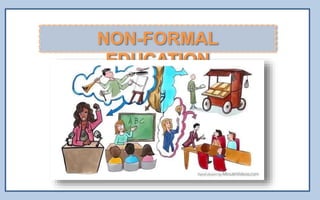
NON-FORMAL
EDUCATION
NON-FORMAL
EDUCATION
1. Differentiate Non-Formal Education from Formal
Education
2. Mission of NFE in the Philippines
3. Enumerate the forms of Non-Formal Education
(NFE)
4. Alternative Learning System (ALS) & TESDA
5. Discuss the Non-Formal Education in other
countries
Objectives:
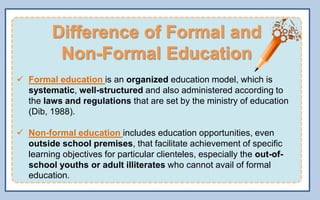
Difference of Formal and
Non-Formal Education
 Formal education is an organized education model, which is
systematic, well-structured and also administered according to
the laws and regulations that are set by the ministry of education
(Dib, 1988).
 Non-formal education includes education opportunities, even
outside school premises, that facilitate achievement of specific
learning objectives for particular clienteles, especially the out-of-
school youths or adult illiterates who cannot avail of formal
education.
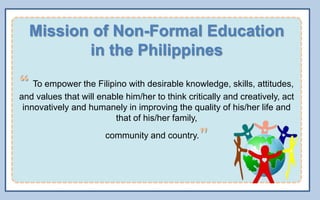
Mission of Non-Formal Education
in the Philippines
“ To empower the Filipino with desirable knowledge, skills, attitudes,
and values that will enable him/her to think critically and creatively, act
innovatively and humanely in improving the quality of his/her life and
that of his/her family,
community and country."
Alternative Learning System (ALS)
Technical Education and Skills
Development Authority (TESDA)
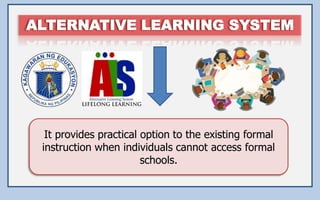
It provides practical option to the existing formal
instruction when individuals cannot access formal
schools.
Out-of-school youths
Adult illiterates
Young parents
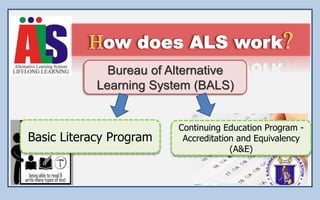
Bureau of Alternative
Learning System (BALS)
Basic Literacy Program
Continuing Education Program -
Accreditation and Equivalency
(A&E)
Technical Education and Skills
Development Authority (TESDA)
 Non-degree technical-vocational
programs
 Skill orientation and training
 Development of out-of-school youth
and unemployed community adults.
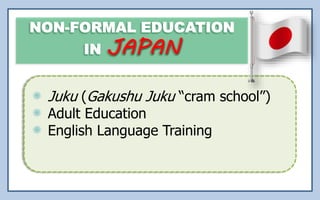
Juku (Gakushu Juku “cram school”)
Adult Education
English Language Training
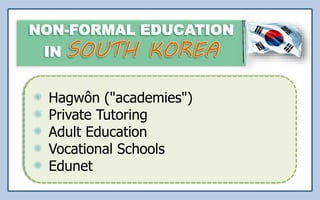
Hagwôn ("academies")
Private Tutoring
Adult Education
Vocational Schools
Edunet
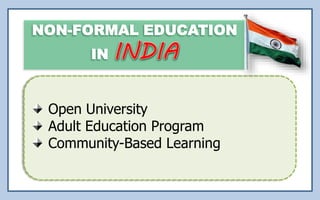
Open University
Adult Education Program
Community-Based Learning
Basic Education for Skills Training (BEST)
Worker Improvement through Secondary
Education (WISE)
Open University Degree Programme
(OUDP)
Adult Education
Non-formal education should not be
considered as less important because
it is in fact as important as formal
education.
Non-formal education may not be fully
organized and well structured, but it is still
provides important information for
the generation.
.
Non-Formal Education (Comparative Education)

Non-Formal Education (Comparative Education)

  • 1.
    College of theImmaculate Conception Cabanatuan City Comparative Education
  • 3.
  • 4.
  • 5.
  • 6.
  • 8.
    1. Differentiate Non-FormalEducation from Formal Education 2. Mission of NFE in the Philippines 3. Enumerate the forms of Non-Formal Education (NFE) 4. Alternative Learning System (ALS) & TESDA 5. Discuss the Non-Formal Education in other countries Objectives:
  • 9.
    Difference of Formaland Non-Formal Education  Formal education is an organized education model, which is systematic, well-structured and also administered according to the laws and regulations that are set by the ministry of education (Dib, 1988).  Non-formal education includes education opportunities, even outside school premises, that facilitate achievement of specific learning objectives for particular clienteles, especially the out-of- school youths or adult illiterates who cannot avail of formal education.
  • 10.
    Mission of Non-FormalEducation in the Philippines “ To empower the Filipino with desirable knowledge, skills, attitudes, and values that will enable him/her to think critically and creatively, act innovatively and humanely in improving the quality of his/her life and that of his/her family, community and country."
  • 12.
    Alternative Learning System(ALS) Technical Education and Skills Development Authority (TESDA)
  • 13.
    It provides practicaloption to the existing formal instruction when individuals cannot access formal schools.
  • 14.
  • 15.
    Bureau of Alternative LearningSystem (BALS) Basic Literacy Program Continuing Education Program - Accreditation and Equivalency (A&E)
  • 16.
    Technical Education andSkills Development Authority (TESDA)  Non-degree technical-vocational programs  Skill orientation and training  Development of out-of-school youth and unemployed community adults.
  • 17.
    Juku (Gakushu Juku“cram school”) Adult Education English Language Training
  • 18.
    Hagwôn ("academies") Private Tutoring AdultEducation Vocational Schools Edunet
  • 19.
    Open University Adult EducationProgram Community-Based Learning
  • 20.
    Basic Education forSkills Training (BEST) Worker Improvement through Secondary Education (WISE) Open University Degree Programme (OUDP)
  • 21.
  • 22.
    Non-formal education shouldnot be considered as less important because it is in fact as important as formal education. Non-formal education may not be fully organized and well structured, but it is still provides important information for the generation. .