Syllabus Math 205
                                        Functions and Modeling
                                for Secondary Mathematics Instruction
                                               Fall 2012


College of Education Health and Human Sciences Vision: is one that aspires to achieve
extraordinary results in the areas of learning, research, outreach, diversity and enrichment of quality of
life.

College of Education Health and Human Sciences Mission: to promote a healthy, educated, and
civil society; to encourage life-long learning; and to enhance the quality of life within the diverse, global
community by preparing professionals to lead and serve, by conducting research and by engaging in
service and outreach activities.


CRN:                 Section:               Days:                  Time:                  Location:
48305                1                      MWF                    1:25-2:15 pm           Greve 107


        Instructor: Jeneva Moseley          Office: Ayres 230          Email: jmoseley@math.utk.edu
        Office Phone: (865) 974-3708                Cell Phone: (865) 924-4133
        Office Hours: (1) MWF, 7:00-7:50 am, in Hoskins 110C
              (2) MWF, 9:05-9:55 am, by appointment
              (3) MWF, 11:15 am- 12:05 pm, by appointment
              (4) MWF, 2:30-3:30 pm, by appointment


Course Description: In this course, you will engage in explorations and lab activities designed to
strengthen and expand your knowledge of the topics found in secondary mathematics. Course activities
are designed to have you take a second, deeper look at topics you should have been exposed to previously;
illuminate the connections between secondary and college mathematics; illustrate good, as opposed to
typically poor, sometimes counterproductive, uses of technology in teaching; illuminate the connections
between various areas of mathematics; and engage you in serious (i.e., non-routine) problem solving,
problem-based learning, and applications of mathematics.

The course consists of four units: 1) Functions, 2) Modeling, 3) Overlooked Topics and Explorations, and
4) Geometry of Complex Numbers. Specific topics of investigation include function properties and
patterns, complex numbers, parametric equations, polar equations, vectors, and exponential growth and
decay. Explorations involve the use of multiple representations, transformations, data analysis
techniques (such as curve fitting) and interconnections among topics in algebra, analytic geometry,
statistics, trigonometry, and calculus. The lab investigations include use of various technologies including
computers, calculators, and computer graphing software.
3 credit hours.
Course Prerequisites: Math 142 or Math 148

Student Learning Expectations/Outcomes for the Course:


                    Students will be able to…                     Evidence of Student Learning:

      demonstrate a depth of content knowledge with             classroom activities, student
      regard to important secondary mathematics topics           presentation of findings,
      such as parametric relations, polar relations,             assessments, and classroom
      matrices, exponential and logarithmic functions,           performance
      vectors, and complex numbers.

      generate or work with relevant lab or exploration         classroom activities and classroom
      data and use regression, matrix, function pattern,         lab write up
      and systems methods to generate a model the data.

      present mathematical ideas and topics in a                classroom presentations of findings
      knowledgeable and effective manner.                        and classroom performance

      demonstrate proficiency in the use of technology in       classroom activities, labs,
      the mathematics classroom.                                 assessments, and classroom
                                                                 performance

      identify mathematics content connections between          classroom activities, student
      the various levels of secondary mathematics                presentation of findings, and
      curriculum and between secondary and university            classroom performance
      level curriculum.

Expectations
       1. You are expected to attend every class.
       2. You are expected to come prepared to actively participate in class discussions (do the assigned
          readings and problem sets).
       3. You should attempt all assigned problems and show all work in order to receive full credit.
       4. You are expected to check your e-mail regularly for announcements.

Required Materials: Calculator: TI-83/84/Inspire.

Disability Services: If you need course adaptations or accommodations because of a documented
disability or if you have emergency information to share, please contact the Office of Disability Services at
2227 Dunford Hall at 974-6087.

Math Tutorial Center: The Math Tutorial Center is in Ayres Hall B012. It provides free tutoring.
Hours of operation are posted at http://www.math.utk.edu/MTC/. Please make use of this free service.
Course Outline:

                 Class                        Tentative Topic List
              Unit 1: Functions, Rates, Patterns & More…
                                          Function Definition(s)
                                 Roots of a Quadratic (Real & Complex)
                                          Qualitative Graphing
                                             Conic Sections
                                            Spring Mass Lab
                                                Sequences
                                           Difference Columns
                                                 Test #1
              Unit 2: Modeling

                               Modeling Functions and Linear Regression
                                      Regression and Residuals
                                  Modeling Functions with Matrices
                                         Terminal Speed Lab
                                               Test #2

              Unit 3: Overlooked Topics and Explorations

                                          Parametric Models
                                       Parametric Explorations
                                       Polar Coordinate System
                                      Exponential/Logistic Models
                                              Vector Lab
                                               Test #3

              Unit 4: Geometry of Complex Numbers

                                     Geometry of Complex Numbers
                                        Polar Complex Numbers
                                            Mandelbrot Set
                                         Wrap-up and Review
                                                Test #4


Assessment of Student Learning Outcomes: Grades will be determined using the grading scale
below. Your letter grade is a measure of your mastery of course material and your fulfillment of course
objectives. You should keep all of your graded work until final grades are posted.

                                                                                          Percent of
                                     Assessments:                                           Final
                                                                                            Grade
    Tests – There will be four exams to test your knowledge of the concepts we are
                                                                                              40%
                             currently discussing in class.
  Journal, Labs, and Homework – You will keep a journal recording your thinking.
    You will make lab reports after we do in-class labs. You will complete homework           30%
                                     assignments.
 Attendance & Participation – Attendance is vital. You are expected to be an active
                                                                                              5%
                               participant in the course.
     Midterm Project - You will be given more details about the midterm project.              10%
   Final Exam – The comprehensive exam will cover material from throughout the
                                                                                              15%
                                       semester.
                               Total Percentage Possible                                     100%
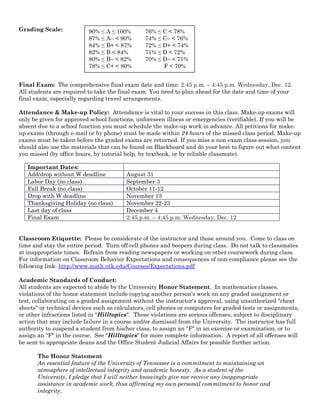
Grading Scale:            90% ≤ A ≤ 100%        76% ≤ C < 78%
                          87% ≤ A– < 90%        74% ≤ C– < 76%
                          84% ≤ B+ < 87%        72% ≤ D+ < 74%
                          82% ≤ B < 84%         71% ≤ D < 72%
                          80% ≤ B– < 82%        70% ≤ D– < 71%
                          78% ≤ C+ < 80%              F < 70%


Final Exam: The comprehensive final exam date and time: 2:45 p.m. – 4:45 p.m. Wednesday, Dec. 12.
All students are required to take the final exam. You need to plan ahead for the date and time of your
final exam, especially regarding travel arrangements.

Attendance & Make-up Policy: Attendance is vital to your success in this class. Make-up exams will
only be given for approved school functions, unforeseen illness or emergencies (verifiable). If you will be
absent due to a school function you must schedule the make-up work in advance. All petitions for make-
up exams (through e-mail or by phone) must be made within 24 hours of the missed class period. Make-up
exams must be taken before the graded exams are returned. If you miss a non-exam class session, you
should also use the materials that can be found on Blackboard and do your best to figure out what content
you missed (by office hours, by tutorial help, by textbook, or by reliable classmate).

   Important Dates:
   Add/drop without W deadline           August 31
   Labor Day (no class)                  September 3
   Fall Break (no class)                 October 11-12
   Drop with W deadline                  November 13
   Thanksgiving Holiday (no class)       November 22-23
   Last day of class                     December 4
   Final Exam                            2:45 p.m. – 4:45 p.m. Wednesday, Dec. 12


Classroom Etiquette: Please be considerate of the instructor and those around you. Come to class on
time and stay the entire period. Turn off cell phones and beepers during class. Do not talk to classmates
at inappropriate times. Refrain from reading newspapers or working on other coursework during class.
For information on Classroom Behavior Expectations and consequences of non-compliance please see the
following link: http://www.math.utk.edu/Courses/Expectations.pdf

Academic Standards of Conduct:
All students are expected to abide by the University Honor Statement. In mathematics classes,
violations of the honor statement include copying another person's work on any graded assignment or
test, collaborating on a graded assignment without the instructor's approval, using unauthorized "cheat
sheets" or technical devices such as calculators, cell phones or computers for graded tests or assignments,
or other infractions listed in "Hilltopics". These violations are serious offenses, subject to disciplinary
action that may include failure in a course and/or dismissal from the University. The instructor has full
authority to suspend a student from his/her class, to assign an "F" in an exercise or examination, or to
assign an "F" in the course. See "Hilltopics" for more complete information. A report of all offenses will
be sent to appropriate deans and the Office Student Judicial Affairs for possible further action.

       The Honor Statement
       An essential feature of the University of Tennessee is a commitment to maintaining an
       atmosphere of intellectual integrity and academic honesty. As a student of the
       University, I pledge that I will neither knowingly give nor receive any inappropriate
       assistance in academic work, thus affirming my own personal commitment to honor and
       integrity.

Math 205 syllabus Fall 2012

  • 1.
    Syllabus Math 205 Functions and Modeling for Secondary Mathematics Instruction Fall 2012 College of Education Health and Human Sciences Vision: is one that aspires to achieve extraordinary results in the areas of learning, research, outreach, diversity and enrichment of quality of life. College of Education Health and Human Sciences Mission: to promote a healthy, educated, and civil society; to encourage life-long learning; and to enhance the quality of life within the diverse, global community by preparing professionals to lead and serve, by conducting research and by engaging in service and outreach activities. CRN: Section: Days: Time: Location: 48305 1 MWF 1:25-2:15 pm Greve 107 Instructor: Jeneva Moseley Office: Ayres 230 Email: jmoseley@math.utk.edu Office Phone: (865) 974-3708 Cell Phone: (865) 924-4133 Office Hours: (1) MWF, 7:00-7:50 am, in Hoskins 110C (2) MWF, 9:05-9:55 am, by appointment (3) MWF, 11:15 am- 12:05 pm, by appointment (4) MWF, 2:30-3:30 pm, by appointment Course Description: In this course, you will engage in explorations and lab activities designed to strengthen and expand your knowledge of the topics found in secondary mathematics. Course activities are designed to have you take a second, deeper look at topics you should have been exposed to previously; illuminate the connections between secondary and college mathematics; illustrate good, as opposed to typically poor, sometimes counterproductive, uses of technology in teaching; illuminate the connections between various areas of mathematics; and engage you in serious (i.e., non-routine) problem solving, problem-based learning, and applications of mathematics. The course consists of four units: 1) Functions, 2) Modeling, 3) Overlooked Topics and Explorations, and 4) Geometry of Complex Numbers. Specific topics of investigation include function properties and patterns, complex numbers, parametric equations, polar equations, vectors, and exponential growth and decay. Explorations involve the use of multiple representations, transformations, data analysis techniques (such as curve fitting) and interconnections among topics in algebra, analytic geometry, statistics, trigonometry, and calculus. The lab investigations include use of various technologies including computers, calculators, and computer graphing software. 3 credit hours.
  • 2.
    Course Prerequisites: Math142 or Math 148 Student Learning Expectations/Outcomes for the Course: Students will be able to… Evidence of Student Learning: demonstrate a depth of content knowledge with  classroom activities, student regard to important secondary mathematics topics presentation of findings, such as parametric relations, polar relations, assessments, and classroom matrices, exponential and logarithmic functions, performance vectors, and complex numbers. generate or work with relevant lab or exploration  classroom activities and classroom data and use regression, matrix, function pattern, lab write up and systems methods to generate a model the data. present mathematical ideas and topics in a  classroom presentations of findings knowledgeable and effective manner. and classroom performance demonstrate proficiency in the use of technology in  classroom activities, labs, the mathematics classroom. assessments, and classroom performance identify mathematics content connections between  classroom activities, student the various levels of secondary mathematics presentation of findings, and curriculum and between secondary and university classroom performance level curriculum. Expectations 1. You are expected to attend every class. 2. You are expected to come prepared to actively participate in class discussions (do the assigned readings and problem sets). 3. You should attempt all assigned problems and show all work in order to receive full credit. 4. You are expected to check your e-mail regularly for announcements. Required Materials: Calculator: TI-83/84/Inspire. Disability Services: If you need course adaptations or accommodations because of a documented disability or if you have emergency information to share, please contact the Office of Disability Services at 2227 Dunford Hall at 974-6087. Math Tutorial Center: The Math Tutorial Center is in Ayres Hall B012. It provides free tutoring. Hours of operation are posted at http://www.math.utk.edu/MTC/. Please make use of this free service.
  • 3.
    Course Outline: Class Tentative Topic List Unit 1: Functions, Rates, Patterns & More… Function Definition(s) Roots of a Quadratic (Real & Complex) Qualitative Graphing Conic Sections Spring Mass Lab Sequences Difference Columns Test #1 Unit 2: Modeling Modeling Functions and Linear Regression Regression and Residuals Modeling Functions with Matrices Terminal Speed Lab Test #2 Unit 3: Overlooked Topics and Explorations Parametric Models Parametric Explorations Polar Coordinate System Exponential/Logistic Models Vector Lab Test #3 Unit 4: Geometry of Complex Numbers Geometry of Complex Numbers Polar Complex Numbers Mandelbrot Set Wrap-up and Review Test #4 Assessment of Student Learning Outcomes: Grades will be determined using the grading scale below. Your letter grade is a measure of your mastery of course material and your fulfillment of course objectives. You should keep all of your graded work until final grades are posted. Percent of Assessments: Final Grade Tests – There will be four exams to test your knowledge of the concepts we are 40% currently discussing in class. Journal, Labs, and Homework – You will keep a journal recording your thinking. You will make lab reports after we do in-class labs. You will complete homework 30% assignments. Attendance & Participation – Attendance is vital. You are expected to be an active 5% participant in the course. Midterm Project - You will be given more details about the midterm project. 10% Final Exam – The comprehensive exam will cover material from throughout the 15% semester. Total Percentage Possible 100%
  • 4.
    Grading Scale: 90% ≤ A ≤ 100% 76% ≤ C < 78% 87% ≤ A– < 90% 74% ≤ C– < 76% 84% ≤ B+ < 87% 72% ≤ D+ < 74% 82% ≤ B < 84% 71% ≤ D < 72% 80% ≤ B– < 82% 70% ≤ D– < 71% 78% ≤ C+ < 80% F < 70% Final Exam: The comprehensive final exam date and time: 2:45 p.m. – 4:45 p.m. Wednesday, Dec. 12. All students are required to take the final exam. You need to plan ahead for the date and time of your final exam, especially regarding travel arrangements. Attendance & Make-up Policy: Attendance is vital to your success in this class. Make-up exams will only be given for approved school functions, unforeseen illness or emergencies (verifiable). If you will be absent due to a school function you must schedule the make-up work in advance. All petitions for make- up exams (through e-mail or by phone) must be made within 24 hours of the missed class period. Make-up exams must be taken before the graded exams are returned. If you miss a non-exam class session, you should also use the materials that can be found on Blackboard and do your best to figure out what content you missed (by office hours, by tutorial help, by textbook, or by reliable classmate). Important Dates: Add/drop without W deadline August 31 Labor Day (no class) September 3 Fall Break (no class) October 11-12 Drop with W deadline November 13 Thanksgiving Holiday (no class) November 22-23 Last day of class December 4 Final Exam 2:45 p.m. – 4:45 p.m. Wednesday, Dec. 12 Classroom Etiquette: Please be considerate of the instructor and those around you. Come to class on time and stay the entire period. Turn off cell phones and beepers during class. Do not talk to classmates at inappropriate times. Refrain from reading newspapers or working on other coursework during class. For information on Classroom Behavior Expectations and consequences of non-compliance please see the following link: http://www.math.utk.edu/Courses/Expectations.pdf Academic Standards of Conduct: All students are expected to abide by the University Honor Statement. In mathematics classes, violations of the honor statement include copying another person's work on any graded assignment or test, collaborating on a graded assignment without the instructor's approval, using unauthorized "cheat sheets" or technical devices such as calculators, cell phones or computers for graded tests or assignments, or other infractions listed in "Hilltopics". These violations are serious offenses, subject to disciplinary action that may include failure in a course and/or dismissal from the University. The instructor has full authority to suspend a student from his/her class, to assign an "F" in an exercise or examination, or to assign an "F" in the course. See "Hilltopics" for more complete information. A report of all offenses will be sent to appropriate deans and the Office Student Judicial Affairs for possible further action. The Honor Statement An essential feature of the University of Tennessee is a commitment to maintaining an atmosphere of intellectual integrity and academic honesty. As a student of the University, I pledge that I will neither knowingly give nor receive any inappropriate assistance in academic work, thus affirming my own personal commitment to honor and integrity.