Beyond TaskBased Testing:
Interviews &
Personas
October 29, 2013
Darlene Fichter
Jeff Wisniewski
Road Map
 What’s

a persona?
 Benefits of personas
 Isn’t task based testing enough? Do I
need to do personas too?
 How to create personas


Interviewing and other methods

 How

to use personas
Caveats
 Design

/= visual design
 Design = product design as a whole from
features, colors, interactions, content,
organization, etc.
Personas
 Personas

are “stand ins” or hypothetical
archetypes created to represent the
primary user segments for your web site
 Each persona represents a key user type
that shares demographic
characteristics, needs, behaviours, and
environment
Personas
 Although

personas are imaginary they are
derived from user research
 Each persona is given a name and
personal details to make them more
realistic











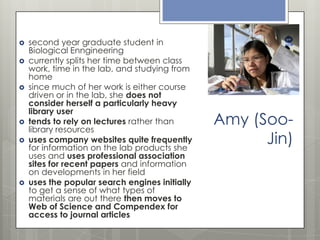
second year graduate student in
Biological Enngineering
currently splits her time between class
work, time in the lab, and studying from
home
since much of her work is either course
driven or in the lab, she does not
consider herself a particularly heavy
library user
tends to rely on lectures rather than
library resources
uses company websites quite frequently
for information on the lab products she
uses and uses professional association
sites for recent papers and information
on developments in her field
uses the popular search engines initially
to get a sense of what types of
materials are out there then moves to
Web of Science and Compendex for
access to journal articles

Amy (SooJin)










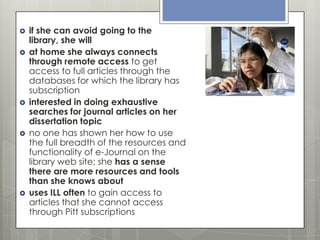
if she can avoid going to the
library, she will
at home she always connects
through remote access to get
access to full articles through the
databases for which the library has
subscription
interested in doing exhaustive
searches for journal articles on her
dissertation topic
no one has shown her how to use
the full breadth of the resources and
functionality of e-Journal on the
library web site; she has a sense
there are more resources and tools
than she knows about
uses ILL often to gain access to
articles that she cannot access
through Pitt subscriptions
Customer Segments to
Personas
 Originated

in the 1930’s for marketing
brands started using fictional characters
to represent a customer segment
 Alan Cooper, a software
developer, coined a related term and
similar practice: personas.
 His book The Inmates are Running the
Asylum popularized the use of personas
and designing for “archetypal users”.
Benefits of Personas
#1 “User” Centered Design
 Way

to have users attend all your design
meeting that representative of the major
user types
 Each persona has the weight
 Personas are based on and embody
what we know about our library’s web site
users

Personas
keeping it about the user
#2. Support Evidence Based
Decision Making
 Way

to harness the user research data to
inform web site development
 Easier to remember a persona than pages
of facts and figures: path data, survey
results, interview summaries etc.
 Share abstract data in a compelling and
memorable way

Personas
encapsulate evidence
#3 Where to put design effort
 Personas

spell out what the site needs to

do
 Persona goals and task provide a focus
-Avoid scope creep
- Elastic band users

Personas
provide focus
#4. Communicate to
Stakeholders in a Language
Understood by Everyone
 Easy

and fun way to communicate design
decisions
 Keeps the focus on the user
 Avoid “geek” speak

Personas
speak to everyone
#4 Build Consensus and
Commitment to the Design
 Communicate

a common direction
 Reduce the need for extremely detailed
specifications. Nuances of behaviours
and preferences are captured in the
persona and narratives

Personas
build shared vision
Task Based Testing
 How

personas work with task based
testing
Task Based Testing
 Extremely

useful
 Evidence of how users actually use your
site

Are you getting the most value out of your task based testing
investment?
Task Based Testing
 Even




on a shoestring, still resource intensive

Usability testing takes time
Only do one test or maybe 2 or 3 iterations due to
resource constraints

 Most

designs need many iterations

Using personas allows you to raise the base level of the
design that you use for task based testing
Small Studies & Representative
Sample
A

small “shoestring” usability study usually
can only pull in a few participants broadly
categorized by age, gender, year in
school if an educational
setting, department/profession in a firm
etc.
 But are these the broad categories that
help us zero in on primary user types?
The Tasks
Where do the tasks come from?
 Some are easy. i.e. frequently used on
the web site now. We know that our 30
study rooms are booked around the clock
from the online form.
 What about designing bookable study
room form on the mobile site? Is there
interest? How/when/where/who would
use it and what’s the best design?
Tasks
Some Tasks are Tar Pits


Find an article on ....
 Do

we know based on user research (or just
on our personal hunches) the typical way this
questions is approached by primary user
types? What happens when they have too
large a search result? Null result?



Find out how to borrow a laptop from the
Library.
 Will

they browse or search?
 If search has too many results, what will they
try next?
Personas
Reality check that helps you create better
tasks
How to Create Personas
Research!




Environmental scan
Interviews
Ethnographic research
Environmental scanning
 Identify

true peers
 Literature review
 Web search
 Provides a framework
Ethnographic research
 Gorillas

in the Mist
 Time consuming
 Expensive
 Highly useful!
Interviews
 Useful

for creating from scratch and for
local validation of “borrowed”
Finding subjects
 Leverage

your networks
 General advertising not useful
Logistics
 Voice

recorder of smartphone app
 Transcription
 Analysis
What to ask and how to ask it
 What



you’re doing and why

You’re helping us build a better website
Be candid

 General



computer usage habits

When you start your browser where’s are
the first places you go?
Favorite sites, and why?
What to ask and how to ask it
 If

you need to:

Find books to take on vacation
 Write a paper
…Where’s the first place you’d go?

What to ask and how to ask it









How often do you go to the library?
How often do you go to the library website?
When do you go to the library website? What
do you do when you’re there? (Take them to
site)
What immediately draws your attention?
What information did you look for but not
find?
Is there something you looked for on the
homepage but didn’t find?
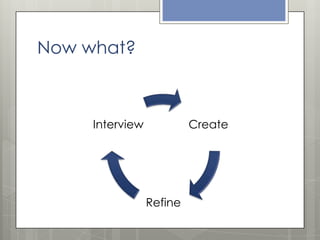
Now what?

Interview

Create

Refine
How many personas ?
 Primary

constituencies
 5-7 generally recommended
How to use the personas
 In

the room
 Frame discussions
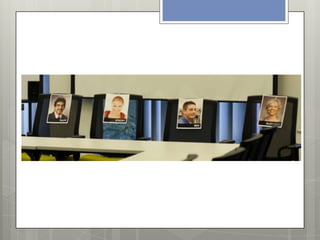
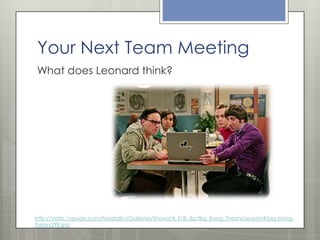
Your Next Team Meeting
What does Leonard think?

http://static.tvguide.com/MediaBin/Galleries/Shows/A_F/Bi_Bp/Big_Bang_Theory/season4/big-bangtheory298.jpg
Question?
Thanks!

Beyond Task Based Testing: Interviews and Personas

  • 1.
    Beyond TaskBased Testing: Interviews& Personas October 29, 2013 Darlene Fichter Jeff Wisniewski
  • 2.
    Road Map  What’s apersona?  Benefits of personas  Isn’t task based testing enough? Do I need to do personas too?  How to create personas  Interviewing and other methods  How to use personas
  • 3.
    Caveats  Design /= visualdesign  Design = product design as a whole from features, colors, interactions, content, organization, etc.
  • 4.
    Personas  Personas are “standins” or hypothetical archetypes created to represent the primary user segments for your web site  Each persona represents a key user type that shares demographic characteristics, needs, behaviours, and environment
  • 5.
    Personas  Although personas areimaginary they are derived from user research  Each persona is given a name and personal details to make them more realistic
  • 6.
          second year graduatestudent in Biological Enngineering currently splits her time between class work, time in the lab, and studying from home since much of her work is either course driven or in the lab, she does not consider herself a particularly heavy library user tends to rely on lectures rather than library resources uses company websites quite frequently for information on the lab products she uses and uses professional association sites for recent papers and information on developments in her field uses the popular search engines initially to get a sense of what types of materials are out there then moves to Web of Science and Compendex for access to journal articles Amy (SooJin)
  • 7.
         if she canavoid going to the library, she will at home she always connects through remote access to get access to full articles through the databases for which the library has subscription interested in doing exhaustive searches for journal articles on her dissertation topic no one has shown her how to use the full breadth of the resources and functionality of e-Journal on the library web site; she has a sense there are more resources and tools than she knows about uses ILL often to gain access to articles that she cannot access through Pitt subscriptions
  • 8.
    Customer Segments to Personas Originated in the 1930’s for marketing brands started using fictional characters to represent a customer segment  Alan Cooper, a software developer, coined a related term and similar practice: personas.  His book The Inmates are Running the Asylum popularized the use of personas and designing for “archetypal users”.
  • 9.
  • 10.
    #1 “User” CenteredDesign  Way to have users attend all your design meeting that representative of the major user types  Each persona has the weight  Personas are based on and embody what we know about our library’s web site users Personas keeping it about the user
  • 11.
    #2. Support EvidenceBased Decision Making  Way to harness the user research data to inform web site development  Easier to remember a persona than pages of facts and figures: path data, survey results, interview summaries etc.  Share abstract data in a compelling and memorable way Personas encapsulate evidence
  • 12.
    #3 Where toput design effort  Personas spell out what the site needs to do  Persona goals and task provide a focus -Avoid scope creep - Elastic band users Personas provide focus
  • 13.
    #4. Communicate to Stakeholdersin a Language Understood by Everyone  Easy and fun way to communicate design decisions  Keeps the focus on the user  Avoid “geek” speak Personas speak to everyone
  • 14.
    #4 Build Consensusand Commitment to the Design  Communicate a common direction  Reduce the need for extremely detailed specifications. Nuances of behaviours and preferences are captured in the persona and narratives Personas build shared vision
  • 15.
    Task Based Testing How personas work with task based testing
  • 16.
    Task Based Testing Extremely useful  Evidence of how users actually use your site Are you getting the most value out of your task based testing investment?
  • 17.
    Task Based Testing Even   on a shoestring, still resource intensive Usability testing takes time Only do one test or maybe 2 or 3 iterations due to resource constraints  Most designs need many iterations Using personas allows you to raise the base level of the design that you use for task based testing
  • 18.
    Small Studies &Representative Sample A small “shoestring” usability study usually can only pull in a few participants broadly categorized by age, gender, year in school if an educational setting, department/profession in a firm etc.  But are these the broad categories that help us zero in on primary user types?
  • 19.
    The Tasks Where dothe tasks come from?  Some are easy. i.e. frequently used on the web site now. We know that our 30 study rooms are booked around the clock from the online form.  What about designing bookable study room form on the mobile site? Is there interest? How/when/where/who would use it and what’s the best design?
  • 20.
    Tasks Some Tasks areTar Pits  Find an article on ....  Do we know based on user research (or just on our personal hunches) the typical way this questions is approached by primary user types? What happens when they have too large a search result? Null result?  Find out how to borrow a laptop from the Library.  Will they browse or search?  If search has too many results, what will they try next?
  • 21.
    Personas Reality check thathelps you create better tasks
  • 22.
    How to CreatePersonas Research!    Environmental scan Interviews Ethnographic research
  • 23.
    Environmental scanning  Identify truepeers  Literature review  Web search  Provides a framework
  • 24.
    Ethnographic research  Gorillas inthe Mist  Time consuming  Expensive  Highly useful!
  • 25.
    Interviews  Useful for creatingfrom scratch and for local validation of “borrowed”
  • 26.
    Finding subjects  Leverage yournetworks  General advertising not useful
  • 27.
    Logistics  Voice recorder ofsmartphone app  Transcription  Analysis
  • 28.
    What to askand how to ask it  What   you’re doing and why You’re helping us build a better website Be candid  General   computer usage habits When you start your browser where’s are the first places you go? Favorite sites, and why?
  • 29.
    What to askand how to ask it  If you need to: Find books to take on vacation  Write a paper …Where’s the first place you’d go? 
  • 30.
    What to askand how to ask it       How often do you go to the library? How often do you go to the library website? When do you go to the library website? What do you do when you’re there? (Take them to site) What immediately draws your attention? What information did you look for but not find? Is there something you looked for on the homepage but didn’t find?
  • 31.
  • 32.
    How many personas?  Primary constituencies  5-7 generally recommended
  • 33.
    How to usethe personas  In the room  Frame discussions
  • 35.
    Your Next TeamMeeting What does Leonard think? http://static.tvguide.com/MediaBin/Galleries/Shows/A_F/Bi_Bp/Big_Bang_Theory/season4/big-bangtheory298.jpg
  • 36.
  • 37.

Editor's Notes

  • #5 A more specific definition from the Foviance/Seren guide to Segmented personas is:“A persona is a fictional character that communicates the primary characteristics of a group of users, identified and selected as a key target through use of segmentation data, across the company in a usable and effective manner.
  • #15 "About Face 2.0" (p. 55), thestrengths of personas as a design tool