In association with
INSIGHT CONTRACTOR QUALIFICATION
How cost-effective is contractor
qualification software for your company?
Visit www.browz.com/roi to see how
much you can save with BROWZ.
3
Procurement Leaders
CONTRACTOR QUALIFICATION
INSIGHT
IT HAS become the downside the
strategy consultants don’t tell
you about. Although it is widely
accepted that it makes good sense
for businesses to concentrate
on their core competencies,
the inevitable corollary is that
non-core activities will have to
be outsourced to third parties.
But what if those third-party
contractors are negligent,
unsafe,or incompetent?
BP can provide one answer.
Back in 2010, contractor failings
were implicated in the Gulf of
Mexico oil well blowout that saw
the Deepwater Horizon rig catch
fire and sink, killing 11 crew and
triggering a 206 million gallon
Safe and sound?
It is dangerous to assume that on-site contractors have the
requisite skills and qualifications, writes Malcolm Wheatley
oil spill that has so far cost the
oil giant $54bn in fines and
remediation costs.
Or ask retailers such as Walmart,
Benetton, Matalan, and Primark,
slammed by consumer activists
after using garment factories
housed in the unsafely built nine-
storey Rana Plaza building outside
Dhaka, Bangladesh, which
collapsed in April 2013, killing
more than 1,100 workers.
Tech titan Apple, meanwhile, is
still smarting after a spate of high-
profile suicides at its Foxconn
manufacturing contractor in
2010 and sportswear company
Nike still bears scars around
15  years after some of its Æ
THE ‘CONTRACTOR’
pass on a lanyard
conveys a lot of
authority. It means
the wearer has
someone’s permission to be
on your premises. It may even
mean it’s easier to do a roll call
in the unlikely event of having
to evacuate because of an
emergency (real or a drill).
But the question is: does that
hard-hatted, badge-wearing
contractor have the necessary
skills? Do they have the requisite
training, licences and insurance?
Perhaps, but how would you
know? Do those signs on the wall
that say ‘Safety is our number
one priority’ mean anything if you
have hired contractors but don’t
know who is doing what?
Fortunately, it isn’t necessary
for procurement staff to personally
check the credentials of everyone
on site. There are better options.
And with a typical industrial
accident costing tens of thousands
of dollars, those options could pay
for themselves many times over.
Andrew Sawers
Special projects editor,
Procurement Leaders
© A Procurement Leaders publication.
In association with BROWZ.
All rights reserved
PERMISSIONS AND REPRINTS
Reproduction in whole or part of any
photograph, text or illustration without
written permission from the publisher is
prohibited. Due care is taken to ensure
that the content of this publication is
fully accurate, but the publisher and
printer cannot accept liability for errors
and omissions.
Published by: Sigaria Ltd
Prospero House,
241 Borough High Street,
London, SE1 1GA, UK
4
Procurement Leaders
CONTRACTOR QUALIFICATION
INSIGHT
shoes were found to be produced
by children working in third-
world sweatshops.
In short, while a strategy
of sticking to their core
competencies may make
excellent sense for many
businesses, the very act of
handing over non-core tasks to
third parties potentially opens
the door to a whole host of
unintended consequences.
These include fines and
penalties, reputational damage,
lost production, law suits, devoting
management resources to dealing
with official investigations and
audits, and so on.
A paper from the US non-profit
organisation National Safety
Council (NSC), The business
case for investment in safety:
a guide for executives, states
the most disabling workplace
injuries and illnesses cost US
business around $1bn each week
in direct workers’ compensation
costs alone. It calculates that
each prevented lost-time injury
or illness saves $37,000 while
each avoided occupational
fatality saves almost $1.4m.
The NSC report also points to the
fact that indirect costs – such as
workplace disruption, downtime,
loss of productivity in the wake of
an incident, worker replacement,
training, more expensive insurance
premiums and legal fees – can
be even greater than direct costs
such as workers’ compensation,
medical expenses and litigation.
But what to do? One obvious
answer, pursued by many
businesses, is to espouse high
standards of safety performance.
Merely promoting such
standards, though, doesn’t of
itself deliver them. A week before
the Deepwater Horizon accident,
for instance, chief executive Tony
Hayward had taken to the stage
at BP’s annual general meeting.
“Safety is our number one
priority,” he told the company’s
shareholders, as he reported
on the previous year’s progress.
“Our focus on safe and reliable
operations is now strongly
embedded in all our businesses.”
To clarify expectations further,
enshrine them in auditable
operating procedures – ways of
working that codify best practice,
ADA’S PRAGMATIC APPROACH TO
SUPPLIER RISK ASSESSMENT
“Each prevented lost-time injury or illness
saves $37,000, while each avoided
occupational fatality saves almost $1.4m”
“On any given day, we might
have 30 or so contractors
coming on site – and during our
annual planned maintenance
shutdown, that number
rises to 150 or so,” says Tim
Whatley, corporate health
and safety director at ADA
Carbon Solutions, an American
manufacturer of activated
carbon. “With so many
contractors, a prequalification
process provides a vital level
of confidence that contractors
align with our company’s
core values around safety,
environmental stewardship,
cost, and project timeline.”
But by 2014, he says, the
business realised that managing
so many contractors with
spreadsheets and manual
systems posed obvious
challenges in terms of workload
and efficiencies.
“We would create a folder
for the contractor, and have
a checklist for items such as
insurance certificates and safety
certifications as they came in,”
Whatley explains. “But when
you’re managing hundreds of
contractors, this can become
difficult to manage, and even
simply maintaining the data over
time was becoming a challenge.
We realised that we needed a
better way of doing things.”
Coincidentally a potential
customer of ADA, managing
hundreds of contractors, used
BROWZ for this very purpose,
and required the activated carbon
manufacturer to use BROWZ to
submit its own safety and related
certifications for prequalification
purposes. Whatley duly contacted
BROWZ to arrange the telephone-
based training that he felt
he needed.
“I remember that this was on
a Thursday, and we arranged
the training call for the following
Monday,” he explains. “But
on the Friday afternoon, on
an impulse, I thought I’d
attempt it anyway, and found
the process to be really quick
and straightforward. I began to
answer the questions, load the
5
Procurement Leaders
ensuring operations are safe,
efficient and legally complaint.
Again, however, BP highlights the
difficulties in this.
“[BP] was producing a lot of
standards, but many were not very
good, and many were irrelevant,”
Nancy Leveson, an industrial
safety expert at the Massachusetts
Institute of Technology told
Fortune magazine.
Fortune writers Peter Elkind
and David Whitford pointed out:
“BP had strict guidelines barring
employees from carrying a cup
of coffee without a lid – but no
standard procedure for how to
conduct a ‘negative-pressure’
test, a critical last step in
avoiding a well blowout. If done
properly, that test might have
saved the Deepwater Horizon.”
Real qualifications
This all serves to underscore
the downsides and challenges
of outsourcing operational tasks
to third-party contractors –
especially when those tasks are
performed on either a business’s
own premises, or on premises
over which the company has
contractual responsibility. More
so than might be realised, poor
practice among such facilities
management contractors opens
up an organisation to risk.
Suppose a painting or
electrical contractor inadvertently
causes a fire, burning down all
or part of a chemical plant? Or
a contractor causes damage Æ
required documentation and,
within a short period of time,
I had completed it. Given that
I’d also found the customer
service help desk people to
be really responsive, I was
impressed enough to reach out
to BROWZ’s sales people.”
Risk recognition
A meeting with BROWZ was set
up, at which Whatley discovered
that the BROWZ system worked
differently to some other tools
he had encountered. Critically,
it pragmatically recognised
that different contracting
activities posed different risk
levels, which would permit
ADA to tailor its contractors’
prequalification requirements
more precisely to the actual
risk that they represented
or incurred.
“BROWZ was the only
provider that I’d come across
that allowed for different
tier levels of risk, with low-,
medium-, and high-risk job
types,” he explains. “This allows
us to have different levels of
assessment based on the type
of work that a contractor is
performing at our facility.
So for example, you’ll
have a janitorial service
looked at differently from
someone operating a
crane. This really helps
our contractors and
helps us to build a
positive relationship
with them.”
And – just as
Whatley himself had
found – contractors
have had little difficulty
with the new BROWZ-
based prequalification
process.
“We have actually
had some of our
contractors tell us that
they have really found
the BROWZ process to
be so much more user-
friendly and efficient for
them,” he concludes.
“And for me, in my
role, the single biggest
impact is just having the
required information at
my fingertips: it’s so easy
to log on to the BROWZ
website and look up what
we need.”
6
Procurement Leaders
CONTRACTOR QUALIFICATION
INSIGHT
to a production line, bringing
output to a halt? What if a
contractor’s working practices
result in one of an organisation’s
own employees being injured or
killed? Or, for that matter, one of
the contractor’s employees?
Such suppositions are not
fanciful, say those close to
the issue. Far more than,
say, contractors engaged to
undertake major civil engineering
projects or to operate major
pieces of transport or municipal
infrastructure, the very nature
of engaging contractors in the
corporate facilities management
space tends to incur an element
of virtually unavoidable risk.
“You need people who you
will feel comfortable allowing
into your business, satisfied that
they will comply with all the
relevant stipulations regarding
operational procedures, safety
procedures and appropriate
working practices,” says Oscar
Palacios, purchasing director for
North America in the wet product
line of the major appliances
division of domestic appliance
manufacturer Electrolux. “Yet,
at the same time, contractors
have a business to run. So it’s
important to be very transparent
about those procedures and safe
working practices: you don’t
want contractors turning up and
saying, ‘This wasn’t part of what
I assumed, or part of my planned
scheme of work.’”
The size of contractors’
businesses also varies
significantly, notes Tim Whatley,
corporate health and safety
director at ADA Carbon Solutions,
an American manufacturer of
activated carbon. This in turn
calls for a sensitive and realistic
approach to risk assessment if a
business wishes to engage with a
diverse supplier base in a socially
responsible manner.
“A guy laying tiles on the
floor poses a different level of
risk to a contracting company
doing high-level steel erection
work,” he explains. “It’s
important to prequalify them
in the same way, but reflect
their size and risk differently.
We have contractors ranging
from a family-owned business
collecting waste cardboard to
large national companies. If we
imposed the highest risk tier and
insurance requirements on all
our contractors, we’d never get
the small family-run businesses
working for us.”
Moreover, says Joy Inouye,
research associate at the NSC, the
nature of the relationship between
an outsourcing organisation and
its contractors can have a bearing
on its ability to consistently
comply with safe and appropriate
working practices.
“Contractors aren’t inherently
unsafe, but they can be subject
to commercial pressures – either
financial or timescale-based –
CONTRACTOR QUALIFICATION: MORE
THAN JUST A ‘DO ONCE’ AFFAIR
Why should businesses
engage BROWZ for contractor
qualification and management?
Quite simply, it’s about
achieving better long-term
control over contractor
compliance, says Shane Neve,
the company’s vice-president
for professional services. And
that improved control comes in
several forms, he explains.
“We talk to many businesses
that don’t have an issue with
contractor prequalification,
but that are aware that once
they’ve qualified a contractor,
they rarely go back and revisit
that qualification. And that’s a
risk – one that companies see
and perceive, but one that it’s
difficult to justify continually
devoting resources to.”
Better control also arises
through improved management
information on contractor
compliance, he adds. BROWZ’s
Software-as-a-Service solution
isn’t just a transaction and
storage engine, but also a
reporting tool.
“Look at how even those
businesses that excel at
contractor qualification manage
the resulting information, and
you’ll see that spreadsheets and
filing cabinets are commonplace.
But while spreadsheets and
filing cabinets are acceptable as
data repositories, they don’t have
in-built reporting or assessment
capabilities – whereas our
software solution does, enabling
businesses to slice-and-dice
information however they wish.”
7
Procurement Leaders
which can in turn encourage
a contractor’s employees to
cut corners,” she observes.
“Often, too, the nature of
contracting employment is such
that employees won’t report in
sick for minor ailments, and
so will continue to work while
physically impaired, which can
lead to injury. Finally, the nature
of contracting may lead to a
contractor’s employees being
undertrained or underqualified
for particular kinds of work:
they may not have the full
specialised certificate that might
be required, or such certification
may not be up to date. And in
each case, while the outsourcing
organisation may be strict about
holding its own employees to its
standards, enforcement in the
case of a contractor’s employees
might be more relaxed.”
Staying up to date
Clearly, many businesses are
aware of these risks, and seek
to protect themselves from
them. Talk to senior executives
tasked with procuring facilities
management and similar services
from third-party contractors, and
a familiar series of protective
steps is quickly discernible.
Typically, for example,
businesses will have in
place some prequalification
processes designed to quickly
and economically screen out
the contractors least likely
to meet their safety and
compliance standards.
When label manufacturer
Avery Dennison seeks bids for
specific contracting services,
explains Joe Larocca, the
company’s global category
manager for capital equipment,
it generally relies on a pool of
contractors with which it has had
satisfactory past experiences,
and that are known to possess
the financial and management
strengths required in order to
meet Avery’s broad requirements.
“That tends to eliminate
the ‘mom and pop’ shops,” he
observes. “We then move on to
lay out the specific scope of work
that is involved, and specify,
as part of the bid package, the
quality and safety standards
that must be met, the insurance
requirements that must be
met, and the warranties and
indemnifications we require.”
Typically, too, he adds, while
contractors will be required
to adhere to Avery Dennison’s
corporate health and safety
standards, each manufacturing
site will also have in place its
own local contractor-specific
and activity-specific safety
requirements, which will have
been developed by the site’s own
local environment, health and
safety manager.
At industrial company Metso,
meanwhile, a broadly similar
process applies, explains Ann-
Mari Mattila, sourcing category
manager for indirect procurement.
While the firm tends to use
contractors with which it has
satisfactory previous experiences
over a number of years, and are
known to understand and comply
with Metso’s requirements, a
careful process of onboarding
new contractors aims to weed out
the mavericks.
“Effectively, it’s a two-stage
process,” she explains. “At
a high level, the contractors
commit to Metso health, safety
and environmental requirements
via corporate contracts and
are obliged to demonstrate Æ
“We want to deal with contractors that
meet the standards, not those that
downloaded a tick-the-box template”
Third, adds Neve, BROWZ
helps businesses with hundreds
or thousands of contractors to
achieve long-term contractor
compliance at a cost that’s
usually significantly lower
than carrying out the activity
in-house.
On its website, the firm hosts
a tool that enables businesses
to input their own particular
circumstances and calculate
the return on investment they
could potentially enjoy by using
BROWZ technology.
“Let’s be clear: cost is rarely
the key driver for our clients –
safety, and protection from
reputational risk come higher
up,” he says. “But it’s still part
of the compliance equation,
and is still something that
companies are aware of. The
BROWZ solution lowers the
cost of achieving long-term
contractor compliance, and
frees up internal resources to
focus on other things. It’s not
about doing it better or more
cheaply, it’s about doing it better
and more cheaply.”
8
Procurement Leaders
CONTRACTOR QUALIFICATION
INSIGHT
satisfactory safety records and
insurance levels. The procedure
is backed by local safety training
when contractors employees
come on site.”
As Metso’s approach
highlights, ensuring contractors
follow safe and appropriate
working practices comes at a
price. Prequalification processes
must be designed and managed,
audits performed, contractors
monitored, and insurance cover
sought and assessed.
Moreover, all of this must be
carried out on an ongoing basis
over the long term, and not
just when contractors are first
appointed. Insurances expire
and contractors’ staff and safety
records change. Assessing a
contractor once, upon first
appointment, provides only a
snapshot at that point in time.
The diligent business will ensure
it is abreast of any changes.
It is not necessary to do this
onboarding process for all new
suppliers, however – especially
the small ones. Onboarding adds
cost and complexity – especially
when it must be undertaken at
scale, stresses Ville Kuusela,
programme manager for indirect
procurement at Metso. He
says the company has a global
contractor base that numbers in
the thousands.
“Consequently, over the
longer term, our focus is on
consolidating our facilities
management and services spend
over fewer and larger contractors,
in order to make it easier to
ensure that our health and safety
requirements and standards are
being met,” Kuusela says.
Squaring an awkward circle
The cost and management burden
of such approaches are not their
only drawback. The widespread
reliance on requiring contractors
to hold – often high – levels of
insurance, for instance, operates
as a zero-sum game at best.
As another NSC paper,
Best practices in contractor
management, states: insuring
against risk does not of itself
do anything to reduce that risk,
unlike proactively working to
improve contractor standards.
“Safety is just good business,”
it argues. “Screening for high
incident rates and avoiding
awarding contracts to high-risk
contractors not only reduces
liability and insurance claims,
but creates safer work sites
and increases the potential
profitability for all parties
involved – owners, contractors,
and subcontractors, alike.”
Moreover, in attempting to
raise standards through screening
out unsafe and unqualified
contractors, businesses must
also square an awkward circle:
they are engaging contractors
precisely because the task they
wish to have carried out is not
a core competency, yet they
have to judge how safely and
professionally  – or otherwise –
these tasks are being performed.
Inevitably, says the NSC’s
Inouye, the danger is of a flawed
or dumbed-down assessment
process, reliant upon a few key
‘one-size-fits-all’ measures,
and a broad brush approach
to risk assessment that lacks
the granularity appropriate
for particular specialisms or
contracting businesses.
Pointing to examples of best
practice from organisations as
diverse as paper manufacturer
Georgia-Pacific, industrial
conglomerate Schneider Electric,
space agency Nasa and steel
firm US Steel, she stresses that
it is important for organisations
to assess not only contractors’
“Screening for high incident rates and
avoiding high-risk contractors increases
the potential profitability for all parties”
9
Procurement Leaders
safety records and experience,
but also the risks inherent in the
type of work being undertaken: a
landscape gardener, for instance,
will face a different set of risks
from a contractor engaged
to work at heights, or with
dangerous machinery.
Understanding the risks
Businesses face a particularly
thorny dilemma. Aware of the
wisdom of outsourcing non-
core competencies to third-
party contractors, they are
also uncomfortably aware of
the dangers implicit in this. In
seeking to mitigate against these
dangers, they incur a costly
administrative burden – one
tinged with the knowledge that a
maverick contractor may still slip
through the net.
What to do? A growing number
of businesses are squaring the
circle by turning to another third-
party – specialists such as Salt
Lake City-headquartered BROWZ,
which combines a deep bench of
skills in contractor management
and evaluation with an innovative
Software-as-a-Service (SaaS)
solution designed to apply those
skills to clients’ needs.
At its simplest, explains
Shane Neve, vice-president
for professional services at
BROWZ, the company supports
its clients’ contractor assurance
requirements in three ways.
“First, we work with a client’s
contractors to determine exactly
what it is that those contractors
do for our client, where the risks
are, and what assurances and
further investigations might be
required. You’d be surprised at
just how many clients don’t have
that level of granular visibility
into their contracting supply
chains. It’s a risk-driven process:
a contractor refilling vending
machines poses a very different
risk from a contractor carrying
out electrical maintenance, or
working at heights,” he says.
“Second, our operational audit
teams work with contractors to
audit and assess their operations,
gathering data on safety records,
risk management processes,
qualifications and certifications,
and any applicable insurances.
This information is then fed
back to our clients, contractor
by contractor, as either weighted
scorecards or traffic lights – so
clients can understand exactly
what risks they are incurring, and
from which contractors.
“Third, there’s a SaaS solution
designed to serve as a hub,
allowing BROWZ’s operational
teams, our clients and their
contractors to collaboratively
maintain up-to-date records
demonstrating compliance
with contractual requirements,
insurances, and agreed
performance standards. What’s
more, as our clients onboard
new contractors, our software
platform serves as the hub for
them to begin demonstrating
their own compliance and
safety performances.”
It’s precisely this software-
powered, tight, efficient, and
low-cost linkage between
BROWZ’s operational teams,
its clients, and its clients’
contractors that makes Æ
10
Procurement Leaders
CONTRACTOR QUALIFICATION
INSIGHT
the firm’s offering attractive
to businesses, asserts Aaron
Rudd, BROWZ vice-president of
product development.
“Managing contractor
compliance at the point of
first engagement is one thing;
managing it over the long term is
quite another; 50% of our offering
is in the form of services, 50% in
the form of our SaaS platform –
and to manage contractors cost-
effectively over the long term you
need both,” Rudd says.
Jonathan Scheibe, life safety
programs manager in the
environmental, health, and safety
function of speciality chemical
manufacturer Ashland, agrees.
A BROWZ client since 2011,
the business has found BROWZ
has enabled Ashland to ensure
consistent standards of contractor
management right across its North
American operations, irrespective
of the size of manufacturing
plants in question.
“Large facilities have
experienced environmental,
health and safety teams, while
smaller facilities might roll the
activity into the job description
of the operations of maintenance
manager,” he says. “Using
BROWZ, we know that contractor
management is being undertaken
to the same standard, right
across the business. For the first
time, we’re achieving business-
wide levels of consistency and
thoroughness in contractor
management – and incidentally,
doing so at lower cost, although
that wasn’t the key driver.”
“Plus, we know – positively and
without doubt – how compliant
our individual contractors are.
Our compliance rate has gone
up from 50%-55% to an average
of 75% – and in some plants
higher. That’s a demonstrable
difference, and using BROWZ
has helped us achieve it.” n
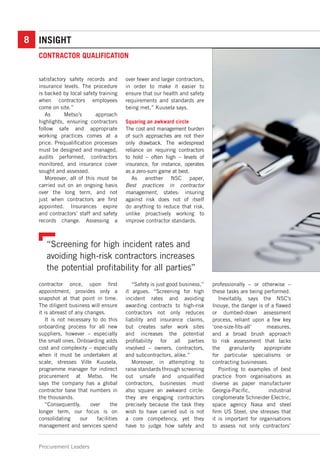
“Managing contractor compliance at the
point of first engagement is one thing;
managing it over the long term is another”
BROWZ DELIVERS assurance that your business
is working with safe, qualified and socially
responsible contractors, suppliers and vendors.
BROWZ provides a comprehensive solution to
prequalify and manage your supply chain. The
BROWZ product suite will help you identify risk
in your supply chain, prequalify and continually
monitor the partners you hire, manage employee-
level data on your suppliers, conduct safety
auditing and source new suppliers.
CONTACT DETAILS
T: 1-888-604-4981
W: www.BROWZ.com
ABOUT OUR PARTNER
11
Procurement Leaders
CATEGORY HEAD
INSIGHT
Organizations Outsource Contractor
How much can you save by implementing BROWZ?
Visit www.browz.com/roi today.
They have
limited
administrative
resources.
BROWZ partners
with you and your
contractors to
minimize risk.
They lack the
technology needed
to proactively
manage contractor
BROWZ patented technology
business needs.
They want
contractors they
can count on.
BROWZ intuitive
icons and score
cards tell you who
meets your
standards.
Contractor qualification

Contractor qualification

  • 1.
    In association with INSIGHTCONTRACTOR QUALIFICATION
  • 2.
    How cost-effective iscontractor qualification software for your company? Visit www.browz.com/roi to see how much you can save with BROWZ.
  • 3.
    3 Procurement Leaders CONTRACTOR QUALIFICATION INSIGHT ITHAS become the downside the strategy consultants don’t tell you about. Although it is widely accepted that it makes good sense for businesses to concentrate on their core competencies, the inevitable corollary is that non-core activities will have to be outsourced to third parties. But what if those third-party contractors are negligent, unsafe,or incompetent? BP can provide one answer. Back in 2010, contractor failings were implicated in the Gulf of Mexico oil well blowout that saw the Deepwater Horizon rig catch fire and sink, killing 11 crew and triggering a 206 million gallon Safe and sound? It is dangerous to assume that on-site contractors have the requisite skills and qualifications, writes Malcolm Wheatley oil spill that has so far cost the oil giant $54bn in fines and remediation costs. Or ask retailers such as Walmart, Benetton, Matalan, and Primark, slammed by consumer activists after using garment factories housed in the unsafely built nine- storey Rana Plaza building outside Dhaka, Bangladesh, which collapsed in April 2013, killing more than 1,100 workers. Tech titan Apple, meanwhile, is still smarting after a spate of high- profile suicides at its Foxconn manufacturing contractor in 2010 and sportswear company Nike still bears scars around 15  years after some of its Æ THE ‘CONTRACTOR’ pass on a lanyard conveys a lot of authority. It means the wearer has someone’s permission to be on your premises. It may even mean it’s easier to do a roll call in the unlikely event of having to evacuate because of an emergency (real or a drill). But the question is: does that hard-hatted, badge-wearing contractor have the necessary skills? Do they have the requisite training, licences and insurance? Perhaps, but how would you know? Do those signs on the wall that say ‘Safety is our number one priority’ mean anything if you have hired contractors but don’t know who is doing what? Fortunately, it isn’t necessary for procurement staff to personally check the credentials of everyone on site. There are better options. And with a typical industrial accident costing tens of thousands of dollars, those options could pay for themselves many times over. Andrew Sawers Special projects editor, Procurement Leaders © A Procurement Leaders publication. In association with BROWZ. All rights reserved PERMISSIONS AND REPRINTS Reproduction in whole or part of any photograph, text or illustration without written permission from the publisher is prohibited. Due care is taken to ensure that the content of this publication is fully accurate, but the publisher and printer cannot accept liability for errors and omissions. Published by: Sigaria Ltd Prospero House, 241 Borough High Street, London, SE1 1GA, UK
  • 4.
    4 Procurement Leaders CONTRACTOR QUALIFICATION INSIGHT shoeswere found to be produced by children working in third- world sweatshops. In short, while a strategy of sticking to their core competencies may make excellent sense for many businesses, the very act of handing over non-core tasks to third parties potentially opens the door to a whole host of unintended consequences. These include fines and penalties, reputational damage, lost production, law suits, devoting management resources to dealing with official investigations and audits, and so on. A paper from the US non-profit organisation National Safety Council (NSC), The business case for investment in safety: a guide for executives, states the most disabling workplace injuries and illnesses cost US business around $1bn each week in direct workers’ compensation costs alone. It calculates that each prevented lost-time injury or illness saves $37,000 while each avoided occupational fatality saves almost $1.4m. The NSC report also points to the fact that indirect costs – such as workplace disruption, downtime, loss of productivity in the wake of an incident, worker replacement, training, more expensive insurance premiums and legal fees – can be even greater than direct costs such as workers’ compensation, medical expenses and litigation. But what to do? One obvious answer, pursued by many businesses, is to espouse high standards of safety performance. Merely promoting such standards, though, doesn’t of itself deliver them. A week before the Deepwater Horizon accident, for instance, chief executive Tony Hayward had taken to the stage at BP’s annual general meeting. “Safety is our number one priority,” he told the company’s shareholders, as he reported on the previous year’s progress. “Our focus on safe and reliable operations is now strongly embedded in all our businesses.” To clarify expectations further, enshrine them in auditable operating procedures – ways of working that codify best practice, ADA’S PRAGMATIC APPROACH TO SUPPLIER RISK ASSESSMENT “Each prevented lost-time injury or illness saves $37,000, while each avoided occupational fatality saves almost $1.4m” “On any given day, we might have 30 or so contractors coming on site – and during our annual planned maintenance shutdown, that number rises to 150 or so,” says Tim Whatley, corporate health and safety director at ADA Carbon Solutions, an American manufacturer of activated carbon. “With so many contractors, a prequalification process provides a vital level of confidence that contractors align with our company’s core values around safety, environmental stewardship, cost, and project timeline.” But by 2014, he says, the business realised that managing so many contractors with spreadsheets and manual systems posed obvious challenges in terms of workload and efficiencies. “We would create a folder for the contractor, and have a checklist for items such as insurance certificates and safety certifications as they came in,” Whatley explains. “But when you’re managing hundreds of contractors, this can become difficult to manage, and even simply maintaining the data over time was becoming a challenge. We realised that we needed a better way of doing things.” Coincidentally a potential customer of ADA, managing hundreds of contractors, used BROWZ for this very purpose, and required the activated carbon manufacturer to use BROWZ to submit its own safety and related certifications for prequalification purposes. Whatley duly contacted BROWZ to arrange the telephone- based training that he felt he needed. “I remember that this was on a Thursday, and we arranged the training call for the following Monday,” he explains. “But on the Friday afternoon, on an impulse, I thought I’d attempt it anyway, and found the process to be really quick and straightforward. I began to answer the questions, load the
  • 5.
    5 Procurement Leaders ensuring operationsare safe, efficient and legally complaint. Again, however, BP highlights the difficulties in this. “[BP] was producing a lot of standards, but many were not very good, and many were irrelevant,” Nancy Leveson, an industrial safety expert at the Massachusetts Institute of Technology told Fortune magazine. Fortune writers Peter Elkind and David Whitford pointed out: “BP had strict guidelines barring employees from carrying a cup of coffee without a lid – but no standard procedure for how to conduct a ‘negative-pressure’ test, a critical last step in avoiding a well blowout. If done properly, that test might have saved the Deepwater Horizon.” Real qualifications This all serves to underscore the downsides and challenges of outsourcing operational tasks to third-party contractors – especially when those tasks are performed on either a business’s own premises, or on premises over which the company has contractual responsibility. More so than might be realised, poor practice among such facilities management contractors opens up an organisation to risk. Suppose a painting or electrical contractor inadvertently causes a fire, burning down all or part of a chemical plant? Or a contractor causes damage Æ required documentation and, within a short period of time, I had completed it. Given that I’d also found the customer service help desk people to be really responsive, I was impressed enough to reach out to BROWZ’s sales people.” Risk recognition A meeting with BROWZ was set up, at which Whatley discovered that the BROWZ system worked differently to some other tools he had encountered. Critically, it pragmatically recognised that different contracting activities posed different risk levels, which would permit ADA to tailor its contractors’ prequalification requirements more precisely to the actual risk that they represented or incurred. “BROWZ was the only provider that I’d come across that allowed for different tier levels of risk, with low-, medium-, and high-risk job types,” he explains. “This allows us to have different levels of assessment based on the type of work that a contractor is performing at our facility. So for example, you’ll have a janitorial service looked at differently from someone operating a crane. This really helps our contractors and helps us to build a positive relationship with them.” And – just as Whatley himself had found – contractors have had little difficulty with the new BROWZ- based prequalification process. “We have actually had some of our contractors tell us that they have really found the BROWZ process to be so much more user- friendly and efficient for them,” he concludes. “And for me, in my role, the single biggest impact is just having the required information at my fingertips: it’s so easy to log on to the BROWZ website and look up what we need.”
  • 6.
    6 Procurement Leaders CONTRACTOR QUALIFICATION INSIGHT toa production line, bringing output to a halt? What if a contractor’s working practices result in one of an organisation’s own employees being injured or killed? Or, for that matter, one of the contractor’s employees? Such suppositions are not fanciful, say those close to the issue. Far more than, say, contractors engaged to undertake major civil engineering projects or to operate major pieces of transport or municipal infrastructure, the very nature of engaging contractors in the corporate facilities management space tends to incur an element of virtually unavoidable risk. “You need people who you will feel comfortable allowing into your business, satisfied that they will comply with all the relevant stipulations regarding operational procedures, safety procedures and appropriate working practices,” says Oscar Palacios, purchasing director for North America in the wet product line of the major appliances division of domestic appliance manufacturer Electrolux. “Yet, at the same time, contractors have a business to run. So it’s important to be very transparent about those procedures and safe working practices: you don’t want contractors turning up and saying, ‘This wasn’t part of what I assumed, or part of my planned scheme of work.’” The size of contractors’ businesses also varies significantly, notes Tim Whatley, corporate health and safety director at ADA Carbon Solutions, an American manufacturer of activated carbon. This in turn calls for a sensitive and realistic approach to risk assessment if a business wishes to engage with a diverse supplier base in a socially responsible manner. “A guy laying tiles on the floor poses a different level of risk to a contracting company doing high-level steel erection work,” he explains. “It’s important to prequalify them in the same way, but reflect their size and risk differently. We have contractors ranging from a family-owned business collecting waste cardboard to large national companies. If we imposed the highest risk tier and insurance requirements on all our contractors, we’d never get the small family-run businesses working for us.” Moreover, says Joy Inouye, research associate at the NSC, the nature of the relationship between an outsourcing organisation and its contractors can have a bearing on its ability to consistently comply with safe and appropriate working practices. “Contractors aren’t inherently unsafe, but they can be subject to commercial pressures – either financial or timescale-based – CONTRACTOR QUALIFICATION: MORE THAN JUST A ‘DO ONCE’ AFFAIR Why should businesses engage BROWZ for contractor qualification and management? Quite simply, it’s about achieving better long-term control over contractor compliance, says Shane Neve, the company’s vice-president for professional services. And that improved control comes in several forms, he explains. “We talk to many businesses that don’t have an issue with contractor prequalification, but that are aware that once they’ve qualified a contractor, they rarely go back and revisit that qualification. And that’s a risk – one that companies see and perceive, but one that it’s difficult to justify continually devoting resources to.” Better control also arises through improved management information on contractor compliance, he adds. BROWZ’s Software-as-a-Service solution isn’t just a transaction and storage engine, but also a reporting tool. “Look at how even those businesses that excel at contractor qualification manage the resulting information, and you’ll see that spreadsheets and filing cabinets are commonplace. But while spreadsheets and filing cabinets are acceptable as data repositories, they don’t have in-built reporting or assessment capabilities – whereas our software solution does, enabling businesses to slice-and-dice information however they wish.”
  • 7.
    7 Procurement Leaders which canin turn encourage a contractor’s employees to cut corners,” she observes. “Often, too, the nature of contracting employment is such that employees won’t report in sick for minor ailments, and so will continue to work while physically impaired, which can lead to injury. Finally, the nature of contracting may lead to a contractor’s employees being undertrained or underqualified for particular kinds of work: they may not have the full specialised certificate that might be required, or such certification may not be up to date. And in each case, while the outsourcing organisation may be strict about holding its own employees to its standards, enforcement in the case of a contractor’s employees might be more relaxed.” Staying up to date Clearly, many businesses are aware of these risks, and seek to protect themselves from them. Talk to senior executives tasked with procuring facilities management and similar services from third-party contractors, and a familiar series of protective steps is quickly discernible. Typically, for example, businesses will have in place some prequalification processes designed to quickly and economically screen out the contractors least likely to meet their safety and compliance standards. When label manufacturer Avery Dennison seeks bids for specific contracting services, explains Joe Larocca, the company’s global category manager for capital equipment, it generally relies on a pool of contractors with which it has had satisfactory past experiences, and that are known to possess the financial and management strengths required in order to meet Avery’s broad requirements. “That tends to eliminate the ‘mom and pop’ shops,” he observes. “We then move on to lay out the specific scope of work that is involved, and specify, as part of the bid package, the quality and safety standards that must be met, the insurance requirements that must be met, and the warranties and indemnifications we require.” Typically, too, he adds, while contractors will be required to adhere to Avery Dennison’s corporate health and safety standards, each manufacturing site will also have in place its own local contractor-specific and activity-specific safety requirements, which will have been developed by the site’s own local environment, health and safety manager. At industrial company Metso, meanwhile, a broadly similar process applies, explains Ann- Mari Mattila, sourcing category manager for indirect procurement. While the firm tends to use contractors with which it has satisfactory previous experiences over a number of years, and are known to understand and comply with Metso’s requirements, a careful process of onboarding new contractors aims to weed out the mavericks. “Effectively, it’s a two-stage process,” she explains. “At a high level, the contractors commit to Metso health, safety and environmental requirements via corporate contracts and are obliged to demonstrate Æ “We want to deal with contractors that meet the standards, not those that downloaded a tick-the-box template” Third, adds Neve, BROWZ helps businesses with hundreds or thousands of contractors to achieve long-term contractor compliance at a cost that’s usually significantly lower than carrying out the activity in-house. On its website, the firm hosts a tool that enables businesses to input their own particular circumstances and calculate the return on investment they could potentially enjoy by using BROWZ technology. “Let’s be clear: cost is rarely the key driver for our clients – safety, and protection from reputational risk come higher up,” he says. “But it’s still part of the compliance equation, and is still something that companies are aware of. The BROWZ solution lowers the cost of achieving long-term contractor compliance, and frees up internal resources to focus on other things. It’s not about doing it better or more cheaply, it’s about doing it better and more cheaply.”
  • 8.
    8 Procurement Leaders CONTRACTOR QUALIFICATION INSIGHT satisfactorysafety records and insurance levels. The procedure is backed by local safety training when contractors employees come on site.” As Metso’s approach highlights, ensuring contractors follow safe and appropriate working practices comes at a price. Prequalification processes must be designed and managed, audits performed, contractors monitored, and insurance cover sought and assessed. Moreover, all of this must be carried out on an ongoing basis over the long term, and not just when contractors are first appointed. Insurances expire and contractors’ staff and safety records change. Assessing a contractor once, upon first appointment, provides only a snapshot at that point in time. The diligent business will ensure it is abreast of any changes. It is not necessary to do this onboarding process for all new suppliers, however – especially the small ones. Onboarding adds cost and complexity – especially when it must be undertaken at scale, stresses Ville Kuusela, programme manager for indirect procurement at Metso. He says the company has a global contractor base that numbers in the thousands. “Consequently, over the longer term, our focus is on consolidating our facilities management and services spend over fewer and larger contractors, in order to make it easier to ensure that our health and safety requirements and standards are being met,” Kuusela says. Squaring an awkward circle The cost and management burden of such approaches are not their only drawback. The widespread reliance on requiring contractors to hold – often high – levels of insurance, for instance, operates as a zero-sum game at best. As another NSC paper, Best practices in contractor management, states: insuring against risk does not of itself do anything to reduce that risk, unlike proactively working to improve contractor standards. “Safety is just good business,” it argues. “Screening for high incident rates and avoiding awarding contracts to high-risk contractors not only reduces liability and insurance claims, but creates safer work sites and increases the potential profitability for all parties involved – owners, contractors, and subcontractors, alike.” Moreover, in attempting to raise standards through screening out unsafe and unqualified contractors, businesses must also square an awkward circle: they are engaging contractors precisely because the task they wish to have carried out is not a core competency, yet they have to judge how safely and professionally  – or otherwise – these tasks are being performed. Inevitably, says the NSC’s Inouye, the danger is of a flawed or dumbed-down assessment process, reliant upon a few key ‘one-size-fits-all’ measures, and a broad brush approach to risk assessment that lacks the granularity appropriate for particular specialisms or contracting businesses. Pointing to examples of best practice from organisations as diverse as paper manufacturer Georgia-Pacific, industrial conglomerate Schneider Electric, space agency Nasa and steel firm US Steel, she stresses that it is important for organisations to assess not only contractors’ “Screening for high incident rates and avoiding high-risk contractors increases the potential profitability for all parties”
  • 9.
    9 Procurement Leaders safety recordsand experience, but also the risks inherent in the type of work being undertaken: a landscape gardener, for instance, will face a different set of risks from a contractor engaged to work at heights, or with dangerous machinery. Understanding the risks Businesses face a particularly thorny dilemma. Aware of the wisdom of outsourcing non- core competencies to third- party contractors, they are also uncomfortably aware of the dangers implicit in this. In seeking to mitigate against these dangers, they incur a costly administrative burden – one tinged with the knowledge that a maverick contractor may still slip through the net. What to do? A growing number of businesses are squaring the circle by turning to another third- party – specialists such as Salt Lake City-headquartered BROWZ, which combines a deep bench of skills in contractor management and evaluation with an innovative Software-as-a-Service (SaaS) solution designed to apply those skills to clients’ needs. At its simplest, explains Shane Neve, vice-president for professional services at BROWZ, the company supports its clients’ contractor assurance requirements in three ways. “First, we work with a client’s contractors to determine exactly what it is that those contractors do for our client, where the risks are, and what assurances and further investigations might be required. You’d be surprised at just how many clients don’t have that level of granular visibility into their contracting supply chains. It’s a risk-driven process: a contractor refilling vending machines poses a very different risk from a contractor carrying out electrical maintenance, or working at heights,” he says. “Second, our operational audit teams work with contractors to audit and assess their operations, gathering data on safety records, risk management processes, qualifications and certifications, and any applicable insurances. This information is then fed back to our clients, contractor by contractor, as either weighted scorecards or traffic lights – so clients can understand exactly what risks they are incurring, and from which contractors. “Third, there’s a SaaS solution designed to serve as a hub, allowing BROWZ’s operational teams, our clients and their contractors to collaboratively maintain up-to-date records demonstrating compliance with contractual requirements, insurances, and agreed performance standards. What’s more, as our clients onboard new contractors, our software platform serves as the hub for them to begin demonstrating their own compliance and safety performances.” It’s precisely this software- powered, tight, efficient, and low-cost linkage between BROWZ’s operational teams, its clients, and its clients’ contractors that makes Æ
  • 10.
    10 Procurement Leaders CONTRACTOR QUALIFICATION INSIGHT thefirm’s offering attractive to businesses, asserts Aaron Rudd, BROWZ vice-president of product development. “Managing contractor compliance at the point of first engagement is one thing; managing it over the long term is quite another; 50% of our offering is in the form of services, 50% in the form of our SaaS platform – and to manage contractors cost- effectively over the long term you need both,” Rudd says. Jonathan Scheibe, life safety programs manager in the environmental, health, and safety function of speciality chemical manufacturer Ashland, agrees. A BROWZ client since 2011, the business has found BROWZ has enabled Ashland to ensure consistent standards of contractor management right across its North American operations, irrespective of the size of manufacturing plants in question. “Large facilities have experienced environmental, health and safety teams, while smaller facilities might roll the activity into the job description of the operations of maintenance manager,” he says. “Using BROWZ, we know that contractor management is being undertaken to the same standard, right across the business. For the first time, we’re achieving business- wide levels of consistency and thoroughness in contractor management – and incidentally, doing so at lower cost, although that wasn’t the key driver.” “Plus, we know – positively and without doubt – how compliant our individual contractors are. Our compliance rate has gone up from 50%-55% to an average of 75% – and in some plants higher. That’s a demonstrable difference, and using BROWZ has helped us achieve it.” n “Managing contractor compliance at the point of first engagement is one thing; managing it over the long term is another” BROWZ DELIVERS assurance that your business is working with safe, qualified and socially responsible contractors, suppliers and vendors. BROWZ provides a comprehensive solution to prequalify and manage your supply chain. The BROWZ product suite will help you identify risk in your supply chain, prequalify and continually monitor the partners you hire, manage employee- level data on your suppliers, conduct safety auditing and source new suppliers. CONTACT DETAILS T: 1-888-604-4981 W: www.BROWZ.com ABOUT OUR PARTNER
  • 11.
    11 Procurement Leaders CATEGORY HEAD INSIGHT OrganizationsOutsource Contractor How much can you save by implementing BROWZ? Visit www.browz.com/roi today. They have limited administrative resources. BROWZ partners with you and your contractors to minimize risk. They lack the technology needed to proactively manage contractor BROWZ patented technology business needs. They want contractors they can count on. BROWZ intuitive icons and score cards tell you who meets your standards.