Open Education and
Digitalized Society
Digital Learning in a Borderless World
The International Congress on Education for the 21st Century (ICE2017),
Bangkok, Thailand, May 3-4, 2017
Gard Titlestad, Secretary General
International Council for Open and Distance Education
Member of the Governing Board
Outline
• The new paradigm of lifelong learning
• The big change
• Trends and responses when digitalization
happens
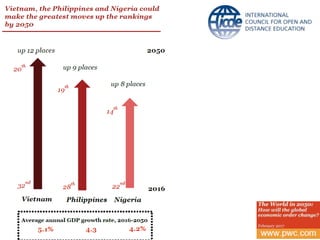
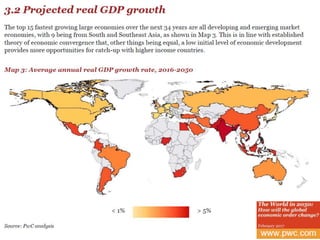
• South East Asia and the big change
• A benchmark for South East Asia?
• Message
What is
Open Educational
Resources
A catalyst for
innovation
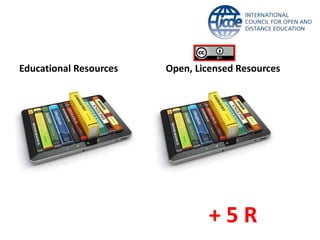
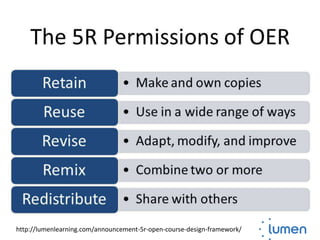
Educational Resources Open, Licensed Resources
+ 5 R
http://lumenlearning.com/announcement-5r-open-course-design-framework/
The Learners
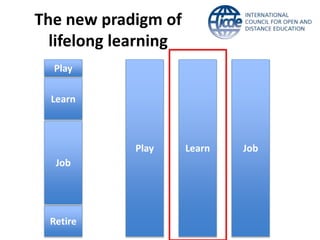
Play
Retire
Learn
Job
Play Learn Job
The new pradigm of
lifelong learning
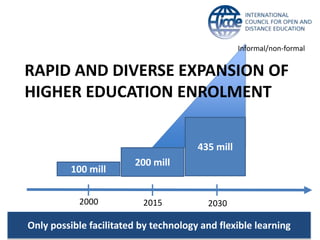
Informal/non-formal
RAPID AND DIVERSE EXPANSION OF
HIGHER EDUCATION ENROLMENT
100 mill
200 mill
2000 2015 2030
435 mill
Only possible facilitated by technology and flexible learning
Where are we now?
One year after………..
http://gem-report-2016.unesco.org/en/home/
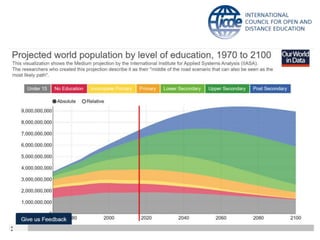
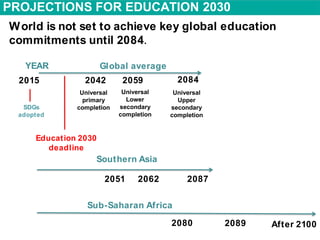
World is not set to achieve key global education
commitments until 2084.
PROJECTIONS FOR EDUCATION 2030
2030 2042 2059 2084
Universal
primary
completion
Universal
Upper
secondary
completion
Universal
Lower
secondary
completion
YEAR
Education 2030
deadline
Education 2030
deadline
2042 2059 2084
YEAR Global average
Universal
primary
completion
Universal
Upper
secondary
completion
Universal
Lower
secondary
completion
2015
SDGs
adopted
20872051 2062
Southern Asia
After 21002080 2089
Sub-Saharan Africa
The Big Change
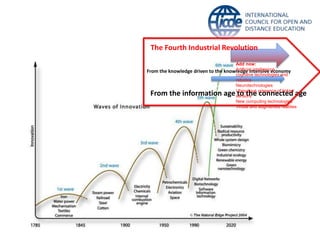
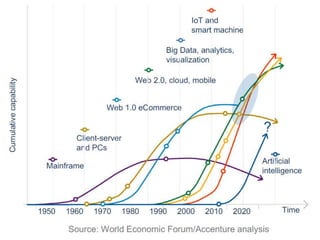
From the information age to the connected age
From the knowledge driven to the knowledge intensive economy
The Fourth Industrial Revolution
Add now:
Artificial intelligence,
cognitive technologies and
robotics
Neurotechnologies
Ubiquitous presence of linked
sensors
New computing technologies
Virtual and augmented realities
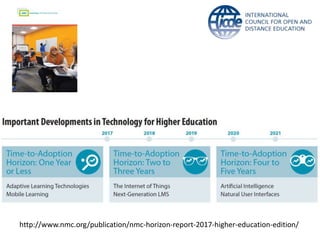
http://www.nmc.org/publication/nmc-horizon-report-2017-higher-education-edition/
Higher Education
Trends in the
digital era
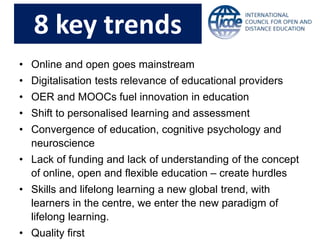
8 key trends
• Online and open goes mainstream
• Digitalisation tests relevance of educational providers
• OER and MOOCs fuel innovation in education
• Shift to personalised learning and assessment
• Convergence of education, cognitive psychology and
neuroscience
• Lack of funding and lack of understanding of the concept
of online, open and flexible education – create hurdles
• Skills and lifelong learning a new global trend, with
learners in the centre, we enter the new paradigm of
lifelong learning.
• Quality first
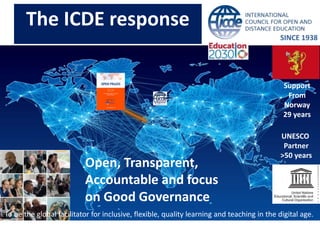
Open, Transparent,
Accountable and focus
on Good Governance
Support
From
Norway
29 years
UNESCO
Partner
>50 years
SINCE 1938
To be the global facilitator for inclusive, flexible, quality learning and teaching in the digital age.
The ICDE response
• Awareness, advocacy, analysis related to digital, flexible and open
• Quality
– Global quality network
– Partner with UNESCO for Quality in Higher Education
– Global Doctoral Consortium
– Map models for online, open and technology enhanced education
• Knowledge exchange – clustering
– Learning analytics
– Collaborative online international learning COIL
– Blended learning
• OER and open initiatives
– ICDE OER Chairs
– Global Open Library? Connecting OER repositories
• Aims for North-South-South initiatives, in collaboration with the Teachers
Task Force/UNESCO
• Events, conferences and webinars
ICDE actions
ICDE International Conference
Lifelong Learning,
Lillehammer February 11. – 13. 2019
1.Emerging Pedagogies and Designs for
Online Learning
2.Expanding Access, Openness and
Flexibility
3.Changing Models of Assessment
4.New Delivery Tools and Resources for
Learning
5.Re-designed Institutional Business
Models
More on
trends and
what ICDE
does:
www.icde.org
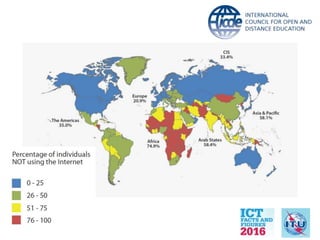
South East Asia and
the big change
The future
And Education in
the digital era?
Making a Difference: Shaping a
New Learning Paradigm for a
Sustainable Southeast Asia?
How to benchmark this?
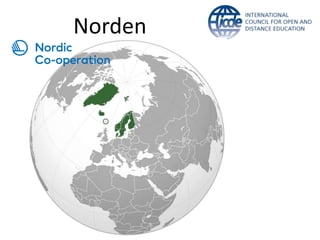
Norden
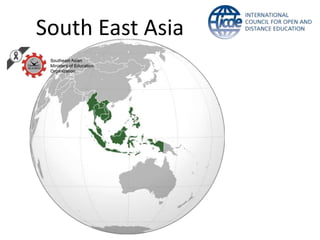
South East Asia
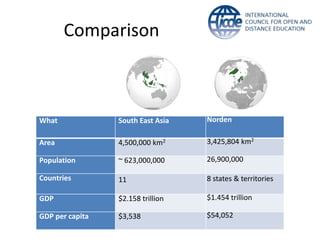
Comparison
What South East Asia Norden
Area 4,500,000 km2 3,425,804 km2
Population ~ 623,000,000 26,900,000
Countries 11 8 states & territories
GDP $2.158 trillion $1.454 trillion
GDP per capita $3,538 $54,052
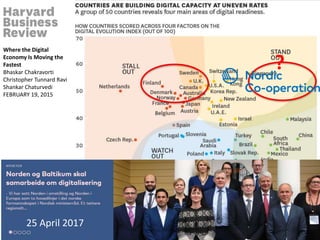
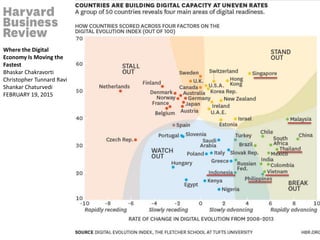
Where the Digital
Economy Is Moving the
Fastest
Bhaskar Chakravorti
Christopher Tunnard Ravi
Shankar Chaturvedi
FEBRUARY 19, 2015
Where the Digital
Economy Is Moving the
Fastest
Bhaskar Chakravorti
Christopher Tunnard Ravi
Shankar Chaturvedi
FEBRUARY 19, 2015
25 April 2017
?
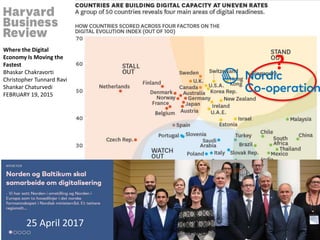
Where the Digital
Economy Is Moving the
Fastest
Bhaskar Chakravorti
Christopher Tunnard Ravi
Shankar Chaturvedi
FEBRUARY 19, 2015
25 April 2017
?
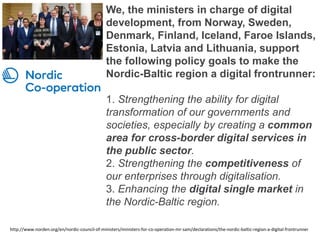
We, the ministers in charge of digital
development, from Norway, Sweden,
Denmark, Finland, Iceland, Faroe Islands,
Estonia, Latvia and Lithuania, support
the following policy goals to make the
Nordic-Baltic region a digital frontrunner:
1. Strengthening the ability for digital
transformation of our governments and
societies, especially by creating a common
area for cross-border digital services in
the public sector.
2. Strengthening the competitiveness of
our enterprises through digitalisation.
3. Enhancing the digital single market in
the Nordic-Baltic region.
http://www.norden.org/en/nordic-council-of-ministers/ministers-for-co-operation-mr-sam/declarations/the-nordic-baltic-region-a-digital-frontrunner
Questions for
benchmarking
• A shared, common education area?
• Mutual recognition of qualifications?
• A shared area for free movement of knowledge?
• A shared digital infrastructure
• Aim for building a shared high capacity network?
• Black fiber binding the countries together?
• A SEA digital single market?
• Lead relative investments in Education?
• A strategy for learning anf teching in the digital age?
• Base education learning material on OER?
• Agree to invest jointly across boarder in quality OER and translate?
• Leap frog on mobile and blended learning?
• Leap frog on OER?
Good Teachers and Rich Content
Open up for
great learning
experience
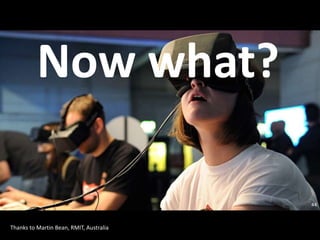
• Woman in virtual glasses
44
Now what?
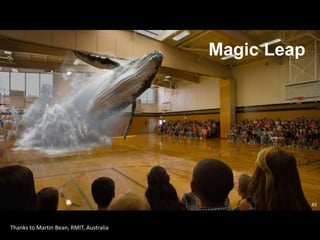
Thanks to Martin Bean, RMIT, Australia
45
Magic Leap
Thanks to Martin Bean, RMIT, Australia
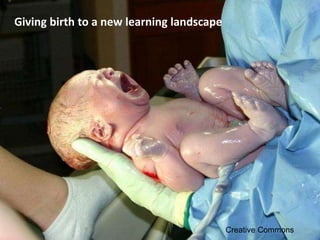
Giving birth to a new learning landscape
Creative Commons
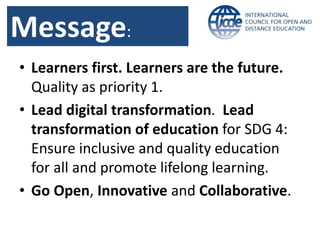
Message:
• Learners first. Learners are the future.
Quality as priority 1.
• Lead digital transformation. Lead
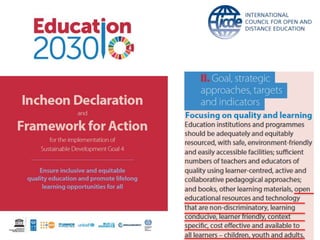
transformation of education for SDG 4:
Ensure inclusive and quality education
for all and promote lifelong learning.
• Go Open, Innovative and Collaborative.
”TOWARDS INCLUSIVE AND EQUITABLE
QUALITY EDUCATION AND LIFELONG
LEARNING FOR ALL”
Sustainable Development Goal 4: Education 2030
THANK YOU!
titlestad@icde.org
www.icde.org

Digital Learning in a Borderless World

  • 1.
    Open Education and DigitalizedSociety Digital Learning in a Borderless World The International Congress on Education for the 21st Century (ICE2017), Bangkok, Thailand, May 3-4, 2017 Gard Titlestad, Secretary General International Council for Open and Distance Education Member of the Governing Board
  • 2.
    Outline • The newparadigm of lifelong learning • The big change • Trends and responses when digitalization happens • South East Asia and the big change • A benchmark for South East Asia? • Message
  • 3.
    What is Open Educational Resources Acatalyst for innovation
  • 4.
    Educational Resources Open,Licensed Resources + 5 R
  • 5.
  • 6.
  • 8.
    Play Retire Learn Job Play Learn Job Thenew pradigm of lifelong learning
  • 10.
    Informal/non-formal RAPID AND DIVERSEEXPANSION OF HIGHER EDUCATION ENROLMENT 100 mill 200 mill 2000 2015 2030 435 mill Only possible facilitated by technology and flexible learning
  • 12.
    Where are wenow? One year after………..
  • 13.
  • 14.
    World is notset to achieve key global education commitments until 2084. PROJECTIONS FOR EDUCATION 2030 2030 2042 2059 2084 Universal primary completion Universal Upper secondary completion Universal Lower secondary completion YEAR Education 2030 deadline Education 2030 deadline 2042 2059 2084 YEAR Global average Universal primary completion Universal Upper secondary completion Universal Lower secondary completion 2015 SDGs adopted 20872051 2062 Southern Asia After 21002080 2089 Sub-Saharan Africa
  • 15.
  • 16.
    From the informationage to the connected age From the knowledge driven to the knowledge intensive economy The Fourth Industrial Revolution Add now: Artificial intelligence, cognitive technologies and robotics Neurotechnologies Ubiquitous presence of linked sensors New computing technologies Virtual and augmented realities
  • 18.
  • 19.
  • 20.
    8 key trends •Online and open goes mainstream • Digitalisation tests relevance of educational providers • OER and MOOCs fuel innovation in education • Shift to personalised learning and assessment • Convergence of education, cognitive psychology and neuroscience • Lack of funding and lack of understanding of the concept of online, open and flexible education – create hurdles • Skills and lifelong learning a new global trend, with learners in the centre, we enter the new paradigm of lifelong learning. • Quality first
  • 21.
    Open, Transparent, Accountable andfocus on Good Governance Support From Norway 29 years UNESCO Partner >50 years SINCE 1938 To be the global facilitator for inclusive, flexible, quality learning and teaching in the digital age. The ICDE response
  • 22.
    • Awareness, advocacy,analysis related to digital, flexible and open • Quality – Global quality network – Partner with UNESCO for Quality in Higher Education – Global Doctoral Consortium – Map models for online, open and technology enhanced education • Knowledge exchange – clustering – Learning analytics – Collaborative online international learning COIL – Blended learning • OER and open initiatives – ICDE OER Chairs – Global Open Library? Connecting OER repositories • Aims for North-South-South initiatives, in collaboration with the Teachers Task Force/UNESCO • Events, conferences and webinars ICDE actions
  • 23.
    ICDE International Conference LifelongLearning, Lillehammer February 11. – 13. 2019 1.Emerging Pedagogies and Designs for Online Learning 2.Expanding Access, Openness and Flexibility 3.Changing Models of Assessment 4.New Delivery Tools and Resources for Learning 5.Re-designed Institutional Business Models
  • 24.
    More on trends and whatICDE does: www.icde.org
  • 25.
    South East Asiaand the big change
  • 30.
  • 33.
  • 34.
    Making a Difference:Shaping a New Learning Paradigm for a Sustainable Southeast Asia? How to benchmark this?
  • 35.
  • 36.
  • 37.
    Comparison What South EastAsia Norden Area 4,500,000 km2 3,425,804 km2 Population ~ 623,000,000 26,900,000 Countries 11 8 states & territories GDP $2.158 trillion $1.454 trillion GDP per capita $3,538 $54,052
  • 38.
    Where the Digital EconomyIs Moving the Fastest Bhaskar Chakravorti Christopher Tunnard Ravi Shankar Chaturvedi FEBRUARY 19, 2015
  • 39.
    Where the Digital EconomyIs Moving the Fastest Bhaskar Chakravorti Christopher Tunnard Ravi Shankar Chaturvedi FEBRUARY 19, 2015 25 April 2017 ?
  • 40.
    Where the Digital EconomyIs Moving the Fastest Bhaskar Chakravorti Christopher Tunnard Ravi Shankar Chaturvedi FEBRUARY 19, 2015 25 April 2017 ?
  • 41.
    We, the ministersin charge of digital development, from Norway, Sweden, Denmark, Finland, Iceland, Faroe Islands, Estonia, Latvia and Lithuania, support the following policy goals to make the Nordic-Baltic region a digital frontrunner: 1. Strengthening the ability for digital transformation of our governments and societies, especially by creating a common area for cross-border digital services in the public sector. 2. Strengthening the competitiveness of our enterprises through digitalisation. 3. Enhancing the digital single market in the Nordic-Baltic region. http://www.norden.org/en/nordic-council-of-ministers/ministers-for-co-operation-mr-sam/declarations/the-nordic-baltic-region-a-digital-frontrunner
  • 42.
    Questions for benchmarking • Ashared, common education area? • Mutual recognition of qualifications? • A shared area for free movement of knowledge? • A shared digital infrastructure • Aim for building a shared high capacity network? • Black fiber binding the countries together? • A SEA digital single market? • Lead relative investments in Education? • A strategy for learning anf teching in the digital age? • Base education learning material on OER? • Agree to invest jointly across boarder in quality OER and translate? • Leap frog on mobile and blended learning? • Leap frog on OER?
  • 43.
    Good Teachers andRich Content Open up for great learning experience
  • 44.
    • Woman invirtual glasses 44 Now what? Thanks to Martin Bean, RMIT, Australia
  • 45.
    45 Magic Leap Thanks toMartin Bean, RMIT, Australia
  • 46.
    Giving birth toa new learning landscape Creative Commons
  • 47.
    Message: • Learners first.Learners are the future. Quality as priority 1. • Lead digital transformation. Lead transformation of education for SDG 4: Ensure inclusive and quality education for all and promote lifelong learning. • Go Open, Innovative and Collaborative.
  • 48.
    ”TOWARDS INCLUSIVE ANDEQUITABLE QUALITY EDUCATION AND LIFELONG LEARNING FOR ALL” Sustainable Development Goal 4: Education 2030 THANK YOU! titlestad@icde.org www.icde.org

Editor's Notes

  • #11 • What before was in the margins, open and distance learning, is now going mainstream in large parts of the world, materialised as online, blended, open, flexible, technology enhanced and e-Learning. Convergence is here, followed by increasing competition (and collaboration) and diversity in higher education. While this is the main trend, the situation in some regions will provide a different picture, e.g. in parts of the south.