
The
Financial Aid
Process
Paying for College
“Making college accessible and
        affordable for Illinois students.”
                                               - Mission Statement

The Illinois Student Assistance Commission (ISAC) is the
financial aid agency in the state of Illinois that administers
scholarship, grant, and prepaid tuition programs.
College Tuition and Fees


     Source: Trends in College Pricing 2011, The College Board, New York, NY.
     http://trends.collegeboard.org/college_pricing/overview/introduction
                                           3
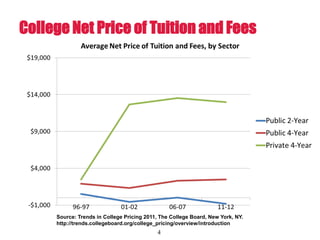
College Net Price of Tuition and Fees


     Source: Trends in College Pricing 2011, The College Board, New York, NY.
     http://trends.collegeboard.org/college_pricing/overview/introduction
                                           4
Education Pays
   •Unemployment Rate, Age 25+, December 2010
   15.0%
                                                                                  National
                                                                                  Average
                                                                                   9.4%
   10.0%


    5.0%


    0.0%
            Less than a high      High school           Some        Associate's    Bachelor's
            school diploma         graduates          College, No    Degree        Degree and
                                                        Degree                      Higher
Note: Data are averages for persons 25 and over.
Source: Bureau of Labor Statistics, Current Population Survey
(December 2010)                                          5
Education Pays
   •Median Weekly Earnings, Age 25+, December 2010
    $1,400


                               National
    $1,050                     Average
                                $788

      $700


      $350


       $-
              Less than a high      High school     Some College or   Bachelor's   Advanced
              school diploma        graduates*        Associate's      Degree       Degree
                                                       Degree
Note: Data are averages for persons 25 and over.
Source: Bureau of Labor Statistics, Current Population Survey
(December 2010)
                                                        6
Plan to go to college
There are lots of things to   •   How much will it cost?
think about and many
questions you need to ask.    •   Can I afford college?
                              •   What is financial aid?
                              •   What is a FAFSA?
                              •   When and how do I apply?
                              •   Where can I get help?


                                         Ask questions…
Ways to Finance College

•   Financial Aid Programs

•   529 Savings & Prepaid
    Tuition Programs

•   Employer Tuition Benefits

•   Tuition Payment Plans


                      Know your options…
What is financial aid?
Financial aid makes college affordable for you.

•   Financial aid refers to specific
    borrowed, given, or earned money that
    can be obtained from various sources
    to help pay for college.

•   It is intended to make up the difference
    between what your family can afford to
    pay and what college costs.


If you think you can’t afford college, think
again. There’s lots of aid out there.
Types of Financial Aid
There are many types of financial aid.


                                      Grants
            gift aid
                                      Scholarships

          self-help                   Work-Study
             aid
                                      Loans

    These funds may be merit-based, need-based, or non need-based.
Sources of Financial Aid
Financial aid comes from a variety of sources.


             federal                 state
           government             government


                                   outside/
               college
                                    private
            (institutional aid)
                                   sources
Sources of Financial Aid
The “Must-Get-To-Know” Financial Aid Sources


          Illinois Student                 U.S. Department of
      Assistance Commission               Education’s Office of
                                          Federal Student Aid
             www.isac.org
                                        www.FederalStudentAid.ed.gov

     The agency in the State of
                                       The federal agency that
     Illinois that administers state
                                       provides college funding in the
     and federal
                                       form of grant, scholarship, work-
     grant, scholarship, and prepaid
                                       study, and educational loan
     tuition programs.
                                       programs.
The Big Three
      Maximum Award Amounts for 2012-13

                                             Up to                — State of Illinois
                                            $4,720*                 Monetary Award
                                                                    Program (MAP)

                                                    Up to
                                                   $5,550         — Federal Pell Grant

                                                                  — Federal Supplemental
                                              Up to
                                             $4,000                 Education Opportunity
      Total = $14,270
                                                                    Grant (FSEOG)
* Based on funding as of publication date. Announced grand
awards could increase or decrease throughout the academic year.
Illinois Student Assistance Commission
Grant and Scholarship Programs
Program                                                 Type of Aid                                2012-2013 Benefit
Monetary Award Program                      MAP         Grant; Need-based; Appropriation           up to $4,720
Silas Purnell IL Incentive for Access       IIA         Grant; Need-based; Appropriation           up to $1,000 (Not funded)

Illinois Veteran Grant                      IVG         Grant; Entitlement                         maximum 12 units per term, up
                                                                                                   to 120 units cumulative
Illinois National Guard Grant               ING         Grant; Entitlement                         maximum 12 units per term, up
                                                                                                   to 120 units cumulative
Grant Program for Dependents of Police,                 Grant; Appropriation                       up to 8 semesters or 12
Fire, or Correctional Officers                                                                     quarters
Bonus Incentive Grant (BIG) Program         BIG         Grant; Appropriation                       $40 to $440
Illinois State Scholars Program             ISSP        Certificate of Achievement, Scholarship,   $1,000 (Not funded)
                                                        Appropriation
Merit Recognition Scholarship               MRS         Scholarship; Merit-Based; Appropriation    $1,000 (Not funded)


Teacher Programs
Program                                                        Type of Aid                          2012-2013 Benefit
Minority Teachers of Illinois Scholarship         MTI          Scholarship; Appropriation           up to $5,000
IL Special Ed. Teacher Tuition Waiver        SETTW             Waiver                               up to 4 yrs


* Academic year 2011-12 was the final year of IFTC funding.
U. S. Department of Education
 Federal Grant Programs
Program                              Acronym   Type of Aid             2012-2013 Award

Federal Pell Grant                             Grant; Need-based       up to $5,550
Iraq and Afghanistan Service Grant             Grant                   up to $5,550

Federal TEACH Grant Program          TEACH     Grant                   up to $4,000 a yr; total amount may not
                                                                       exceed $16,000.


 Campus-Based Programs
Program                              Acronym   Type of Aid             2012-2013 Award
Federal Supplemental Education       FSEOG     Grant                   $100-$4,000
Opportunity Grant                              Exceptional Need
Federal Work-Study                     FWS     Need-based Employment   no annual minimum or maximum
                                                                       amounts; at least minimum wage

Perkins Loans                                  Need-based Loan         up to $5,500 for undergraduates and up
                                                                       to $8,000 for graduate students
Federal Work-Study
A need-based employment
program that provides on- and off-
campus jobs to students.
A completed FAFSA is required

It is a campus-based financial aid program; funds are limited
and available only at participating postsecondary institutions

Priority deadlines may apply

Compensation is at least the current federal minimum wage

A student must earn these funds
Loan Programs
When evaluating loan options, consider the
following:


                                                Repayment
   Source        Subsidized                      Options
                                  Interest
     of             vs.                             &
                                    Rate
    Loan        Unsubsidized                      Grace
                                                  Period


Start by knowing your rights and responsibilities.
U. S. Department of Education
Federal Loan Programs, 2012-13

                          Type           Rate           Amount                Grace
                          Subsidized        5%          $5,500 per year          9
Perkins                                    Fixed                               Months

                          Subsidized       3.4%         $3,500 first year        6
Stafford*                                  Fixed                               Months
(2012-2013)
                         Unsubsidized      6.8%       $2,000 first year for       6
                                           fixed      dependents, $6,000        Months
                                                       for independents
                                                            first year
                         Credit-based      7.9%           Depends on          Within first
PLUS                     Unsubsidized      fixed       remaining financial     60 days
                                                             need.
Graduate PLUS

*Note: New Stafford Loans (both subsidized and unsubsidized) for Graduate students
have a fixed interest rate of 6.8% through the 2012-2013 academic year.
Subsidized vs. Unsubsidized
To understand the difference between the two,
consider this: When will interest begin to accrue?

    Type          Need or                 Interest
                  No Need

Subsidized      A need-based   Interest is paid by the federal
Stafford Loan   loan           government while a student is in
                               school at least ½ time, during
                               grace period, and during
                               authorized periods of deferment

Unsubsidized    NOT a need-    A student is always responsible
Stafford Loan   based loan     for paying interest
How to Apply
To be considered for student aid, a student must
complete all forms required by a college.


          Free            Institutional            Other
     Application for         Forms
        Federal                                   as required
      Student Aid
       (FAFSA)


Note: Communicate with each college to find out what is required for
a complete application.
Free Application for Federal Student Aid (FAFSA)
What is a FAFSA?
It is the first step in the financial aid process. A FAFSA is used to apply
for state and federal financial aid programs. In addition, some colleges
use it to award institutional aid. The application is available at no fee.

Three Ways to Access a FAFSA


     Paper FAFSA           FAFSA on the Web             .pdf FAFSA
   1-800-4-FED-AID           www.FAFSA.gov            www.FAFSA.gov
When to Apply for the 2012-2013 Academic Year
Important Dates

     FAFSA       • January 1 (First date to submit FAFSA)


                 • Dates vary by college (Check with each
    College
                   college)

     MAP         • As soon as possible after January 1, 2012.
     Grant         Awards made until funds are depleted.*

    Federal
                 • June 30, 2013 (at the end of the academic
      Pell
     Grant         year)

* Note: In Illinois, grants and dollar amounts are subject to appropriations by
the Illinois General Assembly and the Governor.
Completing the FAFSA
    What information is needed?
    o Social Security Number. Be sure that it is correct!
    o Records of income, such as income earned from work and business, child support
        paid or received, and any other untaxed income. If available, refer to the W-2
        Forms and the Federal Income Tax Return IRS 1040, 1040A, or 1040EZ.
    o Information about assets, such as savings, certificates of deposit, stock options,
        bonds, 529 plans and other college savings programs, and investment real estate,
        business, and farm.
    o Driver’s license number, if the student has one.
    o Alien Registration Number, if not a U.S. citizen.
NOTES:
•   Parental information is required unless a student is at least 24 years of age or meets the criteria for filing as an independent
    student as described on the Free Application for Federal Student Aid. Refer to www.FAFSA.gov.
•   A student must report his or her income and assets and those of the parents (if a dependent student) or spouse (if married).
•   Use income records for the year prior to the academic year for which a student is applying: for instance, if filling the 2012-
    2013 FAFSA, refer to 2011 tax information.
Personal Identification Number (PIN)
A PIN, along with other identifiers, gives Internet access to
information on the Federal Student Aid systems.

•   Serves as an electronic signature and
    provides access to personal records          PIN Checklist

•   Go to www.pin.ed.gov                         oSocial Security Number
                                                 oLast Name
    Option 1: Create a four-digit PIN
    Option 2: Have the site create PIN           oFirst Name
                                                 oMiddle Initial
•   PIN is conditional until relevant
    information is verified with the Social      oDate of Birth
    Security Administration (1-3 days)           oStreet Address
•   PIN will not expire at the end of the year
                                                 oe-Mail address (optional)
•   Parents and students need a pin to use
    the FAFSA on the Web.
What are the costs?

    Tuition & Fees
    Room & Board
    Transportation
    Books & Supplies
    Miscellaneous Living Expenses
+
    Cost of Attendance (COA)
Expected Family Contribution
                                A need analysis formula established
                                by Congress determines a student’s
          EFC                   Expected Family Contribution;
 Expected Family Contribution
                                using information reported on the
                                FAFSA.


         What?                           Why?                     Where?
A comparative measure           Used to determine a         Shown on the Student
of how much a family can        student’s eligibility for   Aid Report (SAR)
be expected to contribute       most federal and state
over the course of an           assistance
academic year
Financial Need
How much aid can a student receive?


                   Expected
  Cost of
                    Family            Financial
 Attendance
              -   Contribution   =      Need
   (COA)
                    (EFC)
Three Examples
                 COA                      EFC               Financial
          (Cost of Attendance)       (Expected Family         Need
                                       Contribution)

College
               $10,000           -      $3,000          =     $7,000
  A
College
                                 -                      =
  B            $20,000                  $3,000               $17,000


College
                                 -                      =
 C             $35,000                  $3,000               $32,000
Financial Aid Awards
The financial aid administrator at the college will
package all available aid and send an award offer for
consideration.

Goal: To meet a student’s need.


 •   What is the total cost of       •   What is the Expected
     attendance?                         Family Contribution?

 •   What is a student’s financial   •   What types of financial
     aid eligibility?                    aid are included?
 •   Was financial need met?         •   What is the out-of-pocket cost?
Other Things to Know

•   Apply early
•   Information reported on the FAFSA is confidential and is
    used ONLY to determine financial aid eligibility

•   You may be asked to submit documentation to the financial
    aid office for verification purposes

•   Supplemental applications or forms may be required

•   Keep track of application DEADLINES!

•   Keep a copy of everything you submit

•   You must reapply every year
Avoid Scholarship Scams
View with caution any service that requires you to pay.


While most scholarship services are legitimate, some may
be fraudulent and could charge a lot of money for little
information.

Report Scams
Better
           High School Financial
Business                            Friends
           Counselor   Aid Office
Bureau

Federal Trade Commission
www.ftc.gov/scholarshipscams
The Financial Aid Process
                 Receive and    Complete
   Complete       review the   verification
   FAFSA        Student Aid      process
                  Report        (if selected)


  Receive and                  Complete all
    review       Respond
                                pending
 Award Offer      to college   processes


   Renew
   FAFSA
  every year
Trusted Web Sites
Get your hands on up-to-date, accurate and trusted
sources of information to learn what you need to know.

           ISAC.org


           FederalStudentAid.ed.gov


           FAFSA.gov


           PIN.ed.gov


           nces.ed.gov/CollegeNavigator
Find answers to your questions
         Illinois Student Assistance Commission
         800-899-ISAC (4722)
         ISAC.org
         isac.studentservices@isac.illinois.gov


         U.S. Department of Education
         800-4-FED-AID (800-433-3243)
         FederalStudentAid.ed.gov


                                        ISAC FAP_SWG_06212012

Financial Aid 101/102

  • 1.
  • 2.
    “Making college accessibleand affordable for Illinois students.” - Mission Statement The Illinois Student Assistance Commission (ISAC) is the financial aid agency in the state of Illinois that administers scholarship, grant, and prepaid tuition programs.
  • 3.
    College Tuition andFees Source: Trends in College Pricing 2011, The College Board, New York, NY. http://trends.collegeboard.org/college_pricing/overview/introduction 3
  • 4.
    College Net Priceof Tuition and Fees Source: Trends in College Pricing 2011, The College Board, New York, NY. http://trends.collegeboard.org/college_pricing/overview/introduction 4
  • 5.
    Education Pays •Unemployment Rate, Age 25+, December 2010 15.0% National Average 9.4% 10.0% 5.0% 0.0% Less than a high High school Some Associate's Bachelor's school diploma graduates College, No Degree Degree and Degree Higher Note: Data are averages for persons 25 and over. Source: Bureau of Labor Statistics, Current Population Survey (December 2010) 5
  • 6.
    Education Pays •Median Weekly Earnings, Age 25+, December 2010 $1,400 National $1,050 Average $788 $700 $350 $- Less than a high High school Some College or Bachelor's Advanced school diploma graduates* Associate's Degree Degree Degree Note: Data are averages for persons 25 and over. Source: Bureau of Labor Statistics, Current Population Survey (December 2010) 6
  • 7.
    Plan to goto college There are lots of things to • How much will it cost? think about and many questions you need to ask. • Can I afford college? • What is financial aid? • What is a FAFSA? • When and how do I apply? • Where can I get help? Ask questions…
  • 8.
    Ways to FinanceCollege • Financial Aid Programs • 529 Savings & Prepaid Tuition Programs • Employer Tuition Benefits • Tuition Payment Plans Know your options…
  • 9.
    What is financialaid? Financial aid makes college affordable for you. • Financial aid refers to specific borrowed, given, or earned money that can be obtained from various sources to help pay for college. • It is intended to make up the difference between what your family can afford to pay and what college costs. If you think you can’t afford college, think again. There’s lots of aid out there.
  • 10.
    Types of FinancialAid There are many types of financial aid. Grants gift aid Scholarships self-help Work-Study aid Loans These funds may be merit-based, need-based, or non need-based.
  • 11.
    Sources of FinancialAid Financial aid comes from a variety of sources. federal state government government outside/ college private (institutional aid) sources
  • 12.
    Sources of FinancialAid The “Must-Get-To-Know” Financial Aid Sources Illinois Student U.S. Department of Assistance Commission Education’s Office of Federal Student Aid www.isac.org www.FederalStudentAid.ed.gov The agency in the State of The federal agency that Illinois that administers state provides college funding in the and federal form of grant, scholarship, work- grant, scholarship, and prepaid study, and educational loan tuition programs. programs.
  • 13.
    The Big Three Maximum Award Amounts for 2012-13 Up to — State of Illinois $4,720* Monetary Award Program (MAP) Up to $5,550 — Federal Pell Grant — Federal Supplemental Up to $4,000 Education Opportunity Total = $14,270 Grant (FSEOG) * Based on funding as of publication date. Announced grand awards could increase or decrease throughout the academic year.
  • 14.
    Illinois Student AssistanceCommission Grant and Scholarship Programs Program Type of Aid 2012-2013 Benefit Monetary Award Program MAP Grant; Need-based; Appropriation up to $4,720 Silas Purnell IL Incentive for Access IIA Grant; Need-based; Appropriation up to $1,000 (Not funded) Illinois Veteran Grant IVG Grant; Entitlement maximum 12 units per term, up to 120 units cumulative Illinois National Guard Grant ING Grant; Entitlement maximum 12 units per term, up to 120 units cumulative Grant Program for Dependents of Police, Grant; Appropriation up to 8 semesters or 12 Fire, or Correctional Officers quarters Bonus Incentive Grant (BIG) Program BIG Grant; Appropriation $40 to $440 Illinois State Scholars Program ISSP Certificate of Achievement, Scholarship, $1,000 (Not funded) Appropriation Merit Recognition Scholarship MRS Scholarship; Merit-Based; Appropriation $1,000 (Not funded) Teacher Programs Program Type of Aid 2012-2013 Benefit Minority Teachers of Illinois Scholarship MTI Scholarship; Appropriation up to $5,000 IL Special Ed. Teacher Tuition Waiver SETTW Waiver up to 4 yrs * Academic year 2011-12 was the final year of IFTC funding.
  • 15.
    U. S. Departmentof Education Federal Grant Programs Program Acronym Type of Aid 2012-2013 Award Federal Pell Grant Grant; Need-based up to $5,550 Iraq and Afghanistan Service Grant Grant up to $5,550 Federal TEACH Grant Program TEACH Grant up to $4,000 a yr; total amount may not exceed $16,000. Campus-Based Programs Program Acronym Type of Aid 2012-2013 Award Federal Supplemental Education FSEOG Grant $100-$4,000 Opportunity Grant Exceptional Need Federal Work-Study FWS Need-based Employment no annual minimum or maximum amounts; at least minimum wage Perkins Loans Need-based Loan up to $5,500 for undergraduates and up to $8,000 for graduate students
  • 16.
    Federal Work-Study A need-basedemployment program that provides on- and off- campus jobs to students. A completed FAFSA is required It is a campus-based financial aid program; funds are limited and available only at participating postsecondary institutions Priority deadlines may apply Compensation is at least the current federal minimum wage A student must earn these funds
  • 17.
    Loan Programs When evaluatingloan options, consider the following: Repayment Source Subsidized Options Interest of vs. & Rate Loan Unsubsidized Grace Period Start by knowing your rights and responsibilities.
  • 18.
    U. S. Departmentof Education Federal Loan Programs, 2012-13 Type Rate Amount Grace Subsidized 5% $5,500 per year 9 Perkins Fixed Months Subsidized 3.4% $3,500 first year 6 Stafford* Fixed Months (2012-2013) Unsubsidized 6.8% $2,000 first year for 6 fixed dependents, $6,000 Months for independents first year Credit-based 7.9% Depends on Within first PLUS Unsubsidized fixed remaining financial 60 days need. Graduate PLUS *Note: New Stafford Loans (both subsidized and unsubsidized) for Graduate students have a fixed interest rate of 6.8% through the 2012-2013 academic year.
  • 19.
    Subsidized vs. Unsubsidized Tounderstand the difference between the two, consider this: When will interest begin to accrue? Type Need or Interest No Need Subsidized A need-based Interest is paid by the federal Stafford Loan loan government while a student is in school at least ½ time, during grace period, and during authorized periods of deferment Unsubsidized NOT a need- A student is always responsible Stafford Loan based loan for paying interest
  • 20.
    How to Apply Tobe considered for student aid, a student must complete all forms required by a college. Free Institutional Other Application for Forms Federal as required Student Aid (FAFSA) Note: Communicate with each college to find out what is required for a complete application.
  • 21.
    Free Application forFederal Student Aid (FAFSA) What is a FAFSA? It is the first step in the financial aid process. A FAFSA is used to apply for state and federal financial aid programs. In addition, some colleges use it to award institutional aid. The application is available at no fee. Three Ways to Access a FAFSA Paper FAFSA FAFSA on the Web .pdf FAFSA 1-800-4-FED-AID www.FAFSA.gov www.FAFSA.gov
  • 22.
    When to Applyfor the 2012-2013 Academic Year Important Dates FAFSA • January 1 (First date to submit FAFSA) • Dates vary by college (Check with each College college) MAP • As soon as possible after January 1, 2012. Grant Awards made until funds are depleted.* Federal • June 30, 2013 (at the end of the academic Pell Grant year) * Note: In Illinois, grants and dollar amounts are subject to appropriations by the Illinois General Assembly and the Governor.
  • 23.
    Completing the FAFSA What information is needed? o Social Security Number. Be sure that it is correct! o Records of income, such as income earned from work and business, child support paid or received, and any other untaxed income. If available, refer to the W-2 Forms and the Federal Income Tax Return IRS 1040, 1040A, or 1040EZ. o Information about assets, such as savings, certificates of deposit, stock options, bonds, 529 plans and other college savings programs, and investment real estate, business, and farm. o Driver’s license number, if the student has one. o Alien Registration Number, if not a U.S. citizen. NOTES: • Parental information is required unless a student is at least 24 years of age or meets the criteria for filing as an independent student as described on the Free Application for Federal Student Aid. Refer to www.FAFSA.gov. • A student must report his or her income and assets and those of the parents (if a dependent student) or spouse (if married). • Use income records for the year prior to the academic year for which a student is applying: for instance, if filling the 2012- 2013 FAFSA, refer to 2011 tax information.
  • 24.
    Personal Identification Number(PIN) A PIN, along with other identifiers, gives Internet access to information on the Federal Student Aid systems. • Serves as an electronic signature and provides access to personal records PIN Checklist • Go to www.pin.ed.gov oSocial Security Number oLast Name Option 1: Create a four-digit PIN Option 2: Have the site create PIN oFirst Name oMiddle Initial • PIN is conditional until relevant information is verified with the Social oDate of Birth Security Administration (1-3 days) oStreet Address • PIN will not expire at the end of the year oe-Mail address (optional) • Parents and students need a pin to use the FAFSA on the Web.
  • 25.
    What are thecosts? Tuition & Fees Room & Board Transportation Books & Supplies Miscellaneous Living Expenses + Cost of Attendance (COA)
  • 26.
    Expected Family Contribution A need analysis formula established by Congress determines a student’s EFC Expected Family Contribution; Expected Family Contribution using information reported on the FAFSA. What? Why? Where? A comparative measure Used to determine a Shown on the Student of how much a family can student’s eligibility for Aid Report (SAR) be expected to contribute most federal and state over the course of an assistance academic year
  • 27.
    Financial Need How muchaid can a student receive? Expected Cost of Family Financial Attendance - Contribution = Need (COA) (EFC)
  • 28.
    Three Examples COA EFC Financial (Cost of Attendance) (Expected Family Need Contribution) College $10,000 - $3,000 = $7,000 A College - = B $20,000 $3,000 $17,000 College - = C $35,000 $3,000 $32,000
  • 29.
    Financial Aid Awards Thefinancial aid administrator at the college will package all available aid and send an award offer for consideration. Goal: To meet a student’s need. • What is the total cost of • What is the Expected attendance? Family Contribution? • What is a student’s financial • What types of financial aid eligibility? aid are included? • Was financial need met? • What is the out-of-pocket cost?
  • 30.
    Other Things toKnow • Apply early • Information reported on the FAFSA is confidential and is used ONLY to determine financial aid eligibility • You may be asked to submit documentation to the financial aid office for verification purposes • Supplemental applications or forms may be required • Keep track of application DEADLINES! • Keep a copy of everything you submit • You must reapply every year
  • 31.
    Avoid Scholarship Scams Viewwith caution any service that requires you to pay. While most scholarship services are legitimate, some may be fraudulent and could charge a lot of money for little information. Report Scams Better High School Financial Business Friends Counselor Aid Office Bureau Federal Trade Commission www.ftc.gov/scholarshipscams
  • 32.
    The Financial AidProcess Receive and Complete Complete review the verification FAFSA Student Aid process Report (if selected) Receive and Complete all review Respond pending Award Offer to college processes Renew FAFSA every year
  • 33.
    Trusted Web Sites Getyour hands on up-to-date, accurate and trusted sources of information to learn what you need to know. ISAC.org FederalStudentAid.ed.gov FAFSA.gov PIN.ed.gov nces.ed.gov/CollegeNavigator
  • 34.
    Find answers toyour questions Illinois Student Assistance Commission 800-899-ISAC (4722) ISAC.org isac.studentservices@isac.illinois.gov U.S. Department of Education 800-4-FED-AID (800-433-3243) FederalStudentAid.ed.gov ISAC FAP_SWG_06212012

Editor's Notes

  • #4 Community colleges saw tuition and fees rise slightly, from $2,110 in 96-97 to $2,960 in 11-12Public 4-Years saw tuition and fees nearly double, from $4,280 in 96-97 to $2,490 in 11-12Private 4-years had similarly large increases in tuition and fees, rising from $18,700 in 96-97 to $28,500 in 11-12.
  • #5 NET PRICES:WHAT STUDENTS ACTUALLY PAYAlthough it is generally the published prices that make headlines, it is the net prices paid by individual students that matter most for college access and affordability. This concept will become more familiar as students and families use the new net price calculators that all colleges and universities participating in federal student aid programs are required by Congress to post on their websites as of Oct. 29, 2011.The definition of "net price" on which we rely is the average price paid by all full-time students — including those who do and do not receive student aid — after subtracting grant aid from all sources in addition to federal tax credits and deductions.
  • #6 Almost any job or career you might choose will require some training after high school. Research also shows that jobs that require higher levels of education are growing faster and are leading to lower unemployment rates.
  • #7 Similarly, on average the more education you earn the more money you make. Students who go on to earn a bachelor’s degree make significantly more money than students who do not complete high school.
  • #8 Now that you’re planning to go to college, you and your family may have questions such as: How much will it cost? Can I afford it? and Where do I go for help? To assist you in finding the answers to these questions, you first need to learn some of the basics.
  • #10 Financial aid makes college affordable for you. Financial aid refers to specific borrowed, given, or earned money that can be obtained from various sources to help pay for college. It is intended to make up the difference between what your family can afford to pay and what college costs.
  • #20 To understand the difference between Subsidized and Unsubsidized, consider this: When will interest start to accrue?Eligibility for Subsidized Federal Stafford Loans is based on financial need. The federal government pays the interest on your behalf while you are enrolled at least half time, during your grace period, and authorized deferment periods.Eligibility for Unsubsidized Federal Stafford Loans is not based on financial need, and you are responsible for paying interest at all times. You may pay this interest while in school, or you can allow it to accrue and capitalize. If you allow it to accrue, the interest will be added to your principal balance to be paid off with the rest of your loan when you stop attending on at least a half-time basis.
  • #24 Take some time to print the FAFSA on the Web Worksheet from www.fafsa.gov. Gather all documents needed to fill out the form, using the list provided. Then, walk through the FAFSA and make notes of the questions you need help with. It’s great practice, even if college is still a few years away!When it’s time to complete the FAFSA, visit isac.org/students/before-college/outreach-activities-calendar.html to locate a FAFSA completion workshop near your home or school. All workshops listed are open to the public at no fee.
  • #25 Filing your FAFSA electronically requires a Personal Identification Number (PIN) to serve as an electronic signature, which can be obtained online at www.pin.ed.gov. A student and a parent each need their own individual PIN.
  • #33 Do not become overwhelmed by the sticker price of a college, it may not be what is seems. Here are a few steps to remember...  It is never too early to start planning for the future The first step in the financial aid process is the FAFSA Receive, review, and edit the Student Aid Report as appropriate - check with the financial aid office first. Consider award offers Respond to college offers by designated deadlines Advise school(s) of outside scholarships Renew the FAFSA every year
  • #34 At ISAC, we are committed to making college accessible and affordable for all Illinois students.Take advantage of the information and interactive tools that are available – at no cost – at isac.org .