WWelcome toelcome to oourur
BBiible Studyble Study
44thth
SundSundaay of Advent Cy of Advent C
20 December 201520 December 2015
In preparation for this Sunday’s liturgyIn preparation for this Sunday’s liturgy
As aid in focAs aid in focuusing our hsing our hoomilies and sharingmilies and sharing
Prepared by Fr. Cielo R. Almazan, OFM
1st reading: Micah 5,1-4a1st reading: Micah 5,1-4a
• 1 Thus says the Lord, “You, Bethlehem-Ephrathah
too small to be among the clans of Judah, from
you shall come forth for me one who is to be
ruler in Israel; Whose origin is from of old, from
ancient times. 2 (Therefore the Lord will give
them up, until the time when she who is to give
birth has borne, and the rest of his brethren shall
return to the children of Israel.) 3 He shall stand
firm and shepherd his flock by the strength of the
LORD, in the majestic name of the LORD, his
God; And they shall remain, for now his
greatness shall reach to the ends of the earth; 4
he shall be peace.
The focus is on the ruler/shepherd (Christ)
Textual Context of Micah 5,1-4aTextual Context of Micah 5,1-4a
• Part I Series of Threats (1-3)
• Part II Series of Promises (4-5)
• Part III Series of Threats (poems) (6,1-7,7)
• Part IV Series of Promises (7,8-20)
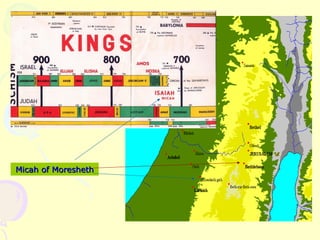
Micah of MoreshethMicah of Moresheth
1st reading: Micah 5,1-4a1st reading: Micah 5,1-4a
• 1Thus says the Lord, “You,
Bethlehem-Ephrathah too
small to be among the clans
of Judah, from you shall
come forth for me one who
is to be ruler in Israel;
Whose origin is from of old,
from ancient times. 2
Therefore the Lord will give
them up, until the time
when she who is to give
birth has borne, and the
rest of his brethren shall
return to the children of
Israel. 3 He shall stand
firm and shepherd his flock
by the strength of the
LORD, in the majestic name
of the LORD, his God; And
they shall remain, for now
his greatness shall reach to
the ends of the earth; 4 he
shall be peace.
Commentary
• In v.1, Micah, a prophet in the
countryside, away from Jerusalem,
prophesies that from that little
barrio of Bethlehem will come a
ruler of the whole land of Israel.
• The ruler has deep roots in the
ancient history of Israel.
• V.2 refers to the mother of the
ruler.
• In v.3, the ruler (king) will not be a
weakling.
• He will be a leader who is
determined to implement rules.
• In v.3b, those who remain may
refer to those governed by the
king. “They shall remain…” (They
shall not be driven away.)
• V.4 affirms that the ruler will bring
peace.
Reflections on the 1Reflections on the 1stst
readingreading
• It is but proper for us to anticipate with joy the
coming of a good leader.
• We have been deprived for so many years, many
a generation, of a good leader.
• We should not belittle anyone, anything, any
place, for it might become the source of good
leadership. (O Bethlehem, you’re not the least…)
• Jesus is the ruler who brings security and peace.
• Foreign invaders (colonizers, imperialists, oppressors,
abortionists) will not succeed in their scheme in the
face of Jesus.
• To be truly Christian, we must align ourselves
with Christ (who defends his people), not with the
“outsider” whose purpose is to manipulate us, get
all our money, resources and dignity, by all
means.
• In this season of Advent, we await Jesus, who is
rooted in God, who represents God, who
shepherds (feeds and guides) his people
according to the plan of God.
• We Christians must be prepared to be ruled,
guided, shepherded and to adopt his means to
peace.
Resp. Psalm
Ps 80:2-3, 15-16, 18-19
• (4) Lord, make us turn to you; let us see your face
and we shall be saved.
• 2 O shepherd of Israel, hearken,
from your throne upon the cherubim, shine forth.
3 Rouse your power,
and come to save us.
• 15 Once again, O LORD of hosts,
look down from heaven, and see;
16 take care of this vine,
and protect what your right hand has planted
the son of man whom you yourself made strong.
• 18 May your help be with the man of your right hand,
with the son of man whom you yourself made strong.
19 Then we will no more withdraw from you;
give us new life, and we will call upon your name.
Resp. Psalm 80:2-3, 15-16, 18-19
• (4) Lord, make us turn to
you; let us see your face and
we shall be saved.
• 2 O shepherd of Israel, hearken,
from your throne upon the
cherubim, shine forth.
3 Rouse your power,
and come to save us.
• 15 Once again, O LORD of hosts,
look down from heaven, and see;
16 take care of this vine,
and protect what your right hand
has planted
the son of man whom you
yourself made strong.
• 18 May your help be with the
man of your right hand,
with the son of man whom you
yourself made strong.
19 Then we will no more
withdraw from you;
give us new life, and we will call
upon your name.
Commentary
• The responsorial psalm is a prayer
to conversion, to see God face to
face and to be saved.
• In v.2, the psalmist addresses God
as the Shepherd of Israel.
• V.3 asks God to show his power and
salvation.
• In v.15, the psalmist addresses the
Lord of hosts (the majestic God).
• V.16 appeals to God
– To take care of the vine (son of
man)
– To protect the one whom he has
strengthened.
• V.18 asks God to help the man,
whom he has made strong.
• V.19 states the result: no more
turning away from God.
• V.19b is a prayer for new life and a
promise to pray always.
Reflections on the PsalmReflections on the Psalm
• In our prayer, we must be conscious that we are
addressing ourselves to the great God.
• We should pray for the more fundamental things,
like his rule over us, his protection, his
providence.
• We also pray that we may be always loyal to him.
• Jesus represents the kingship of God to us.
• Jesus represents us before God’s throne.
22ndnd
reading: Hebrews 10,5-10reading: Hebrews 10,5-10
• 5 When he came into the world, he said:
"Sacrifice and offering you did not desire, but a
body you prepared for me; 6 holocausts and sin
offerings you took no delight in. 7 Then I said,
'As is written of me in the scroll, Behold, I come
to do your will, O God.'“ 8 First he says,
Sacrifices and offerings, holocausts and sin
offerings, you neither desired nor delighted in."
These are offered according to the law. 9 Then
he says, "Behold, I come to do your will." He
takes away the first to establish the second. 10
By this "will," we have been consecrated through
the offering of the body of Jesus Christ once for
all.
The focus is on doing the will of God.
22ndnd
reading: Hebrews 10,5-10reading: Hebrews 10,5-10
Offering sacrifices
• 5 When he came into the world, he said: "Sacrifice and
offering you did not desire, but a body you prepared for
me; 6 holocausts and sin offerings you took no delight in.
Doing God’s will
• 7 Then I said, 'As is written of me in the scroll, Behold, I
come to do your will, O God.'“
Offering sacrifices
• 8 First he says, Sacrifices and offerings, holocausts and sin
offerings, you neither desired nor delighted in." These are
offered according to the law.
Doing God’s will
• 9 Then he says, "Behold, I come to do your will." He takes
away the first to establish the second. 10 By this "will," we
have been consecrated through the offering of the body of
Jesus Christ once for all.
A simple outline!
Textual Context of Heb 10,5-10Textual Context of Heb 10,5-10
• I. 1:5--2:18 The name superior to the angels (Eschatology)
• II. 3: 1--5:10 Jesus faithful and compassionate (Ecclesiology)
• III. 5: 11--10:39 The central exposition (Sacrifice)
• IV. 11:1--12: 13 Faith and endurance (Ecclesiological
paraenesis)
• V. 12: 14--13:19 The peaceful fruit of justice (Eschatology).
22ndnd
reading: Hebrews 10,5-10reading: Hebrews 10,5-10
Offering sacrifices
• 5 When he came into the
world, he said: "Sacrifice
and offering you did not
desire, but a body you
prepared for me; 6
holocausts and sin offerings
you took no delight in.
Doing God’s will
• 7 Then I said, 'As is written
of me in the scroll, Behold, I
come to do your will, O
God.'“
Offering sacrifices
• 8 First he says, Sacrifices
and offerings, holocausts
and sin offerings, you
neither desired nor
delighted in." These are
offered according to the law.
Doing God’s will
• 9 Then he says, "Behold, I
come to do your will." He
takes away the first to
establish the second. 10 By
this "will," we have been
consecrated through the
offering of the body of Jesus
Christ once for all.
Commentary
• In vv.5-6, the author reports that
according to Christ, God does not like
sacrifices and holocausts, but a body
prepared (community, church
prepared).
• In v.7, Christ does God’s preference:
doing his will.
• V.8 repeats vv.5-6. It adds a
commentary: The offerings are done
according to the law (of Moses).
• V.9 repeats v.7.
• In v.9b, Christ supersedes the Mosaic
law (of Temple practices).
• In v.10, we are consecrated because
of God’s will.
• God’s will for Jesus is to offer himself
to God (to suffer martyrdom) once and
for all.
Reflections on the 2Reflections on the 2ndnd
readingreading
• The Messiah comes to do God’s will: to
offer himself as a sacrifice, to be hurt, to
be wounded and to die for humankind.
• He is not here to repeat the old traditions
that have no more relevance.
• God’s will is always timely.
• Like the Messiah, we are always asked by
God to give ourselves to others.
• It must not become a routine.
• We must always find new ways to give
ourselves to others. Remember the
demands of the New Evangelization.
Gospel reading: Luke 1,39-45Gospel reading: Luke 1,39-45
• 39 During those days Mary set out and traveled
to the hill country in haste to a town of Judah,
40 where she entered the house of Zechariah and
greeted Elizabeth. 41 When Elizabeth heard
Mary's greeting, the infant leaped in her womb,
and Elizabeth, filled with the holy Spirit, 42 cried
out in a loud voice and said, "Most blessed are
you among women, and blessed is the fruit of
your womb. 43 And how does this happen to me,
that the mother of my Lord should come to me?
44 For at the moment the sound of your greeting
reached my ears, the infant in my womb leaped
for joy. 45 Blessed are you who believed that
what was spoken to you by the Lord would be
fulfilled."
The focus of the reading is on joy.
Gospel reading: Luke 1,39-45Gospel reading: Luke 1,39-45
• 39 During those days Mary
set out and traveled to the
hill country in haste to a
town of Judah, 40 where
she entered the house of
Zechariah and greeted
Elizabeth. 41 When
Elizabeth heard Mary's
greeting, the infant leaped
in her womb, and
Elizabeth, filled with the
holy Spirit, 42 cried out in
a loud voice and said,
"Most blessed are you
among women, and
blessed is the fruit of your
womb. 43 And how does
this happen to me, that
the mother of my Lord
should come to me? 44
For at the moment the
sound of your greeting
reached my ears, the
infant in my womb leaped
for joy. 45 Blessed are
you who believed that
what was spoken to you
by the Lord would be
fulfilled."
Commentary
• The text is entitled the Visitation.
• Mary visits Elizabeth (pregnant for about 6
months already).
• Luke portrays the encounter between two
mothers.
• Old mother, Elizabeth, post-menopausal
stage, is not supposed to get pregnant.
• Young mother, Mary, just had her period,
not supposed to be pregnant because she
had no husband.
• The two characters portray joy in their
hearts as they believe God has intervened in
their lives.
• Mary goes in haste to Ain Karem (where
Elizabeth is).
• Mary greets her upon arrival.
• Elizabeth acknowledges her greetings: Who
am I? - an expression of joy.
• Even the baby inside the womb leaps for joy
(twice reported).
• That blessedness in v.45 is an expression of
joy (happy are you for you believed).
Further commentaryFurther commentary
• The visitation of Mary to Elizabeth is part of the series of
joyful events that lead to the joyful birth of Christ.
• The story of the visitation is meant to stir up our
imagination to engage in the realm of the divine.
• The story seems to be very ordinary, but it evokes a lot of
joyful feelings: the feeling of Elizabeth, now healed from
sterility; now a mother, not yet too late; the feeling of
Zechariah, prayer answered (though not mentioned in the
text); baby John, Jesus is brought close to him.
• The encounter is not just the encounter of two women,
mothers, but also two unborn children, one is able to react
now (6 months).
• In a mysterious way, Elizabeth knows that Mary is the
mother of God. Her awareness is affirmed by the reaction
of baby John.
• The reading celebrates the coming (advent) of Jesus to
John, to the house of Zechariah and Elizabeth, done
possible by the young Mary running up and down the hill,
to help her in childbearing.
Reflections on the gospel readingReflections on the gospel reading
• Joy is the by-product of saying Yes to the Lord.
• Joy is the fruit of believing in the word of God
(announced by the angel).
• Joy is made possible through the encounter of two
persons who believe God intervenes in their lives.
More joy awaits in the events to come.
• We have joy if we stand in awe in face of
mysteries.
• To the incredulous, no joy is possible.
• Are you joyful?
Tying the 3 readings and the PsalmTying the 3 readings and the Psalm
• The 1st
reading talks about the coming of a good
ruler, from a humble place. This should be a
source of rejoicing for those who are also put
down.
• The psalm acknowledges God’s power as ruler
over us.
• The 2nd
reading talks about Christ who does the
will of God.
• The gospel reading talks about the visitation
which is a joyful encounter of two expectant
mothers.
The preacher must focus on the meaning of visitation.
How to develop your homily/sharingHow to develop your homily/sharing
• Begin by narrating your story about your
visit to your friends or relatives (masayamasaya,
good food, treated very well, felt important, etc) or
when you were visited by others.
• By nature, visits should provoke joy in us,
because we are given importance.
• Visits usually are friendly. You cannot visit
a person who is not your friend; you
cannot go to a house without his / her
permission.
• We must distinguish between visitation and
bwisitation, as we say in Tagalog. To go to a
house in order to make war or to scold someone is
not a visitation according to our texts.
• According to the gospel, Mary visits Elizabeth (to
help her in giving birth or do some house chores as Elizabeth
gives birth. 3 months later Mary goes home. Mary does not
overstay.)
• Mary’s visit brings joy to Elizabeth and her baby.
Mary’s faith in the word of God makes her blessed
(happy).
• Mary was not punished (like Zechariah, who at
first did not believe in the angel at the Temple in
Jerusalem, so he became dumb).
• Mary believed right away in the angel who visited
her at Nazareth.
• The first reading does not explicitly talk
about visitation, but God sending a prophet
to announce something good (the coming of
a ruler) is a form of visitation.
• Who is not happy to hear that in a humble
place like Bethlehem, a good ruler/leader
will rise?
• We must look forward to his coming
(visitation).
• We call him “the Messiah.”
• When he comes and rules over us, there will
be peace and joy.
• He is a good shepherd/leader.
• Likewise, the second reading does not explicitly
talk about visitation.
• Instead, it talks about doing the will of God.
• Jesus’ mission is not tied down to ritualism.
• The purpose of Jesus’ coming is to do the will of
God.
• Jesus concludes his coming (visitation), by
shedding his blood for all mankind.
• We must discern how best we can do the will of
God for us.
• But first, we must discern our particular mission.
• Definitely, our mission is not to repeat what has
been repeated a million times.
• God demands that we express our love in a new
and heroic manner.
• Take note of the demand of the New Evangelization.
• The gospel reading teaches us how to react to
God’s visitation.
• We should rejoice when we hear of Jesus’ coming
(through his word and sacrament).
• Like Elizabeth welcoming Mary, we should
welcome Jesus with joy.
• Like John, we should leap with joy (lukso, talon).
• We should acknowledge the presence of Jesus to
have joy.
• According to the Message of the Synod of Bishops
that met in October 2012, we, the Church people,
must form welcoming communities in which the
outcasts find a home (3rd
point).
• In the eucharist, Jesus comes down to
visit us, to give us joy.
• Jesus who has both great (divine, heavenly)
and humble beginnings (in Bethlehem) comes
to shepherd us in the eucharist.
• In the eucharist, Jesus sends us to visit
our brethren, to bring them joy.
Our Context of Sin and GraceOur Context of Sin and Grace
• Unwanted visitors
• Gate crashers
• Overstaying
visitors
• Stuck to ritualism
• Inhospitable
• Nuisance, pest
• House visitation
• Visiting the sick
and imprisoned
• Surprise visit
• Hospitable
• Good leaders
• Welcoming
• Accommodating
Suggested SongsSuggested Songs
• O Come O Come Emmanuel
• Halina Jesus Halina
• Dear brothers and sisters,
• Let us be hospitable to the Lord. Let
us welcome him in his word,
sacrament and the poor.
• Fr. Cielo

4th Advent D

  • 1.
    WWelcome toelcome tooourur BBiible Studyble Study 44thth SundSundaay of Advent Cy of Advent C 20 December 201520 December 2015 In preparation for this Sunday’s liturgyIn preparation for this Sunday’s liturgy As aid in focAs aid in focuusing our hsing our hoomilies and sharingmilies and sharing Prepared by Fr. Cielo R. Almazan, OFM
  • 2.
    1st reading: Micah5,1-4a1st reading: Micah 5,1-4a • 1 Thus says the Lord, “You, Bethlehem-Ephrathah too small to be among the clans of Judah, from you shall come forth for me one who is to be ruler in Israel; Whose origin is from of old, from ancient times. 2 (Therefore the Lord will give them up, until the time when she who is to give birth has borne, and the rest of his brethren shall return to the children of Israel.) 3 He shall stand firm and shepherd his flock by the strength of the LORD, in the majestic name of the LORD, his God; And they shall remain, for now his greatness shall reach to the ends of the earth; 4 he shall be peace. The focus is on the ruler/shepherd (Christ)
  • 3.
    Textual Context ofMicah 5,1-4aTextual Context of Micah 5,1-4a • Part I Series of Threats (1-3) • Part II Series of Promises (4-5) • Part III Series of Threats (poems) (6,1-7,7) • Part IV Series of Promises (7,8-20)
  • 4.
  • 5.
    1st reading: Micah5,1-4a1st reading: Micah 5,1-4a • 1Thus says the Lord, “You, Bethlehem-Ephrathah too small to be among the clans of Judah, from you shall come forth for me one who is to be ruler in Israel; Whose origin is from of old, from ancient times. 2 Therefore the Lord will give them up, until the time when she who is to give birth has borne, and the rest of his brethren shall return to the children of Israel. 3 He shall stand firm and shepherd his flock by the strength of the LORD, in the majestic name of the LORD, his God; And they shall remain, for now his greatness shall reach to the ends of the earth; 4 he shall be peace. Commentary • In v.1, Micah, a prophet in the countryside, away from Jerusalem, prophesies that from that little barrio of Bethlehem will come a ruler of the whole land of Israel. • The ruler has deep roots in the ancient history of Israel. • V.2 refers to the mother of the ruler. • In v.3, the ruler (king) will not be a weakling. • He will be a leader who is determined to implement rules. • In v.3b, those who remain may refer to those governed by the king. “They shall remain…” (They shall not be driven away.) • V.4 affirms that the ruler will bring peace.
  • 6.
    Reflections on the1Reflections on the 1stst readingreading • It is but proper for us to anticipate with joy the coming of a good leader. • We have been deprived for so many years, many a generation, of a good leader. • We should not belittle anyone, anything, any place, for it might become the source of good leadership. (O Bethlehem, you’re not the least…) • Jesus is the ruler who brings security and peace. • Foreign invaders (colonizers, imperialists, oppressors, abortionists) will not succeed in their scheme in the face of Jesus.
  • 7.
    • To betruly Christian, we must align ourselves with Christ (who defends his people), not with the “outsider” whose purpose is to manipulate us, get all our money, resources and dignity, by all means. • In this season of Advent, we await Jesus, who is rooted in God, who represents God, who shepherds (feeds and guides) his people according to the plan of God. • We Christians must be prepared to be ruled, guided, shepherded and to adopt his means to peace.
  • 8.
    Resp. Psalm Ps 80:2-3,15-16, 18-19 • (4) Lord, make us turn to you; let us see your face and we shall be saved. • 2 O shepherd of Israel, hearken, from your throne upon the cherubim, shine forth. 3 Rouse your power, and come to save us. • 15 Once again, O LORD of hosts, look down from heaven, and see; 16 take care of this vine, and protect what your right hand has planted the son of man whom you yourself made strong. • 18 May your help be with the man of your right hand, with the son of man whom you yourself made strong. 19 Then we will no more withdraw from you; give us new life, and we will call upon your name.
  • 9.
    Resp. Psalm 80:2-3,15-16, 18-19 • (4) Lord, make us turn to you; let us see your face and we shall be saved. • 2 O shepherd of Israel, hearken, from your throne upon the cherubim, shine forth. 3 Rouse your power, and come to save us. • 15 Once again, O LORD of hosts, look down from heaven, and see; 16 take care of this vine, and protect what your right hand has planted the son of man whom you yourself made strong. • 18 May your help be with the man of your right hand, with the son of man whom you yourself made strong. 19 Then we will no more withdraw from you; give us new life, and we will call upon your name. Commentary • The responsorial psalm is a prayer to conversion, to see God face to face and to be saved. • In v.2, the psalmist addresses God as the Shepherd of Israel. • V.3 asks God to show his power and salvation. • In v.15, the psalmist addresses the Lord of hosts (the majestic God). • V.16 appeals to God – To take care of the vine (son of man) – To protect the one whom he has strengthened. • V.18 asks God to help the man, whom he has made strong. • V.19 states the result: no more turning away from God. • V.19b is a prayer for new life and a promise to pray always.
  • 10.
    Reflections on thePsalmReflections on the Psalm • In our prayer, we must be conscious that we are addressing ourselves to the great God. • We should pray for the more fundamental things, like his rule over us, his protection, his providence. • We also pray that we may be always loyal to him. • Jesus represents the kingship of God to us. • Jesus represents us before God’s throne.
  • 11.
    22ndnd reading: Hebrews 10,5-10reading:Hebrews 10,5-10 • 5 When he came into the world, he said: "Sacrifice and offering you did not desire, but a body you prepared for me; 6 holocausts and sin offerings you took no delight in. 7 Then I said, 'As is written of me in the scroll, Behold, I come to do your will, O God.'“ 8 First he says, Sacrifices and offerings, holocausts and sin offerings, you neither desired nor delighted in." These are offered according to the law. 9 Then he says, "Behold, I come to do your will." He takes away the first to establish the second. 10 By this "will," we have been consecrated through the offering of the body of Jesus Christ once for all. The focus is on doing the will of God.
  • 12.
    22ndnd reading: Hebrews 10,5-10reading:Hebrews 10,5-10 Offering sacrifices • 5 When he came into the world, he said: "Sacrifice and offering you did not desire, but a body you prepared for me; 6 holocausts and sin offerings you took no delight in. Doing God’s will • 7 Then I said, 'As is written of me in the scroll, Behold, I come to do your will, O God.'“ Offering sacrifices • 8 First he says, Sacrifices and offerings, holocausts and sin offerings, you neither desired nor delighted in." These are offered according to the law. Doing God’s will • 9 Then he says, "Behold, I come to do your will." He takes away the first to establish the second. 10 By this "will," we have been consecrated through the offering of the body of Jesus Christ once for all. A simple outline!
  • 13.
    Textual Context ofHeb 10,5-10Textual Context of Heb 10,5-10 • I. 1:5--2:18 The name superior to the angels (Eschatology) • II. 3: 1--5:10 Jesus faithful and compassionate (Ecclesiology) • III. 5: 11--10:39 The central exposition (Sacrifice) • IV. 11:1--12: 13 Faith and endurance (Ecclesiological paraenesis) • V. 12: 14--13:19 The peaceful fruit of justice (Eschatology).
  • 14.
    22ndnd reading: Hebrews 10,5-10reading:Hebrews 10,5-10 Offering sacrifices • 5 When he came into the world, he said: "Sacrifice and offering you did not desire, but a body you prepared for me; 6 holocausts and sin offerings you took no delight in. Doing God’s will • 7 Then I said, 'As is written of me in the scroll, Behold, I come to do your will, O God.'“ Offering sacrifices • 8 First he says, Sacrifices and offerings, holocausts and sin offerings, you neither desired nor delighted in." These are offered according to the law. Doing God’s will • 9 Then he says, "Behold, I come to do your will." He takes away the first to establish the second. 10 By this "will," we have been consecrated through the offering of the body of Jesus Christ once for all. Commentary • In vv.5-6, the author reports that according to Christ, God does not like sacrifices and holocausts, but a body prepared (community, church prepared). • In v.7, Christ does God’s preference: doing his will. • V.8 repeats vv.5-6. It adds a commentary: The offerings are done according to the law (of Moses). • V.9 repeats v.7. • In v.9b, Christ supersedes the Mosaic law (of Temple practices). • In v.10, we are consecrated because of God’s will. • God’s will for Jesus is to offer himself to God (to suffer martyrdom) once and for all.
  • 15.
    Reflections on the2Reflections on the 2ndnd readingreading • The Messiah comes to do God’s will: to offer himself as a sacrifice, to be hurt, to be wounded and to die for humankind. • He is not here to repeat the old traditions that have no more relevance. • God’s will is always timely. • Like the Messiah, we are always asked by God to give ourselves to others. • It must not become a routine. • We must always find new ways to give ourselves to others. Remember the demands of the New Evangelization.
  • 16.
    Gospel reading: Luke1,39-45Gospel reading: Luke 1,39-45 • 39 During those days Mary set out and traveled to the hill country in haste to a town of Judah, 40 where she entered the house of Zechariah and greeted Elizabeth. 41 When Elizabeth heard Mary's greeting, the infant leaped in her womb, and Elizabeth, filled with the holy Spirit, 42 cried out in a loud voice and said, "Most blessed are you among women, and blessed is the fruit of your womb. 43 And how does this happen to me, that the mother of my Lord should come to me? 44 For at the moment the sound of your greeting reached my ears, the infant in my womb leaped for joy. 45 Blessed are you who believed that what was spoken to you by the Lord would be fulfilled." The focus of the reading is on joy.
  • 17.
    Gospel reading: Luke1,39-45Gospel reading: Luke 1,39-45 • 39 During those days Mary set out and traveled to the hill country in haste to a town of Judah, 40 where she entered the house of Zechariah and greeted Elizabeth. 41 When Elizabeth heard Mary's greeting, the infant leaped in her womb, and Elizabeth, filled with the holy Spirit, 42 cried out in a loud voice and said, "Most blessed are you among women, and blessed is the fruit of your womb. 43 And how does this happen to me, that the mother of my Lord should come to me? 44 For at the moment the sound of your greeting reached my ears, the infant in my womb leaped for joy. 45 Blessed are you who believed that what was spoken to you by the Lord would be fulfilled." Commentary • The text is entitled the Visitation. • Mary visits Elizabeth (pregnant for about 6 months already). • Luke portrays the encounter between two mothers. • Old mother, Elizabeth, post-menopausal stage, is not supposed to get pregnant. • Young mother, Mary, just had her period, not supposed to be pregnant because she had no husband. • The two characters portray joy in their hearts as they believe God has intervened in their lives. • Mary goes in haste to Ain Karem (where Elizabeth is). • Mary greets her upon arrival. • Elizabeth acknowledges her greetings: Who am I? - an expression of joy. • Even the baby inside the womb leaps for joy (twice reported). • That blessedness in v.45 is an expression of joy (happy are you for you believed).
  • 18.
    Further commentaryFurther commentary •The visitation of Mary to Elizabeth is part of the series of joyful events that lead to the joyful birth of Christ. • The story of the visitation is meant to stir up our imagination to engage in the realm of the divine. • The story seems to be very ordinary, but it evokes a lot of joyful feelings: the feeling of Elizabeth, now healed from sterility; now a mother, not yet too late; the feeling of Zechariah, prayer answered (though not mentioned in the text); baby John, Jesus is brought close to him. • The encounter is not just the encounter of two women, mothers, but also two unborn children, one is able to react now (6 months). • In a mysterious way, Elizabeth knows that Mary is the mother of God. Her awareness is affirmed by the reaction of baby John. • The reading celebrates the coming (advent) of Jesus to John, to the house of Zechariah and Elizabeth, done possible by the young Mary running up and down the hill, to help her in childbearing.
  • 19.
    Reflections on thegospel readingReflections on the gospel reading • Joy is the by-product of saying Yes to the Lord. • Joy is the fruit of believing in the word of God (announced by the angel). • Joy is made possible through the encounter of two persons who believe God intervenes in their lives. More joy awaits in the events to come. • We have joy if we stand in awe in face of mysteries. • To the incredulous, no joy is possible. • Are you joyful?
  • 20.
    Tying the 3readings and the PsalmTying the 3 readings and the Psalm • The 1st reading talks about the coming of a good ruler, from a humble place. This should be a source of rejoicing for those who are also put down. • The psalm acknowledges God’s power as ruler over us. • The 2nd reading talks about Christ who does the will of God. • The gospel reading talks about the visitation which is a joyful encounter of two expectant mothers. The preacher must focus on the meaning of visitation.
  • 21.
    How to developyour homily/sharingHow to develop your homily/sharing • Begin by narrating your story about your visit to your friends or relatives (masayamasaya, good food, treated very well, felt important, etc) or when you were visited by others. • By nature, visits should provoke joy in us, because we are given importance. • Visits usually are friendly. You cannot visit a person who is not your friend; you cannot go to a house without his / her permission.
  • 22.
    • We mustdistinguish between visitation and bwisitation, as we say in Tagalog. To go to a house in order to make war or to scold someone is not a visitation according to our texts. • According to the gospel, Mary visits Elizabeth (to help her in giving birth or do some house chores as Elizabeth gives birth. 3 months later Mary goes home. Mary does not overstay.) • Mary’s visit brings joy to Elizabeth and her baby. Mary’s faith in the word of God makes her blessed (happy). • Mary was not punished (like Zechariah, who at first did not believe in the angel at the Temple in Jerusalem, so he became dumb). • Mary believed right away in the angel who visited her at Nazareth.
  • 23.
    • The firstreading does not explicitly talk about visitation, but God sending a prophet to announce something good (the coming of a ruler) is a form of visitation. • Who is not happy to hear that in a humble place like Bethlehem, a good ruler/leader will rise? • We must look forward to his coming (visitation). • We call him “the Messiah.” • When he comes and rules over us, there will be peace and joy. • He is a good shepherd/leader.
  • 24.
    • Likewise, thesecond reading does not explicitly talk about visitation. • Instead, it talks about doing the will of God. • Jesus’ mission is not tied down to ritualism. • The purpose of Jesus’ coming is to do the will of God. • Jesus concludes his coming (visitation), by shedding his blood for all mankind. • We must discern how best we can do the will of God for us. • But first, we must discern our particular mission. • Definitely, our mission is not to repeat what has been repeated a million times. • God demands that we express our love in a new and heroic manner. • Take note of the demand of the New Evangelization.
  • 25.
    • The gospelreading teaches us how to react to God’s visitation. • We should rejoice when we hear of Jesus’ coming (through his word and sacrament). • Like Elizabeth welcoming Mary, we should welcome Jesus with joy. • Like John, we should leap with joy (lukso, talon). • We should acknowledge the presence of Jesus to have joy.
  • 26.
    • According tothe Message of the Synod of Bishops that met in October 2012, we, the Church people, must form welcoming communities in which the outcasts find a home (3rd point).
  • 27.
    • In theeucharist, Jesus comes down to visit us, to give us joy. • Jesus who has both great (divine, heavenly) and humble beginnings (in Bethlehem) comes to shepherd us in the eucharist. • In the eucharist, Jesus sends us to visit our brethren, to bring them joy.
  • 28.
    Our Context ofSin and GraceOur Context of Sin and Grace • Unwanted visitors • Gate crashers • Overstaying visitors • Stuck to ritualism • Inhospitable • Nuisance, pest • House visitation • Visiting the sick and imprisoned • Surprise visit • Hospitable • Good leaders • Welcoming • Accommodating
  • 29.
    Suggested SongsSuggested Songs •O Come O Come Emmanuel • Halina Jesus Halina
  • 30.
    • Dear brothersand sisters, • Let us be hospitable to the Lord. Let us welcome him in his word, sacrament and the poor. • Fr. Cielo