DIALOGUE
BRIDGING STORIES—BUILDING UNDERSTANDING
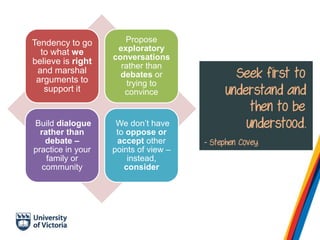
Tendency to go
to what we
believe is right
and marshal
arguments to
support it
Federal Court Judge
Michael Phelan, in his
recent ruling on access to
medical cannabis, criticized
expert witnesses on both
sides for their “almost
religious fervour” and for
not being open to consider
evidence that weakened
their position.
Tendency to go
to what we
believe is right
and marshal
arguments to
support it
Propose
exploratory
conversations
rather than
debates or
trying to
convince
Tendency to go
to what we
believe is right
and marshal
arguments to
support it
Propose
exploratory
conversations
rather than
debates or
trying to
convince
We don’t have
to oppose or
accept other
points of view –
instead,
consider
Tendency to go
to what we
believe is right
and marshal
arguments to
support it
Propose
exploratory
conversations
rather than
debates or
trying to
convince
Build dialogue
rather than
debate –
practice in your
family or
community
We don’t have
to oppose or
accept other
points of view –
instead,
consider
Dialogue is not rocket science
1. Be aware of our own ideas – reflect on them
2. Listen to each other’s ideas
3. Try to deepen our understanding of each
other’s ideas
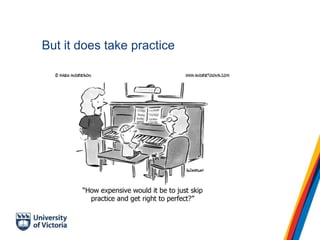
But it does take practice
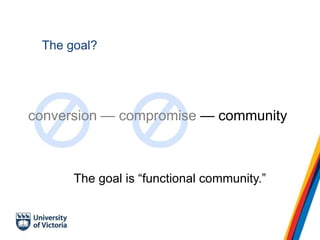
The goal?
conversion — compromise — community
The goal is “functional community.”
A number of states in the US have legalized
cannabis use and adopted various measures to
regulate use in their jurisdictions.
Now the Canadian government is committed to
going in the same direction.
Imagine a discussion following a proposal on
campus to allow cannabis use in residence.
Remember
1. Be aware of our own ideas – reflect on them
2. Listen to each other’s ideas
3. Try to deepen our understanding of each
other’s ideas
4.
What have we learned
• What was your experience when putting yourself in
the other’s position?
– How did it feel?
– Was it comfortable/uncomfortable/
interesting/surprising?
• In what way did the experience affect you? Did it
have any impact on you at all?
• Do you think that you have a better understanding of
the other and their ideas now?
• How could this approach change a conversation on
your campus?
Thank you!

Bridging Stories-- Building Understanding

  • 1.
  • 2.
    Tendency to go towhat we believe is right and marshal arguments to support it Federal Court Judge Michael Phelan, in his recent ruling on access to medical cannabis, criticized expert witnesses on both sides for their “almost religious fervour” and for not being open to consider evidence that weakened their position.
  • 3.
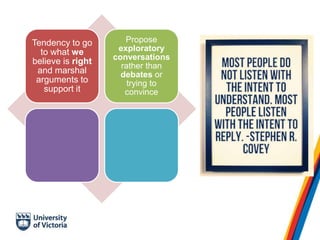
    Tendency to go towhat we believe is right and marshal arguments to support it Propose exploratory conversations rather than debates or trying to convince
  • 4.
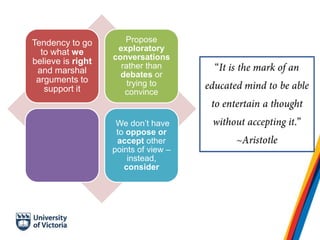
    Tendency to go towhat we believe is right and marshal arguments to support it Propose exploratory conversations rather than debates or trying to convince We don’t have to oppose or accept other points of view – instead, consider
  • 5.
    Tendency to go towhat we believe is right and marshal arguments to support it Propose exploratory conversations rather than debates or trying to convince Build dialogue rather than debate – practice in your family or community We don’t have to oppose or accept other points of view – instead, consider
  • 9.
    Dialogue is notrocket science 1. Be aware of our own ideas – reflect on them 2. Listen to each other’s ideas 3. Try to deepen our understanding of each other’s ideas
  • 10.
    But it doestake practice
  • 11.
    The goal? conversion —compromise — community The goal is “functional community.”
  • 12.
    A number ofstates in the US have legalized cannabis use and adopted various measures to regulate use in their jurisdictions. Now the Canadian government is committed to going in the same direction. Imagine a discussion following a proposal on campus to allow cannabis use in residence.
  • 13.
    Remember 1. Be awareof our own ideas – reflect on them 2. Listen to each other’s ideas 3. Try to deepen our understanding of each other’s ideas 4.
  • 14.
    What have welearned • What was your experience when putting yourself in the other’s position? – How did it feel? – Was it comfortable/uncomfortable/ interesting/surprising? • In what way did the experience affect you? Did it have any impact on you at all? • Do you think that you have a better understanding of the other and their ideas now? • How could this approach change a conversation on your campus?
  • 15.