World Café Conversations


What is it?          •   “A Café Conversation is a creative process for leading collaborative
                         dialogue, sharing knowledge and creating possibilities for action in
                         groups of all sizes.” (http://www.theworldcafe.com/worldcafe.html)
                     •   A structured event in which a café ambience is evoked in order to
                         allow participants to converse casually in small groups about a topic
                         that matters, intermingling and sharing ideas, then bringing key
                         learnings out in the open
                     •   Use to create a sense of community, shared understanding,
                         collaboration, innovation, and joint vision for action among
                         constituents with diverse and possibly adversarial points of view
                     •   Like role plays, can promote understanding of others’ perspectives, re-
                         examination of one’s own beliefs, and deep learning
                     •   Has similarities to buzz groups and jigsaw learning (Silberman, pp.
                         108-111)


What are some        •   Plenary session format for 2002 Systems Thinking in Action (STIA)
examples?                conference “Leading in a Complex World”
                         (http://www.theworldcafe.com/storystiasd02.html), and keynote event at
                         1998 STIA conference “Catalyzing Large Scale Collective Learning”
                         (http://www.theworldcafe.com/hospitablespace.pdf)
                     •   A “Roundtable Café” of world executives in information,
                         communication, and transportation industries, plus Greenpeace and
                         city government (http://www.theworldcafe.com/listeningtogether.html)
                     •   A 12 week online course, “Organization Development Concepts and
                         Methods” in a management Master’s degree program
                         (http://www.theworldcafe.com/virtualcafes.pdf)


Strengths and     Strengths
Weaknesses           •   Promotes understanding of diverse perspectives
                     •   Fosters creative and collaborative solution-finding
                     •   Gives all participants a chance to speak and be heard
                     •   Shares ideas and viewpoints in a group in an organic “network” or
                         “virus” fashion
                     •   Individuals speak directly to others, from the heart, rather than
                         lecturing or taking a stand
                     •   Supports individual reflection and change


Karen O. Storer                                                                   2/15/03
Strengths and      Weaknesses
Weaknesses            •   Some participants may resist an unconventional approach
                      •   Depends on the good intentions of participants accepting ground rules
                          of inquiry and dialogue, rather than advocacy, domination and
                          coercion
                      •   Creating “hospitable space” requires attention and preparation by host
                      •   Not appropriate when a course of action has already been decided


Steps to Success      •   30 – 1000 participants for diversity of perspectives
                      •   Small tables seating 4-5
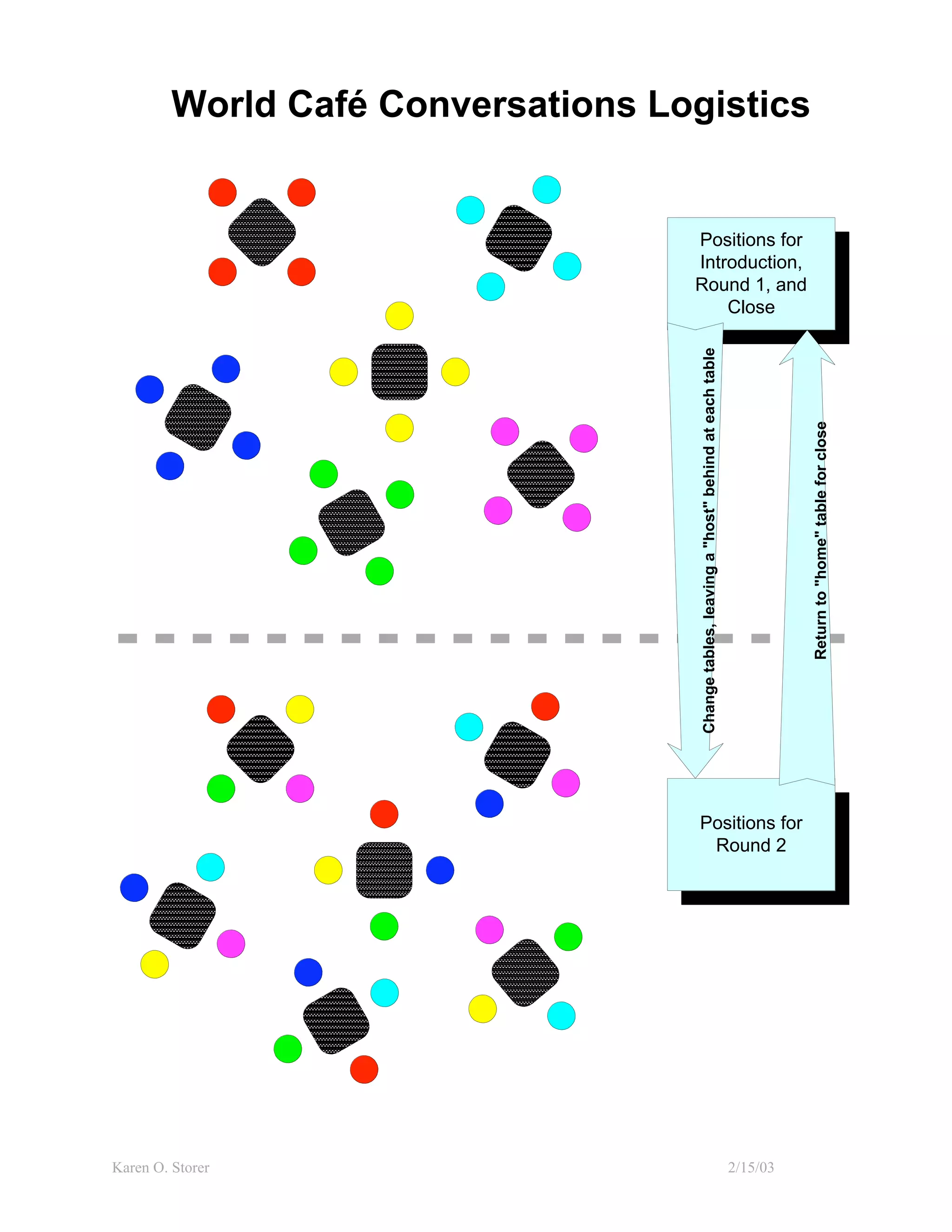
                      •   Introduction followed by two or more rounds of dialogue with
                          participants changing tables for each round, closing with involvement
                          of all
                      •   Follow the seven principles in
                          http://www.theworldcafe.com/knowhow.html:
                          1. Clarify the context (have a clear purpose)
                          2. Create hospitable space (inviting atmosphere through music, small tables
                             with flowers or candles, possibly light beverages or snacks)
                          3. Explore questions that matter
                          4. Encourage everyone’s contribution
                          5. Connect diverse perspectives
                          6. Listen together and notice patterns
                          7. Share collective discoveries (debrief at the end to elicit meaningful
                             discoveries and essential learnings)
                      •   For virtual café guideline details, see “Connecting Diverse People and
                          Ideas, A Virtual Knowledge Café” by Bo Gyllenpalm
                          (http://www.theworldcafe.com/virtualcafes.pdf):
                          o Each student hosts at least one topic
                          o Students participate at least twice a week (usually more)
                          o Three rounds, three weeks each
                          o Topics cross-pollinate each other
                          o Hosts synthesize their topic on completion of each round
                          o All students contribute to a round of joint reflection
                          o Each student synthesizes their learning and how they will put it to use,
                            and these are posted for all to see


Why it works          •   “As people engage together to learn more about their collective
                          identity, it affects them as individuals in a surprising way. They are
                          able to see how their personal patterns and behaviors contribute to the
                          whole. The surprise is that they then take responsibility for changing
                          themselves.” (Wheatley, p. 144)
                      •   “Real change happens in personal behaviors, or at larger scale in
                          entire organizations, only when we take time to discover this sense of
                          what’s worthy of our shared attention.” (Wheatley, p. 149)


Karen O. Storer                                                                          2/15/03
References        •   http://www.theworldcafe.com
                  •   http://www.conversationcafe.org
                  •   Leadership and the New Science: Discovering Order in a Chaotic
                      World (Second Edition) by Margaret J. Wheatley, 1999
                  •   Active Training: A Handbook of Techniques, Designs, Case Examples,
                      and Tips (Second Edition) by Mel Silberman, Ph.D. assisted by Carol
                      Auerbach, 1998


Karen O. Storer                                                            2/15/03
World Café Conversations Logistics


                                    Positions for
                                    Introduction,
                                    Round 1, and
                                        Close


                                     Change tables, leaving a "host" behind at each table


                                     Positions for                                                    Return to "home" table for close
                                      Round 2


Karen O. Storer                                                                             2/15/03

World Cafe

  • 1.
    World Café Conversations Whatis it? • “A Café Conversation is a creative process for leading collaborative dialogue, sharing knowledge and creating possibilities for action in groups of all sizes.” (http://www.theworldcafe.com/worldcafe.html) • A structured event in which a café ambience is evoked in order to allow participants to converse casually in small groups about a topic that matters, intermingling and sharing ideas, then bringing key learnings out in the open • Use to create a sense of community, shared understanding, collaboration, innovation, and joint vision for action among constituents with diverse and possibly adversarial points of view • Like role plays, can promote understanding of others’ perspectives, re- examination of one’s own beliefs, and deep learning • Has similarities to buzz groups and jigsaw learning (Silberman, pp. 108-111) What are some • Plenary session format for 2002 Systems Thinking in Action (STIA) examples? conference “Leading in a Complex World” (http://www.theworldcafe.com/storystiasd02.html), and keynote event at 1998 STIA conference “Catalyzing Large Scale Collective Learning” (http://www.theworldcafe.com/hospitablespace.pdf) • A “Roundtable Café” of world executives in information, communication, and transportation industries, plus Greenpeace and city government (http://www.theworldcafe.com/listeningtogether.html) • A 12 week online course, “Organization Development Concepts and Methods” in a management Master’s degree program (http://www.theworldcafe.com/virtualcafes.pdf) Strengths and Strengths Weaknesses • Promotes understanding of diverse perspectives • Fosters creative and collaborative solution-finding • Gives all participants a chance to speak and be heard • Shares ideas and viewpoints in a group in an organic “network” or “virus” fashion • Individuals speak directly to others, from the heart, rather than lecturing or taking a stand • Supports individual reflection and change Karen O. Storer 2/15/03
  • 2.
    Strengths and Weaknesses Weaknesses • Some participants may resist an unconventional approach • Depends on the good intentions of participants accepting ground rules of inquiry and dialogue, rather than advocacy, domination and coercion • Creating “hospitable space” requires attention and preparation by host • Not appropriate when a course of action has already been decided Steps to Success • 30 – 1000 participants for diversity of perspectives • Small tables seating 4-5 • Introduction followed by two or more rounds of dialogue with participants changing tables for each round, closing with involvement of all • Follow the seven principles in http://www.theworldcafe.com/knowhow.html: 1. Clarify the context (have a clear purpose) 2. Create hospitable space (inviting atmosphere through music, small tables with flowers or candles, possibly light beverages or snacks) 3. Explore questions that matter 4. Encourage everyone’s contribution 5. Connect diverse perspectives 6. Listen together and notice patterns 7. Share collective discoveries (debrief at the end to elicit meaningful discoveries and essential learnings) • For virtual café guideline details, see “Connecting Diverse People and Ideas, A Virtual Knowledge Café” by Bo Gyllenpalm (http://www.theworldcafe.com/virtualcafes.pdf): o Each student hosts at least one topic o Students participate at least twice a week (usually more) o Three rounds, three weeks each o Topics cross-pollinate each other o Hosts synthesize their topic on completion of each round o All students contribute to a round of joint reflection o Each student synthesizes their learning and how they will put it to use, and these are posted for all to see Why it works • “As people engage together to learn more about their collective identity, it affects them as individuals in a surprising way. They are able to see how their personal patterns and behaviors contribute to the whole. The surprise is that they then take responsibility for changing themselves.” (Wheatley, p. 144) • “Real change happens in personal behaviors, or at larger scale in entire organizations, only when we take time to discover this sense of what’s worthy of our shared attention.” (Wheatley, p. 149) Karen O. Storer 2/15/03
  • 3.
    References • http://www.theworldcafe.com • http://www.conversationcafe.org • Leadership and the New Science: Discovering Order in a Chaotic World (Second Edition) by Margaret J. Wheatley, 1999 • Active Training: A Handbook of Techniques, Designs, Case Examples, and Tips (Second Edition) by Mel Silberman, Ph.D. assisted by Carol Auerbach, 1998 Karen O. Storer 2/15/03
  • 4.
    World Café ConversationsLogistics Positions for Introduction, Round 1, and Close Change tables, leaving a "host" behind at each table Positions for Return to "home" table for close Round 2 Karen O. Storer 2/15/03