Adpositional Argumentation
How Logic Originates In Natural Argumentative Discourse
Federico Gobbo, Marco Benini, Jean H.M. Wagemans
F.Gobbo@uva.nl
22 April 2022, Logic4Peace
1
What is Adpositional Argumentation
AdArg = PTA + CxAdGrams
A new formal method that enables the analyst of argumentative discourse
to represent linguistic and pragmatic information in a highly detailed and
yet flexible way.
Source: Gobbo & Wagemans (Actes JIAF 2019)
Adpositional Argumentation (AdArg) comes from the combination of:
1. The Periodic Table of Arguments (PTA, by Wagemans)
2
AdArg = PTA + CxAdGrams
A new formal method that enables the analyst of argumentative discourse
to represent linguistic and pragmatic information in a highly detailed and
yet flexible way.
Source: Gobbo & Wagemans (Actes JIAF 2019)
Adpositional Argumentation (AdArg) comes from the combination of:
1. The Periodic Table of Arguments (PTA, by Wagemans)
2. Constructive Adpositional Grammars (CxAdGrams, by Gobbo & Benini)
2
Epistemological and applicative aims of AdArg
Epistemologically, bridges the gap between:
1. Computational Argumentation (argument mining and mapping)
2. Argumentation Theory and Rhetoric (insights from tradition)
3
Epistemological and applicative aims of AdArg
Epistemologically, bridges the gap between:
1. Computational Argumentation (argument mining and mapping)
2. Argumentation Theory and Rhetoric (insights from tradition)
Applicatively, annotates natural language discourse
• by means of adpositional trees (adtrees), representing linguistic and
pragmatic information on different levels of abstraction without running
the risk of losing any information;
3
Epistemological and applicative aims of AdArg
Epistemologically, bridges the gap between:
1. Computational Argumentation (argument mining and mapping)
2. Argumentation Theory and Rhetoric (insights from tradition)
Applicatively, annotates natural language discourse
• by means of adpositional trees (adtrees), representing linguistic and
pragmatic information on different levels of abstraction without running
the risk of losing any information;
• in this way, adtrees explicate the logic stemming from the discourse
3
Epistemological and applicative aims of AdArg
Epistemologically, bridges the gap between:
1. Computational Argumentation (argument mining and mapping)
2. Argumentation Theory and Rhetoric (insights from tradition)
Applicatively, annotates natural language discourse
• by means of adpositional trees (adtrees), representing linguistic and
pragmatic information on different levels of abstraction without running
the risk of losing any information;
• in this way, adtrees explicate the logic stemming from the discourse
3
Epistemological and applicative aims of AdArg
Epistemologically, bridges the gap between:
1. Computational Argumentation (argument mining and mapping)
2. Argumentation Theory and Rhetoric (insights from tradition)
Applicatively, annotates natural language discourse
• by means of adpositional trees (adtrees), representing linguistic and
pragmatic information on different levels of abstraction without running
the risk of losing any information;
• in this way, adtrees explicate the logic stemming from the discourse
Source: Gobbo, Benini & Wagemans (Intelligenza Artificiale 2019), here
3
The Periodic Table of Arguments (PTA)
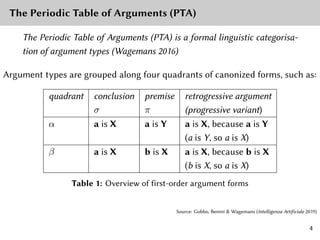
The Periodic Table of Arguments (PTA) is a formal linguistic categorisa-
tion of argument types (Wagemans 2016)
Argument types are grouped along four quadrants of canonized forms, such as:
quadrant conclusion premise retrogressive argument
σ π (progressive variant)
α a is X a is Y a is X, because a is Y
(a is Y, so a is X)
β a is X b is X a is X, because b is X
(b is X, so a is X)
Table 1: Overview of first-order argument forms
Source: Gobbo, Benini & Wagemans (Intelligenza Artificiale 2019)
4
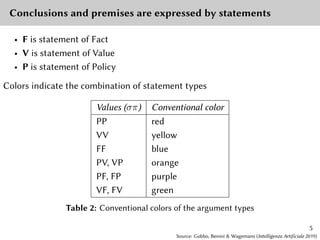
Conclusions and premises are expressed by statements
• F is statement of Fact
• V is statement of Value
• P is statement of Policy
Colors indicate the combination of statement types
Values (σπ) Conventional color
PP red
VV yellow
FF blue
PV, VP orange
PF, FP purple
VF, FV green
Table 2: Conventional colors of the argument types
Source: Gobbo, Benini & Wagemans (Intelligenza Artificiale 2019)
5
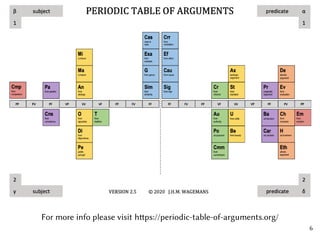
For more info please visit https://periodic-table-of-arguments.org/
6
Constructive Adpositional Grammars (CxAdGrams)
• The theoretical framework results from the application of constructive
mathematics to the adpositional paradigm in linguistics
• CxAdGrams specifically are based on topos-theory
• It thus permits to use Grothendieck’s topologies to formalize natural
languages, making information completely explicit.
What does ‘adpositional’ mean, in this context?
The adpositional paradigm in linguistics follows the idea that relations
between linguistic elements can be described as hierarchical in that the
one element ‘governs’ the other (which then ‘depends’ on the
former).
Source: Gobbo & Wagemans (with Benini, AI3
, AIXIA 2018)
7
Abstract adpositional trees
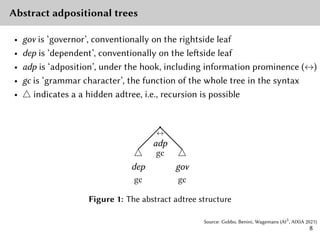
• gov is ‘governor’, conventionally on the rightside leaf
• dep is ‘dependent’, conventionally on the leftside leaf
• adp is ‘adposition’, under the hook, including information prominence (↔)
• gc is ‘grammar character’, the function of the whole tree in the syntax
• △ indicates a a hidden adtree, i.e., recursion is possible
△
dep
gc
q
↔
adp
gc
@
@
@
△
gov
gc
Figure 1: The abstract adtree structure
Source: Gobbo, Benini, Wagemans (AI3
, AIXIA 2021)
8
Argumentative adpositional trees
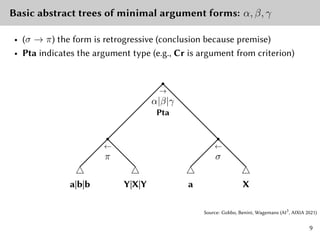
Basic abstract trees of minimal argument forms: α, β, γ
• (σ → π) the form is retrogressive (conclusion because premise)
• Pta indicates the argument type (e.g., Cr is argument from criterion)
△
a|b|b
r
←
π
@
@
@
@
△
Y|X|Y
r
→
α|β|γ
Pta
@
@
@
@
@
@
@
@
△
a
r
←
σ
@
@
@
@
△
X
Source: Gobbo, Benini, Wagemans (AI3
, AIXIA 2021)
9
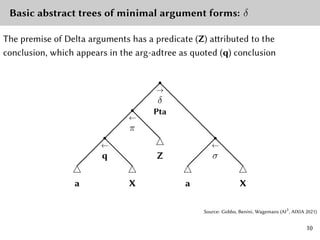
Basic abstract trees of minimal argument forms: δ
The premise of Delta arguments has a predicate (Z) attributed to the
conclusion, which appears in the arg-adtree as quoted (q) conclusion
△
a
r
←
q
@
@
@
@
△
X
r
←
π
@
@
@
@
△
Z
r
→
δ
Pta
@
@
@
@
@
@
@
@
△
a
r
←
σ
@
@
@
@
△
X
Source: Gobbo, Benini, Wagemans (AI3
, AIXIA 2021)
10
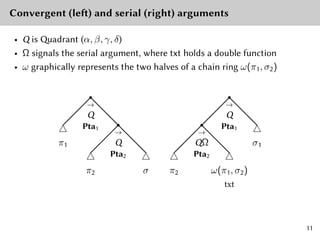
Convergent (left) and serial (right) arguments
• Q is Quadrant (α, β, γ, δ)
• Ω signals the serial argument, where txt holds a double function
• ω graphically represents the two halves of a chain ring ω(π1, σ2)
△
π1
r
→
Q
Pta1
@
@
@
@
△
π2
r
→
Q
Pta2
@
@
@
@
△
σ
△
π2
r
→
QΩ
Pta2
@
@
@
@
△
ω(π1, σ2)
txt
r
→
Q
Pta1
@
@
@
@
△
σ1
11
Convergent (left) and serial (right) arguments
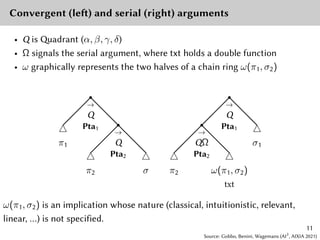
• Q is Quadrant (α, β, γ, δ)
• Ω signals the serial argument, where txt holds a double function
• ω graphically represents the two halves of a chain ring ω(π1, σ2)
△
π1
r
→
Q
Pta1
@
@
@
@
△
π2
r
→
Q
Pta2
@
@
@
@
△
σ
△
π2
r
→
QΩ
Pta2
@
@
@
@
△
ω(π1, σ2)
txt
r
→
Q
Pta1
@
@
@
@
△
σ1
ω(π1, σ2) is an implication whose nature (classical, intuitionistic, relevant,
linear, …) is not specified.
Source: Gobbo, Benini, Wagemans (AI3
, AIXIA 2021)
11
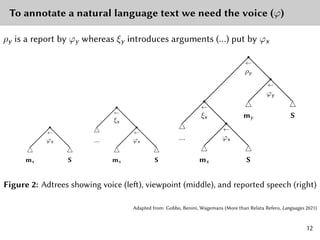
To annotate a natural language text we need the voice (φ)
ρy is a report by φy whereas ξy introduces arguments (…) put by φx
△
mx
r
←
φx
@
@
@
@
△
S
△
…
r
←
ξx
@
@
@
@
△
mx
r
←
φx
@
@
@
@
△
S
△
…
r
←
ξx
@
@
@
@
△
mx
r
←
φx
@
@
@
@
△
S
r
←
ρy
@
@
@
@
△
my
r
←
φy
@
@
@
@
△
S
Figure 2: Adtrees showing voice (left), viewpoint (middle), and reported speech (right)
Adapted from: Gobbo, Benini, Wagemans (More than Relata Refero, Languages 2021)
12
Annotating an Argumentative Text
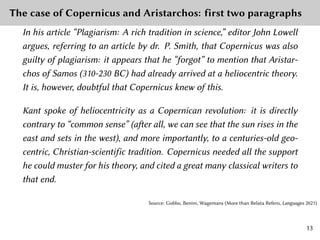
The case of Copernicus and Aristarchos: first two paragraphs
In his article “Plagiarism: A rich tradition in science,” editor John Lowell
argues, referring to an article by dr. P. Smith, that Copernicus was also
guilty of plagiarism: it appears that he “forgot” to mention that Aristar-
chos of Samos (310-230 BC) had already arrived at a heliocentric theory.
It is, however, doubtful that Copernicus knew of this.
Kant spoke of heliocentricity as a Copernican revolution: it is directly
contrary to “common sense” (after all, we can see that the sun rises in the
east and sets in the west), and more importantly, to a centuries-old geo-
centric, Christian-scientific tradition. Copernicus needed all the support
he could muster for his theory, and cited a great many classical writers to
that end.
Source: Gobbo, Benini, Wagemans (More than Relata Refero, Languages 2021)
13
First paragraph of Copernicus and Aristarchos
[0] [the author writes]
1.1.a.I In his article “Plagiarism: A rich tradition in science,”
1.1.a.II editor John Lowell
1.1.a.III argues,
1.1.b.I referring
1.1.b.II to an article
1.1.b.III by dr. P. Smith,
1.1.c that Copernicus was also guilty of plagiarism:
1.1.d.I it appears that he “forgot” to mention
1.1.d.II that Aristarchos of Samos (310–230 BC) had already arrived at a heliocentric theory.
1.2.a It is, however, doubtful
1.2.b.I that Copernicus knew of
1.2.b.II this [anaphora of 1.1.d.II].
Source: Gobbo, Benini, Wagemans (More than Relata Refero, Languages 2021)
14
Second paragraph of Copernicus and Aristarchos
2.1.a.I Kant
2.1.a.II spoke of
2.1.a.III heliocentricity as a Copernican revolution:
2.1.b it is directly contrary to “common sense”
2.1.c (after all, we can see that the sun rises in the east and sets in the west)
2.1.d and more importantly, to a centuries old geocentric, Christian scientific tradition.
2.2.a Copernicus needed all the support he could muster for his theory,
2.2.b.I and [Copernicus] cited a great many classical writers
2.2.b.II to that end.
Source: Gobbo, Benini, Wagemans (More than Relata Refero, Languages 2021)
15
△
q
2.1.a.III
r
←
π
@
@
@
@
△
f1
2.1.a.I
r
←
φ1
Z
@
@
@
@
△
S
2.1.a.II
r
←
δ
Au
@
@
@
@
@
@
@
@
△
π
2.1.d
r
←
α
Cr
@
@
@
@
△
π2
2.1.c
r
←
γΩ
@
@
@
@
△
ω(π1, σ2)
2.1.b
r
←
α
Cr
@
@
@
@
△
σ1
2.1.a.III
r
←
δΩ
@
@
@
@
△
ω
2.2.a
r
←
λ
@
@
@
@
△
κ
2.2.b.II
r
←
αΩ
T
@
@
@
@
△
ω
2.2.b.I
r
←
ξ0
@
@
@
@
△
σ
1.2
r
←
ξ0
@
@
@
@
△
ξ1
1.1
r
←
ρ0
@
@
@
@
△
φ0
[0]
Figure 3: Arg-adtree of § 1-2 of Copernicus and Aristarchos
16
Conclusion
Wrapping up
• Adpositional Argumentation results from a combination of argumentation
theory (PTA) and formal modelling of natural language (CxAdGrams)
17
Wrapping up
• Adpositional Argumentation results from a combination of argumentation
theory (PTA) and formal modelling of natural language (CxAdGrams)
• it lets analyze linguistic and pragmatic elements, including reported
speech
17
Wrapping up
• Adpositional Argumentation results from a combination of argumentation
theory (PTA) and formal modelling of natural language (CxAdGrams)
• it lets analyze linguistic and pragmatic elements, including reported
speech
• information hiding permits to look at the text from an abstract level,
without the risk of losing any information in the process
17
Wrapping up
• Adpositional Argumentation results from a combination of argumentation
theory (PTA) and formal modelling of natural language (CxAdGrams)
• it lets analyze linguistic and pragmatic elements, including reported
speech
• information hiding permits to look at the text from an abstract level,
without the risk of losing any information in the process
• the annotated text reveals argumentation structures and patterns
17
Wrapping up
• Adpositional Argumentation results from a combination of argumentation
theory (PTA) and formal modelling of natural language (CxAdGrams)
• it lets analyze linguistic and pragmatic elements, including reported
speech
• information hiding permits to look at the text from an abstract level,
without the risk of losing any information in the process
• the annotated text reveals argumentation structures and patterns
• annotation is pre-logical: it shows exactly where the logic comes in
17
Wrapping up
• Adpositional Argumentation results from a combination of argumentation
theory (PTA) and formal modelling of natural language (CxAdGrams)
• it lets analyze linguistic and pragmatic elements, including reported
speech
• information hiding permits to look at the text from an abstract level,
without the risk of losing any information in the process
• the annotated text reveals argumentation structures and patterns
• annotation is pre-logical: it shows exactly where the logic comes in
• it makes evident the points of attack of the way of reasoning
17
Thank You for Your Kind Attention! Any Questions?
] ] ] ] for more researcH on AdArg ] ] ] ]
https://lancar.org/research-projects/
constructive-adpositional-argumentation-cxadarg/
ß Federico Gobbo (he/him), University of Amsterdam
a f.gobbo@uva.nl
Ŵ uva.nl/profile/f.gobbo
Nj federicogobbo.name
Social media profiles
f linkedin.com/in/federicogobbo/
_ https://twitter.com/goberiko
İ facebook.com/federico.gobbo
q instagram.com/la.profesoro
§ slideshare.net/goberiko
Messaging apps
Ŷ ID Telegram goberiko
¦ ID WeChat goberiko

Adpositional Argumentation: How Logic Originates In Natural Argumentative Discourse

  • 1.
    Adpositional Argumentation How LogicOriginates In Natural Argumentative Discourse Federico Gobbo, Marco Benini, Jean H.M. Wagemans F.Gobbo@uva.nl 22 April 2022, Logic4Peace 1
  • 2.
    What is AdpositionalArgumentation
  • 3.
    AdArg = PTA+ CxAdGrams A new formal method that enables the analyst of argumentative discourse to represent linguistic and pragmatic information in a highly detailed and yet flexible way. Source: Gobbo & Wagemans (Actes JIAF 2019) Adpositional Argumentation (AdArg) comes from the combination of: 1. The Periodic Table of Arguments (PTA, by Wagemans) 2
  • 4.
    AdArg = PTA+ CxAdGrams A new formal method that enables the analyst of argumentative discourse to represent linguistic and pragmatic information in a highly detailed and yet flexible way. Source: Gobbo & Wagemans (Actes JIAF 2019) Adpositional Argumentation (AdArg) comes from the combination of: 1. The Periodic Table of Arguments (PTA, by Wagemans) 2. Constructive Adpositional Grammars (CxAdGrams, by Gobbo & Benini) 2
  • 5.
    Epistemological and applicativeaims of AdArg Epistemologically, bridges the gap between: 1. Computational Argumentation (argument mining and mapping) 2. Argumentation Theory and Rhetoric (insights from tradition) 3
  • 6.
    Epistemological and applicativeaims of AdArg Epistemologically, bridges the gap between: 1. Computational Argumentation (argument mining and mapping) 2. Argumentation Theory and Rhetoric (insights from tradition) Applicatively, annotates natural language discourse • by means of adpositional trees (adtrees), representing linguistic and pragmatic information on different levels of abstraction without running the risk of losing any information; 3
  • 7.
    Epistemological and applicativeaims of AdArg Epistemologically, bridges the gap between: 1. Computational Argumentation (argument mining and mapping) 2. Argumentation Theory and Rhetoric (insights from tradition) Applicatively, annotates natural language discourse • by means of adpositional trees (adtrees), representing linguistic and pragmatic information on different levels of abstraction without running the risk of losing any information; • in this way, adtrees explicate the logic stemming from the discourse 3
  • 8.
    Epistemological and applicativeaims of AdArg Epistemologically, bridges the gap between: 1. Computational Argumentation (argument mining and mapping) 2. Argumentation Theory and Rhetoric (insights from tradition) Applicatively, annotates natural language discourse • by means of adpositional trees (adtrees), representing linguistic and pragmatic information on different levels of abstraction without running the risk of losing any information; • in this way, adtrees explicate the logic stemming from the discourse 3
  • 9.
    Epistemological and applicativeaims of AdArg Epistemologically, bridges the gap between: 1. Computational Argumentation (argument mining and mapping) 2. Argumentation Theory and Rhetoric (insights from tradition) Applicatively, annotates natural language discourse • by means of adpositional trees (adtrees), representing linguistic and pragmatic information on different levels of abstraction without running the risk of losing any information; • in this way, adtrees explicate the logic stemming from the discourse Source: Gobbo, Benini & Wagemans (Intelligenza Artificiale 2019), here 3
  • 10.
    The Periodic Tableof Arguments (PTA) The Periodic Table of Arguments (PTA) is a formal linguistic categorisa- tion of argument types (Wagemans 2016) Argument types are grouped along four quadrants of canonized forms, such as: quadrant conclusion premise retrogressive argument σ π (progressive variant) α a is X a is Y a is X, because a is Y (a is Y, so a is X) β a is X b is X a is X, because b is X (b is X, so a is X) Table 1: Overview of first-order argument forms Source: Gobbo, Benini & Wagemans (Intelligenza Artificiale 2019) 4
  • 11.
    Conclusions and premisesare expressed by statements • F is statement of Fact • V is statement of Value • P is statement of Policy Colors indicate the combination of statement types Values (σπ) Conventional color PP red VV yellow FF blue PV, VP orange PF, FP purple VF, FV green Table 2: Conventional colors of the argument types Source: Gobbo, Benini & Wagemans (Intelligenza Artificiale 2019) 5
  • 12.
    For more infoplease visit https://periodic-table-of-arguments.org/ 6
  • 13.
    Constructive Adpositional Grammars(CxAdGrams) • The theoretical framework results from the application of constructive mathematics to the adpositional paradigm in linguistics • CxAdGrams specifically are based on topos-theory • It thus permits to use Grothendieck’s topologies to formalize natural languages, making information completely explicit. What does ‘adpositional’ mean, in this context? The adpositional paradigm in linguistics follows the idea that relations between linguistic elements can be described as hierarchical in that the one element ‘governs’ the other (which then ‘depends’ on the former). Source: Gobbo & Wagemans (with Benini, AI3 , AIXIA 2018) 7
  • 14.
    Abstract adpositional trees •gov is ‘governor’, conventionally on the rightside leaf • dep is ‘dependent’, conventionally on the leftside leaf • adp is ‘adposition’, under the hook, including information prominence (↔) • gc is ‘grammar character’, the function of the whole tree in the syntax • △ indicates a a hidden adtree, i.e., recursion is possible △ dep gc q ↔ adp gc @ @ @ △ gov gc Figure 1: The abstract adtree structure Source: Gobbo, Benini, Wagemans (AI3 , AIXIA 2021) 8
  • 15.
  • 16.
    Basic abstract treesof minimal argument forms: α, β, γ • (σ → π) the form is retrogressive (conclusion because premise) • Pta indicates the argument type (e.g., Cr is argument from criterion) △ a|b|b r ← π @ @ @ @ △ Y|X|Y r → α|β|γ Pta @ @ @ @ @ @ @ @ △ a r ← σ @ @ @ @ △ X Source: Gobbo, Benini, Wagemans (AI3 , AIXIA 2021) 9
  • 17.
    Basic abstract treesof minimal argument forms: δ The premise of Delta arguments has a predicate (Z) attributed to the conclusion, which appears in the arg-adtree as quoted (q) conclusion △ a r ← q @ @ @ @ △ X r ← π @ @ @ @ △ Z r → δ Pta @ @ @ @ @ @ @ @ △ a r ← σ @ @ @ @ △ X Source: Gobbo, Benini, Wagemans (AI3 , AIXIA 2021) 10
  • 18.
    Convergent (left) andserial (right) arguments • Q is Quadrant (α, β, γ, δ) • Ω signals the serial argument, where txt holds a double function • ω graphically represents the two halves of a chain ring ω(π1, σ2) △ π1 r → Q Pta1 @ @ @ @ △ π2 r → Q Pta2 @ @ @ @ △ σ △ π2 r → QΩ Pta2 @ @ @ @ △ ω(π1, σ2) txt r → Q Pta1 @ @ @ @ △ σ1 11
  • 19.
    Convergent (left) andserial (right) arguments • Q is Quadrant (α, β, γ, δ) • Ω signals the serial argument, where txt holds a double function • ω graphically represents the two halves of a chain ring ω(π1, σ2) △ π1 r → Q Pta1 @ @ @ @ △ π2 r → Q Pta2 @ @ @ @ △ σ △ π2 r → QΩ Pta2 @ @ @ @ △ ω(π1, σ2) txt r → Q Pta1 @ @ @ @ △ σ1 ω(π1, σ2) is an implication whose nature (classical, intuitionistic, relevant, linear, …) is not specified. Source: Gobbo, Benini, Wagemans (AI3 , AIXIA 2021) 11
  • 20.
    To annotate anatural language text we need the voice (φ) ρy is a report by φy whereas ξy introduces arguments (…) put by φx △ mx r ← φx @ @ @ @ △ S △ … r ← ξx @ @ @ @ △ mx r ← φx @ @ @ @ △ S △ … r ← ξx @ @ @ @ △ mx r ← φx @ @ @ @ △ S r ← ρy @ @ @ @ △ my r ← φy @ @ @ @ △ S Figure 2: Adtrees showing voice (left), viewpoint (middle), and reported speech (right) Adapted from: Gobbo, Benini, Wagemans (More than Relata Refero, Languages 2021) 12
  • 21.
  • 22.
    The case ofCopernicus and Aristarchos: first two paragraphs In his article “Plagiarism: A rich tradition in science,” editor John Lowell argues, referring to an article by dr. P. Smith, that Copernicus was also guilty of plagiarism: it appears that he “forgot” to mention that Aristar- chos of Samos (310-230 BC) had already arrived at a heliocentric theory. It is, however, doubtful that Copernicus knew of this. Kant spoke of heliocentricity as a Copernican revolution: it is directly contrary to “common sense” (after all, we can see that the sun rises in the east and sets in the west), and more importantly, to a centuries-old geo- centric, Christian-scientific tradition. Copernicus needed all the support he could muster for his theory, and cited a great many classical writers to that end. Source: Gobbo, Benini, Wagemans (More than Relata Refero, Languages 2021) 13
  • 23.
    First paragraph ofCopernicus and Aristarchos [0] [the author writes] 1.1.a.I In his article “Plagiarism: A rich tradition in science,” 1.1.a.II editor John Lowell 1.1.a.III argues, 1.1.b.I referring 1.1.b.II to an article 1.1.b.III by dr. P. Smith, 1.1.c that Copernicus was also guilty of plagiarism: 1.1.d.I it appears that he “forgot” to mention 1.1.d.II that Aristarchos of Samos (310–230 BC) had already arrived at a heliocentric theory. 1.2.a It is, however, doubtful 1.2.b.I that Copernicus knew of 1.2.b.II this [anaphora of 1.1.d.II]. Source: Gobbo, Benini, Wagemans (More than Relata Refero, Languages 2021) 14
  • 24.
    Second paragraph ofCopernicus and Aristarchos 2.1.a.I Kant 2.1.a.II spoke of 2.1.a.III heliocentricity as a Copernican revolution: 2.1.b it is directly contrary to “common sense” 2.1.c (after all, we can see that the sun rises in the east and sets in the west) 2.1.d and more importantly, to a centuries old geocentric, Christian scientific tradition. 2.2.a Copernicus needed all the support he could muster for his theory, 2.2.b.I and [Copernicus] cited a great many classical writers 2.2.b.II to that end. Source: Gobbo, Benini, Wagemans (More than Relata Refero, Languages 2021) 15
  • 25.
  • 26.
  • 27.
    Wrapping up • AdpositionalArgumentation results from a combination of argumentation theory (PTA) and formal modelling of natural language (CxAdGrams) 17
  • 28.
    Wrapping up • AdpositionalArgumentation results from a combination of argumentation theory (PTA) and formal modelling of natural language (CxAdGrams) • it lets analyze linguistic and pragmatic elements, including reported speech 17
  • 29.
    Wrapping up • AdpositionalArgumentation results from a combination of argumentation theory (PTA) and formal modelling of natural language (CxAdGrams) • it lets analyze linguistic and pragmatic elements, including reported speech • information hiding permits to look at the text from an abstract level, without the risk of losing any information in the process 17
  • 30.
    Wrapping up • AdpositionalArgumentation results from a combination of argumentation theory (PTA) and formal modelling of natural language (CxAdGrams) • it lets analyze linguistic and pragmatic elements, including reported speech • information hiding permits to look at the text from an abstract level, without the risk of losing any information in the process • the annotated text reveals argumentation structures and patterns 17
  • 31.
    Wrapping up • AdpositionalArgumentation results from a combination of argumentation theory (PTA) and formal modelling of natural language (CxAdGrams) • it lets analyze linguistic and pragmatic elements, including reported speech • information hiding permits to look at the text from an abstract level, without the risk of losing any information in the process • the annotated text reveals argumentation structures and patterns • annotation is pre-logical: it shows exactly where the logic comes in 17
  • 32.
    Wrapping up • AdpositionalArgumentation results from a combination of argumentation theory (PTA) and formal modelling of natural language (CxAdGrams) • it lets analyze linguistic and pragmatic elements, including reported speech • information hiding permits to look at the text from an abstract level, without the risk of losing any information in the process • the annotated text reveals argumentation structures and patterns • annotation is pre-logical: it shows exactly where the logic comes in • it makes evident the points of attack of the way of reasoning 17
  • 33.
    Thank You forYour Kind Attention! Any Questions? ] ] ] ] for more researcH on AdArg ] ] ] ] https://lancar.org/research-projects/ constructive-adpositional-argumentation-cxadarg/ ß Federico Gobbo (he/him), University of Amsterdam a f.gobbo@uva.nl Ŵ uva.nl/profile/f.gobbo Nj federicogobbo.name Social media profiles f linkedin.com/in/federicogobbo/ _ https://twitter.com/goberiko İ facebook.com/federico.gobbo q instagram.com/la.profesoro § slideshare.net/goberiko Messaging apps Ŷ ID Telegram goberiko ¦ ID WeChat goberiko