ANALYSING AN
ARTISTS WORK
Analysing an artist's work means studying the elements
that make up an artwork.
Analysing an artist's work means studying the elements
that make up an artwork.
In order to achieve higher marks you need to show that
you understand the work of artists.
Analysing an artist's work means studying the elements
that make up an artwork.
In order to achieve higher marks you need to show that
you understand the work of artists.

The following headings and questions can help you to
structure a piece of writing and understand a piece of
artwork. Always remember to use your own words so
that you are expressing what you think.
Form : This means looking at the formal elements
of an artwork.
•What is the medium of the work?
•What colours does the artist use? Why? How is
colour organised?
•What kind of shapes or forms can you find?
•What kind of marks or techniques does the artist
use?
Context : This refers to how the work relates to a
particular time, place, culture and society in which it was
produced.
•When was it made? Where was it made? Who made it?
•What do you know about the artist?
•Does the work relate to the social or political history of
the time?
•Does the work relate to other areas of knowledge, such
as science or geography?
Content : The content is the subject of a piece of work.
•What is it? What is it about? What is happening?
•What does the work represent?
•Does the title change the way we see the work?
•Is it a realistic depiction?
•Have any parts been exaggerated or distorted? If so,
why?
•What message does the work communicate?
Mood : Mood means looking at how the artist has
created a certain atmosphere or feeling.
•How does the work make you feel?
•Why do you think you feel like this?
•Does the colour, texture, form or theme of the work
affect your mood?
•Does the work create an atmosphere?
Your Project : How does the artist you have analysed
relate to your work.
•What links are there between the artists work and
yours?
•How has the artist inspired you ?
•What elements of the work will you use to develop your
own project?
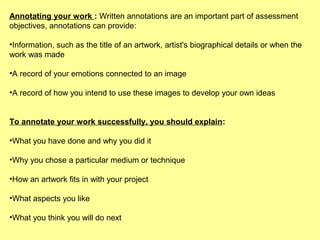
1 page of
analysis
hand
written or
typed

1 image
from the
artist that
has
inspired
you and
relates to
your work

Copy of
the image
that you
have
analysed
using a
similar
technique
and
materials
if possible
Annotating your work : Written annotations are an important part of assessment
objectives, annotations can provide:
•Information, such as the title of an artwork, artist's biographical details or when the
work was made
•A record of your emotions connected to an image
•A record of how you intend to use these images to develop your own ideas
To annotate your work successfully, you should explain:
•What you have done and why you did it
•Why you chose a particular medium or technique
•How an artwork fits in with your project
•What aspects you like
•What you think you will do next
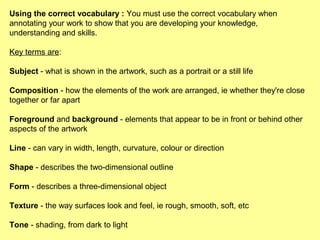
Using the correct vocabulary : You must use the correct vocabulary when
annotating your work to show that you are developing your knowledge,
understanding and skills.
Key terms are:
Subject - what is shown in the artwork, such as a portrait or a still life
Composition - how the elements of the work are arranged, ie whether they're close
together or far apart
Foreground and background - elements that appear to be in front or behind other
aspects of the artwork
Line - can vary in width, length, curvature, colour or direction
Shape - describes the two-dimensional outline
Form - describes a three-dimensional object
Texture - the way surfaces look and feel, ie rough, smooth, soft, etc
Tone - shading, from dark to light

Analysing an artists work

  • 1.
  • 2.
    Analysing an artist'swork means studying the elements that make up an artwork.
  • 3.
    Analysing an artist'swork means studying the elements that make up an artwork. In order to achieve higher marks you need to show that you understand the work of artists.
  • 4.
    Analysing an artist'swork means studying the elements that make up an artwork. In order to achieve higher marks you need to show that you understand the work of artists. The following headings and questions can help you to structure a piece of writing and understand a piece of artwork. Always remember to use your own words so that you are expressing what you think.
  • 5.
    Form : Thismeans looking at the formal elements of an artwork. •What is the medium of the work? •What colours does the artist use? Why? How is colour organised? •What kind of shapes or forms can you find? •What kind of marks or techniques does the artist use?
  • 6.
    Context : Thisrefers to how the work relates to a particular time, place, culture and society in which it was produced. •When was it made? Where was it made? Who made it? •What do you know about the artist? •Does the work relate to the social or political history of the time? •Does the work relate to other areas of knowledge, such as science or geography?
  • 7.
    Content : Thecontent is the subject of a piece of work. •What is it? What is it about? What is happening? •What does the work represent? •Does the title change the way we see the work? •Is it a realistic depiction? •Have any parts been exaggerated or distorted? If so, why? •What message does the work communicate?
  • 8.
    Mood : Moodmeans looking at how the artist has created a certain atmosphere or feeling. •How does the work make you feel? •Why do you think you feel like this? •Does the colour, texture, form or theme of the work affect your mood? •Does the work create an atmosphere?
  • 9.
    Your Project :How does the artist you have analysed relate to your work. •What links are there between the artists work and yours? •How has the artist inspired you ? •What elements of the work will you use to develop your own project?
  • 10.
    1 page of analysis hand writtenor typed 1 image from the artist that has inspired you and relates to your work Copy of the image that you have analysed using a similar technique and materials if possible
  • 11.
    Annotating your work: Written annotations are an important part of assessment objectives, annotations can provide: •Information, such as the title of an artwork, artist's biographical details or when the work was made •A record of your emotions connected to an image •A record of how you intend to use these images to develop your own ideas To annotate your work successfully, you should explain: •What you have done and why you did it •Why you chose a particular medium or technique •How an artwork fits in with your project •What aspects you like •What you think you will do next
  • 12.
    Using the correctvocabulary : You must use the correct vocabulary when annotating your work to show that you are developing your knowledge, understanding and skills. Key terms are: Subject - what is shown in the artwork, such as a portrait or a still life Composition - how the elements of the work are arranged, ie whether they're close together or far apart Foreground and background - elements that appear to be in front or behind other aspects of the artwork Line - can vary in width, length, curvature, colour or direction Shape - describes the two-dimensional outline Form - describes a three-dimensional object Texture - the way surfaces look and feel, ie rough, smooth, soft, etc Tone - shading, from dark to light