+
Social Media for
Public Safety Telecommunicators
Grace Larsen
glarsen911@gmail.com
June 25, 2014
+
What is “Social Media”?
+
What is “Social Media”?
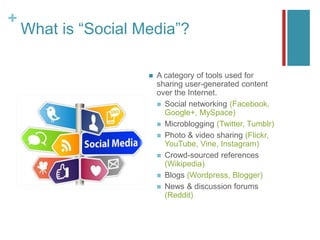
 A category of tools used for
sharing user-generated content
over the Internet.
 Social networking (Facebook,
Google+, MySpace)
 Microblogging (Twitter, Tumblr)
 Photo & video sharing (Flickr,
YouTube, Vine, Instagram)
 Crowd-sourced references
(Wikipedia)
 Blogs (Wordpress, Blogger)
 News & discussion forums
(Reddit)
+
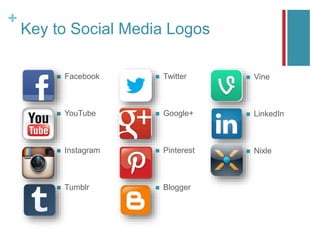
 Facebook
 YouTube
 Instagram
 Tumblr
Key to Social Media Logos
 Twitter
 Google+
 Pinterest
 Blogger
 Vine
 LinkedIn
 Nixle
+
 Twitter
 Instagram
Most Used Networks
for Law Enforcement
 Facebook
 Nixle
 YouTube
 Blogs
+
Twitter
 19% of all online adults are active on Twitter
 Total number of active users: 255 million
 Majority demographics: adults age 18-29, urban residents, African
Americans
 46% of users check Twitter daily, 29% check several times per day
 52% of users get news on Twitter
Source: Pew Research Internet Project Social Media Update, Dec 2013
+
Twitter
Good for:
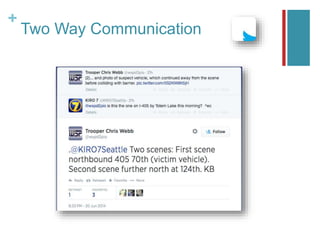
 Two-way communication with public & news reporters
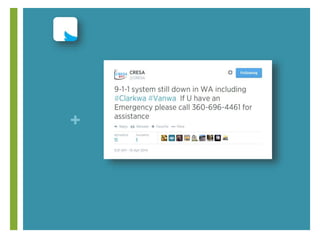
 Timely alerts (events, road closures, police activity, school lockdowns)
 “Tweetups” (Q&A sessions conducted via Twitter hashtag)
 “Tweetalongs” (police ridealongs narrated on Twitter)
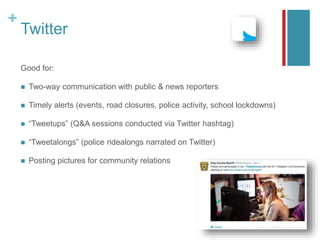
 Posting pictures for community relations
+
Two Way Communication
+
Facebook
 71% of all Internet users are active on Facebook
 Total number of active users: 1 billion, 310 million
 Percent of all users who log in any given day: 63%
 Percentage of users who log in more than once a day: 40%
 Percent of 18-34 year olds who check Facebook before they get out
of bed: 28%
 38% of users get news on Facebook
 Number of links shared every 20 minutes: 1 million
 Majority demographics: women, adults age 18-29
Source: Pew Research Internet Project Social Media Update Dec 2013, Statistic Brain Jan 2014
+
Facebook
Good for:
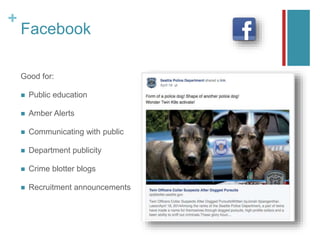
 Public education
 Amber Alerts
 Communicating with public
 Department publicity
 Crime blotter blogs
 Recruitment announcements
+
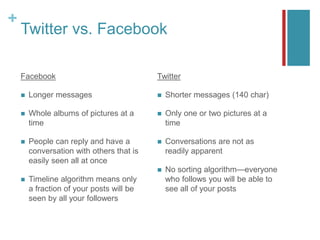
Twitter vs. Facebook
Facebook
 Longer messages
 Whole albums of pictures at a
time
 People can reply and have a
conversation with others that is
easily seen all at once
 Timeline algorithm means only
a fraction of your posts will be
seen by all your followers
Twitter
 Shorter messages (140 char)
 Only one or two pictures at a
time
 Conversations are not as
readily apparent
 No sorting algorithm—everyone
who follows you will be able to
see all of your posts
+
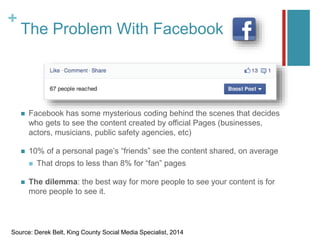
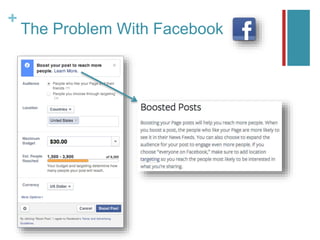
The Problem With Facebook
 Facebook has some mysterious coding behind the scenes that decides
who gets to see the content created by official Pages (businesses,
actors, musicians, public safety agencies, etc)
 10% of a personal page’s “friends” see the content shared, on average
 That drops to less than 8% for “fan” pages
 The dilemma: the best way for more people to see your content is for
more people to see it.
Source: Derek Belt, King County Social Media Specialist, 2014
+
The Problem With Facebook
+
The Problem With Facebook
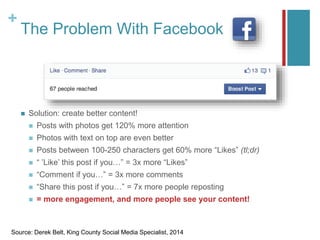
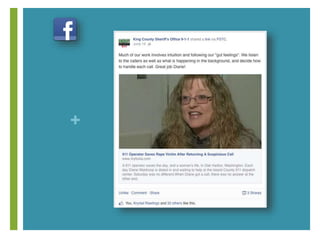
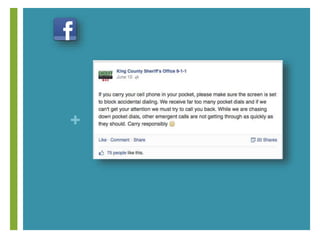
 Solution: create better content!
 Posts with photos get 120% more attention
 Photos with text on top are even better
 Posts between 100-250 characters get 60% more “Likes” (tl;dr)
 “ ’Like’ this post if you…” = 3x more “Likes”
 “Comment if you…” = 3x more comments
 “Share this post if you…” = 7x more people reposting
 = more engagement, and more people see your content!
Source: Derek Belt, King County Social Media Specialist, 2014
+
Instagram
 17% of all online adults are active on Instagram, up from 13% in 2012.
 Number of monthly active users: 200 million
 Number of daily active users: 75 million
 Majority demographics: adults age 18-29, suburban residents, African
Americans
 57% of Instagram users use the app daily, 35% several times a day
 Was acquired by Facebook in April 2012.
Source: DMR, expandedramblings.com, June 2014
+
Instagram
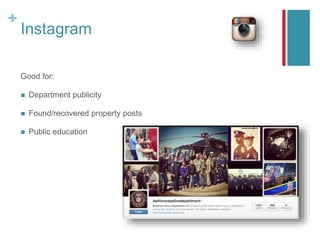
Good for:
 Department publicity
 Found/recovered property posts
 Public education
+
YouTube
 Number of videos viewed every day: 4,250,000,000
 Number of unique visits every month: 900,000,000
 Number of hours watched every month: 3.25 billion
 Percent of Americans that use YouTube during work hours: 14.4%
 Majority demographics: adults age 18-29, urban residents, African
Americans
 20% of users get news on YouTube
Source: DMR, expandedramblings.com, June 2014
+
YouTube
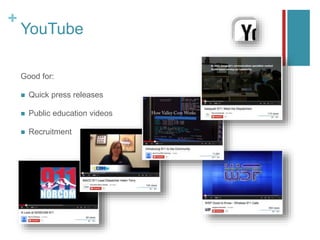
Good for:
 Quick press releases
 Public education videos
 Recruitment
+
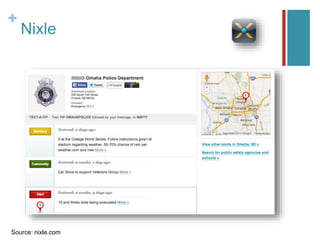
Nixle
 Designed for public safety agencies to send messages to the
community
 Used by 3200-7000+ agencies
 Basic product is free to public safety
 Citizens register to receive information by phone, email, text, etc.
Source: nixle.com
+
Nixle
Source: nixle.com
+
Social Media &
the 911 Industry
Why Do
I Care?
+
Who uses social media?
 Media
 Businesses
 Office of POTUS
 City Governments
 Washington State DOT
 Police & Fire Departments
 Dispatch Centers
 FEMA
 CDC
 APCO
 AmberAlert.com
 Astronauts
 The public!
(This is not an inclusive list!)
+
Why should my agency consider
adopting social media?
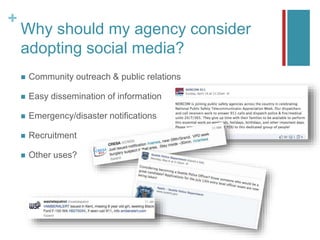
 Community outreach & public relations
 Easy dissemination of information
 Emergency/disaster notifications
 Recruitment
 Other uses?
+
Why should my agency consider
adopting social media?
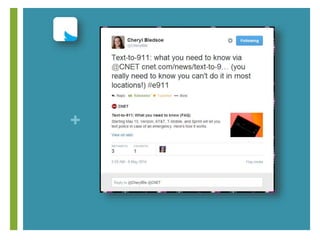
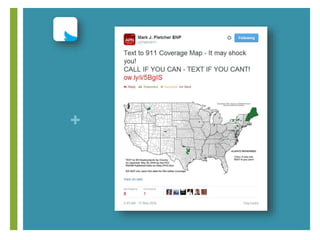
Number One Reason:
public education
and engagement
+
+
+
+
+
+
+
+
+
+
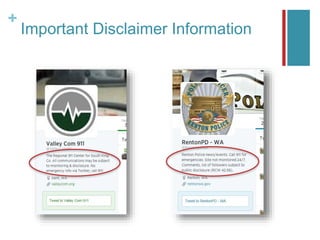
Important Disclaimer Information
+
Important Disclaimer Information
+
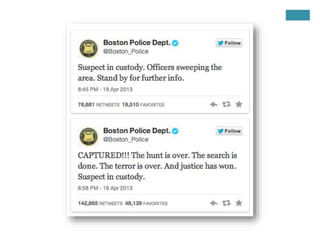
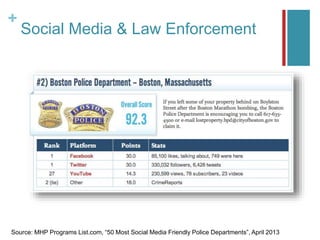
Social Media & Law Enforcement
Source: MHP Programs List.com, “50 Most Social Media Friendly Police Departments”, April 2013
IACP Center for Social Media
http://www.iacpsocialmedia.org/
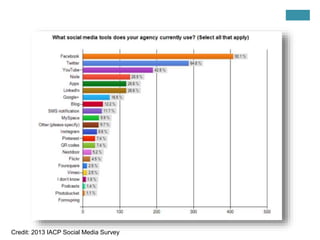
Credit: 2013 IACP Social Media Survey
+
Credit: 2013 IACP Social Media Survey
IACP Social Media Survey
 Surveyed 500 law enforcement agencies in 48
states.
 96% of agencies surveyed use social media.
 Over half of the other 4% are considering it.
 73% say social media has improved police-
community relations in their jurisdiction.
 70% of agencies using social media have a written
policy for official use of social media, and an
additional 14% are in the process of crafting a policy.
Grace’s Rule #1:
No policy?
Don’t do it!
IACP Center for Social Media
http://www.iacpsocialmedia.org/GettingStarted/PolicyDevelopment.aspx
+
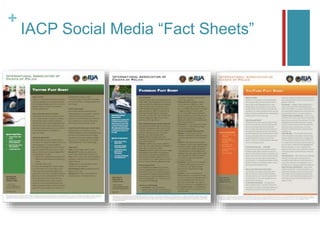
IACP Social Media “Fact Sheets”
+
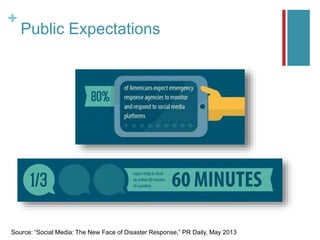
Public Expectations
Source: “Social Media: The New Face of Disaster Response,” PR Daily, May 2013
+
My Tips for Using Social Media
 Before you start, decide:
 Who is your audience?
 What are your goals?
 How to manage security?
 Who’s in charge?
 What will they share?
 How often will they post?
 WRITE A POLICY before you start.
 Have it vetted through your Legal department.
 Form a Social Media team and give them guidelines.
+
DO:
 DO: be personable, friendly,
relatable. Humor humanizes.
 DO: stay on topic. Business
accounts are for business; you
can talk about that excellent
restaurant or your latest
vacation on your personal
account.
 DO: use secure passwords.
 DO: Find your employees who
know how it works already and
get them to assist.
 DO: make sure each account
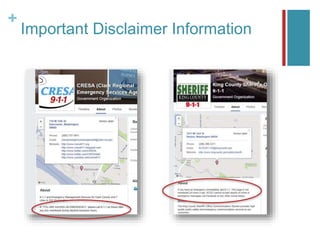
has a prominent statement that
it isn’t monitored 24/7 and
people should call 911 for
emergencies.
 DO: Consider forming a social
media workgroup within your
region.
 DO: answer your followers.
Social media is all about
connection and conversation
+
DON’T:
 DON’T: say anything on a
social media account that you
wouldn’t say to the media, the
mayor, or the chief.
 DON’T: argue with people on
social media. Expect to be
mocked or attacked, but
NEVER fight back.
 DON’T: use “netspeak”. Proper
grammar at all times. If it
doesn’t fit, revise it.
 DON’T: spam. Post enough to
be active, but remember:
everything in moderation.
 DON’T: use Twitter just to post
links to your Facebook posts.
You can automate it to do that,
but that doesn’t mean you
should. People use the different
networks for different reasons.
 DON’T: be afraid to own it and
apologize when you screw up.
+
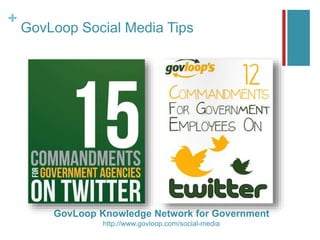
GovLoop Social Media Tips
GovLoop Knowledge Network for Government
http://www.govloop.com/social-media
+
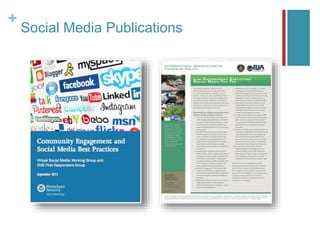
Social Media Publications
+
Social Media Publications
+
Social Media Publications
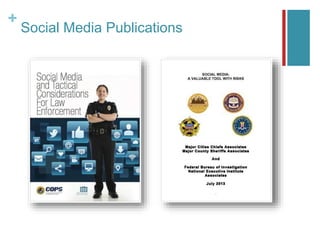
 IACP: Social Media Concepts & Issues Paper
http://www.iacpsocialmedia.org/Portals/1/documents/social%20me
dia%20paper.pdf
 IACP: Social Media Model Policy
http://www.iacpsocialmedia.org/portals/1/documents/social%20me
dia%20policy.pdf
 IACP: 2013 Social Media Survey
http://www.iacpsocialmedia.org/Resources/Publications/2013Surv
eyResults.aspx
 IACP: Law Enforcement Execs Social Media Top Ten
http://www.iacpsocialmedia.org/Portals/1/documents/Fact%20She
ets/Chiefs%20Top%20Ten%20Fact%20Sheet.pdf
+
Social Media Publications
 IACP: Social Media Fact Sheet
http://www.iacpsocialmedia.org/Portals/1/documents/Fact%20She
ets/Social%20Media%20Fact%20Sheet.pdf
 IACP: Facebook Fact Sheet
http://www.iacpsocialmedia.org/Portals/1/documents/Fact%20She
ets/Facebook%20Fact%20Sheet.pdf
 IACP: Twitter Fact Sheet
http://www.iacpsocialmedia.org/Portals/1/documents/Fact%20She
ets/Twitter%20Fact%20Sheet.pdf
 IACP: YouTube Fact Sheet
http://www.iacpsocialmedia.org/Portals/1/documents/Fact%20She
ets/YouTube%20Fact%20Sheet.pdf
+
Social Media Publications
 GovLoop: The Social Media Experiment in Government:
Elements of Excellence
http://www.govloop.com/profiles/blogs/the-social-media-
experiment-in-government-elements-of-excellence-
 GovLoop: Twitter Guide for Government Agencies
http://www.govloop.com/page/twitter-guide-for-government-
agencies-regularity
 GovLoop: Twitter Guide for Government Employees
http://www.govloop.com/profiles/blogs/new-twitter-guides-for-
government-agencies-and-employees
+
Social Media Publications
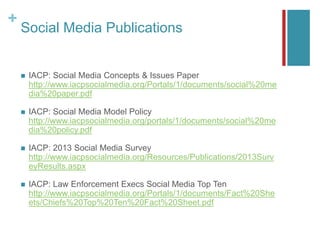
 DHS: Community Engagement and Social Media Best
Practices https://www.llis.dhs.gov/content/community-
engagement-and-social-media-best-practices
 FBI & Major Cities Chiefs/County Sheriffs: Social Media: A
Valuable Tool With Risks
http://www.neiassociates.org/storage/FBINEIA-2013-
SocMediaTool.pdf
+
Presentation Info Can Be Found At:
http://sm4pst.blogspot.com
(Social Media for Public Safety
Telecommunications
Professionals – a blog)  Email: glarsen911@gmail.com
 Twitter: @raincitysun
 Facebook: Grace Larsen

Social Media for Public Safety Telecommunicators

  • 1.
    + Social Media for PublicSafety Telecommunicators Grace Larsen glarsen911@gmail.com June 25, 2014
  • 2.
  • 3.
    + What is “SocialMedia”?  A category of tools used for sharing user-generated content over the Internet.  Social networking (Facebook, Google+, MySpace)  Microblogging (Twitter, Tumblr)  Photo & video sharing (Flickr, YouTube, Vine, Instagram)  Crowd-sourced references (Wikipedia)  Blogs (Wordpress, Blogger)  News & discussion forums (Reddit)
  • 4.
    +  Facebook  YouTube Instagram  Tumblr Key to Social Media Logos  Twitter  Google+  Pinterest  Blogger  Vine  LinkedIn  Nixle
  • 7.
    +  Twitter  Instagram MostUsed Networks for Law Enforcement  Facebook  Nixle  YouTube  Blogs
  • 8.
    + Twitter  19% ofall online adults are active on Twitter  Total number of active users: 255 million  Majority demographics: adults age 18-29, urban residents, African Americans  46% of users check Twitter daily, 29% check several times per day  52% of users get news on Twitter Source: Pew Research Internet Project Social Media Update, Dec 2013
  • 9.
    + Twitter Good for:  Two-waycommunication with public & news reporters  Timely alerts (events, road closures, police activity, school lockdowns)  “Tweetups” (Q&A sessions conducted via Twitter hashtag)  “Tweetalongs” (police ridealongs narrated on Twitter)  Posting pictures for community relations
  • 10.
  • 11.
    + Facebook  71% ofall Internet users are active on Facebook  Total number of active users: 1 billion, 310 million  Percent of all users who log in any given day: 63%  Percentage of users who log in more than once a day: 40%  Percent of 18-34 year olds who check Facebook before they get out of bed: 28%  38% of users get news on Facebook  Number of links shared every 20 minutes: 1 million  Majority demographics: women, adults age 18-29 Source: Pew Research Internet Project Social Media Update Dec 2013, Statistic Brain Jan 2014
  • 12.
    + Facebook Good for:  Publiceducation  Amber Alerts  Communicating with public  Department publicity  Crime blotter blogs  Recruitment announcements
  • 13.
    + Twitter vs. Facebook Facebook Longer messages  Whole albums of pictures at a time  People can reply and have a conversation with others that is easily seen all at once  Timeline algorithm means only a fraction of your posts will be seen by all your followers Twitter  Shorter messages (140 char)  Only one or two pictures at a time  Conversations are not as readily apparent  No sorting algorithm—everyone who follows you will be able to see all of your posts
  • 14.
    + The Problem WithFacebook  Facebook has some mysterious coding behind the scenes that decides who gets to see the content created by official Pages (businesses, actors, musicians, public safety agencies, etc)  10% of a personal page’s “friends” see the content shared, on average  That drops to less than 8% for “fan” pages  The dilemma: the best way for more people to see your content is for more people to see it. Source: Derek Belt, King County Social Media Specialist, 2014
  • 15.
  • 16.
    + The Problem WithFacebook  Solution: create better content!  Posts with photos get 120% more attention  Photos with text on top are even better  Posts between 100-250 characters get 60% more “Likes” (tl;dr)  “ ’Like’ this post if you…” = 3x more “Likes”  “Comment if you…” = 3x more comments  “Share this post if you…” = 7x more people reposting  = more engagement, and more people see your content! Source: Derek Belt, King County Social Media Specialist, 2014
  • 17.
    + Instagram  17% ofall online adults are active on Instagram, up from 13% in 2012.  Number of monthly active users: 200 million  Number of daily active users: 75 million  Majority demographics: adults age 18-29, suburban residents, African Americans  57% of Instagram users use the app daily, 35% several times a day  Was acquired by Facebook in April 2012. Source: DMR, expandedramblings.com, June 2014
  • 18.
    + Instagram Good for:  Departmentpublicity  Found/recovered property posts  Public education
  • 19.
    + YouTube  Number ofvideos viewed every day: 4,250,000,000  Number of unique visits every month: 900,000,000  Number of hours watched every month: 3.25 billion  Percent of Americans that use YouTube during work hours: 14.4%  Majority demographics: adults age 18-29, urban residents, African Americans  20% of users get news on YouTube Source: DMR, expandedramblings.com, June 2014
  • 20.
    + YouTube Good for:  Quickpress releases  Public education videos  Recruitment
  • 21.
    + Nixle  Designed forpublic safety agencies to send messages to the community  Used by 3200-7000+ agencies  Basic product is free to public safety  Citizens register to receive information by phone, email, text, etc. Source: nixle.com
  • 22.
  • 23.
    + Social Media & the911 Industry Why Do I Care?
  • 24.
    + Who uses socialmedia?  Media  Businesses  Office of POTUS  City Governments  Washington State DOT  Police & Fire Departments  Dispatch Centers  FEMA  CDC  APCO  AmberAlert.com  Astronauts  The public! (This is not an inclusive list!)
  • 25.
    + Why should myagency consider adopting social media?  Community outreach & public relations  Easy dissemination of information  Emergency/disaster notifications  Recruitment  Other uses?
  • 26.
    + Why should myagency consider adopting social media? Number One Reason: public education and engagement
  • 27.
  • 28.
  • 29.
  • 30.
  • 31.
  • 32.
  • 33.
  • 34.
  • 35.
  • 36.
  • 37.
  • 38.
    + Social Media &Law Enforcement Source: MHP Programs List.com, “50 Most Social Media Friendly Police Departments”, April 2013
  • 40.
    IACP Center forSocial Media http://www.iacpsocialmedia.org/
  • 41.
    Credit: 2013 IACPSocial Media Survey
  • 42.
    + Credit: 2013 IACPSocial Media Survey IACP Social Media Survey  Surveyed 500 law enforcement agencies in 48 states.  96% of agencies surveyed use social media.  Over half of the other 4% are considering it.  73% say social media has improved police- community relations in their jurisdiction.  70% of agencies using social media have a written policy for official use of social media, and an additional 14% are in the process of crafting a policy.
  • 43.
    Grace’s Rule #1: Nopolicy? Don’t do it!
  • 44.
    IACP Center forSocial Media http://www.iacpsocialmedia.org/GettingStarted/PolicyDevelopment.aspx
  • 45.
    + IACP Social Media“Fact Sheets”
  • 46.
    + Public Expectations Source: “SocialMedia: The New Face of Disaster Response,” PR Daily, May 2013
  • 47.
    + My Tips forUsing Social Media  Before you start, decide:  Who is your audience?  What are your goals?  How to manage security?  Who’s in charge?  What will they share?  How often will they post?  WRITE A POLICY before you start.  Have it vetted through your Legal department.  Form a Social Media team and give them guidelines.
  • 48.
    + DO:  DO: bepersonable, friendly, relatable. Humor humanizes.  DO: stay on topic. Business accounts are for business; you can talk about that excellent restaurant or your latest vacation on your personal account.  DO: use secure passwords.  DO: Find your employees who know how it works already and get them to assist.  DO: make sure each account has a prominent statement that it isn’t monitored 24/7 and people should call 911 for emergencies.  DO: Consider forming a social media workgroup within your region.  DO: answer your followers. Social media is all about connection and conversation
  • 49.
    + DON’T:  DON’T: sayanything on a social media account that you wouldn’t say to the media, the mayor, or the chief.  DON’T: argue with people on social media. Expect to be mocked or attacked, but NEVER fight back.  DON’T: use “netspeak”. Proper grammar at all times. If it doesn’t fit, revise it.  DON’T: spam. Post enough to be active, but remember: everything in moderation.  DON’T: use Twitter just to post links to your Facebook posts. You can automate it to do that, but that doesn’t mean you should. People use the different networks for different reasons.  DON’T: be afraid to own it and apologize when you screw up.
  • 50.
    + GovLoop Social MediaTips GovLoop Knowledge Network for Government http://www.govloop.com/social-media
  • 51.
  • 52.
  • 53.
    + Social Media Publications IACP: Social Media Concepts & Issues Paper http://www.iacpsocialmedia.org/Portals/1/documents/social%20me dia%20paper.pdf  IACP: Social Media Model Policy http://www.iacpsocialmedia.org/portals/1/documents/social%20me dia%20policy.pdf  IACP: 2013 Social Media Survey http://www.iacpsocialmedia.org/Resources/Publications/2013Surv eyResults.aspx  IACP: Law Enforcement Execs Social Media Top Ten http://www.iacpsocialmedia.org/Portals/1/documents/Fact%20She ets/Chiefs%20Top%20Ten%20Fact%20Sheet.pdf
  • 54.
    + Social Media Publications IACP: Social Media Fact Sheet http://www.iacpsocialmedia.org/Portals/1/documents/Fact%20She ets/Social%20Media%20Fact%20Sheet.pdf  IACP: Facebook Fact Sheet http://www.iacpsocialmedia.org/Portals/1/documents/Fact%20She ets/Facebook%20Fact%20Sheet.pdf  IACP: Twitter Fact Sheet http://www.iacpsocialmedia.org/Portals/1/documents/Fact%20She ets/Twitter%20Fact%20Sheet.pdf  IACP: YouTube Fact Sheet http://www.iacpsocialmedia.org/Portals/1/documents/Fact%20She ets/YouTube%20Fact%20Sheet.pdf
  • 55.
    + Social Media Publications GovLoop: The Social Media Experiment in Government: Elements of Excellence http://www.govloop.com/profiles/blogs/the-social-media- experiment-in-government-elements-of-excellence-  GovLoop: Twitter Guide for Government Agencies http://www.govloop.com/page/twitter-guide-for-government- agencies-regularity  GovLoop: Twitter Guide for Government Employees http://www.govloop.com/profiles/blogs/new-twitter-guides-for- government-agencies-and-employees
  • 56.
    + Social Media Publications DHS: Community Engagement and Social Media Best Practices https://www.llis.dhs.gov/content/community- engagement-and-social-media-best-practices  FBI & Major Cities Chiefs/County Sheriffs: Social Media: A Valuable Tool With Risks http://www.neiassociates.org/storage/FBINEIA-2013- SocMediaTool.pdf
  • 57.
    + Presentation Info CanBe Found At: http://sm4pst.blogspot.com (Social Media for Public Safety Telecommunications Professionals – a blog)  Email: glarsen911@gmail.com  Twitter: @raincitysun  Facebook: Grace Larsen

Editor's Notes

  • #11 Definition of hashtags
  • #12 Facebook stats
  • #13 Facebook stats
  • #14 What are the basic content differences?
  • #15 Facebook seems like the perfect solution! Lots of users, lots of options for content creation. Why use anything else? Derek Belt: At any given moment, there are approximately 1,500 stories that Facebook could show in the average user’s News Feed. The struggle is figuring out how to get the right stories to the right people. It’s all pre-determined by Facebook’s computer algorithm, and there is no longer a clear way around this. Affinity—the relationship between a fan page and a regular user—is strengthened over time with every like, comment, share, video or photo view, and link click. Affinity is personalized to every user, so different posts will reach different people every time. If you—the user--usually click on and like photos, Facebook will show you more posts with photos in them and fewer posts with links or just text in them.
  • #16 The solution for businesses is to buy ads (though even that doesn’t always work). Not realistic for a police department or dispatch center.
  • #17 Photos get 120% more interactions, says Facebook, because they’re easier to see. Photo with text are catchy. Several tools out there for easy adding text to photos
  • #18 Basic stats
  • #19 Basic stats
  • #20 Basic stats