Media theories
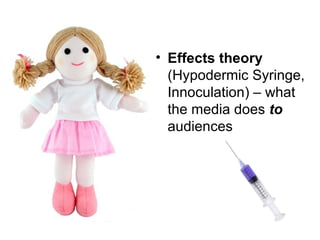
Effects theory  (Hypodermic Syringe, Innoculation) – what the media does  to  audiences
Uses and Gratifications  – what audiences do  with  the media
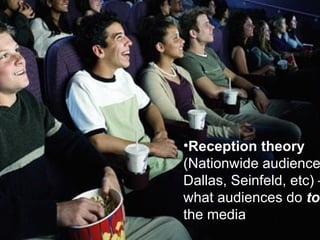
Reception theory  (Nationwide audience, Dallas, Seinfeld, etc) – what audiences do  to  the media
Effects Theories Mass media/mass communications make people powerless to resist messages the media carries Consumers are ā€˜drugged’, ā€˜addicted’ or ā€˜hypnotised’ Effects theories taken up with protection of young, link between violence and the media
Effects Theories Historical stuff Frankfurt School: Marxist German intellectuals reacting against Nazi propaganda and US advertising – suggested the power of big corporations and the state to control how we think Rise of TV in the 50’s and 60’s – fear of danger to children
Effects Theories Historical Stuff Influence of behavioural scientists (think of Pavlov’s dogs) – media may reinforce attitudes through repetition Bobo doll experiment (1963) – Bandura and Walters – children imitate adult treatment of doll seen on film
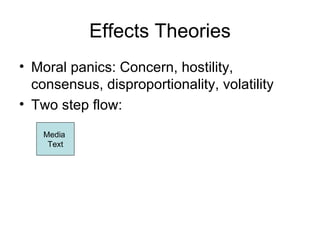
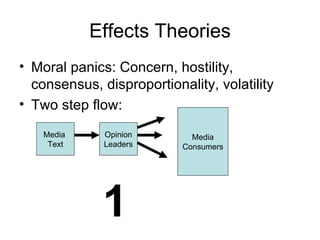
Effects Theories Moral panics: Concern, hostility, consensus, disproportionality, volatility Two step flow: Media  Text
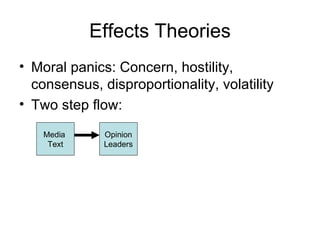
Effects Theories Moral panics: Concern, hostility, consensus, disproportionality, volatility Two step flow: Media  Text Opinion Leaders
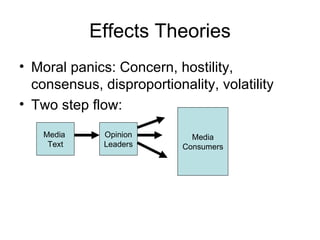
Effects Theories Moral panics: Concern, hostility, consensus, disproportionality, volatility Two step flow: Media  Text Opinion Leaders Media Consumers
Effects Theories Moral panics: Concern, hostility, consensus, disproportionality, volatility Two step flow: Media  Text Opinion Leaders Media Consumers 1
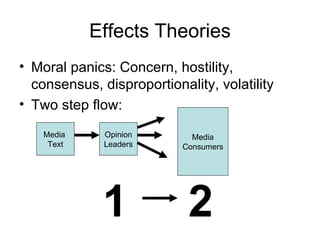
Effects Theories Moral panics: Concern, hostility, consensus, disproportionality, volatility Two step flow: Media  Text Opinion Leaders Media Consumers 1 2
Effects Theories What’s wrong with effects theories? The problems with violence are often social/psychological not to do with the media The media can often be positive rather than harmful Criticism of the media using the effects model is often politically motivated There is not real grounding of research and theory for this model.
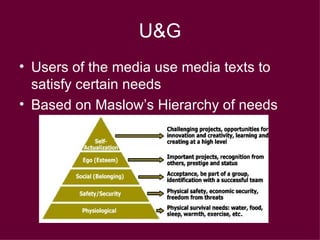
U&G Users of the media use media texts to satisfy certain needs Based on Maslow’s Hierarchy of needs
U&G: Denis McQuail (1987)   Information : finding out about the world; seeking advice; satisfying curiosity; education; gaining security though knowledge Personal Identity : reinforcement of personal values; models of behaviour; identifying with valued other; gaining insight into oneself Integration and Social Interaction : gaining insight into circumstances of others; identifying with others; basis for conversation with others; substitute for real life companionship; helping to carry out social roles; enabling connection with family friends and society Entertainment : escapism; diversion; relaxation; cultural or aesthetic enjoyment; filling time; emotional release; sexual arousal
U&G: James Lull (1990)   Structural Environmental:  background noise; companionship; entertainment Regulative:   keeping time; part of pattern of daily life Relational Communication Facilitation:   experience illustration; common ground; conversation starter; anxiety reduction; agenda for talk; value clarification Affiliation/Avoidance:   physical/verbal contact/neglect; family solidarity; family  relaxant/conflict reducer; relationship maintenance Social Learning:   decision making; behaviour modelling; problem solving; value transmission; legitimization; information dissemination; education Competence/Dominance:   role enactment; role reinforcement; substitute role portrayal; intellectual validation; authority exercise; gatekeeping; argument facilitation
U&G: Richard Kilborn (1992)   Part of routine and entertaining reward for work Launchpad of social and personal interaction Fulfilling individual needs – a way of choosing to be alone or of enduring enforced loneliness Identification or involvement with characters Escapist fantasy Focus of debate on topical issues Kind of critical game involving knowledge of rules or conventions of the genre
U&G:  Problems   We may not have choice about what we watch Neglects any aspects of effects theories Neglects socio-economic factors
Reception Theory Often as opposite to Effects theories Sees media consumption as active not passive Suggests media texts are polysemic Research examines social, cultural, economic, gender, sexuality as influence on the reading of media texts
Reception Theory Active  versus  Passive
Reception Theory Reception Theory  versus  Effects Theory
1 Reception Theory
Nationwide Audience David Morley 1980 Different social/economic groups watched same TV programme Interviews reveal different readings of same text
Nationwide Audience Dominant (Hegemonic) reading : reader shares the encoded meanings of the text Negotiated reading : reader shares some of the embedded ideologies but not all Oppositional (counter-hegemonic) reading:  where the reader does not share the programme’s code and rejects the preferred reading
Nationwide Audience Members of the same subculture will tend to decode texts in similar ways.  Individual readings of texts will be framed by shared cultural formations and practices.
2 Reception Theory
Watching Dallas Ien Ang 1985 Different social/cultural groups watched same TV programme Interviews reveal different readings of same text
Watching Dallas Importance is the pleasure derived from ā€˜Dallas’ as entertainment Independent of ideas about mass culture
Watching Dallas Readers saw characters as either realistic or unrealistic All saw characters as ā€˜genuine’ ā€˜ Emotional Realism’ May see the programme as lowbrow but accept that it is entertaining.
3 Reception Theory
Leibes and Katz on Dallas (1984) International cross cultural groups watched Dallas Retell the story The retelling was shaped by cultural background although there were similar patterns amonst all groups
4 Reception Theory
Watching Seinfeld Lori Yanish 1995 Canadian and Dutch viewers’ reactions to Seinfeld Dutch viewers associated American comedy with low class television Media as cultural imperialism
5 Reception Theory
Madonna John Fiske 1989 Does Madonna exploit the music industry or does the music industry exploit Madonna?
Modes of Address How a text is constructed to make us feel that it is specifically aimed at us The ways in which texts built to appeal to particular audiences (Skins, any children’s programme, The Sun)

Media Theories.

  • 1.
  • 2.
    Effects theory (Hypodermic Syringe, Innoculation) – what the media does to audiences
  • 3.
    Uses and Gratifications – what audiences do with the media
  • 4.
    Reception theory (Nationwide audience, Dallas, Seinfeld, etc) – what audiences do to the media
  • 5.
    Effects Theories Massmedia/mass communications make people powerless to resist messages the media carries Consumers are ā€˜drugged’, ā€˜addicted’ or ā€˜hypnotised’ Effects theories taken up with protection of young, link between violence and the media
  • 6.
    Effects Theories Historicalstuff Frankfurt School: Marxist German intellectuals reacting against Nazi propaganda and US advertising – suggested the power of big corporations and the state to control how we think Rise of TV in the 50’s and 60’s – fear of danger to children
  • 7.
    Effects Theories HistoricalStuff Influence of behavioural scientists (think of Pavlov’s dogs) – media may reinforce attitudes through repetition Bobo doll experiment (1963) – Bandura and Walters – children imitate adult treatment of doll seen on film
  • 8.
    Effects Theories Moralpanics: Concern, hostility, consensus, disproportionality, volatility Two step flow: Media Text
  • 9.
    Effects Theories Moralpanics: Concern, hostility, consensus, disproportionality, volatility Two step flow: Media Text Opinion Leaders
  • 10.
    Effects Theories Moralpanics: Concern, hostility, consensus, disproportionality, volatility Two step flow: Media Text Opinion Leaders Media Consumers
  • 11.
    Effects Theories Moralpanics: Concern, hostility, consensus, disproportionality, volatility Two step flow: Media Text Opinion Leaders Media Consumers 1
  • 12.
    Effects Theories Moralpanics: Concern, hostility, consensus, disproportionality, volatility Two step flow: Media Text Opinion Leaders Media Consumers 1 2
  • 13.
    Effects Theories What’swrong with effects theories? The problems with violence are often social/psychological not to do with the media The media can often be positive rather than harmful Criticism of the media using the effects model is often politically motivated There is not real grounding of research and theory for this model.
  • 14.
    U&G Users ofthe media use media texts to satisfy certain needs Based on Maslow’s Hierarchy of needs
  • 15.
    U&G: Denis McQuail(1987) Information : finding out about the world; seeking advice; satisfying curiosity; education; gaining security though knowledge Personal Identity : reinforcement of personal values; models of behaviour; identifying with valued other; gaining insight into oneself Integration and Social Interaction : gaining insight into circumstances of others; identifying with others; basis for conversation with others; substitute for real life companionship; helping to carry out social roles; enabling connection with family friends and society Entertainment : escapism; diversion; relaxation; cultural or aesthetic enjoyment; filling time; emotional release; sexual arousal
  • 16.
    U&G: James Lull(1990) Structural Environmental: background noise; companionship; entertainment Regulative: keeping time; part of pattern of daily life Relational Communication Facilitation: experience illustration; common ground; conversation starter; anxiety reduction; agenda for talk; value clarification Affiliation/Avoidance: physical/verbal contact/neglect; family solidarity; family relaxant/conflict reducer; relationship maintenance Social Learning: decision making; behaviour modelling; problem solving; value transmission; legitimization; information dissemination; education Competence/Dominance: role enactment; role reinforcement; substitute role portrayal; intellectual validation; authority exercise; gatekeeping; argument facilitation
  • 17.
    U&G: Richard Kilborn(1992) Part of routine and entertaining reward for work Launchpad of social and personal interaction Fulfilling individual needs – a way of choosing to be alone or of enduring enforced loneliness Identification or involvement with characters Escapist fantasy Focus of debate on topical issues Kind of critical game involving knowledge of rules or conventions of the genre
  • 18.
    U&G: Problems We may not have choice about what we watch Neglects any aspects of effects theories Neglects socio-economic factors
  • 19.
    Reception Theory Oftenas opposite to Effects theories Sees media consumption as active not passive Suggests media texts are polysemic Research examines social, cultural, economic, gender, sexuality as influence on the reading of media texts
  • 20.
    Reception Theory Active versus Passive
  • 21.
    Reception Theory ReceptionTheory versus Effects Theory
  • 22.
  • 23.
    Nationwide Audience DavidMorley 1980 Different social/economic groups watched same TV programme Interviews reveal different readings of same text
  • 24.
    Nationwide Audience Dominant(Hegemonic) reading : reader shares the encoded meanings of the text Negotiated reading : reader shares some of the embedded ideologies but not all Oppositional (counter-hegemonic) reading: where the reader does not share the programme’s code and rejects the preferred reading
  • 25.
    Nationwide Audience Membersof the same subculture will tend to decode texts in similar ways. Individual readings of texts will be framed by shared cultural formations and practices.
  • 26.
  • 27.
    Watching Dallas IenAng 1985 Different social/cultural groups watched same TV programme Interviews reveal different readings of same text
  • 28.
    Watching Dallas Importanceis the pleasure derived from ā€˜Dallas’ as entertainment Independent of ideas about mass culture
  • 29.
    Watching Dallas Readerssaw characters as either realistic or unrealistic All saw characters as ā€˜genuine’ ā€˜ Emotional Realism’ May see the programme as lowbrow but accept that it is entertaining.
  • 30.
  • 31.
    Leibes and Katzon Dallas (1984) International cross cultural groups watched Dallas Retell the story The retelling was shaped by cultural background although there were similar patterns amonst all groups
  • 32.
  • 33.
    Watching Seinfeld LoriYanish 1995 Canadian and Dutch viewers’ reactions to Seinfeld Dutch viewers associated American comedy with low class television Media as cultural imperialism
  • 34.
  • 35.
    Madonna John Fiske1989 Does Madonna exploit the music industry or does the music industry exploit Madonna?
  • 36.
    Modes of AddressHow a text is constructed to make us feel that it is specifically aimed at us The ways in which texts built to appeal to particular audiences (Skins, any children’s programme, The Sun)