Audiology Engine
AudiologyWebsite Design & Audiology
SEOThat Drives LeadsToYour Practice
All Search Engines
want to deliver
relevant results to their
customers
Only Search Engine
Customers MatterTo
Search Engines
Relevance
in search
Search Engines Want To Deliver
An Excellent Experience To Their
Customers By Delivering
Relevant Results To Their
Searches
Content
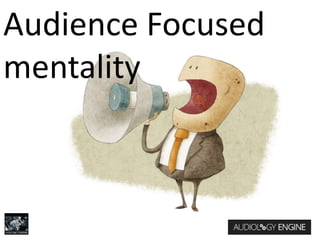
Audience Focused
mentality
Write For People
Copy That Engages
Copy That Inspires
Copy That drives
Action
Semantic Localisation
Deeper Focus On LongTail
Local Keyword Phrases
In depth hearing test in Dublin
Blend Online
& Offline
Driving Conversion
Every Page Should StriveTo
Convert A Prospect
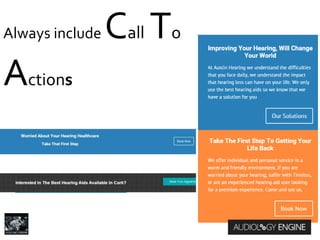
Always include Call To
Actions
Imagery
Always Include
Your Phone
Number
Always Use Social Proof
Social Media
Content
The Rules Are
The Same For
Social Media
Lets Look At
Content Creation
in Practice

Content presentation workshop

Editor's Notes

  • #3 Search engines only care about their customers, the searchers. They want to deliver a good experience to those customers. A good experience is to serve them relevant results that they are interested in for a search term.
  • #4 This means that you need to supply relevant and engaging content that meets the needs of the searchers. They are the only ones that matter.
  • #5 But what is relevance in search?
  • #6 Relevance is simply the concept that the content you provide that targets a particular search phrase is relevant, interesting and engaging to the people that search for it. If it is, Google or Bing will reward you by placing your content higher in the search rankings. They assess the relevance by the actions that viewers take when landing on your content. This is where bounce rate and engagement comes into play.
  • #7 So what is content? For our purposes the term content covers a myriad of things. It is the copy that you write on your web pages, it is the articles that you write to support your website on your blog, it is also the images you create and use across your site and your social media profiles. It is the downloads you offer and the infographics you publish. It is the audio and video you create and supply across your online channels. In short, content is everything.
  • #8 When creating content, you need to use an audience focused mentality, focus on the needs of the reader or viewer. Work those needs into the needs of your business.
  • #9 While SEO is important for your content strategy, writing for people is more important. The saying is write for people and optimise for search engines.
  • #10 Semantic search and localisation have changed things forever. There is now a deeper focus on spoken search terms, or search terms in more natural language. There is also a deep focus on localisation of search from Google. This localisation actually democratises the web. Just because you don’t have a marketing budget of £100,000 does not mean that you as a small business can not be at the top of the search engine rankings.
  • #11 Blend your offline and online marketing strategy, in this way each channel supports the other.
  • #12 Every piece of content you produce should be produced with driving a conversion in mind. That is what we want, a bum on a seat, don’t hobble yourself by not focusing on that goal.
  • #13 Always, always include Call To Action elements on your pages and blog articles. While I have displayed some text ones here, we actually find that visual call to actions drive better conversion.
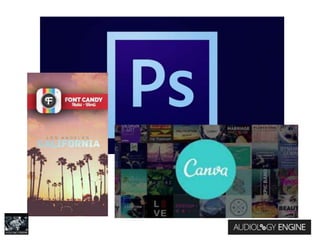
  • #14 This is a small visual call to action box, it was in fact thrown together on canva, a freely available online service. We also use an app called Font Candy for the same purpose. They are powerful enough and more importantly easy to use.
  • #15 Always, always include your phone number on your call to actions, we have discovered that giving the option increases conversion over and above just a contact form. It actually varies from area to area, in some areas there are plenty of form submissions and some calls. In other areas we find the calls far out weigh the form submissions.
  • #16 Use tools to design visuals & visual call to actions that can be used across all of your online channels. Your website, your blog and your social media profiles
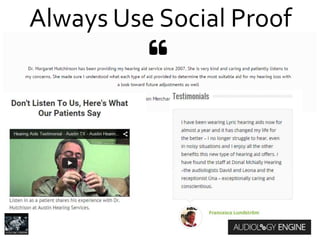
  • #17 Always, always use social proof, try to use testimonials with accompanying images but if you can get video, get it! Use the social proof element close to the call to action element. It will increase the conversion on the call to action.
  • #18 Don’t forget your social media content
  • #19 The rules we have already discussed apply to your social media content. Although, you may be able to get away with a slight bit more on your social media channels.
  • #20 Here is two images we designed for social media, both use humour to highlight the issues