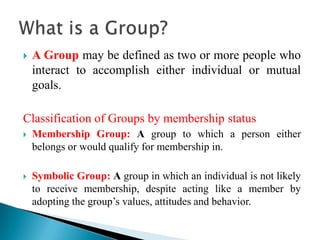
   A Group may be defined as two or more people who
    interact to accomplish either individual or mutual
    goals.

Classification of Groups by membership status
   Membership Group: A group to which a person either
    belongs or would qualify for membership in.

   Symbolic Group: A group in which an individual is not likely
    to receive membership, despite acting like a member by
    adopting the group’s values, attitudes and behavior.
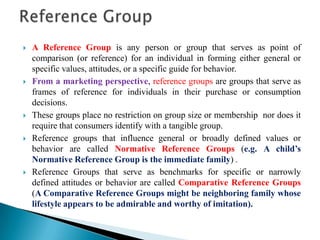
   A Reference Group is any person or group that serves as point of
    comparison (or reference) for an individual in forming either general or
    specific values, attitudes, or a specific guide for behavior.
   From a marketing perspective, reference groups are groups that serve as
    frames of reference for individuals in their purchase or consumption
    decisions.
   These groups place no restriction on group size or membership nor does it
    require that consumers identify with a tangible group.
   Reference groups that influence general or broadly defined values or
    behavior are called Normative Reference Groups (e.g. A child’s
    Normative Reference Group is the immediate family) .
   Reference Groups that serve as benchmarks for specific or narrowly
    defined attitudes or behavior are called Comparative Reference Groups
    (A Comparative Reference Groups might be neighboring family whose
    lifestyle appears to be admirable and worthy of imitation).
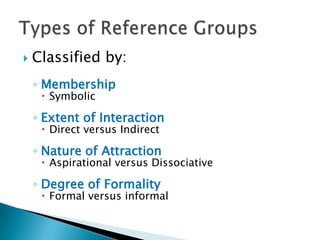
   Classified by:
    ◦ Membership
      Symbolic

    ◦ Extent of Interaction
      Direct versus Indirect

    ◦ Nature of Attraction
      Aspirational versus Dissociative

    ◦ Degree of Formality
      Formal versus informal
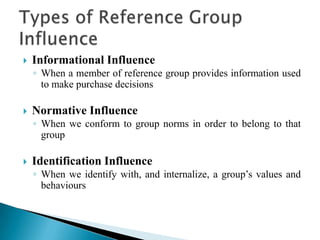
   Informational Influence
    ◦ When a member of reference group provides information used
      to make purchase decisions

   Normative Influence
    ◦ When we conform to group norms in order to belong to that
      group

   Identification Influence
    ◦ When we identify with, and internalize, a group’s values and
      behaviours
   Inform or make the individual aware of a specific product
    or brand.

   Provide the individual with the opportunity to compare
    his or her own thinking with the attitudes and behavior of
    the group.

   Influence the individual to adopt attitudes and behavior
    that are consistent with the norms of the group.

   Legitimize the decision to use the same products as the
    group
   Friendship Groups

   Shopping Groups

   Work Groups
   Virtual Groups or Communities

   Brand Communities

   Consumer-action Groups

   Celebrities
   Friendship groups are typically classified as informal groups because they
    are usually unstructured and lack specific authority levels.

   In terms of relative influence, after an individual’s family, his or her friends
    are most likely to influence the individual’s purchase decisions.

   Seeking and maintaining friendships is a basic drive of most people.

   Friends fill a wide range of needs: They provide companionship, security,
    and opportunities to discuss problems that an individual may be reluctant to
    discuss with family members.

   Marketers of products such as brand-name clothing, fine jewelry,
    snack foods, and alcoholic beverages recognize the power of peer
    group influence and frequently depict friendship situations in their
    advertisements.
   Two or more people who shop together, whether for food, for clothing, or
    simply to pass the time, can be called a shopping group.

   Such groups are often offshoots of family or friendship groups and
    therefore, they function as what has been referred to as purchase pal.

   The motivation for shopping with a purchase pal range from a primarily
    social motive to helping reduce the risk when making an important
    decision.

   A special type of shopping group is the in-home shopping party, which
    typically consists of a group that gathers together in the same home of a
    friend to attend a “party” devoted to demonstrating and evaluating a
    specific line of products.
   The sheer amount of time people spend at their jobs, frequently more than
    35 hours per week, provide ample opportunity for work groups to serve as
    a major influence on the consumption behavior of the members.

   Formal Work Group: it consists of individuals who work together as part
    of a team, and thus have a sustained opportunity to influence each other’s
    consumption related attitudes and actions.

   Informal Work Group: it consists of people who have become friends as
    a result of working for the same firm, whether or not they work together as
    a team, and they can influence the consumption behavior of other members
    during coffee or lunch breaks or at after-work meetings.
   A virtual team (also known as a geographically dispersed
    team or distributed team) is a group of individuals who work across time,
    space and organizational boundaries with links strengthened by webs
    of communication technology.

   Powell, Piccoli and Ives define virtual teams in their literature review
    article "as groups of geographically, organizationally and/or time dispersed
    workers brought together by information and telecommunication
    technologies to accomplish one or more organizational tasks.”

   Ale Ebrahim, N., Ahmed, S. & Taha, Z. in their recent (2009) literature
    review paper, added two key issues to definition of a virtual team “as small
    temporary groups of geographically, organizationally and/ or time
    dispersed knowledge workers who coordinate their work predominantly
    with electronic information and communication technologies in order to
    accomplish one or more organization tasks”.
   Members of virtual teams communicate electronically and may
    never meet face-to-face.

   Virtual teams are made possible by a proliferation of fiber
    optic technology that has significantly increased the scope of off-
    site communication.
   Virtual teams allow companies to procure the best talent without
    geographical restrictions.
   According to Hambley, O’Neil, & Kline (2007), "virtual teams
    require new ways of working across boundaries through systems,
    processes, technology, and people, which requires effective
    leadership...despite the widespread increase in virtual teamwork,
    there has been relatively little focus on the role of virtual team
    leaders."
   A brand community is a community formed on the basis of attachment to
    a product or marquee.

   Recent developments in marketing and in research in consumer
    behavior       result      in       stressing      the      connection
    between brand, individual identity and culture. Among the concepts
    developed to explain the behavior of consumers, the concept of a brand
    community focuses on the connections between consumers.

   A brand community can be defined as an enduring self-selected group of
    actors sharing a system of values, standards and representations (a culture)
    and recognizing bonds of membership with each other and with the whole.

   Brand communities are characterized in shared consciousness, rituals and
    traditions, and a sense of moral responsibility.
   The term "brand community" was first presented by Albert Muniz Jr. and
    Thomas C. O'Guinn in a 1995 paper for the Association for Consumer
    Research Annual Conference in Minneapolis, Minnesota.

   In a 2001 article titled "Brand community", published in the Journal of
    Consumer Research (SSCI), they defined the concept as "a specialized, non-
    geographically bound community, based on a structured set of social relations
    among admirers of a brand." This 2001 paper has been acknowledged
    by Thomson Scientific & Healthcare to be one of the most cited papers in the
    field of economics and business.

   Many brands provide examples of brand communities. In computers and
    electronics: Apple Inc. (Macintosh, iPod, iPhone), Holga and LOMO cameras,
    and Palm and Pocket PC Ultra-Mobile PCs.
        In vehicles: Ford Bronco, Jeep, automobiles, and
        Royal Enfield and Harley-Davidson motorcycles.
        In toys: Barbie and Lego.
   A particular kind of consumer group-A Consumer Action Group-has emerged
    in response to the consumerist movement. Today there are a large number of
    such groups that are dedicated to providing consumer products in a healthy and
    responsible manner, and to generally add to the overall quality.

   For example, a diverse range of consumer concerns being addressed by private
    and public consumer-action groups: neighborhood crime watch, youth
    development, forest and wildlife concerns, children and advertising, race and
    ethnicity, community volunteerism, legal assistance, public health, disaster
    relief, energy conservation, education, smoking, the environment, access to
    telecommunications, science in the public interest, credit counseling, privacy
    issues, and children and internet.

Two broad categories of Consumer Action Groups:
 Those that organize to correct a specific consumer abuse and then disband
  (Agitation against liquor shop in a community) .

   Those that organize to address broader, more persuasive problem areas and
    operate over an extended or indefinite period of time (Group against drunk
    driving).
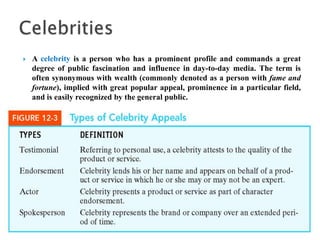
   A celebrity is a person who has a prominent profile and commands a great
    degree of public fascination and influence in day-to-day media. The term is
    often synonymous with wealth (commonly denoted as a person with fame and
    fortune), implied with great popular appeal, prominence in a particular field,
    and is easily recognized by the general public.
   A second type of reference group appeals used by
    marketers is the expert, a person who, because of his or
    her occupation, special training, or experience, is in a
    unique position to help the prospective consumer
    evaluate the product that the advertisement promotes.

   e.g. An ad for a quality frying pan may feature the
    endorsement of a chef.
   A reference group appeal that uses the testimonials of satisfied
    customers is known as the common-man approach.

   The advantage is that it demonstrates to prospective customers
    that someone just like them uses and is satisfied with the good
    or service being advertised.

   The common man appeal is especially effective in public
    health announcement (such as antismoking or high B.P.
    messages), for most people seem to identify with people like
    themselves when it comes to such messages.
   The popularity of this type of advt. probably is due to the
    success and publicity received by a number of executive
    spokespersons.

   Like celebrity spokespersons, executive spokespersons seem
    to be admired by the general population because of their
    achievements and the status implicitly conferred on business
    leaders.

   e.g. Ratan Tata, K. Birla, Mukesh Ambani etc.
   These are often employed as attention grabbers, acting
    as spokespersons to promote children’ products.

   Trade characters are intended to bond a child to a brand
    so that the child’s brand awareness might form the
    basis of brand preference either immediately or later in
    life.

   e.g. Animated characters used by marketers in
    advertisements for children products
   A variety of other promotional strategies can function
    creatively as frames of reference for consumers.
   Respected retailers and the editorial content of selected
    special interest magazines can also function as frames
    of reference that influence consumer attitudes and
    behavior.
   e.g. Indian Dental Association’s seal of approval for
    toothpaste.

Reference Groups

  • 2.
    A Group may be defined as two or more people who interact to accomplish either individual or mutual goals. Classification of Groups by membership status  Membership Group: A group to which a person either belongs or would qualify for membership in.  Symbolic Group: A group in which an individual is not likely to receive membership, despite acting like a member by adopting the group’s values, attitudes and behavior.
  • 3.
    A Reference Group is any person or group that serves as point of comparison (or reference) for an individual in forming either general or specific values, attitudes, or a specific guide for behavior.  From a marketing perspective, reference groups are groups that serve as frames of reference for individuals in their purchase or consumption decisions.  These groups place no restriction on group size or membership nor does it require that consumers identify with a tangible group.  Reference groups that influence general or broadly defined values or behavior are called Normative Reference Groups (e.g. A child’s Normative Reference Group is the immediate family) .  Reference Groups that serve as benchmarks for specific or narrowly defined attitudes or behavior are called Comparative Reference Groups (A Comparative Reference Groups might be neighboring family whose lifestyle appears to be admirable and worthy of imitation).
  • 4.
    Classified by: ◦ Membership  Symbolic ◦ Extent of Interaction  Direct versus Indirect ◦ Nature of Attraction  Aspirational versus Dissociative ◦ Degree of Formality  Formal versus informal
  • 5.
    Informational Influence ◦ When a member of reference group provides information used to make purchase decisions  Normative Influence ◦ When we conform to group norms in order to belong to that group  Identification Influence ◦ When we identify with, and internalize, a group’s values and behaviours
  • 6.
    Inform or make the individual aware of a specific product or brand.  Provide the individual with the opportunity to compare his or her own thinking with the attitudes and behavior of the group.  Influence the individual to adopt attitudes and behavior that are consistent with the norms of the group.  Legitimize the decision to use the same products as the group
  • 7.
    Friendship Groups  Shopping Groups  Work Groups  Virtual Groups or Communities  Brand Communities  Consumer-action Groups  Celebrities
  • 8.
    Friendship groups are typically classified as informal groups because they are usually unstructured and lack specific authority levels.  In terms of relative influence, after an individual’s family, his or her friends are most likely to influence the individual’s purchase decisions.  Seeking and maintaining friendships is a basic drive of most people.  Friends fill a wide range of needs: They provide companionship, security, and opportunities to discuss problems that an individual may be reluctant to discuss with family members.  Marketers of products such as brand-name clothing, fine jewelry, snack foods, and alcoholic beverages recognize the power of peer group influence and frequently depict friendship situations in their advertisements.
  • 9.
    Two or more people who shop together, whether for food, for clothing, or simply to pass the time, can be called a shopping group.  Such groups are often offshoots of family or friendship groups and therefore, they function as what has been referred to as purchase pal.  The motivation for shopping with a purchase pal range from a primarily social motive to helping reduce the risk when making an important decision.  A special type of shopping group is the in-home shopping party, which typically consists of a group that gathers together in the same home of a friend to attend a “party” devoted to demonstrating and evaluating a specific line of products.
  • 10.
    The sheer amount of time people spend at their jobs, frequently more than 35 hours per week, provide ample opportunity for work groups to serve as a major influence on the consumption behavior of the members.  Formal Work Group: it consists of individuals who work together as part of a team, and thus have a sustained opportunity to influence each other’s consumption related attitudes and actions.  Informal Work Group: it consists of people who have become friends as a result of working for the same firm, whether or not they work together as a team, and they can influence the consumption behavior of other members during coffee or lunch breaks or at after-work meetings.
  • 11.
    A virtual team (also known as a geographically dispersed team or distributed team) is a group of individuals who work across time, space and organizational boundaries with links strengthened by webs of communication technology.  Powell, Piccoli and Ives define virtual teams in their literature review article "as groups of geographically, organizationally and/or time dispersed workers brought together by information and telecommunication technologies to accomplish one or more organizational tasks.”  Ale Ebrahim, N., Ahmed, S. & Taha, Z. in their recent (2009) literature review paper, added two key issues to definition of a virtual team “as small temporary groups of geographically, organizationally and/ or time dispersed knowledge workers who coordinate their work predominantly with electronic information and communication technologies in order to accomplish one or more organization tasks”.
  • 12.
    Members of virtual teams communicate electronically and may never meet face-to-face.  Virtual teams are made possible by a proliferation of fiber optic technology that has significantly increased the scope of off- site communication.  Virtual teams allow companies to procure the best talent without geographical restrictions.  According to Hambley, O’Neil, & Kline (2007), "virtual teams require new ways of working across boundaries through systems, processes, technology, and people, which requires effective leadership...despite the widespread increase in virtual teamwork, there has been relatively little focus on the role of virtual team leaders."
  • 13.
    A brand community is a community formed on the basis of attachment to a product or marquee.  Recent developments in marketing and in research in consumer behavior result in stressing the connection between brand, individual identity and culture. Among the concepts developed to explain the behavior of consumers, the concept of a brand community focuses on the connections between consumers.  A brand community can be defined as an enduring self-selected group of actors sharing a system of values, standards and representations (a culture) and recognizing bonds of membership with each other and with the whole.  Brand communities are characterized in shared consciousness, rituals and traditions, and a sense of moral responsibility.
  • 14.
    The term "brand community" was first presented by Albert Muniz Jr. and Thomas C. O'Guinn in a 1995 paper for the Association for Consumer Research Annual Conference in Minneapolis, Minnesota.  In a 2001 article titled "Brand community", published in the Journal of Consumer Research (SSCI), they defined the concept as "a specialized, non- geographically bound community, based on a structured set of social relations among admirers of a brand." This 2001 paper has been acknowledged by Thomson Scientific & Healthcare to be one of the most cited papers in the field of economics and business.  Many brands provide examples of brand communities. In computers and electronics: Apple Inc. (Macintosh, iPod, iPhone), Holga and LOMO cameras, and Palm and Pocket PC Ultra-Mobile PCs.  In vehicles: Ford Bronco, Jeep, automobiles, and  Royal Enfield and Harley-Davidson motorcycles.  In toys: Barbie and Lego.
  • 15.
    A particular kind of consumer group-A Consumer Action Group-has emerged in response to the consumerist movement. Today there are a large number of such groups that are dedicated to providing consumer products in a healthy and responsible manner, and to generally add to the overall quality.  For example, a diverse range of consumer concerns being addressed by private and public consumer-action groups: neighborhood crime watch, youth development, forest and wildlife concerns, children and advertising, race and ethnicity, community volunteerism, legal assistance, public health, disaster relief, energy conservation, education, smoking, the environment, access to telecommunications, science in the public interest, credit counseling, privacy issues, and children and internet. Two broad categories of Consumer Action Groups:  Those that organize to correct a specific consumer abuse and then disband (Agitation against liquor shop in a community) .  Those that organize to address broader, more persuasive problem areas and operate over an extended or indefinite period of time (Group against drunk driving).
  • 16.
    A celebrity is a person who has a prominent profile and commands a great degree of public fascination and influence in day-to-day media. The term is often synonymous with wealth (commonly denoted as a person with fame and fortune), implied with great popular appeal, prominence in a particular field, and is easily recognized by the general public.
  • 17.
    A second type of reference group appeals used by marketers is the expert, a person who, because of his or her occupation, special training, or experience, is in a unique position to help the prospective consumer evaluate the product that the advertisement promotes.  e.g. An ad for a quality frying pan may feature the endorsement of a chef.
  • 18.
    A reference group appeal that uses the testimonials of satisfied customers is known as the common-man approach.  The advantage is that it demonstrates to prospective customers that someone just like them uses and is satisfied with the good or service being advertised.  The common man appeal is especially effective in public health announcement (such as antismoking or high B.P. messages), for most people seem to identify with people like themselves when it comes to such messages.
  • 19.
    The popularity of this type of advt. probably is due to the success and publicity received by a number of executive spokespersons.  Like celebrity spokespersons, executive spokespersons seem to be admired by the general population because of their achievements and the status implicitly conferred on business leaders.  e.g. Ratan Tata, K. Birla, Mukesh Ambani etc.
  • 20.
    These are often employed as attention grabbers, acting as spokespersons to promote children’ products.  Trade characters are intended to bond a child to a brand so that the child’s brand awareness might form the basis of brand preference either immediately or later in life.  e.g. Animated characters used by marketers in advertisements for children products
  • 21.
    A variety of other promotional strategies can function creatively as frames of reference for consumers.  Respected retailers and the editorial content of selected special interest magazines can also function as frames of reference that influence consumer attitudes and behavior.  e.g. Indian Dental Association’s seal of approval for toothpaste.