BTEC Creative Digital
Media Production
Unit 1 – Revision
Exam Unit Set Up
There for THREE learning aims to
this unit of work:
1. Learning Aim A: Understanding digital
media sectors, products & platforms.
2. Learning Aim B: Understanding
audiences for digital media products.
3. Learning Aim C: Explore how audiences
engage with media products.
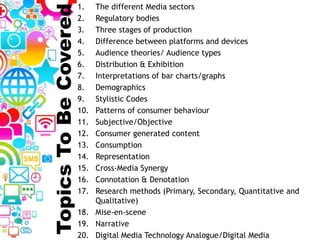
TopicsToBeCovered
1. The different Media sectors
2. Regulatory bodies
3. Three stages of production
4. Difference between platforms and devices
5. Audience theories/ Audience types
6. Distribution & Exhibition
7. Interpretations of bar charts/graphs
8. Demographics
9. Stylistic Codes
10. Patterns of consumer behaviour
11. Subjective/Objective
12. Consumer generated content
13. Consumption
14. Representation
15. Cross-Media Synergy
16. Connotation & Denotation
17. Research methods (Primary, Secondary, Quantitative and
Qualitative)
18. Mise-en-scene
19. Narrative
20. Digital Media Technology Analogue/Digital Media
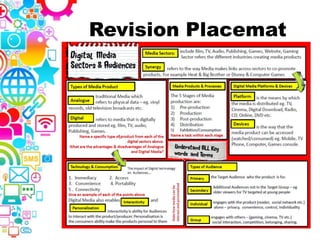
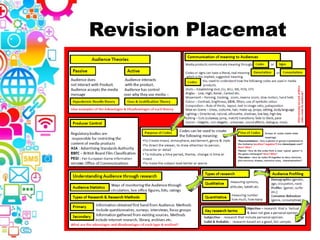
Revision Placemat
Revision Placemat
Media Sectors
Q1.How many sectors are there?
Q2.What are the different media sectors?
Media
Sectors
Regulatory Bodies
Q1.How many regulatory bodies have you studied?
Q2.Who are they? (Both full title and their
acronym)
Regulatory
Bodies
OFCOM
Q1.Who is OFCOM?
Q2.What act of parliament does
OFCOM particularly operate under?
3 main duties of
OFCOM?
ASA
Q1.Who is ASA?
Q2.The ASA have reasonability over
what?
Q3.How does the ASA operate?
3 complaint
themes?
PEGI
Q1.What is PEGI?
Q2.Why was it set up?
Q3.What appears on the front and back
of games packing?
Example of what you would find?
Front: Back:
BBFC
Q1.What is BBFC?
Q2.What is the role of the BBFC?
Q3.What does the BBFC have the right to
do?
Age Ratings:
PCC
Q1.What is the PCC? (& What is it now
known as?)
Q2. How does the PCC operate?
Editors Code of
Practice? (16 in total)
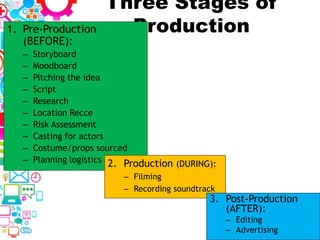
Three Stages of
Production1. Pre-Production
(BEFORE):
– Storyboard
– Moodboard
– Pitching the idea
– Script
– Research
– Location Recce
– Risk Assessment
– Casting for actors
– Costume/props sourced
– Planning logistics 2. Production (DURING):
– Filming
– Recording soundtrack
3. Post-Production
(AFTER):
– Editing
– Advertising
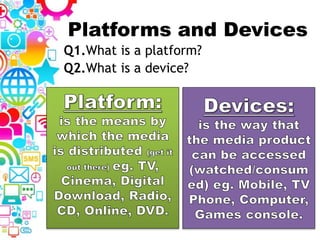
Platforms and Devices
Q1.What is a platform?
Q2.What is a device?
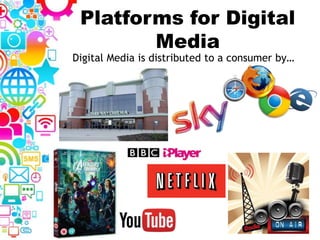
Platforms for Digital
Media
Digital Media is distributed to a consumer by…
Devices for Digital
MediaDevices that can access digital media…
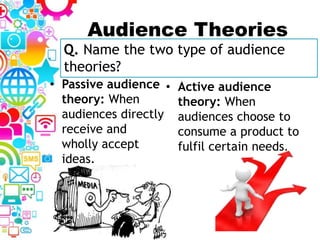
Audience Theories
• Passive audience
theory: When
audiences directly
receive and
wholly accept
ideas.
• Active audience
theory: When
audiences choose to
consume a product to
fulfil certain needs.
Q. Name the two type of audience
theories?
Audience Theory
•What is the
difference between
passive and active
media
consumption?
Hypodermic
Needle Theory
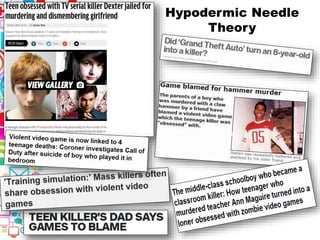
• This was one of the first media theories
used as an attempt to explain how
audiences consume media.
• It suggests that the audience, passively
(without knowing) have information
“injected” into them via mass media, and
influences how they can behave.
Q. What is Hypodermic Needle Theory?
Hypodermic Needle
Theory
Uses and Gratification
Theory
The Uses and Gratification Theory states
that we are active consumers of media.
Four reasons :
• Inform / Education
• Entertainment
• Social Interaction
• Personal Identity
Q1. What is Uses and Gratification Theory?
Q2. What are the four reasons we chose to
consume a media product?
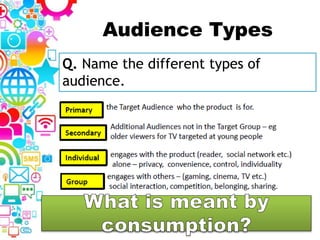
Audience Types
Q. Name the different types of
audience.
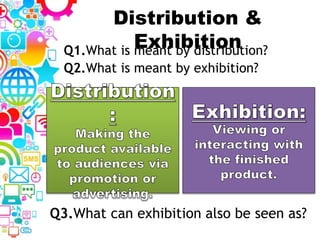
Distribution &
ExhibitionQ1.What is meant by distribution?
Q2.What is meant by exhibition?
Q3.What can exhibition also be seen as?
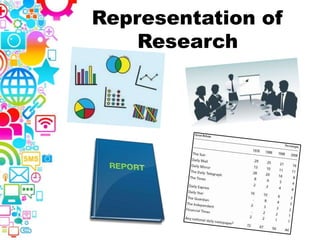
Representation of
Research
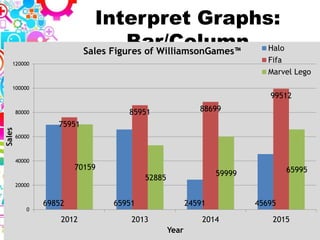
Interpret Graphs:
Bar/Column
69852 65951 24591 45695
75951
85951 88699
99512
70159
52885
59999 65995
0
20000
40000
60000
80000
100000
120000
2012 2013 2014 2015
Sales
Year
Sales Figures of WilliamsonGames™ Halo
Fifa
Marvel Lego
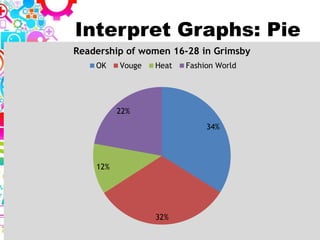
Interpret Graphs: Pie
34%
32%
12%
22%
Readership of women 16-28 in Grimsby
OK Vouge Heat Fashion World
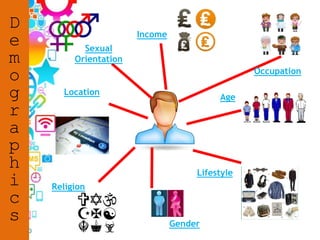
Location
Age
Sexual
Orientation
Lifestyle
Religion
Income
Occupation
Gender
D
e
m
o
g
r
a
p
h
i
c
s
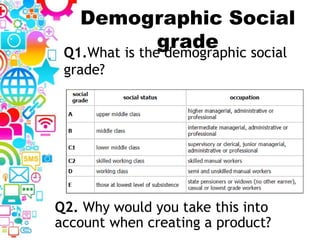
Demographic Social
gradeQ1.What is the demographic social
grade?
Q2. Why would you take this into
account when creating a product?
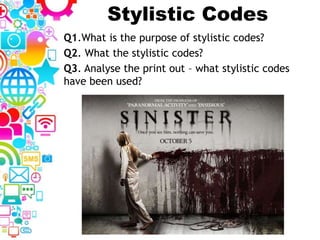
Stylistic Codes
Q1.What is the purpose of stylistic codes?
Q2. What the stylistic codes?
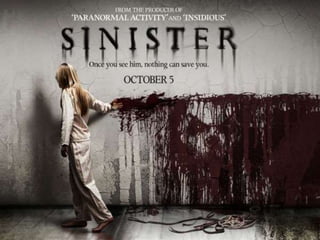
Q3. Analyse the print out – what stylistic codes
have been used?
Stylistic Code Analysis
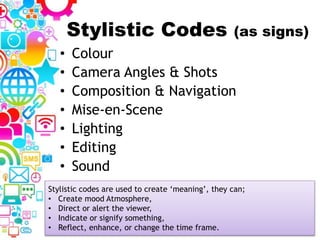
Stylistic Codes (as signs)
• Colour
• Camera Angles & Shots
• Composition & Navigation
• Mise-en-Scene
• Lighting
• Editing
• Sound
Stylistic codes are used to create ‘meaning’, they can;
• Create mood Atmosphere,
• Direct or alert the viewer,
• Indicate or signify something,
• Reflect, enhance, or change the time frame.
Patterns of consumer
behaviour
Q. Name the 5 main patterns of
consumer behaviour?
Subjective & Objective
Q1.What is meant by subjective?
Q2.What is meant by objective?
Consumer Generated
ContentQ. What is meant consumer generated
content?
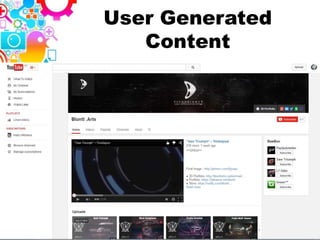
User Generated
Content
Representation
Q1.What is meant by representation?
Q2.What are the sub groups when discussing
representation?
Refers to the way
Media makes links
across sectors to
co-promote
products.
Q. What is this known as?
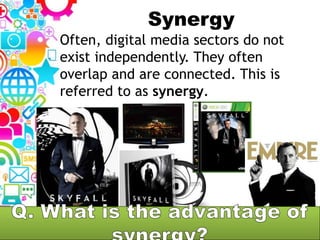
Synergy
Often, digital media sectors do not
exist independently. They often
overlap and are connected. This is
referred to as synergy.
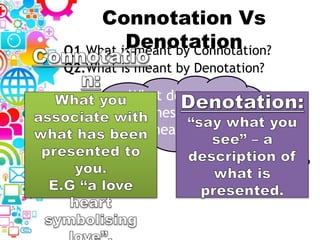
Connotation Vs
DenotationQ1.What is meant by Connotation?
Q2.What is meant by Denotation?
What do you
think these words
mean?
connotations denotations
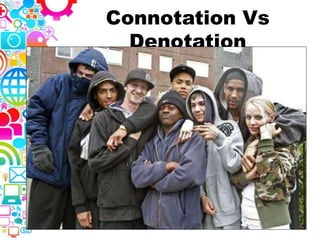
Connotation Vs
Denotation
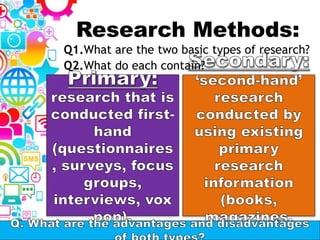
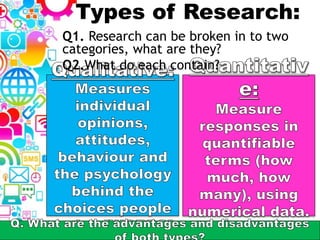
Research Methods:
Q1.What are the two basic types of research?
Q2.What do each contain?
Understanding
Audiences:
B.A.R.B
Q1. What does this acronym stand for?
Q2. and what is B.A.R.B?
Understanding
Audiences:
When facts and figures
are collected on things
like circulation (how
many are sold), website
‘hits’, box office figures,
ratings, sales.
Q. What is this known as?
Types of Research:
Q1. Research can be broken in to two
categories, what are they?
Q2.What do each contain?
Mise-en-Scène
In media, everything is constructed for a
reason. Every shot type, every font
choice, every colour has been chosen for
a particular effect THESE ARE SIGNS.
What is Mise-en-
Scene?
Mise-en-Scène
Is a French term meaning “what is
put into a scene or frame”.
¤ Setting
¤ Props
¤ Costume
¤ Performance
¤ Lighting
¤ Colour
Mise-en-Scène:
Mise-en-Scène:
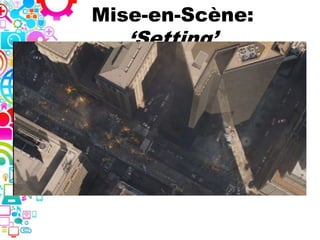
‘Setting’
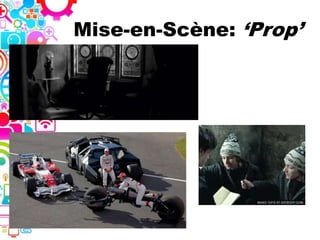
Mise-en-Scène: ‘Props’
¤ Props are the objects placed
within the setting.
¤ They serve to strengthen the
effect of the setting and makes
it more convincing.
Mise-en-Scène:
Mise-en-Scène: ‘Prop’
Mise-en-Scène:
‘Costume’
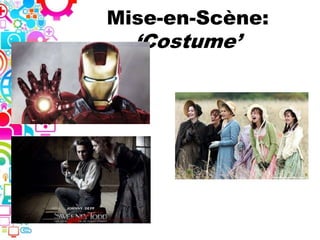
¤ Costumes helps create an actors
character.
¤ They can place a character within
a period of time or lifestyle.
¤ They can reveal things about the
character.
Mise-en-Scène:
Mise-en-Scène:
‘Costume’
Mise-en-Scène:
‘Performance’
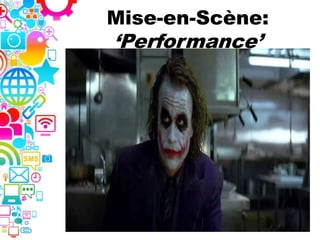
¤ The way an actor moves could
indicate fear, panic, confidence,
certainty or friendliness.
¤ Facial expressions can create:
fear, anger, happiness or sadness.
Mise-en-Scène:
Mise-en-Scène:
‘Performance’
Mise-en-Scène: ‘Lighting &
Colour’
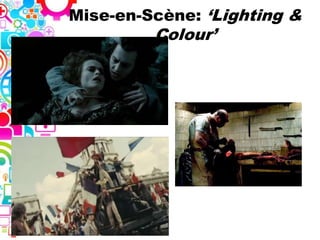
¤ Lighting and colour can
highlight the emotions, themes
or messages that are being put
across.
Mise-en-Scène:
Mise-en-Scène: ‘Lighting &
Colour’
Narrative
Q1.What is meant by the term narrative?
Q2.Name the three structures of narrative
you have studied?
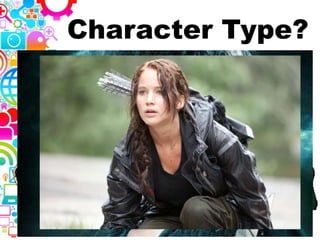
Q3. Name the two character types
(characterisation)
Character Type?
Digital Media Technology:
Analogue/Digital Media
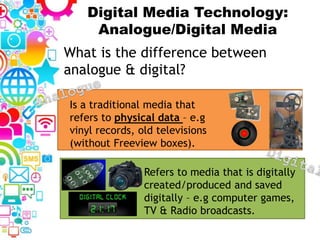
What is the difference between
analogue & digital?
Refers to media that is digitally
created/produced and saved
digitally – e.g computer games,
TV & Radio broadcasts.
Is a traditional media that
refers to physical data – e.g
vinyl records, old televisions
(without Freeview boxes).
BEST OF LUCK IN
YOUR SUMMER
EXAMINATIONS!

Revision ppt

Editor's Notes

  • #8 OFCOM ASA PCC PEGI BBFC
  • #9 Ofcom is the independent regulator and authority for the UK communications industries. Ofcom is regulated by the Communications Act 2003. The act says that Ofcom’s general duties should be to further the interests of citizens and of consumers #1 (Wide Range of programming) To ensue the UK has a wide range of high-quality radio programmes that appeal to a range of tastes and interests and situations #2 (People are protected abusive) People who listen to the radio are protected from harmful or offensive material (swearing, racism, sexism) #3 (People privacy is protected) People are protected from being treated unfairly in radio programmes and from having their privacy invaded
  • #10 The Advertising Standards Authority (ASA) is the UK’s independent regulator of advertising All media sectors (advertising) Misleading, discrimination (disability, sexual orientation, gender, religion) , sex, exploiting children, animals.
  • #11 The Pan-European Game Information (PEGI) age rating system was established to help European parents make informed decisions on buying computer games Age rating – Front Descriptors - Back
  • #12 ‘The British Board of Film Classification’ (BBFC) is the regulator for the film industry. Their role is to classify (age rating): Films DVDs BBFC has the right to censor some films – this means they control what materials audiences are exposed to. If the BBFC deem the material harmful, offensive or sensitive it can be cut or removed. AGE RATINGS: U = Universal for all PG = Parental Guidance 12A = The 12A requires an adult to accompany any child under 12 seeing a 12A film at the cinema.  12 = The 12 means they cannot watch unless they over the age of 12. 15 = No-one under 15 is allowed to see a 15 film at the cinema or buy/rent a 15 rated video.  18 = Films rated 18 are for adults. No-one under 18 is allowed to see an 18 film at the cinema or buy / rent an 18 rated video. R18 = The R18 category is a special and legally-restricted classification primarily for explicit works of consenting sex or strong fetish material involving adults. 
  • #13 The Press Complaints Commission (PCC) is a voluntary regulatory body for British printed newspapers and magazines, consisting of representatives of the major publishers.  IPSO – Independent press standards organisation Working on complaints made by individuals or organisations 1 Accuracy 2 Opportunity to reply 3 Privacy 4 Harassment 5 Intrusion into grief or shock 6 Children 7 Children in sex cases 8 Hospitals 9 Reporting of Crime 10 Clandestine devices 11 Victims of sexual assault 12 Discrimination 13 Financial journalism 14 Confidential sources 15 Witness payments in criminal trials 16 Payment to criminals
  • #23 There are four!!! CONSUMPTION
  • #24 Q3 - consumption
  • #30 Grade given relating to income / job Allow you to understand your target market – price.
  • #31 Stylistic codes are used to create ‘meaning’, they can; Create mood Atmosphere, Direct or alert the viewer, Indicate or signify something, Reflect, enhance, or change the time frame. Q2. Colour Camera Angles & Shots Composition & Navigation Mise-en-Scene Lighting Editing Sound
  • #34 Genre choices Scheduling when products are consumed Regularity Platform Price
  • #35 PRO & CONS?
  • #36 Content that is created by media consumers (YOU) Tweets, Shared links, YouTube Social Media Tweets, Images uploaded to any website etc
  • #38 The way in which people, places or events are re-presented to audiences Women Men Children Teens Elderly Ethnic groups
  • #39 SYNERGY -
  • #40 How could this use synergy? What is the advantage of synergy? – Increased sales, advertising/promotion, Increased revenue to produce another film/game etc The film skyfall promotes the soundtrack, which promotes DVD/game, which in-turn promotes TV or the computer.
  • #41 PRO & CONS?
  • #47 What is mise en scene What makes up MES?
  • #58 Narrative is how the STORY is constructed and how the audience understands the meaning of the film. There are three Narrative Structures; Circular Episodic Linear Protagonist Antagonist