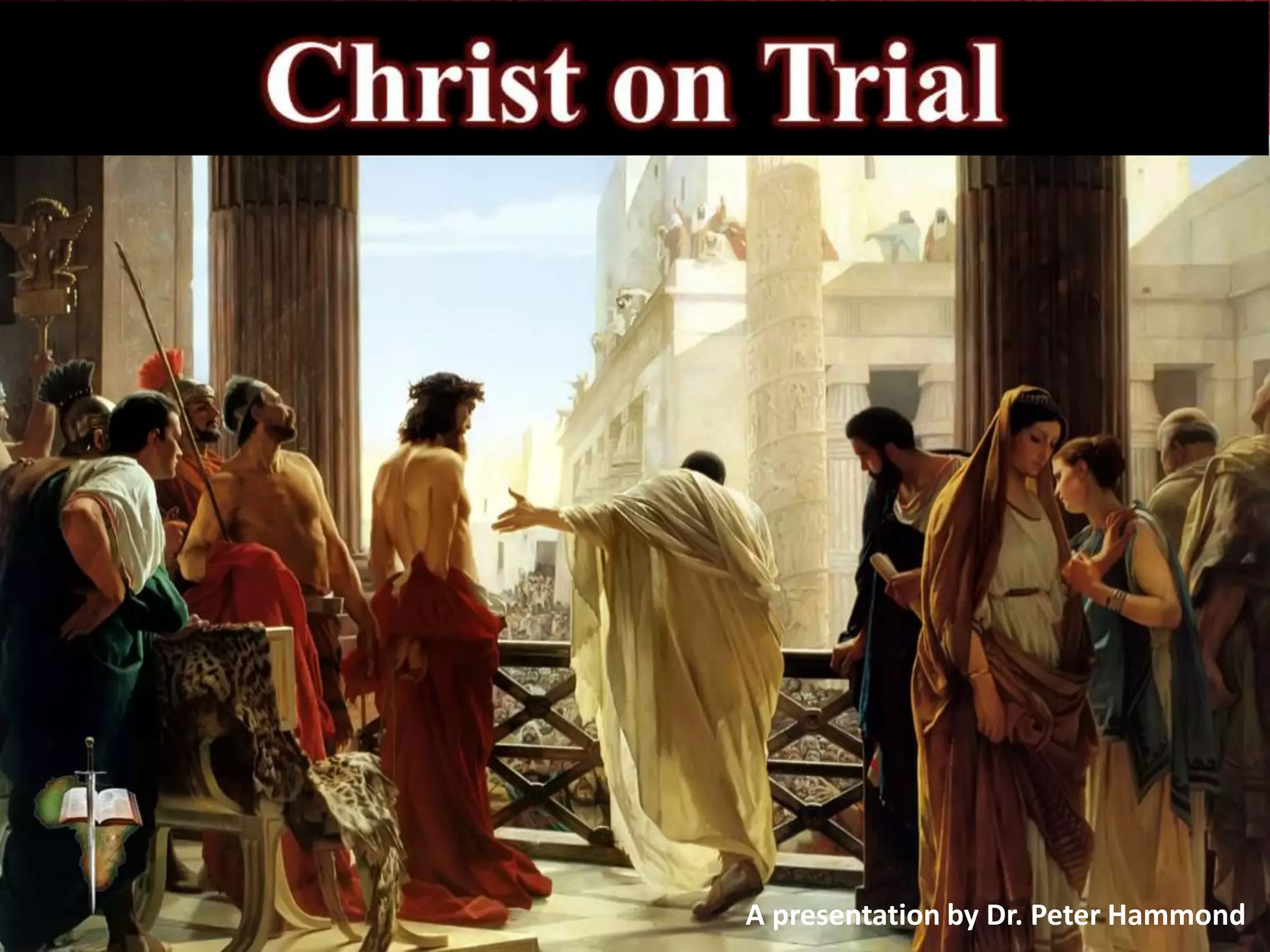
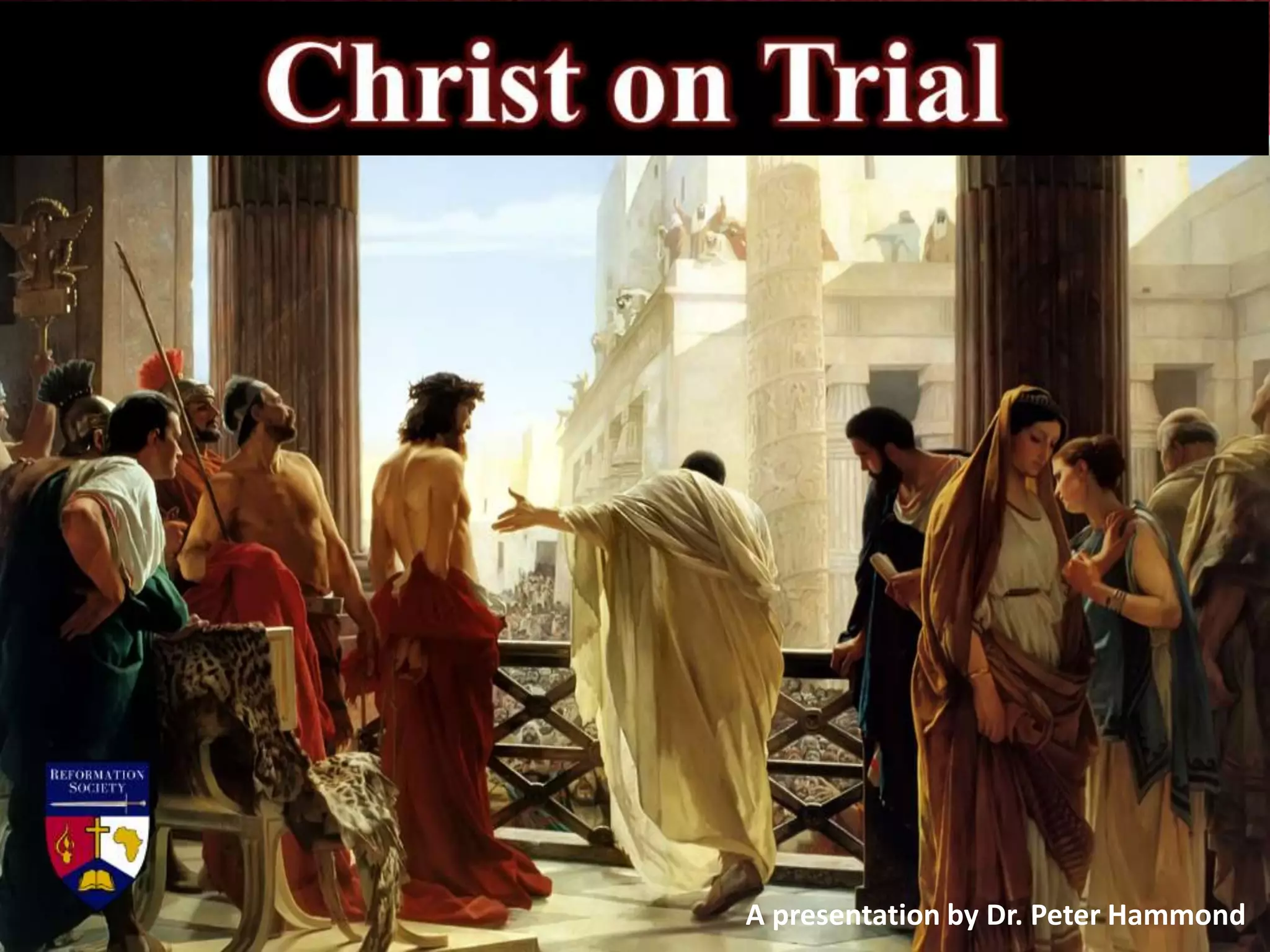
A presentation by Dr. Peter Hammond
"In this is love, not that we love God,
but that He loved us
and sent His Son
to be the propitiation for our sins."
1 John 4:10
A presentation by Dr. Peter Hammond
• In this age of ignorance, confusion and
apostasy, many presume to put Christ on trial.
• How are we as Christians to respond?
• How can we give an effective answer to those
who challenge the foundations of the Faith?
• “But sanctify the Lord God in your hearts
and always be ready to give a defense
to everyone who asks you a reason for the
hope that is in you, with meekness and fear.”
1 Peter 3:15
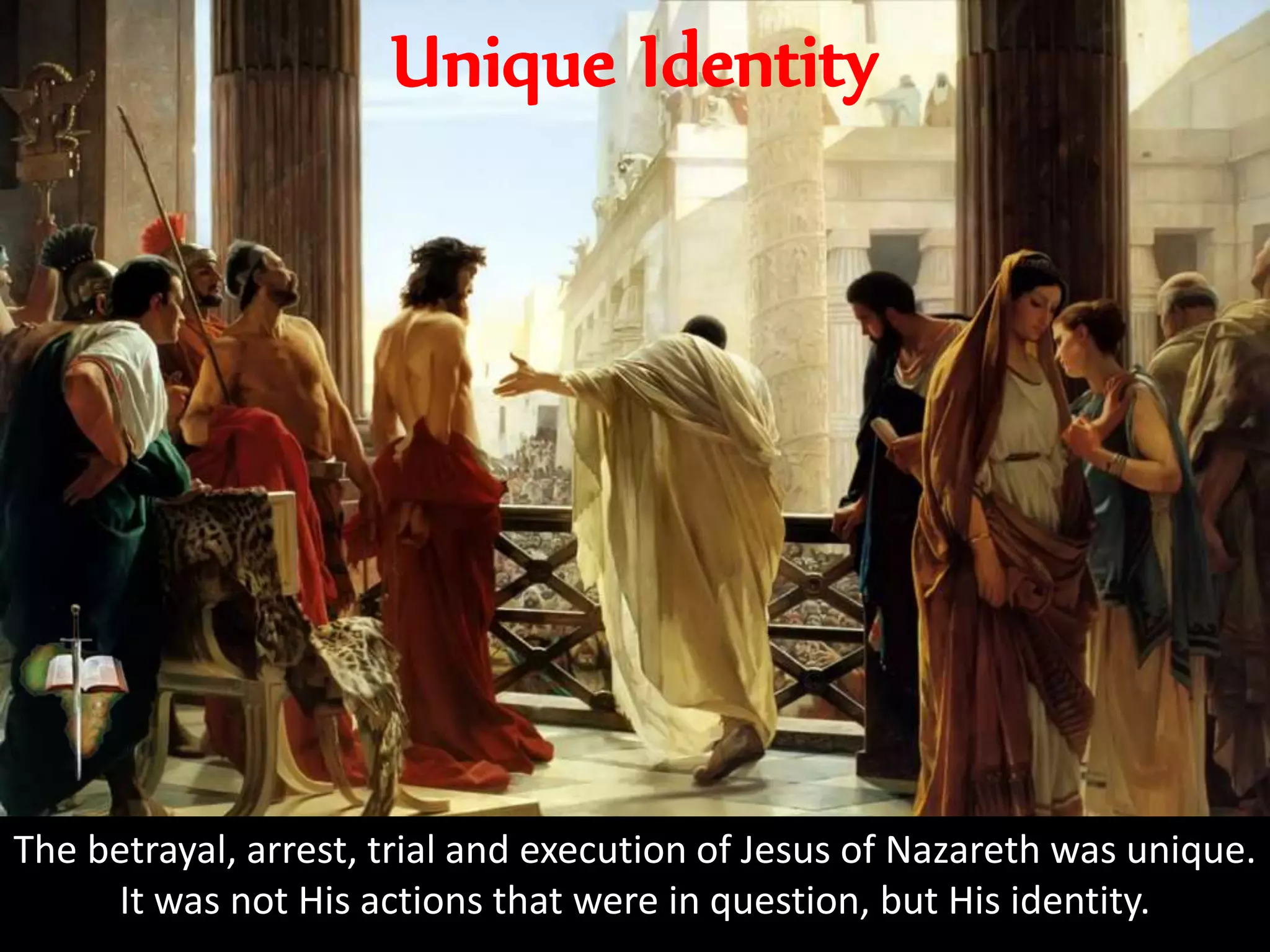
The betrayal, arrest, trial and execution of Jesus of Nazareth was unique.
It was not His actions that were in question, but His identity.
Unique Identity
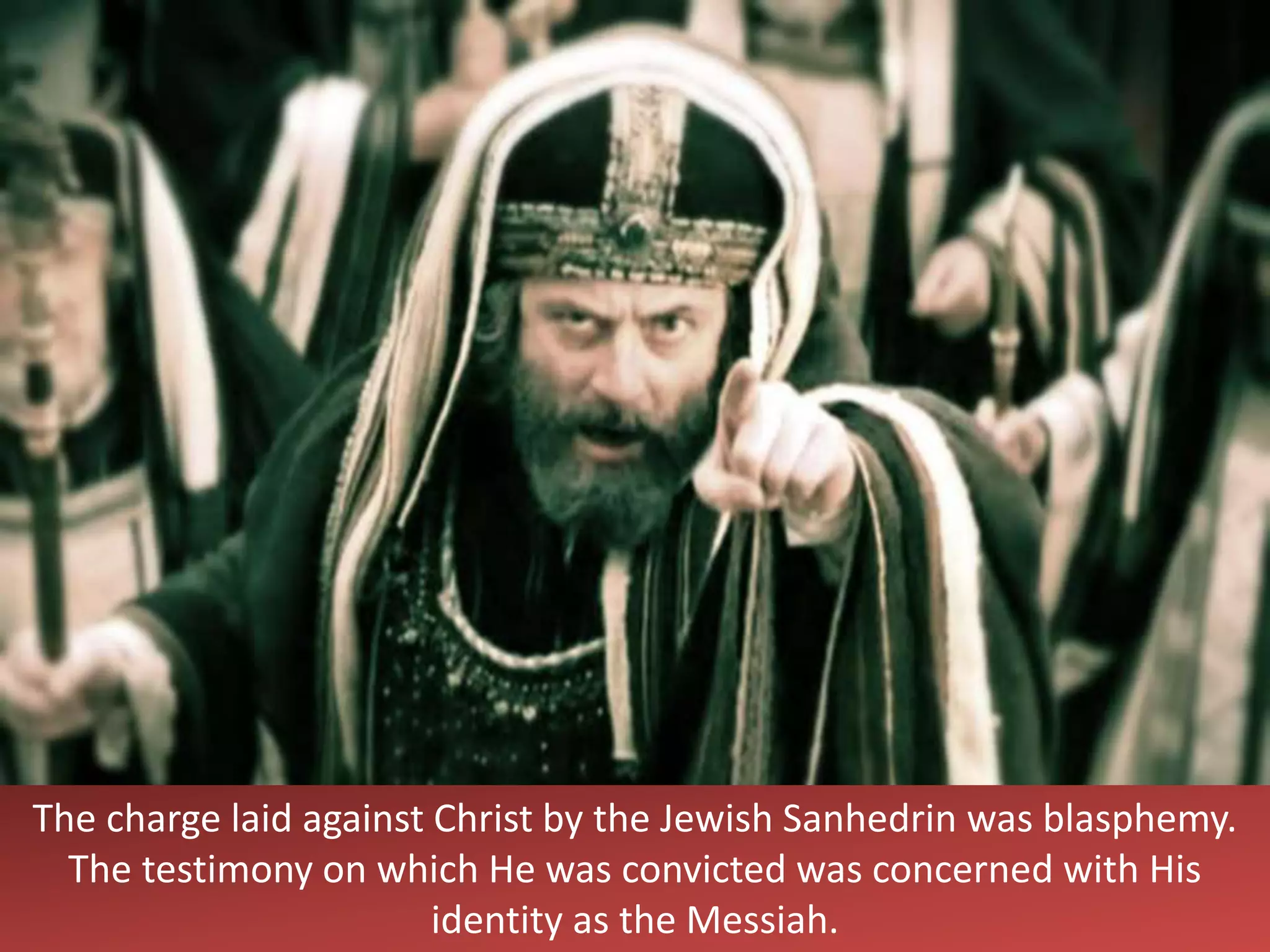
The charge laid against Christ by the Jewish Sanhedrin was blasphemy.
The testimony on which He was convicted was concerned with His
identity as the Messiah.
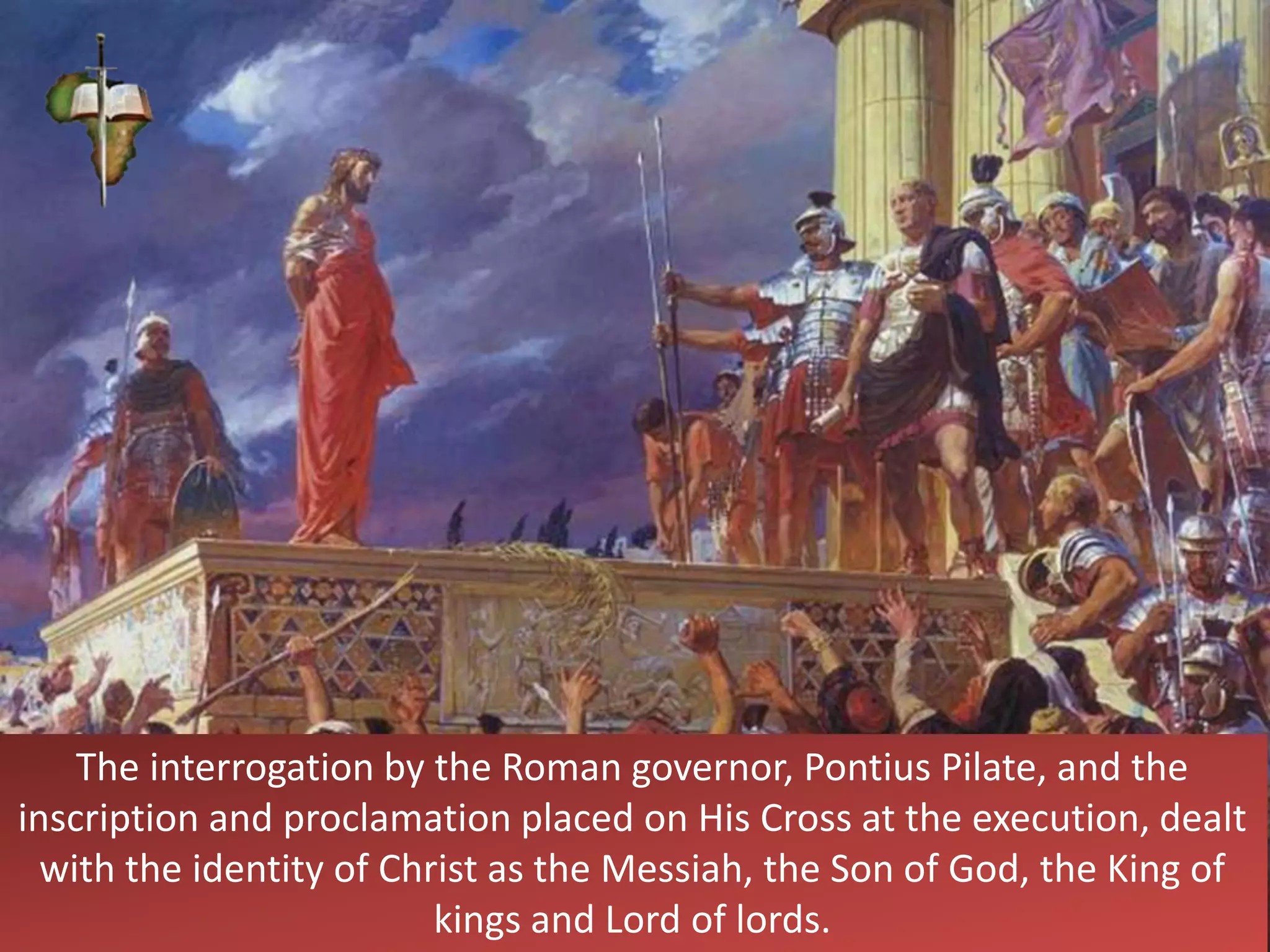
The interrogation by the Roman governor, Pontius Pilate, and the
inscription and proclamation placed on His Cross at the execution, dealt
with the identity of Christ as the Messiah, the Son of God, the King of
kings and Lord of lords.
The trial of Jesus of
Nazareth was
completely illegal.
At every point it broke the
laws of Israel
as well as the laws
of Rome.
It was illegal to conduct a
trial at night.
The Illegal Trial
It was also
against the law to
conduct a summary trial
without any warning,
or opportunity,
for the accused
to prepare a defense
or seek positive
character witnesses.
At any trial the accused was to be granted an opportunity to prepare a
defense and heralds were to be sent out into the area requiring anyone
who knew anything positive about the accused to come forward and
testify.
There was no opportunity granted for appeal. There was no delay
between the arrest and trial, between the trial and verdict, between the
verdict and sentencing, and between the sentencing and execution.
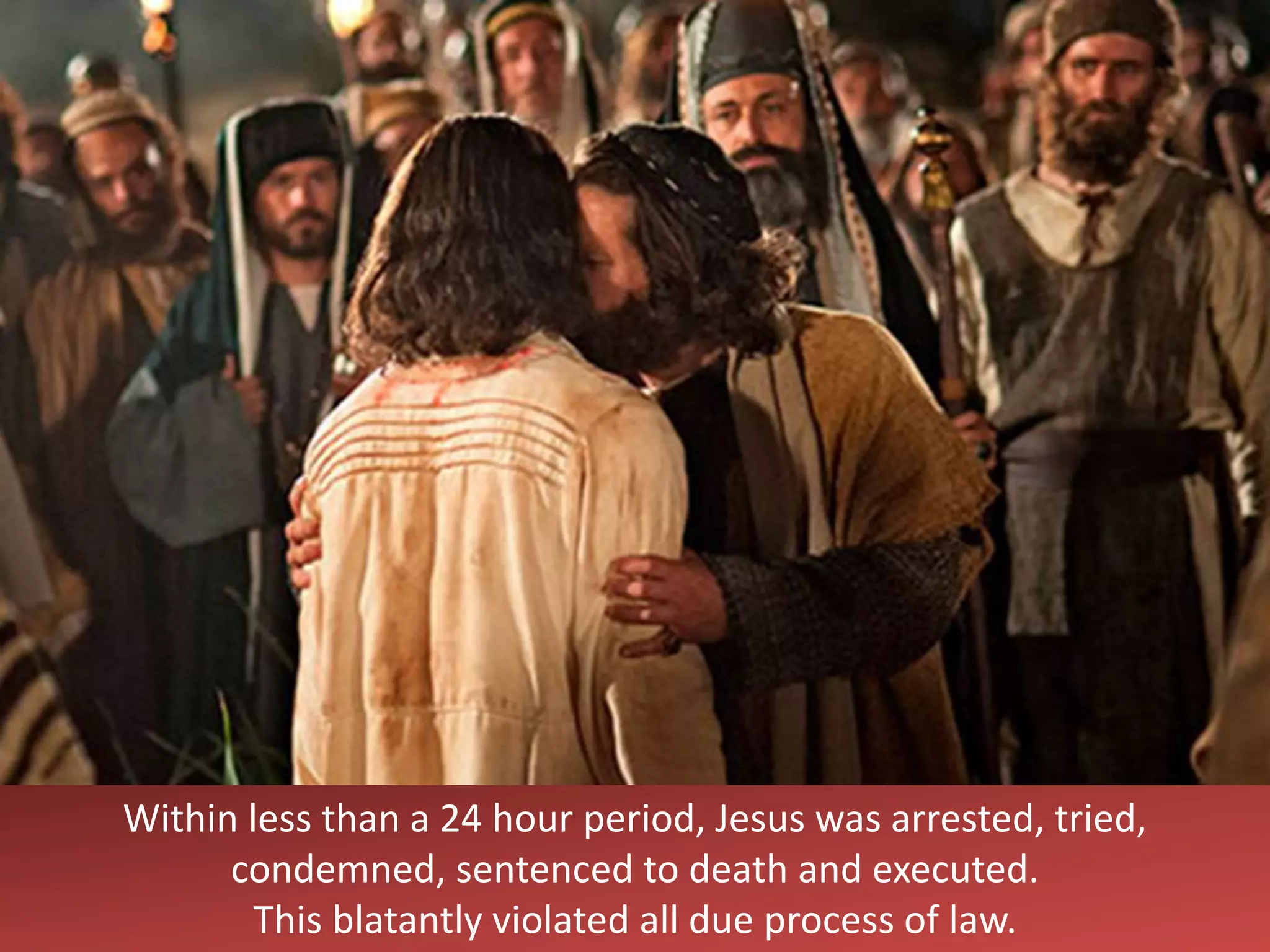
Within less than a 24 hour period, Jesus was arrested, tried,
condemned, sentenced to death and executed.
This blatantly violated all due process of law.
It was obvious that there was a conspiracy against the
accused. In the event of there being evidence of a conspiracy
judges were obligated to release the accused.
Conspiracy and False Witnesses
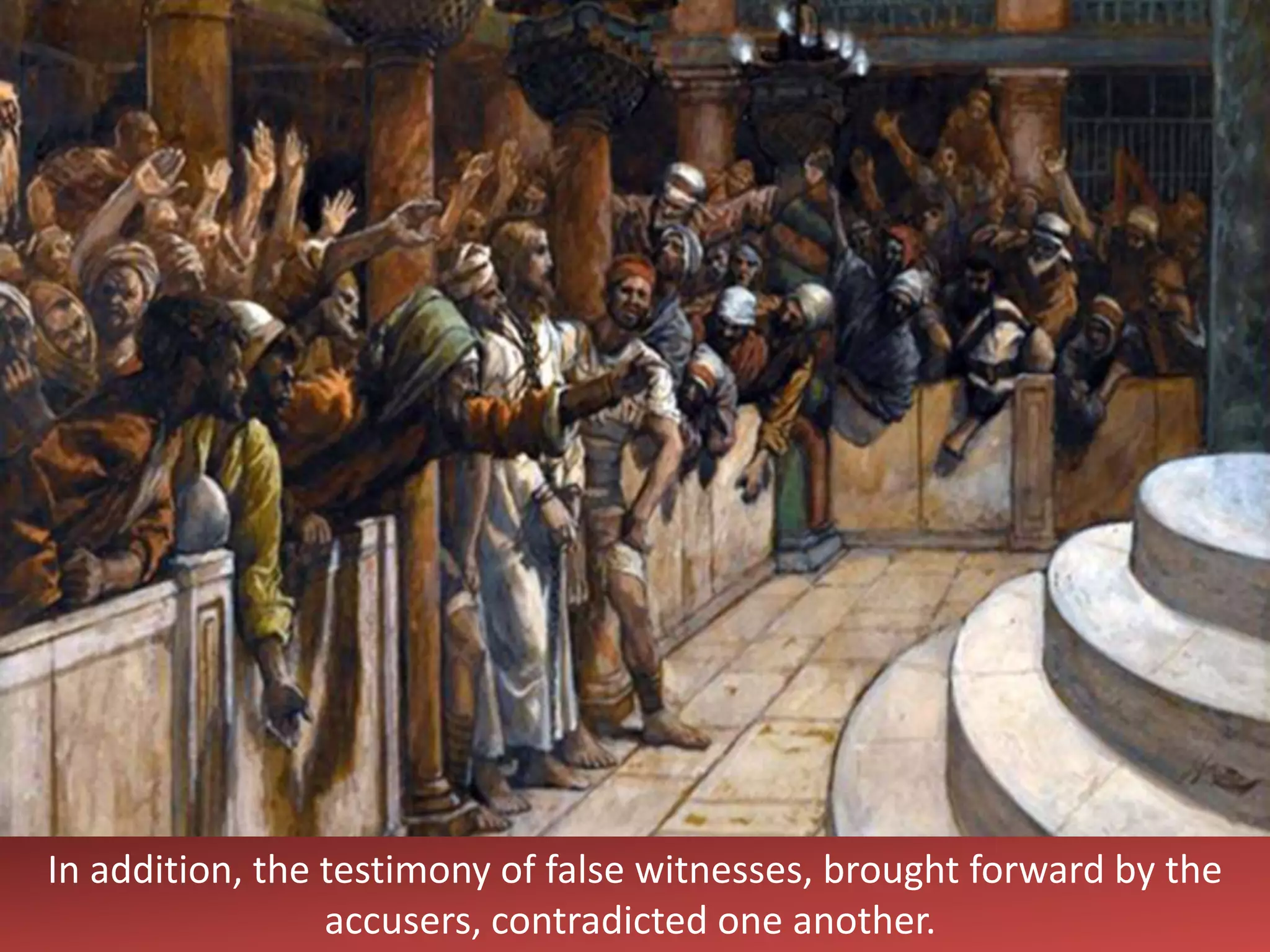
In addition, the testimony of false witnesses, brought forward by the
accusers, contradicted one another.
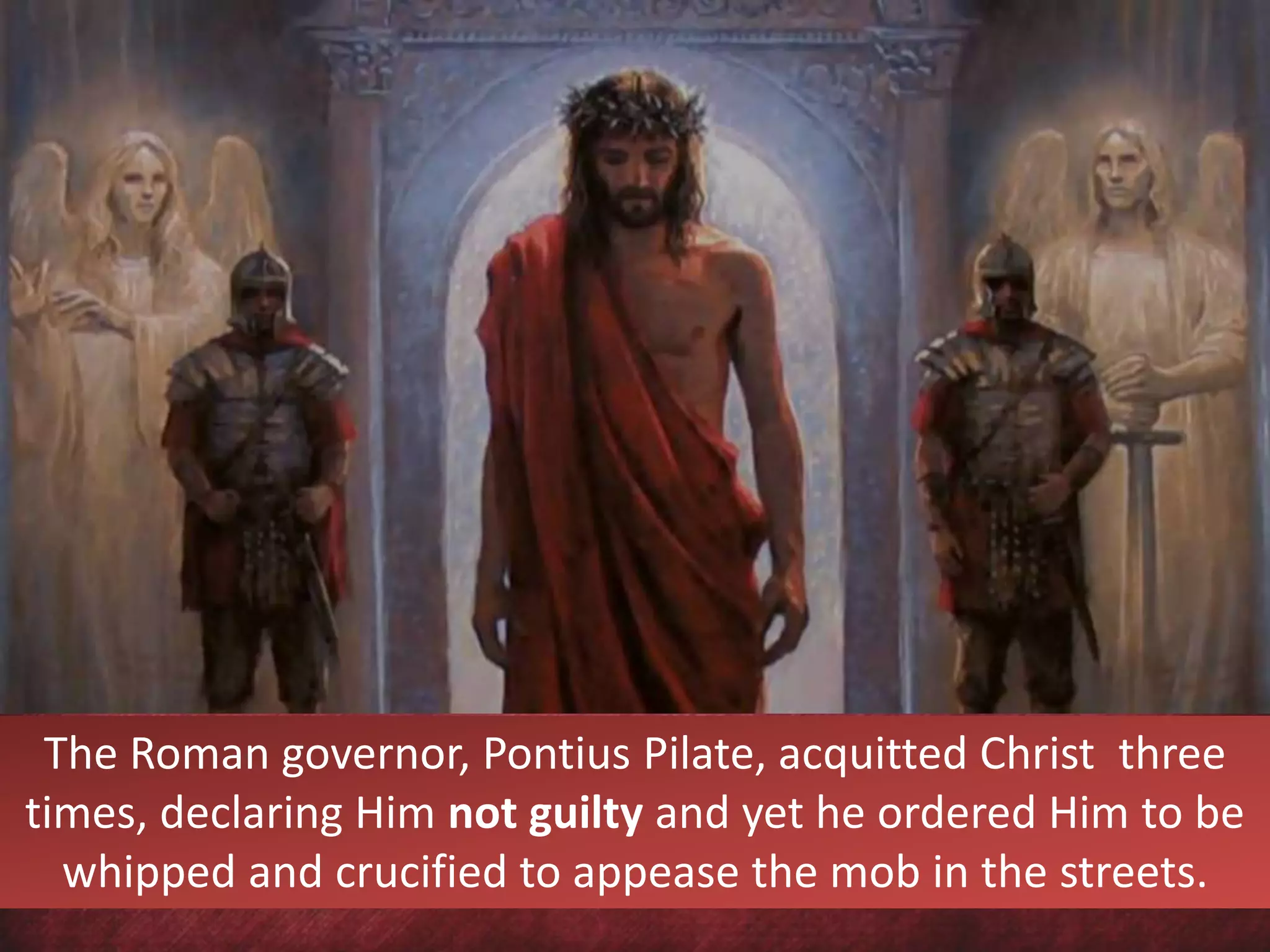
The Roman governor, Pontius Pilate, acquitted Christ three times:
"I find no fault in Him at all." John 18:38
"… I find no fault in Him." John 19:6
Condemning the Innocent
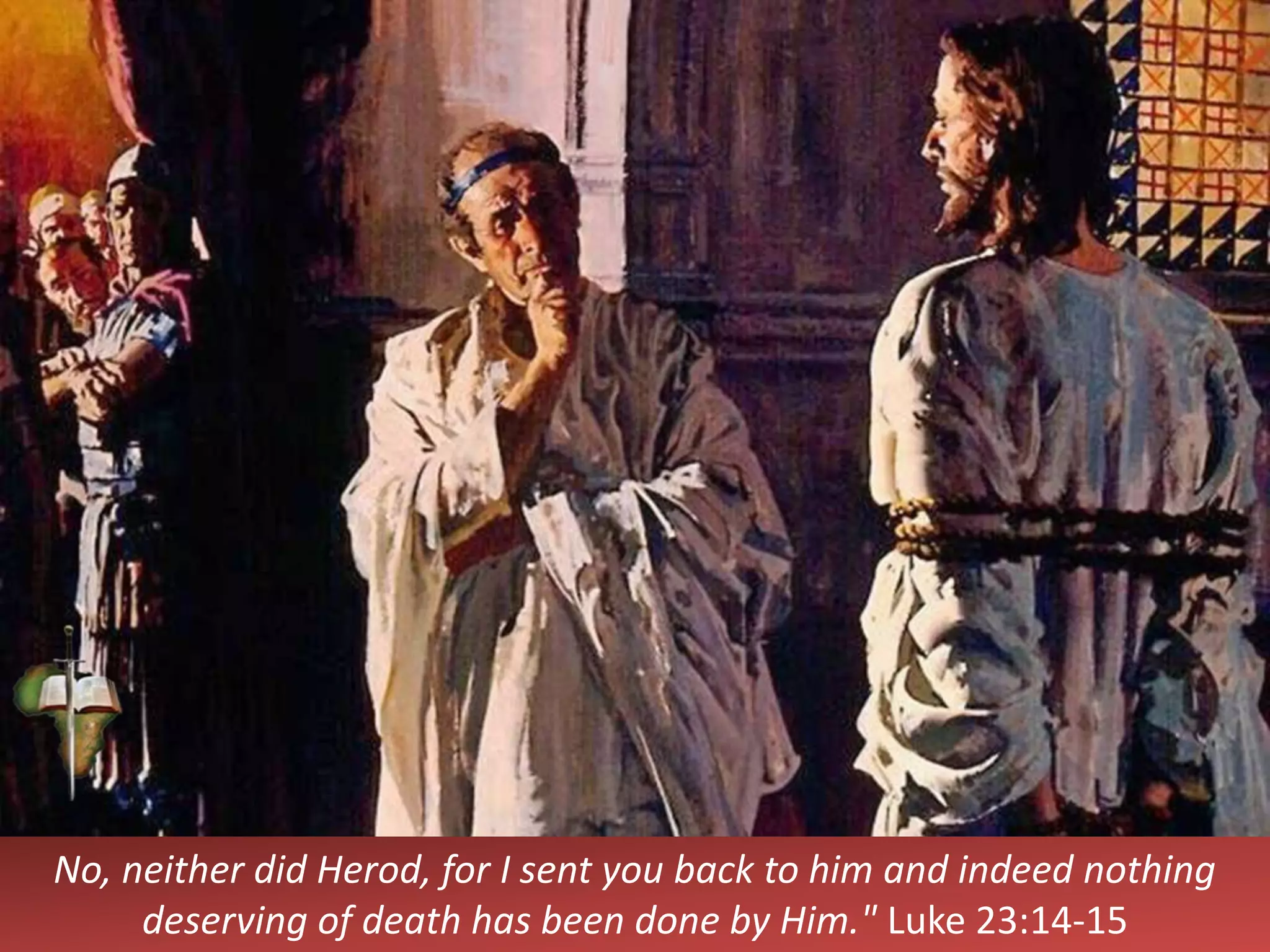
“You have brought this Man to me as one who misleads the people. And
indeed, having examined Him in your presence, I have found no fault in
this Man concerning those things of which you accuse Him.
No, neither did Herod, for I sent you back to him and indeed nothing
deserving of death has been done by Him." Luke 23:14-15
"But they shouted saying, 'Crucify Him, crucify Him!' Then he said to
them the third time, 'Why, what evil has He done? I have found no
reason for death in Him.
Trial by Mob
I will therefore chastise Him and let Him go.'
But they were insistent, demanding with loud voices
that He be crucified."
Luke 23:21-23
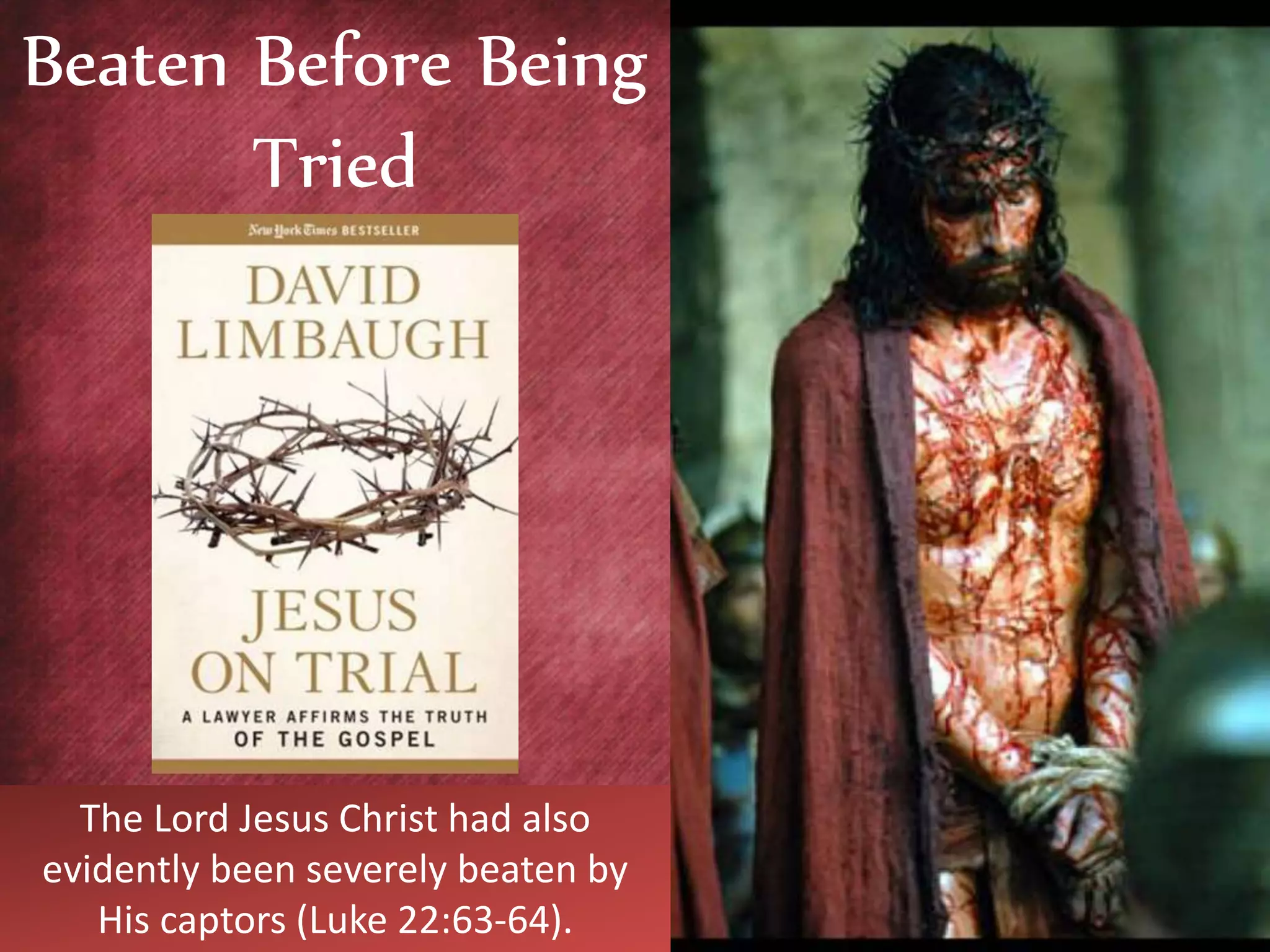
The Lord Jesus Christ had also
evidently been severely beaten by
His captors (Luke 22:63-64).
Beaten Before Being
Tried
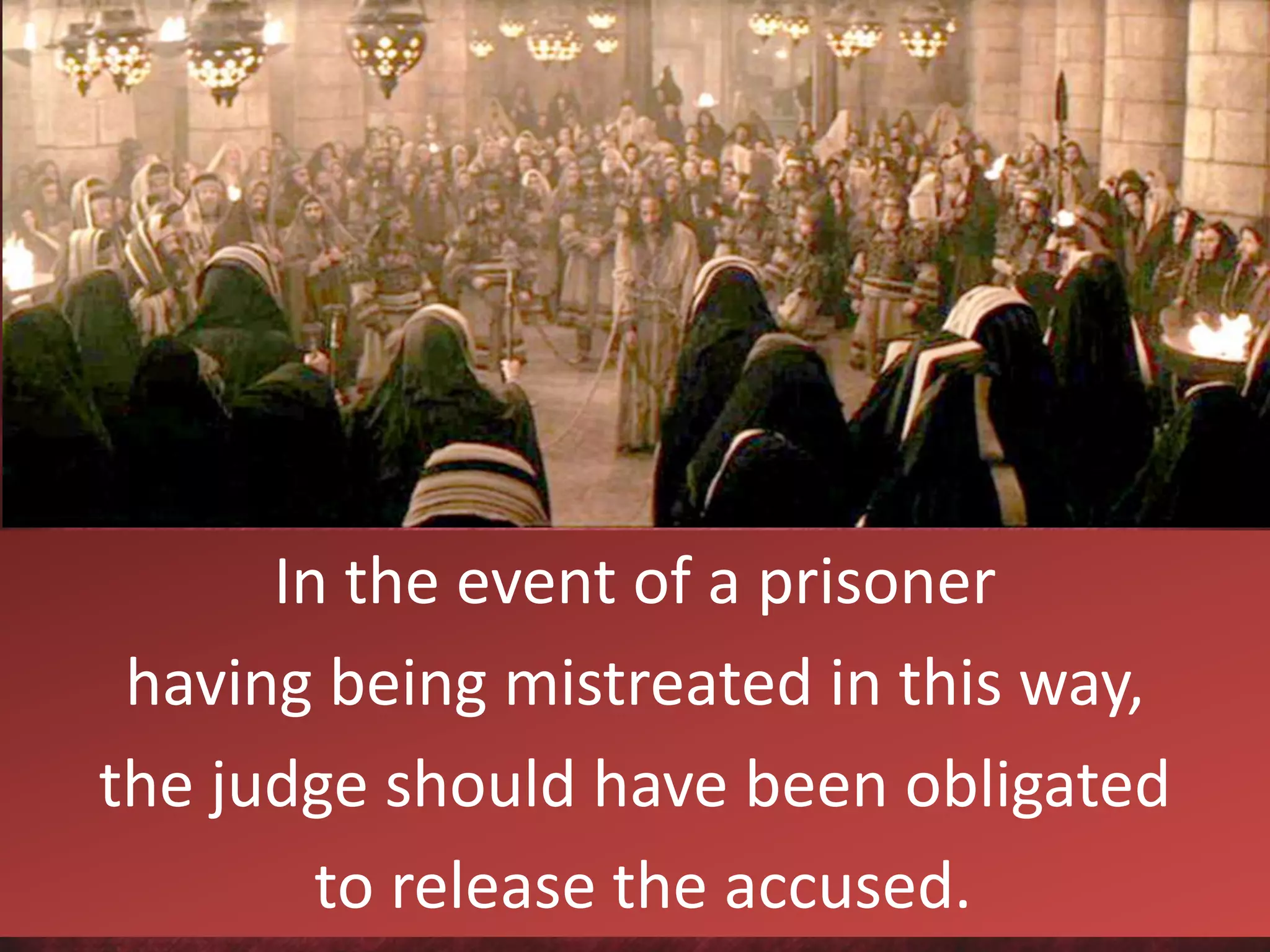
In the event of a prisoner
having being mistreated in this way,
the judge should have been obligated
to release the accused.
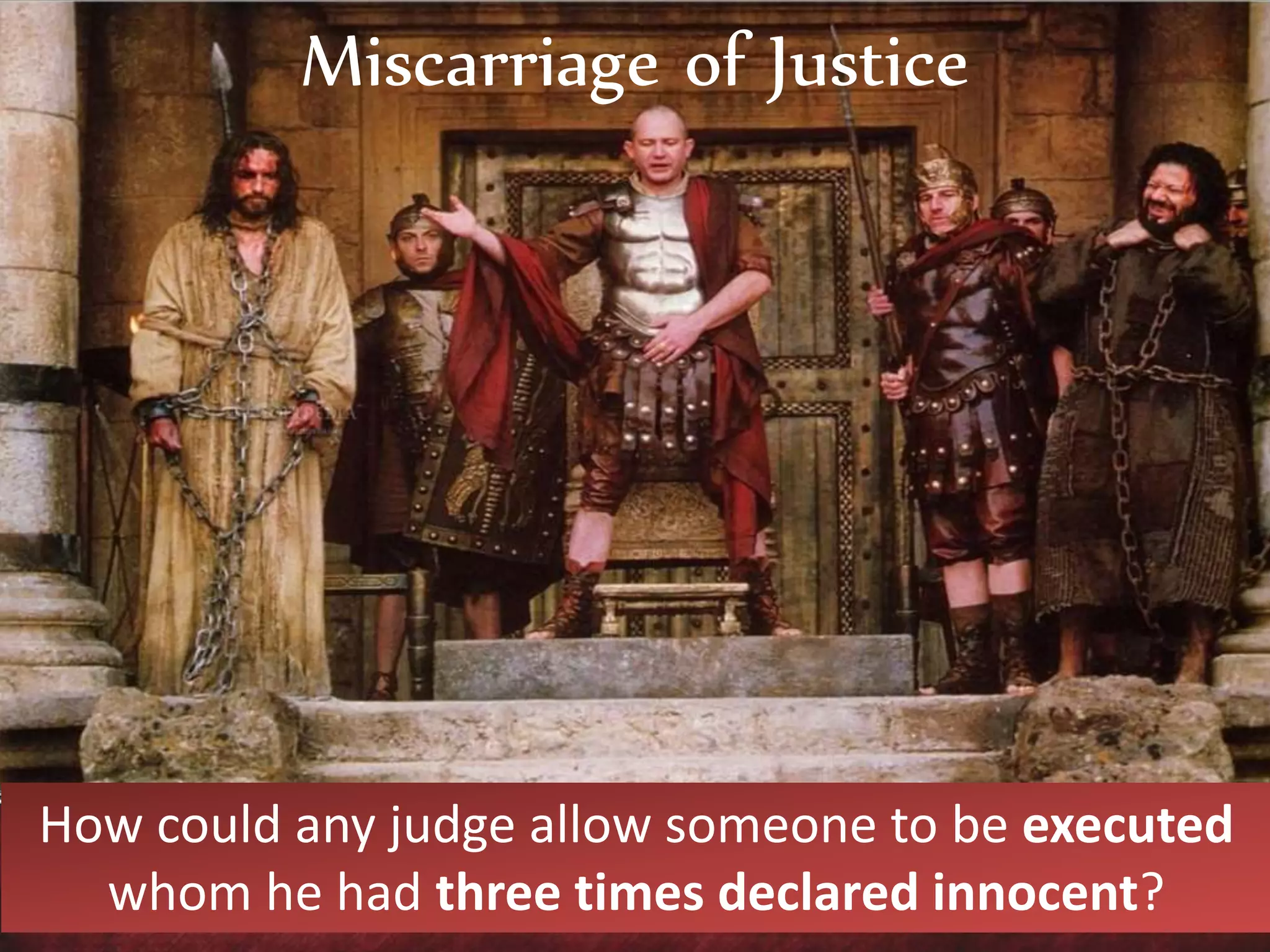
How could any judge allow someone to be executed
whom he had three times declared innocent?
Miscarriage of Justice
And what a meaningless gesture for the governor and
magistrate to wash his hands claiming that he was
innocent of the blood of a person who was clearly
the victim of a conspiracy and who, as a magistrate,
he should have protected from the mob.
"When Pilate saw that he could not prevail at all, but rather that a
tumult was rising, he took water and washed his hands before the
multitude saying, 'I am innocent of the blood of this Just Person.
Cowardice and Compromise
You see to it.' And all the people answered and said,
'His blood be on us and on our children.'" Matthew 27:24-25
The trial of Jesus was a travesty of justice.
It is a terrifying thing to be judged by the mob.
Can you imagine being judged by your worst enemies?
A Travesty of Justice
However, today, let us call forward some character witnesses to testify
of Jesus.
Character Witnesses
Of course, we could call forth millions of Christians throughout the ages
who would eagerly testify to the incomparable goodness and greatness
of our Lord and Saviour.
However, today, we will call forward only skeptics and many of them
enemies of Christ.
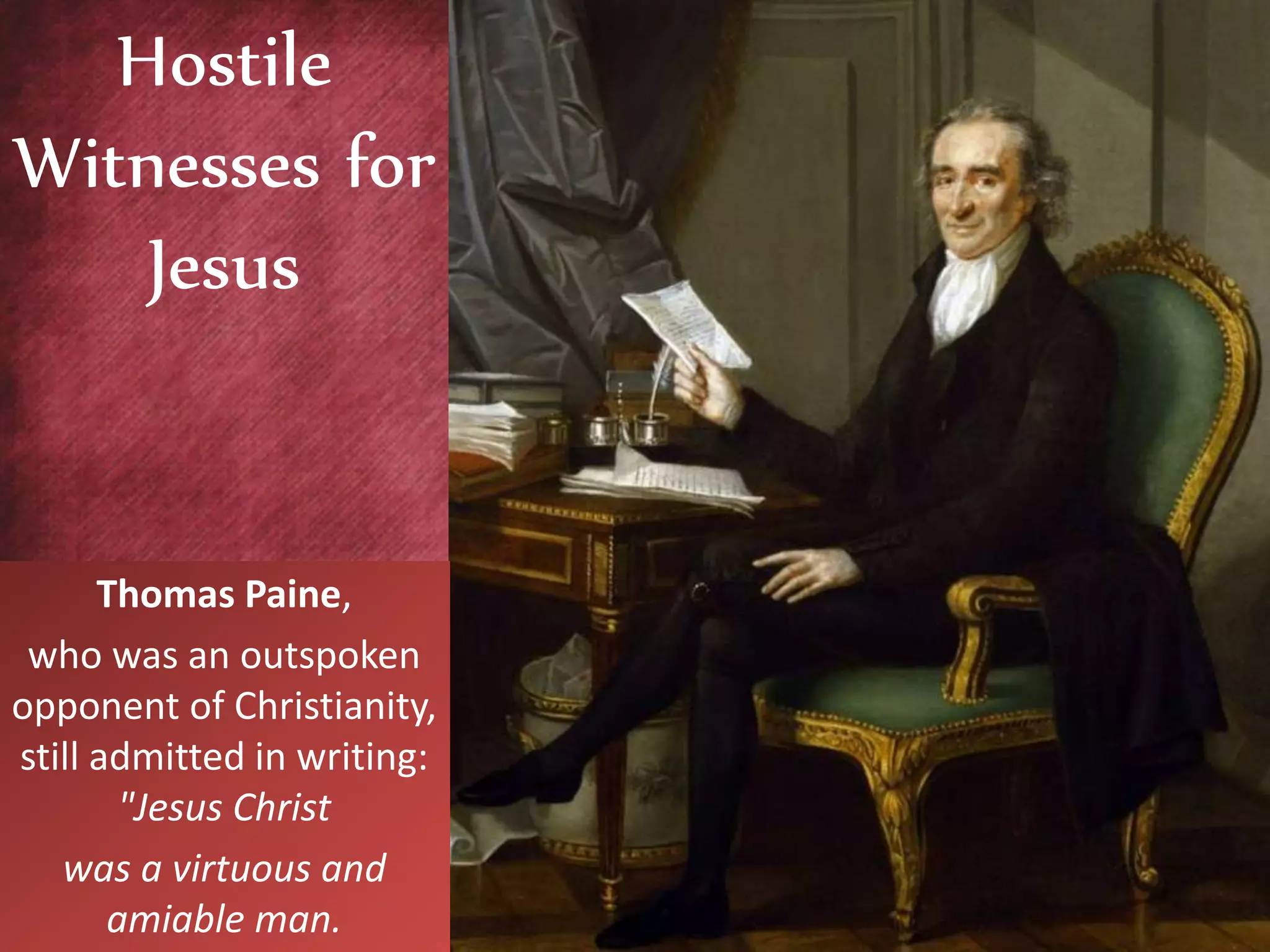
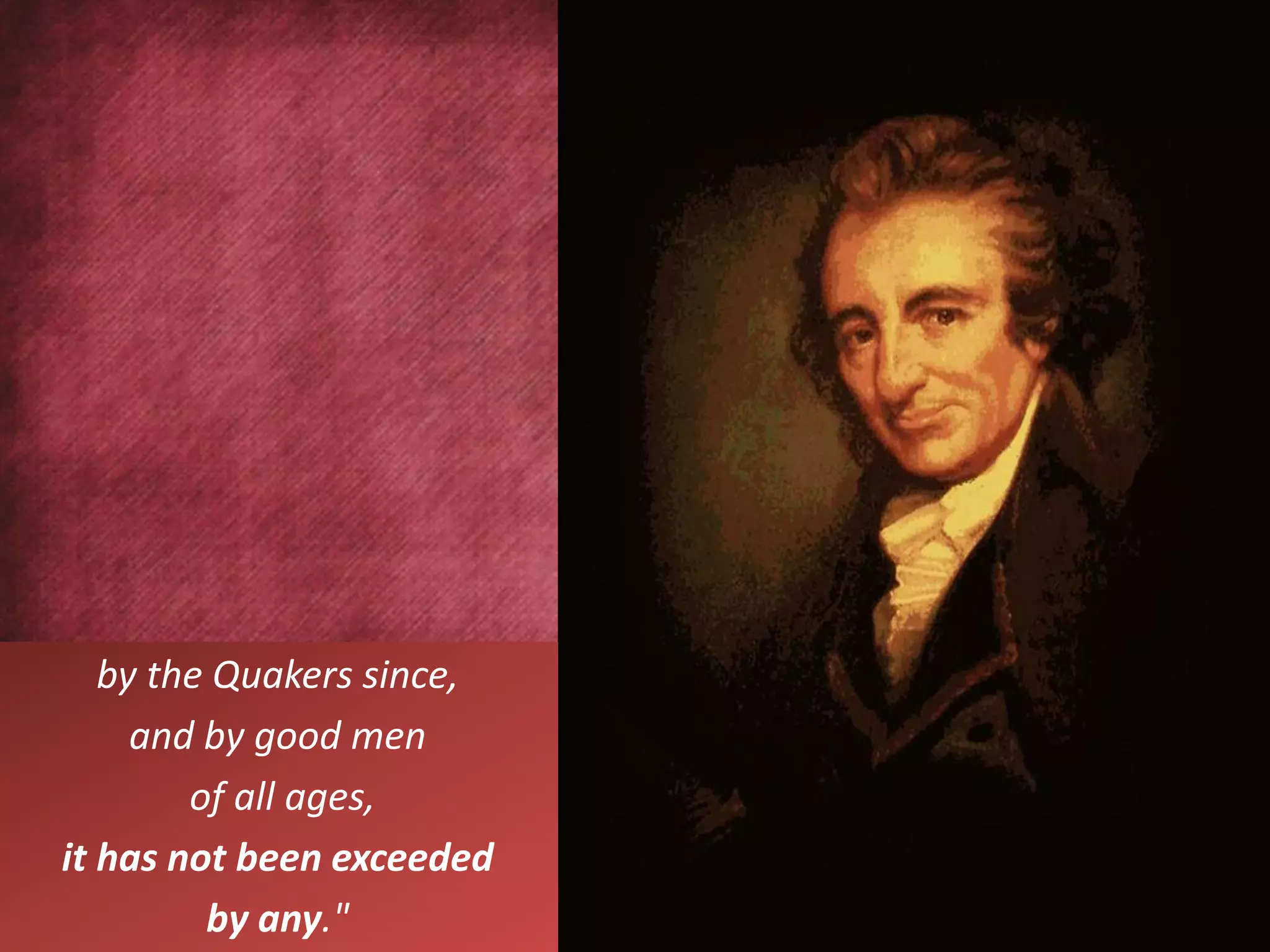
Thomas Paine,
who was an outspoken
opponent of Christianity,
still admitted in writing:
"Jesus Christ
was a virtuous and
amiable man.
Hostile
Witnesses for
Jesus
For the morality that He preached and practiced was of the most
benevolent kind;
and while similar systems of morality had been preached by Confucius,
and by some of the Greek philosophers… ;
by the Quakers since,
and by good men
of all ages,
it has not been exceeded
by any."
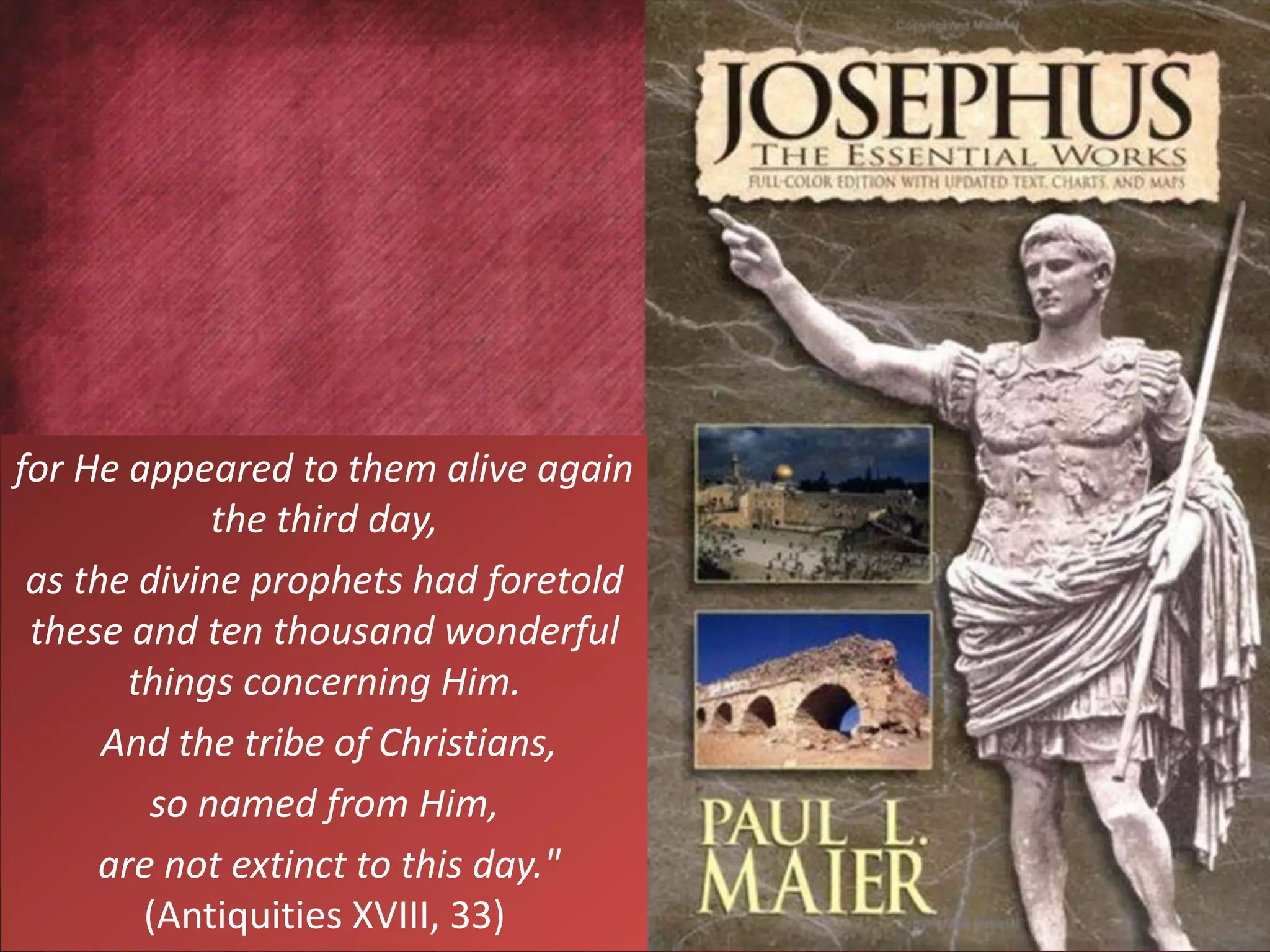
The first century Jewish historian,
Josephus Ben Mattathias,
the author of The Antiquities of the
Jews, wrote:
"Now there was about this time
Jesus, a wise man,
if it be lawful to call Him a man,
for He was a doer of wonderful
works, a Teacher of such men as
receive the truth with pleasure.
The Christ
He drew over to Him both
many of the Jews and many of
the Gentiles. He was the
Christ and when Pilate at the
suggestion of the principal
men among us,
had condemned
Him to the Cross,
those who loved
Him at the first, did
not forsake Him;
for He appeared to them alive again
the third day,
as the divine prophets had foretold
these and ten thousand wonderful
things concerning Him.
And the tribe of Christians,
so named from Him,
are not extinct to this day."
(Antiquities XVIII, 33)
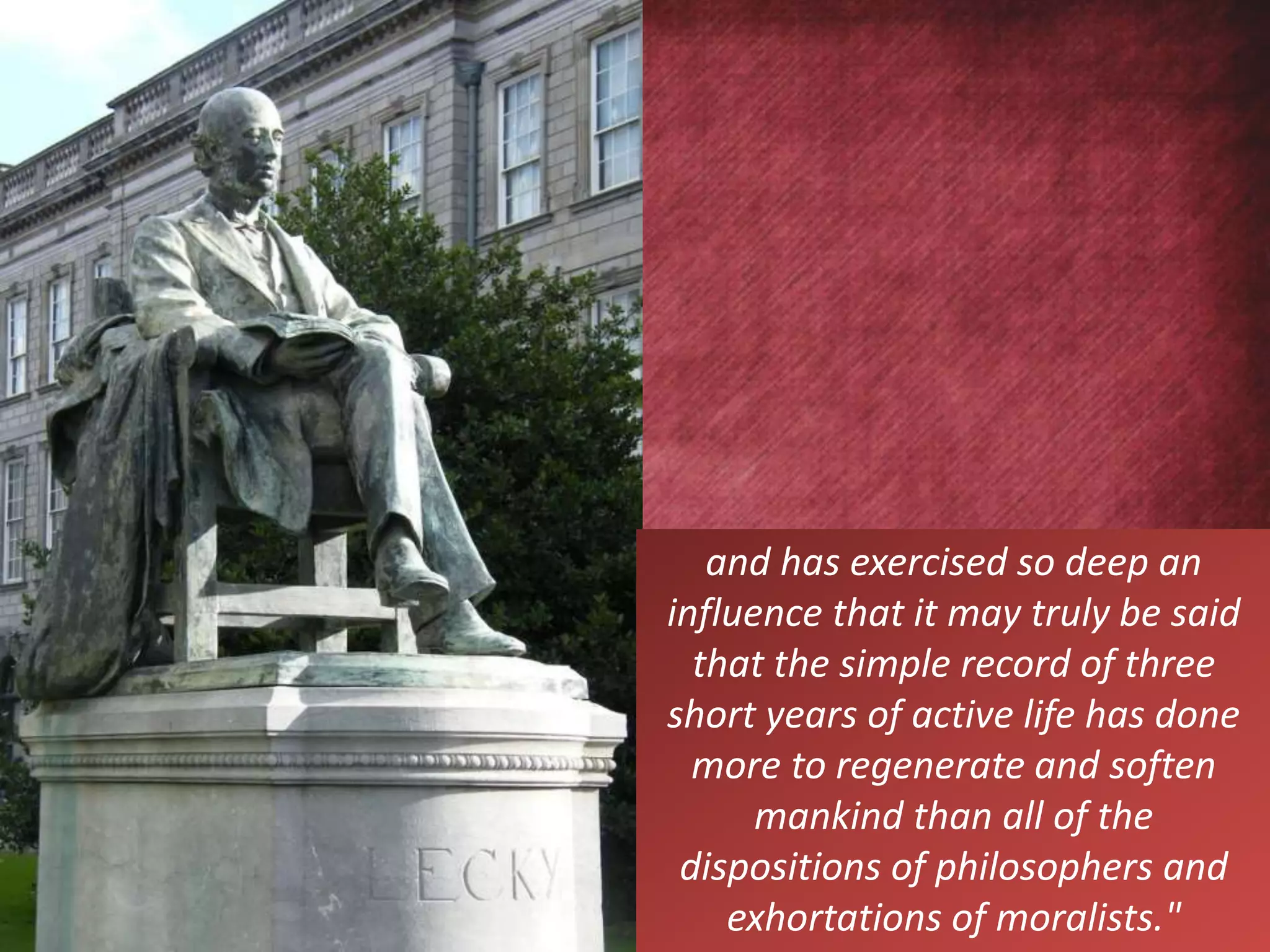
William H. Lecky was one of the
leading historians
of the 19th century
and the author of
The History of
the Rise and Influence
of the Spirit of Rationalism
in Europe.
The
Greatest Example
and Inspiration
Lecky spent his life
advancing the cause of
Rationalism, attacking
Christianity and the
supernatural.
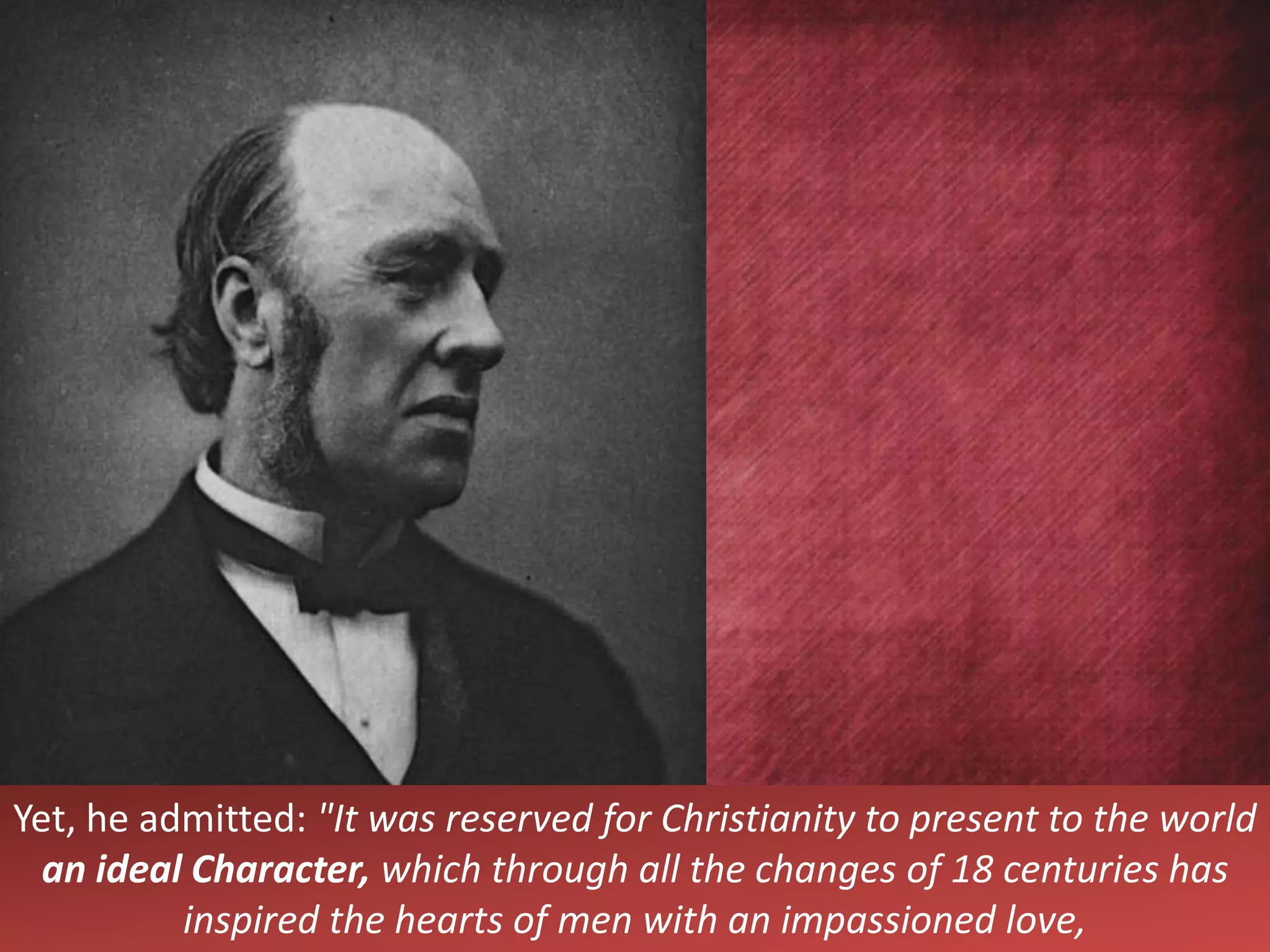
Yet, he admitted: "It was reserved for Christianity to present to the world
an ideal Character, which through all the changes of 18 centuries has
inspired the hearts of men with an impassioned love,
has shown itself capable of acting on all ages, nations, temperaments,
and conditions and has been not only the highest pattern of virtue, but
also the strongest incentive to its practice,
and has exercised so deep an
influence that it may truly be said
that the simple record of three
short years of active life has done
more to regenerate and soften
mankind than all of the
dispositions of philosophers and
exhortations of moralists."
John Stewart Mill was perhaps the most influential and respected
economist of the 18th century.
Pre-Eminent
He often spoke out against
Christianity,
yet he had to acknowledge:
"Christ is still left
- a unique figure,
- not more unlike all of His
percusses than all his
followers.
Even those who had the direct
benefit of His personal teaching.
It is of no use to say that Christ,
as exhibited in the Gospel,
is not historical in that we know not
how much of what is admirable
has been added
by the tradition of His followers
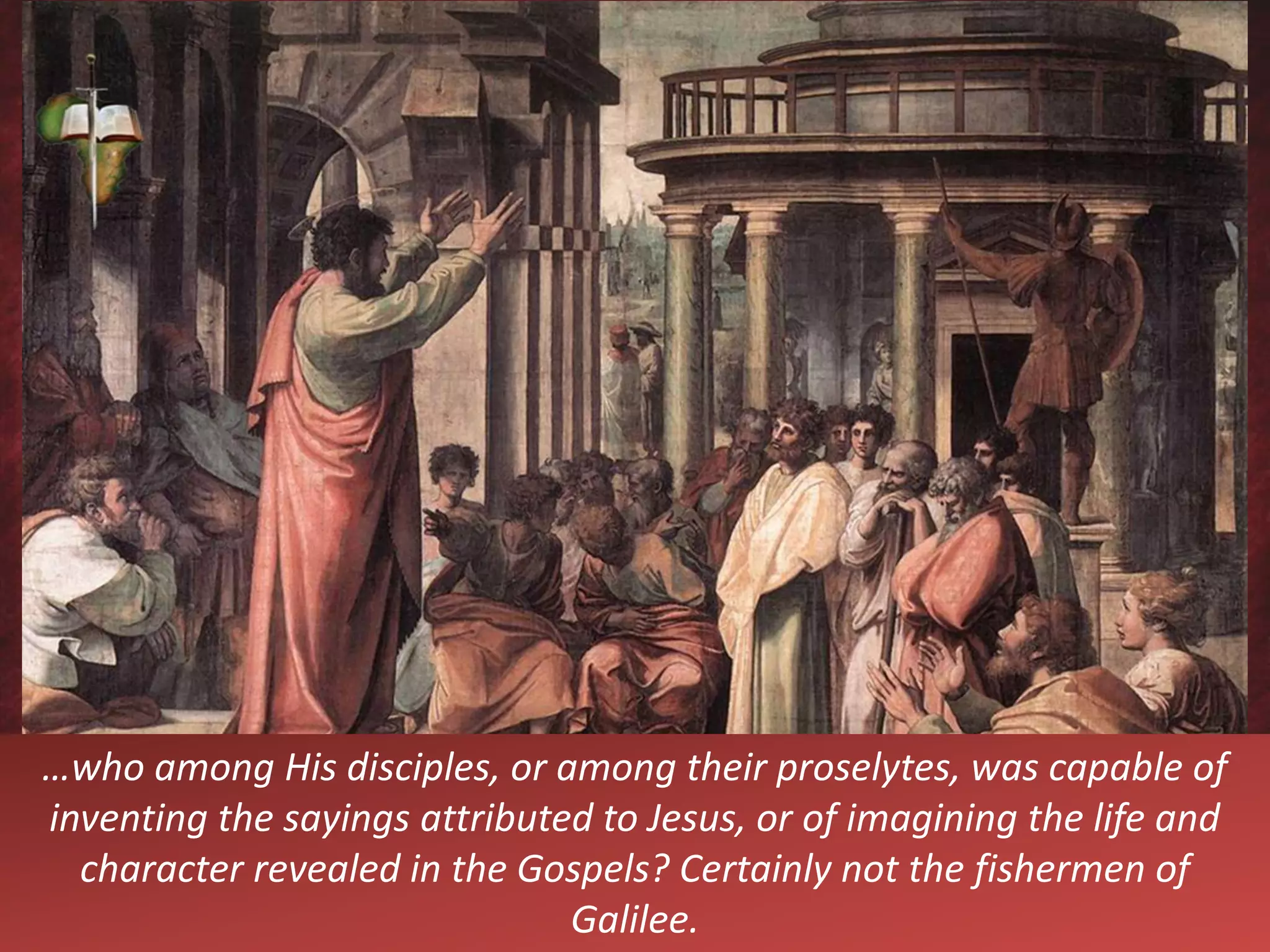
…who among His disciples, or among their proselytes, was capable of
inventing the sayings attributed to Jesus, or of imagining the life and
character revealed in the Gospels? Certainly not the fishermen of
Galilee.
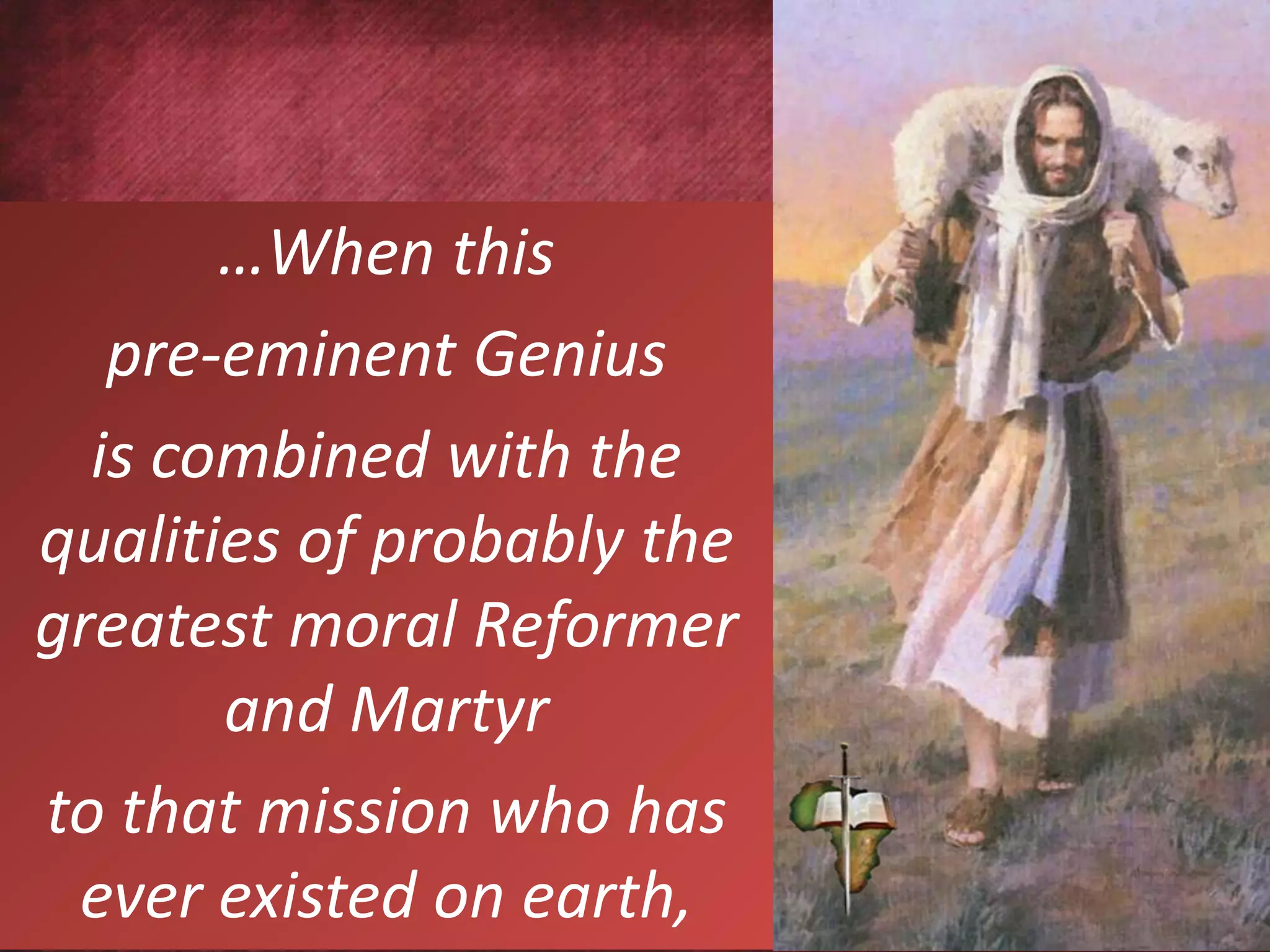
…When this
pre-eminent Genius
is combined with the
qualities of probably the
greatest moral Reformer
and Martyr
to that mission who has
ever existed on earth,
religion cannot be said to
have made a bad choice
in pitching on this Man
as the ideal
Representative
and guide of humanity;
nor even now would it be
easy,
even for an unbeliever,
to find a better translation of the
rule of virtue from the abstract into
the concrete then to endeavour
to so live that Christ
would approve our life."
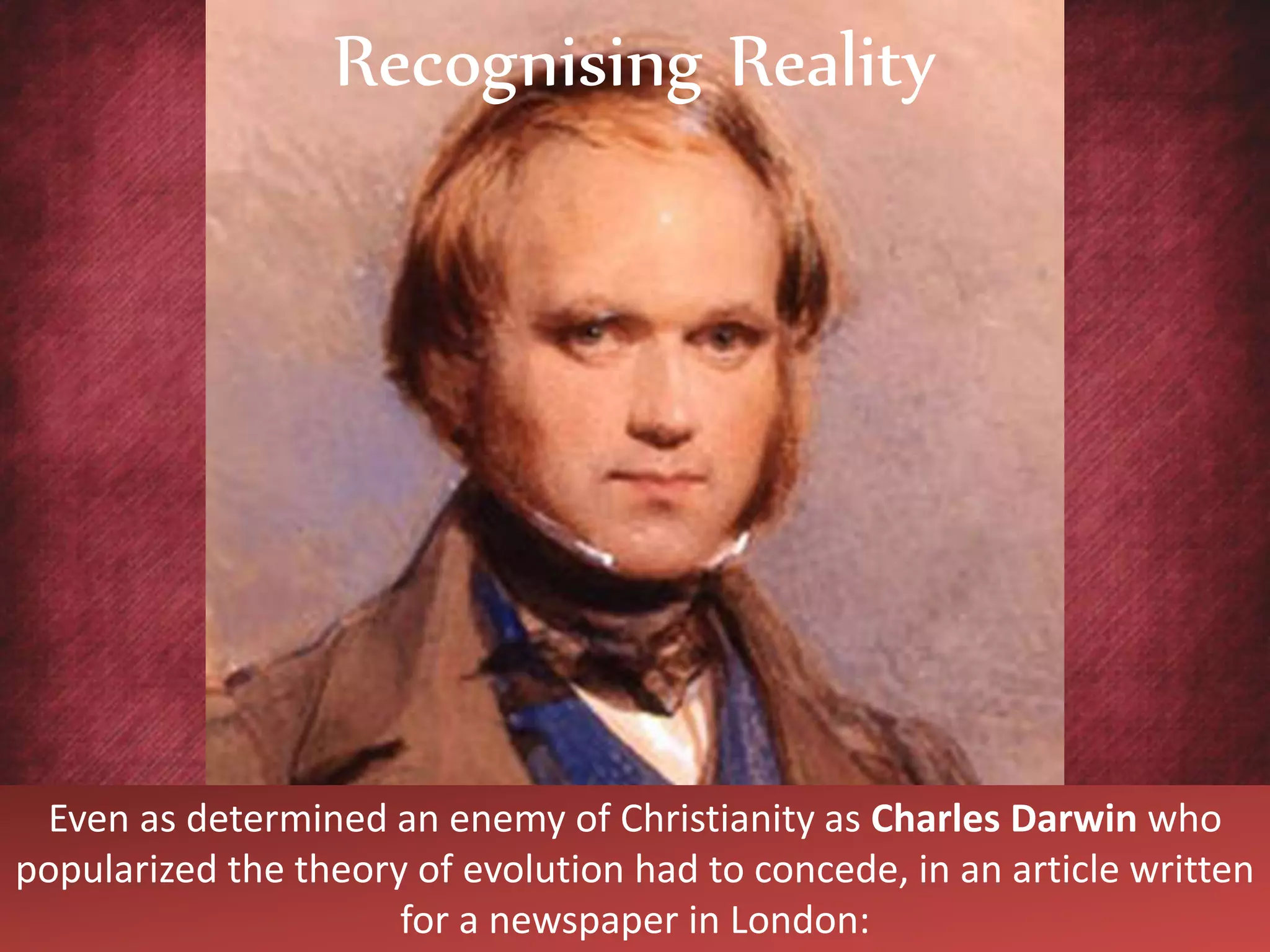
Even as determined an enemy of Christianity as Charles Darwin who
popularized the theory of evolution had to concede, in an article written
for a newspaper in London:
Recognising Reality
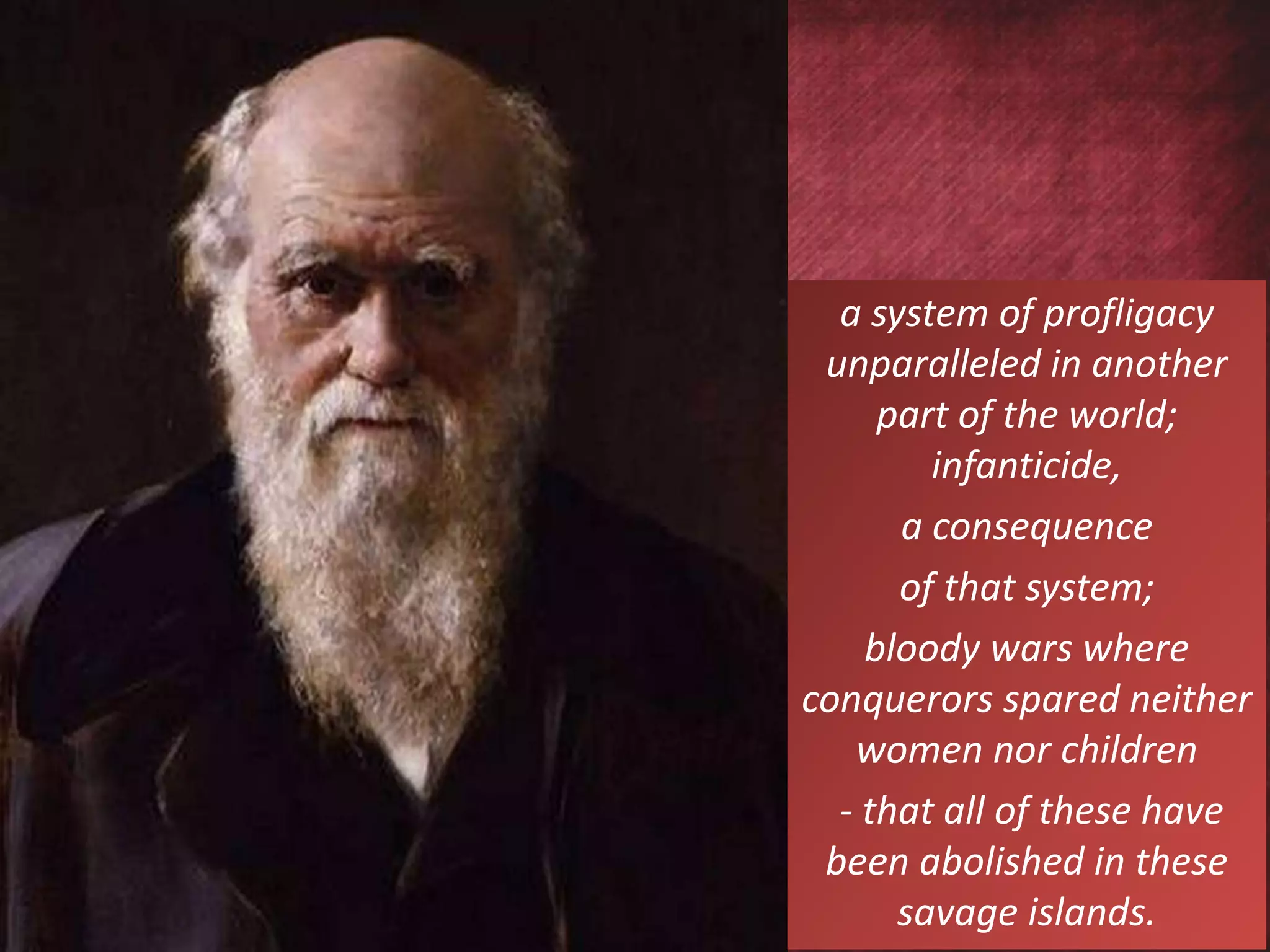
"They forget, or will not remember,
those who minimize the work of
missionaries in pagan countries.
They forget, or will not remember,
that human sacrifices and the power
of an idolatrous priesthood;
a system of profligacy
unparalleled in another
part of the world;
infanticide,
a consequence
of that system;
bloody wars where
conquerors spared neither
women nor children
- that all of these have
been abolished in these
savage islands.
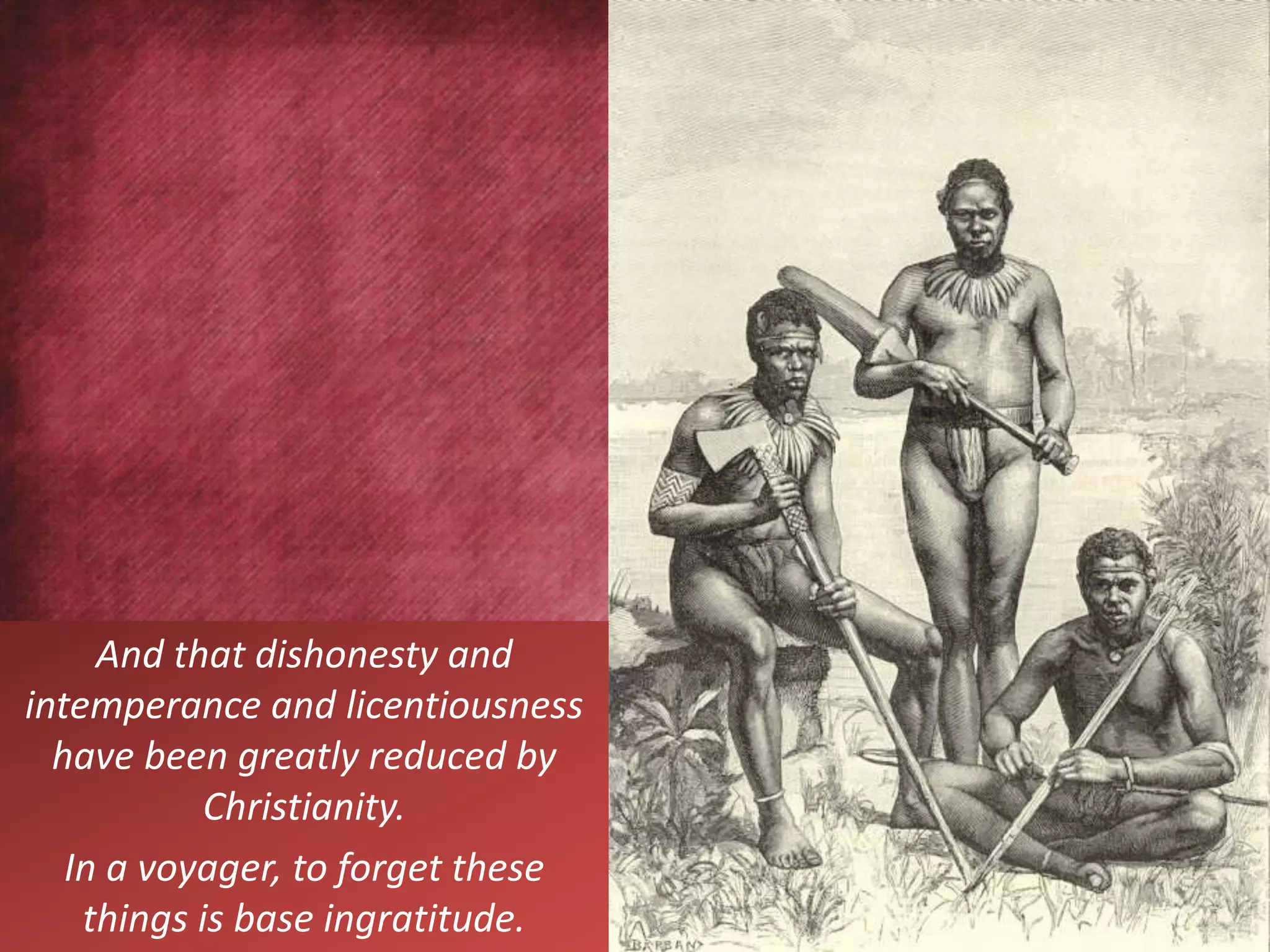
And that dishonesty and
intemperance and licentiousness
have been greatly reduced by
Christianity.
In a voyager, to forget these
things is base ingratitude.
For should he chance to be at the point of shipwreck on some unknown
coast, he will most devoutly pray that the lesson of the missionary may
have reached thus far!"
On another occasion,
Darwin wrote:
"The lesson of the missionary
is the enchanter's wand.
The house has been built,
the windows framed,
the fields ploughed
and even the trees grafted
by the New Zealander.
Civilising
The march of improvement, consequent on the introduction of
Christianity throughout the seas probably stands by itself in the records
of history."
Another hostile witness that could be brought to testify of the
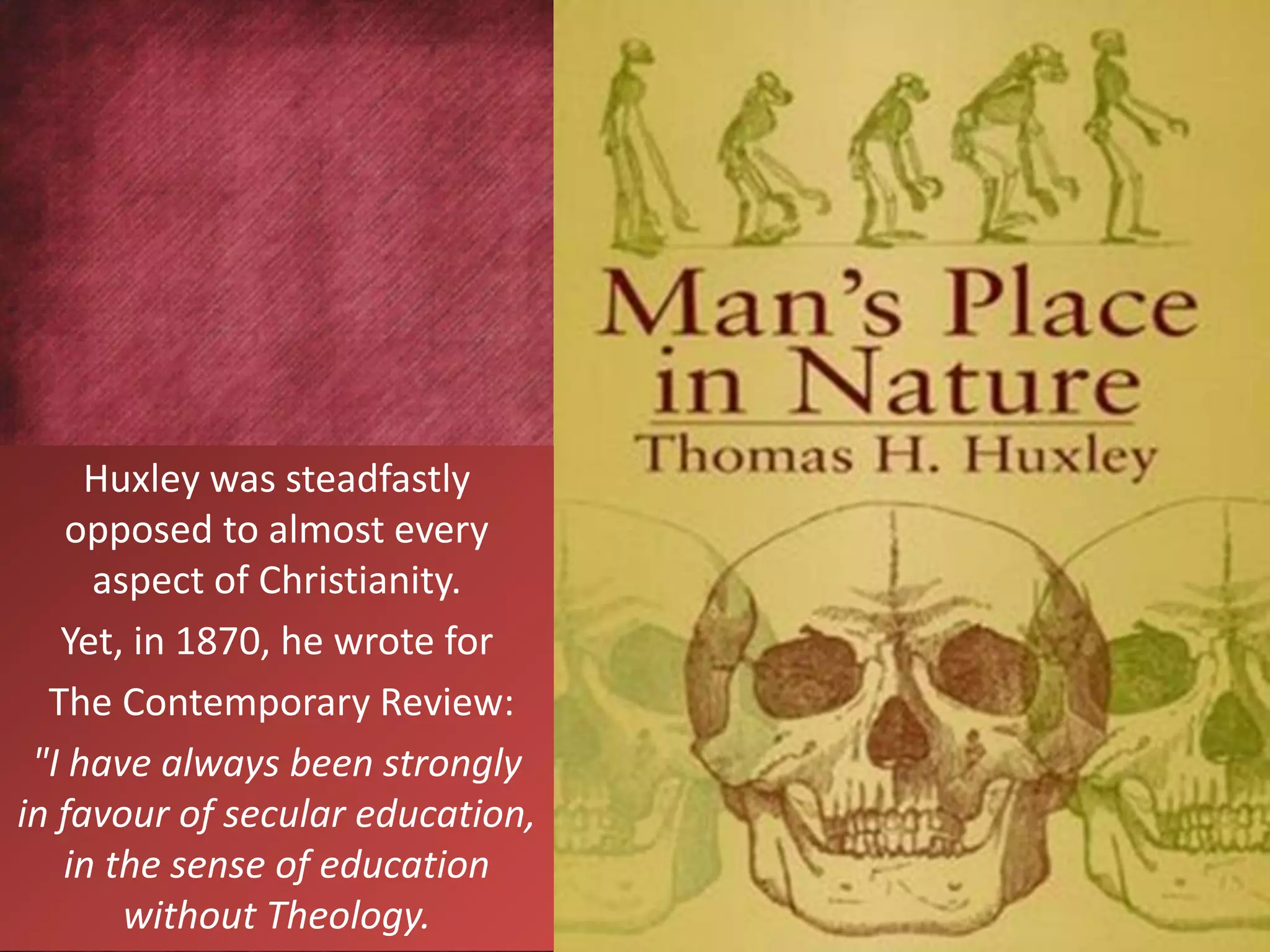
uniqueness of Christ was Darwin's bulldog, Thomas Huxley.
Irreplaceable
It was Huxley who first coined the
word agnostic,
which is what he claimed to be.
Huxley did more than any other
to popularize
the theories of Darwinism.
Huxley was steadfastly
opposed to almost every
aspect of Christianity.
Yet, in 1870, he wrote for
The Contemporary Review:
"I have always been strongly
in favour of secular education,
in the sense of education
without Theology.
But, I must confess that I have been
no less seriously perplexed to know
by what practical measures the
religious feeling,
which is the essential
basis of conduct,
was to be kept up in the presently
utterly chaotic state of opinion
on these matters
- without the use of the Bible.
The pagan moralists lack life and colour.
Take the Bible as a whole, make the severest deductions which
criticisms can dictate and there still remains
a vast residuum of moral beauty and grandeur.
By the study of what other book could children be so much humanized
and made to feel that each figure in that vast historical procession fills,
like themselves,
but a momentary space and interval between two eternities and earns
the blessings, or curses, of all time, according to its efforts to do good
and evil?"
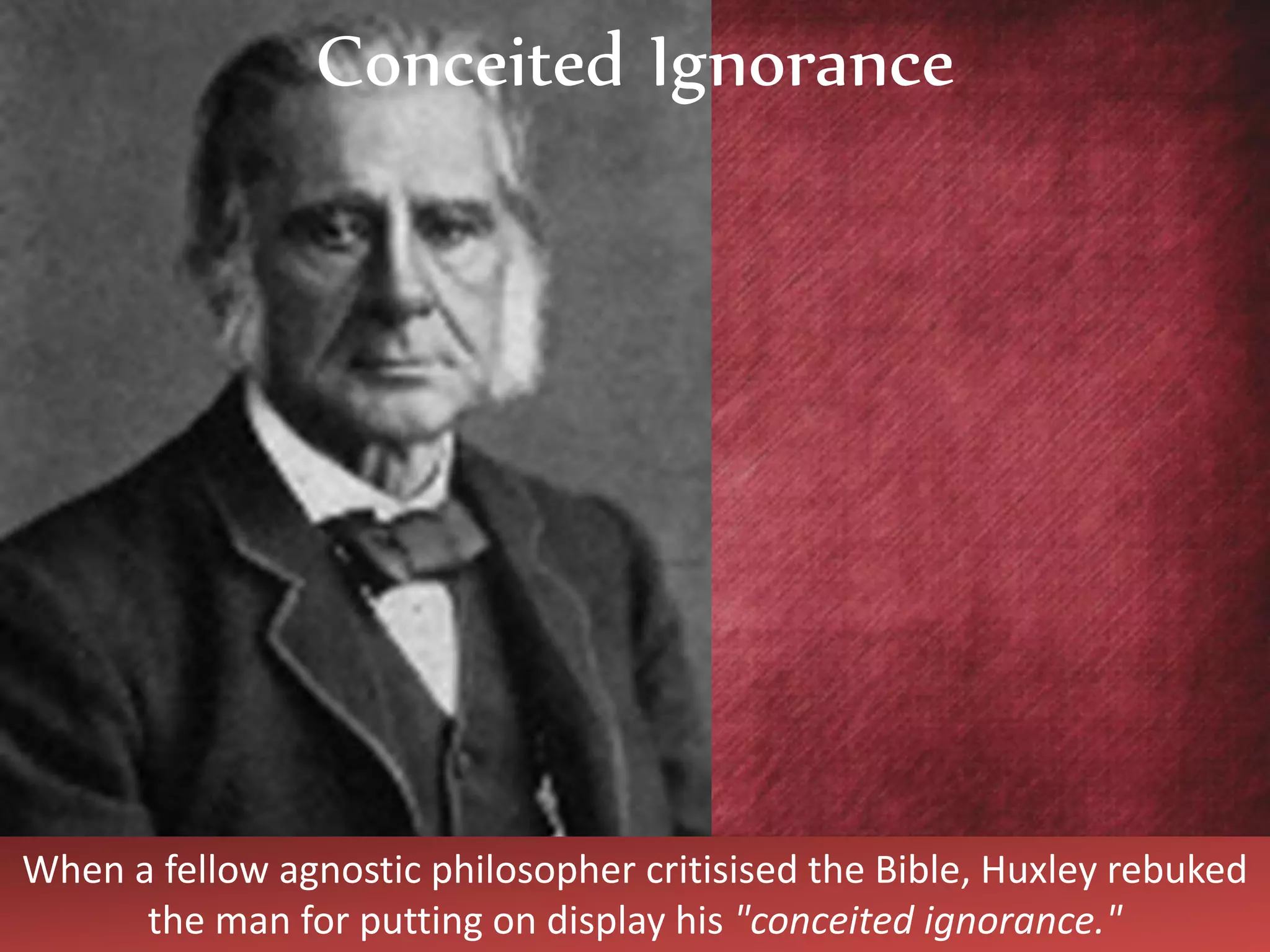
When a fellow agnostic philosopher critisised the Bible, Huxley rebuked
the man for putting on display his "conceited ignorance."
Conceited Ignorance
Huxley even had to go further in admitting: "The Bible has been the
Magna Carta of the poor and the oppressed down to modern times.
Indispensable
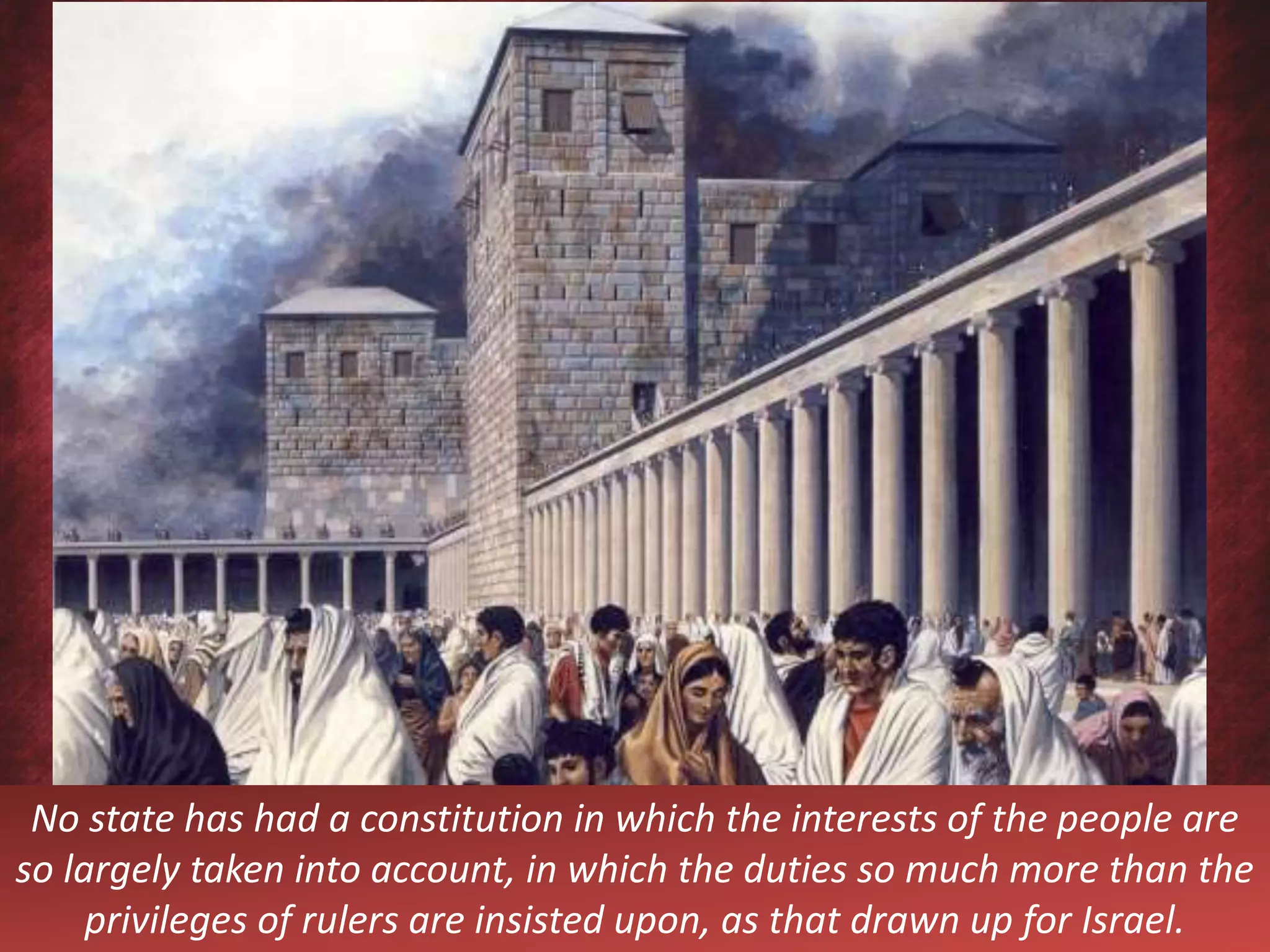
No state has had a constitution in which the interests of the people are
so largely taken into account, in which the duties so much more than the
privileges of rulers are insisted upon, as that drawn up for Israel.
Nowhere is the fundamental truth that the welfare of the state, in the
long run, depends upon the uprightness of the citizen so strongly laid
down.
I do not believe that the human
race is yet,
and possibly never will be,
in a position to dispense
with the Bible."
Another vocal sceptic who can be
called upon to testify of Christ was
George Romanes.
He wrote many articles against
Christianity during his lifetime.
Immeasurably
in Advance
Yet, in his book
Thoughts on Religion,
Romanes observed:
"Not only is Christianity thus so
immeasurably in advance
of all other religions,
it is no less so of every other system
of thought that has ever
been promulgated in regard
to all that is moral and spiritual.
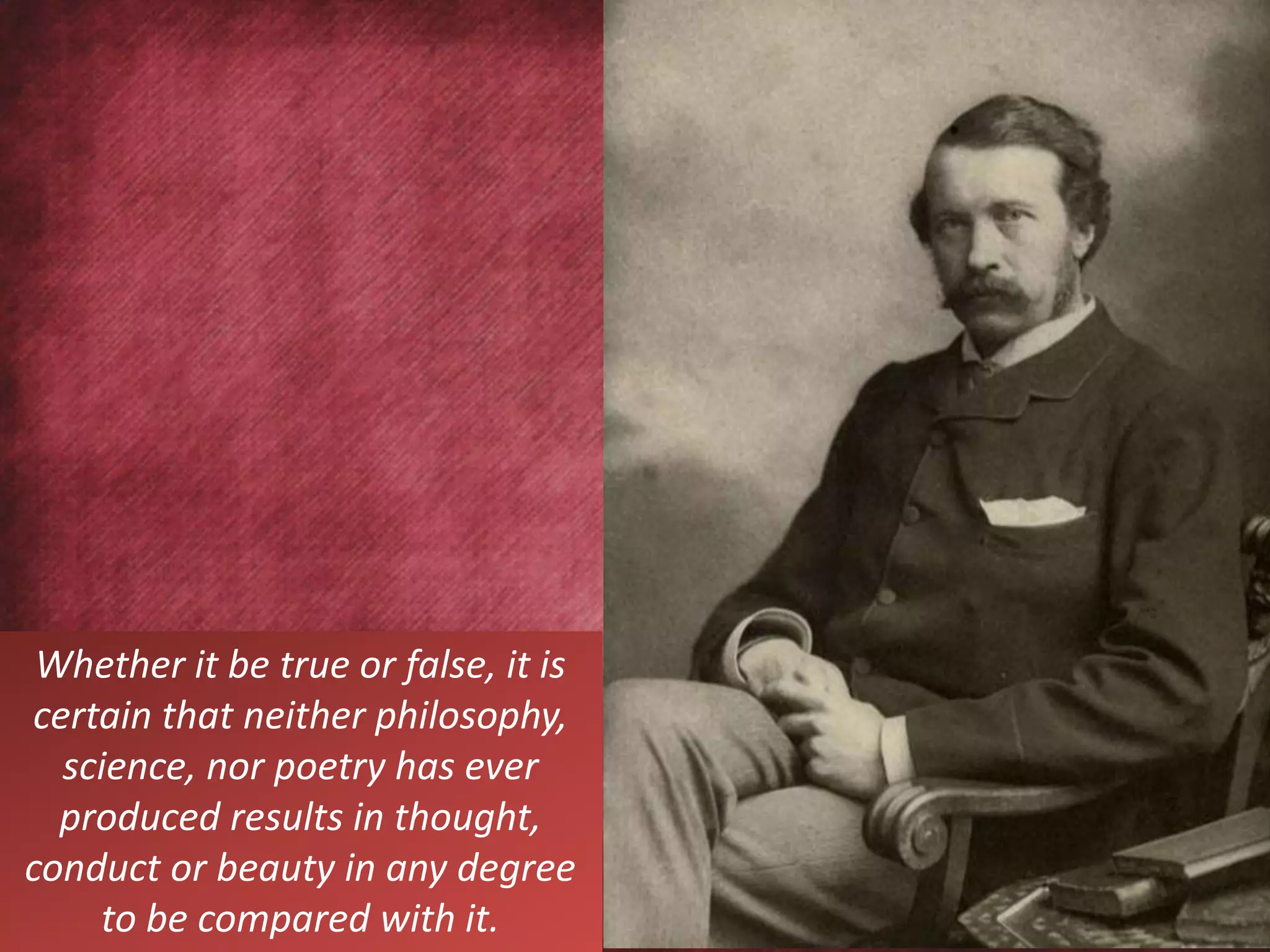
Whether it be true or false, it is
certain that neither philosophy,
science, nor poetry has ever
produced results in thought,
conduct or beauty in any degree
to be compared with it.
It is the greatest exhibition of the beautiful, the sublime, and all else that
appeals to our spiritual nature which has ever been known upon our
earth.
What has all the science, or all the philosophy of the world, done for the
thought of mankind to be compared to this one Doctrine - God is Love?"
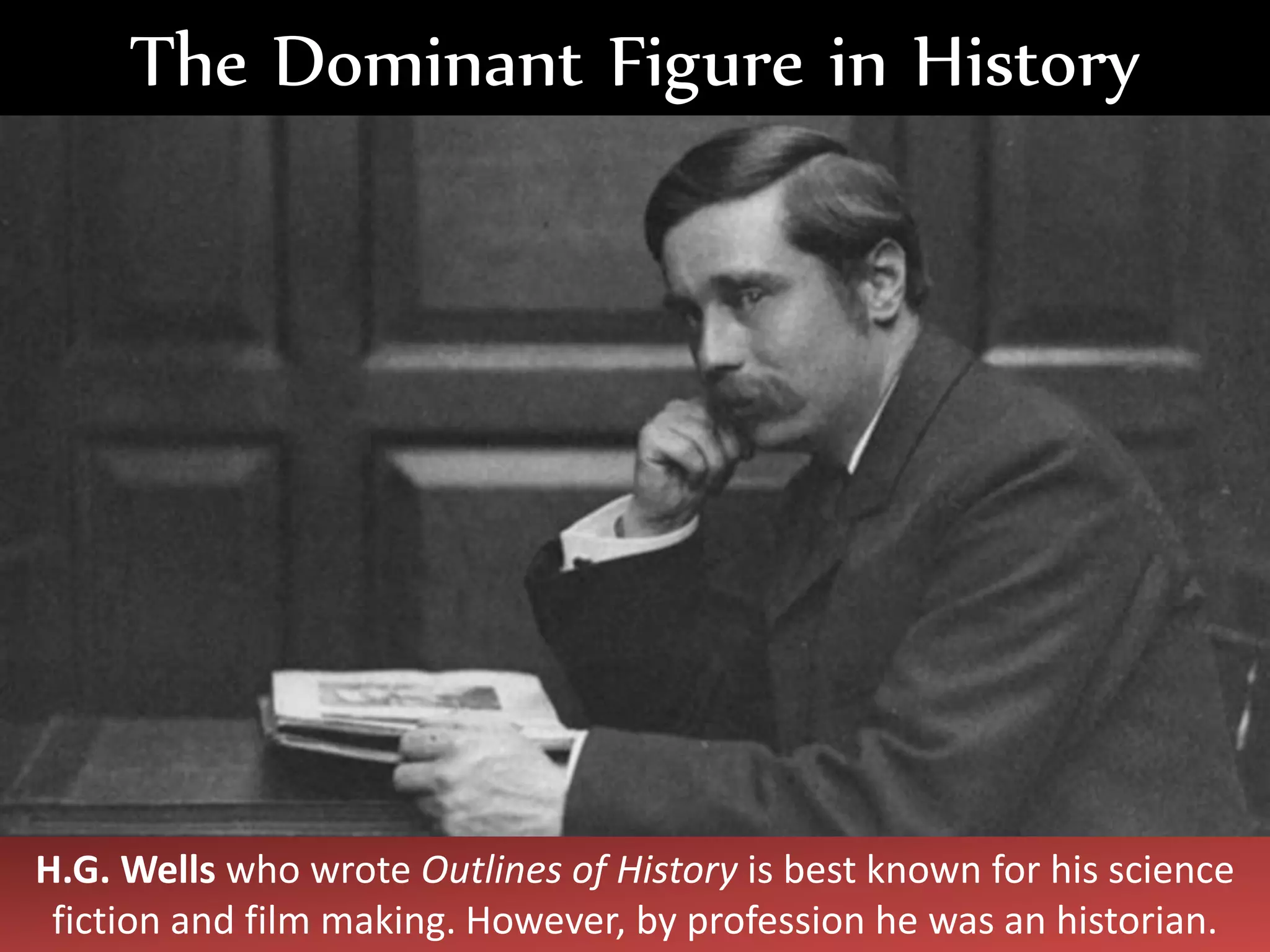
H.G. Wells who wrote Outlines of History is best known for his science
fiction and film making. However, by profession he was an historian.
The Dominant Figure in History
Despite being a very outspoken critic of Christianity, H.G. Wells wrote:
"Jesus of Nazareth is easily the dominant figure in history.
I am speaking of Him, of course, as a man.
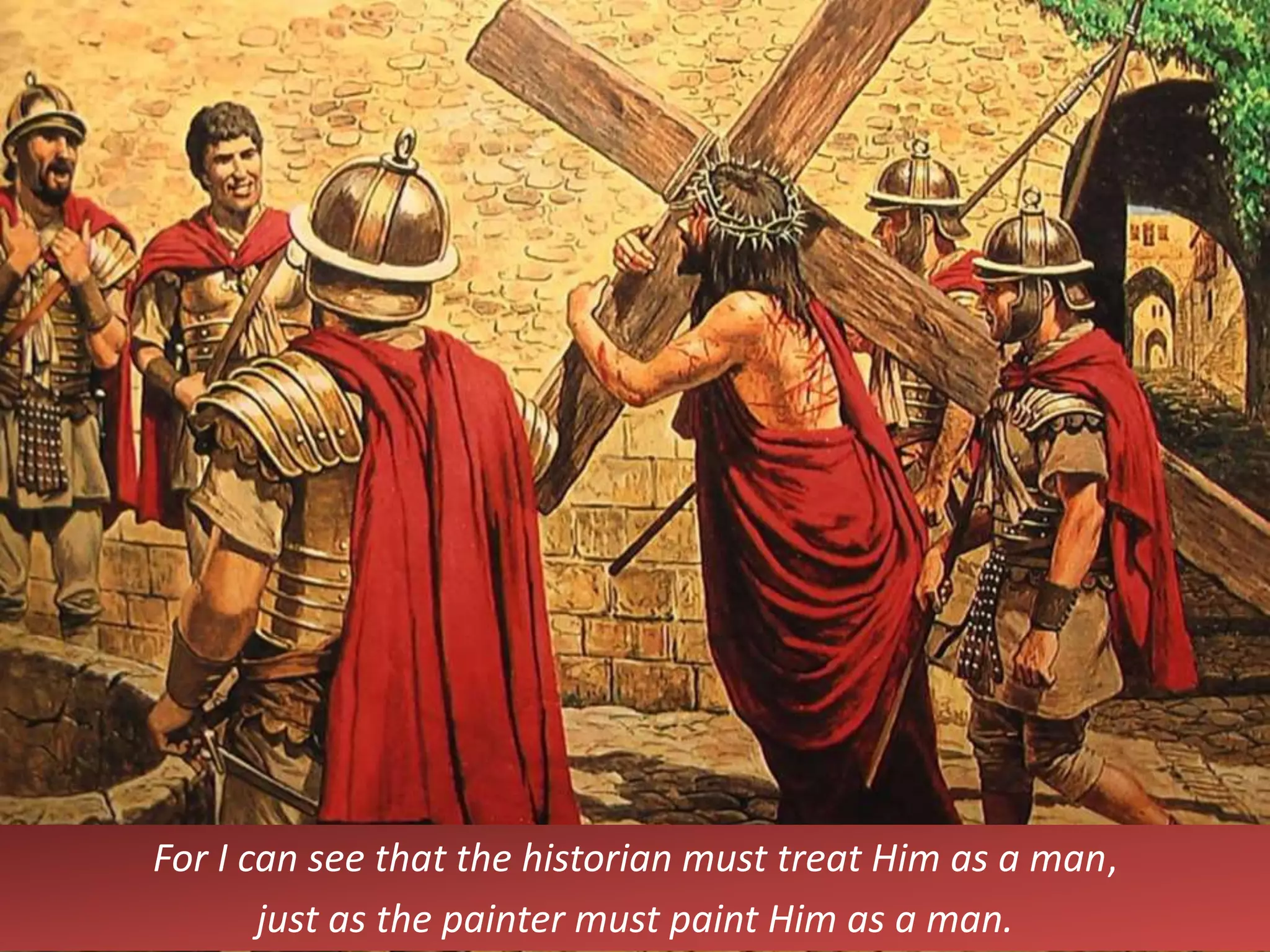
For I can see that the historian must treat Him as a man,
just as the painter must paint Him as a man.
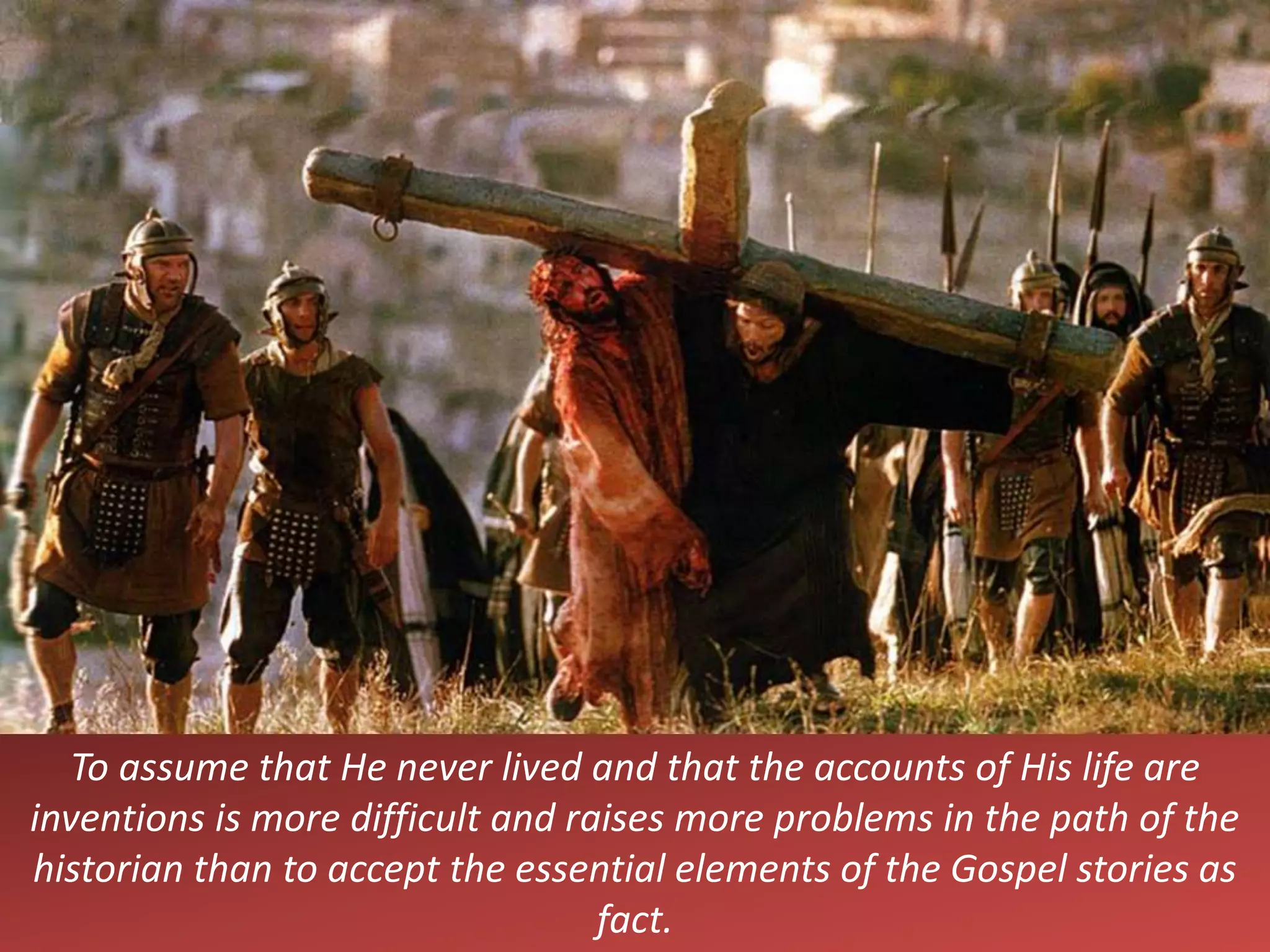
To assume that He never lived and that the accounts of His life are
inventions is more difficult and raises more problems in the path of the
historian than to accept the essential elements of the Gospel stories as
fact.
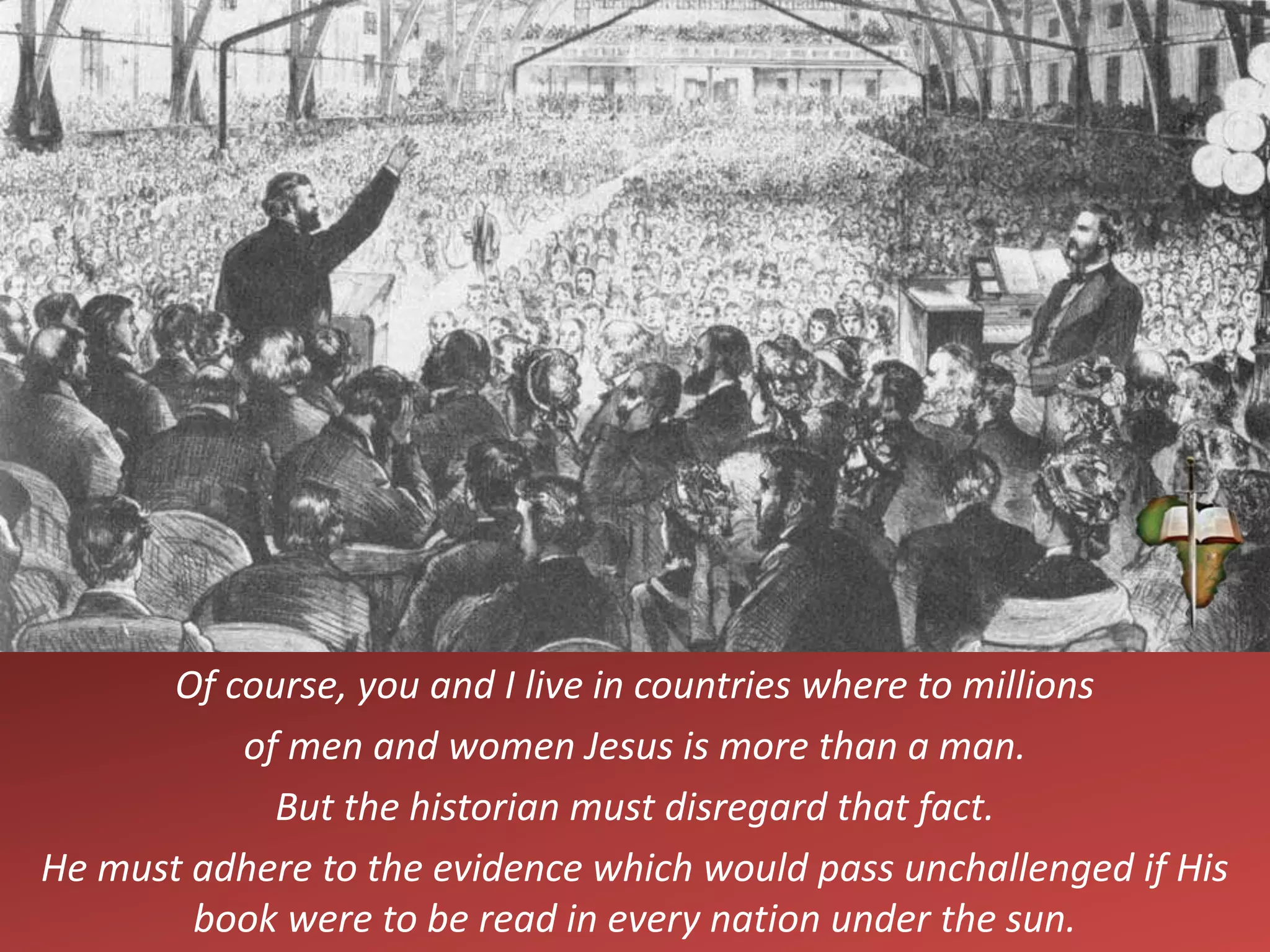
Of course, you and I live in countries where to millions
of men and women Jesus is more than a man.
But the historian must disregard that fact.
He must adhere to the evidence which would pass unchallenged if His
book were to be read in every nation under the sun.
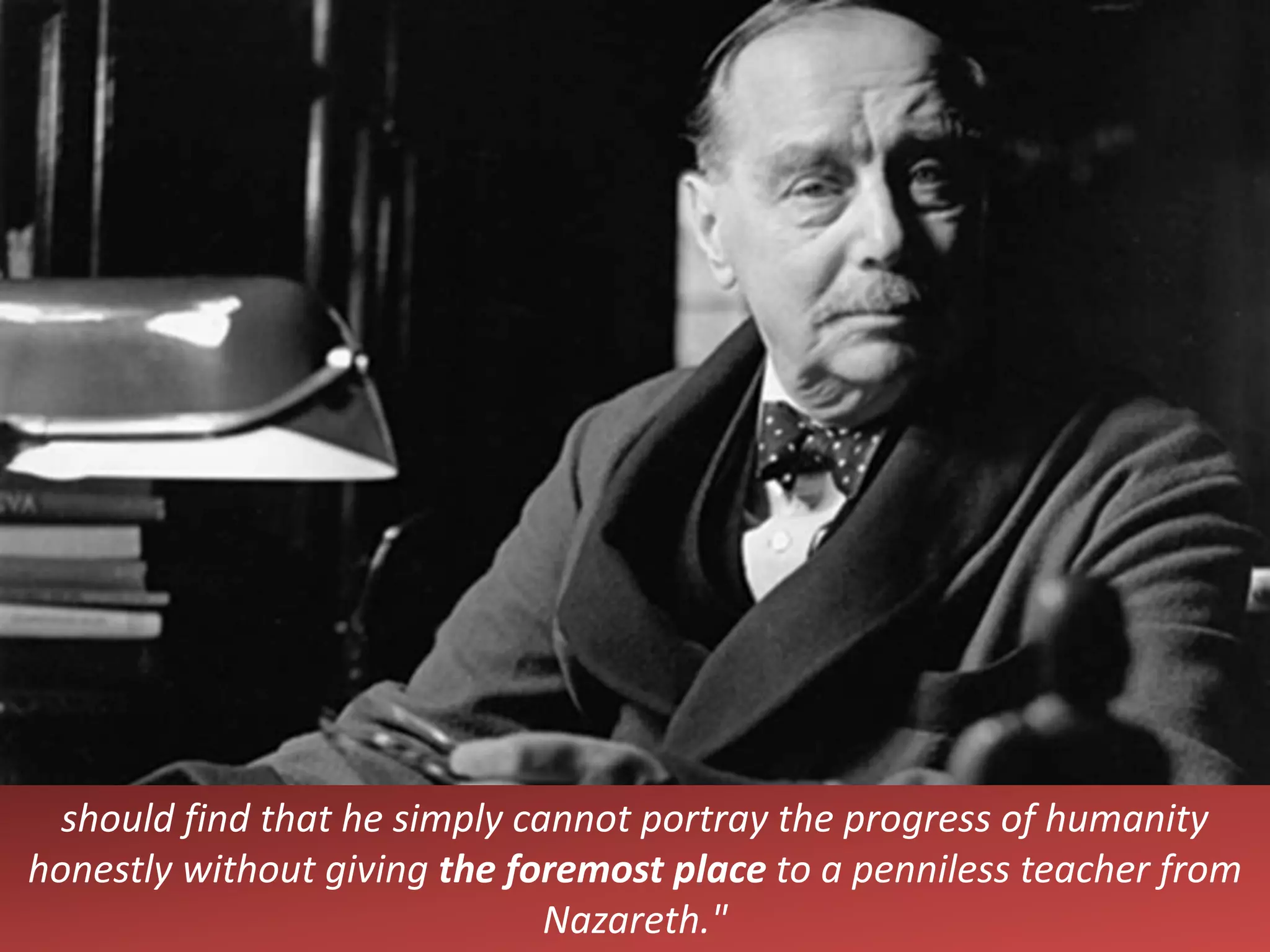
Now, it is interesting and significant, isn't it, that an historian setting
forth in that spirit, without any theological bias whatsoever,
should find that he simply cannot portray the progress of humanity
honestly without giving the foremost place to a penniless teacher from
Nazareth."
The final hostile witness
which I would like to call to
testify of Christ is the brilliant
and volatile journalist and
writer H.L. Mencken.
Mencken dipped his pen
in acid whenever it came to
writing on Christianity.
Unparalleled
Mencken was the journalist who transformed the evolutionist's legal
defeat in the courtroom at the Scopes trial to a victory in the court of
public opinion.
In his work: Treaties on the gods, Mencken declared:
"This historicity of Jesus is no longer questioned seriously by anyone,
whether Christian or unbeliever.
The main facts about Him seem to be beyond dispute …it is
not easy to account for His singular and stupendous success.
How did it
come about
that one who
in His life had
only the bitter
cup of
contumely to
drink should
have lifted
Himself in
death to such
vast esteem
and
circumstance,
such
incomparable
and world
shaking power
and renown?
…It seems to be certain
that many persons saw
Him after His supposed
death on the Cross,
including not a few who
were violently
disinclined to believe in
His Resurrection.
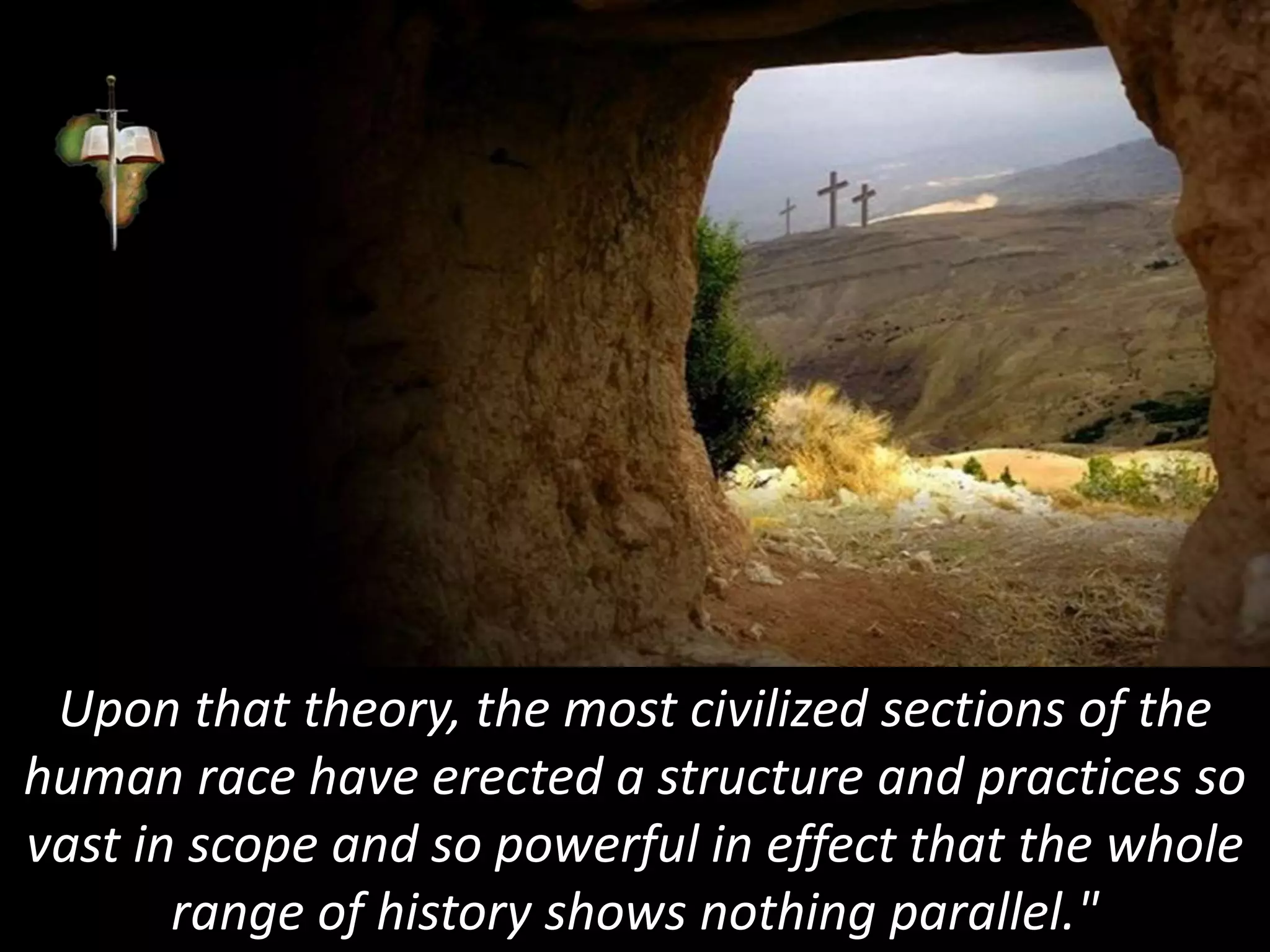
Upon that theory, the most civilized sections of the
human race have erected a structure and practices so
vast in scope and so powerful in effect that the whole
range of history shows nothing parallel."
So, here we have testimonies of some famous skeptics, some of them
Christ's enemies, over almost 2000 years, including: rationalist
philosophers, a Jewish historian, some famous evolutionists,
A Unanimous Verdict
a secular humanist journalist, a world renowned economist, a religious
sceptic and a famous science fiction writer and Hollywood director.
None of them were Christians. They all rejected Christianity.
Yet, they all had to acknowledge that Jesus Christ was the greatest
Person to ever walk on earth. His impact on history and
the Bible's contribution to life and civilization are incomparable.
The verdict of these skeptics is unanimous.
This One who was born in obscurity, who lived in poverty, who died in
agony, became the most important and positive influence in the
history of the world. No one has influenced the world for the good
more than Jesus Christ.
The chief priests in the Jewish Sanhedrin conspired against and
condemned Christ.
Condemning the Eternal Judge
The Roman governor, Pontius Pilate, acquitted Christ three
times, declaring Him not guilty and yet he ordered Him to be
whipped and crucified to appease the mob in the streets.
Pilate then had the audacity to wash his hands in public declaring that
he was innocent of this Just Man's blood.
Today many presume to sit in judgement upon Christ
The Day of Judgement Will Come
But the Day will come when each one of them, and each one of us, will
stand before the Judgment Throne of Jesus Christ to give an account of
our lives to Him.
"It is appointed unto men once to die
and after that the Judgement."
Hebrews 9:27
The question is not so much what you think of Christ
– but what does He think of you?
Jesus Will Judge You and I
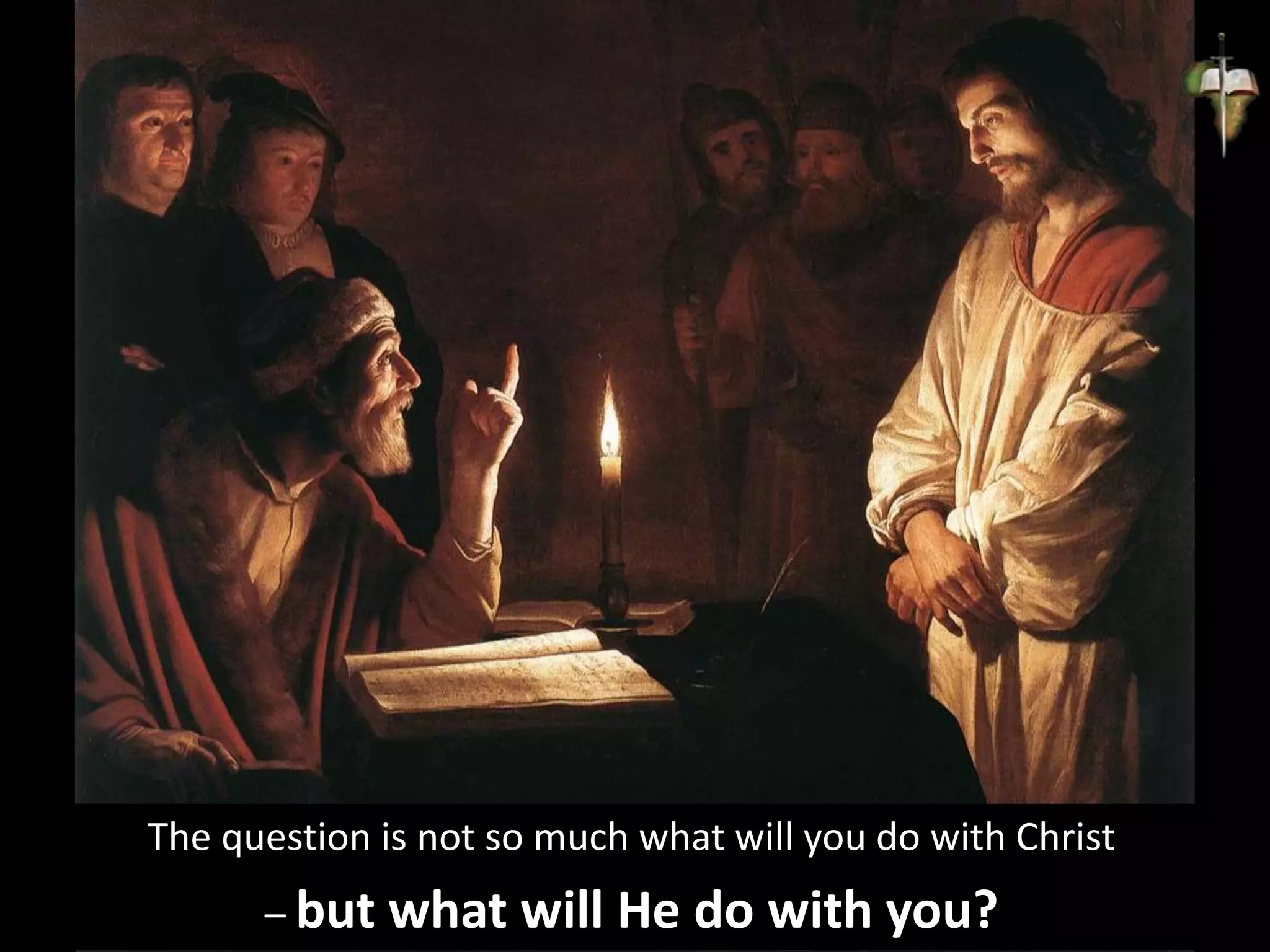
The question is not so much what will you do with Christ
– but what will He do with you?
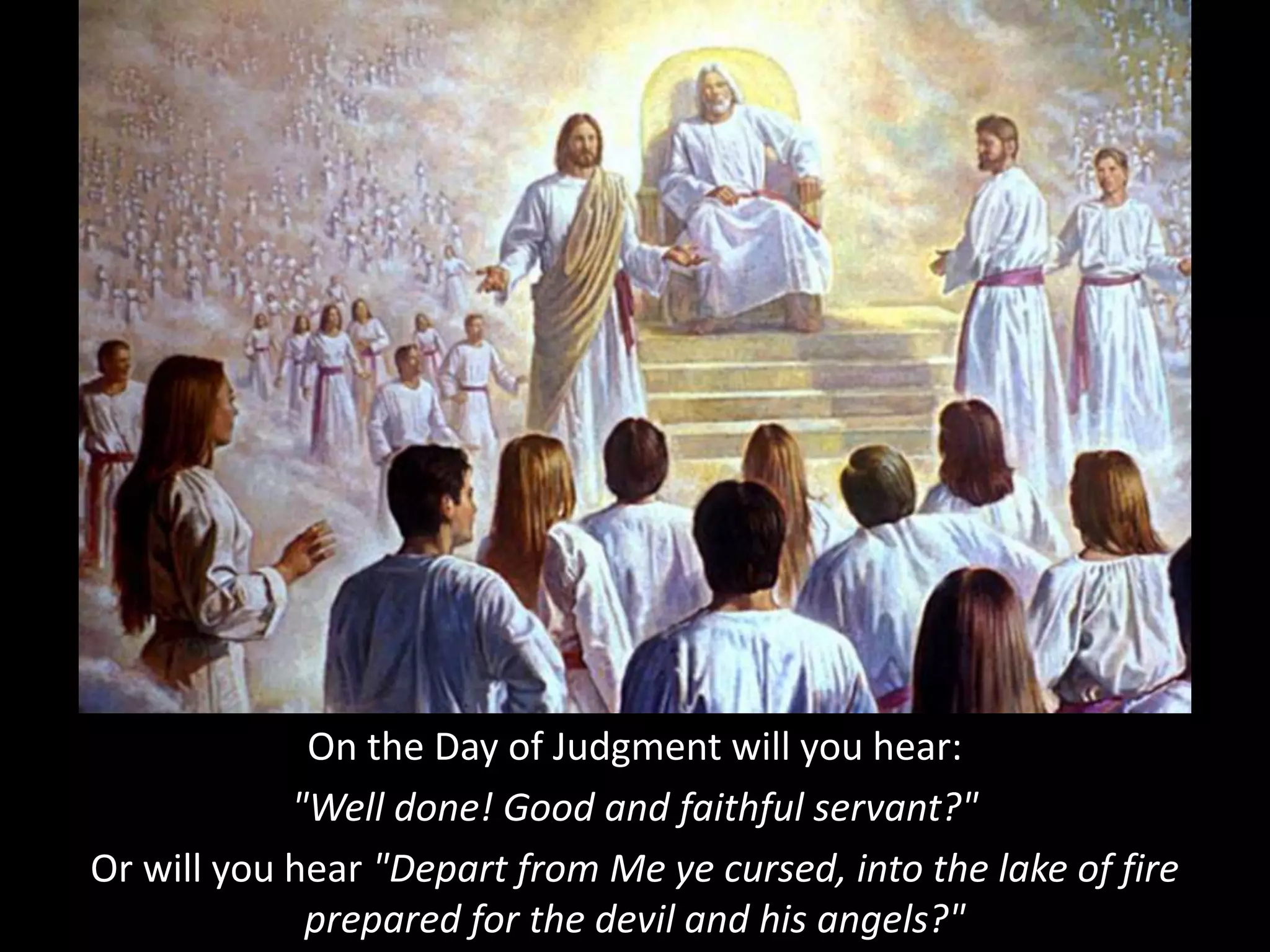
On the Day of Judgment will you hear:
"Well done! Good and faithful servant?"
Or will you hear "Depart from Me ye cursed, into the lake of fire
prepared for the devil and his angels?"
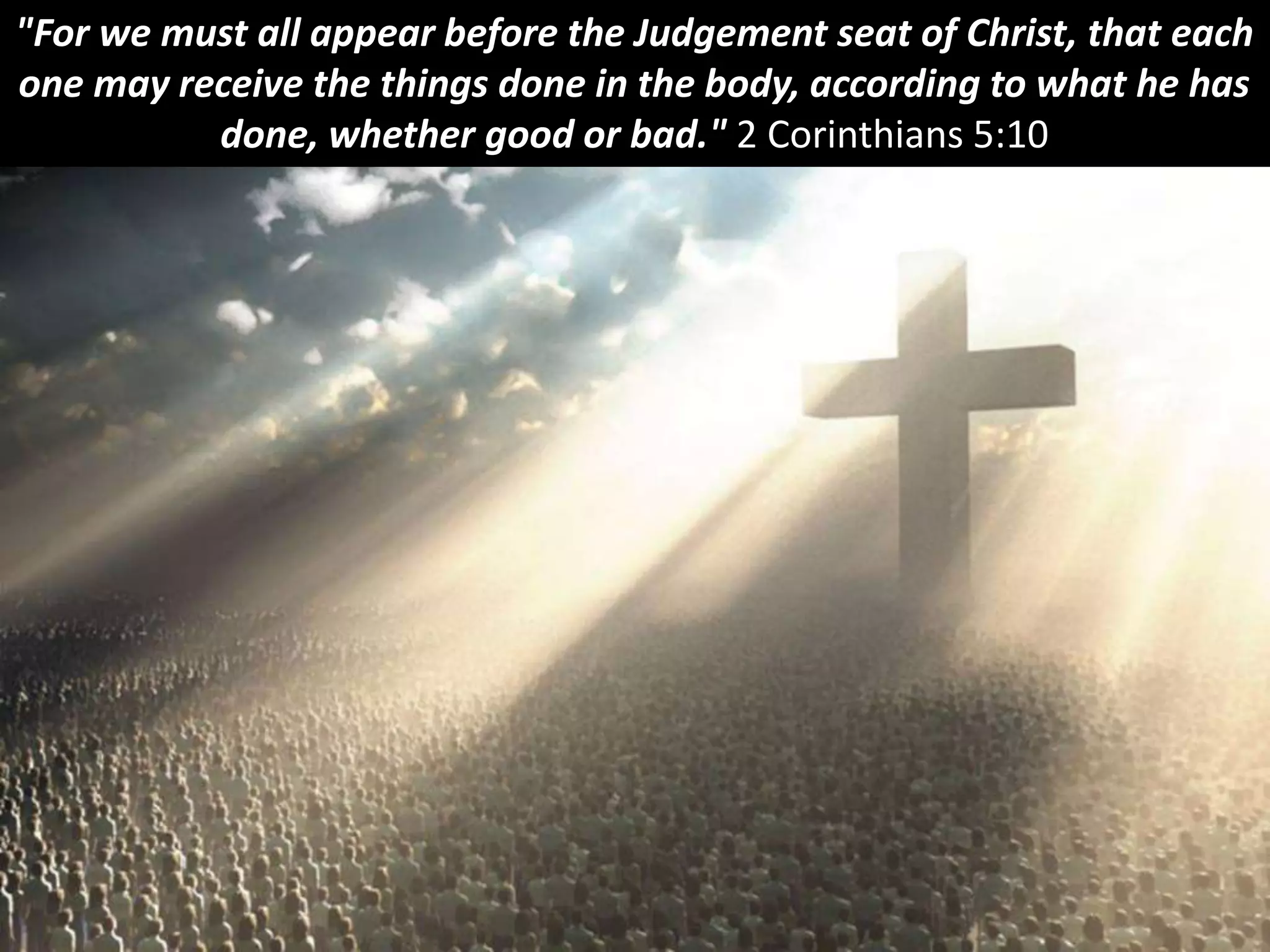
"For we must all appear before the Judgement seat of Christ, that each
one may receive the things done in the body, according to what he has
done, whether good or bad." 2 Corinthians 5:10
A presentation by Dr. Peter Hammond
During each Easter season, as we are reminded again of the sufferings
of Christ on the Cross, we need to consider the question:
Who is responsible for the sufferings of Christ?
As we read the Gospel narratives,
or as we see the crucifixion of our Saviour depicted
by The Passion of the Christ film,
we have to ask the question:
Who killed Jesus?
Do we blame the Roman soldiers?
Certainly they crucified Him.
Surely though it was the Roman governor, Pontius Pilate, who was
responsible? He alone had the power to enforce the death penalty,
it was he who, as a magistrate of the Roman Empire, declared:
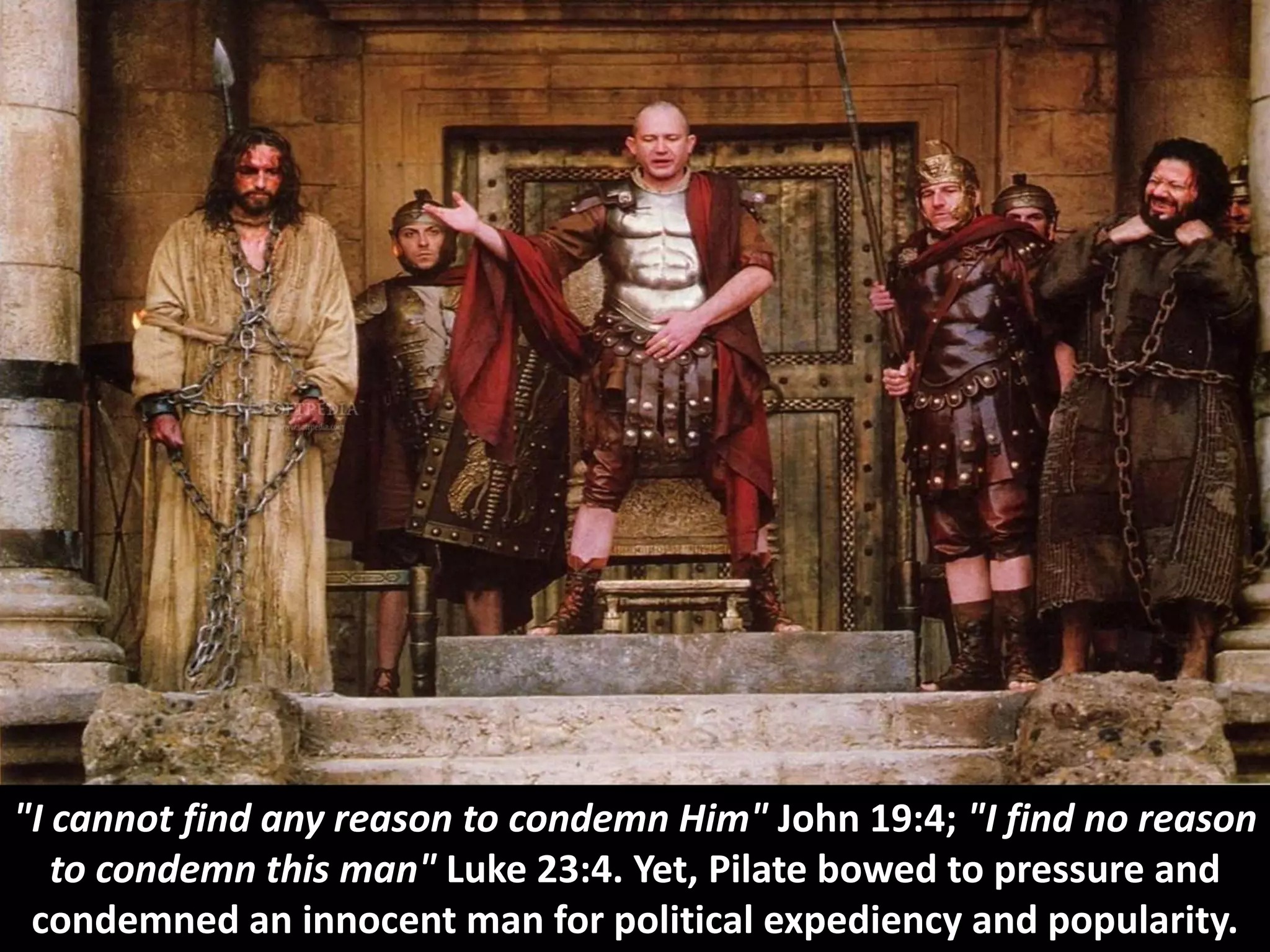
"I cannot find any reason to condemn Him" John 19:4; "I find no reason
to condemn this man" Luke 23:4. Yet, Pilate bowed to pressure and
condemned an innocent man for political expediency and popularity.
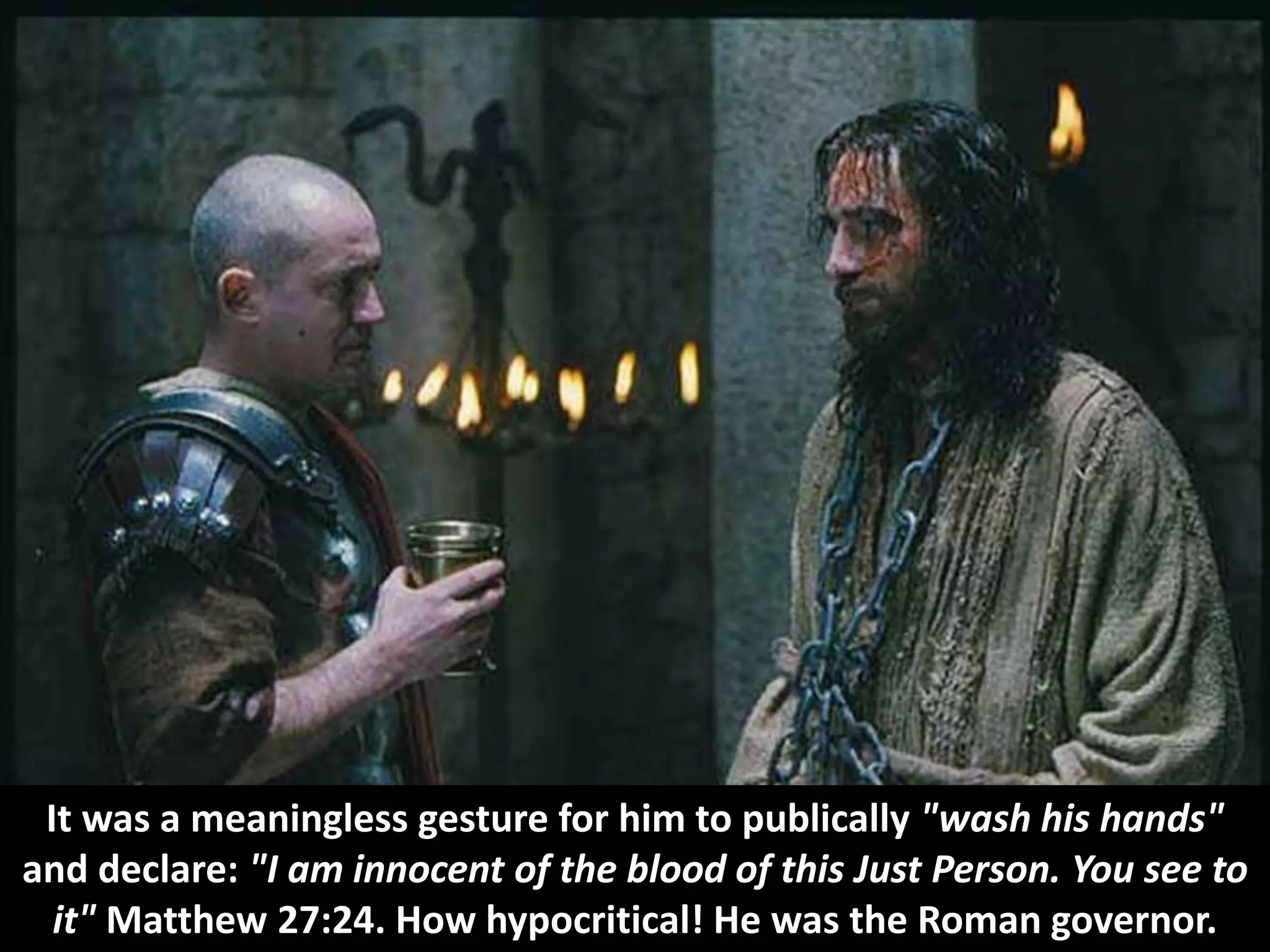
It was a meaningless gesture for him to publically "wash his hands"
and declare: "I am innocent of the blood of this Just Person. You see to
it" Matthew 27:24. How hypocritical! He was the Roman governor.
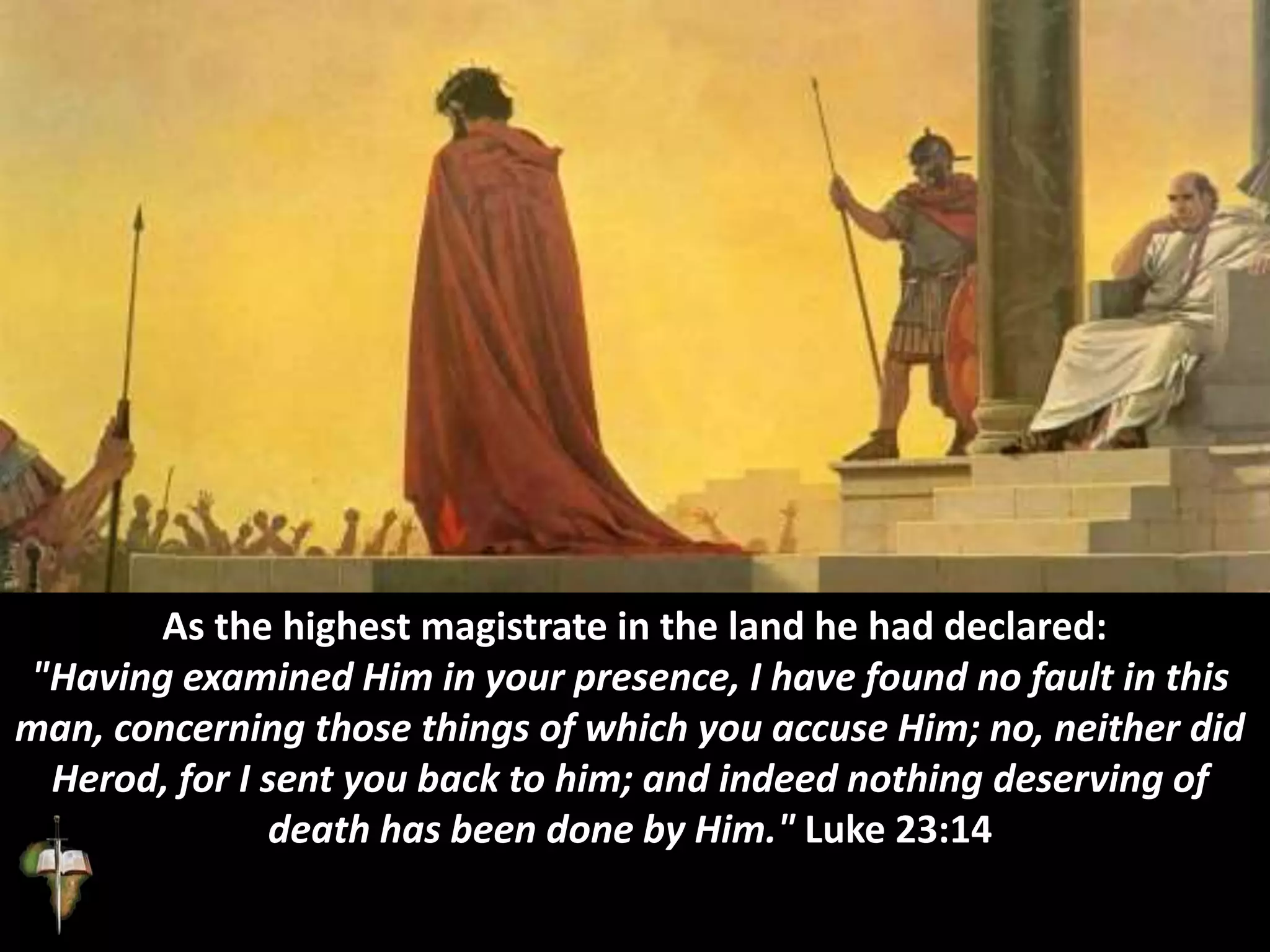
As the highest magistrate in the land he had declared:
"Having examined Him in your presence, I have found no fault in this
man, concerning those things of which you accuse Him; no, neither did
Herod, for I sent you back to him; and indeed nothing deserving of
death has been done by Him." Luke 23:14
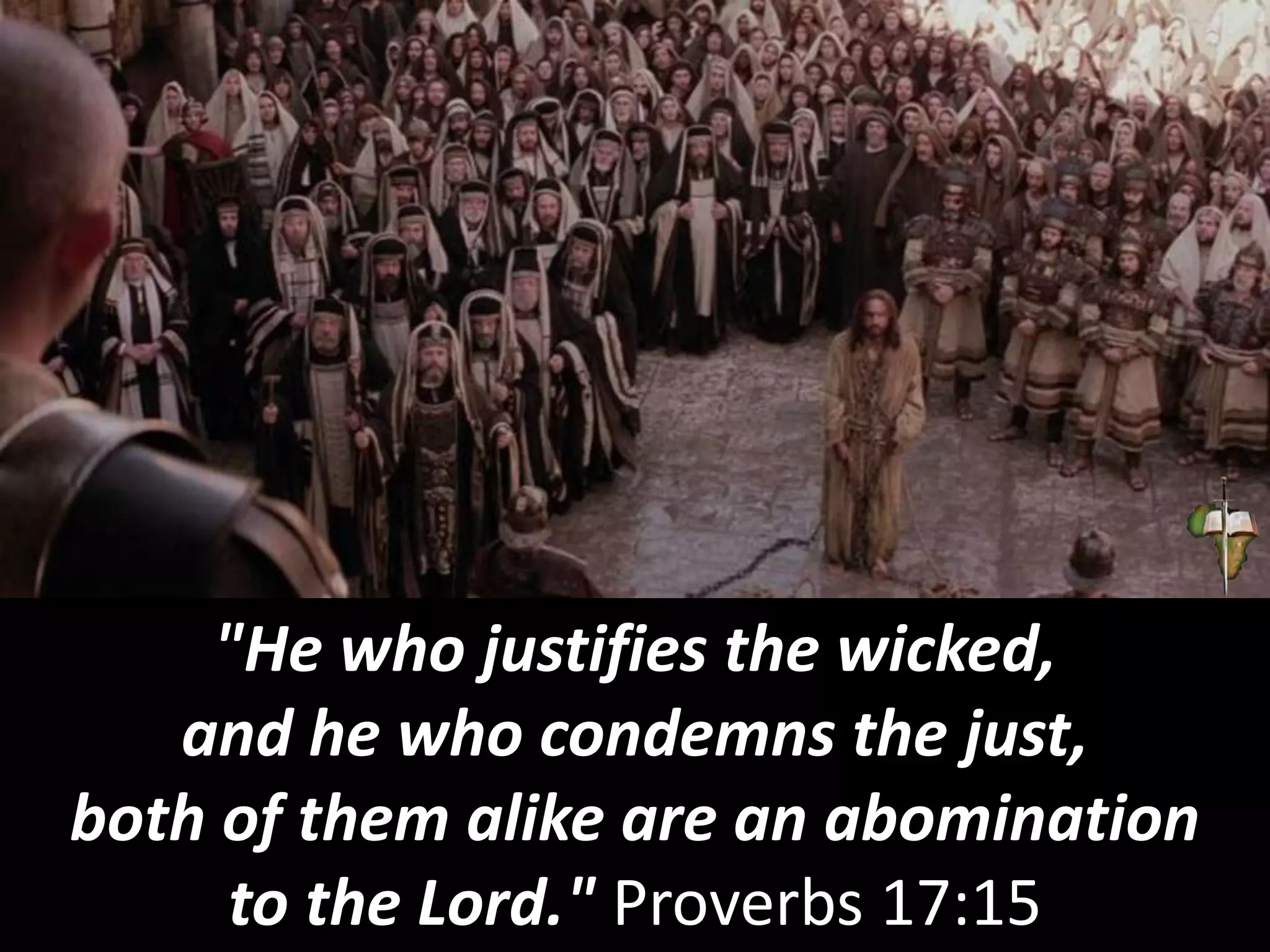
"He who justifies the wicked,
and he who condemns the just,
both of them alike are an abomination
to the Lord." Proverbs 17:15
But what about the mob of
people in the streets?
They were the ones who
pressured Pontius Pilate to
condemn the Lord to death.
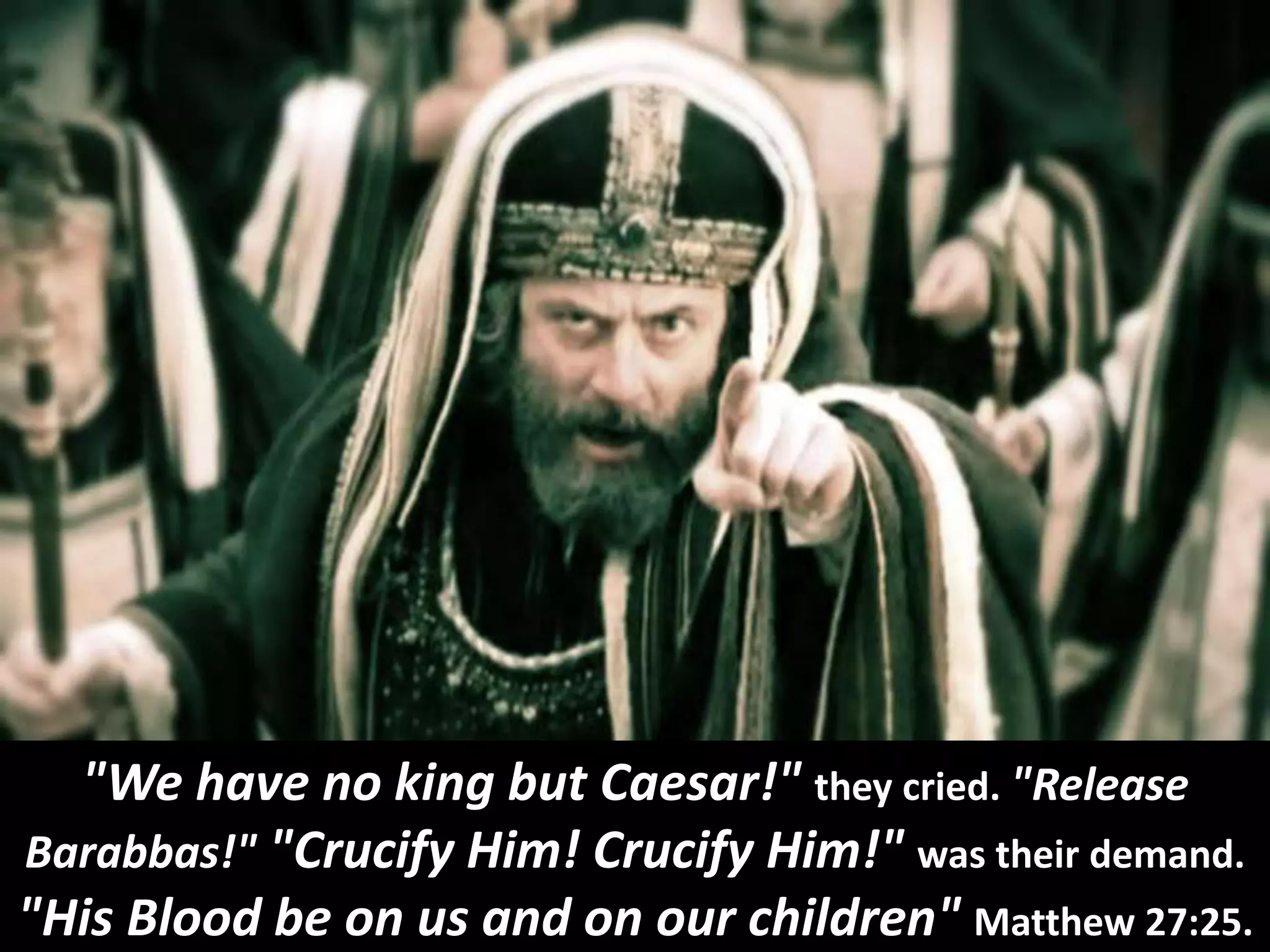
"We have no king but Caesar!" they cried. "Release
Barabbas!" "Crucify Him! Crucify Him!" was their demand.
"His Blood be on us and on our children" Matthew 27:25.
However, it was the Jewish religious leaders
who initiated the arrest and trial of Jesus.
It was the religious leaders who incited the mob to scream
for Barabbas to be released and Christ to be crucified.
(Matthew 26:3-4; Luke 22:3-4; John 7:32).
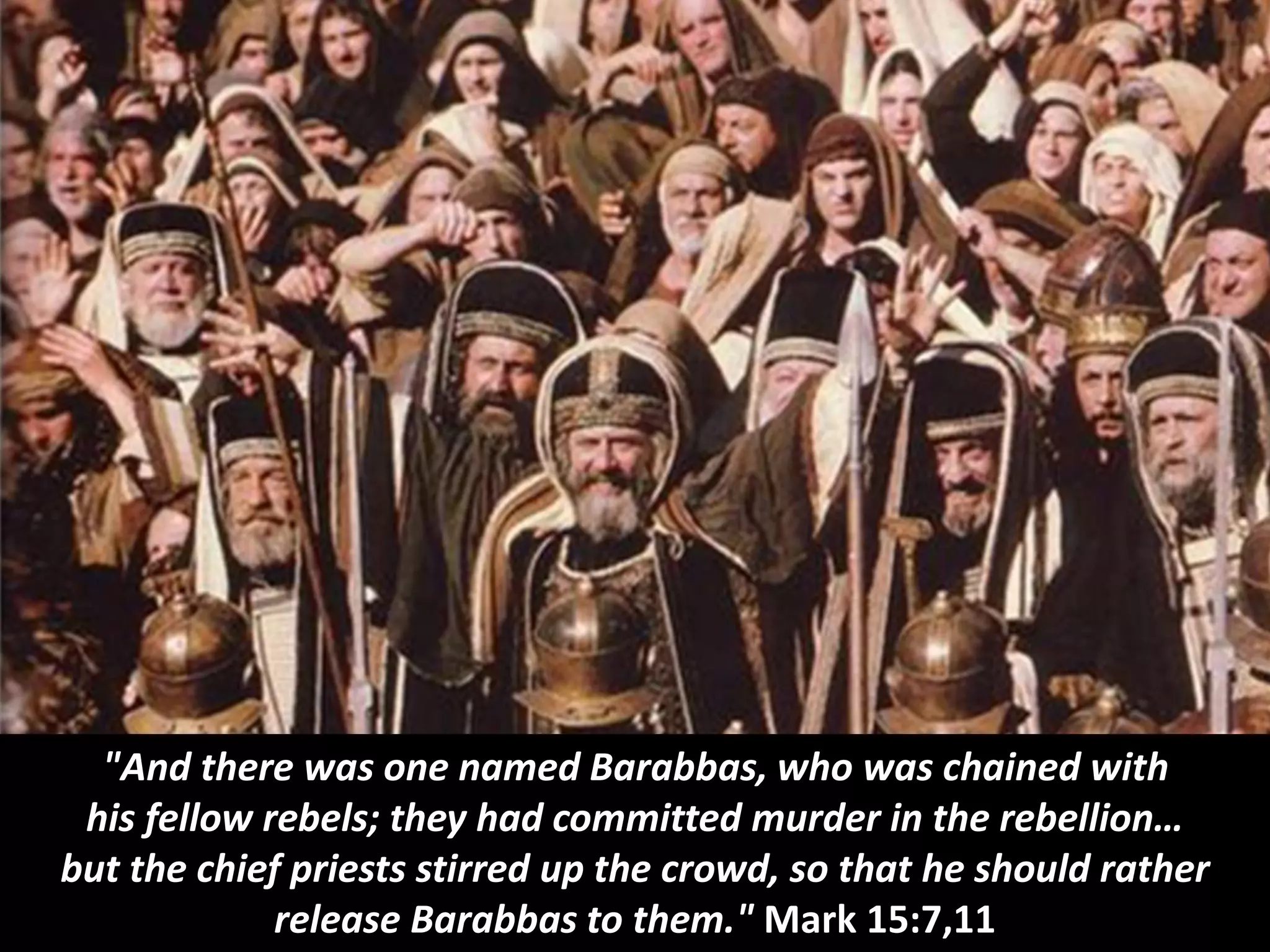
"And there was one named Barabbas, who was chained with
his fellow rebels; they had committed murder in the rebellion…
but the chief priests stirred up the crowd, so that he should rather
release Barabbas to them." Mark 15:7,11
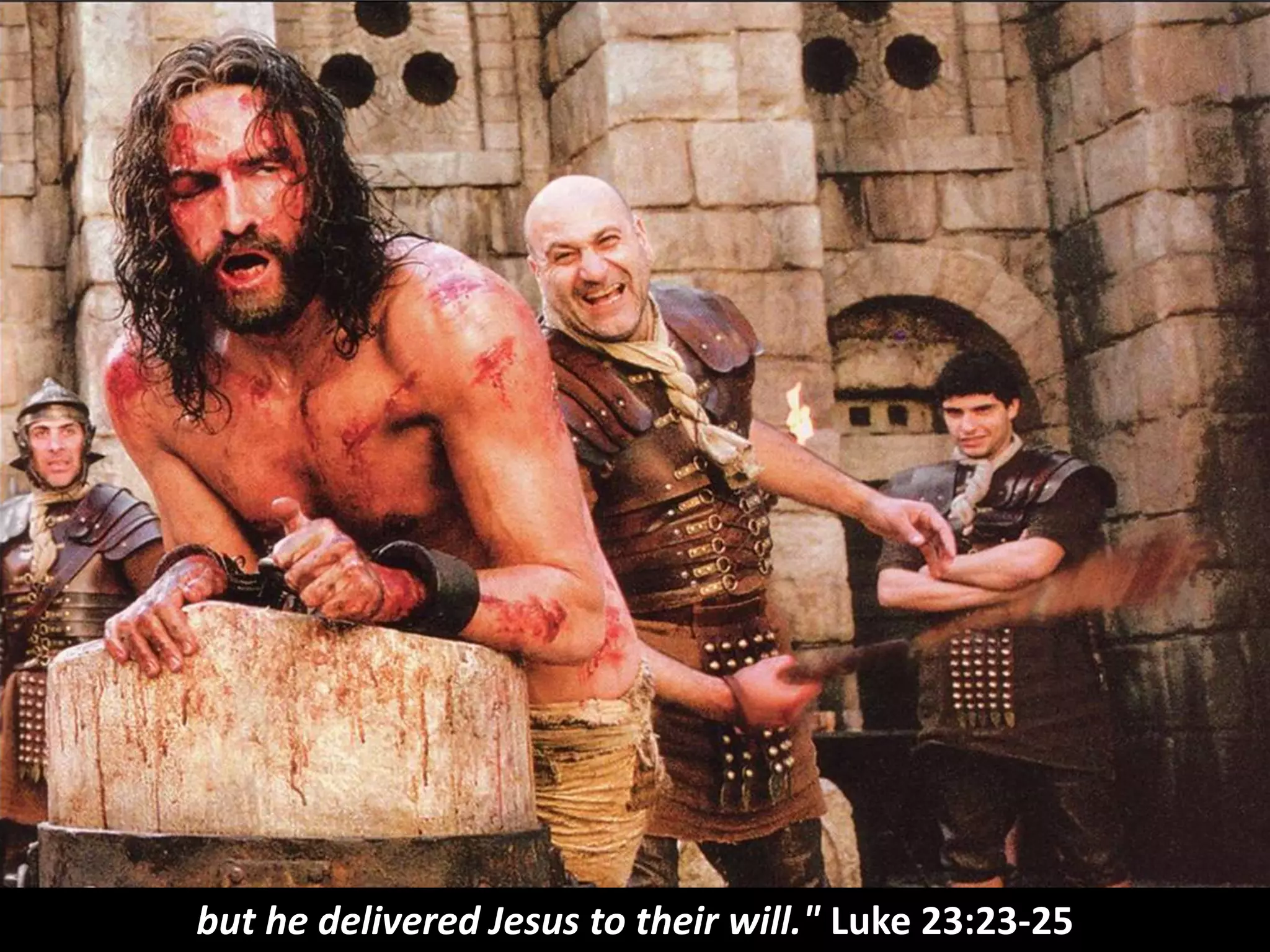
"They were insistent, demanding with loud voices that He be crucified.
And the voices of these men and of the chief priests prevailed.
So Pilate gave sentence that it should be as they requested.
And he released to them the one they requested,
who for rebellion and murder had been thrown into prison;
but he delivered Jesus to their will." Luke 23:23-25
"You shall
not follow
a crowd to
do evil;
nor shall you
testify
in a dispute
so as to
turn aside
many to
pervert
justice."
Exodus 23:2
Of course,
it was
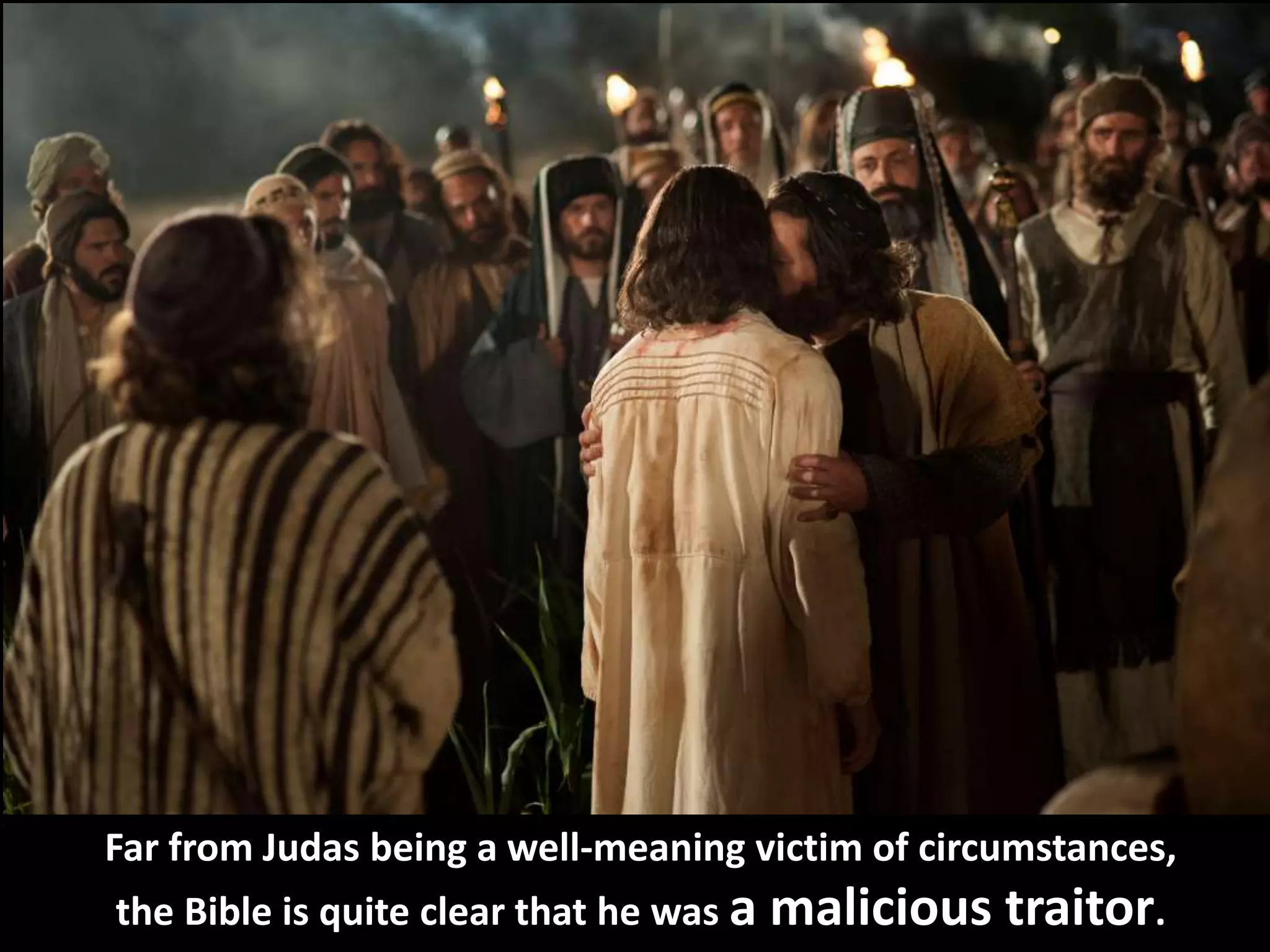
Judas
who
betrayed
Christ - for
mere silver.
Judas was
one of the
Lord's
trusted
twelve
disciples, the
treasurer,
but he
became a
traitor.
It has been common for Hollywood productions to deal very
sympathetically with Judas, but the Bible is clear that Judas was
greedy (Matthew 26:14-15); treacherous (Luke 22:47-48);
dishonest and hypocritical (John 12:5-6).
The Bible states
it clearly that
Judas Iscariot
betrayed Christ
(Matthew 10:4).
The Apostle
became an
Apostate.
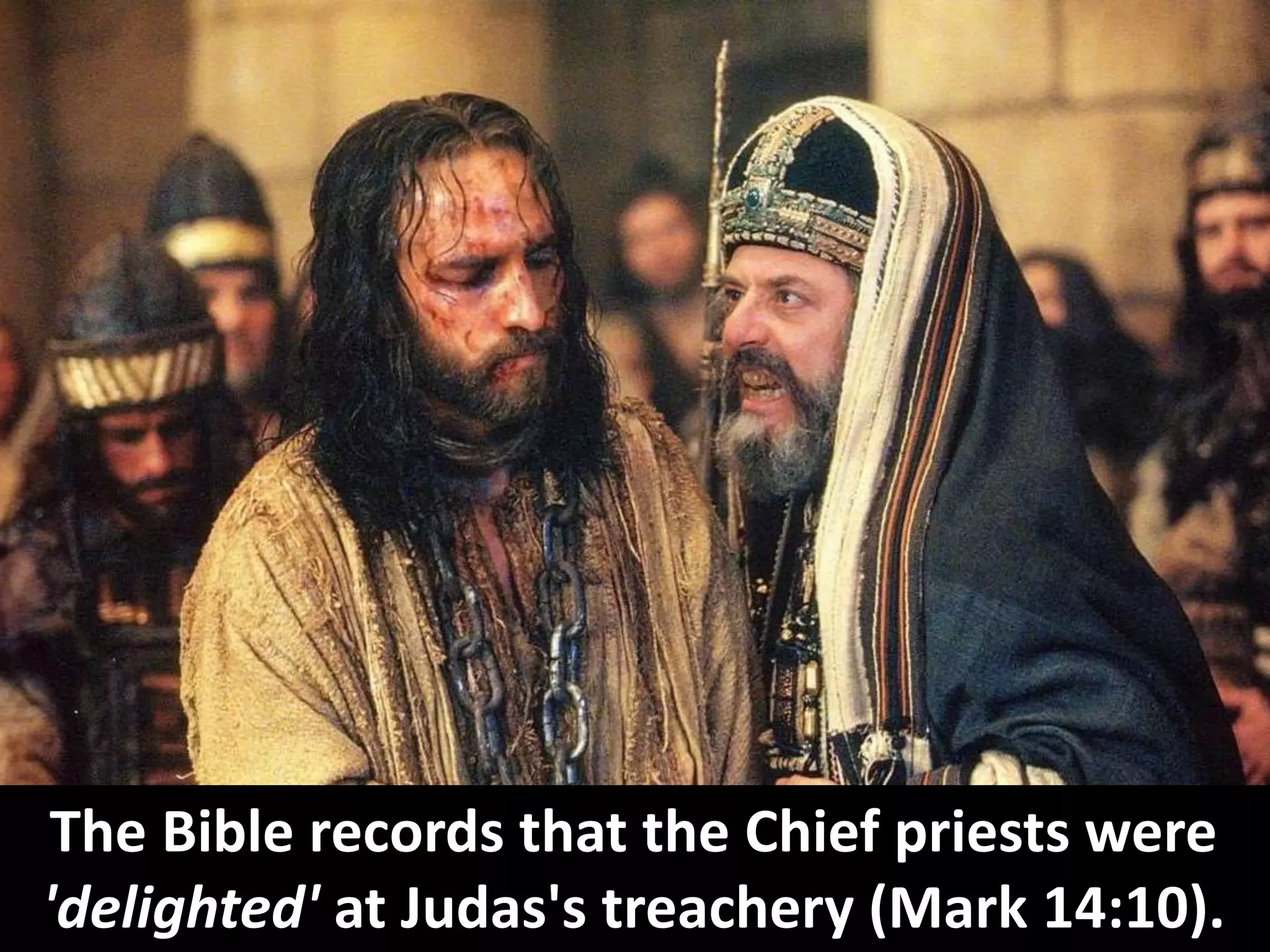
Judas asked the Chief priests: "What are you willing to give me
if I hand Him over to you?" Matthew 26:14.
The Bible records that the Chief priests were
'delighted' at Judas's treachery (Mark 14:10).
Although Judas was
the treasurer
of the Twelve,
and feigned concern
for the poor,
the Bible reveals
that, in fact,
Judas was a thief,
stealing from the
funds of the Lord
Himself
(John 12:4-6).
Far from Judas being a well-meaning victim of circumstances,
the Bible is quite clear that he was a malicious traitor.
John's Gospel plainly states:
"Then satan
entered into Judas"
John 13:27.
Jesus was betrayed by Judas.
Yet, was it not
God's will that
Christ suffer and
die on the Cross?
In the garden of
Gethsemane,
Jesus prayed:
"Father, if it is
Your will, take
this cup away
from Me;
nevertheless, not
My will, but
Yours,
be done."
Luke 22:42
However, we also need to ask whether it was not the Lord Jesus Christ
Himself, who was responsible for His own death.
As our Lord declared: "I lay down My life for the sheep… I lay down
My life… no one takes it from Me, but I lay it down of Myself…“
John 10:15-18.
Our Lord Jesus was not a victim, or a martyr,
He was a willing sacrifice - an Atonement
- for our sins.
At Calvary's Cross, mankind's sin resulted in the murder of the most
innocent victim of all time: God's own Son, Jesus Christ.
He willingly
submitted and
became a victim of
this heinous
violation of justice,
so that we
– the very people
responsible for His
suffering and death
– might in turn find
life and joy
forever.
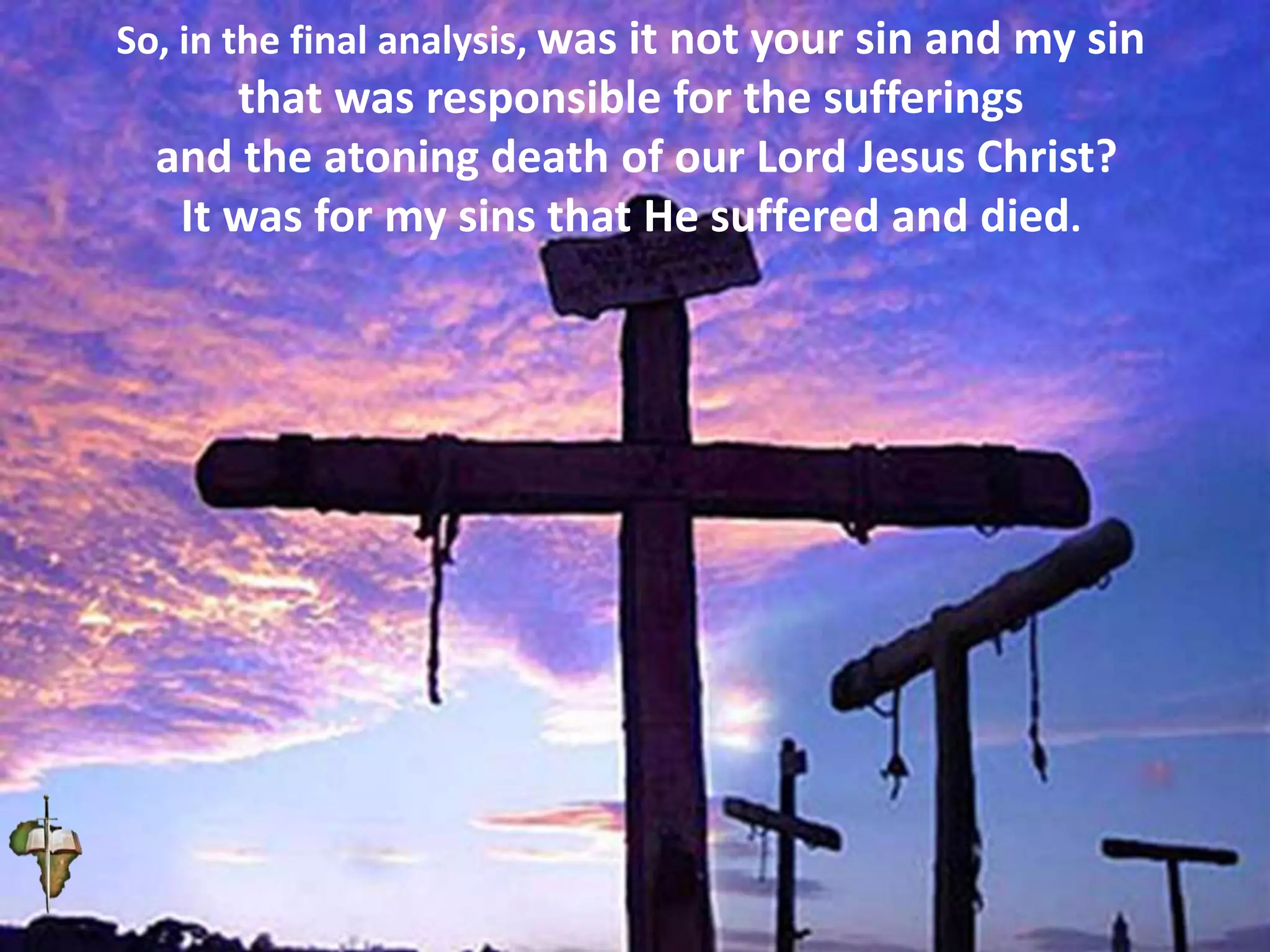
So, in the final analysis, was it not your sin and my sin
that was responsible for the sufferings
and the atoning death of our Lord Jesus Christ?
It was for my sins that He suffered and died.
"But He was wounded
for our transgressions,
He was bruised
for our iniquity;
the chastisement
for our peace
was upon Him,
and by His stripes
we are healed.
All we like sheep
have gone astray;
we have turned,
everyone,
to his own way;
and the Lord
has laid on Him
the iniquity of us all.
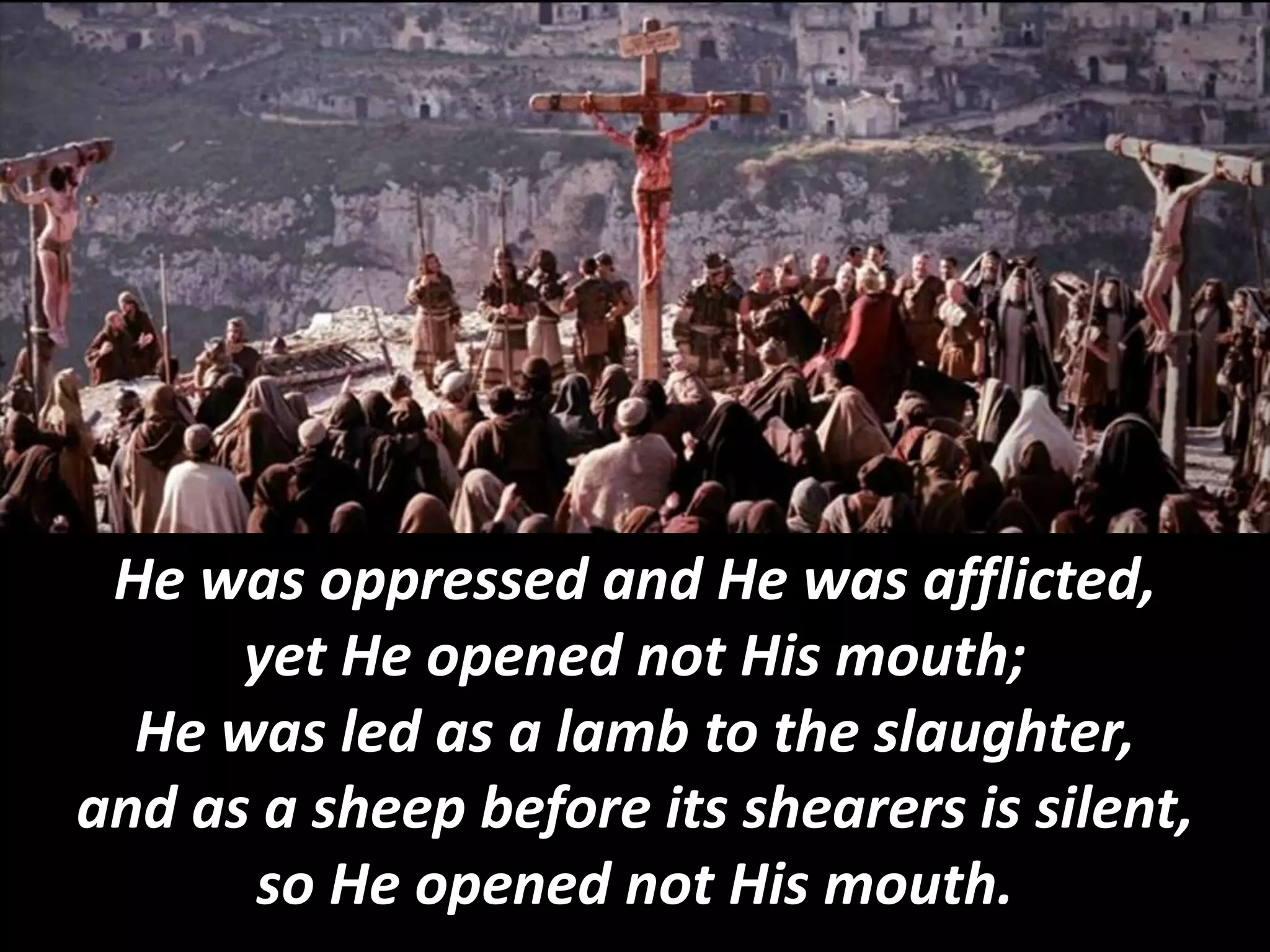
He was oppressed and He was afflicted,
yet He opened not His mouth;
He was led as a lamb to the slaughter,
and as a sheep before its shearers is silent,
so He opened not His mouth.
He was taken from prison
and from judgment,
but who will declare
His generation?
For He was cut off from
the land of the living;
for the transgression
of my people
He was stricken…
and He bore the sin
of many,
and made intercession
for the transgressors."
Isaiah 53:5-12
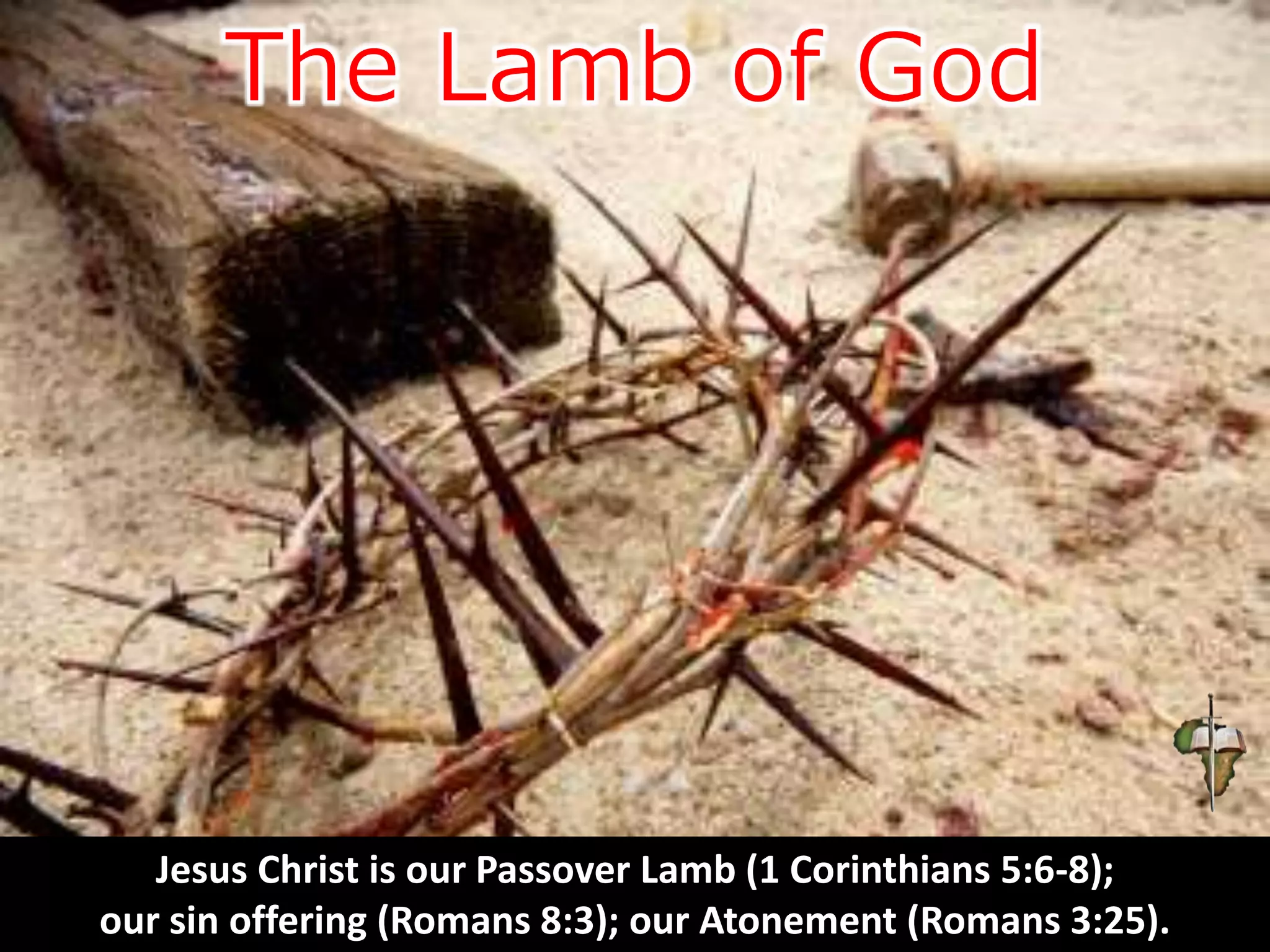
Jesus Christ is our Passover Lamb (1 Corinthians 5:6-8);
our sin offering (Romans 8:3); our Atonement (Romans 3:25).
When Christ,
the perfect Son of God,
a Lamb without spot
or blemish
(1 Peter 1:19)
shed His precious Blood
on the Cross
it was
a substitutionary death.
He died for us,
in our place
(1 Peter 3:18),
the Innocent
for the guilty,
the Just
in the place
of the unjust.
He became like us
- that we might
become like Him.
He was rejected
- that we might be
accepted.
He was condemned
- that we might be
forgiven.
He was punished
- that we might be pardoned.
He suffered
- that we might be
strengthened.
He was whipped
- that we might healed.
He was hated
- that we might be loved.
He was crucified - that we might be justified.
He was tortured - that we might be comforted.
He died - that we might live.
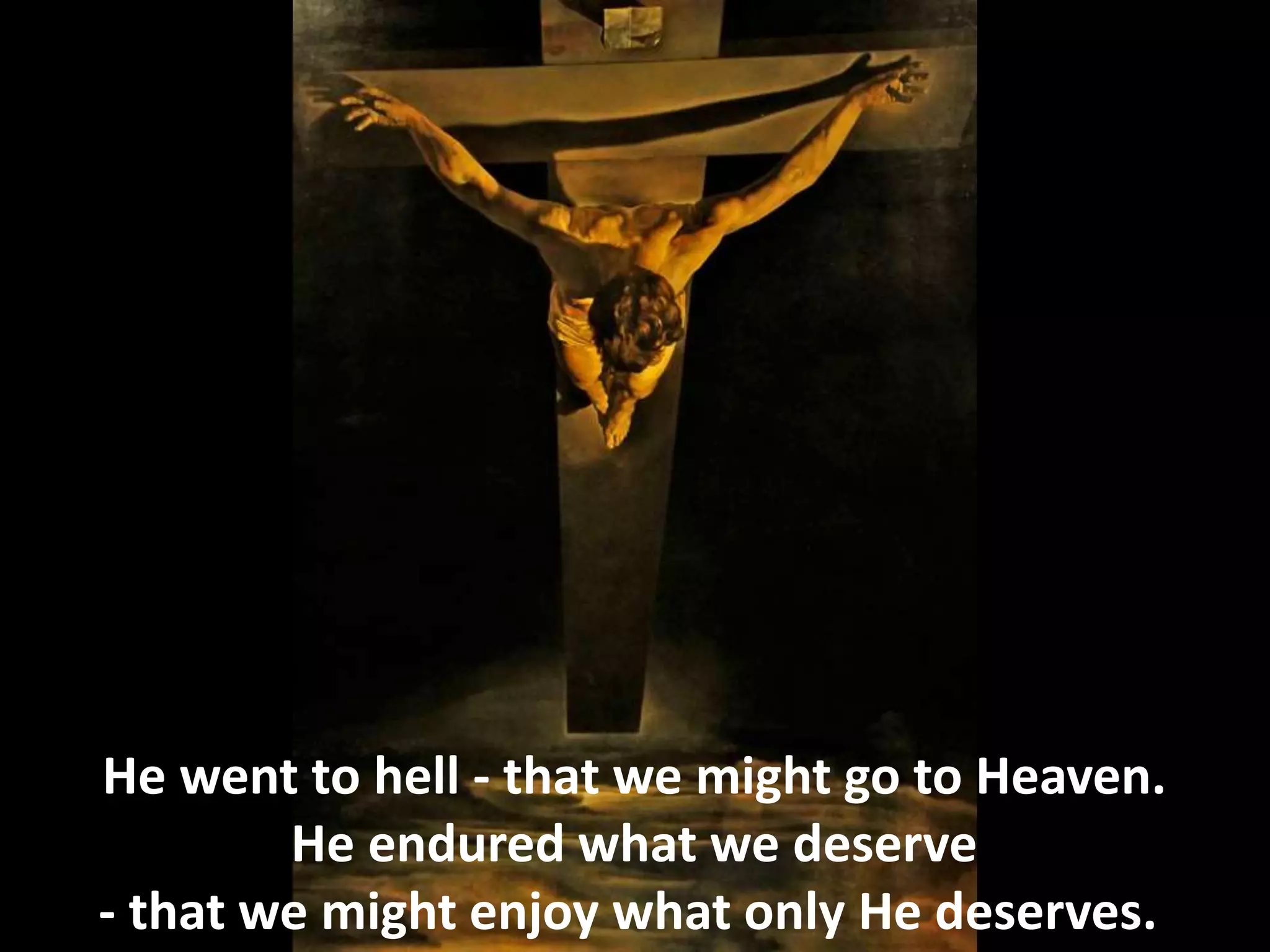
He went to hell - that we might go to Heaven.
He endured what we deserve
- that we might enjoy what only He deserves.
"In this is love, not that we love God,
but that He loved us
and sent His Son
to be the propitiation for our sins."
1 John 4:10
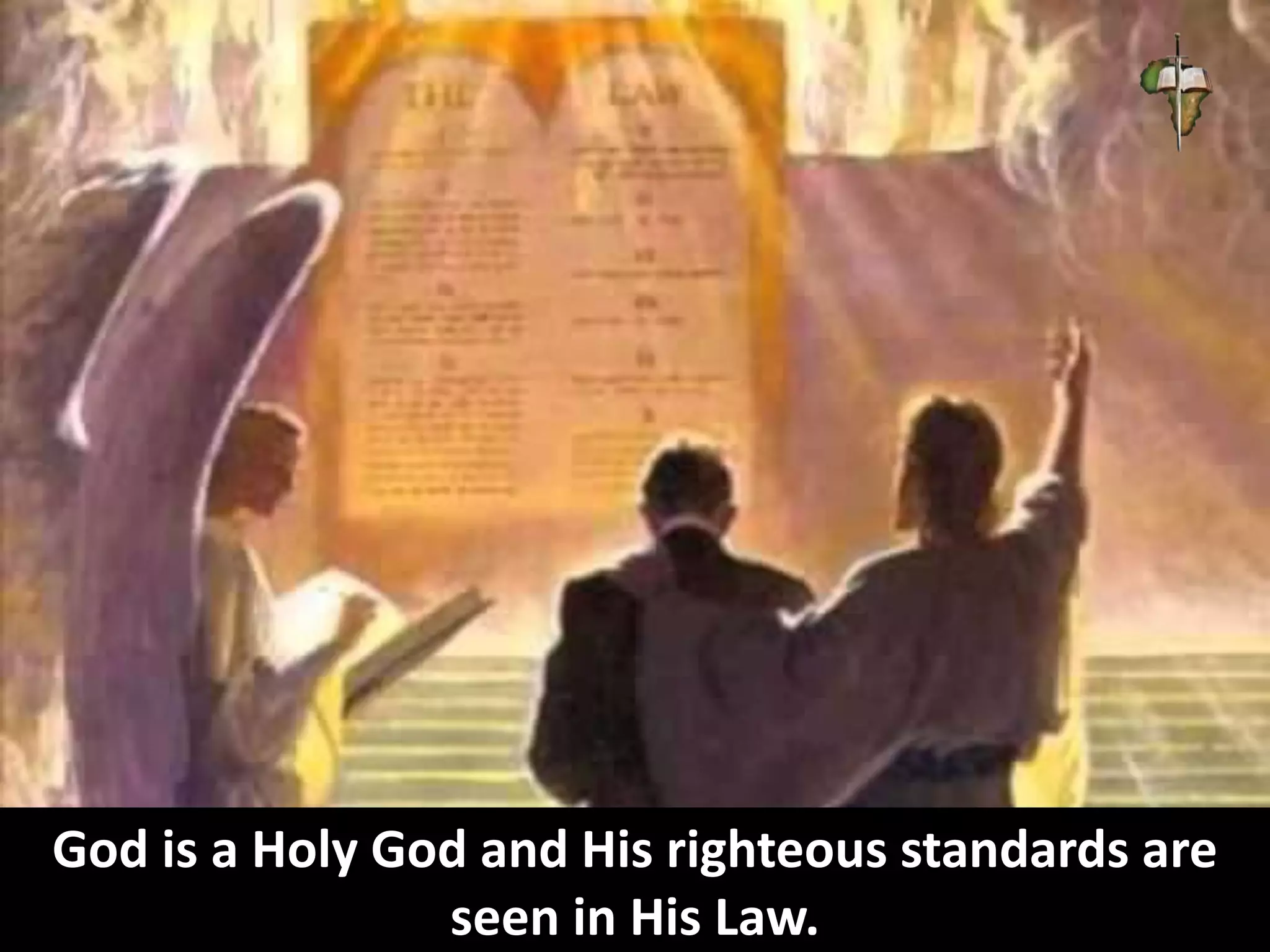
God is a Holy God and His righteous standards are
seen in His Law.
We are sinful
and need to
repent from
our wickedness
and place our
trust in Christ.
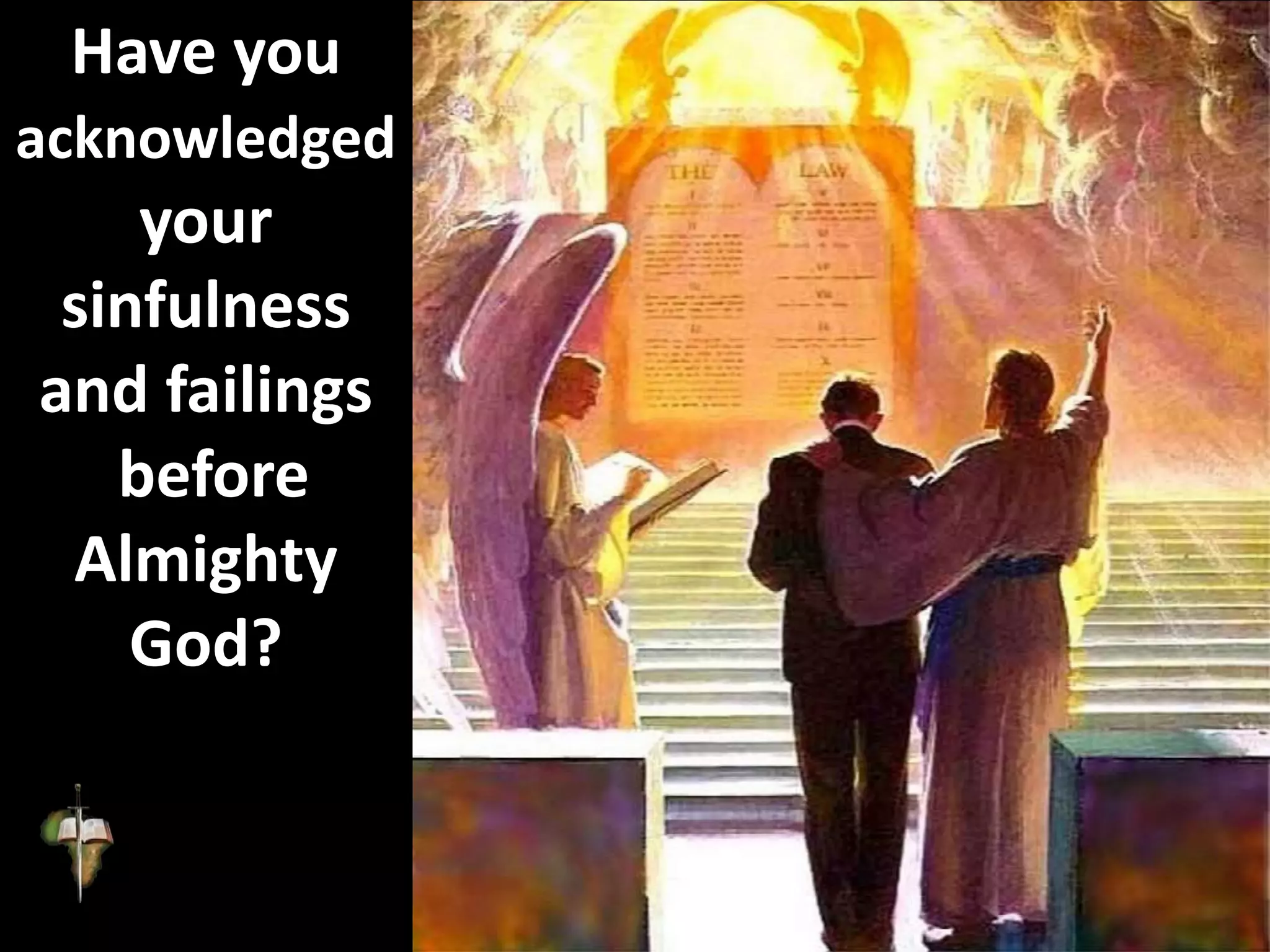
Have you
acknowledged
your
sinfulness
and failings
before
Almighty
God?
Have you repented of your complicity in the death of our
Lord Jesus Christ?
Have you found life in Christ?
Are you pointing people to the Saviour each day?
Have you
thanked Him for
dying on the Cross
for your sins?
Jesus died for you.
Are you living
for Him?
Photo Album
by Joshua
www.FrontlineMissionSA.org
TRUST AND OBEY
When we walk with the Lord
in the light of His Word,
What a glory He sheds on our way!
While we do His good will,
He abides with us still,
and with all who will trust and obey.
Chorus:
Trust and obey, for there’s no other way
To be happy in Jesus, but to trust and obey.
Not a shadow can rise,
not a cloud in the skies,
But His smile quickly drives it away;
Not a doubt or a fear,
not a sigh or a tear,
Can abide while we trust and obey.
Chorus:
Trust and obey, for there’s no other way
To be happy in Jesus, but to trust and obey.
Not a burden we bear,
not a sorrow we share,
But our toil He doth richly repay;
Not a grief or a loss,
not a frown or a Cross,
But is blessed if we trust and obey.
Chorus:
Trust and obey, for there’s no other way
To be happy in Jesus, but to trust and obey.
But we never can prove
the delights of His love
Until all on the altar we lay;
For the favour He shows,
for the joy He bestows,
Are for them who will trust and obey.
Chorus:
Trust and obey, for there’s no other way
To be happy in Jesus, but to trust and obey.
Then in fellowship sweet
we will sit at His feet,
Or we’ll walk by His side in the way;
What He says we will do,
where He sends we will go;
Never fear, only trust and obey.
Chorus:
Trust and obey, for there’s no other way
To be happy in Jesus, but to trust and obey.

Christ on Trial

  • 1.
    A presentation byDr. Peter Hammond
  • 3.
    "In this islove, not that we love God, but that He loved us and sent His Son to be the propitiation for our sins." 1 John 4:10
  • 4.
    A presentation byDr. Peter Hammond
  • 5.
    • In thisage of ignorance, confusion and apostasy, many presume to put Christ on trial.
  • 6.
    • How arewe as Christians to respond?
  • 7.
    • How canwe give an effective answer to those who challenge the foundations of the Faith?
  • 8.
    • “But sanctifythe Lord God in your hearts and always be ready to give a defense to everyone who asks you a reason for the hope that is in you, with meekness and fear.” 1 Peter 3:15
  • 9.
    The betrayal, arrest,trial and execution of Jesus of Nazareth was unique. It was not His actions that were in question, but His identity. Unique Identity
  • 10.
    The charge laidagainst Christ by the Jewish Sanhedrin was blasphemy. The testimony on which He was convicted was concerned with His identity as the Messiah.
  • 11.
    The interrogation bythe Roman governor, Pontius Pilate, and the inscription and proclamation placed on His Cross at the execution, dealt with the identity of Christ as the Messiah, the Son of God, the King of kings and Lord of lords.
  • 12.
    The trial ofJesus of Nazareth was completely illegal. At every point it broke the laws of Israel as well as the laws of Rome. It was illegal to conduct a trial at night. The Illegal Trial
  • 13.
    It was also againstthe law to conduct a summary trial without any warning, or opportunity, for the accused to prepare a defense or seek positive character witnesses.
  • 14.
    At any trialthe accused was to be granted an opportunity to prepare a defense and heralds were to be sent out into the area requiring anyone who knew anything positive about the accused to come forward and testify.
  • 15.
    There was noopportunity granted for appeal. There was no delay between the arrest and trial, between the trial and verdict, between the verdict and sentencing, and between the sentencing and execution.
  • 16.
    Within less thana 24 hour period, Jesus was arrested, tried, condemned, sentenced to death and executed. This blatantly violated all due process of law.
  • 17.
    It was obviousthat there was a conspiracy against the accused. In the event of there being evidence of a conspiracy judges were obligated to release the accused. Conspiracy and False Witnesses
  • 18.
    In addition, thetestimony of false witnesses, brought forward by the accusers, contradicted one another.
  • 19.
    The Roman governor,Pontius Pilate, acquitted Christ three times: "I find no fault in Him at all." John 18:38 "… I find no fault in Him." John 19:6 Condemning the Innocent
  • 20.
    “You have broughtthis Man to me as one who misleads the people. And indeed, having examined Him in your presence, I have found no fault in this Man concerning those things of which you accuse Him.
  • 21.
    No, neither didHerod, for I sent you back to him and indeed nothing deserving of death has been done by Him." Luke 23:14-15
  • 22.
    "But they shoutedsaying, 'Crucify Him, crucify Him!' Then he said to them the third time, 'Why, what evil has He done? I have found no reason for death in Him. Trial by Mob
  • 23.
    I will thereforechastise Him and let Him go.' But they were insistent, demanding with loud voices that He be crucified." Luke 23:21-23
  • 24.
    The Lord JesusChrist had also evidently been severely beaten by His captors (Luke 22:63-64). Beaten Before Being Tried
  • 25.
    In the eventof a prisoner having being mistreated in this way, the judge should have been obligated to release the accused.
  • 26.
    How could anyjudge allow someone to be executed whom he had three times declared innocent? Miscarriage of Justice
  • 27.
    And what ameaningless gesture for the governor and magistrate to wash his hands claiming that he was innocent of the blood of a person who was clearly the victim of a conspiracy and who, as a magistrate, he should have protected from the mob.
  • 28.
    "When Pilate sawthat he could not prevail at all, but rather that a tumult was rising, he took water and washed his hands before the multitude saying, 'I am innocent of the blood of this Just Person. Cowardice and Compromise
  • 29.
    You see toit.' And all the people answered and said, 'His blood be on us and on our children.'" Matthew 27:24-25
  • 30.
    The trial ofJesus was a travesty of justice. It is a terrifying thing to be judged by the mob. Can you imagine being judged by your worst enemies? A Travesty of Justice
  • 31.
    However, today, letus call forward some character witnesses to testify of Jesus. Character Witnesses
  • 32.
    Of course, wecould call forth millions of Christians throughout the ages who would eagerly testify to the incomparable goodness and greatness of our Lord and Saviour.
  • 33.
    However, today, wewill call forward only skeptics and many of them enemies of Christ.
  • 34.
    Thomas Paine, who wasan outspoken opponent of Christianity, still admitted in writing: "Jesus Christ was a virtuous and amiable man. Hostile Witnesses for Jesus
  • 35.
    For the moralitythat He preached and practiced was of the most benevolent kind;
  • 36.
    and while similarsystems of morality had been preached by Confucius, and by some of the Greek philosophers… ;
  • 37.
    by the Quakerssince, and by good men of all ages, it has not been exceeded by any."
  • 38.
    The first centuryJewish historian, Josephus Ben Mattathias, the author of The Antiquities of the Jews, wrote: "Now there was about this time Jesus, a wise man, if it be lawful to call Him a man, for He was a doer of wonderful works, a Teacher of such men as receive the truth with pleasure. The Christ
  • 39.
    He drew overto Him both many of the Jews and many of the Gentiles. He was the Christ and when Pilate at the suggestion of the principal men among us,
  • 40.
    had condemned Him tothe Cross, those who loved Him at the first, did not forsake Him;
  • 41.
    for He appearedto them alive again the third day, as the divine prophets had foretold these and ten thousand wonderful things concerning Him. And the tribe of Christians, so named from Him, are not extinct to this day." (Antiquities XVIII, 33)
  • 42.
    William H. Leckywas one of the leading historians of the 19th century and the author of The History of the Rise and Influence of the Spirit of Rationalism in Europe. The Greatest Example and Inspiration
  • 43.
    Lecky spent hislife advancing the cause of Rationalism, attacking Christianity and the supernatural.
  • 44.
    Yet, he admitted:"It was reserved for Christianity to present to the world an ideal Character, which through all the changes of 18 centuries has inspired the hearts of men with an impassioned love,
  • 45.
    has shown itselfcapable of acting on all ages, nations, temperaments, and conditions and has been not only the highest pattern of virtue, but also the strongest incentive to its practice,
  • 46.
    and has exercisedso deep an influence that it may truly be said that the simple record of three short years of active life has done more to regenerate and soften mankind than all of the dispositions of philosophers and exhortations of moralists."
  • 47.
    John Stewart Millwas perhaps the most influential and respected economist of the 18th century. Pre-Eminent
  • 48.
    He often spokeout against Christianity, yet he had to acknowledge: "Christ is still left - a unique figure, - not more unlike all of His percusses than all his followers.
  • 49.
    Even those whohad the direct benefit of His personal teaching. It is of no use to say that Christ, as exhibited in the Gospel, is not historical in that we know not how much of what is admirable has been added by the tradition of His followers
  • 50.
    …who among Hisdisciples, or among their proselytes, was capable of inventing the sayings attributed to Jesus, or of imagining the life and character revealed in the Gospels? Certainly not the fishermen of Galilee.
  • 51.
    …When this pre-eminent Genius iscombined with the qualities of probably the greatest moral Reformer and Martyr to that mission who has ever existed on earth,
  • 52.
    religion cannot besaid to have made a bad choice in pitching on this Man as the ideal Representative and guide of humanity; nor even now would it be easy, even for an unbeliever,
  • 53.
    to find abetter translation of the rule of virtue from the abstract into the concrete then to endeavour to so live that Christ would approve our life."
  • 54.
    Even as determinedan enemy of Christianity as Charles Darwin who popularized the theory of evolution had to concede, in an article written for a newspaper in London: Recognising Reality
  • 55.
    "They forget, orwill not remember, those who minimize the work of missionaries in pagan countries. They forget, or will not remember, that human sacrifices and the power of an idolatrous priesthood;
  • 56.
    a system ofprofligacy unparalleled in another part of the world; infanticide, a consequence of that system; bloody wars where conquerors spared neither women nor children - that all of these have been abolished in these savage islands.
  • 57.
    And that dishonestyand intemperance and licentiousness have been greatly reduced by Christianity. In a voyager, to forget these things is base ingratitude.
  • 58.
    For should hechance to be at the point of shipwreck on some unknown coast, he will most devoutly pray that the lesson of the missionary may have reached thus far!"
  • 59.
    On another occasion, Darwinwrote: "The lesson of the missionary is the enchanter's wand. The house has been built, the windows framed, the fields ploughed and even the trees grafted by the New Zealander. Civilising
  • 60.
    The march ofimprovement, consequent on the introduction of Christianity throughout the seas probably stands by itself in the records of history."
  • 61.
    Another hostile witnessthat could be brought to testify of the uniqueness of Christ was Darwin's bulldog, Thomas Huxley. Irreplaceable
  • 62.
    It was Huxleywho first coined the word agnostic, which is what he claimed to be. Huxley did more than any other to popularize the theories of Darwinism.
  • 63.
    Huxley was steadfastly opposedto almost every aspect of Christianity. Yet, in 1870, he wrote for The Contemporary Review: "I have always been strongly in favour of secular education, in the sense of education without Theology.
  • 64.
    But, I mustconfess that I have been no less seriously perplexed to know by what practical measures the religious feeling, which is the essential basis of conduct, was to be kept up in the presently utterly chaotic state of opinion on these matters - without the use of the Bible.
  • 65.
    The pagan moralistslack life and colour. Take the Bible as a whole, make the severest deductions which criticisms can dictate and there still remains a vast residuum of moral beauty and grandeur.
  • 66.
    By the studyof what other book could children be so much humanized and made to feel that each figure in that vast historical procession fills, like themselves,
  • 67.
    but a momentaryspace and interval between two eternities and earns the blessings, or curses, of all time, according to its efforts to do good and evil?"
  • 68.
    When a fellowagnostic philosopher critisised the Bible, Huxley rebuked the man for putting on display his "conceited ignorance." Conceited Ignorance
  • 69.
    Huxley even hadto go further in admitting: "The Bible has been the Magna Carta of the poor and the oppressed down to modern times. Indispensable
  • 70.
    No state hashad a constitution in which the interests of the people are so largely taken into account, in which the duties so much more than the privileges of rulers are insisted upon, as that drawn up for Israel.
  • 71.
    Nowhere is thefundamental truth that the welfare of the state, in the long run, depends upon the uprightness of the citizen so strongly laid down.
  • 72.
    I do notbelieve that the human race is yet, and possibly never will be, in a position to dispense with the Bible."
  • 73.
    Another vocal scepticwho can be called upon to testify of Christ was George Romanes. He wrote many articles against Christianity during his lifetime. Immeasurably in Advance
  • 74.
    Yet, in hisbook Thoughts on Religion, Romanes observed: "Not only is Christianity thus so immeasurably in advance of all other religions, it is no less so of every other system of thought that has ever been promulgated in regard to all that is moral and spiritual.
  • 75.
    Whether it betrue or false, it is certain that neither philosophy, science, nor poetry has ever produced results in thought, conduct or beauty in any degree to be compared with it.
  • 76.
    It is thegreatest exhibition of the beautiful, the sublime, and all else that appeals to our spiritual nature which has ever been known upon our earth.
  • 77.
    What has allthe science, or all the philosophy of the world, done for the thought of mankind to be compared to this one Doctrine - God is Love?"
  • 78.
    H.G. Wells whowrote Outlines of History is best known for his science fiction and film making. However, by profession he was an historian. The Dominant Figure in History
  • 79.
    Despite being avery outspoken critic of Christianity, H.G. Wells wrote: "Jesus of Nazareth is easily the dominant figure in history. I am speaking of Him, of course, as a man.
  • 80.
    For I cansee that the historian must treat Him as a man, just as the painter must paint Him as a man.
  • 81.
    To assume thatHe never lived and that the accounts of His life are inventions is more difficult and raises more problems in the path of the historian than to accept the essential elements of the Gospel stories as fact.
  • 82.
    Of course, youand I live in countries where to millions of men and women Jesus is more than a man. But the historian must disregard that fact. He must adhere to the evidence which would pass unchallenged if His book were to be read in every nation under the sun.
  • 83.
    Now, it isinteresting and significant, isn't it, that an historian setting forth in that spirit, without any theological bias whatsoever,
  • 84.
    should find thathe simply cannot portray the progress of humanity honestly without giving the foremost place to a penniless teacher from Nazareth."
  • 85.
    The final hostilewitness which I would like to call to testify of Christ is the brilliant and volatile journalist and writer H.L. Mencken. Mencken dipped his pen in acid whenever it came to writing on Christianity. Unparalleled
  • 86.
    Mencken was thejournalist who transformed the evolutionist's legal defeat in the courtroom at the Scopes trial to a victory in the court of public opinion.
  • 87.
    In his work:Treaties on the gods, Mencken declared: "This historicity of Jesus is no longer questioned seriously by anyone, whether Christian or unbeliever.
  • 88.
    The main factsabout Him seem to be beyond dispute …it is not easy to account for His singular and stupendous success.
  • 89.
    How did it comeabout that one who in His life had only the bitter cup of contumely to drink should have lifted Himself in death to such vast esteem and circumstance, such incomparable and world shaking power and renown?
  • 90.
    …It seems tobe certain that many persons saw Him after His supposed death on the Cross, including not a few who were violently disinclined to believe in His Resurrection.
  • 91.
    Upon that theory,the most civilized sections of the human race have erected a structure and practices so vast in scope and so powerful in effect that the whole range of history shows nothing parallel."
  • 92.
    So, here wehave testimonies of some famous skeptics, some of them Christ's enemies, over almost 2000 years, including: rationalist philosophers, a Jewish historian, some famous evolutionists, A Unanimous Verdict
  • 93.
    a secular humanistjournalist, a world renowned economist, a religious sceptic and a famous science fiction writer and Hollywood director. None of them were Christians. They all rejected Christianity.
  • 94.
    Yet, they allhad to acknowledge that Jesus Christ was the greatest Person to ever walk on earth. His impact on history and the Bible's contribution to life and civilization are incomparable.
  • 95.
    The verdict ofthese skeptics is unanimous. This One who was born in obscurity, who lived in poverty, who died in agony, became the most important and positive influence in the history of the world. No one has influenced the world for the good more than Jesus Christ.
  • 96.
    The chief priestsin the Jewish Sanhedrin conspired against and condemned Christ. Condemning the Eternal Judge
  • 97.
    The Roman governor,Pontius Pilate, acquitted Christ three times, declaring Him not guilty and yet he ordered Him to be whipped and crucified to appease the mob in the streets.
  • 98.
    Pilate then hadthe audacity to wash his hands in public declaring that he was innocent of this Just Man's blood.
  • 99.
    Today many presumeto sit in judgement upon Christ The Day of Judgement Will Come
  • 100.
    But the Daywill come when each one of them, and each one of us, will stand before the Judgment Throne of Jesus Christ to give an account of our lives to Him.
  • 101.
    "It is appointedunto men once to die and after that the Judgement." Hebrews 9:27
  • 102.
    The question isnot so much what you think of Christ – but what does He think of you? Jesus Will Judge You and I
  • 103.
    The question isnot so much what will you do with Christ – but what will He do with you?
  • 104.
    On the Dayof Judgment will you hear: "Well done! Good and faithful servant?" Or will you hear "Depart from Me ye cursed, into the lake of fire prepared for the devil and his angels?"
  • 105.
    "For we mustall appear before the Judgement seat of Christ, that each one may receive the things done in the body, according to what he has done, whether good or bad." 2 Corinthians 5:10
  • 106.
    A presentation byDr. Peter Hammond
  • 107.
    During each Easterseason, as we are reminded again of the sufferings of Christ on the Cross, we need to consider the question: Who is responsible for the sufferings of Christ?
  • 108.
    As we readthe Gospel narratives, or as we see the crucifixion of our Saviour depicted
  • 109.
    by The Passionof the Christ film,
  • 110.
    we have toask the question: Who killed Jesus?
  • 111.
    Do we blamethe Roman soldiers? Certainly they crucified Him.
  • 112.
    Surely though itwas the Roman governor, Pontius Pilate, who was responsible? He alone had the power to enforce the death penalty, it was he who, as a magistrate of the Roman Empire, declared:
  • 113.
    "I cannot findany reason to condemn Him" John 19:4; "I find no reason to condemn this man" Luke 23:4. Yet, Pilate bowed to pressure and condemned an innocent man for political expediency and popularity.
  • 114.
    It was ameaningless gesture for him to publically "wash his hands" and declare: "I am innocent of the blood of this Just Person. You see to it" Matthew 27:24. How hypocritical! He was the Roman governor.
  • 115.
    As the highestmagistrate in the land he had declared: "Having examined Him in your presence, I have found no fault in this man, concerning those things of which you accuse Him; no, neither did Herod, for I sent you back to him; and indeed nothing deserving of death has been done by Him." Luke 23:14
  • 116.
    "He who justifiesthe wicked, and he who condemns the just, both of them alike are an abomination to the Lord." Proverbs 17:15
  • 117.
    But what aboutthe mob of people in the streets? They were the ones who pressured Pontius Pilate to condemn the Lord to death.
  • 118.
    "We have noking but Caesar!" they cried. "Release Barabbas!" "Crucify Him! Crucify Him!" was their demand. "His Blood be on us and on our children" Matthew 27:25.
  • 119.
    However, it wasthe Jewish religious leaders who initiated the arrest and trial of Jesus.
  • 120.
    It was thereligious leaders who incited the mob to scream for Barabbas to be released and Christ to be crucified. (Matthew 26:3-4; Luke 22:3-4; John 7:32).
  • 121.
    "And there wasone named Barabbas, who was chained with his fellow rebels; they had committed murder in the rebellion… but the chief priests stirred up the crowd, so that he should rather release Barabbas to them." Mark 15:7,11
  • 122.
    "They were insistent,demanding with loud voices that He be crucified. And the voices of these men and of the chief priests prevailed. So Pilate gave sentence that it should be as they requested.
  • 123.
    And he releasedto them the one they requested, who for rebellion and murder had been thrown into prison;
  • 124.
    but he deliveredJesus to their will." Luke 23:23-25
  • 125.
    "You shall not follow acrowd to do evil; nor shall you testify in a dispute so as to turn aside many to pervert justice." Exodus 23:2
  • 126.
    Of course, it was Judas who betrayed Christ- for mere silver. Judas was one of the Lord's trusted twelve disciples, the treasurer, but he became a traitor.
  • 127.
    It has beencommon for Hollywood productions to deal very sympathetically with Judas, but the Bible is clear that Judas was greedy (Matthew 26:14-15); treacherous (Luke 22:47-48); dishonest and hypocritical (John 12:5-6).
  • 128.
    The Bible states itclearly that Judas Iscariot betrayed Christ (Matthew 10:4). The Apostle became an Apostate.
  • 129.
    Judas asked theChief priests: "What are you willing to give me if I hand Him over to you?" Matthew 26:14.
  • 130.
    The Bible recordsthat the Chief priests were 'delighted' at Judas's treachery (Mark 14:10).
  • 131.
    Although Judas was thetreasurer of the Twelve, and feigned concern for the poor, the Bible reveals that, in fact, Judas was a thief, stealing from the funds of the Lord Himself (John 12:4-6).
  • 132.
    Far from Judasbeing a well-meaning victim of circumstances, the Bible is quite clear that he was a malicious traitor.
  • 133.
    John's Gospel plainlystates: "Then satan entered into Judas" John 13:27. Jesus was betrayed by Judas.
  • 134.
    Yet, was itnot God's will that Christ suffer and die on the Cross? In the garden of Gethsemane, Jesus prayed: "Father, if it is Your will, take this cup away from Me; nevertheless, not My will, but Yours, be done." Luke 22:42
  • 135.
    However, we alsoneed to ask whether it was not the Lord Jesus Christ Himself, who was responsible for His own death.
  • 136.
    As our Lorddeclared: "I lay down My life for the sheep… I lay down My life… no one takes it from Me, but I lay it down of Myself…“ John 10:15-18.
  • 137.
    Our Lord Jesuswas not a victim, or a martyr, He was a willing sacrifice - an Atonement - for our sins.
  • 138.
    At Calvary's Cross,mankind's sin resulted in the murder of the most innocent victim of all time: God's own Son, Jesus Christ.
  • 139.
    He willingly submitted and becamea victim of this heinous violation of justice, so that we – the very people responsible for His suffering and death – might in turn find life and joy forever.
  • 140.
    So, in thefinal analysis, was it not your sin and my sin that was responsible for the sufferings and the atoning death of our Lord Jesus Christ? It was for my sins that He suffered and died.
  • 141.
    "But He waswounded for our transgressions, He was bruised for our iniquity; the chastisement for our peace was upon Him, and by His stripes we are healed.
  • 142.
    All we likesheep have gone astray; we have turned, everyone, to his own way; and the Lord has laid on Him the iniquity of us all.
  • 143.
    He was oppressedand He was afflicted, yet He opened not His mouth; He was led as a lamb to the slaughter, and as a sheep before its shearers is silent, so He opened not His mouth.
  • 144.
    He was takenfrom prison and from judgment, but who will declare His generation? For He was cut off from the land of the living; for the transgression of my people He was stricken… and He bore the sin of many, and made intercession for the transgressors." Isaiah 53:5-12
  • 145.
    Jesus Christ isour Passover Lamb (1 Corinthians 5:6-8); our sin offering (Romans 8:3); our Atonement (Romans 3:25).
  • 146.
    When Christ, the perfectSon of God, a Lamb without spot or blemish (1 Peter 1:19) shed His precious Blood on the Cross it was a substitutionary death. He died for us, in our place (1 Peter 3:18), the Innocent for the guilty, the Just in the place of the unjust.
  • 147.
    He became likeus - that we might become like Him. He was rejected - that we might be accepted. He was condemned - that we might be forgiven.
  • 148.
    He was punished -that we might be pardoned. He suffered - that we might be strengthened. He was whipped - that we might healed. He was hated - that we might be loved.
  • 149.
    He was crucified- that we might be justified. He was tortured - that we might be comforted. He died - that we might live.
  • 150.
    He went tohell - that we might go to Heaven. He endured what we deserve - that we might enjoy what only He deserves.
  • 151.
    "In this islove, not that we love God, but that He loved us and sent His Son to be the propitiation for our sins." 1 John 4:10
  • 152.
    God is aHoly God and His righteous standards are seen in His Law.
  • 153.
    We are sinful andneed to repent from our wickedness and place our trust in Christ.
  • 154.
  • 155.
    Have you repentedof your complicity in the death of our Lord Jesus Christ? Have you found life in Christ? Are you pointing people to the Saviour each day?
  • 156.
    Have you thanked Himfor dying on the Cross for your sins? Jesus died for you. Are you living for Him?
  • 158.
  • 160.
  • 166.
  • 167.
    When we walkwith the Lord in the light of His Word, What a glory He sheds on our way! While we do His good will, He abides with us still, and with all who will trust and obey. Chorus: Trust and obey, for there’s no other way To be happy in Jesus, but to trust and obey.
  • 168.
    Not a shadowcan rise, not a cloud in the skies, But His smile quickly drives it away; Not a doubt or a fear, not a sigh or a tear, Can abide while we trust and obey. Chorus: Trust and obey, for there’s no other way To be happy in Jesus, but to trust and obey.
  • 169.
    Not a burdenwe bear, not a sorrow we share, But our toil He doth richly repay; Not a grief or a loss, not a frown or a Cross, But is blessed if we trust and obey. Chorus: Trust and obey, for there’s no other way To be happy in Jesus, but to trust and obey.
  • 170.
    But we nevercan prove the delights of His love Until all on the altar we lay; For the favour He shows, for the joy He bestows, Are for them who will trust and obey. Chorus: Trust and obey, for there’s no other way To be happy in Jesus, but to trust and obey.
  • 171.
    Then in fellowshipsweet we will sit at His feet, Or we’ll walk by His side in the way; What He says we will do, where He sends we will go; Never fear, only trust and obey. Chorus: Trust and obey, for there’s no other way To be happy in Jesus, but to trust and obey.