COMENIUS
ONE BUT NOT THE SAME
Institut EMT Granollers (Spain)
UNESCO
UNESCO is the United Nations,for Education, Science and
Culture.
UNESCO World Heritage Site is a place (such as a forest,
a mountain, a lake, an island,a desert,a monument a
building or a city) which is listed by United Nations
Educational, Scientific and Cultural Organization UNESCO
for its special cultural or physical significance (see the list of
World Heritage Sites). The list is maintained by the
international World Heritage Programmer which is
administered by the UNESCO World Heritage Committee.It
is composed by 21 states parties which are elected by their
General Assembly.
INDEX
1.- MODERNISM
2.- CAVE PAINTINGS
3.- VALL DE BOÍ
4.- TARRACO
5.- MEDITERRANEAN DIET
1.- MODERNISME or
ART NOUVEAU
“ Modernisme” is a philosophical movement that,
along with cultural trends and changes, arose from
wide-scale and far-reaching transformations
in Western society in the late 19th and early 20th
centuries.
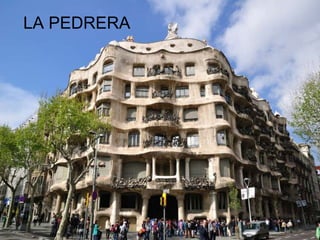
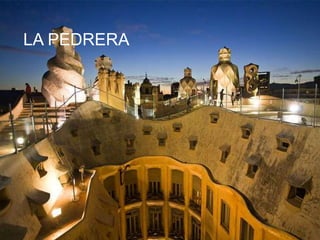
LA PEDRERA
It is a modernist building located at 92, Passeig de Gràcia
in Barcelona, Catalonia, at the corner of Provença street,
in the Eixample. It was the last civil work designed by the
Catalan architect Antoni Gaudi and it was built between
1906 and 1910.
LA PEDRERA
LA PEDRERA
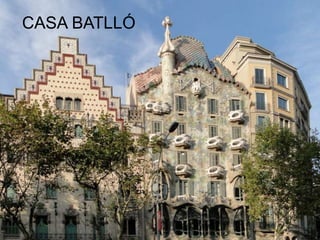
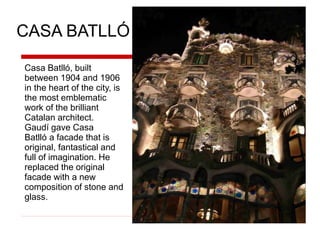
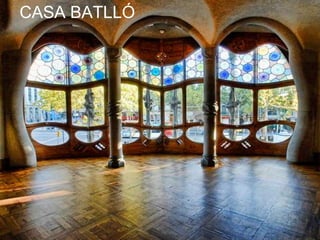
CASA BATLLÓ
CASA BATLLÓ
Casa Batlló, built
between 1904 and 1906
in the heart of the city, is
the most emblematic
work of the brilliant
Catalan architect.
Gaudí gave Casa
Batlló a facade that is
original, fantastical and
full of imagination. He
replaced the original
facade with a new
composition of stone and
glass.
CASA BATLLÓ
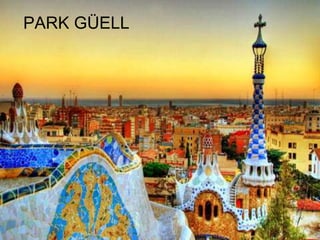
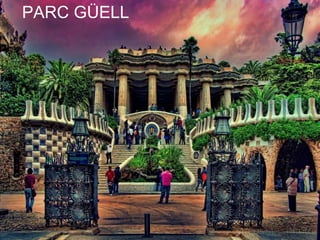
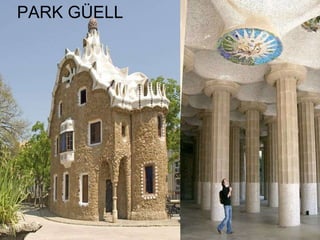
PARK GÜELL
PARC GÜELL
PARK GÜELL
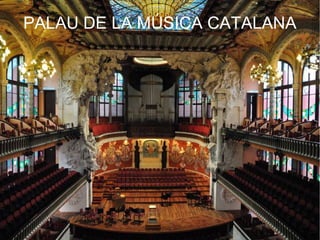
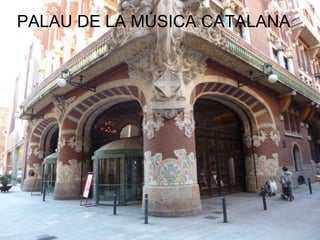
PALAU DE LA MÚSICA CATALANA
It is a concert hall in Barcelona. Designed in the
Catalan modernista style by the architect Lluís
Domènech i Montaner, it was built between 1905 and
1908 for the Orfeó Català, a choral society founded in
1891 that was a leading force in the Catalan cultural
movement that came to be known as
the Renaixença (Catalan Rebirth). It was inaugurated
February 9, 1908.
PALAU DE LA MÚSICA CATALANA
SAGRADA FAMILIA
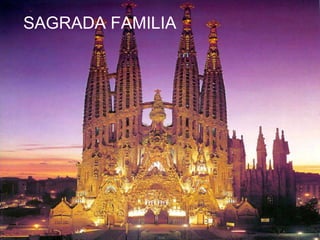
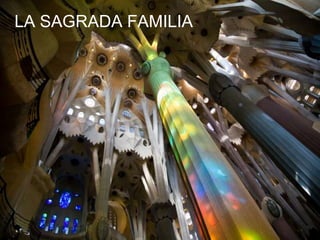
SAGRADA FAMILIA CHURCH
The expiatory church of La Sagrada Família is a work on a
grand scale which was begun on 19 March 1882 from a
project by the diocesan architect Francisco de Paula del
Villar (1828-1901). At the end of 1883 Gaudí was
commissioned to carry on the works, a task which he did
not abandon until his death in 1926. Since then different
architects have continued the work after his original idea.
According to data from the year 2004, the Sagrada Familia
is one of the most visited monuments in Spain. In 2008 it
received more than 2.7 million visitors, a figure which rose
to 3.2 million in 2011. The work done by AntoniGaudí, that
is to say, the crypt and the Nativity façade, were declared
world heritage site by UNESCO in 2005.
LA SAGRADA FAMILIA
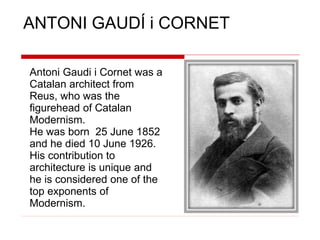
ANTONI GAUDÍ i CORNET
Antoni Gaudi i Cornet was a
Catalan architect from
Reus, who was the
figurehead of Catalan
Modernism.
He was born 25 June 1852
and he died 10 June 1926.
His contribution to
architecture is unique and
he is considered one of the
top exponents of
Modernism.
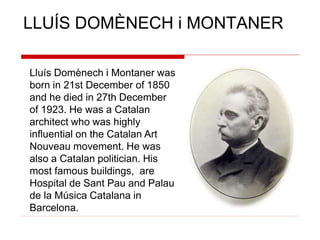
LLUÍS DOMÈNECH i MONTANER
Lluís Domènech i Montaner was
born in 21st December of 1850
and he died in 27th December
of 1923. He was a Catalan
architect who was highly
influential on the Catalan Art
Nouveau movement. He was
also a Catalan politician. His
most famous buildings, are
Hospital de Sant Pau and Palau
de la Música Catalana in
Barcelona.
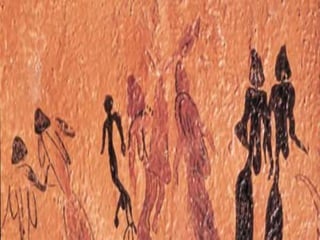
2.- CAVE PAINTINGS
Cave paintings are paintings found on cave walls and ceilings,
and especially refer to those of prehistoric origin.
The cave paintings were drawed by prehistoric people.
They drew the cave paintings with natural materials.
They are also often located in areas of caves that are not easily
accessible.
Some theories hold that cave paintings may have been a way
of communicating with others, while other theories ascribe a
religious or ceremonial purpose to them.
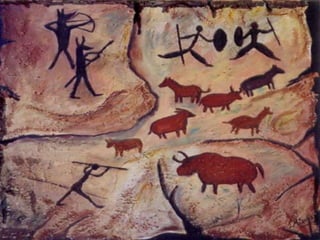
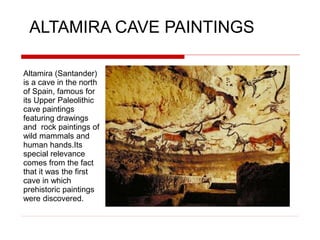
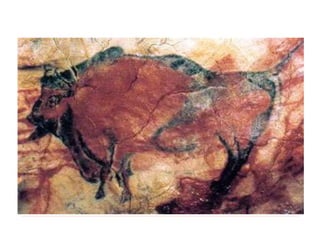
ALTAMIRA CAVE PAINTINGS
Altamira (Santander)
is a cave in the north
of Spain, famous for
its Upper Paleolithic
cave paintings
featuring drawings
and rock paintings of
wild mammals and
human hands.Its
special relevance
comes from the fact
that it was the first
cave in which
prehistoric paintings
were discovered.
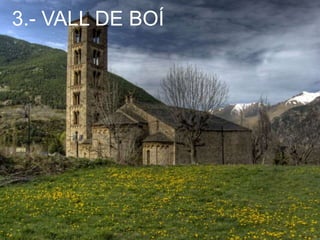
3.- VALL DE BOÍ
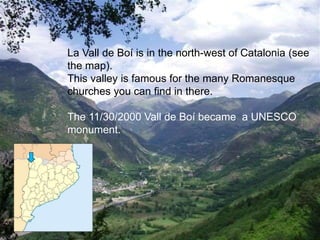
La Vall de Boí is in the north-west of Catalonia (see
the map).
This valley is famous for the many Romanesque
churches you can find in there.
The 11/30/2000 Vall de Boí became a UNESCO
monument.
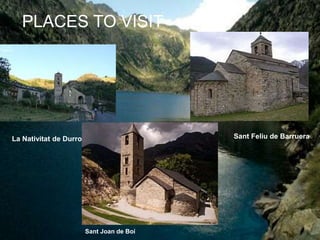
PLACES TO VISIT
Sant Feliu de Barruera
Sant Joan de Boí
La Nativitat de Durro
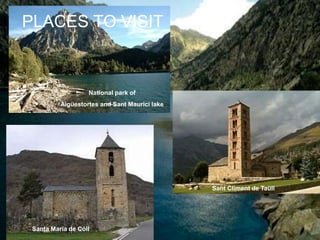
20/05/14
Sant Climent de Taüll
Santa María de Cóll
National park of
Aigüestortes and Sant Maurici lake
PLACES TO VISIT
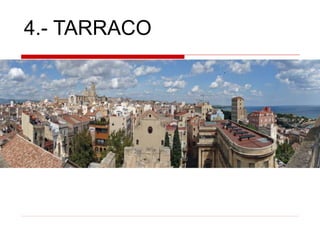
4.- TARRACO
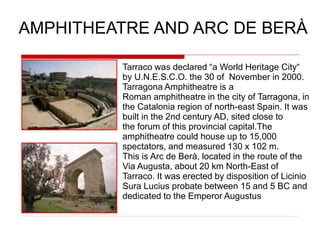
Tarraco was declared “a World Heritage City“
by U.N.E.S.C.O. the 30 of November in 2000.
Tarragona Amphitheatre is a
Roman amphitheatre in the city of Tarragona, in
the Catalonia region of north-east Spain. It was
built in the 2nd century AD, sited close to
the forum of this provincial capital.The
amphitheatre could house up to 15,000
spectators, and measured 130 x 102 m.
This is Arc de Berà, located in the route of the
Via Augusta, about 20 km North-East of
Tarraco. It was erected by disposition of Licinio
Sura Lucius probate between 15 and 5 BC and
dedicated to the Emperor Augustus
AMPHITHEATRE AND ARC DE BERÀ
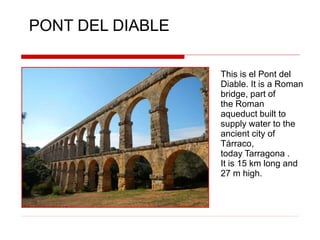
This is el Pont del
Diable. It is a Roman
bridge, part of
the Roman
aqueduct built to
supply water to the
ancient city of
Tárraco,
today Tarragona .
It is 15 km long and
27 m high.
PONT DEL DIABLE
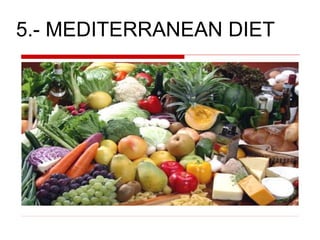
MEDITERRANIAN DIET
5.- MEDITERRANEAN DIET
The Mediterranean diet is a modern nutritional
recommendation originally inspired by the traditional
dietary patterns of Greece, Spain, Italy and Morocco. The
principal aspects of this diet include proportionally high
consumption of olive oil, legumes, unrefine cereals, fruits,
and vegetables, moderate to high consumption of fish,
moderate consumption of dairy products (mostly as
cheese and yoghurt), moderate wine consumption, and
low consumption of meat and meat products.
DEFINITION
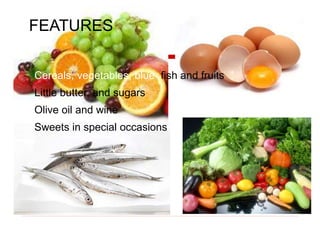
Cereals, vegetables, blue fish and fruits
Little butter, and sugars
Olive oil and wine
Sweets in special occasionss
FEATURES
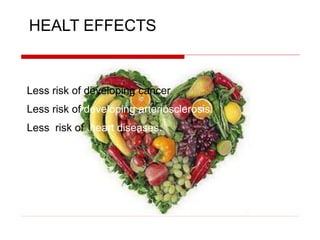
Less risk of developing cancer
Less risk of developing arteriosclerosis.
Less risk of heart diseases.
HEALT EFFECTS
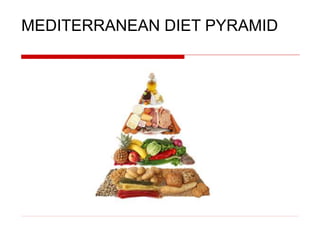
MEDITERRANEAN DIET PYRAMID

Comenius unesco granollers

  • 1.
    COMENIUS ONE BUT NOTTHE SAME Institut EMT Granollers (Spain)
  • 2.
    UNESCO UNESCO is theUnited Nations,for Education, Science and Culture. UNESCO World Heritage Site is a place (such as a forest, a mountain, a lake, an island,a desert,a monument a building or a city) which is listed by United Nations Educational, Scientific and Cultural Organization UNESCO for its special cultural or physical significance (see the list of World Heritage Sites). The list is maintained by the international World Heritage Programmer which is administered by the UNESCO World Heritage Committee.It is composed by 21 states parties which are elected by their General Assembly.
  • 3.
    INDEX 1.- MODERNISM 2.- CAVEPAINTINGS 3.- VALL DE BOÍ 4.- TARRACO 5.- MEDITERRANEAN DIET
  • 4.
    1.- MODERNISME or ARTNOUVEAU “ Modernisme” is a philosophical movement that, along with cultural trends and changes, arose from wide-scale and far-reaching transformations in Western society in the late 19th and early 20th centuries.
  • 5.
  • 6.
    It is amodernist building located at 92, Passeig de Gràcia in Barcelona, Catalonia, at the corner of Provença street, in the Eixample. It was the last civil work designed by the Catalan architect Antoni Gaudi and it was built between 1906 and 1910. LA PEDRERA
  • 7.
  • 8.
  • 9.
    CASA BATLLÓ Casa Batlló,built between 1904 and 1906 in the heart of the city, is the most emblematic work of the brilliant Catalan architect. Gaudí gave Casa Batlló a facade that is original, fantastical and full of imagination. He replaced the original facade with a new composition of stone and glass.
  • 10.
  • 11.
  • 12.
  • 13.
  • 14.
    PALAU DE LAMÚSICA CATALANA
  • 15.
    PALAU DE LAMÚSICA CATALANA It is a concert hall in Barcelona. Designed in the Catalan modernista style by the architect Lluís Domènech i Montaner, it was built between 1905 and 1908 for the Orfeó Català, a choral society founded in 1891 that was a leading force in the Catalan cultural movement that came to be known as the Renaixença (Catalan Rebirth). It was inaugurated February 9, 1908.
  • 16.
    PALAU DE LAMÚSICA CATALANA
  • 17.
  • 18.
    SAGRADA FAMILIA CHURCH Theexpiatory church of La Sagrada Família is a work on a grand scale which was begun on 19 March 1882 from a project by the diocesan architect Francisco de Paula del Villar (1828-1901). At the end of 1883 Gaudí was commissioned to carry on the works, a task which he did not abandon until his death in 1926. Since then different architects have continued the work after his original idea. According to data from the year 2004, the Sagrada Familia is one of the most visited monuments in Spain. In 2008 it received more than 2.7 million visitors, a figure which rose to 3.2 million in 2011. The work done by AntoniGaudí, that is to say, the crypt and the Nativity façade, were declared world heritage site by UNESCO in 2005.
  • 19.
  • 20.
    ANTONI GAUDÍ iCORNET Antoni Gaudi i Cornet was a Catalan architect from Reus, who was the figurehead of Catalan Modernism. He was born 25 June 1852 and he died 10 June 1926. His contribution to architecture is unique and he is considered one of the top exponents of Modernism.
  • 21.
    LLUÍS DOMÈNECH iMONTANER Lluís Domènech i Montaner was born in 21st December of 1850 and he died in 27th December of 1923. He was a Catalan architect who was highly influential on the Catalan Art Nouveau movement. He was also a Catalan politician. His most famous buildings, are Hospital de Sant Pau and Palau de la Música Catalana in Barcelona.
  • 22.
    2.- CAVE PAINTINGS Cavepaintings are paintings found on cave walls and ceilings, and especially refer to those of prehistoric origin. The cave paintings were drawed by prehistoric people. They drew the cave paintings with natural materials. They are also often located in areas of caves that are not easily accessible. Some theories hold that cave paintings may have been a way of communicating with others, while other theories ascribe a religious or ceremonial purpose to them.
  • 25.
    ALTAMIRA CAVE PAINTINGS Altamira(Santander) is a cave in the north of Spain, famous for its Upper Paleolithic cave paintings featuring drawings and rock paintings of wild mammals and human hands.Its special relevance comes from the fact that it was the first cave in which prehistoric paintings were discovered.
  • 27.
  • 28.
    La Vall deBoí is in the north-west of Catalonia (see the map). This valley is famous for the many Romanesque churches you can find in there. The 11/30/2000 Vall de Boí became a UNESCO monument.
  • 29.
    PLACES TO VISIT SantFeliu de Barruera Sant Joan de Boí La Nativitat de Durro
  • 30.
    20/05/14 Sant Climent deTaüll Santa María de Cóll National park of Aigüestortes and Sant Maurici lake PLACES TO VISIT
  • 31.
  • 32.
    Tarraco was declared“a World Heritage City“ by U.N.E.S.C.O. the 30 of November in 2000. Tarragona Amphitheatre is a Roman amphitheatre in the city of Tarragona, in the Catalonia region of north-east Spain. It was built in the 2nd century AD, sited close to the forum of this provincial capital.The amphitheatre could house up to 15,000 spectators, and measured 130 x 102 m. This is Arc de Berà, located in the route of the Via Augusta, about 20 km North-East of Tarraco. It was erected by disposition of Licinio Sura Lucius probate between 15 and 5 BC and dedicated to the Emperor Augustus AMPHITHEATRE AND ARC DE BERÀ
  • 33.
    This is elPont del Diable. It is a Roman bridge, part of the Roman aqueduct built to supply water to the ancient city of Tárraco, today Tarragona . It is 15 km long and 27 m high. PONT DEL DIABLE
  • 34.
  • 35.
    The Mediterranean dietis a modern nutritional recommendation originally inspired by the traditional dietary patterns of Greece, Spain, Italy and Morocco. The principal aspects of this diet include proportionally high consumption of olive oil, legumes, unrefine cereals, fruits, and vegetables, moderate to high consumption of fish, moderate consumption of dairy products (mostly as cheese and yoghurt), moderate wine consumption, and low consumption of meat and meat products. DEFINITION
  • 36.
    Cereals, vegetables, bluefish and fruits Little butter, and sugars Olive oil and wine Sweets in special occasionss FEATURES
  • 37.
    Less risk ofdeveloping cancer Less risk of developing arteriosclerosis. Less risk of heart diseases. HEALT EFFECTS
  • 38.