June 2013

Dartview Consulting Limited

1
What is Service Management?
“A service is a means of delivering value to customers by
facilitating outcomes customers want to achieve, without the
ownership of specific costs and risks”
“Outcomes are the result of carrying-out an activity, following a
process, or delivering an IT Service”
“Service Management is a set of specialised organisational
capabilities for providing value to customers in the form of
services”

Dartview Consulting Limited

3
Why do we need Service Management?
•
•
•
•

•
•
•

Integrate and align IT with business goals
Implementing continual improvement
Increased dependency on IT services
Higher customer expectation
Demonstrating the business value of IT
Manage constant business and IT change
Using IT to gain competitive advantage

Dartview Consulting Limited

5
Why is ITIL successful?
•
•
•
•

•
•
•

•

Systematic approach to high quality IT service delivery
Accepted Best Practice for IT Service Management
Provides a common language with well-defined terms
Non-prescriptive
Vendor Independent
Alignment with Business Needs
Processes are predictable, consistent, measurable and
improvable
Improved Customer Satisfaction
Dartview Consulting Limited

7
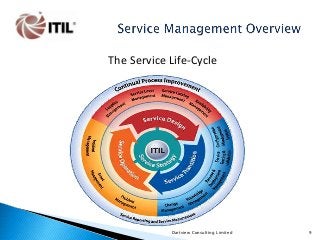
The Service Life-Cycle

Dartview Consulting Limited

9
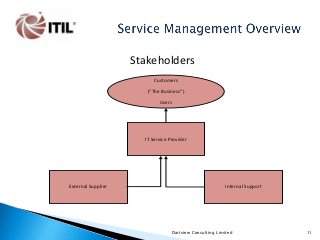
Stakeholders
Customers
(“The Business”)
Users

IT Service Provider

External Supplier

Internal Support

Dartview Consulting Limited

11
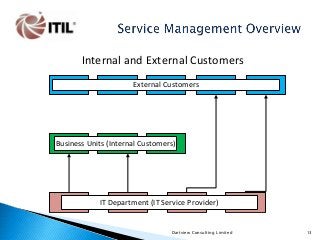
Internal and External Customers
External Customers

Business Units (Internal Customers)

IT Department (IT Service Provider)

Dartview Consulting Limited

13
Processes, Functions & Roles
•

Process:
• A set of co-ordinated activities combining resources and
capabilities to produce an outcome that creates value for the
customer

•

Function:
• A unit of an organisation specialised to perform certain types
of work and responsible for specific outcomes

•

Role:
• A position, responsibility or duty within a process or function
Dartview Consulting Limited

15
Functions
A team or group of people and the tools they use to
carry out an activity e.g. Accounts or HR
•

ITIL Functions
•
•
•
•

Service Desk
Technical Management
Application Management
Operations Management

Dartview Consulting Limited

17
Service Strategy
•

Purpose
• Acknowledge that customers do not buy products, they buy the
satisfaction of particular needs. Therefore, to be successful, the
provider must be perceived by the customer as delivering
sufficient value in the form of outcomes that the customer wants
to achieve
• Achieve a deep understanding of customer needs
• Understand the current and potential market place
• Acknowledge the existence of competition (even for internal
providers)

Dartview Consulting Limited

19
Service Strategy
•

Objectives:
• Provide an understanding of what the strategy is
• Provide clear identification of the definition of services
• Provide the ability to define how value is created and
delivered
• Provide a means to identify opportunities to provide
services
• Provide a clear service provision model
• Provide a means to understand the organisational capability
(people and knowledge)
• Documentation and co-ordination of how service assets are
used to deliver services (people, hardware, software, etc.)
Dartview Consulting Limited

21
Service Strategy (Strategy Generation)
•

Key Activities
• Define the market
• Understand the customer & the opportunities
• Classify & Visualise

• Develop the offerings
• Market Space, Outcome-based, Service Portfolio

• Develop strategic assets
• Establish specialised and hard to replicate resources and capabilities
that create competitive advantage

• Prepare for execution
• Strategy assessment, setting objectives, CSF’s

Dartview Consulting Limited

23
Service Strategy (Business Relationship Management)
•

Purpose:
• To establish and maintain a business relationship between
the service provider and the customer based on
understanding the customer and it’s business needs
• To identify customer needs and ensure that the service
provider is able to meet them

Dartview Consulting Limited

25
Service Strategy (Financial Management)
•

Purpose:
• To secure the appropriate level of funding required to
design, develop and deliver services that meet the strategy
of the organisation
• To ensure that the service provider does not commit to
services that they are not able to provide
• To identify the balance between cost and quality of services
and maintain the balance of supply and demand between
the service provider and it’s customers

Dartview Consulting Limited

27
Service Strategy (Service Portfolio Management)
•

Purpose:
• To ensure that the service provider has the right mix of
services to balance the investment in IT with the ability to
meet business outcomes
• To enable the business to make sound decisions about
investments
• Consider services in terms of the business value that the
services provide

Dartview Consulting Limited

29
Service Strategy (Service Portfolio Management)
•

The Service Portfolio is the complete set of services
that are management by a service provider and is
compromised of three elements:
• The Service Pipeline
• The Service Catalogue
• Retired Services

Dartview Consulting Limited

31
Service Strategy (Service Portfolio Management)
•

The Service Catalogue: A database or structured
document with information about all live services,
including those available for deployment. The Service
Catalogue is the only part of the Service Portfolio
that is published to customers and is used to support
the sale and delivery of IT services. The Service
Catalogue includes information about deliverables,
prices, contact points, ordering and request process

Dartview Consulting Limited

33
Service Strategy (Service Portfolio Management)
Service
Pipeline

Retired
Services

Service Catalogue

Configuration Management System

Customer
Portfolio

Application
Portfolio

Customer
Agreement
Portfolio

Supplier &
Contract
Management
Information
System

Project
Portfolio

Customer
Agreement
Portfolio

CMDB
CMDB
CMDB

Dartview Consulting Limited

35
Service Strategy (Demand Management)
•

Challenges:
• Business activities drive demand for services
• Poorly managed demand can expose providers to risk

•

Techniques
• Patterns of Business Activity (PBA) – frequency, volume,
location, duration
• User Profiles (UP) – roles, responsibilities, interactions,
schedules

Dartview Consulting Limited

37
Service Strategy (Demand Management)
•
•

•

Ensures we don’t waste money with excess capacity
Ensures we have enough capacity to meet demand at agreed
quality
Patterns of Business Activity to be considered
• E.g. Economy 7 electricity, Congestion Charging

Dartview Consulting Limited

39
Service Design
•

Objectives
•
•
•
•

Design services to meet agreed business outcomes
Design processes to support the service lifecycle
Identify and manage risks
Design secure and resilient infrastructures, environments,
applications and data/information resources
• Design measurement methods and metrics
• Develop skills and capability within IT
• Produce and maintain plans, processes, policies, and documents
to support the design of quality services
Dartview Consulting Limited

41
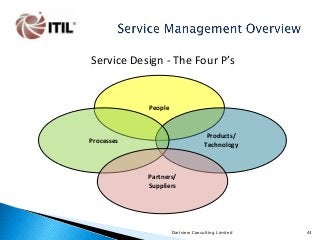
Service Design - The Four P’s

People

Products/
Technology

Processes

Partners/
Suppliers

Dartview Consulting Limited

43
Service Design (Processes)
•
•
•
•

•
•
•
•

Design Co-Ordination
Service Catalogue Management
Service Level Management
Capacity Management
Availability Management
IT Service Continuity Management
Supplier Management
Information Security Management

Dartview Consulting Limited

45
Service Design (Design Co-ordination)
•

Objectives
•
•
•
•
•

Ensure the consistency of design
Co-ordinate all design activities
Plan and co-ordinate the resources and capabilities
Produce Service Design Packages (SDP’s)
Manage the quality criteria, requirements and handover
points
• Ensure that all parties adopt a common framework of
standard reusable design practices

Dartview Consulting Limited

47
Service Design (Service Catalogue Management)
•

Objectives
• To ensure that a Service Catalogue is produced and
maintained
• To manage the information contained within the Service
Catalogue
• To ensure that the information is correct and accurate

Dartview Consulting Limited

49
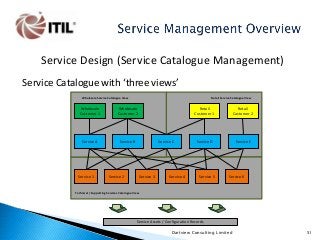
Service Design (Service Catalogue Management)
Service Catalogue with ‘three views’
Wholesale Service Catalogue View

Retail Service Catalogue View

Wholesale
Customer 1

Wholesale
Customer 2

Service A

Service B

Service 1

Retail
Customer 1

Service C

Service 2

Service 3

Service 4

Retail
Customer 2

Service D

Service E

Service 5

Service 6

Technical / Supporting Services Catalogue View

Service Assets / Configuration Records

Dartview Consulting Limited

51
Service Design (Service Catalogue Management)
Technical / Support Services
“An IT service that is not directly used by the business, but is required
by the IT service provider to deliver customer-facing services (for
example, a directory service or a backup service). Supporting services
may also include IT services only used by the IT service provider. All
live supporting services, including those available for deployment, are
recorded in the service catalogue along with information about their
relationships to customer-facing services and other CI’s”

Dartview Consulting Limited

53
Service Design (Service Level Management)
•

Objectives
• Define, document, agree, monitor, measure, report and
review the level of service provision for all services
• Promote and build good relationships with the business and
customers
• Monitor and improve levels of customer satisfaction
• Provide specific and measurable targets (SMART)
• Provide clear and unambiguous service definitions
• Proactively improve service levels where cost justifiable

Dartview Consulting Limited

55
Service Design (Service Level Management)
•

Scope
• Key interface between the business/customer and the
service provider
• Negotiates and agrees SLA for current services in
conjunction with OLA’s and Underpinning Contracts
• Captures SLR’s for future business needs
• Investigation and eradication of poor performance
• Creation and management of Service Improvement Plans
(SIP’s)

Dartview Consulting Limited

57
Service Design (Service Level Management)
•

Basic Concepts

• Service Level Requirements (SLR’s)
•
•
•
•

Customer requirements for all aspects of a service
Based on business objectives
Used to negotiate service level targets to be in included in SLA’s
Documented

• Service Level Agreement (SLA’s)
• Written agreement between a service provider and it’s customers
• Signed by both parties and written in a way that is it clearly
understood
• All targets agreed should be measurable

Dartview Consulting Limited

59
Service Design (Service Level Management)
•

Basic Concepts
• Service Provider
• An organisation supplying services to one or more Internal
Customers or External Customers

• Supplier
• A third party responsible for supplying goods or services to a
Service Provider, that are required to deliver services to
customers

Dartview Consulting Limited

61
Service Design (Service Level Management)
•

Typical Contents found in a Service Level Agreement (SLA)
– Service Description
– Key Business Requirements
– Responsibilities (Provider and Customer)
– Hours of Operation
– Service Levels
– Incident Response & Resolution
– Availability & Continuity Targets
– Operational Level Agreements
– Reporting & Reviewing Details
– Charging Mechanisms
Dartview Consulting Limited

63
Service Design (Capacity Management)
•

Purpose
◦ To provide a point of focus and management for all capacity
and performance-related issues, relating to both services
and resources, and to match the capacity of IT services to
the agreed business/customer demands

Dartview Consulting Limited

65
Service Design (Availability Management)
•

Purpose
◦ To provide a point of focus and management for all
availability-related issues, relating to both services,
components and resources, ensuring that availability
targets in all areas are measured and achieved, and that
they match or exceed the agreed needs of the
business/customer in a cost-effective manner

Dartview Consulting Limited

67
Service Design (IT Service Continuity Management)
•

Purpose
• To support the overall BCM (Business Continuity
Management) process by ensuring that the required
services can be resumed within agreed business timescales
• This is achieved by introducing risk reduction measures and
recover options

Dartview Consulting Limited

69
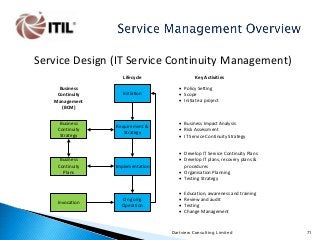
Service Design (IT Service Continuity Management)
Lifecycle
Business
Continuity
Management
(BCM)

Initiation

Key Activities
· Policy Setting
· Scope
· Initiate a project

Requirement &
Strategy

· Business Impact Analysis
· Risk Assessment
· IT Service Continuity Strategy

Business
Continuity
Plans

Implementation

· Develop IT Service Continuity Plans
· Develop IT plans, recovery plans &
procedures
· Organisation Planning
· Testing Strategy

Invocation

On going
Operation

Business
Continuity
Strategy

·
·
·
·

Education, awareness and training
Review and audit
Testing
Change Management

Dartview Consulting Limited

71
Service Design (Supplier Management)
•

Objectives:
• Obtain value for money from supplier and contracts
• Ensure that underpinning contracts and agreements with
suppliers are aligned with business needs
• Manage relationships with suppliers
• Negotiate and agree contracts with suppliers and manage
them through their lifecycle
• Maintain a Supplier Policy and a supporting Supplier &
Contract Database

Dartview Consulting Limited

73
Service Design (Information Security Management)
•

Purpose:
• To provide a focus for all aspects of IT Security activities
• To align IT Security with Business Security and ensure
that information security is effectively managed in all
service and Service Management activities

Dartview Consulting Limited

75
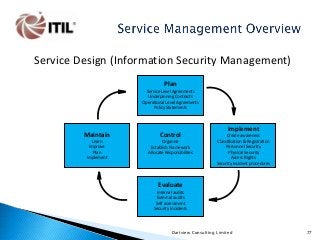
Service Design (Information Security Management)
Plan
Service Level Agreements
Underpinning Contracts
Operational Level Agreements
Policy Statements

Maintain

Control

Learn
Improve
Plan
Implement

Organise
Establish Framework
Allocate Responsibilites

Implement
Create awareness
Classification & Registration
Personnel Security
Physical Security
Access Rights
Security Incident procedures

Evaluate
Internal audits
External audits
Self assessment
Security Incidents

Dartview Consulting Limited

77
Service Transition
•

Objectives:
•
•
•
•
•

Provide clear and comprehensive plans
Plan and manage the resources
Minimise impact of change on services
Increase satisfaction
Increase use of services

Dartview Consulting Limited

79
Service Transition (Transition Planning & Support)
•

Purpose
• To provide overall planning for service transitions and to coordinate the resources that they require

Dartview Consulting Limited

81
Service Transition (Change Management)
•

Purpose
• To control the lifecycle of all changes, enabling beneficial
changes to be made with minimum disruption to services

Dartview Consulting Limited

83
Service Transition (Release & Deployment
Management)
•

Purpose
• To plan, schedule and control the build, test and
deployment of releases, and to deliver new functionality
required by the business/customer, while protecting the
integrity of existing services

Dartview Consulting Limited

85
Service Transition (Service Asset & Configuration
Management)
•

Purpose
• To identify, control and account for service assets and
configuration items (CI’s), protecting and ensuring their
integrity across the Service Lifecycle

Dartview Consulting Limited

87
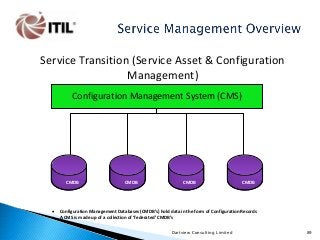
Service Transition (Service Asset & Configuration
Management)
Configuration Management System (CMS)

CMDB

·
·

CMDB

CMDB

CMDB

Configuration Management Databases (CMDB’s) hold data in the form of Configuration Records
A CMS is made up of a collection of ‘federated’ CMDB’s
Dartview Consulting Limited

89
Service Transition (Knowledge Management)
•

Objectives
•
•
•
•

Increased efficiency and quality of service
Increased satisfaction and reduced cost of service
Provide a clear understanding of the value of service
Ensure the service provider has adequate information on:
•
•
•
•

Who is currently using their services
Current service consumption
Service Delivery constraints
Difficulties faced by the customer in fully realising the expect
benefits from the service

Dartview Consulting Limited

91
Service Transition (Knowledge Management)
•

DIKW Structure
• Data needs to be captured, analysed, synthesised and transformed
before it becomes Information.
• Managing the content of Information in a way that makes it easy to
capture, query, find, reuse, and learn from experiences so that mistakes
are not repeated and work is not duplicated, presents us with
Knowledge.
• Knowledge puts Information into an ‘ease of use’ form which can
facilitate decision making
• Wisdom is having the ability, and contextual awareness to be able to
apply Knowledge

Dartview Consulting Limited

93
Service Operation
•

Purpose
To deliver agreed levels of service to customers and
users, and to manage the applications, technology and
infrastructure that support those services
• It is only during the Service Operation stage of the
Service Lifecycle that services can actually deliver
value. It is the responsibility of Service Operation staff
to ensure that this value is delivered

•

Dartview Consulting Limited

95
Service Operation (Event Management)
•

Purpose
• To manage events throughout their lifecycle
“An Event is a change of state that has significance for the
management of a Configuration Item (CI) or Service”
“An Alert is a warning that a threshold has been reached,
something has changed, or a failure has occurred”

Dartview Consulting Limited

97
Service Operation (Event Management)
•

Alerts
• Informational
• A device indicates it is still ‘active’
• An authorised user logs into an application
• An email being opened generates a ‘read’ message back to it’s sender

• Warning
• Concurrent Licence take-up peaks at specific times

• Exception
• An unauthorised user attempts to access an application
• A threshold is breached which is unacceptable
• An audit reveals unauthorised software on a PC

Dartview Consulting Limited

99
Service Operation (Incident Management)
•

Objectives
•
•
•
•

Ensure that standardised methods and procedures are used
Increase visibility and communication of Incidents
Enhance business/customer perception of IT
Align Incident Management activities and priorities with
those of the business
• Maintain user satisfaction with the quality of services

Dartview Consulting Limited

101
Service Operation (Incident Management)
•

Priority
• Derived from Impact and Urgency
• Used as a way of making the most effective use of support
staff by directing them towards higher priority activities

Dartview Consulting Limited

103
Service Operation (Problem Management)
•

Purpose
• To diagnose the root cause of Incidents identified through
the Incident Management process, and to determine
resolution
“A Problem is a cause of one or more Incidents. The cause is
not usually known at the time a problem record is created,
and the Problem Management process is responsible for
further investigation”

Dartview Consulting Limited

105
Service Operation (Request Fulfillment)
•

Purpose
• To enable users to request and receive standard services
“A Service Request is a request from a user for information or
advice, or for a standard change, or for access to a service”

Dartview Consulting Limited

107
Service Operation (Access Management)
•

Purpose
• To provide the right for users to be able to use a service or
group of services, while preventing access to nonauthorised users. Essentially, this is the execution of the
policies and actions defined in Information Security
Management

Dartview Consulting Limited

109
Service Operation (Functions)
•
•
•
•

The Service Desk
Technical Management
Applications Management
Operations Management

Dartview Consulting Limited

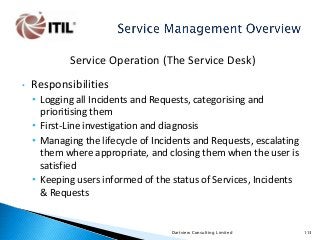
111
Service Operation (The Service Desk)
•

Responsibilities
• Logging all Incidents and Requests, categorising and
prioritising them
• First-Line investigation and diagnosis
• Managing the lifecycle of Incidents and Requests, escalating
them where appropriate, and closing them when the user is
satisfied
• Keeping users informed of the status of Services, Incidents
& Requests

Dartview Consulting Limited

113
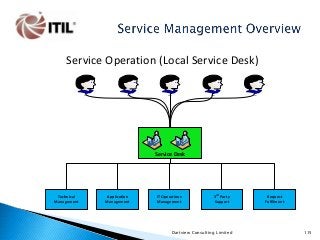
Service Operation (Local Service Desk)
User

User

User

User

User

Service Desk

Technical
Management

Application
Management

IT Operations
Management

3rd Party
Support

Dartview Consulting Limited

Request
Fulfilment

115
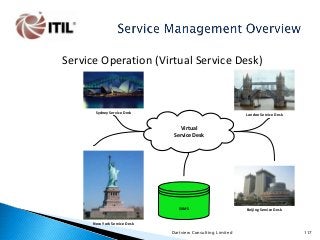
Service Operation (Virtual Service Desk)

Sydney Service Desk

London Service Desk

Virtual
Service Desk

SKMS

Beijing Service Desk

New York Service Desk

Dartview Consulting Limited

117
Service Operation (Applications Management)
•

Objectives
• To support the provision of services by helping to identify
functional and manageability requirements for application
software
• To assist in the design, deployment, on-going support and
improvement of applications. This is achieved through:
• Well designed and cost-effective applications
• Providing the functionality required to meet business/customer
outcomes
• Ensuring the required technical skills are in place to maintain
applications at optimum levels

Dartview Consulting Limited

119
Continuous Service Improvement
•

Purpose
•

Maintaining value for customers through the continual
evaluation and improvement of the quality of services
and the overall maturity of the Service Lifecycle and it’s
underlying processes

Dartview Consulting Limited

121
Continuous Service Improvement
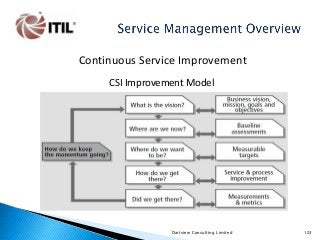
CSI Improvement Model

Dartview Consulting Limited

123
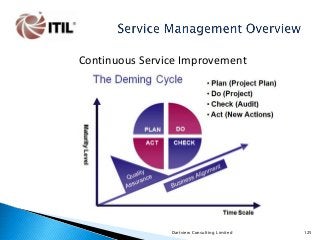
Continuous Service Improvement

Dartview Consulting Limited

125
ITIL – Further Learning
Official ITIL Web Site
http://www.itil-officialsite.com
IT Service Management Forum (itSMF UK)
http://www.itsmf.co.uk

Dartview Consulting Limited

127
Related Standards
ISO/IEC 20000: IT Service Management
ISO/IEC 27001: Information Security Management
Controlled objects for Information and related Technology
(COBIT)
Projects in Controlled Environments (PRINCE2)
Management of Risk (M_o_R)

Dartview Consulting Limited

129

ITIL V3 Service Management Overview

  • 1.
  • 2.
    What is ServiceManagement? “A service is a means of delivering value to customers by facilitating outcomes customers want to achieve, without the ownership of specific costs and risks” “Outcomes are the result of carrying-out an activity, following a process, or delivering an IT Service” “Service Management is a set of specialised organisational capabilities for providing value to customers in the form of services” Dartview Consulting Limited 3
  • 3.
    Why do weneed Service Management? • • • • • • • Integrate and align IT with business goals Implementing continual improvement Increased dependency on IT services Higher customer expectation Demonstrating the business value of IT Manage constant business and IT change Using IT to gain competitive advantage Dartview Consulting Limited 5
  • 4.
    Why is ITILsuccessful? • • • • • • • • Systematic approach to high quality IT service delivery Accepted Best Practice for IT Service Management Provides a common language with well-defined terms Non-prescriptive Vendor Independent Alignment with Business Needs Processes are predictable, consistent, measurable and improvable Improved Customer Satisfaction Dartview Consulting Limited 7
  • 5.
    The Service Life-Cycle DartviewConsulting Limited 9
  • 6.
    Stakeholders Customers (“The Business”) Users IT ServiceProvider External Supplier Internal Support Dartview Consulting Limited 11
  • 7.
    Internal and ExternalCustomers External Customers Business Units (Internal Customers) IT Department (IT Service Provider) Dartview Consulting Limited 13
  • 8.
    Processes, Functions &Roles • Process: • A set of co-ordinated activities combining resources and capabilities to produce an outcome that creates value for the customer • Function: • A unit of an organisation specialised to perform certain types of work and responsible for specific outcomes • Role: • A position, responsibility or duty within a process or function Dartview Consulting Limited 15
  • 9.
    Functions A team orgroup of people and the tools they use to carry out an activity e.g. Accounts or HR • ITIL Functions • • • • Service Desk Technical Management Application Management Operations Management Dartview Consulting Limited 17
  • 10.
    Service Strategy • Purpose • Acknowledgethat customers do not buy products, they buy the satisfaction of particular needs. Therefore, to be successful, the provider must be perceived by the customer as delivering sufficient value in the form of outcomes that the customer wants to achieve • Achieve a deep understanding of customer needs • Understand the current and potential market place • Acknowledge the existence of competition (even for internal providers) Dartview Consulting Limited 19
  • 11.
    Service Strategy • Objectives: • Providean understanding of what the strategy is • Provide clear identification of the definition of services • Provide the ability to define how value is created and delivered • Provide a means to identify opportunities to provide services • Provide a clear service provision model • Provide a means to understand the organisational capability (people and knowledge) • Documentation and co-ordination of how service assets are used to deliver services (people, hardware, software, etc.) Dartview Consulting Limited 21
  • 12.
    Service Strategy (StrategyGeneration) • Key Activities • Define the market • Understand the customer & the opportunities • Classify & Visualise • Develop the offerings • Market Space, Outcome-based, Service Portfolio • Develop strategic assets • Establish specialised and hard to replicate resources and capabilities that create competitive advantage • Prepare for execution • Strategy assessment, setting objectives, CSF’s Dartview Consulting Limited 23
  • 13.
    Service Strategy (BusinessRelationship Management) • Purpose: • To establish and maintain a business relationship between the service provider and the customer based on understanding the customer and it’s business needs • To identify customer needs and ensure that the service provider is able to meet them Dartview Consulting Limited 25
  • 14.
    Service Strategy (FinancialManagement) • Purpose: • To secure the appropriate level of funding required to design, develop and deliver services that meet the strategy of the organisation • To ensure that the service provider does not commit to services that they are not able to provide • To identify the balance between cost and quality of services and maintain the balance of supply and demand between the service provider and it’s customers Dartview Consulting Limited 27
  • 15.
    Service Strategy (ServicePortfolio Management) • Purpose: • To ensure that the service provider has the right mix of services to balance the investment in IT with the ability to meet business outcomes • To enable the business to make sound decisions about investments • Consider services in terms of the business value that the services provide Dartview Consulting Limited 29
  • 16.
    Service Strategy (ServicePortfolio Management) • The Service Portfolio is the complete set of services that are management by a service provider and is compromised of three elements: • The Service Pipeline • The Service Catalogue • Retired Services Dartview Consulting Limited 31
  • 17.
    Service Strategy (ServicePortfolio Management) • The Service Catalogue: A database or structured document with information about all live services, including those available for deployment. The Service Catalogue is the only part of the Service Portfolio that is published to customers and is used to support the sale and delivery of IT services. The Service Catalogue includes information about deliverables, prices, contact points, ordering and request process Dartview Consulting Limited 33
  • 18.
    Service Strategy (ServicePortfolio Management) Service Pipeline Retired Services Service Catalogue Configuration Management System Customer Portfolio Application Portfolio Customer Agreement Portfolio Supplier & Contract Management Information System Project Portfolio Customer Agreement Portfolio CMDB CMDB CMDB Dartview Consulting Limited 35
  • 19.
    Service Strategy (DemandManagement) • Challenges: • Business activities drive demand for services • Poorly managed demand can expose providers to risk • Techniques • Patterns of Business Activity (PBA) – frequency, volume, location, duration • User Profiles (UP) – roles, responsibilities, interactions, schedules Dartview Consulting Limited 37
  • 20.
    Service Strategy (DemandManagement) • • • Ensures we don’t waste money with excess capacity Ensures we have enough capacity to meet demand at agreed quality Patterns of Business Activity to be considered • E.g. Economy 7 electricity, Congestion Charging Dartview Consulting Limited 39
  • 21.
    Service Design • Objectives • • • • Design servicesto meet agreed business outcomes Design processes to support the service lifecycle Identify and manage risks Design secure and resilient infrastructures, environments, applications and data/information resources • Design measurement methods and metrics • Develop skills and capability within IT • Produce and maintain plans, processes, policies, and documents to support the design of quality services Dartview Consulting Limited 41
  • 22.
    Service Design -The Four P’s People Products/ Technology Processes Partners/ Suppliers Dartview Consulting Limited 43
  • 23.
    Service Design (Processes) • • • • • • • • DesignCo-Ordination Service Catalogue Management Service Level Management Capacity Management Availability Management IT Service Continuity Management Supplier Management Information Security Management Dartview Consulting Limited 45
  • 24.
    Service Design (DesignCo-ordination) • Objectives • • • • • Ensure the consistency of design Co-ordinate all design activities Plan and co-ordinate the resources and capabilities Produce Service Design Packages (SDP’s) Manage the quality criteria, requirements and handover points • Ensure that all parties adopt a common framework of standard reusable design practices Dartview Consulting Limited 47
  • 25.
    Service Design (ServiceCatalogue Management) • Objectives • To ensure that a Service Catalogue is produced and maintained • To manage the information contained within the Service Catalogue • To ensure that the information is correct and accurate Dartview Consulting Limited 49
  • 26.
    Service Design (ServiceCatalogue Management) Service Catalogue with ‘three views’ Wholesale Service Catalogue View Retail Service Catalogue View Wholesale Customer 1 Wholesale Customer 2 Service A Service B Service 1 Retail Customer 1 Service C Service 2 Service 3 Service 4 Retail Customer 2 Service D Service E Service 5 Service 6 Technical / Supporting Services Catalogue View Service Assets / Configuration Records Dartview Consulting Limited 51
  • 27.
    Service Design (ServiceCatalogue Management) Technical / Support Services “An IT service that is not directly used by the business, but is required by the IT service provider to deliver customer-facing services (for example, a directory service or a backup service). Supporting services may also include IT services only used by the IT service provider. All live supporting services, including those available for deployment, are recorded in the service catalogue along with information about their relationships to customer-facing services and other CI’s” Dartview Consulting Limited 53
  • 28.
    Service Design (ServiceLevel Management) • Objectives • Define, document, agree, monitor, measure, report and review the level of service provision for all services • Promote and build good relationships with the business and customers • Monitor and improve levels of customer satisfaction • Provide specific and measurable targets (SMART) • Provide clear and unambiguous service definitions • Proactively improve service levels where cost justifiable Dartview Consulting Limited 55
  • 29.
    Service Design (ServiceLevel Management) • Scope • Key interface between the business/customer and the service provider • Negotiates and agrees SLA for current services in conjunction with OLA’s and Underpinning Contracts • Captures SLR’s for future business needs • Investigation and eradication of poor performance • Creation and management of Service Improvement Plans (SIP’s) Dartview Consulting Limited 57
  • 30.
    Service Design (ServiceLevel Management) • Basic Concepts • Service Level Requirements (SLR’s) • • • • Customer requirements for all aspects of a service Based on business objectives Used to negotiate service level targets to be in included in SLA’s Documented • Service Level Agreement (SLA’s) • Written agreement between a service provider and it’s customers • Signed by both parties and written in a way that is it clearly understood • All targets agreed should be measurable Dartview Consulting Limited 59
  • 31.
    Service Design (ServiceLevel Management) • Basic Concepts • Service Provider • An organisation supplying services to one or more Internal Customers or External Customers • Supplier • A third party responsible for supplying goods or services to a Service Provider, that are required to deliver services to customers Dartview Consulting Limited 61
  • 32.
    Service Design (ServiceLevel Management) • Typical Contents found in a Service Level Agreement (SLA) – Service Description – Key Business Requirements – Responsibilities (Provider and Customer) – Hours of Operation – Service Levels – Incident Response & Resolution – Availability & Continuity Targets – Operational Level Agreements – Reporting & Reviewing Details – Charging Mechanisms Dartview Consulting Limited 63
  • 33.
    Service Design (CapacityManagement) • Purpose ◦ To provide a point of focus and management for all capacity and performance-related issues, relating to both services and resources, and to match the capacity of IT services to the agreed business/customer demands Dartview Consulting Limited 65
  • 34.
    Service Design (AvailabilityManagement) • Purpose ◦ To provide a point of focus and management for all availability-related issues, relating to both services, components and resources, ensuring that availability targets in all areas are measured and achieved, and that they match or exceed the agreed needs of the business/customer in a cost-effective manner Dartview Consulting Limited 67
  • 35.
    Service Design (ITService Continuity Management) • Purpose • To support the overall BCM (Business Continuity Management) process by ensuring that the required services can be resumed within agreed business timescales • This is achieved by introducing risk reduction measures and recover options Dartview Consulting Limited 69
  • 36.
    Service Design (ITService Continuity Management) Lifecycle Business Continuity Management (BCM) Initiation Key Activities · Policy Setting · Scope · Initiate a project Requirement & Strategy · Business Impact Analysis · Risk Assessment · IT Service Continuity Strategy Business Continuity Plans Implementation · Develop IT Service Continuity Plans · Develop IT plans, recovery plans & procedures · Organisation Planning · Testing Strategy Invocation On going Operation Business Continuity Strategy · · · · Education, awareness and training Review and audit Testing Change Management Dartview Consulting Limited 71
  • 37.
    Service Design (SupplierManagement) • Objectives: • Obtain value for money from supplier and contracts • Ensure that underpinning contracts and agreements with suppliers are aligned with business needs • Manage relationships with suppliers • Negotiate and agree contracts with suppliers and manage them through their lifecycle • Maintain a Supplier Policy and a supporting Supplier & Contract Database Dartview Consulting Limited 73
  • 38.
    Service Design (InformationSecurity Management) • Purpose: • To provide a focus for all aspects of IT Security activities • To align IT Security with Business Security and ensure that information security is effectively managed in all service and Service Management activities Dartview Consulting Limited 75
  • 39.
    Service Design (InformationSecurity Management) Plan Service Level Agreements Underpinning Contracts Operational Level Agreements Policy Statements Maintain Control Learn Improve Plan Implement Organise Establish Framework Allocate Responsibilites Implement Create awareness Classification & Registration Personnel Security Physical Security Access Rights Security Incident procedures Evaluate Internal audits External audits Self assessment Security Incidents Dartview Consulting Limited 77
  • 40.
    Service Transition • Objectives: • • • • • Provide clearand comprehensive plans Plan and manage the resources Minimise impact of change on services Increase satisfaction Increase use of services Dartview Consulting Limited 79
  • 41.
    Service Transition (TransitionPlanning & Support) • Purpose • To provide overall planning for service transitions and to coordinate the resources that they require Dartview Consulting Limited 81
  • 42.
    Service Transition (ChangeManagement) • Purpose • To control the lifecycle of all changes, enabling beneficial changes to be made with minimum disruption to services Dartview Consulting Limited 83
  • 43.
    Service Transition (Release& Deployment Management) • Purpose • To plan, schedule and control the build, test and deployment of releases, and to deliver new functionality required by the business/customer, while protecting the integrity of existing services Dartview Consulting Limited 85
  • 44.
    Service Transition (ServiceAsset & Configuration Management) • Purpose • To identify, control and account for service assets and configuration items (CI’s), protecting and ensuring their integrity across the Service Lifecycle Dartview Consulting Limited 87
  • 45.
    Service Transition (ServiceAsset & Configuration Management) Configuration Management System (CMS) CMDB · · CMDB CMDB CMDB Configuration Management Databases (CMDB’s) hold data in the form of Configuration Records A CMS is made up of a collection of ‘federated’ CMDB’s Dartview Consulting Limited 89
  • 46.
    Service Transition (KnowledgeManagement) • Objectives • • • • Increased efficiency and quality of service Increased satisfaction and reduced cost of service Provide a clear understanding of the value of service Ensure the service provider has adequate information on: • • • • Who is currently using their services Current service consumption Service Delivery constraints Difficulties faced by the customer in fully realising the expect benefits from the service Dartview Consulting Limited 91
  • 47.
    Service Transition (KnowledgeManagement) • DIKW Structure • Data needs to be captured, analysed, synthesised and transformed before it becomes Information. • Managing the content of Information in a way that makes it easy to capture, query, find, reuse, and learn from experiences so that mistakes are not repeated and work is not duplicated, presents us with Knowledge. • Knowledge puts Information into an ‘ease of use’ form which can facilitate decision making • Wisdom is having the ability, and contextual awareness to be able to apply Knowledge Dartview Consulting Limited 93
  • 48.
    Service Operation • Purpose To deliveragreed levels of service to customers and users, and to manage the applications, technology and infrastructure that support those services • It is only during the Service Operation stage of the Service Lifecycle that services can actually deliver value. It is the responsibility of Service Operation staff to ensure that this value is delivered • Dartview Consulting Limited 95
  • 49.
    Service Operation (EventManagement) • Purpose • To manage events throughout their lifecycle “An Event is a change of state that has significance for the management of a Configuration Item (CI) or Service” “An Alert is a warning that a threshold has been reached, something has changed, or a failure has occurred” Dartview Consulting Limited 97
  • 50.
    Service Operation (EventManagement) • Alerts • Informational • A device indicates it is still ‘active’ • An authorised user logs into an application • An email being opened generates a ‘read’ message back to it’s sender • Warning • Concurrent Licence take-up peaks at specific times • Exception • An unauthorised user attempts to access an application • A threshold is breached which is unacceptable • An audit reveals unauthorised software on a PC Dartview Consulting Limited 99
  • 51.
    Service Operation (IncidentManagement) • Objectives • • • • Ensure that standardised methods and procedures are used Increase visibility and communication of Incidents Enhance business/customer perception of IT Align Incident Management activities and priorities with those of the business • Maintain user satisfaction with the quality of services Dartview Consulting Limited 101
  • 52.
    Service Operation (IncidentManagement) • Priority • Derived from Impact and Urgency • Used as a way of making the most effective use of support staff by directing them towards higher priority activities Dartview Consulting Limited 103
  • 53.
    Service Operation (ProblemManagement) • Purpose • To diagnose the root cause of Incidents identified through the Incident Management process, and to determine resolution “A Problem is a cause of one or more Incidents. The cause is not usually known at the time a problem record is created, and the Problem Management process is responsible for further investigation” Dartview Consulting Limited 105
  • 54.
    Service Operation (RequestFulfillment) • Purpose • To enable users to request and receive standard services “A Service Request is a request from a user for information or advice, or for a standard change, or for access to a service” Dartview Consulting Limited 107
  • 55.
    Service Operation (AccessManagement) • Purpose • To provide the right for users to be able to use a service or group of services, while preventing access to nonauthorised users. Essentially, this is the execution of the policies and actions defined in Information Security Management Dartview Consulting Limited 109
  • 56.
    Service Operation (Functions) • • • • TheService Desk Technical Management Applications Management Operations Management Dartview Consulting Limited 111
  • 57.
    Service Operation (TheService Desk) • Responsibilities • Logging all Incidents and Requests, categorising and prioritising them • First-Line investigation and diagnosis • Managing the lifecycle of Incidents and Requests, escalating them where appropriate, and closing them when the user is satisfied • Keeping users informed of the status of Services, Incidents & Requests Dartview Consulting Limited 113
  • 58.
    Service Operation (LocalService Desk) User User User User User Service Desk Technical Management Application Management IT Operations Management 3rd Party Support Dartview Consulting Limited Request Fulfilment 115
  • 59.
    Service Operation (VirtualService Desk) Sydney Service Desk London Service Desk Virtual Service Desk SKMS Beijing Service Desk New York Service Desk Dartview Consulting Limited 117
  • 60.
    Service Operation (ApplicationsManagement) • Objectives • To support the provision of services by helping to identify functional and manageability requirements for application software • To assist in the design, deployment, on-going support and improvement of applications. This is achieved through: • Well designed and cost-effective applications • Providing the functionality required to meet business/customer outcomes • Ensuring the required technical skills are in place to maintain applications at optimum levels Dartview Consulting Limited 119
  • 61.
    Continuous Service Improvement • Purpose • Maintainingvalue for customers through the continual evaluation and improvement of the quality of services and the overall maturity of the Service Lifecycle and it’s underlying processes Dartview Consulting Limited 121
  • 62.
    Continuous Service Improvement CSIImprovement Model Dartview Consulting Limited 123
  • 63.
  • 64.
    ITIL – FurtherLearning Official ITIL Web Site http://www.itil-officialsite.com IT Service Management Forum (itSMF UK) http://www.itsmf.co.uk Dartview Consulting Limited 127
  • 65.
    Related Standards ISO/IEC 20000:IT Service Management ISO/IEC 27001: Information Security Management Controlled objects for Information and related Technology (COBIT) Projects in Controlled Environments (PRINCE2) Management of Risk (M_o_R) Dartview Consulting Limited 129