Drafting Tools/Materials/
instruments
RECHIE ANIÑON DIGAMON
DRAFTING TOOLS
•Refers to sets of tools that are used in all drafting
works or activities especially if the activities
requires mechanical presentation
•Hand-held devices that aid in drawing and
designing
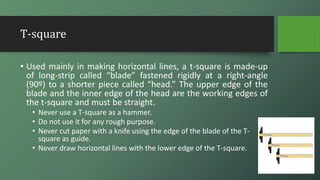
T-square
• Used mainly in making horizontal lines, a t-square is made-up
of long-strip called “blade” fastened rigidly at a right-angle
(90º) to a shorter piece called “head.” The upper edge of the
blade and the inner edge of the head are the working edges of
the t-square and must be straight.
• Never use a T-square as a hammer.
• Do not use it for any rough purpose.
• Never cut paper with a knife using the edge of the blade of the T-
square as guide.
• Never draw horizontal lines with the lower edge of the T-square.
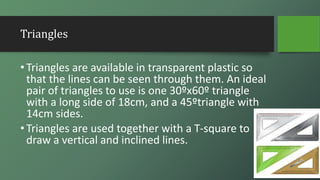
Triangles
•Triangles are available in transparent plastic so
that the lines can be seen through them. An ideal
pair of triangles to use is one 30ºx60º triangle
with a long side of 18cm, and a 45ºtriangle with
14cm sides.
•Triangles are used together with a T-square to
draw a vertical and inclined lines.
Drawing Pencil
• Pencil is the most important tool in any drafting activity.
• Drawing pencils come in various grades of softness or hardness.
• A pencil is a writing implement or art medium usually constructed of a
narrow, solid pigment core inside a protective casing. The case prevents
the core from breaking, and also from marking the user’s hand during use.
• Pencils create marks via physical abrasion, leaving behind a trail of solid
core material that adheres to a sheet of paper or other surface. They are
noticeably distinct from pens, which dispense liquid or gel ink that stain
the light colour of the paper.
Grading and classification of drawing pencil
• Many pencils across the world, and almost all in Europe, are
graded on the European system using a continuum from “H”
(for hardness) to “B” (for blackness), as well as “F” (for fine
point). The standard writing pencil is graded HB. According to
Petroski, this system might have been developed in the early
20th century by Brookman, an English pencil maker. It used “B”
for black and “H” for hard; a pencil's grade was described by a
sequence or successive Hs or Bs such as BB and BBB for
successively softer leads, and HH and HHH for successively
harder ones.
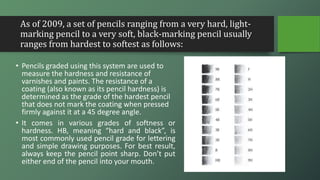
As of 2009, a set of pencils ranging from a very hard, light-
marking pencil to a very soft, black-marking pencil usually
ranges from hardest to softest as follows:
• Pencils graded using this system are used to
measure the hardness and resistance of
varnishes and paints. The resistance of a
coating (also known as its pencil hardness) is
determined as the grade of the hardest pencil
that does not mark the coating when pressed
firmly against it at a 45 degree angle.
• It comes in various grades of softness or
hardness. HB, meaning “hard and black”, is
most commonly used pencil grade for lettering
and simple drawing purposes. For best result,
always keep the pencil point sharp. Don’t put
either end of the pencil into your mouth.
Erasing Shield
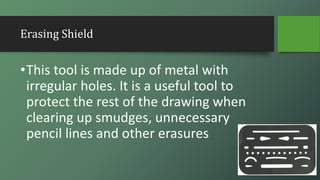
•This tool is made up of metal with
irregular holes. It is a useful tool to
protect the rest of the drawing when
clearing up smudges, unnecessary
pencil lines and other erasures
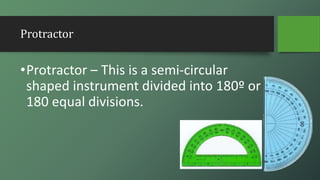
Protractor
•Protractor – This is a semi-circular
shaped instrument divided into 180º or
180 equal divisions.
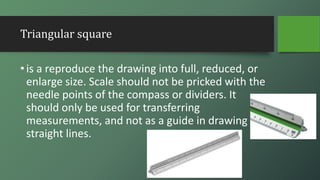
Triangular square
•is a reproduce the drawing into full, reduced, or
enlarge size. Scale should not be pricked with the
needle points of the compass or dividers. It
should only be used for transferring
measurements, and not as a guide in drawing
straight lines.
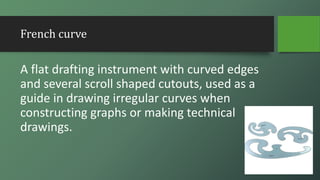
French curve
A flat drafting instrument with curved edges
and several scroll shaped cutouts, used as a
guide in drawing irregular curves when
constructing graphs or making technical
drawings.
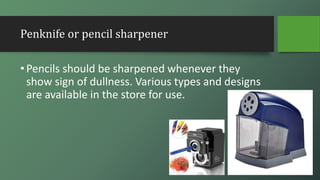
Penknife or pencil sharpener
•Pencils should be sharpened whenever they
show sign of dullness. Various types and designs
are available in the store for use.
Compass
•This drawing instrument is used when drawing
arcs and circles. It is used in a similar way to a
divider. It is composed of one with the pen leg
and the needle point leg being held together with
a handle. This drawing instrument can be used
for both penciling and inking.
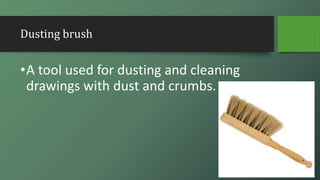
Dusting brush
•A tool used for dusting and cleaning
drawings with dust and crumbs.
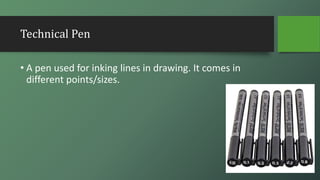
Technical Pen
• A pen used for inking lines in drawing. It comes in
different points/sizes.
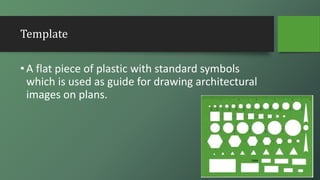
Template
•A flat piece of plastic with standard symbols
which is used as guide for drawing architectural
images on plans.
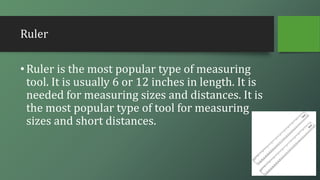
Ruler
•Ruler is the most popular type of measuring
tool. It is usually 6 or 12 inches in length. It is
needed for measuring sizes and distances. It is
the most popular type of tool for measuring
sizes and short distances.
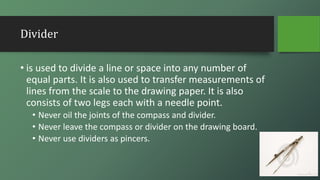
Divider
• is used to divide a line or space into any number of
equal parts. It is also used to transfer measurements of
lines from the scale to the drawing paper. It is also
consists of two legs each with a needle point.
• Never oil the joints of the compass and divider.
• Never leave the compass or divider on the drawing board.
• Never use dividers as pincers.
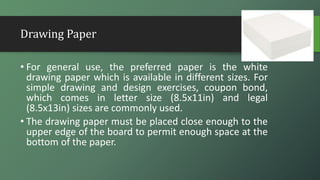
Drawing Paper
• For general use, the preferred paper is the white
drawing paper which is available in different sizes. For
simple drawing and design exercises, coupon bond,
which comes in letter size (8.5x11in) and legal
(8.5x13in) sizes are commonly used.
• The drawing paper must be placed close enough to the
upper edge of the board to permit enough space at the
bottom of the paper.
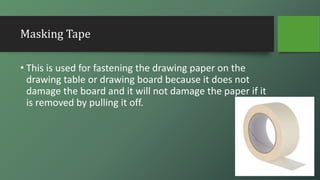
Masking Tape
• This is used for fastening the drawing paper on the
drawing table or drawing board because it does not
damage the board and it will not damage the paper if it
is removed by pulling it off.
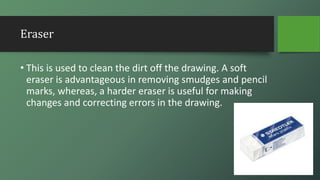
Eraser
• This is used to clean the dirt off the drawing. A soft
eraser is advantageous in removing smudges and pencil
marks, whereas, a harder eraser is useful for making
changes and correcting errors in the drawing.
Sandpaper block
Serves as substitute instrument in
sharpening a pencil into desired points
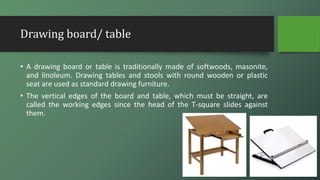
Drawing board/ table
• A drawing board or table is traditionally made of softwoods, masonite,
and linoleum. Drawing tables and stools with round wooden or plastic
seat are used as standard drawing furniture.
• The vertical edges of the board and table, which must be straight, are
called the working edges since the head of the T-square slides against
them.
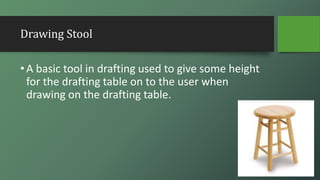
Drawing Stool
•A basic tool in drafting used to give some height
for the drafting table on to the user when
drawing on the drafting table.
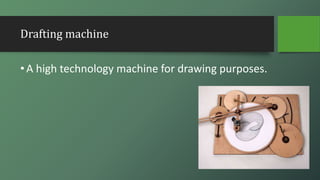
Drafting machine
•A high technology machine for drawing purposes.
-End-

Drafting tools, materials and equipment

  • 1.
  • 2.
    DRAFTING TOOLS •Refers tosets of tools that are used in all drafting works or activities especially if the activities requires mechanical presentation •Hand-held devices that aid in drawing and designing
  • 3.
    T-square • Used mainlyin making horizontal lines, a t-square is made-up of long-strip called “blade” fastened rigidly at a right-angle (90º) to a shorter piece called “head.” The upper edge of the blade and the inner edge of the head are the working edges of the t-square and must be straight. • Never use a T-square as a hammer. • Do not use it for any rough purpose. • Never cut paper with a knife using the edge of the blade of the T- square as guide. • Never draw horizontal lines with the lower edge of the T-square.
  • 4.
    Triangles •Triangles are availablein transparent plastic so that the lines can be seen through them. An ideal pair of triangles to use is one 30ºx60º triangle with a long side of 18cm, and a 45ºtriangle with 14cm sides. •Triangles are used together with a T-square to draw a vertical and inclined lines.
  • 5.
    Drawing Pencil • Pencilis the most important tool in any drafting activity. • Drawing pencils come in various grades of softness or hardness. • A pencil is a writing implement or art medium usually constructed of a narrow, solid pigment core inside a protective casing. The case prevents the core from breaking, and also from marking the user’s hand during use. • Pencils create marks via physical abrasion, leaving behind a trail of solid core material that adheres to a sheet of paper or other surface. They are noticeably distinct from pens, which dispense liquid or gel ink that stain the light colour of the paper.
  • 6.
    Grading and classificationof drawing pencil • Many pencils across the world, and almost all in Europe, are graded on the European system using a continuum from “H” (for hardness) to “B” (for blackness), as well as “F” (for fine point). The standard writing pencil is graded HB. According to Petroski, this system might have been developed in the early 20th century by Brookman, an English pencil maker. It used “B” for black and “H” for hard; a pencil's grade was described by a sequence or successive Hs or Bs such as BB and BBB for successively softer leads, and HH and HHH for successively harder ones.
  • 7.
    As of 2009,a set of pencils ranging from a very hard, light- marking pencil to a very soft, black-marking pencil usually ranges from hardest to softest as follows: • Pencils graded using this system are used to measure the hardness and resistance of varnishes and paints. The resistance of a coating (also known as its pencil hardness) is determined as the grade of the hardest pencil that does not mark the coating when pressed firmly against it at a 45 degree angle. • It comes in various grades of softness or hardness. HB, meaning “hard and black”, is most commonly used pencil grade for lettering and simple drawing purposes. For best result, always keep the pencil point sharp. Don’t put either end of the pencil into your mouth.
  • 8.
    Erasing Shield •This toolis made up of metal with irregular holes. It is a useful tool to protect the rest of the drawing when clearing up smudges, unnecessary pencil lines and other erasures
  • 9.
    Protractor •Protractor – Thisis a semi-circular shaped instrument divided into 180º or 180 equal divisions.
  • 10.
    Triangular square •is areproduce the drawing into full, reduced, or enlarge size. Scale should not be pricked with the needle points of the compass or dividers. It should only be used for transferring measurements, and not as a guide in drawing straight lines.
  • 11.
    French curve A flatdrafting instrument with curved edges and several scroll shaped cutouts, used as a guide in drawing irregular curves when constructing graphs or making technical drawings.
  • 12.
    Penknife or pencilsharpener •Pencils should be sharpened whenever they show sign of dullness. Various types and designs are available in the store for use.
  • 13.
    Compass •This drawing instrumentis used when drawing arcs and circles. It is used in a similar way to a divider. It is composed of one with the pen leg and the needle point leg being held together with a handle. This drawing instrument can be used for both penciling and inking.
  • 14.
    Dusting brush •A toolused for dusting and cleaning drawings with dust and crumbs.
  • 15.
    Technical Pen • Apen used for inking lines in drawing. It comes in different points/sizes.
  • 16.
    Template •A flat pieceof plastic with standard symbols which is used as guide for drawing architectural images on plans.
  • 17.
    Ruler •Ruler is themost popular type of measuring tool. It is usually 6 or 12 inches in length. It is needed for measuring sizes and distances. It is the most popular type of tool for measuring sizes and short distances.
  • 18.
    Divider • is usedto divide a line or space into any number of equal parts. It is also used to transfer measurements of lines from the scale to the drawing paper. It is also consists of two legs each with a needle point. • Never oil the joints of the compass and divider. • Never leave the compass or divider on the drawing board. • Never use dividers as pincers.
  • 19.
    Drawing Paper • Forgeneral use, the preferred paper is the white drawing paper which is available in different sizes. For simple drawing and design exercises, coupon bond, which comes in letter size (8.5x11in) and legal (8.5x13in) sizes are commonly used. • The drawing paper must be placed close enough to the upper edge of the board to permit enough space at the bottom of the paper.
  • 20.
    Masking Tape • Thisis used for fastening the drawing paper on the drawing table or drawing board because it does not damage the board and it will not damage the paper if it is removed by pulling it off.
  • 21.
    Eraser • This isused to clean the dirt off the drawing. A soft eraser is advantageous in removing smudges and pencil marks, whereas, a harder eraser is useful for making changes and correcting errors in the drawing.
  • 22.
    Sandpaper block Serves assubstitute instrument in sharpening a pencil into desired points
  • 23.
    Drawing board/ table •A drawing board or table is traditionally made of softwoods, masonite, and linoleum. Drawing tables and stools with round wooden or plastic seat are used as standard drawing furniture. • The vertical edges of the board and table, which must be straight, are called the working edges since the head of the T-square slides against them.
  • 24.
    Drawing Stool •A basictool in drafting used to give some height for the drafting table on to the user when drawing on the drafting table.
  • 25.
    Drafting machine •A hightechnology machine for drawing purposes.
  • 26.