MECHANICAL
DRAFTING
PREPARED BY:
ABDULCARIM P.
CASAN
Objectives:
1. Explain the function of Drafting
tools.
2. Illustrate the Drafting tools.
3. Appreciate the Drafting tools
UNLOCKING DEFINITION
TERM:
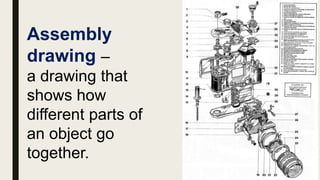
Assembly
drawing –
a drawing that
shows how
different parts of
an object go
together.
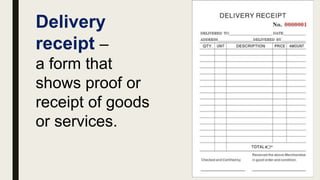
Delivery
receipt –
a form that
shows proof or
receipt of goods
or services.
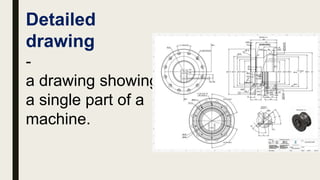
Detailed
drawing
-
a drawing showing
a single part of a
machine.
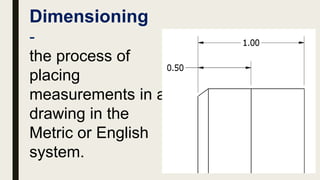
Dimensioning
-
the process of
placing
measurements in a
drawing in the
Metric or English
system.
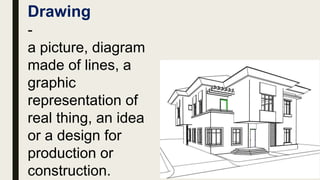
Drawing
-
a picture, diagram
made of lines, a
graphic
representation of
real thing, an idea
or a design for
production or
construction.
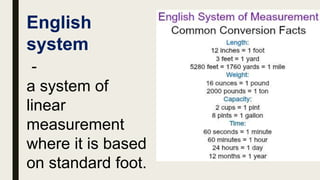
English
system
-
a system of
linear
measurement
where it is based
on standard foot.
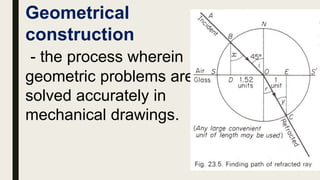
Geometrical
construction
- the process wherein
geometric problems are
solved accurately in
mechanical drawings.
Mechanical drafting
- a process for making accurate
drawings using special drawing tools and
instruments
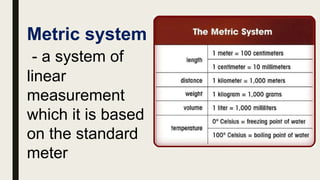
Metric system
- a system of
linear
measurement
which it is based
on the standard
meter
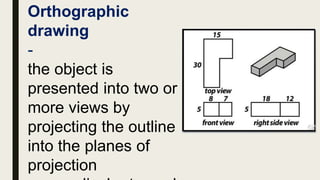
Orthographic
drawing
-
the object is
presented into two or
more views by
projecting the outline
into the planes of
projection
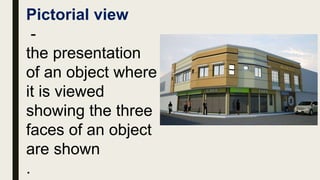
Pictorial view
-
the presentation
of an object where
it is viewed
showing the three
faces of an object
are shown
.
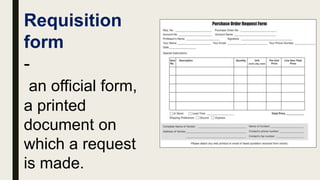
Requisition
form
-
an official form,
a printed
document on
which a request
is made.
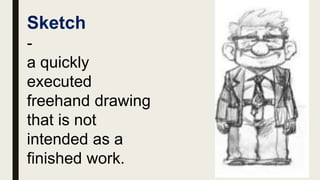
Sketch
-
a quickly
executed
freehand drawing
that is not
intended as a
finished work.
Drafting Materials and Tools
There is a great variety of drafting
materials and tools used in mechanical
drawing. The drafting materials and tools
discussed in this Module include most of
the basic ones but sufficient enough for
your initial understanding about
mechanical drawing.
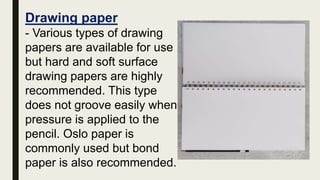
Drawing paper
- Various types of drawing
papers are available for use
but hard and soft surface
drawing papers are highly
recommended. This type
does not groove easily when
pressure is applied to the
pencil. Oslo paper is
commonly used but bond
paper is also recommended.
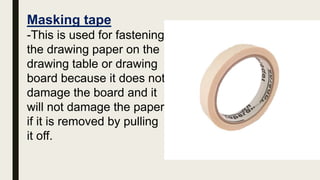
Masking tape
-This is used for fastening
the drawing paper on the
drawing table or drawing
board because it does not
damage the board and it
will not damage the paper
if it is removed by pulling
it off.
Pencil sharpener
-Pencils should be
sharpened whenever
they show sign of
dullness. Various
types and designs
are available in the
store for use.
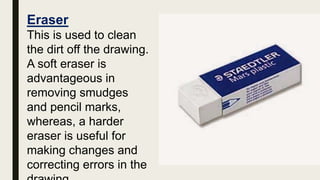
Eraser
This is used to clean
the dirt off the drawing.
A soft eraser is
advantageous in
removing smudges
and pencil marks,
whereas, a harder
eraser is useful for
making changes and
correcting errors in the
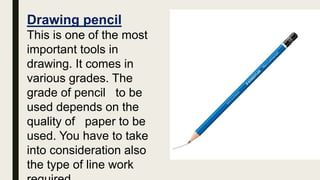
Drawing pencil
This is one of the most
important tools in
drawing. It comes in
various grades. The
grade of pencil to be
used depends on the
quality of paper to be
used. You have to take
into consideration also
the type of line work
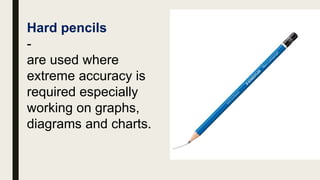
Hard pencils
-
are used where
extreme accuracy is
required especially
working on graphs,
diagrams and charts.
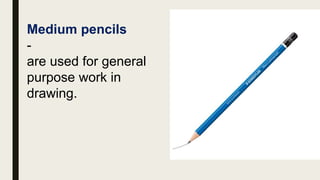
Medium pencils
-
are used for general
purpose work in
drawing.
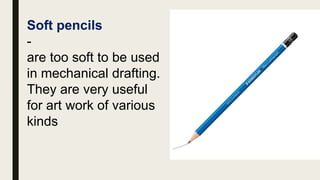
Soft pencils
-
are too soft to be used
in mechanical drafting.
They are very useful
for art work of various
kinds
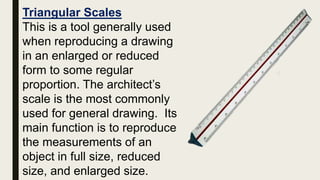
Triangular Scales
This is a tool generally used
when reproducing a drawing
in an enlarged or reduced
form to some regular
proportion. The architect’s
scale is the most commonly
used for general drawing. Its
main function is to reproduce
the measurements of an
object in full size, reduced
size, and enlarged size.
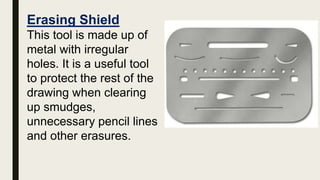
Erasing Shield
This tool is made up of
metal with irregular
holes. It is a useful tool
to protect the rest of the
drawing when clearing
up smudges,
unnecessary pencil lines
and other erasures.
DRAWING INSTRUMENTS
Drawing instruments are used for drawing and
designing purposes. Their quality is very essential if
you want to have good result. Cheaper drawing
tools and instruments do not only provide poor
quality results but also do not last long. You have to
observe proper handling and care of drawing
instrument if you want them to function accurately.
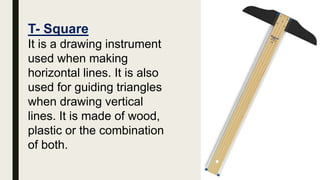
T- Square
It is a drawing instrument
used when making
horizontal lines. It is also
used for guiding triangles
when drawing vertical
lines. It is made of wood,
plastic or the combination
of both.
There are three (3) types of T- square, namely:
1. Fixed Head. The head is fastened to the
blade. It is used for ordinary work.
2. Movable Head or Adjustable Head. It has
one fixed and one adjustable head and used only
for occasional drawing.
3. Detachable Head or Removable Head. It is
designed for comfort when carrying the T-square.
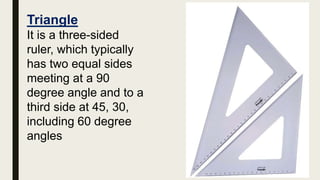
Triangle
It is a three-sided
ruler, which typically
has two equal sides
meeting at a 90
degree angle and to a
third side at 45, 30,
including 60 degree
angles
Commonly used triangles are:
a. 30 degrees X 60 degrees
b. 45 degrees X 45 degrees
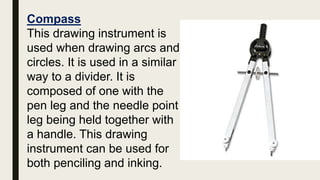
Compass
This drawing instrument is
used when drawing arcs and
circles. It is used in a similar
way to a divider. It is
composed of one with the
pen leg and the needle point
leg being held together with
a handle. This drawing
instrument can be used for
both penciling and inking.
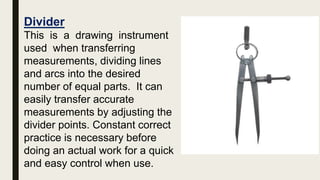
Divider
This is a drawing instrument
used when transferring
measurements, dividing lines
and arcs into the desired
number of equal parts. It can
easily transfer accurate
measurements by adjusting the
divider points. Constant correct
practice is necessary before
doing an actual work for a quick
and easy control when use.
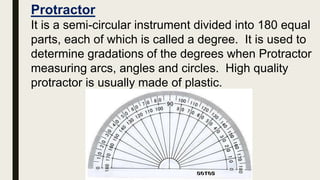
Protractor
It is a semi-circular instrument divided into 180 equal
parts, each of which is called a degree. It is used to
determine gradations of the degrees when Protractor
measuring arcs, angles and circles. High quality
protractor is usually made of plastic.
QUIZ TIME
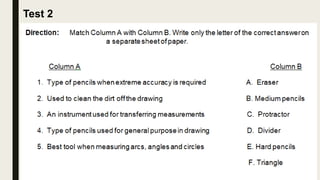
Test 2
Assignment
Okay class, since you already know about drafting
tools and drawing instruments. I will give you an
assignment. Now, your assignment is to bring
following materials next meeting and I will
demonstrate to you how to use the tools, 15points for
those students bring their tools.
1. drawing book
2. pencil
3. eraser
4. ruler
5. triangle ruler
Drafting tools

Drafting tools

  • 1.
  • 2.
    Objectives: 1. Explain thefunction of Drafting tools. 2. Illustrate the Drafting tools. 3. Appreciate the Drafting tools
  • 3.
  • 4.
    Assembly drawing – a drawingthat shows how different parts of an object go together.
  • 5.
    Delivery receipt – a formthat shows proof or receipt of goods or services.
  • 6.
    Detailed drawing - a drawing showing asingle part of a machine.
  • 7.
    Dimensioning - the process of placing measurementsin a drawing in the Metric or English system.
  • 8.
    Drawing - a picture, diagram madeof lines, a graphic representation of real thing, an idea or a design for production or construction.
  • 9.
  • 10.
    Geometrical construction - the processwherein geometric problems are solved accurately in mechanical drawings.
  • 11.
    Mechanical drafting - aprocess for making accurate drawings using special drawing tools and instruments
  • 12.
    Metric system - asystem of linear measurement which it is based on the standard meter
  • 13.
    Orthographic drawing - the object is presentedinto two or more views by projecting the outline into the planes of projection
  • 14.
    Pictorial view - the presentation ofan object where it is viewed showing the three faces of an object are shown .
  • 15.
    Requisition form - an official form, aprinted document on which a request is made.
  • 16.
    Sketch - a quickly executed freehand drawing thatis not intended as a finished work.
  • 17.
    Drafting Materials andTools There is a great variety of drafting materials and tools used in mechanical drawing. The drafting materials and tools discussed in this Module include most of the basic ones but sufficient enough for your initial understanding about mechanical drawing.
  • 18.
    Drawing paper - Varioustypes of drawing papers are available for use but hard and soft surface drawing papers are highly recommended. This type does not groove easily when pressure is applied to the pencil. Oslo paper is commonly used but bond paper is also recommended.
  • 19.
    Masking tape -This isused for fastening the drawing paper on the drawing table or drawing board because it does not damage the board and it will not damage the paper if it is removed by pulling it off.
  • 20.
    Pencil sharpener -Pencils shouldbe sharpened whenever they show sign of dullness. Various types and designs are available in the store for use.
  • 21.
    Eraser This is usedto clean the dirt off the drawing. A soft eraser is advantageous in removing smudges and pencil marks, whereas, a harder eraser is useful for making changes and correcting errors in the
  • 22.
    Drawing pencil This isone of the most important tools in drawing. It comes in various grades. The grade of pencil to be used depends on the quality of paper to be used. You have to take into consideration also the type of line work
  • 23.
    Hard pencils - are usedwhere extreme accuracy is required especially working on graphs, diagrams and charts.
  • 24.
    Medium pencils - are usedfor general purpose work in drawing.
  • 25.
    Soft pencils - are toosoft to be used in mechanical drafting. They are very useful for art work of various kinds
  • 26.
    Triangular Scales This isa tool generally used when reproducing a drawing in an enlarged or reduced form to some regular proportion. The architect’s scale is the most commonly used for general drawing. Its main function is to reproduce the measurements of an object in full size, reduced size, and enlarged size.
  • 27.
    Erasing Shield This toolis made up of metal with irregular holes. It is a useful tool to protect the rest of the drawing when clearing up smudges, unnecessary pencil lines and other erasures.
  • 28.
    DRAWING INSTRUMENTS Drawing instrumentsare used for drawing and designing purposes. Their quality is very essential if you want to have good result. Cheaper drawing tools and instruments do not only provide poor quality results but also do not last long. You have to observe proper handling and care of drawing instrument if you want them to function accurately.
  • 29.
    T- Square It isa drawing instrument used when making horizontal lines. It is also used for guiding triangles when drawing vertical lines. It is made of wood, plastic or the combination of both.
  • 30.
    There are three(3) types of T- square, namely: 1. Fixed Head. The head is fastened to the blade. It is used for ordinary work. 2. Movable Head or Adjustable Head. It has one fixed and one adjustable head and used only for occasional drawing. 3. Detachable Head or Removable Head. It is designed for comfort when carrying the T-square.
  • 31.
    Triangle It is athree-sided ruler, which typically has two equal sides meeting at a 90 degree angle and to a third side at 45, 30, including 60 degree angles
  • 32.
    Commonly used trianglesare: a. 30 degrees X 60 degrees b. 45 degrees X 45 degrees
  • 33.
    Compass This drawing instrumentis used when drawing arcs and circles. It is used in a similar way to a divider. It is composed of one with the pen leg and the needle point leg being held together with a handle. This drawing instrument can be used for both penciling and inking.
  • 34.
    Divider This is adrawing instrument used when transferring measurements, dividing lines and arcs into the desired number of equal parts. It can easily transfer accurate measurements by adjusting the divider points. Constant correct practice is necessary before doing an actual work for a quick and easy control when use.
  • 35.
    Protractor It is asemi-circular instrument divided into 180 equal parts, each of which is called a degree. It is used to determine gradations of the degrees when Protractor measuring arcs, angles and circles. High quality protractor is usually made of plastic.
  • 36.
  • 38.
  • 39.
    Assignment Okay class, sinceyou already know about drafting tools and drawing instruments. I will give you an assignment. Now, your assignment is to bring following materials next meeting and I will demonstrate to you how to use the tools, 15points for those students bring their tools. 1. drawing book 2. pencil 3. eraser 4. ruler 5. triangle ruler