Different Literary types / Genre
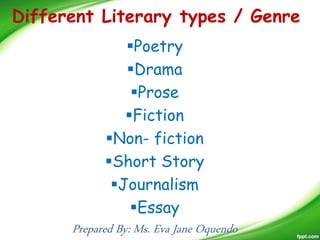
Poetry
Drama
Prose
Fiction
Non- fiction
Short Story
Journalism
Essay
Prepared By: Ms. Eva Jane Oquendo
Different Literary types / Genre
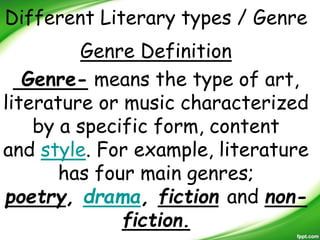
Genre Definition
Genre- means the type of art,
literature or music characterized
by a specific form, content
and style. For example, literature
has four main genres;
poetry, drama, fiction and non-
fiction.
All of these genres have
particular features and functions
that distinguish them from one
another. Hence, it is necessary on
the part of readers to know which
category of genre they are
reading in order to understand
the message it conveys, as they
may have certain expectations
prior to the reading concerned.
Types of Genre
•There are five types of genres in
literature, which include:
Poetry
Poetry- is the first major literary
genre. All types of poetry share
specific characteristics. In fact,
poetry is a form of text that
follows a meter and rhythm with
each lines and syllables.
subdivided into different genres
such an epic poem, narrative,
romantic, dramatic, and lyric.
Dramatic poetry
includes melodrama, tragedy and
comedy, while other poems
includes ode,sonnet, elegy, ballad,
song and epics.
•Popular examples of epic poems
are Paradise Lost by John
Milton, The Iliad and The
Odyssey by Homer and romantic
poem includes, Red Red Rose
byRobert Burns etc.
•All these poetic forms share
specific features such as they do
not follow paragraphs or sentences;
they use stanzas and lines instead.
•Some forms follow very strict
rules of length and number of
stanzas and lines such as villanelle,
sonnet and haiku etc.
•while some may be free like a
free verse poem “Feelings, Now” by
Katherine Foreman that is devoid of any
regular meter and rhyme scheme. Besides
that, often poetry uses figurative
language like metaphor,simile, onomatopoe
ia, hyperbole, and alliteration, etc. to
create heightened effects.
Drama
Drama -is a form of text that is
performed in front of an audience. -
It is also called a play.
Its written text contains dialogues,
and stage directions.
This genre has further categories
such as comedy,
tragedy, tragicomedy etc.
William Shakespeare is known as the
father of English drama.
His well-known plays
include Taming of the Shrew,
Romeo & Juliet and Hamlet,
while Greek playwrights were the
pioneers in this field such as
Sophocles’ masterpiece is Oedipus
Rex and Antigone,
while modern dramas
include Death of a Salesman by
Arthur Miller etc.
Prose
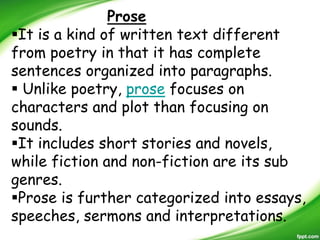
It is a kind of written text different
from poetry in that it has complete
sentences organized into paragraphs.
 Unlike poetry, prose focuses on
characters and plot than focusing on
sounds.
It includes short stories and novels,
while fiction and non-fiction are its sub
genres.
Prose is further categorized into essays,
speeches, sermons and interpretations.
Fiction
Fiction -has three categories that are,
realistic, non-realistic and semi-fiction.
 Usually, fiction work is not real and
therefore, authors can use complex
figurative language to touch readers’
imagination.
Unlike poetry, it is more structured,
follows proper grammatical pattern and
correct mechanics.
A fictional work may incorporate
fantastical and imaginary ideas from
everyday life.
It comprises some important elements
such as
plot, exposition, foreshadowing, rising
action, climax, falling action and
resolution.
The popular examples of literary
fiction include, James Joyce’s’ novel A
Portrait of an Artist as a Young Man,
Charles Dickens’ A Tale of Two Cities,
Jane Austen’s Pride and Prejudice,
and Harper Lee’s To Kill a Mockingbird,
etc.
Non-Fiction
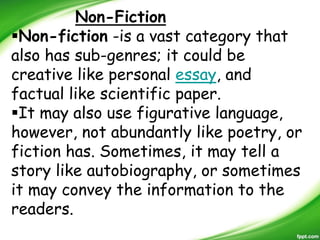
Non-fiction -is a vast category that
also has sub-genres; it could be
creative like personal essay, and
factual like scientific paper.
It may also use figurative language,
however, not abundantly like poetry, or
fiction has. Sometimes, it may tell a
story like autobiography, or sometimes
it may convey the information to the
readers.
Other examples of non-fiction
include biographies, diaries, memoirs,
journals, fantasies, mysteries and
romances.
The popular example of non-fiction
genre is Michael Pollan’s highly
celebrated book, The
Omnivore’s Dilemma: A Natural
History of Four Meals, which is an
account about eating habits of
Americans.
Short story-
brief fictional prose narrative that
is shorter than a novel and that
usually deals with only a few
characters .
The short story is usually
concerned with a single effect
conveyed in only one or a few
significant episodes or scenes.
subject.
The form encourages economy
ofsetting, concise narrative, and the
omission of a
complex plot; character is disclosed in
action and dramatic encounter but is
seldom fully developed. Despite its
relatively limited scope, though, a
short story is often judged by its
ability to provide a “complete” or
satisfying treatment of its characters
and subject.
Journalism
Journalism - is gathering, processing,
and dissemination of news, and
information related to news, to
an audience.
The word applies to the method of
inquiring for news, the literary style
which is used to disseminate it, and the
activity (professional or not) of
journalism.
The media that journalism uses
vary diversely and include:
content published via newspapers
and magazines (print),
television and
radio (broadcast), and their digital
media versions — news websites
and applications
Essays
Essay - are generally scholarly pieces of
writing giving the author's own argument,
but the definition is vague, overlapping
with those of anarticle, a pamphlet and
a short story.
Essays can consist of a number of
elements, including: literary criticism,
political manifestos, learned arguments,
observations of daily life, recollections,
and reflections of the author.
Almost all modern essays are written
in prose, but works in verse have been
dubbed essays (e.g. Alexander Pope's An
Essay on Criticism and An Essay on Man).
While brevity usually defines an essay,
voluminous works like John Locke's An Essay
Concerning Human
Understanding and Thomas Malthus's An
Essay on the Principle of Population are
counterexamples.
In some countries (e.g., the United States
and Canada), essays have become a major
part of formal education.
Secondary students are taught
structured essay formats to improve
their writing skills; admission essays are
often used by universities in selecting
applicants, and in the humanities and
social sciences essays are often used as a
way of assessing the performance of
students during final exams.
 The concept of an "essay" has been
extended to other mediums beyond
writing.
Function of Genre
Depending upon their types, different
genres have different roles.
For example, fiction and dramatic
genres help students and writers learn
and improve their communication skills.
A poetic genre, on the other hand,
enhances imaginative and emotional
power of the readers.
 Non-fictional texts and essays
help readers develop analytical and
persuasive capabilities.
 However, the major function of
genre is to establish a code of
behavior between the writers and
audience, and keep the readers
informed about the topics
discussed or the themes presented.

Different literary types

  • 1.
    Different Literary types/ Genre Poetry Drama Prose Fiction Non- fiction Short Story Journalism Essay Prepared By: Ms. Eva Jane Oquendo
  • 2.
    Different Literary types/ Genre Genre Definition Genre- means the type of art, literature or music characterized by a specific form, content and style. For example, literature has four main genres; poetry, drama, fiction and non- fiction.
  • 3.
    All of thesegenres have particular features and functions that distinguish them from one another. Hence, it is necessary on the part of readers to know which category of genre they are reading in order to understand the message it conveys, as they may have certain expectations prior to the reading concerned.
  • 4.
    Types of Genre •Thereare five types of genres in literature, which include: Poetry Poetry- is the first major literary genre. All types of poetry share specific characteristics. In fact, poetry is a form of text that follows a meter and rhythm with each lines and syllables.
  • 5.
    subdivided into differentgenres such an epic poem, narrative, romantic, dramatic, and lyric. Dramatic poetry includes melodrama, tragedy and comedy, while other poems includes ode,sonnet, elegy, ballad, song and epics.
  • 6.
    •Popular examples ofepic poems are Paradise Lost by John Milton, The Iliad and The Odyssey by Homer and romantic poem includes, Red Red Rose byRobert Burns etc. •All these poetic forms share specific features such as they do not follow paragraphs or sentences; they use stanzas and lines instead.
  • 7.
    •Some forms followvery strict rules of length and number of stanzas and lines such as villanelle, sonnet and haiku etc. •while some may be free like a free verse poem “Feelings, Now” by Katherine Foreman that is devoid of any regular meter and rhyme scheme. Besides that, often poetry uses figurative language like metaphor,simile, onomatopoe ia, hyperbole, and alliteration, etc. to create heightened effects.
  • 8.
    Drama Drama -is aform of text that is performed in front of an audience. - It is also called a play. Its written text contains dialogues, and stage directions. This genre has further categories such as comedy, tragedy, tragicomedy etc. William Shakespeare is known as the father of English drama.
  • 9.
    His well-known plays includeTaming of the Shrew, Romeo & Juliet and Hamlet, while Greek playwrights were the pioneers in this field such as Sophocles’ masterpiece is Oedipus Rex and Antigone, while modern dramas include Death of a Salesman by Arthur Miller etc.
  • 10.
    Prose It is akind of written text different from poetry in that it has complete sentences organized into paragraphs.  Unlike poetry, prose focuses on characters and plot than focusing on sounds. It includes short stories and novels, while fiction and non-fiction are its sub genres. Prose is further categorized into essays, speeches, sermons and interpretations.
  • 11.
    Fiction Fiction -has threecategories that are, realistic, non-realistic and semi-fiction.  Usually, fiction work is not real and therefore, authors can use complex figurative language to touch readers’ imagination. Unlike poetry, it is more structured, follows proper grammatical pattern and correct mechanics. A fictional work may incorporate fantastical and imaginary ideas from everyday life.
  • 12.
    It comprises someimportant elements such as plot, exposition, foreshadowing, rising action, climax, falling action and resolution. The popular examples of literary fiction include, James Joyce’s’ novel A Portrait of an Artist as a Young Man, Charles Dickens’ A Tale of Two Cities, Jane Austen’s Pride and Prejudice, and Harper Lee’s To Kill a Mockingbird, etc.
  • 13.
    Non-Fiction Non-fiction -is avast category that also has sub-genres; it could be creative like personal essay, and factual like scientific paper. It may also use figurative language, however, not abundantly like poetry, or fiction has. Sometimes, it may tell a story like autobiography, or sometimes it may convey the information to the readers.
  • 14.
    Other examples ofnon-fiction include biographies, diaries, memoirs, journals, fantasies, mysteries and romances. The popular example of non-fiction genre is Michael Pollan’s highly celebrated book, The Omnivore’s Dilemma: A Natural History of Four Meals, which is an account about eating habits of Americans.
  • 15.
    Short story- brief fictionalprose narrative that is shorter than a novel and that usually deals with only a few characters . The short story is usually concerned with a single effect conveyed in only one or a few significant episodes or scenes. subject.
  • 16.
    The form encourageseconomy ofsetting, concise narrative, and the omission of a complex plot; character is disclosed in action and dramatic encounter but is seldom fully developed. Despite its relatively limited scope, though, a short story is often judged by its ability to provide a “complete” or satisfying treatment of its characters and subject.
  • 17.
    Journalism Journalism - isgathering, processing, and dissemination of news, and information related to news, to an audience. The word applies to the method of inquiring for news, the literary style which is used to disseminate it, and the activity (professional or not) of journalism.
  • 18.
    The media thatjournalism uses vary diversely and include: content published via newspapers and magazines (print), television and radio (broadcast), and their digital media versions — news websites and applications
  • 19.
    Essays Essay - aregenerally scholarly pieces of writing giving the author's own argument, but the definition is vague, overlapping with those of anarticle, a pamphlet and a short story. Essays can consist of a number of elements, including: literary criticism, political manifestos, learned arguments, observations of daily life, recollections, and reflections of the author.
  • 20.
    Almost all modernessays are written in prose, but works in verse have been dubbed essays (e.g. Alexander Pope's An Essay on Criticism and An Essay on Man). While brevity usually defines an essay, voluminous works like John Locke's An Essay Concerning Human Understanding and Thomas Malthus's An Essay on the Principle of Population are counterexamples. In some countries (e.g., the United States and Canada), essays have become a major part of formal education.
  • 21.
    Secondary students aretaught structured essay formats to improve their writing skills; admission essays are often used by universities in selecting applicants, and in the humanities and social sciences essays are often used as a way of assessing the performance of students during final exams.  The concept of an "essay" has been extended to other mediums beyond writing.
  • 22.
    Function of Genre Dependingupon their types, different genres have different roles. For example, fiction and dramatic genres help students and writers learn and improve their communication skills. A poetic genre, on the other hand, enhances imaginative and emotional power of the readers.
  • 23.
     Non-fictional textsand essays help readers develop analytical and persuasive capabilities.  However, the major function of genre is to establish a code of behavior between the writers and audience, and keep the readers informed about the topics discussed or the themes presented.