FairFields Consulting
What should a consultant be doing
at different stages
Matthew Baird
Environmental Law and Policy
(Presenting for Sally Johnson)
19 March 2018
FairFields Consulting
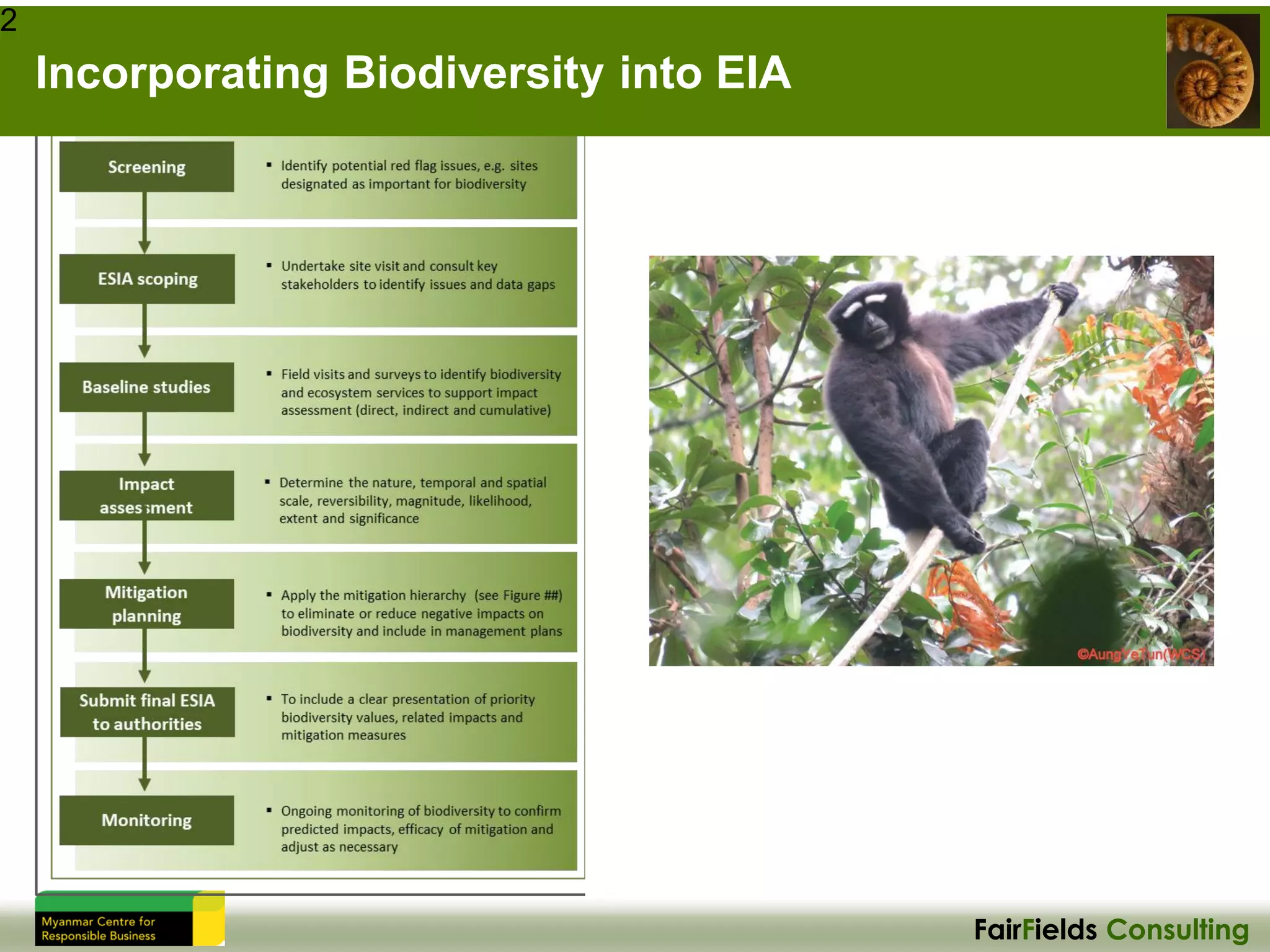
Incorporating Biodiversity into EIA
2
FairFields Consulting
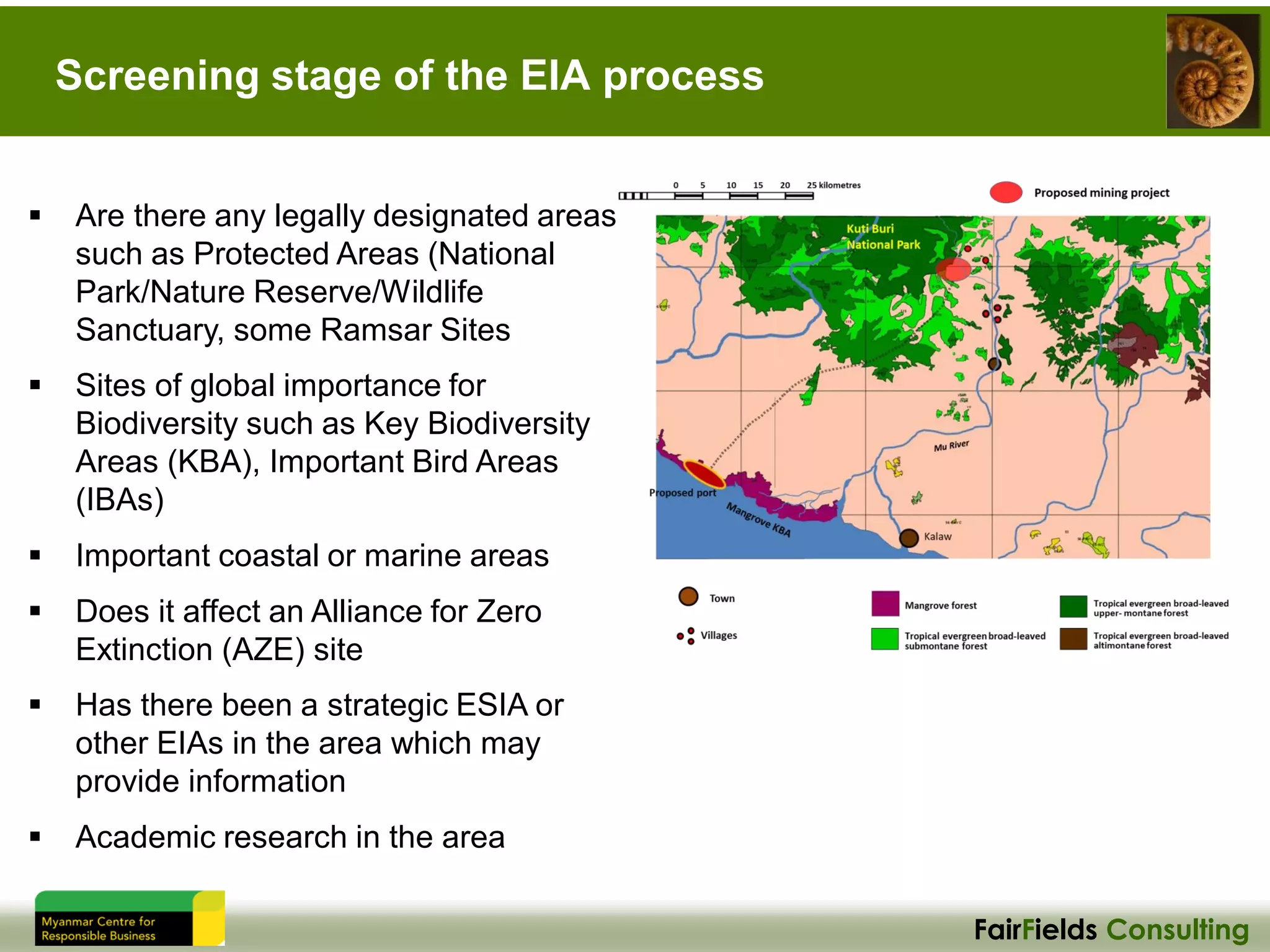
Screening stage of the EIA process
▪ Are there any legally designated areas
such as Protected Areas (National
Park/Nature Reserve/Wildlife
Sanctuary, some Ramsar Sites
▪ Sites of global importance for
Biodiversity such as Key Biodiversity
Areas (KBA), Important Bird Areas
(IBAs)
▪ Important coastal or marine areas
▪ Does it affect an Alliance for Zero
Extinction (AZE) site
▪ Has there been a strategic ESIA or
other EIAs in the area which may
provide information
▪ Academic research in the area
FairFields Consulting
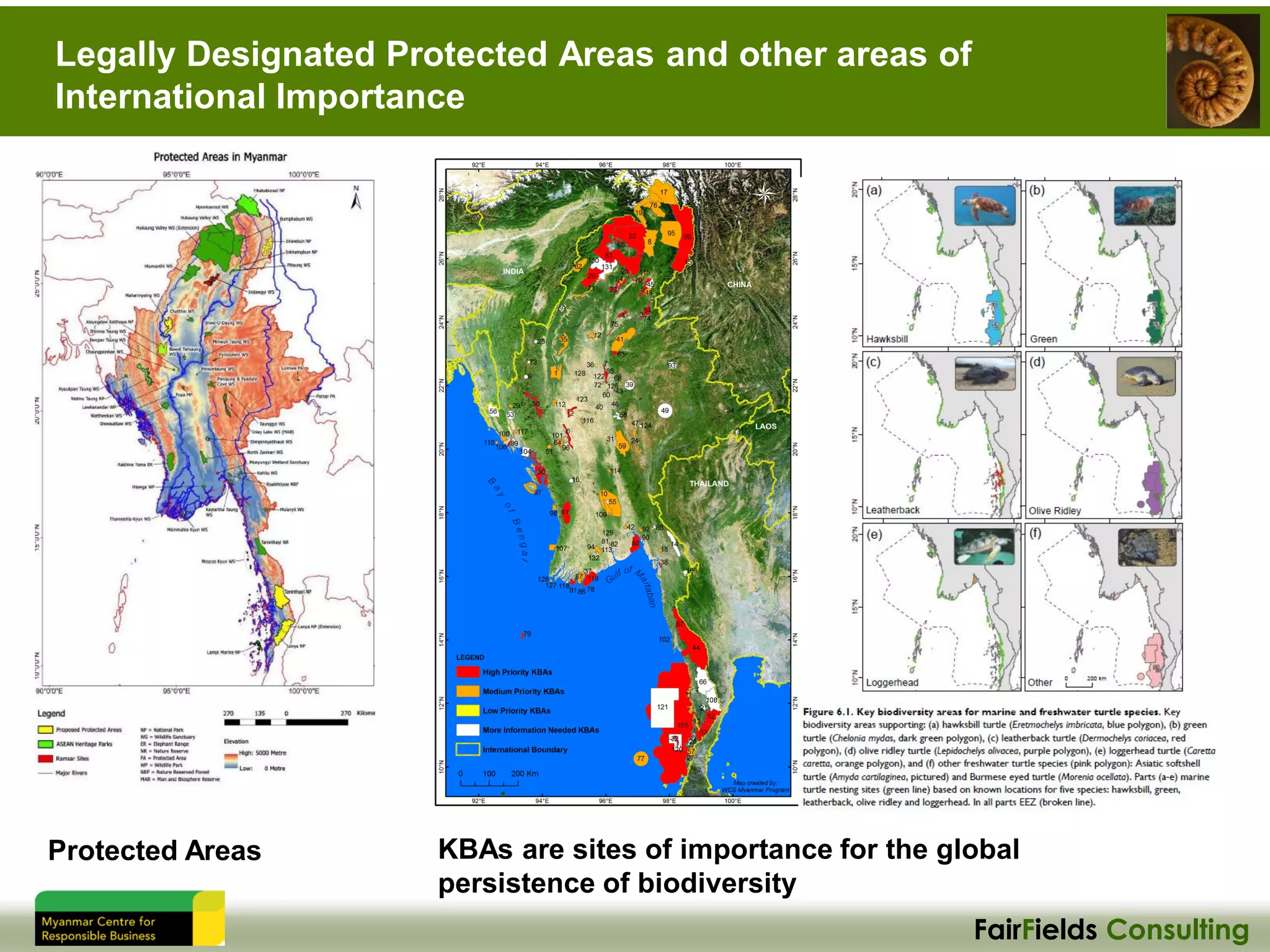
Legally Designated Protected Areas and other areas of
International Importance
KBAs are sites of importance for the global
persistence of biodiversity
Protected Areas
FairFields Consulting
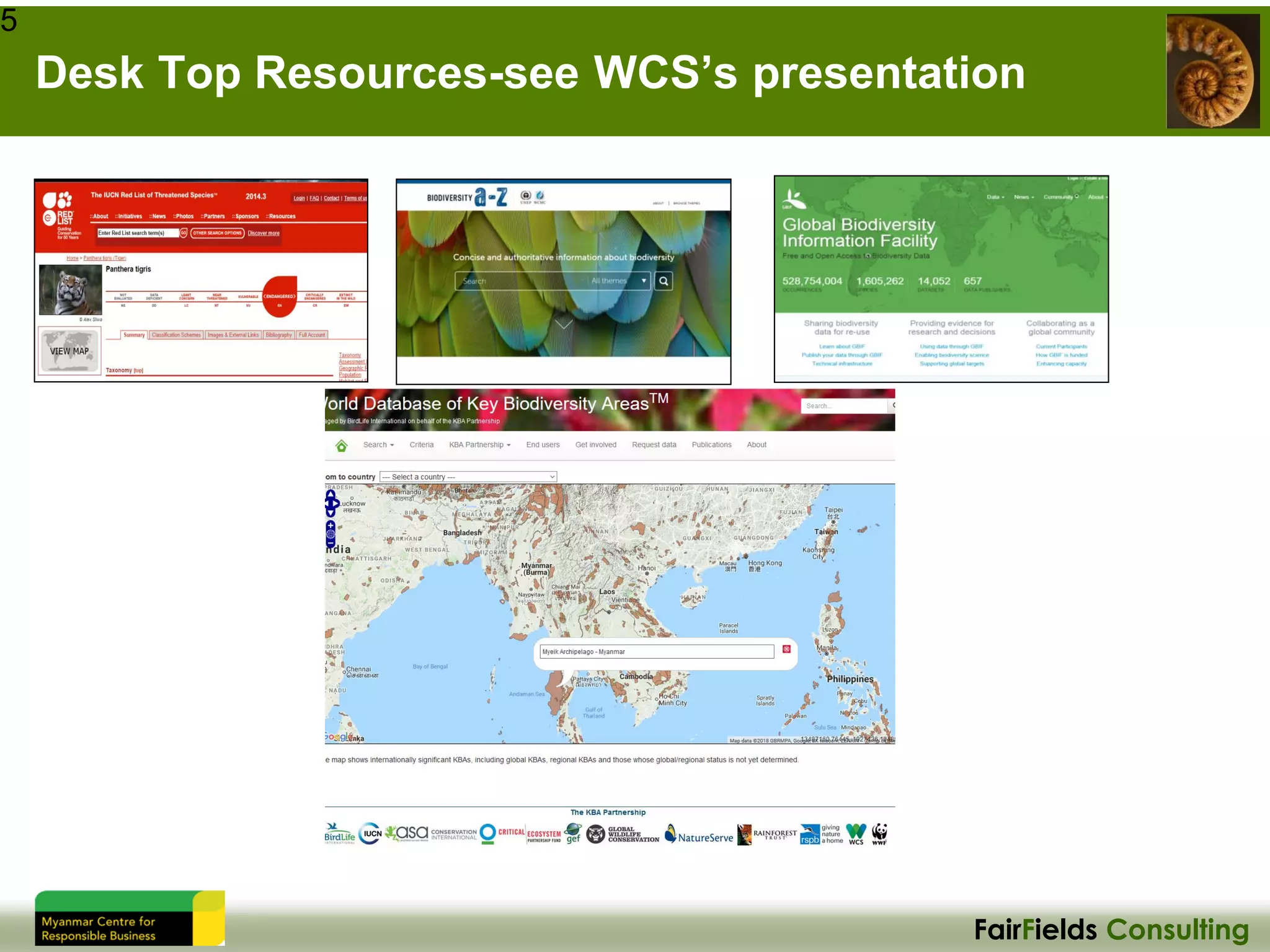
Desk Top Resources-see WCS’s presentation
5
FairFields Consulting
Scoping stage of the ESIA process
Scoping is the process of determining the content of the
Biodiversity component of the EIA
▪ Understand the project (location, size, extent, temporal
and spatial organization, other infrastructure and
activities;
▪ Alternative options
▪ Consult stakeholders -relevant experts, NGOs, academic,
communities
▪ Defining the project area of influence
▪ Site visit
▪ What will be included in the biodiversity baseline surveys
FairFields Consulting
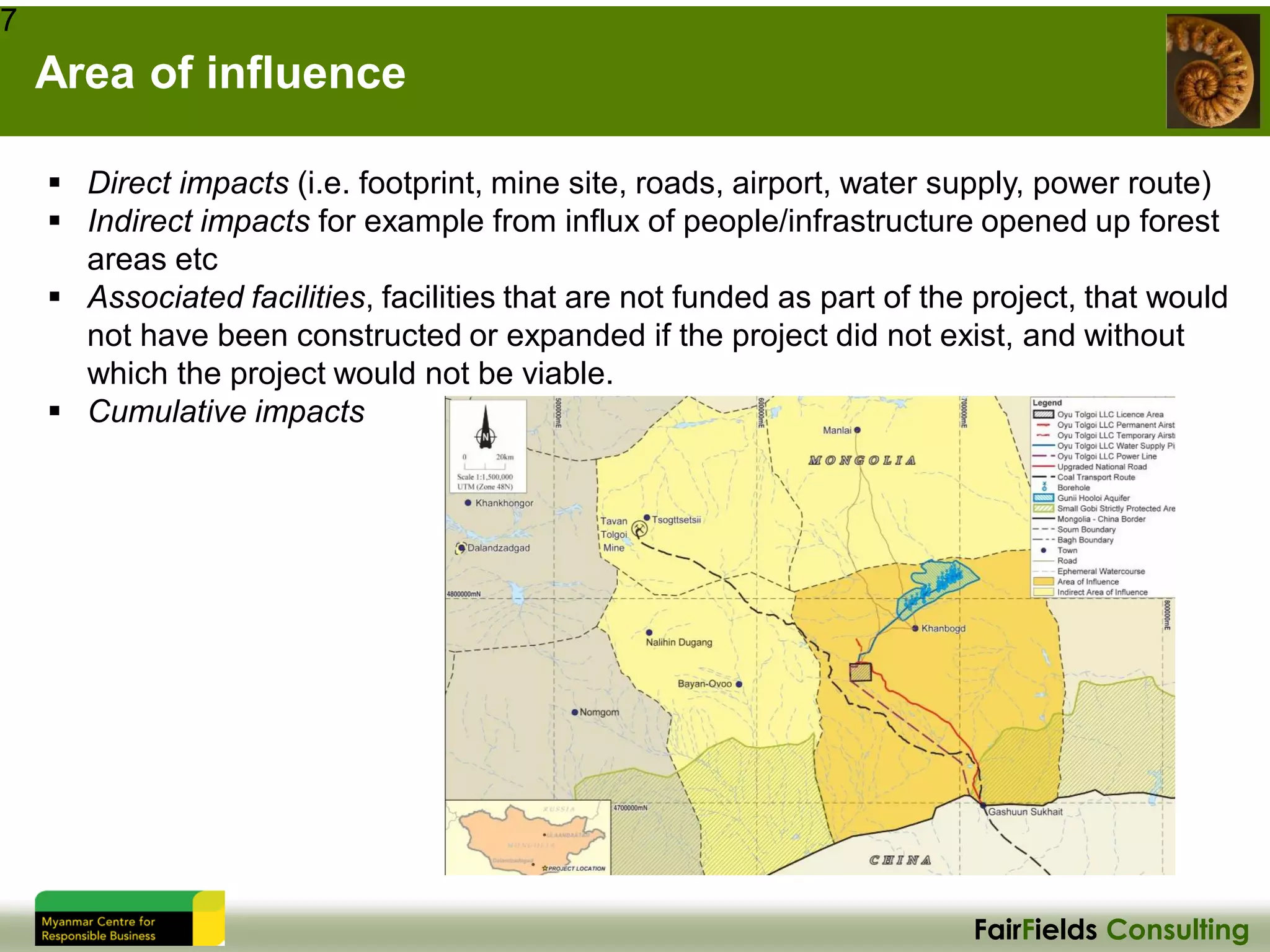
Area of influence
7
▪ Direct impacts (i.e. footprint, mine site, roads, airport, water supply, power route)
▪ Indirect impacts for example from influx of people/infrastructure opened up forest
areas etc
▪ Associated facilities, facilities that are not funded as part of the project, that would
not have been constructed or expanded if the project did not exist, and without
which the project would not be viable.
▪ Cumulative impacts
FairFields Consulting
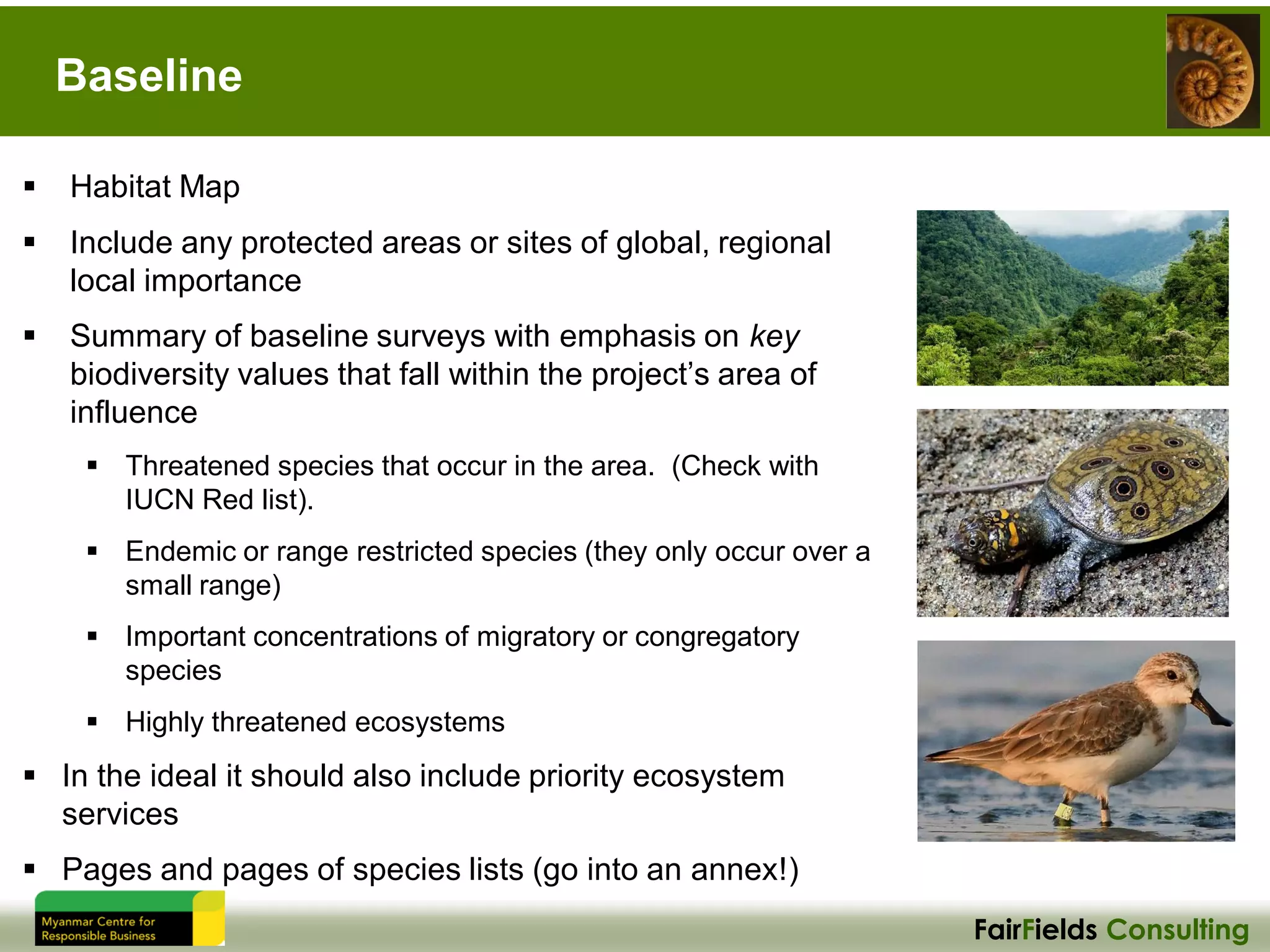
Baseline
▪ Habitat Map
▪ Include any protected areas or sites of global, regional
local importance
▪ Summary of baseline surveys with emphasis on key
biodiversity values that fall within the project’s area of
influence
▪ Threatened species that occur in the area. (Check with
IUCN Red list).
▪ Endemic or range restricted species (they only occur over a
small range)
▪ Important concentrations of migratory or congregatory
species
▪ Highly threatened ecosystems
▪ In the ideal it should also include priority ecosystem
services
▪ Pages and pages of species lists (go into an annex!)
FairFields Consulting
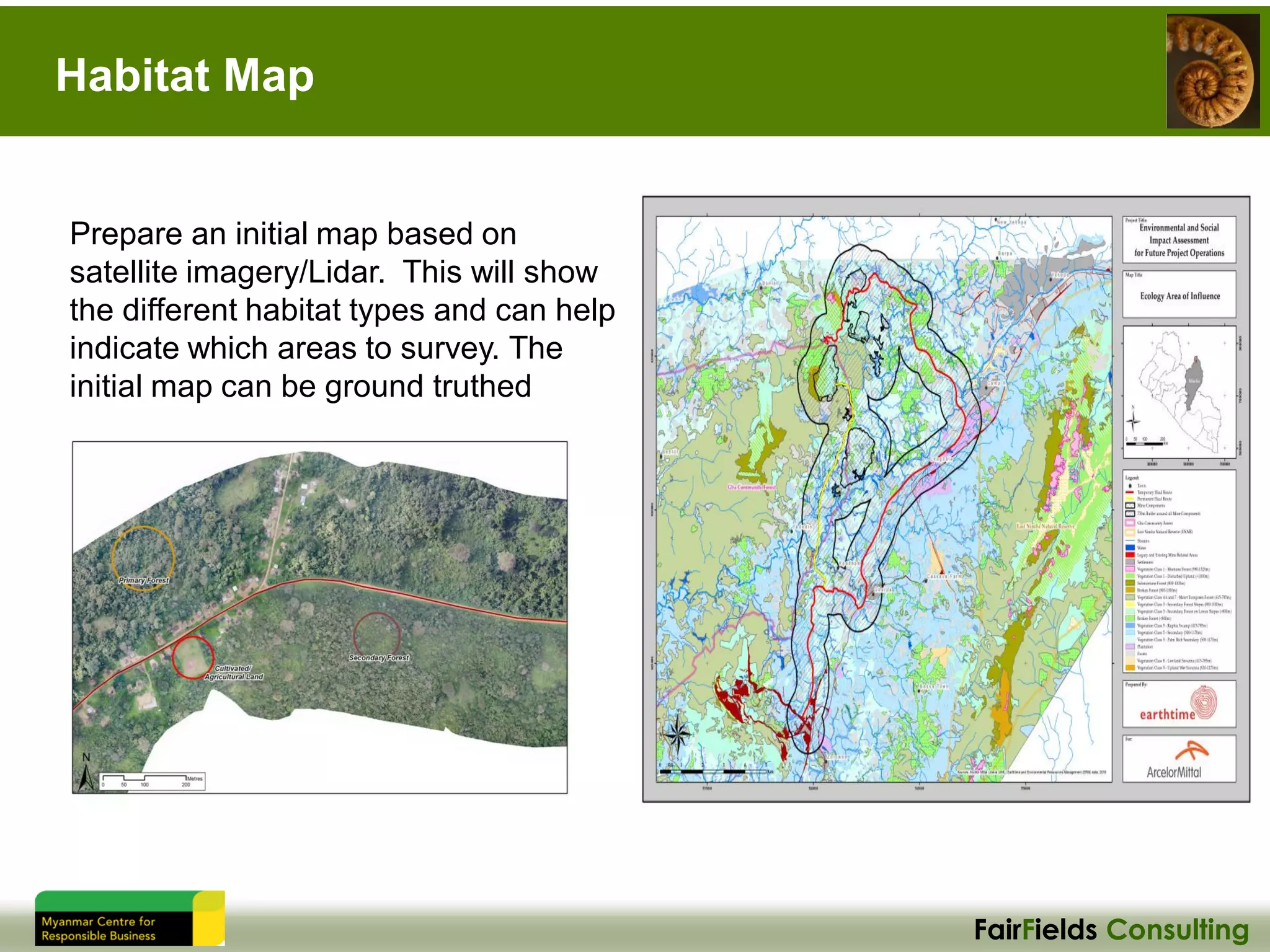
Habitat Map
Prepare an initial map based on
satellite imagery/Lidar. This will show
the different habitat types and can help
indicate which areas to survey. The
initial map can be ground truthed
FairFields Consulting
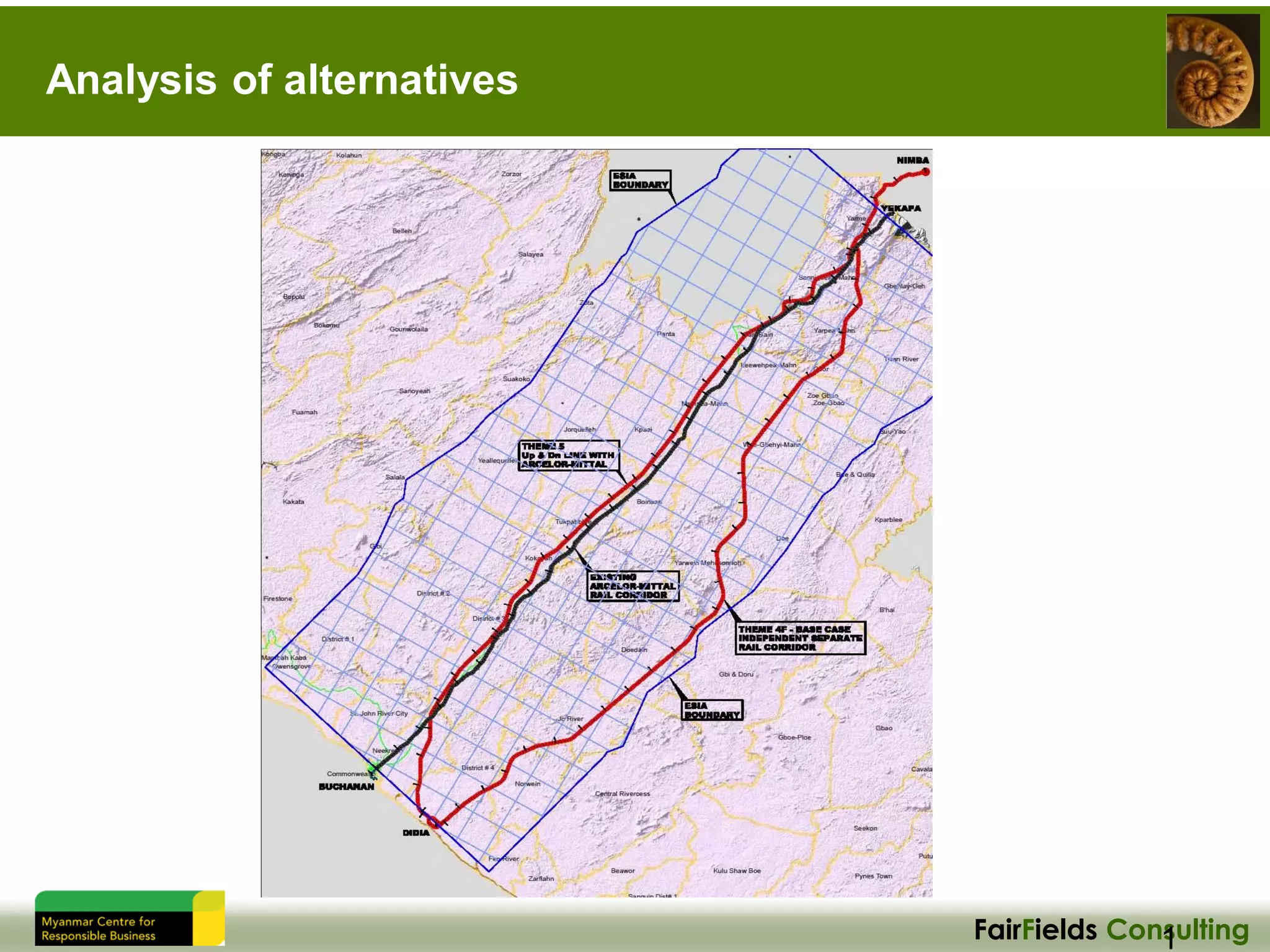
Analysis of alternatives
1
FairFields Consulting
Ecosystem Services
1
Ecosystem services are the benefits provided by ecosystems to humans.
These include
Loss of access to fisheries
Impacts on freshwater or marine fish species can adversely affect both local populations who depend on
fish as a food source or whose livelihoodsdepend on fisheries.
Loss of access to fruit trees, medicinalplants, or
game species
Loss and degradation of forests can adversely affect both local populations who depend on the ecosystem
services they provide, especiallywhere they are an important part of the local diet.
Loss of construction material and charcoal
Loss and degradation of forests can adversely affect local populations who depend on the provisioning
services they provide
Loss of access to forage crops or grazing
Areas of importance for biodiversity can also be an important source of forage crops or seasonal grazing
for livestock, which may be lost due to land clearing.
Induced development impacts on biodiversity
Where developments involve upgrades to infrastructure(especiallyroads), this can open up access to
other forms of development that in turn can adversely impact biodiversityand the ecosystem services it
provides.
FairFields Consulting
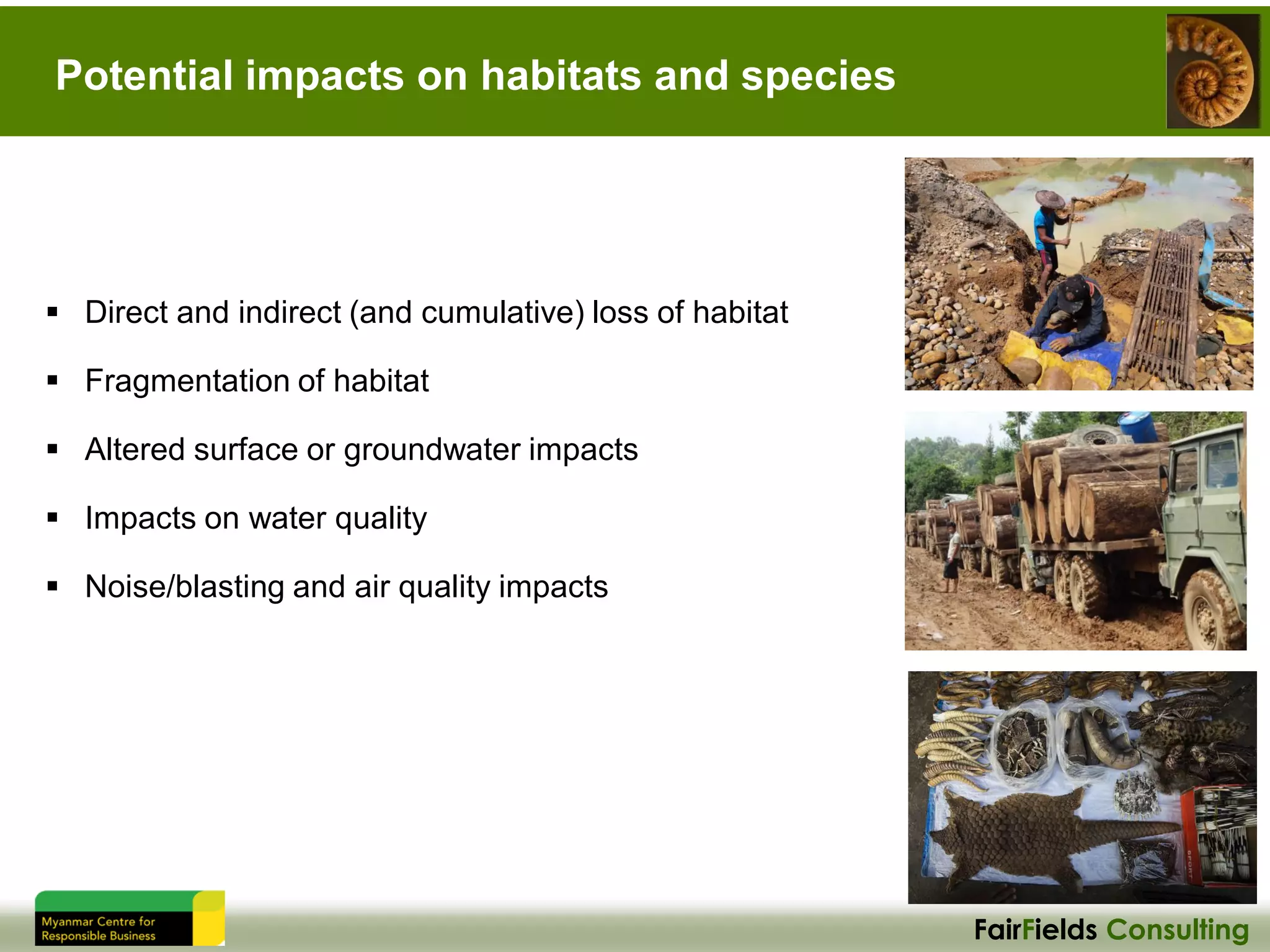
Potential impacts on habitats and species
▪ Direct and indirect (and cumulative) loss of habitat
▪ Fragmentation of habitat
▪ Altered surface or groundwater impacts
▪ Impacts on water quality
▪ Noise/blasting and air quality impacts
FairFields Consulting
Impact Assessment (magnitude of impact)
Biodiversity Impact Assessment involves assessing the magnitude of an impact
(scale, reversibility, intensity, extent, duration) with the value of the receptor to
understand the significance of the impact. You may also look at the likelihood of it
happening.
▪ Identify nature of biodiversity impacts
▪ Assess magnitude of the impacts (intensity, extent etc)
▪ Assess the value of the habitat and associated species
▪ Assess significance of predicted impacts
Magnitude of impact x value of the receptor = Significance
FairFields Consulting
Impact Assessment (Biodiversity value of an area)
14
Value Species Habitats Landscapes
Low Widespread, abundant, not
threatened, may be listed as LC on
IUCN red List of threatened
habitats, no designated sites
Highly modified habitat*, can be
low diversity, non native species
Highly modified habitats, little
connectivity
Medium Species that are NT, valued
regionally or locally
Mosaic of natural and modified
habitats. Moderately threatened
ecosystems
Mosaic of natural and modified
habitats/Some connectivity
High Species that are list as CR or EN
(sometimes significant
concentrations of VU) or they are
range restricted. Significant
concentrations of migratory or
congregatory birds. Very high
diversity.
Highly threatened ecosystem,
unique ecosystem habitat. Areas
that Contain
Habitat for Viable Populations
of Endangered, Restricted
Range or Protected Species
Landscape-level mosaics that are
significant at global, regional or
national levels, and that contain
viable populations of the great
majority of the naturally occurring
species. High connectivity
*Some modified habitats can support important biodiversity values
Valuing the conservation value of a site is complex and involves a mix of criteria
and professional judgement, but some criteria are outlined below
FairFields Consulting
Assessing impacts on Chimpanzees
Have a look at the map. The dark area is the proposed pit of a mine. The red, orange and yellow shading show the density of
the West African chimpanzee is Critically Endangered (CR) and a group is present in these mountains.
The dark red, shows the highest concentration, but as you can see they even occur all over the mountain. These species are
Critically endangered.
Proposed pit
FairFields Consulting
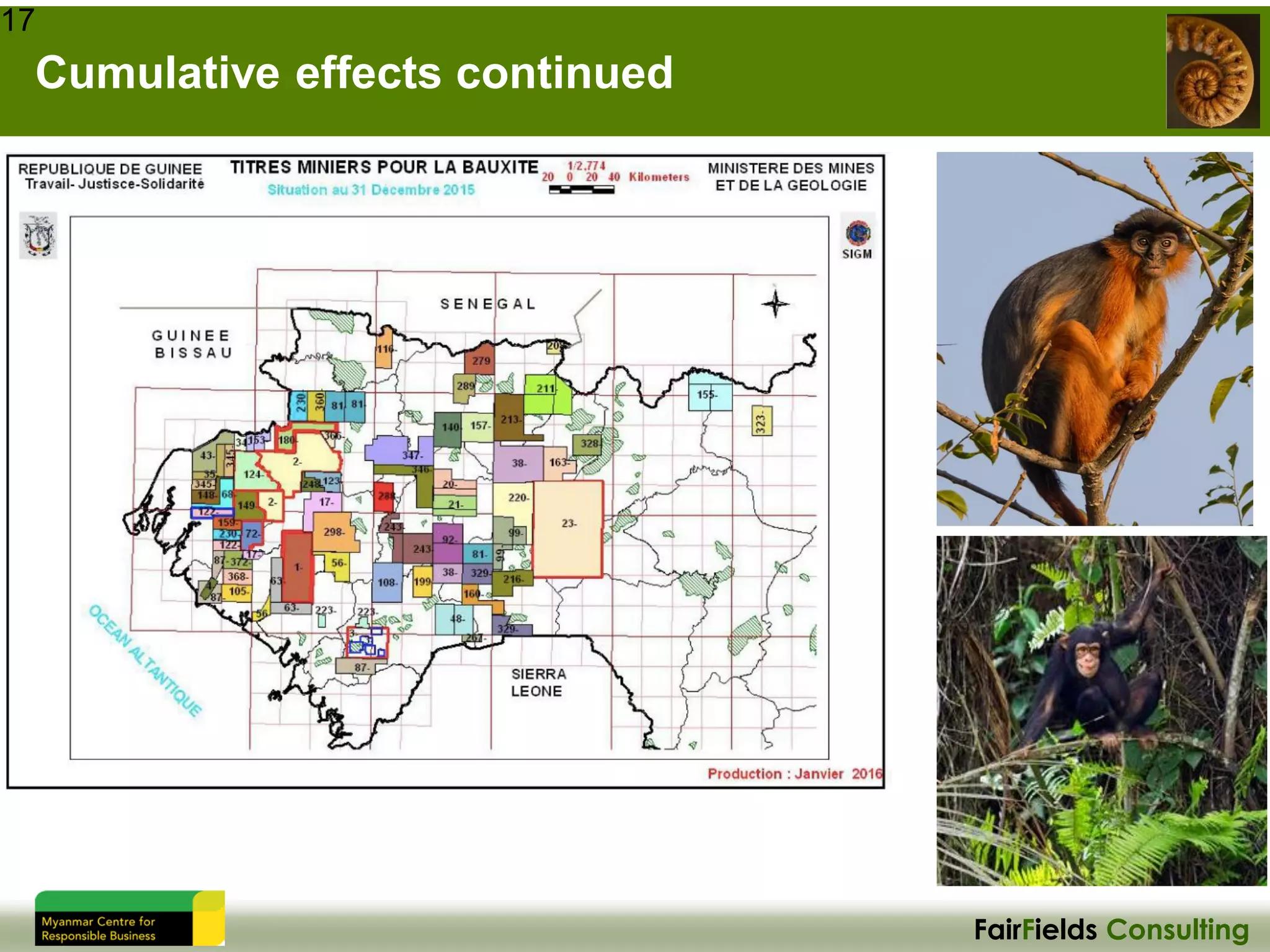
Cumulative effects
16
▪ Cumulative effects result from the incremental
impact of developments (and other activities)
▪ Indus delta -an extraordinary ecosystem, has
had an estimated loss of 80% it its
mangroves. Very little freshwater now flows
into the delta.
▪ This is due to the construction of dams and
barrages along the Indus river to meet the
increasing water demands for agricultural and
industrial purposes.
FairFields Consulting
Cumulative effects continued
17
FairFields Consulting
The mitigation hierarchy
Impact
Residual
Impact
Avoid
Minimize
Restore
Residual
Impact
Avoid
Minimize
Restore
Offset
+
- • Site selection,
Project Design,
Timing
Physical controls
Operational
controls
Low risk
Low cost
Current value
of biodiversity
FairFields Consulting
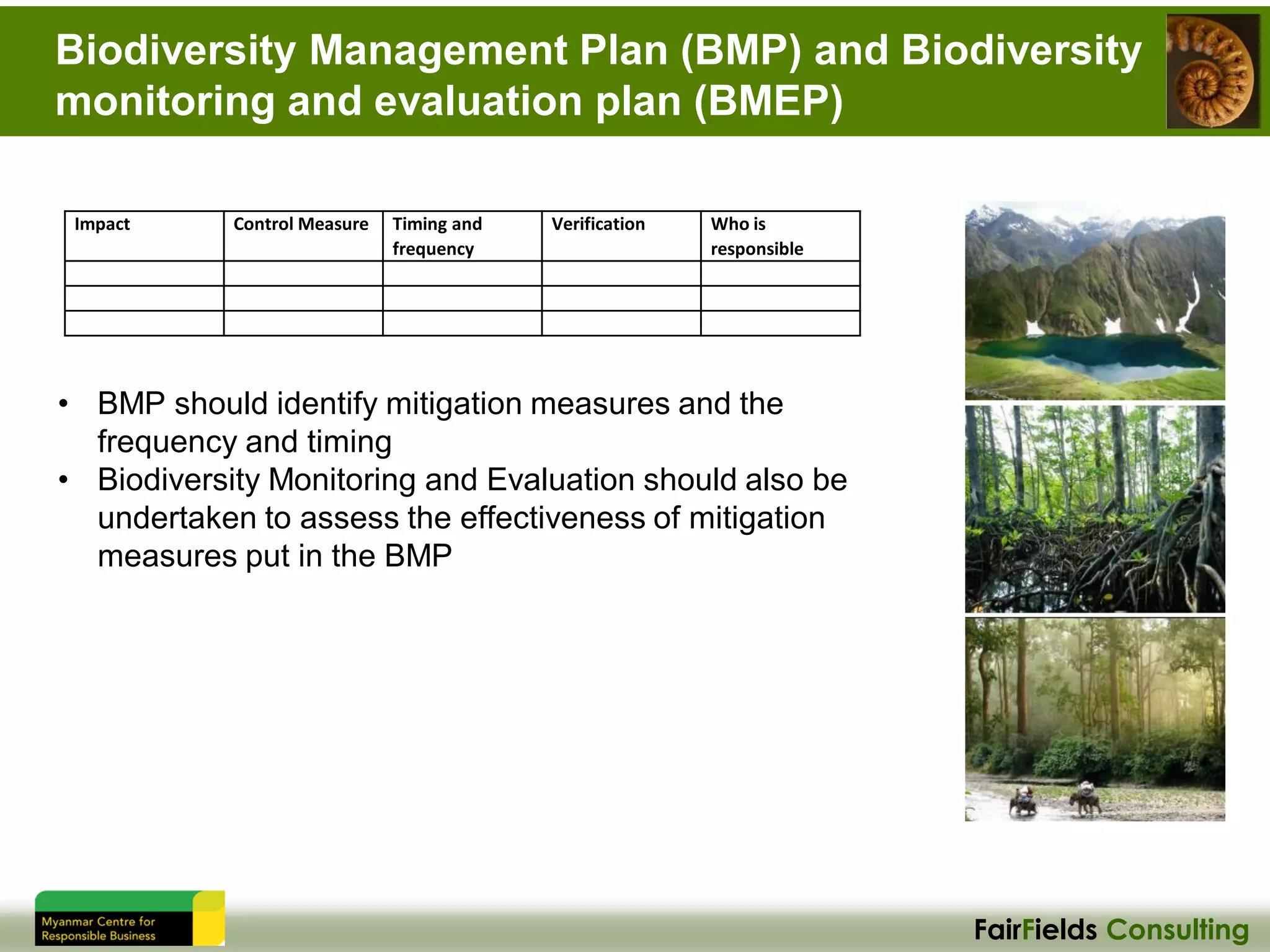
Biodiversity Management Plan (BMP) and Biodiversity
monitoring and evaluation plan (BMEP)
Impact Control Measure Timing and
frequency
Verification Who is
responsible
• BMP should identify mitigation measures and the
frequency and timing
• Biodiversity Monitoring and Evaluation should also be
undertaken to assess the effectiveness of mitigation
measures put in the BMP
FairFields Consulting
Offsets
▪ Offsets are measurable conservation outcomes resulting
from actions to compensate for significant residual
adverse biodiversity impacts
▪ Many offsets are protection offsets “ averted loss” ,
which means that you protect another area from habitat
loss or degradation somewhere else.
▪ The goal of biodiversity offsets is to achieve no net loss
(and preferably a net gain) of biodiversity
▪ The use of biodiversity offsets should be viewed as a
‘last resort’, after other mitigation measures have been
applied.
▪ Three core principles of offsets, are Additionality, Equivalence and Permeance
Converted land
Moist evergreen secondary
forest
Moist evergreen forest
Semi-deciduousforest
Villages
0 5 10 15 20 25 kilometres
Illustrative overview of offsets (1 of 4)
Proposed mining project
Key Biodiversity Area or
Protected Area
FairFields Consulting
Offset can;
• Strengthen ineffective protected areas
• Safeguarding unprotected areas
• Addressing underlying causes of biodiversity
loss
• Establishing corridors
• Establishing buffer zones: For instance, around
a national park lacking a buffer zone.
• Prioritising KBAs as recipients of offsets to
compensate residual impacts in non-KBA sites
FairFields Consulting
Other International Standards
(PS6)/ NO GO’s
Matthew Baird
Environmental Law and Policy
(Presenting for Sally Johnson)
19 March 2018
FairFields Consulting
IFC-part of the World Bank Group
24
• Private sector financing for sustainable development
• Over 100 countries and In FY16, $11.1 billion in long-
term investments in 344 projects
FairFields Consulting
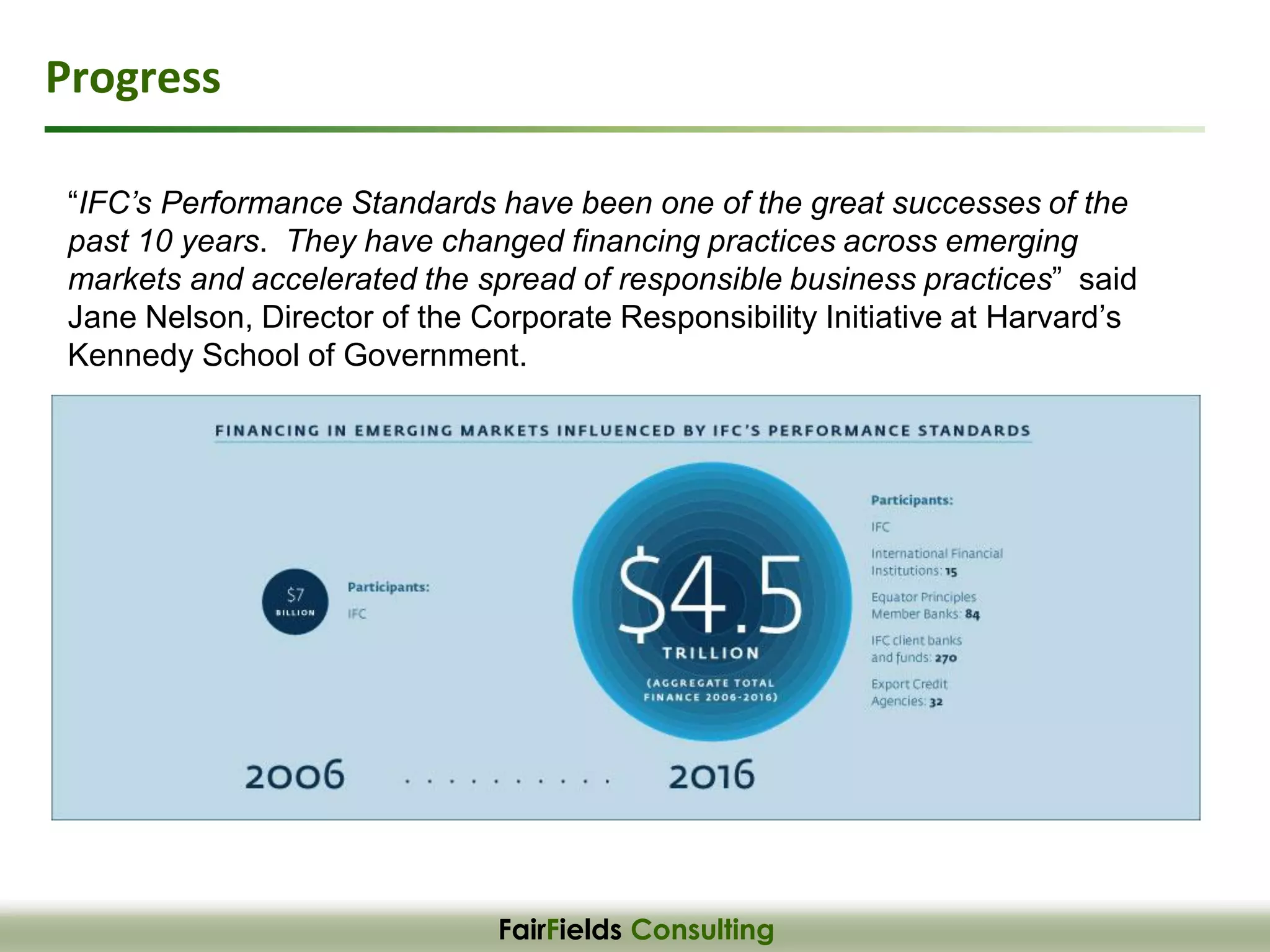
Progress
“IFC’s Performance Standards have been one of the great successes of the
past 10 years. They have changed financing practices across emerging
markets and accelerated the spread of responsible business practices” said
Jane Nelson, Director of the Corporate Responsibility Initiative at Harvard’s
Kennedy School of Government.
FairFields Consulting
IFC’s Performance Standards
26
PS1: Assessment &
management of
environmental & social
risk & impacts
PS2: Labor &
working conditions
PS3: Resource
efficiency & pollution
prevention
PS4: Community
health, safety & security
PS5: Land
acquisition &
involuntary resettlement
PS7: Indigenous
Peoples
PS8: Cultural Heritage
PS6: Biodiversity
conservation& sustainable
management of living natural
resources
FairFields Consulting
Summary PS 6 requirements
27
▪ PS6 applies if significant biodiversity values found
▪ Minimize impacts
▪ Mitigate as appropriate
Modified
▪ No viable alternatives in modified habitat
▪ Views of stakeholders established about impacts
▪ Mitigation hierarchy
▪ No net loss
Critical
Natural
▪ No viable alternatives in non-critical habitat
▪ No measurable adverse impacts on CH values
▪ No net reduction in CR or EN population over reasonable
time period
▪ Long-term monitoring and evaluation program
▪ Net gain for CH values
▪ If biodiversity offsets used, provide technical rationale
FairFields Consulting
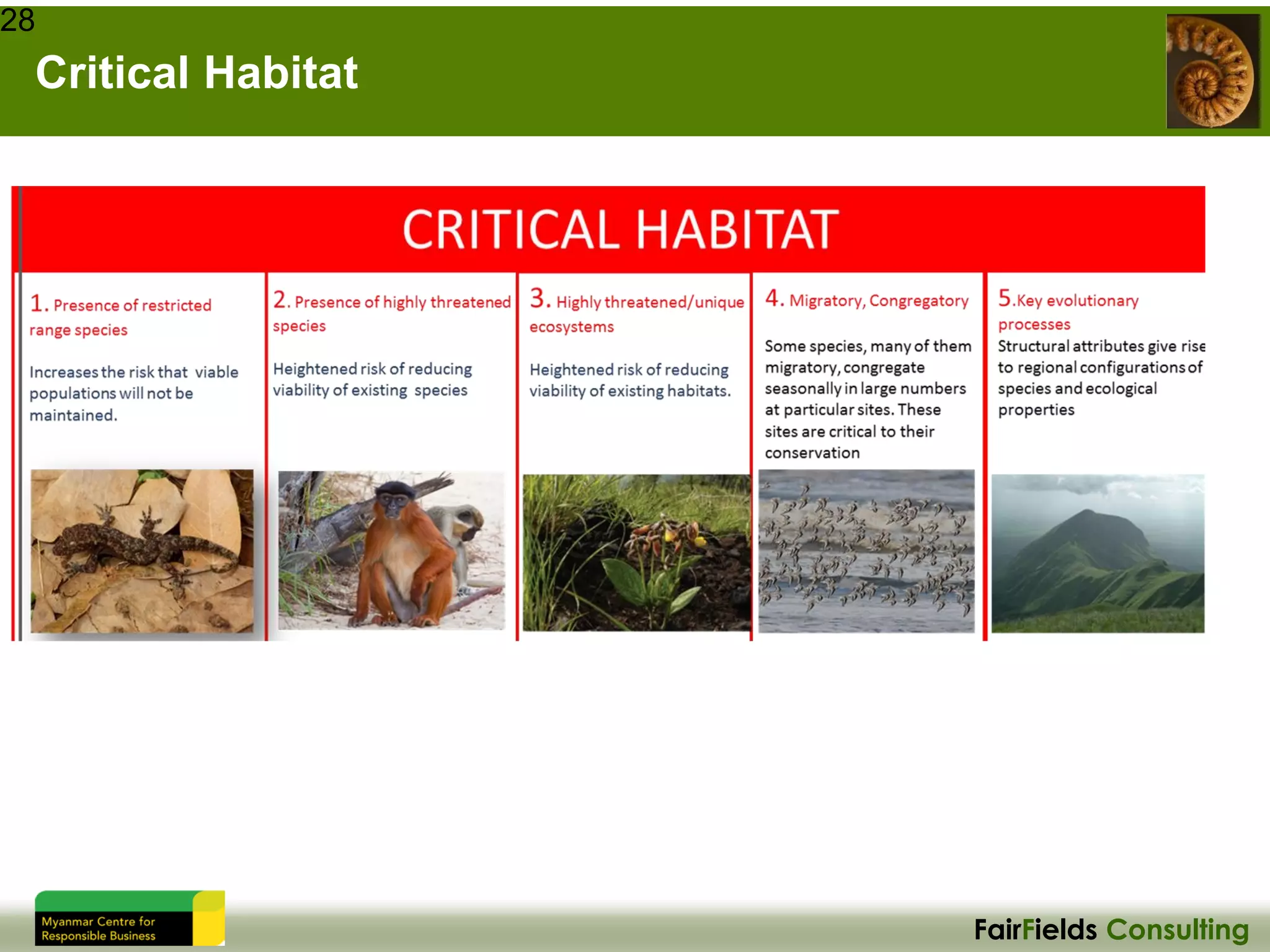
Critical Habitat
28
FairFields Consulting
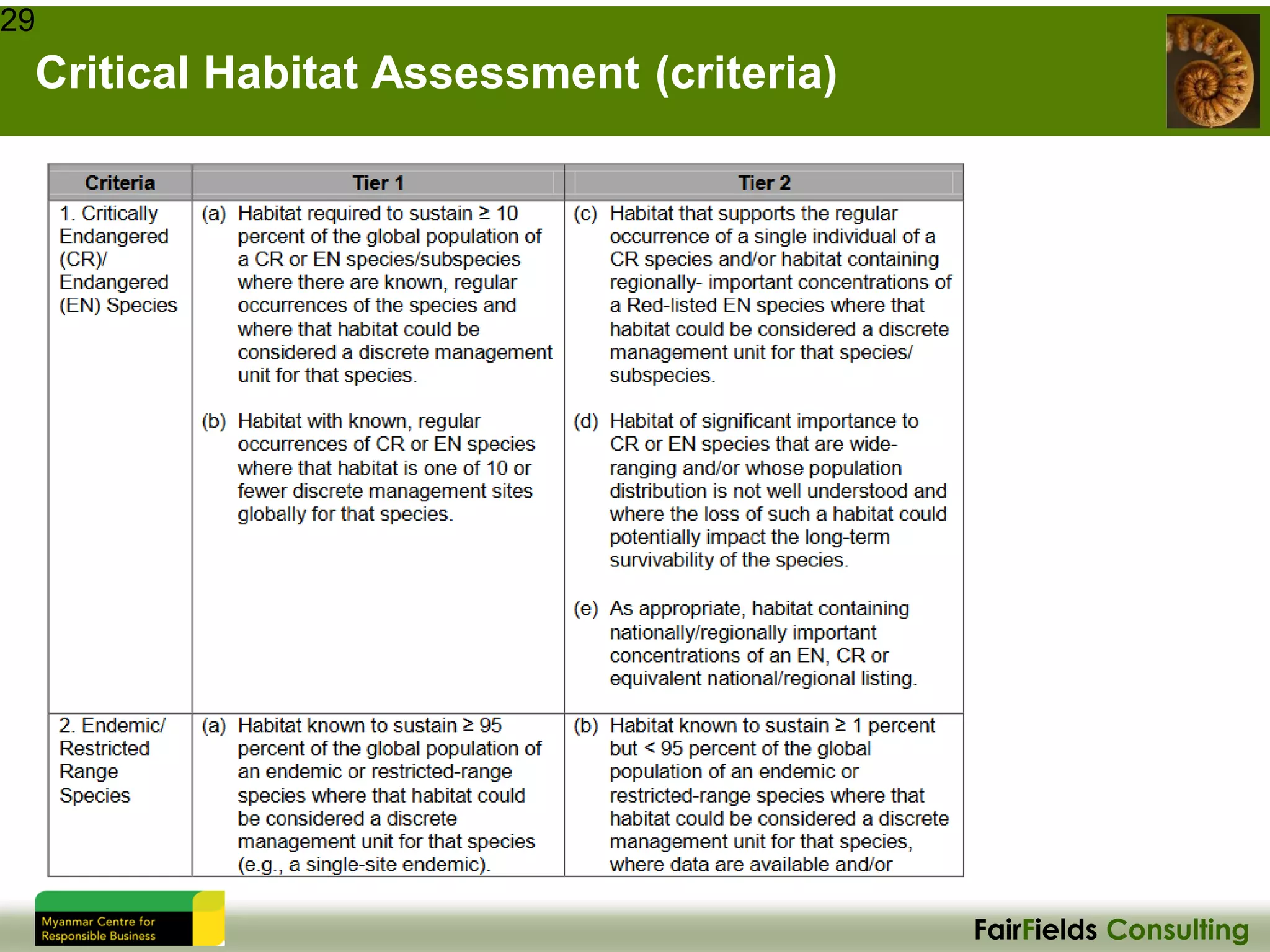
Critical Habitat Assessment (criteria)
29
FairFields Consulting
Critical Habitat Criteria
30
Criterion 4: Highly Threatened and/ or
Unique Ecosystems
Highly threatened or unique ecosystems
are those (i) that are at risk of
significantly decreasing in area or
quality; (ii) with a small spatial extent;
and/or (iii) containing unique
assemblages of species including
assemblages or concentrations of
biome-restricted species
.
Criterion 5:
Key Evolutionary Processes Isolated areas
(e.g., islands, mountaintops, lakes) are associated with populations
FairFields Consulting
Ecosystem Services
31
Where beneficiaries are
global, PS6 does not apply,
e.g. Climate regulation
Client will conduct a systematic
review to identify priority services
for Affected Communities; and/or
services on which the project is
directly dependent for its
operations (e.g. water).
FairFields Consulting
Initiatives
32
▪ ICMM ’s 25 corporate members have been required to avoid
mining in World Heritage properties
▪ The Initiative for Responsible Mining Assurance (IRMA) is
designing a Standard. It states that that Highly Protected Areas
(HPAs) are ‘no go zones’. World Heritage Sites and IUCN
protected Areas categories I-II
▪ At the World Conservation Congress, in 2016, the IUCN state that
Governments should prohibit damaging activities inside all
categories of protected areas, and not to tamper with PA
designations. IUCN ask that Businesses respect this ‘no go’
provision. Investors are asked not to fund such activities
▪ IUCN have prepared some guidelines for business in Key
Biodiversity Areas which will be launched in March 2018
▪ Governments are also asked to restrict activities that might have
negative impacts on Key Biodiversity Areas
FairFields Consulting
Recommendations for the private sector
33
▪ Ensure that Initial Environmental Examinations (IEE)/Environmental Impact
Assessment (EIA) and Environmental Management plans (EMPs) incorporate
biodiversity considerations
▪ Address biodiversity aspects at the EIA Screening stage, including possible impacts
on legally designated Protected Areas as well as other sites of international
importance for biodiversity such as KBAs
▪ Take account of relevant information or requirements from Strategic Environmental
Assessments (SEA)
▪ Ensure that the Scoping study fully addresses potential biodiversity impacts
and assesses ‘alternatives’ so that adverse impacts on biodiversity can be
avoided wherever possible
▪ Identify and engage stakeholders likely to be affected by business activities,
so that the company can begin to understand community dependence on
biodiversity and ecosystem services
▪ Make full use of existing data sources
FairFields Consulting
Questions and Answers

3. What Should a Consultant Be Doing at Different Stages?

  • 1.
    FairFields Consulting What shoulda consultant be doing at different stages Matthew Baird Environmental Law and Policy (Presenting for Sally Johnson) 19 March 2018
  • 2.
  • 3.
    FairFields Consulting Screening stageof the EIA process ▪ Are there any legally designated areas such as Protected Areas (National Park/Nature Reserve/Wildlife Sanctuary, some Ramsar Sites ▪ Sites of global importance for Biodiversity such as Key Biodiversity Areas (KBA), Important Bird Areas (IBAs) ▪ Important coastal or marine areas ▪ Does it affect an Alliance for Zero Extinction (AZE) site ▪ Has there been a strategic ESIA or other EIAs in the area which may provide information ▪ Academic research in the area
  • 4.
    FairFields Consulting Legally DesignatedProtected Areas and other areas of International Importance KBAs are sites of importance for the global persistence of biodiversity Protected Areas
  • 5.
    FairFields Consulting Desk TopResources-see WCS’s presentation 5
  • 6.
    FairFields Consulting Scoping stageof the ESIA process Scoping is the process of determining the content of the Biodiversity component of the EIA ▪ Understand the project (location, size, extent, temporal and spatial organization, other infrastructure and activities; ▪ Alternative options ▪ Consult stakeholders -relevant experts, NGOs, academic, communities ▪ Defining the project area of influence ▪ Site visit ▪ What will be included in the biodiversity baseline surveys
  • 7.
    FairFields Consulting Area ofinfluence 7 ▪ Direct impacts (i.e. footprint, mine site, roads, airport, water supply, power route) ▪ Indirect impacts for example from influx of people/infrastructure opened up forest areas etc ▪ Associated facilities, facilities that are not funded as part of the project, that would not have been constructed or expanded if the project did not exist, and without which the project would not be viable. ▪ Cumulative impacts
  • 8.
    FairFields Consulting Baseline ▪ HabitatMap ▪ Include any protected areas or sites of global, regional local importance ▪ Summary of baseline surveys with emphasis on key biodiversity values that fall within the project’s area of influence ▪ Threatened species that occur in the area. (Check with IUCN Red list). ▪ Endemic or range restricted species (they only occur over a small range) ▪ Important concentrations of migratory or congregatory species ▪ Highly threatened ecosystems ▪ In the ideal it should also include priority ecosystem services ▪ Pages and pages of species lists (go into an annex!)
  • 9.
    FairFields Consulting Habitat Map Preparean initial map based on satellite imagery/Lidar. This will show the different habitat types and can help indicate which areas to survey. The initial map can be ground truthed
  • 10.
  • 11.
    FairFields Consulting Ecosystem Services 1 Ecosystemservices are the benefits provided by ecosystems to humans. These include Loss of access to fisheries Impacts on freshwater or marine fish species can adversely affect both local populations who depend on fish as a food source or whose livelihoodsdepend on fisheries. Loss of access to fruit trees, medicinalplants, or game species Loss and degradation of forests can adversely affect both local populations who depend on the ecosystem services they provide, especiallywhere they are an important part of the local diet. Loss of construction material and charcoal Loss and degradation of forests can adversely affect local populations who depend on the provisioning services they provide Loss of access to forage crops or grazing Areas of importance for biodiversity can also be an important source of forage crops or seasonal grazing for livestock, which may be lost due to land clearing. Induced development impacts on biodiversity Where developments involve upgrades to infrastructure(especiallyroads), this can open up access to other forms of development that in turn can adversely impact biodiversityand the ecosystem services it provides.
  • 12.
    FairFields Consulting Potential impactson habitats and species ▪ Direct and indirect (and cumulative) loss of habitat ▪ Fragmentation of habitat ▪ Altered surface or groundwater impacts ▪ Impacts on water quality ▪ Noise/blasting and air quality impacts
  • 13.
    FairFields Consulting Impact Assessment(magnitude of impact) Biodiversity Impact Assessment involves assessing the magnitude of an impact (scale, reversibility, intensity, extent, duration) with the value of the receptor to understand the significance of the impact. You may also look at the likelihood of it happening. ▪ Identify nature of biodiversity impacts ▪ Assess magnitude of the impacts (intensity, extent etc) ▪ Assess the value of the habitat and associated species ▪ Assess significance of predicted impacts Magnitude of impact x value of the receptor = Significance
  • 14.
    FairFields Consulting Impact Assessment(Biodiversity value of an area) 14 Value Species Habitats Landscapes Low Widespread, abundant, not threatened, may be listed as LC on IUCN red List of threatened habitats, no designated sites Highly modified habitat*, can be low diversity, non native species Highly modified habitats, little connectivity Medium Species that are NT, valued regionally or locally Mosaic of natural and modified habitats. Moderately threatened ecosystems Mosaic of natural and modified habitats/Some connectivity High Species that are list as CR or EN (sometimes significant concentrations of VU) or they are range restricted. Significant concentrations of migratory or congregatory birds. Very high diversity. Highly threatened ecosystem, unique ecosystem habitat. Areas that Contain Habitat for Viable Populations of Endangered, Restricted Range or Protected Species Landscape-level mosaics that are significant at global, regional or national levels, and that contain viable populations of the great majority of the naturally occurring species. High connectivity *Some modified habitats can support important biodiversity values Valuing the conservation value of a site is complex and involves a mix of criteria and professional judgement, but some criteria are outlined below
  • 15.
    FairFields Consulting Assessing impactson Chimpanzees Have a look at the map. The dark area is the proposed pit of a mine. The red, orange and yellow shading show the density of the West African chimpanzee is Critically Endangered (CR) and a group is present in these mountains. The dark red, shows the highest concentration, but as you can see they even occur all over the mountain. These species are Critically endangered. Proposed pit
  • 16.
    FairFields Consulting Cumulative effects 16 ▪Cumulative effects result from the incremental impact of developments (and other activities) ▪ Indus delta -an extraordinary ecosystem, has had an estimated loss of 80% it its mangroves. Very little freshwater now flows into the delta. ▪ This is due to the construction of dams and barrages along the Indus river to meet the increasing water demands for agricultural and industrial purposes.
  • 17.
  • 18.
    FairFields Consulting The mitigationhierarchy Impact Residual Impact Avoid Minimize Restore Residual Impact Avoid Minimize Restore Offset + - • Site selection, Project Design, Timing Physical controls Operational controls Low risk Low cost Current value of biodiversity
  • 19.
    FairFields Consulting Biodiversity ManagementPlan (BMP) and Biodiversity monitoring and evaluation plan (BMEP) Impact Control Measure Timing and frequency Verification Who is responsible • BMP should identify mitigation measures and the frequency and timing • Biodiversity Monitoring and Evaluation should also be undertaken to assess the effectiveness of mitigation measures put in the BMP
  • 20.
    FairFields Consulting Offsets ▪ Offsetsare measurable conservation outcomes resulting from actions to compensate for significant residual adverse biodiversity impacts ▪ Many offsets are protection offsets “ averted loss” , which means that you protect another area from habitat loss or degradation somewhere else. ▪ The goal of biodiversity offsets is to achieve no net loss (and preferably a net gain) of biodiversity ▪ The use of biodiversity offsets should be viewed as a ‘last resort’, after other mitigation measures have been applied. ▪ Three core principles of offsets, are Additionality, Equivalence and Permeance
  • 21.
    Converted land Moist evergreensecondary forest Moist evergreen forest Semi-deciduousforest Villages 0 5 10 15 20 25 kilometres Illustrative overview of offsets (1 of 4) Proposed mining project Key Biodiversity Area or Protected Area
  • 22.
    FairFields Consulting Offset can; •Strengthen ineffective protected areas • Safeguarding unprotected areas • Addressing underlying causes of biodiversity loss • Establishing corridors • Establishing buffer zones: For instance, around a national park lacking a buffer zone. • Prioritising KBAs as recipients of offsets to compensate residual impacts in non-KBA sites
  • 23.
    FairFields Consulting Other InternationalStandards (PS6)/ NO GO’s Matthew Baird Environmental Law and Policy (Presenting for Sally Johnson) 19 March 2018
  • 24.
    FairFields Consulting IFC-part ofthe World Bank Group 24 • Private sector financing for sustainable development • Over 100 countries and In FY16, $11.1 billion in long- term investments in 344 projects
  • 25.
    FairFields Consulting Progress “IFC’s PerformanceStandards have been one of the great successes of the past 10 years. They have changed financing practices across emerging markets and accelerated the spread of responsible business practices” said Jane Nelson, Director of the Corporate Responsibility Initiative at Harvard’s Kennedy School of Government.
  • 26.
    FairFields Consulting IFC’s PerformanceStandards 26 PS1: Assessment & management of environmental & social risk & impacts PS2: Labor & working conditions PS3: Resource efficiency & pollution prevention PS4: Community health, safety & security PS5: Land acquisition & involuntary resettlement PS7: Indigenous Peoples PS8: Cultural Heritage PS6: Biodiversity conservation& sustainable management of living natural resources
  • 27.
    FairFields Consulting Summary PS6 requirements 27 ▪ PS6 applies if significant biodiversity values found ▪ Minimize impacts ▪ Mitigate as appropriate Modified ▪ No viable alternatives in modified habitat ▪ Views of stakeholders established about impacts ▪ Mitigation hierarchy ▪ No net loss Critical Natural ▪ No viable alternatives in non-critical habitat ▪ No measurable adverse impacts on CH values ▪ No net reduction in CR or EN population over reasonable time period ▪ Long-term monitoring and evaluation program ▪ Net gain for CH values ▪ If biodiversity offsets used, provide technical rationale
  • 28.
  • 29.
  • 30.
    FairFields Consulting Critical HabitatCriteria 30 Criterion 4: Highly Threatened and/ or Unique Ecosystems Highly threatened or unique ecosystems are those (i) that are at risk of significantly decreasing in area or quality; (ii) with a small spatial extent; and/or (iii) containing unique assemblages of species including assemblages or concentrations of biome-restricted species . Criterion 5: Key Evolutionary Processes Isolated areas (e.g., islands, mountaintops, lakes) are associated with populations
  • 31.
    FairFields Consulting Ecosystem Services 31 Wherebeneficiaries are global, PS6 does not apply, e.g. Climate regulation Client will conduct a systematic review to identify priority services for Affected Communities; and/or services on which the project is directly dependent for its operations (e.g. water).
  • 32.
    FairFields Consulting Initiatives 32 ▪ ICMM’s 25 corporate members have been required to avoid mining in World Heritage properties ▪ The Initiative for Responsible Mining Assurance (IRMA) is designing a Standard. It states that that Highly Protected Areas (HPAs) are ‘no go zones’. World Heritage Sites and IUCN protected Areas categories I-II ▪ At the World Conservation Congress, in 2016, the IUCN state that Governments should prohibit damaging activities inside all categories of protected areas, and not to tamper with PA designations. IUCN ask that Businesses respect this ‘no go’ provision. Investors are asked not to fund such activities ▪ IUCN have prepared some guidelines for business in Key Biodiversity Areas which will be launched in March 2018 ▪ Governments are also asked to restrict activities that might have negative impacts on Key Biodiversity Areas
  • 33.
    FairFields Consulting Recommendations forthe private sector 33 ▪ Ensure that Initial Environmental Examinations (IEE)/Environmental Impact Assessment (EIA) and Environmental Management plans (EMPs) incorporate biodiversity considerations ▪ Address biodiversity aspects at the EIA Screening stage, including possible impacts on legally designated Protected Areas as well as other sites of international importance for biodiversity such as KBAs ▪ Take account of relevant information or requirements from Strategic Environmental Assessments (SEA) ▪ Ensure that the Scoping study fully addresses potential biodiversity impacts and assesses ‘alternatives’ so that adverse impacts on biodiversity can be avoided wherever possible ▪ Identify and engage stakeholders likely to be affected by business activities, so that the company can begin to understand community dependence on biodiversity and ecosystem services ▪ Make full use of existing data sources
  • 34.