
Transforming
investment
banks
2 | Transforming investment banks
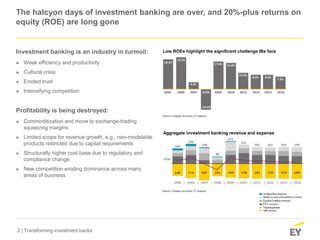
The halcyon days of investment banking are over, and 20%-plus returns on
equity (ROE) are long gone
Investment banking is an industry in turmoil:
► Weak efficiency and productivity
► Cultural crisis
► Eroded trust
► Intensifying competition
Profitability is being destroyed:
► Commoditization and move to exchange-trading
squeezing margins
► Limited scope for revenue growth, e.g., non-modelable
products restricted due to capital requirements
► Structurally higher cost base due to regulatory and
compliance change
► New competition eroding dominance across many
areas of business
Low ROEs highlight the significant challenge IBs face
Aggregate investment banking revenue and expense
3 | Transforming investment banks
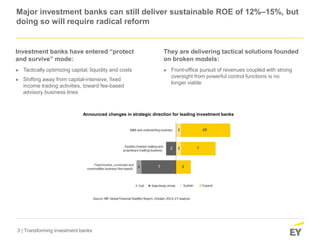
Major investment banks can still deliver sustainable ROE of 12%–15%, but
doing so will require radical reform
Investment banks have entered “protect
and survive” mode:
► Tactically optimizing capital, liquidity and costs
► Shifting away from capital-intensive, fixed
income trading activities, toward fee-based
advisory business lines
They are delivering tactical solutions founded
on broken models:
► Front-office pursuit of revenues coupled with strong
oversight from powerful control functions is no
longer viable
Announced changes in strategic direction for leading investment banks
4 | Transforming investment banks
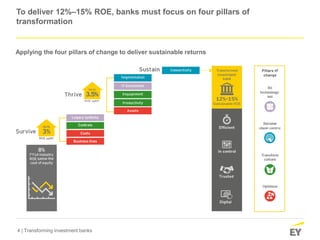
To deliver 12%–15% ROE, banks must focus on four pillars of
transformation
Applying the four pillars of change to deliver sustainable returns
5 | Transforming investment banks
Pillar 1: optimize
Investment banks must better utilize balance sheets, radically reduce costs …
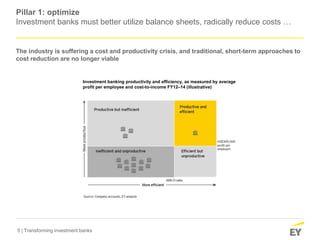
The industry is suffering a cost and productivity crisis, and traditional, short-term approaches to
cost reduction are no longer viable
Investment banking productivity and efficiency, as measured by average
profit per employee and cost-to-income FY12–14 (illustrative)
6 | Transforming investment banks
Pillar 1: optimize
… and explore innovative sourcing and shoring options
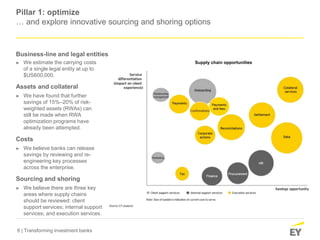
Business-line and legal entities
► We estimate the carrying costs
of a single legal entity at up to
$US600,000.
Assets and collateral
► We have found that further
savings of 15%–20% of risk-
weighted assets (RWAs) can
still be made when RWA
optimization programs have
already been attempted.
Costs
► We believe banks can release
savings by reviewing and re-
engineering key processes
across the enterprise.
Sourcing and shoring
► We believe there are three key
areas where supply chains
should be reviewed: client
support services; internal support
services; and execution services.
Supply chain opportunities
7 | Transforming investment banks
Pillar 2: transform culture
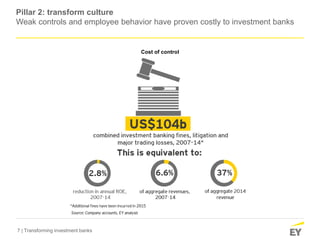
Weak controls and employee behavior have proven costly to investment banks
Cost of control
8 | Transforming investment banks
Pillar 2: transform culture
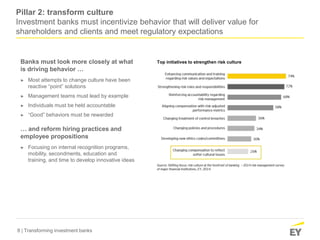
Investment banks must incentivize behavior that will deliver value for
shareholders and clients and meet regulatory expectations
Banks must look more closely at what
is driving behavior …
► Most attempts to change culture have been
reactive “point” solutions
► Management teams must lead by example
► Individuals must be held accountable
► “Good” behaviors must be rewarded
… and reform hiring practices and
employee propositions
► Focusing on internal recognition programs,
mobility, secondments, education and
training, and time to develop innovative ideas
Top initiatives to strengthen risk culture
9 | Transforming investment banks
Pillar 3: become client-centric
Investment banks must put their clients at the heart of their business …
Trust in investment banks has been eroded:
► Beyond low public trust, client trust has
suffered from high-profile reports of
investment banks ignoring conflicts of interest.
► Traditional operating models, based on
product innovation to drive the bottom line,
are inadequate.
► Banks must better identify their core clients and
their needs.
► They should improve systems to monitor
client satisfaction …
► … and enhance the client experience by
considering creating a “single shop-front.”
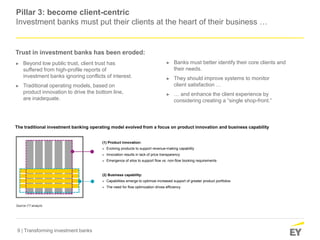
(1) Product innovation:
► Evolving products to support revenue-making capability
► Innovation results in lack of price transparency
► Emergence of silos to support flow vs. non-flow booking requirements
(2) Business capability:
► Capabilities emerge to optimize increased support of greater product portfolios
► The need for flow optimization drives efficiency
The traditional investment banking operating model evolved from a focus on product innovation and business capability
10 | Transforming investment banks
Pillar 3: become client-centric
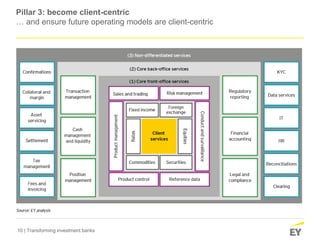
… and ensure future operating models are client-centric
11 | Transforming investment banks
Pillar 4: be technology-led
Investment banks must transform legacy processes and embrace innovation
Today, banks are people-led businesses —
tomorrow, they will be technology-led:
► In a more commoditized, risk-averse future, cost-to-serve,
speed of execution and quality of service will be the key
performance differentiators.
► Currently, 50%–66% of costs are staff costs. This is
unsustainable.
Transition to a technology-led business will
be difficult and stretch budgets
► Banks must invest across a number of
areas — new collateral and capital
systems, client-centric solutions,
improving data, controls technology.
► But with around 75% of IT spend on systems
maintenance, they must first deal with
legacy technology.
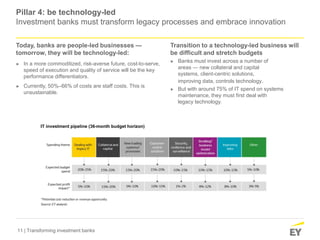
IT investment pipeline (36-month budget horizon)
12 | Transforming investment banks
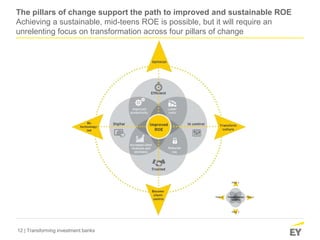
The pillars of change support the path to improved and sustainable ROE
Achieving a sustainable, mid-teens ROE is possible, but it will require an
unrelenting focus on transformation across four pillars of change
EY | Assurance | Tax | Transactions | Advisory
About EY
EY is a global leader in assurance, tax, transaction and advisory services.
The insights and quality services we deliver help build trust and confidence in
the capital markets and in economies the world over. We develop
outstanding leaders who team to deliver on our promises to all of our
stakeholders. In so doing, we play a critical role in building a better working
world for our people, for our clients and for our communities.
EY refers to the global organization, and may refer to one or more, of the
member firms of Ernst & Young Global Limited, each of which is a separate
legal entity. Ernst & Young Global Limited, a UK company limited by
guarantee, does not provide services to clients. For more information about
our organization, please visit ey.com.
About EY Global Banking & Capital Markets network
In today’s globally competitive and highly regulated environment, managing
risk effectively while satisfying an array of divergent stakeholders is a key
goal of banks and securities firms. EY’s Global Banking & Capital Markets
network brings together a worldwide team of professionals to help you
succeed — a team with deep technical experience in providing assurance,
tax, transaction and advisory services. The network works to anticipate
market trends, identify the implications and develop points of view on
relevant sector issues. Ultimately it enables us to help you meet your goals
and compete more effectively.
.
© 2015 EYGM Limited.
All Rights Reserved.
1503-1413137 NE
ED None
This material has been prepared for general informational purposes only and is not intended to be
relied upon as accounting, tax, or other professional advice. Please refer to your advisors for specific
advice.
ey.com/investmentbanking

Looking for acceptable, sustainable ROE?

  • 1.
  • 2.
    2 | Transforminginvestment banks The halcyon days of investment banking are over, and 20%-plus returns on equity (ROE) are long gone Investment banking is an industry in turmoil: ► Weak efficiency and productivity ► Cultural crisis ► Eroded trust ► Intensifying competition Profitability is being destroyed: ► Commoditization and move to exchange-trading squeezing margins ► Limited scope for revenue growth, e.g., non-modelable products restricted due to capital requirements ► Structurally higher cost base due to regulatory and compliance change ► New competition eroding dominance across many areas of business Low ROEs highlight the significant challenge IBs face Aggregate investment banking revenue and expense
  • 3.
    3 | Transforminginvestment banks Major investment banks can still deliver sustainable ROE of 12%–15%, but doing so will require radical reform Investment banks have entered “protect and survive” mode: ► Tactically optimizing capital, liquidity and costs ► Shifting away from capital-intensive, fixed income trading activities, toward fee-based advisory business lines They are delivering tactical solutions founded on broken models: ► Front-office pursuit of revenues coupled with strong oversight from powerful control functions is no longer viable Announced changes in strategic direction for leading investment banks
  • 4.
    4 | Transforminginvestment banks To deliver 12%–15% ROE, banks must focus on four pillars of transformation Applying the four pillars of change to deliver sustainable returns
  • 5.
    5 | Transforminginvestment banks Pillar 1: optimize Investment banks must better utilize balance sheets, radically reduce costs … The industry is suffering a cost and productivity crisis, and traditional, short-term approaches to cost reduction are no longer viable Investment banking productivity and efficiency, as measured by average profit per employee and cost-to-income FY12–14 (illustrative)
  • 6.
    6 | Transforminginvestment banks Pillar 1: optimize … and explore innovative sourcing and shoring options Business-line and legal entities ► We estimate the carrying costs of a single legal entity at up to $US600,000. Assets and collateral ► We have found that further savings of 15%–20% of risk- weighted assets (RWAs) can still be made when RWA optimization programs have already been attempted. Costs ► We believe banks can release savings by reviewing and re- engineering key processes across the enterprise. Sourcing and shoring ► We believe there are three key areas where supply chains should be reviewed: client support services; internal support services; and execution services. Supply chain opportunities
  • 7.
    7 | Transforminginvestment banks Pillar 2: transform culture Weak controls and employee behavior have proven costly to investment banks Cost of control
  • 8.
    8 | Transforminginvestment banks Pillar 2: transform culture Investment banks must incentivize behavior that will deliver value for shareholders and clients and meet regulatory expectations Banks must look more closely at what is driving behavior … ► Most attempts to change culture have been reactive “point” solutions ► Management teams must lead by example ► Individuals must be held accountable ► “Good” behaviors must be rewarded … and reform hiring practices and employee propositions ► Focusing on internal recognition programs, mobility, secondments, education and training, and time to develop innovative ideas Top initiatives to strengthen risk culture
  • 9.
    9 | Transforminginvestment banks Pillar 3: become client-centric Investment banks must put their clients at the heart of their business … Trust in investment banks has been eroded: ► Beyond low public trust, client trust has suffered from high-profile reports of investment banks ignoring conflicts of interest. ► Traditional operating models, based on product innovation to drive the bottom line, are inadequate. ► Banks must better identify their core clients and their needs. ► They should improve systems to monitor client satisfaction … ► … and enhance the client experience by considering creating a “single shop-front.” (1) Product innovation: ► Evolving products to support revenue-making capability ► Innovation results in lack of price transparency ► Emergence of silos to support flow vs. non-flow booking requirements (2) Business capability: ► Capabilities emerge to optimize increased support of greater product portfolios ► The need for flow optimization drives efficiency The traditional investment banking operating model evolved from a focus on product innovation and business capability
  • 10.
    10 | Transforminginvestment banks Pillar 3: become client-centric … and ensure future operating models are client-centric
  • 11.
    11 | Transforminginvestment banks Pillar 4: be technology-led Investment banks must transform legacy processes and embrace innovation Today, banks are people-led businesses — tomorrow, they will be technology-led: ► In a more commoditized, risk-averse future, cost-to-serve, speed of execution and quality of service will be the key performance differentiators. ► Currently, 50%–66% of costs are staff costs. This is unsustainable. Transition to a technology-led business will be difficult and stretch budgets ► Banks must invest across a number of areas — new collateral and capital systems, client-centric solutions, improving data, controls technology. ► But with around 75% of IT spend on systems maintenance, they must first deal with legacy technology. IT investment pipeline (36-month budget horizon)
  • 12.
    12 | Transforminginvestment banks The pillars of change support the path to improved and sustainable ROE Achieving a sustainable, mid-teens ROE is possible, but it will require an unrelenting focus on transformation across four pillars of change
  • 13.
    EY | Assurance| Tax | Transactions | Advisory About EY EY is a global leader in assurance, tax, transaction and advisory services. The insights and quality services we deliver help build trust and confidence in the capital markets and in economies the world over. We develop outstanding leaders who team to deliver on our promises to all of our stakeholders. In so doing, we play a critical role in building a better working world for our people, for our clients and for our communities. EY refers to the global organization, and may refer to one or more, of the member firms of Ernst & Young Global Limited, each of which is a separate legal entity. Ernst & Young Global Limited, a UK company limited by guarantee, does not provide services to clients. For more information about our organization, please visit ey.com. About EY Global Banking & Capital Markets network In today’s globally competitive and highly regulated environment, managing risk effectively while satisfying an array of divergent stakeholders is a key goal of banks and securities firms. EY’s Global Banking & Capital Markets network brings together a worldwide team of professionals to help you succeed — a team with deep technical experience in providing assurance, tax, transaction and advisory services. The network works to anticipate market trends, identify the implications and develop points of view on relevant sector issues. Ultimately it enables us to help you meet your goals and compete more effectively. . © 2015 EYGM Limited. All Rights Reserved. 1503-1413137 NE ED None This material has been prepared for general informational purposes only and is not intended to be relied upon as accounting, tax, or other professional advice. Please refer to your advisors for specific advice. ey.com/investmentbanking