

Ambient Insight’s
         2012 Learning Technology
            Research Taxonomy
       Research Methodology, Buyer Segmentation,
         Product Definitions, and Licensing Model


                   “We Put Research into Practice”
                            www.ambientinsight.com


                             Updated: August 2012


            To learn more about our research services, email:
                       info@ambientinsight.com

Ambient Insight Copyright Policy: All rights reserved. All media and research data
published by Ambient Insight are protected by copyright. Unauthorized use of Ambient
Insight research without prior permission is prohibited. Ambient Insight research products
provide valuable financial data only to the individual purchaser or the purchasing
organization. Purchasers may not modify or repurpose the information and financial data in
our research in any manner. Specific distribution rights are provided based on the license
model granted at time of purchase.

Quoting Ambient Insight Research: Permission is required to use quotes, tables,
diagrams, or charts from Ambient Insight research in press releases, promotional material,
external presentations, or commercial publications. Permission from Ambient Insight is
required to reproduce or distribute in entirety any table, paragraph, section, or report.
Ambient Insight's 2012 Learning Technology Research Taxonomy, Research Methodology,
                         Product Definitions, and Licensing Model


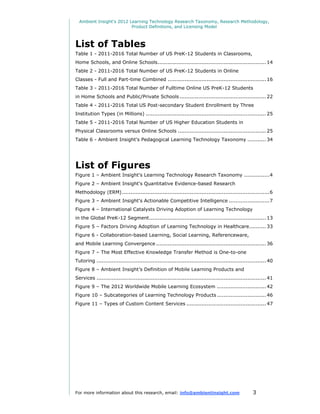
Table of Contents
List of Tables .......................................................................... 3
List of Figures......................................................................... 3
Ambient Insight's Research Taxonomy ...................................... 4
     Who are We? ......................................................................................... 4
     Our Quantitative Evidence-based Research Methodology ............................. 6
     Geographical Regions Defined .................................................................. 8
 International Buyer Segmentation Descriptions ...................... 9
     Consumers .......................................................................................... 10
     PreK-12 (Preschool, Primary, and Secondary) Academic Institutions ........... 11
     Higher Education Institutions ................................................................. 23
     Local and State/Provincial Governments ................................................. 27
     Federal Governments ........................................................................... 27
     Corporations and Businesses ................................................................. 29
     Associations, Non-profits, and NGOs ....................................................... 30
     Healthcare .......................................................................................... 31
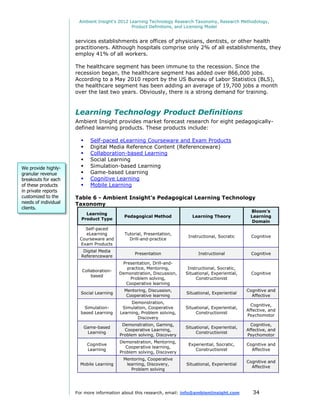
 Learning Technology Product Definitions ............................. 34
     Self-paced eLearning Courseware and Exam Products ............................... 35
     Digital Media Reference Content (Referenceware) .................................... 36
     Collaboration-based Learning ................................................................ 36
     Social Learning .................................................................................... 37
     Simulation-based Learning .................................................................... 37
     Game-based Learning ........................................................................... 38
     Cognitive Learning ............................................................................... 38
     Mobile Learning ................................................................................... 40
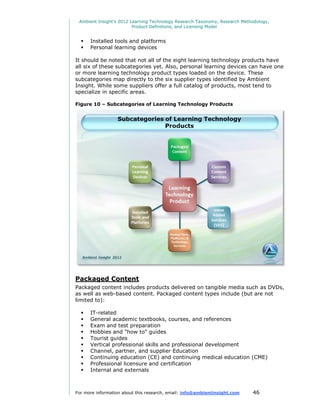
 Subcategories of Learning Technology Products ................... 45
     Packaged Content ................................................................................ 46
     Custom Content Services ...................................................................... 47
     Value Added Services ........................................................................... 48
     Hosted Tools, Platforms, and Technology Services .................................... 48
     Installed Tools and Platforms ................................................................. 48
     Personal Learning Devices ..................................................................... 49
 Ambient Insight’s Research Licensing Model ........................ 49


For more information about this research, email: info@ambientinsight.com                         2
Ambient Insight's 2012 Learning Technology Research Taxonomy, Research Methodology,
                          Product Definitions, and Licensing Model


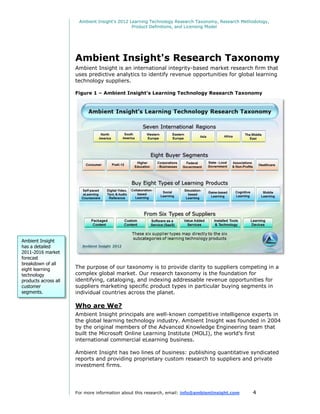
List of Tables
Table 1 - 2011-2016 Total Number of US PreK-12 Students in Classrooms,
Home Schools, and Online Schools ................................................................ 14
Table 2 - 2011-2016 Total Number of US PreK-12 Students in Online
Classes - Full and Part-time Combined .......................................................... 16
Table 3 - 2011-2016 Total Number of Fulltime Online US PreK-12 Students
in Home Schools and Public/Private Schools ................................................... 22
Table 4 - 2011-2016 Total US Post-secondary Student Enrollment by Three
Institution Types (in Millions) ....................................................................... 25
Table 5 - 2011-2016 Total Number of US Higher Education Students in
Physical Classrooms versus Online Schools .................................................... 25
Table 6 - Ambient Insight's Pedagogical Learning Technology Taxonomy ........... 34


List of Figures
Figure 1 – Ambient Insight's Learning Technology Research Taxonomy ............... 4
Figure 2 – Ambient Insight's Quantitative Evidence-based Research
Methodology (ERM) ....................................................................................... 6
Figure 3 – Ambient Insight's Actionable Competitive Intelligence ........................ 7
Figure 4 – International Catalysts Driving Adoption of Learning Technology
in the Global PreK-12 Segment ..................................................................... 13
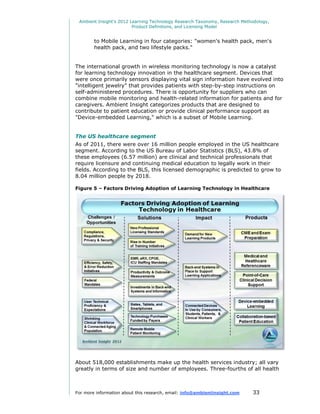
Figure 5 – Factors Driving Adoption of Learning Technology in Healthcare.......... 33
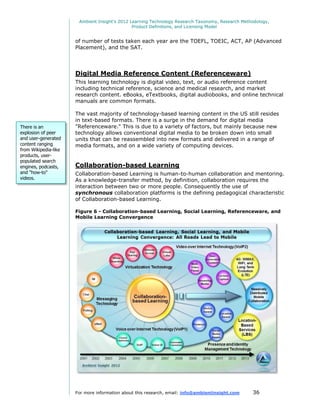
Figure 6 - Collaboration-based Learning, Social Learning, Referenceware,
and Mobile Learning Convergence ................................................................. 36
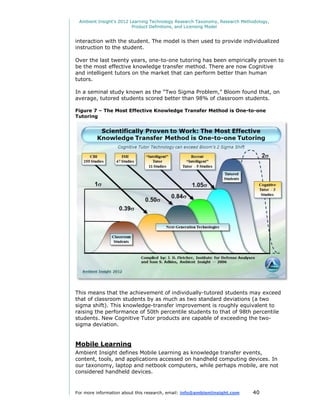
Figure 7 – The Most Effective Knowledge Transfer Method is One-to-one
Tutoring .................................................................................................... 40
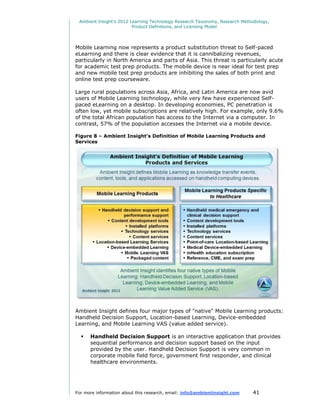
Figure 8 – Ambient Insight’s Definition of Mobile Learning Products and
Services .................................................................................................... 41
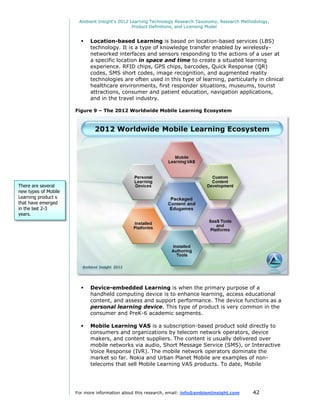
Figure 9 – The 2012 Worldwide Mobile Learning Ecosystem ............................. 42
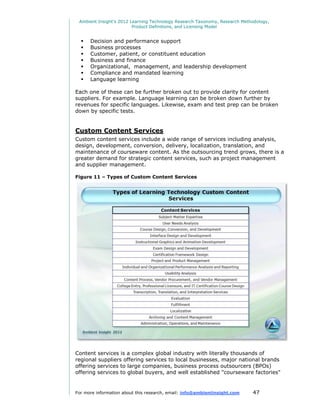
Figure 10 – Subcategories of Learning Technology Products ............................. 46
Figure 11 – Types of Custom Content Services ............................................... 47


For more information about this research, email: info@ambientinsight.com                            3
Ambient Insight's 2012 Learning Technology Research Taxonomy, Research Methodology,
                                               Product Definitions, and Licensing Model


                      Ambient Insight's Research Taxonomy
                      Ambient Insight is an international integrity-based market research firm that
                      uses predictive analytics to identify revenue opportunities for global learning
                      technology suppliers.

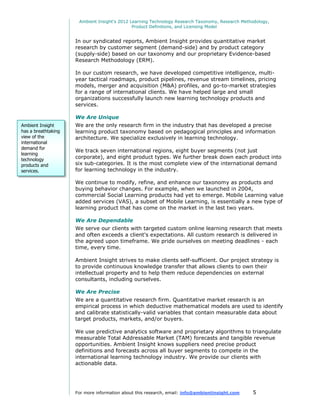
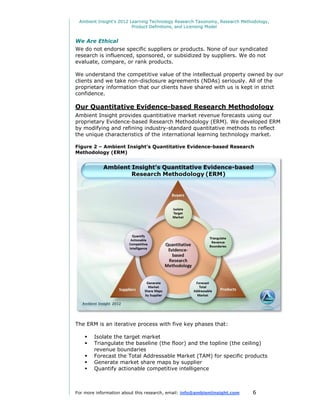
                      Figure 1 – Ambient Insight's Learning Technology Research Taxonomy


Ambient Insight
has a detailed
2011-2016 market
forecast
breakdown of all
eight learning        The purpose of our taxonomy is to provide clarity to suppliers competing in a
technology            complex global market. Our research taxonomy is the foundation for
products across all   identifying, cataloging, and indexing addressable revenue opportunities for
customer              suppliers marketing specific product types in particular buying segments in
segments.             individual countries across the planet.

                      Who are We?
                      Ambient Insight principals are well-known competitive intelligence experts in
                      the global learning technology industry. Ambient Insight was founded in 2004
                      by the original members of the Advanced Knowledge Engineering team that
                      built the Microsoft Online Learning Institute (MOLI), the world’s first
                      international commercial eLearning business.

                      Ambient Insight has two lines of business: publishing quantitative syndicated
                      reports and providing proprietary custom research to suppliers and private
                      investment firms.


                      For more information about this research, email: info@ambientinsight.com    4
Ambient Insight's 2012 Learning Technology Research Taxonomy, Research Methodology,
                                              Product Definitions, and Licensing Model


                     In our syndicated reports, Ambient Insight provides quantitative market
                     research by customer segment (demand-side) and by product category
                     (supply-side) based on our taxonomy and our proprietary Evidence-based
                     Research Methodology (ERM).

                     In our custom research, we have developed competitive intelligence, multi-
                     year tactical roadmaps, product pipelines, revenue stream timelines, pricing
                     models, merger and acquisition (M&A) profiles, and go-to-market strategies
                     for a range of international clients. We have helped large and small
                     organizations successfully launch new learning technology products and
                     services.

                     We Are Unique
Ambient Insight      We are the only research firm in the industry that has developed a precise
has a breathtaking   learning product taxonomy based on pedagogical principles and information
view of the          architecture. We specialize exclusively in learning technology.
international
demand for
                     We track seven international regions, eight buyer segments (not just
learning
technology
                     corporate), and eight product types. We further break down each product into
products and         six sub-categories. It is the most complete view of the international demand
services.            for learning technology in the industry.

                     We continue to modify, refine, and enhance our taxonomy as products and
                     buying behavior changes. For example, when we launched in 2004,
                     commercial Social Learning products had yet to emerge. Mobile Learning value
                     added services (VAS), a subset of Mobile Learning, is essentially a new type of
                     learning product that has come on the market in the last two years.

                     We Are Dependable
                     We serve our clients with targeted custom online learning research that meets
                     and often exceeds a client's expectations. All custom research is delivered in
                     the agreed upon timeframe. We pride ourselves on meeting deadlines - each
                     time, every time.

                     Ambient Insight strives to make clients self-sufficient. Our project strategy is
                     to provide continuous knowledge transfer that allows clients to own their
                     intellectual property and to help them reduce dependencies on external
                     consultants, including ourselves.

                     We Are Precise
                     We are a quantitative research firm. Quantitative market research is an
                     empirical process in which deductive mathematical models are used to identify
                     and calibrate statistically-valid variables that contain measurable data about
                     target products, markets, and/or buyers.

                     We use predictive analytics software and proprietary algorithms to triangulate
                     measurable Total Addressable Market (TAM) forecasts and tangible revenue
                     opportunities. Ambient Insight knows suppliers need precise product
                     definitions and forecasts across all buyer segments to compete in the
                     international learning technology industry. We provide our clients with
                     actionable data.


                     For more information about this research, email: info@ambientinsight.com    5
Ambient Insight's 2012 Learning Technology Research Taxonomy, Research Methodology,
                         Product Definitions, and Licensing Model


We Are Ethical
We do not endorse specific suppliers or products. None of our syndicated
research is influenced, sponsored, or subsidized by suppliers. We do not
evaluate, compare, or rank products.

We understand the competitive value of the intellectual property owned by our
clients and we take non-disclosure agreements (NDAs) seriously. All of the
proprietary information that our clients have shared with us is kept in strict
confidence.

Our Quantitative Evidence-based Research Methodology
Ambient Insight provides quantitiative market revenue forecasts using our
proprietary Evidence-based Research Methodology (ERM). We developed ERM
by modifying and refining industry-standard quantitative methods to reflect
the unique characteristics of the international learning technology market.

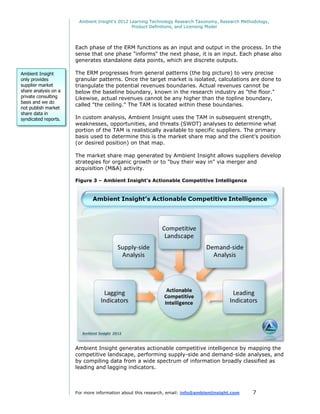
Figure 2 – Ambient Insight's Quantitative Evidence-based Research
Methodology (ERM)


The ERM is an iterative process with five key phases that:

       Isolate the target market
       Triangulate the baseline (the floor) and the topline (the ceiling)
        revenue boundaries
       Forecast the Total Addressable Market (TAM) for specific products
       Generate market share maps by supplier
       Quantify actionable competitive intelligence


For more information about this research, email: info@ambientinsight.com    6
Ambient Insight's 2012 Learning Technology Research Taxonomy, Research Methodology,
                                               Product Definitions, and Licensing Model


                      Each phase of the ERM functions as an input and output in the process. In the
                      sense that one phase "informs" the next phase, it is an input. Each phase also
                      generates standalone data points, which are discrete outputs.

Ambient Insight       The ERM progresses from general patterns (the big picture) to very precise
only provides         granular patterns. Once the target market is isolated, calculations are done to
supplier market       triangulate the potential revenues boundaries. Actual revenues cannot be
share analysis on a   below the baseline boundary, known in the research industry as "the floor."
private consulting    Likewise, actual revenues cannot be any higher than the topline boundary,
basis and we do
                      called "the ceiling." The TAM is located within these boundaries.
not publish market
share data in
syndicated reports.   In custom analysis, Ambient Insight uses the TAM in subsequent strength,
                      weaknesses, opportunities, and threats (SWOT) analyses to determine what
                      portion of the TAM is realistically available to specific suppliers. The primary
                      basis used to determine this is the market share map and the client's position
                      (or desired position) on that map.

                      The market share map generated by Ambient Insight allows suppliers develop
                      strategies for organic growth or to "buy their way in" via merger and
                      acquisition (M&A) activity.

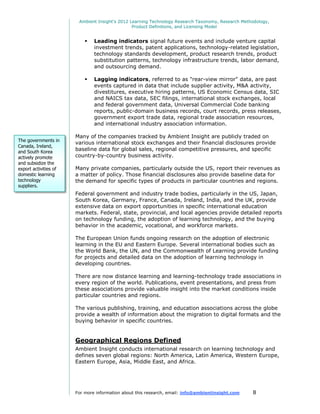
                      Figure 3 – Ambient Insight's Actionable Competitive Intelligence


                      Ambient Insight generates actionable competitive intelligence by mapping the
                      competitive landscape, performing supply-side and demand-side analyses, and
                      by compiling data from a wide spectrum of information broadly classified as
                      leading and lagging indicators.


                      For more information about this research, email: info@ambientinsight.com    7
Ambient Insight's 2012 Learning Technology Research Taxonomy, Research Methodology,
                                                Product Definitions, and Licensing Model


                              Leading indicators signal future events and include venture capital
                               investment trends, patent applications, technology-related legislation,
                               technology standards development, product research trends, product
                               substitution patterns, technology infrastructure trends, labor demand,
                               and outsourcing demand.

                              Lagging indicators, referred to as "rear-view mirror" data, are past
                               events captured in data that include supplier activity, M&A activity,
                               divestitures, executive hiring patterns, US Economic Census data, SIC
                               and NAICS tax data, SEC filings, international stock exchanges, local
                               and federal government data, Universal Commercial Code banking
                               reports, public-domain business records, court records, press releases,
                               government export trade data, regional trade association resources,
                               and international industry association information.

                       Many of the companies tracked by Ambient Insight are publicly traded on
The governments in
                       various international stock exchanges and their financial disclosures provide
Canada, Ireland,
and South Korea
                       baseline data for global sales, regional competitive pressures, and specific
actively promote       country-by-country business activity.
and subsidize the
export activities of   Many private companies, particularly outside the US, report their revenues as
domestic learning      a matter of policy. Those financial disclosures also provide baseline data for
technology             the demand for specific types of products in particular countries and regions.
suppliers.
                       Federal government and industry trade bodies, particularly in the US, Japan,
                       South Korea, Germany, France, Canada, Ireland, India, and the UK, provide
                       extensive data on export opportunities in specific international education
                       markets. Federal, state, provincial, and local agencies provide detailed reports
                       on technology funding, the adoption of learning technology, and the buying
                       behavior in the academic, vocational, and workforce markets.

                       The European Union funds ongoing research on the adoption of electronic
                       learning in the EU and Eastern Europe. Several international bodies such as
                       the World Bank, the UN, and the Commonwealth of Learning provide funding
                       for projects and detailed data on the adoption of learning technology in
                       developing countries.

                       There are now distance learning and learning-technology trade associations in
                       every region of the world. Publications, event presentations, and press from
                       these associations provide valuable insight into the market conditions inside
                       particular countries and regions.

                       The various publishing, training, and education associations across the globe
                       provide a wealth of information about the migration to digital formats and the
                       buying behavior in specific countries.


                       Geographical Regions Defined
                       Ambient Insight conducts international research on learning technology and
                       defines seven global regions: North America, Latin America, Western Europe,
                       Eastern Europe, Asia, Middle East, and Africa.


                       For more information about this research, email: info@ambientinsight.com    8
Ambient Insight's 2012 Learning Technology Research Taxonomy, Research Methodology,
                                                 Product Definitions, and Licensing Model


                               North America includes the US and Canada.

                               Latin America includes the rest of the western hemisphere starting with
The buying behavior             Mexico southward. The Caribbean countries and islands are grouped
inside particular               with Latin America.
countries and
regions tend to be             Ambient Insight defines Western Europe as the 27 countries in the
quite different. That           European Union as of January 2011. It also includes four countries that,
said, there are often
                                so far, have not joined the EU: Iceland, Norway, Lichtenstein, and
pan-regional
revenue                         Switzerland.
opportunities and
Ambient Insight                Ambient Insight defines Eastern Europe as the countries that were once
identifies those for            part of Yugoslavia and many of the Commonwealth of Independent
suppliers.                      States (CIS) that were once part of the former Soviet Union: Serbia,
                                Montenegro, Bosnia and Herzegovina, Macedonia, Albania, the Russian
                                Federation, Belarus, Croatia, Georgia, Moldova, Armenia, Azerbaijan,
                                Turkmenistan, Kazakhstan, Kyrgyzstan, Uzbekistan, and Ukraine.

                               Asia is defined as the countries in continental eastern Asia and the
                                countries and island nations in the Asian Pacific including Australia and
                                New Zealand.

                               The Middle East includes all the countries in the southeast
                                Mediterranean, the Gulf countries, and arbitrarily groups Turkey and
                                Egypt as part of the Middle East.

                               Africa includes all the countries on the African continent except Egypt
                                and also includes Madagascar.


                        International Buyer Segmentation Descriptions
                        Ambient Insight provides market research across all the global buyer
                        segments including:

                               Consumers
                               PreK-12 academic institutions
                               Higher education institutions
                               Local, state/provincial governments
                               Federal governments
                               Corporations and businesses
                               Associations, non-profits, and NGOs
                               Healthcare buyers

                        Because the healthcare market includes buyers in several of the other
                        segments (e.g. associations, consumers, corporations, and governments),
                        Ambient Insight breaks out the healthcare segment to provide clarity for
                        suppliers. The healthcare segment in each country tends to be unique and it is
                        rarely a monolithic vertical buyer segment.


                        For more information about this research, email: info@ambientinsight.com    9
Ambient Insight's 2012 Learning Technology Research Taxonomy, Research Methodology,
                                              Product Definitions, and Licensing Model


                     Consumers
                     Ambient Insight defines consumers as individual buyers that purchase
                     products directly. The consumer segment is the only buying segment in which
                     the buyer and the user are identical. In all other segments the buyers and the
                     users are not the same. It should be noted that consumers do not buy tools or
                     platforms.

                     Consequently, buying behavior in the global consumer markets tend to provide
                     the best data on customer satisfaction from a product standpoint. In all other
                     segments customer demand is based on the needs of organizational buyers,
                     not the actual users.

                     The consumer demand for technology-based learning products is different in
                     each country. The differences in Mobile Learning preferences are interesting:

                            In the US, the top Mobile Learning apps purchased by consumers are
                             edugames designed for preschool children and brain trainer games
                             designed for the older demographic.

                            The top selling educational apps in Germany are English and Spanish
                             language learning titles.

                            The selling mobile educational apps in South Korea are dominated by
                             English language apps. Eight of the top ten selling education apps
                             in South Korea are English language learning apps.

                            In India, French and Chinese language learning apps trend in the top
                             ten list.

                            Five of the top ten selling mobile education apps in Taiwan are English
                             language learning products, with English learning apps taking the first
                             and second place in top sales.

                            In Indonesia, consumers prefer language learning products with
                             Chinese, Vietnamese, English, Arabic, and Farsi consistently being in
There are distinct           the top ten paid apps.
regional
differences and             Turkish consumers buy language learning apps and early childhood
the buying                   education apps. The top languages are Greek, English, and Japanese.
behavior can be
quite different in
                            In Nigeria, consumers prefer Spanish and Chinese language learning
each region, and
in countries
                             apps.
within a region.
                     Test prep apps for driving tests are popular with consumers in the UK. The top
                     Mobile Learning apps purchased by Russian consumers are language learning
                     (across several languages) and astronomy apps. In South Africa, early
                     childhood learning and astronomy apps top the sales charts. The top selling
                     apps in Canada are astronomy apps. In fact, the consumer demand for
                     astronomy apps is a common thread across the globe.

                     The consumer demand for academic content is unique in the US. In 2011, 4.1
                     million PreK-12 children took extracurricular online classes outside the


                     For more information about this research, email: info@ambientinsight.com    10
Ambient Insight's 2012 Learning Technology Research Taxonomy, Research Methodology,
                         Product Definitions, and Licensing Model


jurisdiction of the schools. These students are spread out across public
schools, private schools, homeschools, and virtual/cyber charter schools and
they are not additional populations. The vast majority of these online classes
are sold by commercial suppliers directly to parents. The parents are the
buyers of the products.

In order to help suppliers target the buyers, as of 2012, Ambient Insight no
longer includes these populations in the PreK-12 category. We now categorize
these extracurricular expenditures as part of the consumer segment.

Language learning dominates this extracurricular activity, but there a range of
other topics purchased. A breakdown by subject matter is included in the
consumer section of "The US Market for Self-paced eLearning Products and
Services: 2011-2016 Forecast and Analysis, Ambient Insight, LLC."

The number of US kids taking extracurricular online classes is growing by a
five-year annual growth rate of 30.3%. By 2016, over 15.7 million school-aged
children will be taking online extracurricular classes outside the jurisdiction of
the schools, representing a significant revenue opportunity for consumer-
facing suppliers. The demand has been recognized by international suppliers
who are now offering products and services (particularly live tutoring) to US
children.


PreK-12 (Preschool, Primary, and Secondary) Academic
Institutions
PreK-12 school systems are different in each country. Some school systems,
such as Mexico, Brazil, South Korea, and China, are operated by the central
government. Other school systems, such as Canada and the US, are operated
at the provincial/state and local levels. While the French government owns the
national curriculum and manages the content for all the schools in France, the
school systems make the technology purchasing decisions at the local level.

Consequently, academic buying behavior is quite different in each country. In
some countries, schools are autonomous and can make their own buying
decisions. In other countries, central government agencies not only decide
what products are used, but also purchase the products directly.

In our worldwide syndicated reports, we highlight the unique buying behavior
of domestic school systems.

There are often stark differences in buying behavior from country to country
even among the technologically advanced nations. The concept that
"eLearning Readiness" is defined by a country's technology adoption
is simply not true.

For example, except for online language learning there is very little Self-paced
eLearning used in Japanese primary and secondary schools. In contrast,
essentially all primary and secondary schools in Singapore and South Korea
use Self-paced eLearning for a variety of subjects.


For more information about this research, email: info@ambientinsight.com    11
Ambient Insight's 2012 Learning Technology Research Taxonomy, Research Methodology,
                                               Product Definitions, and Licensing Model


                      A country's educational policies are often more important than a country's
                      technical readiness when it comes to the adoption of learning technology:

                             In March 2011, the Ukrainian Minister of Education announced an
                              ambitious program called Open World, launched in the 2011 school
                              year, to deploy distance learning in every school in the country. The
                              program is modeled on the successful Magellan Initiative in Portugal.

                             In May 2011, the Education Ministry of the United Arab Emirates (UAE)
                              initiated a policy that mandates the installation of learning platforms in
                              all 425 of the UAE's public schools within six years.

                             In May 2011, the Laguna province of the Philippines announced that
                              they would begin providing students with an educational tablet called
                              the Rizal Tablet designed by a local company, Ionics EMS. The
                              preloaded content on the Rizal was developed in collaboration with the
                              provincial government, Vibal Publishing, and the University of the
                              Philippines. Starting with 1,000 tablets in 2011, the goal is to equip
                              every school child in the province with the device within five years.

                             In June 2011, the Education and Vocational Training Minister of
                              Tanzania announced an ambitious multi-year plan starting in 2011 to
                              deploy online learning in 4,000 schools with the goal to reach 1.2
                              million secondary students.

                             In June 2011, the South Korean Education Ministry mandated that all
                              instructional content in all primary and secondary schools must be
                              100% digital by 2015. By 2015, every school child in South Korea
                              will be carrying a personal learning device.

                             In July 2011, the government in Thailand announced that they intend
                              to give every child in grades 1-6 a tablet starting with first grade
                              students in the 2012 school year. The multi-year program will equip
                              over 5 million primary students with handheld devices.

                             In October 2011, the Indian government launched their heavily-
                              subsidized tablet designed for schools called Aakash. The tablet is
                              priced at $35.00 for schools and the government plans to deploy over
                              one million devices to schools in 2012 alone.

                             In November 2011, the Minister of Education and Science in
                              Kazakhstan announced that every school-aged child in the country will
China and South               be provided with a tablet by 2020. Interestingly, they are supplying the
Korea are the first           first wave of tablets to, "the 9,300 children with disabilities that are
countries in the              unable to attend school for health reasons."
world to convert
all their primary
                             In December 2011, the state government of Pernambuco in northeast
and secondary
academic content              Brazil announced that they would purchase 170,000 tablets for high
to digital formats.           school students in 2012.

                      In China, the central government develops and controls the academic
                      curriculum. As of 2010, the entire primary and secondary curriculum was
                      online in China. Although the content is online, relatively few students have


                      For more information about this research, email: info@ambientinsight.com    12
Ambient Insight's 2012 Learning Technology Research Taxonomy, Research Methodology,
                         Product Definitions, and Licensing Model


access to it yet. The Chinese government's goal is to have their entire
K-12 population of over 200 million students online by 2020.

The Pre-K education system in Indonesia is also controlled by the central
government. The Indonesian Ministry of Education started digitizing textbooks
in 2008. As of September 2011, they had 942 textbooks digitized and posted
online in the country.

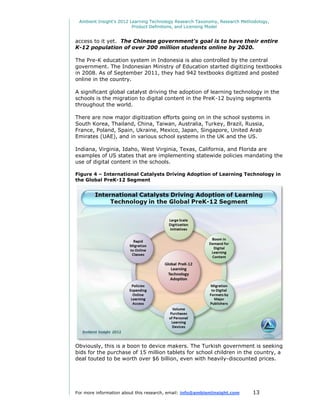
A significant global catalyst driving the adoption of learning technology in the
schools is the migration to digital content in the PreK-12 buying segments
throughout the world.

There are now major digitization efforts going on in the school systems in
South Korea, Thailand, China, Taiwan, Australia, Turkey, Brazil, Russia,
France, Poland, Spain, Ukraine, Mexico, Japan, Singapore, United Arab
Emirates (UAE), and in various school systems in the UK and the US.

Indiana, Virginia, Idaho, West Virginia, Texas, California, and Florida are
examples of US states that are implementing statewide policies mandating the
use of digital content in the schools.

Figure 4 – International Catalysts Driving Adoption of Learning Technology in
the Global PreK-12 Segment


Obviously, this is a boon to device makers. The Turkish government is seeking
bids for the purchase of 15 million tablets for school children in the country, a
deal touted to be worth over $6 billion, even with heavily-discounted prices.


For more information about this research, email: info@ambientinsight.com    13
Ambient Insight's 2012 Learning Technology Research Taxonomy, Research Methodology,
                         Product Definitions, and Licensing Model


In August 2011, the Russian government announced a plan to deploy tablets,
"on a massive scale in the Russian educational system to replace printed
textbooks."

While all domestic school systems are unique, the US stands out because it
has the largest population of online PreK-12 students, so far. The large (and
growing) number of children attending online primary and secondary schools
fulltime in the US is a trend found nowhere else in the world.


The US PreK-12 Academic Market
As of 2011, the US PreK-12 buying segment represented the most dynamic
academic market on the globe. It has the highest growth rate for learning
technology out of all the eight buying segments tracked by Ambient Insight. In
terms of deal volumes, it has the highest number of merger and acquisition
deals anywhere in the world.

The strong demand for learning technology in US schools is being driven by
the robust growth of virtual and cyber charter schools, the rapid rise of online
student enrollments, state legislation mandating content digitization (and
online alternatives to classroom instruction), and ironically, the reduced
budgets resulting from the lingering effects of the recession.

Ambient Insight defines virtual and cyber charter classes as courses that are
taken outside the physical classroom, but within the jurisdiction of the schools.
The schools are the buyers of the learning technology products.

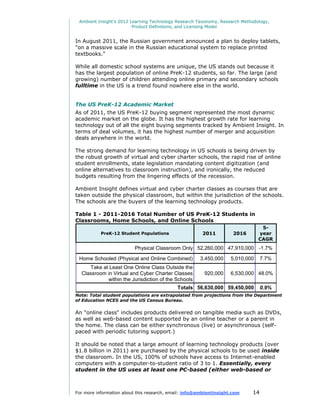
Table 1 - 2011-2016 Total Number of US PreK-12 Students in
Classrooms, Home Schools, and Online Schools
                                                                                 5-
           PreK-12 Student Populations                 2011          2016       year
                                                                                CAGR
                          Physical Classroom Only 52,260,000 47,910,000 -1.7%

 Home Schooled (Physical and Online Combined)         3,450,000     5,010,000    7.7%
     Take at Least One Online Class Outside the
  Classroom in Virtual and Cyber Charter Classes        920,000     6,530,000 48.0%
            within the Jurisdiction of the Schools
                                            Totals 56,630,000 59,450,000         0.9%
Note: Total student populations are extrapolated from projections from the Department
of Education NCES and the US Census Bureau.

An "online class" includes products delivered on tangible media such as DVDs,
as well as web-based content supported by an online teacher or a parent in
the home. The class can be either synchronous (live) or asynchronous (self-
paced with periodic tutoring support.)

It should be noted that a large amount of learning technology products (over
$1.8 billion in 2011) are purchased by the physical schools to be used inside
the classroom. In the US, 100% of schools have access to Internet-enabled
computers with a computer-to-student ratio of 3 to 1. Essentially, every
student in the US uses at least one PC-based (either web-based or


For more information about this research, email: info@ambientinsight.com    14
Ambient Insight's 2012 Learning Technology Research Taxonomy, Research Methodology,
                                               Product Definitions, and Licensing Model


                      DVD-based) product every year inside the classroom. Language learning
                      and math are the dominant topics. These products are almost always used as
                      part of a course, and are rarely a course in itself.

                      Learning technology provides a viable, cost-effective alternative to schools
                      strapped with reduced budgets. For example, learning technology is
                      increasingly being used to deliver supplemental, advanced placement, credit-
                      recovery, and remedial content.

                      The PreK-12 academic segment includes private, public, and commercial
In 2012, Ambient      institutions. As of 2011, there were 14,166 school districts, 133,464 schools
Insight started       (both public and private combined), 56.6 million students, and 3.8 million
categorizing the      teachers in the US PreK-12 educational system.
students taking
extracurricular
                      There are 33,366 private schools in the US comprising 25% of all schools.
online classes
taken outside the     Almost 10% (5.5 million) of school children in the US attend private schools.
jurisdiction of the
schools as part of    There are five student sub-markets in the PreK-12 segment:
the consumer
segment.                     Charter Schools
                             Home Schools
                             Private Schools
                             Public Schools
                             Virtual Schools and Cyber Charter Schools

                      As of 2011, 49 states and the District of Colombia have policies sanctioning
                      virtual classes (the exception being Delaware), 41 states and the District of
                      Colombia allow charter schools, and 31 states allow cyber charter schools. As
                      of 2011, there were over 5,300 charter schools in the US and the number of
                      schools is growing by 6% a year. Over 380 charter schools in the US offer
                      online programs. There are over 250 dedicated virtual charter schools in the
                      US. Sources: National Conference of State Legislatures and National Alliance for Public
                      Charter Schools.

                      In general, a charter school is publicly funded and privately managed. Virtual
                      schools can be publicly funded or privately funded and can be managed by
                      public or private entities. That said, many states label their cyber charter
                      schools as virtual schools or even virtual charters, so the terms are used
                      interchangeably.

                      There are now attempts to catalog all the online schools in the US. Wikipedia
                      has identified 233 virtual and cyber charter schools in the US. The EU's
                      Researching Virtual Initiatives in Education project has catalogued 261 online
                      schools in the US.


                      The US online PreK-12 populations
                      Ambient Insight counts the discrete number of individual students, not course
                      enrollments. A student can enroll in one or more courses in a year, yet we
                      focus on the unduplicated student headcount as it represents a quantifiable
                      "seat license" baseline for suppliers.


                      For more information about this research, email: info@ambientinsight.com    15
Ambient Insight's 2012 Learning Technology Research Taxonomy, Research Methodology,
                                                Product Definitions, and Licensing Model


                       Ambient Insight derives their online student population totals by counting
                       numbers reported in quantitative public-domain sources provided by state
                       education agencies, school districts, universities, state legislatures, federal
                       government agencies, charter school associations, and commercial suppliers.
                       We do not triangulate data from qualitative sources.

                       Over 1.6 million discrete students were enrolled in online programs in 2011,
                       with at least 455,000 students (including home schooled) attending fulltime
                       (see Table 3 for fulltime totals.) As of late 2011, the aggregate percentage of
                       students (full and part-time combined) taking virtual or cyber charter classes
                       across all states is 2.9%.

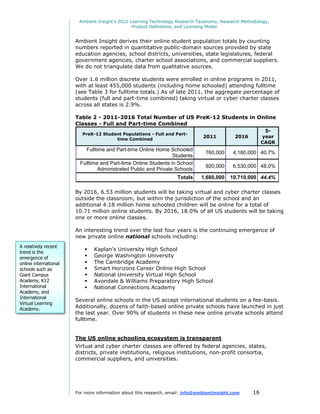
                       Table 2 - 2011-2016 Total Number of US PreK-12 Students in Online
                       Classes - Full and Part-time Combined
                                                                                                         5-
                          PreK-12 Student Populations - Full and Part-
                                                                               2011         2016        year
                                       time Combined
                                                                                                        CAGR
                           Fulltime and Part-time Online Home Schooled
                                                                                760,000     4,180,000 40.7%
                                                                 Students
                         Fulltime and Part-time Online Students in School
                                                                                920,000     6,530,000 48.0%
                                 Administrated Public and Private Schools
                                                                   Totals     1,680,000   10,710,000 44.4%

                       By 2016, 6.53 million students will be taking virtual and cyber charter classes
                       outside the classroom, but within the jurisdiction of the school and an
                       additional 4.18 million home schooled children will be online for a total of
                       10.71 million online students. By 2016, 18.0% of all US students will be taking
                       one or more online classes.

                       An interesting trend over the last four years is the continuing emergence of
                       new private online national schools including:
A relatively recent
                              Kaplan's University High School
trend is the
emergence of                  George Washington University
online international          The Cambridge Academy
schools such as               Smart Horizons Career Online High School
Giant Campus                  National University Virtual High School
Academy, K12                  Avondale & Williams Preparatory High School
International                 National Connections Academy
Academy, and
International
                       Several online schools in the US accept international students on a fee-basis.
Virtual Learning
Academy.
                       Additionally, dozens of faith-based online private schools have launched in just
                       the last year. Over 90% of students in these new online private schools attend
                       fulltime.


                       The US online schooling ecosystem is transparent
                       Virtual and cyber charter classes are offered by federal agencies, states,
                       districts, private institutions, religious institutions, non-profit consortia,
                       commercial suppliers, and universities.


                       For more information about this research, email: info@ambientinsight.com    16
Ambient Insight's 2012 Learning Technology Research Taxonomy, Research Methodology,
                                                Product Definitions, and Licensing Model


                       Even the US Department of Defense has a virtual high school. The Department
                       of Defense Education Activity (DoDEA) operates 223 schools, which employ
                       14,500 teachers and support staff. The DoDEA has over 101,500 students
                       enrolled. In the 2010-2011 school year, the DoDEA launched their virtual high
                       school with 33 courses.

                       Several states, such as California, Ohio, Colorado, Washington, Florida,
                       Nebraska, Minnesota, Texas, North Carolina, Nevada, Wisconsin, Idaho, Utah,
                       New York, and Arizona have state-wide data repositories that track online
                       enrollment percentages across all school districts in the state.

                       Additionally, state-operated virtual schools serve the majority of school
                       districts in their respective states making it unnecessary to sample individual
                       districts.

                       Ambient Insight is agnostic about educational policy. We track online
A major trend that     student populations in order to quantify revenue opportunities for suppliers.
emerged in 2011
was the growing        The presence of dedicated virtual and cyber charter schools with discrete
tendency for           student populations is a clear "per-seat" opportunity for content, services, and
school districts to    technology suppliers.
launch their own
virtual schools as a
way to cut costs,
attract home           State legislation data sources
schooled students,     A valuable source of data is the total online populations cited in the various
and pull students      state legislative documents dealing with online schools. There have been over
back from              25 states that initiated high-profile legislative efforts relating to PreK-12 online
virtual/cyber          learning in 2011 alone. Almost all of those proceedings reported the current
charter schools.
                       number of online students and many provided projections.

                       The Arizona legislature approved expansion of the Arizona Online Instruction
                       program in 2010. As of May 2011, 28 school districts and 14 charter schools
                       had received approval for online programs. Administrators of the program
                       report that more than 35,000 students are already enrolled in just the first
                       year of the expanded operation.

                       In September 2011, results from a report by the Office of the Legislature
                       Auditor commissioned by the Minnesota legislature indicated that over 20,000
                       students in Minnesota took at least one online class in the 2010 school year,
                       (and the number has doubled annually for the last three years.) Minnesota's
                       online student population has a high percentage of fulltime online students,
                       averaging 68% (13,600 students in 2010) over the last three years.

                       In April 2011, the New York Board of Regents approved a policy mandating
                       that all schools in the state increase the amount of online learning available to
                       students. New York was granted $700 million in funds from the national Race
                       to the Top program and indicated they would use some of the money to launch
                       the New York State Virtual High School with the goal to reach 20,000 students
                       by 2014.


                       Legislative Trends


                       For more information about this research, email: info@ambientinsight.com    17
Ambient Insight's 2012 Learning Technology Research Taxonomy, Research Methodology,
                                               Product Definitions, and Licensing Model


                      Until recently, the prevailing trend in state legislation regarding online schools
                      was restrictive and laws were designed to limit the growth of those schools.

                      While restrictive laws (such as enrollment caps and new online school
                      moratoriums) are still on the books, the new legal trend that emerged in 2010
                      and 2011 was the introduction of laws that allowed:

                             Expansion of enrollments (either by raising the enrollment caps or
                              removing caps altogether) at existing online schools
                             Creation of new online schools
                             Students to take all their classes online
                             Students to enroll in virtual schools outside their district
                             Online classes to be taught by a percentage (usually quite small) of
                              teachers from outside the state
                             Home schooled children to enroll in district-run virtual schools without
                              having to enroll in the district.

                      For example, state legislatures in Arizona, Connecticut, Maryland, Virginia,
                      Louisiana, Utah, Alabama, Florida, Wisconsin, Tennessee, and New Jersey
                      passed laws in 2010 and 2011 that expanded (or created for the first time)
                      virtual and cyber charter school programs.


                      Follow the numbers
                      Just five virtual school systems account for 302,000, or 32.9%, of the total US
                      online student population in virtual and cyber charter schools:

                             Florida Virtual School (FLVS) with 122,000 students, up from 97,000
                              students in 2010
                             Kaplan University Online High School is a national high school with over
Until recently,
                              50,000 students
charter schools in
Alabama, while               North Carolina's Virtual Public School (NCVPS) has over 49,000
permitted to offer            students
online classes, had          Alabama's ACCESS Distance Learning Initiative has over 41,000 online
to also operate               students.
physical buildings.          Penn Foster High School (owned by the Princeton Review) has over
That requirement              40,000 online students.
was eliminated in
2011, allowing
                      Each of these school systems has reported phenomenal growth over the last
virtual charter
schools to operate
                      two years.
without a physical
presence.
                      State sources of enrollment data
                      California has the most extensive and detailed data on online students. The
                      California Board of Education (CDE) has a data repository called the California
                      Directory of Online Schools and Programs (CDOSP), which shows discrete
                      online enrollment totals for every county in the state for schools that provide
                      over 30% of their curriculum online.

                      Over 2.7% of California's 6.2 million PreK-12 students are taking at least one
                      class online as of 2011. The percentage of online students is much higher in
                      the charter schools.


                      For more information about this research, email: info@ambientinsight.com    18
Ambient Insight's 2012 Learning Technology Research Taxonomy, Research Methodology,
                                                Product Definitions, and Licensing Model


                       The California Board of Education (CDE) estimates that 23%, or 95,000, of the
                       412,000 students in charter schools (both online and physical) are taking one
                       or more of their classes online. (California added 100 new charter schools in
                       2011 and their student population spiked from 364,000 to 412,000 charter
                       students in one year.)

                       California Virtual Academies (CAVA), a publicly-funded online charter school
In 2011, Kapolei       system operated by K12, Inc., had 10,766 online students in 2010 according
Middle School in       to their School Accountability Report Cards (SARC) required by the California
Honolulu became        Department of Education (CDE). CAVA had 11,519 online students in 2011
the first school       according to the CDOSP, a 7% increase over 2010.
district in Hawaii
to offer all 7th and   Pennsylvania has over 50,000 online students across the 13 cyber charter
8th grade classes      schools. The Pennsylvania Cyber Charter School is just one of those 13 cyber
online.
                       charter schools and has 11,000 students.
Interestingly, the
move is aimed at
reducing               In May 2011, the Ohio Department of Education reported that the number of
overcrowding.          students enrolled in the publicly-funded "e-schools" increased 46% from 2006
                       to 2011 to a total of 31,000 students. This total does not include the students
                       in private online programs.

                       Ironically, Ohio has a moratorium on the increase of new online schools, yet
                       their online population has increased dramatically in spite of the moratorium.

                       The Minnesota Department of Education reports that over 23,000 children are
                       enrolled in online programs in the state, with over 8,500 enrolled fulltime.
                       According to Minnesota's Office of the Legislative Auditor (OLA), part-time
                       enrollment nearly doubled in the last four years, while full-time enrollment
                       more than tripled in the same period.

                       According to the Colorado Department of Education, the number of Colorado
                       students enrolled in online programs jumped from 9,222 in 2007 to 15,249 in
                       2010, a 65% increase. As of 2012, they have 24 online schools with over
                       22,000 students.

                       Washington State education officials announced in May 2011, that over 20,000
                       students, or 2% of their public school K12 population, were enrolled in one or
                       more online programs. This does not include enrollments in private schools.

                       The non-profit Virtual High School Global Consortium is a national program
                       and serves over 770 schools across 35 states with 15,000 enrolled students.
                       They report that the number of schools working with them has grown 34% in
                       the last two years.

                       All state-run programs report on their online student populations. For
                       example:

                              Michigan Virtual School has over 18,000 online students

                              Idaho Digital Learning Academy (IDLA) serves 100% of Idaho's school
                               districts and has 14,300 students enrolled.


                       For more information about this research, email: info@ambientinsight.com    19
Ambient Insight's 2012 Learning Technology Research Taxonomy, Research Methodology,
                                               Product Definitions, and Licensing Model


                             The Utah Electronic High School has over 9,000 students.

                             The Texas Virtual School Network (TxVSN) serves all 1,225 districts in
                              the state and online enrollment rapidly grew from 103 students in 2009
                              to over 8,000 students by the summer of 2011.

                             Virtual Virginia Online School serves 90% of Virginia's schools and has
                              over 7,800 students.

                             The Oregon Virtual School District (ORVSD) has over 7,000 online
                              students.

                             The Georgia Cyber Academy currently has 6,500 students enrolled in K-
                              9 online classes.

                             The Louisiana Virtual School (LVS) has 5,234 students as of 2011.

                      It should be noted that the numbers above are just for the students in these
                      specific state-run programs and are not the total number of online students in
                      the states. For example, Idaho has an additional 4,900 online students across
                      seven district-level virtual charter schools.


                      University Sources of Enrollment Data
                      Several colleges including Stanford, Brigham Young, and Northwestern offer
                      online high school classes. There are also several colleges that operate virtual
                      high schools that grant high school degrees.

Thousands of high            During the 2010-2011 school year, Texas Tech University Independent
school children               School District (TTUISD) had over 12,000 part time enrollments and
take online classes           more than 2,500 full-time students in their high school diploma
annually from                 program.
universities and
colleges. The                The University of Missouri High School reports that they average 7,000
majority of those             student enrollments a year.
students are taking
post-secondary
classes (known as
                             Indiana University High School reports they have over 2,500 students a
dual program.)                year.
Those enrollments
are analyzed in       Stanford University's Online High School is unique in that it is designed for
Ambient Insight's     gifted children. In 2010, Middlebury College partnered with K12, Inc. to offer
higher education      online language learning to high school students. As of November 2011, they
segment.              serve over 50,000 students. The George Washington University Online High
                      School opened in January, 2011. Clearly, this is a significant new trend driving
                      the growth of online high schools in the US.


                      High growth rates now common
                      The one thing all these virtual and cyber charter schools have in common is
                      the explosive growth in enrollments. For example, the Virtual Learning
                      Academy Charter in New Hampshire grew from 700 students in 2008 to over
                      9,000 students in 2011. And that is just one cyber charter school in the state.


                      For more information about this research, email: info@ambientinsight.com    20
Ambient Insight's 2012 Learning Technology Research Taxonomy, Research Methodology,
                         Product Definitions, and Licensing Model


The Southern Regional Education Board (SREB), a non-profit organization set
up by 16 member states, works directly with state education agencies. SREB
tracks state virtual schools in 14 states and reports that four of their schools
are growing enrollments by 40% or more a year and that all their schools
combined expect a minimum enrollment growth of 25% over the next five
years.

The only examples of virtual and cyber charter schools that are not
experiencing rapid growth are schools in states that still impose enrollment
caps and states that have reduced funding or outright eliminated funding (as
in Delaware.)


Fulltime online enrollments growing rapidly
A conservative estimate (that includes online home schooled children) is that,
as of 2011, at least 420,000 PreK-12 children in the US attended all their
classes online. This is a mere 0.74% of the total number of school children in
the US. However, this is changing fast.

Four providers account for 65% of the fulltime population: Kaplan University
Online High School, Penn Foster High School, K12, Inc., and Connections
Education.

In November 2011, K12, Inc. reported in their SEC filing that, "our total full
time enrollment has grown from approximately 99,600 to 141,500 over the
past year." This is a breathtaking annual growth rate of 42%.

In September 2011, Connections Education reported that they had over
40,000 fulltime students. Connections Education was purchased by Pearson in
September 2011 for $400 million and at the time of the acquisition indicated in
the press that they had grown their revenues 30% in each of the last three
years.

In states that allow fulltime online attendance, fulltime enrollment tends to be
very high. For example:

       Almost all students attending national online high schools and online
        faith-based private schools are fulltime.

       Agora Cyber Charter School is just one of 13 cyber charters in
        Pennsylvania with over 6,000 students and all of their students are
        fulltime.

       Primavera Online High School in Arizona has over 15,000 online
        students and 86% are fulltime students.

       Over 68% of Minnesota's online students are fulltime.

       Over 7,180 (half of all students) of Idaho Digital Learning Academy
        (IDLA) online students are fulltime.


For more information about this research, email: info@ambientinsight.com    21
Ambient Insight's 2012 Learning Technology Research Taxonomy, Research Methodology,
                                               Product Definitions, and Licensing Model


                             Data derived from the California Department of Education Data
                              Partnership (Ed-Data) show that enrollment in online charter schools in
                              the state has been growing by 38-40% in the last three years and they
                              now have over 35,000 fulltime online students.

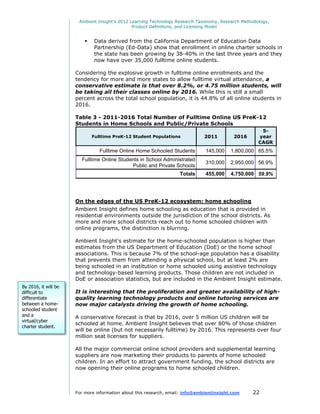
                      Considering the explosive growth in fulltime online enrollments and the
                      tendency for more and more states to allow fulltime virtual attendance, a
                      conservative estimate is that over 8.2%, or 4.75 million students, will
                      be taking all their classes online by 2016. While this is still a small
                      percent across the total school population, it is 44.8% of all online students in
                      2016.

                      Table 3 - 2011-2016 Total Number of Fulltime Online US PreK-12
                      Students in Home Schools and Public/Private Schools
                                                                                                      5-
                              Fulltime PreK-12 Student Populations            2011         2016      year
                                                                                                     CAGR
                                 Fulltime Online Home Schooled Students        145,000    1,800,000 65.5%
                        Fulltime Online Students in School Administrated
                                                                               310,000    2,950,000 56.9%
                                             Public and Private Schools
                                                                   Totals      455,000    4,750,000 59.9%


                      On the edges of the US PreK-12 ecosystem: home schooling
                      Ambient Insight defines home schooling as education that is provided in
                      residential environments outside the jurisdiction of the school districts. As
                      more and more school districts reach out to home schooled children with
                      online programs, the distinction is blurring.

                      Ambient Insight's estimate for the home-schooled population is higher than
                      estimates from the US Department of Education (DoE) or the home school
                      associations. This is because 7% of the school-age population has a disability
                      that prevents them from attending a physical school, but at least 2% are
                      being schooled in an institution or home schooled using assistive technology
                      and technology-based learning products. Those children are not included in
                      DoE or association statistics, but are included in the Ambient Insight estimate.
By 2016, it will be
difficult to          It is interesting that the proliferation and greater availability of high-
differentiate         quality learning technology products and online tutoring services are
between a home-       now major catalysts driving the growth of home schooling.
schooled student
and a                 A conservative forecast is that by 2016, over 5 million US children will be
virtual/cyber
                      schooled at home. Ambient Insight believes that over 80% of those children
charter student.
                      will be online (but not necessarily fulltime) by 2016. This represents over four
                      million seat licenses for suppliers.

                      All the major commercial online school providers and supplemental learning
                      suppliers are now marketing their products to parents of home schooled
                      children. In an effort to attract government funding, the school districts are
                      now opening their online programs to home schooled children.


                      For more information about this research, email: info@ambientinsight.com    22
Ambient Insight's 2012 Learning Technology Research Taxonomy, Research Methodology,
                         Product Definitions, and Licensing Model


Higher Education Institutions
Like the Prek-12 segment, higher education institutions are different in every
country. The adoption of learning technology varies dramatically from country
to country.

Government-mandated educational policies have a significant impact (either
negative or positive depending on the country) on the adoption of learning
technology in the higher education institutions across the globe.

Educational policies are inhibiting the growth of learning technology in several
countries:

       Both Brazil and Indonesia have strict government guidelines
        surrounding "the quality" of academic distance learning content making
        it difficult for foreign suppliers to compete.

       The Chinese Ministry of Education must approve online degree
        programs and, so far, does not allow foreign firms to grant online
        degrees in China. As of 2010, 68 schools (all domestic firms based in
        China) have been approved.

       In August 2010, the Ethiopian Ministry of Education banned all
        distance learning in higher education institutions in the country. In
        October 2010, the government lifted the ban on the condition that
        restrictive (and complex) curriculum guidelines are followed.

A country's educational policies can also create positive market conditions that
accelerate the adoption of learning technology:

       Mexico's Public Education Secretariat launched a federally funded
        virtual university in September 2010 called the Educación Superior
        Abierta y a Distancia (ESAD). ESAD offers free undergraduate degree
        programs to Mexican nationals.

       In April 2011, Malaysia launched the Malaysia Education Online (MEdO)
        national online learning portal. The goal of their new National e-
        Learning Policy is to have 30% of all higher education courses delivered
        online by 2015.

       In May 2011, The Sri Lankan Ministry of Higher Education signed an
        agreement with Mobitel to use Mobitel’s mLearning platform as "the
        National Higher Education Learning Platform through the National
        Online Distance Education Service (NODES)."

       In October 2011, the French Higher Education and Research Ministry
        announced they were subsidizing tablet purchases for higher education
        students in a partnership with France's largest mobile operator,
        Orange. Students are offered tablets at significant discounts. The
        government has a similar deal with Bouygues Telecom, France’s third-
        largest operator.


For more information about this research, email: info@ambientinsight.com    23
Ambient Insight's 2012 Learning Technology Research Taxonomy, Research Methodology,
                                              Product Definitions, and Licensing Model


                     The French government's (rather ambitious) goal is to have 95% of all higher
                     education students using tablets by the end of 2013.

                     Apple has been a major proponent of global higher education. Launched in
                     2007, Apple's iTunes U has content from over 1,000 educational institutions
                     from 26 countries across the globe. The content is available in over 123
                     countries. In September 2011, Apple reported that over 60% of iTunes U
                     traffic comes from outside the US. Apple reports that they have had over 600
                     million downloads since the launch of iTunes U in 2007.

                     All public content on iTunes U is free, yet it is a major catalyst for the
                     commercial Mobile Learning industry as it increases awareness and drives
                     adoption worldwide. About half of all iTunes U content providers make their
                     content available to the public. The other half provides private access only to
                     their enrolled students.

                     One of the largest institutions on iTunes U is the Open University based in the
                     UK. In August 2011, they reported that since their launch on iTunes U in June
                     2008, they had over 38.7 million downloads by over 4.4 million visitors. They
                     indicate that 89.9% of downloads originate outside the UK, with the US
                     accounting for the largest activity with 10.7 million downloads. The next
                     largest downloads originated from the UK, Canada, China, Australia, Germany,
                     Japan, France, the Netherlands, and Spain, respectively.

                     Stanford has had over 30 million downloads since they joined iTunes U.
                     Schools with over 20 million downloads include UC Berkeley, Yale, and MIT.
                     Oxford and the University of Munich each have had over 10 million downloads
                     on iTunes U.
Starting in 2012,
Ambient Insight
categorizes non-     The US online higher education ecosystem
Title IV trade and   The US has been the leading adopter of learning technology in higher
vocational schools   education so far and is treated in greater depth in this document. Ambient
as part of the
                     Insight's US higher education segment is comprised of the institutions that are
corporate
commercial
                     eligible for Title IV funds (student loans.) Those schools include: public non-
training and         profit universities and colleges, private non-profit universities and colleges,
education            and for-profit career colleges. We use the term "higher education" throughout
industry. The        this section.
online populations
are discussed in     The higher education segment includes degree and non-degree granting
the corporate        organizations. According the US Department of Education, there are over 27
section.             million students that are formally enrolled in the post-secondary system as of
                     2010.

                     Roughly 18 million are in degree or certificate programs with over nine
                     million additional students attending classes, but not pursuing a
                     credential.

                     This non-credential demographic is routinely overlooked in research, yet this is
                     a third of the total higher education population and represents a significant
                     revenue opportunity for suppliers.


                     For more information about this research, email: info@ambientinsight.com    24
Ambient Insight's 2012 Learning Technology Research Taxonomy, Research Methodology,
                                                Product Definitions, and Licensing Model


                       The demographic is much larger considering that up to 50 million adults in the
                       US also participate every year in some kind of formal educational experience.

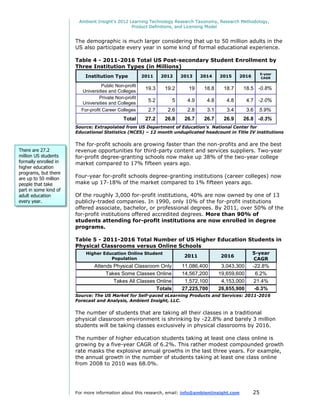
                       Table 4 - 2011-2016 Total US Post-secondary Student Enrollment by
                       Three Institution Types (in Millions)
                                                                                                            5-year
                           Institution Type            2011    2012    2013    2014    2015     2016        CAGR

                                   Public Non-profit
                         Universities and Colleges
                                                        19.3    19.2     19     18.8     18.7     18.5 -0.8%
                                  Private Non-profit
                         Universities and Colleges
                                                         5.2      5      4.9     4.8      4.8       4.7 -2.0%
                         For-profit Career Colleges      2.7     2.6     2.8     3.1      3.4       3.6   5.9%
                                             Total      27.2    26.8    26.7    26.7     26.9     26.8 -0.3%
                       Source: Extrapolated from US Department of Education's National Center for
                       Educational Statistics (NCES) – 12 month unduplicated headcount in Title IV institutions

                       The for-profit schools are growing faster than the non-profits and are the best
There are 27.2         revenue opportunities for third-party content and services suppliers. Two-year
million US students    for-profit degree-granting schools now make up 38% of the two-year college
formally enrolled in   market compared to 17% fifteen years ago.
higher education
programs, but there
are up to 50 million
                       Four-year for-profit schools degree-granting institutions (career colleges) now
people that take       make up 17-18% of the market compared to 1% fifteen years ago.
part in some kind of
adult education        Of the roughly 3,000 for-profit institutions, 40% are now owned by one of 13
every year.            publicly-traded companies. In 1990, only 10% of the for-profit institutions
                       offered associate, bachelor, or professional degrees. By 2011, over 50% of the
                       for-profit institutions offered accredited degrees. More than 90% of
                       students attending for-profit institutions are now enrolled in degree
                       programs.

                       Table 5 - 2011-2016 Total Number of US Higher Education Students in
                       Physical Classrooms versus Online Schools
                           Higher Education Online Student                                             5-year
                                     Population
                                                                        2011           2016
                                                                                                       CAGR
                               Attends Physical Classroom Only         11,086,400       3,043,300      -22.8%
                                    Takes Some Classes Online          14,567,200      19,659,600       6.2%
                                       Takes All Classes Online         1,572,100       4,153,000      21.4%
                                                         Totals        27,225,700      26,855,900       -0.3%
                       Source: The US Market for Self-paced eLearning Products and Services: 2011-2016
                       Forecast and Analysis, Ambient Insight, LLC.

                       The number of students that are taking all their classes in a traditional
                       physical classroom environment is shrinking by -22.8% and barely 3 million
                       students will be taking classes exclusively in physical classrooms by 2016.

                       The number of higher education students taking at least one class online is
                       growing by a five-year CAGR of 6.2%. This rather modest compounded growth
                       rate masks the explosive annual growths in the last three years. For example,
                       the annual growth in the number of students taking at least one class online
                       from 2008 to 2010 was 68.0%.


                       For more information about this research, email: info@ambientinsight.com        25
Ambient Insight's 2012 Learning Technology Research Taxonomy, Research Methodology,
                         Product Definitions, and Licensing Model


The growth rate has slowed, but the total number of students is now very
large, and even modest growth rates will result in large increases of online
populations. By 2016, over 23.8 million higher education students will be
taking one or more courses online.

The "big story" in the US higher education segment is the rapid growth of the
number of students taking all their classes online. The number of fulltime
students is growing by a five-year CAGR of 21.4% and enrollments will reach
4.1 million by 2016.

By 2016, there will be more full time online students than students
that take all their classes in a physical classroom.

Ambient Insight quantifies the fulltime enrollment and part-time enrollment in
great detail in our syndicated US Self-paced eLearning reports. We identify the
top institutions by enrollment totals.

For example, just ten institutions account for 34.3% of all fulltime
enrollments. Source: "The US Market for Self-paced eLearning Products and Services:
2011-2016 Forecast and Analysis," Ambient Insight LLC.

From a marketing perspective, it is interesting to look at the demographics of
the online higher education student population.

       The Ohio Learning Network publishes annual reports on their
        demographics and as of late 2009, 66% of their online students were
        female and 51% were over the age of 25.

       Jones International University, a school that is 100% online, indicates
        that the average age of their students is 37.

       The average age of an Ivy Bridge student is 30. Over 75% of Ivy
        Bridge students are older than 21 and 65% are female.

       The average age of an undergraduate student at University of Maryland
        University College (UMUC) is 31 and the majority of undergrads are
        female. UMUC reports that 66% of their students are married, 75%
        attend part time, and 92% of UMUC students are employed full time.

       The Distance Education and Training Council (DETC) accredits online
        schools that reach 4 million students a year. DETC reports that these
        students are, "in their thirties, half are female, and the complete their
        studies in 70% of the time compared to traditional students."

       Working adults and "non-traditional students" make up three-fourths of
        the University of Phoenix undergraduate population. Over two-thirds of
        UoP's students are female.

Obviously, the online demographic is distinct, and suppliers are advised to
target this population with products that meet their unique needs.


For more information about this research, email: info@ambientinsight.com    26
Ambient Insight's 2012 Learning Technology Research Taxonomy, Research Methodology,
                         Product Definitions, and Licensing Model


Local and State/Provincial Governments
Relative to buying behavior, the local and state/provincial governments vary
widely across the planet. The one common thread as of 2011 was the impact
of training budget cuts induced by the slow economy. Education and training
budgets have been dramatically reduced except for training for public safety
personnel.

One common adoption of learning technology in local and state governments
across the planet is electronic tests related to obtaining a driving license.
Government agencies pay service providers to create test prep products and
usually offer the test prep to citizens for free. The agencies are also converting
their paper-based portions of the driving test to electronic formats, which
dramatically reduce the costs compared to paper-based tests.

Interestingly, the recession has contributed to a spike in expenditures on
learning technology in city and county libraries. Libraries across the globe
have been purchasing learning content, particularly around workforce
development, to help their patrons retrain for new jobs. Language learning
content is also popular with library patrons. As of early 2012, OverDrive, one
of the leading digital content suppliers for libraries, had over 15,000 library
customers across 21 countries. A significant portion of their online content
catalog is educational.


The US Local and State Governments
According to the US Census Bureau, there are about 90,500 local governments
in the US that employ 5.2 million people. Local government agencies include
county and municipal institutions. These include about 3,000 county
governments; 19,400 municipal governments; 16,500 townships; 16,500
school districts; and 35,100 special districts. Illinois has the most local
government units, with more than 6,900; Hawaii has the fewest, with 20.
County and municipal agencies spend $8 billion a year on employee training.

There are 50 US state government entities that employ 2.6 million people and
they spend about $2.7 billion a year on training and education for employees.


Federal Governments
A consistent international pattern is the growing demand for learning
technology in government agencies. Many countries, such as Mexico and
China, have centralized educational systems and they are the primary buyers
of academic content, outspending corporate buyers in those countries.

Brazil has a centralized education system administered by the federal
government. Brazil spends over $400 million a year (48% of the entire
Brazilian publishing industry) on textbooks for schools and announced that
they will begin buying digital content in 2014. The government explicitly
stated that the reason they are waiting until 2014 is to give publishers time to
develop the content.


For more information about this research, email: info@ambientinsight.com    27
Ambient Insight's 2012 Learning Technology Research Taxonomy, Research Methodology,
                         Product Definitions, and Licensing Model


DataWind, the company that builds the government-subsidized Aakash tablet
in India, reported in October 2011 that the governments of Mexico, Sri Lanka,
Egypt, Thailand, and Brazil are now interested in replicating the program.

Federal governments are not only direct buyers of learning products for their
civilian employees and military personnel, they also fund a great deal of
technology-based learning initiatives. For example:

       The French Ministry of Education, Research, Youth and Sports hired
        SIVECO Romania to build a professional development learning portal
        for teachers in France. The project is co-funded by the European Social
        Fund and is funded through 2014.

       The largest domestic Self-paced eLearning provider in the UK, in terms
        of enrollment, is learndirect, a federally funded organization. The
        organization was created by Ufi, a government body, to provide free
        vocational online learning in the country and they now serve 8,500
        users a day.

       The South Korean government subsidizes a great deal of online
        learning. For example, the government's Cyber Home Learning System
        is essentially a national virtual school.

       Colombia's National Learning Service (SENA) awarded Rosetta Stone a
        million dollar contract to provide English language learning to over
        100,000 Colombian citizens.

       In December 2011, the Catalan government in Spain awarded
        Cambridge ELT a contract to provide an online learning to adult
        learners over the next three years.

       The Australian government is a major funder of domestic Self-paced
        eLearning programs in two specific areas: PreK-12 and workforce
        training. The government grants awards directly to suppliers as part of
        their National Vocational Education and Training E-learning Strategy.

       Brazil won the competition to host two major games: The 2014 World
        Cup and the 2016 Olympics. Brazil's Ministry of Tourism awarded
        Englishtown a multimillion dollar multi-year contract to provide online
        language learning to the country's tourism professionals.


The US Federal Government
The US federal government is major buyer of learning products and services.
There are two major sub-segments in the US federal government segment:
civilian and military. There are 2.6 million civilians employed by the federal
government. Of these 640,000 are civilian employees that work for the
Department of Defense (DoD).

There are 1.4 million active personnel in the US military and another 890
thousand in the reserves. Both civilian and military agencies purchase training
for contractors and there are at least 4 million additional individuals that are
often provided training by the two sub-segments.


For more information about this research, email: info@ambientinsight.com    28
Ambient Insight's 2012 Learning Technology Research Taxonomy, Research Methodology,
                                             Product Definitions, and Licensing Model


                    There are several areas in the federal government besides agency employee
                    or personnel training that represent revenue opportunities for suppliers. For
                    example, the Department of Defense runs a very large K-12 school system
                    and is responsible for the education of over 100,000 PreK-12 students. The
                    federal government also provides $9.7 billion in workforce retraining funding,
                    but these funds are almost always administered by state and local agencies.
                    Consequently, the state and local agencies are the actual buyers for content
                    and services.


                    Corporations and Businesses
                    The overall global corporate market has been negatively impacted by the
                    recession, downsizing, training budget cuts, commoditization pressures, and
The current
economic
                    product substitution. The lingering impact of the recession has had a greater
conditions are      impact (both positive and negative) on training expenditures in certain
catalysts for       industries.
specific types of
products, such as   While no industry is immune from a recession, there are verticals (such as
hosted tools,       healthcare) that tend to be "recession-resilient" and some industries tend to
platforms, and      recover faster or slower than others.
services.
                    Large companies (particularly in the US) were early adopters of learning
                    technology and during the current gradual economic recovery they are
                    reducing their expenditures on all types of training and education products. On
                    the other hand, small and medium-sized businesses (SMB) are migrating away
                    from classroom products to a range of learning technologies.

                    There is a long-standing myth that corporations in advanced countries follow
                    the adoption patterns of the US. The evidence does not support this
                    conclusion. For a variety of reasons not related to technology, the demand and
                    revenues for Self-paced eLearning are relatively low in corporations in Japan,
                    France, and Germany.

                    There is also little evidence to support the widely held belief in the industry
                    that the corporate-facing learning technology markets in the US, Canada, the
                    UK, and Australia are very similar. The evidence shows that the corporate
                    buying behavior is quite different in each of these countries.

                    The current economic conditions are influencing the growth rates of
                    expenditures on specific types of content. Companies tend to calibrate budgets
                    for certain types of content during economic recoveries, increasing
                    expenditures in some areas and decreasing them in others.


                    The US Commercial Training and Education Industry
                    There are private commercial institutions catering to post-secondary students
                    seeking vocational training all over the world. The market is quite transparent
                    in the US because these institutions file federal income taxes under the tax
                    code for "educational services" with total revenues formally tracked by the
                    government. Over 3 million people in the US take classes each year from
                    commercial training and education firms.


                    For more information about this research, email: info@ambientinsight.com    29
Ambient Insight's 2012 Learning Technology Research Taxonomy, Research Methodology,
                                                Product Definitions, and Licensing Model


                       The number of establishments filing taxes as educational services (excluding
                       PreK-12 and degree-granting higher education providers) is growing by a
                       healthy 23% every five years. As of 2011, there were 60,907 establishments,
                       up from 49,319 in 2002.

                       According to the US Economic Census, there are 49,201 for-profit educational
                       service companies and they generate over $25.3 billion in annual revenues.
                       These for-profit companies represent the commercial training and education
                       industry in the US.

                       There are an additional 11,706 non-profit establishments that account for
The US commercial      $13.3 billion in annual revenue, but they only generate $800 million of
training and           that revenue. The non-profits obtain $5.0 billion from government grants and
education industry
                       $7.5 billion from private contributions, gifts, and grants.
is a significant
revenue opportunity
for suppliers          These combined establishments account for $26.1 billion in generated
considering the        revenues for occupational, technical, and trade; professional development;
relatively low         and management training programs. As of 2011, very little of this $26.1 billion
adoption of learning   in revenue was generated from the sales of learning technology products. Part
technology so far.     of this is due to the necessity of hands-on training required for many trades
                       and skills. Training in many areas (for example auto repair) simply does not
                       lend itself to technology-based instruction.


                       Associations, Non-profits, and NGOs
                       Associations, non-profits, and non-government organizations (NGOs) are both
                       buyers of learning technology for their membership and major funders of
                       learning technology projects across the globe.

                       In the US, associations spend over $6.2 billion annually on education and
                       training events. Associations were once slow adopters of learning technology
                       in general, but this is no longer true. This segment is moving fast to learning
                       technology.

                       According to the American Society of Association Executives (ASAE), there are
                       more than 140,000 US associations. This includes more than 116,000 local,
                       state, and regional associations; 23,000 national associations; and 1,300
                       international associations headquartered in the US.

                       This US segment has over 60 professions that require continuing education
                       and certification. The Canada has over 30 professions that require continuing
                       education. This association segment will experience steady growth as
                       assessment, re-certification, and mandatory continuing education events
                       migrate to learning technology formats.

                       UNESCO, The World Bank, The European Social Fund, and the Commonwealth
                       of Learning are examples of NGOs that subsidize learning technology
                       initiatives across the planet. The funding is heavily concentrated in developing
                       economies.

                       NGOs play a pivotal role in the uptake of Mobile Learning in Africa:


                       For more information about this research, email: info@ambientinsight.com    30
Ambient Insight's 2012 Learning Technology Research Taxonomy, Research Methodology,
                         Product Definitions, and Licensing Model


       In January 2011, the non-profit Worldreader.org began rolling out pre-
        loaded eReaders for school children in Ghana. It has partnered with
        eight African publishers to digitize local content and textbooks. The
        Kindle eReader is heavily subsidized by Amazon and Worldreader is
        able to sell the complete bundle for $200 per student. Worldreader now
        has permission from the Ministry of Education in Ghana to take the
        program across the country, potentially reaching millions of school
        children.

       In South Africa, where literacy rates are low, the Shuttleworth
        Foundation has started a major Mobile Learning campaign called the
        m4Lit to encourage reading and writing among schoolchildren and
        young adults. The project publishes "teen mysteries" and interfaces
        with the most popular social network in South Africa called MXit. The
        foundation reports that, "In the first three months of publication, over
        12,000 teens read the whole story on their phones."

       The Institute for Entrepreneurship and Management (ISEG) and
        International University for African Diasporas (UNIDAF) in Senegal
        develops and sells a product called mLearning4Africa, "an innovative
        platform that provides low-cost mobile learning services to African
        schools, universities, and corporations in remote areas."

       Nurses and health workers in Kenya who are trained by the African
        Medical and Research Foundation (AMREF) can download tests,
        reference material, and exam dates on their mobile phones.

       M-Ubuntu is Mobile Learning project funded by the Swedish NGO
        Learning Academy Worldwide in South Africa.


The BridgeIT project was launched in Tanzania in 2007 and in Lagos, Nigeria
in May 2011. The Tanzanian project was funded by a three-year $2 million
grant from the US Agency for International Development (USAID). The
Nigerian content and the technology are donated by Nokia, Pearson, Longman,
and Airtel.

BridgeIT allows teachers in public schools to access and download a catalog of
educational videos using a video-based mobile application. "The videos are
stored on a remote server and organized by subject and grade. By connecting
the mobile phone to a TV or a projector, the teacher can play the videos to a
class to illustrate any relevant topic in the school curriculum."


Healthcare
The healthcare segment in most countries is a very complex, and relatively
opaque, supply chain. It is not a monolithic vertical, but rather an amorphous
cluster of buyers. The buyers in the healthcare segment are spread out among
consumers, corporations, academic institutions, government agencies, and
associations.


For more information about this research, email: info@ambientinsight.com    31
Ambient Insight's 2012 Learning Technology Research Taxonomy, Research Methodology,
                                               Product Definitions, and Licensing Model


                      Some of the most innovative learning technology products are found in the
                      healthcare segment including sophisticated Simulation-based Learning and
                      Mobile Learning products.

                      While the majority of technology-based learning products and services are
                      targeted to healthcare professionals, suppliers are increasingly developing
                      innovative products and services for consumers. Technology-based patient
                      education is an international growth trend.
Discerning "who the
buyer is" is the      One significant trend driving the adoption of Mobile Learning in developing
most difficult        economies is the "mHealth" initiatives being launched by NGOs, carriers,
challenge for         device makers, and governments. Mobile Learning is now recognized as an
suppliers in this     integral component of mHealth and the rapid adoption of mHealth across the
segment. More         planet is a significant catalyst for Mobile Learning.
often than not, the
largest buyers are    Not only are rural teachers and healthcare workers being provided with
not the users.
                      professional development, procedural support, and decision support; but
                      consumers and patients are being provided with a range of educational
                      content, including mobile game-based learning content. The programs have
                      been enthusiastically received by the users.

                      The UN Foundation-Vodaphone Foundation Partnership has been developing
                      Mobile Learning applications that include remote data collection and
                      monitoring, diagnostic and treatment support, education and awareness,
                      communication and training for healthcare workers, and disease and epidemic
                      outbreak tracking. Remote monitoring and medication notification reminders
                      increased compliance rates among TB patients in Thailand to 90%.

                      In rural communities around the world, the mobile phone provides more than
                      connectivity and conversation. In India, when learners get the right answers
                      while playing ZMQ's mobile edugame about HIV/AIDS called Safety Cricket,
                      they win coveted airtime minutes. Players downloaded 10.3 million game
                      sessions for this and three other ZMQ HIV/AIDS edugames in the 15 months
                      following launch. ZMQ has also developed a program to provide women in
                      India with information on prenatal care via SMS.

                      Houghton Mifflin Harcourt (HMH) and the iheed Institute sponsored the world's
                      first mobile healthcare education event called mHealthEd in Africa in June
                      2011. They report that mobile healthcare education "leverages the
                      proliferation and relative cost effectiveness of mobile phone devices to
                      improve the training and skills of front–line health workers." At the event an
                      HMH executive stated that, "Houghton Mifflin Harcourt is pleased to be
                      working at the forefront of mobile learning technology."

                      There are mHealth products that are designed exclusively for patient
                      education:

                             The Japanese mobile cellular company NTT DoCoMo launched a new
                              "mobile health support service" in 2010 called i-Bodymo. The service
                              includes a suite of wellness apps performance-based health tools.

                             Bharti Airtel launched their "m-health services" value added service
                              (VAS) in India in June 2011. For two cents a day subscribers get access


                      For more information about this research, email: info@ambientinsight.com    32
Ambient Insight's 2012 Learning Technology Research Taxonomy, Research Methodology,
                         Product Definitions, and Licensing Model


        to Mobile Learning in four categories: "women's health pack, men's
        health pack, and two lifestyle packs."


The international growth in wireless monitoring technology is now a catalyst
for learning technology innovation in the healthcare segment. Devices that
were once primarily sensors displaying vital sign information have evolved into
"intelligent jewelry" that provides patients with step-by-step instructions on
self-administered procedures. There is opportunity for suppliers who can
combine mobile monitoring and health-related information for patients and for
caregivers. Ambient Insight categorizes products that are designed to
contribute to patient education or provide clinical performance support as
"Device-embedded Learning," which is a subset of Mobile Learning.


The US healthcare segment
As of 2011, there were over 16 million people employed in the US healthcare
segment. According to the US Bureau of Labor Statistics (BLS), 43.8% of
these employees (6.57 million) are clinical and technical professionals that
require licensure and continuing medical education to legally work in their
fields. According to the BLS, this licensed demographic is predicted to grow to
8.04 million people by 2018.

Figure 5 – Factors Driving Adoption of Learning Technology in Healthcare


About 518,000 establishments make up the health services industry; all vary
greatly in terms of size and number of employees. Three-fourths of all health


For more information about this research, email: info@ambientinsight.com    33
Ambient Insight's 2012 Learning Technology Research Taxonomy, Research Methodology,
                                               Product Definitions, and Licensing Model


                      services establishments are offices of physicians, dentists, or other health
                      practitioners. Although hospitals comprise only 2% of all establishments, they
                      employ 41% of all workers.

                      The healthcare segment has been immune to the recession. Since the
                      recession began, the healthcare segment has added over 866,000 jobs.
                      According to a May 2010 report by the US Bureau of Labor Statistics (BLS),
                      the healthcare segment has been adding an average of 19,700 jobs a month
                      over the last two years. Obviously, there is a strong demand for training.


                      Learning Technology Product Definitions
                      Ambient Insight provides market forecast research for eight pedagogically-
                      defined learning products. These products include:

                             Self-paced eLearning Courseware and Exam Products
                             Digital Media Reference Content (Referenceware)
                             Collaboration-based Learning
                             Social Learning
We provide highly-           Simulation-based Learning
granular revenue             Game-based Learning
breakouts for each           Cognitive Learning
of these products            Mobile Learning
in private reports
customized to the     Table 6 - Ambient Insight's Pedagogical Learning Technology
needs of individual   Taxonomy
clients.
                                                                                                     Bloom’s
                          Learning
                                            Pedagogical Method            Learning Theory            Learning
                        Product Type
                                                                                                      Domain
                         Self-paced
                         eLearning          Tutorial, Presentation,
                                                                        Instructional, Socratic       Cognitive
                       Courseware and         Drill-and-practice
                       Exam Products
                         Digital Media
                                                 Presentation                Instructional            Cognitive
                        Referenceware
                                           Presentation, Drill-and-
                                             practice, Mentoring,       Instructional, Socratic,
                        Collaboration-
                                          Demonstration, Discussion,   Situational, Experiential,     Cognitive
                            based
                                               Problem solving,             Constructionist
                                            Cooperative learning
                                            Mentoring, Discussion,                                  Cognitive and
                        Social Learning                                Situational, Experiential
                                             Cooperative learning                                     Affective
                                               Demonstration,
                                                                                                      Cognitive,
                          Simulation-      Simulation, Cooperative     Situational, Experiential,
                                                                                                    Affective, and
                        based Learning    Learning, Problem solving,        Constructionist
                                                                                                    Psychomotor
                                                  Discovery
                                           Demonstration, Gaming,                                     Cognitive,
                            Game-based                                 Situational, Experiential,
                                            Cooperative Learning,                                   Affective, and
                             Learning                                       Constructionist
                                          Problem solving, Discovery                                Psychomotor
                                          Demonstration, Mentoring,
                             Cognitive                                  Experiential, Socratic,     Cognitive and
                                             Cooperative learning,
                             Learning                                      Constructionist            Affective
                                          Problem solving, Discovery
                                           Mentoring, Cooperative
                                                                                                    Cognitive and
                        Mobile Learning     learning, Discovery,       Situational, Experiential
                                                                                                      Affective
                                              Problem solving


                      For more information about this research, email: info@ambientinsight.com         34
Ambient Insight's 2012 Learning Technology Research Taxonomy, Research Methodology,
                                              Product Definitions, and Licensing Model


                     The demand for a specific product type can be much higher (or lower) in a
                     particular region. For example, the growth rate for specialized authoring
                     software tools is negative in North America, yet positive in Asia and Eastern
                     Europe.

                     The dermand for installed learning platforms is flat in Western Europe
                     compared to Eastern Europe where the growth rate is quite high. Ambient
                     Insight provides detailed breakouts of demand in targeted regional reports


                     Self-paced eLearning Courseware and Exam Products
                     Ambient Insight defines eLearning as self-paced courseware products. This
                     includes catalog off-the-shelf content, installed learning management
                     platforms and authoring tools, and two types of services (content and
                     technology).

                     The defining characteristic of Self-paced eLearning is the pedagogical structure
                     imposed by formal instructional design and systematic development of the
                     products.

                     There is a significant degree of "resistance" to traditional packaged Self-paced
                     eLearning content in various countries, particularly in the Middle East and
                     Africa. This resistance is often due to the fact that content is translated, but
                     not localized.

                     Additionally, the systematic instructional design process pioneered in the US
                     results in a very distinct product design and user experience that does not
                     resonate in many countries.


                     Test Preparation and Exam Products
                     Exam and assessment products are almost always used in conjunction with
                     some type of courseware and include technology, content, and services
Cognitive            surrounding the design and delivery of test questions intended to measure
assessment           learning or behavior characteristics.
products are
categorized as       The market for technology-based exam products is growing by 20-22% due to
Cognitive Learning   consumer, corporate, government, and academic demand for test prep,
products by          compliance assurance, skills assessment, and NCLB-related testing. Academic
Ambient Insight.     test prep and NCLB-related exam products and services dominate the market.

                     As of 2011, the traditional US academic test preparation industry was a $2.9
                     billion industry and suppliers competed from three industries: educational
                     services, supplemental educational services (SES), and educational publishing.
                     Ambient Insight excludes exam preparation revenues related to state-
                     mandated K-12 testing to isolate the revenue opportunities for national
                     "commercial" academic exams.

                     The largest test developers are ACT, Educational Testing Service (ETS), and
                     the College Board. Interestingly, ETS is also a secure exam provider having
                     acquired Prometric from Thomson. The five largest academic exams in terms


                     For more information about this research, email: info@ambientinsight.com    35
Ambient Insight's 2012 Learning Technology Research Taxonomy, Research Methodology,
                                               Product Definitions, and Licensing Model


                      of number of tests taken each year are the TOEFL, TOEIC, ACT, AP (Advanced
                      Placement), and the SAT.


                      Digital Media Reference Content (Referenceware)
                      This learning technology is digital video, text, or audio reference content
                      including technical reference, science and medical research, and market
                      research content. eBooks, eTextbooks, digital audiobooks, and online technical
                      manuals are common formats.

                      The vast majority of technology-based learning content in the US still resides
                      in text-based formats. There is a surge in the demand for digital media
There is an           "Referenceware." This is due to a variety of factors, but mainly because new
explosion of peer     technology allows conventional digital media to be broken down into small
and user-generated    units that can be reassembled into new formats and delivered in a range of
content ranging       media formats, and on a wide variety of computing devices.
from Wikipedia-like
products, user-
populated search
engines, podcasts,    Collaboration-based Learning
and "how-to"          Collaboration-based Learning is human-to-human collaboration and mentoring.
videos.               As a knowledge-transfer method, by definition, collaboration requires the
                      interaction between two or more people. Consequently the use of
                      synchronous collaboration platforms is the defining pedagogical characteristic
                      of Collaboration-based Learning.

                      Figure 6 - Collaboration-based Learning, Social Learning, Referenceware, and
                      Mobile Learning Convergence


                      For more information about this research, email: info@ambientinsight.com    36
Ambient Insight's 2012 Learning Technology Research Taxonomy, Research Methodology,
                                              Product Definitions, and Licensing Model


                     Ambient Insight defines Collaboration-based Learning products sold via the
                     hosted SaaS model as Technology Services in our market research. Access to
                     the products is sold as a service and customers do not actually own the
                     products.

                     There are five specific types of Collaboration-based Learning platforms:

                          Remote assistance and screen-sharing tools
                          Virtual labs
                          Virtual classrooms and virtual learning environments (VLE)
                          General-purpose collaboration platforms used for learning
                          Classroom collaboration management systems

                     With the exception of classroom collaboration management systems, which to
                     date, are usually sold as installed solutions; they can all be sold either as
                     hosted SaaS solutions or as installed platforms.


                     Social Learning
                     There is a very new type of Web 2.0-based open learning product that
                     Ambient Insight refers to as Social Learning. The term "open learning" was
                     coined many years before Web 2.0 entered the lexicon. In both, the locus of
                     control is centered on the user.

                     The traditional pedagogical concept of open learning involves giving the
                     learner control of most of the instructional process. Web 2.0 open learning
Social Learning is
disrupting the       gives the learner complete control.
business of
training and         Social Learning represents a shift from top-down centralized sources of
education. The       learning to bottom-up widely distributed peer-to-peer learning communities. It
traditional value    is not about push or pull. It is about a constantly evolving experience. Above
chain is now         all, it is about community.
threatened.
                     In Social Learning the value migrates to something never anticipated by
                     product suppliers or practitioners: user-generated content and data. In terms
                     of adoption, it enables very large numbers of people to not only get access to
                     learning but to participate in the development of it.

                     Social Learning could potentially replace both commercial and open source
                     products. This is called product substitution in traditional competitive analysis.

                     There is now clear evidence that the growing demand for Social Learning is
                     cannibalizing textbook (print and electronic), classroom, and eLearning
                     revenues, particularly in North America.


                     Simulation-based Learning
                     The definitions of Simulation-based Learning and Game-based Learning in our
                     taxonomy are based on the research done by Alessi and Trollip. In their
                     seminal work entitled, "Computer Based Instruction: Methods and
                     Development," they identified five types of computer-aided instruction (CAI):


                     For more information about this research, email: info@ambientinsight.com    37
Ambient Insight's 2012 Learning Technology Research Taxonomy, Research Methodology,
                                               Product Definitions, and Licensing Model


                      drills, tutorials, simulations, instructional games, and tests. Alessi and Trollip
                      define four types of Simulation-based Learning:

                             Physical Object and Environmental
                             Process
                             Procedural
                             Situational

                      The researchers compressed these four into two instructional strategies:
                      learning about something (physical and process), and learning to do
                      something (procedural and situational). These can be restated in instructional
                      terms as knowledge-based and performance-based simulations.

                      Ambient Insight does not include high-end military, aviation, and heavy
                      equipment simulator revenues in our forecasts. The barriers to entry are quite
                      high to develop and market these machines and only a handful of suppliers
                      can compete in the simulator market.


                      Game-based Learning
                      Game-based Learning is a knowledge transfer method that utilizes
                      "gameplay," which includes some form of competition (against oneself or
                      others) and a reward/penalty system that essentially functions as an
There are distinct
pedagogical           assessment method. Game-based Learning products (edugames) have explicit
differences           pedagogical goals. A user "wins" an edugame when they achieve the learning
between               objectives of the gameplay.
Simulation-based
Learning and          All educational games are designed for behavior modification (learning),
Game-based            pedagogical intervention, or cognitive remediation. The first two are well
Learning. There is    known but the third is relatively new.
confusion in the
marketplace with
practitioners and
                      There are remediation edugames designed to alter behavior attributed to
suppliers using the   developmental or cognitive challenges (such as dyslexia.) There are also
terms                 remediation edugames used to strengthen appropriate (and mitigate
interchangeably.      inappropriate) behavior in areas of diversity, conflict management, team
                      building, and leadership.

                      Virtual worlds designed for children often embed edugaming in semi-
                      immersive environments. Whyville, JumpStart, and Mingoville are good
                      examples of virtual worlds that include edugames designed for children. Most
                      virtual worlds for children under ten include edugames.

                      Virtual worlds that embed edugames illustrate the difference between
                      Simulation-based Learning and Game-based Learning. The "environment" is
                      indeed simulated but the knowledge transfer method is game-based. In
                      Simulation-based Learning, the simulation itself is the knowledge transfer
                      method.


                      Cognitive Learning
                      Webster's Dictionary defines learning as "modification of a behavioral tendency
                      by experience." Technology-based Cognitive Learning products are designed to


                      For more information about this research, email: info@ambientinsight.com    38
Ambient Insight's 2012 Learning Technology Research Taxonomy, Research Methodology,
                                               Product Definitions, and Licensing Model


                      improve or enhance perception, working memory, comprehension, emotional
                      states, decision making, fluid intelligence (general problem solving), and
                      reasoning.

                      They are meta-cognition products that enable users to modify cognitive
                      behavior (learn) by understanding and manipulating the learning process
                      itself.

                      Meta-cognition was defined by the educational psychologist John W. Santrock
                      in 2008 as the information process that, "includes knowledge about when and
                      where to use particular strategies for learning or for problem solving."

                      There are three primary types of Cognitive Learning products on the market:

                             Cognitive assessments
                             Cognitive and intelligent tutors
                             Brain fitness applications.

                      Cognitive assessments evaluate and measure the spatial perceptions, verbal
                      abilities, memory, problem-solving skills, temperament, and the so-called
Ambient Insight       "intentional" states of users. These products are used in two major areas: in
does not categorize   the evaluation of childhood cognitive abilities and in employee personality
clinical diagnostic   screening during the hiring process.
and clinical
intervention
(therapy and
                      There are three primary cognitive tests given to 4-15 year-old children in the
treatment) tools      US: the Cognitive Abilities Test (CogAT), the Otis-Lennon School Ability Test
designed to           (OLSAT), and the Naglieri Non-Verbal Ability Test (NNAT). The majority of the
diagnose and treat    commercial assessment products on the market are test preparation exercises
cognitive disorders   and practice tests that map to these three tests.
as Cognitive
Learning products.    The employee personality measurement products range from sophisticated
Consequently,         psychometric instruments (such as those based on the so-called five-factor
                      model) to scientifically-unproven instruments such as the Wonderlic Personnel
                      Test (WPT) or the Myers-Briggs Type Indicator (MBTI). One important
                      distinction is that the psychometric instruments are defensible in court, while
                      the scientifically-unproven tests are not.

                      Even though several million people a year take the WPT or MBTI, tests based
                      on the five-factor model are the most widely used for candidate screening. The
                      five-factor model is also known as the OCEAN model and is comprised of five
                      personality dimensions: Openness to Experience, Conscientiousness,
                      Extraversion, Agreeableness, and Neuroticism (OCEAN).

                      One of the more common five-factor instruments is the Revised NEO
                      Personality Inventory, or NEO PI-R. The NEO PI-R is copyrighted by
                      Psychological Assessment Resources (PAR), and can only be purchased by
                      professionals.

                      Cognitive and intelligent tutors are meta-cognition technologies that simulate
                      the behavior of a human mentor and provide personalized responses,
                      remediation, and interventions in real time based on the knowledge, behavior,
                      and cognitive abilities of a particular user. The products are based on artificial
                      intelligence and generate a cognitive model of the student based on the


                      For more information about this research, email: info@ambientinsight.com    39
Ambient Insight's 2012 Learning Technology Research Taxonomy, Research Methodology,
                         Product Definitions, and Licensing Model


interaction with the student. The model is then used to provide individualized
instruction to the student.

Over the last twenty years, one-to-one tutoring has been empirically proven to
be the most effective knowledge transfer method. There are now Cognitive
and intelligent tutors on the market that can perform better than human
tutors.

In a seminal study known as the “Two Sigma Problem,” Bloom found that, on
average, tutored students scored better than 98% of classroom students.

Figure 7 – The Most Effective Knowledge Transfer Method is One-to-one
Tutoring


This means that the achievement of individually-tutored students may exceed
that of classroom students by as much as two standard deviations (a two
sigma shift). This knowledge-transfer improvement is roughly equivalent to
raising the performance of 50th percentile students to that of 98th percentile
students. New Cognitive Tutor products are capable of exceeding the two-
sigma deviation.


Mobile Learning
Ambient Insight defines Mobile Learning as knowledge transfer events,
content, tools, and applications accessed on handheld computing devices. In
our taxonomy, laptop and netbook computers, while perhaps mobile, are not
considered handheld devices.


For more information about this research, email: info@ambientinsight.com    40
Ambient Insight's 2012 Learning Technology Research Taxonomy, Research Methodology,
                         Product Definitions, and Licensing Model


Mobile Learning now represents a product substitution threat to Self-paced
eLearning and there is clear evidence that it is cannibalizing revenues,
particularly in North America and parts of Asia. This threat is particularly acute
for academic test prep products. The mobile device is near ideal for test prep
and new mobile test prep products are inhibiting the sales of both print and
online test prep courseware.

Large rural populations across Asia, Africa, and Latin America are now avid
users of Mobile Learning technology, while very few have experienced Self-
paced eLearning on a desktop. In developing economies, PC penetration is
often low, yet mobile subscriptions are relatively high. For example, only 9.6%
of the total African population has access to the Internet via a computer. In
contrast, 57% of the population accesses the Internet via a mobile device.

Figure 8 – Ambient Insight’s Definition of Mobile Learning Products and
Services


Ambient Insight defines four major types of "native" Mobile Learning products:
Handheld Decision Support, Location-based Learning, Device-embedded
Learning, and Mobile Learning VAS (value added service).

     Handheld Decision Support is an interactive application that provides
      sequential performance and decision support based on the input
      provided by the user. Handheld Decision Support is very common in
      corporate mobile field force, government first responder, and clinical
      healthcare environments.


For more information about this research, email: info@ambientinsight.com    41
Ambient Insight's 2012 Learning Technology Research Taxonomy, Research Methodology,
                                               Product Definitions, and Licensing Model


                           Location-based Learning is based on location-based services (LBS)
                            technology. It is a type of knowledge transfer enabled by wirelessly-
                            networked interfaces and sensors responding to the actions of a user at
                            a specific location in space and time to create a situated learning
                            experience. RFID chips, GPS chips, barcodes, Quick Response (QR)
                            codes, SMS short codes, image recognition, and augmented reality
                            technologies are often used in this type of learning, particularly in clinical
                            healthcare environments, first responder situations, museums, tourist
                            attractions, consumer and patient education, navigation applications,
                            and in the travel industry.

                      Figure 9 – The 2012 Worldwide Mobile Learning Ecosystem


There are several
new types of Mobile
Learning product s
that have emerged
in the last 2-3
years.


                           Device-embedded Learning is when the primary purpose of a
                            handheld computing device is to enhance learning, access educational
                            content, and assess and support performance. The device functions as a
                            personal learning device. This type of product is very common in the
                            consumer and PreK-6 academic segments.

                           Mobile Learning VAS is a subscription-based product sold directly to
                            consumers and organizations by telecom network operators, device
                            makers, and content suppliers. The content is usually delivered over
                            mobile networks via audio, Short Message Service (SMS), or Interactive
                            Voice Response (IVR). The mobile network operators dominate the
                            market so far. Nokia and Urban Planet Mobile are examples of non-
                            telecoms that sell Mobile Learning VAS products. To date, Mobile


                      For more information about this research, email: info@ambientinsight.com    42
Ambient Insight's 2012 Learning Technology Research Taxonomy, Research Methodology,
                                              Product Definitions, and Licensing Model


                             Learning VAS products are heavily concentrated in Asia, Africa, and Latin
                             America.

                     Subscription-based Mobile Learning content sold as a value-added service is
                     quite new on the market and essentially represents a new type of Mobile
                     Learning product – a fusion of packaged content and services.
                     Ambient Insight has labeled this new product type "Mobile Learning
                     VAS".

                     There are many types of handheld devices that are used for Mobile Learning
                     including:

                                  Dedicated gaming devices (e.g., the Nintendo DS or Sony PSP)
                                  Personal media players (PMPs)
                                  Personal digital assistants (PDAs)
                                  Handheld tablets and slates
                                  Handheld eReaders
                                  Personal learning devices designed solely for learning and
                                   performance support
                                  Mobile phones (feature phones and smartphones)

                     A new type of Mobile Learning product has emerged in the last two years
                     utilizing mobile augmented reality. Mobile augmented reality utilizes images,
                     schematics, audio, multimedia, historical context, location data, and other
                     forms of digital content overlaid on real-world objects and locations that are
                     manipulated by users holding a mobile device.


                     Mobile Edugame Types
                     There are six major types of Mobile Game-based Learning content tracked by
                     Ambient Insight:

                                Knowledge-based games
                                Skills-based games
                                Brain trainers and cognitive fitness games
                                Language learning games
                                Location-based learning games
Ambient Insight's               Mobile augmented reality games
definition of
knowledge and
                     The current market is dominated by the brain training and cognitive fitness
skills is based on
Bloom's Taxonomy     category, although the demand for each of the other content types is growing
of educational       much faster. Knowledge-based games will dominate by 2016.
domains.

                     Knowledge-based Games
                     Handheld and mobile knowledge-based edugames are designed to help users
                     learn and memorize concepts, principles, facts, patterns, and rules (such as
                     verb conjugation.) These edugames are usually designed as quizzes,
                     flashcards, or trivia games. They are relatively easy to design and there are
                     commercial development tools on the market. Players compete for high scores
                     and often the incentive is a race against the clock.


                     For more information about this research, email: info@ambientinsight.com    43
Ambient Insight's 2012 Learning Technology Research Taxonomy, Research Methodology,
                                                 Product Definitions, and Licensing Model


                        In the current market, the majority of knowledge-based mobile games are
                        designed for the PreK-3 market. They are designed to help children learn to
                        recognize shapes, colors, letters, words, and numbers. Test prep edugames
                        for college entry exams are also prevalent.


                        Skill-based Games
                        A skill is the ability to apply knowledge in the context of a performance. Skill-
                        based games are designed to improve hand-eye coordination, improve
                        performance on mental abilities, improve performance on physical tasks, and
                        hone psychomotor skills of players. For example, a math game is considered a
                        skill-based game. Memorizing the rules of math is knowledge-based. Applying
                        that knowledge in calculations is a skill. Memorizing facts for a driving written
                        test is knowledge-based, while applying those rules in the car is a skill.

                        The growth of these types of edugames is being driven by developers
                        aggressively marketing to new customers and by the rapid pace of innovation
                        in mobile technology. For example, there are dozens of edugames on the
                        market that teach users to cook, type, play music, or create art.


                        Game developers can now use sophisticated motion sensor and gesture
                        tracking technology in the design of their games. It is quite likely that skill-
                        based edugames will be in much higher demand once developers and buyers
                        realize that complex psychomotor skills can be taught using the mobile device.


                        Brain Trainers and Cognitive Fitness Games
                        Brain trainer and cognitive fitness games are based on cognitive science,
                        neuropsychology, and brain-based learning theories emerging from
                        educational psychology and educational neuroscience. It is an instructional
                        method that targets the neuro-physiological processes involved in learning and
                        has little in common with traditional instructional design principles.

                        The "fitness" metaphor derives from physical exercise concepts. Researchers
                        and suppliers have a growing body of empirical evidence to show that people
                        who use the products can condition and train the brain to improve memory,
                        attention, visual and spatial awareness, auditory processing, linguistic skills,
                        planning skills, and problem solving.
The brain trainer
                        Nintendo almost single-handedly created the market for these games with the
and cognitive fitness
industry in the US      launch of their Brain Age games and also expanded the demand for the games
entered a wide          into completely new demographics.
adoption phase in
late 2008-early                Brain Age and Brain Age 2 have sold over 37 million copies worldwide
2009. Nintendo has              since their launch in 2006 - 9.3 million sold in the US
defined this new               The best-selling game in Europe in 2007 and 2008 was Brain Age
category of games              In Japan, Brain Age 2 was the best-selling game in its debut month
as "mental training.
                               In December 2009, Amazon placed Brain Age as the top selling game
                                of the decade
                               The Professor Layton series of brain trainers have sold 10.1 million
                                copies worldwide - 1.7 million sold in the US


                        For more information about this research, email: info@ambientinsight.com    44
Ambient Insight's 2012 Learning Technology Research Taxonomy, Research Methodology,
                                            Product Definitions, and Licensing Model


                             Until August 2010, the top selling video game in the UK across all
                              platforms (including consoles) was Brain Age

                   Language Learning Games
                   Memorizing foreign words is knowledge-based, while using those words in
                   speech and writing is a skill. Ambient Insight breaks out mobile language
                   learning edugames for suppliers because they are part of the greater language
                   learning market.

                   There is a growing demand for language learning edugames on mobile
                   devices. This type of mobile edugame has been a staple in the Japanese
                   market and now games like this are being adopted across the planet. The
                   language "coaching" games for the Nintendo devices are good examples of
                   this genre.

                   Speech recognition and real-time translation are now being used in the more
                   sophisticated language learning games.


                   Location-based Learning Games
Ambient Insight    There is a new type of mobile edugame that emerged in 2009 that utilizes
began              location-based technology. Essentially, developers are designing educational
forecasting the    game play around physical locations and time. For example, a new company
revenues for       called SCVNGR has their own location-based platform and creates these
mobile location-   games for customers.
based games in
2010.
                   Another example is the City Secrets games developed by the European
                   supplier La Mosca. They have transformed tour guide content into location-
                   based games for Paris, Barcelona and Amsterdam.


                   Mobile Augmented Reality Games
                   Mobile augmented reality games are new on the market and emerged in 2010.
                   Mobile augmented reality games utilize images, schematics, audio,
                   multimedia, historical context, location data, and other forms of digital content
                   overlaid on real-world objects and locations that are manipulated by users
                   holding a mobile device.

                   Artificial environments and objects are overlaid on the real world via the
                   mobile device's camera. The augmented elements are triggered by specific
                   objects, print-based markers, and/or by location coordinates. Ogmento and
                   PBS Kids are pioneers in this new genre.

                   Subcategories of Learning Technology Products
                   Ambient Insight defines six sub-types of learning technology products and
                   services for our eight product types including:

                            Packaged content
                            Custom content services
                            Value added services (VAS)
                            Hosted tools platforms, and technology services


                   For more information about this research, email: info@ambientinsight.com    45
Ambient Insight's 2012 Learning Technology Research Taxonomy, Research Methodology,
                         Product Definitions, and Licensing Model


     Installed tools and platforms
     Personal learning devices

It should be noted that not all of the eight learning technology products have
all six of these subcategories yet. Also, personal learning devices can have one
or more learning technology product types loaded on the device. These
subcategories map directly to the six supplier types identified by Ambient
Insight. While some suppliers offer a full catalog of products, most tend to
specialize in specific areas.

Figure 10 – Subcategories of Learning Technology Products


Packaged Content
Packaged content includes products delivered on tangible media such as DVDs,
as well as web-based content. Packaged content types include (but are not
limited to):

     IT-related
     General academic textbooks, courses, and references
     Exam and test preparation
     Hobbies and "how to" guides
     Tourist guides
     Vertical professional skills and professional development
     Channel, partner, and supplier Education
     Continuing education (CE) and continuing medical education (CME)
     Professional licensure and certification
     Internal and externals


For more information about this research, email: info@ambientinsight.com    46
Ambient Insight's 2012 Learning Technology Research Taxonomy, Research Methodology,
                         Product Definitions, and Licensing Model


     Decision and performance support
     Business processes
     Customer, patient, or constituent education
     Business and finance
     Organizational, management, and leadership development
     Compliance and mandated learning
     Language learning

Each one of these can be further broken out to provide clarity for content
suppliers. For example. Language learning can be broken down further by
revenues for specific languages. Likewise, exam and test prep can be broken
down by specific tests.


Custom Content Services
Custom content services include a wide range of services including analysis,
design, development, conversion, delivery, localization, translation, and
maintenance of courseware content. As the outsourcing trend grows, there is a
greater demand for strategic content services, such as project management
and supplier management.

Figure 11 – Types of Custom Content Services


Content services is a complex global industry with literally thousands of
regional suppliers offering services to local businesses, major national brands
offering services to large companies, business process outsourcers (BPOs)
offering services to global buyers, and well established "courseware factories"


For more information about this research, email: info@ambientinsight.com    47
Ambient Insight's 2012 Learning Technology Research Taxonomy, Research Methodology,
                                                Product Definitions, and Licensing Model


                       in Canada, Ireland, India, China, Russia, and Pakistan selling retail services
                       directly to companies and selling wholesale services to BPOs.


                       Value Added Services
                       Mobile Learning has spread like wildfire across the planet primarily due to the
                       launch of dozens of successful Mobile Learning value-added service (VAS)
                       products sold directly to consumers by telecom network operators, device
                       makers, and content suppliers. The content is usually delivered via audio,
                       Short Message Service (SMS), or Interactive Voice Response (IVR).

                       Subscription-based Mobile Learning content sold as a value-added service is
                       quite new on the market and essentially represents a new type of Mobile
                       Learning product – a fusion of packaged content and services.
                       Ambient Insight has labeled this new product type "Mobile Learning
                       VAS".

                       The operators initially launched their Mobile Learning VAS products in
                       developing economies and are now expanding into the developed economies.
                       Combining the Mobile Learning VAS products with the "legacy" Mobile Learning
                       market in the developed economies exposes the clear contours of a cohesive
                       worldwide Mobile Learning market.

                       So far, language learning content is the most popular type of Mobile Learning
                       VAS, which obviously threatens the revenues of the other language learning
                       products. It is no surprise that the major educational publishers with language
                       learning content are partnering with the carriers.


                       Hosted Tools, Platforms, and Technology Services
                       Hosting and technology services include a wide range of services including
                       (but not limited to):

                              Integration, configuration, and customization services
                              Content hosting services
                              Data architecture design
                              Coding
Authoring tool                Reporting
suppliers are                 Product support
continually lowering          Technical support
their prices. This            Software-as-a-Service (SaaS) hosted tools and platforms
generates more
sales, but less        Ambient Insight defines cloud-based products and products sold via the
revenue across the
                       Software-as-a-Service (SaaS) model as hosting services in our market
market.
                       research. Access to the products is sold as a service and customers do not
                       actually own the products.


                       Installed Tools and Platforms
                       The current Self-paced eLearning authoring tool market is dominated by
                       products marketed as "rapid learning" tools. Many of these tools originated as
                       screen capture utilities and have been modified to create self-paced


                       For more information about this research, email: info@ambientinsight.com    48
Ambient Insight's 2012 Learning Technology Research Taxonomy, Research Methodology,
                                               Product Definitions, and Licensing Model


                      courseware as well. All of these tools allow native authoring as well as convert
                      Microsoft PowerPoint slides into Adobe's Flash format. Adobe's Captivate is the
                      best known rapid-learning tool and the market leader.

                      There are several dedicated Simulation-based Learning authoring tools on the
                      market. Interestingly, developers tend to use general-purpose game engines
                      (such as Unity) to build Game-based Learning. Since 2010 dozens of native
                      Mobile Learning authoring tools have come on the market.

                      The installed platforms include Learning Management Systems (LMS),
                      Classroom Management Systems, Education Management Systems, Student
                      Information Systems, Course Management Systems, Learning Content
                      Management Systems (LCMS), Collaboration Management Systems and the
                      range of products used in PreK-12 for tracking instructional content usually
                      called Student Information Systems (SIS).


                      Personal Learning Devices
                      Personal learning devices are quite popular with consumers and academic
                      buyers in Asia and are now gaining traction in other parts of the world. New
                      international and domestic suppliers continue to enter the market with new
                      products designed for young children and PreK-12 academic buyers.

                      In essence, these are dedicated educational tablets. The devices are attractive
                      to consumers (parents) and academic buyers because they are:

                              Designed solely for education
Since mid-2010,               Preloaded with vetted educational content
over 30 new
                              Priced significantly lower than general-purpose tablets such as the iPad
personal learning
devices have come              or the Galaxy.
on the global
market. Some are      The burst of academic content digitization efforts underway across the globe
being marketed in     are the major catalysts for personal learning devices. Although many school
specific countries,   systems will use commercial general-purpose devices, the devices will be
while others are      configured for dedicates educational use.
global offerings.
                      A conservative estimate is that by 2016, over 300 million PreK-12
                      schoolchildren across the planet will be carrying personal learning devices.

                      The rapid adoption of personal learning devices represents significant revenue
                      opportunities for content suppliers. Essentially, personal learning devices
                      represent a new distribution method for packaged content suppliers.


                      Ambient Insight’s Research Licensing Model
                      Ambient Insight’s Distribution and Limitations on Use Policy
                      In 2009, Ambient Insight moved to a flat-rate transparent pricing model.
                      Ambient Insight has a single organizational site-licensing pricing model.

                      Organizational Site License - Unlimited Internal Distribution
                      Permitted: The Ambient Insight Organizational Site License is an
                      organization-wide volume license, which allows buyers to post the report on


                      For more information about this research, email: info@ambientinsight.com    49
Ambient Insight's 2012 Learning Technology Research Taxonomy, Research Methodology,
                         Product Definitions, and Licensing Model


their internal portals, intranets, and servers and grants unlimited access to all
employees.

The Ambient Insight Organizational Site License covers an unlimited number of
users within your organization, regardless of the number of locations and
distance between them.

An Ambient Insight Organizational Site license does not have any geographical
restrictions whatsoever. There is no time limitation and the license is granted
in perpetuity. The license does not permit reproduction or distribution of the
report(s) to external customers, channel partners, or suppliers without the
express permission of Ambient Insight.

Custom Ambient Insight Research is Owned by the Client: All media and
research data that are customized by Ambient Insight for a client on a
proprietary custom project are owned by the client and we relinquish the
rights to that custom data. Clients may modify and distribute those data in
any manner.


Ambient Insight’s Research Disclaimer
Ambient Insight uses a rigorous quantitative research methodology to verify
the accuracy and minimize the margin of error of the financial data and the
market information in our research. All market forecast data have a statistical
probability of margin of error and every effort is made to the keep the margin
of error as low as possible.

Financial and market data are subject to rapid change and Ambient Insight is
not responsible for loss caused by errors, or misinterpretation of the content.
Ambient Insight disclaims any liability to any individual or organization that
has made business or investment decisions based on reliance on the content
of our research.

Ambient Insight’s No Refund Policy
All sales are final. We do not provide refunds. Our market research reports
contain valuable financial data and cannot be returned for refunds once
reports are delivered. To ensure that you are making the right purchase, we
provide abstracts, detailed executive overviews, key findings, products
covered, buyers covered, sample images, and tables of content that clients
can review prior to purchase.


                         “We Put Research into Practice”
                             www.ambientinsight.com


For more information about this research, email: info@ambientinsight.com    50

·Learning Technology Research Taxonomy. Ambient Insight

  • 1.
    Ambient Insight’s 2012 Learning Technology Research Taxonomy Research Methodology, Buyer Segmentation, Product Definitions, and Licensing Model “We Put Research into Practice” www.ambientinsight.com Updated: August 2012 To learn more about our research services, email: info@ambientinsight.com Ambient Insight Copyright Policy: All rights reserved. All media and research data published by Ambient Insight are protected by copyright. Unauthorized use of Ambient Insight research without prior permission is prohibited. Ambient Insight research products provide valuable financial data only to the individual purchaser or the purchasing organization. Purchasers may not modify or repurpose the information and financial data in our research in any manner. Specific distribution rights are provided based on the license model granted at time of purchase. Quoting Ambient Insight Research: Permission is required to use quotes, tables, diagrams, or charts from Ambient Insight research in press releases, promotional material, external presentations, or commercial publications. Permission from Ambient Insight is required to reproduce or distribute in entirety any table, paragraph, section, or report.
  • 2.
    Ambient Insight's 2012Learning Technology Research Taxonomy, Research Methodology, Product Definitions, and Licensing Model Table of Contents List of Tables .......................................................................... 3 List of Figures......................................................................... 3 Ambient Insight's Research Taxonomy ...................................... 4 Who are We? ......................................................................................... 4 Our Quantitative Evidence-based Research Methodology ............................. 6 Geographical Regions Defined .................................................................. 8 International Buyer Segmentation Descriptions ...................... 9 Consumers .......................................................................................... 10 PreK-12 (Preschool, Primary, and Secondary) Academic Institutions ........... 11 Higher Education Institutions ................................................................. 23 Local and State/Provincial Governments ................................................. 27 Federal Governments ........................................................................... 27 Corporations and Businesses ................................................................. 29 Associations, Non-profits, and NGOs ....................................................... 30 Healthcare .......................................................................................... 31 Learning Technology Product Definitions ............................. 34 Self-paced eLearning Courseware and Exam Products ............................... 35 Digital Media Reference Content (Referenceware) .................................... 36 Collaboration-based Learning ................................................................ 36 Social Learning .................................................................................... 37 Simulation-based Learning .................................................................... 37 Game-based Learning ........................................................................... 38 Cognitive Learning ............................................................................... 38 Mobile Learning ................................................................................... 40 Subcategories of Learning Technology Products ................... 45 Packaged Content ................................................................................ 46 Custom Content Services ...................................................................... 47 Value Added Services ........................................................................... 48 Hosted Tools, Platforms, and Technology Services .................................... 48 Installed Tools and Platforms ................................................................. 48 Personal Learning Devices ..................................................................... 49 Ambient Insight’s Research Licensing Model ........................ 49 For more information about this research, email: info@ambientinsight.com 2
  • 3.
    Ambient Insight's 2012Learning Technology Research Taxonomy, Research Methodology, Product Definitions, and Licensing Model List of Tables Table 1 - 2011-2016 Total Number of US PreK-12 Students in Classrooms, Home Schools, and Online Schools ................................................................ 14 Table 2 - 2011-2016 Total Number of US PreK-12 Students in Online Classes - Full and Part-time Combined .......................................................... 16 Table 3 - 2011-2016 Total Number of Fulltime Online US PreK-12 Students in Home Schools and Public/Private Schools ................................................... 22 Table 4 - 2011-2016 Total US Post-secondary Student Enrollment by Three Institution Types (in Millions) ....................................................................... 25 Table 5 - 2011-2016 Total Number of US Higher Education Students in Physical Classrooms versus Online Schools .................................................... 25 Table 6 - Ambient Insight's Pedagogical Learning Technology Taxonomy ........... 34 List of Figures Figure 1 – Ambient Insight's Learning Technology Research Taxonomy ............... 4 Figure 2 – Ambient Insight's Quantitative Evidence-based Research Methodology (ERM) ....................................................................................... 6 Figure 3 – Ambient Insight's Actionable Competitive Intelligence ........................ 7 Figure 4 – International Catalysts Driving Adoption of Learning Technology in the Global PreK-12 Segment ..................................................................... 13 Figure 5 – Factors Driving Adoption of Learning Technology in Healthcare.......... 33 Figure 6 - Collaboration-based Learning, Social Learning, Referenceware, and Mobile Learning Convergence ................................................................. 36 Figure 7 – The Most Effective Knowledge Transfer Method is One-to-one Tutoring .................................................................................................... 40 Figure 8 – Ambient Insight’s Definition of Mobile Learning Products and Services .................................................................................................... 41 Figure 9 – The 2012 Worldwide Mobile Learning Ecosystem ............................. 42 Figure 10 – Subcategories of Learning Technology Products ............................. 46 Figure 11 – Types of Custom Content Services ............................................... 47 For more information about this research, email: info@ambientinsight.com 3
  • 4.
    Ambient Insight's 2012Learning Technology Research Taxonomy, Research Methodology, Product Definitions, and Licensing Model Ambient Insight's Research Taxonomy Ambient Insight is an international integrity-based market research firm that uses predictive analytics to identify revenue opportunities for global learning technology suppliers. Figure 1 – Ambient Insight's Learning Technology Research Taxonomy Ambient Insight has a detailed 2011-2016 market forecast breakdown of all eight learning The purpose of our taxonomy is to provide clarity to suppliers competing in a technology complex global market. Our research taxonomy is the foundation for products across all identifying, cataloging, and indexing addressable revenue opportunities for customer suppliers marketing specific product types in particular buying segments in segments. individual countries across the planet. Who are We? Ambient Insight principals are well-known competitive intelligence experts in the global learning technology industry. Ambient Insight was founded in 2004 by the original members of the Advanced Knowledge Engineering team that built the Microsoft Online Learning Institute (MOLI), the world’s first international commercial eLearning business. Ambient Insight has two lines of business: publishing quantitative syndicated reports and providing proprietary custom research to suppliers and private investment firms. For more information about this research, email: info@ambientinsight.com 4
  • 5.
    Ambient Insight's 2012Learning Technology Research Taxonomy, Research Methodology, Product Definitions, and Licensing Model In our syndicated reports, Ambient Insight provides quantitative market research by customer segment (demand-side) and by product category (supply-side) based on our taxonomy and our proprietary Evidence-based Research Methodology (ERM). In our custom research, we have developed competitive intelligence, multi- year tactical roadmaps, product pipelines, revenue stream timelines, pricing models, merger and acquisition (M&A) profiles, and go-to-market strategies for a range of international clients. We have helped large and small organizations successfully launch new learning technology products and services. We Are Unique Ambient Insight We are the only research firm in the industry that has developed a precise has a breathtaking learning product taxonomy based on pedagogical principles and information view of the architecture. We specialize exclusively in learning technology. international demand for We track seven international regions, eight buyer segments (not just learning technology corporate), and eight product types. We further break down each product into products and six sub-categories. It is the most complete view of the international demand services. for learning technology in the industry. We continue to modify, refine, and enhance our taxonomy as products and buying behavior changes. For example, when we launched in 2004, commercial Social Learning products had yet to emerge. Mobile Learning value added services (VAS), a subset of Mobile Learning, is essentially a new type of learning product that has come on the market in the last two years. We Are Dependable We serve our clients with targeted custom online learning research that meets and often exceeds a client's expectations. All custom research is delivered in the agreed upon timeframe. We pride ourselves on meeting deadlines - each time, every time. Ambient Insight strives to make clients self-sufficient. Our project strategy is to provide continuous knowledge transfer that allows clients to own their intellectual property and to help them reduce dependencies on external consultants, including ourselves. We Are Precise We are a quantitative research firm. Quantitative market research is an empirical process in which deductive mathematical models are used to identify and calibrate statistically-valid variables that contain measurable data about target products, markets, and/or buyers. We use predictive analytics software and proprietary algorithms to triangulate measurable Total Addressable Market (TAM) forecasts and tangible revenue opportunities. Ambient Insight knows suppliers need precise product definitions and forecasts across all buyer segments to compete in the international learning technology industry. We provide our clients with actionable data. For more information about this research, email: info@ambientinsight.com 5
  • 6.
    Ambient Insight's 2012Learning Technology Research Taxonomy, Research Methodology, Product Definitions, and Licensing Model We Are Ethical We do not endorse specific suppliers or products. None of our syndicated research is influenced, sponsored, or subsidized by suppliers. We do not evaluate, compare, or rank products. We understand the competitive value of the intellectual property owned by our clients and we take non-disclosure agreements (NDAs) seriously. All of the proprietary information that our clients have shared with us is kept in strict confidence. Our Quantitative Evidence-based Research Methodology Ambient Insight provides quantitiative market revenue forecasts using our proprietary Evidence-based Research Methodology (ERM). We developed ERM by modifying and refining industry-standard quantitative methods to reflect the unique characteristics of the international learning technology market. Figure 2 – Ambient Insight's Quantitative Evidence-based Research Methodology (ERM) The ERM is an iterative process with five key phases that:  Isolate the target market  Triangulate the baseline (the floor) and the topline (the ceiling) revenue boundaries  Forecast the Total Addressable Market (TAM) for specific products  Generate market share maps by supplier  Quantify actionable competitive intelligence For more information about this research, email: info@ambientinsight.com 6
  • 7.
    Ambient Insight's 2012Learning Technology Research Taxonomy, Research Methodology, Product Definitions, and Licensing Model Each phase of the ERM functions as an input and output in the process. In the sense that one phase "informs" the next phase, it is an input. Each phase also generates standalone data points, which are discrete outputs. Ambient Insight The ERM progresses from general patterns (the big picture) to very precise only provides granular patterns. Once the target market is isolated, calculations are done to supplier market triangulate the potential revenues boundaries. Actual revenues cannot be share analysis on a below the baseline boundary, known in the research industry as "the floor." private consulting Likewise, actual revenues cannot be any higher than the topline boundary, basis and we do called "the ceiling." The TAM is located within these boundaries. not publish market share data in syndicated reports. In custom analysis, Ambient Insight uses the TAM in subsequent strength, weaknesses, opportunities, and threats (SWOT) analyses to determine what portion of the TAM is realistically available to specific suppliers. The primary basis used to determine this is the market share map and the client's position (or desired position) on that map. The market share map generated by Ambient Insight allows suppliers develop strategies for organic growth or to "buy their way in" via merger and acquisition (M&A) activity. Figure 3 – Ambient Insight's Actionable Competitive Intelligence Ambient Insight generates actionable competitive intelligence by mapping the competitive landscape, performing supply-side and demand-side analyses, and by compiling data from a wide spectrum of information broadly classified as leading and lagging indicators. For more information about this research, email: info@ambientinsight.com 7
  • 8.
    Ambient Insight's 2012Learning Technology Research Taxonomy, Research Methodology, Product Definitions, and Licensing Model  Leading indicators signal future events and include venture capital investment trends, patent applications, technology-related legislation, technology standards development, product research trends, product substitution patterns, technology infrastructure trends, labor demand, and outsourcing demand.  Lagging indicators, referred to as "rear-view mirror" data, are past events captured in data that include supplier activity, M&A activity, divestitures, executive hiring patterns, US Economic Census data, SIC and NAICS tax data, SEC filings, international stock exchanges, local and federal government data, Universal Commercial Code banking reports, public-domain business records, court records, press releases, government export trade data, regional trade association resources, and international industry association information. Many of the companies tracked by Ambient Insight are publicly traded on The governments in various international stock exchanges and their financial disclosures provide Canada, Ireland, and South Korea baseline data for global sales, regional competitive pressures, and specific actively promote country-by-country business activity. and subsidize the export activities of Many private companies, particularly outside the US, report their revenues as domestic learning a matter of policy. Those financial disclosures also provide baseline data for technology the demand for specific types of products in particular countries and regions. suppliers. Federal government and industry trade bodies, particularly in the US, Japan, South Korea, Germany, France, Canada, Ireland, India, and the UK, provide extensive data on export opportunities in specific international education markets. Federal, state, provincial, and local agencies provide detailed reports on technology funding, the adoption of learning technology, and the buying behavior in the academic, vocational, and workforce markets. The European Union funds ongoing research on the adoption of electronic learning in the EU and Eastern Europe. Several international bodies such as the World Bank, the UN, and the Commonwealth of Learning provide funding for projects and detailed data on the adoption of learning technology in developing countries. There are now distance learning and learning-technology trade associations in every region of the world. Publications, event presentations, and press from these associations provide valuable insight into the market conditions inside particular countries and regions. The various publishing, training, and education associations across the globe provide a wealth of information about the migration to digital formats and the buying behavior in specific countries. Geographical Regions Defined Ambient Insight conducts international research on learning technology and defines seven global regions: North America, Latin America, Western Europe, Eastern Europe, Asia, Middle East, and Africa. For more information about this research, email: info@ambientinsight.com 8
  • 9.
    Ambient Insight's 2012Learning Technology Research Taxonomy, Research Methodology, Product Definitions, and Licensing Model  North America includes the US and Canada.  Latin America includes the rest of the western hemisphere starting with The buying behavior Mexico southward. The Caribbean countries and islands are grouped inside particular with Latin America. countries and regions tend to be  Ambient Insight defines Western Europe as the 27 countries in the quite different. That European Union as of January 2011. It also includes four countries that, said, there are often so far, have not joined the EU: Iceland, Norway, Lichtenstein, and pan-regional revenue Switzerland. opportunities and Ambient Insight  Ambient Insight defines Eastern Europe as the countries that were once identifies those for part of Yugoslavia and many of the Commonwealth of Independent suppliers. States (CIS) that were once part of the former Soviet Union: Serbia, Montenegro, Bosnia and Herzegovina, Macedonia, Albania, the Russian Federation, Belarus, Croatia, Georgia, Moldova, Armenia, Azerbaijan, Turkmenistan, Kazakhstan, Kyrgyzstan, Uzbekistan, and Ukraine.  Asia is defined as the countries in continental eastern Asia and the countries and island nations in the Asian Pacific including Australia and New Zealand.  The Middle East includes all the countries in the southeast Mediterranean, the Gulf countries, and arbitrarily groups Turkey and Egypt as part of the Middle East.  Africa includes all the countries on the African continent except Egypt and also includes Madagascar. International Buyer Segmentation Descriptions Ambient Insight provides market research across all the global buyer segments including:  Consumers  PreK-12 academic institutions  Higher education institutions  Local, state/provincial governments  Federal governments  Corporations and businesses  Associations, non-profits, and NGOs  Healthcare buyers Because the healthcare market includes buyers in several of the other segments (e.g. associations, consumers, corporations, and governments), Ambient Insight breaks out the healthcare segment to provide clarity for suppliers. The healthcare segment in each country tends to be unique and it is rarely a monolithic vertical buyer segment. For more information about this research, email: info@ambientinsight.com 9
  • 10.
    Ambient Insight's 2012Learning Technology Research Taxonomy, Research Methodology, Product Definitions, and Licensing Model Consumers Ambient Insight defines consumers as individual buyers that purchase products directly. The consumer segment is the only buying segment in which the buyer and the user are identical. In all other segments the buyers and the users are not the same. It should be noted that consumers do not buy tools or platforms. Consequently, buying behavior in the global consumer markets tend to provide the best data on customer satisfaction from a product standpoint. In all other segments customer demand is based on the needs of organizational buyers, not the actual users. The consumer demand for technology-based learning products is different in each country. The differences in Mobile Learning preferences are interesting:  In the US, the top Mobile Learning apps purchased by consumers are edugames designed for preschool children and brain trainer games designed for the older demographic.  The top selling educational apps in Germany are English and Spanish language learning titles.  The selling mobile educational apps in South Korea are dominated by English language apps. Eight of the top ten selling education apps in South Korea are English language learning apps.  In India, French and Chinese language learning apps trend in the top ten list.  Five of the top ten selling mobile education apps in Taiwan are English language learning products, with English learning apps taking the first and second place in top sales.  In Indonesia, consumers prefer language learning products with Chinese, Vietnamese, English, Arabic, and Farsi consistently being in There are distinct the top ten paid apps. regional differences and  Turkish consumers buy language learning apps and early childhood the buying education apps. The top languages are Greek, English, and Japanese. behavior can be quite different in  In Nigeria, consumers prefer Spanish and Chinese language learning each region, and in countries apps. within a region. Test prep apps for driving tests are popular with consumers in the UK. The top Mobile Learning apps purchased by Russian consumers are language learning (across several languages) and astronomy apps. In South Africa, early childhood learning and astronomy apps top the sales charts. The top selling apps in Canada are astronomy apps. In fact, the consumer demand for astronomy apps is a common thread across the globe. The consumer demand for academic content is unique in the US. In 2011, 4.1 million PreK-12 children took extracurricular online classes outside the For more information about this research, email: info@ambientinsight.com 10
  • 11.
    Ambient Insight's 2012Learning Technology Research Taxonomy, Research Methodology, Product Definitions, and Licensing Model jurisdiction of the schools. These students are spread out across public schools, private schools, homeschools, and virtual/cyber charter schools and they are not additional populations. The vast majority of these online classes are sold by commercial suppliers directly to parents. The parents are the buyers of the products. In order to help suppliers target the buyers, as of 2012, Ambient Insight no longer includes these populations in the PreK-12 category. We now categorize these extracurricular expenditures as part of the consumer segment. Language learning dominates this extracurricular activity, but there a range of other topics purchased. A breakdown by subject matter is included in the consumer section of "The US Market for Self-paced eLearning Products and Services: 2011-2016 Forecast and Analysis, Ambient Insight, LLC." The number of US kids taking extracurricular online classes is growing by a five-year annual growth rate of 30.3%. By 2016, over 15.7 million school-aged children will be taking online extracurricular classes outside the jurisdiction of the schools, representing a significant revenue opportunity for consumer- facing suppliers. The demand has been recognized by international suppliers who are now offering products and services (particularly live tutoring) to US children. PreK-12 (Preschool, Primary, and Secondary) Academic Institutions PreK-12 school systems are different in each country. Some school systems, such as Mexico, Brazil, South Korea, and China, are operated by the central government. Other school systems, such as Canada and the US, are operated at the provincial/state and local levels. While the French government owns the national curriculum and manages the content for all the schools in France, the school systems make the technology purchasing decisions at the local level. Consequently, academic buying behavior is quite different in each country. In some countries, schools are autonomous and can make their own buying decisions. In other countries, central government agencies not only decide what products are used, but also purchase the products directly. In our worldwide syndicated reports, we highlight the unique buying behavior of domestic school systems. There are often stark differences in buying behavior from country to country even among the technologically advanced nations. The concept that "eLearning Readiness" is defined by a country's technology adoption is simply not true. For example, except for online language learning there is very little Self-paced eLearning used in Japanese primary and secondary schools. In contrast, essentially all primary and secondary schools in Singapore and South Korea use Self-paced eLearning for a variety of subjects. For more information about this research, email: info@ambientinsight.com 11
  • 12.
    Ambient Insight's 2012Learning Technology Research Taxonomy, Research Methodology, Product Definitions, and Licensing Model A country's educational policies are often more important than a country's technical readiness when it comes to the adoption of learning technology:  In March 2011, the Ukrainian Minister of Education announced an ambitious program called Open World, launched in the 2011 school year, to deploy distance learning in every school in the country. The program is modeled on the successful Magellan Initiative in Portugal.  In May 2011, the Education Ministry of the United Arab Emirates (UAE) initiated a policy that mandates the installation of learning platforms in all 425 of the UAE's public schools within six years.  In May 2011, the Laguna province of the Philippines announced that they would begin providing students with an educational tablet called the Rizal Tablet designed by a local company, Ionics EMS. The preloaded content on the Rizal was developed in collaboration with the provincial government, Vibal Publishing, and the University of the Philippines. Starting with 1,000 tablets in 2011, the goal is to equip every school child in the province with the device within five years.  In June 2011, the Education and Vocational Training Minister of Tanzania announced an ambitious multi-year plan starting in 2011 to deploy online learning in 4,000 schools with the goal to reach 1.2 million secondary students.  In June 2011, the South Korean Education Ministry mandated that all instructional content in all primary and secondary schools must be 100% digital by 2015. By 2015, every school child in South Korea will be carrying a personal learning device.  In July 2011, the government in Thailand announced that they intend to give every child in grades 1-6 a tablet starting with first grade students in the 2012 school year. The multi-year program will equip over 5 million primary students with handheld devices.  In October 2011, the Indian government launched their heavily- subsidized tablet designed for schools called Aakash. The tablet is priced at $35.00 for schools and the government plans to deploy over one million devices to schools in 2012 alone.  In November 2011, the Minister of Education and Science in Kazakhstan announced that every school-aged child in the country will China and South be provided with a tablet by 2020. Interestingly, they are supplying the Korea are the first first wave of tablets to, "the 9,300 children with disabilities that are countries in the unable to attend school for health reasons." world to convert all their primary  In December 2011, the state government of Pernambuco in northeast and secondary academic content Brazil announced that they would purchase 170,000 tablets for high to digital formats. school students in 2012. In China, the central government develops and controls the academic curriculum. As of 2010, the entire primary and secondary curriculum was online in China. Although the content is online, relatively few students have For more information about this research, email: info@ambientinsight.com 12
  • 13.
    Ambient Insight's 2012Learning Technology Research Taxonomy, Research Methodology, Product Definitions, and Licensing Model access to it yet. The Chinese government's goal is to have their entire K-12 population of over 200 million students online by 2020. The Pre-K education system in Indonesia is also controlled by the central government. The Indonesian Ministry of Education started digitizing textbooks in 2008. As of September 2011, they had 942 textbooks digitized and posted online in the country. A significant global catalyst driving the adoption of learning technology in the schools is the migration to digital content in the PreK-12 buying segments throughout the world. There are now major digitization efforts going on in the school systems in South Korea, Thailand, China, Taiwan, Australia, Turkey, Brazil, Russia, France, Poland, Spain, Ukraine, Mexico, Japan, Singapore, United Arab Emirates (UAE), and in various school systems in the UK and the US. Indiana, Virginia, Idaho, West Virginia, Texas, California, and Florida are examples of US states that are implementing statewide policies mandating the use of digital content in the schools. Figure 4 – International Catalysts Driving Adoption of Learning Technology in the Global PreK-12 Segment Obviously, this is a boon to device makers. The Turkish government is seeking bids for the purchase of 15 million tablets for school children in the country, a deal touted to be worth over $6 billion, even with heavily-discounted prices. For more information about this research, email: info@ambientinsight.com 13
  • 14.
    Ambient Insight's 2012Learning Technology Research Taxonomy, Research Methodology, Product Definitions, and Licensing Model In August 2011, the Russian government announced a plan to deploy tablets, "on a massive scale in the Russian educational system to replace printed textbooks." While all domestic school systems are unique, the US stands out because it has the largest population of online PreK-12 students, so far. The large (and growing) number of children attending online primary and secondary schools fulltime in the US is a trend found nowhere else in the world. The US PreK-12 Academic Market As of 2011, the US PreK-12 buying segment represented the most dynamic academic market on the globe. It has the highest growth rate for learning technology out of all the eight buying segments tracked by Ambient Insight. In terms of deal volumes, it has the highest number of merger and acquisition deals anywhere in the world. The strong demand for learning technology in US schools is being driven by the robust growth of virtual and cyber charter schools, the rapid rise of online student enrollments, state legislation mandating content digitization (and online alternatives to classroom instruction), and ironically, the reduced budgets resulting from the lingering effects of the recession. Ambient Insight defines virtual and cyber charter classes as courses that are taken outside the physical classroom, but within the jurisdiction of the schools. The schools are the buyers of the learning technology products. Table 1 - 2011-2016 Total Number of US PreK-12 Students in Classrooms, Home Schools, and Online Schools 5- PreK-12 Student Populations 2011 2016 year CAGR Physical Classroom Only 52,260,000 47,910,000 -1.7% Home Schooled (Physical and Online Combined) 3,450,000 5,010,000 7.7% Take at Least One Online Class Outside the Classroom in Virtual and Cyber Charter Classes 920,000 6,530,000 48.0% within the Jurisdiction of the Schools Totals 56,630,000 59,450,000 0.9% Note: Total student populations are extrapolated from projections from the Department of Education NCES and the US Census Bureau. An "online class" includes products delivered on tangible media such as DVDs, as well as web-based content supported by an online teacher or a parent in the home. The class can be either synchronous (live) or asynchronous (self- paced with periodic tutoring support.) It should be noted that a large amount of learning technology products (over $1.8 billion in 2011) are purchased by the physical schools to be used inside the classroom. In the US, 100% of schools have access to Internet-enabled computers with a computer-to-student ratio of 3 to 1. Essentially, every student in the US uses at least one PC-based (either web-based or For more information about this research, email: info@ambientinsight.com 14
  • 15.
    Ambient Insight's 2012Learning Technology Research Taxonomy, Research Methodology, Product Definitions, and Licensing Model DVD-based) product every year inside the classroom. Language learning and math are the dominant topics. These products are almost always used as part of a course, and are rarely a course in itself. Learning technology provides a viable, cost-effective alternative to schools strapped with reduced budgets. For example, learning technology is increasingly being used to deliver supplemental, advanced placement, credit- recovery, and remedial content. The PreK-12 academic segment includes private, public, and commercial In 2012, Ambient institutions. As of 2011, there were 14,166 school districts, 133,464 schools Insight started (both public and private combined), 56.6 million students, and 3.8 million categorizing the teachers in the US PreK-12 educational system. students taking extracurricular There are 33,366 private schools in the US comprising 25% of all schools. online classes taken outside the Almost 10% (5.5 million) of school children in the US attend private schools. jurisdiction of the schools as part of There are five student sub-markets in the PreK-12 segment: the consumer segment.  Charter Schools  Home Schools  Private Schools  Public Schools  Virtual Schools and Cyber Charter Schools As of 2011, 49 states and the District of Colombia have policies sanctioning virtual classes (the exception being Delaware), 41 states and the District of Colombia allow charter schools, and 31 states allow cyber charter schools. As of 2011, there were over 5,300 charter schools in the US and the number of schools is growing by 6% a year. Over 380 charter schools in the US offer online programs. There are over 250 dedicated virtual charter schools in the US. Sources: National Conference of State Legislatures and National Alliance for Public Charter Schools. In general, a charter school is publicly funded and privately managed. Virtual schools can be publicly funded or privately funded and can be managed by public or private entities. That said, many states label their cyber charter schools as virtual schools or even virtual charters, so the terms are used interchangeably. There are now attempts to catalog all the online schools in the US. Wikipedia has identified 233 virtual and cyber charter schools in the US. The EU's Researching Virtual Initiatives in Education project has catalogued 261 online schools in the US. The US online PreK-12 populations Ambient Insight counts the discrete number of individual students, not course enrollments. A student can enroll in one or more courses in a year, yet we focus on the unduplicated student headcount as it represents a quantifiable "seat license" baseline for suppliers. For more information about this research, email: info@ambientinsight.com 15
  • 16.
    Ambient Insight's 2012Learning Technology Research Taxonomy, Research Methodology, Product Definitions, and Licensing Model Ambient Insight derives their online student population totals by counting numbers reported in quantitative public-domain sources provided by state education agencies, school districts, universities, state legislatures, federal government agencies, charter school associations, and commercial suppliers. We do not triangulate data from qualitative sources. Over 1.6 million discrete students were enrolled in online programs in 2011, with at least 455,000 students (including home schooled) attending fulltime (see Table 3 for fulltime totals.) As of late 2011, the aggregate percentage of students (full and part-time combined) taking virtual or cyber charter classes across all states is 2.9%. Table 2 - 2011-2016 Total Number of US PreK-12 Students in Online Classes - Full and Part-time Combined 5- PreK-12 Student Populations - Full and Part- 2011 2016 year time Combined CAGR Fulltime and Part-time Online Home Schooled 760,000 4,180,000 40.7% Students Fulltime and Part-time Online Students in School 920,000 6,530,000 48.0% Administrated Public and Private Schools Totals 1,680,000 10,710,000 44.4% By 2016, 6.53 million students will be taking virtual and cyber charter classes outside the classroom, but within the jurisdiction of the school and an additional 4.18 million home schooled children will be online for a total of 10.71 million online students. By 2016, 18.0% of all US students will be taking one or more online classes. An interesting trend over the last four years is the continuing emergence of new private online national schools including: A relatively recent  Kaplan's University High School trend is the emergence of  George Washington University online international  The Cambridge Academy schools such as  Smart Horizons Career Online High School Giant Campus  National University Virtual High School Academy, K12  Avondale & Williams Preparatory High School International  National Connections Academy Academy, and International Several online schools in the US accept international students on a fee-basis. Virtual Learning Academy. Additionally, dozens of faith-based online private schools have launched in just the last year. Over 90% of students in these new online private schools attend fulltime. The US online schooling ecosystem is transparent Virtual and cyber charter classes are offered by federal agencies, states, districts, private institutions, religious institutions, non-profit consortia, commercial suppliers, and universities. For more information about this research, email: info@ambientinsight.com 16
  • 17.
    Ambient Insight's 2012Learning Technology Research Taxonomy, Research Methodology, Product Definitions, and Licensing Model Even the US Department of Defense has a virtual high school. The Department of Defense Education Activity (DoDEA) operates 223 schools, which employ 14,500 teachers and support staff. The DoDEA has over 101,500 students enrolled. In the 2010-2011 school year, the DoDEA launched their virtual high school with 33 courses. Several states, such as California, Ohio, Colorado, Washington, Florida, Nebraska, Minnesota, Texas, North Carolina, Nevada, Wisconsin, Idaho, Utah, New York, and Arizona have state-wide data repositories that track online enrollment percentages across all school districts in the state. Additionally, state-operated virtual schools serve the majority of school districts in their respective states making it unnecessary to sample individual districts. Ambient Insight is agnostic about educational policy. We track online A major trend that student populations in order to quantify revenue opportunities for suppliers. emerged in 2011 was the growing The presence of dedicated virtual and cyber charter schools with discrete tendency for student populations is a clear "per-seat" opportunity for content, services, and school districts to technology suppliers. launch their own virtual schools as a way to cut costs, attract home State legislation data sources schooled students, A valuable source of data is the total online populations cited in the various and pull students state legislative documents dealing with online schools. There have been over back from 25 states that initiated high-profile legislative efforts relating to PreK-12 online virtual/cyber learning in 2011 alone. Almost all of those proceedings reported the current charter schools. number of online students and many provided projections. The Arizona legislature approved expansion of the Arizona Online Instruction program in 2010. As of May 2011, 28 school districts and 14 charter schools had received approval for online programs. Administrators of the program report that more than 35,000 students are already enrolled in just the first year of the expanded operation. In September 2011, results from a report by the Office of the Legislature Auditor commissioned by the Minnesota legislature indicated that over 20,000 students in Minnesota took at least one online class in the 2010 school year, (and the number has doubled annually for the last three years.) Minnesota's online student population has a high percentage of fulltime online students, averaging 68% (13,600 students in 2010) over the last three years. In April 2011, the New York Board of Regents approved a policy mandating that all schools in the state increase the amount of online learning available to students. New York was granted $700 million in funds from the national Race to the Top program and indicated they would use some of the money to launch the New York State Virtual High School with the goal to reach 20,000 students by 2014. Legislative Trends For more information about this research, email: info@ambientinsight.com 17
  • 18.
    Ambient Insight's 2012Learning Technology Research Taxonomy, Research Methodology, Product Definitions, and Licensing Model Until recently, the prevailing trend in state legislation regarding online schools was restrictive and laws were designed to limit the growth of those schools. While restrictive laws (such as enrollment caps and new online school moratoriums) are still on the books, the new legal trend that emerged in 2010 and 2011 was the introduction of laws that allowed:  Expansion of enrollments (either by raising the enrollment caps or removing caps altogether) at existing online schools  Creation of new online schools  Students to take all their classes online  Students to enroll in virtual schools outside their district  Online classes to be taught by a percentage (usually quite small) of teachers from outside the state  Home schooled children to enroll in district-run virtual schools without having to enroll in the district. For example, state legislatures in Arizona, Connecticut, Maryland, Virginia, Louisiana, Utah, Alabama, Florida, Wisconsin, Tennessee, and New Jersey passed laws in 2010 and 2011 that expanded (or created for the first time) virtual and cyber charter school programs. Follow the numbers Just five virtual school systems account for 302,000, or 32.9%, of the total US online student population in virtual and cyber charter schools:  Florida Virtual School (FLVS) with 122,000 students, up from 97,000 students in 2010  Kaplan University Online High School is a national high school with over Until recently, 50,000 students charter schools in Alabama, while  North Carolina's Virtual Public School (NCVPS) has over 49,000 permitted to offer students online classes, had  Alabama's ACCESS Distance Learning Initiative has over 41,000 online to also operate students. physical buildings.  Penn Foster High School (owned by the Princeton Review) has over That requirement 40,000 online students. was eliminated in 2011, allowing Each of these school systems has reported phenomenal growth over the last virtual charter schools to operate two years. without a physical presence. State sources of enrollment data California has the most extensive and detailed data on online students. The California Board of Education (CDE) has a data repository called the California Directory of Online Schools and Programs (CDOSP), which shows discrete online enrollment totals for every county in the state for schools that provide over 30% of their curriculum online. Over 2.7% of California's 6.2 million PreK-12 students are taking at least one class online as of 2011. The percentage of online students is much higher in the charter schools. For more information about this research, email: info@ambientinsight.com 18
  • 19.
    Ambient Insight's 2012Learning Technology Research Taxonomy, Research Methodology, Product Definitions, and Licensing Model The California Board of Education (CDE) estimates that 23%, or 95,000, of the 412,000 students in charter schools (both online and physical) are taking one or more of their classes online. (California added 100 new charter schools in 2011 and their student population spiked from 364,000 to 412,000 charter students in one year.) California Virtual Academies (CAVA), a publicly-funded online charter school In 2011, Kapolei system operated by K12, Inc., had 10,766 online students in 2010 according Middle School in to their School Accountability Report Cards (SARC) required by the California Honolulu became Department of Education (CDE). CAVA had 11,519 online students in 2011 the first school according to the CDOSP, a 7% increase over 2010. district in Hawaii to offer all 7th and Pennsylvania has over 50,000 online students across the 13 cyber charter 8th grade classes schools. The Pennsylvania Cyber Charter School is just one of those 13 cyber online. charter schools and has 11,000 students. Interestingly, the move is aimed at reducing In May 2011, the Ohio Department of Education reported that the number of overcrowding. students enrolled in the publicly-funded "e-schools" increased 46% from 2006 to 2011 to a total of 31,000 students. This total does not include the students in private online programs. Ironically, Ohio has a moratorium on the increase of new online schools, yet their online population has increased dramatically in spite of the moratorium. The Minnesota Department of Education reports that over 23,000 children are enrolled in online programs in the state, with over 8,500 enrolled fulltime. According to Minnesota's Office of the Legislative Auditor (OLA), part-time enrollment nearly doubled in the last four years, while full-time enrollment more than tripled in the same period. According to the Colorado Department of Education, the number of Colorado students enrolled in online programs jumped from 9,222 in 2007 to 15,249 in 2010, a 65% increase. As of 2012, they have 24 online schools with over 22,000 students. Washington State education officials announced in May 2011, that over 20,000 students, or 2% of their public school K12 population, were enrolled in one or more online programs. This does not include enrollments in private schools. The non-profit Virtual High School Global Consortium is a national program and serves over 770 schools across 35 states with 15,000 enrolled students. They report that the number of schools working with them has grown 34% in the last two years. All state-run programs report on their online student populations. For example:  Michigan Virtual School has over 18,000 online students  Idaho Digital Learning Academy (IDLA) serves 100% of Idaho's school districts and has 14,300 students enrolled. For more information about this research, email: info@ambientinsight.com 19
  • 20.
    Ambient Insight's 2012Learning Technology Research Taxonomy, Research Methodology, Product Definitions, and Licensing Model  The Utah Electronic High School has over 9,000 students.  The Texas Virtual School Network (TxVSN) serves all 1,225 districts in the state and online enrollment rapidly grew from 103 students in 2009 to over 8,000 students by the summer of 2011.  Virtual Virginia Online School serves 90% of Virginia's schools and has over 7,800 students.  The Oregon Virtual School District (ORVSD) has over 7,000 online students.  The Georgia Cyber Academy currently has 6,500 students enrolled in K- 9 online classes.  The Louisiana Virtual School (LVS) has 5,234 students as of 2011. It should be noted that the numbers above are just for the students in these specific state-run programs and are not the total number of online students in the states. For example, Idaho has an additional 4,900 online students across seven district-level virtual charter schools. University Sources of Enrollment Data Several colleges including Stanford, Brigham Young, and Northwestern offer online high school classes. There are also several colleges that operate virtual high schools that grant high school degrees. Thousands of high  During the 2010-2011 school year, Texas Tech University Independent school children School District (TTUISD) had over 12,000 part time enrollments and take online classes more than 2,500 full-time students in their high school diploma annually from program. universities and colleges. The  The University of Missouri High School reports that they average 7,000 majority of those student enrollments a year. students are taking post-secondary classes (known as  Indiana University High School reports they have over 2,500 students a dual program.) year. Those enrollments are analyzed in Stanford University's Online High School is unique in that it is designed for Ambient Insight's gifted children. In 2010, Middlebury College partnered with K12, Inc. to offer higher education online language learning to high school students. As of November 2011, they segment. serve over 50,000 students. The George Washington University Online High School opened in January, 2011. Clearly, this is a significant new trend driving the growth of online high schools in the US. High growth rates now common The one thing all these virtual and cyber charter schools have in common is the explosive growth in enrollments. For example, the Virtual Learning Academy Charter in New Hampshire grew from 700 students in 2008 to over 9,000 students in 2011. And that is just one cyber charter school in the state. For more information about this research, email: info@ambientinsight.com 20
  • 21.
    Ambient Insight's 2012Learning Technology Research Taxonomy, Research Methodology, Product Definitions, and Licensing Model The Southern Regional Education Board (SREB), a non-profit organization set up by 16 member states, works directly with state education agencies. SREB tracks state virtual schools in 14 states and reports that four of their schools are growing enrollments by 40% or more a year and that all their schools combined expect a minimum enrollment growth of 25% over the next five years. The only examples of virtual and cyber charter schools that are not experiencing rapid growth are schools in states that still impose enrollment caps and states that have reduced funding or outright eliminated funding (as in Delaware.) Fulltime online enrollments growing rapidly A conservative estimate (that includes online home schooled children) is that, as of 2011, at least 420,000 PreK-12 children in the US attended all their classes online. This is a mere 0.74% of the total number of school children in the US. However, this is changing fast. Four providers account for 65% of the fulltime population: Kaplan University Online High School, Penn Foster High School, K12, Inc., and Connections Education. In November 2011, K12, Inc. reported in their SEC filing that, "our total full time enrollment has grown from approximately 99,600 to 141,500 over the past year." This is a breathtaking annual growth rate of 42%. In September 2011, Connections Education reported that they had over 40,000 fulltime students. Connections Education was purchased by Pearson in September 2011 for $400 million and at the time of the acquisition indicated in the press that they had grown their revenues 30% in each of the last three years. In states that allow fulltime online attendance, fulltime enrollment tends to be very high. For example:  Almost all students attending national online high schools and online faith-based private schools are fulltime.  Agora Cyber Charter School is just one of 13 cyber charters in Pennsylvania with over 6,000 students and all of their students are fulltime.  Primavera Online High School in Arizona has over 15,000 online students and 86% are fulltime students.  Over 68% of Minnesota's online students are fulltime.  Over 7,180 (half of all students) of Idaho Digital Learning Academy (IDLA) online students are fulltime. For more information about this research, email: info@ambientinsight.com 21
  • 22.
    Ambient Insight's 2012Learning Technology Research Taxonomy, Research Methodology, Product Definitions, and Licensing Model  Data derived from the California Department of Education Data Partnership (Ed-Data) show that enrollment in online charter schools in the state has been growing by 38-40% in the last three years and they now have over 35,000 fulltime online students. Considering the explosive growth in fulltime online enrollments and the tendency for more and more states to allow fulltime virtual attendance, a conservative estimate is that over 8.2%, or 4.75 million students, will be taking all their classes online by 2016. While this is still a small percent across the total school population, it is 44.8% of all online students in 2016. Table 3 - 2011-2016 Total Number of Fulltime Online US PreK-12 Students in Home Schools and Public/Private Schools 5- Fulltime PreK-12 Student Populations 2011 2016 year CAGR Fulltime Online Home Schooled Students 145,000 1,800,000 65.5% Fulltime Online Students in School Administrated 310,000 2,950,000 56.9% Public and Private Schools Totals 455,000 4,750,000 59.9% On the edges of the US PreK-12 ecosystem: home schooling Ambient Insight defines home schooling as education that is provided in residential environments outside the jurisdiction of the school districts. As more and more school districts reach out to home schooled children with online programs, the distinction is blurring. Ambient Insight's estimate for the home-schooled population is higher than estimates from the US Department of Education (DoE) or the home school associations. This is because 7% of the school-age population has a disability that prevents them from attending a physical school, but at least 2% are being schooled in an institution or home schooled using assistive technology and technology-based learning products. Those children are not included in DoE or association statistics, but are included in the Ambient Insight estimate. By 2016, it will be difficult to It is interesting that the proliferation and greater availability of high- differentiate quality learning technology products and online tutoring services are between a home- now major catalysts driving the growth of home schooling. schooled student and a A conservative forecast is that by 2016, over 5 million US children will be virtual/cyber schooled at home. Ambient Insight believes that over 80% of those children charter student. will be online (but not necessarily fulltime) by 2016. This represents over four million seat licenses for suppliers. All the major commercial online school providers and supplemental learning suppliers are now marketing their products to parents of home schooled children. In an effort to attract government funding, the school districts are now opening their online programs to home schooled children. For more information about this research, email: info@ambientinsight.com 22
  • 23.
    Ambient Insight's 2012Learning Technology Research Taxonomy, Research Methodology, Product Definitions, and Licensing Model Higher Education Institutions Like the Prek-12 segment, higher education institutions are different in every country. The adoption of learning technology varies dramatically from country to country. Government-mandated educational policies have a significant impact (either negative or positive depending on the country) on the adoption of learning technology in the higher education institutions across the globe. Educational policies are inhibiting the growth of learning technology in several countries:  Both Brazil and Indonesia have strict government guidelines surrounding "the quality" of academic distance learning content making it difficult for foreign suppliers to compete.  The Chinese Ministry of Education must approve online degree programs and, so far, does not allow foreign firms to grant online degrees in China. As of 2010, 68 schools (all domestic firms based in China) have been approved.  In August 2010, the Ethiopian Ministry of Education banned all distance learning in higher education institutions in the country. In October 2010, the government lifted the ban on the condition that restrictive (and complex) curriculum guidelines are followed. A country's educational policies can also create positive market conditions that accelerate the adoption of learning technology:  Mexico's Public Education Secretariat launched a federally funded virtual university in September 2010 called the Educación Superior Abierta y a Distancia (ESAD). ESAD offers free undergraduate degree programs to Mexican nationals.  In April 2011, Malaysia launched the Malaysia Education Online (MEdO) national online learning portal. The goal of their new National e- Learning Policy is to have 30% of all higher education courses delivered online by 2015.  In May 2011, The Sri Lankan Ministry of Higher Education signed an agreement with Mobitel to use Mobitel’s mLearning platform as "the National Higher Education Learning Platform through the National Online Distance Education Service (NODES)."  In October 2011, the French Higher Education and Research Ministry announced they were subsidizing tablet purchases for higher education students in a partnership with France's largest mobile operator, Orange. Students are offered tablets at significant discounts. The government has a similar deal with Bouygues Telecom, France’s third- largest operator. For more information about this research, email: info@ambientinsight.com 23
  • 24.
    Ambient Insight's 2012Learning Technology Research Taxonomy, Research Methodology, Product Definitions, and Licensing Model The French government's (rather ambitious) goal is to have 95% of all higher education students using tablets by the end of 2013. Apple has been a major proponent of global higher education. Launched in 2007, Apple's iTunes U has content from over 1,000 educational institutions from 26 countries across the globe. The content is available in over 123 countries. In September 2011, Apple reported that over 60% of iTunes U traffic comes from outside the US. Apple reports that they have had over 600 million downloads since the launch of iTunes U in 2007. All public content on iTunes U is free, yet it is a major catalyst for the commercial Mobile Learning industry as it increases awareness and drives adoption worldwide. About half of all iTunes U content providers make their content available to the public. The other half provides private access only to their enrolled students. One of the largest institutions on iTunes U is the Open University based in the UK. In August 2011, they reported that since their launch on iTunes U in June 2008, they had over 38.7 million downloads by over 4.4 million visitors. They indicate that 89.9% of downloads originate outside the UK, with the US accounting for the largest activity with 10.7 million downloads. The next largest downloads originated from the UK, Canada, China, Australia, Germany, Japan, France, the Netherlands, and Spain, respectively. Stanford has had over 30 million downloads since they joined iTunes U. Schools with over 20 million downloads include UC Berkeley, Yale, and MIT. Oxford and the University of Munich each have had over 10 million downloads on iTunes U. Starting in 2012, Ambient Insight categorizes non- The US online higher education ecosystem Title IV trade and The US has been the leading adopter of learning technology in higher vocational schools education so far and is treated in greater depth in this document. Ambient as part of the Insight's US higher education segment is comprised of the institutions that are corporate commercial eligible for Title IV funds (student loans.) Those schools include: public non- training and profit universities and colleges, private non-profit universities and colleges, education and for-profit career colleges. We use the term "higher education" throughout industry. The this section. online populations are discussed in The higher education segment includes degree and non-degree granting the corporate organizations. According the US Department of Education, there are over 27 section. million students that are formally enrolled in the post-secondary system as of 2010. Roughly 18 million are in degree or certificate programs with over nine million additional students attending classes, but not pursuing a credential. This non-credential demographic is routinely overlooked in research, yet this is a third of the total higher education population and represents a significant revenue opportunity for suppliers. For more information about this research, email: info@ambientinsight.com 24
  • 25.
    Ambient Insight's 2012Learning Technology Research Taxonomy, Research Methodology, Product Definitions, and Licensing Model The demographic is much larger considering that up to 50 million adults in the US also participate every year in some kind of formal educational experience. Table 4 - 2011-2016 Total US Post-secondary Student Enrollment by Three Institution Types (in Millions) 5-year Institution Type 2011 2012 2013 2014 2015 2016 CAGR Public Non-profit Universities and Colleges 19.3 19.2 19 18.8 18.7 18.5 -0.8% Private Non-profit Universities and Colleges 5.2 5 4.9 4.8 4.8 4.7 -2.0% For-profit Career Colleges 2.7 2.6 2.8 3.1 3.4 3.6 5.9% Total 27.2 26.8 26.7 26.7 26.9 26.8 -0.3% Source: Extrapolated from US Department of Education's National Center for Educational Statistics (NCES) – 12 month unduplicated headcount in Title IV institutions The for-profit schools are growing faster than the non-profits and are the best There are 27.2 revenue opportunities for third-party content and services suppliers. Two-year million US students for-profit degree-granting schools now make up 38% of the two-year college formally enrolled in market compared to 17% fifteen years ago. higher education programs, but there are up to 50 million Four-year for-profit schools degree-granting institutions (career colleges) now people that take make up 17-18% of the market compared to 1% fifteen years ago. part in some kind of adult education Of the roughly 3,000 for-profit institutions, 40% are now owned by one of 13 every year. publicly-traded companies. In 1990, only 10% of the for-profit institutions offered associate, bachelor, or professional degrees. By 2011, over 50% of the for-profit institutions offered accredited degrees. More than 90% of students attending for-profit institutions are now enrolled in degree programs. Table 5 - 2011-2016 Total Number of US Higher Education Students in Physical Classrooms versus Online Schools Higher Education Online Student 5-year Population 2011 2016 CAGR Attends Physical Classroom Only 11,086,400 3,043,300 -22.8% Takes Some Classes Online 14,567,200 19,659,600 6.2% Takes All Classes Online 1,572,100 4,153,000 21.4% Totals 27,225,700 26,855,900 -0.3% Source: The US Market for Self-paced eLearning Products and Services: 2011-2016 Forecast and Analysis, Ambient Insight, LLC. The number of students that are taking all their classes in a traditional physical classroom environment is shrinking by -22.8% and barely 3 million students will be taking classes exclusively in physical classrooms by 2016. The number of higher education students taking at least one class online is growing by a five-year CAGR of 6.2%. This rather modest compounded growth rate masks the explosive annual growths in the last three years. For example, the annual growth in the number of students taking at least one class online from 2008 to 2010 was 68.0%. For more information about this research, email: info@ambientinsight.com 25
  • 26.
    Ambient Insight's 2012Learning Technology Research Taxonomy, Research Methodology, Product Definitions, and Licensing Model The growth rate has slowed, but the total number of students is now very large, and even modest growth rates will result in large increases of online populations. By 2016, over 23.8 million higher education students will be taking one or more courses online. The "big story" in the US higher education segment is the rapid growth of the number of students taking all their classes online. The number of fulltime students is growing by a five-year CAGR of 21.4% and enrollments will reach 4.1 million by 2016. By 2016, there will be more full time online students than students that take all their classes in a physical classroom. Ambient Insight quantifies the fulltime enrollment and part-time enrollment in great detail in our syndicated US Self-paced eLearning reports. We identify the top institutions by enrollment totals. For example, just ten institutions account for 34.3% of all fulltime enrollments. Source: "The US Market for Self-paced eLearning Products and Services: 2011-2016 Forecast and Analysis," Ambient Insight LLC. From a marketing perspective, it is interesting to look at the demographics of the online higher education student population.  The Ohio Learning Network publishes annual reports on their demographics and as of late 2009, 66% of their online students were female and 51% were over the age of 25.  Jones International University, a school that is 100% online, indicates that the average age of their students is 37.  The average age of an Ivy Bridge student is 30. Over 75% of Ivy Bridge students are older than 21 and 65% are female.  The average age of an undergraduate student at University of Maryland University College (UMUC) is 31 and the majority of undergrads are female. UMUC reports that 66% of their students are married, 75% attend part time, and 92% of UMUC students are employed full time.  The Distance Education and Training Council (DETC) accredits online schools that reach 4 million students a year. DETC reports that these students are, "in their thirties, half are female, and the complete their studies in 70% of the time compared to traditional students."  Working adults and "non-traditional students" make up three-fourths of the University of Phoenix undergraduate population. Over two-thirds of UoP's students are female. Obviously, the online demographic is distinct, and suppliers are advised to target this population with products that meet their unique needs. For more information about this research, email: info@ambientinsight.com 26
  • 27.
    Ambient Insight's 2012Learning Technology Research Taxonomy, Research Methodology, Product Definitions, and Licensing Model Local and State/Provincial Governments Relative to buying behavior, the local and state/provincial governments vary widely across the planet. The one common thread as of 2011 was the impact of training budget cuts induced by the slow economy. Education and training budgets have been dramatically reduced except for training for public safety personnel. One common adoption of learning technology in local and state governments across the planet is electronic tests related to obtaining a driving license. Government agencies pay service providers to create test prep products and usually offer the test prep to citizens for free. The agencies are also converting their paper-based portions of the driving test to electronic formats, which dramatically reduce the costs compared to paper-based tests. Interestingly, the recession has contributed to a spike in expenditures on learning technology in city and county libraries. Libraries across the globe have been purchasing learning content, particularly around workforce development, to help their patrons retrain for new jobs. Language learning content is also popular with library patrons. As of early 2012, OverDrive, one of the leading digital content suppliers for libraries, had over 15,000 library customers across 21 countries. A significant portion of their online content catalog is educational. The US Local and State Governments According to the US Census Bureau, there are about 90,500 local governments in the US that employ 5.2 million people. Local government agencies include county and municipal institutions. These include about 3,000 county governments; 19,400 municipal governments; 16,500 townships; 16,500 school districts; and 35,100 special districts. Illinois has the most local government units, with more than 6,900; Hawaii has the fewest, with 20. County and municipal agencies spend $8 billion a year on employee training. There are 50 US state government entities that employ 2.6 million people and they spend about $2.7 billion a year on training and education for employees. Federal Governments A consistent international pattern is the growing demand for learning technology in government agencies. Many countries, such as Mexico and China, have centralized educational systems and they are the primary buyers of academic content, outspending corporate buyers in those countries. Brazil has a centralized education system administered by the federal government. Brazil spends over $400 million a year (48% of the entire Brazilian publishing industry) on textbooks for schools and announced that they will begin buying digital content in 2014. The government explicitly stated that the reason they are waiting until 2014 is to give publishers time to develop the content. For more information about this research, email: info@ambientinsight.com 27
  • 28.
    Ambient Insight's 2012Learning Technology Research Taxonomy, Research Methodology, Product Definitions, and Licensing Model DataWind, the company that builds the government-subsidized Aakash tablet in India, reported in October 2011 that the governments of Mexico, Sri Lanka, Egypt, Thailand, and Brazil are now interested in replicating the program. Federal governments are not only direct buyers of learning products for their civilian employees and military personnel, they also fund a great deal of technology-based learning initiatives. For example:  The French Ministry of Education, Research, Youth and Sports hired SIVECO Romania to build a professional development learning portal for teachers in France. The project is co-funded by the European Social Fund and is funded through 2014.  The largest domestic Self-paced eLearning provider in the UK, in terms of enrollment, is learndirect, a federally funded organization. The organization was created by Ufi, a government body, to provide free vocational online learning in the country and they now serve 8,500 users a day.  The South Korean government subsidizes a great deal of online learning. For example, the government's Cyber Home Learning System is essentially a national virtual school.  Colombia's National Learning Service (SENA) awarded Rosetta Stone a million dollar contract to provide English language learning to over 100,000 Colombian citizens.  In December 2011, the Catalan government in Spain awarded Cambridge ELT a contract to provide an online learning to adult learners over the next three years.  The Australian government is a major funder of domestic Self-paced eLearning programs in two specific areas: PreK-12 and workforce training. The government grants awards directly to suppliers as part of their National Vocational Education and Training E-learning Strategy.  Brazil won the competition to host two major games: The 2014 World Cup and the 2016 Olympics. Brazil's Ministry of Tourism awarded Englishtown a multimillion dollar multi-year contract to provide online language learning to the country's tourism professionals. The US Federal Government The US federal government is major buyer of learning products and services. There are two major sub-segments in the US federal government segment: civilian and military. There are 2.6 million civilians employed by the federal government. Of these 640,000 are civilian employees that work for the Department of Defense (DoD). There are 1.4 million active personnel in the US military and another 890 thousand in the reserves. Both civilian and military agencies purchase training for contractors and there are at least 4 million additional individuals that are often provided training by the two sub-segments. For more information about this research, email: info@ambientinsight.com 28
  • 29.
    Ambient Insight's 2012Learning Technology Research Taxonomy, Research Methodology, Product Definitions, and Licensing Model There are several areas in the federal government besides agency employee or personnel training that represent revenue opportunities for suppliers. For example, the Department of Defense runs a very large K-12 school system and is responsible for the education of over 100,000 PreK-12 students. The federal government also provides $9.7 billion in workforce retraining funding, but these funds are almost always administered by state and local agencies. Consequently, the state and local agencies are the actual buyers for content and services. Corporations and Businesses The overall global corporate market has been negatively impacted by the recession, downsizing, training budget cuts, commoditization pressures, and The current economic product substitution. The lingering impact of the recession has had a greater conditions are impact (both positive and negative) on training expenditures in certain catalysts for industries. specific types of products, such as While no industry is immune from a recession, there are verticals (such as hosted tools, healthcare) that tend to be "recession-resilient" and some industries tend to platforms, and recover faster or slower than others. services. Large companies (particularly in the US) were early adopters of learning technology and during the current gradual economic recovery they are reducing their expenditures on all types of training and education products. On the other hand, small and medium-sized businesses (SMB) are migrating away from classroom products to a range of learning technologies. There is a long-standing myth that corporations in advanced countries follow the adoption patterns of the US. The evidence does not support this conclusion. For a variety of reasons not related to technology, the demand and revenues for Self-paced eLearning are relatively low in corporations in Japan, France, and Germany. There is also little evidence to support the widely held belief in the industry that the corporate-facing learning technology markets in the US, Canada, the UK, and Australia are very similar. The evidence shows that the corporate buying behavior is quite different in each of these countries. The current economic conditions are influencing the growth rates of expenditures on specific types of content. Companies tend to calibrate budgets for certain types of content during economic recoveries, increasing expenditures in some areas and decreasing them in others. The US Commercial Training and Education Industry There are private commercial institutions catering to post-secondary students seeking vocational training all over the world. The market is quite transparent in the US because these institutions file federal income taxes under the tax code for "educational services" with total revenues formally tracked by the government. Over 3 million people in the US take classes each year from commercial training and education firms. For more information about this research, email: info@ambientinsight.com 29
  • 30.
    Ambient Insight's 2012Learning Technology Research Taxonomy, Research Methodology, Product Definitions, and Licensing Model The number of establishments filing taxes as educational services (excluding PreK-12 and degree-granting higher education providers) is growing by a healthy 23% every five years. As of 2011, there were 60,907 establishments, up from 49,319 in 2002. According to the US Economic Census, there are 49,201 for-profit educational service companies and they generate over $25.3 billion in annual revenues. These for-profit companies represent the commercial training and education industry in the US. There are an additional 11,706 non-profit establishments that account for The US commercial $13.3 billion in annual revenue, but they only generate $800 million of training and that revenue. The non-profits obtain $5.0 billion from government grants and education industry $7.5 billion from private contributions, gifts, and grants. is a significant revenue opportunity for suppliers These combined establishments account for $26.1 billion in generated considering the revenues for occupational, technical, and trade; professional development; relatively low and management training programs. As of 2011, very little of this $26.1 billion adoption of learning in revenue was generated from the sales of learning technology products. Part technology so far. of this is due to the necessity of hands-on training required for many trades and skills. Training in many areas (for example auto repair) simply does not lend itself to technology-based instruction. Associations, Non-profits, and NGOs Associations, non-profits, and non-government organizations (NGOs) are both buyers of learning technology for their membership and major funders of learning technology projects across the globe. In the US, associations spend over $6.2 billion annually on education and training events. Associations were once slow adopters of learning technology in general, but this is no longer true. This segment is moving fast to learning technology. According to the American Society of Association Executives (ASAE), there are more than 140,000 US associations. This includes more than 116,000 local, state, and regional associations; 23,000 national associations; and 1,300 international associations headquartered in the US. This US segment has over 60 professions that require continuing education and certification. The Canada has over 30 professions that require continuing education. This association segment will experience steady growth as assessment, re-certification, and mandatory continuing education events migrate to learning technology formats. UNESCO, The World Bank, The European Social Fund, and the Commonwealth of Learning are examples of NGOs that subsidize learning technology initiatives across the planet. The funding is heavily concentrated in developing economies. NGOs play a pivotal role in the uptake of Mobile Learning in Africa: For more information about this research, email: info@ambientinsight.com 30
  • 31.
    Ambient Insight's 2012Learning Technology Research Taxonomy, Research Methodology, Product Definitions, and Licensing Model  In January 2011, the non-profit Worldreader.org began rolling out pre- loaded eReaders for school children in Ghana. It has partnered with eight African publishers to digitize local content and textbooks. The Kindle eReader is heavily subsidized by Amazon and Worldreader is able to sell the complete bundle for $200 per student. Worldreader now has permission from the Ministry of Education in Ghana to take the program across the country, potentially reaching millions of school children.  In South Africa, where literacy rates are low, the Shuttleworth Foundation has started a major Mobile Learning campaign called the m4Lit to encourage reading and writing among schoolchildren and young adults. The project publishes "teen mysteries" and interfaces with the most popular social network in South Africa called MXit. The foundation reports that, "In the first three months of publication, over 12,000 teens read the whole story on their phones."  The Institute for Entrepreneurship and Management (ISEG) and International University for African Diasporas (UNIDAF) in Senegal develops and sells a product called mLearning4Africa, "an innovative platform that provides low-cost mobile learning services to African schools, universities, and corporations in remote areas."  Nurses and health workers in Kenya who are trained by the African Medical and Research Foundation (AMREF) can download tests, reference material, and exam dates on their mobile phones.  M-Ubuntu is Mobile Learning project funded by the Swedish NGO Learning Academy Worldwide in South Africa. The BridgeIT project was launched in Tanzania in 2007 and in Lagos, Nigeria in May 2011. The Tanzanian project was funded by a three-year $2 million grant from the US Agency for International Development (USAID). The Nigerian content and the technology are donated by Nokia, Pearson, Longman, and Airtel. BridgeIT allows teachers in public schools to access and download a catalog of educational videos using a video-based mobile application. "The videos are stored on a remote server and organized by subject and grade. By connecting the mobile phone to a TV or a projector, the teacher can play the videos to a class to illustrate any relevant topic in the school curriculum." Healthcare The healthcare segment in most countries is a very complex, and relatively opaque, supply chain. It is not a monolithic vertical, but rather an amorphous cluster of buyers. The buyers in the healthcare segment are spread out among consumers, corporations, academic institutions, government agencies, and associations. For more information about this research, email: info@ambientinsight.com 31
  • 32.
    Ambient Insight's 2012Learning Technology Research Taxonomy, Research Methodology, Product Definitions, and Licensing Model Some of the most innovative learning technology products are found in the healthcare segment including sophisticated Simulation-based Learning and Mobile Learning products. While the majority of technology-based learning products and services are targeted to healthcare professionals, suppliers are increasingly developing innovative products and services for consumers. Technology-based patient education is an international growth trend. Discerning "who the buyer is" is the One significant trend driving the adoption of Mobile Learning in developing most difficult economies is the "mHealth" initiatives being launched by NGOs, carriers, challenge for device makers, and governments. Mobile Learning is now recognized as an suppliers in this integral component of mHealth and the rapid adoption of mHealth across the segment. More planet is a significant catalyst for Mobile Learning. often than not, the largest buyers are Not only are rural teachers and healthcare workers being provided with not the users. professional development, procedural support, and decision support; but consumers and patients are being provided with a range of educational content, including mobile game-based learning content. The programs have been enthusiastically received by the users. The UN Foundation-Vodaphone Foundation Partnership has been developing Mobile Learning applications that include remote data collection and monitoring, diagnostic and treatment support, education and awareness, communication and training for healthcare workers, and disease and epidemic outbreak tracking. Remote monitoring and medication notification reminders increased compliance rates among TB patients in Thailand to 90%. In rural communities around the world, the mobile phone provides more than connectivity and conversation. In India, when learners get the right answers while playing ZMQ's mobile edugame about HIV/AIDS called Safety Cricket, they win coveted airtime minutes. Players downloaded 10.3 million game sessions for this and three other ZMQ HIV/AIDS edugames in the 15 months following launch. ZMQ has also developed a program to provide women in India with information on prenatal care via SMS. Houghton Mifflin Harcourt (HMH) and the iheed Institute sponsored the world's first mobile healthcare education event called mHealthEd in Africa in June 2011. They report that mobile healthcare education "leverages the proliferation and relative cost effectiveness of mobile phone devices to improve the training and skills of front–line health workers." At the event an HMH executive stated that, "Houghton Mifflin Harcourt is pleased to be working at the forefront of mobile learning technology." There are mHealth products that are designed exclusively for patient education:  The Japanese mobile cellular company NTT DoCoMo launched a new "mobile health support service" in 2010 called i-Bodymo. The service includes a suite of wellness apps performance-based health tools.  Bharti Airtel launched their "m-health services" value added service (VAS) in India in June 2011. For two cents a day subscribers get access For more information about this research, email: info@ambientinsight.com 32
  • 33.
    Ambient Insight's 2012Learning Technology Research Taxonomy, Research Methodology, Product Definitions, and Licensing Model to Mobile Learning in four categories: "women's health pack, men's health pack, and two lifestyle packs." The international growth in wireless monitoring technology is now a catalyst for learning technology innovation in the healthcare segment. Devices that were once primarily sensors displaying vital sign information have evolved into "intelligent jewelry" that provides patients with step-by-step instructions on self-administered procedures. There is opportunity for suppliers who can combine mobile monitoring and health-related information for patients and for caregivers. Ambient Insight categorizes products that are designed to contribute to patient education or provide clinical performance support as "Device-embedded Learning," which is a subset of Mobile Learning. The US healthcare segment As of 2011, there were over 16 million people employed in the US healthcare segment. According to the US Bureau of Labor Statistics (BLS), 43.8% of these employees (6.57 million) are clinical and technical professionals that require licensure and continuing medical education to legally work in their fields. According to the BLS, this licensed demographic is predicted to grow to 8.04 million people by 2018. Figure 5 – Factors Driving Adoption of Learning Technology in Healthcare About 518,000 establishments make up the health services industry; all vary greatly in terms of size and number of employees. Three-fourths of all health For more information about this research, email: info@ambientinsight.com 33
  • 34.
    Ambient Insight's 2012Learning Technology Research Taxonomy, Research Methodology, Product Definitions, and Licensing Model services establishments are offices of physicians, dentists, or other health practitioners. Although hospitals comprise only 2% of all establishments, they employ 41% of all workers. The healthcare segment has been immune to the recession. Since the recession began, the healthcare segment has added over 866,000 jobs. According to a May 2010 report by the US Bureau of Labor Statistics (BLS), the healthcare segment has been adding an average of 19,700 jobs a month over the last two years. Obviously, there is a strong demand for training. Learning Technology Product Definitions Ambient Insight provides market forecast research for eight pedagogically- defined learning products. These products include:  Self-paced eLearning Courseware and Exam Products  Digital Media Reference Content (Referenceware)  Collaboration-based Learning  Social Learning We provide highly-  Simulation-based Learning granular revenue  Game-based Learning breakouts for each  Cognitive Learning of these products  Mobile Learning in private reports customized to the Table 6 - Ambient Insight's Pedagogical Learning Technology needs of individual Taxonomy clients. Bloom’s Learning Pedagogical Method Learning Theory Learning Product Type Domain Self-paced eLearning Tutorial, Presentation, Instructional, Socratic Cognitive Courseware and Drill-and-practice Exam Products Digital Media Presentation Instructional Cognitive Referenceware Presentation, Drill-and- practice, Mentoring, Instructional, Socratic, Collaboration- Demonstration, Discussion, Situational, Experiential, Cognitive based Problem solving, Constructionist Cooperative learning Mentoring, Discussion, Cognitive and Social Learning Situational, Experiential Cooperative learning Affective Demonstration, Cognitive, Simulation- Simulation, Cooperative Situational, Experiential, Affective, and based Learning Learning, Problem solving, Constructionist Psychomotor Discovery Demonstration, Gaming, Cognitive, Game-based Situational, Experiential, Cooperative Learning, Affective, and Learning Constructionist Problem solving, Discovery Psychomotor Demonstration, Mentoring, Cognitive Experiential, Socratic, Cognitive and Cooperative learning, Learning Constructionist Affective Problem solving, Discovery Mentoring, Cooperative Cognitive and Mobile Learning learning, Discovery, Situational, Experiential Affective Problem solving For more information about this research, email: info@ambientinsight.com 34
  • 35.
    Ambient Insight's 2012Learning Technology Research Taxonomy, Research Methodology, Product Definitions, and Licensing Model The demand for a specific product type can be much higher (or lower) in a particular region. For example, the growth rate for specialized authoring software tools is negative in North America, yet positive in Asia and Eastern Europe. The dermand for installed learning platforms is flat in Western Europe compared to Eastern Europe where the growth rate is quite high. Ambient Insight provides detailed breakouts of demand in targeted regional reports Self-paced eLearning Courseware and Exam Products Ambient Insight defines eLearning as self-paced courseware products. This includes catalog off-the-shelf content, installed learning management platforms and authoring tools, and two types of services (content and technology). The defining characteristic of Self-paced eLearning is the pedagogical structure imposed by formal instructional design and systematic development of the products. There is a significant degree of "resistance" to traditional packaged Self-paced eLearning content in various countries, particularly in the Middle East and Africa. This resistance is often due to the fact that content is translated, but not localized. Additionally, the systematic instructional design process pioneered in the US results in a very distinct product design and user experience that does not resonate in many countries. Test Preparation and Exam Products Exam and assessment products are almost always used in conjunction with some type of courseware and include technology, content, and services Cognitive surrounding the design and delivery of test questions intended to measure assessment learning or behavior characteristics. products are categorized as The market for technology-based exam products is growing by 20-22% due to Cognitive Learning consumer, corporate, government, and academic demand for test prep, products by compliance assurance, skills assessment, and NCLB-related testing. Academic Ambient Insight. test prep and NCLB-related exam products and services dominate the market. As of 2011, the traditional US academic test preparation industry was a $2.9 billion industry and suppliers competed from three industries: educational services, supplemental educational services (SES), and educational publishing. Ambient Insight excludes exam preparation revenues related to state- mandated K-12 testing to isolate the revenue opportunities for national "commercial" academic exams. The largest test developers are ACT, Educational Testing Service (ETS), and the College Board. Interestingly, ETS is also a secure exam provider having acquired Prometric from Thomson. The five largest academic exams in terms For more information about this research, email: info@ambientinsight.com 35
  • 36.
    Ambient Insight's 2012Learning Technology Research Taxonomy, Research Methodology, Product Definitions, and Licensing Model of number of tests taken each year are the TOEFL, TOEIC, ACT, AP (Advanced Placement), and the SAT. Digital Media Reference Content (Referenceware) This learning technology is digital video, text, or audio reference content including technical reference, science and medical research, and market research content. eBooks, eTextbooks, digital audiobooks, and online technical manuals are common formats. The vast majority of technology-based learning content in the US still resides in text-based formats. There is a surge in the demand for digital media There is an "Referenceware." This is due to a variety of factors, but mainly because new explosion of peer technology allows conventional digital media to be broken down into small and user-generated units that can be reassembled into new formats and delivered in a range of content ranging media formats, and on a wide variety of computing devices. from Wikipedia-like products, user- populated search engines, podcasts, Collaboration-based Learning and "how-to" Collaboration-based Learning is human-to-human collaboration and mentoring. videos. As a knowledge-transfer method, by definition, collaboration requires the interaction between two or more people. Consequently the use of synchronous collaboration platforms is the defining pedagogical characteristic of Collaboration-based Learning. Figure 6 - Collaboration-based Learning, Social Learning, Referenceware, and Mobile Learning Convergence For more information about this research, email: info@ambientinsight.com 36
  • 37.
    Ambient Insight's 2012Learning Technology Research Taxonomy, Research Methodology, Product Definitions, and Licensing Model Ambient Insight defines Collaboration-based Learning products sold via the hosted SaaS model as Technology Services in our market research. Access to the products is sold as a service and customers do not actually own the products. There are five specific types of Collaboration-based Learning platforms:  Remote assistance and screen-sharing tools  Virtual labs  Virtual classrooms and virtual learning environments (VLE)  General-purpose collaboration platforms used for learning  Classroom collaboration management systems With the exception of classroom collaboration management systems, which to date, are usually sold as installed solutions; they can all be sold either as hosted SaaS solutions or as installed platforms. Social Learning There is a very new type of Web 2.0-based open learning product that Ambient Insight refers to as Social Learning. The term "open learning" was coined many years before Web 2.0 entered the lexicon. In both, the locus of control is centered on the user. The traditional pedagogical concept of open learning involves giving the learner control of most of the instructional process. Web 2.0 open learning Social Learning is disrupting the gives the learner complete control. business of training and Social Learning represents a shift from top-down centralized sources of education. The learning to bottom-up widely distributed peer-to-peer learning communities. It traditional value is not about push or pull. It is about a constantly evolving experience. Above chain is now all, it is about community. threatened. In Social Learning the value migrates to something never anticipated by product suppliers or practitioners: user-generated content and data. In terms of adoption, it enables very large numbers of people to not only get access to learning but to participate in the development of it. Social Learning could potentially replace both commercial and open source products. This is called product substitution in traditional competitive analysis. There is now clear evidence that the growing demand for Social Learning is cannibalizing textbook (print and electronic), classroom, and eLearning revenues, particularly in North America. Simulation-based Learning The definitions of Simulation-based Learning and Game-based Learning in our taxonomy are based on the research done by Alessi and Trollip. In their seminal work entitled, "Computer Based Instruction: Methods and Development," they identified five types of computer-aided instruction (CAI): For more information about this research, email: info@ambientinsight.com 37
  • 38.
    Ambient Insight's 2012Learning Technology Research Taxonomy, Research Methodology, Product Definitions, and Licensing Model drills, tutorials, simulations, instructional games, and tests. Alessi and Trollip define four types of Simulation-based Learning:  Physical Object and Environmental  Process  Procedural  Situational The researchers compressed these four into two instructional strategies: learning about something (physical and process), and learning to do something (procedural and situational). These can be restated in instructional terms as knowledge-based and performance-based simulations. Ambient Insight does not include high-end military, aviation, and heavy equipment simulator revenues in our forecasts. The barriers to entry are quite high to develop and market these machines and only a handful of suppliers can compete in the simulator market. Game-based Learning Game-based Learning is a knowledge transfer method that utilizes "gameplay," which includes some form of competition (against oneself or others) and a reward/penalty system that essentially functions as an There are distinct pedagogical assessment method. Game-based Learning products (edugames) have explicit differences pedagogical goals. A user "wins" an edugame when they achieve the learning between objectives of the gameplay. Simulation-based Learning and All educational games are designed for behavior modification (learning), Game-based pedagogical intervention, or cognitive remediation. The first two are well Learning. There is known but the third is relatively new. confusion in the marketplace with practitioners and There are remediation edugames designed to alter behavior attributed to suppliers using the developmental or cognitive challenges (such as dyslexia.) There are also terms remediation edugames used to strengthen appropriate (and mitigate interchangeably. inappropriate) behavior in areas of diversity, conflict management, team building, and leadership. Virtual worlds designed for children often embed edugaming in semi- immersive environments. Whyville, JumpStart, and Mingoville are good examples of virtual worlds that include edugames designed for children. Most virtual worlds for children under ten include edugames. Virtual worlds that embed edugames illustrate the difference between Simulation-based Learning and Game-based Learning. The "environment" is indeed simulated but the knowledge transfer method is game-based. In Simulation-based Learning, the simulation itself is the knowledge transfer method. Cognitive Learning Webster's Dictionary defines learning as "modification of a behavioral tendency by experience." Technology-based Cognitive Learning products are designed to For more information about this research, email: info@ambientinsight.com 38
  • 39.
    Ambient Insight's 2012Learning Technology Research Taxonomy, Research Methodology, Product Definitions, and Licensing Model improve or enhance perception, working memory, comprehension, emotional states, decision making, fluid intelligence (general problem solving), and reasoning. They are meta-cognition products that enable users to modify cognitive behavior (learn) by understanding and manipulating the learning process itself. Meta-cognition was defined by the educational psychologist John W. Santrock in 2008 as the information process that, "includes knowledge about when and where to use particular strategies for learning or for problem solving." There are three primary types of Cognitive Learning products on the market:  Cognitive assessments  Cognitive and intelligent tutors  Brain fitness applications. Cognitive assessments evaluate and measure the spatial perceptions, verbal abilities, memory, problem-solving skills, temperament, and the so-called Ambient Insight "intentional" states of users. These products are used in two major areas: in does not categorize the evaluation of childhood cognitive abilities and in employee personality clinical diagnostic screening during the hiring process. and clinical intervention (therapy and There are three primary cognitive tests given to 4-15 year-old children in the treatment) tools US: the Cognitive Abilities Test (CogAT), the Otis-Lennon School Ability Test designed to (OLSAT), and the Naglieri Non-Verbal Ability Test (NNAT). The majority of the diagnose and treat commercial assessment products on the market are test preparation exercises cognitive disorders and practice tests that map to these three tests. as Cognitive Learning products. The employee personality measurement products range from sophisticated Consequently, psychometric instruments (such as those based on the so-called five-factor model) to scientifically-unproven instruments such as the Wonderlic Personnel Test (WPT) or the Myers-Briggs Type Indicator (MBTI). One important distinction is that the psychometric instruments are defensible in court, while the scientifically-unproven tests are not. Even though several million people a year take the WPT or MBTI, tests based on the five-factor model are the most widely used for candidate screening. The five-factor model is also known as the OCEAN model and is comprised of five personality dimensions: Openness to Experience, Conscientiousness, Extraversion, Agreeableness, and Neuroticism (OCEAN). One of the more common five-factor instruments is the Revised NEO Personality Inventory, or NEO PI-R. The NEO PI-R is copyrighted by Psychological Assessment Resources (PAR), and can only be purchased by professionals. Cognitive and intelligent tutors are meta-cognition technologies that simulate the behavior of a human mentor and provide personalized responses, remediation, and interventions in real time based on the knowledge, behavior, and cognitive abilities of a particular user. The products are based on artificial intelligence and generate a cognitive model of the student based on the For more information about this research, email: info@ambientinsight.com 39
  • 40.
    Ambient Insight's 2012Learning Technology Research Taxonomy, Research Methodology, Product Definitions, and Licensing Model interaction with the student. The model is then used to provide individualized instruction to the student. Over the last twenty years, one-to-one tutoring has been empirically proven to be the most effective knowledge transfer method. There are now Cognitive and intelligent tutors on the market that can perform better than human tutors. In a seminal study known as the “Two Sigma Problem,” Bloom found that, on average, tutored students scored better than 98% of classroom students. Figure 7 – The Most Effective Knowledge Transfer Method is One-to-one Tutoring This means that the achievement of individually-tutored students may exceed that of classroom students by as much as two standard deviations (a two sigma shift). This knowledge-transfer improvement is roughly equivalent to raising the performance of 50th percentile students to that of 98th percentile students. New Cognitive Tutor products are capable of exceeding the two- sigma deviation. Mobile Learning Ambient Insight defines Mobile Learning as knowledge transfer events, content, tools, and applications accessed on handheld computing devices. In our taxonomy, laptop and netbook computers, while perhaps mobile, are not considered handheld devices. For more information about this research, email: info@ambientinsight.com 40
  • 41.
    Ambient Insight's 2012Learning Technology Research Taxonomy, Research Methodology, Product Definitions, and Licensing Model Mobile Learning now represents a product substitution threat to Self-paced eLearning and there is clear evidence that it is cannibalizing revenues, particularly in North America and parts of Asia. This threat is particularly acute for academic test prep products. The mobile device is near ideal for test prep and new mobile test prep products are inhibiting the sales of both print and online test prep courseware. Large rural populations across Asia, Africa, and Latin America are now avid users of Mobile Learning technology, while very few have experienced Self- paced eLearning on a desktop. In developing economies, PC penetration is often low, yet mobile subscriptions are relatively high. For example, only 9.6% of the total African population has access to the Internet via a computer. In contrast, 57% of the population accesses the Internet via a mobile device. Figure 8 – Ambient Insight’s Definition of Mobile Learning Products and Services Ambient Insight defines four major types of "native" Mobile Learning products: Handheld Decision Support, Location-based Learning, Device-embedded Learning, and Mobile Learning VAS (value added service).  Handheld Decision Support is an interactive application that provides sequential performance and decision support based on the input provided by the user. Handheld Decision Support is very common in corporate mobile field force, government first responder, and clinical healthcare environments. For more information about this research, email: info@ambientinsight.com 41
  • 42.
    Ambient Insight's 2012Learning Technology Research Taxonomy, Research Methodology, Product Definitions, and Licensing Model  Location-based Learning is based on location-based services (LBS) technology. It is a type of knowledge transfer enabled by wirelessly- networked interfaces and sensors responding to the actions of a user at a specific location in space and time to create a situated learning experience. RFID chips, GPS chips, barcodes, Quick Response (QR) codes, SMS short codes, image recognition, and augmented reality technologies are often used in this type of learning, particularly in clinical healthcare environments, first responder situations, museums, tourist attractions, consumer and patient education, navigation applications, and in the travel industry. Figure 9 – The 2012 Worldwide Mobile Learning Ecosystem There are several new types of Mobile Learning product s that have emerged in the last 2-3 years.  Device-embedded Learning is when the primary purpose of a handheld computing device is to enhance learning, access educational content, and assess and support performance. The device functions as a personal learning device. This type of product is very common in the consumer and PreK-6 academic segments.  Mobile Learning VAS is a subscription-based product sold directly to consumers and organizations by telecom network operators, device makers, and content suppliers. The content is usually delivered over mobile networks via audio, Short Message Service (SMS), or Interactive Voice Response (IVR). The mobile network operators dominate the market so far. Nokia and Urban Planet Mobile are examples of non- telecoms that sell Mobile Learning VAS products. To date, Mobile For more information about this research, email: info@ambientinsight.com 42
  • 43.
    Ambient Insight's 2012Learning Technology Research Taxonomy, Research Methodology, Product Definitions, and Licensing Model Learning VAS products are heavily concentrated in Asia, Africa, and Latin America. Subscription-based Mobile Learning content sold as a value-added service is quite new on the market and essentially represents a new type of Mobile Learning product – a fusion of packaged content and services. Ambient Insight has labeled this new product type "Mobile Learning VAS". There are many types of handheld devices that are used for Mobile Learning including:  Dedicated gaming devices (e.g., the Nintendo DS or Sony PSP)  Personal media players (PMPs)  Personal digital assistants (PDAs)  Handheld tablets and slates  Handheld eReaders  Personal learning devices designed solely for learning and performance support  Mobile phones (feature phones and smartphones) A new type of Mobile Learning product has emerged in the last two years utilizing mobile augmented reality. Mobile augmented reality utilizes images, schematics, audio, multimedia, historical context, location data, and other forms of digital content overlaid on real-world objects and locations that are manipulated by users holding a mobile device. Mobile Edugame Types There are six major types of Mobile Game-based Learning content tracked by Ambient Insight:  Knowledge-based games  Skills-based games  Brain trainers and cognitive fitness games  Language learning games  Location-based learning games Ambient Insight's  Mobile augmented reality games definition of knowledge and The current market is dominated by the brain training and cognitive fitness skills is based on Bloom's Taxonomy category, although the demand for each of the other content types is growing of educational much faster. Knowledge-based games will dominate by 2016. domains. Knowledge-based Games Handheld and mobile knowledge-based edugames are designed to help users learn and memorize concepts, principles, facts, patterns, and rules (such as verb conjugation.) These edugames are usually designed as quizzes, flashcards, or trivia games. They are relatively easy to design and there are commercial development tools on the market. Players compete for high scores and often the incentive is a race against the clock. For more information about this research, email: info@ambientinsight.com 43
  • 44.
    Ambient Insight's 2012Learning Technology Research Taxonomy, Research Methodology, Product Definitions, and Licensing Model In the current market, the majority of knowledge-based mobile games are designed for the PreK-3 market. They are designed to help children learn to recognize shapes, colors, letters, words, and numbers. Test prep edugames for college entry exams are also prevalent. Skill-based Games A skill is the ability to apply knowledge in the context of a performance. Skill- based games are designed to improve hand-eye coordination, improve performance on mental abilities, improve performance on physical tasks, and hone psychomotor skills of players. For example, a math game is considered a skill-based game. Memorizing the rules of math is knowledge-based. Applying that knowledge in calculations is a skill. Memorizing facts for a driving written test is knowledge-based, while applying those rules in the car is a skill. The growth of these types of edugames is being driven by developers aggressively marketing to new customers and by the rapid pace of innovation in mobile technology. For example, there are dozens of edugames on the market that teach users to cook, type, play music, or create art. Game developers can now use sophisticated motion sensor and gesture tracking technology in the design of their games. It is quite likely that skill- based edugames will be in much higher demand once developers and buyers realize that complex psychomotor skills can be taught using the mobile device. Brain Trainers and Cognitive Fitness Games Brain trainer and cognitive fitness games are based on cognitive science, neuropsychology, and brain-based learning theories emerging from educational psychology and educational neuroscience. It is an instructional method that targets the neuro-physiological processes involved in learning and has little in common with traditional instructional design principles. The "fitness" metaphor derives from physical exercise concepts. Researchers and suppliers have a growing body of empirical evidence to show that people who use the products can condition and train the brain to improve memory, attention, visual and spatial awareness, auditory processing, linguistic skills, planning skills, and problem solving. The brain trainer Nintendo almost single-handedly created the market for these games with the and cognitive fitness industry in the US launch of their Brain Age games and also expanded the demand for the games entered a wide into completely new demographics. adoption phase in late 2008-early  Brain Age and Brain Age 2 have sold over 37 million copies worldwide 2009. Nintendo has since their launch in 2006 - 9.3 million sold in the US defined this new  The best-selling game in Europe in 2007 and 2008 was Brain Age category of games  In Japan, Brain Age 2 was the best-selling game in its debut month as "mental training.  In December 2009, Amazon placed Brain Age as the top selling game of the decade  The Professor Layton series of brain trainers have sold 10.1 million copies worldwide - 1.7 million sold in the US For more information about this research, email: info@ambientinsight.com 44
  • 45.
    Ambient Insight's 2012Learning Technology Research Taxonomy, Research Methodology, Product Definitions, and Licensing Model  Until August 2010, the top selling video game in the UK across all platforms (including consoles) was Brain Age Language Learning Games Memorizing foreign words is knowledge-based, while using those words in speech and writing is a skill. Ambient Insight breaks out mobile language learning edugames for suppliers because they are part of the greater language learning market. There is a growing demand for language learning edugames on mobile devices. This type of mobile edugame has been a staple in the Japanese market and now games like this are being adopted across the planet. The language "coaching" games for the Nintendo devices are good examples of this genre. Speech recognition and real-time translation are now being used in the more sophisticated language learning games. Location-based Learning Games Ambient Insight There is a new type of mobile edugame that emerged in 2009 that utilizes began location-based technology. Essentially, developers are designing educational forecasting the game play around physical locations and time. For example, a new company revenues for called SCVNGR has their own location-based platform and creates these mobile location- games for customers. based games in 2010. Another example is the City Secrets games developed by the European supplier La Mosca. They have transformed tour guide content into location- based games for Paris, Barcelona and Amsterdam. Mobile Augmented Reality Games Mobile augmented reality games are new on the market and emerged in 2010. Mobile augmented reality games utilize images, schematics, audio, multimedia, historical context, location data, and other forms of digital content overlaid on real-world objects and locations that are manipulated by users holding a mobile device. Artificial environments and objects are overlaid on the real world via the mobile device's camera. The augmented elements are triggered by specific objects, print-based markers, and/or by location coordinates. Ogmento and PBS Kids are pioneers in this new genre. Subcategories of Learning Technology Products Ambient Insight defines six sub-types of learning technology products and services for our eight product types including:  Packaged content  Custom content services  Value added services (VAS)  Hosted tools platforms, and technology services For more information about this research, email: info@ambientinsight.com 45
  • 46.
    Ambient Insight's 2012Learning Technology Research Taxonomy, Research Methodology, Product Definitions, and Licensing Model  Installed tools and platforms  Personal learning devices It should be noted that not all of the eight learning technology products have all six of these subcategories yet. Also, personal learning devices can have one or more learning technology product types loaded on the device. These subcategories map directly to the six supplier types identified by Ambient Insight. While some suppliers offer a full catalog of products, most tend to specialize in specific areas. Figure 10 – Subcategories of Learning Technology Products Packaged Content Packaged content includes products delivered on tangible media such as DVDs, as well as web-based content. Packaged content types include (but are not limited to):  IT-related  General academic textbooks, courses, and references  Exam and test preparation  Hobbies and "how to" guides  Tourist guides  Vertical professional skills and professional development  Channel, partner, and supplier Education  Continuing education (CE) and continuing medical education (CME)  Professional licensure and certification  Internal and externals For more information about this research, email: info@ambientinsight.com 46
  • 47.
    Ambient Insight's 2012Learning Technology Research Taxonomy, Research Methodology, Product Definitions, and Licensing Model  Decision and performance support  Business processes  Customer, patient, or constituent education  Business and finance  Organizational, management, and leadership development  Compliance and mandated learning  Language learning Each one of these can be further broken out to provide clarity for content suppliers. For example. Language learning can be broken down further by revenues for specific languages. Likewise, exam and test prep can be broken down by specific tests. Custom Content Services Custom content services include a wide range of services including analysis, design, development, conversion, delivery, localization, translation, and maintenance of courseware content. As the outsourcing trend grows, there is a greater demand for strategic content services, such as project management and supplier management. Figure 11 – Types of Custom Content Services Content services is a complex global industry with literally thousands of regional suppliers offering services to local businesses, major national brands offering services to large companies, business process outsourcers (BPOs) offering services to global buyers, and well established "courseware factories" For more information about this research, email: info@ambientinsight.com 47
  • 48.
    Ambient Insight's 2012Learning Technology Research Taxonomy, Research Methodology, Product Definitions, and Licensing Model in Canada, Ireland, India, China, Russia, and Pakistan selling retail services directly to companies and selling wholesale services to BPOs. Value Added Services Mobile Learning has spread like wildfire across the planet primarily due to the launch of dozens of successful Mobile Learning value-added service (VAS) products sold directly to consumers by telecom network operators, device makers, and content suppliers. The content is usually delivered via audio, Short Message Service (SMS), or Interactive Voice Response (IVR). Subscription-based Mobile Learning content sold as a value-added service is quite new on the market and essentially represents a new type of Mobile Learning product – a fusion of packaged content and services. Ambient Insight has labeled this new product type "Mobile Learning VAS". The operators initially launched their Mobile Learning VAS products in developing economies and are now expanding into the developed economies. Combining the Mobile Learning VAS products with the "legacy" Mobile Learning market in the developed economies exposes the clear contours of a cohesive worldwide Mobile Learning market. So far, language learning content is the most popular type of Mobile Learning VAS, which obviously threatens the revenues of the other language learning products. It is no surprise that the major educational publishers with language learning content are partnering with the carriers. Hosted Tools, Platforms, and Technology Services Hosting and technology services include a wide range of services including (but not limited to):  Integration, configuration, and customization services  Content hosting services  Data architecture design  Coding Authoring tool  Reporting suppliers are  Product support continually lowering  Technical support their prices. This  Software-as-a-Service (SaaS) hosted tools and platforms generates more sales, but less Ambient Insight defines cloud-based products and products sold via the revenue across the Software-as-a-Service (SaaS) model as hosting services in our market market. research. Access to the products is sold as a service and customers do not actually own the products. Installed Tools and Platforms The current Self-paced eLearning authoring tool market is dominated by products marketed as "rapid learning" tools. Many of these tools originated as screen capture utilities and have been modified to create self-paced For more information about this research, email: info@ambientinsight.com 48
  • 49.
    Ambient Insight's 2012Learning Technology Research Taxonomy, Research Methodology, Product Definitions, and Licensing Model courseware as well. All of these tools allow native authoring as well as convert Microsoft PowerPoint slides into Adobe's Flash format. Adobe's Captivate is the best known rapid-learning tool and the market leader. There are several dedicated Simulation-based Learning authoring tools on the market. Interestingly, developers tend to use general-purpose game engines (such as Unity) to build Game-based Learning. Since 2010 dozens of native Mobile Learning authoring tools have come on the market. The installed platforms include Learning Management Systems (LMS), Classroom Management Systems, Education Management Systems, Student Information Systems, Course Management Systems, Learning Content Management Systems (LCMS), Collaboration Management Systems and the range of products used in PreK-12 for tracking instructional content usually called Student Information Systems (SIS). Personal Learning Devices Personal learning devices are quite popular with consumers and academic buyers in Asia and are now gaining traction in other parts of the world. New international and domestic suppliers continue to enter the market with new products designed for young children and PreK-12 academic buyers. In essence, these are dedicated educational tablets. The devices are attractive to consumers (parents) and academic buyers because they are:  Designed solely for education Since mid-2010,  Preloaded with vetted educational content over 30 new  Priced significantly lower than general-purpose tablets such as the iPad personal learning devices have come or the Galaxy. on the global market. Some are The burst of academic content digitization efforts underway across the globe being marketed in are the major catalysts for personal learning devices. Although many school specific countries, systems will use commercial general-purpose devices, the devices will be while others are configured for dedicates educational use. global offerings. A conservative estimate is that by 2016, over 300 million PreK-12 schoolchildren across the planet will be carrying personal learning devices. The rapid adoption of personal learning devices represents significant revenue opportunities for content suppliers. Essentially, personal learning devices represent a new distribution method for packaged content suppliers. Ambient Insight’s Research Licensing Model Ambient Insight’s Distribution and Limitations on Use Policy In 2009, Ambient Insight moved to a flat-rate transparent pricing model. Ambient Insight has a single organizational site-licensing pricing model. Organizational Site License - Unlimited Internal Distribution Permitted: The Ambient Insight Organizational Site License is an organization-wide volume license, which allows buyers to post the report on For more information about this research, email: info@ambientinsight.com 49
  • 50.
    Ambient Insight's 2012Learning Technology Research Taxonomy, Research Methodology, Product Definitions, and Licensing Model their internal portals, intranets, and servers and grants unlimited access to all employees. The Ambient Insight Organizational Site License covers an unlimited number of users within your organization, regardless of the number of locations and distance between them. An Ambient Insight Organizational Site license does not have any geographical restrictions whatsoever. There is no time limitation and the license is granted in perpetuity. The license does not permit reproduction or distribution of the report(s) to external customers, channel partners, or suppliers without the express permission of Ambient Insight. Custom Ambient Insight Research is Owned by the Client: All media and research data that are customized by Ambient Insight for a client on a proprietary custom project are owned by the client and we relinquish the rights to that custom data. Clients may modify and distribute those data in any manner. Ambient Insight’s Research Disclaimer Ambient Insight uses a rigorous quantitative research methodology to verify the accuracy and minimize the margin of error of the financial data and the market information in our research. All market forecast data have a statistical probability of margin of error and every effort is made to the keep the margin of error as low as possible. Financial and market data are subject to rapid change and Ambient Insight is not responsible for loss caused by errors, or misinterpretation of the content. Ambient Insight disclaims any liability to any individual or organization that has made business or investment decisions based on reliance on the content of our research. Ambient Insight’s No Refund Policy All sales are final. We do not provide refunds. Our market research reports contain valuable financial data and cannot be returned for refunds once reports are delivered. To ensure that you are making the right purchase, we provide abstracts, detailed executive overviews, key findings, products covered, buyers covered, sample images, and tables of content that clients can review prior to purchase. “We Put Research into Practice” www.ambientinsight.com For more information about this research, email: info@ambientinsight.com 50