
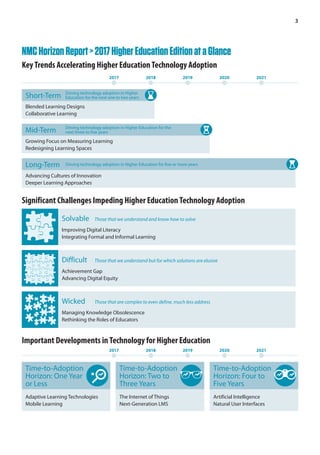
Horizon Report > 2017 Higher Education Edition
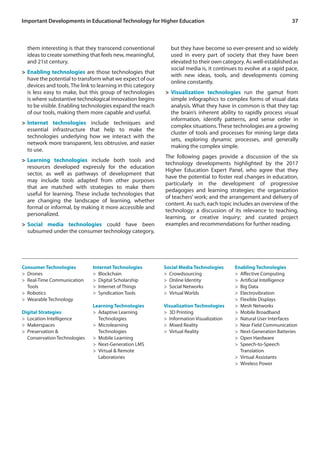
Interested in these emerging technology topics? Learn more about them and other edtech insights by“liking”
us on Facebook at facebook.com/newmediaconsortium and on Twitter at twitter.com/nmcorg.
iii
Table of Contents
Executive Summary	2
Introduction	4
Key Trends Accelerating Technology Adoption in Higher Education	8
	 Long-Term Trends: Driving Ed Tech adoption in higher education for five or more years
		> Advancing Cultures of Innovation	10
		> Deeper Learning Approaches	12
	 Mid-Term Trends: Driving Ed Tech adoption in higher education for the next three to five years
		> Growing Focus on Measuring Learning	14
		> Redesigning Learning Spaces	16
	 Short-Term Trends: Driving Ed Tech adoption in higher education for the next one to two years
		> Blended Learning Designs	18
		> Collaborative Learning	20
Significant Challenges Impeding Technology Adoption in Higher Education	22
	 Solvable Challenges: Those that we understand and know how to solve
		> Improving Digital Literacy	24
		> Integrating Formal and Informal Learning	26
	 Difficult Challenges: Those that we understand but for which solutions are elusive
		> Achievement Gap	28
		> Advancing Digital Equity	30
	 Wicked Challenges: Those that are complex to even define, much less address
		> Managing Knowledge Obsolescence	32
		> Rethinking the Roles of Educators	34
Important Developments in Educational Technology for Higher Education	36
	 Time-to-Adoption Horizon: One Year or Less
		> Adaptive Learning Technologies	38
		> Mobile Learning	40
	 Time-to-Adoption Horizon: Two to Three Years
		> The Internet of Things	42
		> Next-Generation LMS 	44
	 Time-to-Adoption Horizon: Four to Five Years
		> Artificial Intelligence	46
		> Natural User Interfaces	48
Methodology	50
The 2017 Higher Education Expert Panel	52
Endnotes	53
1
The NMC Horizon Report: 2017 Higher Education Edition
is a collaboration between The NEW MEDIA CONSORTIUM and
The EDUCAUSE Learning Initiative, an EDUCAUSE Program.
The research behind the NMC Horizon Report: 2017 Higher
Education Edition is jointly conducted by the New Media
Consortium (NMC) and the EDUCAUSE Learning Initiative
(ELI), an EDUCAUSE Program. The ELI’s critical participation in
the production of this report and their strong support for the
NMC Horizon Project is gratefully acknowledged.To learn more
about ELI, visit www.educause.edu/eli; to learn more about the
NMC, visit www.nmc.org.
© 2017, The New Media Consortium
ISBN 978-0-9977215-7-7
Permission is granted under a Creative Commons Attribution
4.0 International License to replicate, copy, distribute, transmit,
or adapt this report freely provided that attribution is provided
as illustrated in the citation below. To view a copy of this
license, visit creativecommons.org/licenses/by/4.0.
Citation
Adams Becker, S., Cummins, M., Davis, A., Freeman, A., Hall
Giesinger, C., and Ananthanarayanan, V. (2017). NMC Horizon
Report: 2017 Higher Education Edition. Austin, Texas: The New
Media Consortium.
Acknowledgments
The NMC is grateful to Helen Beetham, Steven J. Bell, Cheryl
Brown, Jim Devine, Jill Leafstedt, and Riina Vuorikari for their
input to the Improving Digital Literacy topic in this report.
Front Cover
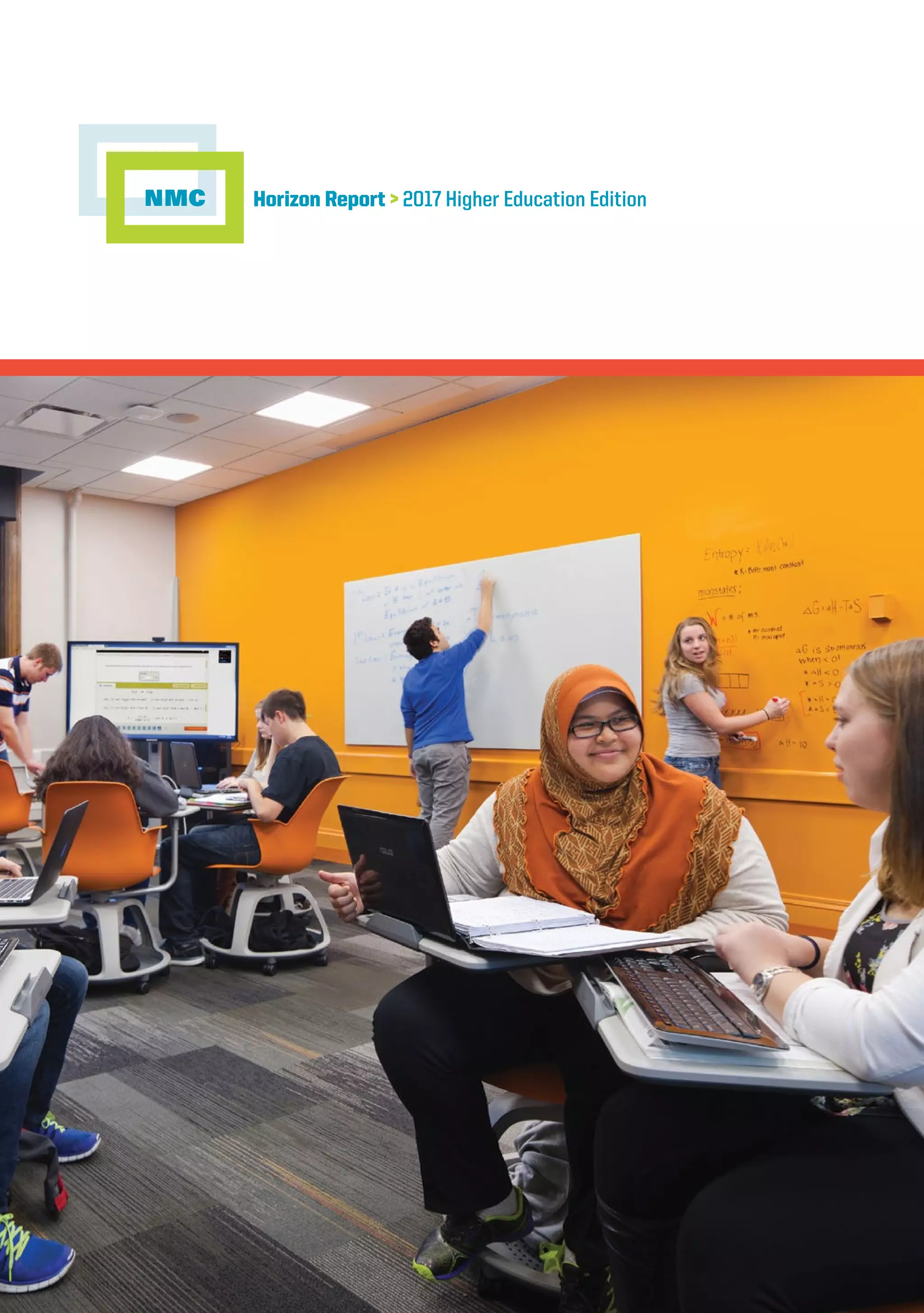
Photo provided by University Technology at Case Western
Reserve University (CWRU), the Bostwick Agency and the
Sextant Group. Interactive classroom at CWRU. The University
is one of the country’s leading private research institutions.
Located in Cleveland, Ohio, CWRU offers a unique combination
of forward-thinking educational opportunities in an inspiring
cultural setting. Leading-edge faculty engage in teaching and
research in a collaborative, hands-on environment. Nationally
recognized programs include arts and sciences, dental
medicine, engineering, law, management, medicine, nursing,
and social work.  Visit case.edu to see how Case Western
Reserve thinks beyond the possible.
Inside and Back Covers
BigStock Photography
2	 NMC Horizon Report: 2017 Higher Education Edition
Executive Summary
W
hat is on the five-year horizon for higher
education institutions? Which trends
and technology developments will drive
educational change? What are the critical
challenges and how can we strategize
solutions? These questions regarding technology
adoption and educational change steered the
discussions of 78 experts to produce the NMC Horizon
Report: 2017 Higher Education Edition, in partnership
with the EDUCAUSE Learning Initiative (ELI). This NMC
Horizon Report series charts the five-year impact of
innovative practices and technologies for higher
education across the globe. With more than 15 years of
research and publications, the NMC Horizon Project can
be regarded as education’s longest-running exploration
of emerging technology trends and uptake.
Six key trends, six significant challenges, and six
developments in educational technology profiled in
this report are poised to impact teaching, learning, and
creative inquiry in higher education. The three sections
of this report constitute a reference and technology
planning guide for educators, higher education leaders,
administrators, policymakers, and technologists. These
top 10 highlights capture the big picture themes of
educational change that underpin the 18 topics:
1Advancing progressive learning approaches
requires cultural transformation. Institutions must
be structured in ways that promote the exchange
of fresh ideas, identify successful models within and
outside of the campus, and reward teaching innovation
— with student success at the center.
2Real-world skills are needed to bolster
employability and workplace development.
Students expect to graduate into gainful employment.
Institutions have a responsibility to deliver deeper,
active learning experiences and skills-based training
that integrate technology in meaningful ways.
3Collaborationiskeyforscalingeffectivesolutions.
Communities of practice, multidisciplinary leadership
groups, and open social networks can help spread
evidence-based approaches. Institutions and educators
can make more progress learning from each other.
4Despitetheproliferationoftechnologyandonline
learning materials, access is still unequal. Gaps
persist across the world that are hampering college
completion for student groups by socioeconomic
status, race, ethnicity, and gender. Further, sufficient
internet access remains uneven.
5Processes for assessing nuanced skills at a
personal level are needed. Adaptive technologies
and a focus on measuring learning are driving
institutional decision-making while personalizing
student learning experiences; leaders must now
consider how to evaluate the acquisition of vocational
skills, competencies, creativity, and critical thinking.
6Fluency in the digital realm is more than just
understanding how to use technology. Training
must go beyond gaining isolated technology skills
toward generating a deep understanding of digital
environments, enabling intuitive adaptation to new
contexts and co-creation of content with others.
7Online, mobile, and blended learning are
foregone conclusions. If institutions do not already
have robust strategies for integrating these now
pervasive approaches, then they simply will not survive.
An important step is tracking how these models are
actively enriching learning outcomes.
8Learning ecosystems must be agile enough to
support the practices of the future. In using tools
and platforms like LMS, educators have a desire to
unbundleallofthecomponentsofalearningexperience
to remix open content and educational apps in unique
and compelling ways.
9Higher education is an incubator for developing
more intuitive computers. As artificial intelligence
and natural user interfaces tip into mainstream use,
universities are designing machine learning algorithms
and haptic devices that more authentically respond to
human interaction.
10Lifelong learning is the lifeblood of higher
education. Institutions must prioritize and
recognize ongoing learning — both formal and informal
— for their faculty, staff, and students.
It is our hope that this analysis will help to inform the
choices that institutions are making about technology
to improve, support, or extend teaching, learning,
and creative inquiry. Education leaders worldwide
look to NMC Horizon Project publications as strategic
technology planning references, and it is for that
purpose that the NMC Horizon Report: 2017 Higher
Education Edition is presented.
3
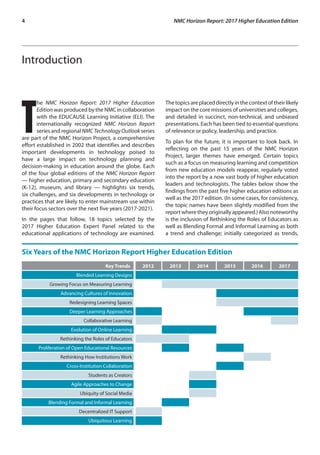
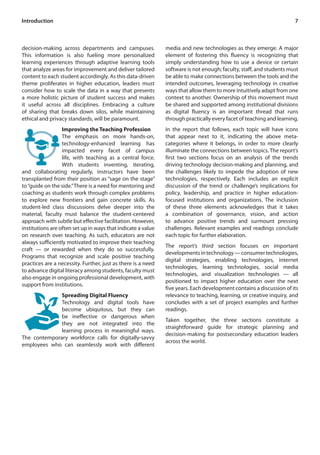
Time-to-Adoption
Horizon: Four to
Five Years
Artificial Intelligence
Natural User Interfaces
Time-to-Adoption
Horizon: Two to
Three Years
The Internet of Things
Next-Generation LMS
Blended Learning Designs
Collaborative Learning
NMCHorizonReport>2017HigherEducationEditionataGlance
KeyTrends Accelerating Higher EducationTechnology Adoption
2017 2018 2019 2020 2021
Short-Term Driving technology adoption in Higher
Education for the next one to two years
Growing Focus on Measuring Learning
Redesigning Learning Spaces
Mid-Term Driving technology adoption in Higher Education for the
next three to five years
Advancing Cultures of Innovation
Deeper Learning Approaches
Long-Term Driving technology adoption in Higher Education for five or more years
Significant Challenges Impeding Higher EducationTechnology Adoption
Solvable	 Those that we understand and know how to solve
Improving Digital Literacy
Integrating Formal and Informal Learning
Difficult	 Those that we understand but for which solutions are elusive
Achievement Gap
Advancing Digital Equity
Wicked	 Those that are complex to even define, much less address
Managing Knowledge Obsolescence
Rethinking the Roles of Educators
Important Developments inTechnology for Higher Education
2017 2018 2019 2020 2021
Time-to-Adoption
Horizon: One Year
or Less
Adaptive Learning Technologies
Mobile Learning
4	 NMC Horizon Report: 2017 Higher Education Edition
Introduction
T
he NMC Horizon Report: 2017 Higher Education
Edition was produced by the NMC in collaboration
with the EDUCAUSE Learning Initiative (ELI). The
internationally recognized NMC Horizon Report
series and regional NMCTechnologyOutlook series
are part of the NMC Horizon Project, a comprehensive
effort established in 2002 that identifies and describes
important developments in technology poised to
have a large impact on technology planning and
decision-making in education around the globe. Each
of the four global editions of the NMC Horizon Report
— higher education, primary and secondary education
(K-12), museum, and library — highlights six trends,
six challenges, and six developments in technology or
practices that are likely to enter mainstream use within
their focus sectors over the next five years (2017-2021).
In the pages that follow, 18 topics selected by the
2017 Higher Education Expert Panel related to the
educational applications of technology are examined.
Thetopicsareplaceddirectlyinthecontextoftheirlikely
impact on the core missions of universities and colleges,
and detailed in succinct, non-technical, and unbiased
presentations. Each has been tied to essential questions
of relevance or policy, leadership, and practice.
To plan for the future, it is important to look back. In
reflecting on the past 15 years of the NMC Horizon
Project, larger themes have emerged. Certain topics
such as a focus on measuring learning and competition
from new education models reappear, regularly voted
into the report by a now vast body of higher education
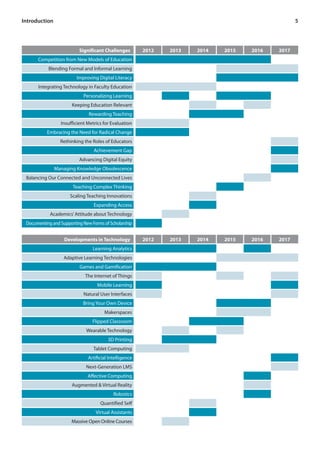
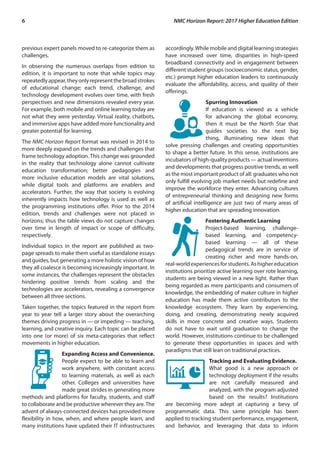
leaders and technologists. The tables below show the
findings from the past five higher education editions as
well as the 2017 edition. (In some cases, for consistency,
the topic names have been slightly modified from the
reportwheretheyoriginallyappeared.)Alsonoteworthy
is the inclusion of Rethinking the Roles of Educators as
well as Blending Formal and Informal Learning as both
a trend and challenge; initially categorized as trends,
Key Trends 2012 2013 2014 2015 2016 2017
Blended Learning Designs
Growing Focus on Measuring Learning
Advancing Cultures of Innovation
Redesigning Learning Spaces
Deeper Learning Approaches
Collaborative Learning
Evolution of Online Learning
Rethinking the Roles of Educators
Proliferation of Open Educational Resources
Rethinking How Institutions Work
Cross-Institution Collaboration
Students as Creators
Agile Approaches to Change
Ubiquity of Social Media
Blending Formal and Informal Learning
Decentralized IT Support
Ubiquitous Learning
Six Years of the NMC Horizon Report Higher Education Edition
5Introduction
Significant Challenges 2012 2013 2014 2015 2016 2017
Competition from New Models of Education
Blending Formal and Informal Learning
Improving Digital Literacy
Integrating Technology in Faculty Education
Personalizing Learning
Keeping Education Relevant
Rewarding Teaching
Insufficient Metrics for Evaluation
Embracing the Need for Radical Change
Rethinking the Roles of Educators
Achievement Gap
Advancing Digital Equity
Managing Knowledge Obsolescence
Balancing Our Connected and Unconnected Lives
Teaching Complex Thinking
Scaling Teaching Innovations
Expanding Access
Academics’Attitude about Technology
Documenting and Supporting New Forms of Scholarship
Developments in Technology 2012 2013 2014 2015 2016 2017
Learning Analytics
Adaptive Learning Technologies
Games and Gamification
The Internet of Things
Mobile Learning
Natural User Interfaces
Bring Your Own Device
Makerspaces
Flipped Classroom
Wearable Technology
3D Printing
Tablet Computing
Artificial Intelligence
Next-Generation LMS
Affective Computing
Augmented & Virtual Reality
Robotics
Quantified Self
Virtual Assistants
Massive Open Online Courses
6	 NMC Horizon Report: 2017 Higher Education Edition
previous expert panels moved to re-categorize them as
challenges.
In observing the numerous overlaps from edition to
edition, it is important to note that while topics may
repeatedlyappear,theyonlyrepresentthebroadstrokes
of educational change; each trend, challenge, and
technology development evolves over time, with fresh
perspectives and new dimensions revealed every year.
For example, both mobile and online learning today are
not what they were yesterday. Virtual reality, chatbots,
and immersive apps have added more functionality and
greater potential for learning.
The NMC Horizon Report format was revised in 2014 to
more deeply expand on the trends and challenges that
frame technology adoption. This change was grounded
in the reality that technology alone cannot cultivate
education transformation; better pedagogies and
more inclusive education models are vital solutions,
while digital tools and platforms are enablers and
accelerators. Further, the way that society is evolving
inherently impacts how technology is used as well as
the programming institutions offer. Prior to the 2014
edition, trends and challenges were not placed in
horizons; thus the table views do not capture changes
over time in length of impact or scope of difficulty,
respectively.
Individual topics in the report are published as two-
page spreads to make them useful as standalone essays
and guides, but generating a more holistic vision of how
they all coalesce is becoming increasingly important. In
some instances, the challenges represent the obstacles
hindering positive trends from scaling and the
technologies are accelerators, revealing a convergence
between all three sections.
Taken together, the topics featured in the report from
year to year tell a larger story about the overarching
themes driving progress in — or impeding — teaching,
learning, and creative inquiry. Each topic can be placed
into one (or more) of six meta-categories that reflect
movements in higher education.
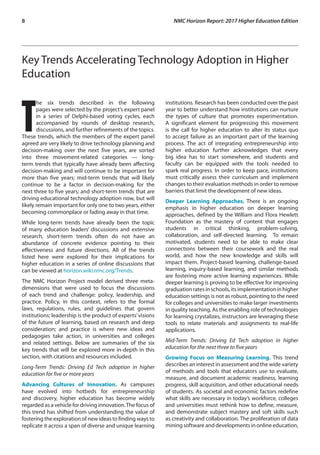
Expanding Access and Convenience.
People expect to be able to learn and
work anywhere, with constant access
to learning materials, as well as each
other. Colleges and universities have
made great strides in generating more
methods and platforms for faculty, students, and staff
to collaborate and be productive wherever they are.The
advent of always-connected devices has provided more
flexibility in how, when, and where people learn, and
many institutions have updated their IT infrastructures
accordingly.While mobile and digital learning strategies
have increased over time, disparities in high-speed
broadband connectivity and in engagement between
different student groups (socioeconomic status, gender,
etc.) prompt higher education leaders to continuously
evaluate the affordability, access, and quality of their
offerings.
Spurring Innovation
If education is viewed as a vehicle
for advancing the global economy,
then it must be the North Star that
guides societies to the next big
thing, illuminating new ideas that
solve pressing challenges and creating opportunities
to shape a better future. In this sense, institutions are
incubators of high-quality products — actual inventions
and developments that progress positive trends, as well
as the most important product of all: graduates who not
only fulfill evolving job market needs but redefine and
improve the workforce they enter. Advancing cultures
of entrepreneurial thinking and designing new forms
of artificial intelligence are just two of many areas of
higher education that are spreading innovation.
Fostering Authentic Learning
Project-based learning, challenge-
based learning, and competency-
based learning — all of these
pedagogical trends are in service of
creating richer and more hands-on,
real-worldexperiencesforstudents.Ashighereducation
institutions prioritize active learning over rote learning,
students are being viewed in a new light. Rather than
being regarded as mere participants and consumers of
knowledge, the embedding of maker culture in higher
education has made them active contributors to the
knowledge ecosystem. They learn by experiencing,
doing, and creating, demonstrating newly acquired
skills in more concrete and creative ways. Students
do not have to wait until graduation to change the
world. However, institutions continue to be challenged
to generate these opportunities in spaces and with
paradigms that still lean on traditional practices.
Tracking and Evaluating Evidence.
What good is a new approach or
technology deployment if the results
are not carefully measured and
analyzed, with the program adjusted
based on the results? Institutions
are becoming more adept at capturing a bevy of
programmatic data. This same principle has been
applied to tracking student performance, engagement,
and behavior, and leveraging that data to inform
7
decision-making across departments and campuses.
This information is also fueling more personalized
learning experiences through adaptive learning tools
that analyze areas for improvement and deliver tailored
content to each student accordingly. As this data-driven
theme proliferates in higher education, leaders must
consider how to scale the data in a way that presents
a more holistic picture of student success and makes
it useful across all disciplines. Embracing a culture
of sharing that breaks down silos, while maintaining
ethical and privacy standards, will be paramount.
Improving the Teaching Profession
The emphasis on more hands-on,
technology-enhanced learning has
impacted every facet of campus
life, with teaching as a central force.
With students inventing, iterating,
and collaborating regularly, instructors have been
transplanted from their position as “sage on the stage”
to“guide on the side.”There is a need for mentoring and
coaching as students work through complex problems
to explore new frontiers and gain concrete skills. As
student-led class discussions delve deeper into the
material, faculty must balance the student-centered
approach with subtle but effective facilitation. However,
institutions are often set up in ways that indicate a value
on research over teaching. As such, educators are not
always sufficiently motivated to improve their teaching
craft — or rewarded when they do so successfully.
Programs that recognize and scale positive teaching
practices are a necessity. Further, just as there is a need
to advance digital literacy among students, faculty must
also engage in ongoing professional development, with
support from institutions.
Spreading Digital Fluency
Technology and digital tools have
become ubiquitous, but they can
be ineffective or dangerous when
they are not integrated into the
learning process in meaningful ways.
The contemporary workforce calls for digitally-savvy
employees who can seamlessly work with different
media and new technologies as they emerge. A major
element of fostering this fluency is recognizing that
simply understanding how to use a device or certain
software is not enough; faculty, staff, and students must
be able to make connections between the tools and the
intended outcomes, leveraging technology in creative
ways that allow them to more intuitively adapt from one
context to another. Ownership of this movement must
be shared and supported among institutional divisions
as digital fluency is an important thread that runs
through practically every facet of teaching and learning.
In the report that follows, each topic will have icons
that appear next to it, indicating the above meta-
categories where it belongs, in order to more clearly
illuminate the connections between topics. The report’s
first two sections focus on an analysis of the trends
driving technology decision-making and planning, and
the challenges likely to impede the adoption of new
technologies, respectively. Each includes an explicit
discussion of the trend or challenge’s implications for
policy, leadership, and practice in higher education-
focused institutions and organizations. The inclusion
of these three elements acknowledges that it takes
a combination of governance, vision, and action
to advance positive trends and surmount pressing
challenges. Relevant examples and readings conclude
each topic for further elaboration.
The report’s third section focuses on important
developmentsintechnology—consumertechnologies,
digital strategies, enabling technologies, internet
technologies, learning technologies, social media
technologies, and visualization technologies — all
positioned to impact higher education over the next
five years. Each development contains a discussion of its
relevance to teaching, learning, or creative inquiry, and
concludes with a set of project examples and further
readings.
Taken together, the three sections constitute a
straightforward guide for strategic planning and
decision-making for postsecondary education leaders
across the world.
Introduction
8	 NMC Horizon Report: 2017 Higher Education Edition
Key Trends Accelerating Technology Adoption in Higher
Education
T
he six trends described in the following
pages were selected by the project’s expert panel
in a series of Delphi-based voting cycles, each
accompanied by rounds of desktop research,
discussions, and further refinements of the topics.
These trends, which the members of the expert panel
agreed are very likely to drive technology planning and
decision-making over the next five years, are sorted
into three movement-related categories — long-
term trends that typically have already been affecting
decision-making and will continue to be important for
more than five years; mid-term trends that will likely
continue to be a factor in decision-making for the
next three to five years; and short-term trends that are
driving educational technology adoption now, but will
likely remain important for only one to two years, either
becoming commonplace or fading away in that time.
While long-term trends have already been the topic
of many education leaders’ discussions and extensive
research, short-term trends often do not have an
abundance of concrete evidence pointing to their
effectiveness and future directions. All of the trends
listed here were explored for their implications for
higher education in a series of online discussions that
can be viewed at horizon.wiki.nmc.org/Trends.
The NMC Horizon Project model derived three meta-
dimensions that were used to focus the discussions
of each trend and challenge: policy, leadership, and
practice. Policy, in this context, refers to the formal
laws, regulations, rules, and guidelines that govern
institutions; leadership is the product of experts’visions
of the future of learning, based on research and deep
consideration; and practice is where new ideas and
pedagogies take action, in universities and colleges
and related settings. Below are summaries of the six
key trends that will be explored more in-depth in this
section, with citations and resources included.
Long-Term Trends: Driving Ed Tech adoption in higher
education for five or more years
Advancing Cultures of Innovation. As campuses
have evolved into hotbeds for entrepreneurship
and discovery, higher education has become widely
regarded as a vehicle for driving innovation.The focus of
this trend has shifted from understanding the value of
fostering the exploration of new ideas to finding ways to
replicate it across a span of diverse and unique learning
institutions. Research has been conducted over the past
year to better understand how institutions can nurture
the types of culture that promotes experimentation.
A significant element for progressing this movement
is the call for higher education to alter its status quo
to accept failure as an important part of the learning
process. The act of integrating entrepreneurship into
higher education further acknowledges that every
big idea has to start somewhere, and students and
faculty can be equipped with the tools needed to
spark real progress. In order to keep pace, institutions
must critically assess their curriculum and implement
changes to their evaluation methods in order to remove
barriers that limit the development of new ideas.
Deeper Learning Approaches. There is an ongoing
emphasis in higher education on deeper learning
approaches, defined by the William and Flora Hewlett
Foundation as the mastery of content that engages
students in critical thinking, problem-solving,
collaboration, and self-directed learning. To remain
motivated, students need to be able to make clear
connections between their coursework and the real
world, and how the new knowledge and skills will
impact them. Project-based learning, challenge-based
learning, inquiry-based learning, and similar methods
are fostering more active learning experiences. While
deeper learning is proving to be effective for improving
graduationratesinschools,itsimplementationinhigher
education settings is not as robust, pointing to the need
for colleges and universities to make larger investments
in quality teaching. As the enabling role of technologies
for learning crystalizes, instructors are leveraging these
tools to relate materials and assignments to real-life
applications.
Mid-Term Trends: Driving Ed Tech adoption in higher
education for the next three to five years
Growing Focus on Measuring Learning. This trend
describes an interest in assessment and the wide variety
of methods and tools that educators use to evaluate,
measure, and document academic readiness, learning
progress, skill acquisition, and other educational needs
of students. As societal and economic factors redefine
what skills are necessary in today’s workforce, colleges
and universities must rethink how to define, measure,
and demonstrate subject mastery and soft skills such
as creativity and collaboration. The proliferation of data
mining software and developments in online education,
9
mobile learning, and learning management systems are
coalescing toward learning environments that leverage
analytics and visualization software to portray learning
data in a multidimensional and portable manner.
In online and blended courses, data can reveal how
student actions contribute to their progress and specific
learning gains.
Redesigning Learning Spaces. As universities engage
with strategies that incorporate digital elements and
accommodate more active learning in the physical
classroom, they are rearranging physical environments
to promote these pedagogical shifts. Educational
settings are increasingly designed to support project-
based interactions with attention to greater mobility,
flexibility, and multiple device usage. To improve
remote communication, institutions are upgrading
wireless bandwidth and installing large displays that
allow for more natural collaboration on digital projects.
Further, universities are exploring how mixed reality
technologies can blend 3D holographic content into
physical spaces for simulations like experiencing Mars
by controlling rover vehicles, or to enable multifaceted
interaction with objects, such as the human body in
anatomy labs, with detailed visuals. As higher education
continues to move away from traditional, lecture-based
lessons toward more hands-on activities, classrooms
are starting to resemble real-world work and social
environments that foster organic interactions and
cross-disciplinary problem-solving.
Short-Term Trends: Driving Ed Tech adoption in higher
education for the next one to two years
BlendedLearningDesigns. Over the past several years,
perceptions of online learning have been shifting in its
favor as more learners and educators see it as a viable
alternative to some forms of face-to-face learning.
Drawing from best practices in both online and face-to-
face methods, blended learning is on the rise at colleges
and universities as the number of digital learning
platforms and ways to leverage them for educational
purposes continues to expand. The affordances
blended learning offers are now well understood, and
its flexibility, ease of access, and the integration of
sophisticated multimedia and technologies are high
among the list of appeals. The current focus of this
trend has shifted to understanding how applications of
digital modes of teaching are impacting students. Many
findings showcase an increase in creative thinking,
independent study, and the ability for the student to
tailor learning experiences to meet their individual
needs.
Collaborative Learning. Collaborative learning, which
refers to students or educators working together
in peer-to-peer or group activities, is based on the
perspective that learning is a social construct. The
Key Trends
approach involves activities generally focused around
four principles: placing the learner at the center,
emphasizing interaction, working in groups, and
developing solutions to real challenges. In addition to
improving student engagement and achievement, a key
benefit of collaborative learning is bolstering openness
to diversity, exposing students to people from different
demographics. Educators also engage in collaborative
learning through online communities of practice where
ideas and insights are regularly exchanged. While
this trend is rooted in pedagogy, technology plays an
important role in the implementation; cloud-based
services,apps,andotherdigitaltoolspromotepersistent
connectivity, enabling students and educators to access
and contribute to shared workspaces, anytime. Further,
through adaptive learning and student advising
platforms, data can be shared across an institution
to illuminate student performance in order to inform
improved instructional design and student advising.
The following pages provide a discussion of each of
the trends highlighted by this year’s expert panel that
includes an overview of the trend, its implications, and
a set of curated recommendations for further reading
on the topic.
10	 NMC Horizon Report: 2017 Higher Education Edition
Advancing Cultures of Innovation
Long-Term Trend: Driving Ed Tech adoption in higher education
for five or more years
A
s campuses have evolved into hotbeds for
entrepreneurship and discovery, higher
education has become widely regarded as a
vehicle for driving innovation. The focus of
this trend has shifted from understanding the
value of fostering the exploration of new ideas to
finding ways to replicate it across a span of diverse
and unique learning institutions. Research has been
conducted over the past year to better understand
how institutions can nurture the types of culture that
promotes experimentation. A significant element
for progressing this movement is the call for higher
education to alter its status quo to accept failure as
an important part of the learning process. The act of
integrating entrepreneurship into higher education
further acknowledges that every big idea has to start
somewhere,andstudentsandfacultycanbeequipped
with the tools needed to spark real progress.1
In order
to keep pace, institutions must critically assess their
curriculumandimplementchangestotheirevaluation
methods in order to remove barriers that limit the
development of new ideas.
Overview
Innovation within higher education has been
accelerated by institutions that are moving away from
traditional methods of learning in which academics and
researchers are the main sources of idea generation.
New approaches are prompting universities to act as
incubators for all students, faculty, and staff to make
new discoveries and design solutions to meet the needs
of real-world challenges. A study published by the
Teachers Insurance and Annuity Association of America
(TIAA) Institute highlights three factors for promoting
strategic innovation: a diversity of people, who bring
along a variety of proficiencies and opinions; a need
for dedicated resources to support individuals’ intrinsic
motivations, rather than using extrinsic incentives, such
as the promise of perfect grades; and autonomy, where
individuals are encouraged to voice differing opinions
based on a variety of experiences instead of making
decisions as a single-minded group.2
In order to breed innovation, institutions must be
structured in ways that allow for flexibility while driving
creativity and entrepreneurial thinking. Universities
can accomplish this by fostering environments
that encourage risk-taking behavior, through
experimentation and the testing of ideas. An interview
with a professor from Harvard University advocates
for institutions to “incubate, then integrate.” Successful
transformative practices can be identified by piloting
proofs of concept, but an important facet of this
approach involves the acceptance of the risk of failure.3
In a study to better understand how to graduate more
entrepreneurial thinkers, faculty members from the
University of Malaysia investigated the relationship
between a university’s environment and its effect on
student behavior. Using a four-dimensional framework,
the report concludes that students’ innovation-friendly
behaviors, such as curiosity and creativity, stem from
the establishment of positive internal and external
factors such as teamwork, support, and motivation.4
Before this trend can take root at an institution,
faculty and staff must be equipped with the proper
tools to implement new practices. The Chronicle
of Higher Education’s “Great Colleges to Work For”
program interviewed over 1,200 institutions to identify
the specific kinds of support needed to advance
innovation. The responses were then analyzed and
grouped together to form five overarching themes:
the need for open communication, collaboration
within departments, job security when challenging
the status quo, shared responsibility, and top-down
support.5
While student success remains at the core
of institutions’ initiatives, education leaders must also
recognize the need to empower all stakeholders to
support the changes needed to advance cultures that
promote invention and discovery.
Implications for Policy, Leadership, or
Practice
Recent publications underscore the need for policies
that help institutions better finance revolutionary
practices, calling for US states to be more strategic
in their allocation of funds to invest in efforts that
increase program completion and degree attainment.
For example, HCM Strategists’ Driving Better Outcomes
report series centers on outcome-based funding,
which provides incentives for institutions to graduate
more students. This structure could open doors for
universities to adopt academic models that provide
targetedassistancetoimproveretentionandgraduation
rates for first-generation, minority, and lower-income
students.6
Other organizations are working to evolve
traditional higher education paradigms. Information
Technology and Innovation Foundation (ITIF) published
11
a report urging institutions to separate learning from
credentialing. The authors champion policy shifts that
help students more effectively demonstrate their skills
and knowledge to prospective employers. To advance
these goals, ITIF proposes that the US Congress enact
reforms when reauthorizing the Higher Education
Act, including new accrediting agencies, alternative
credentials to diplomas, and the use of federal financial
aid to support these alternatives.7
The Times Higher Education Asia Universities Summit
2016 focused on how Asian universities are developing
a culture open to the exploration of new ideas in order
to create changes with environmental, economic, and
social implications. The keynote presenter proposed
that higher education is unique in its ability to foster
an ecosystem where discovery, intervention, and
learning occur without constraint.8
The president of
the University of Hong Kong penned an article prior
to his summit session that rallied for “i-words” to form
the backbone of his institution’s planning for the next
decade: internationalism, interdisciplinary, impact, and
innovation. He charges university leadership to nurture
environments that normalize failure as another facet of
learning — an idea that is a major cultural challenge in
Asia.9
Dedicated space is needed to foster this kind of
experimentation and iteration. For example, the Maker
Commons at Penn State houses the Invention Studio,
which is equipped with littleBits, Arduinos, Raspberry
Pis, and Phillips HUE lightbulbs to provide students with
hands-on experience in using connected technologies
to create custom solutions.10
For universities that recognize the importance of
this trend, programs are well underway to ensure a
progressive culture is promoted throughout their
campuses. The University of Sydney piloted its
Inventing the Future initiative, which aims to cultivate
multidisciplinary collaboration skills through product
development; students work together to engage in
ideation, prototyping, and seeking funding.11
Nesta, a
foundationthatfostersnewideastoovercometheworld’s
inequalities, recently published a report that highlights
institutional exemplars whose curricula align with their
mission. For example, the Norwegian School of Science
andTechnology forms student groups to create solutions
to real-world issues including sustainable energy and
social justice. The publication also features prospective
developments, like the New Model in Technology and
Engineering University, set to launch in Britain in 2018,
which will leverage interdisciplinary and problem-
based approaches to teaching and learning through
collaborations with industry and academic partners.12
For Further Reading
The following resources are recommended for those who
wishtolearnmoreaboutadvancingculturesofinnovation:
Embracing an Entrepreneurial Culture on Campus
go.nmc.org/uni
(Tom Corr, University Affairs, 4 May 2016.) The Ontario
Network of Entrepreneurs is gaining global recognition
for its efforts to bolster students’business skills through
investing in multiple campus events and programs. For
example, the success of Ontario Centres of Excellence
has led to the establishment of similar innovation hubs
throughout North America, the UK, Australia, and Asia.
Innovation Fest Brings Entrepreneurs to Campus
go.nmc.org/fest
(Amy Weaver, Auburn University News and Research, 29
November 2016.) Auburn University teamed up with
city leaders to host its first ever Innovation Fest, an
opportunityforcollaborationanddialoguebetweenthe
university and local businesses. Students participated in
challenges with the potential to win cash prizes.
JMU Drone Challenge Project
go.nmc.org/jmudrones
(JMU Drones Project, accessed 24 January 2017.) At
James Madison University, the JMU Drone Challenge
project is an interdisciplinary collaborative effort be-
tween seven majors, four professors, and a variety of
off-campus organizations. Participants will use design
thinking and drone technology to determine innovative
solutions to complex global problems.
Promoting a Culture of Innovation &
Entrepreneurship in Saudi Arabia (PDF)
go.nmc.org/saudiarabia
(Nadia Yusuf and Huda Atassi, International Journal
of Higher Education Management, February 2016.) In
efforts to diversify and strengthen the national economy,
Saudi Arabian leaders proposed a framework that
includes partnerships between government, industry
stakeholders, and universities to bring new ideas to life.
UMUC’s Blueprint for Designing a Culture of
Constant Innovation
go.nmc.org/blueprint
(Peter Smith, EdSurge, 30 July 2016.) The University of
Maryland University College has mapped out ways to
ensure their campus remains on the cutting edge of
discovery. First acknowledging that all change is difficult,
theauthoroutlinesmethodsforcontinuousimprovement
that help to define what the“new normal”looks like.
Universities are Becoming Like Mechanical
Nightingales
go.nmc.org/innovate
(Keith Burnett, Times Higher Education, 19 December
2016.) This article cautions academic practitioners of
the dangers of complacency within a static system.
Rather than viewing higher education as a machine,
leaders must continue searching for new models of
teaching and learning so that the field can address the
needs of an evolving society.
Long-Term Trend
12	 NMC Horizon Report: 2017 Higher Education Edition
Deeper Learning Approaches
Long-Term Trend: Driving Ed Tech adoption in higher
education for five or more years
T
here is an ongoing emphasis in higher education
on deeper learning approaches, defined by the
William and Flora Hewlett Foundation as the
mastery of content that engages students in
criticalthinking,problem-solving,collaboration,
and self-directed learning.13
To remain motivated,
students need to be able to make clear connections
between their coursework and the real world, and
how the new knowledge and skills will impact them.
Project-based learning,14
challenge-based learning,15
inquiry-based learning,16
and similar methods are
fostering more active learning experiences. While
deeperlearningisprovingtobeeffectiveforimproving
graduation rates in schools,17
its implementation in
higher education settings is not as robust, pointing to
the need for colleges and universities to make larger
investments in quality teaching.18
As the enabling role
of technologies for learning crystalizes, instructors
are leveraging these tools to relate materials and
assignments to real-life applications.
Overview
Integrating deeper learning pedagogies in higher
education has been a growing trend over the past
few years and is continuing to see new developments,
particularly in STEM disciplines. These active learning
approaches fall primarily under two strategies of
inquiry-based learning: problem-based learning where
students solve real challenges and project-based
learning where they create completed products.19
According to research conducted by Umeå University in
Sweden, when technology-enhanced problem-based
learning concepts were applied to small group work
in advanced chemistry courses, it proved effective in
motivating and engaging students in the process of
solving authentic challenges, such as sampling and
analysis of contaminated sites. Students claimed that
social technologies like online logs and group wikis
supplemented their learning, helped them articulate
their new knowledge, and guided them in addressing
problems in new ways.20
A goal of higher education is to equip students with the
skills they need to be successful in the workforce and
to make an impact on the world at large. This notion
is giving rise to the challenge-driven university. Over
the past decade, higher education institutions from
Chile to China are eschewing traditional lectures and
textbooks in favor of project-based learning activities
where students work in teams to tackle problems
without clear solutions.21
A fundamentals of strategic
management course at the University of Buffalo, for
example, worked with a Singapore-based mobile app
startup called Carousell. The course gave students the
opportunity to learn how a small business operates
and apply the knowledge they acquired to navigate
real-world business challenges.22
The University College
Dublin has been applying project-based learning to
impart design skills in their civil engineering course.
Evaluations revealed that the students enjoyed peer-
to-peer teaching and interactions with external experts,
and the activities fostered skills valued by employers,
such as innovation and presentation.23
As disciplines including business, communications,
psychology, and nursing are seeing the benefits of
deeper learning approaches, research indicates that
this trend has not yet seen wide penetration in higher
education. Indeed, a recent survey conducted by
the Buck Institute for Education found that although
77% of the educator respondents use some form of
project-based learning, 43% use it less than 25% of
the time.24
New developments in deeper learning
may encourage greater adoption; student learning
communities, curricular programs designed by faculty,
and collaborations between instructional designers
and students are becoming increasingly popular.
Loyola Marymount University and Ohio University
are both leveraging student learning communities to
connect humanities with STEM disciplines to improve
intercultural competencies and understanding of
human rights issues.25
Implications for Policy, Leadership, or
Practice
While there are no explicit policies mandating project-
based learning or other deeper learning approaches
in colleges and universities, governments around the
world are prioritizing education reforms that emphasize
more 21st century practices. As part of European
Commission program Erasmus+, Knowledge Alliances
represent transnational projects intended to bring
together postsecondary institutions and businesses
to solve common problems. They focus on developing
innovative, multidisciplinary approaches to education;
stimulating entrepreneurial skills in higher education;
and exchanging knowledge. Similarly, in the US, the
Improving Career and Technical Education for the 21st
13Long-Term Trend
CenturyAct,passedbytheHouseofRepresentativesand
awaiting Senate approval, is intended to help Americans
receive the skills required to compete for in-demand
jobs. The legislation will support meaningful student
involvement in work-based learning opportunities and
promote the use of new types of credentialing.26
Partnerships and frameworks are paving the way for
advancing deeper learning worldwide. Conceived by
the University of Delaware and Pontificia Universidad
Católica del Perú, the Pan-American Network for
Problem-Based Learning promotes the approach in
educationthroughouttheAmericasviabilingualtraining
and resource materials, consulting with organizations
interested in implementation, and organizing a bi-
annual conference.27
The Buck Institute for Education
has created a comprehensive, research-based model to
help educators and institutions measure, calibrate, and
improve their practice. Known as Gold Standard Project-
Based Learning, their framework addresses student
learning goals, essential project design elements, and
teaching practices.28
New organizations continue to
emerge, signaling increased interest in deeper learning.
The Center for Project-Based Learning at Worcester
Polytechnic Institute, for example, was recently
established at the Association of American Colleges
& Universities annual meeting to provide faculty and
administrators support in advancing deeper learning
approaches on their campuses through an institute,
workshops, and online resources.29
The impact of this trend continues to grow as deeper
learning matures in practice. Since their founding,
Maastricht University in the Netherlands has integrated
problem-based learning principles into their coursework.
Classes of roughly one dozen students are supervised
by a tutor, and each class is tasked with solving real-
world challenges. An example of an assignment in a
“European Public Health” course, for example, involves a
case study where an electrician with tuberculosis might
have infected patients at a hospital as well as passengers
on public transportation. Students have to answer the
following questions,“How is tuberculosis spread?”,“What
are the risk factors?”, and“What national and cross-border
measures are needed to prevent the further spread of the
disease?”At St. Edward’s University, faculty from different
disciplines collaborated to redesign assignments with
more problem-based and real-world elements; the
course“Mathematics for the Liberal Arts”aims to prepare
studentstoapplymathematicsindailylife,whilestudents
enrolled in “American Dilemmas” apply methodologies
from social sciences to analyze social problems.30
For Further Reading
The following resources are recommended for those
who wish to learn more about deeper learning
approaches:
Does Problem-Based Learning Improve Problem
Solving Skills?
go.nmc.org/doesp
(Z. Abdul Kadir et al., International Education Studies,
26 April 2016.) A study of business undergraduates at
Malaysian Premier Technical University revealed that
when students in an experimental group were given
four problems to solve, they significantly improved their
problem-solving abilities compared to a control group
that only received traditional classroom instruction.
IDEAS Academy
go.nmc.org/ideasacademy
(HCC, accessed 24 January 2017.) Houston Community
College’s West Houston institute encompasses the
IDEAS Academy, which will offer courses in innovation,
design thinking, and entrepreneurship. The Academy is
being designed as a unique learning experience for the
region that teaches students critical skill sets for the 21st
century workplace.
Sharing Power to Promote Deeper Learning
go.nmc.org/sharing
(Maura Rosenthal, Teaching and Learning Together
in Higher Education, Issue 16, Fall 2015.) A sociology
professor at Bridgewater State University describes
using a fishbowl-type discussion to foster deeper
engagement. In this approach, groups of students sit in a
circle to discuss book chapters based on questions they
prepared ahead of class, while students positioned on
the outer circle observed and noted discussion themes.
Strengthening Deeper Learning Through Virtual
Teams in E-Learning
go.nmc.org/streng
(Joyline Makani et al., International Journal of E-Learning
& Distance Education, Vol. 32, No. 2, 2016.) As online
learning becomes more prevalent in universities, there
is a need to identify the core skills and knowledge that
improvelearninginthissetting.Inthisstudy,researchers
concluded that providing plentiful opportunities for
collaboration among “virtual teams” are crucial to
fostering deeper learning.
UICEE Centre for Problem Based Learning
go.nmc.org/uicee
(Aalborg University, accessed 16 December 2016.)
Under the auspices of UNESCO, the Aalborg Centre
works to reform higher education strategies through
combined research involving problem- and project-
based learning, engineering education research, and
education for sustainable development.
Using Blogs to Foster Deeper Student Learning
go.nmc.org/fosdeep
(Kevin Gannon, Pearson, 1 September 2016.) Through
blogging, a history professor’s students at Grandview Uni-
versity felt more connected to the subject matter while
receiving continuous feedback from instructor and peers.
14	 NMC Horizon Report: 2017 Higher Education Edition
Growing Focus on Measuring Learning
Mid-Term Trend: Driving Ed Tech adoption in higher education
for the next three to five years
T
his trend describes an interest in assessment
and the wide variety of methods and tools
that educators use to evaluate, measure,
and document academic readiness, learning
progress, skill acquisition, and other
educational needs of students.31
As societal and
economic factors redefine what skills are necessary
in today’s workforce, colleges and universities must
rethink how to define, measure, and demonstrate
subject mastery and soft skills such as creativity
and collaboration. The proliferation of data mining
software and developments in online education,
mobile learning, and learning management systems
are coalescing toward learning environments that
leverage analytics and visualization software to
portray learning data in a multidimensional and
portable manner. In online and blended courses, data
can reveal how student actions contribute to their
progress and specific learning gains.
Overview
Twenty-first century learning outcomes emphasize
academic skill along with interpersonal and
intrapersonal competencies for complete learner
success. To evaluate these learning gains, next-
generation assessment strategies hold the potential
to measure a range of cognitive skills, social-emotional
development, and deeper learning, giving students and
instructors actionable feedback to foster continued
growth.32
The foundation for facilitating this kind of
assessment is learning analytics (LA) — the collection,
analysis, and reporting of data about learners and their
contexts, for purposes of understanding and optimizing
learning and the environments in which it occurs.33
LA
continues to gain traction at institutions as a means to
assess and fundamentally improve student learning.
Data mining software captures rich datasets that enable
learners and instructors alike to monitor learning and
generate personalized feedback to ensure continued
progress. As the LA industry matures, the emphasis
has shifted from data accumulation to garnering
nuanced insights on student engagement through data
aggregated across multiple sources and courses.34
Multimodal data and social network analysis represent
a holistic focus that prioritizes the social, cognitive,
and affective components of learning. Multimodal
learning analytics, a relatively new approach, focuses on
gathering data on the biological and mental processes
of learning in real-world learning environments.35
Voice and tonal inflections, facial gestures, and visual
attention and inattention are some examples of this
kind of data that can be captured via motion sensors,
video cameras, and other tracking devices. Wearable
technologies that capture biometrics can also serve
as data repositories, but present another layer of
ethical and privacy concerns.36
Concurrently, LMS are
also experiencing a paradigm shift from course to
curricular management that support adaptive learning
technologies, offering specialized data analytics and
visualization tools for enhanced instructional design
and snapshots of student progress.37
More sophisticated analytics are aiding retention
and college completion. For example, Nottingham
Trent University’s (NTU) Student Dashboard has
facilitated timely interventions from tutors, positively
impacting student engagement and behavior. The
dashboard presents data collected from online
learning environments, card swipes, library access, and
assignments as engagement scores. Students use the
dashboard to benchmark their progress against those
of their peers and modify their behaviors accordingly,
while tutors are able to initiate immediate dialogues
to ensure the students’ continued engagement. NTU
leaders assert that it has transformed the university
culture into a data-driven business approach.38
At
the University of Wollongong, instructors use SNAPP,
a browser extension for LMS, to analyze student
interactions in online discussion forums. SNAPP
visualizes participant relationships as social network
diagrams in real time, enabling instructors to compare
and contrast interaction patterns over time and fine
tune discussions.
Implications for Policy, Leadership, or
Practice
While big data technologies have demonstrated
promise in increasing student retention, ethics are a
paramount concern. Mount St. Mary’s use of predictive
analytics to encourage at-risk students to drop out to
elevate the retention rate reveals how analytics can be
abused without student knowledge and consent.39
It
also speaks to the need for policies at national, local, and
institutional levels that frame ethical practices for the
collection, security, ownership, access, dissemination,
and application of learning data. The UK is at the
vanguard of policy efforts with initiatives such as the
15
DELICATE checklist40
and Jisc’s Code of Practice.41
Open
University’s Policy for the Ethical Use of Student Data
is learner-centric and uses openness and transparency
as guiding principles in the use of learning analytics.42
At the University of California, Los Angeles, the chief
privacy officer along with the Data Governance Task
Force developed a governance structure that guides
the ethical and appropriate collection and use of data
on faculty, staff, and students.43
University leaders continue to explore pedagogical
innovations that deepen and enhance student
learning, especially through data-driven analytics.
At the University of Hong Kong, learning analytics
is used to gather direct evidence of learner gains,
recommend teacher actions, and inform curriculum
development through a better understanding of the
relationship between learning design, online learning
behaviors, and student grades.44
More recently, the
University Innovation Alliance launched a large cross-
campus study using 10,000 students to measure the
effectiveness of advising programs based on data
analytics.45
At the other end of the spectrum, the Multi-
State Collaborative to Advance Learning Outcomes
Assessment initiative demonstrated that standardized
rubric-based assessments could be reliably scaled
across disciplines and institutions to gain actionable
insights into student learning.46
The transformative impact of learning analytics is most
evident in the evolution of adaptive learning, featured
in greater detail later in this report.Two professors at the
University of New South Wales used the Smart Sparrow
platform to develop the first massive open online
course in engineering that leverages adaptive learning
to provide personalized support. The course aims to
enhance learning outcomes in a degree area that is
usually marked with high dropout rates, delivering
high-quality learning experiences to students of all
backgrounds.47
LA is also informing better instructional
design. An assistant professor at Marist College used
learner data to identify which content students find the
most challenging and create multiple opportunities
to interact with it until they achieve mastery.48
The
University of Technology in Sydney uses REVIEW,
an online criteria-based assessment tool to monitor
student learning across a set of attributes. Students
can view the visual dashboard to gain a comprehensive
picture of their learning by year, subject, task, and
category.49
For Further Reading
The following resources are recommended for those
who wish to learn more about the growing focus on
measuring learning:
The Colleges Are Watching
go.nmc.org/arewatching
(Mikhail Zinshteyn, The Atlantic, 1 November 2016.)
With unprecedented access to student data and
sophisticated predictive analysis tools, education
institutions balance issues of student privacy while
fostering academic success.
Learning Analytics in Higher Education (PDF)
go.nmc.org/ecarla
(Pam Arroway, et al., Learning Analytics in Higher
Education, March 2016.) This EDUCAUSE Center for
Analysis and Research (ECAR) report provides a
comprehensive overview of learning analytics in higher
education and future considerations of its role and
application for academic success.
Learning Analytics: Visions of the Future (PDF)
go.nmc.org/lace8
(Rebecca Ferguson, et al., 6th International Learning
Analytics and Knowledge Conference, 25-29 April
2016.) The authors present eight visions of the future
of learning analytics developed by the LACE project
(Learning Analytics Community Exchange) for the LACE
Visions of the Future Policy Delphi study.
Measuring Mastery: Best Practices for Assessment
in Competency-Based Education (PDF)
go.nmc.org/measmast
(Katie Larsen McClarty and Matthew N. Gaertner,
Center on Higher Education Reform, American
Enterprise Institute, April 2015.) The potential benefits
of competency-based education for student success
are numerous, but the same processes for measuring
more traditional learning approaches do not apply. This
report recommends a framework for determining the
acquisition of real-world skills.
Personalization at Scale: Using Analytics for
Institutional Improvement
go.nmc.org/atscale
(ElizabethMulherrinandLauraFingerson,TheEvollution,
2 February 2016.) Capella University and University
of Maryland University College are using big data
strategically and effectively to shift from operational
reporting to prescriptive analytics.
Traversing the Trough of Disillusionment:
Where Do Analytics Go from Here?
go.nmc.org/traversing
(Mike Sharkey and Timothy Harfield, Next Generation
Learning Challenges, 19 December 2016.) The authors
offer practical steps to achieve student success at
scale for institutions considering or just undertaking a
learning analytics initiative.
Mid-Term Trend
16	 NMC Horizon Report: 2017 Higher Education Edition
Redesigning Learning Spaces
Mid-Term Trend: Driving Ed Tech adoption in higher
education for the next three to five years
A
s universities engage with strategies that
incorporatedigitalelementsandaccommodate
more active learning in the physical classroom,
they are rearranging physical environments to
promote these pedagogical shifts. Educational
settings are increasingly designed to support project-
based interactions with attention to greater mobility,
flexibility, and multiple device usage. To improve
remote communication, institutions are upgrading
wireless bandwidth50
and installing large displays
that allow for more natural collaboration on digital
projects. Further, universities are exploring how
mixed reality technologies can blend 3D holographic
content into physical spaces for simulations like
experiencing Mars by controlling rover vehicles, or
to enable multifaceted interaction with objects, such
as the human body in anatomy labs, with detailed
visuals.51
As higher education continues to move
away from traditional, lecture-based lessons toward
more hands-on activities, classrooms are starting to
resemble real-world work and social environments
that foster organic interactions and cross-disciplinary
problem-solving.
Overview
To facilitate workplace-style collaboration in the
classroom, some universities are forgoing fixed seating
and transforming traditional lecture halls into dynamic
layouts.52
Telepresence technologies are allowing
geographically dispersed students and professors to
more flexibly meet and work together. For example, the
University of South Carolina developed telepresence
rooms at seven locations, each equipped with cameras,
a 72” display screen, and a control room. Instructors
can rotate between rooms to work with several classes
simultaneously, while students interact across locations
using a polling system as well as shared files and notes.53
Adaptable learning spaces that incorporate features
such as movable furniture, adjustable control of display
screens, WiFi, and multiple outlets can be modified to
suit a variety of learning activities, including group work,
hands-on tasks, and student presentations. Designing
learning environments with flexibility at the forefront is
helping universities maximize their space.54
More accessible spaces can further promote lifelong
learning principles by providing students around-the-
clock access to learning tools. A traditional 50-minute
class period that takes place in the same lecture hall
two or three times a week can be limiting on its own,
so additional opportunities to work in spaces that are
open for longer hours give students flexibility during
their unstructured time. Further, some institutions
are finding that reconfiguring spaces to be more
open and favorable for experimentation can break
down institutional silos, encouraging students and
staff across disciplines to work closely together. The
University of Southern California recently developed
its “Garage,” combining fabrication and workshop
areas with informal lounging spaces to encourage
cross-disciplinary interaction, hands-on projects,
and collaboration; they found students immediately
requesting all-hours access, which reinforced the value
of such a space.55
University makerspaces, a major iteration of learning
space redesign, have gained traction in the past few
years, especially as extensions of campus libraries.
Libraries have traditionally provided access to
information resources and technologies that students
may not otherwise be able to afford; many are now
expanding their offerings to include cutting-edge tools
such as virtual reality equipment, advanced digital
editing software, and 3D printers. Additionally, spaces
that encourage skills like designing and coding are
viewed as valuable aspects of a well-rounded university
experience.56
Institutions are also building incubators
and innovation hubs that connect learning with real-
world opportunities, while helping students to network
and secure funding. The University of Nottingham
Ningbo China’s Incubator Centre is open 24/7; with only
a few enclosed meeting rooms, its open design fosters a
sense of community and a seamless exchange of ideas.
The space also links students and staff to local startups,
investors, and government representatives through
special programs and events.57
Implications for Policy, Leadership, or
Practice
Several organizations offer resources to ensure that
design plans comply with accessibility policies. Under
Section 504 of the Rehabilitation Act and Titles II and
III of the Americans with Disabilities Act, US colleges
and universities must provide students with disabilities
equal and integrated access to higher education; this
includes both physical and digital learning spaces. The
National Federation of the Blind provides free online
resources that institutions can leverage. Additionally,
17Mid-Term Trend
many universities have developed their own taskforces
and policies.58
For example, California State University
Northridge’s Universal Design Center works with
its campus community to incorporate accessibility
considerations into everyday activities, such as using
multiple means of representation when developing
resources, including audio, text, and video. The
university’s procurement process also calls for staff to
evaluate products for accessibility prior to purchase.59
Leading organizations are publishing best practices to
help university leaders transform visions for learning
spaces into practice. Jisc’s Learning Spaces Guide for
evaluating and designing environments is accompanied
by case studies and a photo library. The guide calls for
entrenching the planning process into institutions’
overall teaching and learning strategy, along with
accessibility and inclusion requirements.60
FLEXspace
is another open educational resource that was initially
developed by the SUNY system to aid institutions
in discovering and sharing information on learning
space design. Users can search for content using three
taxonomies: types of activities taking place in the
space; technology equipment within the space; and
architectural technical requirements. It can be further
utilized as a companion tool to the Learning Space
Rating System developed by EDUCAUSE. Campuses are
finding success with first scoring their spaces’ potential
and then using FLEXspace to identify examples of
effective priorities.61
Institutions are analyzing how learning spaces are
currently used campus-wide and applying feedback
from students and instructors, while offering
professional development opportunities that
encourage new and refurbished spaces to be aligned
with innovative instruction. At the University of New
SouthWales, the Piloting Active Learning Spaces project
convened a cohort of cross-disciplinary faculty to test
new learning spaces with configurable furniture and a
range of AV equipment to enable information transfer
and collaboration. Users of the spaces are evaluating
their experiences to allow continual evolution of
the project.62
In the UK, University of Surrey’s Active
Learning Space project team is implementing designs
aimed at providing more flexibility for instructors and
enabling more interactivity. For example, Microsoft
Surface hubs allow anyone in the room to wirelessly
project their laptop or tablet screen. In tandem with
the new spaces, the university is providing workshops
on flipped classroom teaching and active learning
approaches.63
For Further Reading
The following resources are recommended for those
who wish to learn more about redesigning learning
spaces:
Building for Everyone
go.nmc.org/buildfor
(Centre for Excellence in Universal Design, accessed
11 January 2017.) In Ireland, the Centre for Excellence
in Universal Design offers recommendations and best
practices to ensure the design and composition of an
environment allows it to be easily accessed by everyone.
Collaborative Learning Space at BSU
go.nmc.org/bsucollab
(Boise State University, accessed 24 January 2017.)
Boise State University’s English Department redesigned
a traditional computer classroom into a collaborative
learning space. By connecting any wireless device to
Solstice technology, faculty and students can stream
content or share files to any of six monitors. The space
has no focal point and furniture can be easily moved
and reconfigured.
Report of the Ad Hoc Committee on Learning Space
Improvement
go.nmc.org/wismad
(Provost, University of Wisconsin-Madison, March 2016.)
University of Wisconsin-Madison formed the Ad Hoc
Committee on Learning Space Improvement to help
transition its spaces to accommodate more active
learning techniques enabled by technology. This report
describes their improvement plan, providing a window
into the entire process.
Research-Informed Principles for (Re)designing
Teaching and Learning Spaces
go.nmc.org/mcgill
(Adam Finkelstein, Journal of Learning Spaces, 1
November 2016.) McGill University developed a
framework for renovating its campus based on
institutional goals for active, collaborative teaching and
learning. They encourage other institutions to develop
their own research-informed pedagogical principles to
guide the design and evaluation of learning spaces.
The UK Higher Education Learning Space Toolkit
go.nmc.org/uktool
(Universities and Colleges Information Systems Associa-
tion, 2 February 2016.) The Universities and Colleges In-
formation Systems Association created a learning space
toolkit that can serve as a practical guide for higher edu-
cation institutions as they build new pedagogies, evalu-
ate their spaces, and implement changes.
University of Western Australia’s Reid Library
Collaborative Zone
go.nmc.org/refurb
(UWA Library, accessed 24 January 2017.) By offering a
variety of group study spaces enabled by technology
along with dedicated zones for relaxation, the new Reid
Library Ground Floor Collaborative Zone helps students
feel more comfortable while engaged in learning for
long periods of time.
18	 NMC Horizon Report: 2017 Higher Education Edition
Blended Learning Designs 
Short-Term Trend: Driving Ed Tech adoption in higher education
for the next one to two years
O
ver the past several years, perceptions of
online learning have been shifting in its favor
as more learners and educators see it as a
viable alternative to some forms of face-to-
face learning. Drawing from best practices
in both online and face-to-face methods, blended
learning is on the rise at colleges and universities as
the number of digital learning platforms and ways
to leverage them for educational purposes continues
to expand. The affordances blended learning offers
are now well understood, and its flexibility, ease
of access, and the integration of sophisticated
multimedia and technologies are high among the
list of appeals. The current focus of this trend has
shifted to understanding how applications of digital
modes of teaching are impacting students. Many
findings showcase an increase in creative thinking,
independent study, and the ability for the student to
tailor learning experiences to meet their individual
needs.
Overview
The growth of blended learning designs acknowledges
that students have become more adept at navigating
digital environments and engaging with online content
— and enjoy the convenience it affords. Over time, this
trend has become an umbrella term that encompasses
any combination of traditional, face-to-face teaching
with modes of technology-facilitated instruction.64
Campus Technology conducted its first-ever “Teaching
with Technology” survey in 2016, and 71% of faculty
respondents reported using a mix of online and
face-to-face environments to teach.65
From adaptive
learning to flipped classrooms to the incorporation of
online learning modules, blended learning designs are
gaining traction because, when implemented well, they
reflect the best of both worlds: they enhance traditional
approaches with engaging uses of social technology
and rich media. The goal is to foster models that
empower faculty with a range of tools to address the
varying needs of students from all backgrounds.
The most effective incarnations of this trend incorporate
emerging technologies that enable students to learn in
ways they would not be able to on a strictly physical
campus, or without the tools. For example, architecture
students from Ryerson University are using newly
released virtual reality headsets to immerse themselves
in 360-degree sketches of their designs, allowing for in-
depth evaluations.66
The flipped classroom is another
highly recognized form of blended learning, with roots
in K-12 education. Many institutions, including Brazil’s
Singularidades Institute, are finding that this model
benefits students by rearranging the time spent in
the classroom to promote more active learning and
collaboration.67
While some educators are still hesitant
to move a portion of the learning experience online,
proponents view blended approaches as a positive
disruption that individualizes student-learning activities
in ways that build on their strengths and supplement
their limitations with personalized resources.68
Blended learning designs have topped the list of trends
for the past five higher education editions of the NMC
Horizon Report, in part due to their role in increasing
flexibility and convenience for students. Medical
students at the Imperial College London recently
participated in a mixture of online and face-to-face
instruction in a two-course experiment. The study
highlights the students’ appreciation of being able to
combine the physical comfort of interacting on campus
with the convenience of completing assignments and
watching video lectures online. Students attributed
the success of the model to its high-quality design
and structure, with easy-to-follow animations and
interactive quizzes.69
Institutions across the US are also
recognizing the affordances these designs offer in how
time is spent, both in and outside the classroom. Law
students liked that the blended approach allowed
them to review lectures and reading materials online
so they could focus on more difficult topics when
they came together face-to-face. Further, it provided
them the flexibility to attain a degree while supporting
themselves through part- or full-time jobs.70
Implications for Policy, Leadership, or
Practice
The growing momentum of blended learning designs
has led to a number of campuses developing policies to
guide faculty in best practices. In 2016, the University of
Vermont College of Medicine (UVM) began its six-year
journey to flip their courses, replacing the lecture-style
platforms with video lectures with the goal of fostering
more active learning and experimentation during
class. In order to make a successful transition into
the blended program, UVM developed new policies,
including guidelines for faculty development, strategies
for curriculum changes, and new financing structures.71
19
UNESCO recently collaborated with leaders from the
Education University of Hong Kong to co-author a
report that promotes strategies to drive, sustain, and
scale blended learning in higher education. One key
takeaway is for institutions to incorporate the designs
into their vision and mission statements as a way to
ensure the use of a variety of digital learning platforms
is a part of the universities’ long-term guidance and
developmental plan.72
Theevolutionofthistrendanditsprevalencethroughout
higher education has led to multiple events centered on
advancing its designs. A part of the inaugural Learning
InnovationWeek held in New SouthWales, Australia, the
Blended Learning Summit focused on its widespread
adoption by addressing three elements fundamental to
its success: best practices in implementation methods;
ways to promote a culture in which key stakeholders
understand and support the need for transition to
blended models; and communication strategies to
strengthen relationships between educators and
technical staff.73
The Online Learning Consortium (OLC)
alsoinitiatedanewconferenceinApril2016thatfocused
on promoting best practices in online and blended
learning.74
Another effective pathway targets faculty
understanding of the designs. In May 2016, EDUCAUSE
Learning Initiative (ELI) invited educators interested in
adding online learning components to participate in a
three-part course that dives into the design, facilitation,
and direction of blended courses.75
Kiron, a Belgium-based social startup, is modeling an
innovativeapplicationofthistrend,focusedonenrolling
refugees into higher education courses, free of charge.
Their blended program leverages the accessibility
and flexibility offered by the combination of online
and offline services; to date, the program has 1,500
students, and established four study tracks through
partnerships with 22 universities.76
A music course at
the University of Helsinki recently incorporated online
learning into its design in hopes of enriching face-to-
face time and nurturing more creative thinking in the
process of learning music. The overall student feedback
on the inclusion of the digital environment was positive;
students reported advantages in greater opportunities
for independent learning, as well as the ability to apply
existing knowledge and experiences to focus on new
topics.77
For Further Reading
The following resources are recommended for those
who wish to learn more about blended learning designs:
Blended Learning Toolkit
go.nmc.org/bltkt
(University of Central Florida, accessed 28 January
2017.) Funded by the Next Generation Learning
Challenges program and created in partnership
between the American Association of State Colleges
and Universities and the University of Central Florida,
the Blended Learning Toolkit is a free, open resource
for institutions that are developing or expanding their
blended learning initiatives.
Business MOOC Maker Udacity Is Embracing
Blended Campus/Online Learning
go.nmc.org/uconnect
(Seb Murray, Business Because, 20 April 2016.) After
evidence pointed to higher success rates for students
participating in “clicks and bricks,” online learning
companyUdacityinvestedinbrick-and-mortarbuildings
with the goal of generating more opportunities for
students to connect and network.
Flipping Large Classes: Three Strategies to Engage
Students
go.nmc.org/flipped
(Barbi Honeycutt, Faculty Focus, 22 August 2016.)
Flipped classrooms require educators to advance from
dispensing information to guiding students throughout
the learning process. This article provides three tips
on how teachers can help foster more active learning
during class time, transforming into the role of a mentor.
Statement on the Review of Modernization of
Higher Education Systems in Europe
go.nmc.org/CESAEER
(CESAEER, 8 March 2016.) The Conference of European
Schools for Advanced Engineering Education and
Research (CESAEER), which spans 50 universities in
24 countries, promotes blended learning in their
recommendations by calling for an increase in the use of
technology as a means to expand access to institutions.
The Experiences of Lecturers in African, Asian and
European Universities in Preparing and Delivering
Blended Health Research Methods Courses
go.nmc.org/GH
(Myroslava Protsiv and Salla Atkins, Global Health Action,
6 October 2016.)This research paper explores the use of
blended learning across four countries — South Africa,
Uganda, India and Sweden — to better understand
how technology can be used to increase enrollment for
lower-income students with the goal of meeting the
demand for global health training.
Understanding Blended Learning Through
Innovative Professional Development
go.nmc.org/blend
(Stepan Mekhitarian, EdSurge News, 19 November
2016.) The author believes current practices for training
faculty on how to create a blended learning design are
inadequate. This article outlines a step-by-step guide
that institutions can adopt for faculty development.
Short-Term Trend
20	 NMC Horizon Report: 2017 Higher Education Edition
Collaborative Learning
Short-Term Trend: Driving Ed Tech adoption in higher education
for the next one to two years
C
ollaborative learning, which refers to students
or educators working together in peer-to-
peer or group activities, is based on the
perspective that learning is a social construct.78
The approach involves activities generally
focused around four principles: placing the learner
at the center, emphasizing interaction, working in
groups, and developing solutions to real challenges.
In addition to improving student engagement and
achievement, a key benefit of collaborative learning
is bolstering openness to diversity, exposing students
to people from different demographics.79
Educators
also engage in collaborative learning through online
communities of practice where ideas and insights
are regularly exchanged.80
While this trend is rooted
in pedagogy, technology plays an important role in
the implementation; cloud-based services, apps, and
other digital tools promote persistent connectivity,
enabling students and educators to access and
contribute to shared workspaces, anytime. Further,
through adaptive learning and student advising
platforms, data can be shared across an institution
to illuminate student performance in order to inform
improved instructional design and student advising.81
Overview
The now commonplace nature of this trend, also
referred to as cooperative learning, acknowledges
the social, emotional, and learning gains associated
with collaboration. According to the Cornell University
Center for Teaching Excellence, effective collaborative
activities can lead to higher-order thinking, better self-
esteem, and increased leadership skills.82
Rarely in the
workplace do employees operate as silos, independently
completing projects without input from others. As such,
higher education institutions recognize the need to
prepare students for successful careers in which they can
adeptly work with a range of personalities and expertise.
Students benefit not just from their instructors, but also
learn from each other along the way. The University
of Queensland views collaborating learning as an
integral facet of active learning, fostering a community
of inquiry where students feel a sense of belonging.83
Collaboration is an important undercurrent for many of
the other topics in this report, such as Deeper Learning
Approaches and Redesigning Learning Spaces.
While the nature of collaborative learning emphasizes
group work, there are many more factors that comprise
fruitful applications. To guide faculty in designing
effective activities, seminal research at Arizona State
University pinpoints key areas for consideration, from
climate-setting to classroom management. In the
former, instructors get student buy-in, helping the
class understand how collaboration will build better
communication and trust. In the latter, educators
carefully formulate heterogeneous teams in terms of
achievement, skills, ethnicity, gender, or experience
in order to expose students to diverse perspectives.
Once in groups, students may require coaching to hone
their interpersonal communication skills, especially in
terms of giving and receiving feedback to their peers.84
Similarly, Athabasca University in Canada cites the need
for approaches that foster a feeling of community and
integrate socially-conscious pedagogy to establish
trust, set a proper tone for teamwork, and encourage
meaning-making through sustained reflection.85
The advent of educational technology is spurring more
collaborative learning opportunities; at the most basic
level, wikis, Google Docs, social media, and messaging
apps enable seamless sharing and communication. In
China, educators are leveraging the popularity of social
media network WeChat to facilitate student discussions
and review assignments.86
Slack, a real-time messaging
platform increasingly used in the workplace, also holds
compelling implications for collaborative learning. Mar-
keting guru Seth Godin launched AltMBA, an online
leadership workshop hosted in Slack, which consisted
of different channels where participants could synchro-
nously trade ideas, post resources, and initiate calls.87
+Acumen, a nonprofit community of social change lead-
ers, leveraged the success of this model, asking “How
can we teach and assess subjects that are nuanced,
nonlinear, and deeply human on platforms that are in-
creasingly adaptive and automated?”Their Slack-hosted
seminar transcended surface level conversations into
dynamic, complex territory suited for deeper learning.88
Implications for Policy, Leadership, or
Practice
Increasingly, the spirit of collaboration is reflected
in initiatives that prioritize global connectivity and
leadership training. The US Department of State,
in partnership with the Institute of International
Education, launched the EducationUSA Leadership
Institutes — a program aimed at promoting global
collaboration in higher education. With the goal of
21Short-Term Trend
cultivating a more globally competent workforce, more
than 40 government officials from 24 countries were
invited to participate in three academic residencies: US
graduate education, industry-private sector linkages,
and student mobility. Portland State University, Case
Western Reserve University, and GlobalPittsburgh
hosted leadership institutes for the exploration of topics
including international research collaboration and
course accreditation.89
Recognizing a shortage of work-
integrated learning opportunities, the Higher Education
Commission in Thailand is looking to adapt Germany’s
Duale Hochschule Baden-Wuerttemberg institutional
model to prepare students for the multidisciplinary,
cooperative nature of the workforce.90
University leaders are also recognizing the need for
campus-wide collaboration around data-sharing, to
bolster student success. Georgia State University’s
(GSU) advising program, Graduation and Progression
Success (GPS), identified 800 academic “mistakes,” such
as registering for the wrong lab sequence or low math
scores for students whose major requires calculus.
Leveraging this data in a central location, mistakes are
flagged whenever they occur for any student, and an
advisorcontactsthemwithin48hours.91
TheGPSinitiative
has helped drive an increase in the six-year graduation
rate from 32% in 2003 to 54% in 2014.92
GSU has also
partnered with the University Innovation Alliance on an
$8.9 million grant from the US Department of Education
foramultiyearresearchprojecttoexpandtheirsuccessto
11 universities.93
Large-scale international collaborations
are also taking root with University of Washington,
Tsinghua University, and Microsoft partnering to
develop the Global Innovation Exchange, a Washington-
based program that enables US and Chinese students
to attain graduate technology degrees alongside each
other. An 100,000 square-foot building will encompass
design studios, makerspaces, and designated areas for
collaborative projects and presentations.94
Students benefit when universities partner on courses
that leverage collaborative learning activities. For
example, King’s College London and Portsmouth
University bring together student dentists, students
of dental hygiene therapy, and nurses to practice
working in real-world teams.95
Hope College recently
received an $800,000 three-year grant from the
Andrew W. Mellon Foundation to support collaboration
between faculty and students across disciplines. The
“Mellon Grand Challenge Initiative” will establish joint
research opportunities in which faculty-student teams
explore and solve pressing global challenges such as
freedom of speech, religious co-existence, and post-
conflict reconciliation. The program incorporates Hope
College’s liberal arts, natural and applied sciences, arts
and humanities, and social sciences departments with
the aim of developing 50 new linked courses.96
For Further Reading
The following resources are recommended for those
who wish to learn more about collaborative learning:
Assessing Collaborative Learning
go.nmc.org/assesco
(Peter Williams, Assessment & Evaluation in Higher
Education, 28 July 2016.) There is an opportunity for
more authentic assessments that measure the qualities
and dispositions that are key to successful cooperative
learning, leveraging the growing wealth of analytics
accessible at universities.
Collaborative Learning Spaces
go.nmc.org/cls
(TheUniversityofArizona,accessed23November2016.)
As part of the University of Arizona Undergraduate
STEM Education Project, the campus-wide Collaborative
Learning Spaces Project was developed to foster
environments that are better suited for active work with
the goal of improving student learning outcomes.
Cooperative Learning
go.nmc.org/coope
(The University of Tennessee Chattanooga, accessed 23
November 2016.) The Walker Center for Teaching and
Learning at the University of Tennessee Chattanooga
has established definitions and best practices for
facilitating small group work. One recommendation
includes using a three-step interview as an icebreaker
for students who are newly formulated in teams.
How-to Integrate Collaboration Tools to Support
Online Learning
go.nmc.org/5stepstr
(Debbie Morrison, Online Learning Insights, 2 July 2016.)
The author outlines a five-step strategy to cultivate
more active learning in online environments. For
starters, faculty and staff must consider how the digital
tool will improve instruction and motivate learners.
Open Badges Supporting Intercultural Language
Learning in a MOOC
go.nmc.org/opebad
(AssociationforLearningTechnology,26February2015.)
The Language Centre at the University of Warwick has
integrated Mozilla’s Open Badge infrastructure for their
Online Intercultural Exchange in order to recognize the
skill sets required to collaborate effectively online.
Teletandem
go.nmc.org/telet
(Teletandem Brasil, accessed 23 November 2016.) São
Paulo State University created Teletandem, an app with
text, voice, and webcam features that enable pairs of
students who speak different languages to help each
other learn their target languages. Students engage
in 30-minute conversations that are subsequently
mediated by the instructors.
22	 NMC Horizon Report: 2017 Higher Education Edition
Significant Challenges Impeding Technology Adoption in
Higher Education
T
he six challenges described on the following
pages were selected by the project’s expert panel
in a series of Delphi-based cycles of discussion,
refinement, and voting; the expert panel was
in consensus that each is very likely to impede
the adoption of one or more new technologies if
unresolved. A complete record of the discussions and
related materials were captured in the online work site
used by the expert panel and archived at horizon.wiki.
nmc.org/Challenges.
Because not all challenges are of the same scope, the
discussionsherearesortedintothreecategoriesdefined
by the nature of the challenge. The Horizon Project
defines solvable challenges as those that we both
understand and know how to solve; difficult challenges
are ones that are more or less well-understood but for
which solutions remain elusive; and wicked challenges,
the most difficult, are categorized as complex to even
define, and thus require additional data and insights
before solutions will be possible. Once the list of
challenges was identified, they were examined through
three meta-expressions: their implications for policy,
leadership, and practice. Below are summaries of the
six significant challenges that will be explored more
in-depth in this section, with citations and resources
included.
Solvable Challenges: Those that we understand and know
how to solve
Improving Digital Literacy. The productive and
innovative use of technology encompasses 21st
century practices that are vital for success in the
workplace and beyond. Digital literacy transcends
gaining isolated technological skills to generating a
deeper understanding of the digital environment,
enabling intuitive adaptation to new contexts and co-
creation of content with others. Institutions are charged
with developing students’ digital citizenship, ensuring
mastery of responsible and appropriate technology
use, including online communication etiquette and
digital rights and responsibilities in blended and online
learning settings and beyond. This new category of
competence is affecting curriculum design, professional
development, and student-facing services and
resources. Due to the multitude of elements comprising
digital literacy, higher education leaders are challenged
to obtain institution-wide buy-in and to support all
stakeholders in developing these competencies.
Frameworks are helping institutions assess current
staff capabilities, identify growth areas, and develop
strategies to implement digital literacy practices.
Integrating Formal and Informal Learning. As the
internet has brought the ability to learn something
about almost anything to the palm of one’s hand, there
is an increasing interest in self-directed, curiosity-based
learning. Informal learning encompasses these types
of activities, along with life experience and other more
serendipitous forms of learning, and serves to enhance
student engagement by encouraging them to follow
their interests. Many experts believe that blending
formal and informal methods of learning can create an
environment that fosters experimentation, curiosity,
and creativity. An overarching goal is to cultivate the
pursuit of lifelong learning in all students and faculty.
Institutions are beginning to experiment with flexible
programs that provide credit for prior learning and
competencies gained through employment, military,
or extracurricular experiences. However, there is a lack
of scalable methods of formally documenting and
assessing skills mastered outside of the classroom and
adapting pricing structures and financial aid models to
fit new degree options.
Difficult Challenges: Those that we understand but for
which solutions are elusive
Achievement Gap. The achievement gap, also referred
to as the college completion gap, reflects a disparity in
the enrollment and academic performance between
student groups, defined by socioeconomic status, race,
ethnicity, or gender. While emerging technological
developments such as digital courseware and open
educational resources (OER) have made it easier to
engage with learning resources, significant issues of
access and equity persist among students from low-
income, minority, single-parent families, and other
disadvantaged groups. The one-size-fits-all approach
of traditional higher education paradigms, coupled
with overwhelming tuition costs, is in stark contrast
with an increasingly diverse global student population;
more flexible degree plans are needed. The challenge
facing higher education is to cater to all learners’
needs, aligning postsecondary programs with deeper
learning outcomes and the acquisition of 21st century
skills, enabled by personalized learning strategies and
23
data-driven student support systems, that foster goal
achievement and gainful employment.
Advancing Digital Equity. Digital equity refers to
unequal access to technology, particularly broadband
internet. UNESCO reports that while 3.2 billion people
acrosstheglobeareusingtheinternet,only41%ofthose
that live in developing countries are online. Further,
200 million fewer women than men are accessing the
internet around the world. The United Nations has
identified internet access as essential to meeting its
sustainable development goals of alleviating poverty
and hunger and improving health and education
worldwide by 2030. This rampant social justice issue
is not just impacting developing nations: more than
30 million Americans lack access to high-speed
internet. Efforts to improve these figures are necessary
to promote full participation, communication, and
learning within society. Technology plays an important
role in advancing the availability of higher education for
underrepresented student populations and ensuring
accessibility of web materials for disabled students.
Online learning is enabled by high-speed internet
access, while use of open educational resources can
provide cost savings to students.
Wicked Challenges: Those that are complex to even define,
much less address
Managing Knowledge Obsolescence. Staying
organizedandcurrentpresentsachallengetoacademics
in a world where educational needs, software, and
devices advance at a strenuous rate. New developments
in technology hold great potential for improving the
quality of learning and operations. However, just as
faculty and staff are able to master one technology,
it seems a new version launches. Institutions must
grapple with the longevity of technologies and devise
back-up plans before making large investments. There
is added pressure to ensure that any tools selected are
in service of deepening learning outcomes in ways
that are measurable. Processes must be established for
both technology and pedagogy discovery so higher
education professionals can filter, interpret, organize,
and retrieve information in an efficient and insightful
manner. Further, the widespread emphasis on research
over teaching for promotion and tenure consideration
has jeopardized progress in designing high-quality
learning experiences, requiring faculty to balance the
two and pursue relevant professional development
even in the face of inadequate budgets.
Rethinking the Roles of Educators. Educators are
increasinglyexpectedtoemployavarietyoftechnology-
based tools, such as digital learning resources and
courseware, and engage in online discussions and
collaborative authoring. Further, they are tasked
with leveraging active learning methodologies like
Significant Challenges
project- and problem-based learning. This shift to
student-centered learning requires them to act as
guides and facilitators. Adding to this challenge is the
evolution of learning through the rise of competency-
based education, which further customizes the
academic experience to students’ needs. As these
technology-enabled approaches gather steam, many
institutions across the world are rethinking the primary
responsibilities of educators. Related to these growing
expectations are the implications of societal changes
and evolving faculty models where an increasing
percentage of classes are being taught by non-tenure
track instructors.
The following pages provide a discussion of each of the
challenges highlighted by this year’s expert panel that
includes an overview of the challenge, its implications,
and a set of curated recommendations for further
reading on the topic.
24	 NMC Horizon Report: 2017 Higher Education Edition
Improving Digital Literacy
Solvable Challenge: Those that we understand and know how to solve
T
he productive and innovative use of technology
encompasses 21st century practices that are
vital for success in the workplace and beyond.97
Digital literacy transcends gaining isolated
technological skills to generating a deeper
understanding of the digital environment, enabling
intuitive adaptation to new contexts and co-creation
of content with others.98
Institutions are charged with
developing students’ digital citizenship, ensuring
mastery of responsible and appropriate technology
use, including online communication etiquette and
digital rights and responsibilities in blended and
online learning settings and beyond.99
This new
category of competence is affecting curriculum
design, professional development, and student-
facing services and resources. Due to the multitude of
elements comprising digital literacy, higher education
leaders are challenged to obtain institution-wide buy-
in and to support all stakeholders in developing these
competencies. Frameworks are helping institutions
assess current staff capabilities, identify growth
areas, and develop strategies to implement digital
literacy practices.
Overview
Preparing students for the future is the core mission
of higher education. Digital literacy is not just about
ensuring that students can use the latest technologies,
but also developing skills to select the right tools for a
particular context to deepen their learning outcomes
and engage in creative problem-solving.100
Jisc, whose
work in this area is seminal, has defined digital literacies
broadly as “those capabilities which fit an individual
for living, learning, and working in a digital society.”101
Digital literacy also encompasses the ability to critically
evaluate information encountered on the web.
Stanford University researchers have examined “civic
online reasoning” skills and found that undergraduate
students have trouble judging validity and impartiality
of content shared on social media.102
The proliferation
of fake news stories during the recent US presidential
election illustrates the importance of cultivating skills
for mindful media consumption.103
During a recent digital literacy webinar produced by
the NMC, panelists agreed that a major obstacle is
promoting collective ownership of responsibility and
devising comprehensive approaches to developing
digital literacy across the curriculum.104
Embedding
digital issues into strategic planning at an institution-
wide level is vital, while leadership and vision must
incorporate efforts to empower individual growth.105
Professional development and ongoing support are
essential to help faculty contextualize digital literacies
within their disciplines. Jisc recommends staff-student
partnerships to drive innovation while upskilling the
digitalprowessofallinvolved,andhaspublishedaguide
for planning a collaborative approach.106
Their digital
capability framework also illustrates the spectrum of
interrelated skills necessary to meet the challenges of
digital environments,107
including a self-reflection tool
to help individuals assess their strengths and access
resources to build additional competencies.108
In addition to teaching, learning, research, and
innovation divisions, academic libraries play an active
role in addressing the problem; for example, Western
Sydney University Library’s digital literacy tutorials and
reflection activities help students develop high-order
thinking skills.109
While many digital literacy programs
are underway, this challenge remains thorny due to the
need for more comprehensive ownership and action.
Institutions can prioritize their focus on urgent but
achievable actions, and incentivize opportunities for
staff at all levels to translate their skills to advance the
work of the digital university. Creating and participating
in the digital space also surfaces a number of digital
literacy issues, including security, privacy, and openness.
The Digital Polarization Initiative provides a venue for
studentstoengageinfact-checkingandshareadditional
context for news stories. A collaborative wiki reflects
a cross-institutional effort overseen by Washington
State University Vancouver, with support from the
American Association of State Colleges and Universities.
Instructors in any course can gain access and create
student assignments to improve digital literacies.110
Implications for Policy, Leadership, or
Practice
Advancing digital literacy has profound implications
for global economies; governments are recognizing
the intersection of digital strategy with workforce
development. The European Commission reports that
by 2020, there will be over 750,000 IT jobs without
qualified applicants. The Digital Skills and Jobs
Coalition initiative directs EC member states to develop
policies that address deficiencies in digital skills and
increase access to high-quality learning materials.111
25
To support curriculum modernization, policymakers
can look to the DigComp framework, which describes
digital competencies to aid the assessment of digital
knowledge and support the design of targeted
educational initiatives.112
Singapore’s government has
introduced SkillsFuture, a national initiative to nurture
future-ready skills and ensure global competitiveness
in the job market. Courses and training modules in the
SkillsFuture Credit online portal include IT topics such
as digital marketing, data analytics, and social media.113
In 2016, over two million Singaporeans received $500
credits toward courses available in the portal.114
Institutional leaders are working to solve this challenge
by creating widely accessible training materials. In
the spirit of sharing best practices, Irish universities
are collaborating on the Transforming Personal and
Professional Digital Capacities in Teaching and Learning
Contexts project. Following a survey of social policy
educators on their digital proficiencies, instructors
and learning technologists will co-design professional
training to encourage adoption of technology-
enhanced, student-centered teaching and learning
approaches. Contributors serve as digital champions,
sharing stories to help others overhaul their pedagogies
and marking progress with digital badges.115
Further,
the Tech Partnership, an alliance of UK technology
employers, is developing a set of standards for digital
skills for workplace success.The standards will guide the
development of educational programming to best meet
these benchmarks. Two categories of competencies
have been identified: basic technical skills focus on
information management, security, and technology
prowess to improve productivity, while behavioral skills
include collaboration and critical thinking.
The University of Edinburgh has hired a Wikimedian-
in-residence to promote the use of open knowledge
resources and improve students’ critical assessment
skills.116
The resident will curate events including
Wikipedia “edit-a-thons,” research and translation
workshops, and trainings to foster high-quality digital
scholarship.117
The university also recently offered “23
Things for Digital Knowledge,” a self-paced course
introducing topics including digital security, Twitter,
and augmented and virtual reality. Participating
students and staff have linked their blogs to the course
site, sharing their learning journeys.118
Northwestern
University is awarding faculty innovation through the
Provost’s Fellowship for Digital Learning, which provides
funding for projects that leverage technology and
digital environments to enhance student learning. In
one award-winning initiative, students will investigate
the experience of Chinese nationals studying in the
US, publishing stories in a variety of media formats and
languages.119
For Further Reading
The following resources are recommended for those
who wish to learn more about improving digital literacy:
11 Digital Literacy Myths, Debunked
go.nmc.org/digimyth
(Leah Anne Levy, University of Southern California, 2
May 2016.) This article addresses common educator
concerns about the role of technology in the classroom,
its impact on classroom workflow, and perceived needs
to possess expert-level abilities.
Digital Transformation of Industries (PDF)
go.nmc.org/wefdigi
(World Economic Forum, January 2016.) As digital
technologies proliferate, this report examines the
potential impacts on job creation, automation,
environmental sustainability, and more, highlighting the
need for large-scale action to address digital skills gaps.
Enhancing Students’Tertiary Blended Learning
Experience Through Embedding Digital Information
Literacy
go.nmc.org/digimbed
(Bettina Schwenger, Journal of Perspectives in Applied
AcademicPractice,2016.)Byadoptingalearner-centered
approach and providing continual support throughout
the course, blended learning instructors can develop
students’ critical thinking skills and promote learner
independence.
Faculty Development in the Age of Digital,
Connected Learning
go.nmc.org/untether
(Jill Leafstedt and Michelle Pacansky-Brock, EdSurge, 15
December 2016.) California State University Channel
Islands is transforming faculty development through
an innovative, “untethered” approach. By increasing
availabilityofonlinetrainingandencouragingreflection
and sharing through contributions to a digital learning
blog, the program promotes openness and cultivates
connections between educators.
First-Year Experience Project
go.nmc.org/fye
(University of Cape Town, accessed 12 January 2017.) At
the University of Cape Town learners complete a digital
literacy self-assessment to pinpoint areas for further
training, while senior students serve as “tech buddies”
to help build technical skills.
A Peer Training Model to Promote Digital Fluency
Among University Faculty
go.nmc.org/georgefox
(Linda Samek et al., George Fox University, February
2016.) The Digital Fluency Initiative at George Fox
University uses a peer-to-peer model to help faculty
discover implementations of education technologies
relevant to their interests and goals.
Solvable Challenge
26	 NMC Horizon Report: 2017 Higher Education Edition
Integrating Formal and Informal Learning
Solvable Challenge: Those that we understand and
know how to solve
A
s the internet has brought the ability to learn
something about almost anything to the palm
of one’s hand, there is an increasing interest
in self-directed, curiosity-based learning.120
Informal learning encompasses these types of
activities, along with life experience and other more
serendipitousformsoflearning,andservestoenhance
student engagement by encouraging them to follow
their interests. Many experts believe that blending
formalandinformalmethodsoflearningcancreatean
environment that fosters experimentation, curiosity,
andcreativity.121
Anoverarchinggoalistocultivatethe
pursuit of lifelong learning in all students and faculty.
Institutions are beginning to experiment with flexible
programs that provide credit for prior learning and
competencies gained through employment, military,
or extracurricular experiences. However, there is a
lack of scalable methods of formally documenting and
assessing skills mastered outside of the classroom and
adapting pricing structures and financial aid models
to fit new degree options.122
Overview
Market forces and the fast pace of technological
developments are challenging workers to continually
evolve and update their skillsets, making lifelong
learning essential. With over 40% of the world’s
population accessing the internet,123
recognizing the
power and prevalence of online informal learning
opportunities is vital to keeping formal education
relevant. Online learning resources through platforms
such as w3schools, lynda.com, and YouTube have long
been leveraged by motivated learners to hone skills,
especially in technical fields. The internet has become
saturated with learning options on subjects ranging
from financial planning to the history of medicine, to
hands-on activities like building a bicycle. Currently,
incorporating informal knowledge acquisition into
formal learning is hindered by a lack of consensus on
what constitutes credible informal learning, along with
a need for scalable ways to document learning that
happens outside the classroom.
Students must be able to recognize what characterizes
beneficial learning resources for their specific needs
and how to maximize them. Learning institutions
are challenged to encourage self-directed learning
experiences and to guide students toward the wealth of
resources available, such as online courses that reward
students with certificates or digital badges, or public
assets published by libraries, museums, and cultural
centers. Informal experiences can expose students to
new areas outside of their academic focuses and allow
them to make new connections; learning institutions
are in a unique position to connect more students
to these opportunities.124
Humboldt State University
Library, for example, promotes international scientific
research on the effects of mindfulness, attention, and
contemplation through its Library Brain Booth, a drop-
in space with hands-on tools and activities. Learners can
explore the positive impacts of taking an intentional
brain break in a low-key, experiential setting.125
A key to integrating informal and formal learning is
finding a unified manner to support assessment and
certification of knowledge and skills gained through
a variety of ventures. With the right infrastructure,
students might easily display proof of aptitudes
and accomplishments in a more transparent and
comprehensive manner than traditional degrees
allow.126
For instance, a student who took online
marketing courses through Coursera and developed a
product campaign could efficiently display a description
of specific skills gained, along with a link to related
multimedia materials; this would more accurately
portray the student’s abilities to student advisors and
prospective employers. Creative partnerships between
universities, online learning providers, and industry
leaders will be vital in advancing recognition of a
broader array of competencies. The National Coalition
of Certification Centers is connecting community
colleges and local industries to develop and implement
technical certifications that are portable, stackable, and
endorsed by institutions and industry alike.127
Implications for Policy, Leadership, or
Practice
The European Commission is setting an influential
policy precedent by recognizing that informal
learning validation increases visibility of learning
outcomes and appropriate value of these experiences.
Their recently published “European Guidelines for
Validating Non-formal and Informal Learning” is aimed
at stakeholders, policymakers, and practitioners
involved in developing and implementing education
validation arrangements.128
The European Centre for
the Development of Vocational Training has, in tandem,
developed a database that provides an overview of how
27Solvable Challenge
each country is meeting the challenge of validating
informal learning.129
In the US, the Department of
Education launched Education Quality through
Innovative Partnerships, which allows students to
leverage financial aid toward several non-traditional
offerings, including management in industries like
hospitality and manufacturing or mobile and web
development; they are also piloting new assessment
mechanisms to support and track the outcomes of
these new programs.130
Solving this challenge requires leaders to articulate
its significance and mobilize institutions to integrate
informal learning into their curriculum. The VINCE
project encompasses 13 partners from varying sectors,
including higher education institutions, vocational
education and training providers, NGOs, and an
independent Quality Assurance Agency —all working to
validate informal learning experiences to increase access
into continuing education options as well as the labor
market. The project is developing training resources and
policy recommendations.131
Additionally, a coalition of
learning stakeholders in Europe has issued the“Bologna
Open Recognition Declaration: a Call for a Universal
Open Architecture for the Recognition of Lifelong
Learning Achievements.” The coalition values delivery
and recognition of lifelong learning as an enabler for the
promotionofsocialinclusion,employability,andmobility
of the world’s citizens and global development.132
Institutions are also working to move informal learning
recognition into practice by implementing campus-
wide procedures. In Australia, Macquarie University’s
RecognitionofPriorLearningpolicyprovidesaframework
for students to gain credit for informal learning through
work, social, family, hobby, or leisure activities and
experiences as well as other unofficial programs and
courses.133
Trinity College Dublin is another example of
an institution that has created a Recognition of Prior
Learning strategy as part of a broader effort to facilitate
student access and mobility.134
Texas A&M University–
Commerce has developed the competency-based
Texas Affordable Baccalaureate (TAB) Program, which
includes credit for prior learning that has taken place
during previous employment. The TAB option allows
students to gain credit for more courses per term, saving
them time and money.135
While pioneering universities
continue to take measures to validate a wider variety
of learning experiences on their own campuses, broad
cross-institution and cross-sector collaborative efforts
will be crucial for a large-scale solution.
For Further Reading
The following resources are recommended for those
who wish to learn more about integrating formal and
informal learning:
Digital Badges in Nursing
go.nmc.org/dbnursing
(Digital Badges Nursing at CSUCI, accessed 24 January
2017.) Digital Badges in Nursing at California State
University, Channel Islands is a project to recognize and
certify nursing students in skills and competencies that
are not built into the formal nursing curriculum, ranging
from empathy to patient safety to student research.
Integration of Formal and Informal Contexts, for a
Better Learning and a Better Teaching
go.nmc.org/contex
(Daniel Burgos et al., UNESCO-UNIR ICT & Education
LATAM Congress, 2016.) The UNESCO-UNIR ICT &
Education LATAM Congress is focused on combining
informal learning with official academic programs
and has published this selection of papers to give an
overview of related challenges and discussion.
Learning: A Review of the Literature on Informal
Learning
go.nmc.org/reconc
(Michelle Van Noy, ACT Foundation, April 2016.) This
study analyzes and provides strategies for recognizing
informallearningbyusingaframeworkinwhichlearning
occurs on a continuum of formality based on location,
whether learning is instructor- or student-led, content
and curriculum, and the motivation of the learner.
Measuring Outcomes in Informal Learning Spaces
go.nmc.org/outcomesin
(Jessica Morley, HASTAC, 22 March 2016.) Informal
learning can provide traditionally overlooked students
with better educational opportunities. As institutions
and educators access more data, they will be able to
personalize learning opportunities by adjusting for
individual experiences.
Motivational Factors in Self-Directed Informal
Learning from Online Learning Resources
go.nmc.org/inself
(Donggil Song and Curtis J. Bonk, Cogent Education,
22 June 2016.) This study of learners using informal
learning websites and online learning resources
discusses the motivations, obstacles, and learning goals
of the self-directed learners interviewed.
Validation of Non-formal and Informal Learning –
A Holistic Approach by Scotland
go.nmc.org/Scotlan
(Andrew McCoshan, Electronic Platform for Adult
Learning in Europe, 15 August 2016.) Scotland has
implemented a robust recognition of prior learning
approaches embedded within its Scottish Credit and
Qualifications Framework built on values of access,
flexibility, and quality assurance.
28	 NMC Horizon Report: 2017 Higher Education Edition
Achievement Gap
Difficult Challenge: Those that we understand but for which
solutions are elusive
T
he achievement gap, also referred to as the
collegecompletiongap,reflectsadisparityinthe
enrollment and academic performance between
studentgroups,definedbysocioeconomicstatus,
race, ethnicity, or gender.136
While emerging
technologicaldevelopmentssuchasdigitalcourseware
and open educational resources (OER) have made it
easier to engage with learning resources, significant
issues of access and equity persist among students
from low-income, minority, single-parent families,
and other disadvantaged groups. The one-size-fits-all
approach of traditional higher education paradigms,
coupled with overwhelming tuition costs, is in stark
contrast with an increasingly diverse global student
population; more flexible degree plans are needed.137
The challenge facing higher education is to cater to
all learners’ needs, aligning postsecondary programs
with deeper learning outcomes and the acquisition of
21st century skills, enabled by personalized learning
strategies and data-driven student support systems,
thatfostergoalachievementandgainfulemployment.
Overview
Across the world, education has become the most
important currency. Attaining some form of a college
degree is vital for earning livable wages and building
successful long-term careers, with an estimated 85% of
current jobs — and 90% of the fastest-growing, best-
paying jobs — requiring postsecondary education.
Manufacturing jobs, historically attractive for non-
graduates, increasingly require postsecondary training
and skills.138
Unfortunately, even the most developed
nations are struggling with student achievement. The
US, for example, is currently on track to produce at
least 11 million fewer certificates and degrees than the
national economy will require by 2025.139
At the same
time, nearly half of students who most aspire to filling
that need eventually drop out. According to a White
House report, half of all people from high-income
families earn a bachelor’s degree by age 25, as opposed
to just one in ten from low-income families.140
This
problem is amplified in Brazil, where only 43% of adults
have some postsecondary education.141
Additionally, in many of the 40 countries that the OECD
routinely researches, a higher percentage of women
than men graduate from postsecondary programs.
Lithuania sees 66.2% of enrolled women completing
postsecondary education compared to 38.6% of men,142
while women in the US have earned more than half of all
bachelor’s degrees since the 1980s.143
Exacerbating the
completion challenge is the growth in non-traditional
students — defined as financially dependent, single
parent, and full-time workers/part-time learners, with
a fast-growing number of college students ages 22 to
39.144
This cohort of students’ first-year attrition rate
is more than twice as high as traditional students.145
Online or blended offerings with personalized and
adaptive learning strategies are increasingly viewed as
a retention solution.146
Competency-based education,
a model exemplified by Western Governors University
and Southern New Hampshire University, aims to
support completion and job readiness by equipping
online students with concrete skills related to their
career goals.147
Disparities in achievement can also be attributed to
socioeconomic factors. The Pell Institute for the Study
of Opportunity in Higher Education recently reported
that 24-year-olds raised in the top two income brackets
account for 77% of bachelor’s degrees awarded in the
US. The lowest income quarter of less than $35,000
represented just 10%.148
Further, low-income students
eligible to receive federal grants were three times
more likely to enroll in for-profit institutions, where the
completion rates are significantly lower, than students
without financial aid.149
As a result, the Pell Institute
recommends an increase in the maximum Pell grant
award from $5,800 to $13,000 as well as expansions
in federal programs designed for low-income college
students,inwhichonly10%ofeligiblestudentscurrently
participate. Other countries such as Norway, Germany,
and Slovenia have circumvented the wealth gap by
providing free public postsecondary education.150
Implications for Policy, Leadership, or
Practice
Governments are launching large-scale initiatives and
studies to prioritize college completion. The Obama
administration unveiled an agenda to address rising
tuitioncostsaswellasspurringstudent-centeredcampus
innovation;151
studentscannowsecurefinancialaidthree
months earlier to help them make smarter enrollment
decisions.152
The European Commission (EC) published
the report Dropout and Completion in Higher Education
in Europe to investigate factors hampering degree
attainment. They found that flexibility in transferring
credits to different programs impacts completion; in
29Difficult Challenge
Scandinavian countries, students can easily switch from
one degree to another, but transfer credit is not widely
accepted in the UK, prompting students to drop out
after they initially chose a program that was not a good
fit. Further, many institutions have poor data collection
technology infrastructures, hindering them from
developing adequate intervention measures.153
Initiatives that promote different routes to enrollment
beyond traditional testing and admissions processes
are showing promise. Australia is leading this charge,
graduating low-income and first-generation students
at an increasing rate. Forty percent of residents ages
25-34 whose parents did not attend college earn a
degree — compared to just 14% in the US.154
The Fast
Forward program, a partnership between schools,
universities, and the Australian government, provides
early information to prospective students about
alternative pathways to tertiary education, even if they
have not performed well in high school.155
Rather than
relying on standardized test scores from the Australian
Tertiary Admission Rank, students can enroll in online
courses meant to bridge their knowledge from high
school to college, demonstrate skills mastered through
non-formal learning, or submit personal e-portfolios.156
In order to qualify for funding and participation in the
Fast Forward program, each institution must explicitly
detail how its strategies will improve student success.
Institutions are turning to technology solutions to
monitor student engagement and predict potential
dropouts to inform retention tactics. The Office of
InformationTechnology at the University ofTexas at San
Antonio (UTSA) is leveraging Ellucian’s DegreeWorks
platform to aid students in planning their coursework
and tracking their progress towards achieving their
degree and marketable skills. In fall 2016, UTSA
launched the Education Advisory Board’s Student
Success Collaborative Campus to enable student
advisors to provide more personalized support to
learners, integrating data from several systems into a
single platform designed to target at-risk students.157
Queensborough Community College has generated a
virtual network of student support services, connecting
the Academic Literacy Center, the Campus Writing
Center, the College Discovery Center, the Math Learning
Center, and the Student Learning Center with Starfish
Early Alert. Through this infrastructure, learners receive
real-time feedback and recommended resources that
cater to their unique needs.158
For Further Reading
The following resources are recommended for those
who wish to learn more about the achievement gap:
Helping Higher Education Faculty Practice
(Not Preach) Equity
go.nmc.org/notpreach
(Joseph A. Garcia and Estela Mara Bensimon, The Denver
Post, 27 May 2016.) Plans to ensure greater college
enrollment for African-Americans, Latinos, and Native
Americans cannot alone solve degree attainment gaps;
the authors posit that rather than focusing on large
institutional efforts, individual actions from faculty
members must be rethought.
Status and Trends in the Education of Racial and
Ethnic Groups 2016 (PDF)
go.nmc.org/iesnces
(Lauren Musu-Gillette et al., Institute of Education
Sciences,NationalCenterforEducationStatistics,August
2016.) A report commissioned by the US Department of
Education details the educational strides and challenges
of specific demographics, charting changes over time.
While some disadvantaged groups have demonstrated
progress in recent years, gaps persist for other groups.
University Degree Remains‘a Remote Dream’for
Many in Latin America
go.nmc.org/remotedream
(Carolina Guzmán-Valenzuela, Times Higher Education, 7
July 2016.) While increased efforts and investments are
positively impacting some Latin American countries,
the region remains unequal. The growth of private
universities is creating an unmanageable financial
burden for low-income families.
What It Takes for a Poor Black Kid from Chicago to
Earn a College Degree
go.nmc.org/whatitta
(Rebecca Klein, The Huffington Post, 30 September
2016.) The author chronicles the education of Krishaun
Branch and Robert Henderson, two students living in
notoriously violent Chicago neighborhoods. Against
the odds, both earned college degrees — largely due to
effective school and institutional support systems.
When College Students Start Behind
go.nmc.org/tcf
(Thomas Bailey and Shanna Smith Jaggars, The
Century Foundation, 2 June 2016.) Evidence suggests
that investments in helping underprepared students
succeed are not greatly impacting their performances
at community colleges. This report examines four kinds
of reform efforts at various institutions and concludes
that the student experience must be redesigned.
Why are South African Students Protesting?
go.nmc.org/whyaresa
(BBC News, 4 October 2016.) In recent months, South
Africa has experienced the largest student protests
since the apartheid ended, due to 10-12% increases
in university tuition. Many of the protestors, who are
fighting for free tertiary education, come from low-
incomefamiliesandcitethepricehikeasdiscriminatory.
30	 NMC Horizon Report: 2017 Higher Education Edition
Advancing Digital Equity
Difficult Challenge:Those that we understand but for which
solutions are elusive
D
igital equity refers to unequal access to
technology, particularly broadband internet.
UNESCO reports that while 3.2 billion people
across the globe are using the internet, only
41% of those that live in developing countries
are online.159
Further, 200 million fewer women
than men are accessing the internet around the
world. The United Nations has identified internet
access as essential to meeting its sustainable
development goals of alleviating poverty and hunger
and improving health and education worldwide by
2030.160
This rampant social justice issue is not just
impacting developing nations: more than 30 million
Americans lack access to high-speed internet. Efforts
to improve these figures are necessary to promote
full participation, communication, and learning
within society.161
Technology plays an important role
in advancing the availability of higher education for
underrepresented student populations and ensuring
accessibility of web materials for disabled students.
Online learning is enabled by high-speed internet
access, while use of open educational resources can
provide cost savings to students.162
Overview
Internet access is vital to sustainable economic
development; governments must address connectivity
challenges alongside efforts to strengthen traditional
infrastructure such as roads and electricity. AWorld Bank
study found that developing countries experienced
a 1.3% increase in GDP following a 10% increase in
broadband access.163
A white paper by the World
Economic Forum, “Internet for All,” identifies factors
that compound the challenge of bringing more people
online, including a lack of electricity for 15% of the
world’s population, unaffordable broadband access,
and illiteracy.164
Without high-speed internet access,
successfulscalingofemergingtechnologiesineducation
is moot. Barriers to equity persist as broadband remains
unevenly distributed; the Center for Public Integrity
reported that US families in neighborhoods with median
incomes in the lowest 20% are five times more likely to
lack broadband access than households in areas with
median incomes in the top 20%.165
Where high-speed internet is available, institutions are
challenged to leverage technology-enabled education
models to better meet the needs of underserved
students. A report funded by Australia’s National Centre
for Student Equity in Higher Education explored the
learning experience for students with disabilities
studying at Open Universities Australia, an online
institution. Many students advised that the flexibility
of online learning allowed them to pursue educational
opportunities and that they would be unable to
matriculate at traditional institutions.166
As institutions
gather data about student learning via online learning
environments, adaptive technologies provide
personalized support and targeted feedback to help
more students complete courses.167
In some instances,
however, freely available learning resources continue
to benefit the most advantaged learners. Researchers
from Harvard and MIT examined enrollment data from
68 MOOCs they offered between 2012-2014. They found
that participants lived in neighborhoods with median
incomes above US averages. Further, teenagers enrolled
ontheHarvardXplatformwithacollege-educatedparent
were more than twice as likely to earn a certificate than
those whose parents lacked education credentials.168
Many institutions have recognized a social responsibility
to increase educational access through digital resources.
In 2017, Oxford University will provide free online
courses through the edX platform founded by Harvard
University and MIT.169
OER, learning materials with free
use and remixing rights for educators, offer another
alternative to improve equity in higher education.170
Online repositories including ISKME’s OER Commons171
and the international collaboration Commonwealth
of Learning172
house collections of resources that
institutions can use to reduce costs for students.
Evidence is mounting that OER can also positively
impact student performance. For example, at Northern
Virginia Community College, pass rates were 9% higher
in courses using OER as compared to courses using
traditional texts.173
Implications for Policy, Leadership, or
Practice
Government initiatives are working to address
connectivity gaps and increase use of OER. India’s prime
minister recently launched the Digital India program,
which aims to synchronize implementation of a variety
of strategies underway to increase broadband access
in rural areas and empower the country through digital
technologies. Growth areas include mobile connectivity,
public internet access, electronic delivery of services,
and IT training for young people.174
The state of California
31Difficult Challenge
has allocated $5 million for the California Community
Colleges system to develop Z-degrees — zero-textbook-
cost degree pathways. Institutions can design degree
plans using existing OER or use funds to create new OER
materials; the learning resources will be published in the
California Open Online Library for Education (COOL4Ed)
to promote cross-institutional collaboration within the
state and beyond. Incentive funds are also available to
spur faculty adoption of OER through the provision of
professional development services.175
Industry leaders are developing digital equity strategies
to meet this challenge. Comcast is piloting an initiative
in Colorado and Illinois in which community college
students receiving Pell grants are eligible to purchase
computers for less than $150.176
Programs of this nature
recognize the growing importance of access to digital
resources and technologies for postsecondary students.
Google’s Project Link is building metro fiber networks
in Uganda that allow internet service providers to offer
low-cost broadband access. The company is working
with the Research & Education Network of Uganda
(RENU) to provide last-mile connectivity that enables
research collaborations across higher education
institutions.177
Media Access Australia and the Australian
Communications Consumer Action Network have
partnered on Affordable Access, a website aggregating
resources to improve access to technology for disabled
persons and their caregivers.The site provides guidance
on selecting affordable smartphones and tablets as well
as accessibility features of popular devices.178
Institutions are harnessing technologies to meet the
needs of more students. The University of Cambridge
aims to improve inclusivity for students with disabilities
through its Lecture Capture pilot, where faculty will
post course content online in a variety of formats
including audio and video. Analytics on student use
of these materials will also help instructors determine
where further instruction is needed. The program is
part of the institution’s Digital Strategy for Education,
which supports activities that enhance teaching and
learning through technology and improves equity in
the student experience.179
While the MOOC movement
has experienced low completion rates and difficulties
in scaling feedback, discussion, and assistance across
thousands of students,180
well-designed courses
continuetoholdpromisefordeliveringqualityeducation
to underserved populations. Stanford University’s Lytics
Lab found that adding activities that promote social
belonging and self-confidence to MOOCs can improve
learner perseverance and achievement for participants
from developing countries.181
For Further Reading
The following resources are recommended for those
who wish to learn more about advancing digital equity:
Analysis: Internet Access — An Incomplete Promise
go.nmc.org/incomp
(Frederick L. Pilot, Rural Futures Institute, 1 June 2016.)
In the US, access to broadband internet service is often
determined by telecommunications companies’ ability
to seek profits. Lack of infrastructure impacts people’s
ability to pursue online learning, conduct business from
their homes, and receive remote medical services.
Closing the Digital Divide: A Briefing Note
go.nmc.org/wwwbrief
(World Wide Web Foundation, 14 April 2016.) This article
provides recommendations on government-industry
partnerships, fiscal plans, and policy initiatives that
must be prioritized in order to meet the United Nations’
sustainable development goals of improving internet
access worldwide and reducing gender disparities in
technology access.
E-Learning, the Digital Divide, and Student Success
at Community Colleges
go.nmc.org/elearncc
(Lisa Young, EDUCAUSE Review, 22 August 2016.) Online
learning presents opportunities to better meet the
needs of diverse students, including the use of OER to
reduce educational costs. Institutions must be mindful
of persistent inequalities in internet access among those
same populations they serve.
Indigenous Internet Increases Inclusion
go.nmc.org/inclus
(Marcus Butler, University of Canberra, 31 May 2016.)
Internet connectivity rates are persistently lower among
Aboriginal and Torres Strait Islanders as compared to
non-indigenous Australian populations. Addressing
affordability to bring more people online would increase
access to education and employment opportunities,
which in turn could improve health outcomes.
Laptop Program Narrows Digital Divide for College-
Bound Foster Youth
go.nmc.org/foster
(Eric Lindberg, University of Southern California, 13
September 2016.) A program that provides laptops to
foster teens has seen its participants miss fewer school
days, improve their mental health and self-esteem, and
apply to college and jobs in increasing numbers.
Report of the Special Rapporteur on the Right to
Education (PDF)
go.nmc.org/uneduc
(Kishore Singh, United Nations General Assembly, 6
April 2016.) International human rights laws mandate
that governments devote public funds to increasing
access to education. This report cautions against
excess privatization and urges leaders to support the
development of free online resources while addressing
infrastructure inequalities.
32	 NMC Horizon Report: 2017 Higher Education Edition
Managing Knowledge Obsolescence
Wicked Challenge: Those that are complex to even define,
much less address
S
taying organized and current presents a
challenge to academics in a world where
educational needs, software, and devices
advance at a strenuous rate.182
New
developments in technology hold great
potential for improving the quality of learning
and operations. However, just as faculty and staff
are able to master one technology, it seems a new
version launches. Institutions must grapple with the
longevity of technologies and devise back-up plans
before making large investments. There is added
pressure to ensure that any tools selected are in
service of deepening learning outcomes in ways that
are measurable.183
Processes must be established for
both technology and pedagogy discovery so higher
education professionals can filter, interpret, organize,
and retrieve information in an efficient and insightful
manner.Further,thewidespreademphasisonresearch
over teaching for promotion and tenure consideration
has jeopardized progress in designing high-quality
learning experiences, requiring faculty to balance the
two and pursue relevant professional development
even in the face of inadequate budgets.184
Overview
Academics are challenged to understand the
educational impact of societal shifts, agilely anticipate
sea changes, and continuously generate new ideas that
benefit teaching and learning. Additionally, they must
make smart decisions around technology adoption,
connecting tools with furthering effective pedagogies
and research methodologies. However, there is a
disparity between the perceived gains of educational
technologies and tangible student outcomes. In South
Africa, researchers found that technologies are often
deployed without sufficiently addressing the needs of
both instructors and students.185
When Inside Higher Ed
and Gallup surveyed attitudes on technology, they found
the topic of online learning to be particularly divisive;
53%offacultyasserted thatvirtualcoursesdidnotmatch
the quality of face-to-face offerings.186
Although online
learning is on the rise as learners expect more flexible
degree pathways,187
institutions are not yet equipped to
present the most valuable experiences possible.
With more options than ever for students to acquire new
skills,traditionalinstitutionsmustmaintainacompetitive
edge.188
Recognizing that rote learning is insufficient
for producing workforce-ready graduates, faculty at
Asian universities are now expected to incorporate
21st century skills; institutions across the continent are
conceptualizing professional development programs
that instill more effective learning approaches.189
For
example, Seoul Intensive Course for Medical Educators
is a collaborative program for faculty in Cambodia, Laos,
Mongolia, Myanmar, and Vietnam to exchange best
practices and bolster international health education
capacity.190
In the US, the Tracer Project examined how
facultyprofessionaldevelopmentatCarletonCollegeand
Washington State University affected student learning
outcomes. Findings revealed that extensive ongoing
training, as opposed to one-off topical workshops for
single departments, cultivates better teaching practices.
Progress is further enhanced by instructors engaging in
self-directed learning and communities of practice.191
Another dimension of this challenge is the idea
that institutions must prepare for the possibility
that the technologies they adopt may be rendered
obsolete by future incarnations or discontinuations.
Higher education can take a cue from other sectors.
Museums, for instance, are no stranger to the notion
of preservation and conservation as digital objects
require special care to ensure the artist’s intent is
retained during updates to the display technology. The
Canadian Heritage Information Network has established
a digital preservation template and framework to guide
museums in the process.192
Institutions must similarly
build infrastructures that support technology transitions
so that changes in products such as smartphones and
telepresence systems do not disrupt connectivity and
physical spaces on campuses. At Columbia University,
Teachers College’s Gottesman Library is building the
“Learning Theater,” an open-plan educational lab that
deploys proven techniques from the visual arts to enable
staff to experiment with unconventional collaboration
and instructional approaches, constructing mock-spaces
in the same manner a set designer does a play.193
Implications for Policy, Leadership, or
Practice
While policies that directly address this wicked challenge
areelusive,theEuropeanCommissionhassetaprecedent
for developing greater capacity for innovation. One aim
of their Erasmus+ program, for example, is to modernize
higher education offerings by aligning curriculum to
labor market needs, fostering more skills in institutional
leadership,andgeneratingopportunitiesforinternational
33Wicked Challenge
exchanges.194
In 2017, Erasmus+ will award grants of up
to 1,000,000 euros for capacity-building projects aimed
at helping formulate better institutional policies and
practices.195
Additionally, institutions have established
clear policies around faculty and staff professional
development. DurhamTechnical Community College has
training and development advisory committees that are
responsible for identifying opportunities and maximizing
campus resources,196
while Rochester Institute of
Technology allows many tenured faculty to apply for
leave to pursue long-term development.197
Higher education leadership must continuously seek
to fill knowledge gaps among faculty, regardless of
tenure status. The Houston Community College system
exemplifies best practices for providing adjuncts with
technological and pedagogical assistance.198
Eight
Curriculum Innovation Centers work with instructors
to integrate the latest technologies into their courses
and facilitate engaging learning experiences. Adjuncts
receive training on special projects, such as digital
storytelling and designing online courses, as well as
basic assistance with LMS and grade entry software.199
The centers are accessible during set hours or by
appointment, providing flexibility for adjuncts to visit
the location nearest their home, place of employment,
or teaching campus. In the UK, Jisc provides both online
and face-to-face training to a wide range of educators
to encourage timely approaches; a recent virtual
workshop covered upcoming changes to Disabled
Students’ Allowance provisions, helping institutional
leaders identify and deploy affordable strategies to
support disabled learners.200
Penn State University (PSU) employs a three-pronged
approach for managing knowledge obsolescence
among faculty and staff: providing them with emerging
technologies for freeform experimentation, bringing
together instructional designers and programmers to
reimagine how technology can transform classroom
activities, and establishing long-term bonds between
leadership and faculty to engage in creative problem-
solving. PSU’s Faculty Fellows program also awards
grants to those interested in piloting new digital tools,
such as wearable devices. One such pilot with smart
watches has already uncovered compelling student
gains, with seamless interactions between participating
learners and the content itself.201
Encouraging faculty
and staff to learn through innovation and technology
experimentation in this manner is key; effective
evidence-based practices cannot exist without support
for gathering the evidence in the first place.
For Further Reading
The following resources are recommended for those
who wish to learn more about managing knowledge
obsolescence:
Communities of Practice in Higher Education
go.nmc.org/usqcop
(University of Southern Queensland, accessed 19
December 2016.) Australia’s University of Southern
Queenslandemphasizestheimportanceofcommunities
of practice, which provide safe spaces for faculty and
staff to collaborate and reflect on teaching and learning
practices.
Courseware in Context Framework
go.nmc.org/cwicf
(Courseware in Context Framework, Tyton Partners,
accessed 19 December 2016.) This open-access resource
enables higher education leaders to view a product
taxonomy that categorizes technologies by features.
Users can discover peer-reviewed research on how
product features impact student learning as well as
guides to inform implementation.
Departmental Cultures and Non-Tenure-Track
Faculty (PDF)
go.nmc.org/nontenf
(University of Southern California Earl and Pauline Pullias
Center for Higher Education, August 2015.) With the
Delphi Project on the Changing Faculty and Student
Success’s self-assessment tool, institutional leadership
can use the results to address any gaps in creating a
supportive environment that enables adjuncts to best
meet student needs.
Female Professors‘Pay Price for Academic Citizenship’
go.nmc.org/femprof
(Jack Grove, Times Higher Education, 14 December 2016.)
The author makes the case that while male professors
concentrate on bolstering their own research and are
more likely to receive external recognition, female
professors value mentoring and development. Fulfilling
morelearningandservice-orientedrolesmaybecausing
them to be overlooked for promotions.
How Colleges Prepare (or Don’t Prepare) Their
Leaders Is Holding Back Innovation
go.nmc.org/howcol
(Jeffrey J. Selingo, The Chronicle of Higher Education, 9
August 2016.) This article examines barriers to effective
leadership in higher education, including the steep
learning curve before new leaders can be involved in
major decision-making.
Learning Technology Commons
go.nmc.org/uncltc
(Marguerite McNeal, EdSurge, 8 February 2016.)
The University of North Carolina System launched
the Learning Technology Commons to make the
procurement of specific tools easier for faculty members
across 17 campuses. The Commons marketplace allows
faculty and staff to contribute product reviews, creating
an aggregation of crowdsourced user experiences.
34	 NMC Horizon Report: 2017 Higher Education Edition
Rethinking the Roles of Educators
Wicked Challenge: Those that are complex to even define,
much less address
E
ducators are increasingly expected to employ
a variety of technology-based tools, such as
digital learning resources and courseware, and
engage in online discussions and collaborative
authoring. Further, they are tasked with
leveragingactivelearningmethodologieslikeproject-
and problem-based learning. This shift to student-
centered learning requires them to act as guides and
facilitators.202
Adding to this challenge is the evolution
of learning through the rise of competency-based
education, which further customizes the academic
experience to students’ needs. As these technology-
enabled approaches gather steam, many institutions
across the world are rethinking the primary
responsibilitiesofeducators.Relatedtothesegrowing
expectations are the implications of societal changes
and evolving faculty models where an increasing
percentage of classes are being taught by non-tenure
track instructors.
Overview
As detailed in the Deeper Learning Approaches
section, higher education institutions are increasingly
incorporating activities that foster active learning
and promote problem-solving. Educators’ duties
are changing to curators and facilitators of learning
experiences, encouraging students to develop better
research habits and formulate deeper questions.203
With
the rise of personalized and contextualized learning,
such as competency-based education (CBE), educators
arenolongerthesoleauthoritativesourceofinformation
and are expected to assist students in navigating the
mastery of content and skills. An RPK Group study on
CBE found that when traditional faculty models are
unbundled, it allows for further specialization, with
some institutions separating subject-matter experts
from mentors, as well as faculty who only work with
learning assessments.205
CBE requires faculty to work
in a counter-intuitive way that is challenging for them;
experiments at the University of Mary Hardin-Baylor
found that CBE curriculum development requires
designing assessments before content.206
As emerging learning approaches become more
commonplace on campuses, an array of societal
changes are impacting educator roles. A study
by Academic Impressions on faculty professional
development highlighted that in addition to keeping
pace with disruptions in teaching and learning, faculty
must address shifting demographics, changes in
enrollment, and pressure from stakeholders to provide
graduates with the skills for a globalized 21st century
work environment.207
In Bangladesh, thought leaders
note that economic prosperity in developed and
developing countries hinges on universities building a
skilled workforce, and their traditional education system
must evolve to more effectively produce graduates that
are creative and adequately prepared to address real-
world challenges.208
Compoundingthiswickedchallengeisthecontradiction
between what higher education institutions value
and how they prioritize those values. A Gallup survey
of college and university presidents found that 64% of
presidents place teaching first in importance in faculty
roles, and only 1% believe that publishing and research
are their most important responsibilities.209
Yet, pundits
note that a growing number of faculty appointments
are part-time or non-tenure track positions with lower
faculty engagement, higher turnover, and declining
instructional quality, and those with tenure are assessed
primarily on their scholarly output rather than their
ability to engage students.210
The National Education
Association (NEA) supports these claims, stating that
only 30% of instructional faculty are tenure-track
positions at non-profit universities, while a majority are
adjuncts employed on a term-to-term basis. The NEA
claims that failing to properly support non-tenure track
faculty is detrimental to student outcomes.211
Implications for Policy, Leadership, or
Practice
Government action will be key to helping educators
keep pace with the needs of 21st century learners,
especially in the realm of workforce preparedness and
entrepreneurship. In spite of criticism of their model,212
higher education in the state of Arkansas is undergoing
a major change with a new funding framework; instead
of basing funding on how many students start college,
institutions will focus on how many students graduate,
requiring shifts in how they operate, with reimagined
roles for faculty. The governor’s intent is to strengthen
the ties between higher education and workforce
readiness.213
The EC’s Education and Training 2020
(ET 2020) strategic framework is also designed to help
educators address skills deficits in the workforce.214
HEInnovate is an initiative promoted by ET 2020 to
guide institutions in conducting self-assessments on
35Wicked Challenge
the innovative nature of their environment. Criteria
include organizational capacity, knowledge exchange
and collaboration, and entrepreneurial teaching and
learning.215
Education-focused organizations and agencies
are working together to design solutions that
help educators understand how to use innovative
pedagogies to advance their practice. The National
Research Center for Distance Education andTechnology
Advancements (DETA) was created to help colleges
and universities conduct rigorous inquiries on distance
education to identify the variables that influence
learning and teaching efficacy. They offer the DETA
research toolkit that provides faculty and institutions
withconsistentandaccessiblewaystoconductresearch,
including research models, survey instruments, and
data codebooks.216
The Competency-Based Education
Network (C-BEN) is a US consortium of colleges and
universities aimed at designing and scaling CBE degree
programs. The network of 17 institutions will undergo
research and development to provide an evidence-
based approach to advancing CBE.217
C-BEN recently
released eight quality standards for CBE to inform the
design and scaling of high-quality programs in this
emerging field.
Efforts are under way to help educators transform
their teaching practices, enabled by the creative use
of technology. The University of Maryland University
College is embarking on a three-year initiative to shift
their pedagogies from those based on memorizing
knowledge to experiential learning and competency
— radically changing the teaching culture. This will
require faculty to think more like project managers
with experience in interpreting data, monitoring team
dynamics, and managing IT issues among other skills.218
In Australia, the University of Melbourne recently
established a new academic position with the goal of
strengthening connections between the university
and industry. The inaugural round of appointments
included Enterprise Professors across various disciplines
including engineering, economics, and arts.219
For Further Reading
The following resources are recommended for those
who wish to learn more about rethinking the roles of
educators:
Faculty Role in Competency Programs Still Evolving
go.nmc.org/facrol
(Dian Schaffhauser, Campus Technology, 1 December
2016.) This article examines a study on the roles and
responsibilities involved in developing and delivering
CBE content. The researchers found that at least 75% of
the institutions surveyed noted attracting and retaining
students as major challenges.
Issues and Challenges in Open and Distance
e-Learning: Perspectives from the Philippines
go.nmc.org/phili
(Patricia Arinto, International Review of Research in Open
and Distributed Learning, Volume 17, No. 2, February
2016.) Distance education has impacted teaching
practice at the University of Philippines – Open
University. While faculty and administrators in this
study are interested in innovative teaching and learning
practice, they constitute the minority and believe more
faculty development is needed to foster the exploration
of new pedagogies.
Rethinking Faculty Models/Roles: An Emerging
ConsensusaboutFutureDirectionsoftheProfessoriate
go.nmc.org/profess
(Adrianna Kezar et al., TIAA Institute, accessed 1 Decem-
ber 2016.) Researchers commissioned by TIAA Institute
conducted a study on the rise of non-tenured faculty
and the related potential implications and attributes of
future faculty models.
Support Scholar-Practitioner in International
Higher Education
go.nmc.org/suppscho
(Bernhard Streitwieser and Anthony Ogden, NAFSA:
Association of International Educators, 2016.) The
authors define two aspects of international higher
education: practitioners who work in expanding
professional management and scholars who conduct
and publish research. They argue the need for the
development of scholar-practitioners to bridge both
areas, maximizing the connections between the field
and profession.
Teaching Presence and Facilitation
go.nmc.org/presence
(NormaHansen,FacultyeCommons,accessed11January
2017.) Increasing student satisfaction and outcomes in
online courses requires faculty to be mindful of how
they engage with students. This post highlights five
principles that instructors should achieve in their online
offerings including establishing and cultivating online
presence, and responsiveness.
The Shift Toward Competency Starts with Faculty
go.nmc.org/shift
(Richard Senese, EdSurge, 24 March 2016.) Today’s
college students are older and more diverse than ever
and the author claims that this demographic shift is,
in some part, related to the evolution of competency-
based learning. This notion changes the role of
instructors and enables more opportunities to deeply
engage with students.
36	 NMC Horizon Report: 2017 Higher Education Edition
Important Developments in Educational Technology for
Higher Education
E
ach of the six developments in educational
technology detailed in this section were selected
by the project’s expert panel using the Horizon
Project’s Delphi-based process of iterative rounds
of study, discussion, and voting. In the NMC
Horizon Project, educational technology is defined
in a broad sense as tools and resources that are used
to improve teaching, learning, and creative inquiry.
While many of the technologies considered were not
developed for the sole purpose of education, they have
clear applications in the field.
The technology developments, which the members
of the expert panel agreed are very likely to drive
technologyplanninganddecision-makingoverthenext
five years, are sorted into three time-related categories
— near-term developments that are expected to
achieve widespread adoption in one year or less; mid-
term developments that will take two to three years;
and far-term developments, which are forecasted to
enter the mainstream of education within four to five
years. Each technology development opens with an
overview of the topic.
The initial list of topics considered by the expert panel
was arranged into categories that were based on the
primary origin and use of the technology. The potential
applications of the featured technologies, specifically in
the context of global higher education, were considered
in a series of online discussions that can be viewed at
horizon.wiki.nmc.org/Horizon+Topics.
The expert panel was provided with an extensive set
of background materials when the project began
that identified and documented a range of existing
technologies used in both education and beyond.
The panel was also encouraged to consider emerging
technologies whose applications for higher education
institutions may still be distant. They also proposed
developments in technology that were new to the
NMC Horizon Project; a key criterion for the inclusion of
a new topic in this edition was its potential relevance
to teaching, learning, and creative inquiry in higher
education.
In the first round of voting, the expert group reduced
the master set, shown on the next page, to 12
developments in technology that were then researched
in much greater depth by the NMC staff. Each was then
written up in the format of the NMC Horizon Report and
used to inform the final round of voting. Technology
developments that do not make the interim results
or the final report are often thoroughly discussed on
the project wiki at horizon.wiki.nmc.org. Sometimes a
candidate technology does not get voted in because
the expert panel believes it is already in widespread use
in higher education, or, in other cases, they believe it is
more than five years away from widespread adoption.
Some technology developments, while intriguing,
do not have enough credible project examples to
substantiate them.
Akeycriterionfortheinclusionofa
newtechnologydevelopmentinthis
editionwasitspotentialrelevance
toteaching,learning,andcreative
inquiryinhighereducation.
There are currently seven categories of technologies,
tools, and strategies for their use that the NMC monitors
continuously. These are not a closed set, but rather are
intended to provide a way to illustrate and organize
technologies into pathways of development that are
or may be relevant to learning and creative inquiry. The
list of seven categories has proven fairly consistent, but
new technologies are added within these categories
in almost every research cycle; others are merged or
updated. Collectively, the categories serve as lenses for
thinking about innovation; each is defined below.
>	Consumer technologies are tools created for recre-
ational and professional purposes and were not de-
signed, at least initially, for educational use — though
they may serve well as learning aids and be quite
adaptable for use in colleges and universities. These
technologies find their ways into institutions because
people are using them at home or in other settings.
>	Digital strategies are not so much technologies as
they are ways of using devices and software to enrich
teaching and learning, whether inside or outside of
the classroom. Effective digital strategies can be used
in both formal and informal learning; what makes
37
them interesting is that they transcend conventional
ideas to create something that feels new, meaningful,
and 21st century.
>	Enabling technologies are those technologies that
have the potential to transform what we expect of our
devices and tools. The link to learning in this category
is less easy to make, but this group of technologies
is where substantive technological innovation begins
to be visible. Enabling technologies expand the reach
of our tools, making them more capable and useful.
>	Internet technologies include techniques and
essential infrastructure that help to make the
technologies underlying how we interact with the
network more transparent, less obtrusive, and easier
to use.
>	Learning technologies include both tools and
resources developed expressly for the education
sector, as well as pathways of development that
may include tools adapted from other purposes
that are matched with strategies to make them
useful for learning. These include technologies that
are changing the landscape of learning, whether
formal or informal, by making it more accessible and
personalized.
>	Social media technologies could have been
subsumed under the consumer technology category,
Important Developments in Educational Technology for Higher Education
but they have become so ever-present and so widely
used in every part of society that they have been
elevated to their own category. As well-established as
social media is, it continues to evolve at a rapid pace,
with new ideas, tools, and developments coming
online constantly.
>	Visualization technologies run the gamut from
simple infographics to complex forms of visual data
analysis. What they have in common is that they tap
the brain’s inherent ability to rapidly process visual
information, identify patterns, and sense order in
complex situations.These technologies are a growing
cluster of tools and processes for mining large data
sets, exploring dynamic processes, and generally
making the complex simple.
The following pages provide a discussion of the six
technology developments highlighted by the 2017
Higher Education Expert Panel, who agree that they
have the potential to foster real changes in education,
particularly in the development of progressive
pedagogies and learning strategies; the organization
of teachers’ work; and the arrangement and delivery of
content. As such, each topic includes an overview of the
technology; a discussion of its relevance to teaching,
learning, or creative inquiry; and curated project
examples and recommendations for further reading.
Consumer Technologies
>	Drones
>	 Real-Time Communication
Tools
>	Robotics
>	 Wearable Technology
Digital Strategies
>	 Location Intelligence
>	Makerspaces
>	 Preservation &
Conservation Technologies
Internet Technologies
>	Blockchain
>	 Digital Scholarship
>	 Internet of Things
>	 Syndication Tools
Learning Technologies
>	 Adaptive Learning
Technologies
>	Microlearning
Technologies
>	 Mobile Learning
>	 Next-Generation LMS
>	 Virtual & Remote
Laboratories
Social Media Technologies
>	Crowdsourcing
>	 Online Identity
>	 Social Networks
>	 Virtual Worlds
Visualization Technologies
>	 3D Printing
>	 Information Visualization
>	 Mixed Reality
>	 Virtual Reality
Enabling Technologies
>	 Affective Computing
>	 Artificial Intelligence
>	 Big Data
>	Electrovibration
>	 Flexible Displays
>	 Mesh Networks
>	 Mobile Broadband
>	 Natural User Interfaces
>	 Near Field Communication
>	 Next-Generation Batteries
>	 Open Hardware
>	Speech-to-Speech
Translation
>	 Virtual Assistants
>	 Wireless Power
38	 NMC Horizon Report: 2017 Higher Education Edition
Adaptive Learning Technologies
Time-to-Adoption Horizon: OneYear or Less
E
ncompassed by the personalized learning
movement and closely linked to learning
analytics, adaptive learning refers to the
technologies monitoring student progress,
using data to modify instruction at any time.220
Adaptive learning technologies, according to
EDUCAUSE, “dynamically adjust to the level or type
of course content based on an individual’s abilities or
skill attainment, in ways that accelerate a learner’s
performance with both automated and instructor
interventions.”221
Enabled by machine learning,
these technologies can adapt to a student in real
time, providing both instructors and students with
actionabledata.Thegoalistoaccuratelyandlogically
move students through a learning path, empowering
active learning, targeting at-risk student populations,
and assessing factors affecting completion and
student success. Advocates for adaptive learning
believe that it can be a solution for the “iron triangle”
of educational challenges: cost, access, and quality.222
Overview
Previously paired with the topic of learning analytics
in the NMC Horizon Report > 2016 Higher Education
Edition, adaptive learning continues to be poised to
see significant growth in 2017. Gartner named it as
the top strategic technology for higher education IT
leaders to plan for in 2016 because of its potential to
help scale personalized learning.223
Tyton Partners have
been mapping the evolution of adaptive learning in
higher education since 2012; their most recent analysis
has identified several key themes that indicate growth
in adaptive learning.224
The biggest change from the
beginning of their study to present lies in the response
of vendors to institutional demands for new feature sets,
showing that courseware developers are now more in
tune with sector needs.This was followed in importance
by adaptive learning’s viability in some competency-
based education cases, highlighting the technology’s
strength in hybrid and online learning environments.225
Inspiteofthelimitedresearchontheempiricalimpactof
this pedagogical approach, early results are promising.
Adaptive learning company CogBooks and Arizona
State University studied the impact of next-generation
adaptive courseware in a flipped introductory biology
course and two online history courses. After using
CogBooks for one semester, student success rates rose
from 76% to 94% and the dropout rate reduced from
15% to 1.5%.226
SRI’s three-year study of the Adaptive
Learning Market Acceleration (ALMAP) initiative, a
multi-institution effort to use advance adaptive learning
to improve access and graduation rates, showed more
modest gains, with slightly higher than average course
grades in some courseware integrations. Even more
significant was how the adaptive courseware varied
by use case; student learning was positively impacted
both when switching from lecture to adaptive blended
instruction, and when moving from non-adaptive to
adaptive learning environments in fully online courses.
Supportive attitudes amongst leadership towards
adaptivelearningareacceleratingitsadoption.Anannual
survey conducted in 2016 by the Campus Computing
Project found that 96% of higher education CIOs agreed
that adaptive learning technology shows great promise
for improving learning outcomes.227
Projects abound
in the US, with eight universities, including Oregon
State University and Portland State University, recently
receiving funding from the APLU for the Accelerating
Adoption of Adaptive Courseware initiative.228
While
efforts are not advancing as quickly as in the US, the
UK policy group Higher Education Commission sees
the driving force behind adaptive learning systems —
learning analytics — to have enormous potential. The
commission is interested in developing adaptive tools
in consultation with students, with ethics and needs of
the institution being paramount.229
Similarly, a proposal
for ICT strategy in higher education submitted to the
Ministry of Education in Norway highlights adaptive
learning as a key area of development.230
Relevance for Teaching, Learning, or
Creative Inquiry
At Colorado Technical University, adaptive learning
is a major component of their long-range academic
programmingplan.Nearly82%,or800facultymembers,
use Intellipath, the university’s adaptive learning
platform. Longitudinal research shows students have
increased control over their work by progressing more
quickly through known material; are more engaged,
stating classes are “more fun;” and demonstrate higher
confidence in mastering challenging subject areas. A
student in a college algebra course, for example, may
be stronger in general fractions but weaker at solving
linear equations with fractions. Intellipath assesses
each student’s strengths and changes how the course
is delivered, providing more time to work on problem
39Time-to-Adoption Horizon: One Year or Less
areas.231
While STEM subjects have been in the spotlight
for the application of adaptive learning technologies,
the University of Georgia is developing tools for
English composition courses. Using adaptive tools,
students will be guided through foundational concepts
such as peer review strategies, argumentation, and
designing multimodal compositions, ensuring strong
understanding of these concepts before moving on to
more sophisticated activities.232
In Europe, Jisc has been analyzing the benefit of
learning analytics and adaptive learning through 11
case studies in their report Learning Analytics in Higher
Education: A Review of UK and International Practice.233
The authors believe that adaptive learning systems help
foster a more personalized and self-paced approach
to learning and are most appropriate for teaching
basic skills. One case study highlights the work of
Open University Australia (OUA) and their Personalized
Adaptive Study Success (PASS) project intended to
help students identify learning pathways. Embedded
in OUA’s online learning environment and support
systems, PASS analyzes data from customer relationship
management systems, learning management systems,
and curriculum profiles to provide recommendations
via customizable dashboard. In addition to tracking
student performance, the dashboard recommends
activities, predicts course mastery, and provides
dynamic content recommendations.234
The potential of this technology for teaching and
learning continues to grow. The recent report Clicks
and Mortarboards by Nesta, an innovation foundation
based in the UK, examines developments in the use of
digital technologies in higher education. While much
of the literature on adaptive learning technologies
focuses on its relevance for individual learning, new
developments show promise in fostering collaboration.
In online learning environments, for example, new tools
can automatically sort users into groups with shared
interests and recommend information sources based
on user interests and web browsing habits. Similarly,
the report highlights the use of artificial intelligence (AI)
in collaborative learning. In adaptive group formation,
AI is used to create groups of students best-suited to
tackle a specific task; it could suggest pairing learners
based on their cognitive abilities or interests or sort
them based on complementary knowledge and skills.235
AdaptiveLearningTechnologiesinPractice
The following links provide examples of adaptive
learning technologies in use that have direct
implications for higher education settings:
2016 DLIAward Recipient: Tougaloo College
go.nmc.org/tougaloo
Tougaloo College in Mississippi received a Digital
Learning Innovation Award (DLIAward) from the Online
Learning Consortium (OLC) for its implementation of
the Junction Education online platform in its online
biology courses. Integrated into the college’s LMS, the
adaptive learning tool provides differentiated learning
materials such as video introductions, online textbooks,
and games based on students’learning preferences.
Cellular Transport Virtual Lab
go.nmc.org/central
A lecturer at Central Queensland University worked with
edtech startup Smart Sparrow to create an interactive
virtual lab for scientific experiments in cellular transport;
based on how students perform, adaptive feedback and
pathways guide their personalized lab experiences.
PERFORM
go.nmc.org/perform
PERFORM, a joint project of Beijing Normal University
and Universidad Internacional de la Rioja, aims to
develop software that harnesses learner data to provide
personalized recommendations. The initiative not only
works to improve outcomes, but allows for researchers
to observe the learning patterns of students from
different cultures.
For Further Reading
The following articles and resources are recommended
for those who wish to learn more about adaptive
learning technologies:
Clearing the Hurdles to Adaptive Learning
go.nmc.org/clear
(Barb Freda, University Business, 26 August 2016.)
Integrating adaptive learning technologies in higher
education can be an arduous task, requiring time,
expertise, and budgets. The author highlights six
challenges to implementation and how early adopters
have overcome them, including moving ahead without
strong evidence, selecting the right provider, and
dealing with extensive data.
Designing Values in an Adaptive Learning Platform
go.nmc.org/deval
(Josine Verhagen et al., LACE Project, accessed 9 January
2016.) This paper describes the ethical considerations
higher education must undertake when developing
adaptive learning technologies. The authors posit that
collaboration between ethicists and designers early in
the design process may help overcome some obstacles.
How Personalized Learning Unlocks Student Success
go.nmc.org/unlock
(Nazeema Alli et al., EDUCAUSE Review, 7 March 2016.) In
this post, the authors demonstrate how technology can
customize learning experiences, help at-risk students,
and develop pathways for success. Adaptive digital
courseware, for example, can not only help improve
student outcomes, but can also reduce instructional
costs by accelerating course completion.
40	 NMC Horizon Report: 2017 Higher Education Edition
Mobile Learning
Time-to-Adoption Horizon: One Year or Less
T
he pervasiveness of mobile devices is changing
the way people interact with content and
their surroundings. As the processing power
of smartphones, smartwatches, and tablets
continues to increase dramatically, mobile
learning, or m-learning, enables learners to access
materials anywhere, often across multiple devices.
Convenience is driving demand for this strategy, with
potential for new mobile-enhanced delivery models
thatcanincreaseaccesstoeducation.236
Instructorsare
harnessing the capabilities of mobiles to foster deeper
learning approaches by creating new opportunities
for students to connect with course content. Mobile
apps, for example, allow two-way communication
in real time, helping educators efficiently respond to
student needs. This development is impacting both
the delivery and creation of educational content.
Surveys of the field have revealed that instructors still
need technical and pedagogical support from their
institutions in integrating mobiles in their curricula.237
Overview
In 2016, StatCounter reported that 51.3% of web
browsing worldwide took place via mobiles and tablets,
overtaking desktop browsing for the first time.238
Google has adopted a variety of mobile-first strategies
that are driving industry growth, most notably in its
recent inclusion of mobile usability as a ranking factor
in search results. The company recently announced
that it will split its search index into a primary mobile
version and a secondary desktop version, which will
eventually result in desktop searches returning less
updated results as compared to mobile.239
Higher
education is well positioned to leverage the ubiquity of
mobiles to enhance teaching and learning. In a study
conducted by McGraw-Hill Education and Hanover
Research of over 2,600 US college students, nearly two-
thirds reported using their smartphones to study.240
The
global market for mobile learning is predicted to grow
by 36% annually, increasing from $7.98 billion in 2015 to
$37.6 billion by 2020.241
Thought leaders have emphasized the potential for
mobile learning to boost equity, citing the ability to
disseminate content to underserved students.242
Pew
Research Center reports that due to affordability issues,
emerging economies continue to lag behind developed
nations in smartphone ownership.243
However, mobile
penetration is on the rise in Africa, with 557 million
mobile subscribers (46% of the population) at the end
of 2015.244
An innovative mobile learning initiative
aims to increase access to higher education across the
continent. Kenya’s Daystar University has launched
Daystar Mobile, a program in which students can earn
a bachelor’s degree in education primarily through
their smartphones. A mobile app will deliver videos
and interactive course materials on demand; faculty
use the platform to interface with learners and provide
additional support.245
Mobile devices have become the gateways to
personalized working and learning environments
that facilitate the exploration of new subjects at each
user’s pace. A study of a South Korean online university
found that learners with full-time jobs were 48%
more likely to use a mobile LMS than non-working
students. Researchers posited that the flexibility
afforded by on-the-go access to lectures and learning
materials helped these students better integrate
academic pursuits into their schedules.246
Students
can also use mobiles to practice 21st century skills
including communication, collaboration, and creating
content. Effective deployment of mobile technology
entails careful planning built on the foundation of a
thorough initial evaluation of the learning context.247
For example, at RMIT University in Melbourne, Spanish
language students produced autobiographical videos
on their phones, describing their personalities and
neighborhoods. The activity helped learners increase
their vocabularies and offered a practical application
of course content through the perspective of their own
lives.248
Relevance for Teaching, Learning, or
Creative Inquiry
Mobile devices are providing more opportunities
for student-instructor interaction. Hotseat, an app
developed at Purdue University, allows students to
post questions and comments in real time during
class, anonymously or via their social networking
accounts. Learners can participate via SMS or the
mobile app. Through Hotseat, students answer each
other’s questions, “like” posts, and respond to polls
and quizzes. Faculty cite benefits including increased
engagement, the ability to refine their instruction based
on student feedback, and helping introverted students
find their voices.249
Educators can also leverage mobiles’
capabilities to create rich learning content. A faculty
41
member in the University of Nebraska-Lincoln’s College
of Education and Human Sciences produced a series
of food science videos using a GoPro camera and an
iPad.250
One video uses 360-degree recording to provide
an immersive tour of the department’s labs; viewers can
witness students and faculty developing solutions.251
Field research has indicated that mobile learning can
impact student achievement. A study was conducted at
Middlesex University in the UK where mobile learning
activities were incorporated into certain sections of first-
year anatomy courses. Students in the experimental
groups used iPads to access Real Bodywork Muscles
and Skeletal 3D apps during class, which encompass
quiz and game functions to improve learner retention.
Feedback indicated that students found the technology
“fun” and preferred the hands-on experiences to the
lecture format; the iPad cohort also earned better
grades.252
By creating ubiquitous access to educational
materials, mobiles also have potential to foster learner
independence and build habits for lifelong learning.
Jibu, a mobile nursing education app, is helping health
workers in Kenya, Uganda, and Tanzania to engage in
ongoing training to maintain their professional licenses;
institutions can also use the app to support student
nurses in the field.253
Resources are available to assist educators who are
integrating mobiles into their courses. Jisc offers an
extensive guide to mobile learning, including a survey
of pedagogical frameworks, case studies and examples
of higher education mobile initiatives in progress,
and technical considerations. In incorporating mobile
technologies, instructors are encouraged to consider
the SAMR model, moving beyond mere content delivery
toward supporting real-time discussions and data-
driven assessment.254
The University of Central Florida’s
Center for Distributed Learning has created a Critique-
at-a-Glance mobile checklist that allows instructors to
quickly evaluate a mobile app for adoption into course
curriculum based on metrics including price, privacy
policy, content rating, and more. Upon completion
of the checklist, the user receives feedback and is
directed to conduct a deeper assessment of the app’s
accessibility, FERPA compliance, and opportunity for
student feedback.255
Mobile Learning in Practice
The following links provide examples of mobile learning
in use that have direct implications for higher education
settings:
Examining Use of Mobile Device in the Classroom
go.nmc.org/ubit
In the three-part Digital Challenges Series at the
University at Buffalo State University of New York,
students and faculty were invited to share their
experiences of implementing mobile technology
into the classroom. The event focused on integrating
informal uses of mobile learning into formal practices.
Exploring Mobile Apps for Special Education STEAM
Teaching and Learning
go.nmc.org/spedapps
The SpedApps project at Kent State University aims
to produce a searchable database of mobile apps for
special education teachers and students. The initiative
is also building its own apps; a future release called
iPD will provide a mobile professional development
platform.
Using Mobile Devices in Your Teaching
go.nmc.org/qilt
Western Sydney University has dedicated online
resources to help instructors implement mobile
devices to manage their teaching activities. This
website offers ways to leverage mobiles to enhance
established activities and introduce new activities,
including streamlining feedback and assessment and
encouraging active classrooms.
For Further Reading
The following articles and resources are recommended
for those who wish to learn more about mobile learning:
Mobile Device Usage
go.nmc.org/uwmob
(Tara Coffin et al., University of Washington, accessed 12
January 2017.) Potential challenges impeding adoption
of mobile learning include concerns about how to
mitigate student distraction, students’ lack of clarity on
classroom policies, and a lack of support for instructors.
The authors recommend development of professional
training on evidence-based best practices for improving
student success.
Mobile Learning Practice in Higher Education in Nepal
go.nmc.org/nepal
(Krishna Prasad Parajuli, Open Praxis, 2016.) Research
spanning six universities throughout Nepal has found
that the majority of undergraduates use their mobile
devices for learning. The author concludes that a
continued effort by Nepalese institutions to understand
mobiles in the context of pedagogies is essential to
ensure that device usage will foster positive learning
outcomes.
Student-Driven Mobile App Design: A Case Study
go.nmc.org/ctumobile
(Constance Johnson, EDUCAUSE Review, 19 September
2016.) When developing a mobile-learning app for its
students, Colorado Technical University had one goal
in mind: student-driven design. Tapping the students
as stakeholders led to the creation of an app that best
aligned with their needs.
Time-to-Adoption Horizon: One Year or Less
42	 NMC Horizon Report: 2017 Higher Education Edition
The Internet of Things
Time-to-Adoption Horizon: Two to Three Years
T
he Internet of Things (IoT) consists of objects
endowed with computing power through
processorsorimbeddedsensorsthatarecapable
of transmitting information across networks.
These connections allow remote management,
status monitoring, tracking, and alerts.256
Municipal
governments and education institutions are applying
the capabilities of IoT, leveraging data to streamline
processes and promote sustainability. Connected
devices are generating data on student learning
and campus activity, informing the direction of
content delivery and institutional planning. As more
smart devices arrive on campuses, institutions are
examining implications for privacy and security.257
Some technologists predict explosive growth in this
area, which will impact the goals of engineering
education.258
Institutions are partnering with industry
to provide students with hands-on experiences
designing and building IoT devices, equipping them
with the skills to meet workforce needs.
Overview
Many people are already familiar with the Internet
of Things through their experience with wearables
including Apple Watches, Fitbits, and smart home
products such as Nest thermostats. Gartner has
predicted that by 2020, nearly 21 billion connected
things will be in use,259
while International Data
Corporation forecasts that global spending on the IoT
will reach $1.29 trillion by 2020.260
Another growing
facet of this field is the smart cities movement, which
uses connected devices to capture and analyze data
to improve public services and conserve resources. For
example, Copenhagen has deployed smart LED street
lights that dim according to time of day, and brighten
when pedestrians or cyclists pass by.261
The Dubai Plan
2021 aims to address transportation management
through smart traffic sensors, mobile traffic apps,
and potentially driverless cars; the city will also install
250,000 smart meters by 2018.262
As the number of connected things grows, consumers
will be challenged to ensure the security of everyday
objects.In2016,Dyn,aserviceproviderthatresolvesweb
addresses into IP addresses to allow browsers to deliver
content, was the subject of a distributed denial of service
(DDoS) attack; hundreds of thousands of poorly secured,
connected devices such as DVRs and routers were
hacked and infected with malware that overwhelmed
Dyn’s data centers with fake traffic requests.263
Internet
users in Europe and the US were temporarily unable
to access major websites serviced by Dyn, including
Netflix,Twitter, Spotify, and Reddit, as well as major news
outlets.264
This incident has renewed concerns about the
impacts of potential future large-scale security breaches.
Carnegie Mellon University’s CyLab has received a grant
from the National Science Foundation to develop a
software-based security solution to shield networks
from malware on individual devices.265
Institutions face uncertainty about the potential deluge
of smart devices in coming years. As with the advent of
BringYourOwnDevice,leadersmustconsiderbandwidth
needs and determine which things are authorized to
connect to campus networks. Additionally, educational
applications of networked objects are surfacing issues
around data security and ethical questions surrounding
collection and use of student data. Meeting student
needs as new technologies proliferate will require
concerted efforts across multiple departments to
address legal, financial, and technical implications.266
Beyondinfrastructure,theIoT’sdevelopmentwillimpact
curriculum to prepare students for the workforce.
Market research firm Cybersecurity Ventures projects
a total of six million jobs in global information security
by 2019, with a talent pool falling short of this demand
by 1.5 million people.267
Intel Security’s report Hacking
the Skills Shortage recommends that institutions work to
increase diversity in STEM education programs.268
Relevance for Teaching, Learning, or
Creative Inquiry
Applications of IoT have potential to enhance many
aspects of campus life, including safety and efficiency.
Through their VT Alerts system, students, faculty, and
staff at Virginia Tech receive emergency notifications
via smartphone or smartwatch.269
Sensors have been
deployed at the University of New South Wales to lower
energy consumption and improve connectivity. Further,
by tracking student movement and activity, leaders can
take action to facilitate group learning opportunities
outside of lecture delivery.270
Institutions can also use
data from connected devices and location-tracking
to identify students in need of targeted interventions.
For example, one expert describes the possibility of
monitoring for signs of depression by combining
data on skipped meals with data on students staying
inside residence halls for extended periods of time.
43Time-to-Adoption Horizon: Two to Three Years
While these innovations can improve decision-making
and delivery of services, administrators must consider
ethical implications of student data collection and
prioritize security, transparency, and privacy.271
By generating awareness of patterns and connecting
actions to outcomes, consumer technologies that track
movement and sleep can spur change in behaviors.272
Educational applications are similarly poised to impact
student learning and wellbeing. Researchers at the
University of Texas Arlington’s LINK Lab are studying
how emotions affect learning, using wearables to
monitor biological factors that correspond to emotional
states. At the University of the Pacific, Kinect sensors
in classrooms are tracking students’ skeletal positions
to investigate correlations between postures and
learner engagement.273
Instructors will need support
as they harness pedagogical capabilities of IoT. The
Tennessee Board of Regents system offers professional
developmentatitsinstitutionsthroughshowcasescalled
“Education and Workforce Smart Tools and Gadgets for
IoE [Internet of Everything].” Participants apply rubrics
to understand new technologies’ educational impacts,
examining types of data generated and methods to
monitor and analyze data to drive classroom change.274
As IoT proliferates, institutions are partnering with
industry to enable student innovation and developing
new programming to equip learners with the latest
skills. At Aggies Invent: Internet of Things, a two-day
competition at Texas A&M University, representatives
fromTexas Instruments and Accenture mentored student
teams as they conceptualized and prototyped IoT-
enabled solutions. Winning inventions included a device
for shared laundry facilities that alerts users of machines’
cyclestatusandanLEDprojectorthatintegratescustomer
data to optimize timing of advertisements on LED
billboards.275
Undergraduate students can major in IoT at
the University of Sydney. The interdisciplinary course of
studyencompasseselectricalandcomputerengineering,
wireless communications, and data analytics. Through
exposure to cutting-edge technologies, the program
prepares students to develop new products and ideas for
fields such as healthcare, utilities, transportation, retail,
and resource management.276
The Internet of Things in Practice
The following links provide examples of the Internet of
Things in use that have direct implications for higher
education settings:
Internet of Things Lab Fosters Student Innovation,
Adds Industrial Partners
go.nmc.org/iotwisc
At the University of Wisconsin-Madison’s Internet of
Things Lab, students gain access to emerging technol-
ogies to transform ideas into reality, such as Safe Cycle,
a sensing device that alerts cyclists to nearby vehicular
traffic. Companies have joined forces with the lab to
provide students with business development support.
IOT-OPEN.EU
go.nmc.org/iotopen
The European Commission’s Erasmus+ initiative is
supporting the creation of an online education module
focused on the Internet of Things. Students from
multiple European universities connect to a remote lab
to learn about IoT hardware, infrastructure, and mobile
applications. Open access learning materials can be
integrated into courses across various disciplines.
National Internet of Things Innovation Competition
for Women in Engineering
go.nmc.org/iotwin
A student at University of Surrey developed a smart
garden watering system that utilizes ground-based
sensors, taking the top prize in an IoT competition
sponsored by Bosch. As part of the company’s
#BetweenUsWeCan initiative to increase female
representation in engineering fields, Bosch engineers
will provide mentorship to the student for one year.
For Further Reading
The following articles and resources are recommended
for those who wish to learn more about the Internet of
Things:
Growing Trend: Internet of Things Expands into
College and University Curricula
go.nmc.org/iotcurr
(Laura Devaney, eCampus News, 8 August 2016.) Growth
of IoT is increasing demand for skilled workers in areas
including hardware engineering, sensors development,
and systems design and integration. Institutions
and policymakers must support the development of
multidisciplinary curricula to address workforce needs.
How IoT in Education is Changing the Way We Learn
go.nmc.org/learniot
(Andrew Meola, Business Insider, 20 December 2016.)
Connected devices enable the aggregation of learning
data that will help students understand their learning
trajectories, helping instructors gain a clearer picture
of academic progress to inform the direction of lesson
planning.
The Internet of Things: Riding the Wave in Higher
Education
go.nmc.org/iotwave
(Itai Asseo et al., EDUCAUSE Review, 27 June 2016.) Five
experts describe the promise of IoT in higher education.
Connected learning environments can generate
student profiles with data on attendance, performance,
and productivity that provide a holistic view of learner
engagement and knowledge advancement. Machine
learning capabilities will enable data analysis, helping
institutions personalize the student experience.
44	 NMC Horizon Report: 2017 Higher Education Edition
Next-Generation LMS
Time-to-Adoption Horizon: Two to Three Years
L
earningmanagementsystems(LMS),alsoreferred
to as Virtual Learning Environments, comprise a
category of software and web applications that
enable the online delivery of course materials
as well as the tracking and reporting of student
participation.277
Viewed as a centralized location for
the ephemera of learning experiences, LMS have long
been adopted by colleges and universities worldwide
to manage and administer online and blended
courses. It is commonplace for students to access
syllabi and readings, submit assignments, check
grades, and contact peers and instructors through
their institution’s LMS, while faculty monitor student
engagement and performance at individual and
course levels. However, some thought leaders believe
current LMS are limited in capacity, too narrowly
focused on the administration of learning rather
than the learning itself.278
Next-generation LMS, also
called next-generation digital learning environments
(NGDLE),279
refers to the development of more flexible
spaces that support personalization, meet universal
design standards, and play a larger role in formative
learning assessment.280
Rather than existing as single
applications, they are a “confederation of IT systems
and application components that adhere to common
standards …that would enable diversity while
fostering coherence.”281
Overview
ThecurrenthighereducationLMSspaceisdominatedby
several brands, including Canvas, Blackboard, Moodle,
Edmodo, Desire2Learn, and Sakai, which are generally
deployed at the institution-wide level.282
Outside of the
larger players, only a small percentage of the market
share belongs to alternative learning and course
development platforms, though the advent of massive
open online courses in 2011 sparked new possibilities
with open-source platform OpenEdX, while the Helix
LMS caters to burgeoning online approaches such as
open education283
and competency-based learning.284
The path for next-generation LMS is being paved by
the desire for enabling educators to unbundle all of the
components of a learning experience and allow them
to remix open content and educational apps in unique
and compelling ways.
Though technological advancements in LMS have
enabled sophisticated learning analytics, adaptive
learning, and dynamic social exchanges, challenges
persist that necessitate the design of new models. The
2017 Higher Education Expert Panel observed that
LMS are owned by companies that tightly control their
platforms, making it difficult to expand the feature sets
and integrate external resources in ways that best align
with evolving institutional needs and pedagogies.285
More faculty and students leverage tools such as Google
Apps, WordPress, Slack, and iTunes U, but these apps
are generally accessed outside of LMS. Furthermore,
gamification, adaptive learning, and OER are just a few
examples of technology developments that institutions
are adopting to bolster student success and increase
affordability — though these elements are not always
integrated into LMS. There is a need for ecosystems that
not only incorporate emerging learning approaches of
today, but are also agile enough to support evidence-
based practices of tomorrow.
In 2014, EDUCAUSE was commissioned by the Bill &
Melinda Gates Foundation to conduct research on the
LMS landscape and gain a clear picture of the ideal
platforms for student success in higher education.
A collection of three reports document the current
LMS ecosystem, report on next-generation needs,
and synthesize the complex sea of information into
an approachable format.286
Conversations with 70
community thought leaders surfaced the essential
attributes of next-generation digital learning
environments: interoperability; personalization;
analytics, advising, and learning assessment;
collaboration; and accessibility and universal design.
Overall, a “Lego” approach to LMS was recommended
to empower both institutions and individuals with the
flexibility to create bespoke learning environments that
accommodate their unique requirements and needs.287
Relevance for Teaching, Learning, or
Creative Inquiry
The overarching goal of next-generation LMS is to
shift the focus of these platforms from enabling
administrative tasks to deepening the act of learning.
Traditional LMS functions are still a part of the
ecosystem, but reimagined incarnations deviate from
the one-size-fits-all approach to accommodate the
specific needs of all faculty and students. Currently,
this type of environment is more aspiration than reality,
though a number of organizations and institutions
are working to envision and develop next-generation
LMS. IMS Global, an organization devoted to advancing
45Time-to-Adoption Horizon: Two to Three Years
technology in affordable ways that improve education
attainment,hasdevelopedlearningtoolinteroperability
standards and an API for a common architecture that
allows institutions to more seamlessly customize their
virtual environments, integrating both web-based and
externally-hosted content.288
As more institutions adopt mastery- and competency-
based education (CBE) approaches, learning ecosystems
must support the process of skill acquisition and
assessment. To carry out their competency-driven
mission, Grand Canyon University uses LoudCloud,289
a tool that leverages a host of open educational
resources and learning analytics to personalize learning
experiences.290
Western Governors University, a
widely acknowledged leader in delivering CBE online,
does not have an LMS; instead, they have designed
learning portals specifically for each course where
students engage in projects and discussions, access
free e-textbooks, and build portfolios.291
Acrobatiq, a
platform developed based on cognitive science from
Carnegie Mellon University’s Open Learning Initiative,
also aims to bolster student achievement in CBE and
hybrid models, enabling instructional designers —
including those at National Louis University292
— to
author customized courses with adaptive learning
functionality.293
The growth of adaptive learning technologies, explored
earlier in this report, is also expanding the possibilities
for a wealth of data LMS are able to collect and analyze.
Smart Sparrow, for example, enables educators to
customize highly visual content for their classes’
needs and then track how students are engaging
with the material, flagging common mistakes and
misconceptions.294
The promise of next-generation LMS
is that this kind of data will be seamlessly aggregated
with student demographic, grades, social presence,
and other data points to provide a more holistic
picture of learning progress. Another area of interest
is platforms that curate a range of resources for self-
directed learning. Sandstorm, a company in the British
Indian Ocean Territory, aims to make the best open-
source web apps such as WordPress, Etherpad, and
Wekan295
integrate more seamlessly within institutions’
learning ecosystems.296
This strategy emphasizes
greater personalization and access to a continuously
expanding array of digital tools. EdCast uses a similar
model, aggregating content from existing LMS and
recommending resources based on learners’needs.297
Next-Generation LMS in Practice
Thefollowinglinksprovideexamplesofnext-generation
LMS in use that have direct implications for higher
education settings:
Domain of One’s Own
go.nmc.org/domain
University of Mary Washington’s Division of Teaching
and Learning Technologies developed the Domain of
One’s Own project to enable faculty, staff, and students
to register their own domain name and freely associate
it with a hosted university webspace.The Division works
closely with faculty to ensure the domains are well
integrated into course activities.
MyOpenMath
go.nmc.org/mom
Salt Lake City Community College is among the
institutions that have adopted Lumen Learning’s
MyOpenMath, an OER-based learning solution that
has significantly increased the affordability of course
materials for students and helped bolster student
success in developmental and college math courses.
Osmosis at Johns Hopkins University
go.nmc.org/osmosis
Osmosis is an LMS designed to help medical students
learn the extensive content needed to navigate medical
school. Supported by a mobile app, the collaborative
learning framework has led to higher success for users.
The project team is also developing Open Osmosis, a
crowdsourcing model for anyone to contribute content
through open access models.
For Further Reading
Thefollowingarticlesandresourcesarerecommendedfor
thosewhowishtolearnmoreaboutnext-generationLMS:
6 Implications of the Next-Generation Digital
Learning Environments (NGDLE) Framework
go.nmc.org/6imp
(Malcolm Brown, Next Generation Learning Blog, 6
June 2016.) The EDUCAUSE Learning Initiative Director
synthesizes the major themes of the organization’s
seminal work on the blueprint for NGDLEs, citing the
essential role of policy and governance and the need to
rethink the way institutions collaborate with each other.
Authoring Tool Accessibility Guidelines (ATAG) 2.0
go.nmc.org/atag
(W3C, W3C Recommendations, 24 September 2015.)
Higher education professionals involved in the
development of next-generation LMS should look to
ATAG 2.0, a set of guidelines for designing web content
authoring tools that promote universal design.
Beyond the LMS
go.nmc.org/beyondlms
(Audrey Watters, Hack Education, 5 September 2014.)
The author examines the current landscape of LMS with
a critical lens, cautioning that other countries may be
adopting unworthy models from the US and advocating
for systems that foster more open and participatory
learning.
46	 NMC Horizon Report: 2017 Higher Education Edition
Artificial Intelligence
Time-to-Adoption Horizon: Four to Five Years
I
n the field of artificial intelligence (AI), advances
in computer science are being leveraged to
create intelligent machines that more closely
resemble humans in their functions.298
The
knowledge engineering that allows computers to
simulate human perception, learning, and decision-
making is based on access to categories, properties,
and relationships between various information
sets. Machine learning is a subset of AI, providing
computers the ability to learn without being explicitly
programmed.299
As another significant area of
research, neural networks model the biological
function of human brains to interpret and react to
specific inputs such as words and tone of voice. Neural
networks are proving valuable for more sophisticated
natural user interfaces through voice recognition and
natural language processing, allowing humans to
interact with machines similarly to how they interact
with each other.300
As the underlying technologies
continue to develop, AI has the potential to enhance
online learning, adaptive learning software, and
research processes in ways that more intuitively
respond to and engage with students.
Overview
Sincethe1950s,thebenchmarkformachineintelligence
has been the Turing Test, which requires that a human
beunabletodistinguishamachinefromanotherhuman
in conversations and real-world situations.301
IThe test
was finally beaten in 2014302
and AI is now regularly
leveraged in higher education in the form of 24/7 online
help desks, including the use of IBM Watson at Deakin
University.303
AI’s full potential for education remains
untapped, but institutions can look to developments
in the consumer sector. Virtual assistants, for example,
interpret verbal cues to respond conversationally,
mirroring human interaction.304
Though popular
avatars like Siri and Cortana are built into smartphones,
Amazon’s Alexa is becoming a household name as a
standalone, always-listening assistant that uses far-field
microphones to retrieve information from the web on
command.305
Indeed, autonomous technology that
caters to people’s needs is in the spotlight; Uber recently
piloted a fleet of self-driving cars, safely transporting
customers around San Francisco.306
Some fear, however, that the field is advancing faster
than people’s understanding of it. By nature, AI is
complex and opaque in its functioning, so there is
a need for interfaces that crystalize how it works to
foster greater trust. IBM has been a leader in this area,
releasing images and explanatory charts for its medical
AI systems.307
In higher education, the possibilities
for virtual tutors and more sophisticated adaptive
learning tools are routinely met with concern that the
technology, no matter how humanlike, cannot and
should not replace educators.308
The book Interfaces,
by Cornell University professor Brandon Hookway,309
envisions a more balanced future for higher education
in the vein of “Interface University.” In this view, AI-
enabled computers are not seen as a tool, but instead
as a third hemisphere of the brain that enhances the
creative and cognitive learning processes — an equal
and symbiotic partnership, or hybrid mind, between
humans and their devices.310
Machine learning is already spurring progress in both
professional life and informal learning. The citizen
science project, Smart Flower Recognition System, is
a partnership between Microsoft Research Asia and
Chinese Academy of Sciences to help botanists in
China quickly identify plants with photos taken by
smartphones. Through neural networking, algorithms
automatically filter out low-quality image submissions
and identify the flowers in the photo database with
over 90% accuracy.311
The implications of this kind of
project for student and faculty research are compelling,
as search queries no longer have to be based on text. To
scaletheaffordancesofAIoverthenextfourtofiveyears,
higher education can start with open-source codes and
open software libraries for numerical computation, as
provided by OpenAI312
and Google’s TensorFlow.313
Relevance for Teaching, Learning, or
Creative Inquiry
An overarching goal of artificial intelligence is to bolster
productivity and engagement, better supporting the
globalworkforceandindividualsintheirdailylives.314
This
makes this technology promising for higher education,
especially as teaching and learning increasingly take
place online. Adaptive learning, featured earlier in this
report, leverages basic AI algorithms to personalize
learning, delivering content that best suits students’
needs based on performance and engagement with the
subject matter.315
As institutions gather an increasing
amount of data on student learning, they also need
tools to mine and analyze it at scale; machine learning
enterprise software including Jenzabar316
and IBM
47Time-to-Adoption Horizon: Four to Five Years
SPSS317
help colleges and universities interpret the
data to support student retention, improve financial
aid programs, and predict future enrollment. Emerging
approaches like competency-based education will
require more sophisticated forms of AI to assess
concrete skill acquisition, such as the 3D modeling and
prototyping of a car, to provide tailored feedback.
Inpursuitofgreaterpersonalizationinhighereducation,
thought leaders such as Bill Gates champion AI tutors.
Providing thorough feedback on writing assignments,
for example, is an extensive and time-consuming
process for instructors; virtual tutors can transcend
checking for surface level errors to analyze meaning,
themes, and arguments to provide granular feedback to
students. In online classrooms, the tutors can interrupt
video lectures to ask questions directly to learners,
replaying snippets of the video if it is clear the student is
struggling to understand specific subject matter.318
This
kind of omnipresent support and mentoring can fill in
gaps, particularly for large introductory courses where
it is challenging for instructors to give their pupils one-
on-one attention. Researchers at the National School
of Engineers of Sousse in Tunisia are investigating an
AI tutoring system that recognizes facial expressions as
students engage in science experiments in remote and
virtual labs.319
However, skepticism about the ethics of AI may
hamper progress. The World Economic Forum cites
learned biases, such as racism, as a major concern,
questioning humans’ability to prevent such unintended
consequences.320
As AI proponents wade through these
issues, universities are vital incubators for developing
new enabling technology. MIT’s Computer Science
and Artificial Intelligence Laboratory recently created
a deep learning algorithm that observes still images
and then creates brief videos that simulate likely future
events.321
In Switzerland, the University of Zurich’s AI
Lab developed Roboy, a humanoid robot with lifelike
joints and tendons that prompted many follow-up
activities;throughthehumanbrainproject,forexample,
scientists and professors are simulating human brains
for robots.322
Progress in embedding AI into everyday
life hinges on the advancement of natural-language
processing to spark more genuine interactions between
machine and man. Researchers at the Free University
of Brussels are investigating how robotic agents can
self-organize languages, positing that meaning can co-
evolve with language.323
Artificial Intelligence in Practice
The following links provide examples of artificial
intelligence in use that have direct implications for
higher education:
Artificial Intelligence Laboratory at UM
go.nmc.org/umail
A key focus of the University of Michigan’s AI lab is
researching and developing assistive technology for
those with physical and cognitive impairments. One
such project is the design of a computer interface
that automatically adjusts to cater to the needs of the
visually-impaired.
SAIL-Toyota Research Center
go.nmc.org/sailtoy
The Stanford Artificial Intelligence Laboratory has
partnered with Toyota to conduct research for the next
generation of intelligent automobiles. Researchers in
fields including machine learning, robotics, and natural
language processing are coming together to develop
new algorithms.
University of Cambridge Artificial Intelligence
Group (AIG)
go.nmc.org/claiuc
The AIG spans multiple disciplines — including
genomics, computational learning theory, and informal
reasoning — to devise powerful algorithms that address
machines’ pattern recognition issues and subsequently
identify practical applications for those models.
For Further Reading
The following articles and resources are recommended
for those who wish to learn more about artificial
intelligence:
Four Ways that Artificial Intelligence Can Benefit
Universities
go.nmc.org/4ways
(Rose Luckin, Times Higher Education, 9 August 2016.)
In addition to three other affordances, the author
notes that higher education is well positioned to
train students to work alongside complex intelligent
systems; workers who can adeptly discern how and
where human intelligence can augment machines have
the potential to increase productivity.
The Future of Artificial Intelligence in Education
go.nmc.org/futai
(Barbara Kurshan, Forbes, 10 March 2016.) Advancements
inAIstilllagbehindineducation.Thearticlecitesprogress
at Cornell University and Brown University in the design
of robots that can learn how to perform small tasks.
Higher Education for the AI Age
go.nmc.org/machinesdo
(Joseph E. Aoun, The Washington Post, 27 October 2016.)
A 2016 survey reveals 80% of AI researchers assert that
machines will achieve levels of artificial intelligence
that match human intelligence. With AI’s increasing
applications in professional domains such as medical
diagnosis, the author encourages people to view higher
education less as a one-stop milestone and more as a
vehicle for lifelong learning.
48	 NMC Horizon Report: 2017 Higher Education Edition
Natural User Interfaces
Time-to-Adoption Horizon: Four to Five Years
A
growing list of devices built with natural user
interfaces (NUIs) accept input in the form of
taps, swipes, and other ways of touching;
hand and arm motions; body movement;
and increasingly, natural language. Tablets
and smartphones were among the first devices to
allow computers to recognize and interpret physical
gestures as a means of control.324
These NUIs enable
users to engage in virtual activities with movements
similar to what they would use in the real world,
manipulating content intuitively. There is a rising
level of interactive fidelity in systems that understand
gestures, facial expressions, and their nuances, as well
as the convergence of gesture-sensing technology
with voice recognition. While there are many
applications of gesture and voice recognition already,
developments in haptic technology, tactile sensations
that convey information to the user, are creating
new areas of scientific inquiry and application in
education.325
Overview
Although natural user interfaces were largely
popularized with the launch of the iPhone and its
touchscreen in 2007, the concept of the natural user
interface was already forming. Discussions around the
development of interfaces beyond command line and
graphical user interfaces came about in the 1970s and
80s when Steve Mann, widely regarded as the father
of wearable computing, began experimenting with
human-machine interactions that developed into
NUIs.326
According to a report by Tracxn, over $800
million has been invested in NUIs since 2010 in six major
categories: speech recognition, touchscreen interfaces,
gesture recognition, eye-tracking, haptics, and brain
computer interface. Higher education is playing a
major role in these developments as many enabling
technologies are being designed at universities and
impact how students in the future will engage with
learning technologies.327
The development of NUIs in the consumer realm is likely
to impact higher education as learning organizations
need to cater to the evolving expectations of learners.
Industry leaders including Amazon, Apple, and Google
have all developed voice-enabled products that
are gaining traction in the market. The NDP Group’s
recent research study found that 73% of smartphone
owners already use voice commands to interact with
their devices. With its virtual assistant Siri, Apple is
experimenting with speaker recognition where voice
biometrics can be utilized for user authentication.328
The
developers of wearables are also tapping into gesture
recognition as their interfaces evolve. The Korean
Institute of Science and Technology’s third iteration
of smart glasses called K-Glass 3 can now detect hand
movements and provide virtual text or piano keyboards
to make the interfaces more intuitive and convenient.329
Haptic technology where users interact with sensors,
actuators, and software that, in tandem, simulate
physical touch is a NUI category seeing considerable
experimentation in the consumer and education
sectors.330
Researchers at the University of Sussex are
piloting interfaces that use skin as a touchscreen —
a solution to the decreasing size of wearables such
as smartwatches. Called SkinHaptics, the tool sends
ultrasound waves through the back of the hand to
a screen display on the palm.331
Although higher
education is years away from fully unlocking the
potential of NUIs to dramatically change how learners
use computers, the medical training field is already
raising compelling implications. Force feedback haptic
technology is augmenting the robotic surgery already
taking place by helping surgeons more accurately feel
inside a human body as they interact with tissues. This
has applications in anatomy studies where medical
students train with a limited supply of cadavers. Haptic
technology would allow learners to engage with a
digital patient in a more realistic manner.332
Relevance for Teaching, Learning, or
Creative Inquiry
Natural user interfaces are becoming instrumental
in the research and training of medical professionals.
Rice University’s Mechatronics and Haptic Interfaces
Lab is experimenting with neurotechnology to help
stroke patients regain movement. Researchers there
have developed a robotic orthotic device that uses a
stroke patient’s brain waves to operate an exoskeleton
surrounding their arm from elbow to fingertips.333
Stanford University researchers have created the
Wolverine, a mobile, wearable haptic device that
simulates grasping a rigid object in virtual reality.334
At
the Hong Kong Polytechnic University, nursing students
are using a haptic feedback system for nasogastric tube
placement training. Inserting a plastic tube into the
stomach for feeding or drainage is important in nursing
49Time-to-Adoption Horizon: Four to Five Years
training as misplacement could lead to complications
or even death; using a computer-simulated virtual
environment mitigates risk and allows for greater
accuracy.335
Developments in NUIs are enabling greater access to
education for those with disabilities. Visually-impaired
learners will soon be able to benefit from the work of a
team of cross-disciplinary researchers from University of
Michigan’s Engineering, Music, and Theater and Dance
Schools. The team is developing a tablet with a full-
scale refreshable browser display that uses air or fluid
pneumatics to push dots up and down, allowing for
many lines of Braille as well as the possibility of reading
graphs, spreadsheets, and other spatially distributed
mathematic and scientific information.336
At Deakin
University, researchers are developing bespoke haptic-
related research for improving appreciation in the arts.
Their Haptic-Enabled Art Realization (HEAR) project is a
platform that enables the visually-impaired to feel the
information within a two-dimensional work of art.337
Experiments with NUIs have the potential to unearth
new forms of learning and communication in education.
Disney Research has developed an electrostatic
vibration technology nicknamed the TeslaTouch that
enhances smooth glass displays with tactile sensations,
enabling users to feel bumps, ridges, and other textures.
This technology offers possibilities for more profound
interactions with educational content. Applied to
mobile devices, the phenomenon of electrically-
induced tactile sensation creates the potential for
interactive textbooks, allowing students to manipulate
3D objects directly on a page.338
At the University of
Tampere in Finland, current projects are investigating
an entirely new form of human-technology interface
that adds a fresh dimension to communications that are
primarily audio and visual in nature. Their Digital Scents
project measures scents through an electronic nose and
converts that information into a numbering system,
enabling the digital transfer of olfactory perceptions
and experience around the world.339
Natural User Interfaces in Practice
The following links provide examples of natural user
interfaces in use that have direct implications for higher
education settings:
Computer Aided Engineering Design and Virtual
Prototyping
go.nmc.org/pvamu
A mechanical research project at Prairie View A&M
University is combining freeform shape modeling
with virtual reality techniques to improve aerospace,
automobile, and model prototyping. The virtual
sculpting process uses a PowerWall VR system and a
haptic controller.
HoloMed: A Low-Cost Gesture-Based Holographic
System to Learn Normal Delivery Process (PDF)
go.nmc.org/arxiv
Photographs are often used to visualize certain
elements in medicine studies, but they are insufficient
because of their static nature. HoloMed is a holographic
system paired with a gesture based interface that
helps students more accurately visualize the childbirth
process.
Improving Motivation in a Haptic Teaching/
Learning Framework
go.nmc.org/improm
Engineering researchers in Spain have developed a
framework for building haptic feedback simulators in
education. Simulators give students in fields such as
civil engineering education, electronic engineering
education, and surgery the opportunity to virtually
interact with infrastructure, critical devices, and body
tissues and organs, respectively.
For Further Reading
The following articles and resources are recommended
for those who wish to learn more about natural user
interfaces:
Augmented Reality and Virtual Reality Go to Work
go.nmc.org/arandvr
(Nelson Kunkel, Deloite University Press, 24 February
2016.) Technologies such as augmented reality and
virtual reality have introduced new interfaces that are
changing how organizations do business — improving
fidelity of intention, increasing efficiency, and fostering
innovation.
A Tactile Palette to Translate Graphics for the
Visually Impaired
go.nmc.org/tacolor
(Muhammad Usman Raza et al, National Braille
Technology, accessed 18 January 2017.) Research led
by Disney and the National Braille Press investigates
the use of electrostatic vibration on friction-enabled
displays to convey color information. With a tactile
palette of six stimuli corresponding to six specific colors,
visually impaired users will be able to perceive color in
two-dimensional graphics.
Why Conversational UI is the Next Big Digital
Disruption
go.nmc.org/cuiss
(Sarat Pediredla, IT Pro Portal, 1 April 2016.) User
interfaces are moving from graphical user interfaces
to conversational user interfaces where people can use
their voices to interact with a device. Machine learning
and advancements in big data will increasingly enable
computers to understand hypothetical objects and
future events.
50	 NMC Horizon Report: 2017 Higher Education Edition
Methodology
T
he process used to research and create the NMC
Horizon Report: 2017 Higher Education Edition
is rooted in the methods used across all the
research conducted within the NMC Horizon
Project. All editions of the NMC Horizon Report
are informed by both primary and secondary research.
Dozens of meaningful trends, challenges, and important
developments in technology are examined for possible
inclusion in the report for each edition before the expert
panel selects the 18 topics profiled here.
Every report draws on the expertise of an international
expert panel that first considers a broad set of trends,
challenges, and developments in technology, and then
explores each of them in progressively more detail,
reducingthesetuntilthefinallistingoftopicsisselected.
This process takes place online, where it is captured in
the NMC Horizon Project wiki. The wiki is intended to
be a completely transparent window into the work of
the project, one that not only provides a real-time view
of the work as it happens, but also contains the entire
record of the process for each of the various editions
published since 2006.The wiki used for the NMC Horizon
Report: 2017 Higher Education Edition can be found at
horizon.wiki.nmc.org.
This year, the panel was composed of 78 education
and technology experts from 22 countries on five
continents; their names and affiliations are listed at the
end of this report. Despite their diversity of backgrounds
and experience, they share a consensus view that each
of the profiled topics will have a significant impact on
the practice of higher education around the globe over
the next five years.
The procedure for selecting the topics in the report is
based on a modified Delphi process refined over the
now 15 years of producing the NMC Horizon Report
series, and began with the assembly of the panel. The
panel represents a wide range of backgrounds, yet
each member brings a relevant expertise. Over the
years of the NMC Horizon Project research, more than
2,000 internationally recognized practitioners and
experts have participated on the panels; in any given
year, a third of panel members are new, ensuring a
flow of fresh perspectives. Nominations to serve on the
expert panel are encouraged and can be submitted at
go.nmc.org/panel.
Once the panel for a particular edition is constituted,
their work begins with a systematic review of the
literature — press clippings, reports, essays, and other
materials — that pertains to technology developments,
trends and challenges, current research and reports,
and more. Panelists are provided with an extensive set
of background materials when the project begins and
are then asked to comment on them, identify those that
seem especially worthwhile, and add to the set.
Following the review of the literature, the expert
panel engages in the central focus of the process
— the research questions that are at the core of the
NMC Horizon Project. The group discusses existing
applications and manifestations of trends, challenges,
and technology developments while also brainstorming
new ones. A key criterion for the inclusion of a topic
in this edition is its potential relevance to teaching,
learning, and creative inquiry in higher education.
These research questions are designed to elicit a
comprehensive listing of interesting technology
developments, challenges, and trends from the panel:
1
Which of the important developments in
educational technology catalogued in the NMC
Horizon Project Listing will be most important
to teaching, learning, or creative inquiry for higher
education within the next five years?
2
What important developments in educational
technology are missing from our list? Consider
these related questions:
> 	What would you list among the established
developments in technology that some
institutions are using today that arguably
all higher education institutions should be
using broadly to support or enhance teaching,
learning, or creative inquiry?
> 	What technologies that have a solid user
base in consumer, entertainment, or other
industriesshouldhighereducationinstitutions
be actively looking for ways to apply?
> 	What are the developments in technology
you see advancing to the point that higher
education institutions should begin to take
notice during the next four to five years?
51
3
What key trends do you expect to accelerate
educational technology uptake in higher
education?
4
What do you see as the significant challenges
impeding educational technology uptake in
higher education during the next five years?
In the first step of this approach, the responses to
the research questions are systematically ranked and
placed into adoption horizons by each expert panel
member using a multi-vote system that allows members
to weight and categorize their selections. These are
compiled into a collective ranking, and inevitably, the
ones around which there is the most agreement are
quickly apparent.
From the comprehensive list of trends, challenges, and
developments in technology originally considered for
anyreport,thedozenthatemergeatthetopoftheinitial
ranking process in each area are further researched and
expanded. Once these interim results are identified, the
group explores the ways in which these topics impact
teaching and learning in colleges and universities. A
significant amount of time is spent researching real and
potential applications for each of the topics that would
be of interest to practitioners. The semi-finalist topics of
the interim results are then ranked yet again. The final
topics selected by the expert panel are those detailed
here in the NMC Horizon Report: 2017 Higher Education
Edition.
52	 NMC Horizon Report: 2017 Higher Education Edition
The 2017 Higher Education Expert Panel
Samantha Adams Becker
Co-Principal Investigator
New Media Consortium
United States
Malcolm Brown
Co-Principal Investigator
EDUCAUSE Learning
Initiative
United States
Michele Cummins
Horizon Project
Operations
New Media Consortium
United States
Veronica Diaz
Researcher
EDUCAUSE Learning
Initiative
United States
_________________________
Bryan Alexander
Bryan Alexander Consulting,
LLC
United States
Joseph Antonioli
Middlebury College
United States
Kumiko Aoki
Open University of Japan
Japan
Kevin Ashford-Rowe
Australian Catholic
University
Australia
Armagan Ateskan
Bilkent University
Turkey
Yordanos Baharu
The George Washington
University
United States
Elizabeth Barrie
University of Nevada Las
Vegas
United States
Helga Bechmann
Multimedia Kontor Hamburg
GmbH
Germany
Jean-Pierre Berthet
Ecole Centrale de Lyon
France
Jorge Bossio
Universidad Peruana de
Ciencias Aplicadas
Peru
Marwin Britto
University of Saskatchewan
Canada
Daniel Burgos
International University of La
Rioja (UNIR)
Spain
Chun-Yen Chang
National Taiwan Normal
University
Taiwan
Fiona Concannon
NUI Galway
Ireland
Deborah Cooke
Western Governors University
United States
Paulo Dantas
AssociaçãoCulturaInglesa
SãoPaulo
Brazil
Rebecca Frost Davis
St. Edward’s University
United States
Kyle Dickson
Abilene Christian University
United States
Yvette Drager
Department of Training and
Workforce Development
Australia
Kimberly Eke
University of Pennsylvania
United States
Maya Georgieva
Digital Bodies - Immersive
Learning
United States
Aline Germain-Rutherford
University of Ottawa
Canada
David Gibson
Curtin University
Australia
Rob Gibson
Emporia State University
United States
Melissa Green
University of Alabama
United States
Stella Hadjistassou
KIOS Research Center for
Intelligent Systems and
Networks, University of
Cyprus
Cyprus
Tom Haymes
Houston Community College
United States
Doug Hearrington
James Madison University
United States
Anthony Helm
Dartmouth College
United States
Susan Hines
San Jose City College
United States
Brad Hinson
University of Colorado
Denver
United States
Ted Kahn
DesignWorlds for Learning,
Inc.
United States
Vivo Technology Inc.
United Kingdom
AJ Kelton
Emerging Learning Design /
Montclair State University
United States
Mike Kenney
Cuyahoga Community
College
United States
David Kernohan
Jisc
United Kingdom
Whitney Kilgore
University of North Texas
United States
Lisa Koster
Conestoga College
Canada
Ole Lauridsen
Aarhus University
Denmark
Mike Lawrence
CUE
United States
Fernando Ledezma
University of Chihuahua
Mexico
Deborah Lee
Mississippi State University
United States
Joan Lippincott
Coalition for Networked
Information (CNI)
United States
Bryn Lutes
Washington University in
St. Louis
United States
Damian McDonald
University of Leeds
United Kingdom
Courtney Miller
University of Southern
California
United States
Lawrence G. Miller
Miller & Associates
United States
Ruth Nemire
American Association of
Colleges of Pharmacy
United States
Javier No Sanchez
Loyola University Andalusia
Spain
Sunay Palsole
Texas A&M University
United States
David Parkes
De Montfort University
United Kingdom
Andrew Phelps
Rochester Institute of
Technology
United States
Emy Phillips
California State University,
Fresno
United States
Alexandra M. Pickett
State University of New York
United States
Ruben Puentedura
Hippasus
United States
Michael Reese
Johns Hopkins University
United States
Jaime Reinoso
Pontificia Universidad
Javeriana Cali
Colombia
Gilly Salmon
University Western Australia
Australia
Ramesh Sharma
Wawasan Open University
Malaysia
Bill Shewbridge
University of Maryland,
Baltimore County
United States
Paul Signorelli
Paul Signorelli & Associates
United States
Barbara Smith
Niagara College
Canada
Nachamma Sockalingam
Singapore University of
Technology and Design
Singapore
Jan Svärdhagen
Dalarna University
Sweden
David Thomas
University of Colorado
Denver
United States
Kelvin Thompson
University of Central Florida
United States
Paul Turner
University of Notre Dame
United States
Michael van Wetering
Kennisnet Foundation
The Netherlands
Kristen Vogt
Next Generation Learning
Challenges (NGLC)
United States
Ryan Wetzel
Pennsylvania State University
United States
Niki Whiteside
San Jacinto College
United States
Neil Witt
Plymouth University
United Kingdom
Matthew Worwood
University of Connecticut
United States
Noeline Wright
The University of Waikato
New Zealand
Francisca Yonekura
University of Central Florida
United States
Deone Zell
California State University,
Northridge
United States
53
Endnotes
1	https://techcrunch.com/2016/07/21/the-role-of-higher-
education-in-entrepreneurship/
2	https://www.tiaainstitute.org/public/pdf/cultivating_strategic_
innovation_in_higher_ed.pdf (PDF)
3	http://evolllution.com/managing-institution/higher_ed_business/
accepting-risk-and-rejecting-the-status-quo-fostering-an-
innovative-higher-ed-culture/
4	http://www.sciencedirect.com/science/article/pii/
S1877042816301252
5	http://chroniclegreatcolleges.com/blog/indicators-culture-
innovation/
6	http://www.ecampusnews.com/entry/rethinking-state-funding-
policies-to-spur-innovation/
7	https://itif.org/publications/2016/08/01/improve-quality-and-
reduce-costs-higher-education-itif-calls-policies
8	http://www.washington.edu/president/2016/06/20/universitys-
role-innovation-ecosystem-times-higher-education-asia-summit-
keynote/
9	https://www.timeshighereducation.com/comment/innovation-
nation-hong-kongs-eyes-on-the-future
10	http://makercommons.psu.edu
11	http://sydney.edu.au/news-opinion/news/2016/10/24/a-pilot-
program-drives-innovation-across-the-.html
12	https://www.nesta.org.uk/sites/default/files/the_challenge-
driven_university.pdf (PDF)
13	http://www.hewlett.org/library/deeper-learning-defined/
14	http://www.shsu.edu/centers/project-based-learning/higher-
education.html
15	http://cbl.digitalpromise.org/wp-content/uploads/
sites/7/2016/10/CBL_Guide2016.pdf (PDF)
16	http://www.inquirybasedlearning.org/about/#/what-is-ibl/
17	http://www.air.org/sites/default/files/downloads/report/
Graduation-Advantage-Persists-Deeper-Learning-Report-March-
2016-rev.pdf (PDF)
18	http://acue.org/quality-teaching/
19	http://www.uq.edu.au/teach/flipped-classroom/problem-bl.html
20	http://www.education-inquiry.net/index.php/edui/article/
view/27287
21	http://www.economist.com/news/international/21701081-new-
crop-hands-universities-transforming-how-students-learn-flying-
high
22	https://www.linkedin.com/pulse/project-based-learning-
business-education-paul-mcafee
23	https://www.researchgate.net/publication/233224245_
Case_study_of_a_project-based_learning_course_in_civil_
engineering_design
24	http://www.bie.org/blog/pbl_is_making_headway_in_higher_
education
25	http://hechingerreport.org/the-inquiry-based-approach-to-
higher-ed-that-could-prevent-college-students-from-dropping-
out/
26	http://edworkforce.house.gov/news/documentsingle.
aspx?DocumentID=400894
27	http://www1.udel.edu/inst/partners/panpbl.html
28	http://www.bie.org/blog/gold_standard_pbl_essential_project_
design_elements
29	http://wp.wpi.edu/projectbasedlearning/
30	http://www.aacu.org/peerreview/2016/winter-spring/Musselman
31	http://edglossary.org/assessment/
32	http://nextgenlearning.org/next-gen-assessment
33	https://tekri.athabascau.ca/analytics/
34	http://er.educause.edu/articles/2016/8/big-data-analysis-in-
higher-education-promises-and-pitfalls
35	http://epress.lib.uts.edu.au/journals/index.php/JLA/article/
view/5081/5595
36	https://www.weforum.org/agenda/2015/10/wearable-tech-true-
health/
37	http://acrobatiq.com/from-course-to-curriculum-an-interview-
with-ray-henderson-on-the-coming-lms-paradigm-shift/
38	https://analytics.jiscinvolve.org/wp/files/2016/04/CASE-STUDY-I-
Nottingham-Trent-University.pdf (PDF)
39	https://www.datanami.com/2016/11/01/data-analytics-higher-
education/
40	http://www.laceproject.eu/ethics-privacy/
41	https://www.jisc.ac.uk/guides/code-of-practice-for-learning-
analytics
42	https://analytics.jiscinvolve.org/wp/files/2016/04/CASE-STUDY-H-
Open-University-UK.pdf (PDF)
43	https://na-production.s3.amazonaws.com/documents/Promise-
and-Peril_4.pdf (PDF)
44	http://www.unescobkk.org/education/ict/online-resources/
databases/ict-in-education-database/item/article/scaling-out-
teaching-scaling-up-learning-some-thoughts-on-innovation-in-
higher-education/
45	http://postsecondary.gatesfoundation.org/areas-of-focus/
incentives/policy-advocacy/making-difference/bridget-burns/
46	https://www.aacu.org/press/press-releases/multi-state-
collaboration-produces-valuable-new-evidence-about-writing-
critical
47	https://www.engineering.unsw.edu.au/news/worlds-first-
adaptive-engineering-course-opens-up-engineering-
fundamentals-to-all
48	 https://sf-asset-manager.s3.amazonaws.com/96945/2/19.pdf (PDF)
49	http://learning-analytics.info/journals/index.php/JLA/article/
view/4888/5628
50	http://www.csusm.edu/classrooms/
51	http://case.edu/hololens/
52	http://www.conferenceboard.ca/topics/education/
commentaries/16-05-16/innovation_in_learning_spaces_how_
we_are_reinventing_the_classroom.aspx
53	http://www.bizedmagazine.com/archives/2017/1/features/
business-schools-teach-with-telepresence
54	http://www.edtechmagazine.com/higher/article/2016/08/
colleges-transform-campus-sites-high-tech-spaces
55	https://campustechnology.com/articles/2016/06/08/designing-
learning-spaces-for-innovation.aspx
56	https://ww2.kqed.org/mindshift/2016/02/05/what-colleges-can-
gain-by-adding-makerspaces-to-its-libraries/
57	http://www.nottingham.edu.cn/en/news/2016/unnc-launches-
incubator-centre.aspx
58	https://nfb.org/higher-education-accessibility-online-resource-
center
59	http://www.edtechmagazine.com/higher/article/2016/10/
universal-design-does-your-campus-comply
60	https://www.jisc.ac.uk/guides/learning-spaces
61	https://campustechnology.com/articles/2016/05/17/flexspace-
sharing-the-best-of-learning-space-design.aspx
62	https://www.learningenvironments.unsw.edu.au/content/PALS
63	http://www.surrey.ac.uk/tel/news/160634_active_learning_
spaces.htm
64	http://acrobatiq.com/what-is-blended-learning-in-higher-ed-six-
definitions-from-thought-leaders/
65	https://campustechnology.com/articles/2016/10/12/55-percent-
of-faculty-are-flipping-the-classroom.aspx
66	https://nowtoronto.com/lifestyle/class-action/how-virtual-reality-
is-changing-post-secondary-education/
67	http://www.eurodl.org/?p=current&sp=brief&article=717
68	http://www.christenseninstitute.org/blog/breaking-cycle-
education-fads/
69	https://www.ncbi.nlm.nih.gov/pmc/articles/PMC4973547/#CR13
70	http://www.usnews.com/education/best-graduate-schools/top-
law-schools/articles/2016-11-07/law-schools-experiment-with-
partially-online-learning
71	https://www.insidehighered.com/news/2016/09/26/u-vermont-
medical-school-get-rid-all-lecture-courses
72	http://unesdoc.unesco.org/images/0024/002468/246851e.pdf
(PDF)
73	http://www.blended-learning.com.au/
74	https://onlinelearningconsortium.org/jaln_full_issue/online-
learning-2016-olc-conference-special-issue/
75	https://events.educause.edu/eli/courses/webinar/2016/eli-course-
teaching-in-blended-learning-environments
76	https://kiron.ngo/about
77	http://www.sciencedirect.com/science/article/pii/
S1877042816000641
78	http://www.cte.cornell.edu/teaching-ideas/engaging-students/
collaborative-learning.html
79	http://www.education.umd.edu/Academics/Faculty/Bios/facData/
CHSE/cabrera/CollaborativeLearning.pdf (PDF)
80	http://www.connectededucators.org/briefs/online-communities-
of-practice-for-educators/
81	http://agb.org/trusteeship/2015/taming-big-data-using-data-
analytics-for-student-success-and-institutional
82	https://www.cte.cornell.edu/teaching-ideas/engaging-students/
collaborative-learning.html
83	http://www.uq.edu.au/teach/flipped-classroom/collaborative-
learning.html
84	 Ledlow, Susan.“Cooperative Learning in Higher Education.”
Arizona State University, 1999.
85	https://coi.athabascau.ca/coi-model/
86	http://www.sixthtone.com/news/how-wechat-changing-online-
learning-we-know-it
87	https://altmba.com/about
88	https://www.edsurge.com/news/2016-03-04-could-slack-be-the-
next-online-learning-platform
89	http://www.iie.org/Who-We-Are/News-and-Events/Press-Center/
Press-Releases/2016/2016-03-01-EducationUSA-Leadership-
Institutes-2016#.WDRnCKIrLEY
90	 http://www.apjce.org/files/APJCE_17_3_227_247.pdf (PDF)
91	 Cook, Lisa.“How Georgia State University Plans to Use Predictive
Analytics to Address the National Achievement Gap.”Academic
Impressions, February 2, 2016. http://www.academicimpressions.
com/news/how-georgia-state-university-plans-use-predictive-
analytics-address-national-achievement-gap.
92	 Kurzweil, Martin, and D. Derek Wu.“Building a Path to Student
Success at Georgia State University.”Ithaka S+R, April 23, 2015.
http://www.sr.ithaka.org/wp-content/uploads/2015/08/SR_Case_
Study_Building_Pathway_Student_Success_042315_0.pdf (PDF).
93	 Talbot, Jenna Schuette.“US Department of Education Awards UIA
$8.9 Million to Evaluate Analytics-Based Advising for Low-Income
and First-Generation College Students.”University Innovation
Alliance, September 21, 2015. http://www.theuia.org/blog/
post/us-department-education-awards-uia-89-million-evaluate-
analytics-based-advising-low-income.
94	http://www.geekwire.com/2016/gix-groundbreaking/
95	https://www.timeshighereducation.com/blog/office-students-
must-promote-collaboration-well-competition
96	http://www.hope.edu/news/2016/academics/grant-to-support-
faculty-and-students-in-interdisciplinary-exploration-of-grand-
challenges.html
97	http://www.forbes.com/sites/jordanshapiro/2015/10/31/
five-technology-fundamentals-that-all-kids-need-to-
learnnow/#1a712e397c8c
98	http://blog.core-ed.org/blog/2015/10/what-is-digital-fluency.html
99	http://www.digitalcitizenship.net/Nine_Elements.html
100	http://er.educause.edu/articles/2016/3/from-written-to-digital-
the-new-literacy
101	https://www.jisc.ac.uk/guides/developing-digital-literacies
102	https://sheg.stanford.edu/upload/V3LessonPlans/Executive%20
Summary%2011.21.16.pdf (PDF)
103	http://www.npr.org/2016/12/14/505547295/fake-news-expert-
on-how-false-stories-spread-and-why-people-believe-them
104	https://youtu.be/UnrUTPb-Bfs?list=PLVwavmSEaasH_twUVwJ-
zhSo38lewevY9
105	https://ec.europa.eu/jrc/en/digcomporg/framework
106	https://www.jisc.ac.uk/guides/developing-successful-student-
staff-partnerships
107	https://www.jisc.ac.uk/rd/projects/building-digital-capability
108	https://discoverytool.jisc.ac.uk/discovery-
tool/57f5af9013b67a9a177f2ff1/intro
109	https://www.westernsydney.edu.au/studysmart/home/digital_
literacy
110	http://digipo.io/
111	https://ec.europa.eu/digital-single-market/en/news/digital-skills-
core-new-skills-agenda-europe
112	https://ec.europa.eu/jrc/en/publication/eur-scientific-and-
technical-research-reports/digcomp-20-digital-competence-
framework-citizens-update-phase-1-conceptual-reference-model
113	http://www.skillsfuture.sg/
114	http://www.straitstimes.com/singapore/education/starting-jan-1-
singaporeans-aged-25-and-above-will-get-500-credit-to-upgrade
115	http://www.teachingandlearning.ie/transforming-personal-
professional-digital-capacities-teaching-learning-contexts-
collaboration-social-policy-educators-students-learning-technolo-
gists/
116	http://www.ed.ac.uk/information-services/about/news/
wikimedian-in-residence
117	http://thinking.is.ed.ac.uk/wir/
118	http://www.23things.ed.ac.uk/
119	http://www.northwestern.edu/provost/faculty-honors/digital-
learning-fellowships/index.html
120	http://www.sciencedirect.com/science/article/pii/
S0747563213003075
121	http://infed.org/mobi/informal-learning-theory-practice-and-
experience
122	https://www.academicimpressions.com/news/current-state-
competency-based-education-us
123	https://hostingfacts.com/internet-facts-stats-2016/
124	http://etale.org/main/2016/06/29/learning-that-sticks-is-usually-
informal-implications-for-school/
125	http://libguides.humboldt.edu/brainbooth
126http://www.forbes.com/sites/gradsoflife/2016/06/13/are-digital-
badges-the-new-measure-of-mastery/#c17b9ed23aec
127	https://assets.aspeninstitute.org/content/uploads/files/content/
upload/NC3%20Case%20Study.pdf (PDF)
128	http://www.qqi.ie/Publications/European%20guidelines%20
for%20validating%20non-formal%20and%20informal%20
learning%20-%20CEDEFOP%202015.pdf (PDF)
129	http://www.cedefop.europa.eu/en/publications-and-resources/
data-visualisations/european-database-on-validation-of-non-
formal-and-informal-learning
130	https://www.whitehouse.gov/blog/2016/08/16/testing-access-
low-income-students-new-generation-higher-education-
providers
131	http://www.discuss-community.eu/validation-of-informal-
learning-3/item/282-vince-validation-for-inclusion-of-refugees-
and-migrants-in-european-higher-education.html
132	http://www.openrecognition.org/
133	http://www.mq.edu.au/study/admissions/recognition-of-prior-
learning
134	https://www.tcd.ie/teaching-learning/assets/pdf/RPL%20
Policy%20Final.pdf (PDF)
135	http://er.educause.edu/articles/2016/12/competency-based-
education-saving-students-time-and-money
136	http://www.nea.org/home/20380.htm
137	https://www.eab.com/research-and-insights/continuing-and-
online-education-forum/expert-insights/2016/non-traditional-
student-success
138	http://www.tonywagner.com/69
139	http://fortune.com/2015/06/03/bill-gates-college-grads/.
140	http://www.ecampusnews.com/technologies/underserved-
chicago-adaptive-737/.
141	http://portal.unesco.org/geography/es/
files/13662/12960781625TOM_-_Brazil%27s_Ed_System_EN.pdf/
TOM%2B-%2BBrazil%27s%2BEd%2BSystem_EN.pdf (PDF)
142	https://data.oecd.org/eduatt/graduation-rate.htm#indicator-chart
143	http://www.nationalreview.com/article/425506/gender-gap-
college-fatherless-households
144	http://nces.ed.gov/pubs2015/2015025.pdf (PDF)
145	https://www.eab.com/research-and-insights/continuing-and-
online-education-forum/expert-insights/2016/non-traditional-
student-success.
146	http://er.educause.edu/articles/2016/3/how-personalized-
learning-unlocks-student-success
147	http://www.usnews.com/opinion/knowledge-bank/2016/02/17/
the-approaching-revolution-of-competency-based-higher-
education
148	http://www.pellinstitute.org/downloads/publications-Indicators_
of_Higher_Education_Equity_in_the_US_2016_Historical_Trend_
Report.pdf (PDF)
149	http://www.theatlantic.com/education/archive/2016/04/the-
growing-wealth-gap-in-who-earns-college-degrees/479688/
150	http://www.investopedia.com/articles/personal-
finance/080616/6-countries-virtually-free-college-tuition.asp
151	http://www.ed.gov/college
152	http://blog.ed.gov/2015/10/latinosachieve-when-we-believe-in-
them/
153	http://ec.europa.eu/dgs/education_culture/repository/education/
library/study/2015/dropout-completion-he_en.pdf (PDF)
154	http://time.com/90399/how-australia-beats-the-u-s-for-
graduating-low-income-college-students/
54	 NMC Horizon Report: 2017 Higher Education Edition
155	https://www.westernsydney.edu.au/fastforward
156	https://myfuture.edu.au/career-insight/alternative-pathways-to-
higher-education
157	https://www.utsa.edu/today/2016/08/oitipass.html
158	http://www.qcc.cuny.edu/starfish/
159	http://www.unescobkk.org/education/ict/online-resources/
databases/ict-in-education-database/item/article/digital-equity-
as-an-imperative-for-the-ict-ecosystem/
160	http://www.un.org/sustainabledevelopment/blog/2015/12/
countries-adopt-plan-to-use-internet-in-implementation-of-
sustainable-development-goals/
161	https://www.publicintegrity.org/2016/05/12/19659/rich-people-
have-access-high-speed-internet-many-poor-people-still-dont
162	https://www.oercommons.org/
163	https://blogs.state.gov/stories/2016/01/25/global-connect-
initiative-making-internet-development-priority
164	http://www3.weforum.org/docs/WEF_Internet_for_All_
Framework_Accelerating_Internet_Access_Adoption_
report_2016.pdf (PDF)
165	https://www.publicintegrity.org/2016/05/12/19659/rich-people-
have-access-high-speed-internet-many-poor-people-still-dont
166	https://www.ncsehe.edu.au/wp-content/uploads/2016/05/
Access-and-Barriers-to-Online-Education-for-People-with-
Disabilities.pdf (PDF)
167	http://er.educause.edu/articles/2016/3/how-personalized-
learning-unlocks-student-success
168	https://ww2.kqed.org/mindshift/2015/12/14/what-achieving-
digital-equity-using-online-courses-could-look-like/
169	http://www.ox.ac.uk/news/2016-11-15-oxford-announces-its-
partnership-edx-and-its-first-mooc
170	http://www.centerdigitaled.com/higher-ed/What-Are-Open-
Educational-Resources.html
171	https://www.oercommons.org/
172	https://www.col.org/
173	http://achievingthedream.org/press_release/15982/achieving-
the-dream-launches-major-national-initiative-to-help-38-
community-colleges-in-13-states-develop-new-degree-programs-
using-open-educational-resources
174	http://www.digitalindia.gov.in/
175	http://www.lao.ca.gov/Publications/Report/3392
176	https://internetessentials.com/college
177	https://www.google.com/get/projectlink/
178	http://affordableaccess.com.au/
179	http://www.cam.ac.uk/for-staff/news/harnessing-digital-
technology-to-support-teaching-and-learning
180	https://theithacan.org/news/mooc-courses-have-not-gained-as-
much-popularity-as-expected/
181	https://odl.mit.edu/news-events/blog/five-things-you-missed-if-
you-missed-kizilcecs-talk-closing-achievement-gaps-moocs
182	http://er.educause.edu/articles/2016/5/credentials-reform-how-
technology-and-the-changing-needs-of-the-workforce-will-
create-the-higher-ed
183	https://www.edsurge.com/news/2015-06-24-before-choosing-
edtech-products-ask-yourself-these-three-questions
184	http://josotl.indiana.edu/article/view/13319
185	http://www.palgrave-journals.com/articles/palcomms20152
186	https://www.insidehighered.com/news/survey/partial-credit-
2015-survey-faculty-attitudes-technology
187	http://onlinelearningconsortium.org/news_item/babson-study-
distance-education-enrollment-growth-continues-2/
188	Jouko Sarvi and Hitendra Pillay, Innovations in Knowledge and
Learning for Competitive Higher Education in Asia and the Pacific,
Asian Development Bank, 1 December 2015.
189	http://www.palgrave-journals.com/articles/palcomms20152
190	http://bmcmededuc.biomedcentral.com/articles/10.1186/s12909-
015-0518-8
191	William Condon et al., Faculty Development and Student Learning:
Assessing the Connections, Indiana University Press, 11 December
2015:
192	http://canada.pch.gc.ca/eng/1443123010060
193	http://nyrej.com/81418
194	https://ec.europa.eu/programmes/erasmus-plus/opportunities-
for-organisations/innovation-good-practices/capacity-building-
higher-education_en
195	http://eacea.ec.europa.eu/home/erasmus-plus/actions/
key-action-2-cooperation-for-innovation-and-exchange-good-
practices/capacity-0_en
196	https://www.durhamtech.edu/policiesprocedures/
professionaldevelopmentpolicy.htm
197	https://www.rit.edu/academicaffairs/policiesmanual/e180
198	Houston Community College.“Instructional Technology.”
Accessed October 18, 2016. http://northeast.hccs.edu/about-us/
instructional-technology/.
199	Storycenter.“Houston Community College: Embedding Digital
Storytelling Across the Higher Education Curriculum.”Accessed
October 18, 2016. http://www.storycenter.org/case-studies/hcc.
200	https://www.jisc.ac.uk/training/developing-a-strategic-response-
to-dsa-changes
201	http://www.centerdigitaled.com/higher-ed/How-to-Help-Faculty-
Explore-Wearable-Technology-for-Learning.html
202	http://www.downes.ca/post/65519
203	http://www.facultyfocus.com/articles/online-education/
understanding-project-based-learning-in-the-online-classroom/
204	http://blog.blackboard.com/faculty-role-competency-based-
education-vs-traditional-education/
205	http://rpkgroup.com/wp-content/uploads/2016/10/rpkgroup_
cbe_business_model_report_20161018.pdf (PDF)
206	http://onlinelibrary.wiley.com/doi/10.1002/cbe2.1003/full
207	http://www.academicimpressions.com/sites/default/files/pd-
report-2016.pdf (PDF)
208	http://www.thedailystar.net/op-ed/politics/rethinking-higher-
education-1285114
209	http://www.gallup.com/services/194783/gallup-college-
university-presidents-study-2016.aspx
210	http://www.gallup.com/opinion/gallup/195569/restoring-
university-faculty-role-teaching-student-service.aspx
211	http://www.nea.org/home/68481.htm
212	https://tcf.org/content/report/why-performance-based-college-
funding-doesnt-work/
213	http://talkbusiness.net/2016/08/higher-education-and-workforce-
readiness-need-entrepreneurship-building-blocks/
214	http://ec.europa.eu/education/policy/strategic-framework_en
215	https://heinnovate.eu/about
216	http://www.pearsoned.com/education-blog/studying-the-
effectiveness-of-online-learning-needs-to-continue/
217	http://www.cbenetwork.org/about/
218	https://www.edsurge.com/news/2016-07-30-umuc-s-blueprint-
for-designing-a-culture-of-constant-innovation
219	http://newsroom.melbourne.edu/enterpriseprofessors
220	https://campustechnology.com/articles/2016/12/20/the-blurry-
definitions-of-adaptive-vs-personalized-learning.aspx
221	http://er.educause.edu/articles/2016/10/adaptive-learning-
systems-surviving-the-storm
222	http://www.educationdive.com/news/adaptive-learning-holds-
promise-for-the-future-of-higher-education/421228/
223	http://www.gartner.com/newsroom/id/3225717
224	http://tytonpartners.com/library/learning-to-adapt-2-0-the-
evolution-of-adaptive-learning-in-higher-education/
225	https://campustechnology.com/articles/2016/04/21/research-5-
ways-adaptive-learning-has-changed.aspx?admgarea=news
226	https://www.cogbooks.com/2016/02/04/improve-student-
success-and-retention-with-adaptive-courseware/
227	http://www.campuscomputing.net/cc2016
228	http://www.aplu.org/projects-and-initiatives/personalized-
learning-consortium/plc-projects/Accelerating-Adoption-of-
Adaptive-Courseware.html
229	http://www.policyconnect.org.uk/hec/sites/site_hec/
files/report/419/fieldreportdownload/frombrickstoclicks-
hecreportforweb.pdf (PDF)
230	https://www.ecampus.no/2016/10/26/adaptive-learning-lone-
learner-or-community-effort/
231	http://er.educause.edu/articles/2016/3/adaptive-learning-
platforms-creating-a-path-for-success
232	https://ovpi.uga.edu/news/english-composition-incorporates-
adaptive-learning-into-classroom
233	https://www.jisc.ac.uk/sites/default/files/learning-analytics-in-
he-v3.pdf (PDF)
234	https://analytics.jiscinvolve.org/wp/files/2016/04/CASE-STUDY-K-
Open-Universities-Australia.pdf (PDF)
235	http://www.nesta.org.uk/sites/default/files/higher_education_
and_technology_nov16_.pdf (PDF)
236	https://www.thecommonwealth-educationhub.net/wp-content/
uploads/2016/04/eDiscussion-Summary-Increasing-Access-to-
Education.pdf (PDF)
237	http://er.educause.edu/articles/2015/6/students-mobile-learning-
practices-in-higher-education-a-multiyear-study
238	https://www.theguardian.com/technology/2016/nov/02/mobile-
web-browsing-desktop-smartphones-tablets
239	https://www.theguardian.com/technology/2016/oct/14/google-
desktop-search-out-of-date-mobile
240	http://www.mheducation.com/news-media/press-releases/
learning-analytics-new-likes-college-better-access-personalized-
data-new-research.html
241	http://www.emerging-strategy.com/article/learning-on-the-go-
the-rise-of-mobile-learning-across-the-globe
242	http://connectedlearning.tv/personal-stories/bryan-alexander-
mobile-learning-equity-and-future-education
243	http://www.pewglobal.org/2016/02/22/smartphone-ownership-
and-internet-usage-continues-to-climb-in-emerging-economies/
244	https://www.mobileworldlive.com/featured-content/home-
banner/africa-hits-557m-unique-mobile-subs-smartphones-to-
dominate-by-2020/
245	http://www.universityworldnews.com/article.
php?story=20160819075248597
246	https://www.researchgate.net/publication/305453720_The_use_
of_a_mobile_learning_management_system_and_academic_
achievement_of_online_students
247	http://www.educause.edu/eli/events/eli-course-mobile-higher-
education
248	https://ojsspdc.ulpgc.es/ojs/index.php/LFE/article/
viewFile/494/457
249	http://www.purdueexponent.org/features/article_9921c432-
223a-508c-b9da-aaf0019fcafa.html
250	http://cehs.unl.edu/cehs/news/engaging-students-mobile-
technology/
251	https://www.youtube.com/watch?v=DJ-SFcA0zpk
252	http://eprints.mdx.ac.uk/17589/
253	https://www.elsevier.com/connect/m-learning-gives-kenyan-
nurses-scalable-continuing-education
254	https://www.jisc.ac.uk/guides/mobile-learning
255	http://ucfmobile.ucf.edu/cdl/checklist/
256	https://www.theguardian.com/technology/2016/jul/18/what-is-
the-internet-of-things-arm-holdings-softbank
257	http://er.educause.edu/articles/2016/6/the-internet-of-things-
unprecedented-collaboration-required
258	http://er.educause.edu/articles/2016/8/iot-and-the-campus-of-
things
259	http://www.gartner.com/newsroom/id/3165317
260	https://campustechnology.com/articles/2017/01/05/internet-of-
things-spending-to-reach-1-29-trillion-by-2020.aspx
261	http://www.cio.com/article/3137047/internet-of-things/internet-
of-things-poised-to-transform-cities.html
262	http://www.cbronline.com/news/internet-of-things/5-mega-
smart-city-projects-from-around-the-world-4881856/
263	http://www.npr.org/2016/10/22/498954197/internet-outage-
update-internet-of-things-hacking-attack-led-to-outage-of-
popula
264	https://www.theguardian.com/technology/2016/oct/21/ddos-
attack-dyn-internet-denial-service
265	http://www.cmu.edu/news/stories/archives/2016/august/nsf-
award-internet-of-things.html
266	https://www.universitybusiness.com/article/higher-prepares-
internet-things
267	http://cybersecurityventures.com/jobs/
268	http://www.mcafee.com/us/resources/reports/rp-hacking-skills-
shortage.pdf (PDF)
269	http://er.educause.edu/articles/2016/6/the-internet-of-things-is-
here
270	https://www.metering.com/news/university-nsw-becomes-
testbed-iot-smart-city-tech/
271	http://www.edtechmagazine.com/higher/article/2016/08/
internet-things-coming-your-campus-sooner-you-think
272	https://www.edsurge.com/news/2016-01-04-what-higher-
education-can-learn-from-fitbit/
273	https://www.edsurge.com/news/2016-11-17-wearable-tech-
weaves-its-way-into-learning
274	https://campustechnology.com/Articles/2016/09/20/From-IoT-to-
IoE-Institutions-Connect-to-Everything.aspx
275	http://engineering.tamu.edu/news/2016/10/28/students-
collaborate-on-innovative-solutions-using-the-internet-of-things
276	http://sydney.edu.au/courses/bachelor-of-engineering-honours-
mechanical/major-internet-of-things
277	http://searchcio.techtarget.com/definition/learning-
management-system
278	http://er.educause.edu/articles/2015/6/whats-next-for-the-lms
279	https://library.educause.edu/~/media/files/library/2015/12/
eli7127-pdf.pdf (PDF)
280	http://www.educause.edu/blogs/mbrown/lms-future-exploring-
next-generation-digital-learning-environment
281	https://library.educause.edu/~/media/files/library/2015/12/
eli7127-pdf.pdf (PDF)
282	http://mfeldstein.com/state-of-the-us-higher-education-lms-
market-2015-edition/
283	https://open.edx.org/
284	http://www.helixeducation.com/
285	http://horizon.wiki.nmc.org/New+Topic
286	https://library.educause.edu/resources/2014/9/next-generation-
digital-learning-environment-initiative
287	https://library.educause.edu/~/media/files/library/2015/4/
eli3035-pdf.pdf (PDF)
288	https://www.imsglobal.org/activity/learning-tools-interoperability
289	https://support.gcu.edu/hc/en-us/articles/201883674-Accessing-
Your-LoudCloud-Classroom
290	http://www.bnedloudcloud.com/
291	http://teachonline.ca/sites/default/files/tools-trends/downloads/
wgu.pdf (PDF)
292	http://acrobatiq.com/news/underserved-students-thrive-with-
universitys-new-format/#.WD8QtKIrLwc
293	http://acrobatiq.com/
294	https://www.smartsparrow.com/
295	https://apps.sandstorm.io/
296	https://sandstorm.io/go/education
297	https://www.edcast.com/
298	http://www.computerworld.com/article/2906336/emerging-
technology/what-is-artificial-intelligence.html
299	http://www.sas.com/en_us/insights/analytics/machine-learning.
html
300	http://artint.info/html/ArtInt_183.html
301	http://whatis.techtarget.com/definition/Turing-Test
302	https://www.theguardian.com/technology/2014/jun/08/super-
computer-simulates-13-year-old-boy-passes-turing-test
303	http://www.deakin.edu.au/about-deakin/media-releases/articles/
ibm-watson-helps-deakin-drive-the-digital-frontier
304	http://www.slate.com/articles/technology/cover_story/2016/04/
alexa_cortana_and_siri_aren_t_novelties_anymore_they_re_our_
terrifyingly.html
305	http://www.slate.com/articles/technology/cover_story/2016/04/
alexa_cortana_and_siri_aren_t_novelties_anymore_they_re_our_
terrifyingly.html
306	http://www.nytimes.com/2016/12/14/technology/uber-self-
driving-car-san-francisco.html
307	https://www.flickr.com/photos/ibm_research_zurich/
albums/72157636361743526/with/10173949393/
308	http://www.recode.net/2016/6/22/11985726/robot-teachers-
artificial-intelligence-coursera-daphne-koller
309	https://mitpress.mit.edu/books/interface
310	https://mitpress.mit.edu/books/interface
311	https://www.microsoft.com/en-us/research/blog/researchers-
team-up-with-chinese-botanists-on-machine-learning-flower-
recognition-project/
312	https://openai.com/about/
313	https://www.tensorflow.org/
314	https://medium.com/@tdietterich/benefits-and-risks-of-artificial-
intelligence-460d288cccf3#.4m86dzivv
315	http://er.educause.edu/articles/2016/3/adaptive-learning-
platforms-creating-a-path-for-success
316	https://www.jenzabar.com/higher-education-solutions/
enterprise-resource-planning-erp/
317	http://www-01.ibm.com/software/analytics/spss/academic/
solutions/administrators.html
318	http://www.theverge.com/2016/4/25/11492102/bill-gates-
interview-education-software-artificial-intelligence
319	http://www.sciencedirect.com/science/article/pii/
S1877050915034912
320	https://www.weforum.org/agenda/2016/10/top-10-ethical-issues-
in-artificial-intelligence/
321	https://www.csail.mit.edu/node/2910
322	http://roboy.org/
323	https://ai.vub.ac.be/research/topics/evolutionary-linguistics
324	http://arstechnica.com/gadgets/2013/04/from-touch-displays-to-
the-surface-a-brief-history-of-touchscreen-technology/
325	https://www.fastcodesign.com/3049577/wears/the-newest-user-
interface-rhythm
326	https://www.interaction-design.org/encyclopedia/wearable_
computing.html
327	https://blog.tracxn.com/2016/02/11/tracxn-report-natural-user-
interface/
328	http://findbiometrics.com/natural-speech-iot-311-96/
329	https://www.sciencedaily.com/releases/2016/02/160226125315.
htm
330	http://www.sigmadzn.com/user-experience-emerging-use-
haptics/
331	https://thestack.com/world/2016/04/11/skinhaptics-turns-your-
palm-into-a-touchscreen/
332	https://www.vancouver.wsu.edu/haptic-touch
333	https://www.aau.edu/research/article4.aspx?id=17857
334	http://shape.stanford.edu/research/wolverine/
335	https://docs.google.com/document/d/1k4gAtOvO3jMUJeKz4p5Y
zuBESjBHXqDvBQzclcvEyiw/edit#
336	http://www.engin.umich.edu/college/about/news/stories/2015/
december/refreshable-braille-device
337	http://www.deakin.edu.au/iisri/our-research/haptics-research
338	https://blog.somaticlabs.io/electrovibration-electrostatic-
vibration-and-touchscreens/
339	http://www2.uta.fi/en/ajankohtaista/uutinen/universities-
tampere-develop-digital-scent-technology
For the NMC Horizon Report: 2017 Higher Education Edition, an expert panel identified 18 topics very likely
to impact technology planning and decision-making: six key trends, six significant challenges, and six
important developments in educational technology.
ISBN 978-0-9977215-7-7
T	512-445-4200
F	512-445-4205
E	communications@nmc.org
nmc.org
1250 Capital of Texas Hwy South
Building 3, Suite 400
Austin, TX 78746

Horizon Report > 2017 Higher Education Edition

  • 1.
    Horizon Report >2017 Higher Education Edition
  • 2.
    Interested in theseemerging technology topics? Learn more about them and other edtech insights by“liking” us on Facebook at facebook.com/newmediaconsortium and on Twitter at twitter.com/nmcorg.
  • 3.
    iii Table of Contents ExecutiveSummary 2 Introduction 4 Key Trends Accelerating Technology Adoption in Higher Education 8 Long-Term Trends: Driving Ed Tech adoption in higher education for five or more years > Advancing Cultures of Innovation 10 > Deeper Learning Approaches 12 Mid-Term Trends: Driving Ed Tech adoption in higher education for the next three to five years > Growing Focus on Measuring Learning 14 > Redesigning Learning Spaces 16 Short-Term Trends: Driving Ed Tech adoption in higher education for the next one to two years > Blended Learning Designs 18 > Collaborative Learning 20 Significant Challenges Impeding Technology Adoption in Higher Education 22 Solvable Challenges: Those that we understand and know how to solve > Improving Digital Literacy 24 > Integrating Formal and Informal Learning 26 Difficult Challenges: Those that we understand but for which solutions are elusive > Achievement Gap 28 > Advancing Digital Equity 30 Wicked Challenges: Those that are complex to even define, much less address > Managing Knowledge Obsolescence 32 > Rethinking the Roles of Educators 34 Important Developments in Educational Technology for Higher Education 36 Time-to-Adoption Horizon: One Year or Less > Adaptive Learning Technologies 38 > Mobile Learning 40 Time-to-Adoption Horizon: Two to Three Years > The Internet of Things 42 > Next-Generation LMS 44 Time-to-Adoption Horizon: Four to Five Years > Artificial Intelligence 46 > Natural User Interfaces 48 Methodology 50 The 2017 Higher Education Expert Panel 52 Endnotes 53
  • 5.
    1 The NMC HorizonReport: 2017 Higher Education Edition is a collaboration between The NEW MEDIA CONSORTIUM and The EDUCAUSE Learning Initiative, an EDUCAUSE Program. The research behind the NMC Horizon Report: 2017 Higher Education Edition is jointly conducted by the New Media Consortium (NMC) and the EDUCAUSE Learning Initiative (ELI), an EDUCAUSE Program. The ELI’s critical participation in the production of this report and their strong support for the NMC Horizon Project is gratefully acknowledged.To learn more about ELI, visit www.educause.edu/eli; to learn more about the NMC, visit www.nmc.org. © 2017, The New Media Consortium ISBN 978-0-9977215-7-7 Permission is granted under a Creative Commons Attribution 4.0 International License to replicate, copy, distribute, transmit, or adapt this report freely provided that attribution is provided as illustrated in the citation below. To view a copy of this license, visit creativecommons.org/licenses/by/4.0. Citation Adams Becker, S., Cummins, M., Davis, A., Freeman, A., Hall Giesinger, C., and Ananthanarayanan, V. (2017). NMC Horizon Report: 2017 Higher Education Edition. Austin, Texas: The New Media Consortium. Acknowledgments The NMC is grateful to Helen Beetham, Steven J. Bell, Cheryl Brown, Jim Devine, Jill Leafstedt, and Riina Vuorikari for their input to the Improving Digital Literacy topic in this report. Front Cover Photo provided by University Technology at Case Western Reserve University (CWRU), the Bostwick Agency and the Sextant Group. Interactive classroom at CWRU. The University is one of the country’s leading private research institutions. Located in Cleveland, Ohio, CWRU offers a unique combination of forward-thinking educational opportunities in an inspiring cultural setting. Leading-edge faculty engage in teaching and research in a collaborative, hands-on environment. Nationally recognized programs include arts and sciences, dental medicine, engineering, law, management, medicine, nursing, and social work.  Visit case.edu to see how Case Western Reserve thinks beyond the possible. Inside and Back Covers BigStock Photography
  • 6.
    2 NMC HorizonReport: 2017 Higher Education Edition Executive Summary W hat is on the five-year horizon for higher education institutions? Which trends and technology developments will drive educational change? What are the critical challenges and how can we strategize solutions? These questions regarding technology adoption and educational change steered the discussions of 78 experts to produce the NMC Horizon Report: 2017 Higher Education Edition, in partnership with the EDUCAUSE Learning Initiative (ELI). This NMC Horizon Report series charts the five-year impact of innovative practices and technologies for higher education across the globe. With more than 15 years of research and publications, the NMC Horizon Project can be regarded as education’s longest-running exploration of emerging technology trends and uptake. Six key trends, six significant challenges, and six developments in educational technology profiled in this report are poised to impact teaching, learning, and creative inquiry in higher education. The three sections of this report constitute a reference and technology planning guide for educators, higher education leaders, administrators, policymakers, and technologists. These top 10 highlights capture the big picture themes of educational change that underpin the 18 topics: 1Advancing progressive learning approaches requires cultural transformation. Institutions must be structured in ways that promote the exchange of fresh ideas, identify successful models within and outside of the campus, and reward teaching innovation — with student success at the center. 2Real-world skills are needed to bolster employability and workplace development. Students expect to graduate into gainful employment. Institutions have a responsibility to deliver deeper, active learning experiences and skills-based training that integrate technology in meaningful ways. 3Collaborationiskeyforscalingeffectivesolutions. Communities of practice, multidisciplinary leadership groups, and open social networks can help spread evidence-based approaches. Institutions and educators can make more progress learning from each other. 4Despitetheproliferationoftechnologyandonline learning materials, access is still unequal. Gaps persist across the world that are hampering college completion for student groups by socioeconomic status, race, ethnicity, and gender. Further, sufficient internet access remains uneven. 5Processes for assessing nuanced skills at a personal level are needed. Adaptive technologies and a focus on measuring learning are driving institutional decision-making while personalizing student learning experiences; leaders must now consider how to evaluate the acquisition of vocational skills, competencies, creativity, and critical thinking. 6Fluency in the digital realm is more than just understanding how to use technology. Training must go beyond gaining isolated technology skills toward generating a deep understanding of digital environments, enabling intuitive adaptation to new contexts and co-creation of content with others. 7Online, mobile, and blended learning are foregone conclusions. If institutions do not already have robust strategies for integrating these now pervasive approaches, then they simply will not survive. An important step is tracking how these models are actively enriching learning outcomes. 8Learning ecosystems must be agile enough to support the practices of the future. In using tools and platforms like LMS, educators have a desire to unbundleallofthecomponentsofalearningexperience to remix open content and educational apps in unique and compelling ways. 9Higher education is an incubator for developing more intuitive computers. As artificial intelligence and natural user interfaces tip into mainstream use, universities are designing machine learning algorithms and haptic devices that more authentically respond to human interaction. 10Lifelong learning is the lifeblood of higher education. Institutions must prioritize and recognize ongoing learning — both formal and informal — for their faculty, staff, and students. It is our hope that this analysis will help to inform the choices that institutions are making about technology to improve, support, or extend teaching, learning, and creative inquiry. Education leaders worldwide look to NMC Horizon Project publications as strategic technology planning references, and it is for that purpose that the NMC Horizon Report: 2017 Higher Education Edition is presented.
  • 7.
    3 Time-to-Adoption Horizon: Four to FiveYears Artificial Intelligence Natural User Interfaces Time-to-Adoption Horizon: Two to Three Years The Internet of Things Next-Generation LMS Blended Learning Designs Collaborative Learning NMCHorizonReport>2017HigherEducationEditionataGlance KeyTrends Accelerating Higher EducationTechnology Adoption 2017 2018 2019 2020 2021 Short-Term Driving technology adoption in Higher Education for the next one to two years Growing Focus on Measuring Learning Redesigning Learning Spaces Mid-Term Driving technology adoption in Higher Education for the next three to five years Advancing Cultures of Innovation Deeper Learning Approaches Long-Term Driving technology adoption in Higher Education for five or more years Significant Challenges Impeding Higher EducationTechnology Adoption Solvable Those that we understand and know how to solve Improving Digital Literacy Integrating Formal and Informal Learning Difficult Those that we understand but for which solutions are elusive Achievement Gap Advancing Digital Equity Wicked Those that are complex to even define, much less address Managing Knowledge Obsolescence Rethinking the Roles of Educators Important Developments inTechnology for Higher Education 2017 2018 2019 2020 2021 Time-to-Adoption Horizon: One Year or Less Adaptive Learning Technologies Mobile Learning
  • 8.
    4 NMC HorizonReport: 2017 Higher Education Edition Introduction T he NMC Horizon Report: 2017 Higher Education Edition was produced by the NMC in collaboration with the EDUCAUSE Learning Initiative (ELI). The internationally recognized NMC Horizon Report series and regional NMCTechnologyOutlook series are part of the NMC Horizon Project, a comprehensive effort established in 2002 that identifies and describes important developments in technology poised to have a large impact on technology planning and decision-making in education around the globe. Each of the four global editions of the NMC Horizon Report — higher education, primary and secondary education (K-12), museum, and library — highlights six trends, six challenges, and six developments in technology or practices that are likely to enter mainstream use within their focus sectors over the next five years (2017-2021). In the pages that follow, 18 topics selected by the 2017 Higher Education Expert Panel related to the educational applications of technology are examined. Thetopicsareplaceddirectlyinthecontextoftheirlikely impact on the core missions of universities and colleges, and detailed in succinct, non-technical, and unbiased presentations. Each has been tied to essential questions of relevance or policy, leadership, and practice. To plan for the future, it is important to look back. In reflecting on the past 15 years of the NMC Horizon Project, larger themes have emerged. Certain topics such as a focus on measuring learning and competition from new education models reappear, regularly voted into the report by a now vast body of higher education leaders and technologists. The tables below show the findings from the past five higher education editions as well as the 2017 edition. (In some cases, for consistency, the topic names have been slightly modified from the reportwheretheyoriginallyappeared.)Alsonoteworthy is the inclusion of Rethinking the Roles of Educators as well as Blending Formal and Informal Learning as both a trend and challenge; initially categorized as trends, Key Trends 2012 2013 2014 2015 2016 2017 Blended Learning Designs Growing Focus on Measuring Learning Advancing Cultures of Innovation Redesigning Learning Spaces Deeper Learning Approaches Collaborative Learning Evolution of Online Learning Rethinking the Roles of Educators Proliferation of Open Educational Resources Rethinking How Institutions Work Cross-Institution Collaboration Students as Creators Agile Approaches to Change Ubiquity of Social Media Blending Formal and Informal Learning Decentralized IT Support Ubiquitous Learning Six Years of the NMC Horizon Report Higher Education Edition
  • 9.
    5Introduction Significant Challenges 20122013 2014 2015 2016 2017 Competition from New Models of Education Blending Formal and Informal Learning Improving Digital Literacy Integrating Technology in Faculty Education Personalizing Learning Keeping Education Relevant Rewarding Teaching Insufficient Metrics for Evaluation Embracing the Need for Radical Change Rethinking the Roles of Educators Achievement Gap Advancing Digital Equity Managing Knowledge Obsolescence Balancing Our Connected and Unconnected Lives Teaching Complex Thinking Scaling Teaching Innovations Expanding Access Academics’Attitude about Technology Documenting and Supporting New Forms of Scholarship Developments in Technology 2012 2013 2014 2015 2016 2017 Learning Analytics Adaptive Learning Technologies Games and Gamification The Internet of Things Mobile Learning Natural User Interfaces Bring Your Own Device Makerspaces Flipped Classroom Wearable Technology 3D Printing Tablet Computing Artificial Intelligence Next-Generation LMS Affective Computing Augmented & Virtual Reality Robotics Quantified Self Virtual Assistants Massive Open Online Courses
  • 10.
    6 NMC HorizonReport: 2017 Higher Education Edition previous expert panels moved to re-categorize them as challenges. In observing the numerous overlaps from edition to edition, it is important to note that while topics may repeatedlyappear,theyonlyrepresentthebroadstrokes of educational change; each trend, challenge, and technology development evolves over time, with fresh perspectives and new dimensions revealed every year. For example, both mobile and online learning today are not what they were yesterday. Virtual reality, chatbots, and immersive apps have added more functionality and greater potential for learning. The NMC Horizon Report format was revised in 2014 to more deeply expand on the trends and challenges that frame technology adoption. This change was grounded in the reality that technology alone cannot cultivate education transformation; better pedagogies and more inclusive education models are vital solutions, while digital tools and platforms are enablers and accelerators. Further, the way that society is evolving inherently impacts how technology is used as well as the programming institutions offer. Prior to the 2014 edition, trends and challenges were not placed in horizons; thus the table views do not capture changes over time in length of impact or scope of difficulty, respectively. Individual topics in the report are published as two- page spreads to make them useful as standalone essays and guides, but generating a more holistic vision of how they all coalesce is becoming increasingly important. In some instances, the challenges represent the obstacles hindering positive trends from scaling and the technologies are accelerators, revealing a convergence between all three sections. Taken together, the topics featured in the report from year to year tell a larger story about the overarching themes driving progress in — or impeding — teaching, learning, and creative inquiry. Each topic can be placed into one (or more) of six meta-categories that reflect movements in higher education. Expanding Access and Convenience. People expect to be able to learn and work anywhere, with constant access to learning materials, as well as each other. Colleges and universities have made great strides in generating more methods and platforms for faculty, students, and staff to collaborate and be productive wherever they are.The advent of always-connected devices has provided more flexibility in how, when, and where people learn, and many institutions have updated their IT infrastructures accordingly.While mobile and digital learning strategies have increased over time, disparities in high-speed broadband connectivity and in engagement between different student groups (socioeconomic status, gender, etc.) prompt higher education leaders to continuously evaluate the affordability, access, and quality of their offerings. Spurring Innovation If education is viewed as a vehicle for advancing the global economy, then it must be the North Star that guides societies to the next big thing, illuminating new ideas that solve pressing challenges and creating opportunities to shape a better future. In this sense, institutions are incubators of high-quality products — actual inventions and developments that progress positive trends, as well as the most important product of all: graduates who not only fulfill evolving job market needs but redefine and improve the workforce they enter. Advancing cultures of entrepreneurial thinking and designing new forms of artificial intelligence are just two of many areas of higher education that are spreading innovation. Fostering Authentic Learning Project-based learning, challenge- based learning, and competency- based learning — all of these pedagogical trends are in service of creating richer and more hands-on, real-worldexperiencesforstudents.Ashighereducation institutions prioritize active learning over rote learning, students are being viewed in a new light. Rather than being regarded as mere participants and consumers of knowledge, the embedding of maker culture in higher education has made them active contributors to the knowledge ecosystem. They learn by experiencing, doing, and creating, demonstrating newly acquired skills in more concrete and creative ways. Students do not have to wait until graduation to change the world. However, institutions continue to be challenged to generate these opportunities in spaces and with paradigms that still lean on traditional practices. Tracking and Evaluating Evidence. What good is a new approach or technology deployment if the results are not carefully measured and analyzed, with the program adjusted based on the results? Institutions are becoming more adept at capturing a bevy of programmatic data. This same principle has been applied to tracking student performance, engagement, and behavior, and leveraging that data to inform
  • 11.
    7 decision-making across departmentsand campuses. This information is also fueling more personalized learning experiences through adaptive learning tools that analyze areas for improvement and deliver tailored content to each student accordingly. As this data-driven theme proliferates in higher education, leaders must consider how to scale the data in a way that presents a more holistic picture of student success and makes it useful across all disciplines. Embracing a culture of sharing that breaks down silos, while maintaining ethical and privacy standards, will be paramount. Improving the Teaching Profession The emphasis on more hands-on, technology-enhanced learning has impacted every facet of campus life, with teaching as a central force. With students inventing, iterating, and collaborating regularly, instructors have been transplanted from their position as “sage on the stage” to“guide on the side.”There is a need for mentoring and coaching as students work through complex problems to explore new frontiers and gain concrete skills. As student-led class discussions delve deeper into the material, faculty must balance the student-centered approach with subtle but effective facilitation. However, institutions are often set up in ways that indicate a value on research over teaching. As such, educators are not always sufficiently motivated to improve their teaching craft — or rewarded when they do so successfully. Programs that recognize and scale positive teaching practices are a necessity. Further, just as there is a need to advance digital literacy among students, faculty must also engage in ongoing professional development, with support from institutions. Spreading Digital Fluency Technology and digital tools have become ubiquitous, but they can be ineffective or dangerous when they are not integrated into the learning process in meaningful ways. The contemporary workforce calls for digitally-savvy employees who can seamlessly work with different media and new technologies as they emerge. A major element of fostering this fluency is recognizing that simply understanding how to use a device or certain software is not enough; faculty, staff, and students must be able to make connections between the tools and the intended outcomes, leveraging technology in creative ways that allow them to more intuitively adapt from one context to another. Ownership of this movement must be shared and supported among institutional divisions as digital fluency is an important thread that runs through practically every facet of teaching and learning. In the report that follows, each topic will have icons that appear next to it, indicating the above meta- categories where it belongs, in order to more clearly illuminate the connections between topics. The report’s first two sections focus on an analysis of the trends driving technology decision-making and planning, and the challenges likely to impede the adoption of new technologies, respectively. Each includes an explicit discussion of the trend or challenge’s implications for policy, leadership, and practice in higher education- focused institutions and organizations. The inclusion of these three elements acknowledges that it takes a combination of governance, vision, and action to advance positive trends and surmount pressing challenges. Relevant examples and readings conclude each topic for further elaboration. The report’s third section focuses on important developmentsintechnology—consumertechnologies, digital strategies, enabling technologies, internet technologies, learning technologies, social media technologies, and visualization technologies — all positioned to impact higher education over the next five years. Each development contains a discussion of its relevance to teaching, learning, or creative inquiry, and concludes with a set of project examples and further readings. Taken together, the three sections constitute a straightforward guide for strategic planning and decision-making for postsecondary education leaders across the world. Introduction
  • 12.
    8 NMC HorizonReport: 2017 Higher Education Edition Key Trends Accelerating Technology Adoption in Higher Education T he six trends described in the following pages were selected by the project’s expert panel in a series of Delphi-based voting cycles, each accompanied by rounds of desktop research, discussions, and further refinements of the topics. These trends, which the members of the expert panel agreed are very likely to drive technology planning and decision-making over the next five years, are sorted into three movement-related categories — long- term trends that typically have already been affecting decision-making and will continue to be important for more than five years; mid-term trends that will likely continue to be a factor in decision-making for the next three to five years; and short-term trends that are driving educational technology adoption now, but will likely remain important for only one to two years, either becoming commonplace or fading away in that time. While long-term trends have already been the topic of many education leaders’ discussions and extensive research, short-term trends often do not have an abundance of concrete evidence pointing to their effectiveness and future directions. All of the trends listed here were explored for their implications for higher education in a series of online discussions that can be viewed at horizon.wiki.nmc.org/Trends. The NMC Horizon Project model derived three meta- dimensions that were used to focus the discussions of each trend and challenge: policy, leadership, and practice. Policy, in this context, refers to the formal laws, regulations, rules, and guidelines that govern institutions; leadership is the product of experts’visions of the future of learning, based on research and deep consideration; and practice is where new ideas and pedagogies take action, in universities and colleges and related settings. Below are summaries of the six key trends that will be explored more in-depth in this section, with citations and resources included. Long-Term Trends: Driving Ed Tech adoption in higher education for five or more years Advancing Cultures of Innovation. As campuses have evolved into hotbeds for entrepreneurship and discovery, higher education has become widely regarded as a vehicle for driving innovation.The focus of this trend has shifted from understanding the value of fostering the exploration of new ideas to finding ways to replicate it across a span of diverse and unique learning institutions. Research has been conducted over the past year to better understand how institutions can nurture the types of culture that promotes experimentation. A significant element for progressing this movement is the call for higher education to alter its status quo to accept failure as an important part of the learning process. The act of integrating entrepreneurship into higher education further acknowledges that every big idea has to start somewhere, and students and faculty can be equipped with the tools needed to spark real progress. In order to keep pace, institutions must critically assess their curriculum and implement changes to their evaluation methods in order to remove barriers that limit the development of new ideas. Deeper Learning Approaches. There is an ongoing emphasis in higher education on deeper learning approaches, defined by the William and Flora Hewlett Foundation as the mastery of content that engages students in critical thinking, problem-solving, collaboration, and self-directed learning. To remain motivated, students need to be able to make clear connections between their coursework and the real world, and how the new knowledge and skills will impact them. Project-based learning, challenge-based learning, inquiry-based learning, and similar methods are fostering more active learning experiences. While deeper learning is proving to be effective for improving graduationratesinschools,itsimplementationinhigher education settings is not as robust, pointing to the need for colleges and universities to make larger investments in quality teaching. As the enabling role of technologies for learning crystalizes, instructors are leveraging these tools to relate materials and assignments to real-life applications. Mid-Term Trends: Driving Ed Tech adoption in higher education for the next three to five years Growing Focus on Measuring Learning. This trend describes an interest in assessment and the wide variety of methods and tools that educators use to evaluate, measure, and document academic readiness, learning progress, skill acquisition, and other educational needs of students. As societal and economic factors redefine what skills are necessary in today’s workforce, colleges and universities must rethink how to define, measure, and demonstrate subject mastery and soft skills such as creativity and collaboration. The proliferation of data mining software and developments in online education,
  • 13.
    9 mobile learning, andlearning management systems are coalescing toward learning environments that leverage analytics and visualization software to portray learning data in a multidimensional and portable manner. In online and blended courses, data can reveal how student actions contribute to their progress and specific learning gains. Redesigning Learning Spaces. As universities engage with strategies that incorporate digital elements and accommodate more active learning in the physical classroom, they are rearranging physical environments to promote these pedagogical shifts. Educational settings are increasingly designed to support project- based interactions with attention to greater mobility, flexibility, and multiple device usage. To improve remote communication, institutions are upgrading wireless bandwidth and installing large displays that allow for more natural collaboration on digital projects. Further, universities are exploring how mixed reality technologies can blend 3D holographic content into physical spaces for simulations like experiencing Mars by controlling rover vehicles, or to enable multifaceted interaction with objects, such as the human body in anatomy labs, with detailed visuals. As higher education continues to move away from traditional, lecture-based lessons toward more hands-on activities, classrooms are starting to resemble real-world work and social environments that foster organic interactions and cross-disciplinary problem-solving. Short-Term Trends: Driving Ed Tech adoption in higher education for the next one to two years BlendedLearningDesigns. Over the past several years, perceptions of online learning have been shifting in its favor as more learners and educators see it as a viable alternative to some forms of face-to-face learning. Drawing from best practices in both online and face-to- face methods, blended learning is on the rise at colleges and universities as the number of digital learning platforms and ways to leverage them for educational purposes continues to expand. The affordances blended learning offers are now well understood, and its flexibility, ease of access, and the integration of sophisticated multimedia and technologies are high among the list of appeals. The current focus of this trend has shifted to understanding how applications of digital modes of teaching are impacting students. Many findings showcase an increase in creative thinking, independent study, and the ability for the student to tailor learning experiences to meet their individual needs. Collaborative Learning. Collaborative learning, which refers to students or educators working together in peer-to-peer or group activities, is based on the perspective that learning is a social construct. The Key Trends approach involves activities generally focused around four principles: placing the learner at the center, emphasizing interaction, working in groups, and developing solutions to real challenges. In addition to improving student engagement and achievement, a key benefit of collaborative learning is bolstering openness to diversity, exposing students to people from different demographics. Educators also engage in collaborative learning through online communities of practice where ideas and insights are regularly exchanged. While this trend is rooted in pedagogy, technology plays an important role in the implementation; cloud-based services,apps,andotherdigitaltoolspromotepersistent connectivity, enabling students and educators to access and contribute to shared workspaces, anytime. Further, through adaptive learning and student advising platforms, data can be shared across an institution to illuminate student performance in order to inform improved instructional design and student advising. The following pages provide a discussion of each of the trends highlighted by this year’s expert panel that includes an overview of the trend, its implications, and a set of curated recommendations for further reading on the topic.
  • 14.
    10 NMC HorizonReport: 2017 Higher Education Edition Advancing Cultures of Innovation Long-Term Trend: Driving Ed Tech adoption in higher education for five or more years A s campuses have evolved into hotbeds for entrepreneurship and discovery, higher education has become widely regarded as a vehicle for driving innovation. The focus of this trend has shifted from understanding the value of fostering the exploration of new ideas to finding ways to replicate it across a span of diverse and unique learning institutions. Research has been conducted over the past year to better understand how institutions can nurture the types of culture that promotes experimentation. A significant element for progressing this movement is the call for higher education to alter its status quo to accept failure as an important part of the learning process. The act of integrating entrepreneurship into higher education further acknowledges that every big idea has to start somewhere,andstudentsandfacultycanbeequipped with the tools needed to spark real progress.1 In order to keep pace, institutions must critically assess their curriculumandimplementchangestotheirevaluation methods in order to remove barriers that limit the development of new ideas. Overview Innovation within higher education has been accelerated by institutions that are moving away from traditional methods of learning in which academics and researchers are the main sources of idea generation. New approaches are prompting universities to act as incubators for all students, faculty, and staff to make new discoveries and design solutions to meet the needs of real-world challenges. A study published by the Teachers Insurance and Annuity Association of America (TIAA) Institute highlights three factors for promoting strategic innovation: a diversity of people, who bring along a variety of proficiencies and opinions; a need for dedicated resources to support individuals’ intrinsic motivations, rather than using extrinsic incentives, such as the promise of perfect grades; and autonomy, where individuals are encouraged to voice differing opinions based on a variety of experiences instead of making decisions as a single-minded group.2 In order to breed innovation, institutions must be structured in ways that allow for flexibility while driving creativity and entrepreneurial thinking. Universities can accomplish this by fostering environments that encourage risk-taking behavior, through experimentation and the testing of ideas. An interview with a professor from Harvard University advocates for institutions to “incubate, then integrate.” Successful transformative practices can be identified by piloting proofs of concept, but an important facet of this approach involves the acceptance of the risk of failure.3 In a study to better understand how to graduate more entrepreneurial thinkers, faculty members from the University of Malaysia investigated the relationship between a university’s environment and its effect on student behavior. Using a four-dimensional framework, the report concludes that students’ innovation-friendly behaviors, such as curiosity and creativity, stem from the establishment of positive internal and external factors such as teamwork, support, and motivation.4 Before this trend can take root at an institution, faculty and staff must be equipped with the proper tools to implement new practices. The Chronicle of Higher Education’s “Great Colleges to Work For” program interviewed over 1,200 institutions to identify the specific kinds of support needed to advance innovation. The responses were then analyzed and grouped together to form five overarching themes: the need for open communication, collaboration within departments, job security when challenging the status quo, shared responsibility, and top-down support.5 While student success remains at the core of institutions’ initiatives, education leaders must also recognize the need to empower all stakeholders to support the changes needed to advance cultures that promote invention and discovery. Implications for Policy, Leadership, or Practice Recent publications underscore the need for policies that help institutions better finance revolutionary practices, calling for US states to be more strategic in their allocation of funds to invest in efforts that increase program completion and degree attainment. For example, HCM Strategists’ Driving Better Outcomes report series centers on outcome-based funding, which provides incentives for institutions to graduate more students. This structure could open doors for universities to adopt academic models that provide targetedassistancetoimproveretentionandgraduation rates for first-generation, minority, and lower-income students.6 Other organizations are working to evolve traditional higher education paradigms. Information Technology and Innovation Foundation (ITIF) published
  • 15.
    11 a report urginginstitutions to separate learning from credentialing. The authors champion policy shifts that help students more effectively demonstrate their skills and knowledge to prospective employers. To advance these goals, ITIF proposes that the US Congress enact reforms when reauthorizing the Higher Education Act, including new accrediting agencies, alternative credentials to diplomas, and the use of federal financial aid to support these alternatives.7 The Times Higher Education Asia Universities Summit 2016 focused on how Asian universities are developing a culture open to the exploration of new ideas in order to create changes with environmental, economic, and social implications. The keynote presenter proposed that higher education is unique in its ability to foster an ecosystem where discovery, intervention, and learning occur without constraint.8 The president of the University of Hong Kong penned an article prior to his summit session that rallied for “i-words” to form the backbone of his institution’s planning for the next decade: internationalism, interdisciplinary, impact, and innovation. He charges university leadership to nurture environments that normalize failure as another facet of learning — an idea that is a major cultural challenge in Asia.9 Dedicated space is needed to foster this kind of experimentation and iteration. For example, the Maker Commons at Penn State houses the Invention Studio, which is equipped with littleBits, Arduinos, Raspberry Pis, and Phillips HUE lightbulbs to provide students with hands-on experience in using connected technologies to create custom solutions.10 For universities that recognize the importance of this trend, programs are well underway to ensure a progressive culture is promoted throughout their campuses. The University of Sydney piloted its Inventing the Future initiative, which aims to cultivate multidisciplinary collaboration skills through product development; students work together to engage in ideation, prototyping, and seeking funding.11 Nesta, a foundationthatfostersnewideastoovercometheworld’s inequalities, recently published a report that highlights institutional exemplars whose curricula align with their mission. For example, the Norwegian School of Science andTechnology forms student groups to create solutions to real-world issues including sustainable energy and social justice. The publication also features prospective developments, like the New Model in Technology and Engineering University, set to launch in Britain in 2018, which will leverage interdisciplinary and problem- based approaches to teaching and learning through collaborations with industry and academic partners.12 For Further Reading The following resources are recommended for those who wishtolearnmoreaboutadvancingculturesofinnovation: Embracing an Entrepreneurial Culture on Campus go.nmc.org/uni (Tom Corr, University Affairs, 4 May 2016.) The Ontario Network of Entrepreneurs is gaining global recognition for its efforts to bolster students’business skills through investing in multiple campus events and programs. For example, the success of Ontario Centres of Excellence has led to the establishment of similar innovation hubs throughout North America, the UK, Australia, and Asia. Innovation Fest Brings Entrepreneurs to Campus go.nmc.org/fest (Amy Weaver, Auburn University News and Research, 29 November 2016.) Auburn University teamed up with city leaders to host its first ever Innovation Fest, an opportunityforcollaborationanddialoguebetweenthe university and local businesses. Students participated in challenges with the potential to win cash prizes. JMU Drone Challenge Project go.nmc.org/jmudrones (JMU Drones Project, accessed 24 January 2017.) At James Madison University, the JMU Drone Challenge project is an interdisciplinary collaborative effort be- tween seven majors, four professors, and a variety of off-campus organizations. Participants will use design thinking and drone technology to determine innovative solutions to complex global problems. Promoting a Culture of Innovation & Entrepreneurship in Saudi Arabia (PDF) go.nmc.org/saudiarabia (Nadia Yusuf and Huda Atassi, International Journal of Higher Education Management, February 2016.) In efforts to diversify and strengthen the national economy, Saudi Arabian leaders proposed a framework that includes partnerships between government, industry stakeholders, and universities to bring new ideas to life. UMUC’s Blueprint for Designing a Culture of Constant Innovation go.nmc.org/blueprint (Peter Smith, EdSurge, 30 July 2016.) The University of Maryland University College has mapped out ways to ensure their campus remains on the cutting edge of discovery. First acknowledging that all change is difficult, theauthoroutlinesmethodsforcontinuousimprovement that help to define what the“new normal”looks like. Universities are Becoming Like Mechanical Nightingales go.nmc.org/innovate (Keith Burnett, Times Higher Education, 19 December 2016.) This article cautions academic practitioners of the dangers of complacency within a static system. Rather than viewing higher education as a machine, leaders must continue searching for new models of teaching and learning so that the field can address the needs of an evolving society. Long-Term Trend
  • 16.
    12 NMC HorizonReport: 2017 Higher Education Edition Deeper Learning Approaches Long-Term Trend: Driving Ed Tech adoption in higher education for five or more years T here is an ongoing emphasis in higher education on deeper learning approaches, defined by the William and Flora Hewlett Foundation as the mastery of content that engages students in criticalthinking,problem-solving,collaboration, and self-directed learning.13 To remain motivated, students need to be able to make clear connections between their coursework and the real world, and how the new knowledge and skills will impact them. Project-based learning,14 challenge-based learning,15 inquiry-based learning,16 and similar methods are fostering more active learning experiences. While deeperlearningisprovingtobeeffectiveforimproving graduation rates in schools,17 its implementation in higher education settings is not as robust, pointing to the need for colleges and universities to make larger investments in quality teaching.18 As the enabling role of technologies for learning crystalizes, instructors are leveraging these tools to relate materials and assignments to real-life applications. Overview Integrating deeper learning pedagogies in higher education has been a growing trend over the past few years and is continuing to see new developments, particularly in STEM disciplines. These active learning approaches fall primarily under two strategies of inquiry-based learning: problem-based learning where students solve real challenges and project-based learning where they create completed products.19 According to research conducted by Umeå University in Sweden, when technology-enhanced problem-based learning concepts were applied to small group work in advanced chemistry courses, it proved effective in motivating and engaging students in the process of solving authentic challenges, such as sampling and analysis of contaminated sites. Students claimed that social technologies like online logs and group wikis supplemented their learning, helped them articulate their new knowledge, and guided them in addressing problems in new ways.20 A goal of higher education is to equip students with the skills they need to be successful in the workforce and to make an impact on the world at large. This notion is giving rise to the challenge-driven university. Over the past decade, higher education institutions from Chile to China are eschewing traditional lectures and textbooks in favor of project-based learning activities where students work in teams to tackle problems without clear solutions.21 A fundamentals of strategic management course at the University of Buffalo, for example, worked with a Singapore-based mobile app startup called Carousell. The course gave students the opportunity to learn how a small business operates and apply the knowledge they acquired to navigate real-world business challenges.22 The University College Dublin has been applying project-based learning to impart design skills in their civil engineering course. Evaluations revealed that the students enjoyed peer- to-peer teaching and interactions with external experts, and the activities fostered skills valued by employers, such as innovation and presentation.23 As disciplines including business, communications, psychology, and nursing are seeing the benefits of deeper learning approaches, research indicates that this trend has not yet seen wide penetration in higher education. Indeed, a recent survey conducted by the Buck Institute for Education found that although 77% of the educator respondents use some form of project-based learning, 43% use it less than 25% of the time.24 New developments in deeper learning may encourage greater adoption; student learning communities, curricular programs designed by faculty, and collaborations between instructional designers and students are becoming increasingly popular. Loyola Marymount University and Ohio University are both leveraging student learning communities to connect humanities with STEM disciplines to improve intercultural competencies and understanding of human rights issues.25 Implications for Policy, Leadership, or Practice While there are no explicit policies mandating project- based learning or other deeper learning approaches in colleges and universities, governments around the world are prioritizing education reforms that emphasize more 21st century practices. As part of European Commission program Erasmus+, Knowledge Alliances represent transnational projects intended to bring together postsecondary institutions and businesses to solve common problems. They focus on developing innovative, multidisciplinary approaches to education; stimulating entrepreneurial skills in higher education; and exchanging knowledge. Similarly, in the US, the Improving Career and Technical Education for the 21st
  • 17.
    13Long-Term Trend CenturyAct,passedbytheHouseofRepresentativesand awaiting Senateapproval, is intended to help Americans receive the skills required to compete for in-demand jobs. The legislation will support meaningful student involvement in work-based learning opportunities and promote the use of new types of credentialing.26 Partnerships and frameworks are paving the way for advancing deeper learning worldwide. Conceived by the University of Delaware and Pontificia Universidad Católica del Perú, the Pan-American Network for Problem-Based Learning promotes the approach in educationthroughouttheAmericasviabilingualtraining and resource materials, consulting with organizations interested in implementation, and organizing a bi- annual conference.27 The Buck Institute for Education has created a comprehensive, research-based model to help educators and institutions measure, calibrate, and improve their practice. Known as Gold Standard Project- Based Learning, their framework addresses student learning goals, essential project design elements, and teaching practices.28 New organizations continue to emerge, signaling increased interest in deeper learning. The Center for Project-Based Learning at Worcester Polytechnic Institute, for example, was recently established at the Association of American Colleges & Universities annual meeting to provide faculty and administrators support in advancing deeper learning approaches on their campuses through an institute, workshops, and online resources.29 The impact of this trend continues to grow as deeper learning matures in practice. Since their founding, Maastricht University in the Netherlands has integrated problem-based learning principles into their coursework. Classes of roughly one dozen students are supervised by a tutor, and each class is tasked with solving real- world challenges. An example of an assignment in a “European Public Health” course, for example, involves a case study where an electrician with tuberculosis might have infected patients at a hospital as well as passengers on public transportation. Students have to answer the following questions,“How is tuberculosis spread?”,“What are the risk factors?”, and“What national and cross-border measures are needed to prevent the further spread of the disease?”At St. Edward’s University, faculty from different disciplines collaborated to redesign assignments with more problem-based and real-world elements; the course“Mathematics for the Liberal Arts”aims to prepare studentstoapplymathematicsindailylife,whilestudents enrolled in “American Dilemmas” apply methodologies from social sciences to analyze social problems.30 For Further Reading The following resources are recommended for those who wish to learn more about deeper learning approaches: Does Problem-Based Learning Improve Problem Solving Skills? go.nmc.org/doesp (Z. Abdul Kadir et al., International Education Studies, 26 April 2016.) A study of business undergraduates at Malaysian Premier Technical University revealed that when students in an experimental group were given four problems to solve, they significantly improved their problem-solving abilities compared to a control group that only received traditional classroom instruction. IDEAS Academy go.nmc.org/ideasacademy (HCC, accessed 24 January 2017.) Houston Community College’s West Houston institute encompasses the IDEAS Academy, which will offer courses in innovation, design thinking, and entrepreneurship. The Academy is being designed as a unique learning experience for the region that teaches students critical skill sets for the 21st century workplace. Sharing Power to Promote Deeper Learning go.nmc.org/sharing (Maura Rosenthal, Teaching and Learning Together in Higher Education, Issue 16, Fall 2015.) A sociology professor at Bridgewater State University describes using a fishbowl-type discussion to foster deeper engagement. In this approach, groups of students sit in a circle to discuss book chapters based on questions they prepared ahead of class, while students positioned on the outer circle observed and noted discussion themes. Strengthening Deeper Learning Through Virtual Teams in E-Learning go.nmc.org/streng (Joyline Makani et al., International Journal of E-Learning & Distance Education, Vol. 32, No. 2, 2016.) As online learning becomes more prevalent in universities, there is a need to identify the core skills and knowledge that improvelearninginthissetting.Inthisstudy,researchers concluded that providing plentiful opportunities for collaboration among “virtual teams” are crucial to fostering deeper learning. UICEE Centre for Problem Based Learning go.nmc.org/uicee (Aalborg University, accessed 16 December 2016.) Under the auspices of UNESCO, the Aalborg Centre works to reform higher education strategies through combined research involving problem- and project- based learning, engineering education research, and education for sustainable development. Using Blogs to Foster Deeper Student Learning go.nmc.org/fosdeep (Kevin Gannon, Pearson, 1 September 2016.) Through blogging, a history professor’s students at Grandview Uni- versity felt more connected to the subject matter while receiving continuous feedback from instructor and peers.
  • 18.
    14 NMC HorizonReport: 2017 Higher Education Edition Growing Focus on Measuring Learning Mid-Term Trend: Driving Ed Tech adoption in higher education for the next three to five years T his trend describes an interest in assessment and the wide variety of methods and tools that educators use to evaluate, measure, and document academic readiness, learning progress, skill acquisition, and other educational needs of students.31 As societal and economic factors redefine what skills are necessary in today’s workforce, colleges and universities must rethink how to define, measure, and demonstrate subject mastery and soft skills such as creativity and collaboration. The proliferation of data mining software and developments in online education, mobile learning, and learning management systems are coalescing toward learning environments that leverage analytics and visualization software to portray learning data in a multidimensional and portable manner. In online and blended courses, data can reveal how student actions contribute to their progress and specific learning gains. Overview Twenty-first century learning outcomes emphasize academic skill along with interpersonal and intrapersonal competencies for complete learner success. To evaluate these learning gains, next- generation assessment strategies hold the potential to measure a range of cognitive skills, social-emotional development, and deeper learning, giving students and instructors actionable feedback to foster continued growth.32 The foundation for facilitating this kind of assessment is learning analytics (LA) — the collection, analysis, and reporting of data about learners and their contexts, for purposes of understanding and optimizing learning and the environments in which it occurs.33 LA continues to gain traction at institutions as a means to assess and fundamentally improve student learning. Data mining software captures rich datasets that enable learners and instructors alike to monitor learning and generate personalized feedback to ensure continued progress. As the LA industry matures, the emphasis has shifted from data accumulation to garnering nuanced insights on student engagement through data aggregated across multiple sources and courses.34 Multimodal data and social network analysis represent a holistic focus that prioritizes the social, cognitive, and affective components of learning. Multimodal learning analytics, a relatively new approach, focuses on gathering data on the biological and mental processes of learning in real-world learning environments.35 Voice and tonal inflections, facial gestures, and visual attention and inattention are some examples of this kind of data that can be captured via motion sensors, video cameras, and other tracking devices. Wearable technologies that capture biometrics can also serve as data repositories, but present another layer of ethical and privacy concerns.36 Concurrently, LMS are also experiencing a paradigm shift from course to curricular management that support adaptive learning technologies, offering specialized data analytics and visualization tools for enhanced instructional design and snapshots of student progress.37 More sophisticated analytics are aiding retention and college completion. For example, Nottingham Trent University’s (NTU) Student Dashboard has facilitated timely interventions from tutors, positively impacting student engagement and behavior. The dashboard presents data collected from online learning environments, card swipes, library access, and assignments as engagement scores. Students use the dashboard to benchmark their progress against those of their peers and modify their behaviors accordingly, while tutors are able to initiate immediate dialogues to ensure the students’ continued engagement. NTU leaders assert that it has transformed the university culture into a data-driven business approach.38 At the University of Wollongong, instructors use SNAPP, a browser extension for LMS, to analyze student interactions in online discussion forums. SNAPP visualizes participant relationships as social network diagrams in real time, enabling instructors to compare and contrast interaction patterns over time and fine tune discussions. Implications for Policy, Leadership, or Practice While big data technologies have demonstrated promise in increasing student retention, ethics are a paramount concern. Mount St. Mary’s use of predictive analytics to encourage at-risk students to drop out to elevate the retention rate reveals how analytics can be abused without student knowledge and consent.39 It also speaks to the need for policies at national, local, and institutional levels that frame ethical practices for the collection, security, ownership, access, dissemination, and application of learning data. The UK is at the vanguard of policy efforts with initiatives such as the
  • 19.
    15 DELICATE checklist40 and Jisc’sCode of Practice.41 Open University’s Policy for the Ethical Use of Student Data is learner-centric and uses openness and transparency as guiding principles in the use of learning analytics.42 At the University of California, Los Angeles, the chief privacy officer along with the Data Governance Task Force developed a governance structure that guides the ethical and appropriate collection and use of data on faculty, staff, and students.43 University leaders continue to explore pedagogical innovations that deepen and enhance student learning, especially through data-driven analytics. At the University of Hong Kong, learning analytics is used to gather direct evidence of learner gains, recommend teacher actions, and inform curriculum development through a better understanding of the relationship between learning design, online learning behaviors, and student grades.44 More recently, the University Innovation Alliance launched a large cross- campus study using 10,000 students to measure the effectiveness of advising programs based on data analytics.45 At the other end of the spectrum, the Multi- State Collaborative to Advance Learning Outcomes Assessment initiative demonstrated that standardized rubric-based assessments could be reliably scaled across disciplines and institutions to gain actionable insights into student learning.46 The transformative impact of learning analytics is most evident in the evolution of adaptive learning, featured in greater detail later in this report.Two professors at the University of New South Wales used the Smart Sparrow platform to develop the first massive open online course in engineering that leverages adaptive learning to provide personalized support. The course aims to enhance learning outcomes in a degree area that is usually marked with high dropout rates, delivering high-quality learning experiences to students of all backgrounds.47 LA is also informing better instructional design. An assistant professor at Marist College used learner data to identify which content students find the most challenging and create multiple opportunities to interact with it until they achieve mastery.48 The University of Technology in Sydney uses REVIEW, an online criteria-based assessment tool to monitor student learning across a set of attributes. Students can view the visual dashboard to gain a comprehensive picture of their learning by year, subject, task, and category.49 For Further Reading The following resources are recommended for those who wish to learn more about the growing focus on measuring learning: The Colleges Are Watching go.nmc.org/arewatching (Mikhail Zinshteyn, The Atlantic, 1 November 2016.) With unprecedented access to student data and sophisticated predictive analysis tools, education institutions balance issues of student privacy while fostering academic success. Learning Analytics in Higher Education (PDF) go.nmc.org/ecarla (Pam Arroway, et al., Learning Analytics in Higher Education, March 2016.) This EDUCAUSE Center for Analysis and Research (ECAR) report provides a comprehensive overview of learning analytics in higher education and future considerations of its role and application for academic success. Learning Analytics: Visions of the Future (PDF) go.nmc.org/lace8 (Rebecca Ferguson, et al., 6th International Learning Analytics and Knowledge Conference, 25-29 April 2016.) The authors present eight visions of the future of learning analytics developed by the LACE project (Learning Analytics Community Exchange) for the LACE Visions of the Future Policy Delphi study. Measuring Mastery: Best Practices for Assessment in Competency-Based Education (PDF) go.nmc.org/measmast (Katie Larsen McClarty and Matthew N. Gaertner, Center on Higher Education Reform, American Enterprise Institute, April 2015.) The potential benefits of competency-based education for student success are numerous, but the same processes for measuring more traditional learning approaches do not apply. This report recommends a framework for determining the acquisition of real-world skills. Personalization at Scale: Using Analytics for Institutional Improvement go.nmc.org/atscale (ElizabethMulherrinandLauraFingerson,TheEvollution, 2 February 2016.) Capella University and University of Maryland University College are using big data strategically and effectively to shift from operational reporting to prescriptive analytics. Traversing the Trough of Disillusionment: Where Do Analytics Go from Here? go.nmc.org/traversing (Mike Sharkey and Timothy Harfield, Next Generation Learning Challenges, 19 December 2016.) The authors offer practical steps to achieve student success at scale for institutions considering or just undertaking a learning analytics initiative. Mid-Term Trend
  • 20.
    16 NMC HorizonReport: 2017 Higher Education Edition Redesigning Learning Spaces Mid-Term Trend: Driving Ed Tech adoption in higher education for the next three to five years A s universities engage with strategies that incorporatedigitalelementsandaccommodate more active learning in the physical classroom, they are rearranging physical environments to promote these pedagogical shifts. Educational settings are increasingly designed to support project- based interactions with attention to greater mobility, flexibility, and multiple device usage. To improve remote communication, institutions are upgrading wireless bandwidth50 and installing large displays that allow for more natural collaboration on digital projects. Further, universities are exploring how mixed reality technologies can blend 3D holographic content into physical spaces for simulations like experiencing Mars by controlling rover vehicles, or to enable multifaceted interaction with objects, such as the human body in anatomy labs, with detailed visuals.51 As higher education continues to move away from traditional, lecture-based lessons toward more hands-on activities, classrooms are starting to resemble real-world work and social environments that foster organic interactions and cross-disciplinary problem-solving. Overview To facilitate workplace-style collaboration in the classroom, some universities are forgoing fixed seating and transforming traditional lecture halls into dynamic layouts.52 Telepresence technologies are allowing geographically dispersed students and professors to more flexibly meet and work together. For example, the University of South Carolina developed telepresence rooms at seven locations, each equipped with cameras, a 72” display screen, and a control room. Instructors can rotate between rooms to work with several classes simultaneously, while students interact across locations using a polling system as well as shared files and notes.53 Adaptable learning spaces that incorporate features such as movable furniture, adjustable control of display screens, WiFi, and multiple outlets can be modified to suit a variety of learning activities, including group work, hands-on tasks, and student presentations. Designing learning environments with flexibility at the forefront is helping universities maximize their space.54 More accessible spaces can further promote lifelong learning principles by providing students around-the- clock access to learning tools. A traditional 50-minute class period that takes place in the same lecture hall two or three times a week can be limiting on its own, so additional opportunities to work in spaces that are open for longer hours give students flexibility during their unstructured time. Further, some institutions are finding that reconfiguring spaces to be more open and favorable for experimentation can break down institutional silos, encouraging students and staff across disciplines to work closely together. The University of Southern California recently developed its “Garage,” combining fabrication and workshop areas with informal lounging spaces to encourage cross-disciplinary interaction, hands-on projects, and collaboration; they found students immediately requesting all-hours access, which reinforced the value of such a space.55 University makerspaces, a major iteration of learning space redesign, have gained traction in the past few years, especially as extensions of campus libraries. Libraries have traditionally provided access to information resources and technologies that students may not otherwise be able to afford; many are now expanding their offerings to include cutting-edge tools such as virtual reality equipment, advanced digital editing software, and 3D printers. Additionally, spaces that encourage skills like designing and coding are viewed as valuable aspects of a well-rounded university experience.56 Institutions are also building incubators and innovation hubs that connect learning with real- world opportunities, while helping students to network and secure funding. The University of Nottingham Ningbo China’s Incubator Centre is open 24/7; with only a few enclosed meeting rooms, its open design fosters a sense of community and a seamless exchange of ideas. The space also links students and staff to local startups, investors, and government representatives through special programs and events.57 Implications for Policy, Leadership, or Practice Several organizations offer resources to ensure that design plans comply with accessibility policies. Under Section 504 of the Rehabilitation Act and Titles II and III of the Americans with Disabilities Act, US colleges and universities must provide students with disabilities equal and integrated access to higher education; this includes both physical and digital learning spaces. The National Federation of the Blind provides free online resources that institutions can leverage. Additionally,
  • 21.
    17Mid-Term Trend many universitieshave developed their own taskforces and policies.58 For example, California State University Northridge’s Universal Design Center works with its campus community to incorporate accessibility considerations into everyday activities, such as using multiple means of representation when developing resources, including audio, text, and video. The university’s procurement process also calls for staff to evaluate products for accessibility prior to purchase.59 Leading organizations are publishing best practices to help university leaders transform visions for learning spaces into practice. Jisc’s Learning Spaces Guide for evaluating and designing environments is accompanied by case studies and a photo library. The guide calls for entrenching the planning process into institutions’ overall teaching and learning strategy, along with accessibility and inclusion requirements.60 FLEXspace is another open educational resource that was initially developed by the SUNY system to aid institutions in discovering and sharing information on learning space design. Users can search for content using three taxonomies: types of activities taking place in the space; technology equipment within the space; and architectural technical requirements. It can be further utilized as a companion tool to the Learning Space Rating System developed by EDUCAUSE. Campuses are finding success with first scoring their spaces’ potential and then using FLEXspace to identify examples of effective priorities.61 Institutions are analyzing how learning spaces are currently used campus-wide and applying feedback from students and instructors, while offering professional development opportunities that encourage new and refurbished spaces to be aligned with innovative instruction. At the University of New SouthWales, the Piloting Active Learning Spaces project convened a cohort of cross-disciplinary faculty to test new learning spaces with configurable furniture and a range of AV equipment to enable information transfer and collaboration. Users of the spaces are evaluating their experiences to allow continual evolution of the project.62 In the UK, University of Surrey’s Active Learning Space project team is implementing designs aimed at providing more flexibility for instructors and enabling more interactivity. For example, Microsoft Surface hubs allow anyone in the room to wirelessly project their laptop or tablet screen. In tandem with the new spaces, the university is providing workshops on flipped classroom teaching and active learning approaches.63 For Further Reading The following resources are recommended for those who wish to learn more about redesigning learning spaces: Building for Everyone go.nmc.org/buildfor (Centre for Excellence in Universal Design, accessed 11 January 2017.) In Ireland, the Centre for Excellence in Universal Design offers recommendations and best practices to ensure the design and composition of an environment allows it to be easily accessed by everyone. Collaborative Learning Space at BSU go.nmc.org/bsucollab (Boise State University, accessed 24 January 2017.) Boise State University’s English Department redesigned a traditional computer classroom into a collaborative learning space. By connecting any wireless device to Solstice technology, faculty and students can stream content or share files to any of six monitors. The space has no focal point and furniture can be easily moved and reconfigured. Report of the Ad Hoc Committee on Learning Space Improvement go.nmc.org/wismad (Provost, University of Wisconsin-Madison, March 2016.) University of Wisconsin-Madison formed the Ad Hoc Committee on Learning Space Improvement to help transition its spaces to accommodate more active learning techniques enabled by technology. This report describes their improvement plan, providing a window into the entire process. Research-Informed Principles for (Re)designing Teaching and Learning Spaces go.nmc.org/mcgill (Adam Finkelstein, Journal of Learning Spaces, 1 November 2016.) McGill University developed a framework for renovating its campus based on institutional goals for active, collaborative teaching and learning. They encourage other institutions to develop their own research-informed pedagogical principles to guide the design and evaluation of learning spaces. The UK Higher Education Learning Space Toolkit go.nmc.org/uktool (Universities and Colleges Information Systems Associa- tion, 2 February 2016.) The Universities and Colleges In- formation Systems Association created a learning space toolkit that can serve as a practical guide for higher edu- cation institutions as they build new pedagogies, evalu- ate their spaces, and implement changes. University of Western Australia’s Reid Library Collaborative Zone go.nmc.org/refurb (UWA Library, accessed 24 January 2017.) By offering a variety of group study spaces enabled by technology along with dedicated zones for relaxation, the new Reid Library Ground Floor Collaborative Zone helps students feel more comfortable while engaged in learning for long periods of time.
  • 22.
    18 NMC HorizonReport: 2017 Higher Education Edition Blended Learning Designs  Short-Term Trend: Driving Ed Tech adoption in higher education for the next one to two years O ver the past several years, perceptions of online learning have been shifting in its favor as more learners and educators see it as a viable alternative to some forms of face-to- face learning. Drawing from best practices in both online and face-to-face methods, blended learning is on the rise at colleges and universities as the number of digital learning platforms and ways to leverage them for educational purposes continues to expand. The affordances blended learning offers are now well understood, and its flexibility, ease of access, and the integration of sophisticated multimedia and technologies are high among the list of appeals. The current focus of this trend has shifted to understanding how applications of digital modes of teaching are impacting students. Many findings showcase an increase in creative thinking, independent study, and the ability for the student to tailor learning experiences to meet their individual needs. Overview The growth of blended learning designs acknowledges that students have become more adept at navigating digital environments and engaging with online content — and enjoy the convenience it affords. Over time, this trend has become an umbrella term that encompasses any combination of traditional, face-to-face teaching with modes of technology-facilitated instruction.64 Campus Technology conducted its first-ever “Teaching with Technology” survey in 2016, and 71% of faculty respondents reported using a mix of online and face-to-face environments to teach.65 From adaptive learning to flipped classrooms to the incorporation of online learning modules, blended learning designs are gaining traction because, when implemented well, they reflect the best of both worlds: they enhance traditional approaches with engaging uses of social technology and rich media. The goal is to foster models that empower faculty with a range of tools to address the varying needs of students from all backgrounds. The most effective incarnations of this trend incorporate emerging technologies that enable students to learn in ways they would not be able to on a strictly physical campus, or without the tools. For example, architecture students from Ryerson University are using newly released virtual reality headsets to immerse themselves in 360-degree sketches of their designs, allowing for in- depth evaluations.66 The flipped classroom is another highly recognized form of blended learning, with roots in K-12 education. Many institutions, including Brazil’s Singularidades Institute, are finding that this model benefits students by rearranging the time spent in the classroom to promote more active learning and collaboration.67 While some educators are still hesitant to move a portion of the learning experience online, proponents view blended approaches as a positive disruption that individualizes student-learning activities in ways that build on their strengths and supplement their limitations with personalized resources.68 Blended learning designs have topped the list of trends for the past five higher education editions of the NMC Horizon Report, in part due to their role in increasing flexibility and convenience for students. Medical students at the Imperial College London recently participated in a mixture of online and face-to-face instruction in a two-course experiment. The study highlights the students’ appreciation of being able to combine the physical comfort of interacting on campus with the convenience of completing assignments and watching video lectures online. Students attributed the success of the model to its high-quality design and structure, with easy-to-follow animations and interactive quizzes.69 Institutions across the US are also recognizing the affordances these designs offer in how time is spent, both in and outside the classroom. Law students liked that the blended approach allowed them to review lectures and reading materials online so they could focus on more difficult topics when they came together face-to-face. Further, it provided them the flexibility to attain a degree while supporting themselves through part- or full-time jobs.70 Implications for Policy, Leadership, or Practice The growing momentum of blended learning designs has led to a number of campuses developing policies to guide faculty in best practices. In 2016, the University of Vermont College of Medicine (UVM) began its six-year journey to flip their courses, replacing the lecture-style platforms with video lectures with the goal of fostering more active learning and experimentation during class. In order to make a successful transition into the blended program, UVM developed new policies, including guidelines for faculty development, strategies for curriculum changes, and new financing structures.71
  • 23.
    19 UNESCO recently collaboratedwith leaders from the Education University of Hong Kong to co-author a report that promotes strategies to drive, sustain, and scale blended learning in higher education. One key takeaway is for institutions to incorporate the designs into their vision and mission statements as a way to ensure the use of a variety of digital learning platforms is a part of the universities’ long-term guidance and developmental plan.72 Theevolutionofthistrendanditsprevalencethroughout higher education has led to multiple events centered on advancing its designs. A part of the inaugural Learning InnovationWeek held in New SouthWales, Australia, the Blended Learning Summit focused on its widespread adoption by addressing three elements fundamental to its success: best practices in implementation methods; ways to promote a culture in which key stakeholders understand and support the need for transition to blended models; and communication strategies to strengthen relationships between educators and technical staff.73 The Online Learning Consortium (OLC) alsoinitiatedanewconferenceinApril2016thatfocused on promoting best practices in online and blended learning.74 Another effective pathway targets faculty understanding of the designs. In May 2016, EDUCAUSE Learning Initiative (ELI) invited educators interested in adding online learning components to participate in a three-part course that dives into the design, facilitation, and direction of blended courses.75 Kiron, a Belgium-based social startup, is modeling an innovativeapplicationofthistrend,focusedonenrolling refugees into higher education courses, free of charge. Their blended program leverages the accessibility and flexibility offered by the combination of online and offline services; to date, the program has 1,500 students, and established four study tracks through partnerships with 22 universities.76 A music course at the University of Helsinki recently incorporated online learning into its design in hopes of enriching face-to- face time and nurturing more creative thinking in the process of learning music. The overall student feedback on the inclusion of the digital environment was positive; students reported advantages in greater opportunities for independent learning, as well as the ability to apply existing knowledge and experiences to focus on new topics.77 For Further Reading The following resources are recommended for those who wish to learn more about blended learning designs: Blended Learning Toolkit go.nmc.org/bltkt (University of Central Florida, accessed 28 January 2017.) Funded by the Next Generation Learning Challenges program and created in partnership between the American Association of State Colleges and Universities and the University of Central Florida, the Blended Learning Toolkit is a free, open resource for institutions that are developing or expanding their blended learning initiatives. Business MOOC Maker Udacity Is Embracing Blended Campus/Online Learning go.nmc.org/uconnect (Seb Murray, Business Because, 20 April 2016.) After evidence pointed to higher success rates for students participating in “clicks and bricks,” online learning companyUdacityinvestedinbrick-and-mortarbuildings with the goal of generating more opportunities for students to connect and network. Flipping Large Classes: Three Strategies to Engage Students go.nmc.org/flipped (Barbi Honeycutt, Faculty Focus, 22 August 2016.) Flipped classrooms require educators to advance from dispensing information to guiding students throughout the learning process. This article provides three tips on how teachers can help foster more active learning during class time, transforming into the role of a mentor. Statement on the Review of Modernization of Higher Education Systems in Europe go.nmc.org/CESAEER (CESAEER, 8 March 2016.) The Conference of European Schools for Advanced Engineering Education and Research (CESAEER), which spans 50 universities in 24 countries, promotes blended learning in their recommendations by calling for an increase in the use of technology as a means to expand access to institutions. The Experiences of Lecturers in African, Asian and European Universities in Preparing and Delivering Blended Health Research Methods Courses go.nmc.org/GH (Myroslava Protsiv and Salla Atkins, Global Health Action, 6 October 2016.)This research paper explores the use of blended learning across four countries — South Africa, Uganda, India and Sweden — to better understand how technology can be used to increase enrollment for lower-income students with the goal of meeting the demand for global health training. Understanding Blended Learning Through Innovative Professional Development go.nmc.org/blend (Stepan Mekhitarian, EdSurge News, 19 November 2016.) The author believes current practices for training faculty on how to create a blended learning design are inadequate. This article outlines a step-by-step guide that institutions can adopt for faculty development. Short-Term Trend
  • 24.
    20 NMC HorizonReport: 2017 Higher Education Edition Collaborative Learning Short-Term Trend: Driving Ed Tech adoption in higher education for the next one to two years C ollaborative learning, which refers to students or educators working together in peer-to- peer or group activities, is based on the perspective that learning is a social construct.78 The approach involves activities generally focused around four principles: placing the learner at the center, emphasizing interaction, working in groups, and developing solutions to real challenges. In addition to improving student engagement and achievement, a key benefit of collaborative learning is bolstering openness to diversity, exposing students to people from different demographics.79 Educators also engage in collaborative learning through online communities of practice where ideas and insights are regularly exchanged.80 While this trend is rooted in pedagogy, technology plays an important role in the implementation; cloud-based services, apps, and other digital tools promote persistent connectivity, enabling students and educators to access and contribute to shared workspaces, anytime. Further, through adaptive learning and student advising platforms, data can be shared across an institution to illuminate student performance in order to inform improved instructional design and student advising.81 Overview The now commonplace nature of this trend, also referred to as cooperative learning, acknowledges the social, emotional, and learning gains associated with collaboration. According to the Cornell University Center for Teaching Excellence, effective collaborative activities can lead to higher-order thinking, better self- esteem, and increased leadership skills.82 Rarely in the workplace do employees operate as silos, independently completing projects without input from others. As such, higher education institutions recognize the need to prepare students for successful careers in which they can adeptly work with a range of personalities and expertise. Students benefit not just from their instructors, but also learn from each other along the way. The University of Queensland views collaborating learning as an integral facet of active learning, fostering a community of inquiry where students feel a sense of belonging.83 Collaboration is an important undercurrent for many of the other topics in this report, such as Deeper Learning Approaches and Redesigning Learning Spaces. While the nature of collaborative learning emphasizes group work, there are many more factors that comprise fruitful applications. To guide faculty in designing effective activities, seminal research at Arizona State University pinpoints key areas for consideration, from climate-setting to classroom management. In the former, instructors get student buy-in, helping the class understand how collaboration will build better communication and trust. In the latter, educators carefully formulate heterogeneous teams in terms of achievement, skills, ethnicity, gender, or experience in order to expose students to diverse perspectives. Once in groups, students may require coaching to hone their interpersonal communication skills, especially in terms of giving and receiving feedback to their peers.84 Similarly, Athabasca University in Canada cites the need for approaches that foster a feeling of community and integrate socially-conscious pedagogy to establish trust, set a proper tone for teamwork, and encourage meaning-making through sustained reflection.85 The advent of educational technology is spurring more collaborative learning opportunities; at the most basic level, wikis, Google Docs, social media, and messaging apps enable seamless sharing and communication. In China, educators are leveraging the popularity of social media network WeChat to facilitate student discussions and review assignments.86 Slack, a real-time messaging platform increasingly used in the workplace, also holds compelling implications for collaborative learning. Mar- keting guru Seth Godin launched AltMBA, an online leadership workshop hosted in Slack, which consisted of different channels where participants could synchro- nously trade ideas, post resources, and initiate calls.87 +Acumen, a nonprofit community of social change lead- ers, leveraged the success of this model, asking “How can we teach and assess subjects that are nuanced, nonlinear, and deeply human on platforms that are in- creasingly adaptive and automated?”Their Slack-hosted seminar transcended surface level conversations into dynamic, complex territory suited for deeper learning.88 Implications for Policy, Leadership, or Practice Increasingly, the spirit of collaboration is reflected in initiatives that prioritize global connectivity and leadership training. The US Department of State, in partnership with the Institute of International Education, launched the EducationUSA Leadership Institutes — a program aimed at promoting global collaboration in higher education. With the goal of
  • 25.
    21Short-Term Trend cultivating amore globally competent workforce, more than 40 government officials from 24 countries were invited to participate in three academic residencies: US graduate education, industry-private sector linkages, and student mobility. Portland State University, Case Western Reserve University, and GlobalPittsburgh hosted leadership institutes for the exploration of topics including international research collaboration and course accreditation.89 Recognizing a shortage of work- integrated learning opportunities, the Higher Education Commission in Thailand is looking to adapt Germany’s Duale Hochschule Baden-Wuerttemberg institutional model to prepare students for the multidisciplinary, cooperative nature of the workforce.90 University leaders are also recognizing the need for campus-wide collaboration around data-sharing, to bolster student success. Georgia State University’s (GSU) advising program, Graduation and Progression Success (GPS), identified 800 academic “mistakes,” such as registering for the wrong lab sequence or low math scores for students whose major requires calculus. Leveraging this data in a central location, mistakes are flagged whenever they occur for any student, and an advisorcontactsthemwithin48hours.91 TheGPSinitiative has helped drive an increase in the six-year graduation rate from 32% in 2003 to 54% in 2014.92 GSU has also partnered with the University Innovation Alliance on an $8.9 million grant from the US Department of Education foramultiyearresearchprojecttoexpandtheirsuccessto 11 universities.93 Large-scale international collaborations are also taking root with University of Washington, Tsinghua University, and Microsoft partnering to develop the Global Innovation Exchange, a Washington- based program that enables US and Chinese students to attain graduate technology degrees alongside each other. An 100,000 square-foot building will encompass design studios, makerspaces, and designated areas for collaborative projects and presentations.94 Students benefit when universities partner on courses that leverage collaborative learning activities. For example, King’s College London and Portsmouth University bring together student dentists, students of dental hygiene therapy, and nurses to practice working in real-world teams.95 Hope College recently received an $800,000 three-year grant from the Andrew W. Mellon Foundation to support collaboration between faculty and students across disciplines. The “Mellon Grand Challenge Initiative” will establish joint research opportunities in which faculty-student teams explore and solve pressing global challenges such as freedom of speech, religious co-existence, and post- conflict reconciliation. The program incorporates Hope College’s liberal arts, natural and applied sciences, arts and humanities, and social sciences departments with the aim of developing 50 new linked courses.96 For Further Reading The following resources are recommended for those who wish to learn more about collaborative learning: Assessing Collaborative Learning go.nmc.org/assesco (Peter Williams, Assessment & Evaluation in Higher Education, 28 July 2016.) There is an opportunity for more authentic assessments that measure the qualities and dispositions that are key to successful cooperative learning, leveraging the growing wealth of analytics accessible at universities. Collaborative Learning Spaces go.nmc.org/cls (TheUniversityofArizona,accessed23November2016.) As part of the University of Arizona Undergraduate STEM Education Project, the campus-wide Collaborative Learning Spaces Project was developed to foster environments that are better suited for active work with the goal of improving student learning outcomes. Cooperative Learning go.nmc.org/coope (The University of Tennessee Chattanooga, accessed 23 November 2016.) The Walker Center for Teaching and Learning at the University of Tennessee Chattanooga has established definitions and best practices for facilitating small group work. One recommendation includes using a three-step interview as an icebreaker for students who are newly formulated in teams. How-to Integrate Collaboration Tools to Support Online Learning go.nmc.org/5stepstr (Debbie Morrison, Online Learning Insights, 2 July 2016.) The author outlines a five-step strategy to cultivate more active learning in online environments. For starters, faculty and staff must consider how the digital tool will improve instruction and motivate learners. Open Badges Supporting Intercultural Language Learning in a MOOC go.nmc.org/opebad (AssociationforLearningTechnology,26February2015.) The Language Centre at the University of Warwick has integrated Mozilla’s Open Badge infrastructure for their Online Intercultural Exchange in order to recognize the skill sets required to collaborate effectively online. Teletandem go.nmc.org/telet (Teletandem Brasil, accessed 23 November 2016.) São Paulo State University created Teletandem, an app with text, voice, and webcam features that enable pairs of students who speak different languages to help each other learn their target languages. Students engage in 30-minute conversations that are subsequently mediated by the instructors.
  • 26.
    22 NMC HorizonReport: 2017 Higher Education Edition Significant Challenges Impeding Technology Adoption in Higher Education T he six challenges described on the following pages were selected by the project’s expert panel in a series of Delphi-based cycles of discussion, refinement, and voting; the expert panel was in consensus that each is very likely to impede the adoption of one or more new technologies if unresolved. A complete record of the discussions and related materials were captured in the online work site used by the expert panel and archived at horizon.wiki. nmc.org/Challenges. Because not all challenges are of the same scope, the discussionsherearesortedintothreecategoriesdefined by the nature of the challenge. The Horizon Project defines solvable challenges as those that we both understand and know how to solve; difficult challenges are ones that are more or less well-understood but for which solutions remain elusive; and wicked challenges, the most difficult, are categorized as complex to even define, and thus require additional data and insights before solutions will be possible. Once the list of challenges was identified, they were examined through three meta-expressions: their implications for policy, leadership, and practice. Below are summaries of the six significant challenges that will be explored more in-depth in this section, with citations and resources included. Solvable Challenges: Those that we understand and know how to solve Improving Digital Literacy. The productive and innovative use of technology encompasses 21st century practices that are vital for success in the workplace and beyond. Digital literacy transcends gaining isolated technological skills to generating a deeper understanding of the digital environment, enabling intuitive adaptation to new contexts and co- creation of content with others. Institutions are charged with developing students’ digital citizenship, ensuring mastery of responsible and appropriate technology use, including online communication etiquette and digital rights and responsibilities in blended and online learning settings and beyond. This new category of competence is affecting curriculum design, professional development, and student-facing services and resources. Due to the multitude of elements comprising digital literacy, higher education leaders are challenged to obtain institution-wide buy-in and to support all stakeholders in developing these competencies. Frameworks are helping institutions assess current staff capabilities, identify growth areas, and develop strategies to implement digital literacy practices. Integrating Formal and Informal Learning. As the internet has brought the ability to learn something about almost anything to the palm of one’s hand, there is an increasing interest in self-directed, curiosity-based learning. Informal learning encompasses these types of activities, along with life experience and other more serendipitous forms of learning, and serves to enhance student engagement by encouraging them to follow their interests. Many experts believe that blending formal and informal methods of learning can create an environment that fosters experimentation, curiosity, and creativity. An overarching goal is to cultivate the pursuit of lifelong learning in all students and faculty. Institutions are beginning to experiment with flexible programs that provide credit for prior learning and competencies gained through employment, military, or extracurricular experiences. However, there is a lack of scalable methods of formally documenting and assessing skills mastered outside of the classroom and adapting pricing structures and financial aid models to fit new degree options. Difficult Challenges: Those that we understand but for which solutions are elusive Achievement Gap. The achievement gap, also referred to as the college completion gap, reflects a disparity in the enrollment and academic performance between student groups, defined by socioeconomic status, race, ethnicity, or gender. While emerging technological developments such as digital courseware and open educational resources (OER) have made it easier to engage with learning resources, significant issues of access and equity persist among students from low- income, minority, single-parent families, and other disadvantaged groups. The one-size-fits-all approach of traditional higher education paradigms, coupled with overwhelming tuition costs, is in stark contrast with an increasingly diverse global student population; more flexible degree plans are needed. The challenge facing higher education is to cater to all learners’ needs, aligning postsecondary programs with deeper learning outcomes and the acquisition of 21st century skills, enabled by personalized learning strategies and
  • 27.
    23 data-driven student supportsystems, that foster goal achievement and gainful employment. Advancing Digital Equity. Digital equity refers to unequal access to technology, particularly broadband internet. UNESCO reports that while 3.2 billion people acrosstheglobeareusingtheinternet,only41%ofthose that live in developing countries are online. Further, 200 million fewer women than men are accessing the internet around the world. The United Nations has identified internet access as essential to meeting its sustainable development goals of alleviating poverty and hunger and improving health and education worldwide by 2030. This rampant social justice issue is not just impacting developing nations: more than 30 million Americans lack access to high-speed internet. Efforts to improve these figures are necessary to promote full participation, communication, and learning within society. Technology plays an important role in advancing the availability of higher education for underrepresented student populations and ensuring accessibility of web materials for disabled students. Online learning is enabled by high-speed internet access, while use of open educational resources can provide cost savings to students. Wicked Challenges: Those that are complex to even define, much less address Managing Knowledge Obsolescence. Staying organizedandcurrentpresentsachallengetoacademics in a world where educational needs, software, and devices advance at a strenuous rate. New developments in technology hold great potential for improving the quality of learning and operations. However, just as faculty and staff are able to master one technology, it seems a new version launches. Institutions must grapple with the longevity of technologies and devise back-up plans before making large investments. There is added pressure to ensure that any tools selected are in service of deepening learning outcomes in ways that are measurable. Processes must be established for both technology and pedagogy discovery so higher education professionals can filter, interpret, organize, and retrieve information in an efficient and insightful manner. Further, the widespread emphasis on research over teaching for promotion and tenure consideration has jeopardized progress in designing high-quality learning experiences, requiring faculty to balance the two and pursue relevant professional development even in the face of inadequate budgets. Rethinking the Roles of Educators. Educators are increasinglyexpectedtoemployavarietyoftechnology- based tools, such as digital learning resources and courseware, and engage in online discussions and collaborative authoring. Further, they are tasked with leveraging active learning methodologies like Significant Challenges project- and problem-based learning. This shift to student-centered learning requires them to act as guides and facilitators. Adding to this challenge is the evolution of learning through the rise of competency- based education, which further customizes the academic experience to students’ needs. As these technology-enabled approaches gather steam, many institutions across the world are rethinking the primary responsibilities of educators. Related to these growing expectations are the implications of societal changes and evolving faculty models where an increasing percentage of classes are being taught by non-tenure track instructors. The following pages provide a discussion of each of the challenges highlighted by this year’s expert panel that includes an overview of the challenge, its implications, and a set of curated recommendations for further reading on the topic.
  • 28.
    24 NMC HorizonReport: 2017 Higher Education Edition Improving Digital Literacy Solvable Challenge: Those that we understand and know how to solve T he productive and innovative use of technology encompasses 21st century practices that are vital for success in the workplace and beyond.97 Digital literacy transcends gaining isolated technological skills to generating a deeper understanding of the digital environment, enabling intuitive adaptation to new contexts and co-creation of content with others.98 Institutions are charged with developing students’ digital citizenship, ensuring mastery of responsible and appropriate technology use, including online communication etiquette and digital rights and responsibilities in blended and online learning settings and beyond.99 This new category of competence is affecting curriculum design, professional development, and student- facing services and resources. Due to the multitude of elements comprising digital literacy, higher education leaders are challenged to obtain institution-wide buy- in and to support all stakeholders in developing these competencies. Frameworks are helping institutions assess current staff capabilities, identify growth areas, and develop strategies to implement digital literacy practices. Overview Preparing students for the future is the core mission of higher education. Digital literacy is not just about ensuring that students can use the latest technologies, but also developing skills to select the right tools for a particular context to deepen their learning outcomes and engage in creative problem-solving.100 Jisc, whose work in this area is seminal, has defined digital literacies broadly as “those capabilities which fit an individual for living, learning, and working in a digital society.”101 Digital literacy also encompasses the ability to critically evaluate information encountered on the web. Stanford University researchers have examined “civic online reasoning” skills and found that undergraduate students have trouble judging validity and impartiality of content shared on social media.102 The proliferation of fake news stories during the recent US presidential election illustrates the importance of cultivating skills for mindful media consumption.103 During a recent digital literacy webinar produced by the NMC, panelists agreed that a major obstacle is promoting collective ownership of responsibility and devising comprehensive approaches to developing digital literacy across the curriculum.104 Embedding digital issues into strategic planning at an institution- wide level is vital, while leadership and vision must incorporate efforts to empower individual growth.105 Professional development and ongoing support are essential to help faculty contextualize digital literacies within their disciplines. Jisc recommends staff-student partnerships to drive innovation while upskilling the digitalprowessofallinvolved,andhaspublishedaguide for planning a collaborative approach.106 Their digital capability framework also illustrates the spectrum of interrelated skills necessary to meet the challenges of digital environments,107 including a self-reflection tool to help individuals assess their strengths and access resources to build additional competencies.108 In addition to teaching, learning, research, and innovation divisions, academic libraries play an active role in addressing the problem; for example, Western Sydney University Library’s digital literacy tutorials and reflection activities help students develop high-order thinking skills.109 While many digital literacy programs are underway, this challenge remains thorny due to the need for more comprehensive ownership and action. Institutions can prioritize their focus on urgent but achievable actions, and incentivize opportunities for staff at all levels to translate their skills to advance the work of the digital university. Creating and participating in the digital space also surfaces a number of digital literacy issues, including security, privacy, and openness. The Digital Polarization Initiative provides a venue for studentstoengageinfact-checkingandshareadditional context for news stories. A collaborative wiki reflects a cross-institutional effort overseen by Washington State University Vancouver, with support from the American Association of State Colleges and Universities. Instructors in any course can gain access and create student assignments to improve digital literacies.110 Implications for Policy, Leadership, or Practice Advancing digital literacy has profound implications for global economies; governments are recognizing the intersection of digital strategy with workforce development. The European Commission reports that by 2020, there will be over 750,000 IT jobs without qualified applicants. The Digital Skills and Jobs Coalition initiative directs EC member states to develop policies that address deficiencies in digital skills and increase access to high-quality learning materials.111
  • 29.
    25 To support curriculummodernization, policymakers can look to the DigComp framework, which describes digital competencies to aid the assessment of digital knowledge and support the design of targeted educational initiatives.112 Singapore’s government has introduced SkillsFuture, a national initiative to nurture future-ready skills and ensure global competitiveness in the job market. Courses and training modules in the SkillsFuture Credit online portal include IT topics such as digital marketing, data analytics, and social media.113 In 2016, over two million Singaporeans received $500 credits toward courses available in the portal.114 Institutional leaders are working to solve this challenge by creating widely accessible training materials. In the spirit of sharing best practices, Irish universities are collaborating on the Transforming Personal and Professional Digital Capacities in Teaching and Learning Contexts project. Following a survey of social policy educators on their digital proficiencies, instructors and learning technologists will co-design professional training to encourage adoption of technology- enhanced, student-centered teaching and learning approaches. Contributors serve as digital champions, sharing stories to help others overhaul their pedagogies and marking progress with digital badges.115 Further, the Tech Partnership, an alliance of UK technology employers, is developing a set of standards for digital skills for workplace success.The standards will guide the development of educational programming to best meet these benchmarks. Two categories of competencies have been identified: basic technical skills focus on information management, security, and technology prowess to improve productivity, while behavioral skills include collaboration and critical thinking. The University of Edinburgh has hired a Wikimedian- in-residence to promote the use of open knowledge resources and improve students’ critical assessment skills.116 The resident will curate events including Wikipedia “edit-a-thons,” research and translation workshops, and trainings to foster high-quality digital scholarship.117 The university also recently offered “23 Things for Digital Knowledge,” a self-paced course introducing topics including digital security, Twitter, and augmented and virtual reality. Participating students and staff have linked their blogs to the course site, sharing their learning journeys.118 Northwestern University is awarding faculty innovation through the Provost’s Fellowship for Digital Learning, which provides funding for projects that leverage technology and digital environments to enhance student learning. In one award-winning initiative, students will investigate the experience of Chinese nationals studying in the US, publishing stories in a variety of media formats and languages.119 For Further Reading The following resources are recommended for those who wish to learn more about improving digital literacy: 11 Digital Literacy Myths, Debunked go.nmc.org/digimyth (Leah Anne Levy, University of Southern California, 2 May 2016.) This article addresses common educator concerns about the role of technology in the classroom, its impact on classroom workflow, and perceived needs to possess expert-level abilities. Digital Transformation of Industries (PDF) go.nmc.org/wefdigi (World Economic Forum, January 2016.) As digital technologies proliferate, this report examines the potential impacts on job creation, automation, environmental sustainability, and more, highlighting the need for large-scale action to address digital skills gaps. Enhancing Students’Tertiary Blended Learning Experience Through Embedding Digital Information Literacy go.nmc.org/digimbed (Bettina Schwenger, Journal of Perspectives in Applied AcademicPractice,2016.)Byadoptingalearner-centered approach and providing continual support throughout the course, blended learning instructors can develop students’ critical thinking skills and promote learner independence. Faculty Development in the Age of Digital, Connected Learning go.nmc.org/untether (Jill Leafstedt and Michelle Pacansky-Brock, EdSurge, 15 December 2016.) California State University Channel Islands is transforming faculty development through an innovative, “untethered” approach. By increasing availabilityofonlinetrainingandencouragingreflection and sharing through contributions to a digital learning blog, the program promotes openness and cultivates connections between educators. First-Year Experience Project go.nmc.org/fye (University of Cape Town, accessed 12 January 2017.) At the University of Cape Town learners complete a digital literacy self-assessment to pinpoint areas for further training, while senior students serve as “tech buddies” to help build technical skills. A Peer Training Model to Promote Digital Fluency Among University Faculty go.nmc.org/georgefox (Linda Samek et al., George Fox University, February 2016.) The Digital Fluency Initiative at George Fox University uses a peer-to-peer model to help faculty discover implementations of education technologies relevant to their interests and goals. Solvable Challenge
  • 30.
    26 NMC HorizonReport: 2017 Higher Education Edition Integrating Formal and Informal Learning Solvable Challenge: Those that we understand and know how to solve A s the internet has brought the ability to learn something about almost anything to the palm of one’s hand, there is an increasing interest in self-directed, curiosity-based learning.120 Informal learning encompasses these types of activities, along with life experience and other more serendipitousformsoflearning,andservestoenhance student engagement by encouraging them to follow their interests. Many experts believe that blending formalandinformalmethodsoflearningcancreatean environment that fosters experimentation, curiosity, andcreativity.121 Anoverarchinggoalistocultivatethe pursuit of lifelong learning in all students and faculty. Institutions are beginning to experiment with flexible programs that provide credit for prior learning and competencies gained through employment, military, or extracurricular experiences. However, there is a lack of scalable methods of formally documenting and assessing skills mastered outside of the classroom and adapting pricing structures and financial aid models to fit new degree options.122 Overview Market forces and the fast pace of technological developments are challenging workers to continually evolve and update their skillsets, making lifelong learning essential. With over 40% of the world’s population accessing the internet,123 recognizing the power and prevalence of online informal learning opportunities is vital to keeping formal education relevant. Online learning resources through platforms such as w3schools, lynda.com, and YouTube have long been leveraged by motivated learners to hone skills, especially in technical fields. The internet has become saturated with learning options on subjects ranging from financial planning to the history of medicine, to hands-on activities like building a bicycle. Currently, incorporating informal knowledge acquisition into formal learning is hindered by a lack of consensus on what constitutes credible informal learning, along with a need for scalable ways to document learning that happens outside the classroom. Students must be able to recognize what characterizes beneficial learning resources for their specific needs and how to maximize them. Learning institutions are challenged to encourage self-directed learning experiences and to guide students toward the wealth of resources available, such as online courses that reward students with certificates or digital badges, or public assets published by libraries, museums, and cultural centers. Informal experiences can expose students to new areas outside of their academic focuses and allow them to make new connections; learning institutions are in a unique position to connect more students to these opportunities.124 Humboldt State University Library, for example, promotes international scientific research on the effects of mindfulness, attention, and contemplation through its Library Brain Booth, a drop- in space with hands-on tools and activities. Learners can explore the positive impacts of taking an intentional brain break in a low-key, experiential setting.125 A key to integrating informal and formal learning is finding a unified manner to support assessment and certification of knowledge and skills gained through a variety of ventures. With the right infrastructure, students might easily display proof of aptitudes and accomplishments in a more transparent and comprehensive manner than traditional degrees allow.126 For instance, a student who took online marketing courses through Coursera and developed a product campaign could efficiently display a description of specific skills gained, along with a link to related multimedia materials; this would more accurately portray the student’s abilities to student advisors and prospective employers. Creative partnerships between universities, online learning providers, and industry leaders will be vital in advancing recognition of a broader array of competencies. The National Coalition of Certification Centers is connecting community colleges and local industries to develop and implement technical certifications that are portable, stackable, and endorsed by institutions and industry alike.127 Implications for Policy, Leadership, or Practice The European Commission is setting an influential policy precedent by recognizing that informal learning validation increases visibility of learning outcomes and appropriate value of these experiences. Their recently published “European Guidelines for Validating Non-formal and Informal Learning” is aimed at stakeholders, policymakers, and practitioners involved in developing and implementing education validation arrangements.128 The European Centre for the Development of Vocational Training has, in tandem, developed a database that provides an overview of how
  • 31.
    27Solvable Challenge each countryis meeting the challenge of validating informal learning.129 In the US, the Department of Education launched Education Quality through Innovative Partnerships, which allows students to leverage financial aid toward several non-traditional offerings, including management in industries like hospitality and manufacturing or mobile and web development; they are also piloting new assessment mechanisms to support and track the outcomes of these new programs.130 Solving this challenge requires leaders to articulate its significance and mobilize institutions to integrate informal learning into their curriculum. The VINCE project encompasses 13 partners from varying sectors, including higher education institutions, vocational education and training providers, NGOs, and an independent Quality Assurance Agency —all working to validate informal learning experiences to increase access into continuing education options as well as the labor market. The project is developing training resources and policy recommendations.131 Additionally, a coalition of learning stakeholders in Europe has issued the“Bologna Open Recognition Declaration: a Call for a Universal Open Architecture for the Recognition of Lifelong Learning Achievements.” The coalition values delivery and recognition of lifelong learning as an enabler for the promotionofsocialinclusion,employability,andmobility of the world’s citizens and global development.132 Institutions are also working to move informal learning recognition into practice by implementing campus- wide procedures. In Australia, Macquarie University’s RecognitionofPriorLearningpolicyprovidesaframework for students to gain credit for informal learning through work, social, family, hobby, or leisure activities and experiences as well as other unofficial programs and courses.133 Trinity College Dublin is another example of an institution that has created a Recognition of Prior Learning strategy as part of a broader effort to facilitate student access and mobility.134 Texas A&M University– Commerce has developed the competency-based Texas Affordable Baccalaureate (TAB) Program, which includes credit for prior learning that has taken place during previous employment. The TAB option allows students to gain credit for more courses per term, saving them time and money.135 While pioneering universities continue to take measures to validate a wider variety of learning experiences on their own campuses, broad cross-institution and cross-sector collaborative efforts will be crucial for a large-scale solution. For Further Reading The following resources are recommended for those who wish to learn more about integrating formal and informal learning: Digital Badges in Nursing go.nmc.org/dbnursing (Digital Badges Nursing at CSUCI, accessed 24 January 2017.) Digital Badges in Nursing at California State University, Channel Islands is a project to recognize and certify nursing students in skills and competencies that are not built into the formal nursing curriculum, ranging from empathy to patient safety to student research. Integration of Formal and Informal Contexts, for a Better Learning and a Better Teaching go.nmc.org/contex (Daniel Burgos et al., UNESCO-UNIR ICT & Education LATAM Congress, 2016.) The UNESCO-UNIR ICT & Education LATAM Congress is focused on combining informal learning with official academic programs and has published this selection of papers to give an overview of related challenges and discussion. Learning: A Review of the Literature on Informal Learning go.nmc.org/reconc (Michelle Van Noy, ACT Foundation, April 2016.) This study analyzes and provides strategies for recognizing informallearningbyusingaframeworkinwhichlearning occurs on a continuum of formality based on location, whether learning is instructor- or student-led, content and curriculum, and the motivation of the learner. Measuring Outcomes in Informal Learning Spaces go.nmc.org/outcomesin (Jessica Morley, HASTAC, 22 March 2016.) Informal learning can provide traditionally overlooked students with better educational opportunities. As institutions and educators access more data, they will be able to personalize learning opportunities by adjusting for individual experiences. Motivational Factors in Self-Directed Informal Learning from Online Learning Resources go.nmc.org/inself (Donggil Song and Curtis J. Bonk, Cogent Education, 22 June 2016.) This study of learners using informal learning websites and online learning resources discusses the motivations, obstacles, and learning goals of the self-directed learners interviewed. Validation of Non-formal and Informal Learning – A Holistic Approach by Scotland go.nmc.org/Scotlan (Andrew McCoshan, Electronic Platform for Adult Learning in Europe, 15 August 2016.) Scotland has implemented a robust recognition of prior learning approaches embedded within its Scottish Credit and Qualifications Framework built on values of access, flexibility, and quality assurance.
  • 32.
    28 NMC HorizonReport: 2017 Higher Education Edition Achievement Gap Difficult Challenge: Those that we understand but for which solutions are elusive T he achievement gap, also referred to as the collegecompletiongap,reflectsadisparityinthe enrollment and academic performance between studentgroups,definedbysocioeconomicstatus, race, ethnicity, or gender.136 While emerging technologicaldevelopmentssuchasdigitalcourseware and open educational resources (OER) have made it easier to engage with learning resources, significant issues of access and equity persist among students from low-income, minority, single-parent families, and other disadvantaged groups. The one-size-fits-all approach of traditional higher education paradigms, coupled with overwhelming tuition costs, is in stark contrast with an increasingly diverse global student population; more flexible degree plans are needed.137 The challenge facing higher education is to cater to all learners’ needs, aligning postsecondary programs with deeper learning outcomes and the acquisition of 21st century skills, enabled by personalized learning strategies and data-driven student support systems, thatfostergoalachievementandgainfulemployment. Overview Across the world, education has become the most important currency. Attaining some form of a college degree is vital for earning livable wages and building successful long-term careers, with an estimated 85% of current jobs — and 90% of the fastest-growing, best- paying jobs — requiring postsecondary education. Manufacturing jobs, historically attractive for non- graduates, increasingly require postsecondary training and skills.138 Unfortunately, even the most developed nations are struggling with student achievement. The US, for example, is currently on track to produce at least 11 million fewer certificates and degrees than the national economy will require by 2025.139 At the same time, nearly half of students who most aspire to filling that need eventually drop out. According to a White House report, half of all people from high-income families earn a bachelor’s degree by age 25, as opposed to just one in ten from low-income families.140 This problem is amplified in Brazil, where only 43% of adults have some postsecondary education.141 Additionally, in many of the 40 countries that the OECD routinely researches, a higher percentage of women than men graduate from postsecondary programs. Lithuania sees 66.2% of enrolled women completing postsecondary education compared to 38.6% of men,142 while women in the US have earned more than half of all bachelor’s degrees since the 1980s.143 Exacerbating the completion challenge is the growth in non-traditional students — defined as financially dependent, single parent, and full-time workers/part-time learners, with a fast-growing number of college students ages 22 to 39.144 This cohort of students’ first-year attrition rate is more than twice as high as traditional students.145 Online or blended offerings with personalized and adaptive learning strategies are increasingly viewed as a retention solution.146 Competency-based education, a model exemplified by Western Governors University and Southern New Hampshire University, aims to support completion and job readiness by equipping online students with concrete skills related to their career goals.147 Disparities in achievement can also be attributed to socioeconomic factors. The Pell Institute for the Study of Opportunity in Higher Education recently reported that 24-year-olds raised in the top two income brackets account for 77% of bachelor’s degrees awarded in the US. The lowest income quarter of less than $35,000 represented just 10%.148 Further, low-income students eligible to receive federal grants were three times more likely to enroll in for-profit institutions, where the completion rates are significantly lower, than students without financial aid.149 As a result, the Pell Institute recommends an increase in the maximum Pell grant award from $5,800 to $13,000 as well as expansions in federal programs designed for low-income college students,inwhichonly10%ofeligiblestudentscurrently participate. Other countries such as Norway, Germany, and Slovenia have circumvented the wealth gap by providing free public postsecondary education.150 Implications for Policy, Leadership, or Practice Governments are launching large-scale initiatives and studies to prioritize college completion. The Obama administration unveiled an agenda to address rising tuitioncostsaswellasspurringstudent-centeredcampus innovation;151 studentscannowsecurefinancialaidthree months earlier to help them make smarter enrollment decisions.152 The European Commission (EC) published the report Dropout and Completion in Higher Education in Europe to investigate factors hampering degree attainment. They found that flexibility in transferring credits to different programs impacts completion; in
  • 33.
    29Difficult Challenge Scandinavian countries,students can easily switch from one degree to another, but transfer credit is not widely accepted in the UK, prompting students to drop out after they initially chose a program that was not a good fit. Further, many institutions have poor data collection technology infrastructures, hindering them from developing adequate intervention measures.153 Initiatives that promote different routes to enrollment beyond traditional testing and admissions processes are showing promise. Australia is leading this charge, graduating low-income and first-generation students at an increasing rate. Forty percent of residents ages 25-34 whose parents did not attend college earn a degree — compared to just 14% in the US.154 The Fast Forward program, a partnership between schools, universities, and the Australian government, provides early information to prospective students about alternative pathways to tertiary education, even if they have not performed well in high school.155 Rather than relying on standardized test scores from the Australian Tertiary Admission Rank, students can enroll in online courses meant to bridge their knowledge from high school to college, demonstrate skills mastered through non-formal learning, or submit personal e-portfolios.156 In order to qualify for funding and participation in the Fast Forward program, each institution must explicitly detail how its strategies will improve student success. Institutions are turning to technology solutions to monitor student engagement and predict potential dropouts to inform retention tactics. The Office of InformationTechnology at the University ofTexas at San Antonio (UTSA) is leveraging Ellucian’s DegreeWorks platform to aid students in planning their coursework and tracking their progress towards achieving their degree and marketable skills. In fall 2016, UTSA launched the Education Advisory Board’s Student Success Collaborative Campus to enable student advisors to provide more personalized support to learners, integrating data from several systems into a single platform designed to target at-risk students.157 Queensborough Community College has generated a virtual network of student support services, connecting the Academic Literacy Center, the Campus Writing Center, the College Discovery Center, the Math Learning Center, and the Student Learning Center with Starfish Early Alert. Through this infrastructure, learners receive real-time feedback and recommended resources that cater to their unique needs.158 For Further Reading The following resources are recommended for those who wish to learn more about the achievement gap: Helping Higher Education Faculty Practice (Not Preach) Equity go.nmc.org/notpreach (Joseph A. Garcia and Estela Mara Bensimon, The Denver Post, 27 May 2016.) Plans to ensure greater college enrollment for African-Americans, Latinos, and Native Americans cannot alone solve degree attainment gaps; the authors posit that rather than focusing on large institutional efforts, individual actions from faculty members must be rethought. Status and Trends in the Education of Racial and Ethnic Groups 2016 (PDF) go.nmc.org/iesnces (Lauren Musu-Gillette et al., Institute of Education Sciences,NationalCenterforEducationStatistics,August 2016.) A report commissioned by the US Department of Education details the educational strides and challenges of specific demographics, charting changes over time. While some disadvantaged groups have demonstrated progress in recent years, gaps persist for other groups. University Degree Remains‘a Remote Dream’for Many in Latin America go.nmc.org/remotedream (Carolina Guzmán-Valenzuela, Times Higher Education, 7 July 2016.) While increased efforts and investments are positively impacting some Latin American countries, the region remains unequal. The growth of private universities is creating an unmanageable financial burden for low-income families. What It Takes for a Poor Black Kid from Chicago to Earn a College Degree go.nmc.org/whatitta (Rebecca Klein, The Huffington Post, 30 September 2016.) The author chronicles the education of Krishaun Branch and Robert Henderson, two students living in notoriously violent Chicago neighborhoods. Against the odds, both earned college degrees — largely due to effective school and institutional support systems. When College Students Start Behind go.nmc.org/tcf (Thomas Bailey and Shanna Smith Jaggars, The Century Foundation, 2 June 2016.) Evidence suggests that investments in helping underprepared students succeed are not greatly impacting their performances at community colleges. This report examines four kinds of reform efforts at various institutions and concludes that the student experience must be redesigned. Why are South African Students Protesting? go.nmc.org/whyaresa (BBC News, 4 October 2016.) In recent months, South Africa has experienced the largest student protests since the apartheid ended, due to 10-12% increases in university tuition. Many of the protestors, who are fighting for free tertiary education, come from low- incomefamiliesandcitethepricehikeasdiscriminatory.
  • 34.
    30 NMC HorizonReport: 2017 Higher Education Edition Advancing Digital Equity Difficult Challenge:Those that we understand but for which solutions are elusive D igital equity refers to unequal access to technology, particularly broadband internet. UNESCO reports that while 3.2 billion people across the globe are using the internet, only 41% of those that live in developing countries are online.159 Further, 200 million fewer women than men are accessing the internet around the world. The United Nations has identified internet access as essential to meeting its sustainable development goals of alleviating poverty and hunger and improving health and education worldwide by 2030.160 This rampant social justice issue is not just impacting developing nations: more than 30 million Americans lack access to high-speed internet. Efforts to improve these figures are necessary to promote full participation, communication, and learning within society.161 Technology plays an important role in advancing the availability of higher education for underrepresented student populations and ensuring accessibility of web materials for disabled students. Online learning is enabled by high-speed internet access, while use of open educational resources can provide cost savings to students.162 Overview Internet access is vital to sustainable economic development; governments must address connectivity challenges alongside efforts to strengthen traditional infrastructure such as roads and electricity. AWorld Bank study found that developing countries experienced a 1.3% increase in GDP following a 10% increase in broadband access.163 A white paper by the World Economic Forum, “Internet for All,” identifies factors that compound the challenge of bringing more people online, including a lack of electricity for 15% of the world’s population, unaffordable broadband access, and illiteracy.164 Without high-speed internet access, successfulscalingofemergingtechnologiesineducation is moot. Barriers to equity persist as broadband remains unevenly distributed; the Center for Public Integrity reported that US families in neighborhoods with median incomes in the lowest 20% are five times more likely to lack broadband access than households in areas with median incomes in the top 20%.165 Where high-speed internet is available, institutions are challenged to leverage technology-enabled education models to better meet the needs of underserved students. A report funded by Australia’s National Centre for Student Equity in Higher Education explored the learning experience for students with disabilities studying at Open Universities Australia, an online institution. Many students advised that the flexibility of online learning allowed them to pursue educational opportunities and that they would be unable to matriculate at traditional institutions.166 As institutions gather data about student learning via online learning environments, adaptive technologies provide personalized support and targeted feedback to help more students complete courses.167 In some instances, however, freely available learning resources continue to benefit the most advantaged learners. Researchers from Harvard and MIT examined enrollment data from 68 MOOCs they offered between 2012-2014. They found that participants lived in neighborhoods with median incomes above US averages. Further, teenagers enrolled ontheHarvardXplatformwithacollege-educatedparent were more than twice as likely to earn a certificate than those whose parents lacked education credentials.168 Many institutions have recognized a social responsibility to increase educational access through digital resources. In 2017, Oxford University will provide free online courses through the edX platform founded by Harvard University and MIT.169 OER, learning materials with free use and remixing rights for educators, offer another alternative to improve equity in higher education.170 Online repositories including ISKME’s OER Commons171 and the international collaboration Commonwealth of Learning172 house collections of resources that institutions can use to reduce costs for students. Evidence is mounting that OER can also positively impact student performance. For example, at Northern Virginia Community College, pass rates were 9% higher in courses using OER as compared to courses using traditional texts.173 Implications for Policy, Leadership, or Practice Government initiatives are working to address connectivity gaps and increase use of OER. India’s prime minister recently launched the Digital India program, which aims to synchronize implementation of a variety of strategies underway to increase broadband access in rural areas and empower the country through digital technologies. Growth areas include mobile connectivity, public internet access, electronic delivery of services, and IT training for young people.174 The state of California
  • 35.
    31Difficult Challenge has allocated$5 million for the California Community Colleges system to develop Z-degrees — zero-textbook- cost degree pathways. Institutions can design degree plans using existing OER or use funds to create new OER materials; the learning resources will be published in the California Open Online Library for Education (COOL4Ed) to promote cross-institutional collaboration within the state and beyond. Incentive funds are also available to spur faculty adoption of OER through the provision of professional development services.175 Industry leaders are developing digital equity strategies to meet this challenge. Comcast is piloting an initiative in Colorado and Illinois in which community college students receiving Pell grants are eligible to purchase computers for less than $150.176 Programs of this nature recognize the growing importance of access to digital resources and technologies for postsecondary students. Google’s Project Link is building metro fiber networks in Uganda that allow internet service providers to offer low-cost broadband access. The company is working with the Research & Education Network of Uganda (RENU) to provide last-mile connectivity that enables research collaborations across higher education institutions.177 Media Access Australia and the Australian Communications Consumer Action Network have partnered on Affordable Access, a website aggregating resources to improve access to technology for disabled persons and their caregivers.The site provides guidance on selecting affordable smartphones and tablets as well as accessibility features of popular devices.178 Institutions are harnessing technologies to meet the needs of more students. The University of Cambridge aims to improve inclusivity for students with disabilities through its Lecture Capture pilot, where faculty will post course content online in a variety of formats including audio and video. Analytics on student use of these materials will also help instructors determine where further instruction is needed. The program is part of the institution’s Digital Strategy for Education, which supports activities that enhance teaching and learning through technology and improves equity in the student experience.179 While the MOOC movement has experienced low completion rates and difficulties in scaling feedback, discussion, and assistance across thousands of students,180 well-designed courses continuetoholdpromisefordeliveringqualityeducation to underserved populations. Stanford University’s Lytics Lab found that adding activities that promote social belonging and self-confidence to MOOCs can improve learner perseverance and achievement for participants from developing countries.181 For Further Reading The following resources are recommended for those who wish to learn more about advancing digital equity: Analysis: Internet Access — An Incomplete Promise go.nmc.org/incomp (Frederick L. Pilot, Rural Futures Institute, 1 June 2016.) In the US, access to broadband internet service is often determined by telecommunications companies’ ability to seek profits. Lack of infrastructure impacts people’s ability to pursue online learning, conduct business from their homes, and receive remote medical services. Closing the Digital Divide: A Briefing Note go.nmc.org/wwwbrief (World Wide Web Foundation, 14 April 2016.) This article provides recommendations on government-industry partnerships, fiscal plans, and policy initiatives that must be prioritized in order to meet the United Nations’ sustainable development goals of improving internet access worldwide and reducing gender disparities in technology access. E-Learning, the Digital Divide, and Student Success at Community Colleges go.nmc.org/elearncc (Lisa Young, EDUCAUSE Review, 22 August 2016.) Online learning presents opportunities to better meet the needs of diverse students, including the use of OER to reduce educational costs. Institutions must be mindful of persistent inequalities in internet access among those same populations they serve. Indigenous Internet Increases Inclusion go.nmc.org/inclus (Marcus Butler, University of Canberra, 31 May 2016.) Internet connectivity rates are persistently lower among Aboriginal and Torres Strait Islanders as compared to non-indigenous Australian populations. Addressing affordability to bring more people online would increase access to education and employment opportunities, which in turn could improve health outcomes. Laptop Program Narrows Digital Divide for College- Bound Foster Youth go.nmc.org/foster (Eric Lindberg, University of Southern California, 13 September 2016.) A program that provides laptops to foster teens has seen its participants miss fewer school days, improve their mental health and self-esteem, and apply to college and jobs in increasing numbers. Report of the Special Rapporteur on the Right to Education (PDF) go.nmc.org/uneduc (Kishore Singh, United Nations General Assembly, 6 April 2016.) International human rights laws mandate that governments devote public funds to increasing access to education. This report cautions against excess privatization and urges leaders to support the development of free online resources while addressing infrastructure inequalities.
  • 36.
    32 NMC HorizonReport: 2017 Higher Education Edition Managing Knowledge Obsolescence Wicked Challenge: Those that are complex to even define, much less address S taying organized and current presents a challenge to academics in a world where educational needs, software, and devices advance at a strenuous rate.182 New developments in technology hold great potential for improving the quality of learning and operations. However, just as faculty and staff are able to master one technology, it seems a new version launches. Institutions must grapple with the longevity of technologies and devise back-up plans before making large investments. There is added pressure to ensure that any tools selected are in service of deepening learning outcomes in ways that are measurable.183 Processes must be established for both technology and pedagogy discovery so higher education professionals can filter, interpret, organize, and retrieve information in an efficient and insightful manner.Further,thewidespreademphasisonresearch over teaching for promotion and tenure consideration has jeopardized progress in designing high-quality learning experiences, requiring faculty to balance the two and pursue relevant professional development even in the face of inadequate budgets.184 Overview Academics are challenged to understand the educational impact of societal shifts, agilely anticipate sea changes, and continuously generate new ideas that benefit teaching and learning. Additionally, they must make smart decisions around technology adoption, connecting tools with furthering effective pedagogies and research methodologies. However, there is a disparity between the perceived gains of educational technologies and tangible student outcomes. In South Africa, researchers found that technologies are often deployed without sufficiently addressing the needs of both instructors and students.185 When Inside Higher Ed and Gallup surveyed attitudes on technology, they found the topic of online learning to be particularly divisive; 53%offacultyasserted thatvirtualcoursesdidnotmatch the quality of face-to-face offerings.186 Although online learning is on the rise as learners expect more flexible degree pathways,187 institutions are not yet equipped to present the most valuable experiences possible. With more options than ever for students to acquire new skills,traditionalinstitutionsmustmaintainacompetitive edge.188 Recognizing that rote learning is insufficient for producing workforce-ready graduates, faculty at Asian universities are now expected to incorporate 21st century skills; institutions across the continent are conceptualizing professional development programs that instill more effective learning approaches.189 For example, Seoul Intensive Course for Medical Educators is a collaborative program for faculty in Cambodia, Laos, Mongolia, Myanmar, and Vietnam to exchange best practices and bolster international health education capacity.190 In the US, the Tracer Project examined how facultyprofessionaldevelopmentatCarletonCollegeand Washington State University affected student learning outcomes. Findings revealed that extensive ongoing training, as opposed to one-off topical workshops for single departments, cultivates better teaching practices. Progress is further enhanced by instructors engaging in self-directed learning and communities of practice.191 Another dimension of this challenge is the idea that institutions must prepare for the possibility that the technologies they adopt may be rendered obsolete by future incarnations or discontinuations. Higher education can take a cue from other sectors. Museums, for instance, are no stranger to the notion of preservation and conservation as digital objects require special care to ensure the artist’s intent is retained during updates to the display technology. The Canadian Heritage Information Network has established a digital preservation template and framework to guide museums in the process.192 Institutions must similarly build infrastructures that support technology transitions so that changes in products such as smartphones and telepresence systems do not disrupt connectivity and physical spaces on campuses. At Columbia University, Teachers College’s Gottesman Library is building the “Learning Theater,” an open-plan educational lab that deploys proven techniques from the visual arts to enable staff to experiment with unconventional collaboration and instructional approaches, constructing mock-spaces in the same manner a set designer does a play.193 Implications for Policy, Leadership, or Practice While policies that directly address this wicked challenge areelusive,theEuropeanCommissionhassetaprecedent for developing greater capacity for innovation. One aim of their Erasmus+ program, for example, is to modernize higher education offerings by aligning curriculum to labor market needs, fostering more skills in institutional leadership,andgeneratingopportunitiesforinternational
  • 37.
    33Wicked Challenge exchanges.194 In 2017,Erasmus+ will award grants of up to 1,000,000 euros for capacity-building projects aimed at helping formulate better institutional policies and practices.195 Additionally, institutions have established clear policies around faculty and staff professional development. DurhamTechnical Community College has training and development advisory committees that are responsible for identifying opportunities and maximizing campus resources,196 while Rochester Institute of Technology allows many tenured faculty to apply for leave to pursue long-term development.197 Higher education leadership must continuously seek to fill knowledge gaps among faculty, regardless of tenure status. The Houston Community College system exemplifies best practices for providing adjuncts with technological and pedagogical assistance.198 Eight Curriculum Innovation Centers work with instructors to integrate the latest technologies into their courses and facilitate engaging learning experiences. Adjuncts receive training on special projects, such as digital storytelling and designing online courses, as well as basic assistance with LMS and grade entry software.199 The centers are accessible during set hours or by appointment, providing flexibility for adjuncts to visit the location nearest their home, place of employment, or teaching campus. In the UK, Jisc provides both online and face-to-face training to a wide range of educators to encourage timely approaches; a recent virtual workshop covered upcoming changes to Disabled Students’ Allowance provisions, helping institutional leaders identify and deploy affordable strategies to support disabled learners.200 Penn State University (PSU) employs a three-pronged approach for managing knowledge obsolescence among faculty and staff: providing them with emerging technologies for freeform experimentation, bringing together instructional designers and programmers to reimagine how technology can transform classroom activities, and establishing long-term bonds between leadership and faculty to engage in creative problem- solving. PSU’s Faculty Fellows program also awards grants to those interested in piloting new digital tools, such as wearable devices. One such pilot with smart watches has already uncovered compelling student gains, with seamless interactions between participating learners and the content itself.201 Encouraging faculty and staff to learn through innovation and technology experimentation in this manner is key; effective evidence-based practices cannot exist without support for gathering the evidence in the first place. For Further Reading The following resources are recommended for those who wish to learn more about managing knowledge obsolescence: Communities of Practice in Higher Education go.nmc.org/usqcop (University of Southern Queensland, accessed 19 December 2016.) Australia’s University of Southern Queenslandemphasizestheimportanceofcommunities of practice, which provide safe spaces for faculty and staff to collaborate and reflect on teaching and learning practices. Courseware in Context Framework go.nmc.org/cwicf (Courseware in Context Framework, Tyton Partners, accessed 19 December 2016.) This open-access resource enables higher education leaders to view a product taxonomy that categorizes technologies by features. Users can discover peer-reviewed research on how product features impact student learning as well as guides to inform implementation. Departmental Cultures and Non-Tenure-Track Faculty (PDF) go.nmc.org/nontenf (University of Southern California Earl and Pauline Pullias Center for Higher Education, August 2015.) With the Delphi Project on the Changing Faculty and Student Success’s self-assessment tool, institutional leadership can use the results to address any gaps in creating a supportive environment that enables adjuncts to best meet student needs. Female Professors‘Pay Price for Academic Citizenship’ go.nmc.org/femprof (Jack Grove, Times Higher Education, 14 December 2016.) The author makes the case that while male professors concentrate on bolstering their own research and are more likely to receive external recognition, female professors value mentoring and development. Fulfilling morelearningandservice-orientedrolesmaybecausing them to be overlooked for promotions. How Colleges Prepare (or Don’t Prepare) Their Leaders Is Holding Back Innovation go.nmc.org/howcol (Jeffrey J. Selingo, The Chronicle of Higher Education, 9 August 2016.) This article examines barriers to effective leadership in higher education, including the steep learning curve before new leaders can be involved in major decision-making. Learning Technology Commons go.nmc.org/uncltc (Marguerite McNeal, EdSurge, 8 February 2016.) The University of North Carolina System launched the Learning Technology Commons to make the procurement of specific tools easier for faculty members across 17 campuses. The Commons marketplace allows faculty and staff to contribute product reviews, creating an aggregation of crowdsourced user experiences.
  • 38.
    34 NMC HorizonReport: 2017 Higher Education Edition Rethinking the Roles of Educators Wicked Challenge: Those that are complex to even define, much less address E ducators are increasingly expected to employ a variety of technology-based tools, such as digital learning resources and courseware, and engage in online discussions and collaborative authoring. Further, they are tasked with leveragingactivelearningmethodologieslikeproject- and problem-based learning. This shift to student- centered learning requires them to act as guides and facilitators.202 Adding to this challenge is the evolution of learning through the rise of competency-based education, which further customizes the academic experience to students’ needs. As these technology- enabled approaches gather steam, many institutions across the world are rethinking the primary responsibilitiesofeducators.Relatedtothesegrowing expectations are the implications of societal changes and evolving faculty models where an increasing percentage of classes are being taught by non-tenure track instructors. Overview As detailed in the Deeper Learning Approaches section, higher education institutions are increasingly incorporating activities that foster active learning and promote problem-solving. Educators’ duties are changing to curators and facilitators of learning experiences, encouraging students to develop better research habits and formulate deeper questions.203 With the rise of personalized and contextualized learning, such as competency-based education (CBE), educators arenolongerthesoleauthoritativesourceofinformation and are expected to assist students in navigating the mastery of content and skills. An RPK Group study on CBE found that when traditional faculty models are unbundled, it allows for further specialization, with some institutions separating subject-matter experts from mentors, as well as faculty who only work with learning assessments.205 CBE requires faculty to work in a counter-intuitive way that is challenging for them; experiments at the University of Mary Hardin-Baylor found that CBE curriculum development requires designing assessments before content.206 As emerging learning approaches become more commonplace on campuses, an array of societal changes are impacting educator roles. A study by Academic Impressions on faculty professional development highlighted that in addition to keeping pace with disruptions in teaching and learning, faculty must address shifting demographics, changes in enrollment, and pressure from stakeholders to provide graduates with the skills for a globalized 21st century work environment.207 In Bangladesh, thought leaders note that economic prosperity in developed and developing countries hinges on universities building a skilled workforce, and their traditional education system must evolve to more effectively produce graduates that are creative and adequately prepared to address real- world challenges.208 Compoundingthiswickedchallengeisthecontradiction between what higher education institutions value and how they prioritize those values. A Gallup survey of college and university presidents found that 64% of presidents place teaching first in importance in faculty roles, and only 1% believe that publishing and research are their most important responsibilities.209 Yet, pundits note that a growing number of faculty appointments are part-time or non-tenure track positions with lower faculty engagement, higher turnover, and declining instructional quality, and those with tenure are assessed primarily on their scholarly output rather than their ability to engage students.210 The National Education Association (NEA) supports these claims, stating that only 30% of instructional faculty are tenure-track positions at non-profit universities, while a majority are adjuncts employed on a term-to-term basis. The NEA claims that failing to properly support non-tenure track faculty is detrimental to student outcomes.211 Implications for Policy, Leadership, or Practice Government action will be key to helping educators keep pace with the needs of 21st century learners, especially in the realm of workforce preparedness and entrepreneurship. In spite of criticism of their model,212 higher education in the state of Arkansas is undergoing a major change with a new funding framework; instead of basing funding on how many students start college, institutions will focus on how many students graduate, requiring shifts in how they operate, with reimagined roles for faculty. The governor’s intent is to strengthen the ties between higher education and workforce readiness.213 The EC’s Education and Training 2020 (ET 2020) strategic framework is also designed to help educators address skills deficits in the workforce.214 HEInnovate is an initiative promoted by ET 2020 to guide institutions in conducting self-assessments on
  • 39.
    35Wicked Challenge the innovativenature of their environment. Criteria include organizational capacity, knowledge exchange and collaboration, and entrepreneurial teaching and learning.215 Education-focused organizations and agencies are working together to design solutions that help educators understand how to use innovative pedagogies to advance their practice. The National Research Center for Distance Education andTechnology Advancements (DETA) was created to help colleges and universities conduct rigorous inquiries on distance education to identify the variables that influence learning and teaching efficacy. They offer the DETA research toolkit that provides faculty and institutions withconsistentandaccessiblewaystoconductresearch, including research models, survey instruments, and data codebooks.216 The Competency-Based Education Network (C-BEN) is a US consortium of colleges and universities aimed at designing and scaling CBE degree programs. The network of 17 institutions will undergo research and development to provide an evidence- based approach to advancing CBE.217 C-BEN recently released eight quality standards for CBE to inform the design and scaling of high-quality programs in this emerging field. Efforts are under way to help educators transform their teaching practices, enabled by the creative use of technology. The University of Maryland University College is embarking on a three-year initiative to shift their pedagogies from those based on memorizing knowledge to experiential learning and competency — radically changing the teaching culture. This will require faculty to think more like project managers with experience in interpreting data, monitoring team dynamics, and managing IT issues among other skills.218 In Australia, the University of Melbourne recently established a new academic position with the goal of strengthening connections between the university and industry. The inaugural round of appointments included Enterprise Professors across various disciplines including engineering, economics, and arts.219 For Further Reading The following resources are recommended for those who wish to learn more about rethinking the roles of educators: Faculty Role in Competency Programs Still Evolving go.nmc.org/facrol (Dian Schaffhauser, Campus Technology, 1 December 2016.) This article examines a study on the roles and responsibilities involved in developing and delivering CBE content. The researchers found that at least 75% of the institutions surveyed noted attracting and retaining students as major challenges. Issues and Challenges in Open and Distance e-Learning: Perspectives from the Philippines go.nmc.org/phili (Patricia Arinto, International Review of Research in Open and Distributed Learning, Volume 17, No. 2, February 2016.) Distance education has impacted teaching practice at the University of Philippines – Open University. While faculty and administrators in this study are interested in innovative teaching and learning practice, they constitute the minority and believe more faculty development is needed to foster the exploration of new pedagogies. Rethinking Faculty Models/Roles: An Emerging ConsensusaboutFutureDirectionsoftheProfessoriate go.nmc.org/profess (Adrianna Kezar et al., TIAA Institute, accessed 1 Decem- ber 2016.) Researchers commissioned by TIAA Institute conducted a study on the rise of non-tenured faculty and the related potential implications and attributes of future faculty models. Support Scholar-Practitioner in International Higher Education go.nmc.org/suppscho (Bernhard Streitwieser and Anthony Ogden, NAFSA: Association of International Educators, 2016.) The authors define two aspects of international higher education: practitioners who work in expanding professional management and scholars who conduct and publish research. They argue the need for the development of scholar-practitioners to bridge both areas, maximizing the connections between the field and profession. Teaching Presence and Facilitation go.nmc.org/presence (NormaHansen,FacultyeCommons,accessed11January 2017.) Increasing student satisfaction and outcomes in online courses requires faculty to be mindful of how they engage with students. This post highlights five principles that instructors should achieve in their online offerings including establishing and cultivating online presence, and responsiveness. The Shift Toward Competency Starts with Faculty go.nmc.org/shift (Richard Senese, EdSurge, 24 March 2016.) Today’s college students are older and more diverse than ever and the author claims that this demographic shift is, in some part, related to the evolution of competency- based learning. This notion changes the role of instructors and enables more opportunities to deeply engage with students.
  • 40.
    36 NMC HorizonReport: 2017 Higher Education Edition Important Developments in Educational Technology for Higher Education E ach of the six developments in educational technology detailed in this section were selected by the project’s expert panel using the Horizon Project’s Delphi-based process of iterative rounds of study, discussion, and voting. In the NMC Horizon Project, educational technology is defined in a broad sense as tools and resources that are used to improve teaching, learning, and creative inquiry. While many of the technologies considered were not developed for the sole purpose of education, they have clear applications in the field. The technology developments, which the members of the expert panel agreed are very likely to drive technologyplanninganddecision-makingoverthenext five years, are sorted into three time-related categories — near-term developments that are expected to achieve widespread adoption in one year or less; mid- term developments that will take two to three years; and far-term developments, which are forecasted to enter the mainstream of education within four to five years. Each technology development opens with an overview of the topic. The initial list of topics considered by the expert panel was arranged into categories that were based on the primary origin and use of the technology. The potential applications of the featured technologies, specifically in the context of global higher education, were considered in a series of online discussions that can be viewed at horizon.wiki.nmc.org/Horizon+Topics. The expert panel was provided with an extensive set of background materials when the project began that identified and documented a range of existing technologies used in both education and beyond. The panel was also encouraged to consider emerging technologies whose applications for higher education institutions may still be distant. They also proposed developments in technology that were new to the NMC Horizon Project; a key criterion for the inclusion of a new topic in this edition was its potential relevance to teaching, learning, and creative inquiry in higher education. In the first round of voting, the expert group reduced the master set, shown on the next page, to 12 developments in technology that were then researched in much greater depth by the NMC staff. Each was then written up in the format of the NMC Horizon Report and used to inform the final round of voting. Technology developments that do not make the interim results or the final report are often thoroughly discussed on the project wiki at horizon.wiki.nmc.org. Sometimes a candidate technology does not get voted in because the expert panel believes it is already in widespread use in higher education, or, in other cases, they believe it is more than five years away from widespread adoption. Some technology developments, while intriguing, do not have enough credible project examples to substantiate them. Akeycriterionfortheinclusionofa newtechnologydevelopmentinthis editionwasitspotentialrelevance toteaching,learning,andcreative inquiryinhighereducation. There are currently seven categories of technologies, tools, and strategies for their use that the NMC monitors continuously. These are not a closed set, but rather are intended to provide a way to illustrate and organize technologies into pathways of development that are or may be relevant to learning and creative inquiry. The list of seven categories has proven fairly consistent, but new technologies are added within these categories in almost every research cycle; others are merged or updated. Collectively, the categories serve as lenses for thinking about innovation; each is defined below. > Consumer technologies are tools created for recre- ational and professional purposes and were not de- signed, at least initially, for educational use — though they may serve well as learning aids and be quite adaptable for use in colleges and universities. These technologies find their ways into institutions because people are using them at home or in other settings. > Digital strategies are not so much technologies as they are ways of using devices and software to enrich teaching and learning, whether inside or outside of the classroom. Effective digital strategies can be used in both formal and informal learning; what makes
  • 41.
    37 them interesting isthat they transcend conventional ideas to create something that feels new, meaningful, and 21st century. > Enabling technologies are those technologies that have the potential to transform what we expect of our devices and tools. The link to learning in this category is less easy to make, but this group of technologies is where substantive technological innovation begins to be visible. Enabling technologies expand the reach of our tools, making them more capable and useful. > Internet technologies include techniques and essential infrastructure that help to make the technologies underlying how we interact with the network more transparent, less obtrusive, and easier to use. > Learning technologies include both tools and resources developed expressly for the education sector, as well as pathways of development that may include tools adapted from other purposes that are matched with strategies to make them useful for learning. These include technologies that are changing the landscape of learning, whether formal or informal, by making it more accessible and personalized. > Social media technologies could have been subsumed under the consumer technology category, Important Developments in Educational Technology for Higher Education but they have become so ever-present and so widely used in every part of society that they have been elevated to their own category. As well-established as social media is, it continues to evolve at a rapid pace, with new ideas, tools, and developments coming online constantly. > Visualization technologies run the gamut from simple infographics to complex forms of visual data analysis. What they have in common is that they tap the brain’s inherent ability to rapidly process visual information, identify patterns, and sense order in complex situations.These technologies are a growing cluster of tools and processes for mining large data sets, exploring dynamic processes, and generally making the complex simple. The following pages provide a discussion of the six technology developments highlighted by the 2017 Higher Education Expert Panel, who agree that they have the potential to foster real changes in education, particularly in the development of progressive pedagogies and learning strategies; the organization of teachers’ work; and the arrangement and delivery of content. As such, each topic includes an overview of the technology; a discussion of its relevance to teaching, learning, or creative inquiry; and curated project examples and recommendations for further reading. Consumer Technologies > Drones > Real-Time Communication Tools > Robotics > Wearable Technology Digital Strategies > Location Intelligence > Makerspaces > Preservation & Conservation Technologies Internet Technologies > Blockchain > Digital Scholarship > Internet of Things > Syndication Tools Learning Technologies > Adaptive Learning Technologies > Microlearning Technologies > Mobile Learning > Next-Generation LMS > Virtual & Remote Laboratories Social Media Technologies > Crowdsourcing > Online Identity > Social Networks > Virtual Worlds Visualization Technologies > 3D Printing > Information Visualization > Mixed Reality > Virtual Reality Enabling Technologies > Affective Computing > Artificial Intelligence > Big Data > Electrovibration > Flexible Displays > Mesh Networks > Mobile Broadband > Natural User Interfaces > Near Field Communication > Next-Generation Batteries > Open Hardware > Speech-to-Speech Translation > Virtual Assistants > Wireless Power
  • 42.
    38 NMC HorizonReport: 2017 Higher Education Edition Adaptive Learning Technologies Time-to-Adoption Horizon: OneYear or Less E ncompassed by the personalized learning movement and closely linked to learning analytics, adaptive learning refers to the technologies monitoring student progress, using data to modify instruction at any time.220 Adaptive learning technologies, according to EDUCAUSE, “dynamically adjust to the level or type of course content based on an individual’s abilities or skill attainment, in ways that accelerate a learner’s performance with both automated and instructor interventions.”221 Enabled by machine learning, these technologies can adapt to a student in real time, providing both instructors and students with actionabledata.Thegoalistoaccuratelyandlogically move students through a learning path, empowering active learning, targeting at-risk student populations, and assessing factors affecting completion and student success. Advocates for adaptive learning believe that it can be a solution for the “iron triangle” of educational challenges: cost, access, and quality.222 Overview Previously paired with the topic of learning analytics in the NMC Horizon Report > 2016 Higher Education Edition, adaptive learning continues to be poised to see significant growth in 2017. Gartner named it as the top strategic technology for higher education IT leaders to plan for in 2016 because of its potential to help scale personalized learning.223 Tyton Partners have been mapping the evolution of adaptive learning in higher education since 2012; their most recent analysis has identified several key themes that indicate growth in adaptive learning.224 The biggest change from the beginning of their study to present lies in the response of vendors to institutional demands for new feature sets, showing that courseware developers are now more in tune with sector needs.This was followed in importance by adaptive learning’s viability in some competency- based education cases, highlighting the technology’s strength in hybrid and online learning environments.225 Inspiteofthelimitedresearchontheempiricalimpactof this pedagogical approach, early results are promising. Adaptive learning company CogBooks and Arizona State University studied the impact of next-generation adaptive courseware in a flipped introductory biology course and two online history courses. After using CogBooks for one semester, student success rates rose from 76% to 94% and the dropout rate reduced from 15% to 1.5%.226 SRI’s three-year study of the Adaptive Learning Market Acceleration (ALMAP) initiative, a multi-institution effort to use advance adaptive learning to improve access and graduation rates, showed more modest gains, with slightly higher than average course grades in some courseware integrations. Even more significant was how the adaptive courseware varied by use case; student learning was positively impacted both when switching from lecture to adaptive blended instruction, and when moving from non-adaptive to adaptive learning environments in fully online courses. Supportive attitudes amongst leadership towards adaptivelearningareacceleratingitsadoption.Anannual survey conducted in 2016 by the Campus Computing Project found that 96% of higher education CIOs agreed that adaptive learning technology shows great promise for improving learning outcomes.227 Projects abound in the US, with eight universities, including Oregon State University and Portland State University, recently receiving funding from the APLU for the Accelerating Adoption of Adaptive Courseware initiative.228 While efforts are not advancing as quickly as in the US, the UK policy group Higher Education Commission sees the driving force behind adaptive learning systems — learning analytics — to have enormous potential. The commission is interested in developing adaptive tools in consultation with students, with ethics and needs of the institution being paramount.229 Similarly, a proposal for ICT strategy in higher education submitted to the Ministry of Education in Norway highlights adaptive learning as a key area of development.230 Relevance for Teaching, Learning, or Creative Inquiry At Colorado Technical University, adaptive learning is a major component of their long-range academic programmingplan.Nearly82%,or800facultymembers, use Intellipath, the university’s adaptive learning platform. Longitudinal research shows students have increased control over their work by progressing more quickly through known material; are more engaged, stating classes are “more fun;” and demonstrate higher confidence in mastering challenging subject areas. A student in a college algebra course, for example, may be stronger in general fractions but weaker at solving linear equations with fractions. Intellipath assesses each student’s strengths and changes how the course is delivered, providing more time to work on problem
  • 43.
    39Time-to-Adoption Horizon: OneYear or Less areas.231 While STEM subjects have been in the spotlight for the application of adaptive learning technologies, the University of Georgia is developing tools for English composition courses. Using adaptive tools, students will be guided through foundational concepts such as peer review strategies, argumentation, and designing multimodal compositions, ensuring strong understanding of these concepts before moving on to more sophisticated activities.232 In Europe, Jisc has been analyzing the benefit of learning analytics and adaptive learning through 11 case studies in their report Learning Analytics in Higher Education: A Review of UK and International Practice.233 The authors believe that adaptive learning systems help foster a more personalized and self-paced approach to learning and are most appropriate for teaching basic skills. One case study highlights the work of Open University Australia (OUA) and their Personalized Adaptive Study Success (PASS) project intended to help students identify learning pathways. Embedded in OUA’s online learning environment and support systems, PASS analyzes data from customer relationship management systems, learning management systems, and curriculum profiles to provide recommendations via customizable dashboard. In addition to tracking student performance, the dashboard recommends activities, predicts course mastery, and provides dynamic content recommendations.234 The potential of this technology for teaching and learning continues to grow. The recent report Clicks and Mortarboards by Nesta, an innovation foundation based in the UK, examines developments in the use of digital technologies in higher education. While much of the literature on adaptive learning technologies focuses on its relevance for individual learning, new developments show promise in fostering collaboration. In online learning environments, for example, new tools can automatically sort users into groups with shared interests and recommend information sources based on user interests and web browsing habits. Similarly, the report highlights the use of artificial intelligence (AI) in collaborative learning. In adaptive group formation, AI is used to create groups of students best-suited to tackle a specific task; it could suggest pairing learners based on their cognitive abilities or interests or sort them based on complementary knowledge and skills.235 AdaptiveLearningTechnologiesinPractice The following links provide examples of adaptive learning technologies in use that have direct implications for higher education settings: 2016 DLIAward Recipient: Tougaloo College go.nmc.org/tougaloo Tougaloo College in Mississippi received a Digital Learning Innovation Award (DLIAward) from the Online Learning Consortium (OLC) for its implementation of the Junction Education online platform in its online biology courses. Integrated into the college’s LMS, the adaptive learning tool provides differentiated learning materials such as video introductions, online textbooks, and games based on students’learning preferences. Cellular Transport Virtual Lab go.nmc.org/central A lecturer at Central Queensland University worked with edtech startup Smart Sparrow to create an interactive virtual lab for scientific experiments in cellular transport; based on how students perform, adaptive feedback and pathways guide their personalized lab experiences. PERFORM go.nmc.org/perform PERFORM, a joint project of Beijing Normal University and Universidad Internacional de la Rioja, aims to develop software that harnesses learner data to provide personalized recommendations. The initiative not only works to improve outcomes, but allows for researchers to observe the learning patterns of students from different cultures. For Further Reading The following articles and resources are recommended for those who wish to learn more about adaptive learning technologies: Clearing the Hurdles to Adaptive Learning go.nmc.org/clear (Barb Freda, University Business, 26 August 2016.) Integrating adaptive learning technologies in higher education can be an arduous task, requiring time, expertise, and budgets. The author highlights six challenges to implementation and how early adopters have overcome them, including moving ahead without strong evidence, selecting the right provider, and dealing with extensive data. Designing Values in an Adaptive Learning Platform go.nmc.org/deval (Josine Verhagen et al., LACE Project, accessed 9 January 2016.) This paper describes the ethical considerations higher education must undertake when developing adaptive learning technologies. The authors posit that collaboration between ethicists and designers early in the design process may help overcome some obstacles. How Personalized Learning Unlocks Student Success go.nmc.org/unlock (Nazeema Alli et al., EDUCAUSE Review, 7 March 2016.) In this post, the authors demonstrate how technology can customize learning experiences, help at-risk students, and develop pathways for success. Adaptive digital courseware, for example, can not only help improve student outcomes, but can also reduce instructional costs by accelerating course completion.
  • 44.
    40 NMC HorizonReport: 2017 Higher Education Edition Mobile Learning Time-to-Adoption Horizon: One Year or Less T he pervasiveness of mobile devices is changing the way people interact with content and their surroundings. As the processing power of smartphones, smartwatches, and tablets continues to increase dramatically, mobile learning, or m-learning, enables learners to access materials anywhere, often across multiple devices. Convenience is driving demand for this strategy, with potential for new mobile-enhanced delivery models thatcanincreaseaccesstoeducation.236 Instructorsare harnessing the capabilities of mobiles to foster deeper learning approaches by creating new opportunities for students to connect with course content. Mobile apps, for example, allow two-way communication in real time, helping educators efficiently respond to student needs. This development is impacting both the delivery and creation of educational content. Surveys of the field have revealed that instructors still need technical and pedagogical support from their institutions in integrating mobiles in their curricula.237 Overview In 2016, StatCounter reported that 51.3% of web browsing worldwide took place via mobiles and tablets, overtaking desktop browsing for the first time.238 Google has adopted a variety of mobile-first strategies that are driving industry growth, most notably in its recent inclusion of mobile usability as a ranking factor in search results. The company recently announced that it will split its search index into a primary mobile version and a secondary desktop version, which will eventually result in desktop searches returning less updated results as compared to mobile.239 Higher education is well positioned to leverage the ubiquity of mobiles to enhance teaching and learning. In a study conducted by McGraw-Hill Education and Hanover Research of over 2,600 US college students, nearly two- thirds reported using their smartphones to study.240 The global market for mobile learning is predicted to grow by 36% annually, increasing from $7.98 billion in 2015 to $37.6 billion by 2020.241 Thought leaders have emphasized the potential for mobile learning to boost equity, citing the ability to disseminate content to underserved students.242 Pew Research Center reports that due to affordability issues, emerging economies continue to lag behind developed nations in smartphone ownership.243 However, mobile penetration is on the rise in Africa, with 557 million mobile subscribers (46% of the population) at the end of 2015.244 An innovative mobile learning initiative aims to increase access to higher education across the continent. Kenya’s Daystar University has launched Daystar Mobile, a program in which students can earn a bachelor’s degree in education primarily through their smartphones. A mobile app will deliver videos and interactive course materials on demand; faculty use the platform to interface with learners and provide additional support.245 Mobile devices have become the gateways to personalized working and learning environments that facilitate the exploration of new subjects at each user’s pace. A study of a South Korean online university found that learners with full-time jobs were 48% more likely to use a mobile LMS than non-working students. Researchers posited that the flexibility afforded by on-the-go access to lectures and learning materials helped these students better integrate academic pursuits into their schedules.246 Students can also use mobiles to practice 21st century skills including communication, collaboration, and creating content. Effective deployment of mobile technology entails careful planning built on the foundation of a thorough initial evaluation of the learning context.247 For example, at RMIT University in Melbourne, Spanish language students produced autobiographical videos on their phones, describing their personalities and neighborhoods. The activity helped learners increase their vocabularies and offered a practical application of course content through the perspective of their own lives.248 Relevance for Teaching, Learning, or Creative Inquiry Mobile devices are providing more opportunities for student-instructor interaction. Hotseat, an app developed at Purdue University, allows students to post questions and comments in real time during class, anonymously or via their social networking accounts. Learners can participate via SMS or the mobile app. Through Hotseat, students answer each other’s questions, “like” posts, and respond to polls and quizzes. Faculty cite benefits including increased engagement, the ability to refine their instruction based on student feedback, and helping introverted students find their voices.249 Educators can also leverage mobiles’ capabilities to create rich learning content. A faculty
  • 45.
    41 member in theUniversity of Nebraska-Lincoln’s College of Education and Human Sciences produced a series of food science videos using a GoPro camera and an iPad.250 One video uses 360-degree recording to provide an immersive tour of the department’s labs; viewers can witness students and faculty developing solutions.251 Field research has indicated that mobile learning can impact student achievement. A study was conducted at Middlesex University in the UK where mobile learning activities were incorporated into certain sections of first- year anatomy courses. Students in the experimental groups used iPads to access Real Bodywork Muscles and Skeletal 3D apps during class, which encompass quiz and game functions to improve learner retention. Feedback indicated that students found the technology “fun” and preferred the hands-on experiences to the lecture format; the iPad cohort also earned better grades.252 By creating ubiquitous access to educational materials, mobiles also have potential to foster learner independence and build habits for lifelong learning. Jibu, a mobile nursing education app, is helping health workers in Kenya, Uganda, and Tanzania to engage in ongoing training to maintain their professional licenses; institutions can also use the app to support student nurses in the field.253 Resources are available to assist educators who are integrating mobiles into their courses. Jisc offers an extensive guide to mobile learning, including a survey of pedagogical frameworks, case studies and examples of higher education mobile initiatives in progress, and technical considerations. In incorporating mobile technologies, instructors are encouraged to consider the SAMR model, moving beyond mere content delivery toward supporting real-time discussions and data- driven assessment.254 The University of Central Florida’s Center for Distributed Learning has created a Critique- at-a-Glance mobile checklist that allows instructors to quickly evaluate a mobile app for adoption into course curriculum based on metrics including price, privacy policy, content rating, and more. Upon completion of the checklist, the user receives feedback and is directed to conduct a deeper assessment of the app’s accessibility, FERPA compliance, and opportunity for student feedback.255 Mobile Learning in Practice The following links provide examples of mobile learning in use that have direct implications for higher education settings: Examining Use of Mobile Device in the Classroom go.nmc.org/ubit In the three-part Digital Challenges Series at the University at Buffalo State University of New York, students and faculty were invited to share their experiences of implementing mobile technology into the classroom. The event focused on integrating informal uses of mobile learning into formal practices. Exploring Mobile Apps for Special Education STEAM Teaching and Learning go.nmc.org/spedapps The SpedApps project at Kent State University aims to produce a searchable database of mobile apps for special education teachers and students. The initiative is also building its own apps; a future release called iPD will provide a mobile professional development platform. Using Mobile Devices in Your Teaching go.nmc.org/qilt Western Sydney University has dedicated online resources to help instructors implement mobile devices to manage their teaching activities. This website offers ways to leverage mobiles to enhance established activities and introduce new activities, including streamlining feedback and assessment and encouraging active classrooms. For Further Reading The following articles and resources are recommended for those who wish to learn more about mobile learning: Mobile Device Usage go.nmc.org/uwmob (Tara Coffin et al., University of Washington, accessed 12 January 2017.) Potential challenges impeding adoption of mobile learning include concerns about how to mitigate student distraction, students’ lack of clarity on classroom policies, and a lack of support for instructors. The authors recommend development of professional training on evidence-based best practices for improving student success. Mobile Learning Practice in Higher Education in Nepal go.nmc.org/nepal (Krishna Prasad Parajuli, Open Praxis, 2016.) Research spanning six universities throughout Nepal has found that the majority of undergraduates use their mobile devices for learning. The author concludes that a continued effort by Nepalese institutions to understand mobiles in the context of pedagogies is essential to ensure that device usage will foster positive learning outcomes. Student-Driven Mobile App Design: A Case Study go.nmc.org/ctumobile (Constance Johnson, EDUCAUSE Review, 19 September 2016.) When developing a mobile-learning app for its students, Colorado Technical University had one goal in mind: student-driven design. Tapping the students as stakeholders led to the creation of an app that best aligned with their needs. Time-to-Adoption Horizon: One Year or Less
  • 46.
    42 NMC HorizonReport: 2017 Higher Education Edition The Internet of Things Time-to-Adoption Horizon: Two to Three Years T he Internet of Things (IoT) consists of objects endowed with computing power through processorsorimbeddedsensorsthatarecapable of transmitting information across networks. These connections allow remote management, status monitoring, tracking, and alerts.256 Municipal governments and education institutions are applying the capabilities of IoT, leveraging data to streamline processes and promote sustainability. Connected devices are generating data on student learning and campus activity, informing the direction of content delivery and institutional planning. As more smart devices arrive on campuses, institutions are examining implications for privacy and security.257 Some technologists predict explosive growth in this area, which will impact the goals of engineering education.258 Institutions are partnering with industry to provide students with hands-on experiences designing and building IoT devices, equipping them with the skills to meet workforce needs. Overview Many people are already familiar with the Internet of Things through their experience with wearables including Apple Watches, Fitbits, and smart home products such as Nest thermostats. Gartner has predicted that by 2020, nearly 21 billion connected things will be in use,259 while International Data Corporation forecasts that global spending on the IoT will reach $1.29 trillion by 2020.260 Another growing facet of this field is the smart cities movement, which uses connected devices to capture and analyze data to improve public services and conserve resources. For example, Copenhagen has deployed smart LED street lights that dim according to time of day, and brighten when pedestrians or cyclists pass by.261 The Dubai Plan 2021 aims to address transportation management through smart traffic sensors, mobile traffic apps, and potentially driverless cars; the city will also install 250,000 smart meters by 2018.262 As the number of connected things grows, consumers will be challenged to ensure the security of everyday objects.In2016,Dyn,aserviceproviderthatresolvesweb addresses into IP addresses to allow browsers to deliver content, was the subject of a distributed denial of service (DDoS) attack; hundreds of thousands of poorly secured, connected devices such as DVRs and routers were hacked and infected with malware that overwhelmed Dyn’s data centers with fake traffic requests.263 Internet users in Europe and the US were temporarily unable to access major websites serviced by Dyn, including Netflix,Twitter, Spotify, and Reddit, as well as major news outlets.264 This incident has renewed concerns about the impacts of potential future large-scale security breaches. Carnegie Mellon University’s CyLab has received a grant from the National Science Foundation to develop a software-based security solution to shield networks from malware on individual devices.265 Institutions face uncertainty about the potential deluge of smart devices in coming years. As with the advent of BringYourOwnDevice,leadersmustconsiderbandwidth needs and determine which things are authorized to connect to campus networks. Additionally, educational applications of networked objects are surfacing issues around data security and ethical questions surrounding collection and use of student data. Meeting student needs as new technologies proliferate will require concerted efforts across multiple departments to address legal, financial, and technical implications.266 Beyondinfrastructure,theIoT’sdevelopmentwillimpact curriculum to prepare students for the workforce. Market research firm Cybersecurity Ventures projects a total of six million jobs in global information security by 2019, with a talent pool falling short of this demand by 1.5 million people.267 Intel Security’s report Hacking the Skills Shortage recommends that institutions work to increase diversity in STEM education programs.268 Relevance for Teaching, Learning, or Creative Inquiry Applications of IoT have potential to enhance many aspects of campus life, including safety and efficiency. Through their VT Alerts system, students, faculty, and staff at Virginia Tech receive emergency notifications via smartphone or smartwatch.269 Sensors have been deployed at the University of New South Wales to lower energy consumption and improve connectivity. Further, by tracking student movement and activity, leaders can take action to facilitate group learning opportunities outside of lecture delivery.270 Institutions can also use data from connected devices and location-tracking to identify students in need of targeted interventions. For example, one expert describes the possibility of monitoring for signs of depression by combining data on skipped meals with data on students staying inside residence halls for extended periods of time.
  • 47.
    43Time-to-Adoption Horizon: Twoto Three Years While these innovations can improve decision-making and delivery of services, administrators must consider ethical implications of student data collection and prioritize security, transparency, and privacy.271 By generating awareness of patterns and connecting actions to outcomes, consumer technologies that track movement and sleep can spur change in behaviors.272 Educational applications are similarly poised to impact student learning and wellbeing. Researchers at the University of Texas Arlington’s LINK Lab are studying how emotions affect learning, using wearables to monitor biological factors that correspond to emotional states. At the University of the Pacific, Kinect sensors in classrooms are tracking students’ skeletal positions to investigate correlations between postures and learner engagement.273 Instructors will need support as they harness pedagogical capabilities of IoT. The Tennessee Board of Regents system offers professional developmentatitsinstitutionsthroughshowcasescalled “Education and Workforce Smart Tools and Gadgets for IoE [Internet of Everything].” Participants apply rubrics to understand new technologies’ educational impacts, examining types of data generated and methods to monitor and analyze data to drive classroom change.274 As IoT proliferates, institutions are partnering with industry to enable student innovation and developing new programming to equip learners with the latest skills. At Aggies Invent: Internet of Things, a two-day competition at Texas A&M University, representatives fromTexas Instruments and Accenture mentored student teams as they conceptualized and prototyped IoT- enabled solutions. Winning inventions included a device for shared laundry facilities that alerts users of machines’ cyclestatusandanLEDprojectorthatintegratescustomer data to optimize timing of advertisements on LED billboards.275 Undergraduate students can major in IoT at the University of Sydney. The interdisciplinary course of studyencompasseselectricalandcomputerengineering, wireless communications, and data analytics. Through exposure to cutting-edge technologies, the program prepares students to develop new products and ideas for fields such as healthcare, utilities, transportation, retail, and resource management.276 The Internet of Things in Practice The following links provide examples of the Internet of Things in use that have direct implications for higher education settings: Internet of Things Lab Fosters Student Innovation, Adds Industrial Partners go.nmc.org/iotwisc At the University of Wisconsin-Madison’s Internet of Things Lab, students gain access to emerging technol- ogies to transform ideas into reality, such as Safe Cycle, a sensing device that alerts cyclists to nearby vehicular traffic. Companies have joined forces with the lab to provide students with business development support. IOT-OPEN.EU go.nmc.org/iotopen The European Commission’s Erasmus+ initiative is supporting the creation of an online education module focused on the Internet of Things. Students from multiple European universities connect to a remote lab to learn about IoT hardware, infrastructure, and mobile applications. Open access learning materials can be integrated into courses across various disciplines. National Internet of Things Innovation Competition for Women in Engineering go.nmc.org/iotwin A student at University of Surrey developed a smart garden watering system that utilizes ground-based sensors, taking the top prize in an IoT competition sponsored by Bosch. As part of the company’s #BetweenUsWeCan initiative to increase female representation in engineering fields, Bosch engineers will provide mentorship to the student for one year. For Further Reading The following articles and resources are recommended for those who wish to learn more about the Internet of Things: Growing Trend: Internet of Things Expands into College and University Curricula go.nmc.org/iotcurr (Laura Devaney, eCampus News, 8 August 2016.) Growth of IoT is increasing demand for skilled workers in areas including hardware engineering, sensors development, and systems design and integration. Institutions and policymakers must support the development of multidisciplinary curricula to address workforce needs. How IoT in Education is Changing the Way We Learn go.nmc.org/learniot (Andrew Meola, Business Insider, 20 December 2016.) Connected devices enable the aggregation of learning data that will help students understand their learning trajectories, helping instructors gain a clearer picture of academic progress to inform the direction of lesson planning. The Internet of Things: Riding the Wave in Higher Education go.nmc.org/iotwave (Itai Asseo et al., EDUCAUSE Review, 27 June 2016.) Five experts describe the promise of IoT in higher education. Connected learning environments can generate student profiles with data on attendance, performance, and productivity that provide a holistic view of learner engagement and knowledge advancement. Machine learning capabilities will enable data analysis, helping institutions personalize the student experience.
  • 48.
    44 NMC HorizonReport: 2017 Higher Education Edition Next-Generation LMS Time-to-Adoption Horizon: Two to Three Years L earningmanagementsystems(LMS),alsoreferred to as Virtual Learning Environments, comprise a category of software and web applications that enable the online delivery of course materials as well as the tracking and reporting of student participation.277 Viewed as a centralized location for the ephemera of learning experiences, LMS have long been adopted by colleges and universities worldwide to manage and administer online and blended courses. It is commonplace for students to access syllabi and readings, submit assignments, check grades, and contact peers and instructors through their institution’s LMS, while faculty monitor student engagement and performance at individual and course levels. However, some thought leaders believe current LMS are limited in capacity, too narrowly focused on the administration of learning rather than the learning itself.278 Next-generation LMS, also called next-generation digital learning environments (NGDLE),279 refers to the development of more flexible spaces that support personalization, meet universal design standards, and play a larger role in formative learning assessment.280 Rather than existing as single applications, they are a “confederation of IT systems and application components that adhere to common standards …that would enable diversity while fostering coherence.”281 Overview ThecurrenthighereducationLMSspaceisdominatedby several brands, including Canvas, Blackboard, Moodle, Edmodo, Desire2Learn, and Sakai, which are generally deployed at the institution-wide level.282 Outside of the larger players, only a small percentage of the market share belongs to alternative learning and course development platforms, though the advent of massive open online courses in 2011 sparked new possibilities with open-source platform OpenEdX, while the Helix LMS caters to burgeoning online approaches such as open education283 and competency-based learning.284 The path for next-generation LMS is being paved by the desire for enabling educators to unbundle all of the components of a learning experience and allow them to remix open content and educational apps in unique and compelling ways. Though technological advancements in LMS have enabled sophisticated learning analytics, adaptive learning, and dynamic social exchanges, challenges persist that necessitate the design of new models. The 2017 Higher Education Expert Panel observed that LMS are owned by companies that tightly control their platforms, making it difficult to expand the feature sets and integrate external resources in ways that best align with evolving institutional needs and pedagogies.285 More faculty and students leverage tools such as Google Apps, WordPress, Slack, and iTunes U, but these apps are generally accessed outside of LMS. Furthermore, gamification, adaptive learning, and OER are just a few examples of technology developments that institutions are adopting to bolster student success and increase affordability — though these elements are not always integrated into LMS. There is a need for ecosystems that not only incorporate emerging learning approaches of today, but are also agile enough to support evidence- based practices of tomorrow. In 2014, EDUCAUSE was commissioned by the Bill & Melinda Gates Foundation to conduct research on the LMS landscape and gain a clear picture of the ideal platforms for student success in higher education. A collection of three reports document the current LMS ecosystem, report on next-generation needs, and synthesize the complex sea of information into an approachable format.286 Conversations with 70 community thought leaders surfaced the essential attributes of next-generation digital learning environments: interoperability; personalization; analytics, advising, and learning assessment; collaboration; and accessibility and universal design. Overall, a “Lego” approach to LMS was recommended to empower both institutions and individuals with the flexibility to create bespoke learning environments that accommodate their unique requirements and needs.287 Relevance for Teaching, Learning, or Creative Inquiry The overarching goal of next-generation LMS is to shift the focus of these platforms from enabling administrative tasks to deepening the act of learning. Traditional LMS functions are still a part of the ecosystem, but reimagined incarnations deviate from the one-size-fits-all approach to accommodate the specific needs of all faculty and students. Currently, this type of environment is more aspiration than reality, though a number of organizations and institutions are working to envision and develop next-generation LMS. IMS Global, an organization devoted to advancing
  • 49.
    45Time-to-Adoption Horizon: Twoto Three Years technology in affordable ways that improve education attainment,hasdevelopedlearningtoolinteroperability standards and an API for a common architecture that allows institutions to more seamlessly customize their virtual environments, integrating both web-based and externally-hosted content.288 As more institutions adopt mastery- and competency- based education (CBE) approaches, learning ecosystems must support the process of skill acquisition and assessment. To carry out their competency-driven mission, Grand Canyon University uses LoudCloud,289 a tool that leverages a host of open educational resources and learning analytics to personalize learning experiences.290 Western Governors University, a widely acknowledged leader in delivering CBE online, does not have an LMS; instead, they have designed learning portals specifically for each course where students engage in projects and discussions, access free e-textbooks, and build portfolios.291 Acrobatiq, a platform developed based on cognitive science from Carnegie Mellon University’s Open Learning Initiative, also aims to bolster student achievement in CBE and hybrid models, enabling instructional designers — including those at National Louis University292 — to author customized courses with adaptive learning functionality.293 The growth of adaptive learning technologies, explored earlier in this report, is also expanding the possibilities for a wealth of data LMS are able to collect and analyze. Smart Sparrow, for example, enables educators to customize highly visual content for their classes’ needs and then track how students are engaging with the material, flagging common mistakes and misconceptions.294 The promise of next-generation LMS is that this kind of data will be seamlessly aggregated with student demographic, grades, social presence, and other data points to provide a more holistic picture of learning progress. Another area of interest is platforms that curate a range of resources for self- directed learning. Sandstorm, a company in the British Indian Ocean Territory, aims to make the best open- source web apps such as WordPress, Etherpad, and Wekan295 integrate more seamlessly within institutions’ learning ecosystems.296 This strategy emphasizes greater personalization and access to a continuously expanding array of digital tools. EdCast uses a similar model, aggregating content from existing LMS and recommending resources based on learners’needs.297 Next-Generation LMS in Practice Thefollowinglinksprovideexamplesofnext-generation LMS in use that have direct implications for higher education settings: Domain of One’s Own go.nmc.org/domain University of Mary Washington’s Division of Teaching and Learning Technologies developed the Domain of One’s Own project to enable faculty, staff, and students to register their own domain name and freely associate it with a hosted university webspace.The Division works closely with faculty to ensure the domains are well integrated into course activities. MyOpenMath go.nmc.org/mom Salt Lake City Community College is among the institutions that have adopted Lumen Learning’s MyOpenMath, an OER-based learning solution that has significantly increased the affordability of course materials for students and helped bolster student success in developmental and college math courses. Osmosis at Johns Hopkins University go.nmc.org/osmosis Osmosis is an LMS designed to help medical students learn the extensive content needed to navigate medical school. Supported by a mobile app, the collaborative learning framework has led to higher success for users. The project team is also developing Open Osmosis, a crowdsourcing model for anyone to contribute content through open access models. For Further Reading Thefollowingarticlesandresourcesarerecommendedfor thosewhowishtolearnmoreaboutnext-generationLMS: 6 Implications of the Next-Generation Digital Learning Environments (NGDLE) Framework go.nmc.org/6imp (Malcolm Brown, Next Generation Learning Blog, 6 June 2016.) The EDUCAUSE Learning Initiative Director synthesizes the major themes of the organization’s seminal work on the blueprint for NGDLEs, citing the essential role of policy and governance and the need to rethink the way institutions collaborate with each other. Authoring Tool Accessibility Guidelines (ATAG) 2.0 go.nmc.org/atag (W3C, W3C Recommendations, 24 September 2015.) Higher education professionals involved in the development of next-generation LMS should look to ATAG 2.0, a set of guidelines for designing web content authoring tools that promote universal design. Beyond the LMS go.nmc.org/beyondlms (Audrey Watters, Hack Education, 5 September 2014.) The author examines the current landscape of LMS with a critical lens, cautioning that other countries may be adopting unworthy models from the US and advocating for systems that foster more open and participatory learning.
  • 50.
    46 NMC HorizonReport: 2017 Higher Education Edition Artificial Intelligence Time-to-Adoption Horizon: Four to Five Years I n the field of artificial intelligence (AI), advances in computer science are being leveraged to create intelligent machines that more closely resemble humans in their functions.298 The knowledge engineering that allows computers to simulate human perception, learning, and decision- making is based on access to categories, properties, and relationships between various information sets. Machine learning is a subset of AI, providing computers the ability to learn without being explicitly programmed.299 As another significant area of research, neural networks model the biological function of human brains to interpret and react to specific inputs such as words and tone of voice. Neural networks are proving valuable for more sophisticated natural user interfaces through voice recognition and natural language processing, allowing humans to interact with machines similarly to how they interact with each other.300 As the underlying technologies continue to develop, AI has the potential to enhance online learning, adaptive learning software, and research processes in ways that more intuitively respond to and engage with students. Overview Sincethe1950s,thebenchmarkformachineintelligence has been the Turing Test, which requires that a human beunabletodistinguishamachinefromanotherhuman in conversations and real-world situations.301 IThe test was finally beaten in 2014302 and AI is now regularly leveraged in higher education in the form of 24/7 online help desks, including the use of IBM Watson at Deakin University.303 AI’s full potential for education remains untapped, but institutions can look to developments in the consumer sector. Virtual assistants, for example, interpret verbal cues to respond conversationally, mirroring human interaction.304 Though popular avatars like Siri and Cortana are built into smartphones, Amazon’s Alexa is becoming a household name as a standalone, always-listening assistant that uses far-field microphones to retrieve information from the web on command.305 Indeed, autonomous technology that caters to people’s needs is in the spotlight; Uber recently piloted a fleet of self-driving cars, safely transporting customers around San Francisco.306 Some fear, however, that the field is advancing faster than people’s understanding of it. By nature, AI is complex and opaque in its functioning, so there is a need for interfaces that crystalize how it works to foster greater trust. IBM has been a leader in this area, releasing images and explanatory charts for its medical AI systems.307 In higher education, the possibilities for virtual tutors and more sophisticated adaptive learning tools are routinely met with concern that the technology, no matter how humanlike, cannot and should not replace educators.308 The book Interfaces, by Cornell University professor Brandon Hookway,309 envisions a more balanced future for higher education in the vein of “Interface University.” In this view, AI- enabled computers are not seen as a tool, but instead as a third hemisphere of the brain that enhances the creative and cognitive learning processes — an equal and symbiotic partnership, or hybrid mind, between humans and their devices.310 Machine learning is already spurring progress in both professional life and informal learning. The citizen science project, Smart Flower Recognition System, is a partnership between Microsoft Research Asia and Chinese Academy of Sciences to help botanists in China quickly identify plants with photos taken by smartphones. Through neural networking, algorithms automatically filter out low-quality image submissions and identify the flowers in the photo database with over 90% accuracy.311 The implications of this kind of project for student and faculty research are compelling, as search queries no longer have to be based on text. To scaletheaffordancesofAIoverthenextfourtofiveyears, higher education can start with open-source codes and open software libraries for numerical computation, as provided by OpenAI312 and Google’s TensorFlow.313 Relevance for Teaching, Learning, or Creative Inquiry An overarching goal of artificial intelligence is to bolster productivity and engagement, better supporting the globalworkforceandindividualsintheirdailylives.314 This makes this technology promising for higher education, especially as teaching and learning increasingly take place online. Adaptive learning, featured earlier in this report, leverages basic AI algorithms to personalize learning, delivering content that best suits students’ needs based on performance and engagement with the subject matter.315 As institutions gather an increasing amount of data on student learning, they also need tools to mine and analyze it at scale; machine learning enterprise software including Jenzabar316 and IBM
  • 51.
    47Time-to-Adoption Horizon: Fourto Five Years SPSS317 help colleges and universities interpret the data to support student retention, improve financial aid programs, and predict future enrollment. Emerging approaches like competency-based education will require more sophisticated forms of AI to assess concrete skill acquisition, such as the 3D modeling and prototyping of a car, to provide tailored feedback. Inpursuitofgreaterpersonalizationinhighereducation, thought leaders such as Bill Gates champion AI tutors. Providing thorough feedback on writing assignments, for example, is an extensive and time-consuming process for instructors; virtual tutors can transcend checking for surface level errors to analyze meaning, themes, and arguments to provide granular feedback to students. In online classrooms, the tutors can interrupt video lectures to ask questions directly to learners, replaying snippets of the video if it is clear the student is struggling to understand specific subject matter.318 This kind of omnipresent support and mentoring can fill in gaps, particularly for large introductory courses where it is challenging for instructors to give their pupils one- on-one attention. Researchers at the National School of Engineers of Sousse in Tunisia are investigating an AI tutoring system that recognizes facial expressions as students engage in science experiments in remote and virtual labs.319 However, skepticism about the ethics of AI may hamper progress. The World Economic Forum cites learned biases, such as racism, as a major concern, questioning humans’ability to prevent such unintended consequences.320 As AI proponents wade through these issues, universities are vital incubators for developing new enabling technology. MIT’s Computer Science and Artificial Intelligence Laboratory recently created a deep learning algorithm that observes still images and then creates brief videos that simulate likely future events.321 In Switzerland, the University of Zurich’s AI Lab developed Roboy, a humanoid robot with lifelike joints and tendons that prompted many follow-up activities;throughthehumanbrainproject,forexample, scientists and professors are simulating human brains for robots.322 Progress in embedding AI into everyday life hinges on the advancement of natural-language processing to spark more genuine interactions between machine and man. Researchers at the Free University of Brussels are investigating how robotic agents can self-organize languages, positing that meaning can co- evolve with language.323 Artificial Intelligence in Practice The following links provide examples of artificial intelligence in use that have direct implications for higher education: Artificial Intelligence Laboratory at UM go.nmc.org/umail A key focus of the University of Michigan’s AI lab is researching and developing assistive technology for those with physical and cognitive impairments. One such project is the design of a computer interface that automatically adjusts to cater to the needs of the visually-impaired. SAIL-Toyota Research Center go.nmc.org/sailtoy The Stanford Artificial Intelligence Laboratory has partnered with Toyota to conduct research for the next generation of intelligent automobiles. Researchers in fields including machine learning, robotics, and natural language processing are coming together to develop new algorithms. University of Cambridge Artificial Intelligence Group (AIG) go.nmc.org/claiuc The AIG spans multiple disciplines — including genomics, computational learning theory, and informal reasoning — to devise powerful algorithms that address machines’ pattern recognition issues and subsequently identify practical applications for those models. For Further Reading The following articles and resources are recommended for those who wish to learn more about artificial intelligence: Four Ways that Artificial Intelligence Can Benefit Universities go.nmc.org/4ways (Rose Luckin, Times Higher Education, 9 August 2016.) In addition to three other affordances, the author notes that higher education is well positioned to train students to work alongside complex intelligent systems; workers who can adeptly discern how and where human intelligence can augment machines have the potential to increase productivity. The Future of Artificial Intelligence in Education go.nmc.org/futai (Barbara Kurshan, Forbes, 10 March 2016.) Advancements inAIstilllagbehindineducation.Thearticlecitesprogress at Cornell University and Brown University in the design of robots that can learn how to perform small tasks. Higher Education for the AI Age go.nmc.org/machinesdo (Joseph E. Aoun, The Washington Post, 27 October 2016.) A 2016 survey reveals 80% of AI researchers assert that machines will achieve levels of artificial intelligence that match human intelligence. With AI’s increasing applications in professional domains such as medical diagnosis, the author encourages people to view higher education less as a one-stop milestone and more as a vehicle for lifelong learning.
  • 52.
    48 NMC HorizonReport: 2017 Higher Education Edition Natural User Interfaces Time-to-Adoption Horizon: Four to Five Years A growing list of devices built with natural user interfaces (NUIs) accept input in the form of taps, swipes, and other ways of touching; hand and arm motions; body movement; and increasingly, natural language. Tablets and smartphones were among the first devices to allow computers to recognize and interpret physical gestures as a means of control.324 These NUIs enable users to engage in virtual activities with movements similar to what they would use in the real world, manipulating content intuitively. There is a rising level of interactive fidelity in systems that understand gestures, facial expressions, and their nuances, as well as the convergence of gesture-sensing technology with voice recognition. While there are many applications of gesture and voice recognition already, developments in haptic technology, tactile sensations that convey information to the user, are creating new areas of scientific inquiry and application in education.325 Overview Although natural user interfaces were largely popularized with the launch of the iPhone and its touchscreen in 2007, the concept of the natural user interface was already forming. Discussions around the development of interfaces beyond command line and graphical user interfaces came about in the 1970s and 80s when Steve Mann, widely regarded as the father of wearable computing, began experimenting with human-machine interactions that developed into NUIs.326 According to a report by Tracxn, over $800 million has been invested in NUIs since 2010 in six major categories: speech recognition, touchscreen interfaces, gesture recognition, eye-tracking, haptics, and brain computer interface. Higher education is playing a major role in these developments as many enabling technologies are being designed at universities and impact how students in the future will engage with learning technologies.327 The development of NUIs in the consumer realm is likely to impact higher education as learning organizations need to cater to the evolving expectations of learners. Industry leaders including Amazon, Apple, and Google have all developed voice-enabled products that are gaining traction in the market. The NDP Group’s recent research study found that 73% of smartphone owners already use voice commands to interact with their devices. With its virtual assistant Siri, Apple is experimenting with speaker recognition where voice biometrics can be utilized for user authentication.328 The developers of wearables are also tapping into gesture recognition as their interfaces evolve. The Korean Institute of Science and Technology’s third iteration of smart glasses called K-Glass 3 can now detect hand movements and provide virtual text or piano keyboards to make the interfaces more intuitive and convenient.329 Haptic technology where users interact with sensors, actuators, and software that, in tandem, simulate physical touch is a NUI category seeing considerable experimentation in the consumer and education sectors.330 Researchers at the University of Sussex are piloting interfaces that use skin as a touchscreen — a solution to the decreasing size of wearables such as smartwatches. Called SkinHaptics, the tool sends ultrasound waves through the back of the hand to a screen display on the palm.331 Although higher education is years away from fully unlocking the potential of NUIs to dramatically change how learners use computers, the medical training field is already raising compelling implications. Force feedback haptic technology is augmenting the robotic surgery already taking place by helping surgeons more accurately feel inside a human body as they interact with tissues. This has applications in anatomy studies where medical students train with a limited supply of cadavers. Haptic technology would allow learners to engage with a digital patient in a more realistic manner.332 Relevance for Teaching, Learning, or Creative Inquiry Natural user interfaces are becoming instrumental in the research and training of medical professionals. Rice University’s Mechatronics and Haptic Interfaces Lab is experimenting with neurotechnology to help stroke patients regain movement. Researchers there have developed a robotic orthotic device that uses a stroke patient’s brain waves to operate an exoskeleton surrounding their arm from elbow to fingertips.333 Stanford University researchers have created the Wolverine, a mobile, wearable haptic device that simulates grasping a rigid object in virtual reality.334 At the Hong Kong Polytechnic University, nursing students are using a haptic feedback system for nasogastric tube placement training. Inserting a plastic tube into the stomach for feeding or drainage is important in nursing
  • 53.
    49Time-to-Adoption Horizon: Fourto Five Years training as misplacement could lead to complications or even death; using a computer-simulated virtual environment mitigates risk and allows for greater accuracy.335 Developments in NUIs are enabling greater access to education for those with disabilities. Visually-impaired learners will soon be able to benefit from the work of a team of cross-disciplinary researchers from University of Michigan’s Engineering, Music, and Theater and Dance Schools. The team is developing a tablet with a full- scale refreshable browser display that uses air or fluid pneumatics to push dots up and down, allowing for many lines of Braille as well as the possibility of reading graphs, spreadsheets, and other spatially distributed mathematic and scientific information.336 At Deakin University, researchers are developing bespoke haptic- related research for improving appreciation in the arts. Their Haptic-Enabled Art Realization (HEAR) project is a platform that enables the visually-impaired to feel the information within a two-dimensional work of art.337 Experiments with NUIs have the potential to unearth new forms of learning and communication in education. Disney Research has developed an electrostatic vibration technology nicknamed the TeslaTouch that enhances smooth glass displays with tactile sensations, enabling users to feel bumps, ridges, and other textures. This technology offers possibilities for more profound interactions with educational content. Applied to mobile devices, the phenomenon of electrically- induced tactile sensation creates the potential for interactive textbooks, allowing students to manipulate 3D objects directly on a page.338 At the University of Tampere in Finland, current projects are investigating an entirely new form of human-technology interface that adds a fresh dimension to communications that are primarily audio and visual in nature. Their Digital Scents project measures scents through an electronic nose and converts that information into a numbering system, enabling the digital transfer of olfactory perceptions and experience around the world.339 Natural User Interfaces in Practice The following links provide examples of natural user interfaces in use that have direct implications for higher education settings: Computer Aided Engineering Design and Virtual Prototyping go.nmc.org/pvamu A mechanical research project at Prairie View A&M University is combining freeform shape modeling with virtual reality techniques to improve aerospace, automobile, and model prototyping. The virtual sculpting process uses a PowerWall VR system and a haptic controller. HoloMed: A Low-Cost Gesture-Based Holographic System to Learn Normal Delivery Process (PDF) go.nmc.org/arxiv Photographs are often used to visualize certain elements in medicine studies, but they are insufficient because of their static nature. HoloMed is a holographic system paired with a gesture based interface that helps students more accurately visualize the childbirth process. Improving Motivation in a Haptic Teaching/ Learning Framework go.nmc.org/improm Engineering researchers in Spain have developed a framework for building haptic feedback simulators in education. Simulators give students in fields such as civil engineering education, electronic engineering education, and surgery the opportunity to virtually interact with infrastructure, critical devices, and body tissues and organs, respectively. For Further Reading The following articles and resources are recommended for those who wish to learn more about natural user interfaces: Augmented Reality and Virtual Reality Go to Work go.nmc.org/arandvr (Nelson Kunkel, Deloite University Press, 24 February 2016.) Technologies such as augmented reality and virtual reality have introduced new interfaces that are changing how organizations do business — improving fidelity of intention, increasing efficiency, and fostering innovation. A Tactile Palette to Translate Graphics for the Visually Impaired go.nmc.org/tacolor (Muhammad Usman Raza et al, National Braille Technology, accessed 18 January 2017.) Research led by Disney and the National Braille Press investigates the use of electrostatic vibration on friction-enabled displays to convey color information. With a tactile palette of six stimuli corresponding to six specific colors, visually impaired users will be able to perceive color in two-dimensional graphics. Why Conversational UI is the Next Big Digital Disruption go.nmc.org/cuiss (Sarat Pediredla, IT Pro Portal, 1 April 2016.) User interfaces are moving from graphical user interfaces to conversational user interfaces where people can use their voices to interact with a device. Machine learning and advancements in big data will increasingly enable computers to understand hypothetical objects and future events.
  • 54.
    50 NMC HorizonReport: 2017 Higher Education Edition Methodology T he process used to research and create the NMC Horizon Report: 2017 Higher Education Edition is rooted in the methods used across all the research conducted within the NMC Horizon Project. All editions of the NMC Horizon Report are informed by both primary and secondary research. Dozens of meaningful trends, challenges, and important developments in technology are examined for possible inclusion in the report for each edition before the expert panel selects the 18 topics profiled here. Every report draws on the expertise of an international expert panel that first considers a broad set of trends, challenges, and developments in technology, and then explores each of them in progressively more detail, reducingthesetuntilthefinallistingoftopicsisselected. This process takes place online, where it is captured in the NMC Horizon Project wiki. The wiki is intended to be a completely transparent window into the work of the project, one that not only provides a real-time view of the work as it happens, but also contains the entire record of the process for each of the various editions published since 2006.The wiki used for the NMC Horizon Report: 2017 Higher Education Edition can be found at horizon.wiki.nmc.org. This year, the panel was composed of 78 education and technology experts from 22 countries on five continents; their names and affiliations are listed at the end of this report. Despite their diversity of backgrounds and experience, they share a consensus view that each of the profiled topics will have a significant impact on the practice of higher education around the globe over the next five years. The procedure for selecting the topics in the report is based on a modified Delphi process refined over the now 15 years of producing the NMC Horizon Report series, and began with the assembly of the panel. The panel represents a wide range of backgrounds, yet each member brings a relevant expertise. Over the years of the NMC Horizon Project research, more than 2,000 internationally recognized practitioners and experts have participated on the panels; in any given year, a third of panel members are new, ensuring a flow of fresh perspectives. Nominations to serve on the expert panel are encouraged and can be submitted at go.nmc.org/panel. Once the panel for a particular edition is constituted, their work begins with a systematic review of the literature — press clippings, reports, essays, and other materials — that pertains to technology developments, trends and challenges, current research and reports, and more. Panelists are provided with an extensive set of background materials when the project begins and are then asked to comment on them, identify those that seem especially worthwhile, and add to the set. Following the review of the literature, the expert panel engages in the central focus of the process — the research questions that are at the core of the NMC Horizon Project. The group discusses existing applications and manifestations of trends, challenges, and technology developments while also brainstorming new ones. A key criterion for the inclusion of a topic in this edition is its potential relevance to teaching, learning, and creative inquiry in higher education. These research questions are designed to elicit a comprehensive listing of interesting technology developments, challenges, and trends from the panel: 1 Which of the important developments in educational technology catalogued in the NMC Horizon Project Listing will be most important to teaching, learning, or creative inquiry for higher education within the next five years? 2 What important developments in educational technology are missing from our list? Consider these related questions: > What would you list among the established developments in technology that some institutions are using today that arguably all higher education institutions should be using broadly to support or enhance teaching, learning, or creative inquiry? > What technologies that have a solid user base in consumer, entertainment, or other industriesshouldhighereducationinstitutions be actively looking for ways to apply? > What are the developments in technology you see advancing to the point that higher education institutions should begin to take notice during the next four to five years?
  • 55.
    51 3 What key trendsdo you expect to accelerate educational technology uptake in higher education? 4 What do you see as the significant challenges impeding educational technology uptake in higher education during the next five years? In the first step of this approach, the responses to the research questions are systematically ranked and placed into adoption horizons by each expert panel member using a multi-vote system that allows members to weight and categorize their selections. These are compiled into a collective ranking, and inevitably, the ones around which there is the most agreement are quickly apparent. From the comprehensive list of trends, challenges, and developments in technology originally considered for anyreport,thedozenthatemergeatthetopoftheinitial ranking process in each area are further researched and expanded. Once these interim results are identified, the group explores the ways in which these topics impact teaching and learning in colleges and universities. A significant amount of time is spent researching real and potential applications for each of the topics that would be of interest to practitioners. The semi-finalist topics of the interim results are then ranked yet again. The final topics selected by the expert panel are those detailed here in the NMC Horizon Report: 2017 Higher Education Edition.
  • 56.
    52 NMC HorizonReport: 2017 Higher Education Edition The 2017 Higher Education Expert Panel Samantha Adams Becker Co-Principal Investigator New Media Consortium United States Malcolm Brown Co-Principal Investigator EDUCAUSE Learning Initiative United States Michele Cummins Horizon Project Operations New Media Consortium United States Veronica Diaz Researcher EDUCAUSE Learning Initiative United States _________________________ Bryan Alexander Bryan Alexander Consulting, LLC United States Joseph Antonioli Middlebury College United States Kumiko Aoki Open University of Japan Japan Kevin Ashford-Rowe Australian Catholic University Australia Armagan Ateskan Bilkent University Turkey Yordanos Baharu The George Washington University United States Elizabeth Barrie University of Nevada Las Vegas United States Helga Bechmann Multimedia Kontor Hamburg GmbH Germany Jean-Pierre Berthet Ecole Centrale de Lyon France Jorge Bossio Universidad Peruana de Ciencias Aplicadas Peru Marwin Britto University of Saskatchewan Canada Daniel Burgos International University of La Rioja (UNIR) Spain Chun-Yen Chang National Taiwan Normal University Taiwan Fiona Concannon NUI Galway Ireland Deborah Cooke Western Governors University United States Paulo Dantas AssociaçãoCulturaInglesa SãoPaulo Brazil Rebecca Frost Davis St. Edward’s University United States Kyle Dickson Abilene Christian University United States Yvette Drager Department of Training and Workforce Development Australia Kimberly Eke University of Pennsylvania United States Maya Georgieva Digital Bodies - Immersive Learning United States Aline Germain-Rutherford University of Ottawa Canada David Gibson Curtin University Australia Rob Gibson Emporia State University United States Melissa Green University of Alabama United States Stella Hadjistassou KIOS Research Center for Intelligent Systems and Networks, University of Cyprus Cyprus Tom Haymes Houston Community College United States Doug Hearrington James Madison University United States Anthony Helm Dartmouth College United States Susan Hines San Jose City College United States Brad Hinson University of Colorado Denver United States Ted Kahn DesignWorlds for Learning, Inc. United States Vivo Technology Inc. United Kingdom AJ Kelton Emerging Learning Design / Montclair State University United States Mike Kenney Cuyahoga Community College United States David Kernohan Jisc United Kingdom Whitney Kilgore University of North Texas United States Lisa Koster Conestoga College Canada Ole Lauridsen Aarhus University Denmark Mike Lawrence CUE United States Fernando Ledezma University of Chihuahua Mexico Deborah Lee Mississippi State University United States Joan Lippincott Coalition for Networked Information (CNI) United States Bryn Lutes Washington University in St. Louis United States Damian McDonald University of Leeds United Kingdom Courtney Miller University of Southern California United States Lawrence G. Miller Miller & Associates United States Ruth Nemire American Association of Colleges of Pharmacy United States Javier No Sanchez Loyola University Andalusia Spain Sunay Palsole Texas A&M University United States David Parkes De Montfort University United Kingdom Andrew Phelps Rochester Institute of Technology United States Emy Phillips California State University, Fresno United States Alexandra M. Pickett State University of New York United States Ruben Puentedura Hippasus United States Michael Reese Johns Hopkins University United States Jaime Reinoso Pontificia Universidad Javeriana Cali Colombia Gilly Salmon University Western Australia Australia Ramesh Sharma Wawasan Open University Malaysia Bill Shewbridge University of Maryland, Baltimore County United States Paul Signorelli Paul Signorelli & Associates United States Barbara Smith Niagara College Canada Nachamma Sockalingam Singapore University of Technology and Design Singapore Jan Svärdhagen Dalarna University Sweden David Thomas University of Colorado Denver United States Kelvin Thompson University of Central Florida United States Paul Turner University of Notre Dame United States Michael van Wetering Kennisnet Foundation The Netherlands Kristen Vogt Next Generation Learning Challenges (NGLC) United States Ryan Wetzel Pennsylvania State University United States Niki Whiteside San Jacinto College United States Neil Witt Plymouth University United Kingdom Matthew Worwood University of Connecticut United States Noeline Wright The University of Waikato New Zealand Francisca Yonekura University of Central Florida United States Deone Zell California State University, Northridge United States
  • 57.
    53 Endnotes 1 https://techcrunch.com/2016/07/21/the-role-of-higher- education-in-entrepreneurship/ 2 https://www.tiaainstitute.org/public/pdf/cultivating_strategic_ innovation_in_higher_ed.pdf (PDF) 3 http://evolllution.com/managing-institution/higher_ed_business/ accepting-risk-and-rejecting-the-status-quo-fostering-an- innovative-higher-ed-culture/ 4 http://www.sciencedirect.com/science/article/pii/ S1877042816301252 5 http://chroniclegreatcolleges.com/blog/indicators-culture- innovation/ 6 http://www.ecampusnews.com/entry/rethinking-state-funding- policies-to-spur-innovation/ 7 https://itif.org/publications/2016/08/01/improve-quality-and- reduce-costs-higher-education-itif-calls-policies 8 http://www.washington.edu/president/2016/06/20/universitys- role-innovation-ecosystem-times-higher-education-asia-summit- keynote/ 9 https://www.timeshighereducation.com/comment/innovation- nation-hong-kongs-eyes-on-the-future 10 http://makercommons.psu.edu 11 http://sydney.edu.au/news-opinion/news/2016/10/24/a-pilot- program-drives-innovation-across-the-.html 12 https://www.nesta.org.uk/sites/default/files/the_challenge- driven_university.pdf (PDF) 13 http://www.hewlett.org/library/deeper-learning-defined/ 14 http://www.shsu.edu/centers/project-based-learning/higher- education.html 15 http://cbl.digitalpromise.org/wp-content/uploads/ sites/7/2016/10/CBL_Guide2016.pdf(PDF) 16 http://www.inquirybasedlearning.org/about/#/what-is-ibl/ 17 http://www.air.org/sites/default/files/downloads/report/ Graduation-Advantage-Persists-Deeper-Learning-Report-March- 2016-rev.pdf (PDF) 18 http://acue.org/quality-teaching/ 19 http://www.uq.edu.au/teach/flipped-classroom/problem-bl.html 20 http://www.education-inquiry.net/index.php/edui/article/ view/27287 21 http://www.economist.com/news/international/21701081-new- crop-hands-universities-transforming-how-students-learn-flying- high 22 https://www.linkedin.com/pulse/project-based-learning- business-education-paul-mcafee 23 https://www.researchgate.net/publication/233224245_ Case_study_of_a_project-based_learning_course_in_civil_ engineering_design 24 http://www.bie.org/blog/pbl_is_making_headway_in_higher_ education 25 http://hechingerreport.org/the-inquiry-based-approach-to- higher-ed-that-could-prevent-college-students-from-dropping- out/ 26 http://edworkforce.house.gov/news/documentsingle. aspx?DocumentID=400894 27 http://www1.udel.edu/inst/partners/panpbl.html 28 http://www.bie.org/blog/gold_standard_pbl_essential_project_ design_elements 29 http://wp.wpi.edu/projectbasedlearning/ 30 http://www.aacu.org/peerreview/2016/winter-spring/Musselman 31 http://edglossary.org/assessment/ 32 http://nextgenlearning.org/next-gen-assessment 33 https://tekri.athabascau.ca/analytics/ 34 http://er.educause.edu/articles/2016/8/big-data-analysis-in- higher-education-promises-and-pitfalls 35 http://epress.lib.uts.edu.au/journals/index.php/JLA/article/ view/5081/5595 36 https://www.weforum.org/agenda/2015/10/wearable-tech-true- health/ 37 http://acrobatiq.com/from-course-to-curriculum-an-interview- with-ray-henderson-on-the-coming-lms-paradigm-shift/ 38 https://analytics.jiscinvolve.org/wp/files/2016/04/CASE-STUDY-I- Nottingham-Trent-University.pdf (PDF) 39 https://www.datanami.com/2016/11/01/data-analytics-higher- education/ 40 http://www.laceproject.eu/ethics-privacy/ 41 https://www.jisc.ac.uk/guides/code-of-practice-for-learning- analytics 42 https://analytics.jiscinvolve.org/wp/files/2016/04/CASE-STUDY-H- Open-University-UK.pdf (PDF) 43 https://na-production.s3.amazonaws.com/documents/Promise- and-Peril_4.pdf (PDF) 44 http://www.unescobkk.org/education/ict/online-resources/ databases/ict-in-education-database/item/article/scaling-out- teaching-scaling-up-learning-some-thoughts-on-innovation-in- higher-education/ 45 http://postsecondary.gatesfoundation.org/areas-of-focus/ incentives/policy-advocacy/making-difference/bridget-burns/ 46 https://www.aacu.org/press/press-releases/multi-state- collaboration-produces-valuable-new-evidence-about-writing- critical 47 https://www.engineering.unsw.edu.au/news/worlds-first- adaptive-engineering-course-opens-up-engineering- fundamentals-to-all 48 https://sf-asset-manager.s3.amazonaws.com/96945/2/19.pdf (PDF) 49 http://learning-analytics.info/journals/index.php/JLA/article/ view/4888/5628 50 http://www.csusm.edu/classrooms/ 51 http://case.edu/hololens/ 52 http://www.conferenceboard.ca/topics/education/ commentaries/16-05-16/innovation_in_learning_spaces_how_ we_are_reinventing_the_classroom.aspx 53 http://www.bizedmagazine.com/archives/2017/1/features/ business-schools-teach-with-telepresence 54 http://www.edtechmagazine.com/higher/article/2016/08/ colleges-transform-campus-sites-high-tech-spaces 55 https://campustechnology.com/articles/2016/06/08/designing- learning-spaces-for-innovation.aspx 56 https://ww2.kqed.org/mindshift/2016/02/05/what-colleges-can- gain-by-adding-makerspaces-to-its-libraries/ 57 http://www.nottingham.edu.cn/en/news/2016/unnc-launches- incubator-centre.aspx 58 https://nfb.org/higher-education-accessibility-online-resource- center 59 http://www.edtechmagazine.com/higher/article/2016/10/ universal-design-does-your-campus-comply 60 https://www.jisc.ac.uk/guides/learning-spaces 61 https://campustechnology.com/articles/2016/05/17/flexspace- sharing-the-best-of-learning-space-design.aspx 62 https://www.learningenvironments.unsw.edu.au/content/PALS 63 http://www.surrey.ac.uk/tel/news/160634_active_learning_ spaces.htm 64 http://acrobatiq.com/what-is-blended-learning-in-higher-ed-six- definitions-from-thought-leaders/ 65 https://campustechnology.com/articles/2016/10/12/55-percent- of-faculty-are-flipping-the-classroom.aspx 66 https://nowtoronto.com/lifestyle/class-action/how-virtual-reality- is-changing-post-secondary-education/ 67 http://www.eurodl.org/?p=current&sp=brief&article=717 68 http://www.christenseninstitute.org/blog/breaking-cycle- education-fads/ 69 https://www.ncbi.nlm.nih.gov/pmc/articles/PMC4973547/#CR13 70 http://www.usnews.com/education/best-graduate-schools/top- law-schools/articles/2016-11-07/law-schools-experiment-with- partially-online-learning 71 https://www.insidehighered.com/news/2016/09/26/u-vermont- medical-school-get-rid-all-lecture-courses 72 http://unesdoc.unesco.org/images/0024/002468/246851e.pdf (PDF) 73 http://www.blended-learning.com.au/ 74 https://onlinelearningconsortium.org/jaln_full_issue/online- learning-2016-olc-conference-special-issue/ 75 https://events.educause.edu/eli/courses/webinar/2016/eli-course- teaching-in-blended-learning-environments 76 https://kiron.ngo/about 77 http://www.sciencedirect.com/science/article/pii/ S1877042816000641 78 http://www.cte.cornell.edu/teaching-ideas/engaging-students/ collaborative-learning.html 79 http://www.education.umd.edu/Academics/Faculty/Bios/facData/ CHSE/cabrera/CollaborativeLearning.pdf (PDF) 80 http://www.connectededucators.org/briefs/online-communities- of-practice-for-educators/ 81 http://agb.org/trusteeship/2015/taming-big-data-using-data- analytics-for-student-success-and-institutional 82 https://www.cte.cornell.edu/teaching-ideas/engaging-students/ collaborative-learning.html 83 http://www.uq.edu.au/teach/flipped-classroom/collaborative- learning.html 84 Ledlow, Susan.“Cooperative Learning in Higher Education.” Arizona State University, 1999. 85 https://coi.athabascau.ca/coi-model/ 86 http://www.sixthtone.com/news/how-wechat-changing-online- learning-we-know-it 87 https://altmba.com/about 88 https://www.edsurge.com/news/2016-03-04-could-slack-be-the- next-online-learning-platform 89 http://www.iie.org/Who-We-Are/News-and-Events/Press-Center/ Press-Releases/2016/2016-03-01-EducationUSA-Leadership- Institutes-2016#.WDRnCKIrLEY 90 http://www.apjce.org/files/APJCE_17_3_227_247.pdf (PDF) 91 Cook, Lisa.“How Georgia State University Plans to Use Predictive Analytics to Address the National Achievement Gap.”Academic Impressions, February 2, 2016. http://www.academicimpressions. com/news/how-georgia-state-university-plans-use-predictive- analytics-address-national-achievement-gap. 92 Kurzweil, Martin, and D. Derek Wu.“Building a Path to Student Success at Georgia State University.”Ithaka S+R, April 23, 2015. http://www.sr.ithaka.org/wp-content/uploads/2015/08/SR_Case_ Study_Building_Pathway_Student_Success_042315_0.pdf (PDF). 93 Talbot, Jenna Schuette.“US Department of Education Awards UIA $8.9 Million to Evaluate Analytics-Based Advising for Low-Income and First-Generation College Students.”University Innovation Alliance, September 21, 2015. http://www.theuia.org/blog/ post/us-department-education-awards-uia-89-million-evaluate- analytics-based-advising-low-income. 94 http://www.geekwire.com/2016/gix-groundbreaking/ 95 https://www.timeshighereducation.com/blog/office-students- must-promote-collaboration-well-competition 96 http://www.hope.edu/news/2016/academics/grant-to-support- faculty-and-students-in-interdisciplinary-exploration-of-grand- challenges.html 97 http://www.forbes.com/sites/jordanshapiro/2015/10/31/ five-technology-fundamentals-that-all-kids-need-to- learnnow/#1a712e397c8c 98 http://blog.core-ed.org/blog/2015/10/what-is-digital-fluency.html 99 http://www.digitalcitizenship.net/Nine_Elements.html 100 http://er.educause.edu/articles/2016/3/from-written-to-digital- the-new-literacy 101 https://www.jisc.ac.uk/guides/developing-digital-literacies 102 https://sheg.stanford.edu/upload/V3LessonPlans/Executive%20 Summary%2011.21.16.pdf (PDF) 103 http://www.npr.org/2016/12/14/505547295/fake-news-expert- on-how-false-stories-spread-and-why-people-believe-them 104 https://youtu.be/UnrUTPb-Bfs?list=PLVwavmSEaasH_twUVwJ- zhSo38lewevY9 105 https://ec.europa.eu/jrc/en/digcomporg/framework 106 https://www.jisc.ac.uk/guides/developing-successful-student- staff-partnerships 107 https://www.jisc.ac.uk/rd/projects/building-digital-capability 108 https://discoverytool.jisc.ac.uk/discovery- tool/57f5af9013b67a9a177f2ff1/intro 109 https://www.westernsydney.edu.au/studysmart/home/digital_ literacy 110 http://digipo.io/ 111 https://ec.europa.eu/digital-single-market/en/news/digital-skills- core-new-skills-agenda-europe 112 https://ec.europa.eu/jrc/en/publication/eur-scientific-and- technical-research-reports/digcomp-20-digital-competence- framework-citizens-update-phase-1-conceptual-reference-model 113 http://www.skillsfuture.sg/ 114 http://www.straitstimes.com/singapore/education/starting-jan-1- singaporeans-aged-25-and-above-will-get-500-credit-to-upgrade 115 http://www.teachingandlearning.ie/transforming-personal- professional-digital-capacities-teaching-learning-contexts- collaboration-social-policy-educators-students-learning-technolo- gists/ 116 http://www.ed.ac.uk/information-services/about/news/ wikimedian-in-residence 117 http://thinking.is.ed.ac.uk/wir/ 118 http://www.23things.ed.ac.uk/ 119 http://www.northwestern.edu/provost/faculty-honors/digital- learning-fellowships/index.html 120 http://www.sciencedirect.com/science/article/pii/ S0747563213003075 121 http://infed.org/mobi/informal-learning-theory-practice-and- experience 122 https://www.academicimpressions.com/news/current-state- competency-based-education-us 123 https://hostingfacts.com/internet-facts-stats-2016/ 124 http://etale.org/main/2016/06/29/learning-that-sticks-is-usually- informal-implications-for-school/ 125 http://libguides.humboldt.edu/brainbooth 126http://www.forbes.com/sites/gradsoflife/2016/06/13/are-digital- badges-the-new-measure-of-mastery/#c17b9ed23aec 127 https://assets.aspeninstitute.org/content/uploads/files/content/ upload/NC3%20Case%20Study.pdf (PDF) 128 http://www.qqi.ie/Publications/European%20guidelines%20 for%20validating%20non-formal%20and%20informal%20 learning%20-%20CEDEFOP%202015.pdf (PDF) 129 http://www.cedefop.europa.eu/en/publications-and-resources/ data-visualisations/european-database-on-validation-of-non- formal-and-informal-learning 130 https://www.whitehouse.gov/blog/2016/08/16/testing-access- low-income-students-new-generation-higher-education- providers 131 http://www.discuss-community.eu/validation-of-informal- learning-3/item/282-vince-validation-for-inclusion-of-refugees- and-migrants-in-european-higher-education.html 132 http://www.openrecognition.org/ 133 http://www.mq.edu.au/study/admissions/recognition-of-prior- learning 134 https://www.tcd.ie/teaching-learning/assets/pdf/RPL%20 Policy%20Final.pdf (PDF) 135 http://er.educause.edu/articles/2016/12/competency-based- education-saving-students-time-and-money 136 http://www.nea.org/home/20380.htm 137 https://www.eab.com/research-and-insights/continuing-and- online-education-forum/expert-insights/2016/non-traditional- student-success 138 http://www.tonywagner.com/69 139 http://fortune.com/2015/06/03/bill-gates-college-grads/. 140 http://www.ecampusnews.com/technologies/underserved- chicago-adaptive-737/. 141 http://portal.unesco.org/geography/es/ files/13662/12960781625TOM_-_Brazil%27s_Ed_System_EN.pdf/ TOM%2B-%2BBrazil%27s%2BEd%2BSystem_EN.pdf (PDF) 142 https://data.oecd.org/eduatt/graduation-rate.htm#indicator-chart 143 http://www.nationalreview.com/article/425506/gender-gap- college-fatherless-households 144 http://nces.ed.gov/pubs2015/2015025.pdf (PDF) 145 https://www.eab.com/research-and-insights/continuing-and- online-education-forum/expert-insights/2016/non-traditional- student-success. 146 http://er.educause.edu/articles/2016/3/how-personalized- learning-unlocks-student-success 147 http://www.usnews.com/opinion/knowledge-bank/2016/02/17/ the-approaching-revolution-of-competency-based-higher- education 148 http://www.pellinstitute.org/downloads/publications-Indicators_ of_Higher_Education_Equity_in_the_US_2016_Historical_Trend_ Report.pdf (PDF) 149 http://www.theatlantic.com/education/archive/2016/04/the- growing-wealth-gap-in-who-earns-college-degrees/479688/ 150 http://www.investopedia.com/articles/personal- finance/080616/6-countries-virtually-free-college-tuition.asp 151 http://www.ed.gov/college 152 http://blog.ed.gov/2015/10/latinosachieve-when-we-believe-in- them/ 153 http://ec.europa.eu/dgs/education_culture/repository/education/ library/study/2015/dropout-completion-he_en.pdf (PDF) 154 http://time.com/90399/how-australia-beats-the-u-s-for- graduating-low-income-college-students/
  • 58.
    54 NMC HorizonReport: 2017 Higher Education Edition 155 https://www.westernsydney.edu.au/fastforward 156 https://myfuture.edu.au/career-insight/alternative-pathways-to- higher-education 157 https://www.utsa.edu/today/2016/08/oitipass.html 158 http://www.qcc.cuny.edu/starfish/ 159 http://www.unescobkk.org/education/ict/online-resources/ databases/ict-in-education-database/item/article/digital-equity- as-an-imperative-for-the-ict-ecosystem/ 160 http://www.un.org/sustainabledevelopment/blog/2015/12/ countries-adopt-plan-to-use-internet-in-implementation-of- sustainable-development-goals/ 161 https://www.publicintegrity.org/2016/05/12/19659/rich-people- have-access-high-speed-internet-many-poor-people-still-dont 162 https://www.oercommons.org/ 163 https://blogs.state.gov/stories/2016/01/25/global-connect- initiative-making-internet-development-priority 164 http://www3.weforum.org/docs/WEF_Internet_for_All_ Framework_Accelerating_Internet_Access_Adoption_ report_2016.pdf (PDF) 165 https://www.publicintegrity.org/2016/05/12/19659/rich-people- have-access-high-speed-internet-many-poor-people-still-dont 166 https://www.ncsehe.edu.au/wp-content/uploads/2016/05/ Access-and-Barriers-to-Online-Education-for-People-with- Disabilities.pdf (PDF) 167 http://er.educause.edu/articles/2016/3/how-personalized- learning-unlocks-student-success 168 https://ww2.kqed.org/mindshift/2015/12/14/what-achieving- digital-equity-using-online-courses-could-look-like/ 169 http://www.ox.ac.uk/news/2016-11-15-oxford-announces-its- partnership-edx-and-its-first-mooc 170 http://www.centerdigitaled.com/higher-ed/What-Are-Open- Educational-Resources.html 171 https://www.oercommons.org/ 172 https://www.col.org/ 173 http://achievingthedream.org/press_release/15982/achieving- the-dream-launches-major-national-initiative-to-help-38- community-colleges-in-13-states-develop-new-degree-programs- using-open-educational-resources 174 http://www.digitalindia.gov.in/ 175 http://www.lao.ca.gov/Publications/Report/3392 176 https://internetessentials.com/college 177 https://www.google.com/get/projectlink/ 178 http://affordableaccess.com.au/ 179 http://www.cam.ac.uk/for-staff/news/harnessing-digital- technology-to-support-teaching-and-learning 180 https://theithacan.org/news/mooc-courses-have-not-gained-as- much-popularity-as-expected/ 181 https://odl.mit.edu/news-events/blog/five-things-you-missed-if- you-missed-kizilcecs-talk-closing-achievement-gaps-moocs 182 http://er.educause.edu/articles/2016/5/credentials-reform-how- technology-and-the-changing-needs-of-the-workforce-will- create-the-higher-ed 183 https://www.edsurge.com/news/2015-06-24-before-choosing- edtech-products-ask-yourself-these-three-questions 184 http://josotl.indiana.edu/article/view/13319 185 http://www.palgrave-journals.com/articles/palcomms20152 186 https://www.insidehighered.com/news/survey/partial-credit- 2015-survey-faculty-attitudes-technology 187 http://onlinelearningconsortium.org/news_item/babson-study- distance-education-enrollment-growth-continues-2/ 188 Jouko Sarvi and Hitendra Pillay, Innovations in Knowledge and Learning for Competitive Higher Education in Asia and the Pacific, Asian Development Bank, 1 December 2015. 189 http://www.palgrave-journals.com/articles/palcomms20152 190 http://bmcmededuc.biomedcentral.com/articles/10.1186/s12909- 015-0518-8 191 William Condon et al., Faculty Development and Student Learning: Assessing the Connections, Indiana University Press, 11 December 2015: 192 http://canada.pch.gc.ca/eng/1443123010060 193 http://nyrej.com/81418 194 https://ec.europa.eu/programmes/erasmus-plus/opportunities- for-organisations/innovation-good-practices/capacity-building- higher-education_en 195 http://eacea.ec.europa.eu/home/erasmus-plus/actions/ key-action-2-cooperation-for-innovation-and-exchange-good- practices/capacity-0_en 196 https://www.durhamtech.edu/policiesprocedures/ professionaldevelopmentpolicy.htm 197 https://www.rit.edu/academicaffairs/policiesmanual/e180 198 Houston Community College.“Instructional Technology.” Accessed October 18, 2016. http://northeast.hccs.edu/about-us/ instructional-technology/. 199 Storycenter.“Houston Community College: Embedding Digital Storytelling Across the Higher Education Curriculum.”Accessed October 18, 2016. http://www.storycenter.org/case-studies/hcc. 200 https://www.jisc.ac.uk/training/developing-a-strategic-response- to-dsa-changes 201 http://www.centerdigitaled.com/higher-ed/How-to-Help-Faculty- Explore-Wearable-Technology-for-Learning.html 202 http://www.downes.ca/post/65519 203 http://www.facultyfocus.com/articles/online-education/ understanding-project-based-learning-in-the-online-classroom/ 204 http://blog.blackboard.com/faculty-role-competency-based- education-vs-traditional-education/ 205 http://rpkgroup.com/wp-content/uploads/2016/10/rpkgroup_ cbe_business_model_report_20161018.pdf (PDF) 206 http://onlinelibrary.wiley.com/doi/10.1002/cbe2.1003/full 207 http://www.academicimpressions.com/sites/default/files/pd- report-2016.pdf (PDF) 208 http://www.thedailystar.net/op-ed/politics/rethinking-higher- education-1285114 209 http://www.gallup.com/services/194783/gallup-college- university-presidents-study-2016.aspx 210 http://www.gallup.com/opinion/gallup/195569/restoring- university-faculty-role-teaching-student-service.aspx 211 http://www.nea.org/home/68481.htm 212 https://tcf.org/content/report/why-performance-based-college- funding-doesnt-work/ 213 http://talkbusiness.net/2016/08/higher-education-and-workforce- readiness-need-entrepreneurship-building-blocks/ 214 http://ec.europa.eu/education/policy/strategic-framework_en 215 https://heinnovate.eu/about 216 http://www.pearsoned.com/education-blog/studying-the- effectiveness-of-online-learning-needs-to-continue/ 217 http://www.cbenetwork.org/about/ 218 https://www.edsurge.com/news/2016-07-30-umuc-s-blueprint- for-designing-a-culture-of-constant-innovation 219 http://newsroom.melbourne.edu/enterpriseprofessors 220 https://campustechnology.com/articles/2016/12/20/the-blurry- definitions-of-adaptive-vs-personalized-learning.aspx 221 http://er.educause.edu/articles/2016/10/adaptive-learning- systems-surviving-the-storm 222 http://www.educationdive.com/news/adaptive-learning-holds- promise-for-the-future-of-higher-education/421228/ 223 http://www.gartner.com/newsroom/id/3225717 224 http://tytonpartners.com/library/learning-to-adapt-2-0-the- evolution-of-adaptive-learning-in-higher-education/ 225 https://campustechnology.com/articles/2016/04/21/research-5- ways-adaptive-learning-has-changed.aspx?admgarea=news 226 https://www.cogbooks.com/2016/02/04/improve-student- success-and-retention-with-adaptive-courseware/ 227 http://www.campuscomputing.net/cc2016 228 http://www.aplu.org/projects-and-initiatives/personalized- learning-consortium/plc-projects/Accelerating-Adoption-of- Adaptive-Courseware.html 229 http://www.policyconnect.org.uk/hec/sites/site_hec/ files/report/419/fieldreportdownload/frombrickstoclicks- hecreportforweb.pdf (PDF) 230 https://www.ecampus.no/2016/10/26/adaptive-learning-lone- learner-or-community-effort/ 231 http://er.educause.edu/articles/2016/3/adaptive-learning- platforms-creating-a-path-for-success 232 https://ovpi.uga.edu/news/english-composition-incorporates- adaptive-learning-into-classroom 233 https://www.jisc.ac.uk/sites/default/files/learning-analytics-in- he-v3.pdf (PDF) 234 https://analytics.jiscinvolve.org/wp/files/2016/04/CASE-STUDY-K- Open-Universities-Australia.pdf (PDF) 235 http://www.nesta.org.uk/sites/default/files/higher_education_ and_technology_nov16_.pdf (PDF) 236 https://www.thecommonwealth-educationhub.net/wp-content/ uploads/2016/04/eDiscussion-Summary-Increasing-Access-to- Education.pdf (PDF) 237 http://er.educause.edu/articles/2015/6/students-mobile-learning- practices-in-higher-education-a-multiyear-study 238 https://www.theguardian.com/technology/2016/nov/02/mobile- web-browsing-desktop-smartphones-tablets 239 https://www.theguardian.com/technology/2016/oct/14/google- desktop-search-out-of-date-mobile 240 http://www.mheducation.com/news-media/press-releases/ learning-analytics-new-likes-college-better-access-personalized- data-new-research.html 241 http://www.emerging-strategy.com/article/learning-on-the-go- the-rise-of-mobile-learning-across-the-globe 242 http://connectedlearning.tv/personal-stories/bryan-alexander- mobile-learning-equity-and-future-education 243 http://www.pewglobal.org/2016/02/22/smartphone-ownership- and-internet-usage-continues-to-climb-in-emerging-economies/ 244 https://www.mobileworldlive.com/featured-content/home- banner/africa-hits-557m-unique-mobile-subs-smartphones-to- dominate-by-2020/ 245 http://www.universityworldnews.com/article. php?story=20160819075248597 246 https://www.researchgate.net/publication/305453720_The_use_ of_a_mobile_learning_management_system_and_academic_ achievement_of_online_students 247 http://www.educause.edu/eli/events/eli-course-mobile-higher- education 248 https://ojsspdc.ulpgc.es/ojs/index.php/LFE/article/ viewFile/494/457 249 http://www.purdueexponent.org/features/article_9921c432- 223a-508c-b9da-aaf0019fcafa.html 250 http://cehs.unl.edu/cehs/news/engaging-students-mobile- technology/ 251 https://www.youtube.com/watch?v=DJ-SFcA0zpk 252 http://eprints.mdx.ac.uk/17589/ 253 https://www.elsevier.com/connect/m-learning-gives-kenyan- nurses-scalable-continuing-education 254 https://www.jisc.ac.uk/guides/mobile-learning 255 http://ucfmobile.ucf.edu/cdl/checklist/ 256 https://www.theguardian.com/technology/2016/jul/18/what-is- the-internet-of-things-arm-holdings-softbank 257 http://er.educause.edu/articles/2016/6/the-internet-of-things- unprecedented-collaboration-required 258 http://er.educause.edu/articles/2016/8/iot-and-the-campus-of- things 259 http://www.gartner.com/newsroom/id/3165317 260 https://campustechnology.com/articles/2017/01/05/internet-of- things-spending-to-reach-1-29-trillion-by-2020.aspx 261 http://www.cio.com/article/3137047/internet-of-things/internet- of-things-poised-to-transform-cities.html 262 http://www.cbronline.com/news/internet-of-things/5-mega- smart-city-projects-from-around-the-world-4881856/ 263 http://www.npr.org/2016/10/22/498954197/internet-outage- update-internet-of-things-hacking-attack-led-to-outage-of- popula 264 https://www.theguardian.com/technology/2016/oct/21/ddos- attack-dyn-internet-denial-service 265 http://www.cmu.edu/news/stories/archives/2016/august/nsf- award-internet-of-things.html 266 https://www.universitybusiness.com/article/higher-prepares- internet-things 267 http://cybersecurityventures.com/jobs/ 268 http://www.mcafee.com/us/resources/reports/rp-hacking-skills- shortage.pdf (PDF) 269 http://er.educause.edu/articles/2016/6/the-internet-of-things-is- here 270 https://www.metering.com/news/university-nsw-becomes- testbed-iot-smart-city-tech/ 271 http://www.edtechmagazine.com/higher/article/2016/08/ internet-things-coming-your-campus-sooner-you-think 272 https://www.edsurge.com/news/2016-01-04-what-higher- education-can-learn-from-fitbit/ 273 https://www.edsurge.com/news/2016-11-17-wearable-tech- weaves-its-way-into-learning 274 https://campustechnology.com/Articles/2016/09/20/From-IoT-to- IoE-Institutions-Connect-to-Everything.aspx 275 http://engineering.tamu.edu/news/2016/10/28/students- collaborate-on-innovative-solutions-using-the-internet-of-things 276 http://sydney.edu.au/courses/bachelor-of-engineering-honours- mechanical/major-internet-of-things 277 http://searchcio.techtarget.com/definition/learning- management-system 278 http://er.educause.edu/articles/2015/6/whats-next-for-the-lms 279 https://library.educause.edu/~/media/files/library/2015/12/ eli7127-pdf.pdf (PDF) 280 http://www.educause.edu/blogs/mbrown/lms-future-exploring- next-generation-digital-learning-environment 281 https://library.educause.edu/~/media/files/library/2015/12/ eli7127-pdf.pdf (PDF) 282 http://mfeldstein.com/state-of-the-us-higher-education-lms- market-2015-edition/ 283 https://open.edx.org/ 284 http://www.helixeducation.com/ 285 http://horizon.wiki.nmc.org/New+Topic 286 https://library.educause.edu/resources/2014/9/next-generation- digital-learning-environment-initiative 287 https://library.educause.edu/~/media/files/library/2015/4/ eli3035-pdf.pdf (PDF) 288 https://www.imsglobal.org/activity/learning-tools-interoperability 289 https://support.gcu.edu/hc/en-us/articles/201883674-Accessing- Your-LoudCloud-Classroom 290 http://www.bnedloudcloud.com/ 291 http://teachonline.ca/sites/default/files/tools-trends/downloads/ wgu.pdf (PDF) 292 http://acrobatiq.com/news/underserved-students-thrive-with- universitys-new-format/#.WD8QtKIrLwc 293 http://acrobatiq.com/ 294 https://www.smartsparrow.com/ 295 https://apps.sandstorm.io/ 296 https://sandstorm.io/go/education 297 https://www.edcast.com/ 298 http://www.computerworld.com/article/2906336/emerging- technology/what-is-artificial-intelligence.html 299 http://www.sas.com/en_us/insights/analytics/machine-learning. html 300 http://artint.info/html/ArtInt_183.html 301 http://whatis.techtarget.com/definition/Turing-Test 302 https://www.theguardian.com/technology/2014/jun/08/super- computer-simulates-13-year-old-boy-passes-turing-test 303 http://www.deakin.edu.au/about-deakin/media-releases/articles/ ibm-watson-helps-deakin-drive-the-digital-frontier 304 http://www.slate.com/articles/technology/cover_story/2016/04/ alexa_cortana_and_siri_aren_t_novelties_anymore_they_re_our_ terrifyingly.html 305 http://www.slate.com/articles/technology/cover_story/2016/04/ alexa_cortana_and_siri_aren_t_novelties_anymore_they_re_our_ terrifyingly.html 306 http://www.nytimes.com/2016/12/14/technology/uber-self- driving-car-san-francisco.html 307 https://www.flickr.com/photos/ibm_research_zurich/ albums/72157636361743526/with/10173949393/ 308 http://www.recode.net/2016/6/22/11985726/robot-teachers- artificial-intelligence-coursera-daphne-koller 309 https://mitpress.mit.edu/books/interface 310 https://mitpress.mit.edu/books/interface 311 https://www.microsoft.com/en-us/research/blog/researchers- team-up-with-chinese-botanists-on-machine-learning-flower- recognition-project/ 312 https://openai.com/about/ 313 https://www.tensorflow.org/ 314 https://medium.com/@tdietterich/benefits-and-risks-of-artificial- intelligence-460d288cccf3#.4m86dzivv 315 http://er.educause.edu/articles/2016/3/adaptive-learning- platforms-creating-a-path-for-success 316 https://www.jenzabar.com/higher-education-solutions/ enterprise-resource-planning-erp/ 317 http://www-01.ibm.com/software/analytics/spss/academic/ solutions/administrators.html 318 http://www.theverge.com/2016/4/25/11492102/bill-gates- interview-education-software-artificial-intelligence 319 http://www.sciencedirect.com/science/article/pii/ S1877050915034912 320 https://www.weforum.org/agenda/2016/10/top-10-ethical-issues- in-artificial-intelligence/ 321 https://www.csail.mit.edu/node/2910 322 http://roboy.org/ 323 https://ai.vub.ac.be/research/topics/evolutionary-linguistics 324 http://arstechnica.com/gadgets/2013/04/from-touch-displays-to- the-surface-a-brief-history-of-touchscreen-technology/ 325 https://www.fastcodesign.com/3049577/wears/the-newest-user- interface-rhythm 326 https://www.interaction-design.org/encyclopedia/wearable_ computing.html 327 https://blog.tracxn.com/2016/02/11/tracxn-report-natural-user- interface/ 328 http://findbiometrics.com/natural-speech-iot-311-96/ 329 https://www.sciencedaily.com/releases/2016/02/160226125315. htm 330 http://www.sigmadzn.com/user-experience-emerging-use- haptics/ 331 https://thestack.com/world/2016/04/11/skinhaptics-turns-your- palm-into-a-touchscreen/ 332 https://www.vancouver.wsu.edu/haptic-touch 333 https://www.aau.edu/research/article4.aspx?id=17857 334 http://shape.stanford.edu/research/wolverine/ 335 https://docs.google.com/document/d/1k4gAtOvO3jMUJeKz4p5Y zuBESjBHXqDvBQzclcvEyiw/edit# 336 http://www.engin.umich.edu/college/about/news/stories/2015/ december/refreshable-braille-device 337 http://www.deakin.edu.au/iisri/our-research/haptics-research 338 https://blog.somaticlabs.io/electrovibration-electrostatic- vibration-and-touchscreens/ 339 http://www2.uta.fi/en/ajankohtaista/uutinen/universities- tampere-develop-digital-scent-technology
  • 59.
    For the NMCHorizon Report: 2017 Higher Education Edition, an expert panel identified 18 topics very likely to impact technology planning and decision-making: six key trends, six significant challenges, and six important developments in educational technology.
  • 60.