Lawrence G. Miller
Senior Director for Community College Relations
NMC: The New Media Consortium
Challenges, Trends & Important
Developments in Higher Educational
Technology
The future
is
already here
It is just
unevenly
distributed
#NMCHz
The Horizon Project
NMC: The New Media Consortium
Launched 2002 by Laurence F. JohnsonLaunched 2002 by Laurence F. Johnson
To proactively identify technology trends
that could impact education, specifically
higher education
32 Editions
10 reports in 2013
40+ translations
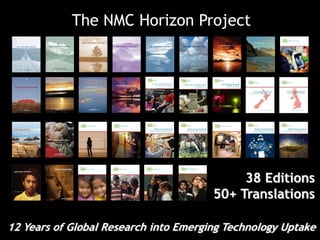
38 Editions
50+ Translations
12 Years of Global Research into Emerging Technology Uptake
The NMC Horizon Project
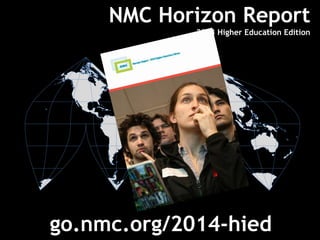
NMC Horizon Report
2013 Higher Education Edition
å
go.nmc.org/2014-hied
The research behind the NMC Horizon Report: 2014 Higher
Education Edition is jointly conducted by the New Media Consortium
(NMC) and the EDUCAUSE Learning Initiative (ELI), an EDUCAUSE
Program. The ELI’s critical participation in the production of this report
and their strong support for the NMC Horizon Project is gratefully
acknowledged.
Acknowledgements
The NMC Horizon Report: 2014 Higher Education Edition Edition is a
publication of the New Media Consortium and is made possible via a
grant from the World Bank.
How does the process work?
Lens of Practical Outcomes
Policy
Leadership
Practice
Hz Advisory Boards
Each project board represents an international, multi-
disciplinary group of between 40 - 50 technology
experts from both within and outside higher
education
Participation on any Horizon Project
advisory board is by invitation and includes
self-nomination
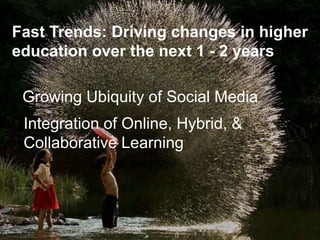
Fast Trends: Driving changes in higher
education over the next 1 - 2 years
Growing Ubiquity of Social Media
Integration of Online, Hybrid, &
Collaborative Learning
Mid-Range Trend: Driving changes in
higher education over the next 3 - 5
years
Rise of Data-Driven Learning & Assessment
Shift from Students as Consumers to
Students as Creators
Long-Range Trend:: Driving changes
in higher education over the next 5+
years
Agile Approaches to Change
Evolution of Online Learning
Solvable Challenge: Those that we
understand and know how to solve
Low Digital Fluency of Faculty
Relative Lack of Rewards for Teaching
Difficult Challenge: Those we
understand but for which solutions are
elusive
Competition from New Models of Education
Scaling Teaching Innovations
Wicked Challenge: Those that are
complex to even define, much less
address
Expanding Access
Keeping Education Relevant
Important Developments in Educational
Technology for Higher Education
Time-to-Adoption Horizon: 1 Year or Less
Flipped Classroom
Learning Analytics
Important Developments in Educational
Technology for Higher Education
Time-to-Adoption Horizon: 2 to 3 Years
3-D Printing
Games and Gamification
Important Developments in Educational
Technology for Higher Education
Time-to-Adoption Horizon: 4 to 5 Years
Quantified Self
Virtual Assistants
How accurate have the
projections been?
Pretty darn good
You Can JUMP IN
Tag articles or reports
Twitter: #NMCHz
Sign up for the Advisory Board
go.nmc.org/horizon-nominate
Submit Your Projects
go.nmc.org/projects
#NMCHz
Lawrence G. Miller
@lawrencegmiller
larry.miller@nmc.org
QUESTIONS?

campus Technology Executive Summit LM Hz

  • 1.
    Lawrence G. Miller SeniorDirector for Community College Relations NMC: The New Media Consortium Challenges, Trends & Important Developments in Higher Educational Technology
  • 2.
  • 3.
  • 4.
    #NMCHz The Horizon Project NMC:The New Media Consortium Launched 2002 by Laurence F. JohnsonLaunched 2002 by Laurence F. Johnson To proactively identify technology trends that could impact education, specifically higher education
  • 5.
    32 Editions 10 reportsin 2013 40+ translations 38 Editions 50+ Translations 12 Years of Global Research into Emerging Technology Uptake The NMC Horizon Project
  • 7.
    NMC Horizon Report 2013Higher Education Edition å go.nmc.org/2014-hied
  • 8.
    The research behindthe NMC Horizon Report: 2014 Higher Education Edition is jointly conducted by the New Media Consortium (NMC) and the EDUCAUSE Learning Initiative (ELI), an EDUCAUSE Program. The ELI’s critical participation in the production of this report and their strong support for the NMC Horizon Project is gratefully acknowledged. Acknowledgements The NMC Horizon Report: 2014 Higher Education Edition Edition is a publication of the New Media Consortium and is made possible via a grant from the World Bank.
  • 9.
    How does theprocess work?
  • 10.
    Lens of PracticalOutcomes Policy Leadership Practice
  • 11.
    Hz Advisory Boards Eachproject board represents an international, multi- disciplinary group of between 40 - 50 technology experts from both within and outside higher education Participation on any Horizon Project advisory board is by invitation and includes self-nomination
  • 12.
    Fast Trends: Drivingchanges in higher education over the next 1 - 2 years Growing Ubiquity of Social Media Integration of Online, Hybrid, & Collaborative Learning
  • 13.
    Mid-Range Trend: Drivingchanges in higher education over the next 3 - 5 years Rise of Data-Driven Learning & Assessment Shift from Students as Consumers to Students as Creators
  • 14.
    Long-Range Trend:: Drivingchanges in higher education over the next 5+ years Agile Approaches to Change Evolution of Online Learning
  • 15.
    Solvable Challenge: Thosethat we understand and know how to solve Low Digital Fluency of Faculty Relative Lack of Rewards for Teaching
  • 16.
    Difficult Challenge: Thosewe understand but for which solutions are elusive Competition from New Models of Education Scaling Teaching Innovations
  • 17.
    Wicked Challenge: Thosethat are complex to even define, much less address Expanding Access Keeping Education Relevant
  • 18.
    Important Developments inEducational Technology for Higher Education Time-to-Adoption Horizon: 1 Year or Less Flipped Classroom Learning Analytics
  • 19.
    Important Developments inEducational Technology for Higher Education Time-to-Adoption Horizon: 2 to 3 Years 3-D Printing Games and Gamification
  • 20.
    Important Developments inEducational Technology for Higher Education Time-to-Adoption Horizon: 4 to 5 Years Quantified Self Virtual Assistants
  • 21.
    How accurate havethe projections been? Pretty darn good
  • 22.
    You Can JUMPIN Tag articles or reports Twitter: #NMCHz Sign up for the Advisory Board go.nmc.org/horizon-nominate Submit Your Projects go.nmc.org/projects
  • 23.
  • 24.