Bernat Adrià
ELECTRIFICATION AS A
SOLUTION FOR PORT
DECARBONISATION
27/April/2021
Sustainability and Energy Transition
2
CONTENTS:
1. Brief overview of European regulation
2. Environmental challenges of the port-maritime
sector
3. Successful electrification projects carried out
and ongoing initiatives
4. The path ahead: future actions
European Green Deal:
§ Climate neutrality in the EU by 2050, including maritime transport
§ Instructions from President Von der Leyen to Commissioner Valean (DG MOVE) to include maritime transport in the
Emissions trading system (ETS)
§ Carbon tax for maritime transport is also being considered although it will be complicated for jurisdictional reasons
(ETS would be easier to implement)
§ Skepticism about IMO's effectiveness in environmental regulation: IMO is perceived as dominated by industry and
interested in moving very slowly in this field. The 2023 deadline agreed by the previous high-level experts in the
Commission is considered irrelevant by the new policy-makers
EUROPEAN GREEN DEAL
3
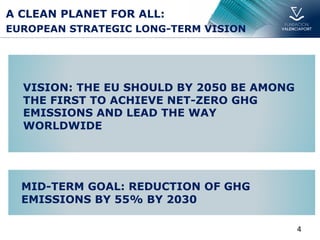
VISION: THE EU SHOULD BY 2050 BE AMONG
THE FIRST TO ACHIEVE NET-ZERO GHG
EMISSIONS AND LEAD THE WAY
WORLDWIDE
A CLEAN PLANET FOR ALL:
EUROPEAN STRATEGIC LONG-TERM VISION
MID-TERM GOAL: REDUCTION OF GHG
EMISSIONS BY 55% BY 2030
4
5
1. Brief overview of European regulation
2. Environmental challenges of the port-maritime
sector
3. Successful electrification projects carried out
and ongoing initiatives
4. The path ahead: future actions
CONTENTS:
6
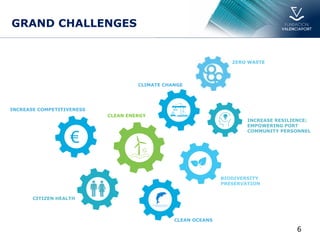
GRAND CHALLENGES
CLEAN ENERGY
CITIZEN HEALTH
ZERO WASTE
CLEAN OCEANS
BIODIVERSITY
PRESERVATION
CLIMATE CHANGE
INCREASE COMPETITIVENESS
INCREASE RESILIENCE:
EMPOWERING PORT
COMMUNITY PERSONNEL
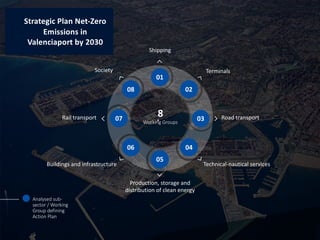
Plan Estratégico Cero Emisiones
Netas en 2030 en el Puerto de
Valencia
•
8
Working Groups
Shipping
Road transport
Rail transport
Terminals
Society
Technical-nautical services
Buildings and infrastructure
Production, storage and
distribution of clean energy
Analysed sub-
sector / Working
Group defining
Action Plan
08
07
06
05
04
03
02
01
Strategic Plan Net-Zero
Emissions in
Valenciaport by 2030
8
1. Brief overview of European regulation
2. Environmental challenges of the port-maritime
sector
3. Successful electrification projects carried out
and ongoing initiatives
4. The path ahead: future actions
CONTENTS:
9
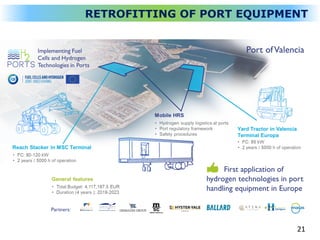
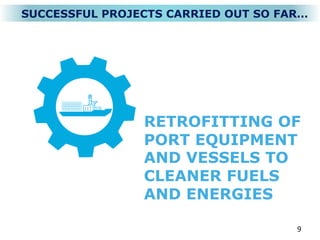
RETROFITTING OF
PORT EQUIPMENT
AND VESSELS TO
CLEANER FUELS
AND ENERGIES
SUCCESSFUL PROJECTS CARRIED OUT SO FAR…
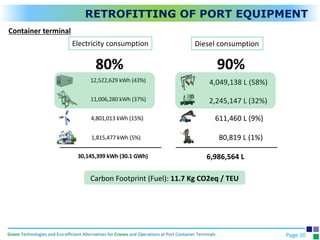
Green Technologies and Eco-efficient Alternatives for Cranes and Operations at Port Container Terminals Page 10
11,006,280 kWh (37%)
4,801,013 kWh (15%)
12,522,629 kWh (43%)
1,815,477 kWh (5%)
30,145,399 kWh (30.1 GWh)
4,049,138 L (58%)
2,245,147 L (32%)
611,460 L (9%)
80,819 L (1%)
6,986,564 L
90%
80%
Carbon Footprint (Fuel): 11.7 Kg CO2eq / TEU
RETROFITTING OF PORT EQUIPMENT
Electricity consumption Diesel consumption
Container terminal
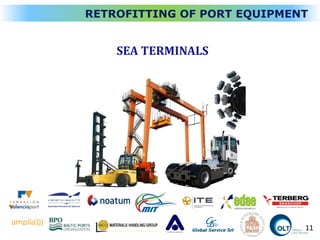
SEA TERMINALS
RETROFITTING OF PORT EQUIPMENT
11
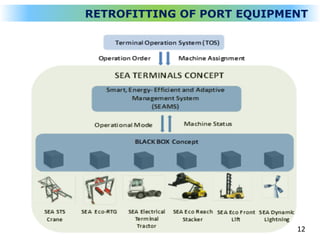
RETROFITTING OF PORT EQUIPMENT
12
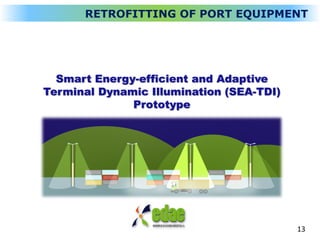
Smart Energy-efficient and Adaptive
Terminal Dynamic Illumination (SEA-TDI)
Prototype
13
RETROFITTING OF PORT EQUIPMENT
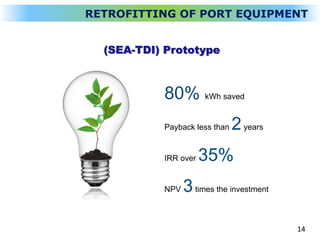
Pilot Results
80% kWh saved
Payback less than 2years
IRR over 35%
NPV 3times the investment
14
RETROFITTING OF PORT EQUIPMENT
(SEA-TDI) Prototype
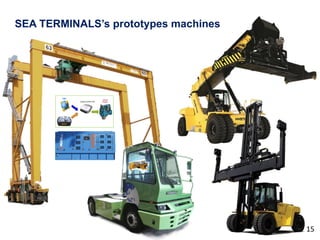
SEA TERMINALS’s prototypes machines
15
Driveline
Power/torque 160/180 hp @ 1800-2800
RPM 633/712 Nm @0-1800 RPM
Autonomy
6 hours (1 operational shift)
Recharging Time
Between 3-5 hours (depending on plug
type)
Electrical Tractor
16
RETROFITTING OF PORT EQUIPMENT
Batteries
Traction battery capacity 206[kWh]
Traction battery type Lithium Iron Phosphate
Nominal voltage 299 [V] (260-380 Volt)
Current 700Ah
Green Technologies and Eco-efficient Alternatives for Cranes and Operations at Port Container Terminals Page 17
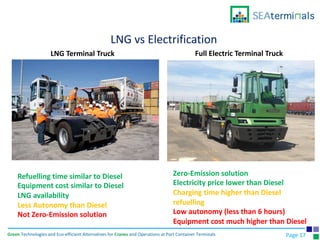
LNG vs Electrification
LNG Terminal Truck Full Electric Terminal Truck
Refuelling time similar to Diesel
Equipment cost similar to Diesel
LNG availability
Less Autonomy than Diesel
Not Zero-Emission solution
Zero-Emission solution
Electricity price lower than Diesel
Charging time higher than Diesel
refuelling
Low autonomy (less than 6 hours)
Equipment cost much higher than Diesel
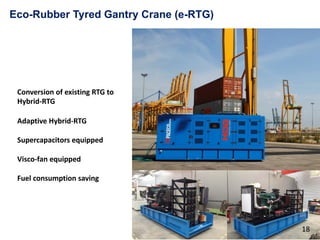
Conversion of existing RTG to
Hybrid-RTG
Adaptive Hybrid-RTG
Supercapacitors equipped
Visco-fan equipped
Fuel consumption saving
Eco-Rubber Tyred Gantry Crane (e-RTG)
18
78
RETROFITTING OF PORT EQUIPMENT
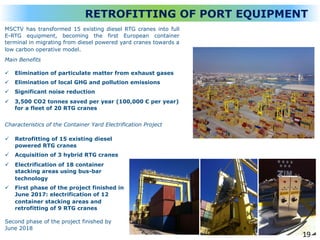
MSCTV has transformed 15 existing diesel RTG cranes into full
E-RTG equipment, becoming the first European container
terminal in migrating from diesel powered yard cranes towards a
low carbon operative model.
Main Benefits
ü Elimination of particulate matter from exhaust gases
ü Elimination of local GHG and pollution emissions
ü Significant noise reduction
ü 3,500 CO2 tonnes saved per year (100,000 € per year)
for a fleet of 20 RTG cranes
Characteristics of the Container Yard Electrification Project
ü Retrofitting of 15 existing diesel
powered RTG cranes
ü Acquisition of 3 hybrid RTG cranes
ü Electrification of 18 container
stacking areas using bus-bar
technology
ü First phase of the project finished in
June 2017: electrification of 12
container stacking areas and
retrofitting of 9 RTG cranes
Second phase of the project finished by
June 2018
19
Green Technologies and Eco-efficient Alternatives for Cranes and Operations at Port Container Terminals Page 20
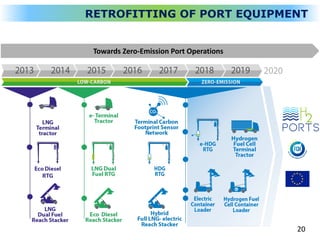
Towards Zero-Emission Port Operations
RETROFITTING OF PORT EQUIPMENT
Towards Zero-Emission Port Operations
20
Green Technologies and Eco-efficient Alternatives for Cranes and Operations at Port Container Terminals Page 21
RETROFITTING OF PORT EQUIPMENT
21
22
CONCLUSIONS
23
o Ensuring that a common harmonised and interoperable framework is brought forward,
in line with the EU technical, legal and regulatory framework, in order to facilitate the
implementation phase of OPS infrastructure in the ports of the consortium;
o Ensuring the port to vessel compatibility in the TEN-T Maritime Network, for vessels
calling at the ports of the consortium;
o Leading all the necessary technical, financial, legal and environmental studies to
prepare and accelerate the effective launch of cold ironing and electric infrastructure
and equipment in the ports.
To implement the first phase of the Global Project.
Specific objectives:
EALING Action (2019-EU-TM-0234-S) – Objectives
Accelerating the effective deployment of
OPS solutions in EU maritime ports
24
Accelerating the effective deployment of
OPS solutions in EU maritime ports
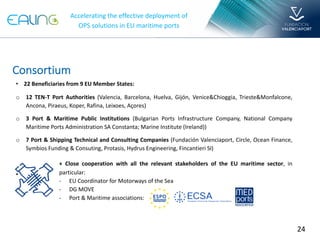
• 22 Beneficiaries from 9 EU Member States:
o 12 TEN-T Port Authorities (Valencia, Barcelona, Huelva, Gijón, Venice&Chioggia, Trieste&Monfalcone,
Ancona, Piraeus, Koper, Rafina, Leixoes, Açores)
o 3 Port & Maritime Public Institutions (Bulgarian Ports Infrastructure Company, National Company
Maritime Ports Administration SA Constanta; Marine Institute (Ireland))
o 7 Port & Shipping Technical and Consulting Companies (Fundación Valenciaport, Circle, Ocean Finance,
Symbios Funding & Consuting, Protasis, Hydrus Engineering, Fincantieri SI)
•
Consortium
+ Close cooperation with all the relevant stakeholders of the EU maritime sector, in
particular:
- EU Coordinator for Motorways of the Sea
- DG MOVE
- Port & Maritime associations:
25
CLEAN AND SAFE
MOBILITY
February 2017- July 2019
Priority axe 2: Fostering low-carbon strategies
and energy efficiency in specific MED
territories: cities, islands and remote areas
Specific objective 2.3 : To increase capacity to
use existing low carbon transport systems and
multimodal connections among them
2,358,759€
Leader: Central Europe Initiative
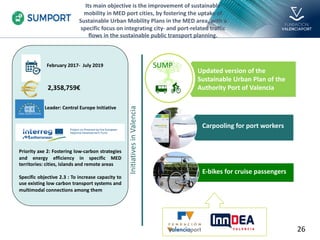
Its main objective is the improvement of sustainable
mobility in MED port cities, by fostering the uptake of
Sustainable Urban Mobility Plans in the MED area, with a
specific focus on integrating city- and port-related traffic
flows in the sustainable public transport planning.
SUMP
Updated version of the
Sustainable Urban Plan of the
Authority Port of Valencia
Carpooling for port workers
E-bikes for cruise passengers
Initiatives
in
Valencia
26
27
CONTENTS:
1. Brief overview of European regulation
2. Environmental challenges of the port-maritime
sector
3. Successful electrification projects carried out
and ongoing initiatives
4. The path ahead: future actions
28
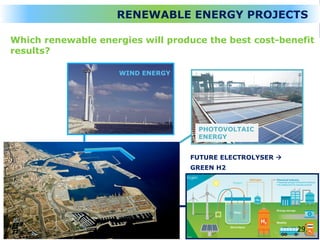
RENEWABLE ENERGY PROJECTS
WIND ENERGY
PHOTOVOLTAIC
ENERGY
FUTURE ELECTROLYSER à
GREEN H2
Which renewable energies will produce the best cost-benefit
results?
29
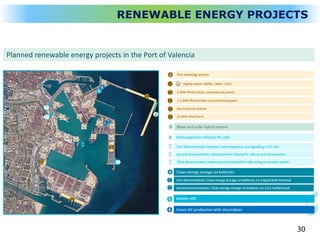
Heterojunction bifacial PV cells
First demonstration: Dynamic road integration and signalling of PV cells
Third demonstration: Heterojunction bifacial PV cells acting as acoustic panels
Second demonstration: Heterojunction bifacial PV cells on port breakwaters
Planned renewable energy projects in the Port of Valencia
Pre-existing assets
Digital meters 98PM, 28MV, 24LV
1
a
6 MW Photovoltaic conventional panels
1
b 1.5 MW Photovoltaic conventional panels
1
c
Electrical sub-station
1
d
15 MW Wind farm
Wave and solar hybrid system
Clean energy storage on batteries
Mobile HRS
1
d
1
a
1
b
1
c
2
2
1
3
3
b
3
a
3
c
3
b
3
a
3
c
4
4
a
4
b
First demonstration: Clean energy storage on batteries on a liquid bulk terminal
Second demonstration: Clean energy storage on batteries on a H2-fuelled boat
4
b
4
a
Green H2 production with electrolyser
5
6
5
6
RENEWABLE ENERGY PROJECTS
30
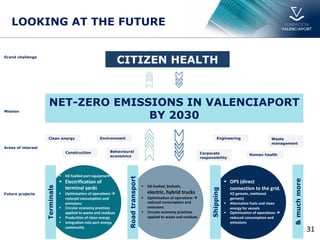
NET-ZERO EMISSIONS IN VALENCIAPORT
BY 2030
LOOKING AT THE FUTURE
CITIZEN HEALTH
§ H2-fuelled port equipment
§ Electrification of
terminal yards
§ Optimisation of operations à
reduced consumption and
emissions
§ Circular economy practices
applied to waste and residues
§ Production of clean energy
§ Integration into port energy
community
Grand challenge
Mission
Areas of interest
Future projects
Clean energy
Construction
Environment
Behavioural
economics
Terminals
Engineering
Corporate
responsibility
Waste
management
Human health
§ H2-fuelled, biofuels,
electric, hybrid trucks
§ Optimisation of operations à
reduced consumption and
emissions
§ Circular economy practices
applied to waste and residues
Road
transport
§ OPS (direct
connection to the grid,
H2 gensets, methanol
gensets)
§ Alternative fuels and clean
energy for vessels
§ Optimisation of operations à
reduced consumption and
emissions
Shipping
&
much
more
31
31
www.fundacion.valenciaport.com
THANK YOU VERY MUCH FOR YOUR ATTENTION!

Electrification as a Solution for Port Decarbonization by Bernat Adriá Mora,

  • 1.
    Bernat Adrià ELECTRIFICATION ASA SOLUTION FOR PORT DECARBONISATION 27/April/2021 Sustainability and Energy Transition
  • 2.
    2 CONTENTS: 1. Brief overviewof European regulation 2. Environmental challenges of the port-maritime sector 3. Successful electrification projects carried out and ongoing initiatives 4. The path ahead: future actions
  • 3.
    European Green Deal: §Climate neutrality in the EU by 2050, including maritime transport § Instructions from President Von der Leyen to Commissioner Valean (DG MOVE) to include maritime transport in the Emissions trading system (ETS) § Carbon tax for maritime transport is also being considered although it will be complicated for jurisdictional reasons (ETS would be easier to implement) § Skepticism about IMO's effectiveness in environmental regulation: IMO is perceived as dominated by industry and interested in moving very slowly in this field. The 2023 deadline agreed by the previous high-level experts in the Commission is considered irrelevant by the new policy-makers EUROPEAN GREEN DEAL 3
  • 4.
    VISION: THE EUSHOULD BY 2050 BE AMONG THE FIRST TO ACHIEVE NET-ZERO GHG EMISSIONS AND LEAD THE WAY WORLDWIDE A CLEAN PLANET FOR ALL: EUROPEAN STRATEGIC LONG-TERM VISION MID-TERM GOAL: REDUCTION OF GHG EMISSIONS BY 55% BY 2030 4
  • 5.
    5 1. Brief overviewof European regulation 2. Environmental challenges of the port-maritime sector 3. Successful electrification projects carried out and ongoing initiatives 4. The path ahead: future actions CONTENTS:
  • 6.
    6 GRAND CHALLENGES CLEAN ENERGY CITIZENHEALTH ZERO WASTE CLEAN OCEANS BIODIVERSITY PRESERVATION CLIMATE CHANGE INCREASE COMPETITIVENESS INCREASE RESILIENCE: EMPOWERING PORT COMMUNITY PERSONNEL
  • 7.
    Plan Estratégico CeroEmisiones Netas en 2030 en el Puerto de Valencia • 8 Working Groups Shipping Road transport Rail transport Terminals Society Technical-nautical services Buildings and infrastructure Production, storage and distribution of clean energy Analysed sub- sector / Working Group defining Action Plan 08 07 06 05 04 03 02 01 Strategic Plan Net-Zero Emissions in Valenciaport by 2030
  • 8.
    8 1. Brief overviewof European regulation 2. Environmental challenges of the port-maritime sector 3. Successful electrification projects carried out and ongoing initiatives 4. The path ahead: future actions CONTENTS:
  • 9.
    9 RETROFITTING OF PORT EQUIPMENT ANDVESSELS TO CLEANER FUELS AND ENERGIES SUCCESSFUL PROJECTS CARRIED OUT SO FAR…
  • 10.
    Green Technologies andEco-efficient Alternatives for Cranes and Operations at Port Container Terminals Page 10 11,006,280 kWh (37%) 4,801,013 kWh (15%) 12,522,629 kWh (43%) 1,815,477 kWh (5%) 30,145,399 kWh (30.1 GWh) 4,049,138 L (58%) 2,245,147 L (32%) 611,460 L (9%) 80,819 L (1%) 6,986,564 L 90% 80% Carbon Footprint (Fuel): 11.7 Kg CO2eq / TEU RETROFITTING OF PORT EQUIPMENT Electricity consumption Diesel consumption Container terminal
  • 11.
  • 12.
  • 13.
    Smart Energy-efficient andAdaptive Terminal Dynamic Illumination (SEA-TDI) Prototype 13 RETROFITTING OF PORT EQUIPMENT
  • 14.
    Pilot Results 80% kWhsaved Payback less than 2years IRR over 35% NPV 3times the investment 14 RETROFITTING OF PORT EQUIPMENT (SEA-TDI) Prototype
  • 15.
  • 16.
    Driveline Power/torque 160/180 hp@ 1800-2800 RPM 633/712 Nm @0-1800 RPM Autonomy 6 hours (1 operational shift) Recharging Time Between 3-5 hours (depending on plug type) Electrical Tractor 16 RETROFITTING OF PORT EQUIPMENT Batteries Traction battery capacity 206[kWh] Traction battery type Lithium Iron Phosphate Nominal voltage 299 [V] (260-380 Volt) Current 700Ah
  • 17.
    Green Technologies andEco-efficient Alternatives for Cranes and Operations at Port Container Terminals Page 17 LNG vs Electrification LNG Terminal Truck Full Electric Terminal Truck Refuelling time similar to Diesel Equipment cost similar to Diesel LNG availability Less Autonomy than Diesel Not Zero-Emission solution Zero-Emission solution Electricity price lower than Diesel Charging time higher than Diesel refuelling Low autonomy (less than 6 hours) Equipment cost much higher than Diesel
  • 18.
    Conversion of existingRTG to Hybrid-RTG Adaptive Hybrid-RTG Supercapacitors equipped Visco-fan equipped Fuel consumption saving Eco-Rubber Tyred Gantry Crane (e-RTG) 18
  • 19.
    78 RETROFITTING OF PORTEQUIPMENT MSCTV has transformed 15 existing diesel RTG cranes into full E-RTG equipment, becoming the first European container terminal in migrating from diesel powered yard cranes towards a low carbon operative model. Main Benefits ü Elimination of particulate matter from exhaust gases ü Elimination of local GHG and pollution emissions ü Significant noise reduction ü 3,500 CO2 tonnes saved per year (100,000 € per year) for a fleet of 20 RTG cranes Characteristics of the Container Yard Electrification Project ü Retrofitting of 15 existing diesel powered RTG cranes ü Acquisition of 3 hybrid RTG cranes ü Electrification of 18 container stacking areas using bus-bar technology ü First phase of the project finished in June 2017: electrification of 12 container stacking areas and retrofitting of 9 RTG cranes Second phase of the project finished by June 2018 19
  • 20.
    Green Technologies andEco-efficient Alternatives for Cranes and Operations at Port Container Terminals Page 20 Towards Zero-Emission Port Operations RETROFITTING OF PORT EQUIPMENT Towards Zero-Emission Port Operations 20
  • 21.
    Green Technologies andEco-efficient Alternatives for Cranes and Operations at Port Container Terminals Page 21 RETROFITTING OF PORT EQUIPMENT 21
  • 22.
  • 23.
    23 o Ensuring thata common harmonised and interoperable framework is brought forward, in line with the EU technical, legal and regulatory framework, in order to facilitate the implementation phase of OPS infrastructure in the ports of the consortium; o Ensuring the port to vessel compatibility in the TEN-T Maritime Network, for vessels calling at the ports of the consortium; o Leading all the necessary technical, financial, legal and environmental studies to prepare and accelerate the effective launch of cold ironing and electric infrastructure and equipment in the ports. To implement the first phase of the Global Project. Specific objectives: EALING Action (2019-EU-TM-0234-S) – Objectives Accelerating the effective deployment of OPS solutions in EU maritime ports
  • 24.
    24 Accelerating the effectivedeployment of OPS solutions in EU maritime ports • 22 Beneficiaries from 9 EU Member States: o 12 TEN-T Port Authorities (Valencia, Barcelona, Huelva, Gijón, Venice&Chioggia, Trieste&Monfalcone, Ancona, Piraeus, Koper, Rafina, Leixoes, Açores) o 3 Port & Maritime Public Institutions (Bulgarian Ports Infrastructure Company, National Company Maritime Ports Administration SA Constanta; Marine Institute (Ireland)) o 7 Port & Shipping Technical and Consulting Companies (Fundación Valenciaport, Circle, Ocean Finance, Symbios Funding & Consuting, Protasis, Hydrus Engineering, Fincantieri SI) • Consortium + Close cooperation with all the relevant stakeholders of the EU maritime sector, in particular: - EU Coordinator for Motorways of the Sea - DG MOVE - Port & Maritime associations:
  • 25.
  • 26.
    February 2017- July2019 Priority axe 2: Fostering low-carbon strategies and energy efficiency in specific MED territories: cities, islands and remote areas Specific objective 2.3 : To increase capacity to use existing low carbon transport systems and multimodal connections among them 2,358,759€ Leader: Central Europe Initiative Its main objective is the improvement of sustainable mobility in MED port cities, by fostering the uptake of Sustainable Urban Mobility Plans in the MED area, with a specific focus on integrating city- and port-related traffic flows in the sustainable public transport planning. SUMP Updated version of the Sustainable Urban Plan of the Authority Port of Valencia Carpooling for port workers E-bikes for cruise passengers Initiatives in Valencia 26
  • 27.
    27 CONTENTS: 1. Brief overviewof European regulation 2. Environmental challenges of the port-maritime sector 3. Successful electrification projects carried out and ongoing initiatives 4. The path ahead: future actions
  • 28.
    28 RENEWABLE ENERGY PROJECTS WINDENERGY PHOTOVOLTAIC ENERGY FUTURE ELECTROLYSER à GREEN H2 Which renewable energies will produce the best cost-benefit results? 29
  • 29.
    Heterojunction bifacial PVcells First demonstration: Dynamic road integration and signalling of PV cells Third demonstration: Heterojunction bifacial PV cells acting as acoustic panels Second demonstration: Heterojunction bifacial PV cells on port breakwaters Planned renewable energy projects in the Port of Valencia Pre-existing assets Digital meters 98PM, 28MV, 24LV 1 a 6 MW Photovoltaic conventional panels 1 b 1.5 MW Photovoltaic conventional panels 1 c Electrical sub-station 1 d 15 MW Wind farm Wave and solar hybrid system Clean energy storage on batteries Mobile HRS 1 d 1 a 1 b 1 c 2 2 1 3 3 b 3 a 3 c 3 b 3 a 3 c 4 4 a 4 b First demonstration: Clean energy storage on batteries on a liquid bulk terminal Second demonstration: Clean energy storage on batteries on a H2-fuelled boat 4 b 4 a Green H2 production with electrolyser 5 6 5 6 RENEWABLE ENERGY PROJECTS 30
  • 30.
    NET-ZERO EMISSIONS INVALENCIAPORT BY 2030 LOOKING AT THE FUTURE CITIZEN HEALTH § H2-fuelled port equipment § Electrification of terminal yards § Optimisation of operations à reduced consumption and emissions § Circular economy practices applied to waste and residues § Production of clean energy § Integration into port energy community Grand challenge Mission Areas of interest Future projects Clean energy Construction Environment Behavioural economics Terminals Engineering Corporate responsibility Waste management Human health § H2-fuelled, biofuels, electric, hybrid trucks § Optimisation of operations à reduced consumption and emissions § Circular economy practices applied to waste and residues Road transport § OPS (direct connection to the grid, H2 gensets, methanol gensets) § Alternative fuels and clean energy for vessels § Optimisation of operations à reduced consumption and emissions Shipping & much more 31
  • 31.