Nursing Management Gibbs Model of Reflection
Case Study Nursing Management of Heart Failure
Publishedby:https://expertassignmenthelp.com/
Filename:1SAMPLE16C208-Nursing-Management-Gibbs-Model-of-Reflection.PDF
For more assistance visit: https://expertassignmenthelp.com/nursing-assignment-help/
Uploaded:April 30, 2016
Enjoy 
Abstract
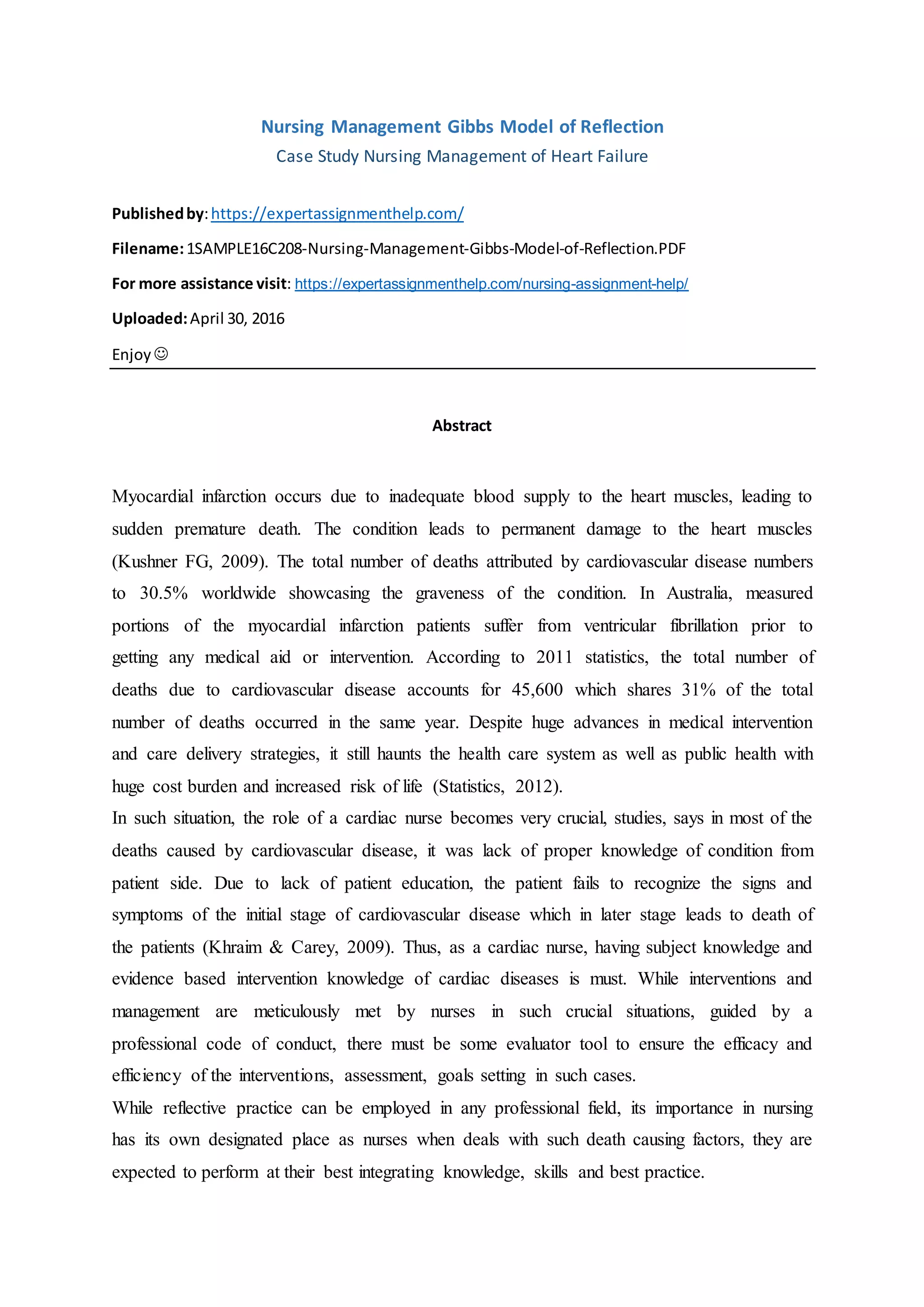
Myocardial infarction occurs due to inadequate blood supply to the heart muscles, leading to
sudden premature death. The condition leads to permanent damage to the heart muscles
(Kushner FG, 2009). The total number of deaths attributed by cardiovascular disease numbers
to 30.5% worldwide showcasing the graveness of the condition. In Australia, measured
portions of the myocardial infarction patients suffer from ventricular fibrillation prior to
getting any medical aid or intervention. According to 2011 statistics, the total number of
deaths due to cardiovascular disease accounts for 45,600 which shares 31% of the total
number of deaths occurred in the same year. Despite huge advances in medical intervention
and care delivery strategies, it still haunts the health care system as well as public health with
huge cost burden and increased risk of life (Statistics, 2012).
In such situation, the role of a cardiac nurse becomes very crucial, studies, says in most of the
deaths caused by cardiovascular disease, it was lack of proper knowledge of condition from
patient side. Due to lack of patient education, the patient fails to recognize the signs and
symptoms of the initial stage of cardiovascular disease which in later stage leads to death of
the patients (Khraim & Carey, 2009). Thus, as a cardiac nurse, having subject knowledge and
evidence based intervention knowledge of cardiac diseases is must. While interventions and
management are meticulously met by nurses in such crucial situations, guided by a
professional code of conduct, there must be some evaluator tool to ensure the efficacy and
efficiency of the interventions, assessment, goals setting in such cases.
While reflective practice can be employed in any professional field, its importance in nursing
has its own designated place as nurses when deals with such death causing factors, they are
expected to perform at their best integrating knowledge, skills and best practice.
Nursing Management Gibbs Model of Reflection

Nursing Management Gibbs Model of Reflection

  • 1.
    Nursing Management GibbsModel of Reflection Case Study Nursing Management of Heart Failure Publishedby:https://expertassignmenthelp.com/ Filename:1SAMPLE16C208-Nursing-Management-Gibbs-Model-of-Reflection.PDF For more assistance visit: https://expertassignmenthelp.com/nursing-assignment-help/ Uploaded:April 30, 2016 Enjoy  Abstract Myocardial infarction occurs due to inadequate blood supply to the heart muscles, leading to sudden premature death. The condition leads to permanent damage to the heart muscles (Kushner FG, 2009). The total number of deaths attributed by cardiovascular disease numbers to 30.5% worldwide showcasing the graveness of the condition. In Australia, measured portions of the myocardial infarction patients suffer from ventricular fibrillation prior to getting any medical aid or intervention. According to 2011 statistics, the total number of deaths due to cardiovascular disease accounts for 45,600 which shares 31% of the total number of deaths occurred in the same year. Despite huge advances in medical intervention and care delivery strategies, it still haunts the health care system as well as public health with huge cost burden and increased risk of life (Statistics, 2012). In such situation, the role of a cardiac nurse becomes very crucial, studies, says in most of the deaths caused by cardiovascular disease, it was lack of proper knowledge of condition from patient side. Due to lack of patient education, the patient fails to recognize the signs and symptoms of the initial stage of cardiovascular disease which in later stage leads to death of the patients (Khraim & Carey, 2009). Thus, as a cardiac nurse, having subject knowledge and evidence based intervention knowledge of cardiac diseases is must. While interventions and management are meticulously met by nurses in such crucial situations, guided by a professional code of conduct, there must be some evaluator tool to ensure the efficacy and efficiency of the interventions, assessment, goals setting in such cases. While reflective practice can be employed in any professional field, its importance in nursing has its own designated place as nurses when deals with such death causing factors, they are expected to perform at their best integrating knowledge, skills and best practice.