Eduardo Oliveira, Anna M. Hersperger
Swiss Federal Research Institute WSL
July 11, 2018
WhatitTakestoMakeandImplementStrategicSpatialPlans?
AESOP Annual Congress, Gothenburg, Sweden
Track 5. Governance 4A – Strategic Spatial Planning
A Cross-Case Comparison between Nordic and UK Urban Regions
CC0 licensing
The aim: strategic spatial planning in European urban regions
The aim of this presentation
is to highlight what the
preparation and implementation
of strategic spatial plans at the
urban-regional level involve.
Hamburg, CC0 licensing
Strategic spatial planning processes:
 Plan-making phase i.e. the
preparation or designing phase
of strategic spatial plans
 Plan-implementation phase i.e.
the translation of the principles
and intentions of a plan into
tangible actions at the ground
e.g.
 housing settlements
 new commercial facilities
 reinforcing transportation
 maintaining green
infrastructure
What do we know: strategic spatial planning in European urban regions
(Hersperger et al. 2018; Oliveira and Hersperger, 2018;
Gradinaru and Hersperger, 2018; Healey 2009; Albrechts,
Balducci and Hillier 2017).Lyon, CC0 licensing
What do we know: strategic spatial planning in European urban regions
Plan-making phase Plan-implementation phase
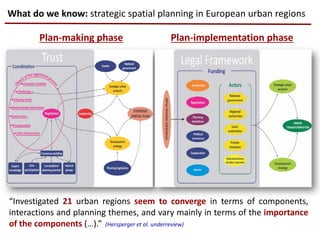
“Investigated 21 urban regions seem to converge in terms of components,
interactions and planning themes, and vary mainly in terms of the importance
of the components (…).” (Hersperger et al. underreview)
 In-depth interviewing with
regional planning experts e.g.
practitioners and academics
 3 interviews per case;
 90 minutes per interview;
 +5500 minutes of discussions;
How do we get there: strategic spatial planning in European urban regions
 Macro-objective:
CC0 licensing
CC0 licensing
 identifying and characterizing
the prime configurations,
components and interactions in
current processes of strategic
spatial plan-making and plan-
implementation.
Commonalities: what it takes to make and implement strategic spatial plans
 Strategic planning processes are characterized
 governance arrangements
 funding mechanisms, and
 power configurations
 Pivotal governance arrangements
 Negotiations
 interest groups involvement and
 multi-level government cooperation
 Private interest groups as developers and retail
representatives have been increasingly
involved in negotiations during planning
processes.
 Strategic spatial planning processes and
governance arrangements within are
increasingly being co-opted into the dominant
neoliberal agendas.
CC0licensingCC0licensing
(Oliveira and Hersperger, 2018)
Commonalities: what it takes to make and implement strategic spatial plans
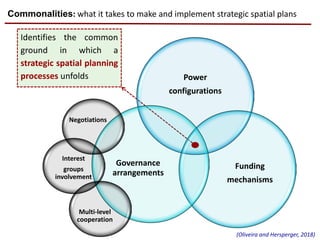
Identifies the common
ground in which a
strategic spatial planning
processes unfolds Power
configurations
Funding
mechanisms
Governance
arrangements
(Oliveira and Hersperger, 2018)
Negotiations
Interest
groups
involvement
Multi-level
cooperation
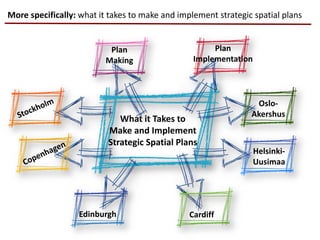
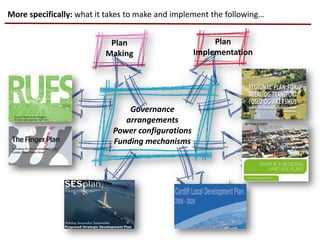
More specifically: what it takes to make and implement strategic spatial plans
What it Takes to
Make and Implement
Strategic Spatial Plans
Edinburgh Cardiff
Oslo-
Akershus
Helsinki-
Uusimaa
Plan
Making
Plan
Implementation
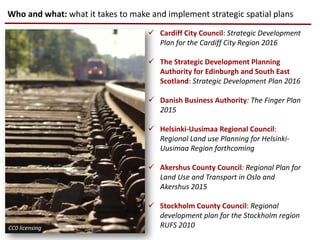
Who and what: what it takes to make and implement strategic spatial plans
 Cardiff City Council: Strategic Development
Plan for the Cardiff City Region 2016
 The Strategic Development Planning
Authority for Edinburgh and South East
Scotland: Strategic Development Plan 2016
 Danish Business Authority: The Finger Plan
2015
 Helsinki-Uusimaa Regional Council:
Regional Land use Planning for Helsinki-
Uusimaa Region forthcoming
 Akershus County Council: Regional Plan for
Land Use and Transport in Oslo and
Akershus 2015
 Stockholm County Council: Regional
development plan for the Stockholm region
RUFS 2010CC0 licensing
Governance
arrangements
Power configurations
Funding mechanisms
Edinburgh Cardiff
Oslo-
Akershus
Helsinki-
Uusimaa
Plan
Making
More specifically: what it takes to make and implement the following…
Plan
Implementation
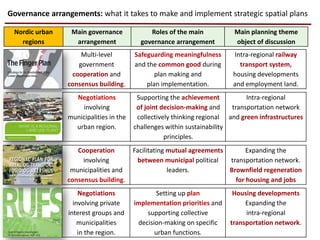
Governance arrangements: what it takes to make and implement strategic spatial plans
Nordic urban
regions
Main governance
arrangement
Roles of the main
governance arrangement
Main planning theme
object of discussion
Copenhagen
Multi-level
government
cooperation and
consensus building.
Safeguarding meaningfulness
and the common good during
plan making and
plan implementation.
Intra-regional railway
transport system,
housing developments
and employment land.
Helsinki-
Uusimaa
Negotiations
involving
municipalities in the
urban region.
Supporting the achievement
of joint decision-making and
collectively thinking regional
challenges within sustainability
principles.
Intra-regional
transportation network
and green infrastructures
Oslo-Akershus
Cooperation
involving
municipalities and
consensus building.
Facilitating mutual agreements
between municipal political
leaders.
Expanding the
transportation network.
Brownfield regeneration
for housing and jobs
Stockholm
Negotiations
involving private
interest groups and
municipalities
in the region.
Setting up plan
implementation priorities and
supporting collective
decision-making on specific
urban functions.
Housing developments
Expanding the
intra-regional
transportation network.
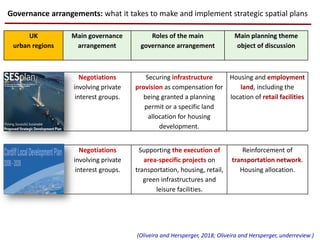
Governance arrangements: what it takes to make and implement strategic spatial plans
UK
urban regions
Main governance
arrangement
Roles of the main
governance arrangement
Main planning theme
object of discussion
Edinburgh
Negotiations
involving private
interest groups.
Securing infrastructure
provision as compensation for
being granted a planning
permit or a specific land
allocation for housing
development.
Housing and employment
land, including the
location of retail facilities
Cardiff
Negotiations
involving private
interest groups.
Supporting the execution of
area-specific projects on
transportation, housing, retail,
green infrastructures and
leisure facilities.
Reinforcement of
transportation network.
Housing allocation.
(Oliveira and Hersperger, 2018; Oliveira and Hersperger, underreview )
Governance arrangements: what it takes to make and implement strategic spatial plans
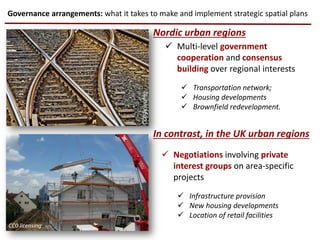
Nordic urban regions
In contrast, in the UK urban regions
 Multi-level government
cooperation and consensus
building over regional interests
 Transportation network;
 Housing developments
 Brownfield redevelopment.
 Negotiations involving private
interest groups on area-specific
projects
 Infrastructure provision
 New housing developments
 Location of retail facilities
CC0licensing
CC0 licensing
Funding mechanisms: what it takes to make and implement strategic spatial plans
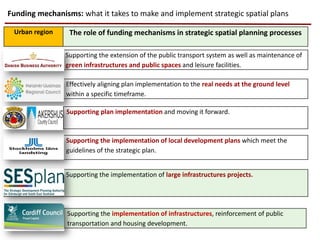
Urban region The role of funding mechanisms in strategic spatial planning processes
Copenhagen Supporting the extension of the public transport system as well as maintenance of
green infrastructures and public spaces and leisure facilities.
Helsinki-
Uusimaa
Effectively aligning plan implementation to the real needs at the ground level
within a specific timeframe.
Oslo-Akershus Supporting plan implementation and moving it forward.
Stockholm Supporting the implementation of local development plans which meet the
guidelines of the strategic plan.
Edinburgh Supporting the implementation of large infrastructures projects.
Cardiff Supporting the implementation of infrastructures, reinforcement of public
transportation and housing development.
Funding mechanisms : what it takes to make and implement strategic spatial plans
Nordic urban regions
In contrast, in the UK urban regions
 Municipalities have stronger financial and
decision-making capacity when compared to UK.
 Municipalities try to be proactive in setting up
partnerships with other municipalities and private
interest groups to find ways of funding specific
planned interventions.
 Scarce financial resources mean that strategic
spatial planning processes are highly dominated
by private actors and thus plans tend to be
implemented through area-specific strategic
projects.
 Supporting enterprise and business growth also
infrastructure provision e.g. primary schools
CC0 licensing
CC0 licensing
CC0 licensing
 Private interest groups such as housing
builders play a chief role throughout the
strategic planning process
 Environmental NGOs; grassroots movements
- put more pressure on the regional
authorities charged with strategic planning
tasks to
 Reducing commuting times/better transp.;
 Maintaining public spaces/recreational
areas;
 Securing sustainable ways of development.
Power configurations: what it takes to make and implement strategic spatial plans
CC0 licensing
UK urban regions
In contrast, in the Nordic urban regions
CC0 licensing
CC0licensing
Take home message: what it takes to make and implement strategic spatial plans
CC0 licensing
 Negotiation-based strategic
spatial planning processes;
 Increasingly persuasive power
of businesses interests in
strategic planning practice.
(finding in line with Daly, 2016; Olesen, 2014; Van Assche,
Duineveld and Beunen, 2014; Olesen and Richardson, 2011)
Concur with recent critical reflections on the
neoliberalization of strategic spatial planning.
Transferability of the findings: making and implementing strategic spatial plans
Lesson on governance arrangements:
negotiation
 Negotiation is the one process able to set
up priorities for plan making and plan
implementation by balancing public and
private interests.
How to better negotiate during SSP processes
 Preparing a set of realistic expectations and
a range of possible outcomes;
 Behaving with honesty and transparency;
 Communicating openly all issues at stake;
 Being willing to compromise and adapt to
circumstances.
The way negotiations in Helsinki-Uusimaa
unfold could be given as an example.CC0 licensing
Lesson on governance arrangements:
interest group involvement
 Interest groups are those pursuing
the interests they represent by
avoiding conflict with the public good
and following the principles
established in the strategic plan.
The way interest groups take part in the
process of plan implementation in
Oslo-Akershus as an example.
Transferability of the findings: making and implementing strategic spatial plans
CC0 licensing
Lesson on funding mechanisms
 Funding mechanisms when clearly
established, meaning they have clear
goals and planning themes they will
contribute to the effectiveness of
strategic spatial planning processes.
Transferability of the findings: making and implementing strategic spatial plans
CC0 licensing
Nordic urban regions as example
Lesson on power configurations
 Power configurations must be
critically considered in plan
implementation.
 It is necessary to secure transparency
and legitimacy of the negotiation
process.
 This can be done by documenting
every discussion during negotiations.
The cases of Oslo-Akershus and
Helsinki-Uusimaa could also be given as
positive examples of how to
balancing public vs private interests.
Transferability of the findings: making and implementing strategic spatial plans
CC0 licensing
Thank you
Eduardo Oliveira*
Land Change Science Research Unit** ¦ CONCUR Project***
Swiss Federal Research Institute WSL
***https://www.wsl.ch/en/projects/concur.html
*https://www.wsl.ch/en/employees/oliveira.html
**https://www.wsl.ch/en/about-wsl/research-units/land-change-science.html
AESOP Annual Congress, Gothenburg, Sweden
Track 5. Governance 4A – Strategic Spatial Planning

What it Takes to Make and Implement Strategic Spatial Plans?

  • 1.
    Eduardo Oliveira, AnnaM. Hersperger Swiss Federal Research Institute WSL July 11, 2018 WhatitTakestoMakeandImplementStrategicSpatialPlans? AESOP Annual Congress, Gothenburg, Sweden Track 5. Governance 4A – Strategic Spatial Planning A Cross-Case Comparison between Nordic and UK Urban Regions CC0 licensing
  • 2.
    The aim: strategicspatial planning in European urban regions The aim of this presentation is to highlight what the preparation and implementation of strategic spatial plans at the urban-regional level involve. Hamburg, CC0 licensing
  • 3.
    Strategic spatial planningprocesses:  Plan-making phase i.e. the preparation or designing phase of strategic spatial plans  Plan-implementation phase i.e. the translation of the principles and intentions of a plan into tangible actions at the ground e.g.  housing settlements  new commercial facilities  reinforcing transportation  maintaining green infrastructure What do we know: strategic spatial planning in European urban regions (Hersperger et al. 2018; Oliveira and Hersperger, 2018; Gradinaru and Hersperger, 2018; Healey 2009; Albrechts, Balducci and Hillier 2017).Lyon, CC0 licensing
  • 4.
    What do weknow: strategic spatial planning in European urban regions Plan-making phase Plan-implementation phase “Investigated 21 urban regions seem to converge in terms of components, interactions and planning themes, and vary mainly in terms of the importance of the components (…).” (Hersperger et al. underreview)
  • 5.
     In-depth interviewingwith regional planning experts e.g. practitioners and academics  3 interviews per case;  90 minutes per interview;  +5500 minutes of discussions; How do we get there: strategic spatial planning in European urban regions  Macro-objective: CC0 licensing CC0 licensing  identifying and characterizing the prime configurations, components and interactions in current processes of strategic spatial plan-making and plan- implementation.
  • 6.
    Commonalities: what ittakes to make and implement strategic spatial plans  Strategic planning processes are characterized  governance arrangements  funding mechanisms, and  power configurations  Pivotal governance arrangements  Negotiations  interest groups involvement and  multi-level government cooperation  Private interest groups as developers and retail representatives have been increasingly involved in negotiations during planning processes.  Strategic spatial planning processes and governance arrangements within are increasingly being co-opted into the dominant neoliberal agendas. CC0licensingCC0licensing (Oliveira and Hersperger, 2018)
  • 7.
    Commonalities: what ittakes to make and implement strategic spatial plans Identifies the common ground in which a strategic spatial planning processes unfolds Power configurations Funding mechanisms Governance arrangements (Oliveira and Hersperger, 2018) Negotiations Interest groups involvement Multi-level cooperation
  • 8.
    More specifically: whatit takes to make and implement strategic spatial plans What it Takes to Make and Implement Strategic Spatial Plans Edinburgh Cardiff Oslo- Akershus Helsinki- Uusimaa Plan Making Plan Implementation
  • 9.
    Who and what:what it takes to make and implement strategic spatial plans  Cardiff City Council: Strategic Development Plan for the Cardiff City Region 2016  The Strategic Development Planning Authority for Edinburgh and South East Scotland: Strategic Development Plan 2016  Danish Business Authority: The Finger Plan 2015  Helsinki-Uusimaa Regional Council: Regional Land use Planning for Helsinki- Uusimaa Region forthcoming  Akershus County Council: Regional Plan for Land Use and Transport in Oslo and Akershus 2015  Stockholm County Council: Regional development plan for the Stockholm region RUFS 2010CC0 licensing
  • 10.
    Governance arrangements Power configurations Funding mechanisms EdinburghCardiff Oslo- Akershus Helsinki- Uusimaa Plan Making More specifically: what it takes to make and implement the following… Plan Implementation
  • 11.
    Governance arrangements: whatit takes to make and implement strategic spatial plans Nordic urban regions Main governance arrangement Roles of the main governance arrangement Main planning theme object of discussion Copenhagen Multi-level government cooperation and consensus building. Safeguarding meaningfulness and the common good during plan making and plan implementation. Intra-regional railway transport system, housing developments and employment land. Helsinki- Uusimaa Negotiations involving municipalities in the urban region. Supporting the achievement of joint decision-making and collectively thinking regional challenges within sustainability principles. Intra-regional transportation network and green infrastructures Oslo-Akershus Cooperation involving municipalities and consensus building. Facilitating mutual agreements between municipal political leaders. Expanding the transportation network. Brownfield regeneration for housing and jobs Stockholm Negotiations involving private interest groups and municipalities in the region. Setting up plan implementation priorities and supporting collective decision-making on specific urban functions. Housing developments Expanding the intra-regional transportation network.
  • 12.
    Governance arrangements: whatit takes to make and implement strategic spatial plans UK urban regions Main governance arrangement Roles of the main governance arrangement Main planning theme object of discussion Edinburgh Negotiations involving private interest groups. Securing infrastructure provision as compensation for being granted a planning permit or a specific land allocation for housing development. Housing and employment land, including the location of retail facilities Cardiff Negotiations involving private interest groups. Supporting the execution of area-specific projects on transportation, housing, retail, green infrastructures and leisure facilities. Reinforcement of transportation network. Housing allocation. (Oliveira and Hersperger, 2018; Oliveira and Hersperger, underreview )
  • 13.
    Governance arrangements: whatit takes to make and implement strategic spatial plans Nordic urban regions In contrast, in the UK urban regions  Multi-level government cooperation and consensus building over regional interests  Transportation network;  Housing developments  Brownfield redevelopment.  Negotiations involving private interest groups on area-specific projects  Infrastructure provision  New housing developments  Location of retail facilities CC0licensing CC0 licensing
  • 14.
    Funding mechanisms: whatit takes to make and implement strategic spatial plans Urban region The role of funding mechanisms in strategic spatial planning processes Copenhagen Supporting the extension of the public transport system as well as maintenance of green infrastructures and public spaces and leisure facilities. Helsinki- Uusimaa Effectively aligning plan implementation to the real needs at the ground level within a specific timeframe. Oslo-Akershus Supporting plan implementation and moving it forward. Stockholm Supporting the implementation of local development plans which meet the guidelines of the strategic plan. Edinburgh Supporting the implementation of large infrastructures projects. Cardiff Supporting the implementation of infrastructures, reinforcement of public transportation and housing development.
  • 15.
    Funding mechanisms :what it takes to make and implement strategic spatial plans Nordic urban regions In contrast, in the UK urban regions  Municipalities have stronger financial and decision-making capacity when compared to UK.  Municipalities try to be proactive in setting up partnerships with other municipalities and private interest groups to find ways of funding specific planned interventions.  Scarce financial resources mean that strategic spatial planning processes are highly dominated by private actors and thus plans tend to be implemented through area-specific strategic projects.  Supporting enterprise and business growth also infrastructure provision e.g. primary schools CC0 licensing CC0 licensing CC0 licensing
  • 16.
     Private interestgroups such as housing builders play a chief role throughout the strategic planning process  Environmental NGOs; grassroots movements - put more pressure on the regional authorities charged with strategic planning tasks to  Reducing commuting times/better transp.;  Maintaining public spaces/recreational areas;  Securing sustainable ways of development. Power configurations: what it takes to make and implement strategic spatial plans CC0 licensing UK urban regions In contrast, in the Nordic urban regions CC0 licensing CC0licensing
  • 17.
    Take home message:what it takes to make and implement strategic spatial plans CC0 licensing  Negotiation-based strategic spatial planning processes;  Increasingly persuasive power of businesses interests in strategic planning practice. (finding in line with Daly, 2016; Olesen, 2014; Van Assche, Duineveld and Beunen, 2014; Olesen and Richardson, 2011) Concur with recent critical reflections on the neoliberalization of strategic spatial planning.
  • 18.
    Transferability of thefindings: making and implementing strategic spatial plans Lesson on governance arrangements: negotiation  Negotiation is the one process able to set up priorities for plan making and plan implementation by balancing public and private interests. How to better negotiate during SSP processes  Preparing a set of realistic expectations and a range of possible outcomes;  Behaving with honesty and transparency;  Communicating openly all issues at stake;  Being willing to compromise and adapt to circumstances. The way negotiations in Helsinki-Uusimaa unfold could be given as an example.CC0 licensing
  • 19.
    Lesson on governancearrangements: interest group involvement  Interest groups are those pursuing the interests they represent by avoiding conflict with the public good and following the principles established in the strategic plan. The way interest groups take part in the process of plan implementation in Oslo-Akershus as an example. Transferability of the findings: making and implementing strategic spatial plans CC0 licensing
  • 20.
    Lesson on fundingmechanisms  Funding mechanisms when clearly established, meaning they have clear goals and planning themes they will contribute to the effectiveness of strategic spatial planning processes. Transferability of the findings: making and implementing strategic spatial plans CC0 licensing Nordic urban regions as example
  • 21.
    Lesson on powerconfigurations  Power configurations must be critically considered in plan implementation.  It is necessary to secure transparency and legitimacy of the negotiation process.  This can be done by documenting every discussion during negotiations. The cases of Oslo-Akershus and Helsinki-Uusimaa could also be given as positive examples of how to balancing public vs private interests. Transferability of the findings: making and implementing strategic spatial plans CC0 licensing
  • 22.
    Thank you Eduardo Oliveira* LandChange Science Research Unit** ¦ CONCUR Project*** Swiss Federal Research Institute WSL ***https://www.wsl.ch/en/projects/concur.html *https://www.wsl.ch/en/employees/oliveira.html **https://www.wsl.ch/en/about-wsl/research-units/land-change-science.html AESOP Annual Congress, Gothenburg, Sweden Track 5. Governance 4A – Strategic Spatial Planning