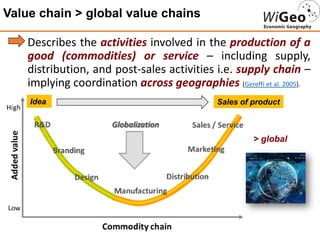
• Describes the activities involved in the production of a
good (commodities) or service – including supply,
distribution, and post-sales activities i.e. supply chain –
implying coordination across geographies (Gereffi et al. 2005).
Value chain > global value chains
Idea Sales of product
> global
The governance of global value chains
Take-home message
(Gereffi et al. 2005)
Global value chain research and policy work examine the
different ways in which global production and distribution
systems are integrated, and the possibilities for firms in
developing countries to enhance their position in global markets.
Key consideration
Globalization has resulted in an extensive distribution of global
production, which requires more intensive organization of ties
among firms or > within global production networks:
 Industrial governance
 Inter-firm governance
 Value chain governance (Nadvi 2008)
Source
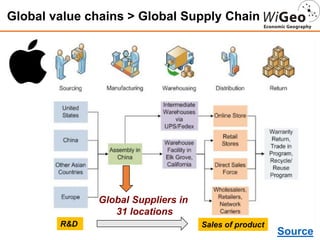
Global value chains > Global Supply Chain
R&D Sales of product
Global Suppliers in
31 locations
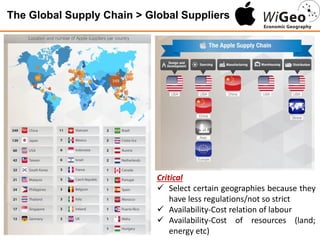
The Global Supply Chain > Global Suppliers
Critical
 Select certain geographies because they
have less regulations/not so strict
 Availability-Cost relation of labour
 Availability-Cost of resources (land;
energy etc)
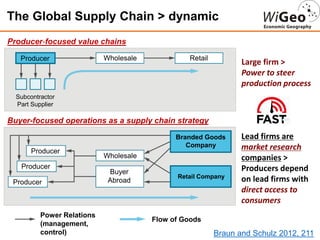
Large firm >
Power to steer
production process
Producer
Branded Goods
Company
Retail Company
Wholesale
Wholesale
Retail
Producer
Producer
Producer
Buyer
Abroad
Power Relations
(management,
control)
Flow of Goods
Producer-focused value chains
Buyer-focused operations as a supply chain strategy
Subcontractor
Part Supplier
Braun and Schulz 2012, 211
The Global Supply Chain > dynamic
Lead firms are
market research
companies >
Producers depend
on lead firms with
direct access to
consumers
Global value chains > Sustainability
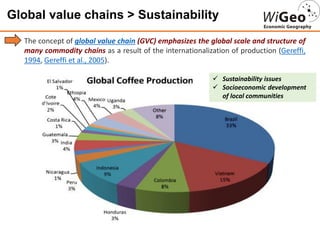
The concept of global value chain (GVC) emphasizes the global scale and structure of
many commodity chains as a result of the internationalization of production (Gereffi,
1994, Gereffi et al., 2005).
 Sustainability issues
 Socioeconomic development
of local communities
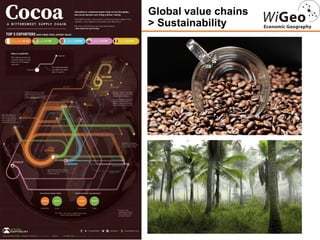
Global value chains
> Sustainability
Sustainable supply chains
The global coffee industry provides an interesting
empirical case to study sustainability in global chains:
Over the past twenty years, more than thirty corporate
and multi-stakeholder sustainability standards have
been developed, including:
International agreements
 Fairtrade
 Rainforest Alliance
 Utz Certified
Corporate Social Responsibility
 Common Code for the Coffee Community
(Manning et al 2012)
(Kolk, 2005)
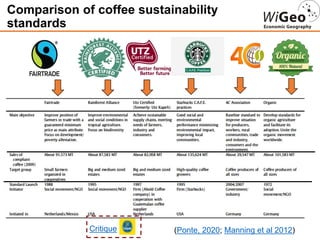
Comparison of coffee sustainability
standards
(Ponte, 2020; Manning et al 2012)
Critique
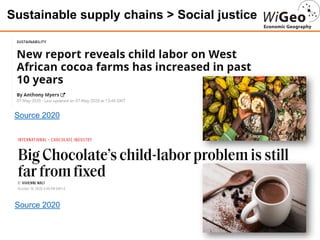
Sustainable supply chains > Social justice
Source 2020
Source 2020
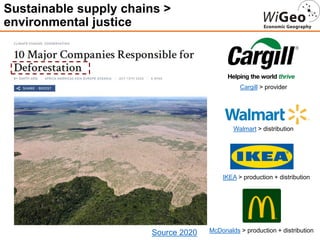
Sustainable supply chains >
environmental justice
Source 2020
Cargill > provider
Walmart > distribution
IKEA > production + distribution
McDonalds > production + distribution
International production configurations are being shaped
(1) ‘Regional’ shoring (relocation of all or parts of the production process to (or
near) the country of origin) > will lead to shorter, less fragmented value chains and
a higher geographical concentration of value added.
(2) Diversification > will lead to a wider distribution of economic activities. It will
primarily affect services and GVC-intensive manufacturing industries. This trajectory
will increase opportunities for new economies and firms to participate in GVCs.
(3) Regionalization will reduce the physical length of supply chains. Regional
economic cooperation, industrial policy and investment promotion will become
indispensable to build regional value chains instead of global.
(4) Replication will lead to shorter value chains. It will lead to more geographically
distributed activities, but more concentrated value added.
Global Investment
Report 2020
Sustainable supply chains
Research gaps in terms of Slow Innovation and Circular economy

Value chain > global value chains by Eduardo Oliveira

  • 1.
    • Describes theactivities involved in the production of a good (commodities) or service – including supply, distribution, and post-sales activities i.e. supply chain – implying coordination across geographies (Gereffi et al. 2005). Value chain > global value chains Idea Sales of product > global
  • 2.
    The governance ofglobal value chains Take-home message (Gereffi et al. 2005) Global value chain research and policy work examine the different ways in which global production and distribution systems are integrated, and the possibilities for firms in developing countries to enhance their position in global markets. Key consideration Globalization has resulted in an extensive distribution of global production, which requires more intensive organization of ties among firms or > within global production networks:  Industrial governance  Inter-firm governance  Value chain governance (Nadvi 2008)
  • 3.
    Source Global value chains> Global Supply Chain R&D Sales of product Global Suppliers in 31 locations
  • 4.
    The Global SupplyChain > Global Suppliers Critical  Select certain geographies because they have less regulations/not so strict  Availability-Cost relation of labour  Availability-Cost of resources (land; energy etc)
  • 5.
    Large firm > Powerto steer production process Producer Branded Goods Company Retail Company Wholesale Wholesale Retail Producer Producer Producer Buyer Abroad Power Relations (management, control) Flow of Goods Producer-focused value chains Buyer-focused operations as a supply chain strategy Subcontractor Part Supplier Braun and Schulz 2012, 211 The Global Supply Chain > dynamic Lead firms are market research companies > Producers depend on lead firms with direct access to consumers
  • 6.
    Global value chains> Sustainability The concept of global value chain (GVC) emphasizes the global scale and structure of many commodity chains as a result of the internationalization of production (Gereffi, 1994, Gereffi et al., 2005).  Sustainability issues  Socioeconomic development of local communities
  • 7.
    Global value chains >Sustainability
  • 8.
    Sustainable supply chains Theglobal coffee industry provides an interesting empirical case to study sustainability in global chains: Over the past twenty years, more than thirty corporate and multi-stakeholder sustainability standards have been developed, including: International agreements  Fairtrade  Rainforest Alliance  Utz Certified Corporate Social Responsibility  Common Code for the Coffee Community (Manning et al 2012) (Kolk, 2005)
  • 9.
    Comparison of coffeesustainability standards (Ponte, 2020; Manning et al 2012) Critique
  • 10.
    Sustainable supply chains> Social justice Source 2020 Source 2020
  • 11.
    Sustainable supply chains> environmental justice Source 2020 Cargill > provider Walmart > distribution IKEA > production + distribution McDonalds > production + distribution
  • 12.
    International production configurationsare being shaped (1) ‘Regional’ shoring (relocation of all or parts of the production process to (or near) the country of origin) > will lead to shorter, less fragmented value chains and a higher geographical concentration of value added. (2) Diversification > will lead to a wider distribution of economic activities. It will primarily affect services and GVC-intensive manufacturing industries. This trajectory will increase opportunities for new economies and firms to participate in GVCs. (3) Regionalization will reduce the physical length of supply chains. Regional economic cooperation, industrial policy and investment promotion will become indispensable to build regional value chains instead of global. (4) Replication will lead to shorter value chains. It will lead to more geographically distributed activities, but more concentrated value added. Global Investment Report 2020 Sustainable supply chains Research gaps in terms of Slow Innovation and Circular economy