UNIT 2. RESPONSIBLE
TOURISM PRODUCT DEVELOPMENT
Unit outline
Objectives
By the end of the unit participants will be able to:
• Explain the importance of conducting a product market
analysis
• Identify methods of collecting market information
• Explain how to conduct a strategic market assessment
• Explain how to conduct a product analysis
• Explain how to match markets with product development
opportunities and development objectives
• Explain how to undertake a Responsible Tourism product
assessment
• List ways to implement stakeholder coordination and
develop a strategic action plan
Topics
1. Understanding (responsible)
tourism products
2. Developing tourism
products that are
commercially viable
3. Matching markets with
product development
opportunities and
development objectives
4. Assessing the sustainability
of tourism products
5. Stakeholder co-ordination
and collaboration
6. Responsible tourism
product development
strategy and action planning
TOPIC 1. UNDERSTANDING
(RESPONSIBLE) TOURISM PRODUCTS
UNIT 2. RESPONSIBLE TOURISM PRODUCT DEVELOPMENT
Picture source:
http://www.flickr.com/photos/cyborgwardt/1393338765/
Defining tourism products
NARROW DEFINITION
What the tourist buys
WIDER DEFINITION
The combination of what the
tourist does at the destination
and the services used
How the UNEP defines tourism products
Experiential factor Emotional factor Physical factor
Types of tourism products
Natural tourism products
Man-made tourism
products
Types of tourism products in Vietnam
Others?
Picture sources:
http://www.flickr.com/photos/barbararich/96982409/; http://www.flickr.com/photos/chericbaker/4446189110/; http://www.flickr.com/photos/matthieu-aubry/1242936011;
http://www.flickr.com/photos/lintmachine/2386330877/; http://commons.wikimedia.org/wiki/File:VietnamCombatArtTheLadiesbyDavidFairringtonCATVI1968.jpg;
http://en.wikipedia.org/wiki/M%E1%BB%B9_S%C6%A1n; http://en.wikipedia.org/wiki/Vietnamese_cuisine; http://commons.wikimedia.org/wiki/File:Hiking_at_highest_peak_in_Kosova_-_Gjeravica.JPG;
http://en.wikipedia.org/wiki/Sea_kayak; http://pixabay.com/en/diver-light-diving-silhouette-sea-108881/; http://www.flickr.com/photos/whltravel/4303957860/;
http://www.flickr.com/photos/agapbulusan/2418856362/; http://en.wikipedia.org/wiki/Hmong_people
Functions of tourism products
FUNCTION
Tourism hub
development Product
clusters of
development
Supporting
products
Circuits
Festivals and
events
Flagship
products
Components of successful tourism destinations
Accessibility
Attractions
ActivitiesAccommodation
Amenities
TOURISM
DESTINATION
Unique characteristics of tourism products
•There is no transfer of
ownership
Intangible
•Involves the acquisition of
“experiences”
Psychological
•Only exist when customer
is present
Perishable
•Cannot be provided by a
single enterprise
Composite
product
•Demand is affected by
external influences
Unstable
demand
•Cannot be brought to the
consumer
Fixed supply
•Ownership remains with
provider
Absence of
ownership
•Tourism varies in standard and
quality over time
Heterogeneous
•Purchase is before consumptionRisky
•Requires destination marketing
and services marketing
Marketable
Characteristics of responsible tourism products
• Responsible tourism products are the goods
and services that form tourism experiences
and are specifically designed to be:
– Environmentally, socially, culturally and
economically sustainable
– Educational
– Promote local participation
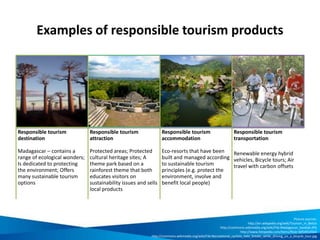
Examples of responsible tourism products
Responsible tourism
destination
Madagascar – contains a
range of ecological wonders;
Is dedicated to protecting
the environment; Offers
many sustainable tourism
options
Responsible tourism
attraction
Protected areas; Protected
cultural heritage sites; A
theme park based on a
rainforest theme that both
educates visitors on
sustainability issues and sells
local products
Responsible tourism
accommodation
Eco-resorts that have been
built and managed according
to sustainable tourism
principles (e.g. protect the
environment, involve and
benefit local people)
Responsible tourism
transportation
Renewable energy hybrid
vehicles, Bicycle tours; Air
travel with carbon offsets
Picture sources:
http://en.wikipedia.org/wiki/Tourism_in_Belize
http://commons.wikimedia.org/wiki/File:Madagascar_baobab.JPG
http://www.fotopedia.com/items/flickr-6054914564
http://commons.wikimedia.org/wiki/File:Recreational_cyclists_take_breaks_while_driving_on_a_bicycle_tour.jpg
TOPIC 2. DEVELOPING TOURISM PRODUCTS
THAT ARE COMMERCIALLY VIABLE
UNIT 2. RESPONSIBLE TOURISM PRODUCT DEVELOPMENT
Picture source:
http://en.wikipedia.org/wiki/Mobile_payment
What is responsible tourism product
development?
• Developing assets into
tourism goods, services and
experiences for consumption
• Responsible tourism product
development requires
integrating sustainability
principles in the process
What is commercial viability?
• Simply developing a
tourism product does not
mean that visitors will
come
• Following a good product
development process
helps ensure the
business, product, or
service can compete
effectively and make a
profit
Development of tourism related
products and experiences
requires:
• Understanding existing supply
and future demand for
products
• Market research on visitor
needs and
satisfaction, product
development gaps and
opportunities
• Understanding the types of
experiences that a visitor
market seeks
• Assuring the value and
sustainability of the tourism
project
The responsible tourism product development
process
RESPONSIBLE TOURISM
PRODUCT PLANNING
•Market analysis
•Product analysis
•Match markets with
products
•Product assessment for
development
STAKEHOLDER
CO-ORDINATION AND
COLLABORATION
•Determine goals and
actions
•Establish collaborations
RESPONSIBLE
TOURISM
PRODUCT
DEVELOPMENT
STRATEGY AND
ACTION PLAN
•Develop a responsible
tourism product
development strategy
•Develop an
implementation action plan
Ensuring viable responsible tourism products
by meeting market needs
• Market visitation
volume
• Market size
• Market trends and
interests
Market
growth
• Reason for travel
• Kinds of
experiences
desired
Motivations
& needs
• Means of travel
• Length of stay
• Level of flexibility
Travel
patterns
• Level of money
spent by visitor
types
• Value to local
development
Spend
• Greatest interest
in the destination
• Connect with
development
objectives
Sustainability
Understanding market needs through market
analysis
Tourism trends overview and
analysis
Visitor surveys
Competition analysis
Using a market analysis to help understand
tourism market features
Characteristics Motivations Expectations
Potential
products
Forms & means of
travel
Reasons for travel
choices
Expectations of
facilities, services,
amenities etc
SEGMENT TYPE CHARACTERISTICS MOTIVATIONS EXPECTATIONS
Holidayers International
1st timers International
2nd timers +
crowd avoiders
International
On holiday Domestic
Phuot Domestic
Day trippers Domestic
Example of typical tourist market segments and
characteristics in Vietnam
SEGMENT TYPE CHARACTERISTICS MOTIVATIONS EXPECTATIONS
Holidayers International
short-haul
Traveling in organized groups or with family
and friends. Shorter trips, few destinations.
Relaxation, entertainment,
visiting main attractions,
shopping.
Superior food and
accommodation,
Mixing
businesses
with pleasure
International
short-haul
Individual and independent business travellers
adding some tourism activities to their trip.
Entertainment, visiting
main attractions,
relaxation.
Quality services and
products. Ease of travel.
1st timers International
long-haul
Individual or group travel for 1 week or more,
utilizing a variety of travel means and many
destinations.
Visiting main attractions,
cultural and natural
features.
Good food, adequate
accommodation, fair prices,
variety.
2nd timers +
crowd
avoiders
International
long-haul
Individual or small group travel – usually self-
organized for 1 week or more, usually
spending more time in fewer destinations.
Authentic experiences and
specific activities (i.e.
trekking, caving).
Adequate accommodation,
good food and services,
authenticity and personal
experiences.
On holiday Domestic Travel as a family, during national holidays and
annual holiday periods
Relaxation, entertainment,
visiting main attractions.
Good food, adequate
accommodation, shopping
opportunities, fair prices.
Phuot Domestic Independent or small group travel, often by
motorbike.
Seeking alternative
activities and non-touristic
locations.
Adequate accommodation
and food, cheap prices,
authenticity.
Day trippers Domestic Independent travel by families and friends in
private vehicles for 1 day, usually on
weekends or national holidays.
Relaxation, entertainment,
visiting main attractions.
Good food, good services,
ease of travel.
TOPIC 3. MATCHING MARKETS WITH PRODUCT
DEVELOPMENT OPPORTUNITIES & OBJECTIVES
UNIT 2. RESPONSIBLE TOURISM PRODUCT DEVELOPMENT
Picture source:
http://commons.wikimedia.org/wiki/File:Fujian_association_Hoi_an.jpg
What is tourism product-market matching?
• Connecting the
characteristics, motivatio
ns and expectations of
market segments with
suitable tourism products
• To ensure
sustainability, products
should also be matched
with development
opportunities and
objectives of the host
destination
Tourism product
•Entertainment and relaxation
•Culture
•Nature
•Adventure
•Education
Tourism market
•Characteristics
•Motivations
•Expectations
Product-market matching conceptual diagram
PRODUCT
A
PRODUCT
B
PRODUCT
C
PRODUCT
E
PRODUCT
D
PRODUCT
F
PRODUCT
G
PRODUCT
I
PRODUCT
H MARKET
SEGMENT 1
MARKET
SEGMENT 2
MARKET
SEGMENT 3
MARKET
SEGMENT 4
Which markets would you match
to these products in Vietnam?
Why are these
markets linked
to these
products?
Matching markets and products in Vietnam
Tourism market segments in Vietnam matched
to product types
ENTERTAINMENT
RELAXATION
CULTURE
NATURE
ADVENTURE
LEARNING
DOMESTIC
Day trippers from Hanoi  
Holidayers    
Phuot   
INTERNATIONAL
Holidayers     
Mixing business with pleasure   
First timers   
Second timers + Crowd avoiders    
PRODUCT TYPE
MARKETSEGMENT
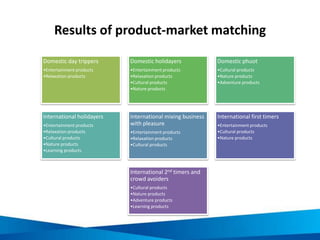
Results of product-market matching
Domestic day trippers
•Entertainment products
•Relaxation products
Domestic holidayers
•Entertainment products
•Relaxation products
•Cultural products
•Nature products
Domestic phuot
•Cultural products
•Nature products
•Adventure products
International holidayers
•Entertainment products
•Relaxation products
•Cultural products
•Nature products
•Learning products
International mixing business
with pleasure
•Entertainment products
•Relaxation products
•Cultural products
International first timers
•Entertainment products
•Cultural products
•Nature products
International 2nd timers and
crowd avoiders
•Cultural products
•Nature products
•Adventure products
•Learning products
Existing products New products
4 key product development options
ExistingmarketsNewmarkets
Market
penetration
Sell more of an
existing product
to an existing
market
Product
development
Sell a new or
improved
product to an
existing market
Market
development
Sell existing
products to a
new market
Product
diversification
Sell new
products to new
markets
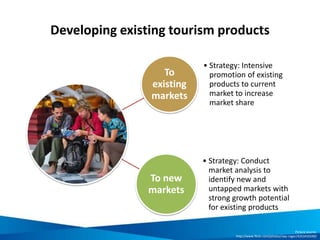
Developing existing tourism products
To
existing
markets
• Strategy: Intensive
promotion of existing
products to current
market to increase
market share
To new
markets
• Strategy: Conduct
market analysis to
identify new and
untapped markets with
strong growth potential
for existing products
Picture source:
http://www.flickr.com/photos/rwp-roger/4353435590/
Developing new tourism products
To
existing
markets
• Strategy: Expand on
products in destination
and promote to existing
market segments
To new
markets
• Strategy: Attract new
markets with strong
growth potential
Picture source:
http://www.flickr.com/photos/dalbera/4410383427/
Product Development Strategy 1
A beach resort destination dissatisfied with its market share
compared to its main competitors decides to undertake an
aggressive marketing campaign targeted at existing target
markets and segments to increase market share.
Source: UNWTO & ETC 2011, Handbook on Tourism Product Development, UNWTO & ETC, Madrid, Spain
Product Development Strategy 2
A beach resort destination recognises that the twenty first
century resort holidaymaker has become more demanding,
develops a “Beach Plus +” programme which it markets to its
existing market segments who might have considered that
the destination had become tired and predictable.
Source: UNWTO & ETC 2011, Handbook on Tourism Product Development, UNWTO & ETC, Madrid, Spain
Product Development Strategy 3
A destination that has relied on a particular geographic
market decides to target other source markets that have a
different seasonal pattern of demand.
Source: UNWTO & ETC 2011, Handbook on Tourism Product Development, UNWTO & ETC, Madrid, Spain
Product Development Strategy 4
A destination that has based its early stages of development
on a particular type of product targeted at the geographically
closest market decides that its product development as been
overly narrow and that there are other resources that can
appeal to visitors, with demand drawn from a wider network
of markets and segments.
Source: UNWTO & ETC 2011, Handbook on Tourism Product Development, UNWTO & ETC, Madrid, Spain
Market penetration and development:
Vietnam tourism market segment
opportunities
MARKET SEGMENT OPPORTUNITIES
Independent
international travellers
Often more flexible in their travel patterns and spending
behaviours than those traveling in groups.
Domestic markets Offer more stable, year-round business than international
tourists.
Business travellers and
visitors to friends/family
Have potential for add-on trips, activities and spending to
business activities
Specialty and niche
markets
Willing to spend more and stay longer for authentic and /
or unique special interest activities and experiences such as
birdwatching, trekking, diving etc
Opportunities offered by different product
development and diversification options
MARKET SEGMENT OPPORTUNITIES
Entertainment &
relaxation products
Generate local spending that can benefit local entrepreneurs, as well as
provide sources of employment for local people
Cultural products Provide opportunities for engaging local people who are often the
“owners” and practitioners of the products (e.g. handicraft products,
cultural performances, local guiding).
Nature products Activities centred around nature; provides local income earning
opportunities through services such as guiding.
Adventure products Typically requires specialised equipment and local support from
specifically trained guides.
Education products Requires specialisation of products, services, and information provisions.
Increasingly popular with some market segments such products also
support sustainability and opportunities for local people knowledgeable
and able to work as specialist guides or interpreters.
Other important considerations in determining
product development options
• Tourism marketing strategies?
• Destination uniqueness and branding?
• Tourism trends?
• Competitor destinations?
TOPIC 4. ASSESSING THE SUSTAINABILITY
OF TOURISM PRODUCTS
UNIT 2. RESPONSIBLE TOURISM PRODUCT DEVELOPMENT
Requirements of sustainable tourism products
• Sustainable tourism
products must meet
the needs and wants
of
consumers, business
and other
stakeholders
• There must also be
available human
resources with
sufficient capacity
Is it good
for us?
others
Do I
want it?
consumers
Can I
sell it?
business
Stakeholder criteria for tourism products
1. Contains
defining
features
2. Contains
core features
3. Considers
market
4. Is
commercially
viable
5. Is
sustainable
6. Provides
local benefits
7. Available
human
resources
CONSUMER
REQUIREMENTS
OTHER STAKEHOLDER
REQUIREMENTS
BUSINESS
REQUIREMENTS
ADDITIONAL
REQUIREMENT
Ensuring tourism products meet defining
feature requirements
1. Contains defining
features
1. Contains
defining
features
consumers
• Authentic
• Distinct
• Variety
• Seasonal
• Product function
• Lifecycle stage
Example of assessment criteria to determine if
product meets defining feature requirements
REQUIREMENT ASSESSMENT CRITERIA
Authentic How genuine and representative of the region is the product
Distinct How unique and special is the product
Variety Is there a good mix of attractions, activities, services?
Seasonal factors Weather, too crowded during the busy season, etc.
Product function Flagship, Hub, or Supporting Product, fit with regional product
clusters and circuits
consumers
Ensuring tourism products meet core feature
requirements
• Accessible
• Attractions
• Activities
• Main services
• Supporting services
2. Contains
core features
consumers
Example of assessment criteria to determine if
product meets core feature requirements
REQUIREMENT ASSESSMENT CRITERIA
Accessibility How easy is it for tourists to get to the site
Attractions Quality of main attractions that routs are coming for
Activities What other activities can the tourists do at the site
Main services What are the required tourism services available (e.g.
accommodation, food service)
consumers
Ensuring tourism products meet market
requirements
• Key target markets
• Market size
• Market trends and
influence 3. Considers
market
business
Example of assessment criteria to determine if
product meets core feature requirements
REQUIREMENT ASSESSMENT CRITERIA
Key target markets Easily identifiable key markets to target
Market size Sufficient to generate benefits and remain viable
Market trends and
influence
Are target markets likely to expand or influence other markets
business
Ensuring tourism products meet commercial
viability requirements
• Market-based planning
• Private sector engagement
• Supportive regulatory
context
• Necessary supporting
resources
4. Is
commercially
viable
business
Example of assessment criteria to determine if
product meets commercial viability
requirements
REQUIREMENT ASSESSMENT CRITERIA
Market-based
planning
Tourism products are developed and managed strategically
based on specific markets and trends
Private sector
engagement
The private sector is involved, including healthy local
enterprises
Supportive regulatory
context
Regulations on business development and operations are
favourable
Necessary supporting
resources
Available local human resources, and necessary infrastructure
business
Ensuring tourism products meet sustainability
requirements
• Economic
• Environmental
• Socio-cultural
• Institutionalisation
• Sector functioning
5. Is
sustainable
others
Example of assessment criteria to determine if
product meets sustainability requirements
REQUIREMENT ASSESSMENT CRITERIA
Economic Tourism economy provides equitable and attractive earning
opportunities
Environmental Natural environment is protected and enhanced
Socio-cultural Local customs and cultures are respected and supported
Institutionalisation Support of government policies, plans and programs
Sector functioning Sector stakeholders able to function in appropriate roles to
ensure effective and ongoing operations
others
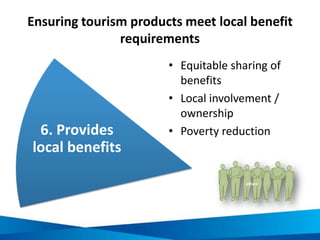
Ensuring tourism products meet local benefit
requirements
• Equitable sharing of
benefits
• Local involvement /
ownership
• Poverty reduction6. Provides
local benefits
others
Example of assessment criteria to determine if
product meets local benefit requirements
REQUIREMENT ASSESSMENT CRITERIA
Equitable sharing of
benefits
Tourism is seen as a fair and welcomed addition to local
livelihood improvement
Local involvement /
ownership
Hosting communities have open, and effective mechanisms
for engagement, including management roles, in the tourism
sector
Poverty reduction To what degree are more disadvantaged groups (poor,
women, disabled, minorities) receiving benefits
others
Ensuring tourism products meet human
resource requirements
1. Contains defining
features
• Public sector
• Business sector
• Local communities
7. Available
human
resources
Example of assessment criteria to determine if
product meets human resource requirements
REQUIREMENT ASSESSMENT CRITERIA
Public sector Management and staff responsible for tourism or relevant
sectors
Businesses sector Business either directly involved or supporting tourism in a
location
Local communities People residing in tourism locations who stand to benefit from
the tourism sector
Assessing product performance against
sustainability criteria
Scoring the degree a product achieves the various evaluation criteria can help
to understand its level of sustainability and viability. An example is below:
SCORE DEFINITION RESPONSE
0 = Not applicable This issue is not needed or relevant to the site No action required
1 = Very weak Complete inadequate leading to disastrous
results.
Intensive and comprehensive focused
support.
2 = Weak Not adequate. Needs improvement to
contribute to and effective or responsible
product.
Focused support of key aspects for
improvement. Strengthening what is already
working.
3 = Adequate Functioning adequately, but could be better
in some key aspects.
Focused support of key aspects for
improvement. Strengthening what is already
working if needed.
4 = Strong Functioning adequately, but could be better
in some minor aspects.
Minor improvement on specific areas if
needed.
5 = Best practice A model example that is highly effective,
innovative and exemplary.
Show case and replicate.
Review findings and identify potential
development responses
• Based upon the results of the sustainability assessment
development responses will become clearer.
• Development responses may vary according to strategic aims
• Below are some examples of development responses:
Improve viability of key
products
Encourage partnerships with
the private sector
Enhance local benefits
Support the establishment of
community-level management
organisations
Improve accessibility
Request and lobby for
government funding for rapid
road improvement
ASPECT COMMENT RATING
Perspective 1: What the Consumer Want (“Do I want this product?”)
I. Core Product Features
Accessibility How easy is it for tourists to get to the site
2. Attractions Quality of main attractions that routs are coming for
3. Activities What other activities can the tourists do at the site
4. Main Services What are the required tourism services available
5. Supporting Services What additional services are there to make it more convenient for tourists?
Summary Comments: Total
II. Defining Product Features: (Characteristics)
1. Authentic How genuine and representative of the region is the product
2. Distinct How unique and special is the product
3. Variety Is there a good mix of attractions, activities, services?
4. Seasonal Factors Weather, too crowded during the busy season, etc.
5.Product Function Flagship, Hub, or Supporting Product, fit with product clusters and circuits
6.Lifecycle Stage The product’s point of development (e.g. emerging, established etc)
Summary Comments: Total
Product assessment score card 1/2
ASPECT COMMENT RATING
Perspective 2: What Businesses Want (“Can I sell this product?”)
III. Market Considerations:
1. Key target markets Easily identifiable key targets to target.
2. Market size Sufficient to generate benefits and remain viable.
3. Market trends and influence Are target markets likely to expand or influence other markets.
Summary Comments: Total
IV. Commercial Viability:
1. Market-based planning Tourism products developed and managed based on markets and trends
2. Private sector engagement The private is involved, including healthy local enterprises.
3. Supportive regulatory context Regulations on business development and operations are favourable.
4. Supporting resources Available local human resources, and necessary infrastructure.
Summary Comments: Total
Product assessment score card 2/2
ASPECT COMMENT RATING
Perspective 3: What the Other Stakeholders Want (“Is it good for us?”)
V. Sustainability:
1. Economic Tourism economy provides equitable and attractive earning opportunities.
2. Environmental Natural environment is protected and enhanced.
3. Socio-cultural Local customs and cultures are respected and support-ed.
4. Institutionalization Support of government policies, plans and programs.
5. Sector functioning Sector stakeholders can function in appropriate roles for good operations.
Summary Comments: Total
VI. Local Benefits:
1. Equitable sharing of benefits Tourism seen as a fair and welcomed addition to local livelihoods
2. Local involvement/ ownership Community has good mechanisms for tourism engagement & management
3. Poverty reduction Disadvantaged groups (poor, women, disabled, minorities) receive benefits
Summary Comments: Total
ASPECT COMMENT RATING
Perspective 4: Human Resources: Availability, Capacity and Needs
VII. Human Resource Development: (Current capacity and needs)
1. Public Sector Management and staff responsible for tourism or relevant sectors
2. Businesses Sector Business either directly involved or supporting tourism in a location
3. Local communities Local communities stand to benefit from the tourism sector
Summary Comments: Total
OVERALL SCORE: TOTAL
TOPIC 5. STAKEHOLDER
CO-ORDINATION AND COLLABORATION
UNIT 2. RESPONSIBLE TOURISM PRODUCT DEVELOPMENT
Picture source:
http://rmbr.nus.edu.sg/news/index.php?start=270&category=
The importance and benefits of stakeholder
co-ordination and collaboration
• Many different products
contribute to a successful
tourism experience
• Tourism has a wide range of
impacts on different
stakeholders which need to be
effectively managed
• By working together
stakeholders are better able to
solve problems and take
advantage of opportunities
Benefits
• Enterprises and
destinations achieve
results more
efficiently and
effectively
• Benefits of tourism
are spread more
widely and fairly
The UNWTO’s 12 roles and benefits of
collaboration in tourism
• To reflect multiple aims and
agree common targets1.
• To ensure inclusiveness and
equity2.
• To sharpen focus and co-
ordinate action3.
• To raise awareness and
engage those with power over
outcomes
4.
• To link components in the
value chain5.
• To strengthen long term
support and commitment6.
• To pool knowledge and skills7.
• To strengthen resources and
funding8.
• To widen contacts and strengthen
communication9.
• To add value and creativity10.
• To share costs and risks –
economies of scale11.
• To cross boundaries12.
Stakeholder types and their importance
STAKEHOLDER IMPORTANCE
PRIVATE
SECTOR
Tourism service providers Main providers of employment, influence supply chains
Tour operators Influence market access and sustainability through conditions placed on destinations and
service providers
Transport operators Influence the market, destination viability and sustainability
Non-tourism businesses Provide income and prosperity
Trade associations Provide leadership and help drive sector development activities
PUBLIC
SECTOR
National government Shape direction and sustainability of tourism through policies, plans and financial support,
help drive market demand through destination marketing
Local authorities Influence sustainability of tourism through provincial plans and policies, influence
development through provision of infrastructure, influence sustainability at local level,
support business development, may provide development funding
CIVIL
SOCIETY
NGOs Influence sustainable development, build capacity, facilitate multi-stakeholder collaboration,
may provide development funding
TVETs Assist with market research, capacity building and vocational training
CITIZENS&
CONSUMERS
Host communities Providers and beneficiaries of labour and employment, provide supportive and welcoming
destinations for tourism
Tourists Influence sustainability through travel choices, influence product viability based on demand
Getting the collaboration fundamentals right
COLLABORATION
FUNDAMENTALS
People make
partnerships
work
No two
situations are
ever the same
Stakeholder
collaborations
are learning
experiences
All
stakeholders
need to see
wins
Being
inclusive
Recognising
differences
Formal structures
& processes
ADDITIONAL FACTORS
Getting collaboration started
ENCOURAGE PARTICIPANTS TO JOIN
•Perceived importance of the issue may be enough
•Demonstrate successes of pilot projects
•Promote commitment of others
BUILD TRUST & UNDERSTANDING
•Open discussion
•Find common ground
ESTABLISH A CO-ORDINATING GROUP & INTERIM
CONVEYOR
•Group or individual
•Candidate/s requires credibility, trust and respect
INITIAL CLARIFICATION OF ISSUES, GOALS & STRUCTURE
•Understand the purpose of collaboration and its functioning
•Explore initial opportunities and ideas and decide on priorities
•Clarify perspectives and differences of various stakeholders and
find common ground
•Consider level of stakeholder commitment
ESTABLISH A MANDATE & COMMITMENT TO FUTURE
SUPPORT
•Establish a mandate for collaboration and commitment
•Ensure approval by all stakeholders
•Define intended length of the collaborative processes
Determining goals and actions of collaboration
• Validate and elaborate on
results of research and
assessments
• Set out the broad goals of
collaboration
• Develop list of key actions
from strategy and action
planning process (see later
slides)
Managing the collaboration process:
Key elements
Establish a
leadership
and
management
structure
Follow
efficient
management
procedures
Develop
stakeholder
capacity
Maintain
stakeholder
commitment
Establish a leadership and management
structure
• Agree on leadership
position or examine other
options
• Ensure structure meets the
needs of the tasks, members
and stakeholder groups
• Ensure structure is inclusive, accountable and
transparent but also effective
• Consider need for additional structural
components according to collaboration size
• Determine functioning rules
Picture source:
http://frank.itlab.us/photo_essays/wrapper.php?sep_01_2007_SBWR.html
Follow efficient management procedures
• Record proceedings
• Use dedicated project
managers or coordinator
• Encourage effective
feedback from members
• Effectively cope with change of personnel
• Add partners with skills when necessary
Picture source:
http://www.flickr.com/photos/acumenfund/5188762078/
Develop stakeholder capacity
• Assess existing skills and knowledge
requirements and capacity of
members and build capacity according
to identified skills gaps
• Areas of consideration might include:
– Principles of responsible tourism
– Marketing
– Product development processes and tools
– Collaborative management
• Identify simple opportunities to build capacity such as:
– Sharing of knowledge and expertise
– Learning by doing
– Seeking external advice, e.g. from private sector, NGOs or
development agencies
Picture source:
http://rmbr.nus.edu.sg/news/index.php?start=78&category=
Maintain stakeholder commitment
• Pursue quick wins and easy achievements
• Demonstrate relevance of
achievements to members
• Provide regular opportunities for
involvement and highlight the results of
members involvement
• Maintain a sense of commitment across
all partners
• Use champions to inspire others
• Make it easy for members to attend
• Use attractive yet relevant incentives
• Be flexible and encourage informal arrangements
• Ensure effective communication
• Celebrating progress
Picture source:
http://rmbr.nus.edu.sg/news/index.php?start=270&category=
Using an adaptive management approach in
collaboration
2. Develop and
implement
monitoring
systems
3. Evaluate
progress
4. Learn and
adapt
1. Define
success criteria
• Quantitative
• Qualitative
• Action plans
• Progress reports
• Progress update meetings
• Widening of scope
• Periodic re-shaping
and improvements
• Outcomes
• Outputs
• Indicators
TOPIC 6. RESPONSIBLE TOURISM PRODUCT
DEVELOPMENT STRATEGY AND ACTION PLANNING
UNIT 2. RESPONSIBLE TOURISM PRODUCT DEVELOPMENT
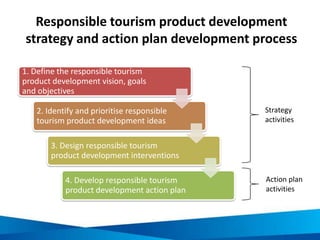
Responsible tourism product development
strategy and action plan development process
1. Define the responsible tourism
product development vision, goals
and objectives
2. Identify and prioritise responsible
tourism product development ideas
3. Design responsible tourism
product development interventions
4. Develop responsible tourism
product development action plan
Strategy
activities
Action plan
activities
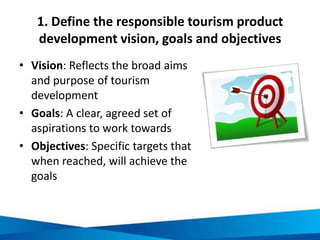
1. Define the responsible tourism product
development vision, goals and objectives
• Vision: Reflects the broad aims
and purpose of tourism
development
• Goals: A clear, agreed set of
aspirations to work towards
• Objectives: Specific targets that
when reached, will achieve the
goals
Example of a vision, goals, and objectives in
responsible tourism product development
Example vision statement:
• “To develop competitive and sustainable
tourism products that contribute to the
improvement of local livelihoods”
Example development goals:
• To increase the amount of spending by
tourists in the destination
• To improve the performance and
profitability of local tourism businesses
• To increasing investment in tourism
• To reduce the impact of tourism on the
local environment and resources
Example development objectives:
• To increase full time employment in
tourism in the local area by 15% by 2015
• To increase average daily spend of
international visitors in the local area by
5% by 2020
• To increase average annual visitation to
cultural villages by 10% by 2015
2. Identify and prioritise responsible
tourism product development ideas
Key considerations include the degree to
which intervention ideas help achieve:
1. Commercial viability goals:
The commercial viability and realistic
development potential of the products
2. Sustainability goals:
The degree to which local environmental,
social and economic benefits will be
created
3. Sectoral goals:
Strengthening infrastructure &
communications; Improving promotion in
key markets; Improving visitor information
& interpretation; Improving quality
standards; Improving safety & security
Commercial
viability test
Sustainability
test
Sectoral test
TOURISM
PRODUCT
DEVELOPMENT
OPTION
Prioritisation considerations:
Targeting development impacts
• The number of people in poverty
who will be reached by the
action

• The likely increase in income per
person reached
• Any non-financial benefits that
could reach the poor
• The ability of the action to reach
the particular target segment of
those in poverty

• The extent to which
measurement of the action’s
impact is possible

• The speed and visibility of
impact
• The sustainability of results
• The extent to which the action
will enhance knowledge and can
be replicated

Prioritisation considerations:
Practicality
• The cost of the initiative?
• The possible funding and other
resources available?
• The relevance to agreed policies
and commitments?
• The availability of people with
sufficient capacity to carry it out?
• The chance of success and the risk
implications?
3. Design responsible tourism product
development interventions
• Starting point - review development goals, outputs of
the product-market matching analysis and the
product assessment activities
• Approaches to consider when designing
interventions can include:
Working with products
that are generating high
volumes of spending
Working with products
which may already be
delivering a high
proportion of spending
to the poor
Fostering, supporting
and encouraging
growth and
participation of the
poor
Taking a pragmatic approach
Finally, ensure the interventions selected
consider the following two questions:
What can be done
with the resources
available?
What are the interests
and commitment of the
different stakeholders?
Principles for preparing a responsible tourism
product development strategy
• Emphasise stakeholder involvement
• Based on principles of sustainable tourism:
RESPONSIBLE TOURISM
PRODUCT DEVELOPMENT STRATEGY
Economically
viable and
competitive
Socially
equitable and
culturally
sensitive
Environmentally
responsible
4. Develop the responsible tourism product
development action plan
• Clearly sets out what is
being done, when, by whom,
and resource commitments
• Should be able to function as
a stand-alone resource
• General principles:
– Ensure participation
– Duration appropriate for the
destination
– Specify actions for all key
stakeholders
Who?
What?
When?
Resources?
Guiding principles for securing resources for
implementing action plans
• Use the project action plan as a tool
• Use a joint partnership budget or fund individually
• Allow time for resource mobilisation
• Identify mechanisms for receiving funding
• Be flexible in financial planning
• Look to the future
VND
Action plan template
ACTIVITY 1 RESULT TIMING RESPONSIBILITY RESOURCES
Sub-activity 1
Sub-activity 2
Sub-activity 3
Sub-activity 4
ACTIVITY 2 RESULT TIMING RESPONSIBILITY RESOURCES
Sub-activity 1
Sub-activity 2
Sub-activity 3
Sub-activity 4
ACTIVITY 3 RESULT TIMING RESPONSIBILITY RESOURCES
Sub-activity 1
Sub-activity 2
…
Unit 2: Responsible Tourism Product Development

Unit 2: Responsible Tourism Product Development

  • 1.
    UNIT 2. RESPONSIBLE TOURISMPRODUCT DEVELOPMENT
  • 2.
    Unit outline Objectives By theend of the unit participants will be able to: • Explain the importance of conducting a product market analysis • Identify methods of collecting market information • Explain how to conduct a strategic market assessment • Explain how to conduct a product analysis • Explain how to match markets with product development opportunities and development objectives • Explain how to undertake a Responsible Tourism product assessment • List ways to implement stakeholder coordination and develop a strategic action plan Topics 1. Understanding (responsible) tourism products 2. Developing tourism products that are commercially viable 3. Matching markets with product development opportunities and development objectives 4. Assessing the sustainability of tourism products 5. Stakeholder co-ordination and collaboration 6. Responsible tourism product development strategy and action planning
  • 3.
    TOPIC 1. UNDERSTANDING (RESPONSIBLE)TOURISM PRODUCTS UNIT 2. RESPONSIBLE TOURISM PRODUCT DEVELOPMENT Picture source: http://www.flickr.com/photos/cyborgwardt/1393338765/
  • 4.
    Defining tourism products NARROWDEFINITION What the tourist buys WIDER DEFINITION The combination of what the tourist does at the destination and the services used
  • 5.
    How the UNEPdefines tourism products Experiential factor Emotional factor Physical factor
  • 6.
    Types of tourismproducts Natural tourism products Man-made tourism products
  • 7.
    Types of tourismproducts in Vietnam Others? Picture sources: http://www.flickr.com/photos/barbararich/96982409/; http://www.flickr.com/photos/chericbaker/4446189110/; http://www.flickr.com/photos/matthieu-aubry/1242936011; http://www.flickr.com/photos/lintmachine/2386330877/; http://commons.wikimedia.org/wiki/File:VietnamCombatArtTheLadiesbyDavidFairringtonCATVI1968.jpg; http://en.wikipedia.org/wiki/M%E1%BB%B9_S%C6%A1n; http://en.wikipedia.org/wiki/Vietnamese_cuisine; http://commons.wikimedia.org/wiki/File:Hiking_at_highest_peak_in_Kosova_-_Gjeravica.JPG; http://en.wikipedia.org/wiki/Sea_kayak; http://pixabay.com/en/diver-light-diving-silhouette-sea-108881/; http://www.flickr.com/photos/whltravel/4303957860/; http://www.flickr.com/photos/agapbulusan/2418856362/; http://en.wikipedia.org/wiki/Hmong_people
  • 8.
    Functions of tourismproducts FUNCTION Tourism hub development Product clusters of development Supporting products Circuits Festivals and events Flagship products
  • 9.
    Components of successfultourism destinations Accessibility Attractions ActivitiesAccommodation Amenities TOURISM DESTINATION
  • 10.
    Unique characteristics oftourism products •There is no transfer of ownership Intangible •Involves the acquisition of “experiences” Psychological •Only exist when customer is present Perishable •Cannot be provided by a single enterprise Composite product •Demand is affected by external influences Unstable demand •Cannot be brought to the consumer Fixed supply •Ownership remains with provider Absence of ownership •Tourism varies in standard and quality over time Heterogeneous •Purchase is before consumptionRisky •Requires destination marketing and services marketing Marketable
  • 11.
    Characteristics of responsibletourism products • Responsible tourism products are the goods and services that form tourism experiences and are specifically designed to be: – Environmentally, socially, culturally and economically sustainable – Educational – Promote local participation
  • 12.
    Examples of responsibletourism products Responsible tourism destination Madagascar – contains a range of ecological wonders; Is dedicated to protecting the environment; Offers many sustainable tourism options Responsible tourism attraction Protected areas; Protected cultural heritage sites; A theme park based on a rainforest theme that both educates visitors on sustainability issues and sells local products Responsible tourism accommodation Eco-resorts that have been built and managed according to sustainable tourism principles (e.g. protect the environment, involve and benefit local people) Responsible tourism transportation Renewable energy hybrid vehicles, Bicycle tours; Air travel with carbon offsets Picture sources: http://en.wikipedia.org/wiki/Tourism_in_Belize http://commons.wikimedia.org/wiki/File:Madagascar_baobab.JPG http://www.fotopedia.com/items/flickr-6054914564 http://commons.wikimedia.org/wiki/File:Recreational_cyclists_take_breaks_while_driving_on_a_bicycle_tour.jpg
  • 13.
    TOPIC 2. DEVELOPINGTOURISM PRODUCTS THAT ARE COMMERCIALLY VIABLE UNIT 2. RESPONSIBLE TOURISM PRODUCT DEVELOPMENT Picture source: http://en.wikipedia.org/wiki/Mobile_payment
  • 14.
    What is responsibletourism product development? • Developing assets into tourism goods, services and experiences for consumption • Responsible tourism product development requires integrating sustainability principles in the process
  • 15.
    What is commercialviability? • Simply developing a tourism product does not mean that visitors will come • Following a good product development process helps ensure the business, product, or service can compete effectively and make a profit Development of tourism related products and experiences requires: • Understanding existing supply and future demand for products • Market research on visitor needs and satisfaction, product development gaps and opportunities • Understanding the types of experiences that a visitor market seeks • Assuring the value and sustainability of the tourism project
  • 16.
    The responsible tourismproduct development process RESPONSIBLE TOURISM PRODUCT PLANNING •Market analysis •Product analysis •Match markets with products •Product assessment for development STAKEHOLDER CO-ORDINATION AND COLLABORATION •Determine goals and actions •Establish collaborations RESPONSIBLE TOURISM PRODUCT DEVELOPMENT STRATEGY AND ACTION PLAN •Develop a responsible tourism product development strategy •Develop an implementation action plan
  • 17.
    Ensuring viable responsibletourism products by meeting market needs • Market visitation volume • Market size • Market trends and interests Market growth • Reason for travel • Kinds of experiences desired Motivations & needs • Means of travel • Length of stay • Level of flexibility Travel patterns • Level of money spent by visitor types • Value to local development Spend • Greatest interest in the destination • Connect with development objectives Sustainability
  • 18.
    Understanding market needsthrough market analysis Tourism trends overview and analysis Visitor surveys Competition analysis
  • 19.
    Using a marketanalysis to help understand tourism market features Characteristics Motivations Expectations Potential products Forms & means of travel Reasons for travel choices Expectations of facilities, services, amenities etc
  • 20.
    SEGMENT TYPE CHARACTERISTICSMOTIVATIONS EXPECTATIONS Holidayers International 1st timers International 2nd timers + crowd avoiders International On holiday Domestic Phuot Domestic Day trippers Domestic
  • 21.
    Example of typicaltourist market segments and characteristics in Vietnam SEGMENT TYPE CHARACTERISTICS MOTIVATIONS EXPECTATIONS Holidayers International short-haul Traveling in organized groups or with family and friends. Shorter trips, few destinations. Relaxation, entertainment, visiting main attractions, shopping. Superior food and accommodation, Mixing businesses with pleasure International short-haul Individual and independent business travellers adding some tourism activities to their trip. Entertainment, visiting main attractions, relaxation. Quality services and products. Ease of travel. 1st timers International long-haul Individual or group travel for 1 week or more, utilizing a variety of travel means and many destinations. Visiting main attractions, cultural and natural features. Good food, adequate accommodation, fair prices, variety. 2nd timers + crowd avoiders International long-haul Individual or small group travel – usually self- organized for 1 week or more, usually spending more time in fewer destinations. Authentic experiences and specific activities (i.e. trekking, caving). Adequate accommodation, good food and services, authenticity and personal experiences. On holiday Domestic Travel as a family, during national holidays and annual holiday periods Relaxation, entertainment, visiting main attractions. Good food, adequate accommodation, shopping opportunities, fair prices. Phuot Domestic Independent or small group travel, often by motorbike. Seeking alternative activities and non-touristic locations. Adequate accommodation and food, cheap prices, authenticity. Day trippers Domestic Independent travel by families and friends in private vehicles for 1 day, usually on weekends or national holidays. Relaxation, entertainment, visiting main attractions. Good food, good services, ease of travel.
  • 22.
    TOPIC 3. MATCHINGMARKETS WITH PRODUCT DEVELOPMENT OPPORTUNITIES & OBJECTIVES UNIT 2. RESPONSIBLE TOURISM PRODUCT DEVELOPMENT Picture source: http://commons.wikimedia.org/wiki/File:Fujian_association_Hoi_an.jpg
  • 23.
    What is tourismproduct-market matching? • Connecting the characteristics, motivatio ns and expectations of market segments with suitable tourism products • To ensure sustainability, products should also be matched with development opportunities and objectives of the host destination Tourism product •Entertainment and relaxation •Culture •Nature •Adventure •Education Tourism market •Characteristics •Motivations •Expectations
  • 24.
    Product-market matching conceptualdiagram PRODUCT A PRODUCT B PRODUCT C PRODUCT E PRODUCT D PRODUCT F PRODUCT G PRODUCT I PRODUCT H MARKET SEGMENT 1 MARKET SEGMENT 2 MARKET SEGMENT 3 MARKET SEGMENT 4
  • 25.
    Which markets wouldyou match to these products in Vietnam?
  • 26.
    Why are these marketslinked to these products? Matching markets and products in Vietnam
  • 27.
    Tourism market segmentsin Vietnam matched to product types ENTERTAINMENT RELAXATION CULTURE NATURE ADVENTURE LEARNING DOMESTIC Day trippers from Hanoi   Holidayers     Phuot    INTERNATIONAL Holidayers      Mixing business with pleasure    First timers    Second timers + Crowd avoiders     PRODUCT TYPE MARKETSEGMENT
  • 28.
    Results of product-marketmatching Domestic day trippers •Entertainment products •Relaxation products Domestic holidayers •Entertainment products •Relaxation products •Cultural products •Nature products Domestic phuot •Cultural products •Nature products •Adventure products International holidayers •Entertainment products •Relaxation products •Cultural products •Nature products •Learning products International mixing business with pleasure •Entertainment products •Relaxation products •Cultural products International first timers •Entertainment products •Cultural products •Nature products International 2nd timers and crowd avoiders •Cultural products •Nature products •Adventure products •Learning products
  • 29.
    Existing products Newproducts 4 key product development options ExistingmarketsNewmarkets Market penetration Sell more of an existing product to an existing market Product development Sell a new or improved product to an existing market Market development Sell existing products to a new market Product diversification Sell new products to new markets
  • 30.
    Developing existing tourismproducts To existing markets • Strategy: Intensive promotion of existing products to current market to increase market share To new markets • Strategy: Conduct market analysis to identify new and untapped markets with strong growth potential for existing products Picture source: http://www.flickr.com/photos/rwp-roger/4353435590/
  • 31.
    Developing new tourismproducts To existing markets • Strategy: Expand on products in destination and promote to existing market segments To new markets • Strategy: Attract new markets with strong growth potential Picture source: http://www.flickr.com/photos/dalbera/4410383427/
  • 32.
    Product Development Strategy1 A beach resort destination dissatisfied with its market share compared to its main competitors decides to undertake an aggressive marketing campaign targeted at existing target markets and segments to increase market share. Source: UNWTO & ETC 2011, Handbook on Tourism Product Development, UNWTO & ETC, Madrid, Spain
  • 33.
    Product Development Strategy2 A beach resort destination recognises that the twenty first century resort holidaymaker has become more demanding, develops a “Beach Plus +” programme which it markets to its existing market segments who might have considered that the destination had become tired and predictable. Source: UNWTO & ETC 2011, Handbook on Tourism Product Development, UNWTO & ETC, Madrid, Spain
  • 34.
    Product Development Strategy3 A destination that has relied on a particular geographic market decides to target other source markets that have a different seasonal pattern of demand. Source: UNWTO & ETC 2011, Handbook on Tourism Product Development, UNWTO & ETC, Madrid, Spain
  • 35.
    Product Development Strategy4 A destination that has based its early stages of development on a particular type of product targeted at the geographically closest market decides that its product development as been overly narrow and that there are other resources that can appeal to visitors, with demand drawn from a wider network of markets and segments. Source: UNWTO & ETC 2011, Handbook on Tourism Product Development, UNWTO & ETC, Madrid, Spain
  • 36.
    Market penetration anddevelopment: Vietnam tourism market segment opportunities MARKET SEGMENT OPPORTUNITIES Independent international travellers Often more flexible in their travel patterns and spending behaviours than those traveling in groups. Domestic markets Offer more stable, year-round business than international tourists. Business travellers and visitors to friends/family Have potential for add-on trips, activities and spending to business activities Specialty and niche markets Willing to spend more and stay longer for authentic and / or unique special interest activities and experiences such as birdwatching, trekking, diving etc
  • 37.
    Opportunities offered bydifferent product development and diversification options MARKET SEGMENT OPPORTUNITIES Entertainment & relaxation products Generate local spending that can benefit local entrepreneurs, as well as provide sources of employment for local people Cultural products Provide opportunities for engaging local people who are often the “owners” and practitioners of the products (e.g. handicraft products, cultural performances, local guiding). Nature products Activities centred around nature; provides local income earning opportunities through services such as guiding. Adventure products Typically requires specialised equipment and local support from specifically trained guides. Education products Requires specialisation of products, services, and information provisions. Increasingly popular with some market segments such products also support sustainability and opportunities for local people knowledgeable and able to work as specialist guides or interpreters.
  • 38.
    Other important considerationsin determining product development options • Tourism marketing strategies? • Destination uniqueness and branding? • Tourism trends? • Competitor destinations?
  • 39.
    TOPIC 4. ASSESSINGTHE SUSTAINABILITY OF TOURISM PRODUCTS UNIT 2. RESPONSIBLE TOURISM PRODUCT DEVELOPMENT
  • 40.
    Requirements of sustainabletourism products • Sustainable tourism products must meet the needs and wants of consumers, business and other stakeholders • There must also be available human resources with sufficient capacity Is it good for us? others Do I want it? consumers Can I sell it? business
  • 41.
    Stakeholder criteria fortourism products 1. Contains defining features 2. Contains core features 3. Considers market 4. Is commercially viable 5. Is sustainable 6. Provides local benefits 7. Available human resources CONSUMER REQUIREMENTS OTHER STAKEHOLDER REQUIREMENTS BUSINESS REQUIREMENTS ADDITIONAL REQUIREMENT
  • 42.
    Ensuring tourism productsmeet defining feature requirements 1. Contains defining features 1. Contains defining features consumers • Authentic • Distinct • Variety • Seasonal • Product function • Lifecycle stage
  • 43.
    Example of assessmentcriteria to determine if product meets defining feature requirements REQUIREMENT ASSESSMENT CRITERIA Authentic How genuine and representative of the region is the product Distinct How unique and special is the product Variety Is there a good mix of attractions, activities, services? Seasonal factors Weather, too crowded during the busy season, etc. Product function Flagship, Hub, or Supporting Product, fit with regional product clusters and circuits consumers
  • 44.
    Ensuring tourism productsmeet core feature requirements • Accessible • Attractions • Activities • Main services • Supporting services 2. Contains core features consumers
  • 45.
    Example of assessmentcriteria to determine if product meets core feature requirements REQUIREMENT ASSESSMENT CRITERIA Accessibility How easy is it for tourists to get to the site Attractions Quality of main attractions that routs are coming for Activities What other activities can the tourists do at the site Main services What are the required tourism services available (e.g. accommodation, food service) consumers
  • 46.
    Ensuring tourism productsmeet market requirements • Key target markets • Market size • Market trends and influence 3. Considers market business
  • 47.
    Example of assessmentcriteria to determine if product meets core feature requirements REQUIREMENT ASSESSMENT CRITERIA Key target markets Easily identifiable key markets to target Market size Sufficient to generate benefits and remain viable Market trends and influence Are target markets likely to expand or influence other markets business
  • 48.
    Ensuring tourism productsmeet commercial viability requirements • Market-based planning • Private sector engagement • Supportive regulatory context • Necessary supporting resources 4. Is commercially viable business
  • 49.
    Example of assessmentcriteria to determine if product meets commercial viability requirements REQUIREMENT ASSESSMENT CRITERIA Market-based planning Tourism products are developed and managed strategically based on specific markets and trends Private sector engagement The private sector is involved, including healthy local enterprises Supportive regulatory context Regulations on business development and operations are favourable Necessary supporting resources Available local human resources, and necessary infrastructure business
  • 50.
    Ensuring tourism productsmeet sustainability requirements • Economic • Environmental • Socio-cultural • Institutionalisation • Sector functioning 5. Is sustainable others
  • 51.
    Example of assessmentcriteria to determine if product meets sustainability requirements REQUIREMENT ASSESSMENT CRITERIA Economic Tourism economy provides equitable and attractive earning opportunities Environmental Natural environment is protected and enhanced Socio-cultural Local customs and cultures are respected and supported Institutionalisation Support of government policies, plans and programs Sector functioning Sector stakeholders able to function in appropriate roles to ensure effective and ongoing operations others
  • 52.
    Ensuring tourism productsmeet local benefit requirements • Equitable sharing of benefits • Local involvement / ownership • Poverty reduction6. Provides local benefits others
  • 53.
    Example of assessmentcriteria to determine if product meets local benefit requirements REQUIREMENT ASSESSMENT CRITERIA Equitable sharing of benefits Tourism is seen as a fair and welcomed addition to local livelihood improvement Local involvement / ownership Hosting communities have open, and effective mechanisms for engagement, including management roles, in the tourism sector Poverty reduction To what degree are more disadvantaged groups (poor, women, disabled, minorities) receiving benefits others
  • 54.
    Ensuring tourism productsmeet human resource requirements 1. Contains defining features • Public sector • Business sector • Local communities 7. Available human resources
  • 55.
    Example of assessmentcriteria to determine if product meets human resource requirements REQUIREMENT ASSESSMENT CRITERIA Public sector Management and staff responsible for tourism or relevant sectors Businesses sector Business either directly involved or supporting tourism in a location Local communities People residing in tourism locations who stand to benefit from the tourism sector
  • 56.
    Assessing product performanceagainst sustainability criteria Scoring the degree a product achieves the various evaluation criteria can help to understand its level of sustainability and viability. An example is below: SCORE DEFINITION RESPONSE 0 = Not applicable This issue is not needed or relevant to the site No action required 1 = Very weak Complete inadequate leading to disastrous results. Intensive and comprehensive focused support. 2 = Weak Not adequate. Needs improvement to contribute to and effective or responsible product. Focused support of key aspects for improvement. Strengthening what is already working. 3 = Adequate Functioning adequately, but could be better in some key aspects. Focused support of key aspects for improvement. Strengthening what is already working if needed. 4 = Strong Functioning adequately, but could be better in some minor aspects. Minor improvement on specific areas if needed. 5 = Best practice A model example that is highly effective, innovative and exemplary. Show case and replicate.
  • 57.
    Review findings andidentify potential development responses • Based upon the results of the sustainability assessment development responses will become clearer. • Development responses may vary according to strategic aims • Below are some examples of development responses: Improve viability of key products Encourage partnerships with the private sector Enhance local benefits Support the establishment of community-level management organisations Improve accessibility Request and lobby for government funding for rapid road improvement
  • 58.
    ASPECT COMMENT RATING Perspective1: What the Consumer Want (“Do I want this product?”) I. Core Product Features Accessibility How easy is it for tourists to get to the site 2. Attractions Quality of main attractions that routs are coming for 3. Activities What other activities can the tourists do at the site 4. Main Services What are the required tourism services available 5. Supporting Services What additional services are there to make it more convenient for tourists? Summary Comments: Total II. Defining Product Features: (Characteristics) 1. Authentic How genuine and representative of the region is the product 2. Distinct How unique and special is the product 3. Variety Is there a good mix of attractions, activities, services? 4. Seasonal Factors Weather, too crowded during the busy season, etc. 5.Product Function Flagship, Hub, or Supporting Product, fit with product clusters and circuits 6.Lifecycle Stage The product’s point of development (e.g. emerging, established etc) Summary Comments: Total Product assessment score card 1/2 ASPECT COMMENT RATING Perspective 2: What Businesses Want (“Can I sell this product?”) III. Market Considerations: 1. Key target markets Easily identifiable key targets to target. 2. Market size Sufficient to generate benefits and remain viable. 3. Market trends and influence Are target markets likely to expand or influence other markets. Summary Comments: Total IV. Commercial Viability: 1. Market-based planning Tourism products developed and managed based on markets and trends 2. Private sector engagement The private is involved, including healthy local enterprises. 3. Supportive regulatory context Regulations on business development and operations are favourable. 4. Supporting resources Available local human resources, and necessary infrastructure. Summary Comments: Total
  • 59.
    Product assessment scorecard 2/2 ASPECT COMMENT RATING Perspective 3: What the Other Stakeholders Want (“Is it good for us?”) V. Sustainability: 1. Economic Tourism economy provides equitable and attractive earning opportunities. 2. Environmental Natural environment is protected and enhanced. 3. Socio-cultural Local customs and cultures are respected and support-ed. 4. Institutionalization Support of government policies, plans and programs. 5. Sector functioning Sector stakeholders can function in appropriate roles for good operations. Summary Comments: Total VI. Local Benefits: 1. Equitable sharing of benefits Tourism seen as a fair and welcomed addition to local livelihoods 2. Local involvement/ ownership Community has good mechanisms for tourism engagement & management 3. Poverty reduction Disadvantaged groups (poor, women, disabled, minorities) receive benefits Summary Comments: Total ASPECT COMMENT RATING Perspective 4: Human Resources: Availability, Capacity and Needs VII. Human Resource Development: (Current capacity and needs) 1. Public Sector Management and staff responsible for tourism or relevant sectors 2. Businesses Sector Business either directly involved or supporting tourism in a location 3. Local communities Local communities stand to benefit from the tourism sector Summary Comments: Total OVERALL SCORE: TOTAL
  • 60.
    TOPIC 5. STAKEHOLDER CO-ORDINATIONAND COLLABORATION UNIT 2. RESPONSIBLE TOURISM PRODUCT DEVELOPMENT Picture source: http://rmbr.nus.edu.sg/news/index.php?start=270&category=
  • 61.
    The importance andbenefits of stakeholder co-ordination and collaboration • Many different products contribute to a successful tourism experience • Tourism has a wide range of impacts on different stakeholders which need to be effectively managed • By working together stakeholders are better able to solve problems and take advantage of opportunities Benefits • Enterprises and destinations achieve results more efficiently and effectively • Benefits of tourism are spread more widely and fairly
  • 62.
    The UNWTO’s 12roles and benefits of collaboration in tourism • To reflect multiple aims and agree common targets1. • To ensure inclusiveness and equity2. • To sharpen focus and co- ordinate action3. • To raise awareness and engage those with power over outcomes 4. • To link components in the value chain5. • To strengthen long term support and commitment6. • To pool knowledge and skills7. • To strengthen resources and funding8. • To widen contacts and strengthen communication9. • To add value and creativity10. • To share costs and risks – economies of scale11. • To cross boundaries12.
  • 63.
    Stakeholder types andtheir importance STAKEHOLDER IMPORTANCE PRIVATE SECTOR Tourism service providers Main providers of employment, influence supply chains Tour operators Influence market access and sustainability through conditions placed on destinations and service providers Transport operators Influence the market, destination viability and sustainability Non-tourism businesses Provide income and prosperity Trade associations Provide leadership and help drive sector development activities PUBLIC SECTOR National government Shape direction and sustainability of tourism through policies, plans and financial support, help drive market demand through destination marketing Local authorities Influence sustainability of tourism through provincial plans and policies, influence development through provision of infrastructure, influence sustainability at local level, support business development, may provide development funding CIVIL SOCIETY NGOs Influence sustainable development, build capacity, facilitate multi-stakeholder collaboration, may provide development funding TVETs Assist with market research, capacity building and vocational training CITIZENS& CONSUMERS Host communities Providers and beneficiaries of labour and employment, provide supportive and welcoming destinations for tourism Tourists Influence sustainability through travel choices, influence product viability based on demand
  • 64.
    Getting the collaborationfundamentals right COLLABORATION FUNDAMENTALS People make partnerships work No two situations are ever the same Stakeholder collaborations are learning experiences All stakeholders need to see wins Being inclusive Recognising differences Formal structures & processes ADDITIONAL FACTORS
  • 65.
    Getting collaboration started ENCOURAGEPARTICIPANTS TO JOIN •Perceived importance of the issue may be enough •Demonstrate successes of pilot projects •Promote commitment of others BUILD TRUST & UNDERSTANDING •Open discussion •Find common ground ESTABLISH A CO-ORDINATING GROUP & INTERIM CONVEYOR •Group or individual •Candidate/s requires credibility, trust and respect INITIAL CLARIFICATION OF ISSUES, GOALS & STRUCTURE •Understand the purpose of collaboration and its functioning •Explore initial opportunities and ideas and decide on priorities •Clarify perspectives and differences of various stakeholders and find common ground •Consider level of stakeholder commitment ESTABLISH A MANDATE & COMMITMENT TO FUTURE SUPPORT •Establish a mandate for collaboration and commitment •Ensure approval by all stakeholders •Define intended length of the collaborative processes
  • 66.
    Determining goals andactions of collaboration • Validate and elaborate on results of research and assessments • Set out the broad goals of collaboration • Develop list of key actions from strategy and action planning process (see later slides)
  • 67.
    Managing the collaborationprocess: Key elements Establish a leadership and management structure Follow efficient management procedures Develop stakeholder capacity Maintain stakeholder commitment
  • 68.
    Establish a leadershipand management structure • Agree on leadership position or examine other options • Ensure structure meets the needs of the tasks, members and stakeholder groups • Ensure structure is inclusive, accountable and transparent but also effective • Consider need for additional structural components according to collaboration size • Determine functioning rules Picture source: http://frank.itlab.us/photo_essays/wrapper.php?sep_01_2007_SBWR.html
  • 69.
    Follow efficient managementprocedures • Record proceedings • Use dedicated project managers or coordinator • Encourage effective feedback from members • Effectively cope with change of personnel • Add partners with skills when necessary Picture source: http://www.flickr.com/photos/acumenfund/5188762078/
  • 70.
    Develop stakeholder capacity •Assess existing skills and knowledge requirements and capacity of members and build capacity according to identified skills gaps • Areas of consideration might include: – Principles of responsible tourism – Marketing – Product development processes and tools – Collaborative management • Identify simple opportunities to build capacity such as: – Sharing of knowledge and expertise – Learning by doing – Seeking external advice, e.g. from private sector, NGOs or development agencies Picture source: http://rmbr.nus.edu.sg/news/index.php?start=78&category=
  • 71.
    Maintain stakeholder commitment •Pursue quick wins and easy achievements • Demonstrate relevance of achievements to members • Provide regular opportunities for involvement and highlight the results of members involvement • Maintain a sense of commitment across all partners • Use champions to inspire others • Make it easy for members to attend • Use attractive yet relevant incentives • Be flexible and encourage informal arrangements • Ensure effective communication • Celebrating progress Picture source: http://rmbr.nus.edu.sg/news/index.php?start=270&category=
  • 72.
    Using an adaptivemanagement approach in collaboration 2. Develop and implement monitoring systems 3. Evaluate progress 4. Learn and adapt 1. Define success criteria • Quantitative • Qualitative • Action plans • Progress reports • Progress update meetings • Widening of scope • Periodic re-shaping and improvements • Outcomes • Outputs • Indicators
  • 73.
    TOPIC 6. RESPONSIBLETOURISM PRODUCT DEVELOPMENT STRATEGY AND ACTION PLANNING UNIT 2. RESPONSIBLE TOURISM PRODUCT DEVELOPMENT
  • 74.
    Responsible tourism productdevelopment strategy and action plan development process 1. Define the responsible tourism product development vision, goals and objectives 2. Identify and prioritise responsible tourism product development ideas 3. Design responsible tourism product development interventions 4. Develop responsible tourism product development action plan Strategy activities Action plan activities
  • 75.
    1. Define theresponsible tourism product development vision, goals and objectives • Vision: Reflects the broad aims and purpose of tourism development • Goals: A clear, agreed set of aspirations to work towards • Objectives: Specific targets that when reached, will achieve the goals
  • 76.
    Example of avision, goals, and objectives in responsible tourism product development Example vision statement: • “To develop competitive and sustainable tourism products that contribute to the improvement of local livelihoods” Example development goals: • To increase the amount of spending by tourists in the destination • To improve the performance and profitability of local tourism businesses • To increasing investment in tourism • To reduce the impact of tourism on the local environment and resources Example development objectives: • To increase full time employment in tourism in the local area by 15% by 2015 • To increase average daily spend of international visitors in the local area by 5% by 2020 • To increase average annual visitation to cultural villages by 10% by 2015
  • 77.
    2. Identify andprioritise responsible tourism product development ideas Key considerations include the degree to which intervention ideas help achieve: 1. Commercial viability goals: The commercial viability and realistic development potential of the products 2. Sustainability goals: The degree to which local environmental, social and economic benefits will be created 3. Sectoral goals: Strengthening infrastructure & communications; Improving promotion in key markets; Improving visitor information & interpretation; Improving quality standards; Improving safety & security Commercial viability test Sustainability test Sectoral test TOURISM PRODUCT DEVELOPMENT OPTION
  • 78.
    Prioritisation considerations: Targeting developmentimpacts • The number of people in poverty who will be reached by the action  • The likely increase in income per person reached • Any non-financial benefits that could reach the poor • The ability of the action to reach the particular target segment of those in poverty  • The extent to which measurement of the action’s impact is possible  • The speed and visibility of impact • The sustainability of results • The extent to which the action will enhance knowledge and can be replicated 
  • 79.
    Prioritisation considerations: Practicality • Thecost of the initiative? • The possible funding and other resources available? • The relevance to agreed policies and commitments? • The availability of people with sufficient capacity to carry it out? • The chance of success and the risk implications?
  • 80.
    3. Design responsibletourism product development interventions • Starting point - review development goals, outputs of the product-market matching analysis and the product assessment activities • Approaches to consider when designing interventions can include: Working with products that are generating high volumes of spending Working with products which may already be delivering a high proportion of spending to the poor Fostering, supporting and encouraging growth and participation of the poor
  • 81.
    Taking a pragmaticapproach Finally, ensure the interventions selected consider the following two questions: What can be done with the resources available? What are the interests and commitment of the different stakeholders?
  • 82.
    Principles for preparinga responsible tourism product development strategy • Emphasise stakeholder involvement • Based on principles of sustainable tourism: RESPONSIBLE TOURISM PRODUCT DEVELOPMENT STRATEGY Economically viable and competitive Socially equitable and culturally sensitive Environmentally responsible
  • 83.
    4. Develop theresponsible tourism product development action plan • Clearly sets out what is being done, when, by whom, and resource commitments • Should be able to function as a stand-alone resource • General principles: – Ensure participation – Duration appropriate for the destination – Specify actions for all key stakeholders Who? What? When? Resources?
  • 84.
    Guiding principles forsecuring resources for implementing action plans • Use the project action plan as a tool • Use a joint partnership budget or fund individually • Allow time for resource mobilisation • Identify mechanisms for receiving funding • Be flexible in financial planning • Look to the future VND
  • 85.
    Action plan template ACTIVITY1 RESULT TIMING RESPONSIBILITY RESOURCES Sub-activity 1 Sub-activity 2 Sub-activity 3 Sub-activity 4 ACTIVITY 2 RESULT TIMING RESPONSIBILITY RESOURCES Sub-activity 1 Sub-activity 2 Sub-activity 3 Sub-activity 4 ACTIVITY 3 RESULT TIMING RESPONSIBILITY RESOURCES Sub-activity 1 Sub-activity 2 …