CLINICAL CASE WRITE-UP
    COMMUNICABLE DISEASE BLOCK


NAME        : UMI NADHIRAH AISYAH MOHD ROKHIBI
MATRIC NO. : 107550
I/C NO.     : 900626-02-5634
YEAR        :3
TUTOR       : DR. MOHAMMAD ZIKRI AHMAD
PATIENT’S IDENTIFICATION
R/N                   :
Name                  : NurFatenSyuhadabinti Muhammad
Age                   : 19 years old
Address               : KubangKerian, Kelantan.
Gender                : Female
Race                  : Malay
Marital status        : Single
Occupation            : Student
Date of Admission     : 7/11/2012
Date of Clerking      : 7/11/2012
Informant             : Patient herself


CHIEF COMPLAINT
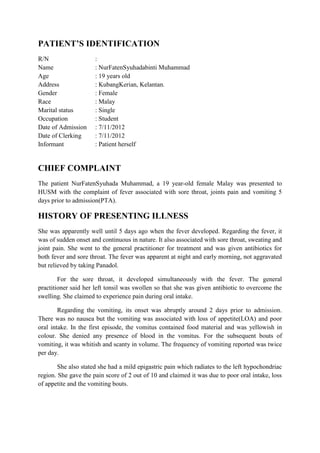
The patient NurFatenSyuhada Muhammad, a 19 year-old female Malay was presented to
HUSM with the complaint of fever associated with sore throat, joints pain and vomiting 5
days prior to admission(PTA).

HISTORY OF PRESENTING ILLNESS
She was apparently well until 5 days ago when the fever developed. Regarding the fever, it
was of sudden onset and continuous in nature. It also associated with sore throat, sweating and
joint pain. She went to the general practitioner for treatment and was given antibiotics for
both fever and sore throat. The fever was apparent at night and early morning, not aggravated
but relieved by taking Panadol.

        For the sore throat, it developed simultaneously with the fever. The general
practitioner said her left tonsil was swollen so that she was given antibiotic to overcome the
swelling. She claimed to experience pain during oral intake.

        Regarding the vomiting, its onset was abruptly around 2 days prior to admission.
There was no nausea but the vomiting was associated with loss of appetite(LOA) and poor
oral intake. In the first episode, the vomitus contained food material and was yellowish in
colour. She denied any presence of blood in the vomitus. For the subsequent bouts of
vomiting, it was whitish and scanty in volume. The frequency of vomiting reported was twice
per day.

        She also stated she had a mild epigastric pain which radiates to the left hypochondriac
region. She gave the pain score of 2 out of 10 and claimed it was due to poor oral intake, loss
of appetite and the vomiting bouts.
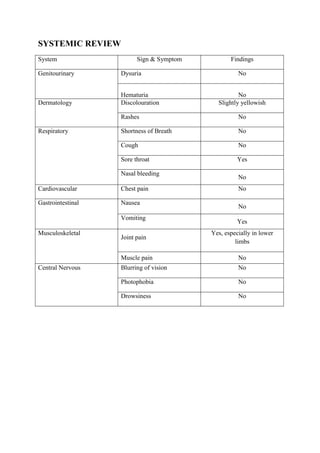
SYSTEMIC REVIEW
System                   Sign & Symptom          Findings

Genitourinary      Dysuria                          No


                   Hematuria                        No
Dermatology        Discolouration           Slightly yellowish

                   Rashes                           No

Respiratory        Shortness of Breath              No

                   Cough                            No

                   Sore throat                      Yes

                   Nasal bleeding
                                                    No
Cardiovascular     Chest pain                       No

Gastrointestinal   Nausea
                                                    No
                   Vomiting
                                                    Yes
Musculoskeletal                           Yes, especially in lower
                   Joint pain
                                                   limbs

                   Muscle pain                      No
Central Nervous    Blurring of vision               No

                   Photophobia                      No

                   Drowsiness                       No
PAST MEDICAL AND SURGICAL HISTORY
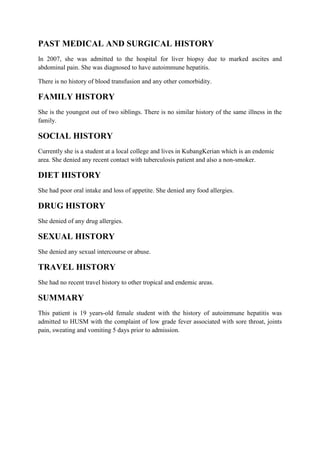
In 2007, she was admitted to the hospital for liver biopsy due to marked ascites and
abdominal pain. She was diagnosed to have autoimmune hepatitis.

There is no history of blood transfusion and any other comorbidity.

FAMILY HISTORY
She is the youngest out of two siblings. There is no similar history of the same illness in the
family.

SOCIAL HISTORY
Currently she is a student at a local college and lives in KubangKerian which is an endemic
area. She denied any recent contact with tuberculosis patient and also a non-smoker.

DIET HISTORY
She had poor oral intake and loss of appetite. She denied any food allergies.

DRUG HISTORY
She denied of any drug allergies.

SEXUAL HISTORY
She denied any sexual intercourse or abuse.

TRAVEL HISTORY
She had no recent travel history to other tropical and endemic areas.

SUMMARY
This patient is 19 years-old female student with the history of autoimmune hepatitis was
admitted to HUSM with the complaint of low grade fever associated with sore throat, joints
pain, sweating and vomiting 5 days prior to admission.
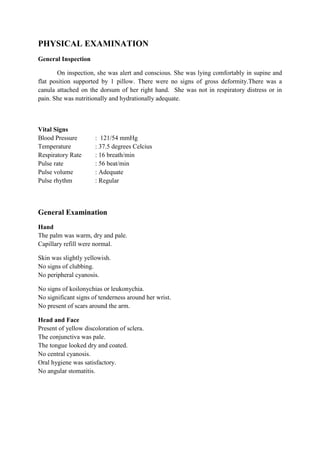
PHYSICAL EXAMINATION
General Inspection

       On inspection, she was alert and conscious. She was lying comfortably in supine and
flat position supported by 1 pillow. There were no signs of gross deformity.There was a
canula attached on the dorsum of her right hand. She was not in respiratory distress or in
pain. She was nutritionally and hydrationally adequate.


Vital Signs
Blood Pressure        : 121/54 mmHg
Temperature           : 37.5 degrees Celcius
Respiratory Rate      : 16 breath/min
Pulse rate            : 56 beat/min
Pulse volume          : Adequate
Pulse rhythm          : Regular


General Examination
Hand
The palm was warm, dry and pale.
Capillary refill were normal.

Skin was slightly yellowish.
No signs of clubbing.
No peripheral cyanosis.

No signs of koilonychias or leukonychia.
No significant signs of tenderness around her wrist.
No present of scars around the arm.

Head and Face
Present of yellow discoloration of sclera.
The conjunctiva was pale.
The tongue looked dry and coated.
No central cyanosis.
Oral hygiene was satisfactory.
No angular stomatitis.
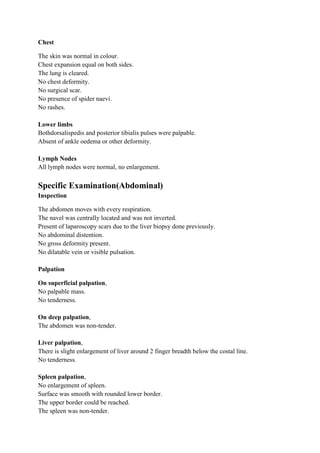
Chest

The skin was normal in colour.
Chest expansion equal on both sides.
The lung is cleared.
No chest deformity.
No surgical scar.
No presence of spider naevi.
No rashes.

Lower limbs
Bothdorsalispedis and posterior tibialis pulses were palpable.
Absent of ankle oedema or other deformity.

Lymph Nodes
All lymph nodes were normal, no enlargement.

Specific Examination(Abdominal)
Inspection

The abdomen moves with every respiration.
The navel was centrally located and was not inverted.
Present of laparoscopy scars due to the liver biopsy done previously.
No abdominal distention.
No gross deformity present.
No dilatable vein or visible pulsation.

Palpation

On superficial palpation,
No palpable mass.
No tenderness.

On deep palpation,
The abdomen was non-tender.

Liver palpation,
There is slight enlargement of liver around 2 finger breadth below the costal line.
No tenderness.

Spleen palpation,
No enlargement of spleen.
Surface was smooth with rounded lower border.
The upper border could be reached.
The spleen was non-tender.
Percussion
Troube’s space percussion was resonance.
No shifting dullness or fluid thrills.
No ballotable kidneys.


Auscultation
Bowel sounds could be heard on all quadrants.
No renal bruits.

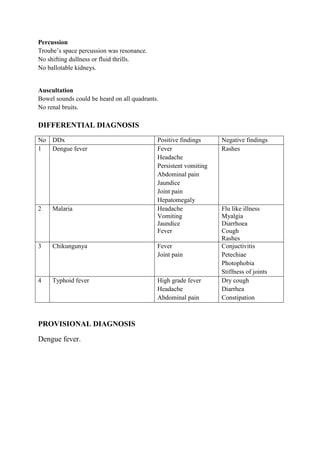
DIFFERENTIAL DIAGNOSIS
No   DDx                                    Positive findings     Negative findings
1    Dengue fever                           Fever                 Rashes
                                            Headache
                                            Persistent vomiting
                                            Abdominal pain
                                            Jaundice
                                            Joint pain
                                            Hepatomegaly
2    Malaria                                Headache              Flu like illness
                                            Vomiting              Myalgia
                                            Jaundice              Diarrhoea
                                            Fever                 Cough
                                                                  Rashes
3    Chikungunya                            Fever                 Conjuctivitis
                                            Joint pain            Petechiae
                                                                  Photophobia
                                                                  Stiffness of joints
4    Typhoid fever                          High grade fever      Dry cough
                                            Headache              Diarrhea
                                            Abdominal pain        Constipation


PROVISIONAL DIAGNOSIS

Dengue fever.
DISCUSSION
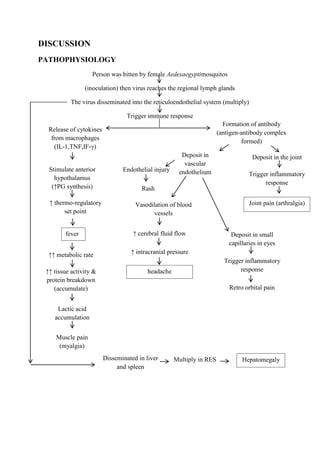
PATHOPHYSIOLOGY
                   Person was bitten by female Aedesaegyptimosquitos

                (inoculation) then virus reaches the regional lymph glands

          The virus disseminated into the reticuloendothelial system (multiply)

                                  Trigger immune response
                                                                         Formation of antibody
  Release of cytokines                                                 (antigen-antibody complex
   from macrophages
                                                                                formed)
    (IL-1,TNF,IF-γ)
                                                       Deposit in                   Deposit in the joint
                                                        vascular
  Stimulate anterior            Endothelial injury    endothelium                  Trigger inflammatory
    hypothalamus
                                                                                         response
   (↑PG synthesis)                     Rash

  ↑ thermo-regulatory                Vasodilation of blood                         Joint pain (arthralgia)
        set point                          vessels


        fever                       ↑ cerebral fluid flow                   Deposit in small
                                                                           capillaries in eyes
  ↑↑ metabolic rate                ↑ intracranial pressure
                                                                         Trigger inflammatory
 ↑↑ tissue activity &                    headache                              response
 protein breakdown
    (accumulate)                                                           Retro orbital pain


     Lactic acid
    accumulation


     Muscle pain
      (myalgia)
                         Disseminated in liver       Multiply in RES            Hepatomegaly
                              and spleen
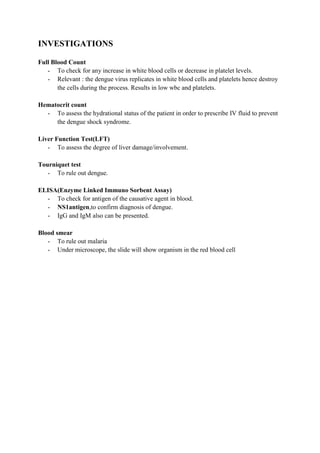
INVESTIGATIONS

Full Blood Count
   - To check for any increase in white blood cells or decrease in platelet levels.
   - Relevant : the dengue virus replicates in white blood cells and platelets hence destroy
       the cells during the process. Results in low wbc and platelets.

Hematocrit count
  - To assess the hydrational status of the patient in order to prescribe IV fluid to prevent
     the dengue shock syndrome.

Liver Function Test(LFT)
   - To assess the degree of liver damage/involvement.

Tourniquet test
   - To rule out dengue.

ELISA(Enzyme Linked Immuno Sorbent Assay)
  - To check for antigen of the causative agent in blood.
  - NS1antigen,to confirm diagnosis of dengue.
  - IgG and IgM also can be presented.

Blood smear
   - To rule out malaria
   - Under microscope, the slide will show organism in the red blood cell
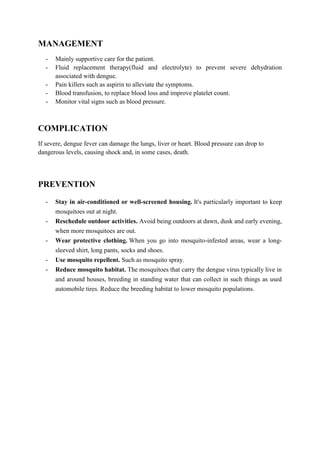
MANAGEMENT
  -   Mainly supportive care for the patient.
  -   Fluid replacement therapy(fluid and electrolyte) to prevent severe dehydration
      associated with dengue.
  -   Pain killers such as aspirin to alleviate the symptoms.
  -   Blood transfusion, to replace blood loss and improve platelet count.
  -   Monitor vital signs such as blood pressure.


COMPLICATION
If severe, dengue fever can damage the lungs, liver or heart. Blood pressure can drop to
dangerous levels, causing shock and, in some cases, death.


PREVENTION
  -   Stay in air-conditioned or well-screened housing. It's particularly important to keep
      mosquitoes out at night.
  -   Reschedule outdoor activities. Avoid being outdoors at dawn, dusk and early evening,
      when more mosquitoes are out.
  -   Wear protective clothing. When you go into mosquito-infested areas, wear a long-
      sleeved shirt, long pants, socks and shoes.
  -   Use mosquito repellent. Such as mosquito spray.
  -   Reduce mosquito habitat. The mosquitoes that carry the dengue virus typically live in
      and around houses, breeding in standing water that can collect in such things as used
      automobile tires. Reduce the breeding habitat to lower mosquito populations.

Clinical Case Write Up Sample

  • 1.
    CLINICAL CASE WRITE-UP COMMUNICABLE DISEASE BLOCK NAME : UMI NADHIRAH AISYAH MOHD ROKHIBI MATRIC NO. : 107550 I/C NO. : 900626-02-5634 YEAR :3 TUTOR : DR. MOHAMMAD ZIKRI AHMAD
  • 2.
    PATIENT’S IDENTIFICATION R/N : Name : NurFatenSyuhadabinti Muhammad Age : 19 years old Address : KubangKerian, Kelantan. Gender : Female Race : Malay Marital status : Single Occupation : Student Date of Admission : 7/11/2012 Date of Clerking : 7/11/2012 Informant : Patient herself CHIEF COMPLAINT The patient NurFatenSyuhada Muhammad, a 19 year-old female Malay was presented to HUSM with the complaint of fever associated with sore throat, joints pain and vomiting 5 days prior to admission(PTA). HISTORY OF PRESENTING ILLNESS She was apparently well until 5 days ago when the fever developed. Regarding the fever, it was of sudden onset and continuous in nature. It also associated with sore throat, sweating and joint pain. She went to the general practitioner for treatment and was given antibiotics for both fever and sore throat. The fever was apparent at night and early morning, not aggravated but relieved by taking Panadol. For the sore throat, it developed simultaneously with the fever. The general practitioner said her left tonsil was swollen so that she was given antibiotic to overcome the swelling. She claimed to experience pain during oral intake. Regarding the vomiting, its onset was abruptly around 2 days prior to admission. There was no nausea but the vomiting was associated with loss of appetite(LOA) and poor oral intake. In the first episode, the vomitus contained food material and was yellowish in colour. She denied any presence of blood in the vomitus. For the subsequent bouts of vomiting, it was whitish and scanty in volume. The frequency of vomiting reported was twice per day. She also stated she had a mild epigastric pain which radiates to the left hypochondriac region. She gave the pain score of 2 out of 10 and claimed it was due to poor oral intake, loss of appetite and the vomiting bouts.
  • 3.
    SYSTEMIC REVIEW System Sign & Symptom Findings Genitourinary Dysuria No Hematuria No Dermatology Discolouration Slightly yellowish Rashes No Respiratory Shortness of Breath No Cough No Sore throat Yes Nasal bleeding No Cardiovascular Chest pain No Gastrointestinal Nausea No Vomiting Yes Musculoskeletal Yes, especially in lower Joint pain limbs Muscle pain No Central Nervous Blurring of vision No Photophobia No Drowsiness No
  • 4.
    PAST MEDICAL ANDSURGICAL HISTORY In 2007, she was admitted to the hospital for liver biopsy due to marked ascites and abdominal pain. She was diagnosed to have autoimmune hepatitis. There is no history of blood transfusion and any other comorbidity. FAMILY HISTORY She is the youngest out of two siblings. There is no similar history of the same illness in the family. SOCIAL HISTORY Currently she is a student at a local college and lives in KubangKerian which is an endemic area. She denied any recent contact with tuberculosis patient and also a non-smoker. DIET HISTORY She had poor oral intake and loss of appetite. She denied any food allergies. DRUG HISTORY She denied of any drug allergies. SEXUAL HISTORY She denied any sexual intercourse or abuse. TRAVEL HISTORY She had no recent travel history to other tropical and endemic areas. SUMMARY This patient is 19 years-old female student with the history of autoimmune hepatitis was admitted to HUSM with the complaint of low grade fever associated with sore throat, joints pain, sweating and vomiting 5 days prior to admission.
  • 5.
    PHYSICAL EXAMINATION General Inspection On inspection, she was alert and conscious. She was lying comfortably in supine and flat position supported by 1 pillow. There were no signs of gross deformity.There was a canula attached on the dorsum of her right hand. She was not in respiratory distress or in pain. She was nutritionally and hydrationally adequate. Vital Signs Blood Pressure : 121/54 mmHg Temperature : 37.5 degrees Celcius Respiratory Rate : 16 breath/min Pulse rate : 56 beat/min Pulse volume : Adequate Pulse rhythm : Regular General Examination Hand The palm was warm, dry and pale. Capillary refill were normal. Skin was slightly yellowish. No signs of clubbing. No peripheral cyanosis. No signs of koilonychias or leukonychia. No significant signs of tenderness around her wrist. No present of scars around the arm. Head and Face Present of yellow discoloration of sclera. The conjunctiva was pale. The tongue looked dry and coated. No central cyanosis. Oral hygiene was satisfactory. No angular stomatitis.
  • 6.
    Chest The skin wasnormal in colour. Chest expansion equal on both sides. The lung is cleared. No chest deformity. No surgical scar. No presence of spider naevi. No rashes. Lower limbs Bothdorsalispedis and posterior tibialis pulses were palpable. Absent of ankle oedema or other deformity. Lymph Nodes All lymph nodes were normal, no enlargement. Specific Examination(Abdominal) Inspection The abdomen moves with every respiration. The navel was centrally located and was not inverted. Present of laparoscopy scars due to the liver biopsy done previously. No abdominal distention. No gross deformity present. No dilatable vein or visible pulsation. Palpation On superficial palpation, No palpable mass. No tenderness. On deep palpation, The abdomen was non-tender. Liver palpation, There is slight enlargement of liver around 2 finger breadth below the costal line. No tenderness. Spleen palpation, No enlargement of spleen. Surface was smooth with rounded lower border. The upper border could be reached. The spleen was non-tender.
  • 7.
    Percussion Troube’s space percussionwas resonance. No shifting dullness or fluid thrills. No ballotable kidneys. Auscultation Bowel sounds could be heard on all quadrants. No renal bruits. DIFFERENTIAL DIAGNOSIS No DDx Positive findings Negative findings 1 Dengue fever Fever Rashes Headache Persistent vomiting Abdominal pain Jaundice Joint pain Hepatomegaly 2 Malaria Headache Flu like illness Vomiting Myalgia Jaundice Diarrhoea Fever Cough Rashes 3 Chikungunya Fever Conjuctivitis Joint pain Petechiae Photophobia Stiffness of joints 4 Typhoid fever High grade fever Dry cough Headache Diarrhea Abdominal pain Constipation PROVISIONAL DIAGNOSIS Dengue fever.
  • 8.
    DISCUSSION PATHOPHYSIOLOGY Person was bitten by female Aedesaegyptimosquitos (inoculation) then virus reaches the regional lymph glands The virus disseminated into the reticuloendothelial system (multiply) Trigger immune response Formation of antibody Release of cytokines (antigen-antibody complex from macrophages formed) (IL-1,TNF,IF-γ) Deposit in Deposit in the joint vascular Stimulate anterior Endothelial injury endothelium Trigger inflammatory hypothalamus response (↑PG synthesis) Rash ↑ thermo-regulatory Vasodilation of blood Joint pain (arthralgia) set point vessels fever ↑ cerebral fluid flow Deposit in small capillaries in eyes ↑↑ metabolic rate ↑ intracranial pressure Trigger inflammatory ↑↑ tissue activity & headache response protein breakdown (accumulate) Retro orbital pain Lactic acid accumulation Muscle pain (myalgia) Disseminated in liver Multiply in RES Hepatomegaly and spleen
  • 9.
    INVESTIGATIONS Full Blood Count - To check for any increase in white blood cells or decrease in platelet levels. - Relevant : the dengue virus replicates in white blood cells and platelets hence destroy the cells during the process. Results in low wbc and platelets. Hematocrit count - To assess the hydrational status of the patient in order to prescribe IV fluid to prevent the dengue shock syndrome. Liver Function Test(LFT) - To assess the degree of liver damage/involvement. Tourniquet test - To rule out dengue. ELISA(Enzyme Linked Immuno Sorbent Assay) - To check for antigen of the causative agent in blood. - NS1antigen,to confirm diagnosis of dengue. - IgG and IgM also can be presented. Blood smear - To rule out malaria - Under microscope, the slide will show organism in the red blood cell
  • 10.
    MANAGEMENT - Mainly supportive care for the patient. - Fluid replacement therapy(fluid and electrolyte) to prevent severe dehydration associated with dengue. - Pain killers such as aspirin to alleviate the symptoms. - Blood transfusion, to replace blood loss and improve platelet count. - Monitor vital signs such as blood pressure. COMPLICATION If severe, dengue fever can damage the lungs, liver or heart. Blood pressure can drop to dangerous levels, causing shock and, in some cases, death. PREVENTION - Stay in air-conditioned or well-screened housing. It's particularly important to keep mosquitoes out at night. - Reschedule outdoor activities. Avoid being outdoors at dawn, dusk and early evening, when more mosquitoes are out. - Wear protective clothing. When you go into mosquito-infested areas, wear a long- sleeved shirt, long pants, socks and shoes. - Use mosquito repellent. Such as mosquito spray. - Reduce mosquito habitat. The mosquitoes that carry the dengue virus typically live in and around houses, breeding in standing water that can collect in such things as used automobile tires. Reduce the breeding habitat to lower mosquito populations.