DYSFUNCTIONAL UTERINE
BLEEDING
‘PATHO – PHYSIOLOGY’
Dr Sonali Ingole
Asst Professor
OBGY
DUB : Definition
• Abnormal uterine bleeding, in the absence
of any demonstrable organic disease of the
genital tract
– Neoplasm
– Infection
– Pregnancy related complication
• Abnormal uterine bleeding in the absence
of genital tract pathology or medical illness
• Abnormal uterine bleeding for which no
specific cause has been found
DUB : Classification
• Primary
• Secondary
– Thyroid dysfunction
– Haematologic disorders
• Thrombocytopenia
• Von Willebrands disease
• Leukemias
– Hepatic dysfunction
• Iatrogenic
– IUCD
– Progesterone only contraception
– Low dose Combined OC pills
DUB
• DUB occurs most often shortly after
menarche and at the end of the
reproductive years.
–20% of cases are adolescents
–50% of cases in 40-50 year olds
• Diagnosis of EXCLUSION
DUB
• Patients present with
“Abnormal uterine bleeding”
NORMAL MENSTRUATION
• Duration of flow : 2 – 7 days
– Average duration : 4 – 6 days
• Volume of flow : 20 – 70 ml
– Average flow : 30 ml
• Cycle length : 24 – 35 days*
– Average cycle length : 28 – 30 days
*Speroff L, Glass RH, Kase NG (Eds). Clinical Gynaecologic
Endocrinology & Infertility. 7th Edn. Baltimore, 2005; 549 - 554
MENORRHAGIA
• Volume of flow ≥ 80 ml
• Duration of flow > 7 days
• Bleeding occurs at regular intervals
• Common causes
– Fibroids
– DUB
– IUCD
– Adenomyosis
– Thyroid dysfunction
– Pregnancy related bleeding
HYPOMENORRHOEA
• Volume of flow < 10 ml
• Duration of flow < 2 days
• Common causes
– Endometrial tuberculosis
– Combined OC pill use
– Ashermann’s syndrome
– PCOD
– Hyperprolactinemia
POLYMENORRHOEA
• Frequent menses
• Bleeding intervals < 24 days*
• Common causes
– PID
– Endometriosis
– DUB
* Speroff L, Glass RH, Kase NG (Eds). Clinical Gynaecologic
Endocrinology & Infertility. 7th Edn. Baltimore, 2005; 549 - 554
POLYMENORRHAGIA
• Frequent & heavy / prolonged menses
• Common causes
– Fibroids uterus
– PID
– DUB
– Endometriosis
– Ovarian cysts
OLIGOMENORRHOEA
• Infrequent menses
• Bleeding intervals > 35 days, upto 6 months
• Common causes
– PCOD
– DUB
– Hyperprolactinemia
– Ovarian cysts
– Thyroid dysfunction
– Stress & Exercise related ( Hypothalamic)
METRORRHAGIA /
MENO- METRORRHAGIA
• Irregular, acyclical bleeding / Heavy or
prolonged irregular, acyclical bleeding
• Common causes
– Improper hormonal contraceptive use
– DUB
– Pregnancy related bleeding
– Submucous fibroids & Fibroid polyps
– Carcinoma cervix
– Carcinoma endometrium
– Progesterone only contraception
Genesis of normal menstruation
Alternatives for estrogen –
progesterone primed endometrium
Genesis of normal menstrual flow
• Estrogen – progesterone withdrawal due to
luteolysis results in enzymatic auto-digestion of
non-gestational hormonally primed endometrium
which is then discharged as menstrual flow
Genesis of normal menstrual flow
: Role of vascular endothelium
• Synthetic activity
– Paracrine factors
– Angiogenic factors
– Vasoactive factors
– Haemostatic factors
• Modulation of
– Vasoactivity
– Haemostasis
– Thrombolysis
– Angiogenesis
Autocrine / paracrine regulation of gene
transcription affecting vascular function
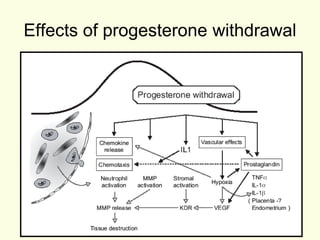
Effects of progesterone withdrawal
Genesis of normal menstrual flow
• Cyclic vasomotor
response of spiral
arterioles (end
arteries) in the
endometrium
Genesis of normal menstrual flow
• Increasing duration
and intensity of
vasospasm results
in ischaemic damage
to endometrium and
breakdown of tissue
Genesis of normal menstrual flow
• During periods of
relaxation of vasospasm,
blood extravasates
though damaged vessel
walls, cleaving the
endometrium between
stratum basalis and
stratum spongiosum
Genesis of normal menstrual flow
• Progesterone withdrawal
induces release of matrix
metalloproteinases from
the endometrial cells
resulting in breakdown of
cell membranes and
extracellular matrix
Genesis of normal menstrual flow
• Endometrial tissue and extravasated
blood are shed as menstrual flow
Haemostaisis within uterus
• Vasospasm
• Platelet plug
• Thrombin generation in
the basal endometrium
• Re-epithelialization
• Myometrial contractions do not play a part in
controlling menstrual blood loss ( in contrast
to control of post – partum hge)
Why is Estrogen – Progesterone
withdrawal menstrual bleeding not heavy ?
• It is a universal
event occurring
simultaneously
throughout the
entire
endometrium
Why is Estrogen – Progesterone
withdrawal menstrual bleeding not heavy ?
• The endometrium
primed with estrogen
and progesterone is
structurally stable
and random
breakdown due to
fragility is avoided
Why is Estrogen – Progesterone
withdrawal menstrual bleeding not heavy ?
• Inherent in the events
(vasospasm) that
start the menstrual
flow are the factors
involved in stopping
the menstrual flow
Why is Estrogen – Progesterone
withdrawal menstrual bleeding not heavy ?
• Denudation of the
functional layers of the
endometrium allows
the reparative process
of re-epithelializtion to
begin from the stratum
basalis
Dysfunctional Uterine Bleeding
• Hormonally imbalanced conditions can give
rise to abnormal uterine bleeding
–Hyper-estrogenic state / Unopposed
estrogen action
–Hyper-progestogenic state / Abnormal
progestogen – estrogen ratio
Dysfunctional Uterine Bleeding
• Anovulatory
– Estrogen withdrawal
– Estrogen breakthrough
• Threshold bleeding
• Supra-threshold bleeding
– Progesterone breakthrough
• Ovulatory
– Irregular ripening
– Irregular shedding
– Abnormal local haemostatic mechanisms
Estrogen withdrawal
• One of the mechanisms of anovulatory uterine
bleeding
• Occurs on withdrawal of estrogen support to the
endometrium
• Common following menarche. Midcycle spotting can
occur due to pre-ovulatory fall in E2 levels
Estrogen breakthrough bleeding
• Threshold bleeding
– The levels of E2 waver around the threshold below
which endometrium cannot be supported
– Results in intermittent / prolonged spotting
– May occur at extremes of reproductive age
Estrogen breakthrough bleeding
• Supra-threshold bleeding
–Continuous E2 production unopposed
by progesterone due to anovulation
–Delayed periods followed by prolonged
moderate to profuse bleeding
–Endometrium thick without concomitant
stromal structural support
–Random breakdown common
Progesterone breakthrough
bleeding
• Seen in the presence of an unfavourably high
ratio of progesterone to estrogen (use of
progesterone only contraception)
• Results in intermittent spotting of variable
duration
• Prolonged progestogenic exposure results in
atrophic changes and altered gland –stromal
ratio within the endometrium
• Bleeding occurs from unsupported
endometrial vessels
Progesterone withdrawal bleeding
• Medical curettage
• Poor compliance with progestogen therapy
Ovulatory DUB
• Luteal phase insufficiency
– Irregular ripening
– Mixed proliferative - secretory patterns
• Prolonged luteal function / Corpus luteum
cysts
– Irregular shedding / Delayed prolonged
menses
• Primary pathology of haemostatic
processes
Mechanisms of DUB
• Hyper-estrogenic / Hyper-progestogenic state
• Abnormal angiogenesis and vascular fragility
• Increased / Asynchronous tissue breakdown
• Impaired haemostatic mechanisms
• Impaired re-epithelialization
Thank You

Dysfunctional Uterine Bleeding (DUB)

  • 1.
    DYSFUNCTIONAL UTERINE BLEEDING ‘PATHO –PHYSIOLOGY’ Dr Sonali Ingole Asst Professor OBGY
  • 2.
    DUB : Definition •Abnormal uterine bleeding, in the absence of any demonstrable organic disease of the genital tract – Neoplasm – Infection – Pregnancy related complication • Abnormal uterine bleeding in the absence of genital tract pathology or medical illness • Abnormal uterine bleeding for which no specific cause has been found
  • 3.
    DUB : Classification •Primary • Secondary – Thyroid dysfunction – Haematologic disorders • Thrombocytopenia • Von Willebrands disease • Leukemias – Hepatic dysfunction • Iatrogenic – IUCD – Progesterone only contraception – Low dose Combined OC pills
  • 4.
    DUB • DUB occursmost often shortly after menarche and at the end of the reproductive years. –20% of cases are adolescents –50% of cases in 40-50 year olds • Diagnosis of EXCLUSION
  • 5.
    DUB • Patients presentwith “Abnormal uterine bleeding”
  • 6.
    NORMAL MENSTRUATION • Durationof flow : 2 – 7 days – Average duration : 4 – 6 days • Volume of flow : 20 – 70 ml – Average flow : 30 ml • Cycle length : 24 – 35 days* – Average cycle length : 28 – 30 days *Speroff L, Glass RH, Kase NG (Eds). Clinical Gynaecologic Endocrinology & Infertility. 7th Edn. Baltimore, 2005; 549 - 554
  • 7.
    MENORRHAGIA • Volume offlow ≥ 80 ml • Duration of flow > 7 days • Bleeding occurs at regular intervals • Common causes – Fibroids – DUB – IUCD – Adenomyosis – Thyroid dysfunction – Pregnancy related bleeding
  • 8.
    HYPOMENORRHOEA • Volume offlow < 10 ml • Duration of flow < 2 days • Common causes – Endometrial tuberculosis – Combined OC pill use – Ashermann’s syndrome – PCOD – Hyperprolactinemia
  • 9.
    POLYMENORRHOEA • Frequent menses •Bleeding intervals < 24 days* • Common causes – PID – Endometriosis – DUB * Speroff L, Glass RH, Kase NG (Eds). Clinical Gynaecologic Endocrinology & Infertility. 7th Edn. Baltimore, 2005; 549 - 554
  • 10.
    POLYMENORRHAGIA • Frequent &heavy / prolonged menses • Common causes – Fibroids uterus – PID – DUB – Endometriosis – Ovarian cysts
  • 11.
    OLIGOMENORRHOEA • Infrequent menses •Bleeding intervals > 35 days, upto 6 months • Common causes – PCOD – DUB – Hyperprolactinemia – Ovarian cysts – Thyroid dysfunction – Stress & Exercise related ( Hypothalamic)
  • 12.
    METRORRHAGIA / MENO- METRORRHAGIA •Irregular, acyclical bleeding / Heavy or prolonged irregular, acyclical bleeding • Common causes – Improper hormonal contraceptive use – DUB – Pregnancy related bleeding – Submucous fibroids & Fibroid polyps – Carcinoma cervix – Carcinoma endometrium – Progesterone only contraception
  • 13.
    Genesis of normalmenstruation
  • 14.
    Alternatives for estrogen– progesterone primed endometrium
  • 15.
    Genesis of normalmenstrual flow • Estrogen – progesterone withdrawal due to luteolysis results in enzymatic auto-digestion of non-gestational hormonally primed endometrium which is then discharged as menstrual flow
  • 16.
    Genesis of normalmenstrual flow : Role of vascular endothelium • Synthetic activity – Paracrine factors – Angiogenic factors – Vasoactive factors – Haemostatic factors • Modulation of – Vasoactivity – Haemostasis – Thrombolysis – Angiogenesis
  • 17.
    Autocrine / paracrineregulation of gene transcription affecting vascular function
  • 18.
  • 19.
    Genesis of normalmenstrual flow • Cyclic vasomotor response of spiral arterioles (end arteries) in the endometrium
  • 20.
    Genesis of normalmenstrual flow • Increasing duration and intensity of vasospasm results in ischaemic damage to endometrium and breakdown of tissue
  • 21.
    Genesis of normalmenstrual flow • During periods of relaxation of vasospasm, blood extravasates though damaged vessel walls, cleaving the endometrium between stratum basalis and stratum spongiosum
  • 22.
    Genesis of normalmenstrual flow • Progesterone withdrawal induces release of matrix metalloproteinases from the endometrial cells resulting in breakdown of cell membranes and extracellular matrix
  • 23.
    Genesis of normalmenstrual flow • Endometrial tissue and extravasated blood are shed as menstrual flow
  • 24.
    Haemostaisis within uterus •Vasospasm • Platelet plug • Thrombin generation in the basal endometrium • Re-epithelialization • Myometrial contractions do not play a part in controlling menstrual blood loss ( in contrast to control of post – partum hge)
  • 25.
    Why is Estrogen– Progesterone withdrawal menstrual bleeding not heavy ? • It is a universal event occurring simultaneously throughout the entire endometrium
  • 26.
    Why is Estrogen– Progesterone withdrawal menstrual bleeding not heavy ? • The endometrium primed with estrogen and progesterone is structurally stable and random breakdown due to fragility is avoided
  • 27.
    Why is Estrogen– Progesterone withdrawal menstrual bleeding not heavy ? • Inherent in the events (vasospasm) that start the menstrual flow are the factors involved in stopping the menstrual flow
  • 28.
    Why is Estrogen– Progesterone withdrawal menstrual bleeding not heavy ? • Denudation of the functional layers of the endometrium allows the reparative process of re-epithelializtion to begin from the stratum basalis
  • 29.
    Dysfunctional Uterine Bleeding •Hormonally imbalanced conditions can give rise to abnormal uterine bleeding –Hyper-estrogenic state / Unopposed estrogen action –Hyper-progestogenic state / Abnormal progestogen – estrogen ratio
  • 30.
    Dysfunctional Uterine Bleeding •Anovulatory – Estrogen withdrawal – Estrogen breakthrough • Threshold bleeding • Supra-threshold bleeding – Progesterone breakthrough • Ovulatory – Irregular ripening – Irregular shedding – Abnormal local haemostatic mechanisms
  • 31.
    Estrogen withdrawal • Oneof the mechanisms of anovulatory uterine bleeding • Occurs on withdrawal of estrogen support to the endometrium • Common following menarche. Midcycle spotting can occur due to pre-ovulatory fall in E2 levels
  • 32.
    Estrogen breakthrough bleeding •Threshold bleeding – The levels of E2 waver around the threshold below which endometrium cannot be supported – Results in intermittent / prolonged spotting – May occur at extremes of reproductive age
  • 33.
    Estrogen breakthrough bleeding •Supra-threshold bleeding –Continuous E2 production unopposed by progesterone due to anovulation –Delayed periods followed by prolonged moderate to profuse bleeding –Endometrium thick without concomitant stromal structural support –Random breakdown common
  • 34.
    Progesterone breakthrough bleeding • Seenin the presence of an unfavourably high ratio of progesterone to estrogen (use of progesterone only contraception) • Results in intermittent spotting of variable duration • Prolonged progestogenic exposure results in atrophic changes and altered gland –stromal ratio within the endometrium • Bleeding occurs from unsupported endometrial vessels
  • 35.
    Progesterone withdrawal bleeding •Medical curettage • Poor compliance with progestogen therapy
  • 36.
    Ovulatory DUB • Lutealphase insufficiency – Irregular ripening – Mixed proliferative - secretory patterns • Prolonged luteal function / Corpus luteum cysts – Irregular shedding / Delayed prolonged menses • Primary pathology of haemostatic processes
  • 37.
    Mechanisms of DUB •Hyper-estrogenic / Hyper-progestogenic state • Abnormal angiogenesis and vascular fragility • Increased / Asynchronous tissue breakdown • Impaired haemostatic mechanisms • Impaired re-epithelialization
  • 38.