Multimode Fiber
What is multi-mode fiber ?
 In optical fiber technology, multimode fiber is optical fiber that is
designed to carry multiple light rays or modes concurrently, each at
a slightly different reflection angle within the optical fiber core.
 Multimode fiber transmission is used for relatively short distances
because the modes tend to disperse over longer lengths (this is
called modal dispersion) .
 such as within a building or on a campus. Typical multimode links
have data rates of 10 Mbit/s to 10 Gbit/s over link lengths of up to
600 meters (2000 feet).
 For longer distances, single mode fiber (sometimes called
monomode) fiber is used.
2
 STEP-INDEX MULTIMODE FIBER
Has a large core, up to 100 microns in diameter. As a result, some of the light rays
that make up the digital pulse may travel a direct route, whereas others zigzag as
they bounce off the cladding. .this type of fiber is best suited for transmission
over short distances.
 GRADED-INDEX MULTIMODE FIBER
Contains a core in which the refractive index diminishes gradually from the center
axis out toward the cladding. The higher refractive index at the center makes the
light rays moving down the axis advance more slowly than those near the
cladding. This type of fiber is best suited for local-area networks.
Multimode fiber is usually 50/125 and 62.5/125 in construction. This means
that the core to cladding diameter ratio is 50 microns to 125 microns and
62.5 microns to 125 microns.
3
Advantages Disadvantages
 Multi-user framework
High power signal transmission
capacity
 Real-time data transmission
 High bandwidth and transfer rate
 High security
 Support of multiple protocols
 Multimode cables are less expensive
to operate, install and maintain
than single-mode cables
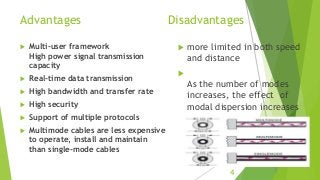
 more limited in both speed
and distance

As the number of modes
increases, the effect of
modal dispersion increases
4
Conclusion
 Multimode fiber is optical fiber that is designed to carry
multiple light rays or modes concurrently, each at a slightly
different reflection angle within the optical fiber core.
 There are 2 categories of Multimode Fiber. Namely Step-index
Multimode Fiber, Graded-index Multimode Fiber
 multi-mode optical fiber generally is used for backbone
applications in buildings.
 There have both Advantages & Disadvantages of Using
Multimode Fiber
5

Multimode fiber

  • 1.
  • 2.
    What is multi-modefiber ?  In optical fiber technology, multimode fiber is optical fiber that is designed to carry multiple light rays or modes concurrently, each at a slightly different reflection angle within the optical fiber core.  Multimode fiber transmission is used for relatively short distances because the modes tend to disperse over longer lengths (this is called modal dispersion) .  such as within a building or on a campus. Typical multimode links have data rates of 10 Mbit/s to 10 Gbit/s over link lengths of up to 600 meters (2000 feet).  For longer distances, single mode fiber (sometimes called monomode) fiber is used. 2
  • 3.
     STEP-INDEX MULTIMODEFIBER Has a large core, up to 100 microns in diameter. As a result, some of the light rays that make up the digital pulse may travel a direct route, whereas others zigzag as they bounce off the cladding. .this type of fiber is best suited for transmission over short distances.  GRADED-INDEX MULTIMODE FIBER Contains a core in which the refractive index diminishes gradually from the center axis out toward the cladding. The higher refractive index at the center makes the light rays moving down the axis advance more slowly than those near the cladding. This type of fiber is best suited for local-area networks. Multimode fiber is usually 50/125 and 62.5/125 in construction. This means that the core to cladding diameter ratio is 50 microns to 125 microns and 62.5 microns to 125 microns. 3
  • 4.
    Advantages Disadvantages  Multi-userframework High power signal transmission capacity  Real-time data transmission  High bandwidth and transfer rate  High security  Support of multiple protocols  Multimode cables are less expensive to operate, install and maintain than single-mode cables  more limited in both speed and distance  As the number of modes increases, the effect of modal dispersion increases 4
  • 5.
    Conclusion  Multimode fiberis optical fiber that is designed to carry multiple light rays or modes concurrently, each at a slightly different reflection angle within the optical fiber core.  There are 2 categories of Multimode Fiber. Namely Step-index Multimode Fiber, Graded-index Multimode Fiber  multi-mode optical fiber generally is used for backbone applications in buildings.  There have both Advantages & Disadvantages of Using Multimode Fiber 5
Editor's Notes

  • #6 http://www.arcelect.com/fibercable.htm http://www.multicominc.com/training/technical-resources/single-mode-vs-multi-mode-fiber-optic-cable/ http://www.fs.com/blog/the-benefits-of-using-multimode-fiber-optic-cable.html