Understanding and Managing Risk
within Complex Supply Chain Projects


         CILT Supply Chain Network
                London, UK
          Monday 15th June 2009
Duracell and Corus suffer
  due to steel conflict


            (Source: headlines from national newspapers)
Car transporter vessel
 sinks after collision


          (Source: headlines from national newspapers)
Recall of Mercedes ML
        Models


          (Source: headlines from national newspapers)
More takeovers and mergers
  in the transport sector


            (Source: headlines from national newspapers)
Strikes in Austria, France
         and Italy


            (Source: headlines from national newspapers)
Distribution halted by IT
      system fault


            (Source: headlines from national newspapers)
EC requires traceability of
food, feed and ingredients
 throughout supply chain


             (Source: headlines from national newspapers)
Research center studies
terrorism's impact on supply
            chain


             (Source: headlines from national newspapers)
Risk is unavoidable
Derek Hill
                     w
                A rro
           cy
       g en
   ntin
Co
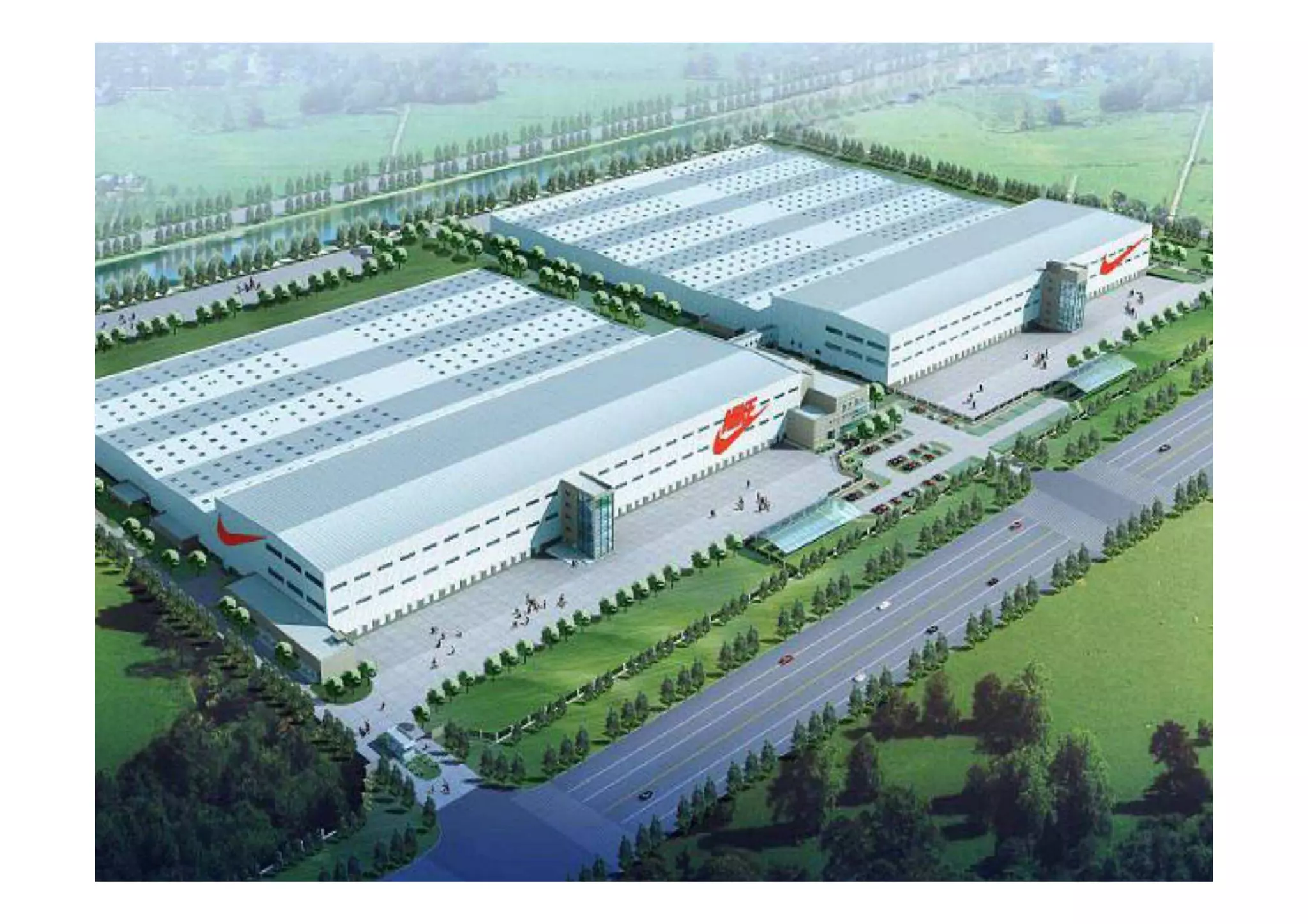
Life before Logistex…
Interesting projects…
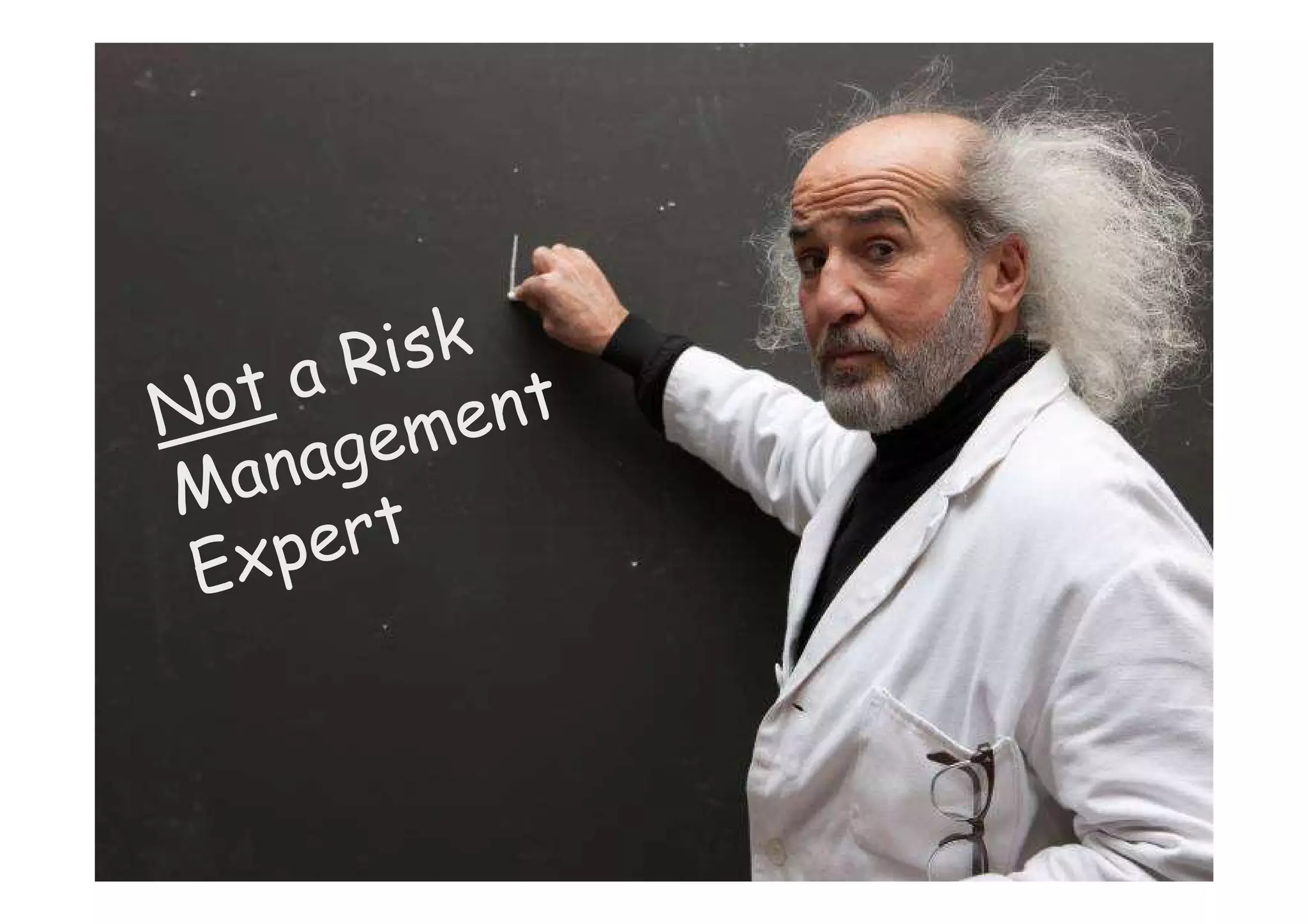
Risk
Not a ment
M an age
 Exp ert
Agenda
• Understanding different types of risks
• Identifying and evaluating risks
• FKI Logistex risk processes and governance
Objective of Risk
 Management
• Not to remove risk
• To raise awareness and visibility of risks
• To manage risks by mitigation actions to
  prevent major impact
• To prepare for contingency
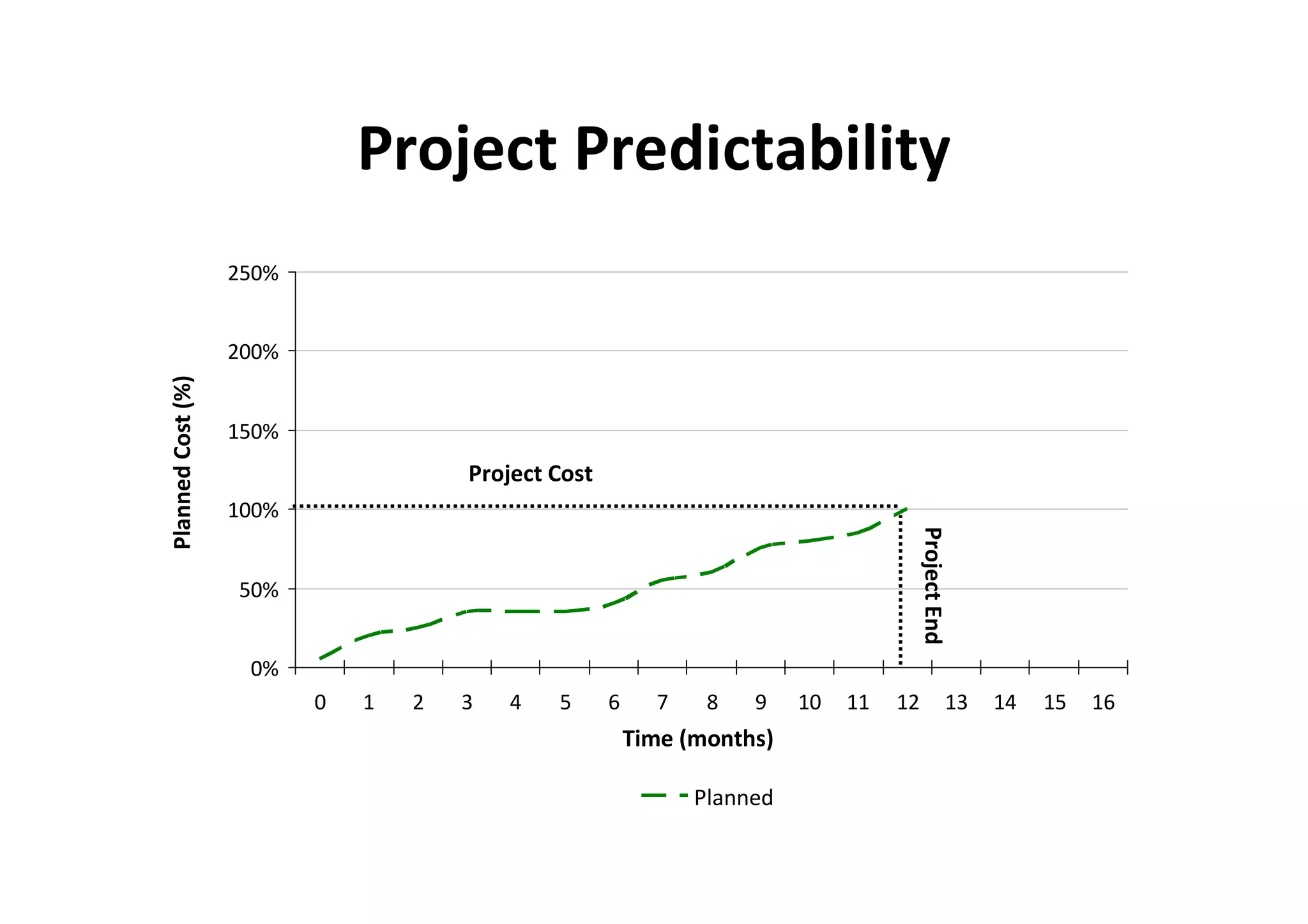
Improve the predictability
      of a project!
Project Predictability
                   250%


                   200%
Planned Cost (%)


                   150%
                                      Project Cost
                   100%


                                                                                        Project End
                   50%


                    0%
                          0   1   2   3   4   5      6     7    8   9    10   11   12                 13   14   15   16
                                                         Time (months)

                                                               Planned
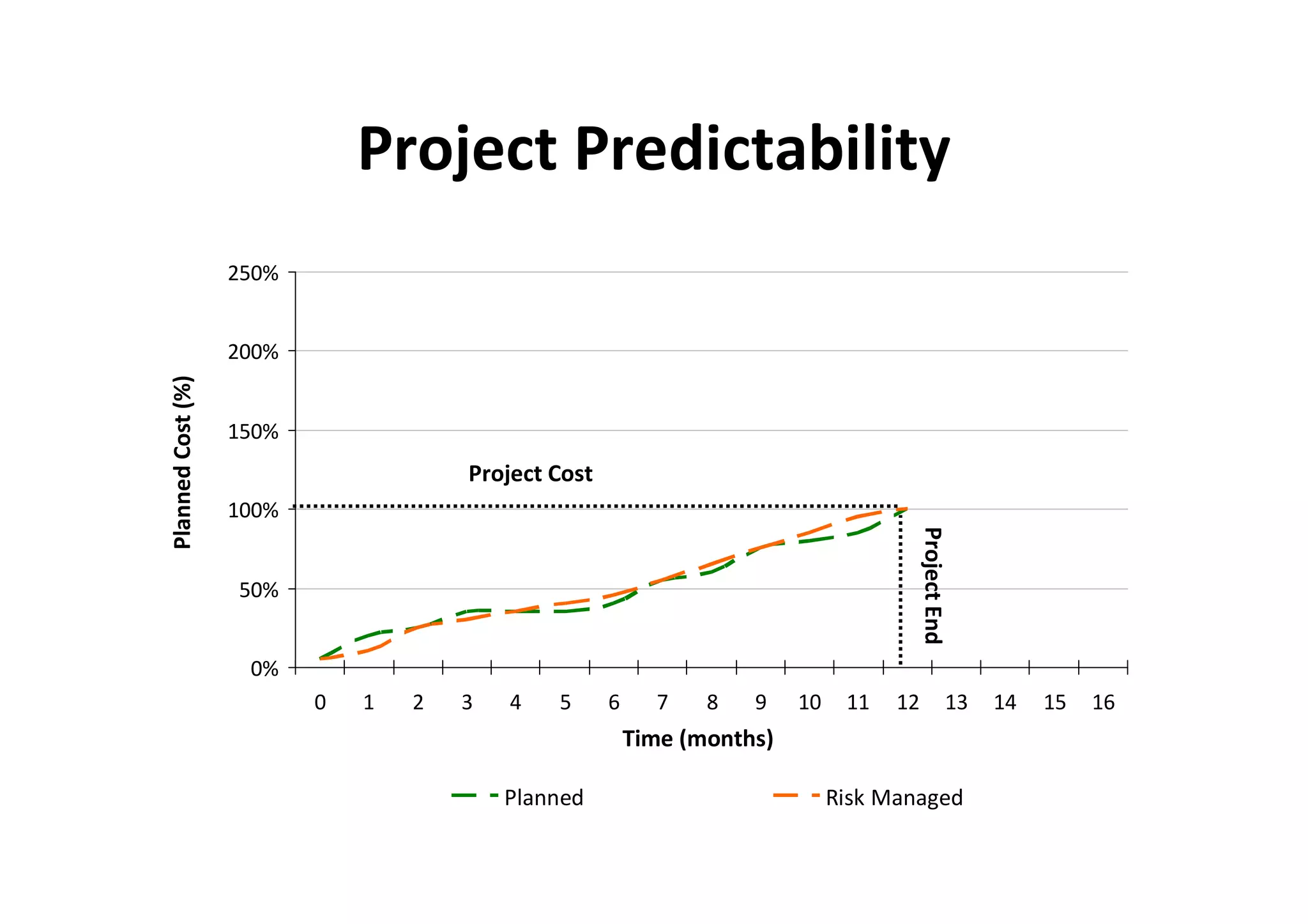
Project Predictability
                   250%


                   200%
Planned Cost (%)


                   150%
                                      Project Cost
                   100%


                                                                                         Project End
                   50%


                    0%
                          0   1   2   3   4   5      6     7    8   9    10    11   12                 13   14   15   16
                                                         Time (months)

                                          Planned                             Risk Managed
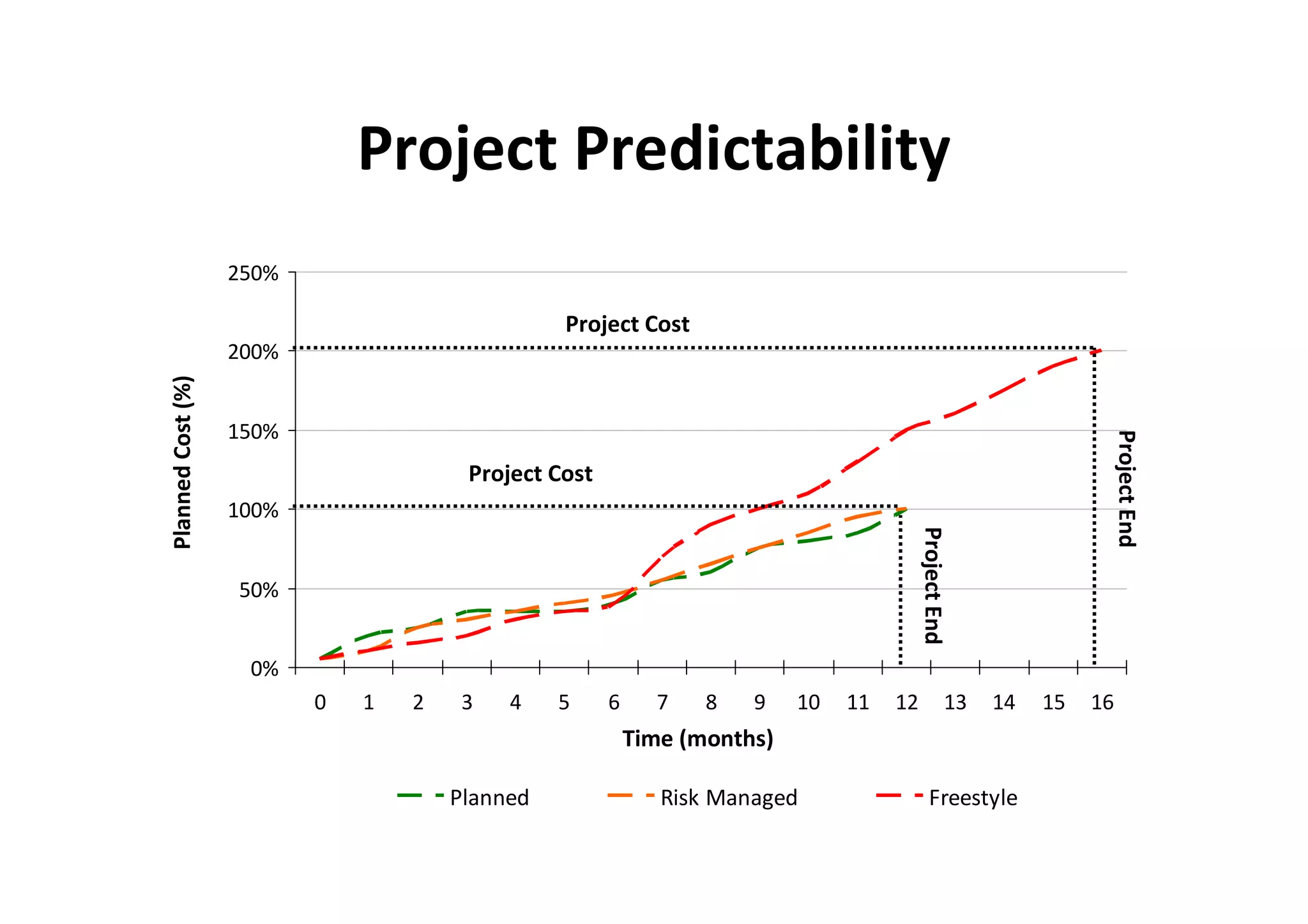
Project Predictability
                   250%

                                                Project Cost
                   200%
Planned Cost (%)


                   150%


                                                                                                                           Project End
                                       Project Cost
                   100%


                                                                                         Project End
                   50%


                    0%
                          0   1   2    3   4    5     6     7    8   9    10   11   12                 13   14   15   16
                                                          Time (months)

                                      Planned                Risk Managed                   Freestyle
1.
Understanding different
    types of risks
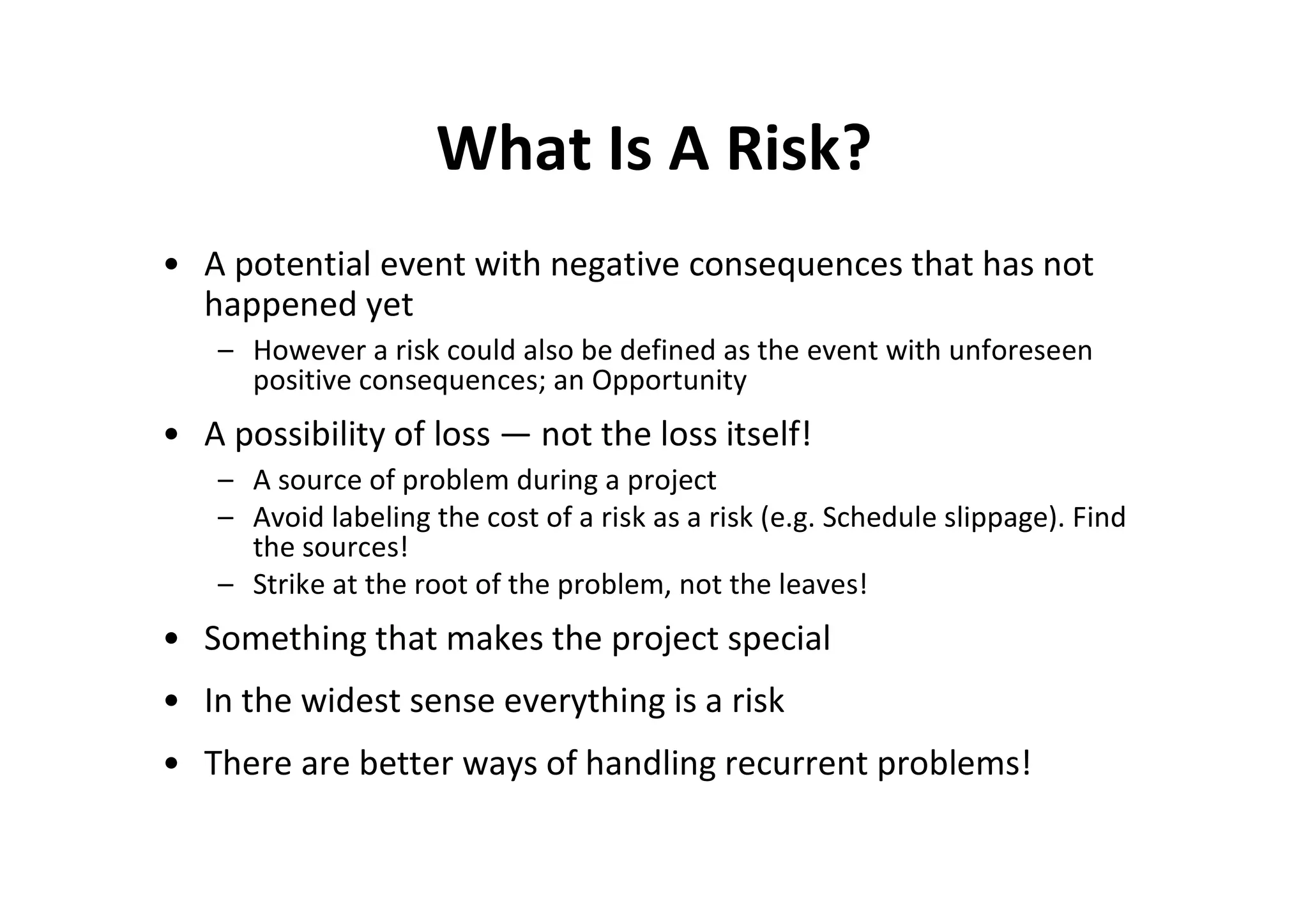
What Is A Risk?
• A potential event with negative consequences that has not
  happened yet
   – However a risk could also be defined as the event with unforeseen
     positive consequences; an Opportunity
• A possibility of loss — not the loss itself!
   – A source of problem during a project
   – Avoid labeling the cost of a risk as a risk (e.g. Schedule slippage). Find
     the sources!
   – Strike at the root of the problem, not the leaves!
• Something that makes the project special
• In the widest sense everything is a risk
• There are better ways of handling recurrent problems!
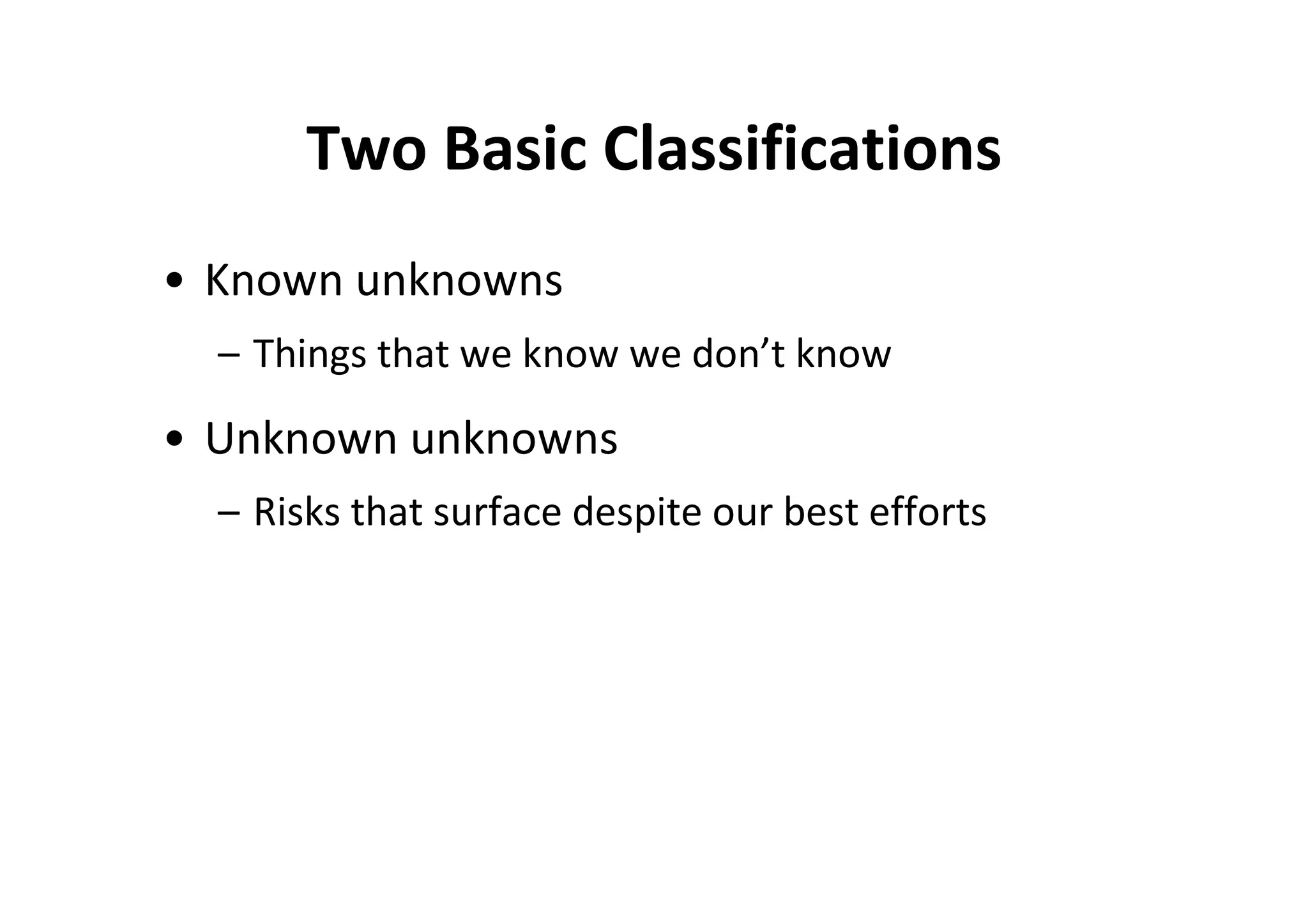
Two Basic Classifications
• Known unknowns
  – Things that we know we don’t know
• Unknown unknowns
  – Risks that surface despite our best efforts
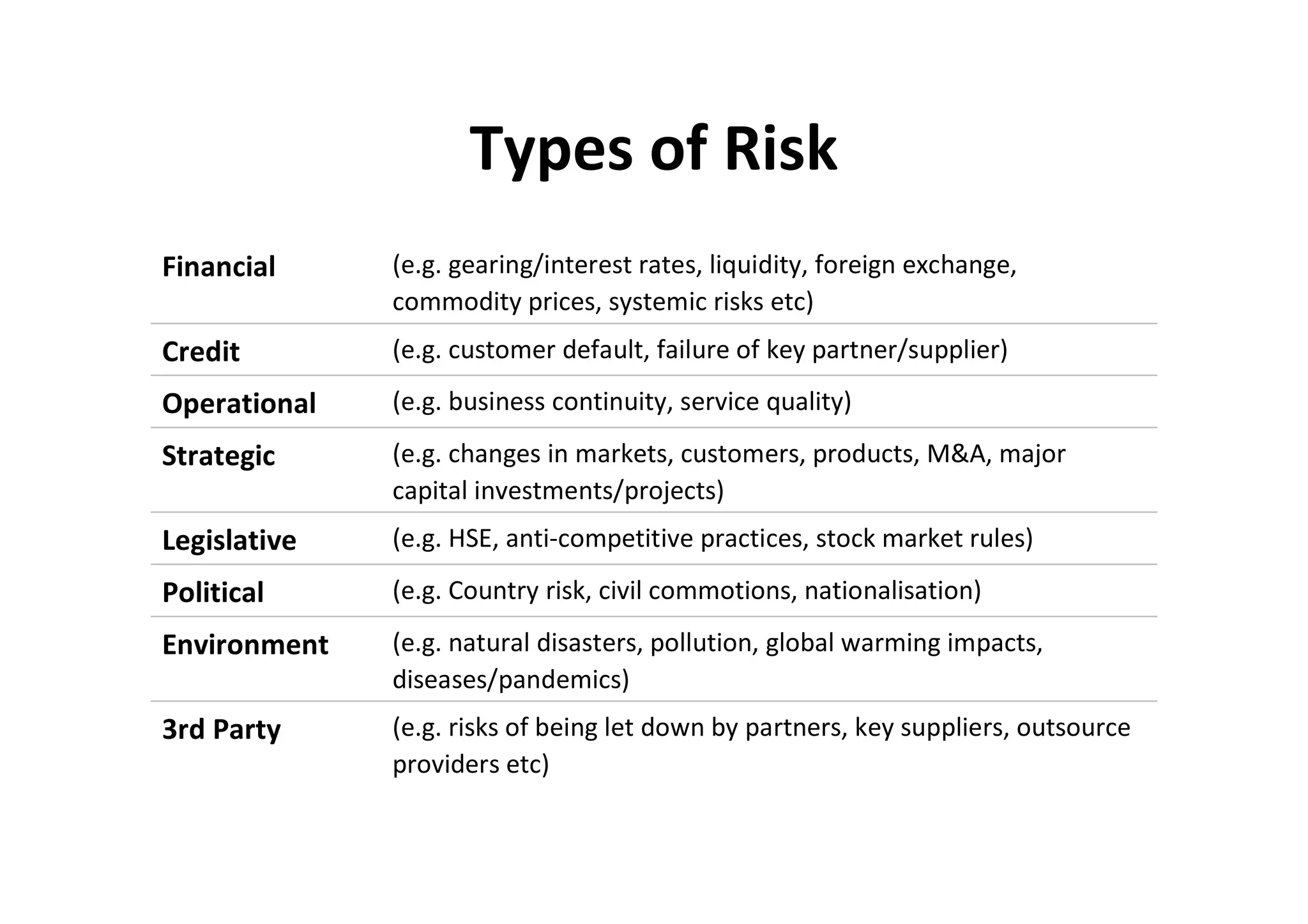
Types of Risk
Financial     (e.g. gearing/interest rates, liquidity, foreign exchange,
              commodity prices, systemic risks etc)
Credit        (e.g. customer default, failure of key partner/supplier)
Operational   (e.g. business continuity, service quality)
Strategic     (e.g. changes in markets, customers, products, M&A, major
              capital investments/projects)
Legislative   (e.g. HSE, anti-competitive practices, stock market rules)
Political     (e.g. Country risk, civil commotions, nationalisation)
Environment   (e.g. natural disasters, pollution, global warming impacts,
              diseases/pandemics)
3rd Party     (e.g. risks of being let down by partners, key suppliers, outsource
              providers etc)
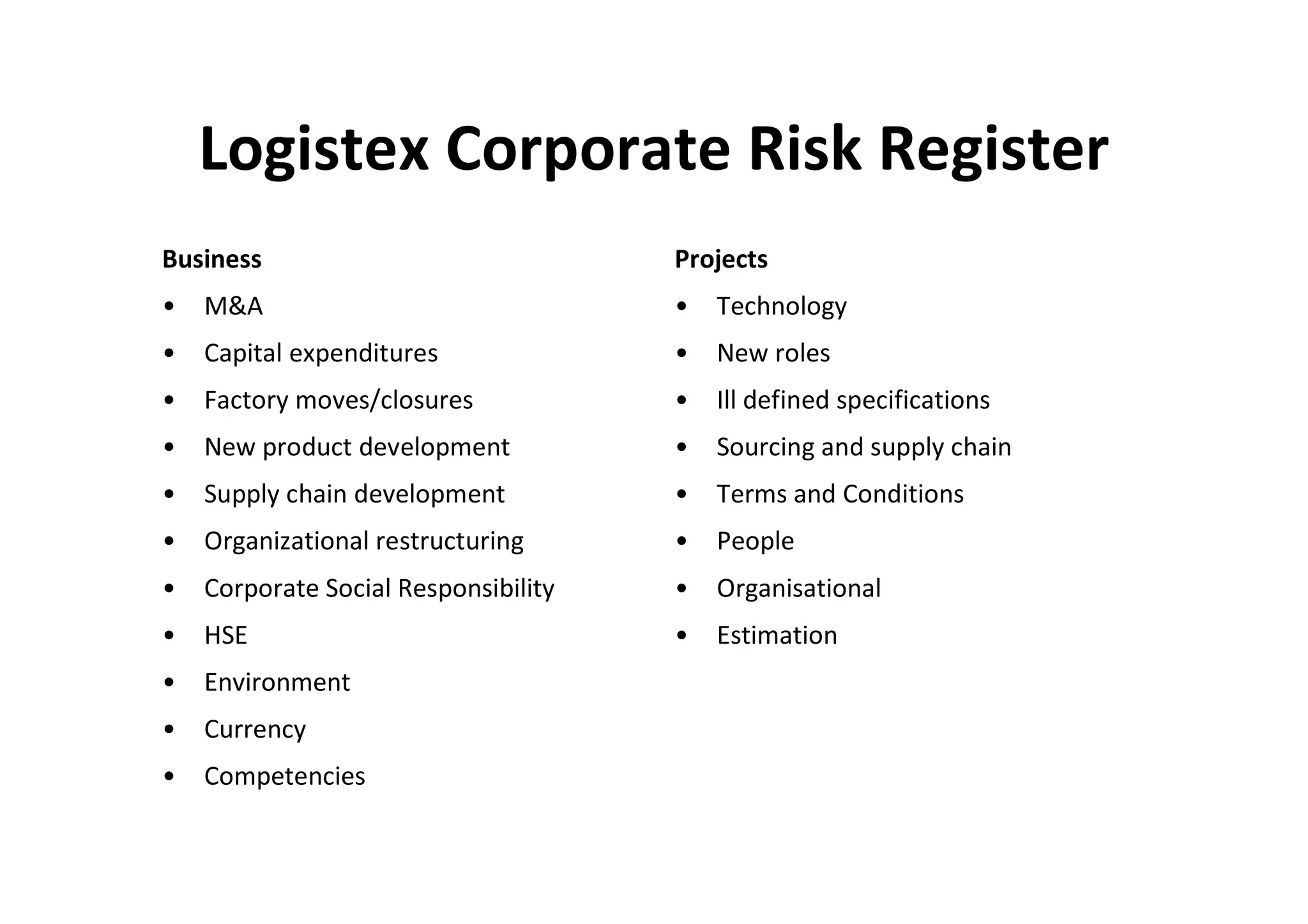
Logistex Corporate Risk Register
Business                              Projects
•   M&A                               •   Technology
•   Capital expenditures              •   New roles
•   Factory moves/closures            •   Ill defined specifications
•   New product development           •   Sourcing and supply chain
•   Supply chain development          •   Terms and Conditions
•   Organizational restructuring      •   People
•   Corporate Social Responsibility   •   Organisational
•   HSE                               •   Estimation
•   Environment
•   Currency
•   Competencies
2.
Identifying and evaluating risks
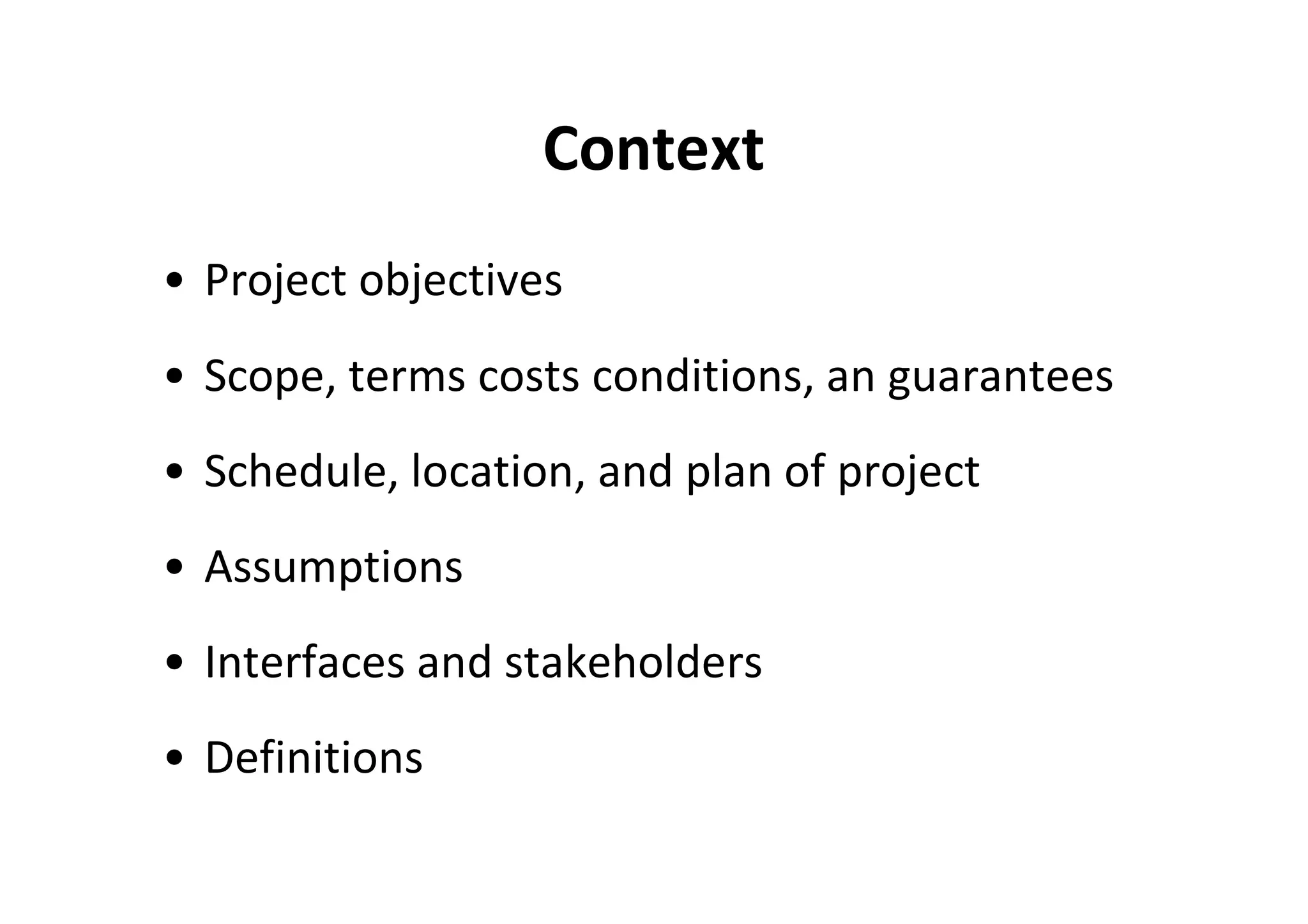
Context
• Project objectives
• Scope, terms costs conditions, an guarantees
• Schedule, location, and plan of project
• Assumptions
• Interfaces and stakeholders
• Definitions
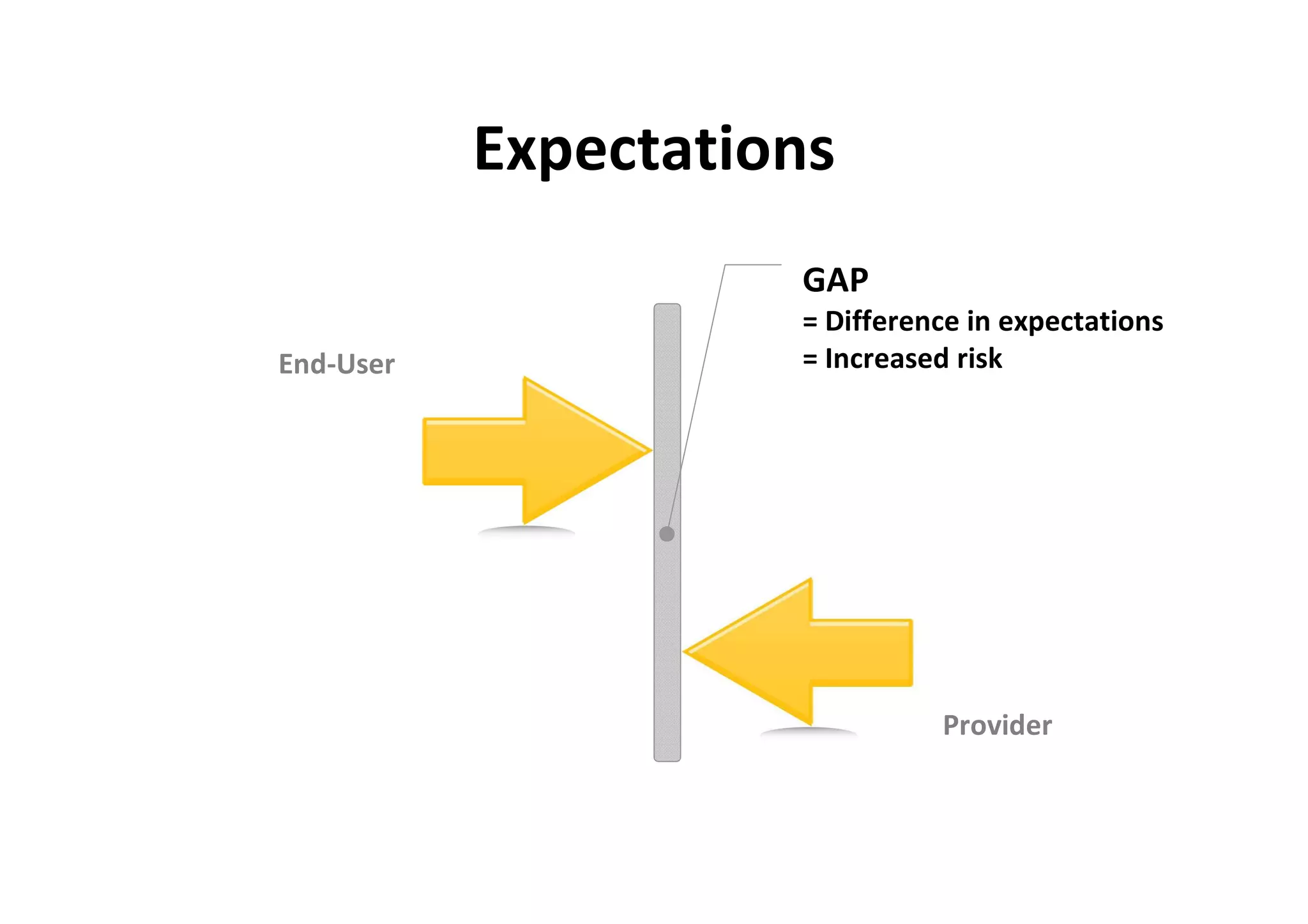
Expectations
                     GAP
                     = Difference in expectations
End-User             = Increased risk


                               Provider
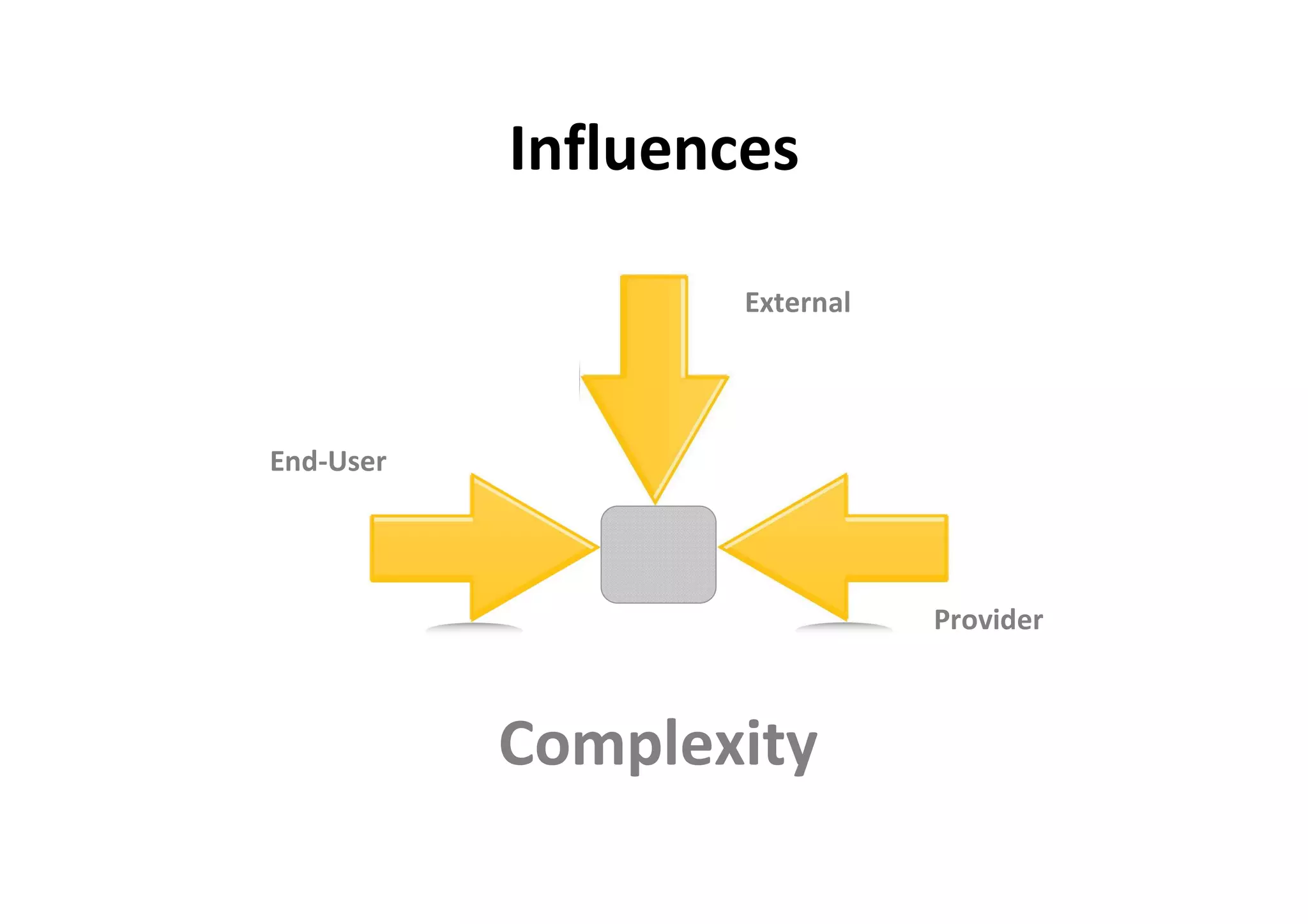
Influences

                   External


End-User


                              Provider


           Complexity
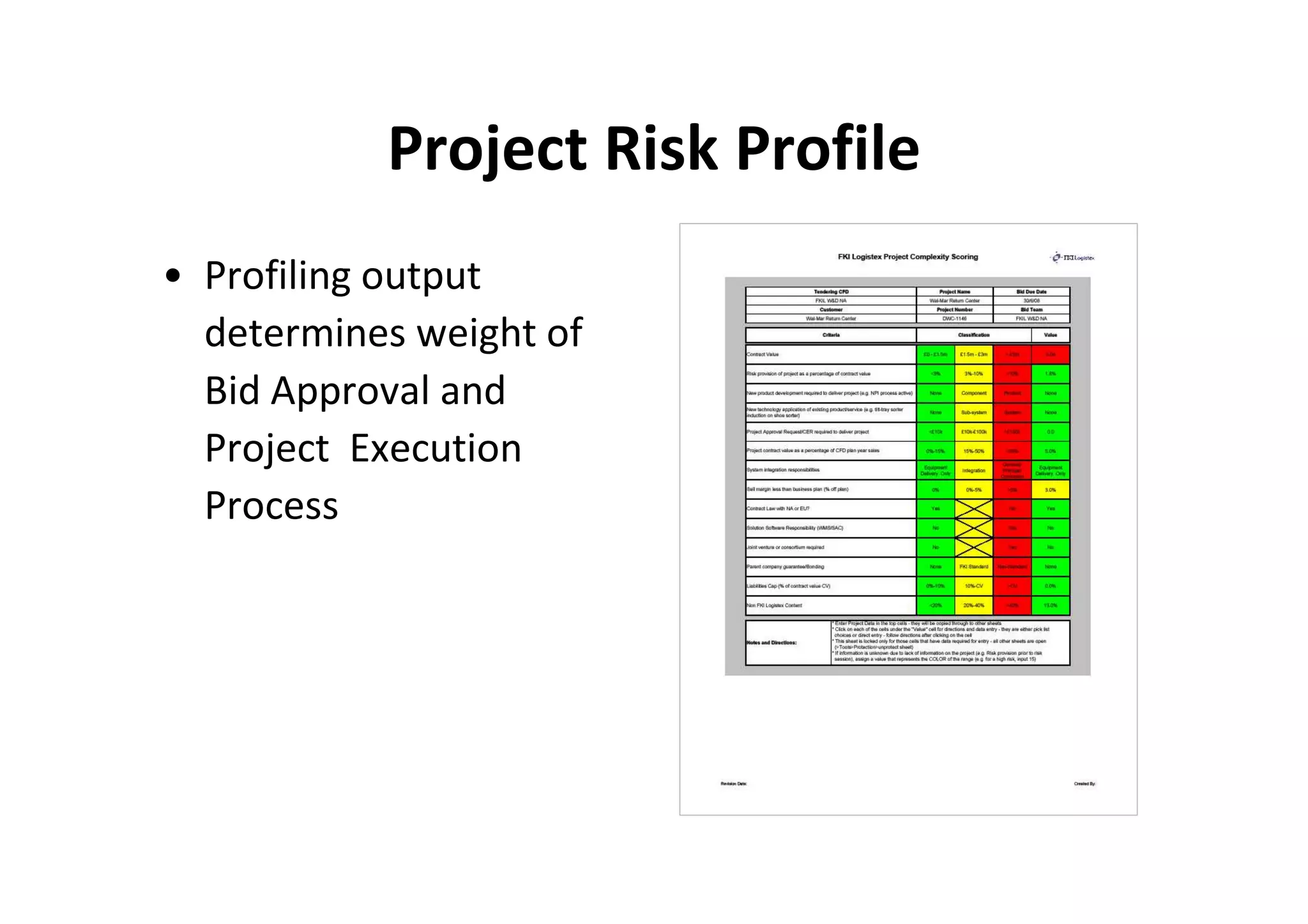
Project Risk Profile
• Profiling output
  determines weight of
  Bid Approval and
  Project Execution
  Process
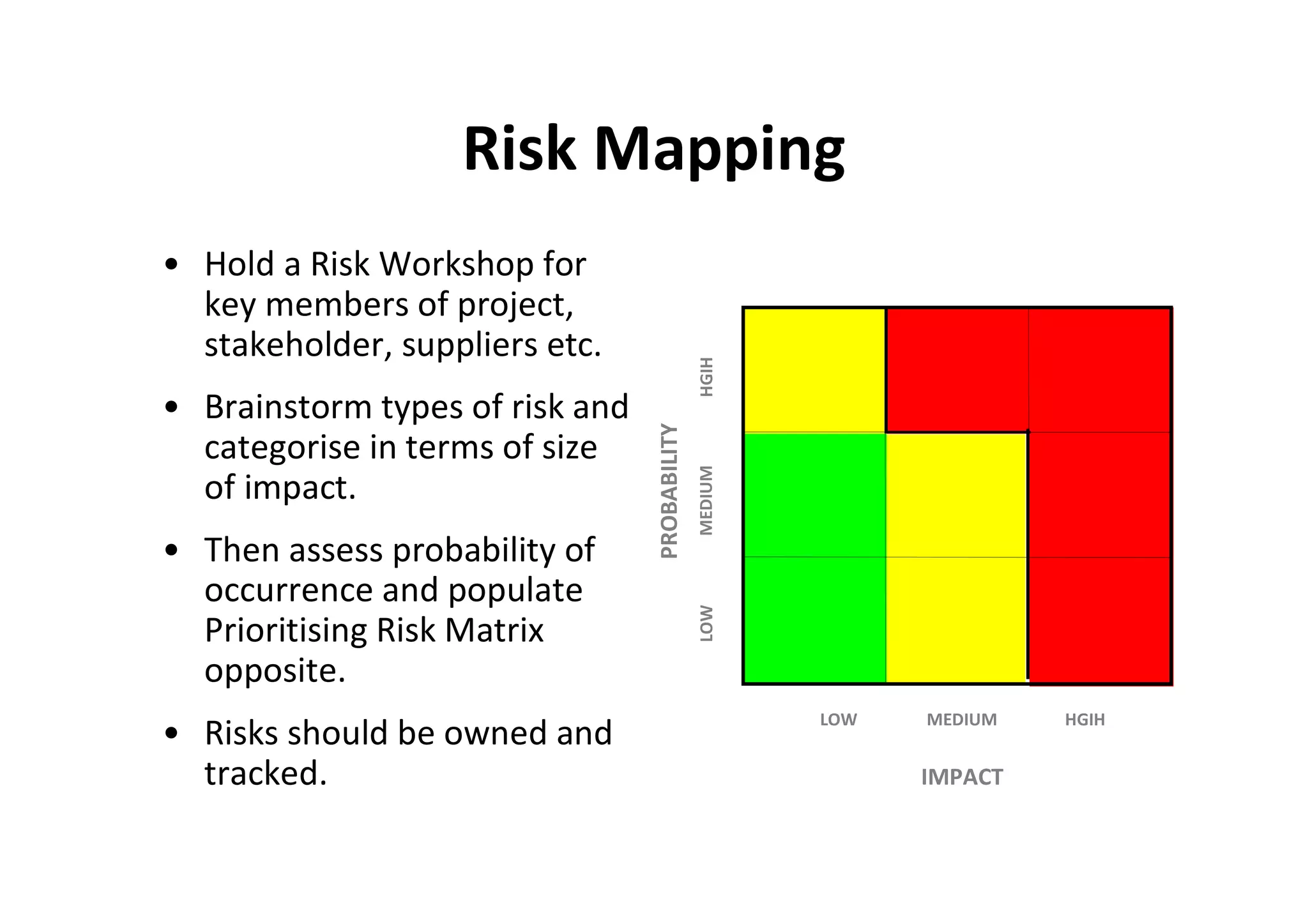
Risk Mapping
• Hold a Risk Workshop for
  key members of project,
  stakeholder, suppliers etc.


                                               HGIH
• Brainstorm types of risk and


                                 PROBABILITY
  categorise in terms of size


                                               MEDIUM
  of impact.
• Then assess probability of
  occurrence and populate

                                               LOW
  Prioritising Risk Matrix
  opposite.
                                                        LOW   MEDIUM   HGIH
• Risks should be owned and
  tracked.                                                    IMPACT
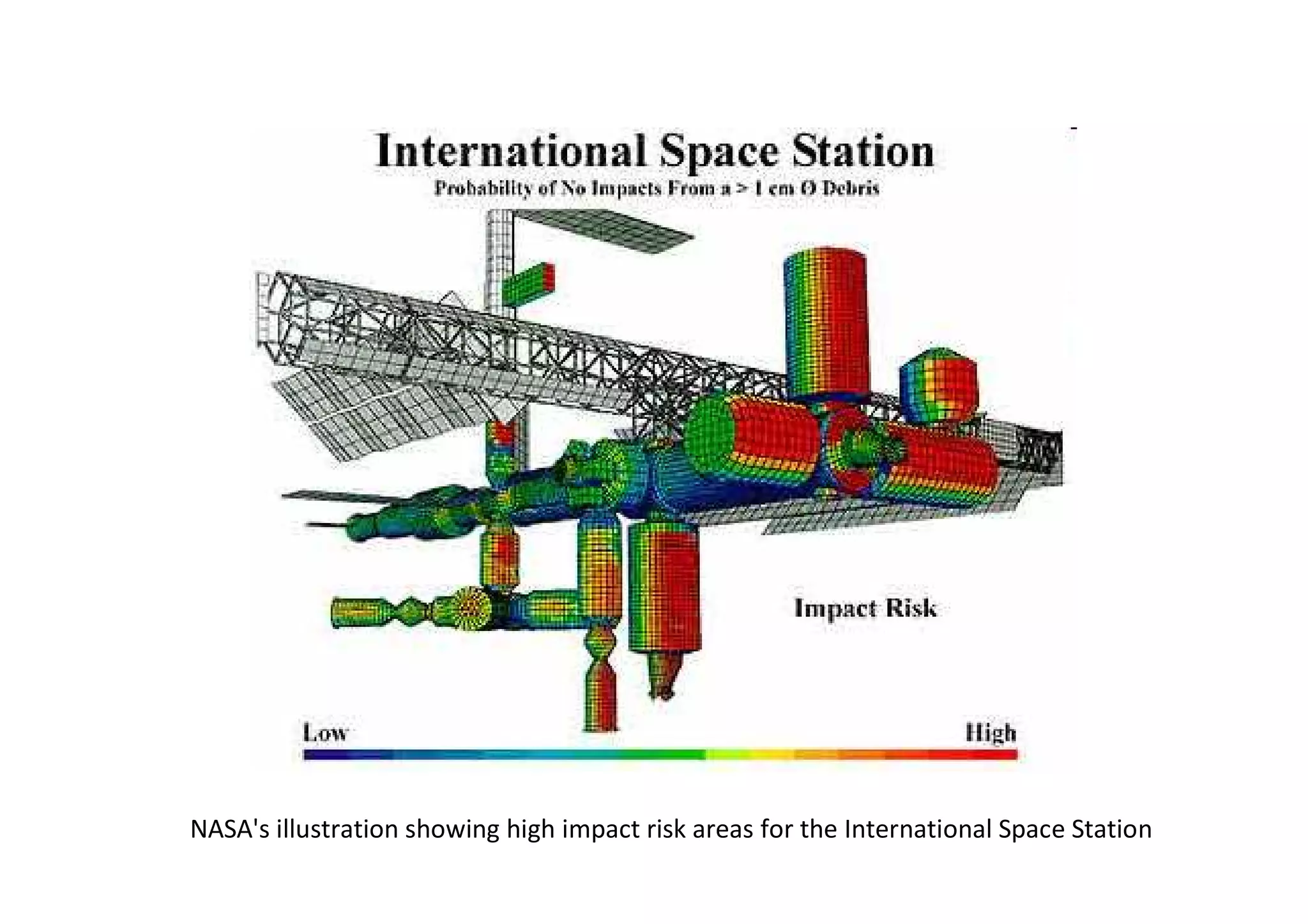
NASA's illustration showing high impact risk areas for the International Space Station
Method
• Describe the Risks
  – Brainstorming potential risks
  – Walkthrough of the risk identification checklist
Method
• Common language
  – Clear and accurate description
  – Formulated as an “IF..THEN…” statement
• Example 1
  – “The equipment will arrive late and we will incur liquidated
    damages.”
• Example 2
  – “IF customs requires additional paperwork and this delays
    the release of the equipment, which delays the installation,
    THEN we will incur liquidated damages.”
Method
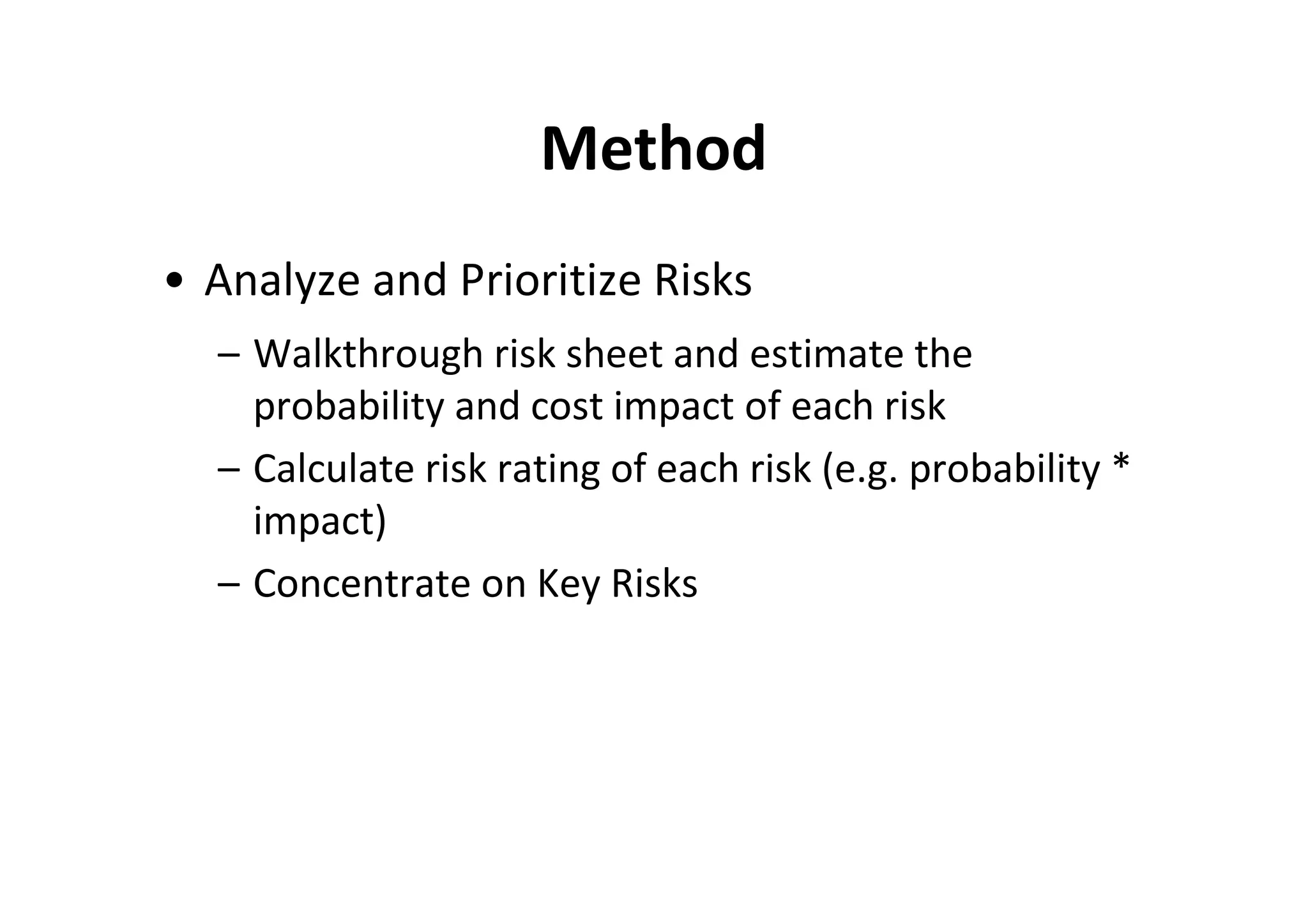
• Analyze and Prioritize Risks
  – Walkthrough risk sheet and estimate the
    probability and cost impact of each risk
  – Calculate risk rating of each risk (e.g. probability *
    impact)
  – Concentrate on Key Risks
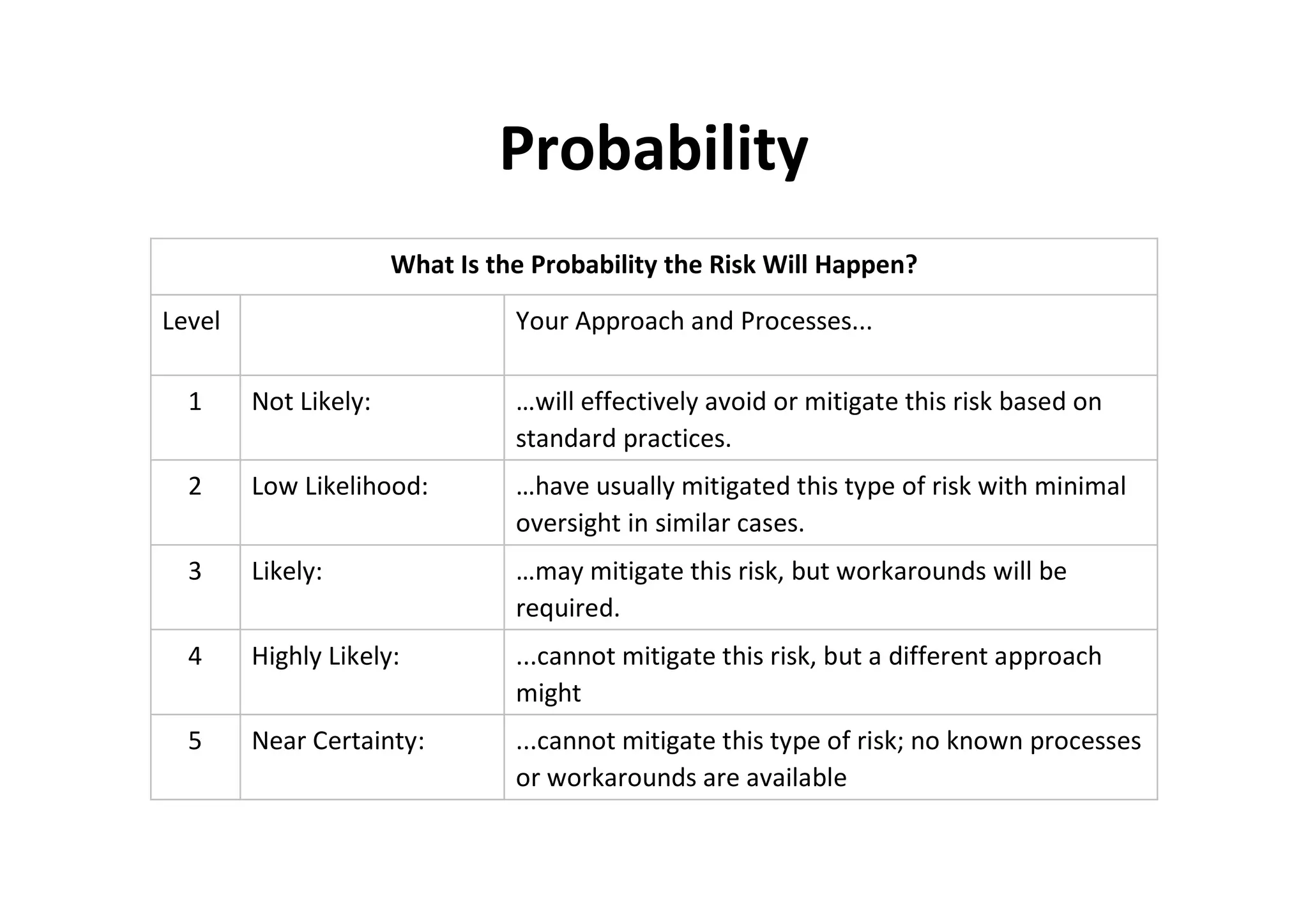
Probability
                      What Is the Probability the Risk Will Happen?

Level                           Your Approach and Processes...

  1     Not Likely:             …will effectively avoid or mitigate this risk based on
                                standard practices.
  2     Low Likelihood:         …have usually mitigated this type of risk with minimal
                                oversight in similar cases.
  3     Likely:                 …may mitigate this risk, but workarounds will be
                                required.
  4     Highly Likely:          ...cannot mitigate this risk, but a different approach
                                might
  5     Near Certainty:         ...cannot mitigate this type of risk; no known processes
                                or workarounds are available
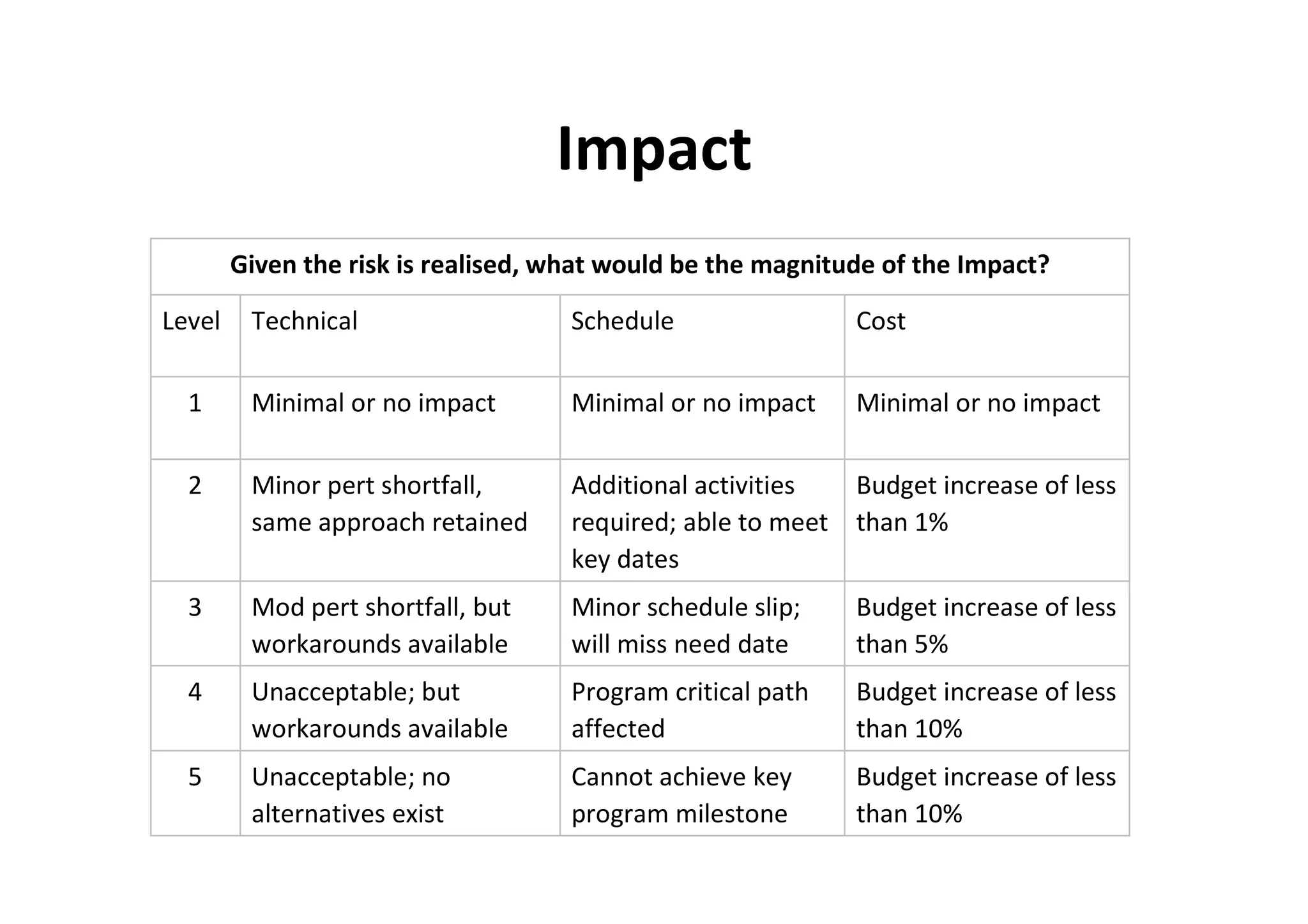
Impact
        Given the risk is realised, what would be the magnitude of the Impact?

Level    Technical                   Schedule                Cost

  1      Minimal or no impact        Minimal or no impact    Minimal or no impact

  2      Minor pert shortfall,       Additional activities  Budget increase of less
         same approach retained      required; able to meet than 1%
                                     key dates
  3      Mod pert shortfall, but     Minor schedule slip;    Budget increase of less
         workarounds available       will miss need date     than 5%
  4      Unacceptable; but           Program critical path   Budget increase of less
         workarounds available       affected                than 10%
  5      Unacceptable; no            Cannot achieve key      Budget increase of less
         alternatives exist          program milestone       than 10%
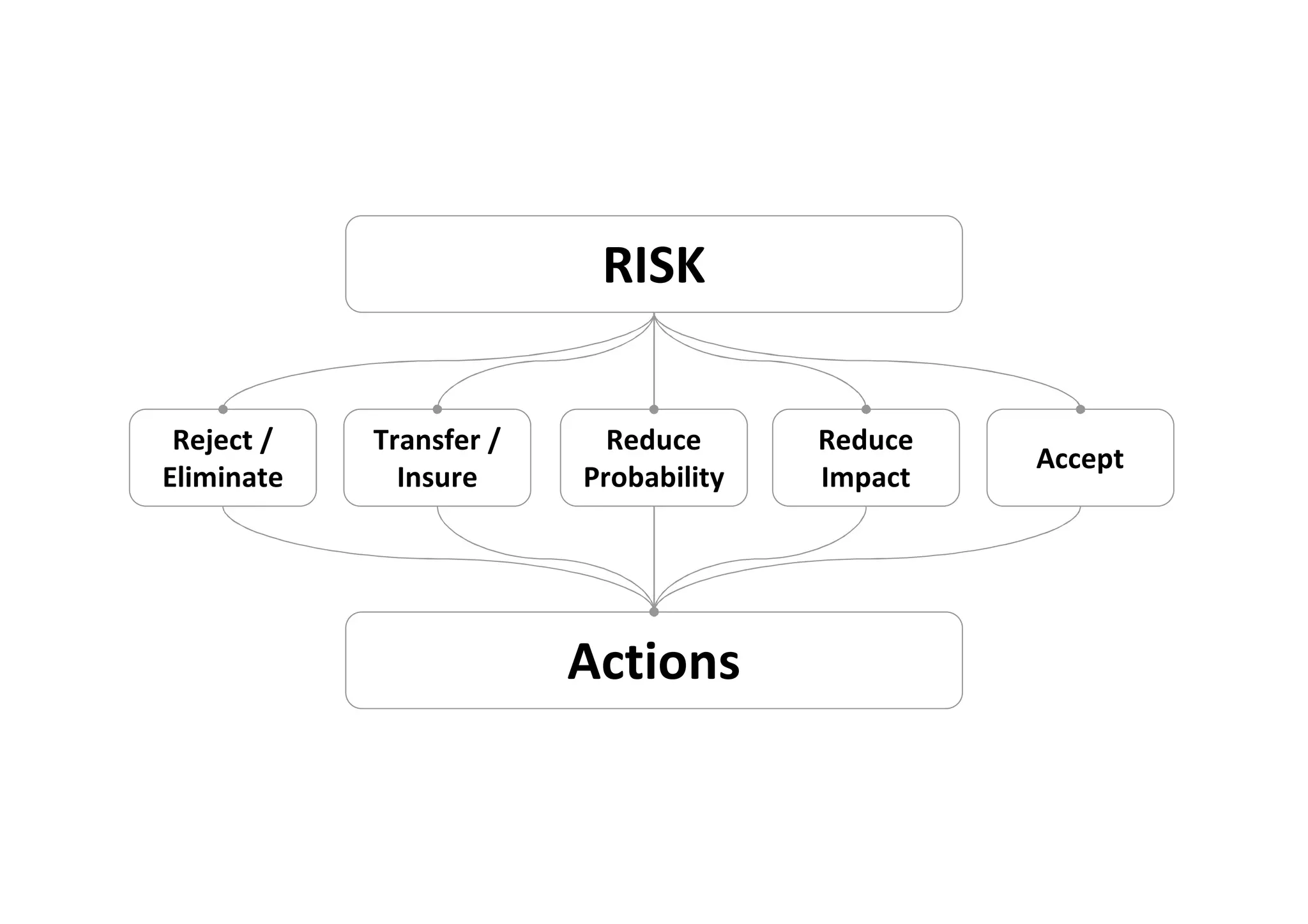
RISK

 Reject /   Transfer /     Reduce      Reduce
                                                Accept
Eliminate     Insure     Probability   Impact


                         Actions
Mitigation and Contingency Planning
• List Mitigation Actions
  – Start with most severe risks
  – List possible actions to reduce probability and/or
    cost
  – Some risks can be avoided
• Contingency Planning
  – Only for the most severe risks that cannot be
    mitigated
  – List actions to take should the risk mature
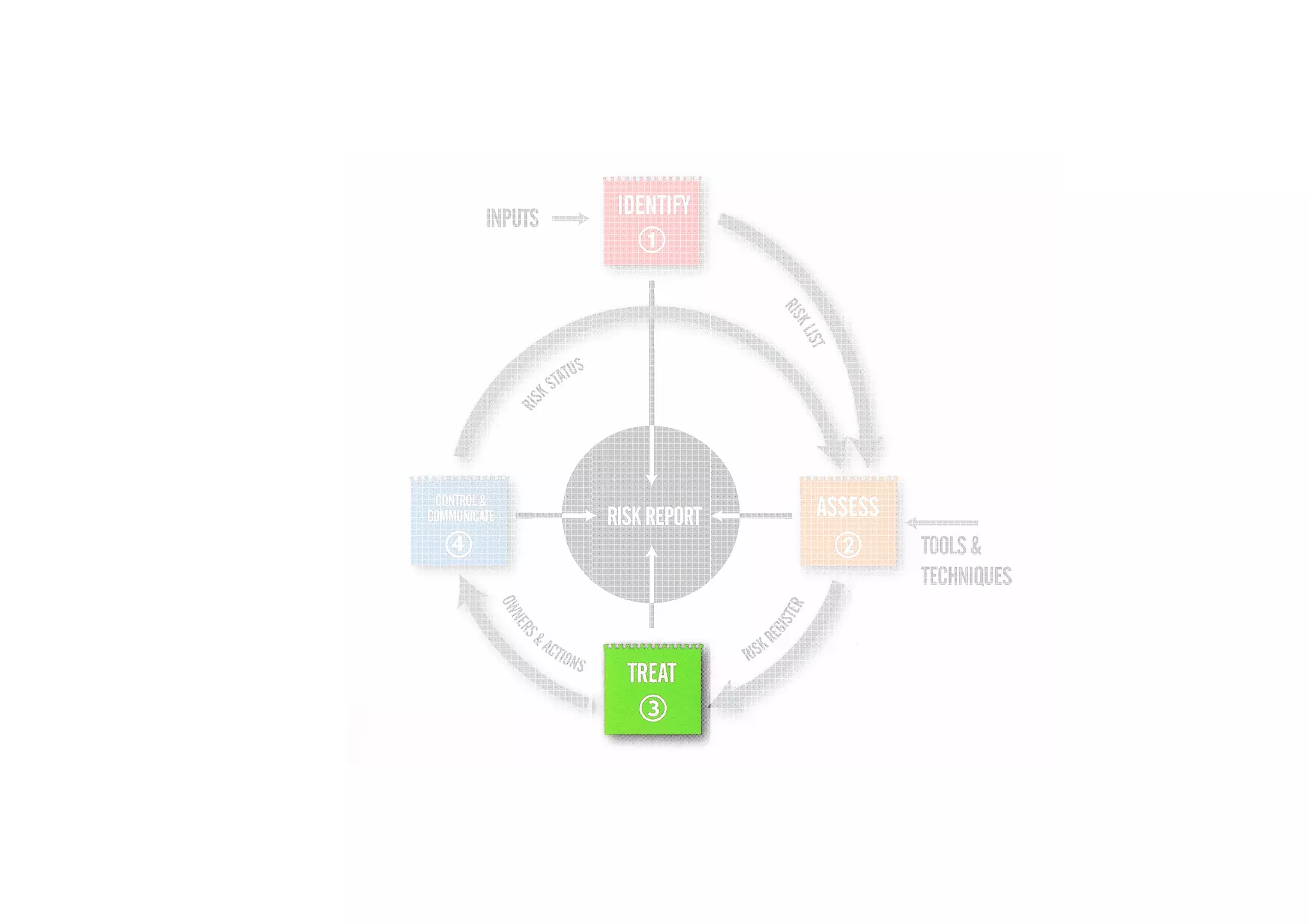
Risk Provisions
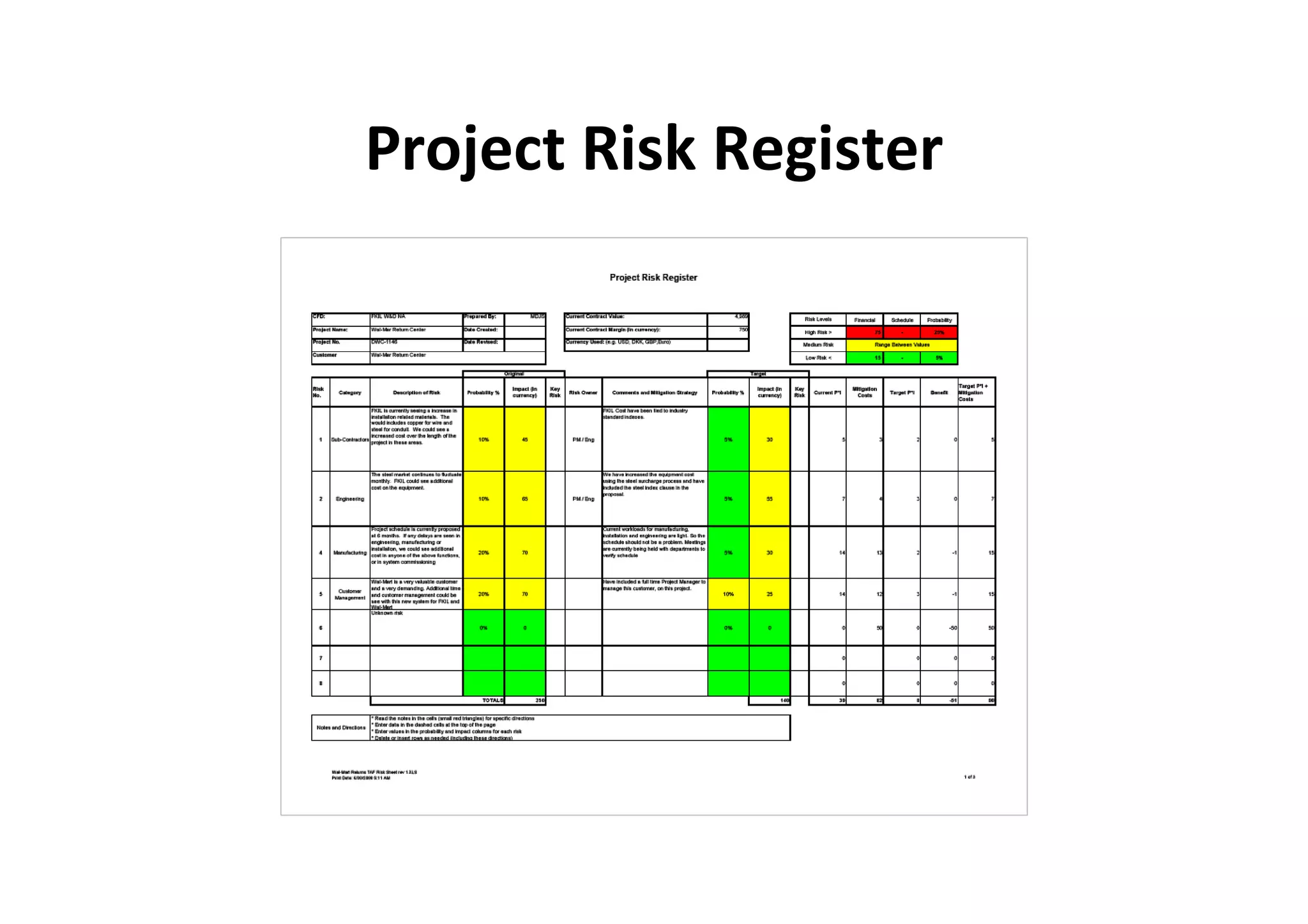
• Provision = (Probability x Impact) + Mitigation cost
• Mitigation cost may out way the Impact cost
   – Manage to the Risk
Project Risk Register
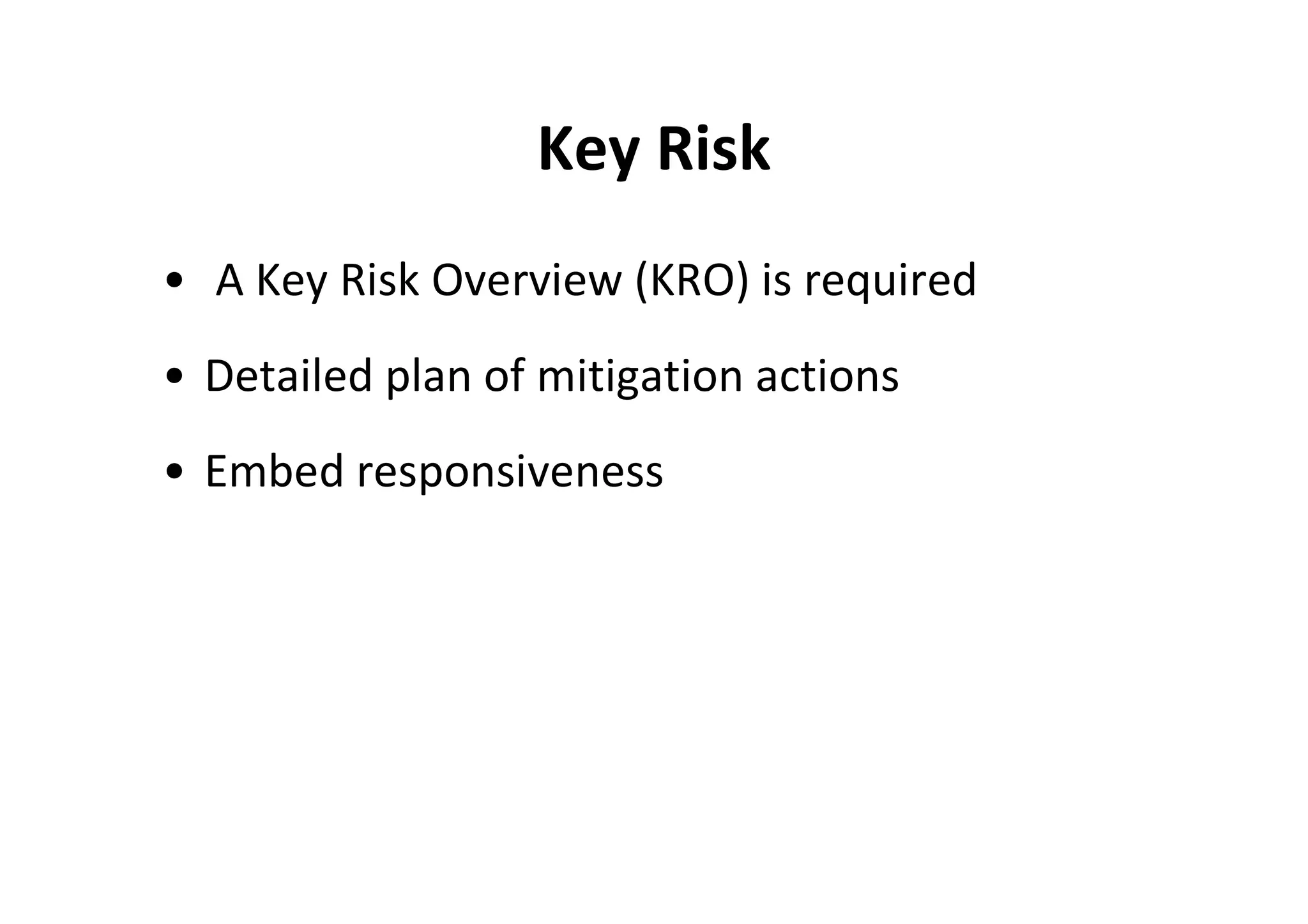
Key Risk
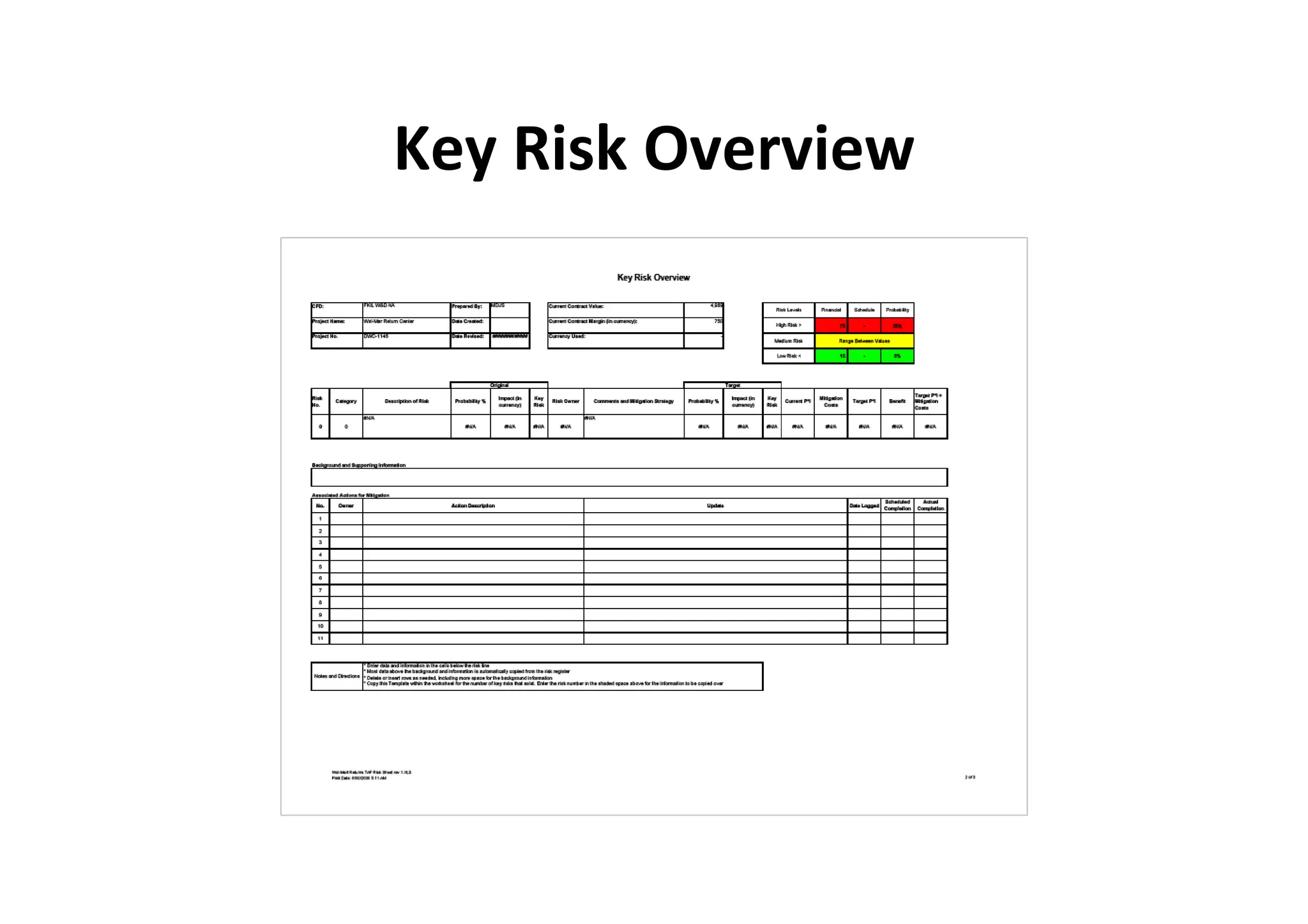
• A Key Risk Overview (KRO) is required
• Detailed plan of mitigation actions
• Embed responsiveness
Key Risk Overview
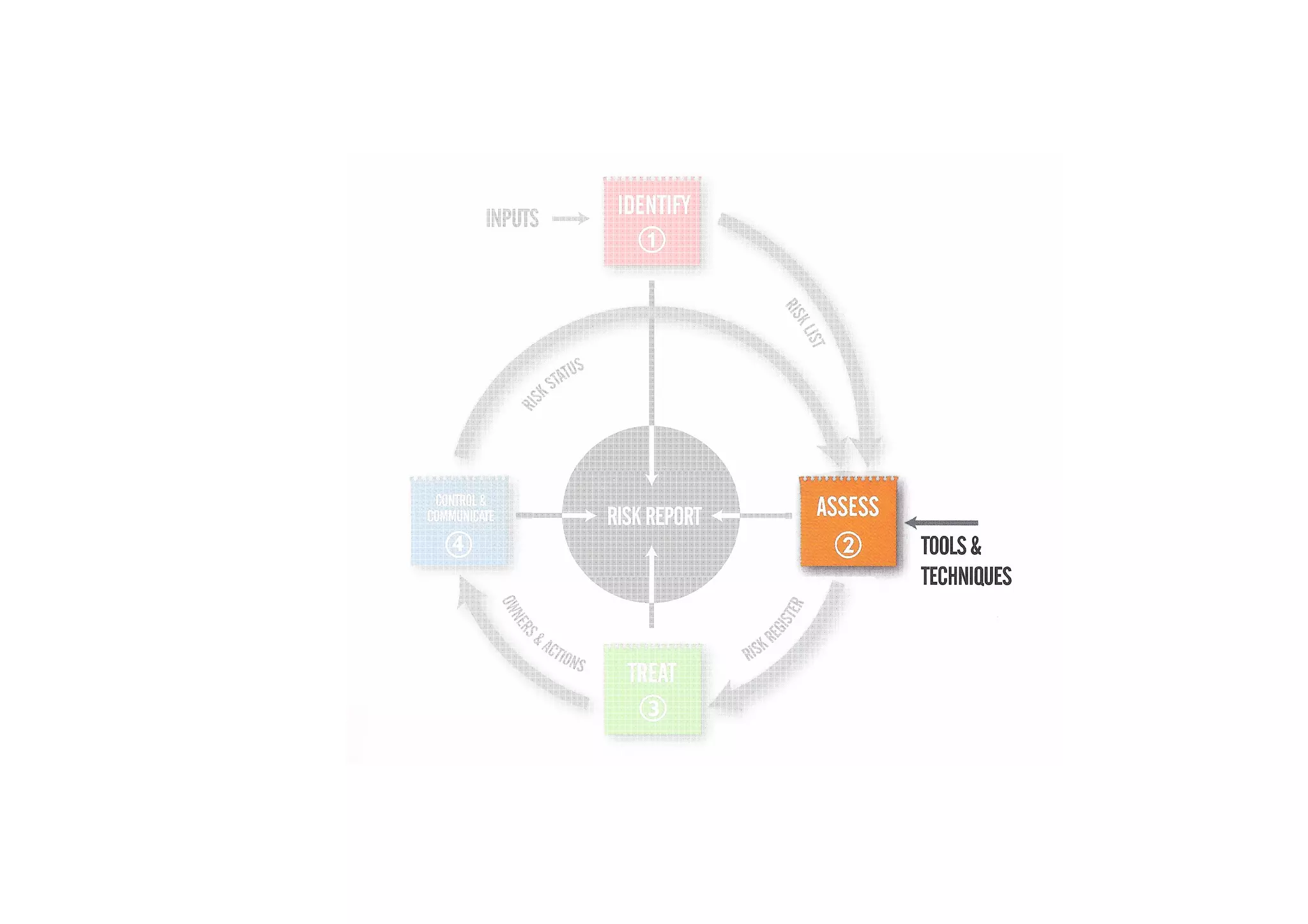
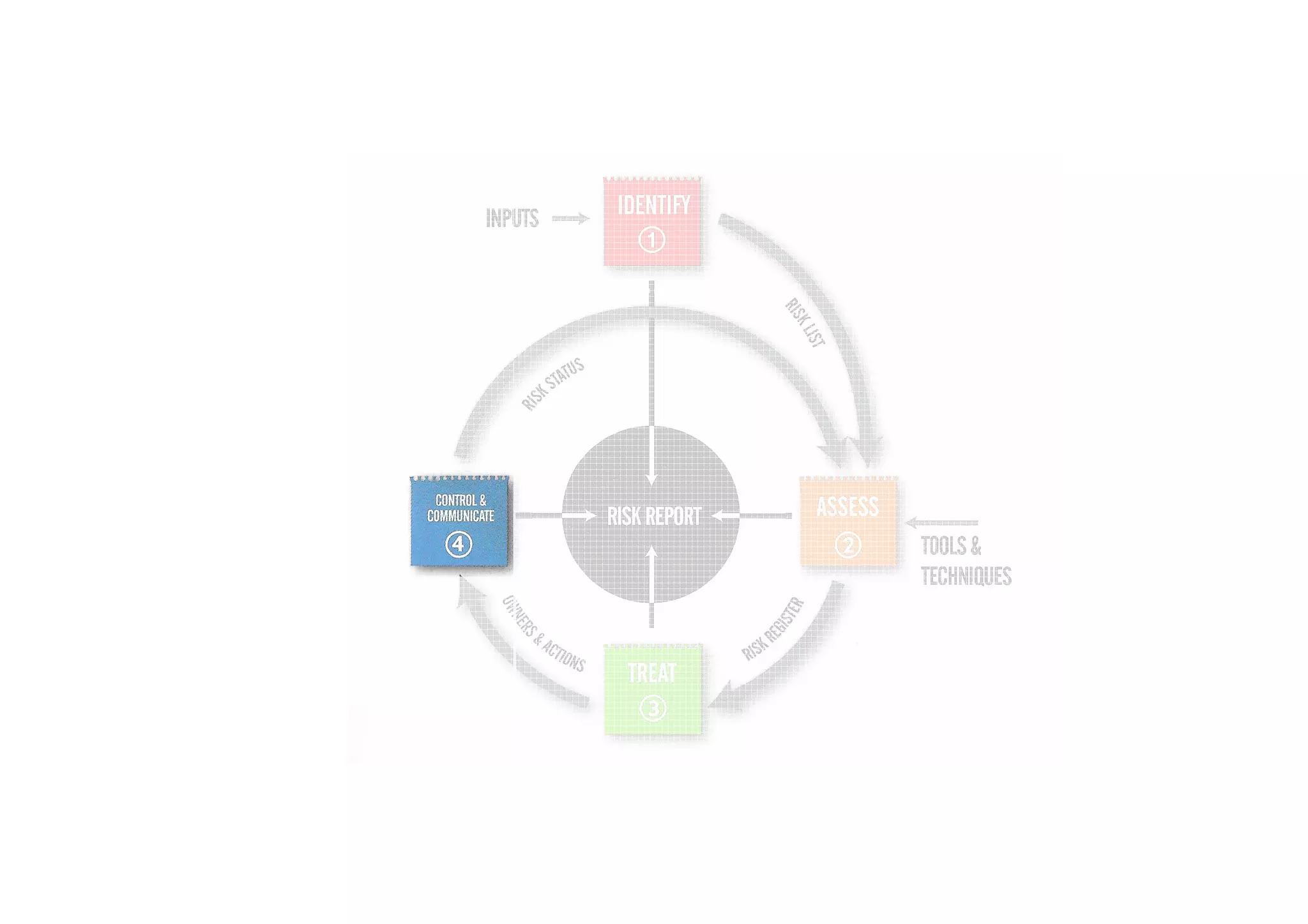
Risks require active
management
• Eliminate the risk NOW - scope, terms & conditions, reject.
• Do something NOW to transfer the risks - Insurer, customer,
  supplier.
• Do something NOW to reduce the probability of the risks
  occurring.
• Plan contingency actions NOW to reduce the impact if the
  risk occurs.
• Set up fallback plans NOW to limit the impact for
  implementation before the risk occurs.
• Get everybody’s agreement if you will just accept the risk.
3.
Processes and governance
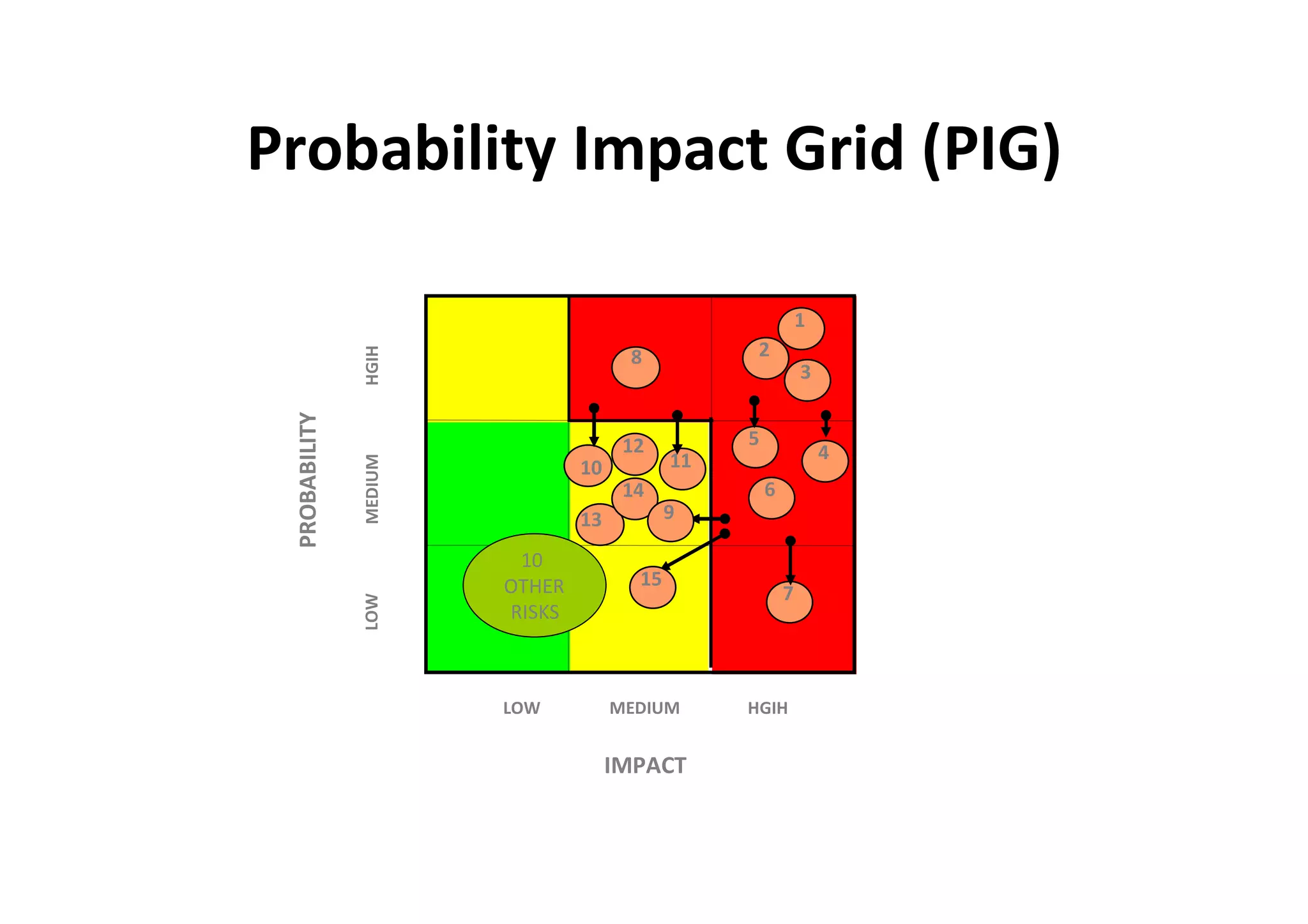
Probability Impact Grid (PIG)

                                                             1
                                                  2
               HGIH
                                      8
                                                             3
 PROBABILITY


                                      12         5
                                            11                   4
               MEDIUM


                                10
                                      14             6
                                13          9

                         10
                        OTHER          15
                                                         7
               LOW


                        RISKS


                        LOW          MEDIUM      HGIH


                                     IMPACT
Monitor
• Re-Assess Risks regularly
  – Has probability and damage of controlled risks
    changed?
  – New risks identified? Analyse them
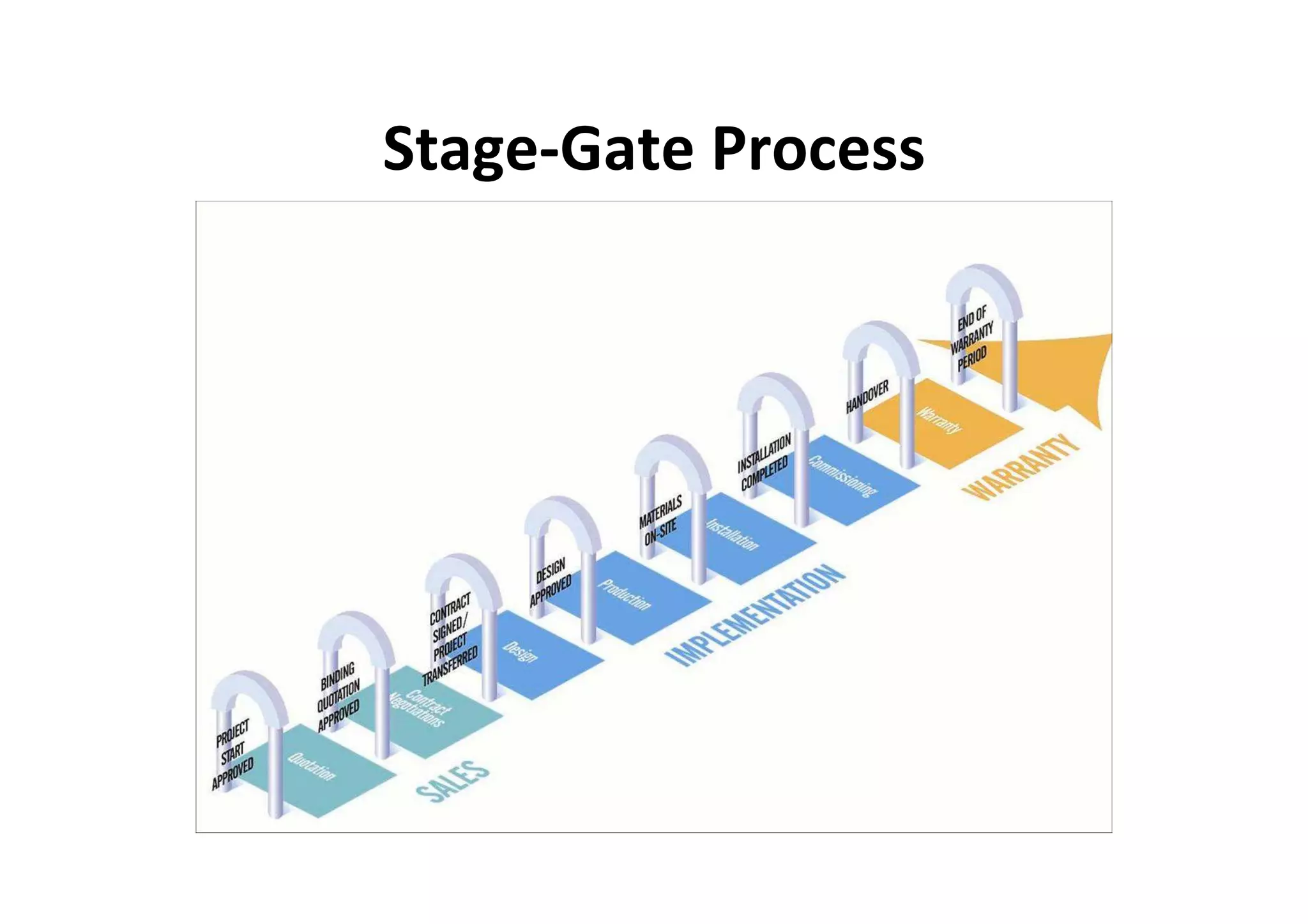
Stage-Gate Process
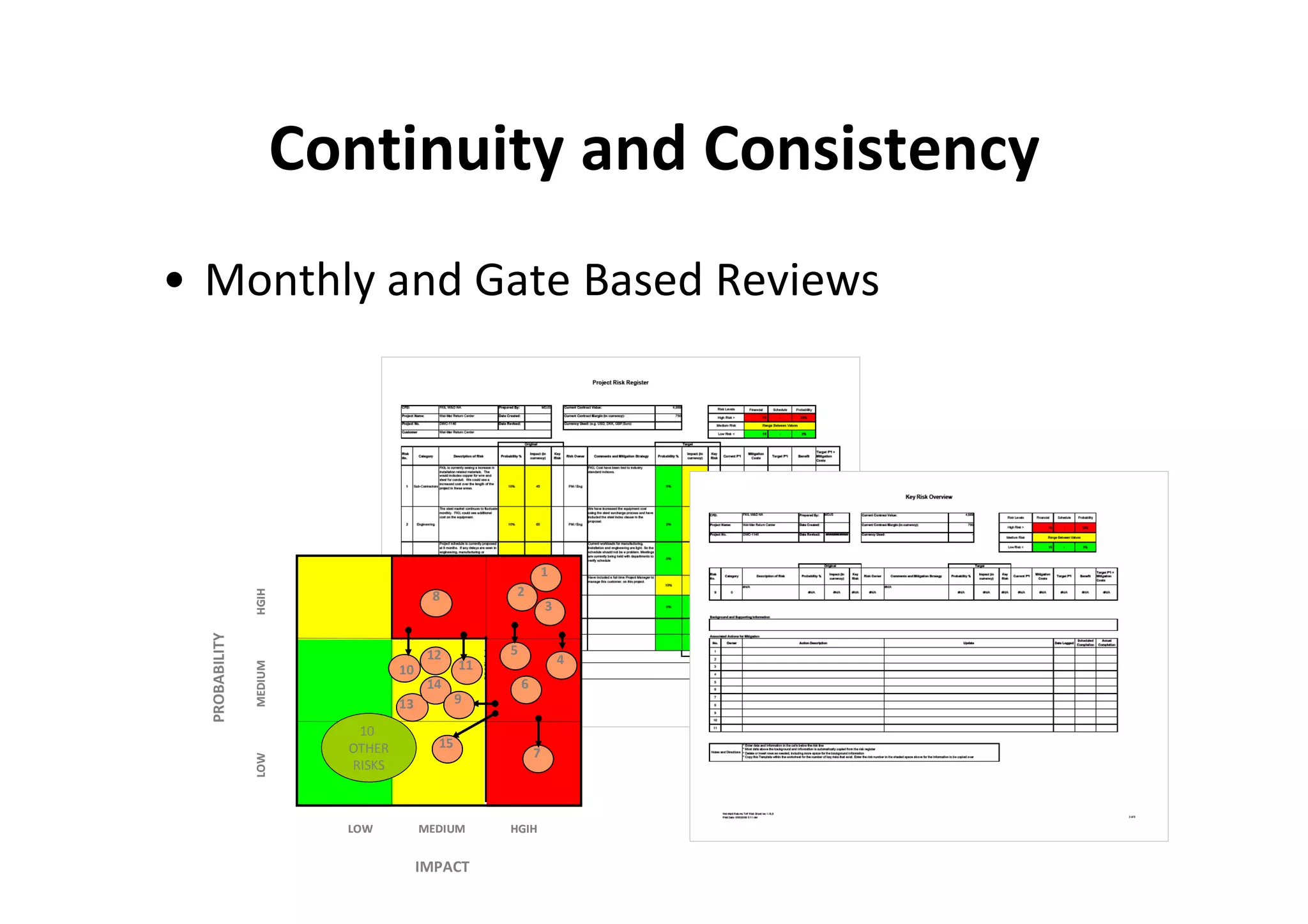
Continuity and Consistency
• Monthly and Gate Based Reviews


                                                                1
                                                     2
                HGIH


                                         8
                                                                3
  PROBABILITY


                                         12         5
                                               11                   4
                MEDIUM


                                   10
                                         14             6
                                   13          9

                            10
                           OTHER          15
                                                            7
                LOW


                           RISKS


                           LOW          MEDIUM      HGIH


                                        IMPACT
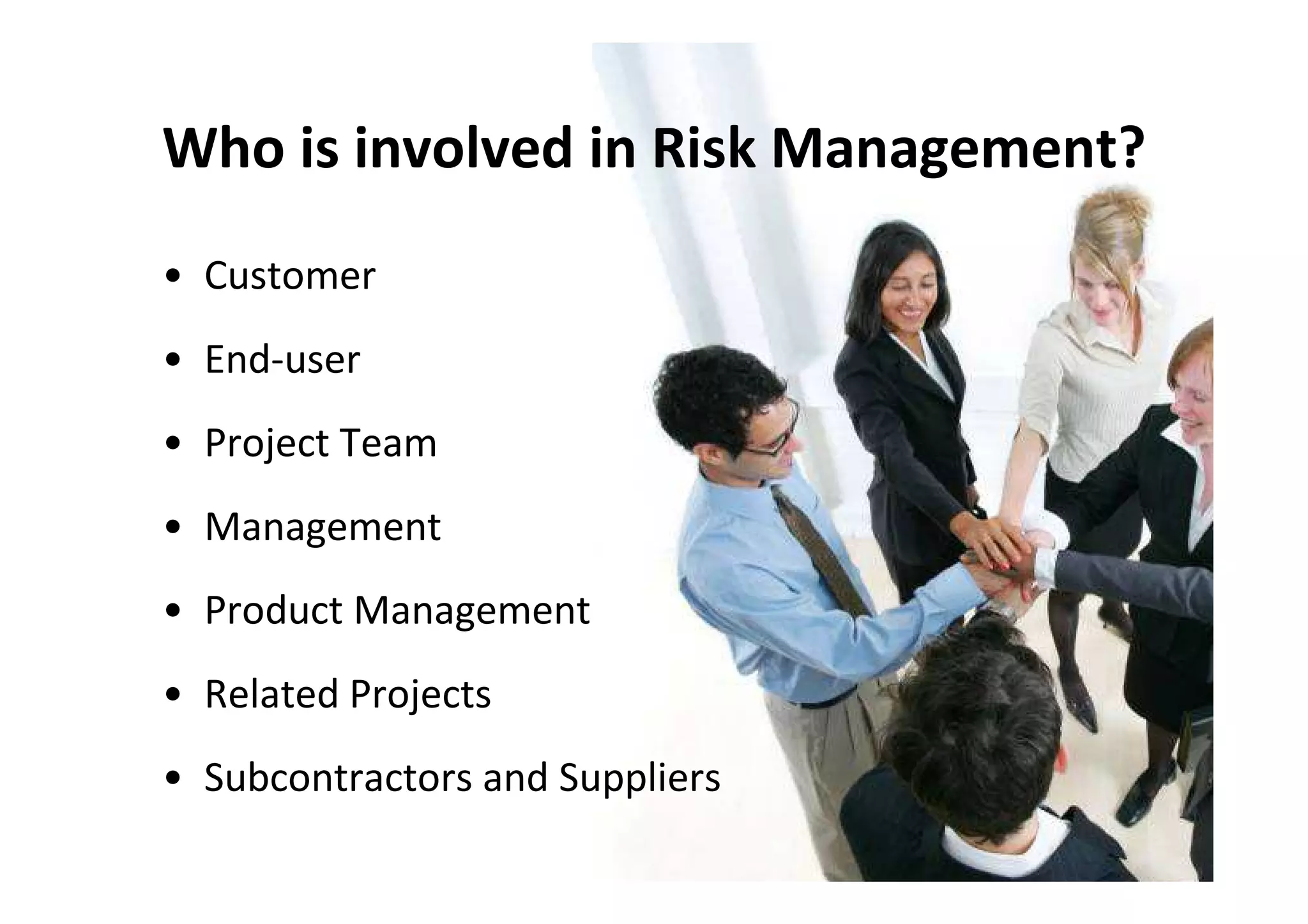
Who is involved in Risk Management?
• Customer
• End-user
• Project Team
• Management
• Product Management
• Related Projects
• Subcontractors and Suppliers
Roles in Risk Management
• Business Unit
• Project Team
• Risk Action Owner
• Risk Coordinator
• Steering Group
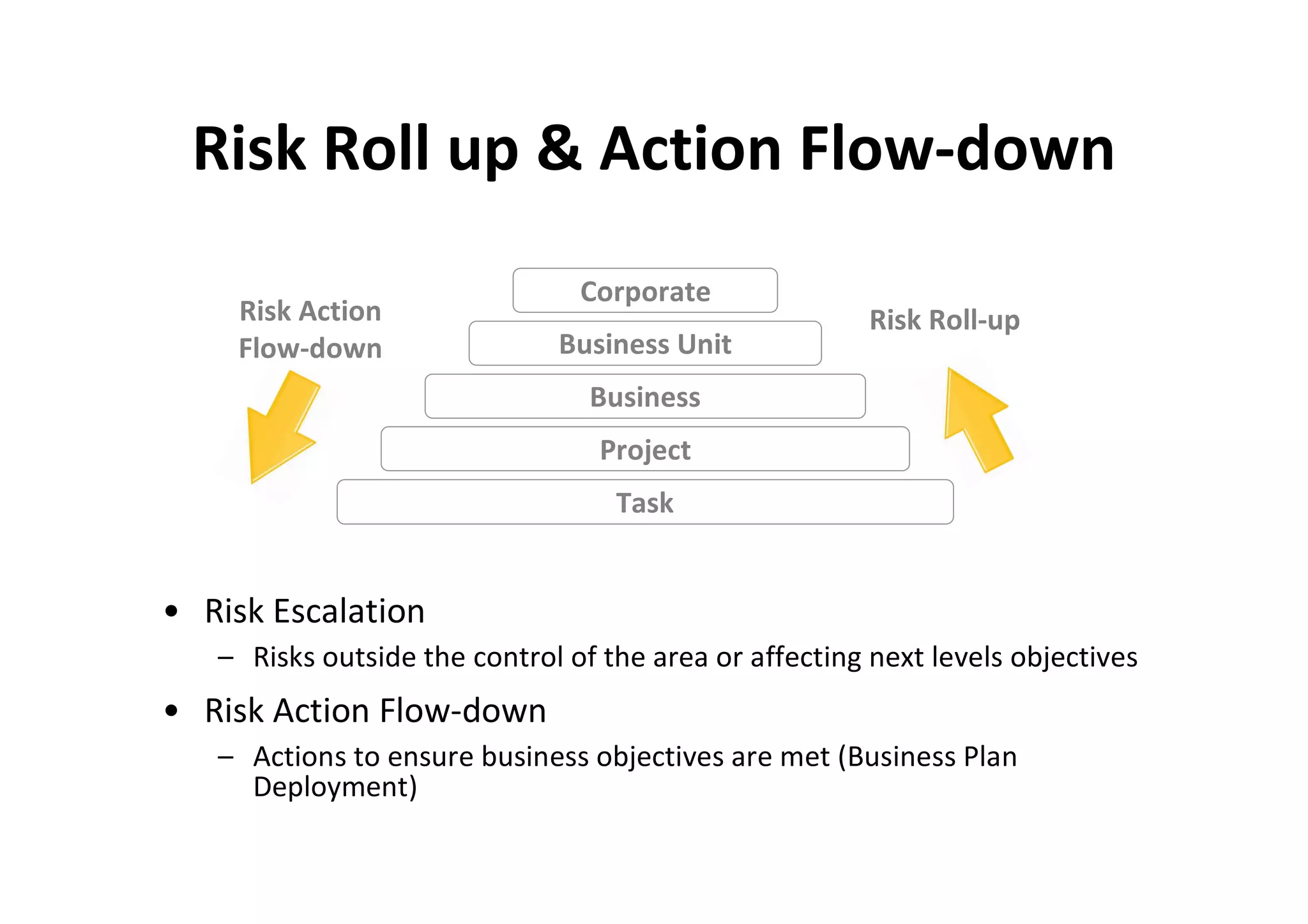
Risk Roll up & Action Flow-down
                                Corporate
    Risk Action                                         Risk Roll-up
    Flow-down                 Business Unit
                                 Business
                                  Project
                                   Task


• Risk Escalation
   – Risks outside the control of the area or affecting next levels objectives
• Risk Action Flow-down
   – Actions to ensure business objectives are met (Business Plan
     Deployment)
(Near the end….)
Risk management should…
• be an integral part of organisational processes
• be systematic and structured
• be based on the best available information
• take into account human factors
• be transparent and inclusive
• be dynamic, and responsive to change
• be tailored
• deliver better projects
derek.hill@fkilogistex.com
      07940 764844
Discussion…
• What risks does your business or team face?
• How do you deal with them?
• What lessons (good or bad) can you share?

Understanding and Managing Risk in Complex Supply Chain Projects

  • 1.
    Understanding and ManagingRisk within Complex Supply Chain Projects CILT Supply Chain Network London, UK Monday 15th June 2009
  • 2.
    Duracell and Corussuffer due to steel conflict (Source: headlines from national newspapers)
  • 3.
    Car transporter vessel sinks after collision (Source: headlines from national newspapers)
  • 4.
    Recall of MercedesML Models (Source: headlines from national newspapers)
  • 5.
    More takeovers andmergers in the transport sector (Source: headlines from national newspapers)
  • 6.
    Strikes in Austria,France and Italy (Source: headlines from national newspapers)
  • 7.
    Distribution halted byIT system fault (Source: headlines from national newspapers)
  • 8.
    EC requires traceabilityof food, feed and ingredients throughout supply chain (Source: headlines from national newspapers)
  • 9.
    Research center studies terrorism'simpact on supply chain (Source: headlines from national newspapers)
  • 10.
  • 11.
    Derek Hill w A rro cy g en ntin Co
  • 18.
  • 23.
  • 30.
    Risk Not a ment Man age Exp ert
  • 31.
  • 32.
    • Understanding differenttypes of risks • Identifying and evaluating risks • FKI Logistex risk processes and governance
  • 33.
  • 34.
    • Not toremove risk • To raise awareness and visibility of risks • To manage risks by mitigation actions to prevent major impact • To prepare for contingency
  • 35.
  • 37.
    Project Predictability 250% 200% Planned Cost (%) 150% Project Cost 100% Project End 50% 0% 0 1 2 3 4 5 6 7 8 9 10 11 12 13 14 15 16 Time (months) Planned
  • 38.
    Project Predictability 250% 200% Planned Cost (%) 150% Project Cost 100% Project End 50% 0% 0 1 2 3 4 5 6 7 8 9 10 11 12 13 14 15 16 Time (months) Planned Risk Managed
  • 39.
    Project Predictability 250% Project Cost 200% Planned Cost (%) 150% Project End Project Cost 100% Project End 50% 0% 0 1 2 3 4 5 6 7 8 9 10 11 12 13 14 15 16 Time (months) Planned Risk Managed Freestyle
  • 40.
  • 41.
    What Is ARisk? • A potential event with negative consequences that has not happened yet – However a risk could also be defined as the event with unforeseen positive consequences; an Opportunity • A possibility of loss — not the loss itself! – A source of problem during a project – Avoid labeling the cost of a risk as a risk (e.g. Schedule slippage). Find the sources! – Strike at the root of the problem, not the leaves! • Something that makes the project special • In the widest sense everything is a risk • There are better ways of handling recurrent problems!
  • 42.
    Two Basic Classifications •Known unknowns – Things that we know we don’t know • Unknown unknowns – Risks that surface despite our best efforts
  • 43.
    Types of Risk Financial (e.g. gearing/interest rates, liquidity, foreign exchange, commodity prices, systemic risks etc) Credit (e.g. customer default, failure of key partner/supplier) Operational (e.g. business continuity, service quality) Strategic (e.g. changes in markets, customers, products, M&A, major capital investments/projects) Legislative (e.g. HSE, anti-competitive practices, stock market rules) Political (e.g. Country risk, civil commotions, nationalisation) Environment (e.g. natural disasters, pollution, global warming impacts, diseases/pandemics) 3rd Party (e.g. risks of being let down by partners, key suppliers, outsource providers etc)
  • 44.
    Logistex Corporate RiskRegister Business Projects • M&A • Technology • Capital expenditures • New roles • Factory moves/closures • Ill defined specifications • New product development • Sourcing and supply chain • Supply chain development • Terms and Conditions • Organizational restructuring • People • Corporate Social Responsibility • Organisational • HSE • Estimation • Environment • Currency • Competencies
  • 45.
  • 46.
    Context • Project objectives •Scope, terms costs conditions, an guarantees • Schedule, location, and plan of project • Assumptions • Interfaces and stakeholders • Definitions
  • 47.
    Expectations GAP = Difference in expectations End-User = Increased risk Provider
  • 49.
    Influences External End-User Provider Complexity
  • 52.
    Project Risk Profile •Profiling output determines weight of Bid Approval and Project Execution Process
  • 54.
    Risk Mapping • Holda Risk Workshop for key members of project, stakeholder, suppliers etc. HGIH • Brainstorm types of risk and PROBABILITY categorise in terms of size MEDIUM of impact. • Then assess probability of occurrence and populate LOW Prioritising Risk Matrix opposite. LOW MEDIUM HGIH • Risks should be owned and tracked. IMPACT
  • 55.
    NASA's illustration showinghigh impact risk areas for the International Space Station
  • 56.
    Method • Describe theRisks – Brainstorming potential risks – Walkthrough of the risk identification checklist
  • 57.
    Method • Common language – Clear and accurate description – Formulated as an “IF..THEN…” statement • Example 1 – “The equipment will arrive late and we will incur liquidated damages.” • Example 2 – “IF customs requires additional paperwork and this delays the release of the equipment, which delays the installation, THEN we will incur liquidated damages.”
  • 59.
    Method • Analyze andPrioritize Risks – Walkthrough risk sheet and estimate the probability and cost impact of each risk – Calculate risk rating of each risk (e.g. probability * impact) – Concentrate on Key Risks
  • 60.
    Probability What Is the Probability the Risk Will Happen? Level Your Approach and Processes... 1 Not Likely: …will effectively avoid or mitigate this risk based on standard practices. 2 Low Likelihood: …have usually mitigated this type of risk with minimal oversight in similar cases. 3 Likely: …may mitigate this risk, but workarounds will be required. 4 Highly Likely: ...cannot mitigate this risk, but a different approach might 5 Near Certainty: ...cannot mitigate this type of risk; no known processes or workarounds are available
  • 61.
    Impact Given the risk is realised, what would be the magnitude of the Impact? Level Technical Schedule Cost 1 Minimal or no impact Minimal or no impact Minimal or no impact 2 Minor pert shortfall, Additional activities Budget increase of less same approach retained required; able to meet than 1% key dates 3 Mod pert shortfall, but Minor schedule slip; Budget increase of less workarounds available will miss need date than 5% 4 Unacceptable; but Program critical path Budget increase of less workarounds available affected than 10% 5 Unacceptable; no Cannot achieve key Budget increase of less alternatives exist program milestone than 10%
  • 63.
    RISK Reject / Transfer / Reduce Reduce Accept Eliminate Insure Probability Impact Actions
  • 64.
    Mitigation and ContingencyPlanning • List Mitigation Actions – Start with most severe risks – List possible actions to reduce probability and/or cost – Some risks can be avoided • Contingency Planning – Only for the most severe risks that cannot be mitigated – List actions to take should the risk mature
  • 65.
    Risk Provisions • Provision= (Probability x Impact) + Mitigation cost • Mitigation cost may out way the Impact cost – Manage to the Risk
  • 67.
  • 68.
    Key Risk • AKey Risk Overview (KRO) is required • Detailed plan of mitigation actions • Embed responsiveness
  • 69.
  • 70.
  • 71.
    • Eliminate therisk NOW - scope, terms & conditions, reject. • Do something NOW to transfer the risks - Insurer, customer, supplier. • Do something NOW to reduce the probability of the risks occurring. • Plan contingency actions NOW to reduce the impact if the risk occurs. • Set up fallback plans NOW to limit the impact for implementation before the risk occurs. • Get everybody’s agreement if you will just accept the risk.
  • 72.
  • 74.
    Probability Impact Grid(PIG) 1 2 HGIH 8 3 PROBABILITY 12 5 11 4 MEDIUM 10 14 6 13 9 10 OTHER 15 7 LOW RISKS LOW MEDIUM HGIH IMPACT
  • 75.
    Monitor • Re-Assess Risksregularly – Has probability and damage of controlled risks changed? – New risks identified? Analyse them
  • 76.
  • 77.
    Continuity and Consistency •Monthly and Gate Based Reviews 1 2 HGIH 8 3 PROBABILITY 12 5 11 4 MEDIUM 10 14 6 13 9 10 OTHER 15 7 LOW RISKS LOW MEDIUM HGIH IMPACT
  • 78.
    Who is involvedin Risk Management? • Customer • End-user • Project Team • Management • Product Management • Related Projects • Subcontractors and Suppliers
  • 79.
    Roles in RiskManagement • Business Unit • Project Team • Risk Action Owner • Risk Coordinator • Steering Group
  • 80.
    Risk Roll up& Action Flow-down Corporate Risk Action Risk Roll-up Flow-down Business Unit Business Project Task • Risk Escalation – Risks outside the control of the area or affecting next levels objectives • Risk Action Flow-down – Actions to ensure business objectives are met (Business Plan Deployment)
  • 81.
  • 83.
    Risk management should… •be an integral part of organisational processes • be systematic and structured • be based on the best available information • take into account human factors • be transparent and inclusive • be dynamic, and responsive to change • be tailored • deliver better projects
  • 84.
  • 85.
    Discussion… • What risksdoes your business or team face? • How do you deal with them? • What lessons (good or bad) can you share?