How can library materials be ranked in the
OPAC?
Prof. Dr. Dirk Lewandowski
University of Applied Sciences Hamburg
dirk.lewandowski@haw-hamburg.de


9th International Bielefeld Conference
Bielefeld, 4 February 2009
Agenda


 The state of the OPAC and the importance of relevance ranking

 Ranking factors

 The composition of results lists

 Conclusions


1 | Dirk Lewandowski
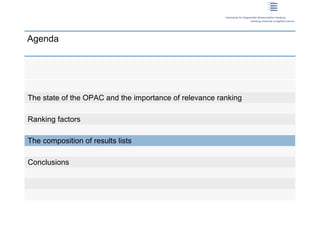
Agenda


 The state of the OPAC and the importance of relevance ranking

 Ranking factors

 The composition of results lists

 Conclusions


2 | Dirk Lewandowski
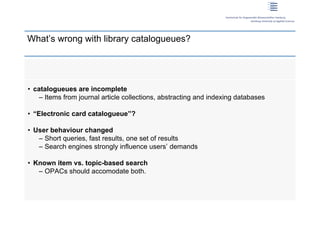
What’s wrong with library catalogueues?


 • catalogueues are incomplete
     – Items from journal article collections, abstracting and indexing databases

 • “Electronic card catalogueue”?

 • User behaviour changed
    – Short queries, fast results, one set of results
    – Search engines strongly influence users’ demands

 • Known item vs. topic-based search
    – OPACs should accomodate both.


3 | Dirk Lewandowski
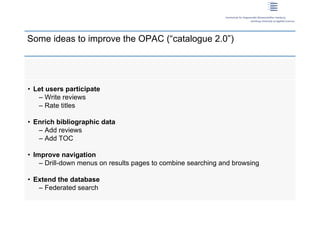
Some ideas to improve the OPAC (“catalogue 2.0”)


 • Let users participate
    – Write reviews
    – Rate titles

 • Enrich bibliographic data
    – Add reviews
    – Add TOC

 • Improve navigation
     – Drill-down menus on results pages to combine searching and browsing

 • Extend the database
    – Federated search

4 | Dirk Lewandowski
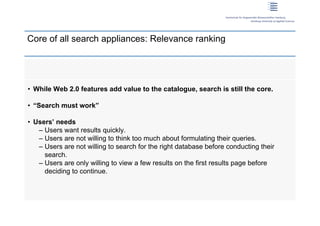
Core of all search appliances: Relevance ranking


 • While Web 2.0 features add value to the catalogue, search is still the core.

 • “Search must work”

 • Users’ needs
    – Users want results quickly.
    – Users are not willing to think too much about formulating their queries.
    – Users are not willing to search for the right database before conducting their
      search.
    – Users are only willing to view a few results on the first results page before
      deciding to continue.


5 | Dirk Lewandowski
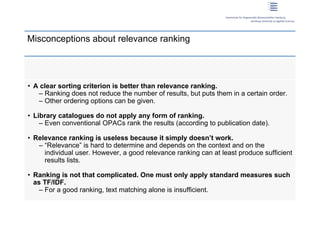
Misconceptions about relevance ranking


 • A clear sorting criterion is better than relevance ranking.
    – Ranking does not reduce the number of results, but puts them in a certain order.
    – Other ordering options can be given.

 • Library catalogues do not apply any form of ranking.
     – Even conventional OPACs rank the results (according to publication date).

 • Relevance ranking is useless because it simply doesn’t work.
    – “Relevance” is hard to determine and depends on the context and on the
      individual user. However, a good relevance ranking can at least produce sufficient
      results lists.

 • Ranking is not that complicated. One must only apply standard measures such
   as TF/IDF.
     – For a good ranking, text matching alone is insufficient.

6 | Dirk Lewandowski
Agenda


 The state of the OPAC and the importance of relevance ranking

 Ranking factors

 The composition of results lists

 Conclusions


7 | Dirk Lewandowski
Ranking factors in web search engines


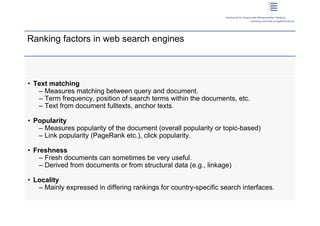
 • Text matching
    – Measures matching between query and document.
    – Term frequency, position of search terms within the documents, etc.
    – Text from document fulltexts, anchor texts.

 • Popularity
    – Measures popularity of the document (overall popularity or topic-based)
    – Link popularity (PageRank etc.), click popularity.

 • Freshness
     – Fresh documents can sometimes be very useful.
     – Derived from documents or from structural data (e.g., linkage)

 • Locality
    – Mainly expressed in differing rankings for country-specific search interfaces.

8 | Dirk Lewandowski: How can library materials be ranked in the OPAC?
         Lewandowski
Text matching


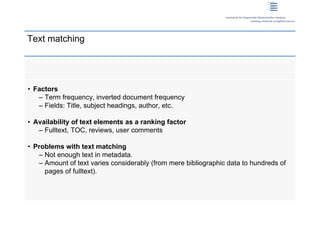
 • Factors
    – Term frequency, inverted document frequency
    – Fields: Title, subject headings, author, etc.

 • Availability of text elements as a ranking factor
    – Fulltext, TOC, reviews, user comments

 • Problems with text matching
    – Not enough text in metadata.
    – Amount of text varies considerably (from mere bibliographic data to hundreds of
      pages of fulltext).


9 | Dirk Lewandowski
Popularity


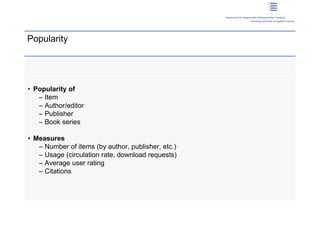
 • Popularity of
    – Item
    – Author/editor
    – Publisher
    – Book series

 • Measures
    – Number of items (by author, publisher, etc.)
    – Usage (circulation rate, download requests)
    – Average user rating
    – Citations


10 | Dirk Lewandowski
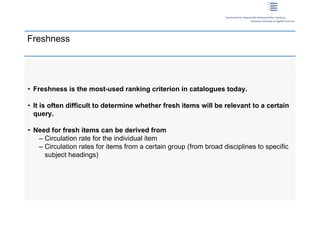
Freshness


 • Freshness is the most-used ranking criterion in catalogues today.

 • It is often difficult to determine whether fresh items will be relevant to a certain
   query.

 • Need for fresh items can be derived from
    – Circulation rate for the individual item
    – Circulation rates for items from a certain group (from broad disciplines to specific
      subject headings)


11 | Dirk Lewandowski
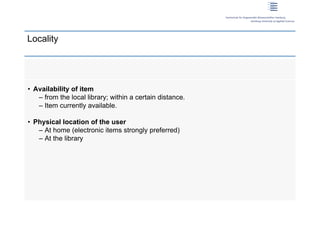
Locality


 • Availability of item
    – from the local library; within a certain distance.
    – Item currently available.

 • Physical location of the user
    – At home (electronic items strongly preferred)
    – At the library


12 | Dirk Lewandowski
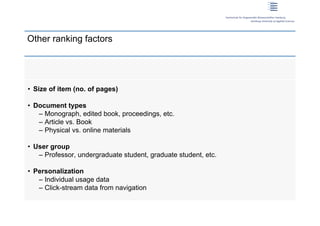
Other ranking factors


 • Size of item (no. of pages)

 • Document types
    – Monograph, edited book, proceedings, etc.
    – Article vs. Book
    – Physical vs. online materials

 • User group
    – Professor, undergraduate student, graduate student, etc.

 • Personalization
    – Individual usage data
    – Click-stream data from navigation

13 | Dirk Lewandowski
Agenda


 The state of the OPAC and the importance of relevance ranking

 Ranking factors

 The composition of results lists

 Conclusions


14 | Dirk Lewandowski
Data needed


 • Data from the catalogue

 • Circulation data
    – Anonymous

 • Location data
    – From IP ranges

 • User data

 • Data from remote resources
    – Abstracts (and fulltexts) from publishers.


15 | Dirk Lewandowski
Collections and databases


 • Library controlled
     – catalogue
     – Local digital repositories
     – Course management systems
     – Institutional web sites

 • External collections
    – A&I databases
    – E-journal collections


16 | Dirk Lewandowski
Mixed results lists


 • Ranking algorithms prefer “more of the same”. This does not satisfy users’
   needs for a variety of results.

 • Example for a broad query
    – Reference works (from subject headings + items from reference collection)
    – Text books
    – Relevant databases
    – Some current items
    – Relevant journals


17 | Dirk Lewandowski
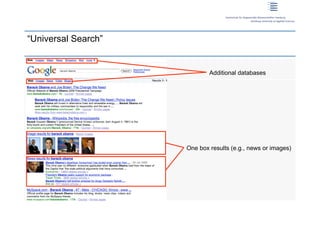
“Universal Search”


                                                                                  Additional databases

 • x


                                                                          One box results (e.g., news or images)


18 | Dirk Lewandowski: How can library materials be ranked in the OPAC?
          Lewandowski
Agenda


 The state of the OPAC and the importance of relevance ranking

 Ranking factors

 The composition of results lists

 Conclusions


19 | Dirk Lewandowski
Conclusions


 • Search is the core of the library catalogue.
    – However, other elements must be considered, too:
          – Usability
          – User guidance
          – Spelling corrections
          – etc.

 • A good ranking is always a mixture of ranking factors

 • In addition, results lists should be mixed.
     – Items from different collections.
     – Mixture of direct results and pointers to other collections.

 • Future: catalogue will become more like a search engines.
20 | Dirk Lewandowski
Thank you for your attention.
Prof. Dr.
Dirk Lewandowski

Hamburg University of Applied Sciences
Department Information
Berliner Tor 5
D - 20099 Hamburg
Germany


www.bui.haw-hamburg.de/lewandowski.html
E-Mail: dirk.lewandowski@haw-hamburg.de

How can library materials be ranked in the OPAC?

  • 1.
    How can librarymaterials be ranked in the OPAC? Prof. Dr. Dirk Lewandowski University of Applied Sciences Hamburg dirk.lewandowski@haw-hamburg.de 9th International Bielefeld Conference Bielefeld, 4 February 2009
  • 2.
    Agenda The stateof the OPAC and the importance of relevance ranking Ranking factors The composition of results lists Conclusions 1 | Dirk Lewandowski
  • 3.
    Agenda The stateof the OPAC and the importance of relevance ranking Ranking factors The composition of results lists Conclusions 2 | Dirk Lewandowski
  • 4.
    What’s wrong withlibrary catalogueues? • catalogueues are incomplete – Items from journal article collections, abstracting and indexing databases • “Electronic card catalogueue”? • User behaviour changed – Short queries, fast results, one set of results – Search engines strongly influence users’ demands • Known item vs. topic-based search – OPACs should accomodate both. 3 | Dirk Lewandowski
  • 5.
    Some ideas toimprove the OPAC (“catalogue 2.0”) • Let users participate – Write reviews – Rate titles • Enrich bibliographic data – Add reviews – Add TOC • Improve navigation – Drill-down menus on results pages to combine searching and browsing • Extend the database – Federated search 4 | Dirk Lewandowski
  • 6.
    Core of allsearch appliances: Relevance ranking • While Web 2.0 features add value to the catalogue, search is still the core. • “Search must work” • Users’ needs – Users want results quickly. – Users are not willing to think too much about formulating their queries. – Users are not willing to search for the right database before conducting their search. – Users are only willing to view a few results on the first results page before deciding to continue. 5 | Dirk Lewandowski
  • 7.
    Misconceptions about relevanceranking • A clear sorting criterion is better than relevance ranking. – Ranking does not reduce the number of results, but puts them in a certain order. – Other ordering options can be given. • Library catalogues do not apply any form of ranking. – Even conventional OPACs rank the results (according to publication date). • Relevance ranking is useless because it simply doesn’t work. – “Relevance” is hard to determine and depends on the context and on the individual user. However, a good relevance ranking can at least produce sufficient results lists. • Ranking is not that complicated. One must only apply standard measures such as TF/IDF. – For a good ranking, text matching alone is insufficient. 6 | Dirk Lewandowski
  • 8.
    Agenda The stateof the OPAC and the importance of relevance ranking Ranking factors The composition of results lists Conclusions 7 | Dirk Lewandowski
  • 9.
    Ranking factors inweb search engines • Text matching – Measures matching between query and document. – Term frequency, position of search terms within the documents, etc. – Text from document fulltexts, anchor texts. • Popularity – Measures popularity of the document (overall popularity or topic-based) – Link popularity (PageRank etc.), click popularity. • Freshness – Fresh documents can sometimes be very useful. – Derived from documents or from structural data (e.g., linkage) • Locality – Mainly expressed in differing rankings for country-specific search interfaces. 8 | Dirk Lewandowski: How can library materials be ranked in the OPAC? Lewandowski
  • 10.
    Text matching •Factors – Term frequency, inverted document frequency – Fields: Title, subject headings, author, etc. • Availability of text elements as a ranking factor – Fulltext, TOC, reviews, user comments • Problems with text matching – Not enough text in metadata. – Amount of text varies considerably (from mere bibliographic data to hundreds of pages of fulltext). 9 | Dirk Lewandowski
  • 11.
    Popularity • Popularityof – Item – Author/editor – Publisher – Book series • Measures – Number of items (by author, publisher, etc.) – Usage (circulation rate, download requests) – Average user rating – Citations 10 | Dirk Lewandowski
  • 12.
    Freshness • Freshnessis the most-used ranking criterion in catalogues today. • It is often difficult to determine whether fresh items will be relevant to a certain query. • Need for fresh items can be derived from – Circulation rate for the individual item – Circulation rates for items from a certain group (from broad disciplines to specific subject headings) 11 | Dirk Lewandowski
  • 13.
    Locality • Availabilityof item – from the local library; within a certain distance. – Item currently available. • Physical location of the user – At home (electronic items strongly preferred) – At the library 12 | Dirk Lewandowski
  • 14.
    Other ranking factors • Size of item (no. of pages) • Document types – Monograph, edited book, proceedings, etc. – Article vs. Book – Physical vs. online materials • User group – Professor, undergraduate student, graduate student, etc. • Personalization – Individual usage data – Click-stream data from navigation 13 | Dirk Lewandowski
  • 15.
    Agenda The stateof the OPAC and the importance of relevance ranking Ranking factors The composition of results lists Conclusions 14 | Dirk Lewandowski
  • 16.
    Data needed •Data from the catalogue • Circulation data – Anonymous • Location data – From IP ranges • User data • Data from remote resources – Abstracts (and fulltexts) from publishers. 15 | Dirk Lewandowski
  • 17.
    Collections and databases • Library controlled – catalogue – Local digital repositories – Course management systems – Institutional web sites • External collections – A&I databases – E-journal collections 16 | Dirk Lewandowski
  • 18.
    Mixed results lists • Ranking algorithms prefer “more of the same”. This does not satisfy users’ needs for a variety of results. • Example for a broad query – Reference works (from subject headings + items from reference collection) – Text books – Relevant databases – Some current items – Relevant journals 17 | Dirk Lewandowski
  • 19.
    “Universal Search” Additional databases • x One box results (e.g., news or images) 18 | Dirk Lewandowski: How can library materials be ranked in the OPAC? Lewandowski
  • 20.
    Agenda The stateof the OPAC and the importance of relevance ranking Ranking factors The composition of results lists Conclusions 19 | Dirk Lewandowski
  • 21.
    Conclusions • Searchis the core of the library catalogue. – However, other elements must be considered, too: – Usability – User guidance – Spelling corrections – etc. • A good ranking is always a mixture of ranking factors • In addition, results lists should be mixed. – Items from different collections. – Mixture of direct results and pointers to other collections. • Future: catalogue will become more like a search engines. 20 | Dirk Lewandowski
  • 22.
    Thank you foryour attention. Prof. Dr. Dirk Lewandowski Hamburg University of Applied Sciences Department Information Berliner Tor 5 D - 20099 Hamburg Germany www.bui.haw-hamburg.de/lewandowski.html E-Mail: dirk.lewandowski@haw-hamburg.de