FAKULTÄT DMI, DEPARTMENT INFORMATION
Dirk Lewandowski
ANALYSING SEARCH ENGINE DATA ON SOCIALLY
RELEVANT TOPICS
Prof. Dr. Dirk Lewandowski
Work done in collaboration with Sebastian Sünkler
GESIS, 19 September 2018
FAKULTÄT DMI, DEPARTMENT INFORMATION
Dirk Lewandowski
AGENDA
1. Background: Search engine bias, user behaviour in search engines
2. How can we crawl data from search engines?
3. How can we build relevant query sets?
4. Case study
5. Conclusion
1
BACKGROUND: SEARCH
ENGINE BIAS, USER
BAHAVIOUR
2
FAKULTÄT DMI, DEPARTMENT INFORMATION
Dirk Lewandowski
3
FAKULTÄT DMI, DEPARTMENT INFORMATION
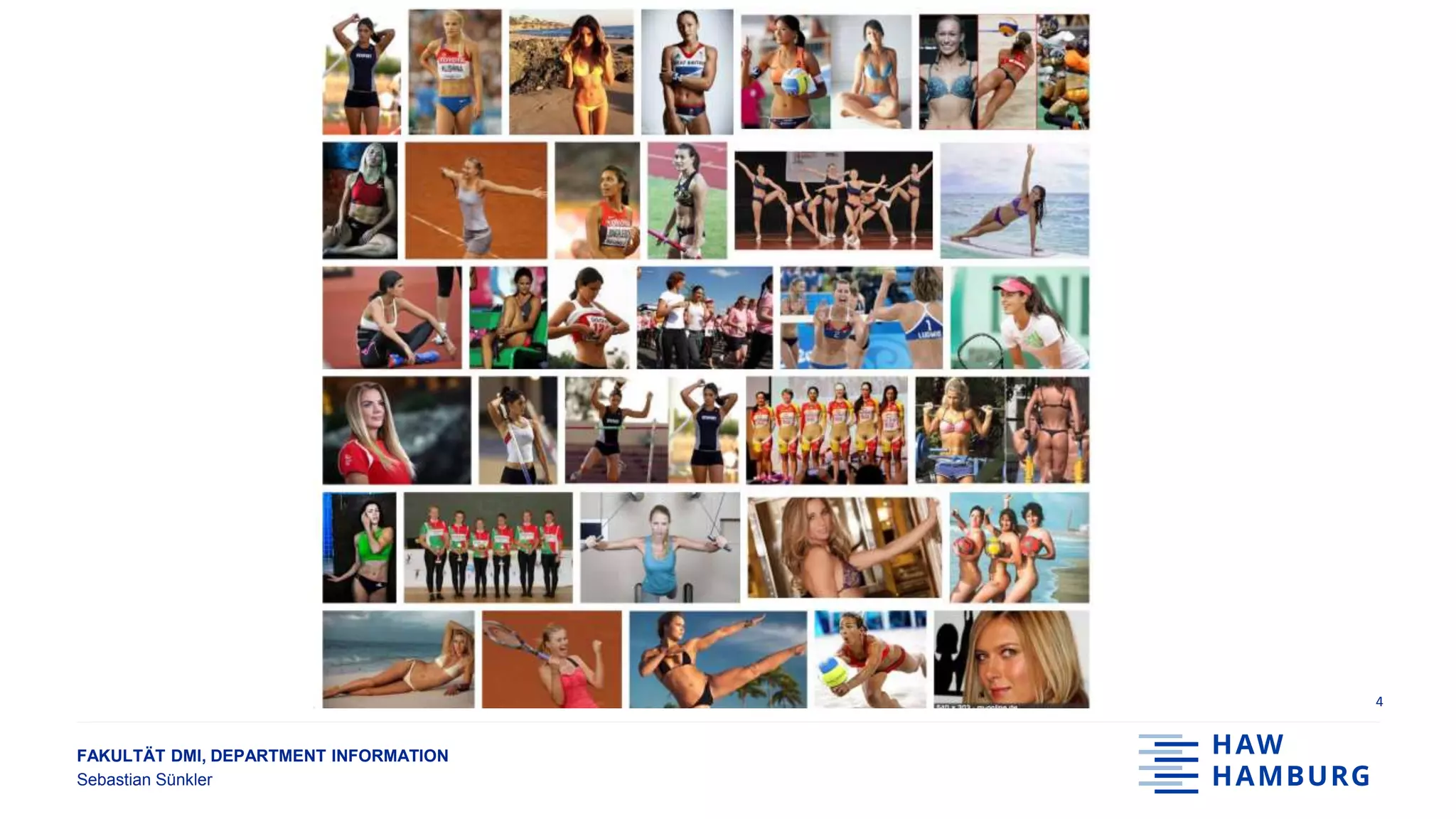
Sebastian Sünkler
4
FAKULTÄT DMI, DEPARTMENT INFORMATION
Dirk Lewandowski
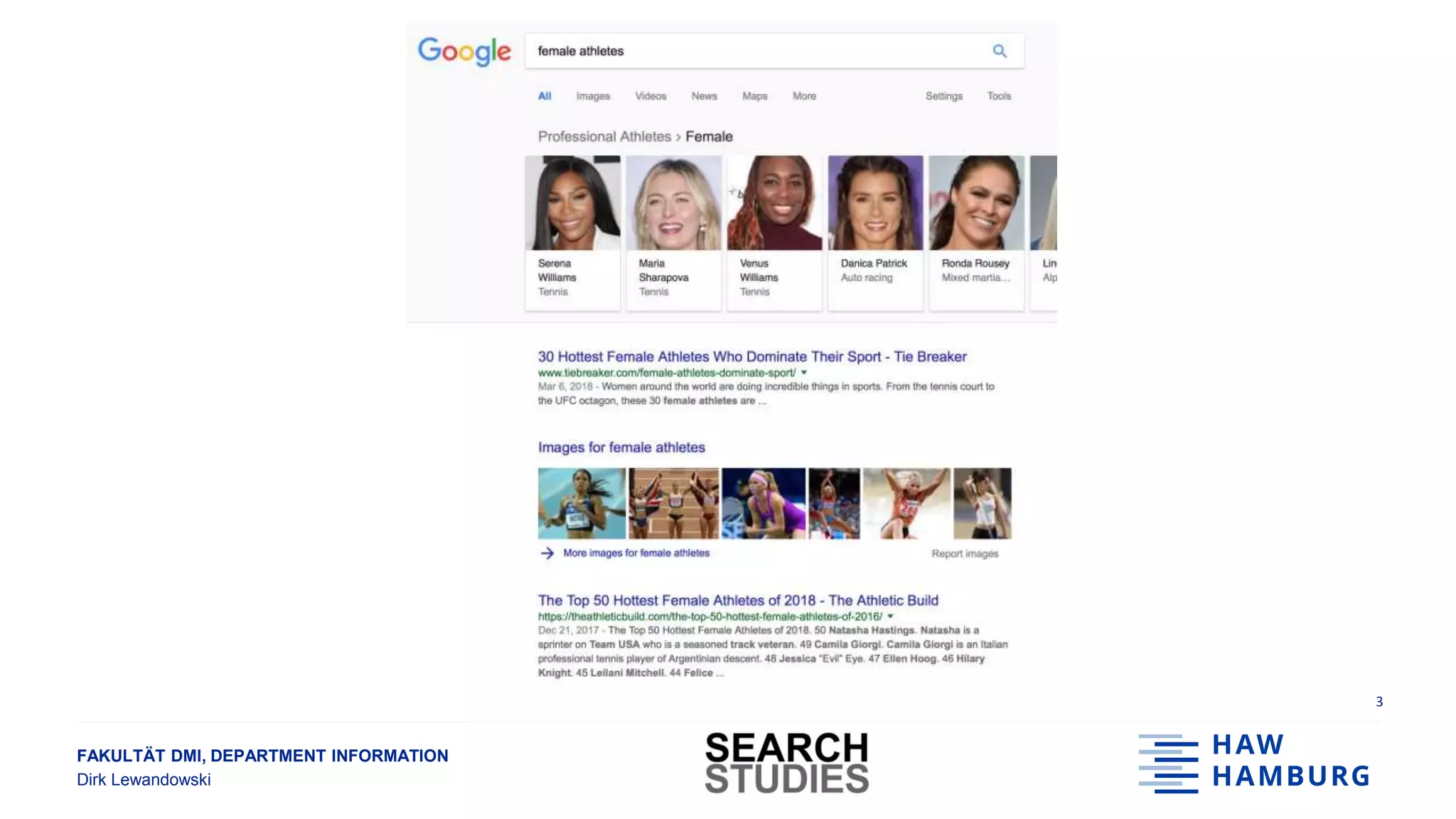
BIASES IN SEARCH ENGINE RESULTS
Biases in regards to…
• Race (Noble, 2018)
• Gender (Noble, 2018; Otterbacher et al., 2017)
• Confirmatory information to queries regarding conspiracy theories (Ballatore, 2015)
• Promotion of hate speech (Bar-Ilan, 2006)
• Health information (White and Horvitz, 2009)
Problems with these studies in general:
• Case studies, anecdotal evidence
• Queries chosen by the researchers (not rule-based); no consideration of query polularity
• No information on results providers; results ranking not considered
5
FAKULTÄT DMI, DEPARTMENT INFORMATION
Dirk Lewandowski
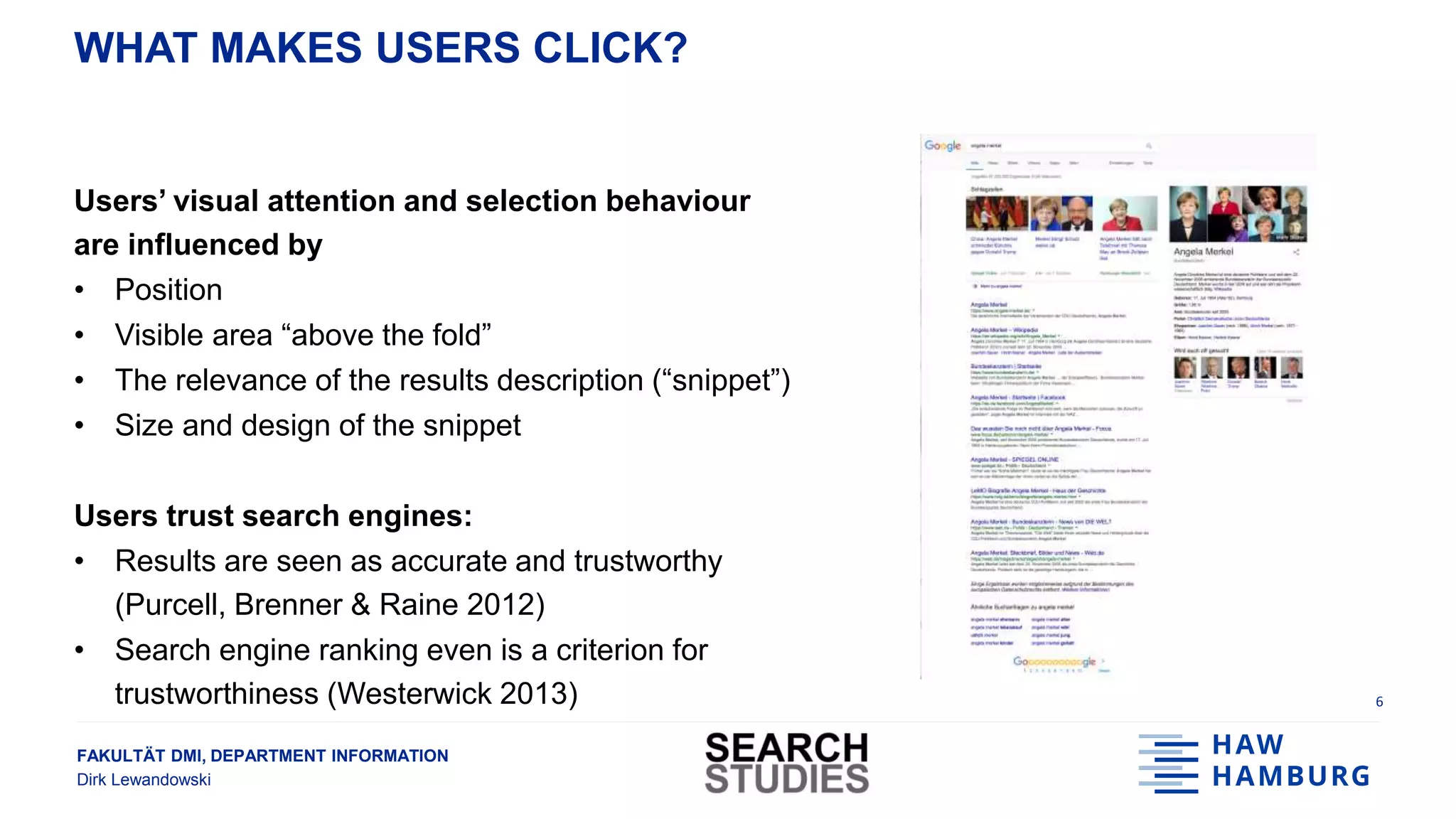
WHAT MAKES USERS CLICK?
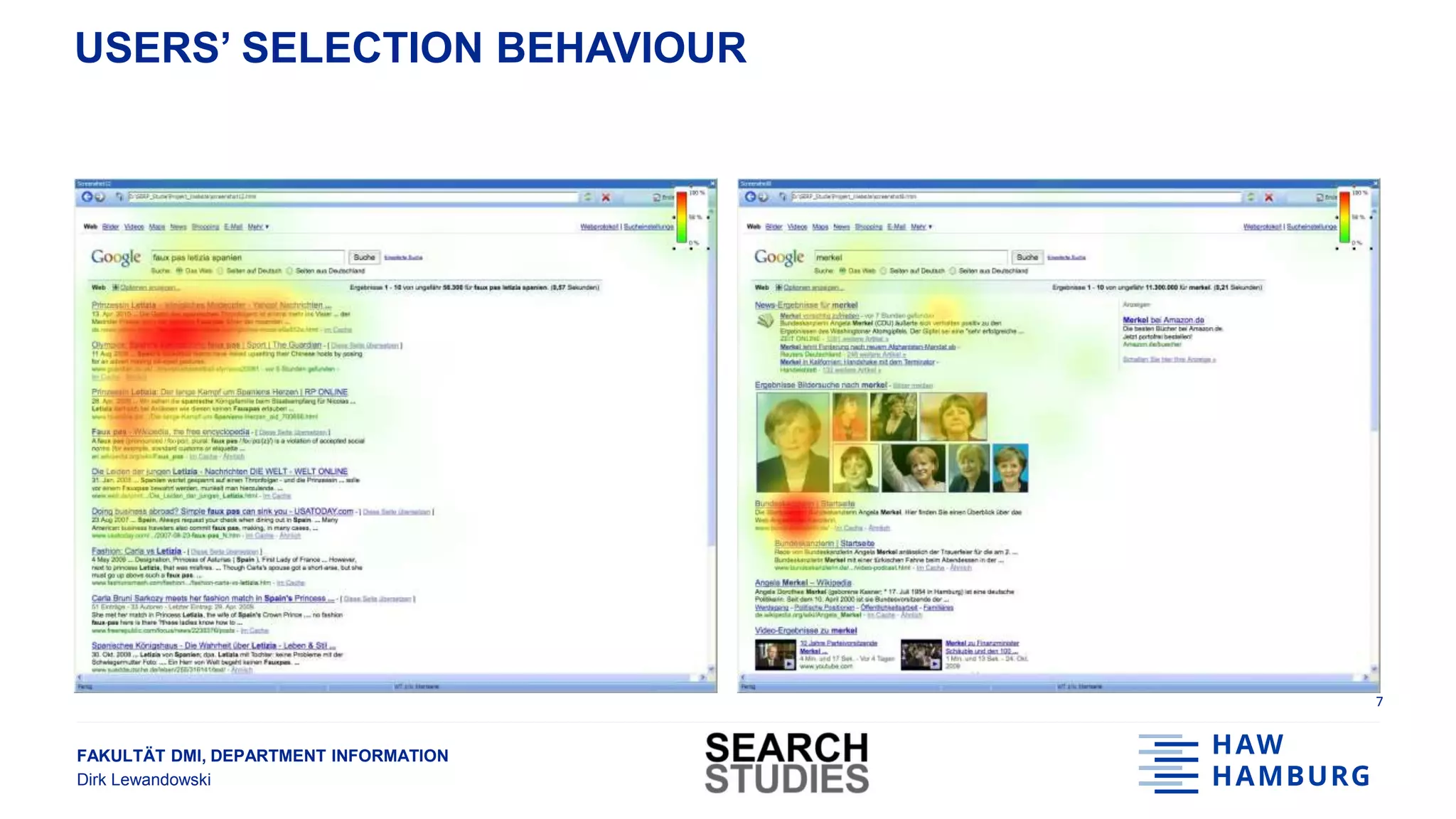
Users’ visual attention and selection behaviour
are influenced by
• Position
• Visible area “above the fold”
• The relevance of the results description (“snippet”)
• Size and design of the snippet
Users trust search engines:
• Results are seen as accurate and trustworthy
(Purcell, Brenner & Raine 2012)
• Search engine ranking even is a criterion for
trustworthiness (Westerwick 2013) 6
FAKULTÄT DMI, DEPARTMENT INFORMATION
Dirk Lewandowski
USERS’ SELECTION BEHAVIOUR
7
FAKULTÄT DMI, DEPARTMENT INFORMATION
Dirk Lewandowski
INFLUENCING SEARCH ENGINE RESULTS
Search engine providers
• Search engine providers act as content providers to their own search engines, e.g.,
Google/YouTube.
• Vertical search engines are integrated into the main search engine, e.g., Google Shopping.
External influences
• Influence on the search results through search engine optimization (SEO), now a multi-billion
Euro industry
8
FAKULTÄT DMI, DEPARTMENT INFORMATION
Dirk Lewandowski
FROM WHICH SOURCES DO THE SEARCH RESULTS COME
FROM?
Studies investigating domains (“sources”)
• About 80 per cent of all clicked results are accounted for by only 10,000 websites (Goel et al.,
2010; 2.6 billion queries from Yahoo logs)
• Low overlap between different search engines in the top 10 results (Spink et al., 2006; 22.000
queries from Infospace/Dogpile)
• Most popular sources in the top 10 differ between search engines; search engine providers
prefer their own offerings (Yahoo Answers; YouTube) (Höchstötter & Lewandowski, 2009;
1.000 queries from Ask.com logs)
Provider level
• To our knowledge, no studies to date
9
HOW CAN WE CRAWL DATA
FROM SEARCH ENGINES?
10
FAKULTÄT DMI, DEPARTMENT INFORMATION
Dirk Lewandowski
COLLECTING SEARCH RESULTS AT SCALE
Problem
• Commercial search engines do not allow access to their results through APIs.
• Data collection in scholarly studies is usually done manually.
• Scholarly studies are usually low-scale, i.e., using only some sample queries.
Our approach
• Querying search engines automatically, using large numbers of queries
• Using screen scraping to collect search results from the HTML pages of search engines
11
FAKULTÄT DMI, DEPARTMENT INFORMATION
Dirk Lewandowski
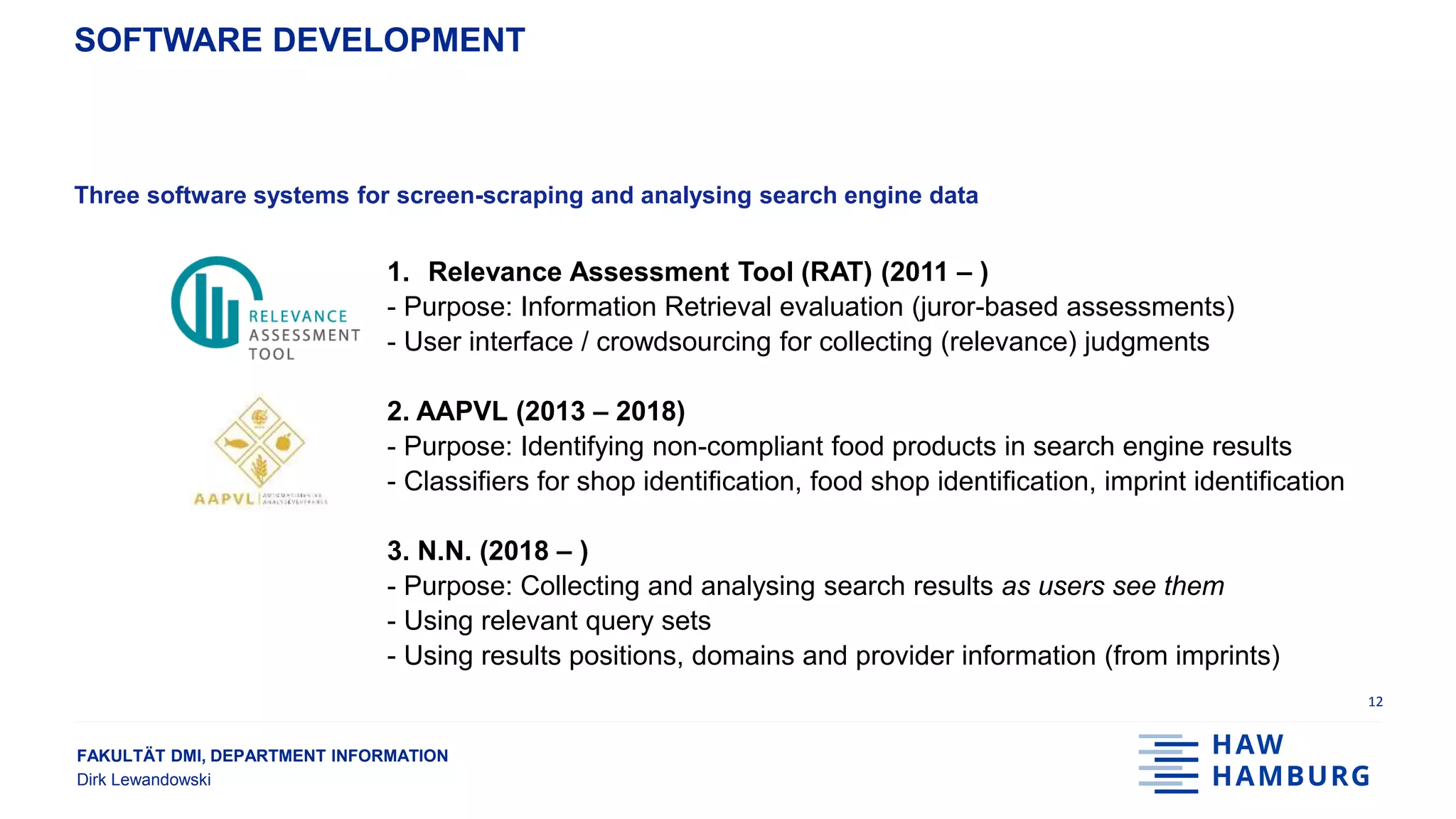
SOFTWARE DEVELOPMENT
Three software systems for screen-scraping and analysing search engine data
1. Relevance Assessment Tool (RAT) (2011 – )
- Purpose: Information Retrieval evaluation (juror-based assessments)
- User interface / crowdsourcing for collecting (relevance) judgments
2. AAPVL (2013 – 2018)
- Purpose: Identifying non-compliant food products in search engine results
- Classifiers for shop identification, food shop identification, imprint identification
3. N.N. (2018 – )
- Purpose: Collecting and analysing search results as users see them
- Using relevant query sets
- Using results positions, domains and provider information (from imprints)
12
FAKULTÄT DMI, DEPARTMENT INFORMATION
Dirk Lewandowski
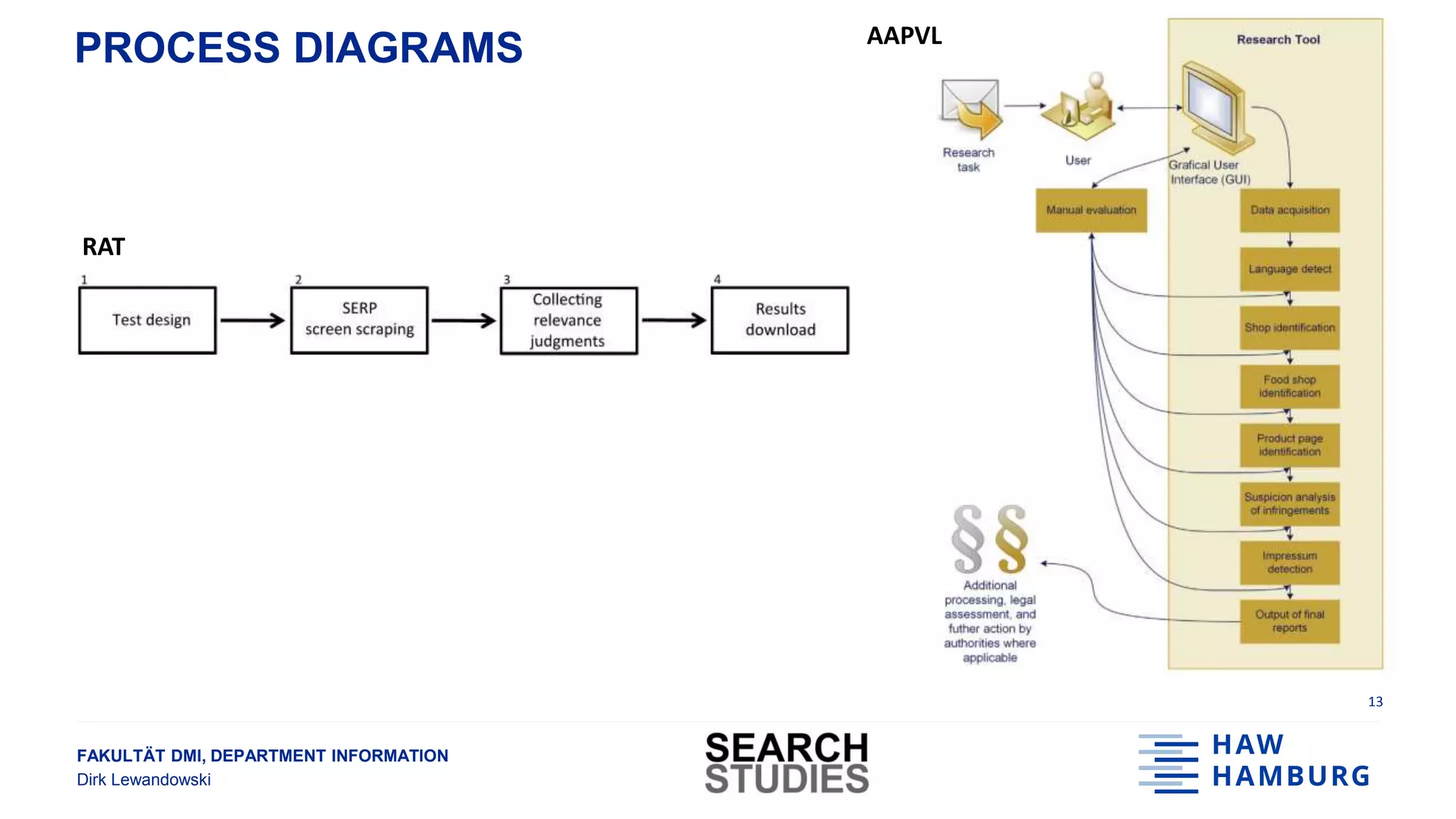
PROCESS DIAGRAMS
13
RAT
AAPVL
FAKULTÄT DMI, DEPARTMENT INFORMATION
Dirk Lewandowski
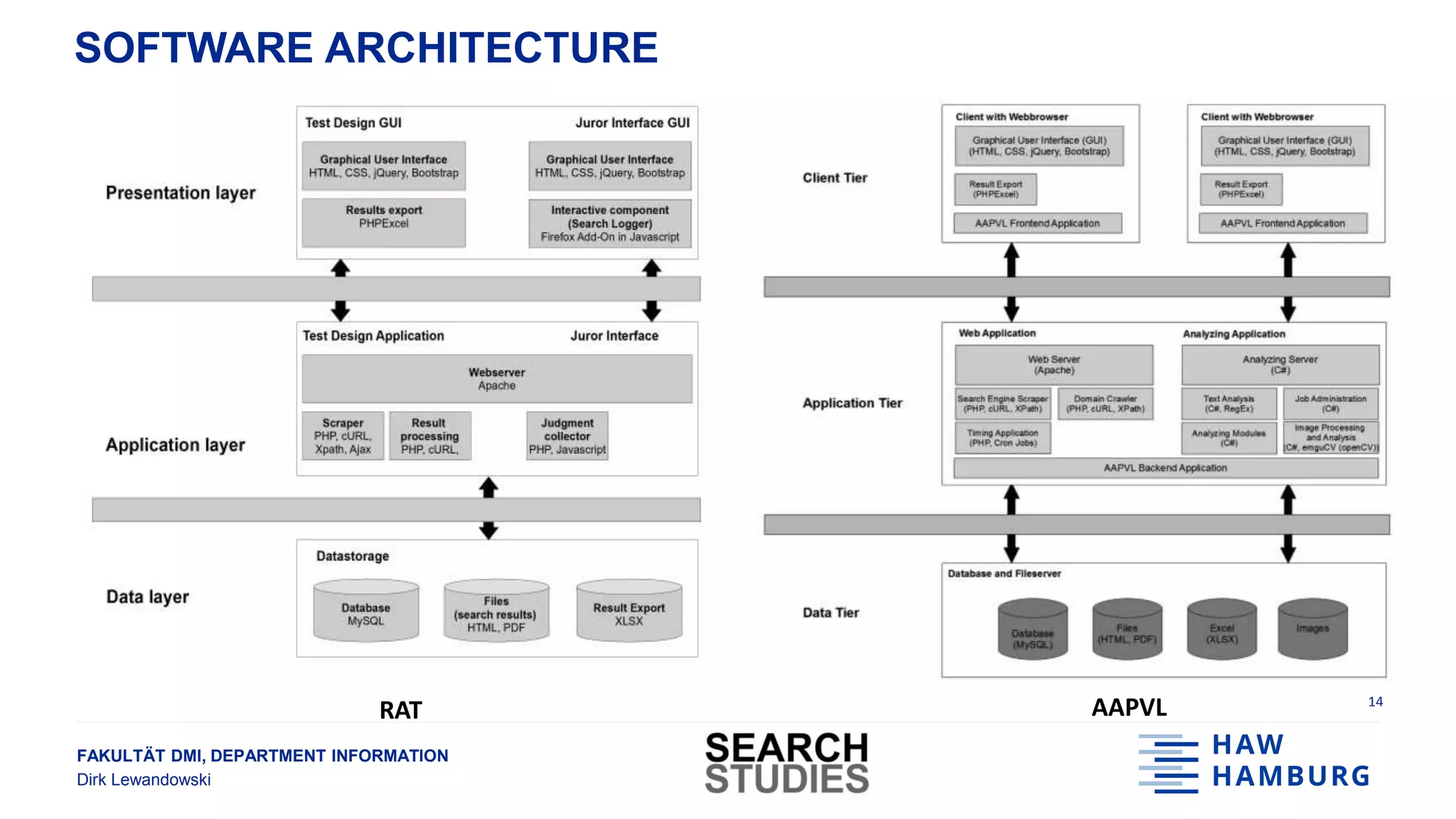
SOFTWARE ARCHITECTURE
14
RAT AAPVL
FAKULTÄT DMI, DEPARTMENT INFORMATION
Dirk Lewandowski
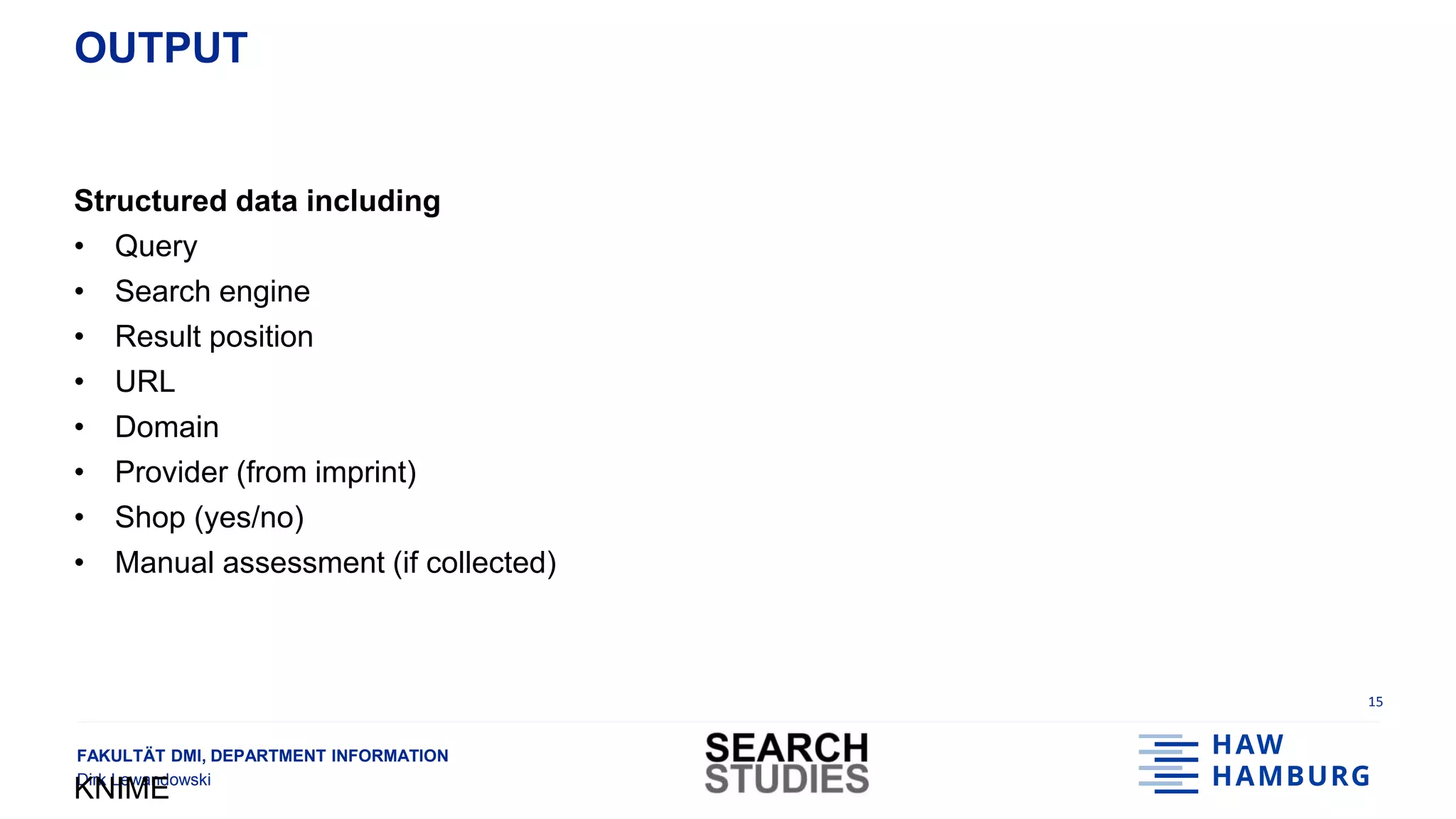
OUTPUT
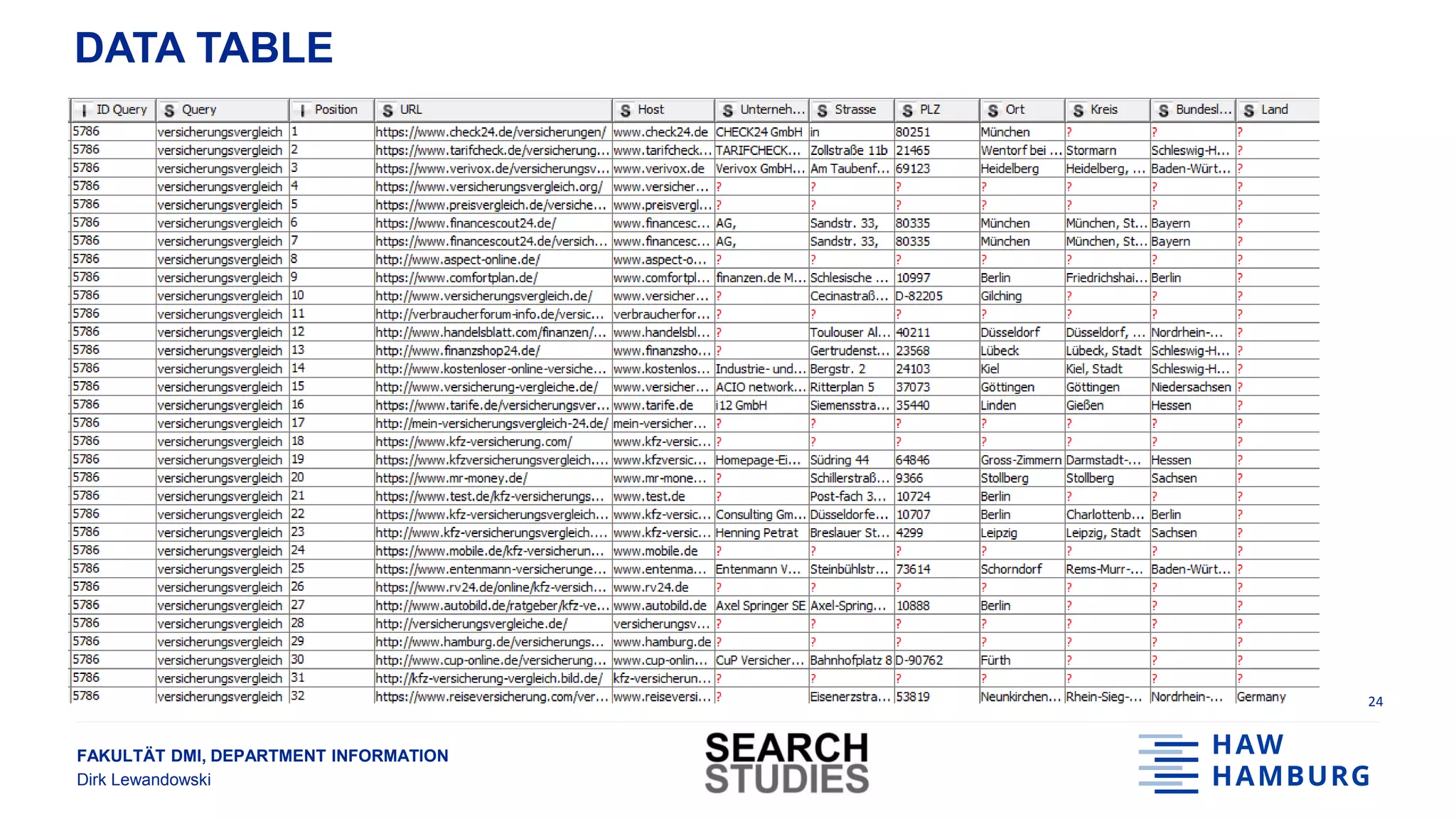
Structured data including
• Query
• Search engine
• Result position
• URL
• Domain
• Provider (from imprint)
• Shop (yes/no)
• Manual assessment (if collected)
KNIME
15
FAKULTÄT DMI, DEPARTMENT INFORMATION
Dirk Lewandowski
APPLICABILITY
Some examples:
• Search engine results evaluation using 1.000 queries, comparing Google and Bing
(Lewandowski, 2015)
• Finding non-compliant food products (several studies, some 10.000 results analysed manually
by expert jurors as well as automatically)
• Finding out what Google users get to see for certain topics (case study discussed later)
16
HOW CAN WE BUILD
RELEVANT QUERY SETS?
17
FAKULTÄT DMI, DEPARTMENT INFORMATION
Dirk Lewandowski
SELECTING SEARCH QUERIES
Why work with query sets?
• Represent actual user behaviour
• Address problem of anecdotal evidence and small-scale studies
Approaches to selecting search queries to build a query set
1. Use your own inspiration (leads to arbitrary query sets)
2. Transaction log data from search engines (problem of access)
3. Google Trends (no absolute numbers but useful for comparing query popularity)
4. Google’s (or Bing’s) advertisement campaign planning tools (not tested yet)
18
USE CASE: QUERIES ON
INSURANCE COMPARISONS
19
FAKULTÄT DMI, DEPARTMENT INFORMATION
Dirk Lewandowski
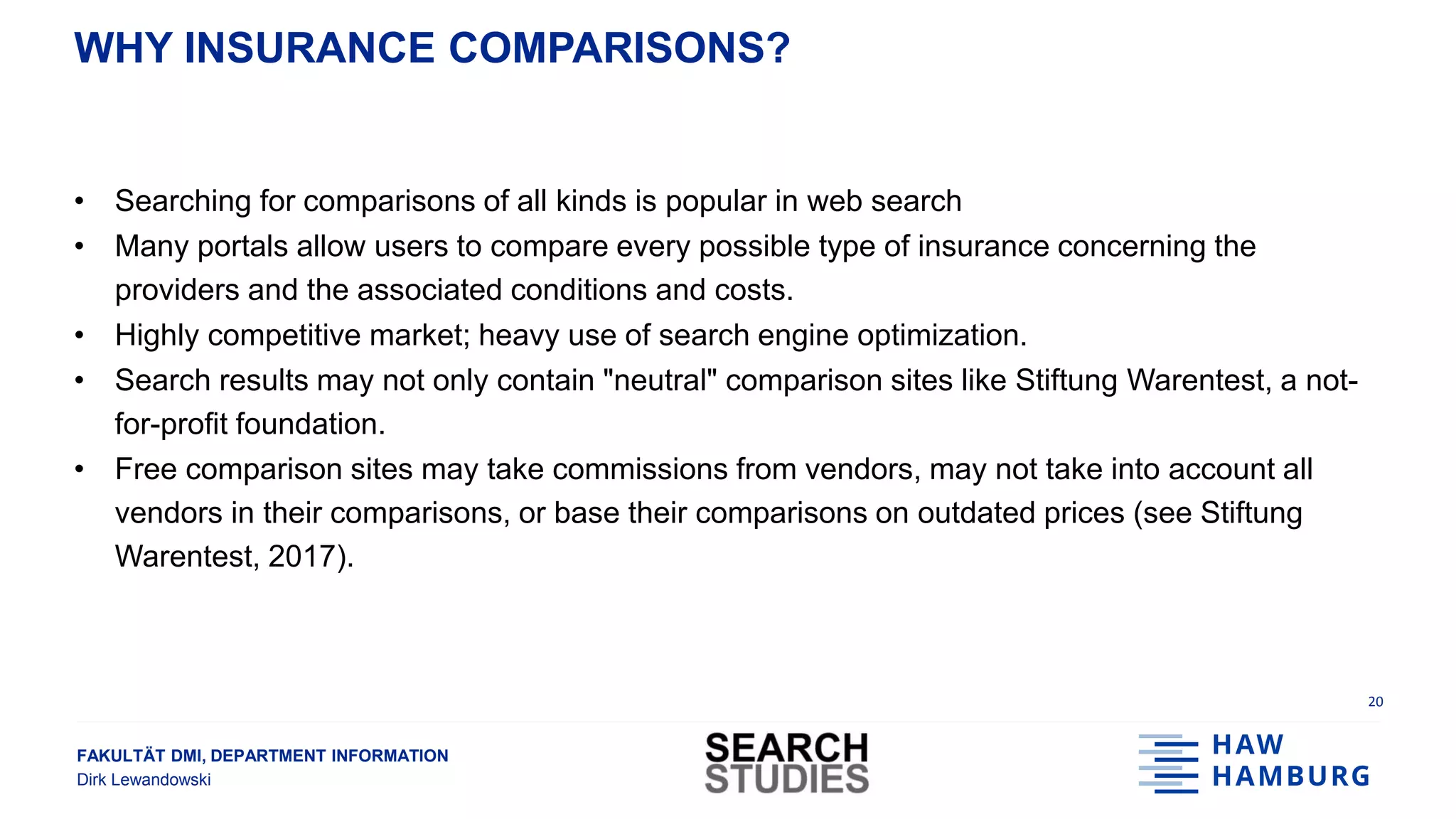
WHY INSURANCE COMPARISONS?
• Searching for comparisons of all kinds is popular in web search
• Many portals allow users to compare every possible type of insurance concerning the
providers and the associated conditions and costs.
• Highly competitive market; heavy use of search engine optimization.
• Search results may not only contain "neutral" comparison sites like Stiftung Warentest, a not-
for-profit foundation.
• Free comparison sites may take commissions from vendors, may not take into account all
vendors in their comparisons, or base their comparisons on outdated prices (see Stiftung
Warentest, 2017).
20
FAKULTÄT DMI, DEPARTMENT INFORMATION
Dirk Lewandowski
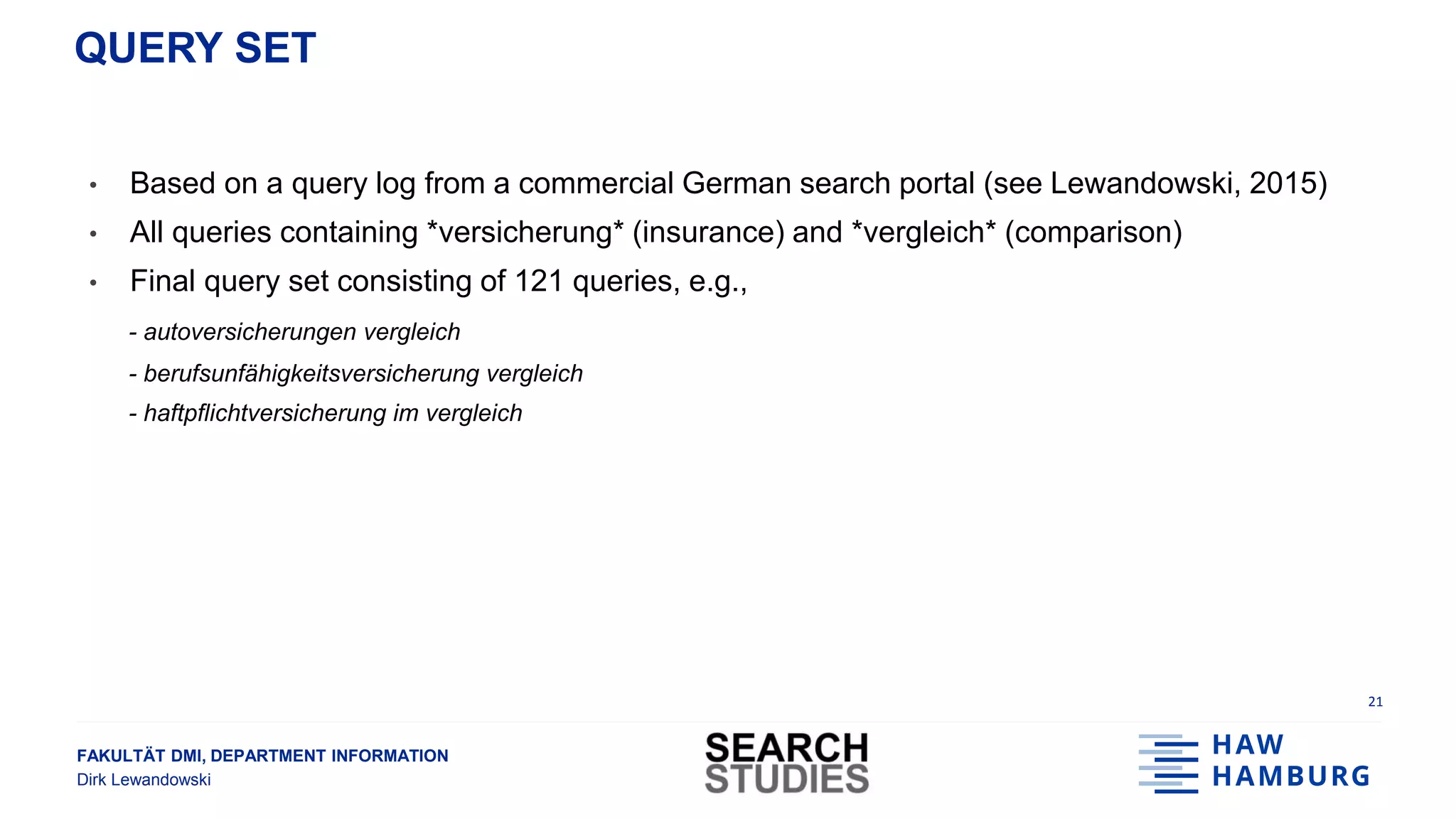
QUERY SET
21
• Based on a query log from a commercial German search portal (see Lewandowski, 2015)
• All queries containing *versicherung* (insurance) and *vergleich* (comparison)
• Final query set consisting of 121 queries, e.g.,
- autoversicherungen vergleich
- berufsunfähigkeitsversicherung vergleich
- haftpflichtversicherung im vergleich
FAKULTÄT DMI, DEPARTMENT INFORMATION
Dirk Lewandowski
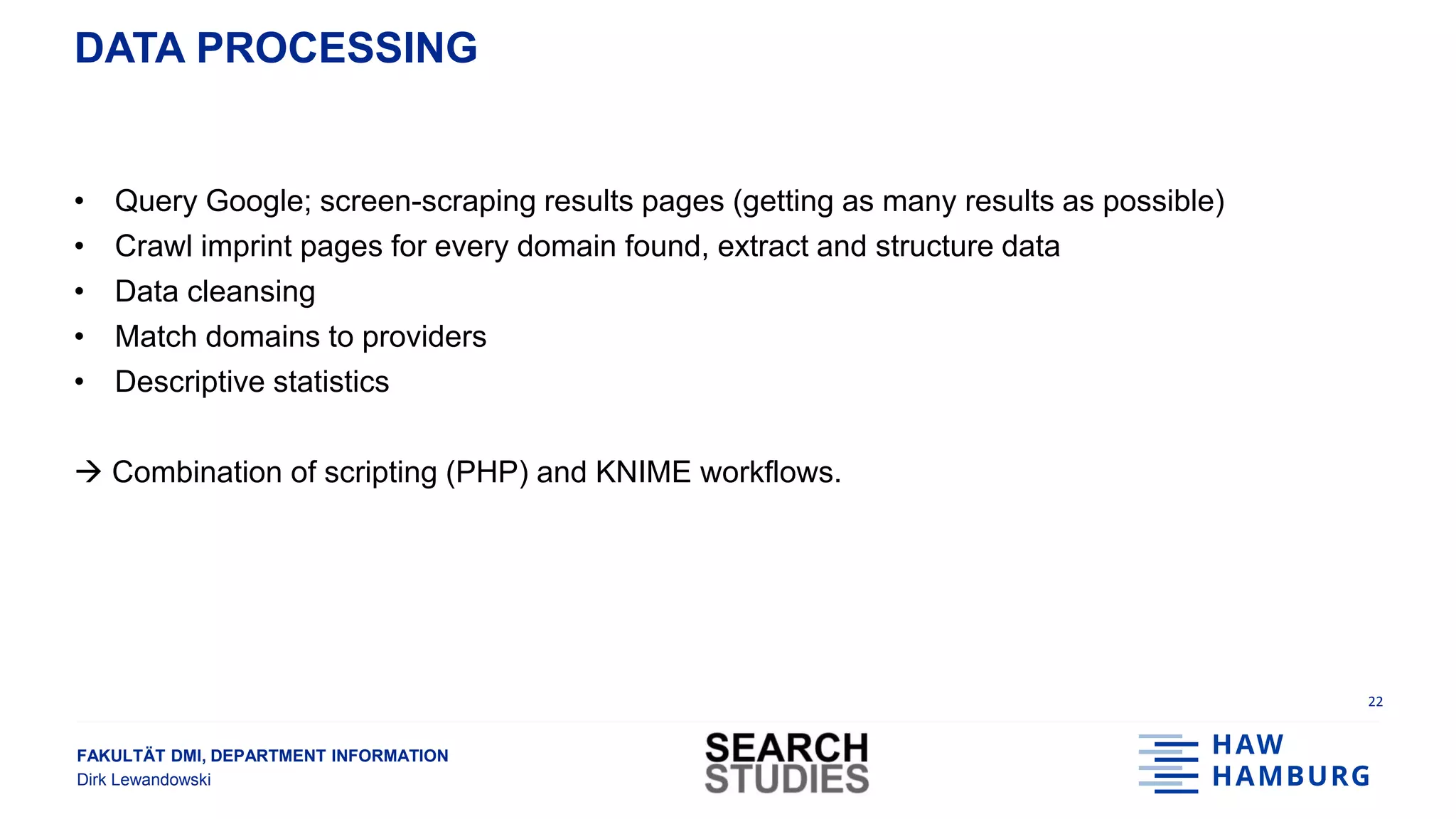
DATA PROCESSING
• Query Google; screen-scraping results pages (getting as many results as possible)
• Crawl imprint pages for every domain found, extract and structure data
• Data cleansing
• Match domains to providers
• Descriptive statistics
 Combination of scripting (PHP) and KNIME workflows.
22
FAKULTÄT DMI, DEPARTMENT INFORMATION
Dirk Lewandowski
DATA SET
• Number of queries: 121
• Number of search results: 22,138
• Results per query: 183 [1, 298]
• Number of different domains: 3,278
23
FAKULTÄT DMI, DEPARTMENT INFORMATION
Dirk Lewandowski
DATA TABLE
24
FAKULTÄT DMI, DEPARTMENT INFORMATION
Dirk Lewandowski
RESULTS SUMMARY
25
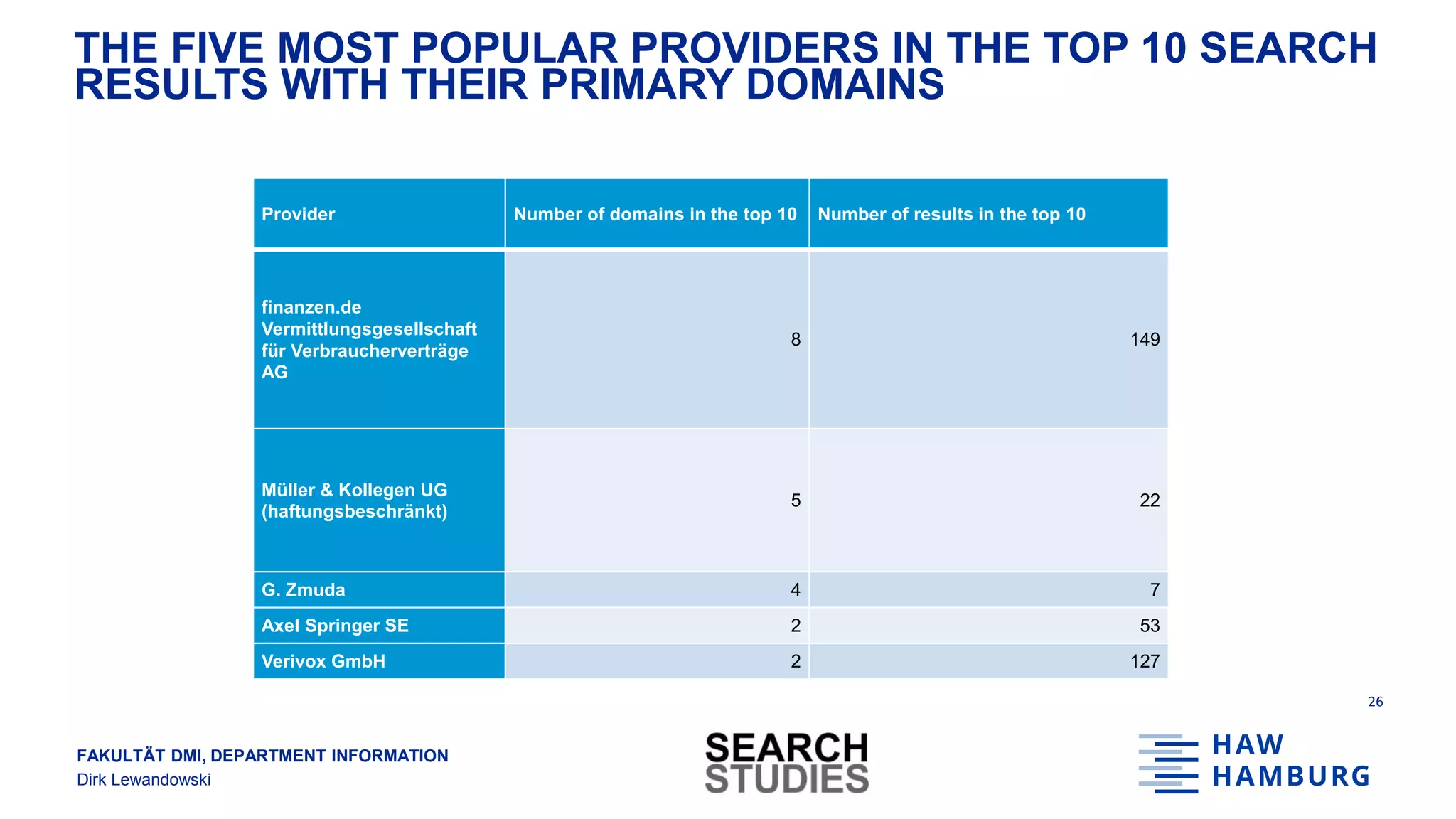
● 116 different domains in top 10 results [10; 1210]
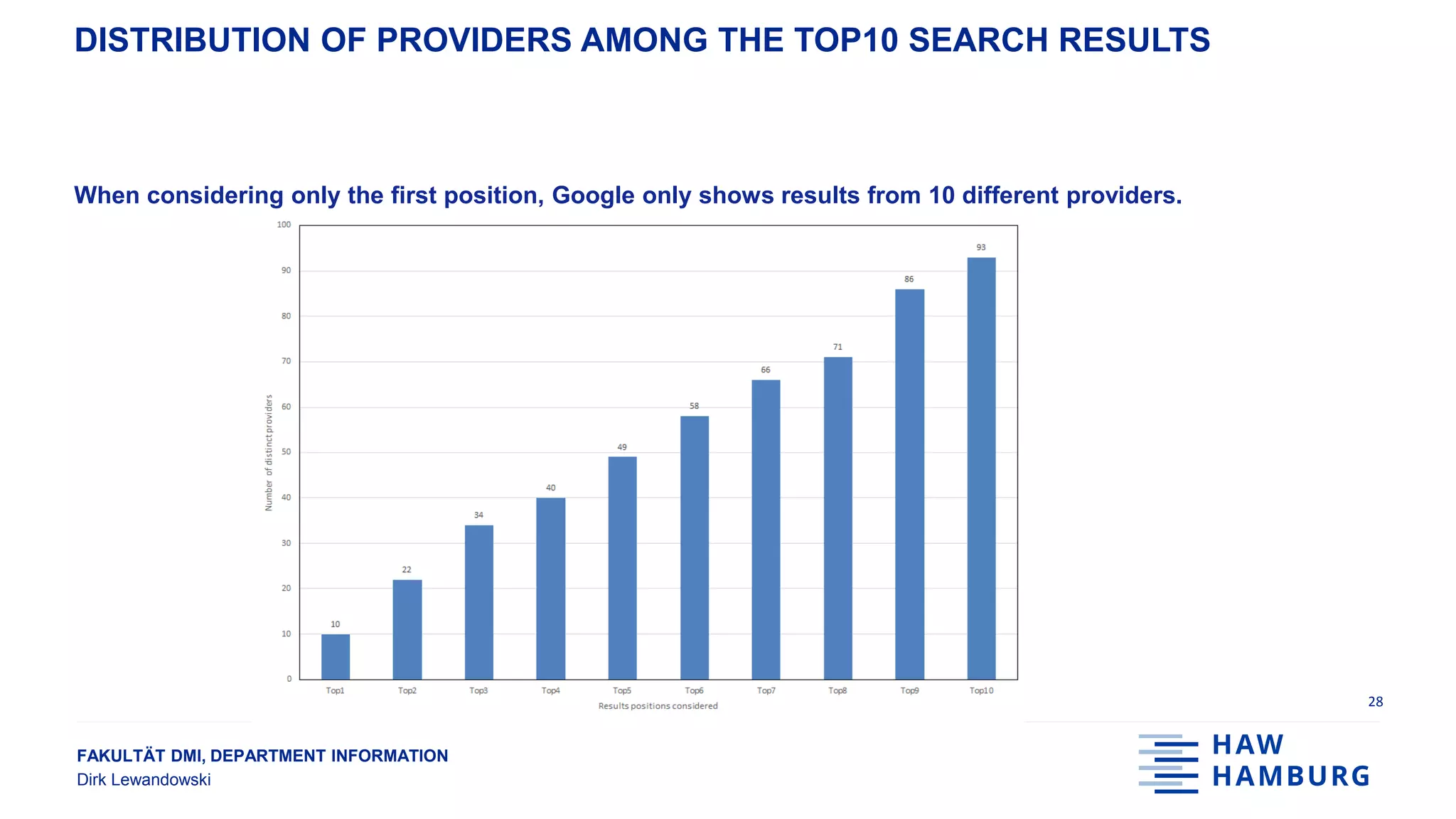
● 93 different providers in top 10 results, i.e., some providers have more than one domain
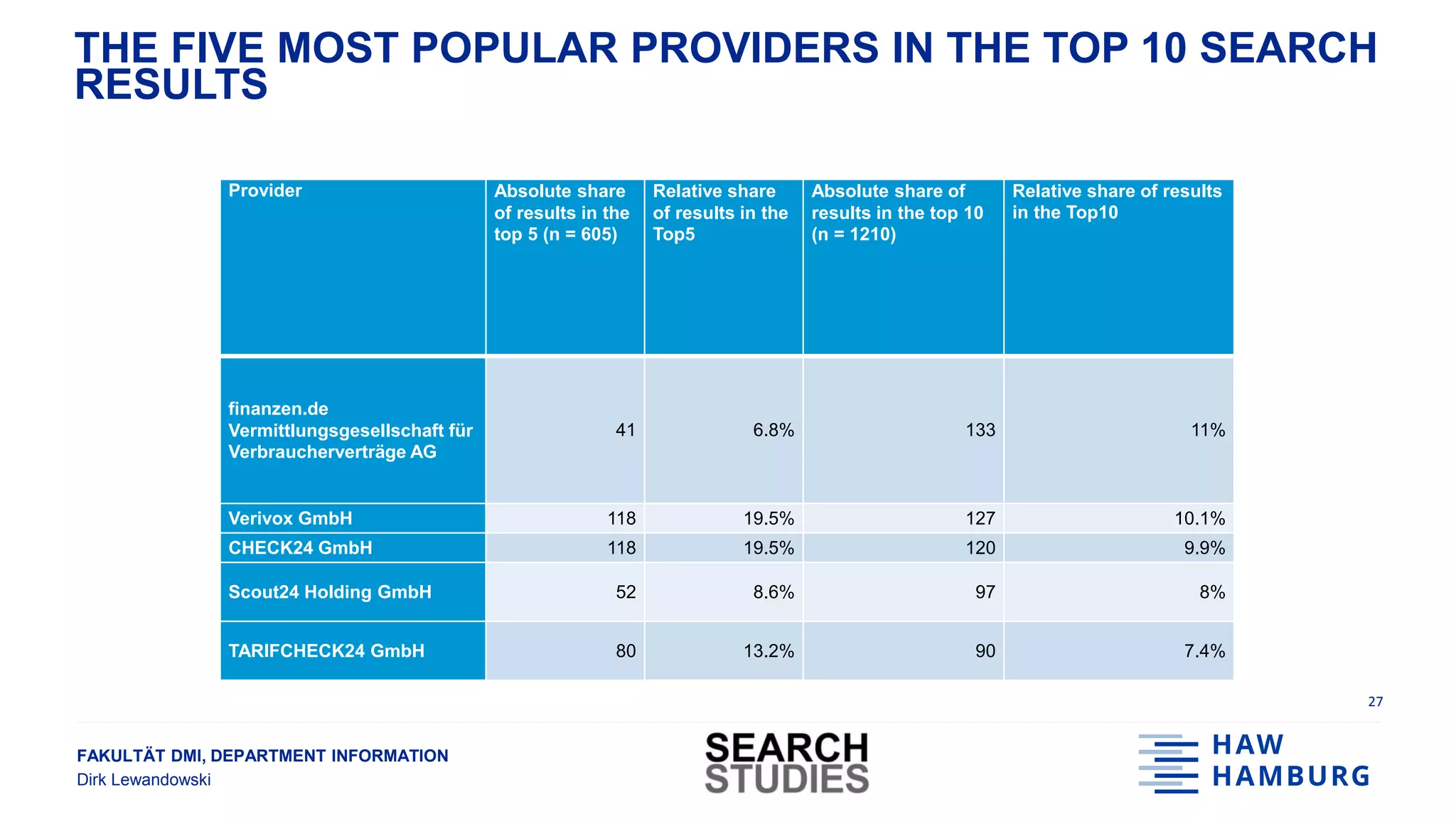
● The 5 most popular providers account for 47% of top 10 results (and 67% of top 5 results)
 Two thirds of top 5 results are from only five different providers
FAKULTÄT DMI, DEPARTMENT INFORMATION
Dirk Lewandowski
THE FIVE MOST POPULAR PROVIDERS IN THE TOP 10 SEARCH
RESULTS WITH THEIR PRIMARY DOMAINS
26
Provider Number of domains in the top 10 Number of results in the top 10
finanzen.de
Vermittlungsgesellschaft
für Verbraucherverträge
AG
8 149
Müller & Kollegen UG
(haftungsbeschränkt)
5 22
G. Zmuda 4 7
Axel Springer SE 2 53
Verivox GmbH 2 127
FAKULTÄT DMI, DEPARTMENT INFORMATION
Dirk Lewandowski
THE FIVE MOST POPULAR PROVIDERS IN THE TOP 10 SEARCH
RESULTS
27
Provider Absolute share
of results in the
top 5 (n = 605)
Relative share
of results in the
Top5
Absolute share of
results in the top 10
(n = 1210)
Relative share of results
in the Top10
finanzen.de
Vermittlungsgesellschaft für
Verbraucherverträge AG
41 6.8% 133 11%
Verivox GmbH 118 19.5% 127 10.1%
CHECK24 GmbH 118 19.5% 120 9.9%
Scout24 Holding GmbH 52 8.6% 97 8%
TARIFCHECK24 GmbH 80 13.2% 90 7.4%
FAKULTÄT DMI, DEPARTMENT INFORMATION
Dirk Lewandowski
DISTRIBUTION OF PROVIDERS AMONG THE TOP10 SEARCH RESULTS
When considering only the first position, Google only shows results from 10 different providers.
28
FAKULTÄT DMI, DEPARTMENT INFORMATION
Dirk Lewandowski
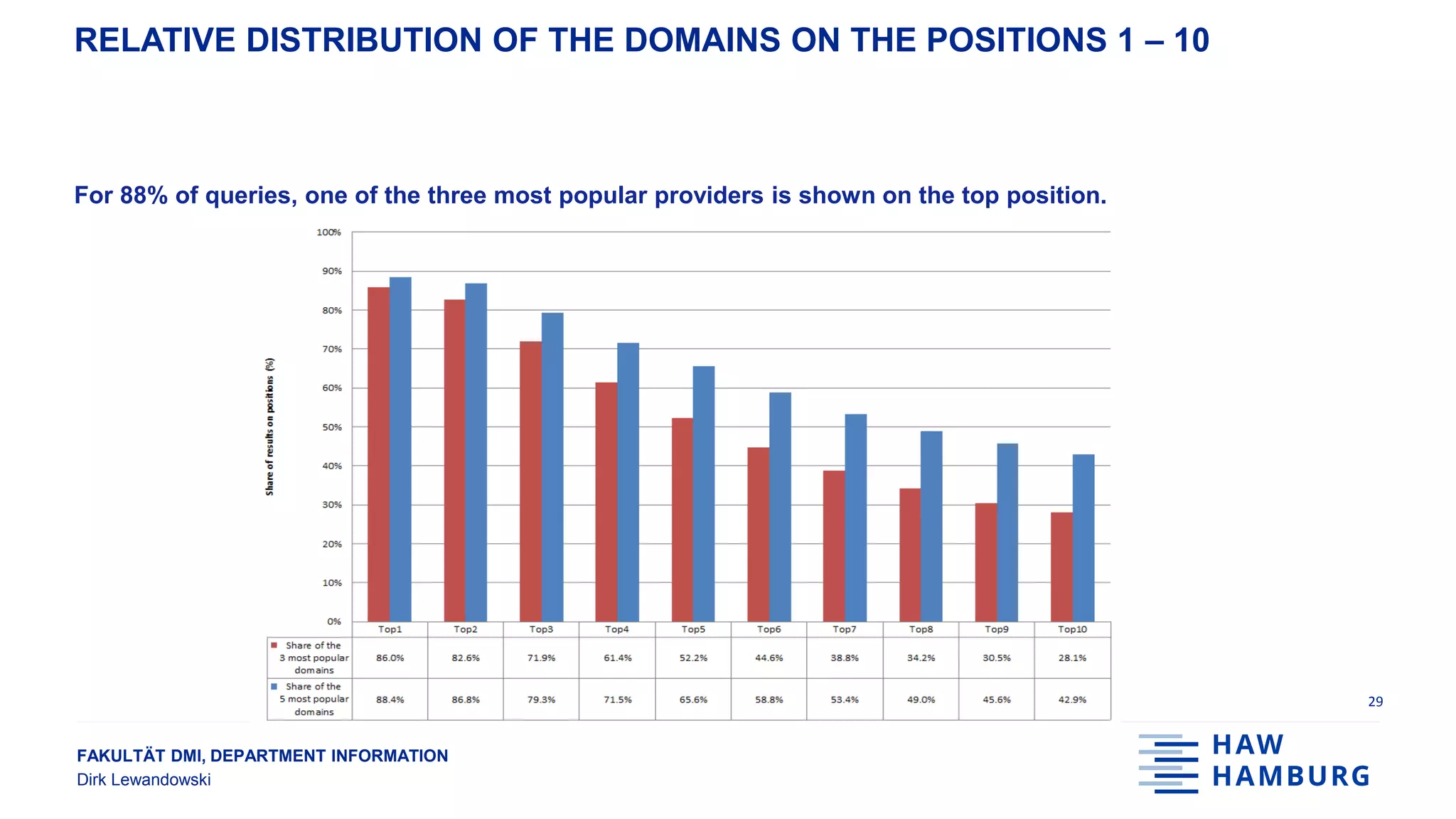
RELATIVE DISTRIBUTION OF THE DOMAINS ON THE POSITIONS 1 – 10
For 88% of queries, one of the three most popular providers is shown on the top position.
29
CONCLUSION
30
FAKULTÄT DMI, DEPARTMENT INFORMATION
Dirk Lewandowski
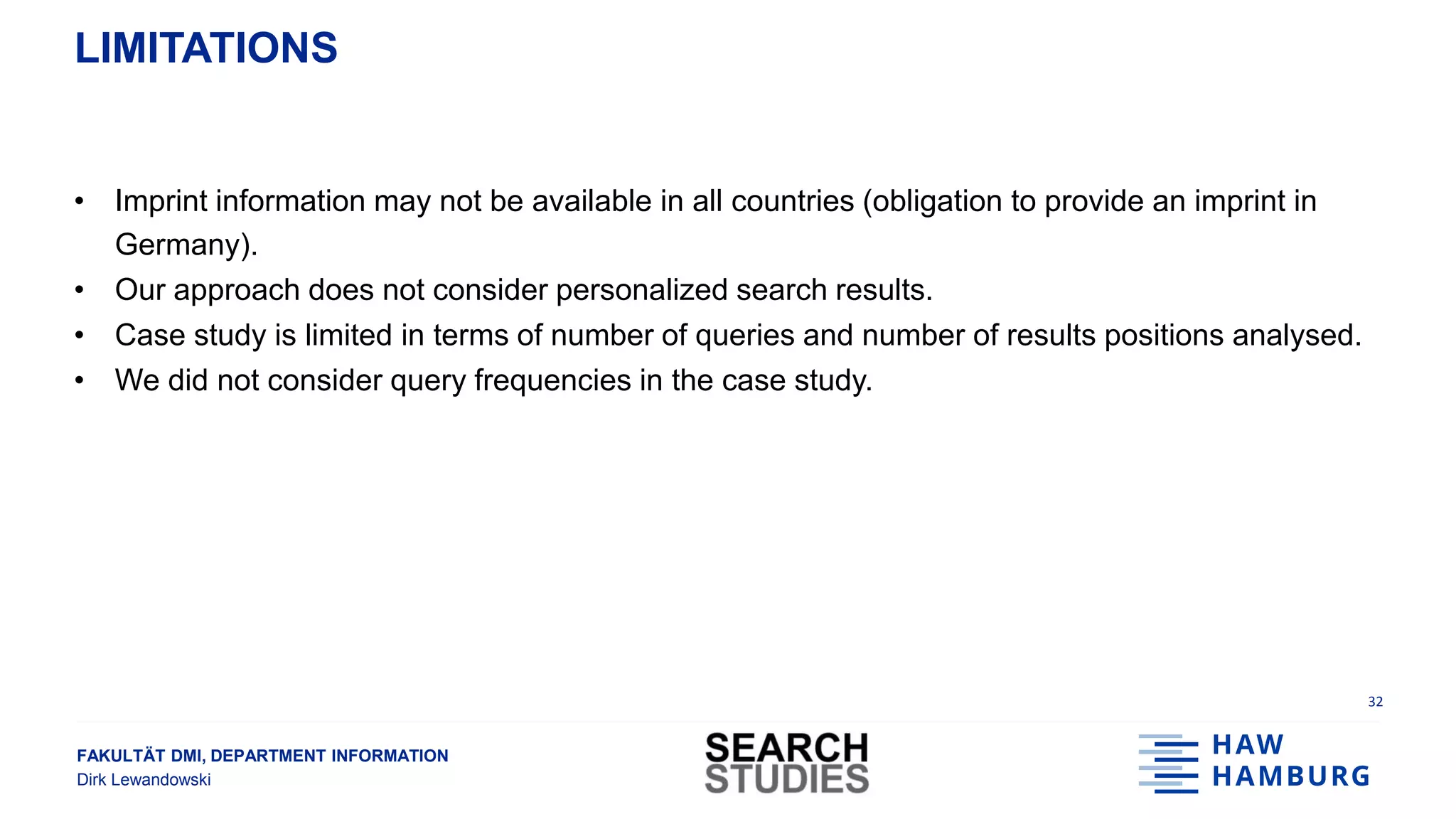
SUMMARY
• Approach that can be used to quantify the distribution of search engine results based on
actual user queries.
• Software is readily available for conducting similar studies.
• Case study shows the feasibility of the approach and gives a first impression of how results in
different topical areas could be analysed.
• In the insurance domain, few domains/providers dominate the top positions. Other providers
are listed, but they tend to be in the lower positions in the top 10 search results.
31
FAKULTÄT DMI, DEPARTMENT INFORMATION
Dirk Lewandowski
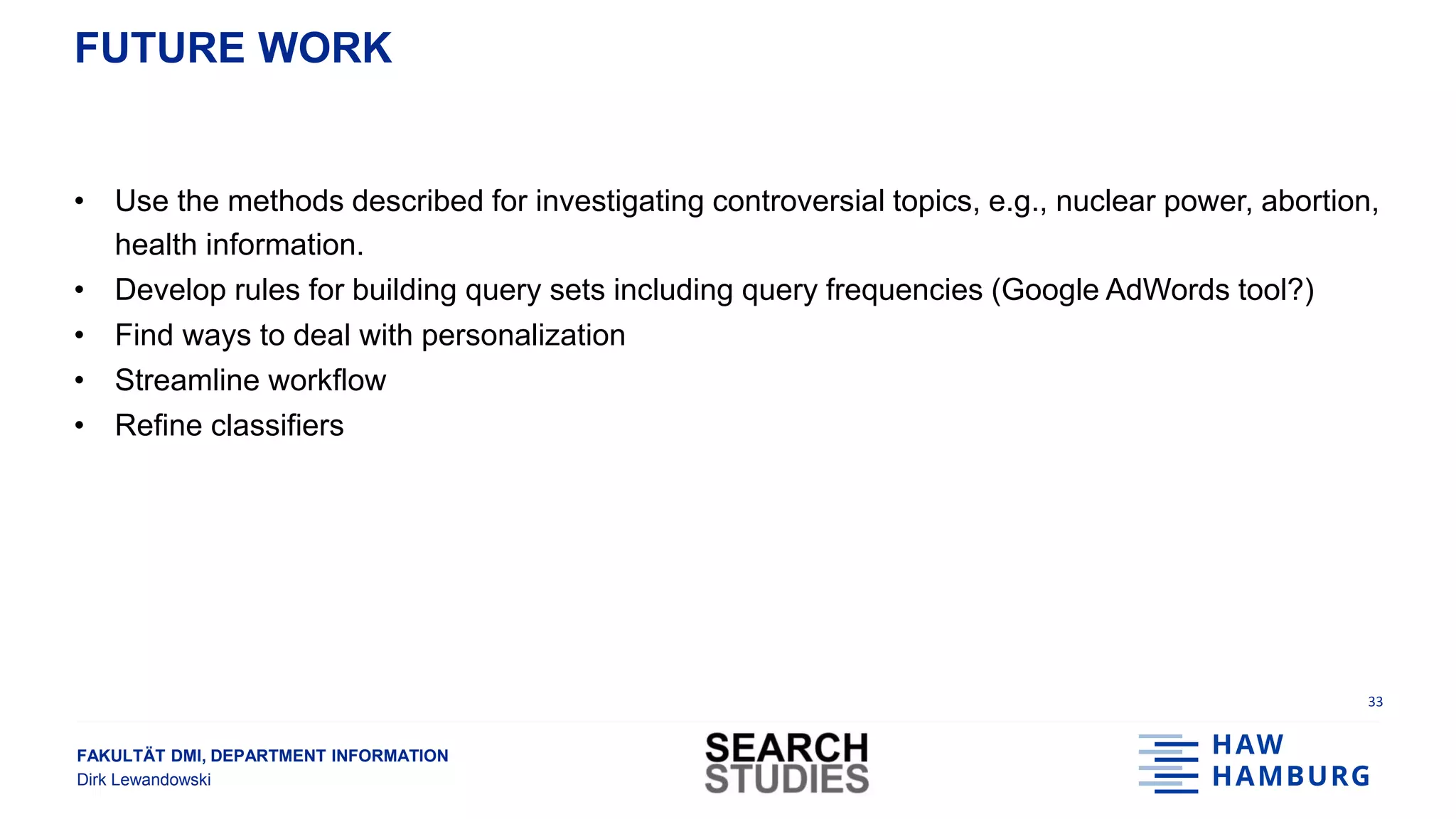
LIMITATIONS
• Imprint information may not be available in all countries (obligation to provide an imprint in
Germany).
• Our approach does not consider personalized search results.
• Case study is limited in terms of number of queries and number of results positions analysed.
• We did not consider query frequencies in the case study.
32
FAKULTÄT DMI, DEPARTMENT INFORMATION
Dirk Lewandowski
FUTURE WORK
• Use the methods described for investigating controversial topics, e.g., nuclear power, abortion,
health information.
• Develop rules for building query sets including query frequencies (Google AdWords tool?)
• Find ways to deal with personalization
• Streamline workflow
• Refine classifiers
33
THANK YOU
Prof. Dr. Dirk Lewandowski
Hamburg University of Applied Sciences
dirk.lewandowski@haw-hamburg.de
www.searchstudies.org/dirk
Twitter: Dirk_Lew
FAKULTÄT DMI, DEPARTMENT INFORMATION
Dirk Lewandowski
REFERENCES
Ballatore, A. (2015), „Google chemtrails: A methodology to analyze topic representation in search engine results“, First Monday, Vol. 20 No.
7, verfügbar unter: http://www.firstmonday.org/ojs/index.php/fm/article/view/5597/4652.
Bar-Ilan, J. (2006), ‘Web links and search engine ranking: The case of Google and the query “Jew”’, Journal of the American Society for
Information & Techology, Vol. 57 No. 12, pp. 1581–1589.
Goel, S., Broder, A., Gabrilovich, E. und Pang, B. (2010), „Anatomy of the long tail“, Proceedings of the third ACM international conference
on Web search and data mining - WSDM ’10, ACM Press, New York, New York, USA, S. 201.
Höchstötter, N., & Lewandowski, D. (2009). What users see – Structures in search engine results pages. Information Sciences, 179(12),
1796–1812. https://doi.org/10.1016/j.ins.2009.01.028
Noble, S.U. (2018), Algorithms of Oppression: How Search Engines Reinforce Racism, New York University Press, New York, USA.
Otterbacher, J., Bates, J. and Clough, P. (2017), ‘Competent Men and Warm Women’, Proceedings of the 2017 CHI Conference on Human
Factors in Computing Systems - CHI ’17, ACM Press, New York, New York, USA, pp. 6620–6631.
Purcell, K., Brenner, J. and Rainie, L. (2012), ‘Search Engine Use 2012’, PEW Research Center, Washington, DC.
Spink, A., Jansen, B.J., Blakely, C. und Koshman, S. (2006), „A study of results overlap and uniqueness among major Web search
engines“, Information Processing & Management, Vol. 42 No. 5, S. 1379–1391.
Stiftung Warentest. (2017). About us: An introduction to Stiftung Warentest. Abgerufen von https://www.test.de/unternehmen/about-us-
5017053-0/
Westerwick, A. (2013), ‘Effects of Sponsorship, Web Site Design, and Google Ranking on the Credibility of Online Information’, Journal of
Computer-Mediated Communication, Vol. 18 No. 2, pp. 80–97.
White, R.W. and Horvitz, E. (2009), ‘Cyberchondria’, ACM Transactions on Information Systems, Vol. 27 No. 4, p. Article No. 23.
35

Analysing search engine data on socially relevant topics

  • 1.
    FAKULTÄT DMI, DEPARTMENTINFORMATION Dirk Lewandowski ANALYSING SEARCH ENGINE DATA ON SOCIALLY RELEVANT TOPICS Prof. Dr. Dirk Lewandowski Work done in collaboration with Sebastian Sünkler GESIS, 19 September 2018
  • 2.
    FAKULTÄT DMI, DEPARTMENTINFORMATION Dirk Lewandowski AGENDA 1. Background: Search engine bias, user behaviour in search engines 2. How can we crawl data from search engines? 3. How can we build relevant query sets? 4. Case study 5. Conclusion 1
  • 3.
  • 4.
    FAKULTÄT DMI, DEPARTMENTINFORMATION Dirk Lewandowski 3
  • 5.
    FAKULTÄT DMI, DEPARTMENTINFORMATION Sebastian Sünkler 4
  • 6.
    FAKULTÄT DMI, DEPARTMENTINFORMATION Dirk Lewandowski BIASES IN SEARCH ENGINE RESULTS Biases in regards to… • Race (Noble, 2018) • Gender (Noble, 2018; Otterbacher et al., 2017) • Confirmatory information to queries regarding conspiracy theories (Ballatore, 2015) • Promotion of hate speech (Bar-Ilan, 2006) • Health information (White and Horvitz, 2009) Problems with these studies in general: • Case studies, anecdotal evidence • Queries chosen by the researchers (not rule-based); no consideration of query polularity • No information on results providers; results ranking not considered 5
  • 7.
    FAKULTÄT DMI, DEPARTMENTINFORMATION Dirk Lewandowski WHAT MAKES USERS CLICK? Users’ visual attention and selection behaviour are influenced by • Position • Visible area “above the fold” • The relevance of the results description (“snippet”) • Size and design of the snippet Users trust search engines: • Results are seen as accurate and trustworthy (Purcell, Brenner & Raine 2012) • Search engine ranking even is a criterion for trustworthiness (Westerwick 2013) 6
  • 8.
    FAKULTÄT DMI, DEPARTMENTINFORMATION Dirk Lewandowski USERS’ SELECTION BEHAVIOUR 7
  • 9.
    FAKULTÄT DMI, DEPARTMENTINFORMATION Dirk Lewandowski INFLUENCING SEARCH ENGINE RESULTS Search engine providers • Search engine providers act as content providers to their own search engines, e.g., Google/YouTube. • Vertical search engines are integrated into the main search engine, e.g., Google Shopping. External influences • Influence on the search results through search engine optimization (SEO), now a multi-billion Euro industry 8
  • 10.
    FAKULTÄT DMI, DEPARTMENTINFORMATION Dirk Lewandowski FROM WHICH SOURCES DO THE SEARCH RESULTS COME FROM? Studies investigating domains (“sources”) • About 80 per cent of all clicked results are accounted for by only 10,000 websites (Goel et al., 2010; 2.6 billion queries from Yahoo logs) • Low overlap between different search engines in the top 10 results (Spink et al., 2006; 22.000 queries from Infospace/Dogpile) • Most popular sources in the top 10 differ between search engines; search engine providers prefer their own offerings (Yahoo Answers; YouTube) (Höchstötter & Lewandowski, 2009; 1.000 queries from Ask.com logs) Provider level • To our knowledge, no studies to date 9
  • 11.
    HOW CAN WECRAWL DATA FROM SEARCH ENGINES? 10
  • 12.
    FAKULTÄT DMI, DEPARTMENTINFORMATION Dirk Lewandowski COLLECTING SEARCH RESULTS AT SCALE Problem • Commercial search engines do not allow access to their results through APIs. • Data collection in scholarly studies is usually done manually. • Scholarly studies are usually low-scale, i.e., using only some sample queries. Our approach • Querying search engines automatically, using large numbers of queries • Using screen scraping to collect search results from the HTML pages of search engines 11
  • 13.
    FAKULTÄT DMI, DEPARTMENTINFORMATION Dirk Lewandowski SOFTWARE DEVELOPMENT Three software systems for screen-scraping and analysing search engine data 1. Relevance Assessment Tool (RAT) (2011 – ) - Purpose: Information Retrieval evaluation (juror-based assessments) - User interface / crowdsourcing for collecting (relevance) judgments 2. AAPVL (2013 – 2018) - Purpose: Identifying non-compliant food products in search engine results - Classifiers for shop identification, food shop identification, imprint identification 3. N.N. (2018 – ) - Purpose: Collecting and analysing search results as users see them - Using relevant query sets - Using results positions, domains and provider information (from imprints) 12
  • 14.
    FAKULTÄT DMI, DEPARTMENTINFORMATION Dirk Lewandowski PROCESS DIAGRAMS 13 RAT AAPVL
  • 15.
    FAKULTÄT DMI, DEPARTMENTINFORMATION Dirk Lewandowski SOFTWARE ARCHITECTURE 14 RAT AAPVL
  • 16.
    FAKULTÄT DMI, DEPARTMENTINFORMATION Dirk Lewandowski OUTPUT Structured data including • Query • Search engine • Result position • URL • Domain • Provider (from imprint) • Shop (yes/no) • Manual assessment (if collected) KNIME 15
  • 17.
    FAKULTÄT DMI, DEPARTMENTINFORMATION Dirk Lewandowski APPLICABILITY Some examples: • Search engine results evaluation using 1.000 queries, comparing Google and Bing (Lewandowski, 2015) • Finding non-compliant food products (several studies, some 10.000 results analysed manually by expert jurors as well as automatically) • Finding out what Google users get to see for certain topics (case study discussed later) 16
  • 18.
    HOW CAN WEBUILD RELEVANT QUERY SETS? 17
  • 19.
    FAKULTÄT DMI, DEPARTMENTINFORMATION Dirk Lewandowski SELECTING SEARCH QUERIES Why work with query sets? • Represent actual user behaviour • Address problem of anecdotal evidence and small-scale studies Approaches to selecting search queries to build a query set 1. Use your own inspiration (leads to arbitrary query sets) 2. Transaction log data from search engines (problem of access) 3. Google Trends (no absolute numbers but useful for comparing query popularity) 4. Google’s (or Bing’s) advertisement campaign planning tools (not tested yet) 18
  • 20.
    USE CASE: QUERIESON INSURANCE COMPARISONS 19
  • 21.
    FAKULTÄT DMI, DEPARTMENTINFORMATION Dirk Lewandowski WHY INSURANCE COMPARISONS? • Searching for comparisons of all kinds is popular in web search • Many portals allow users to compare every possible type of insurance concerning the providers and the associated conditions and costs. • Highly competitive market; heavy use of search engine optimization. • Search results may not only contain "neutral" comparison sites like Stiftung Warentest, a not- for-profit foundation. • Free comparison sites may take commissions from vendors, may not take into account all vendors in their comparisons, or base their comparisons on outdated prices (see Stiftung Warentest, 2017). 20
  • 22.
    FAKULTÄT DMI, DEPARTMENTINFORMATION Dirk Lewandowski QUERY SET 21 • Based on a query log from a commercial German search portal (see Lewandowski, 2015) • All queries containing *versicherung* (insurance) and *vergleich* (comparison) • Final query set consisting of 121 queries, e.g., - autoversicherungen vergleich - berufsunfähigkeitsversicherung vergleich - haftpflichtversicherung im vergleich
  • 23.
    FAKULTÄT DMI, DEPARTMENTINFORMATION Dirk Lewandowski DATA PROCESSING • Query Google; screen-scraping results pages (getting as many results as possible) • Crawl imprint pages for every domain found, extract and structure data • Data cleansing • Match domains to providers • Descriptive statistics  Combination of scripting (PHP) and KNIME workflows. 22
  • 24.
    FAKULTÄT DMI, DEPARTMENTINFORMATION Dirk Lewandowski DATA SET • Number of queries: 121 • Number of search results: 22,138 • Results per query: 183 [1, 298] • Number of different domains: 3,278 23
  • 25.
    FAKULTÄT DMI, DEPARTMENTINFORMATION Dirk Lewandowski DATA TABLE 24
  • 26.
    FAKULTÄT DMI, DEPARTMENTINFORMATION Dirk Lewandowski RESULTS SUMMARY 25 ● 116 different domains in top 10 results [10; 1210] ● 93 different providers in top 10 results, i.e., some providers have more than one domain ● The 5 most popular providers account for 47% of top 10 results (and 67% of top 5 results)  Two thirds of top 5 results are from only five different providers
  • 27.
    FAKULTÄT DMI, DEPARTMENTINFORMATION Dirk Lewandowski THE FIVE MOST POPULAR PROVIDERS IN THE TOP 10 SEARCH RESULTS WITH THEIR PRIMARY DOMAINS 26 Provider Number of domains in the top 10 Number of results in the top 10 finanzen.de Vermittlungsgesellschaft für Verbraucherverträge AG 8 149 Müller & Kollegen UG (haftungsbeschränkt) 5 22 G. Zmuda 4 7 Axel Springer SE 2 53 Verivox GmbH 2 127
  • 28.
    FAKULTÄT DMI, DEPARTMENTINFORMATION Dirk Lewandowski THE FIVE MOST POPULAR PROVIDERS IN THE TOP 10 SEARCH RESULTS 27 Provider Absolute share of results in the top 5 (n = 605) Relative share of results in the Top5 Absolute share of results in the top 10 (n = 1210) Relative share of results in the Top10 finanzen.de Vermittlungsgesellschaft für Verbraucherverträge AG 41 6.8% 133 11% Verivox GmbH 118 19.5% 127 10.1% CHECK24 GmbH 118 19.5% 120 9.9% Scout24 Holding GmbH 52 8.6% 97 8% TARIFCHECK24 GmbH 80 13.2% 90 7.4%
  • 29.
    FAKULTÄT DMI, DEPARTMENTINFORMATION Dirk Lewandowski DISTRIBUTION OF PROVIDERS AMONG THE TOP10 SEARCH RESULTS When considering only the first position, Google only shows results from 10 different providers. 28
  • 30.
    FAKULTÄT DMI, DEPARTMENTINFORMATION Dirk Lewandowski RELATIVE DISTRIBUTION OF THE DOMAINS ON THE POSITIONS 1 – 10 For 88% of queries, one of the three most popular providers is shown on the top position. 29
  • 31.
  • 32.
    FAKULTÄT DMI, DEPARTMENTINFORMATION Dirk Lewandowski SUMMARY • Approach that can be used to quantify the distribution of search engine results based on actual user queries. • Software is readily available for conducting similar studies. • Case study shows the feasibility of the approach and gives a first impression of how results in different topical areas could be analysed. • In the insurance domain, few domains/providers dominate the top positions. Other providers are listed, but they tend to be in the lower positions in the top 10 search results. 31
  • 33.
    FAKULTÄT DMI, DEPARTMENTINFORMATION Dirk Lewandowski LIMITATIONS • Imprint information may not be available in all countries (obligation to provide an imprint in Germany). • Our approach does not consider personalized search results. • Case study is limited in terms of number of queries and number of results positions analysed. • We did not consider query frequencies in the case study. 32
  • 34.
    FAKULTÄT DMI, DEPARTMENTINFORMATION Dirk Lewandowski FUTURE WORK • Use the methods described for investigating controversial topics, e.g., nuclear power, abortion, health information. • Develop rules for building query sets including query frequencies (Google AdWords tool?) • Find ways to deal with personalization • Streamline workflow • Refine classifiers 33
  • 35.
    THANK YOU Prof. Dr.Dirk Lewandowski Hamburg University of Applied Sciences dirk.lewandowski@haw-hamburg.de www.searchstudies.org/dirk Twitter: Dirk_Lew
  • 36.
    FAKULTÄT DMI, DEPARTMENTINFORMATION Dirk Lewandowski REFERENCES Ballatore, A. (2015), „Google chemtrails: A methodology to analyze topic representation in search engine results“, First Monday, Vol. 20 No. 7, verfügbar unter: http://www.firstmonday.org/ojs/index.php/fm/article/view/5597/4652. Bar-Ilan, J. (2006), ‘Web links and search engine ranking: The case of Google and the query “Jew”’, Journal of the American Society for Information & Techology, Vol. 57 No. 12, pp. 1581–1589. Goel, S., Broder, A., Gabrilovich, E. und Pang, B. (2010), „Anatomy of the long tail“, Proceedings of the third ACM international conference on Web search and data mining - WSDM ’10, ACM Press, New York, New York, USA, S. 201. Höchstötter, N., & Lewandowski, D. (2009). What users see – Structures in search engine results pages. Information Sciences, 179(12), 1796–1812. https://doi.org/10.1016/j.ins.2009.01.028 Noble, S.U. (2018), Algorithms of Oppression: How Search Engines Reinforce Racism, New York University Press, New York, USA. Otterbacher, J., Bates, J. and Clough, P. (2017), ‘Competent Men and Warm Women’, Proceedings of the 2017 CHI Conference on Human Factors in Computing Systems - CHI ’17, ACM Press, New York, New York, USA, pp. 6620–6631. Purcell, K., Brenner, J. and Rainie, L. (2012), ‘Search Engine Use 2012’, PEW Research Center, Washington, DC. Spink, A., Jansen, B.J., Blakely, C. und Koshman, S. (2006), „A study of results overlap and uniqueness among major Web search engines“, Information Processing & Management, Vol. 42 No. 5, S. 1379–1391. Stiftung Warentest. (2017). About us: An introduction to Stiftung Warentest. Abgerufen von https://www.test.de/unternehmen/about-us- 5017053-0/ Westerwick, A. (2013), ‘Effects of Sponsorship, Web Site Design, and Google Ranking on the Credibility of Online Information’, Journal of Computer-Mediated Communication, Vol. 18 No. 2, pp. 80–97. White, R.W. and Horvitz, E. (2009), ‘Cyberchondria’, ACM Transactions on Information Systems, Vol. 27 No. 4, p. Article No. 23. 35