COMBINED EFFECTS OF DRUGS
By:
Dr. Dhruva Kumar Sharma
Department of Pharmacology
Moderator:
Dr. Supratim Datta
Associate Professor
Department of Pharmacology
SMIMS
Protocol:
Summation
Additive effects
Synergism
Drug antagonism
2
EFFECT OF COMBINATION OF DRUGS
Combinations of two/ more drugs, simultaneously or
in quick succession
1. No interference with each other’s effects.
2. May oppose each other’s actions (antagonism)
3. May produce similar actions on the same organ
(synergism)
Interaction
Pharmacokinetic Pharmacodynamic
Drug Synergism
Syn- together ; ergon- work
Drug Synergism:
This is facilitation of the effects of one drug
by another when given together
Types:
a. Additive (summation)
b. Supra-additive (Potentiation)
Summation /Addition
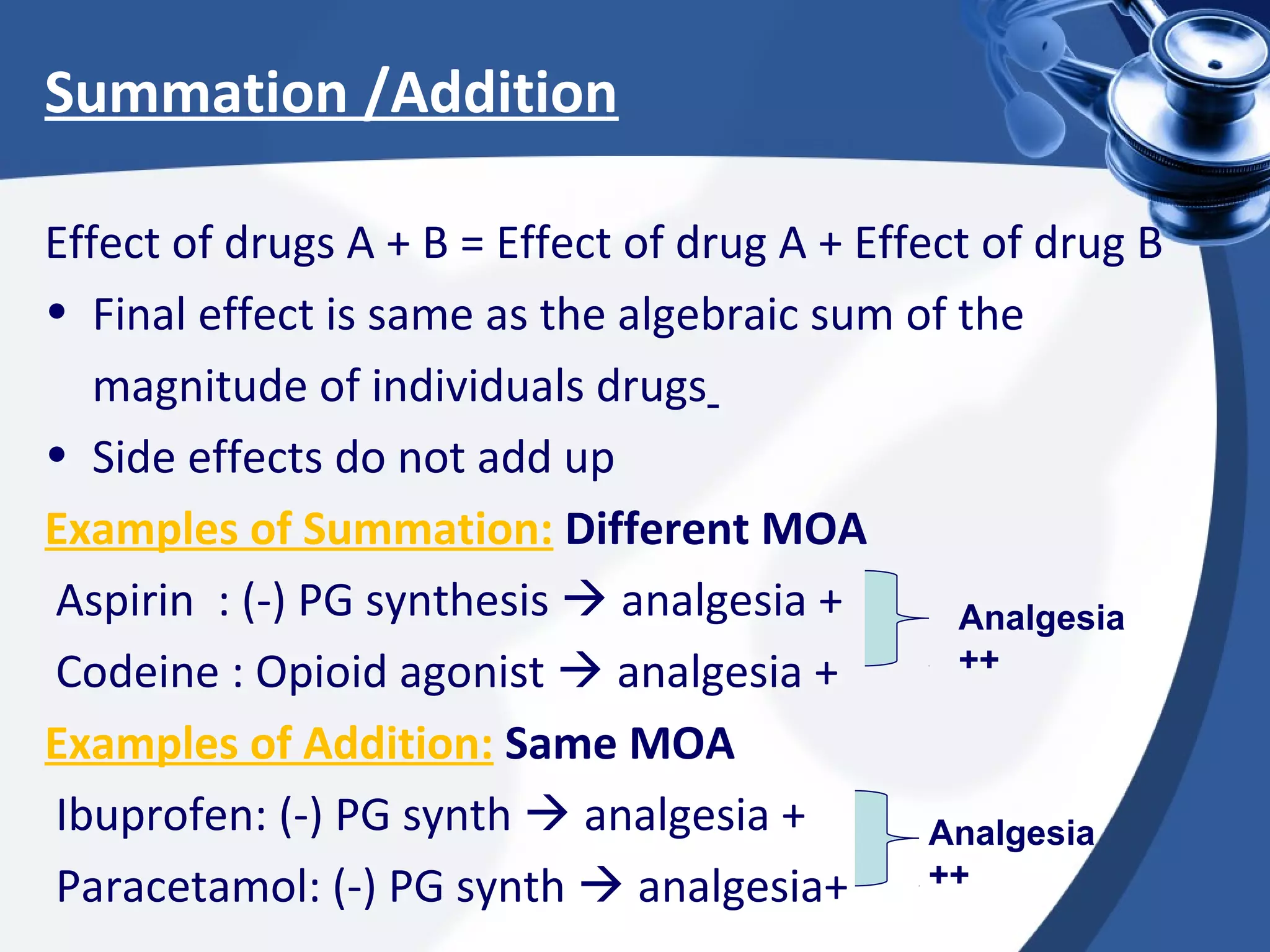
Effect of drugs A + B = Effect of drug A + Effect of drug B
• Final effect is same as the algebraic sum of the
magnitude of individuals drugs
• Side effects do not add up
Examples of Summation: Different MOA
Aspirin : (-) PG synthesis  analgesia +
Codeine : Opioid agonist  analgesia +
Examples of Addition: Same MOA
Ibuprofen: (-) PG synth  analgesia +
Paracetamol: (-) PG synth  analgesia+
Analgesia
++
Analgesia
++
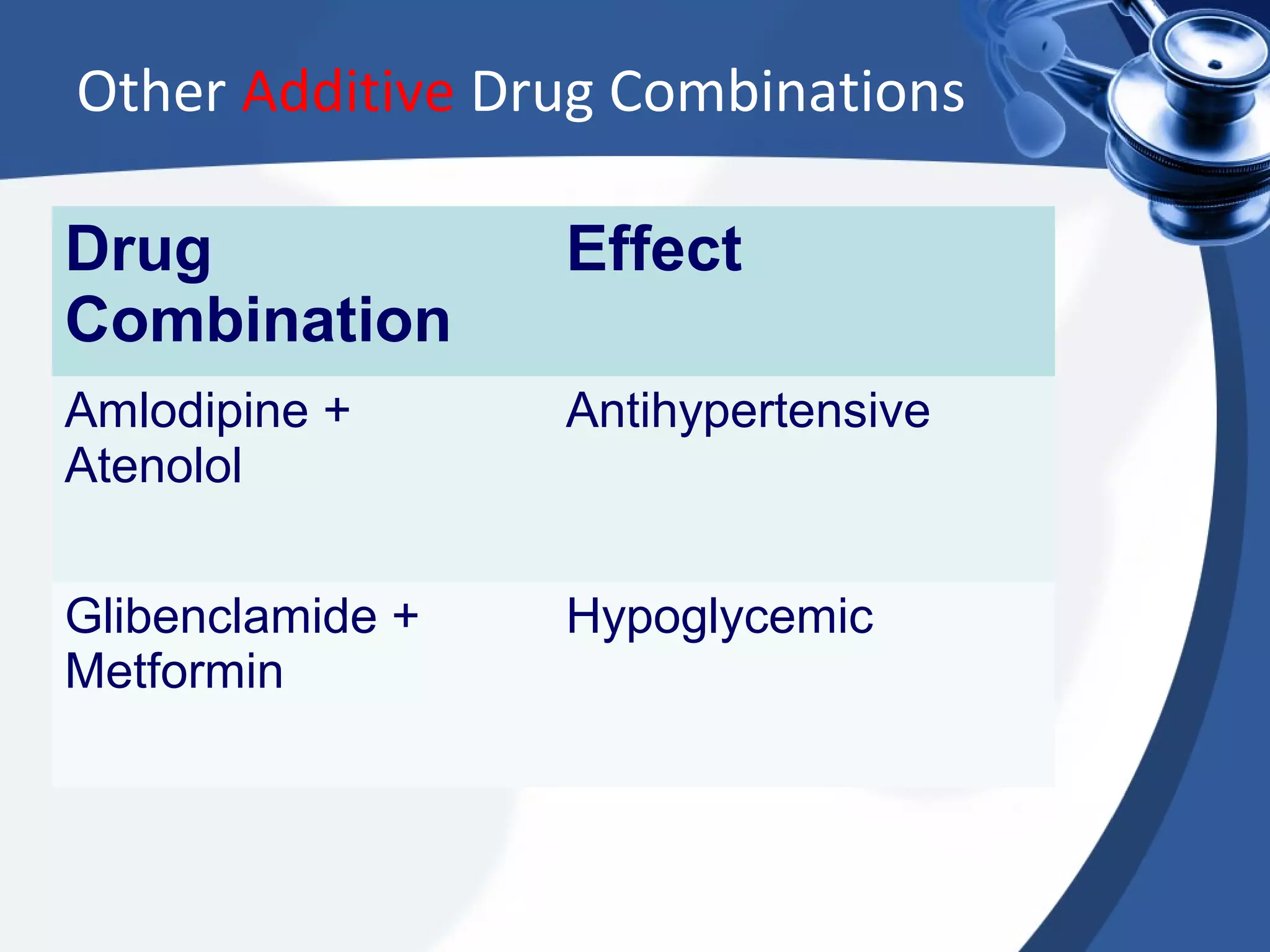
Other Additive Drug Combinations
Drug
Combination
Effect
Amlodipine +
Atenolol
Antihypertensive
Glibenclamide +
Metformin
Hypoglycemic
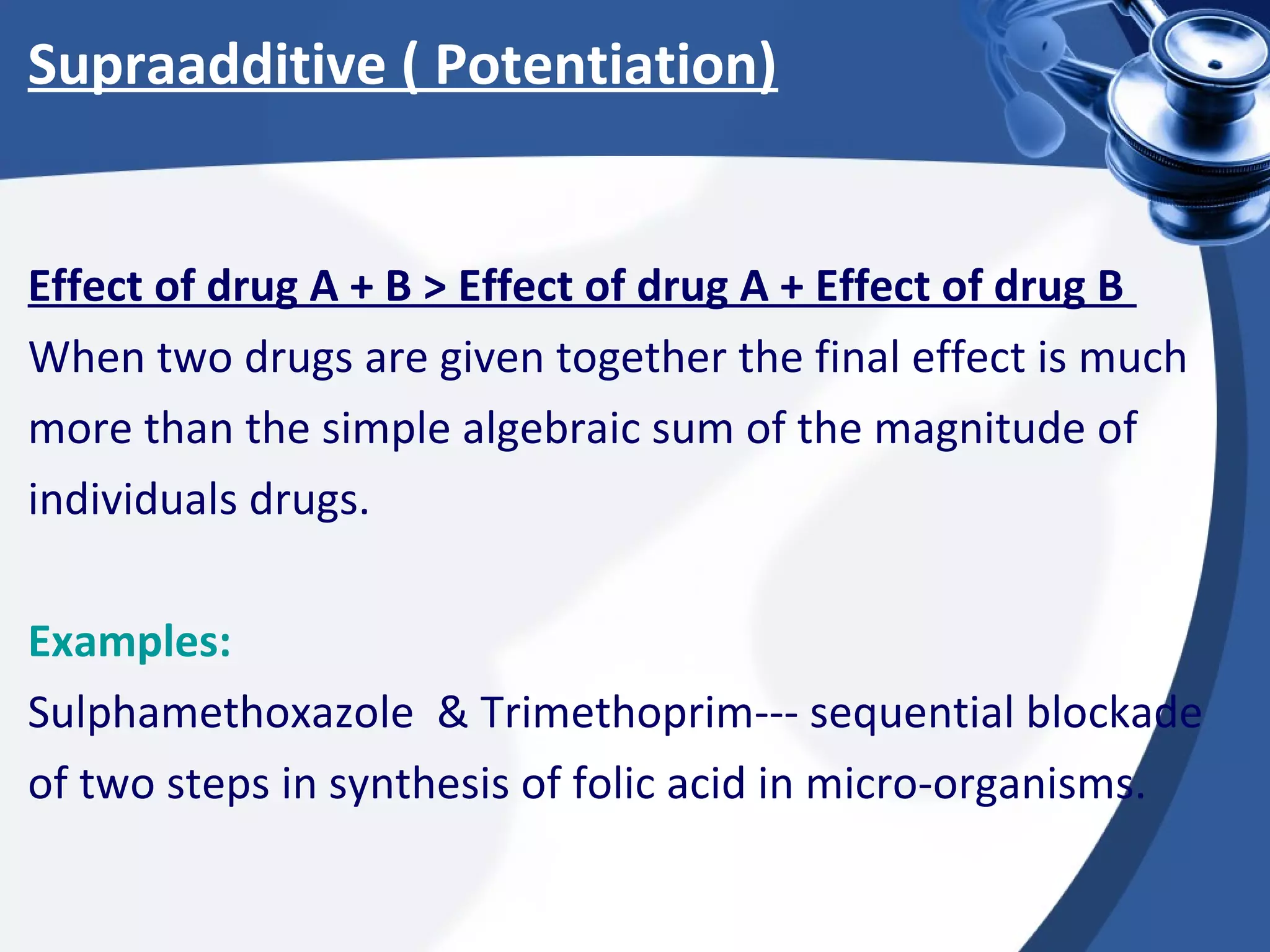
Supraadditive ( Potentiation)
Effect of drug A + B > Effect of drug A + Effect of drug B
When two drugs are given together the final effect is much
more than the simple algebraic sum of the magnitude of
individuals drugs.
Examples:
Sulphamethoxazole & Trimethoprim--- sequential blockade
of two steps in synthesis of folic acid in micro-organisms.
Synergism by altering Pharmacokinetics
of the other:
• Levodopa + Carbidopa
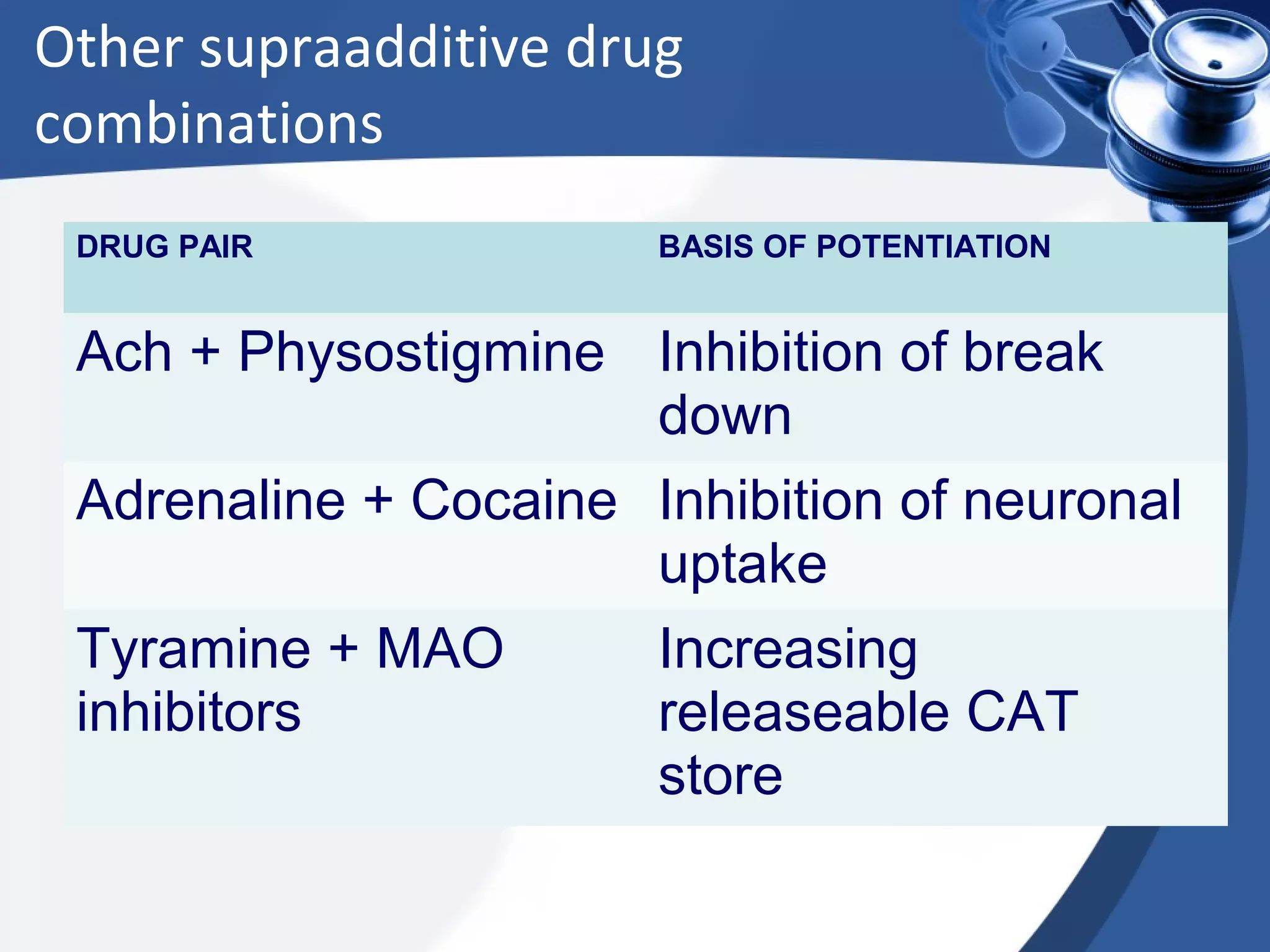
Other supraadditive drug
combinations
DRUG PAIR BASIS OF POTENTIATION
Ach + Physostigmine Inhibition of break
down
Adrenaline + Cocaine Inhibition of neuronal
uptake
Tyramine + MAO
inhibitors
Increasing
releaseable CAT
store
Drug Antagonism
Drug Antagonism
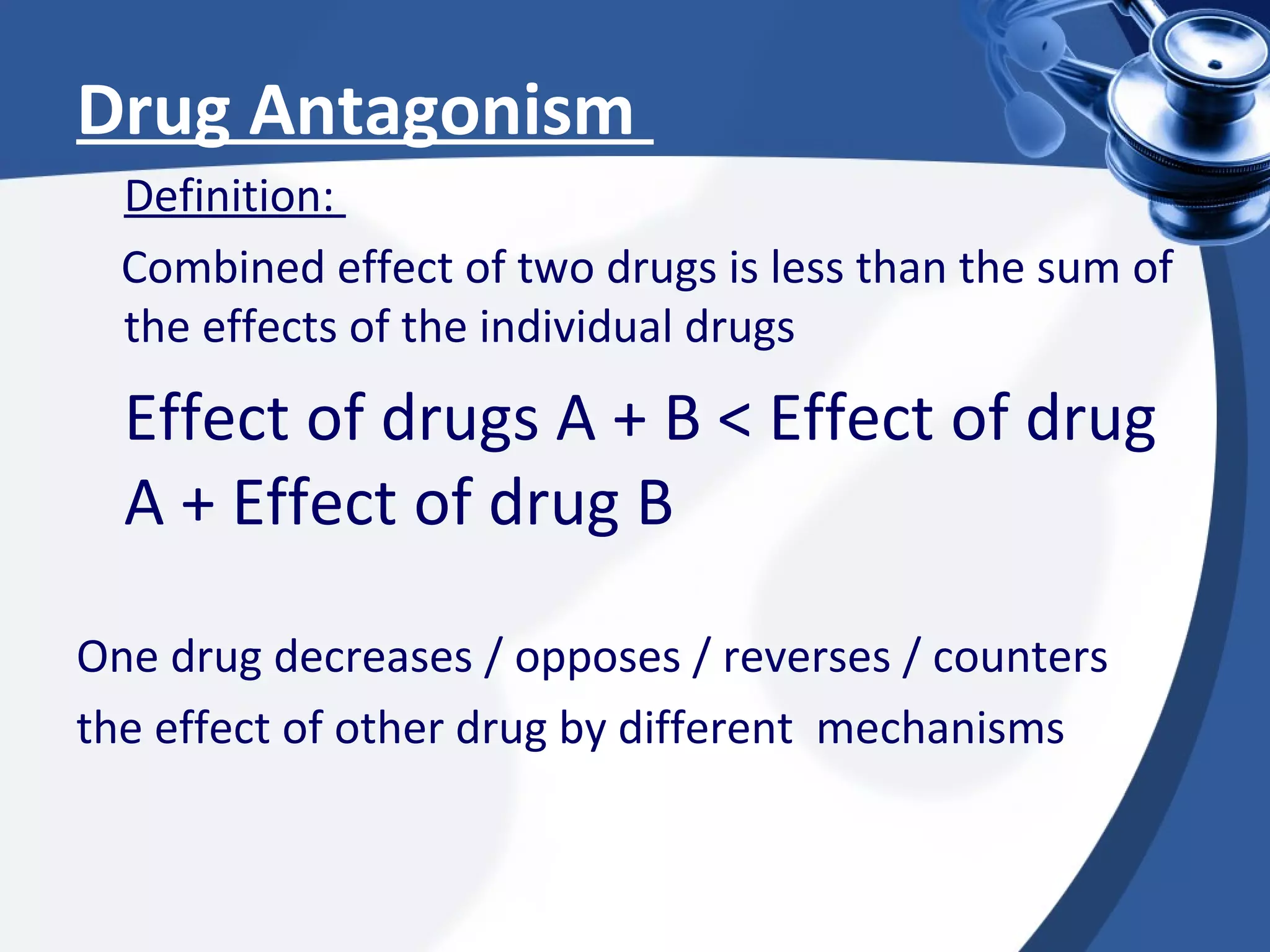
Definition:
Combined effect of two drugs is less than the sum of
the effects of the individual drugs
Effect of drugs A + B < Effect of drug
A + Effect of drug B
One drug decreases / opposes / reverses / counters
the effect of other drug by different mechanisms
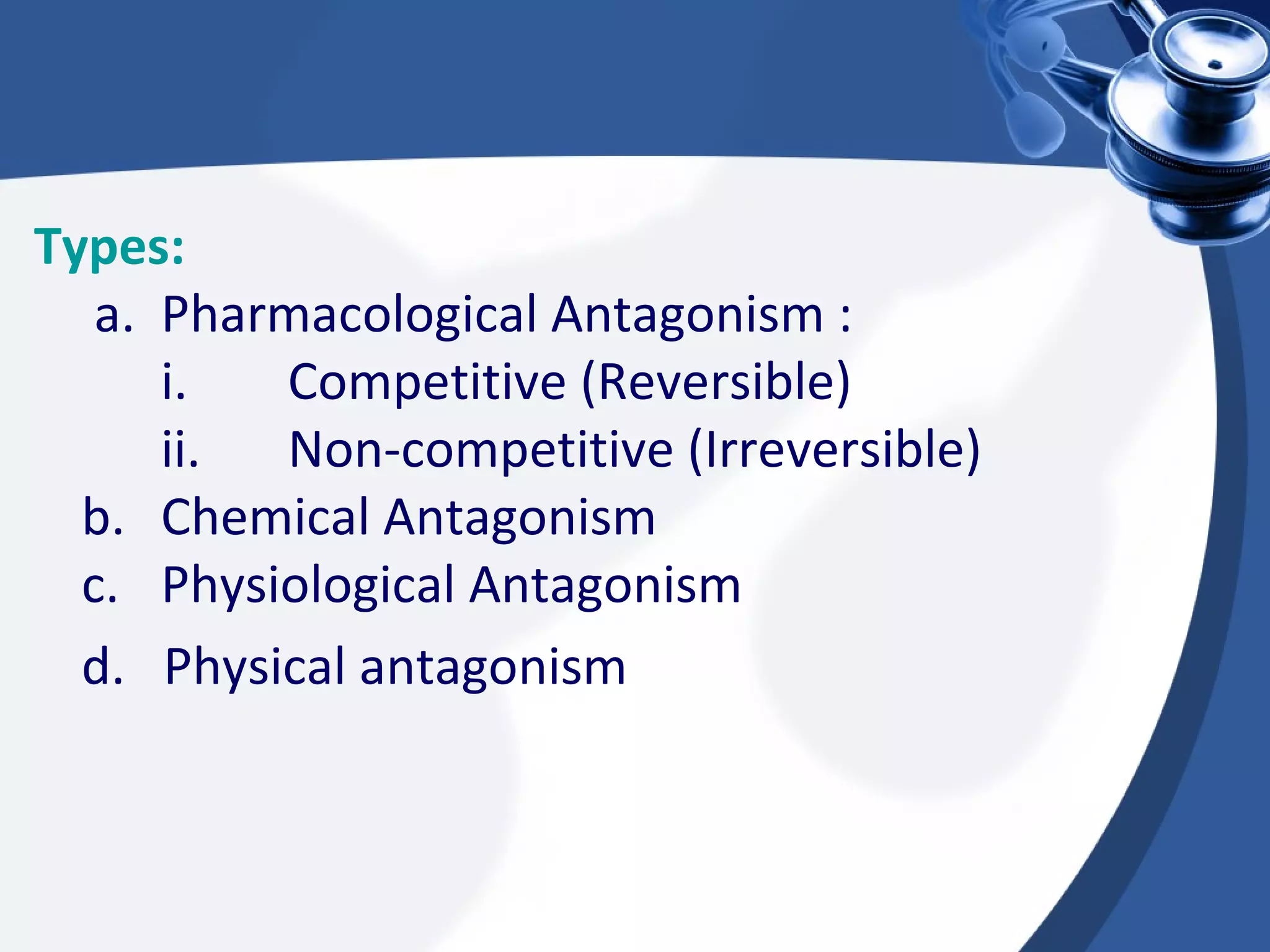
Types:
a. Pharmacological Antagonism :
i. Competitive (Reversible)
ii. Non-competitive (Irreversible)
b. Chemical Antagonism
c. Physiological Antagonism
d. Physical antagonism
Pharmacological Antagonism:
Competitive Non Competitive
Irreversibly
competitive
Reversibly
competitive
Pseudo-
reversibly
competitive
Interfere “Down-stream events” Act on
“allosteric site”
PHARMACODYNAMIC ANTAGONISM
Competitive
Antagonism
18
19
D-R interactions
RBB
D
B
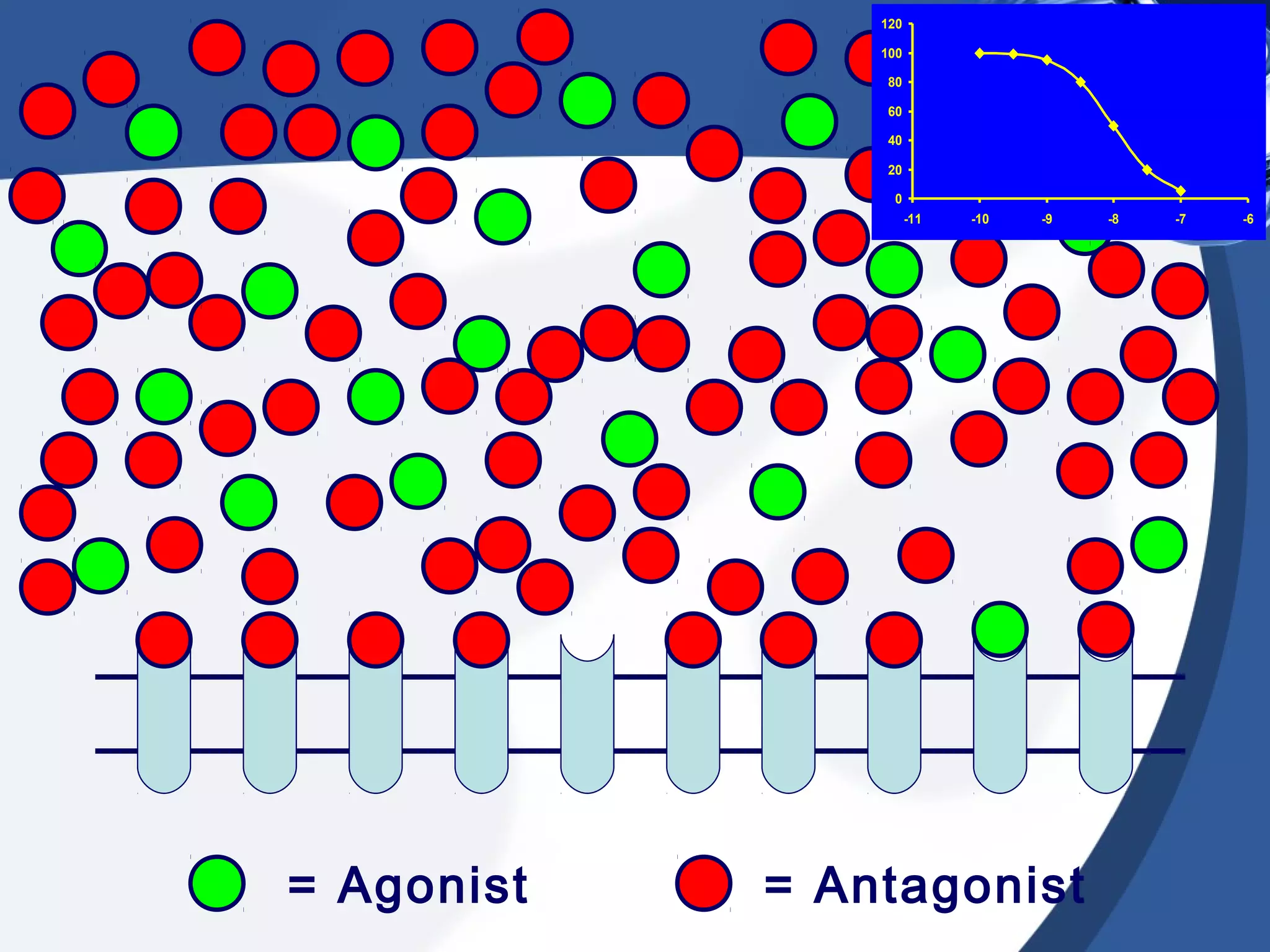
= Agonist = Antagonist
0
20
40
60
80
100
120
-10.5 -10 -9.5 -9 -8.5 -8 -7.5 -7 -6.5 -6
= Agonist = Antagonist
0
20
40
60
80
100
120
-11 -10 -9 -8 -7 -6
= Agonist = Antagonist
0
20
40
60
80
100
120
-11 -10 -9 -8 -7 -6
= Agonist = Antagonist
0
20
40
60
80
100
120
-11 -10 -9 -8 -7 -6
= Agonist = Antagonist
0
20
40
60
80
100
120
-11 -10 -9 -8 -7 -6
= Agonist = Antagonist
0
20
40
60
80
100
120
-11 -10 -9 -8 -7 -6
= Agonist = Antagonist
0
20
40
60
80
100
120
-11 -10 -9 -8 -7 -6
27
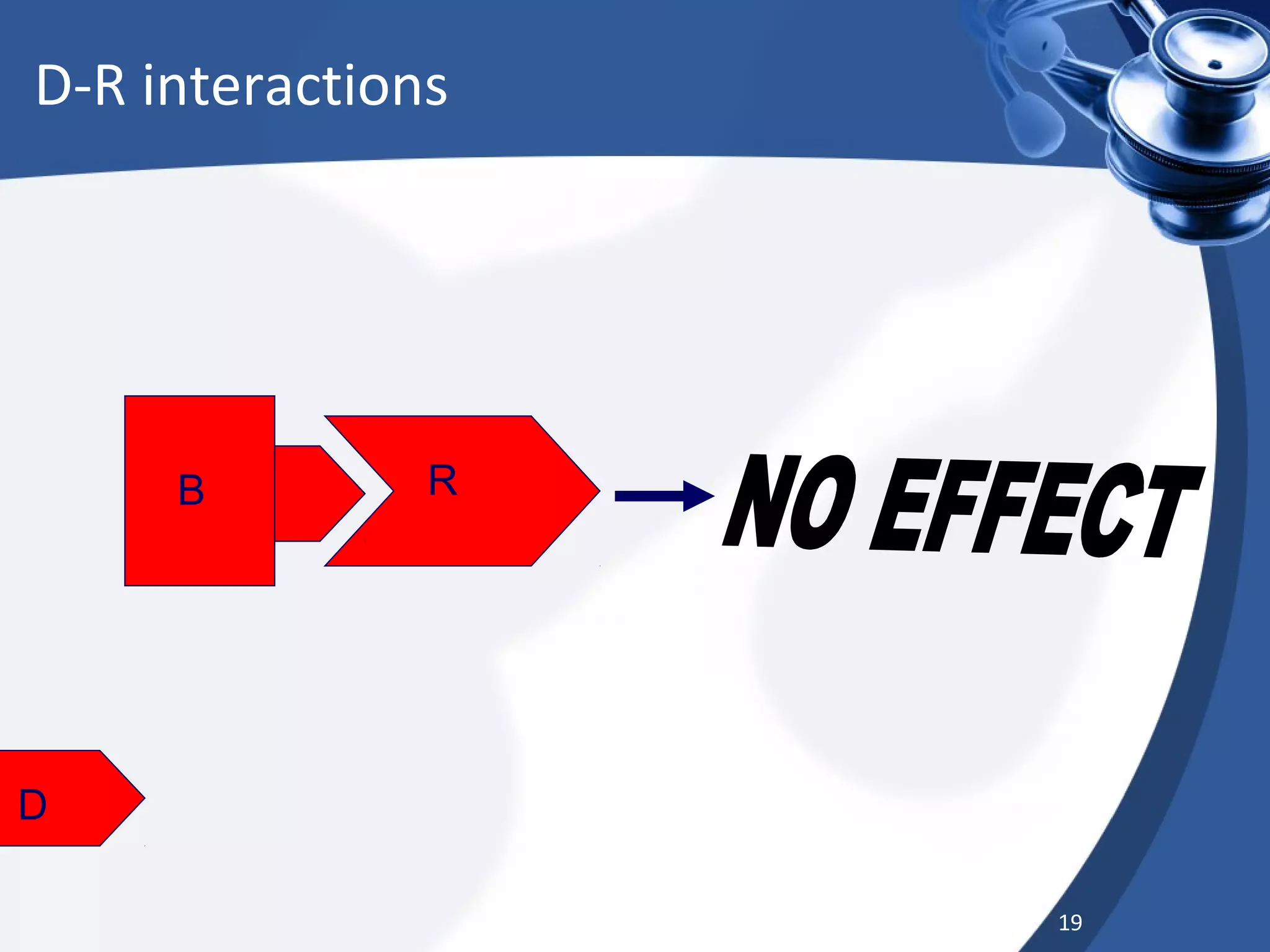
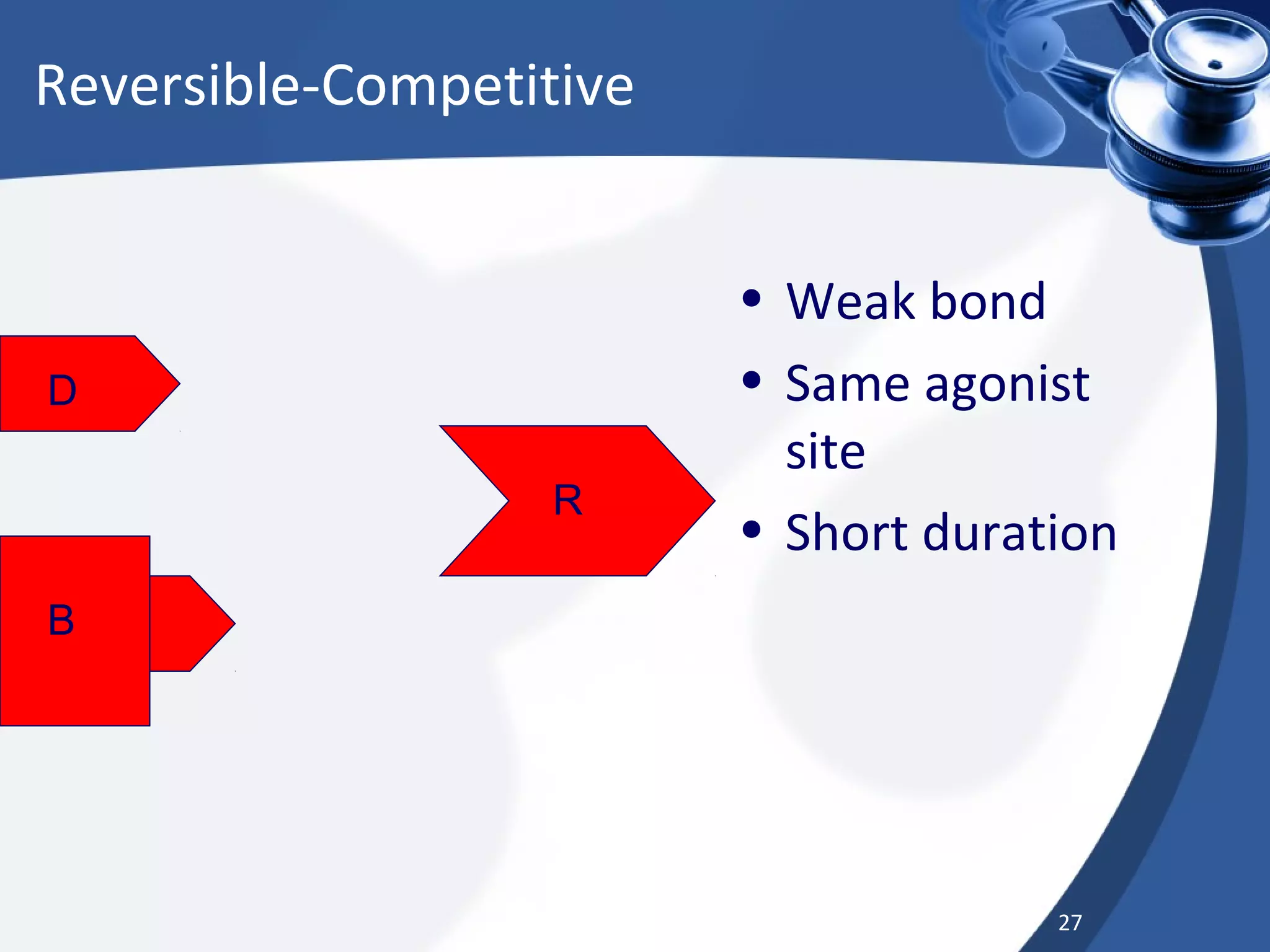
Reversible-Competitive
B
D
R
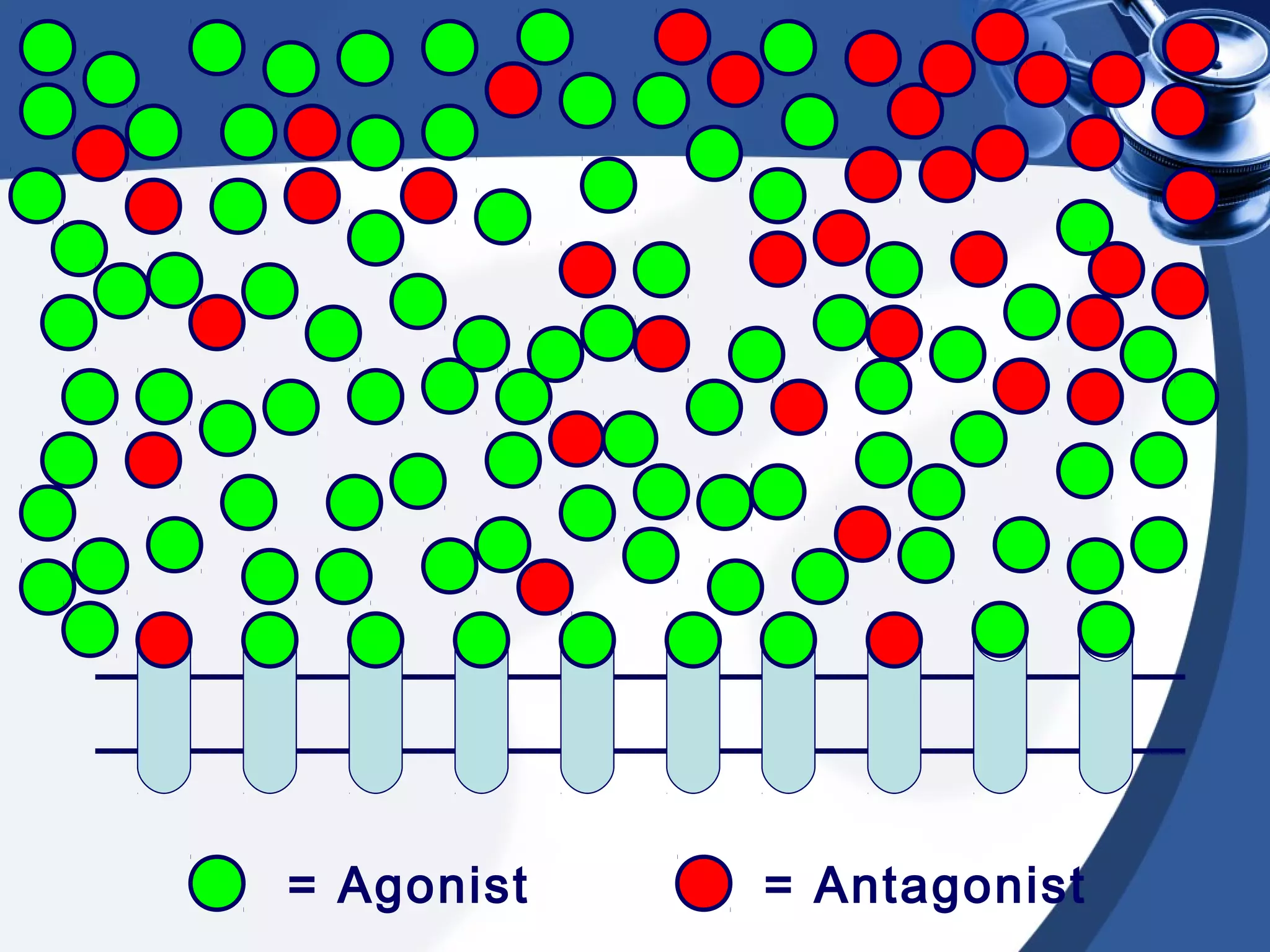
• Weak bond
• Same agonist
site
• Short duration
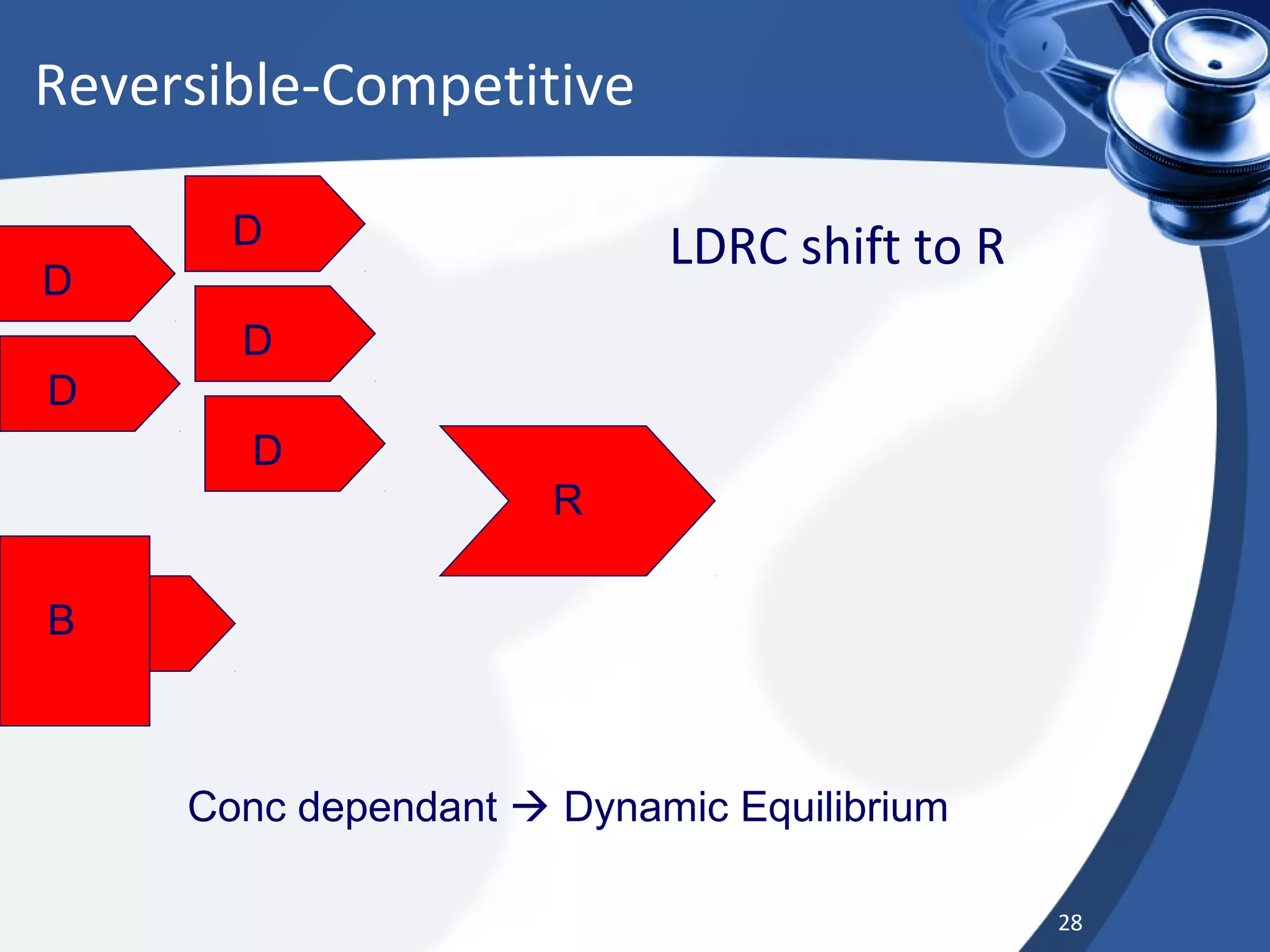
28
LDRC shift to R
B
R
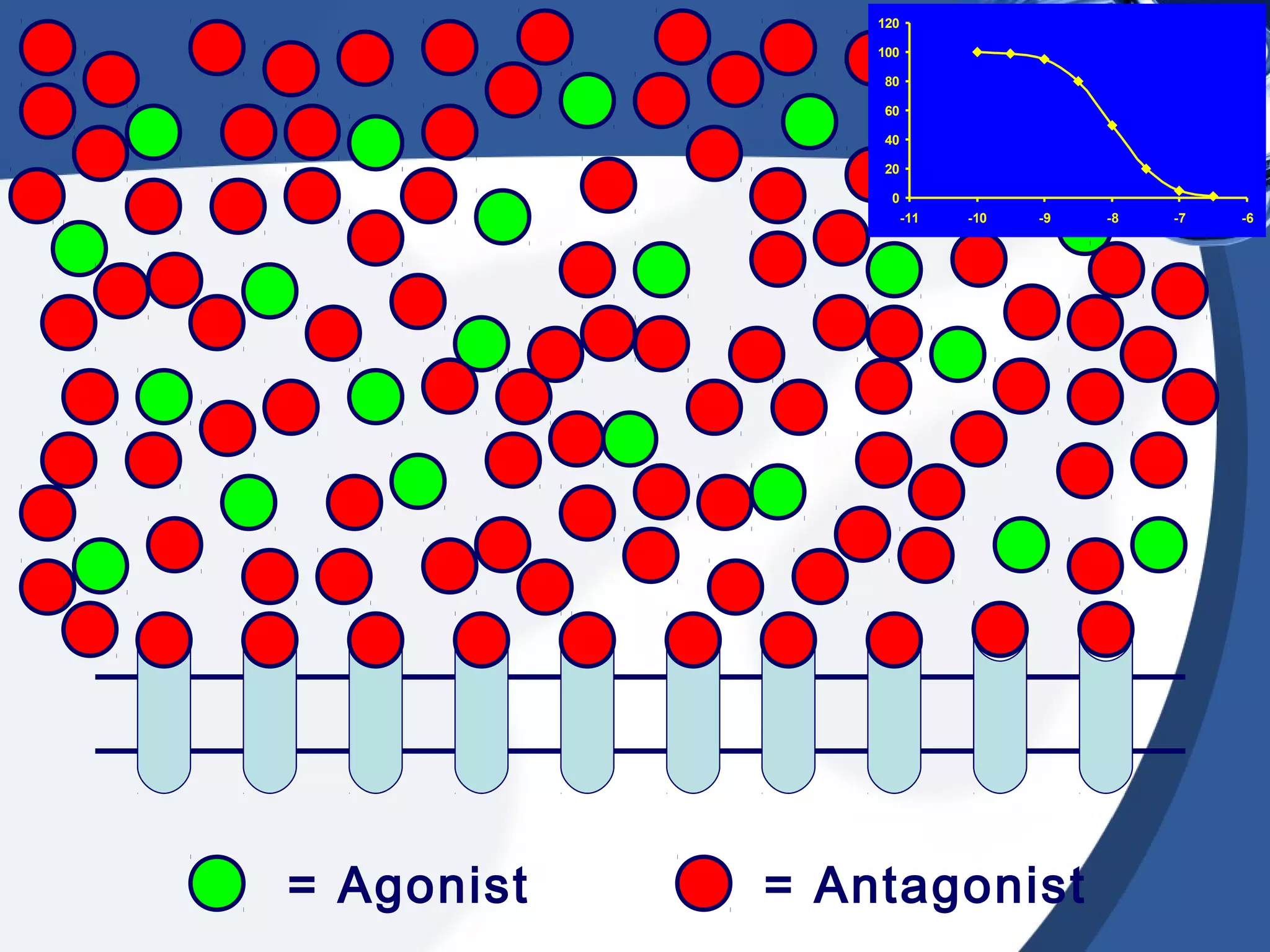
D
D
D
D
D
Reversible-Competitive
Conc dependant  Dynamic Equilibrium
Competitive (Reversible) Antagonism /Competitive
(Equilibrium ) Antagonism
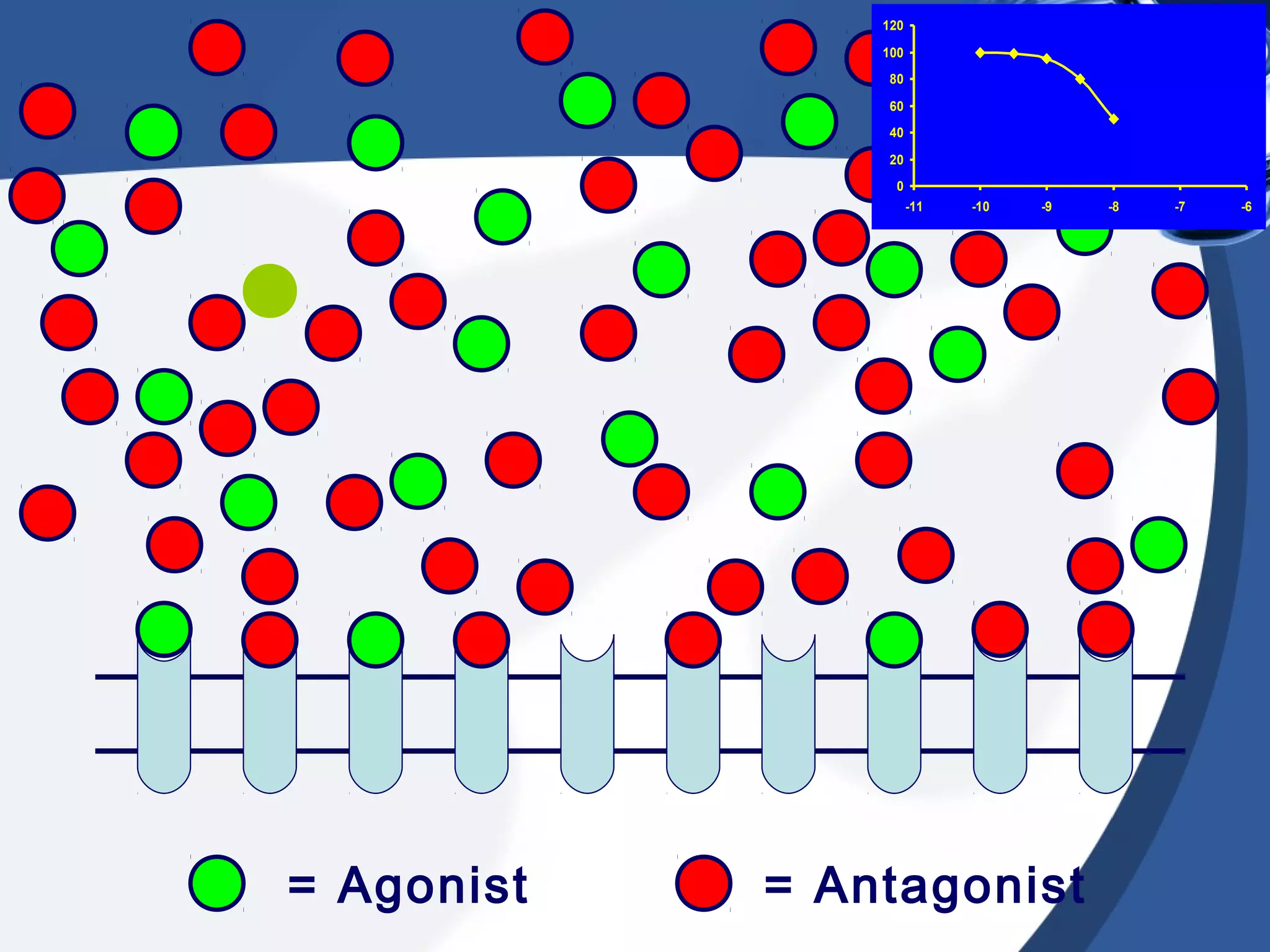
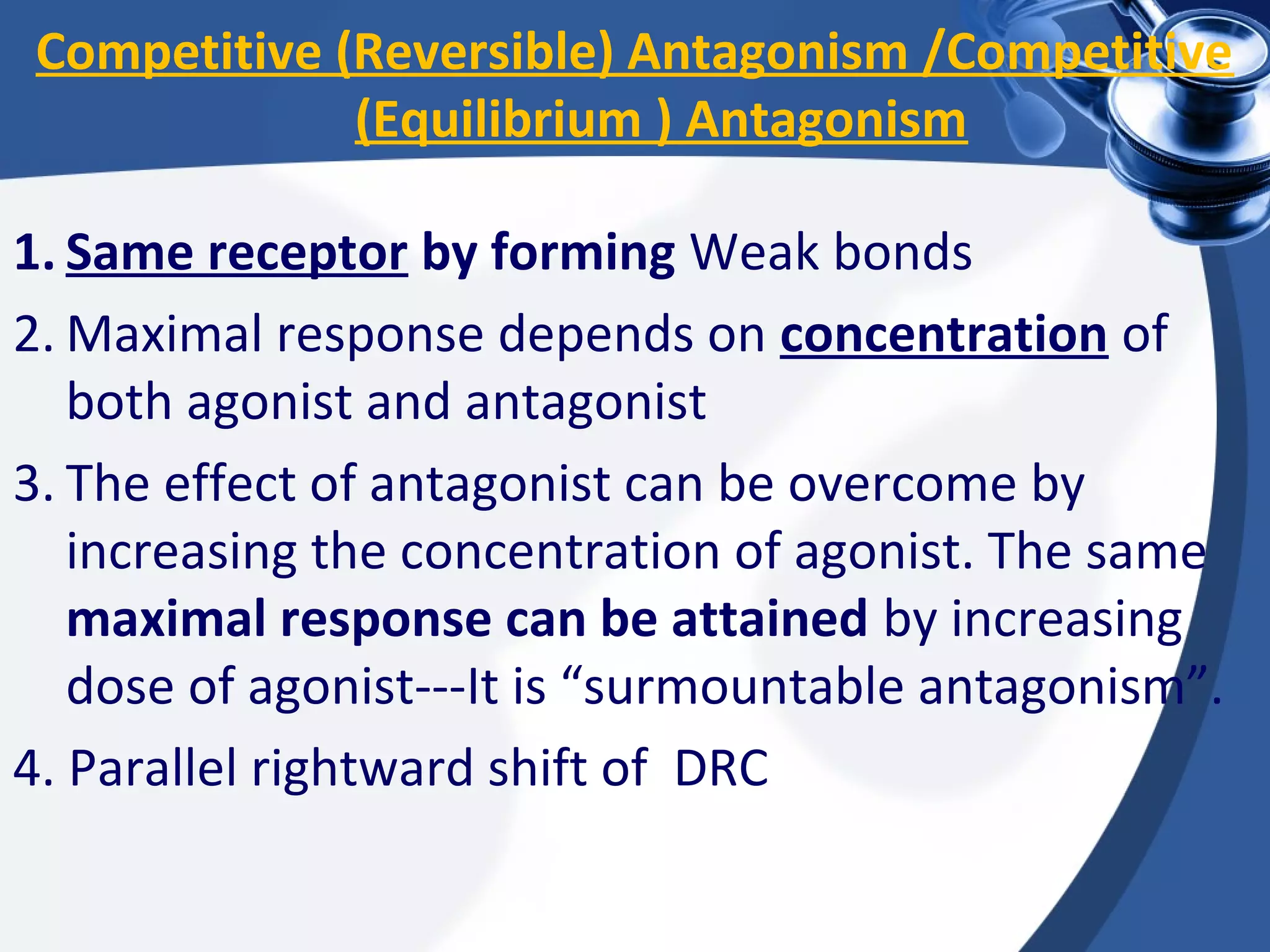
1. Same receptor by forming Weak bonds
2. Maximal response depends on concentration of
both agonist and antagonist
3. The effect of antagonist can be overcome by
increasing the concentration of agonist. The same
maximal response can be attained by increasing
dose of agonist---It is “surmountable antagonism”.
4. Parallel rightward shift of DRC
= Agonist = Antagonist
0
20
40
60
80
100
120
-11 -10 -9 -8 -7 -6
= Agonist = Antagonist
Examples: Atropine and Acetylcholine at Muscarinic -R
Naloxone and Morphine at opioid-R
Propranolol and NE at β2 - R
%Response
50
ED 50 ED 50 ED 50
Irreversibly Competitive or Non
Equilibrium Competitive Antagonism:
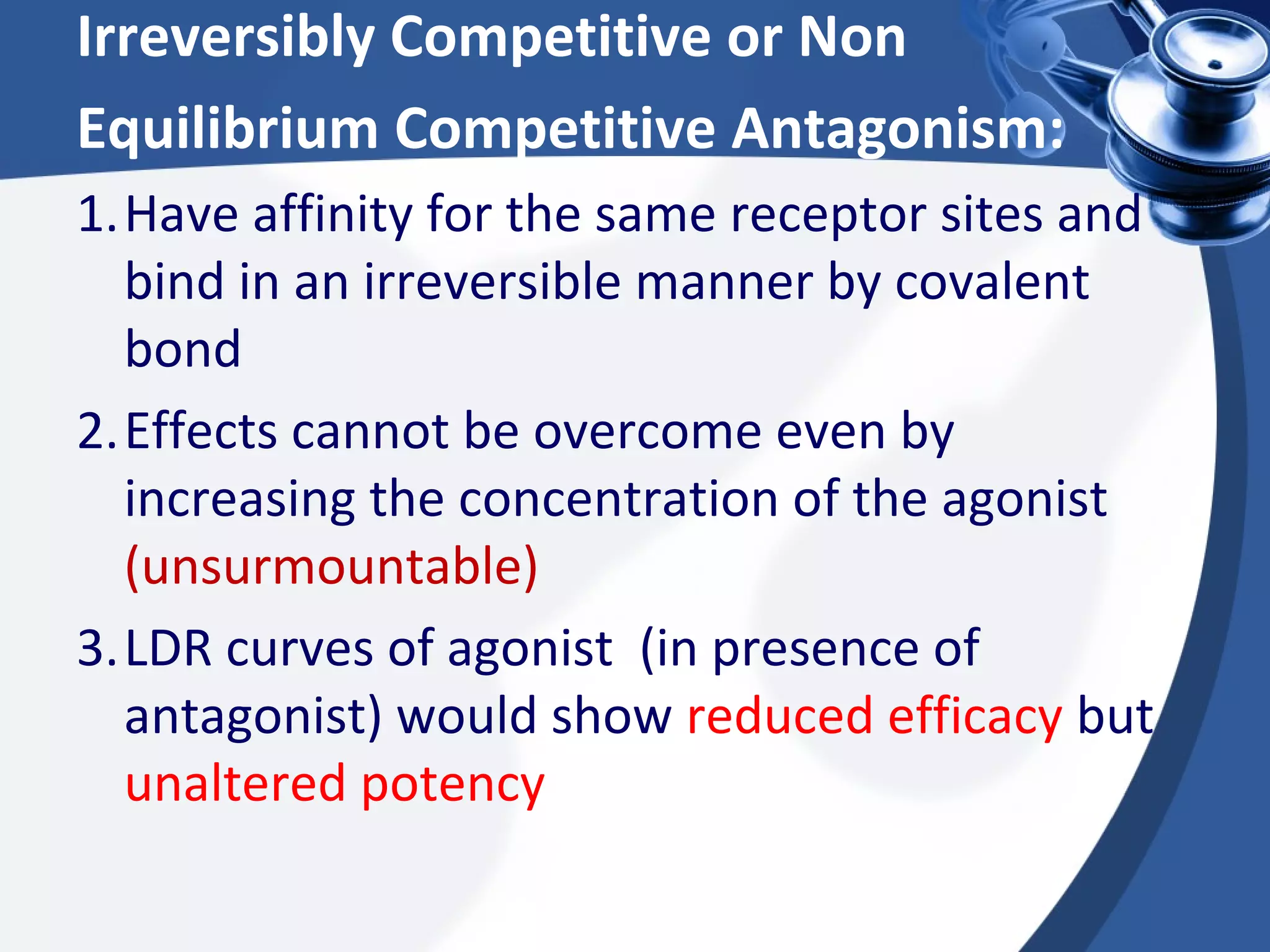
1.Have affinity for the same receptor sites and
bind in an irreversible manner by covalent
bond
2.Effects cannot be overcome even by
increasing the concentration of the agonist
(unsurmountable)
3.LDR curves of agonist (in presence of
antagonist) would show reduced efficacy but
unaltered potency
34
Irreversibly- Competitive
B
D
R
• Same agonist site
• Strong bond
• LDRC  efficacy
(flatten)
• Long duration
35
36
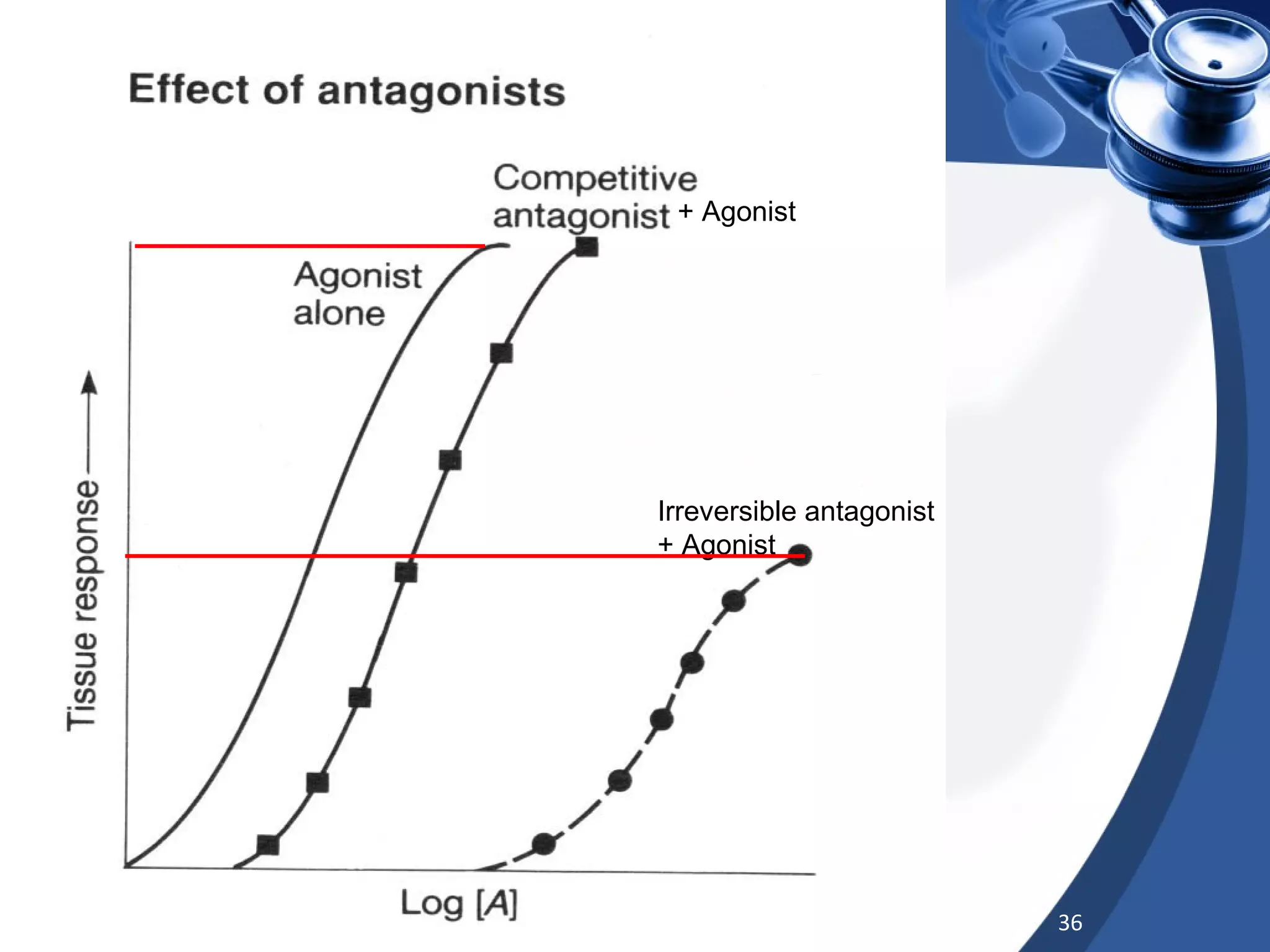
Irreversible antagonist
+ Agonist
+ Agonist
• DOA of irreversible antagonist is longer
• Equilibrium between Antagonist - Agonist
cannot be established even after increasing
the dose of agonist hence the term “Non-
equilibrium competitive antagonism”
• E.g. Dibenamine and NE at α1 adrenoceptors
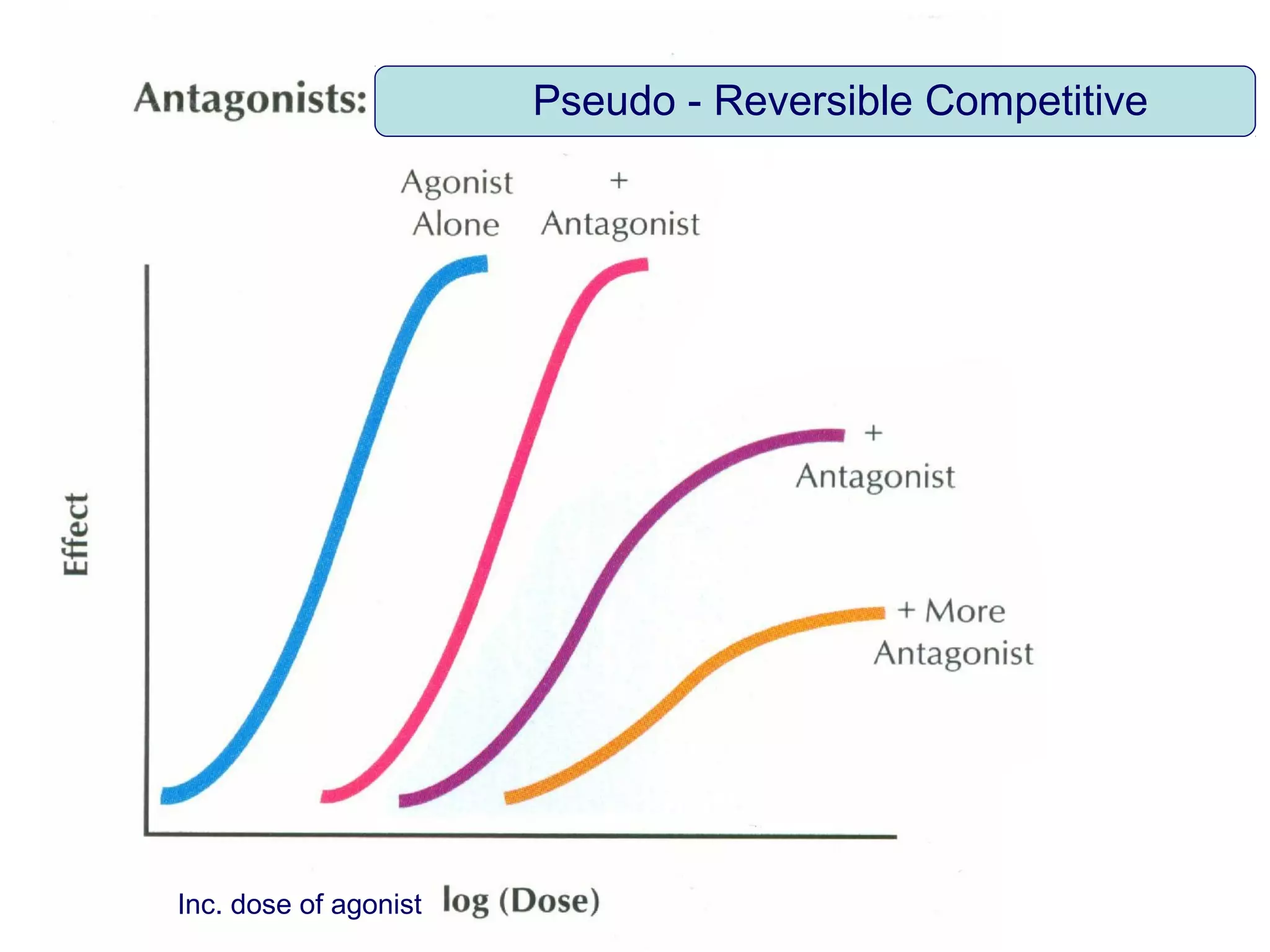
Pseudo-reversible Antagonism:
• Lesser degree of receptor occupancy by the
antagonist & availability of spare receptors
• Increasing conc. of agonist- shift LDR to right
• Increasing conc. of antagonist- reduction in
maximal response.
• Hence the term “Pseudo-reversible
Antagonism”
39
Pseudo-Reversible Competitive
B
D
R
R
R
R
D
D
• Strong bond
• Spare receptors
Agonist
overcomes
antagonist
• Same agonist
site
• LDRC
40
Pseudo reversible competitivePseudo - Reversible Competitive
Inc. dose of agonist
E.g.
Phenoxybenzamine - at α1 adrenoceptor
Methysergide - at 5HT receptor
(5HT receptor blocker)
41
Pseudo-Reversible Competitive
Non Competitive
Antagonism
42
43
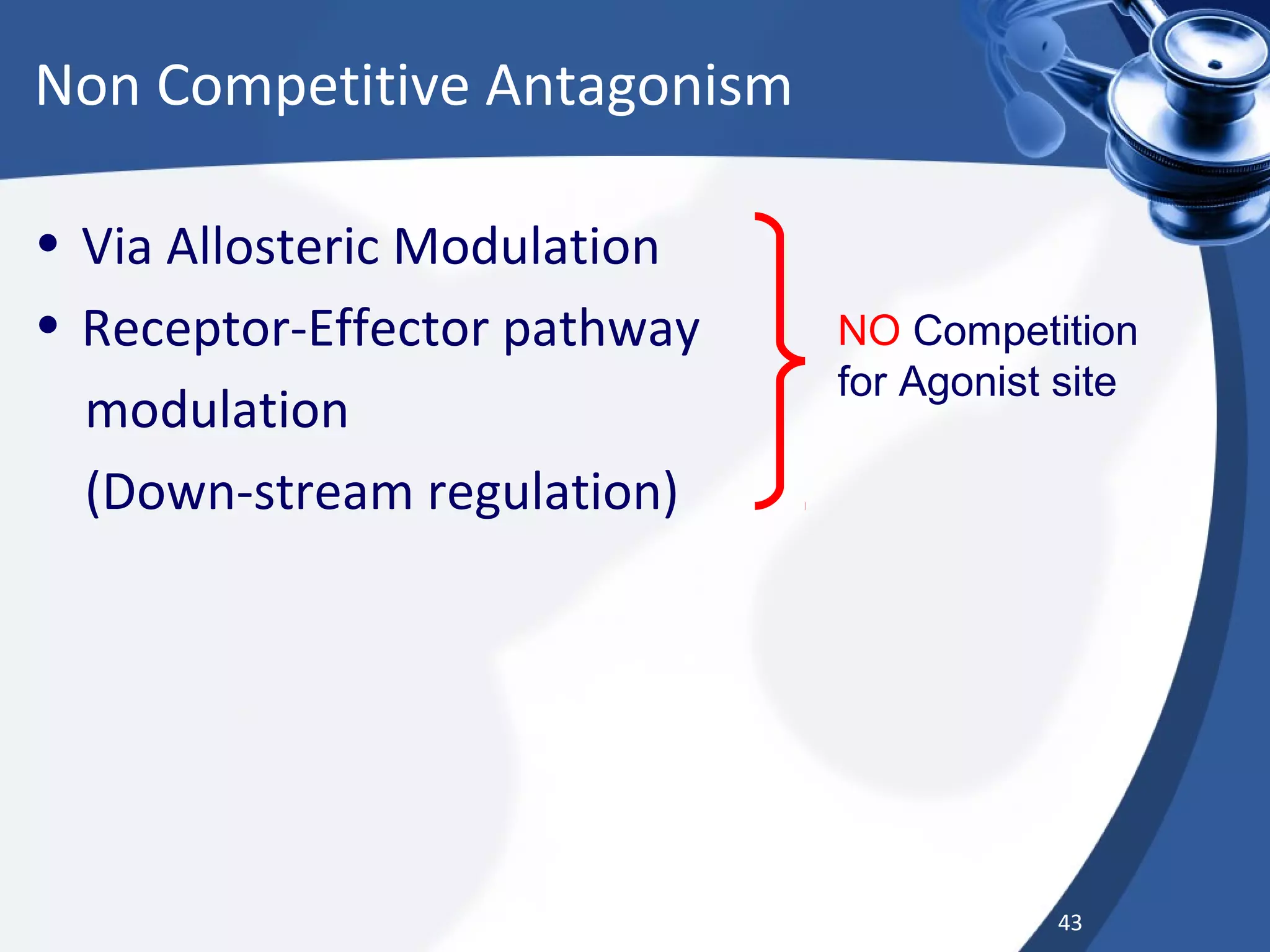
Non Competitive Antagonism
• Via Allosteric Modulation
• Receptor-Effector pathway
modulation
(Down-stream regulation)
NO Competition
for Agonist site
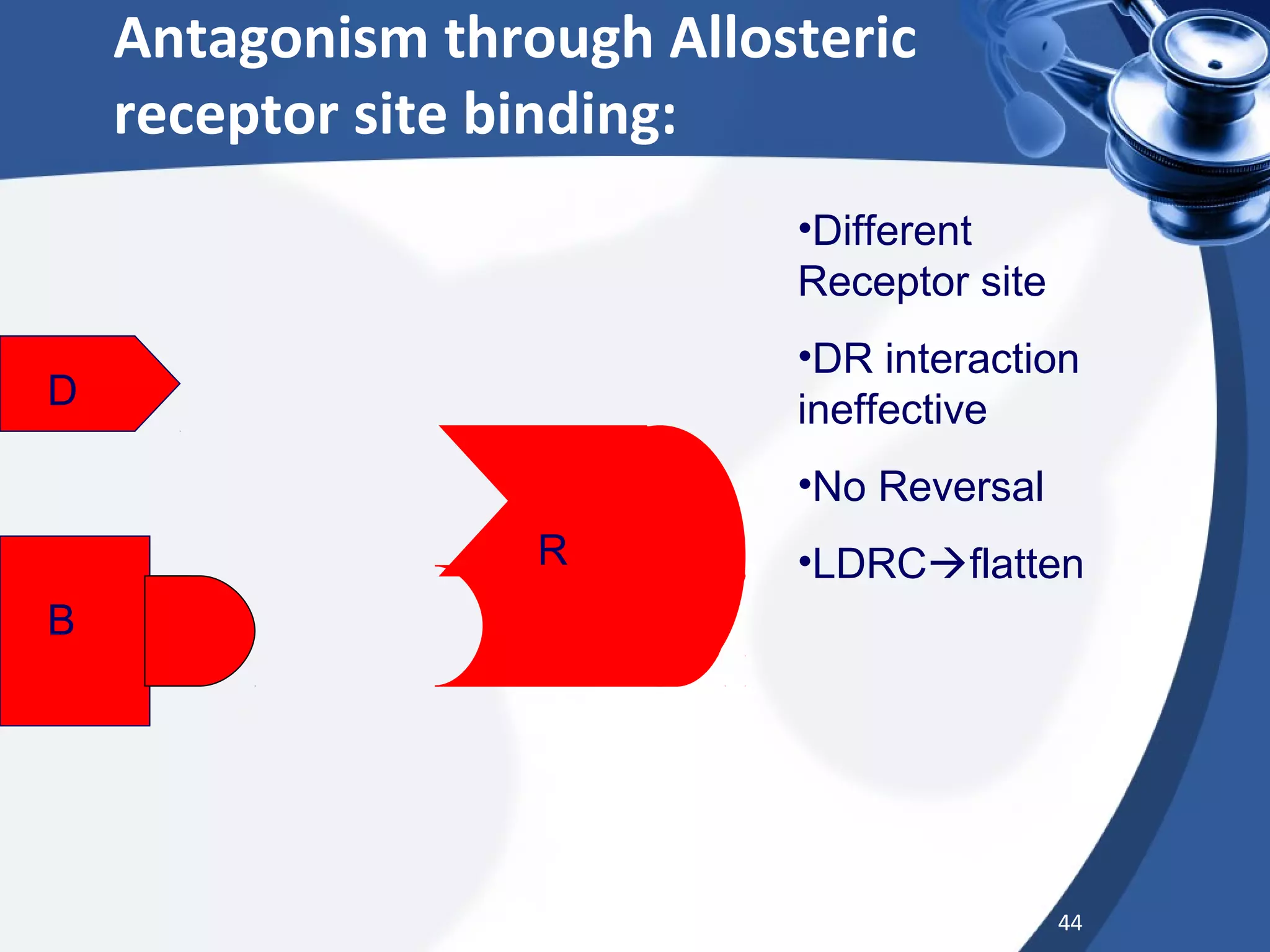
44
B
D
R
•Different
Receptor site
•DR interaction
ineffective
•No Reversal
•LDRCflatten
Antagonism through Allosteric
receptor site binding:
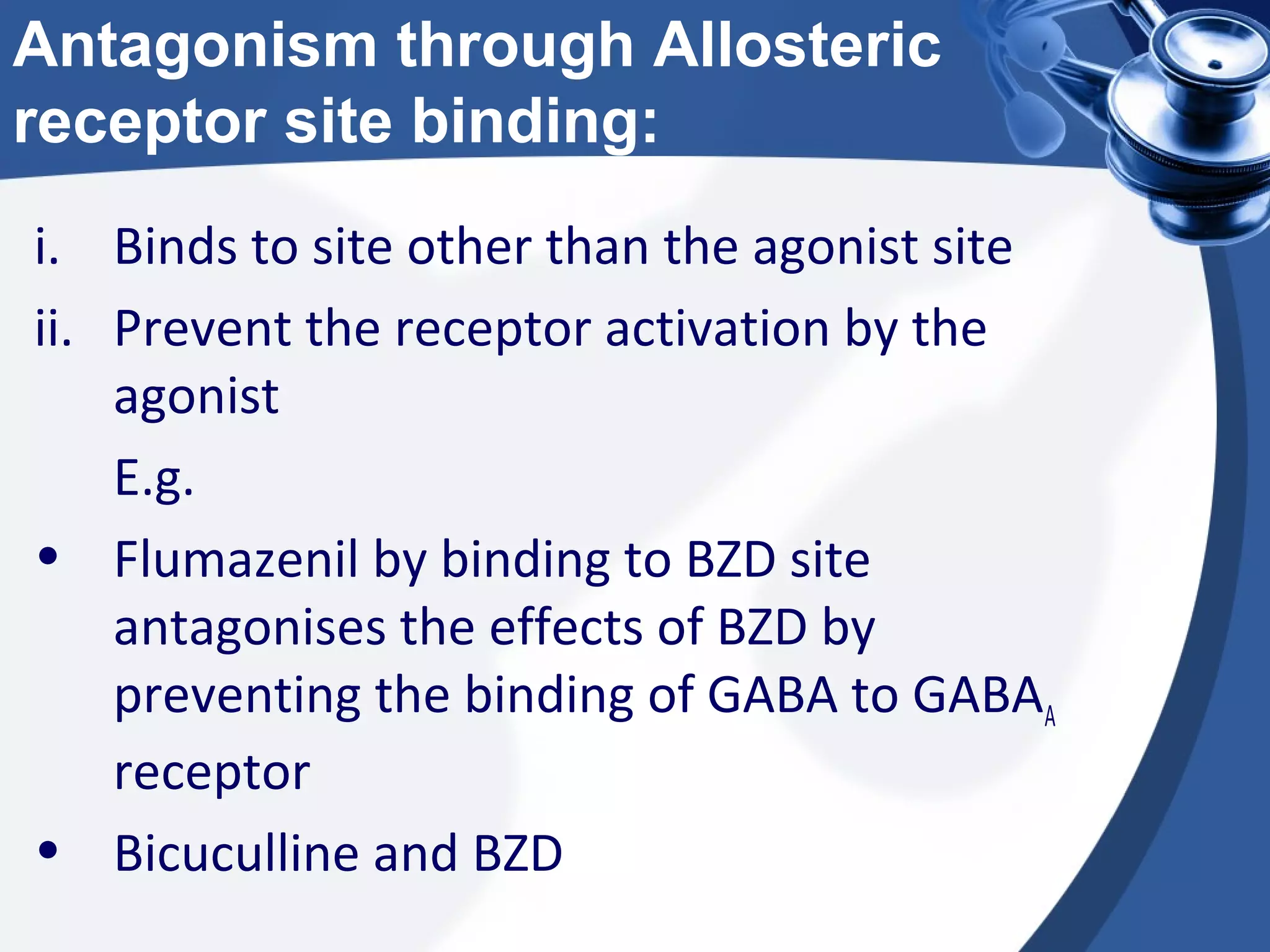
i. Binds to site other than the agonist site
ii. Prevent the receptor activation by the
agonist
E.g.
• Flumazenil by binding to BZD site
antagonises the effects of BZD by
preventing the binding of GABA to GABAA
receptor
• Bicuculline and BZD
Antagonism through Allosteric
receptor site binding:
46
GABA
GABA
binding site
Channel
blocker
(Picrotoxin)
Channel
modulators
(barbiturates)
Inverse
agonists
(β-carbolines)
Flumazenil
(antagonists)
BenzodiazepinesModulatory Site
Cl-
Cl-
Antagonism through Allosteric
receptor site binding:
47
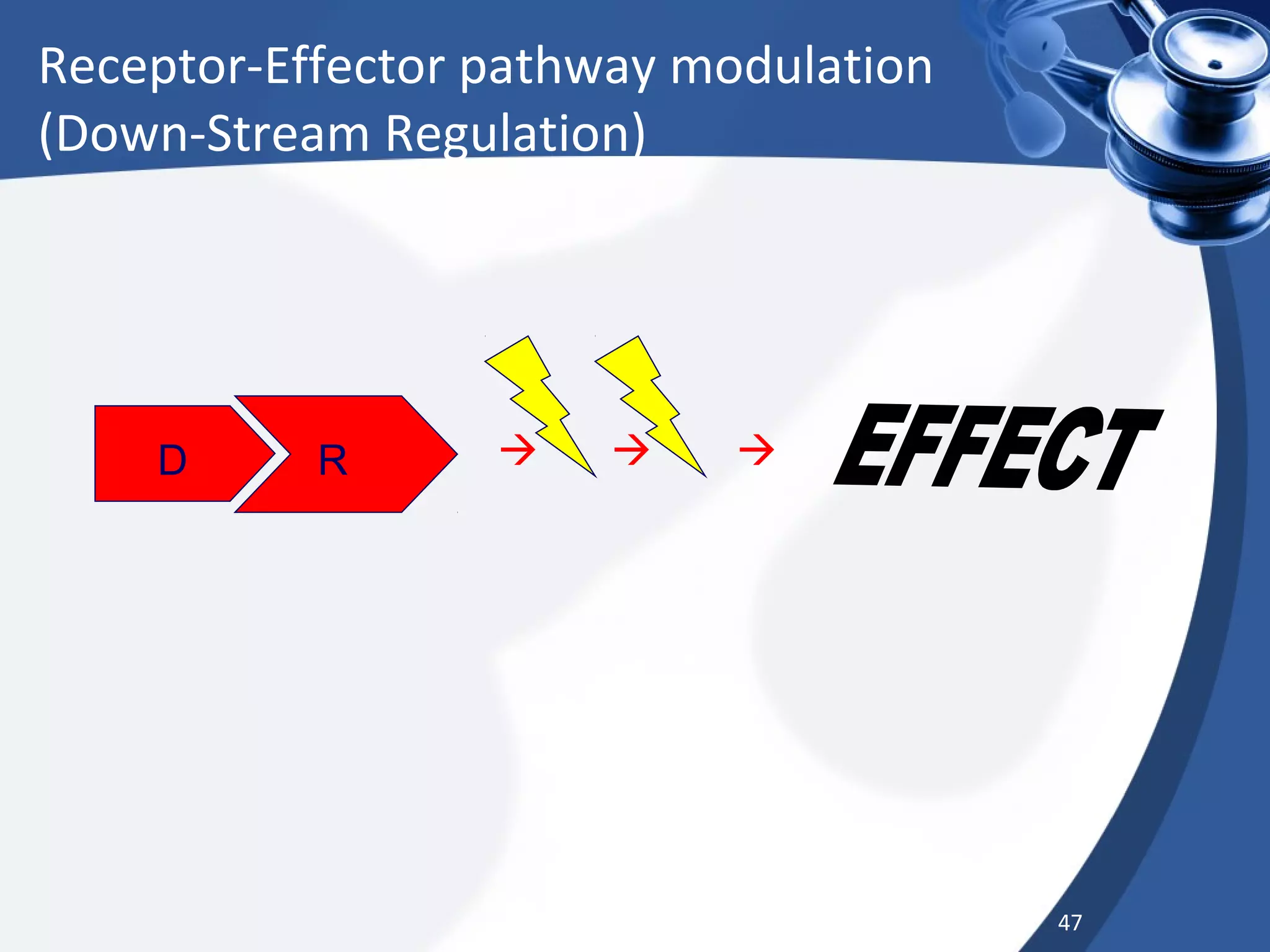
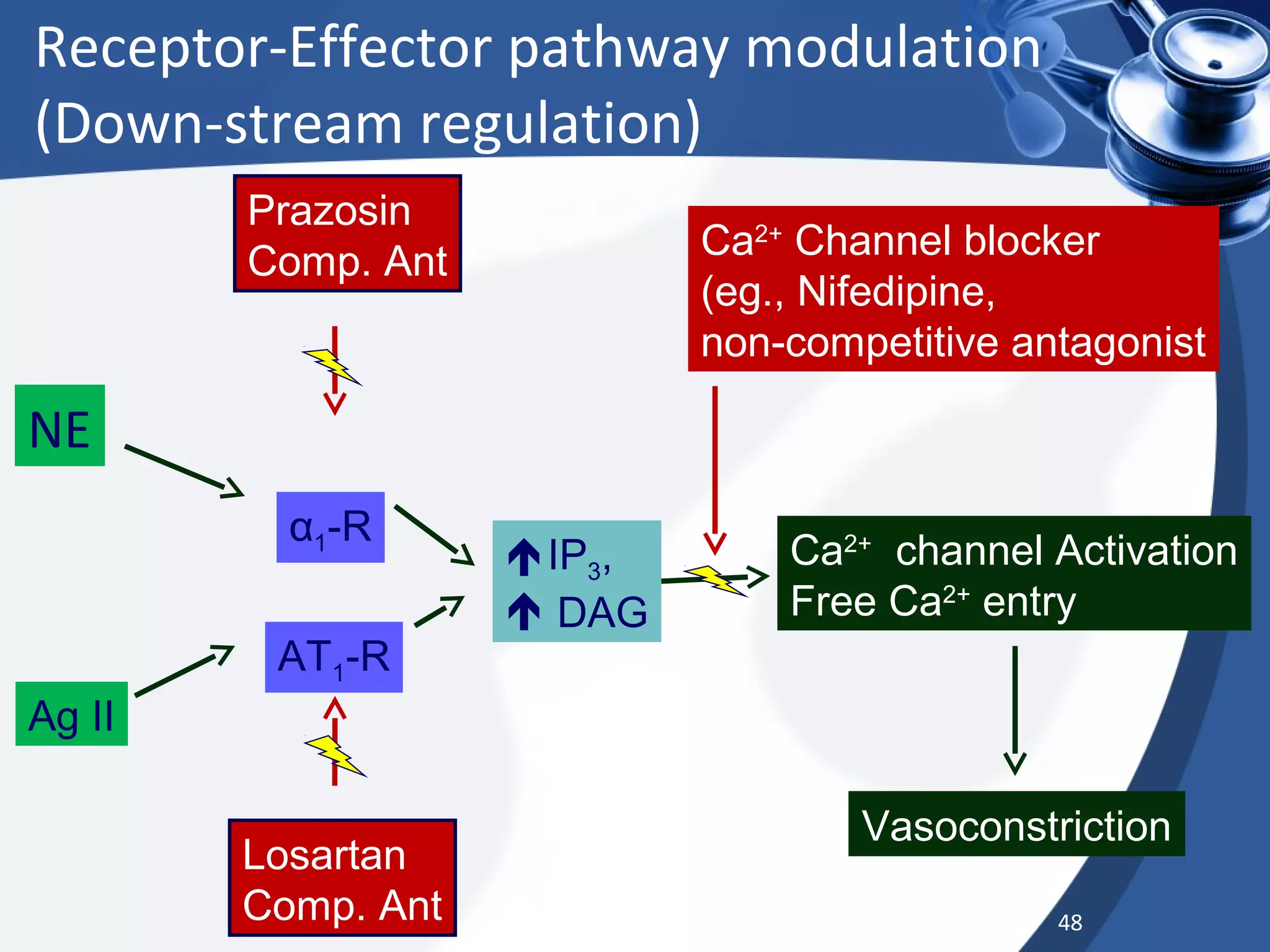
Receptor-Effector pathway modulation
(Down-Stream Regulation)
RD   
Receptor-Effector pathway modulation
(Down-stream regulation)
48
AT1-R
NE
Ag II
Prazosin
Comp. Ant
Losartan
Comp. Ant
IP3,
 DAG
α1-R
Ca2+
channel Activation
Free Ca2+
entry
Ca2+
Channel blocker
(eg., Nifedipine,
non-competitive antagonist
Vasoconstriction
Effects on log DRC
• There is downward shift .The slope is reduced
and maximum response is diminished
• The parallelism is not maintained
• No shift of curve on dose axis
50
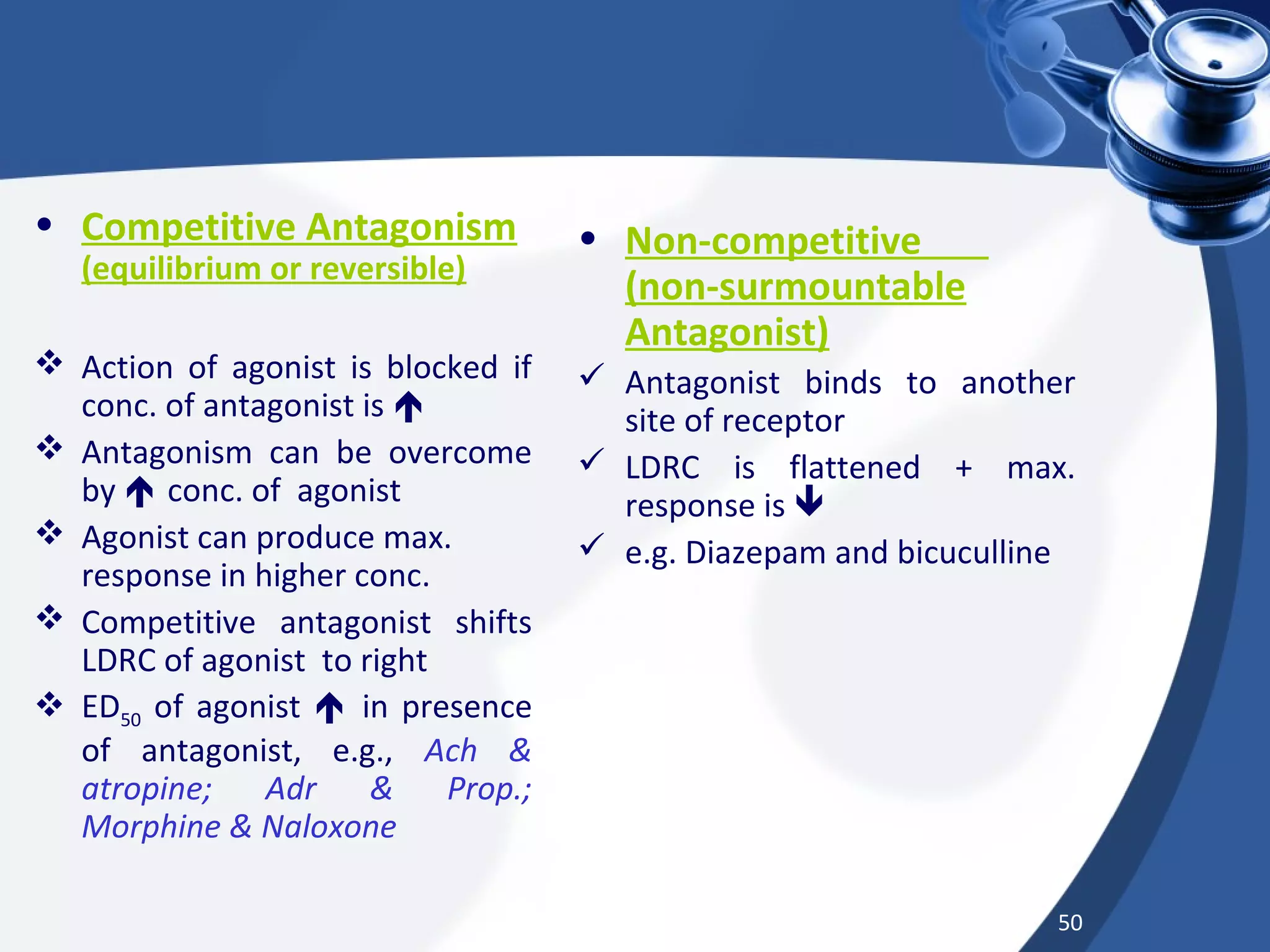
• Competitive Antagonism
(equilibrium or reversible)
 Action of agonist is blocked if
conc. of antagonist is 
 Antagonism can be overcome
by  conc. of agonist
 Agonist can produce max.
response in higher conc.
 Competitive antagonist shifts
LDRC of agonist to right
 ED50 of agonist  in presence
of antagonist, e.g., Ach &
atropine; Adr & Prop.;
Morphine & Naloxone
• Non-competitive
(non-surmountable
Antagonist)
 Antagonist binds to another
site of receptor
 LDRC is flattened + max.
response is 
 e.g. Diazepam and bicuculline
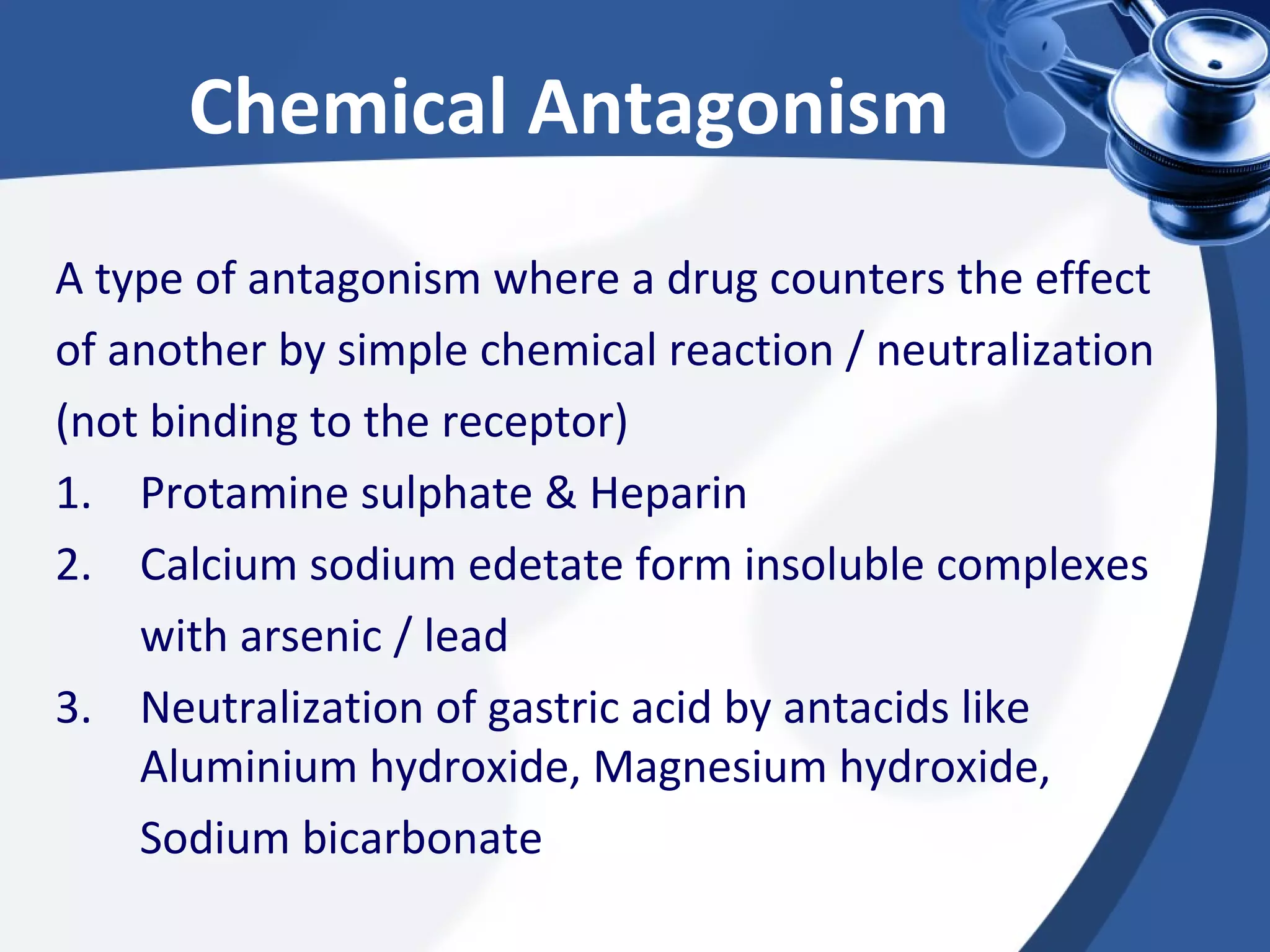
Chemical Antagonism
A type of antagonism where a drug counters the effect
of another by simple chemical reaction / neutralization
(not binding to the receptor)
1. Protamine sulphate & Heparin
2. Calcium sodium edetate form insoluble complexes
with arsenic / lead
3. Neutralization of gastric acid by antacids like
Aluminium hydroxide, Magnesium hydroxide,
Sodium bicarbonate
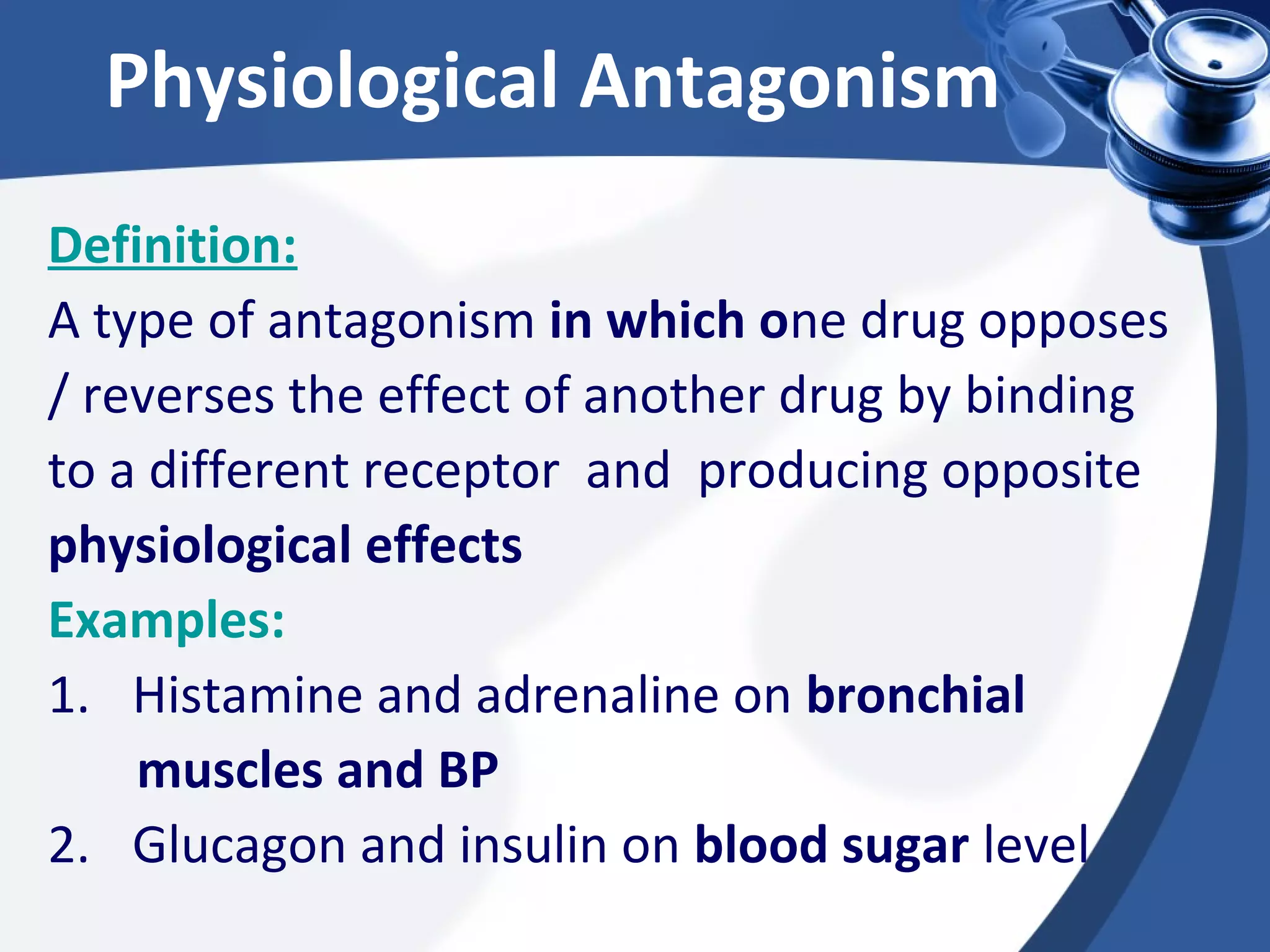
Physiological Antagonism
Definition:
A type of antagonism in which one drug opposes
/ reverses the effect of another drug by binding
to a different receptor and producing opposite
physiological effects
Examples:
1. Histamine and adrenaline on bronchial
muscles and BP
2. Glucagon and insulin on blood sugar level
Physical antagonism
• Based on the physical property of drugs e.g.
Charcoal adsorbs alkaloids and can prevent
their absorption- used in alkaloidal poisonings
53
REFERENCES
• Goodman Gilman - The Pharmacological Basis of
Therapeutics, 12th
Edition
• Katzung – Basic & Clinical Pharmacology,
12th
Edition
• Sharma – Priciples of Pharmacology,
2nd
Edition
• K.D Tripathi – Essentials of Medical
Pharmacology, 7th
edition
• R.S Satoskar – Pharmacology and
Pharmacotherapeutics, 18th
Edition
• www.google .com
55
Thank You..

Combined effects of Drugs, Pharmacology

  • 1.
    COMBINED EFFECTS OFDRUGS By: Dr. Dhruva Kumar Sharma Department of Pharmacology Moderator: Dr. Supratim Datta Associate Professor Department of Pharmacology SMIMS
  • 2.
  • 3.
    EFFECT OF COMBINATIONOF DRUGS Combinations of two/ more drugs, simultaneously or in quick succession 1. No interference with each other’s effects. 2. May oppose each other’s actions (antagonism) 3. May produce similar actions on the same organ (synergism)
  • 4.
  • 5.
  • 6.
    Drug Synergism: This isfacilitation of the effects of one drug by another when given together Types: a. Additive (summation) b. Supra-additive (Potentiation)
  • 7.
    Summation /Addition Effect ofdrugs A + B = Effect of drug A + Effect of drug B • Final effect is same as the algebraic sum of the magnitude of individuals drugs • Side effects do not add up Examples of Summation: Different MOA Aspirin : (-) PG synthesis  analgesia + Codeine : Opioid agonist  analgesia + Examples of Addition: Same MOA Ibuprofen: (-) PG synth  analgesia + Paracetamol: (-) PG synth  analgesia+ Analgesia ++ Analgesia ++
  • 8.
    Other Additive DrugCombinations Drug Combination Effect Amlodipine + Atenolol Antihypertensive Glibenclamide + Metformin Hypoglycemic
  • 9.
    Supraadditive ( Potentiation) Effectof drug A + B > Effect of drug A + Effect of drug B When two drugs are given together the final effect is much more than the simple algebraic sum of the magnitude of individuals drugs. Examples: Sulphamethoxazole & Trimethoprim--- sequential blockade of two steps in synthesis of folic acid in micro-organisms.
  • 11.
    Synergism by alteringPharmacokinetics of the other: • Levodopa + Carbidopa
  • 12.
    Other supraadditive drug combinations DRUGPAIR BASIS OF POTENTIATION Ach + Physostigmine Inhibition of break down Adrenaline + Cocaine Inhibition of neuronal uptake Tyramine + MAO inhibitors Increasing releaseable CAT store
  • 13.
  • 14.
    Drug Antagonism Definition: Combined effectof two drugs is less than the sum of the effects of the individual drugs Effect of drugs A + B < Effect of drug A + Effect of drug B One drug decreases / opposes / reverses / counters the effect of other drug by different mechanisms
  • 15.
    Types: a. Pharmacological Antagonism: i. Competitive (Reversible) ii. Non-competitive (Irreversible) b. Chemical Antagonism c. Physiological Antagonism d. Physical antagonism
  • 16.
    Pharmacological Antagonism: Competitive NonCompetitive Irreversibly competitive Reversibly competitive Pseudo- reversibly competitive Interfere “Down-stream events” Act on “allosteric site” PHARMACODYNAMIC ANTAGONISM
  • 17.
  • 18.
  • 19.
    = Agonist =Antagonist 0 20 40 60 80 100 120 -10.5 -10 -9.5 -9 -8.5 -8 -7.5 -7 -6.5 -6
  • 20.
    = Agonist =Antagonist 0 20 40 60 80 100 120 -11 -10 -9 -8 -7 -6
  • 21.
    = Agonist =Antagonist 0 20 40 60 80 100 120 -11 -10 -9 -8 -7 -6
  • 22.
    = Agonist =Antagonist 0 20 40 60 80 100 120 -11 -10 -9 -8 -7 -6
  • 23.
    = Agonist =Antagonist 0 20 40 60 80 100 120 -11 -10 -9 -8 -7 -6
  • 24.
    = Agonist =Antagonist 0 20 40 60 80 100 120 -11 -10 -9 -8 -7 -6
  • 25.
    = Agonist =Antagonist 0 20 40 60 80 100 120 -11 -10 -9 -8 -7 -6
  • 26.
    27 Reversible-Competitive B D R • Weak bond •Same agonist site • Short duration
  • 27.
    28 LDRC shift toR B R D D D D D Reversible-Competitive Conc dependant  Dynamic Equilibrium
  • 28.
    Competitive (Reversible) Antagonism/Competitive (Equilibrium ) Antagonism 1. Same receptor by forming Weak bonds 2. Maximal response depends on concentration of both agonist and antagonist 3. The effect of antagonist can be overcome by increasing the concentration of agonist. The same maximal response can be attained by increasing dose of agonist---It is “surmountable antagonism”. 4. Parallel rightward shift of DRC
  • 29.
    = Agonist =Antagonist 0 20 40 60 80 100 120 -11 -10 -9 -8 -7 -6
  • 30.
    = Agonist =Antagonist
  • 31.
    Examples: Atropine andAcetylcholine at Muscarinic -R Naloxone and Morphine at opioid-R Propranolol and NE at β2 - R %Response 50 ED 50 ED 50 ED 50
  • 32.
    Irreversibly Competitive orNon Equilibrium Competitive Antagonism: 1.Have affinity for the same receptor sites and bind in an irreversible manner by covalent bond 2.Effects cannot be overcome even by increasing the concentration of the agonist (unsurmountable) 3.LDR curves of agonist (in presence of antagonist) would show reduced efficacy but unaltered potency
  • 33.
    34 Irreversibly- Competitive B D R • Sameagonist site • Strong bond • LDRC  efficacy (flatten) • Long duration
  • 34.
  • 35.
  • 36.
    • DOA ofirreversible antagonist is longer • Equilibrium between Antagonist - Agonist cannot be established even after increasing the dose of agonist hence the term “Non- equilibrium competitive antagonism” • E.g. Dibenamine and NE at α1 adrenoceptors
  • 37.
    Pseudo-reversible Antagonism: • Lesserdegree of receptor occupancy by the antagonist & availability of spare receptors • Increasing conc. of agonist- shift LDR to right • Increasing conc. of antagonist- reduction in maximal response. • Hence the term “Pseudo-reversible Antagonism”
  • 38.
    39 Pseudo-Reversible Competitive B D R R R R D D • Strongbond • Spare receptors Agonist overcomes antagonist • Same agonist site • LDRC
  • 39.
    40 Pseudo reversible competitivePseudo- Reversible Competitive Inc. dose of agonist
  • 40.
    E.g. Phenoxybenzamine - atα1 adrenoceptor Methysergide - at 5HT receptor (5HT receptor blocker) 41 Pseudo-Reversible Competitive
  • 41.
  • 42.
    43 Non Competitive Antagonism •Via Allosteric Modulation • Receptor-Effector pathway modulation (Down-stream regulation) NO Competition for Agonist site
  • 43.
    44 B D R •Different Receptor site •DR interaction ineffective •NoReversal •LDRCflatten Antagonism through Allosteric receptor site binding:
  • 44.
    i. Binds tosite other than the agonist site ii. Prevent the receptor activation by the agonist E.g. • Flumazenil by binding to BZD site antagonises the effects of BZD by preventing the binding of GABA to GABAA receptor • Bicuculline and BZD Antagonism through Allosteric receptor site binding:
  • 45.
  • 46.
  • 47.
    Receptor-Effector pathway modulation (Down-streamregulation) 48 AT1-R NE Ag II Prazosin Comp. Ant Losartan Comp. Ant IP3,  DAG α1-R Ca2+ channel Activation Free Ca2+ entry Ca2+ Channel blocker (eg., Nifedipine, non-competitive antagonist Vasoconstriction
  • 48.
    Effects on logDRC • There is downward shift .The slope is reduced and maximum response is diminished • The parallelism is not maintained • No shift of curve on dose axis
  • 49.
    50 • Competitive Antagonism (equilibriumor reversible)  Action of agonist is blocked if conc. of antagonist is   Antagonism can be overcome by  conc. of agonist  Agonist can produce max. response in higher conc.  Competitive antagonist shifts LDRC of agonist to right  ED50 of agonist  in presence of antagonist, e.g., Ach & atropine; Adr & Prop.; Morphine & Naloxone • Non-competitive (non-surmountable Antagonist)  Antagonist binds to another site of receptor  LDRC is flattened + max. response is   e.g. Diazepam and bicuculline
  • 50.
    Chemical Antagonism A typeof antagonism where a drug counters the effect of another by simple chemical reaction / neutralization (not binding to the receptor) 1. Protamine sulphate & Heparin 2. Calcium sodium edetate form insoluble complexes with arsenic / lead 3. Neutralization of gastric acid by antacids like Aluminium hydroxide, Magnesium hydroxide, Sodium bicarbonate
  • 51.
    Physiological Antagonism Definition: A typeof antagonism in which one drug opposes / reverses the effect of another drug by binding to a different receptor and producing opposite physiological effects Examples: 1. Histamine and adrenaline on bronchial muscles and BP 2. Glucagon and insulin on blood sugar level
  • 52.
    Physical antagonism • Basedon the physical property of drugs e.g. Charcoal adsorbs alkaloids and can prevent their absorption- used in alkaloidal poisonings 53
  • 53.
    REFERENCES • Goodman Gilman- The Pharmacological Basis of Therapeutics, 12th Edition • Katzung – Basic & Clinical Pharmacology, 12th Edition • Sharma – Priciples of Pharmacology, 2nd Edition • K.D Tripathi – Essentials of Medical Pharmacology, 7th edition • R.S Satoskar – Pharmacology and Pharmacotherapeutics, 18th Edition • www.google .com
  • 54.

Editor's Notes

  • #3 Respected prof dr Kc swain sir, Assoc. Prof. Dr supratim sir Assoc prof dr Chandrakala mam, other faculties deb sir, sunil sir , my senior PGs and my dear colleague .I am here to present a seminar on combined effects of drug action and this seminar has been moderated by Assoc. Prof dr supratim
  • #4 When 2 or more
  • #5 Interaction may take place at pharmacokinetic or pharmacodynamic level
  • #7 Synergism: sharma-AB&amp;gt;A+B, Additive and summation diff entity,doesnot talk about potentition/supraadditive Tripathi says synergism as facilitation of the effects of one drug by another when given together, and classifies synergism as additive and supraadditive
  • #8 Pg. 496 sharma opioid Recptors mu and delta, inhbn of ad. cy.—dec camp—dec cell excitablity, activation of K channels-hyperpolarisation,decrease ca conductance
  • #9 ???additive/???summative NO &amp; Halothane: 373 tripathi Amlo-268 sharma Gli+Met=kdt 274,fig 19.6
  • #11 Pharmacodynamic beneficial combinatoin Other eg. Beta blocker and frusemide
  • #14 Ach-105 kdt Adrenaline cocaine-sharma 157,158,159 Mao=sharma 464-tranylcypromine, moclobemide, selegiline iproniazid, Tyramine: 178 sharma mao present liver git metabolise tyramine rapidly-in presence of mao- inhb tyramine met- concof tyr increases and inc releseable cat stores----cheese reaction
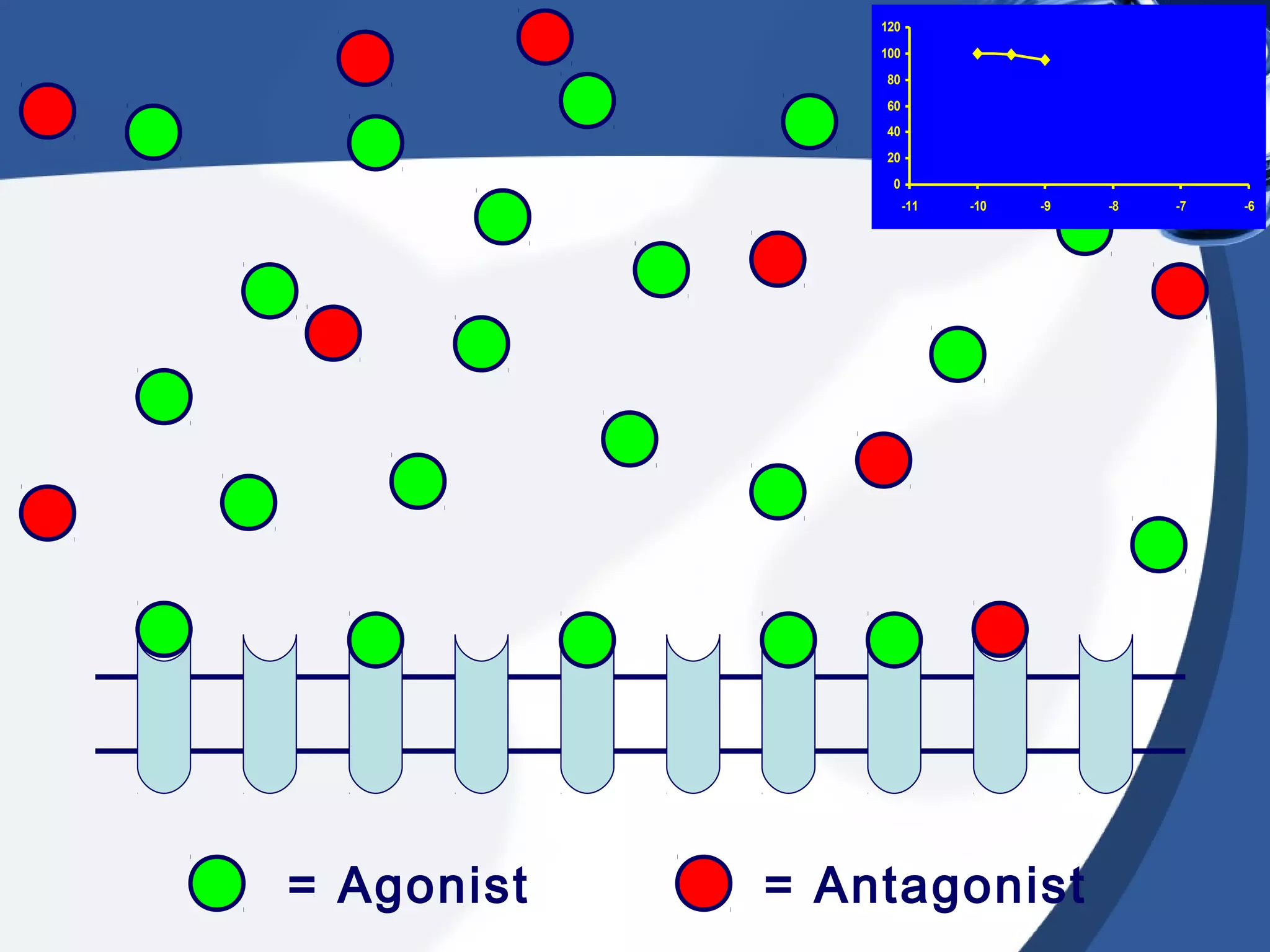
  • #20 Showing competitive antagonism
  • #33 ED50:dose required to produce half max response
  • #37 Competitive antagonists added to an agonist will also shift the curve to the right, as a higher conc of agonist will be needed to overcome the antagonist and produce the maximum tissue response. An irreversible antagonist will bind permanently, so a maximum response will never be able to be reached.
  • #44 Non competitive Antagonism Antagonist binds strongly to different receptor site in an irreversible or nearly irreversible fashion Two types: Non competitive antagonism through Interference in the Down-stream Events of Receptor Activation: Same pattern of log dose response curve as that of irreversible competitive antagonism The effect of antagonist can not be overcome by increasing the concentration of agonist. Maximal response can not be achieved by increasing the conc. of agonist --unsurmountable antagonism
  • #47 Bzd enhance binding of gaba to GABAa (increase frequency rather than duration of binding of gaba to gaba A) Note: bicuculline is a competitive antagonist of binding of GABA to its receptor site hence antagonises the action of BZD non-competitively- another eg. of non comp antagonism at BZD Receptor
  • #52 Protamine- strong positively charged &amp; Heparin- strong negatively charged protein Protamine sulphate is Antidote in Heparin overdosage
  • #53 Essential point about physiological antagonism is- effects produced by the two drugs counteract each other, but each drug in unhindered in its ability to elicit its own response
  • #55 www.google .com