Derivational and
Inflectional Morphemes
GROUP 3 of B-Class
Dewi Maharani (130511100061)
Ismi Intan P (130511100062)
Cucuk Abdullah P (130511100074)
Kamiliatus Syarifah (130511100060)
Abdul Jawat (130511100069)
Siti Irawati (130511100070)
Abdur Rokib (130511100080)
Derivational Morpheme
Create new words by changing the
meaning or by changing the word class
of the word (make words or new
words of a different grammatical
category from the stem)
In derivation a new word is formed by
adding an affix to the root or stem
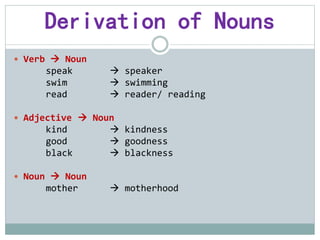
Derivation of Nouns
 Verb  Noun
speak  speaker
swim  swimming
read  reader/ reading
 Adjective  Noun
kind  kindness
good  goodness
black  blackness
 Noun  Noun
mother  motherhood
Derivation of Nouns
 We can also add suffixes such as –hood (status), -ship (state or
condition), -ness (quality, state or condition) , -ity (state or
condition), -ment (result or product of doing the action), -al (act of
somethig), -er (agentive), in the words like brotherhood,
friendship, wildness, sincerity, government, refusal, walker
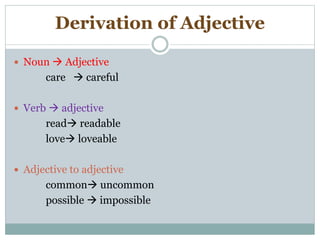
Derivation of Adjective
 Noun  Adjective
care  careful
 Verb  adjective
read readable
love loveable
 Adjective to adjective
common uncommon
possible  impossible
Derivation of Verbs
 Noun  Verb
analysis analyze
slave enslave
 Adjective verb
rich  enrich
legal  legalize
 Verb verb
continue discontinue
pack  unpack
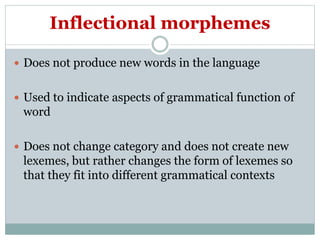
Inflectional morphemes
 Does not produce new words in the language
 Used to indicate aspects of grammatical function of
word
 Does not change category and does not create new
lexemes, but rather changes the form of lexemes so
that they fit into different grammatical contexts
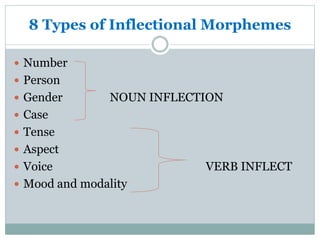
8 Types of Inflectional Morphemes
 Number
 Person
 Gender NOUN INFLECTION
 Case
 Tense
 Aspect
 Voice VERB INFLECT
 Mood and modality
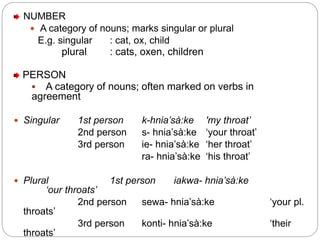
NUMBER
 A category of nouns; marks singular or plural
E.g. singular : cat, ox, child
plural : cats, oxen, children
PERSON
 A category of nouns; often marked on verbs in
agreement
 Singular 1st person k-hnia’sà:ke 'my throat’
2nd person s- hnia’sà:ke ‘your throat’
3rd person ie- hnia’sà:ke ‘her throat’
ra- hnia’sà:ke ‘his throat’
 Plural 1st person iakwa- hnia’sà:ke
‘our throats’
2nd person sewa- hnia’sà:ke ‘your pl.
throats’
3rd person konti- hnia’sà:ke ‘their
throats’
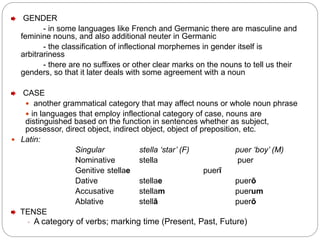
GENDER
- in some languages like French and Germanic there are masculine and
feminine nouns, and also additional neuter in Germanic
- the classification of inflectional morphemes in gender itself is
arbitrariness
- there are no suffixes or other clear marks on the nouns to tell us their
genders, so that it later deals with some agreement with a noun
CASE
 another grammatical category that may affect nouns or whole noun phrase
 in languages that employ inflectional category of case, nouns are
distinguished based on the function in sentences whether as subject,
possessor, direct object, indirect object, object of preposition, etc.
 Latin:
Singular stella ‘star’ (F) puer ‘boy’ (M)
Nominative stella puer
Genitive stellae puerī
Dative stellae puerō
Accusative stellam puerum
Ablative stellā puerō
TENSE
 A category of verbs; marking time (Present, Past, Future)
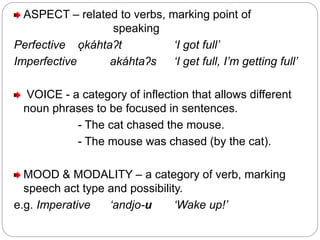
ASPECT – related to verbs, marking point of
speaking
Perfective ǫkáhtaʔt ‘I got full’
Imperfective akáhtaʔs ‘I get full, I’m getting full’
VOICE - a category of inflection that allows different
noun phrases to be focused in sentences.
- The cat chased the mouse.
- The mouse was chased (by the cat).
MOOD & MODALITY – a category of verb, marking
speech act type and possibility.
e.g. Imperative ‘andjo-u ‘Wake up!’
ENGLISH LANGUAGE’S VERB
INFLECTIONAL SUFFIXES
1. The suffix –s functions in the Present Simple as the third
person marking of the verb : to work – he work-s
2. The suffix –ed functions in the past simple as the past
tense marker in regular verbs: to love – lov-ed
3. The suffixes –ed (regular verbs) and –en (for some regular
verbs) function in the marking of the past partciple and, in
general, in the marking of the perfect aspect:
To study studied studied / To eat ate eaten
4. The suffix –ing functions in the marking of the present
participle, the gerund and in the marking of the continuous
aspect: To eat – eating / To study - studying
ENGLISH LANGUAGE’S NOUN
INFLECTIONAL SUFFIXES
5. The suffix –s functions in the marking of the plural
of nouns
 dog – dogs
6. The suffix –s functions as a possessive marker
 Laura – Laura’s book.
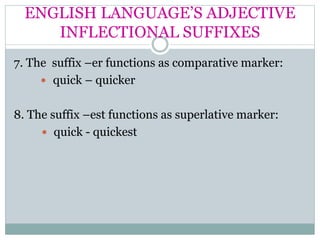
ENGLISH LANGUAGE’S ADJECTIVE
INFLECTIONAL SUFFIXES
7. The suffix –er functions as comparative marker:
 quick – quicker
8. The suffix –est functions as superlative marker:
 quick - quickest
Conclusion
Inflectional
Never changes category
Do not change part of Speech
Adds grammatical meaning
Is important to syntax
Is usually fully productive
Derivational
Sometimes changes category
Can change part of speech
Often adds lexical meaning
Produces new lexemes
Can range from unproductive to fully
Productive
THANK
YOU 
REFERENCES
Lieber, Rochelle. Introducing Morphology. New York:
Cambridge University Press.2009
Yule, George. The Study of Language (fourth edition).
New York: Cambridge University Press.2010
Umich.edu. Inflection.pdf (online).
www.google.co.ig/url?q=http://www.umich.edu/~jlawle
r/Inflection.pdf&sa=U&ved=0ahUKEwj3jNux-
dnJAhVI9WMKHSExAGIQFggLMAA&usg=AFQjCNE6J
rcMFeyTFTJ6ynWhHKSPx2OsOA , accessed on
December 1st, 2015

Derivational and inflectional morphemes

  • 1.
  • 2.
    GROUP 3 ofB-Class Dewi Maharani (130511100061) Ismi Intan P (130511100062) Cucuk Abdullah P (130511100074) Kamiliatus Syarifah (130511100060) Abdul Jawat (130511100069) Siti Irawati (130511100070) Abdur Rokib (130511100080)
  • 3.
    Derivational Morpheme Create newwords by changing the meaning or by changing the word class of the word (make words or new words of a different grammatical category from the stem) In derivation a new word is formed by adding an affix to the root or stem
  • 4.
    Derivation of Nouns Verb  Noun speak  speaker swim  swimming read  reader/ reading  Adjective  Noun kind  kindness good  goodness black  blackness  Noun  Noun mother  motherhood
  • 5.
    Derivation of Nouns We can also add suffixes such as –hood (status), -ship (state or condition), -ness (quality, state or condition) , -ity (state or condition), -ment (result or product of doing the action), -al (act of somethig), -er (agentive), in the words like brotherhood, friendship, wildness, sincerity, government, refusal, walker
  • 6.
    Derivation of Adjective Noun  Adjective care  careful  Verb  adjective read readable love loveable  Adjective to adjective common uncommon possible  impossible
  • 7.
    Derivation of Verbs Noun  Verb analysis analyze slave enslave  Adjective verb rich  enrich legal  legalize  Verb verb continue discontinue pack  unpack
  • 8.
    Inflectional morphemes  Doesnot produce new words in the language  Used to indicate aspects of grammatical function of word  Does not change category and does not create new lexemes, but rather changes the form of lexemes so that they fit into different grammatical contexts
  • 9.
    8 Types ofInflectional Morphemes  Number  Person  Gender NOUN INFLECTION  Case  Tense  Aspect  Voice VERB INFLECT  Mood and modality
  • 10.
    NUMBER  A categoryof nouns; marks singular or plural E.g. singular : cat, ox, child plural : cats, oxen, children PERSON  A category of nouns; often marked on verbs in agreement  Singular 1st person k-hnia’sà:ke 'my throat’ 2nd person s- hnia’sà:ke ‘your throat’ 3rd person ie- hnia’sà:ke ‘her throat’ ra- hnia’sà:ke ‘his throat’  Plural 1st person iakwa- hnia’sà:ke ‘our throats’ 2nd person sewa- hnia’sà:ke ‘your pl. throats’ 3rd person konti- hnia’sà:ke ‘their throats’
  • 11.
    GENDER - in somelanguages like French and Germanic there are masculine and feminine nouns, and also additional neuter in Germanic - the classification of inflectional morphemes in gender itself is arbitrariness - there are no suffixes or other clear marks on the nouns to tell us their genders, so that it later deals with some agreement with a noun CASE  another grammatical category that may affect nouns or whole noun phrase  in languages that employ inflectional category of case, nouns are distinguished based on the function in sentences whether as subject, possessor, direct object, indirect object, object of preposition, etc.  Latin: Singular stella ‘star’ (F) puer ‘boy’ (M) Nominative stella puer Genitive stellae puerī Dative stellae puerō Accusative stellam puerum Ablative stellā puerō TENSE  A category of verbs; marking time (Present, Past, Future)
  • 12.
    ASPECT – relatedto verbs, marking point of speaking Perfective ǫkáhtaʔt ‘I got full’ Imperfective akáhtaʔs ‘I get full, I’m getting full’ VOICE - a category of inflection that allows different noun phrases to be focused in sentences. - The cat chased the mouse. - The mouse was chased (by the cat). MOOD & MODALITY – a category of verb, marking speech act type and possibility. e.g. Imperative ‘andjo-u ‘Wake up!’
  • 13.
    ENGLISH LANGUAGE’S VERB INFLECTIONALSUFFIXES 1. The suffix –s functions in the Present Simple as the third person marking of the verb : to work – he work-s 2. The suffix –ed functions in the past simple as the past tense marker in regular verbs: to love – lov-ed 3. The suffixes –ed (regular verbs) and –en (for some regular verbs) function in the marking of the past partciple and, in general, in the marking of the perfect aspect: To study studied studied / To eat ate eaten 4. The suffix –ing functions in the marking of the present participle, the gerund and in the marking of the continuous aspect: To eat – eating / To study - studying
  • 14.
    ENGLISH LANGUAGE’S NOUN INFLECTIONALSUFFIXES 5. The suffix –s functions in the marking of the plural of nouns  dog – dogs 6. The suffix –s functions as a possessive marker  Laura – Laura’s book.
  • 15.
    ENGLISH LANGUAGE’S ADJECTIVE INFLECTIONALSUFFIXES 7. The suffix –er functions as comparative marker:  quick – quicker 8. The suffix –est functions as superlative marker:  quick - quickest
  • 16.
    Conclusion Inflectional Never changes category Donot change part of Speech Adds grammatical meaning Is important to syntax Is usually fully productive
  • 17.
    Derivational Sometimes changes category Canchange part of speech Often adds lexical meaning Produces new lexemes Can range from unproductive to fully Productive
  • 18.
  • 19.
    REFERENCES Lieber, Rochelle. IntroducingMorphology. New York: Cambridge University Press.2009 Yule, George. The Study of Language (fourth edition). New York: Cambridge University Press.2010 Umich.edu. Inflection.pdf (online). www.google.co.ig/url?q=http://www.umich.edu/~jlawle r/Inflection.pdf&sa=U&ved=0ahUKEwj3jNux- dnJAhVI9WMKHSExAGIQFggLMAA&usg=AFQjCNE6J rcMFeyTFTJ6ynWhHKSPx2OsOA , accessed on December 1st, 2015