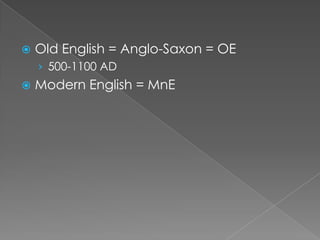
   Old English = Anglo-Saxon = OE
    › 500-1100 AD
   Modern English = MnE
   Modern English retains almost all Anglo-Saxon
    consonant sounds, however a number of differences in
    orthography or pronunciation exist:
   Ð/ð and Þ/þ (eth and thorn) both sounded as [ð], [θ]
   Ƿ/ƿ (wynn) came from runes to make a [w] sound
   C was only pronounced [k], [t∫] (before e or i) or [dʒ] (in
    ‘cg’)
   [r] was rolled in OE
   J, k, q, v, z added to regular use in Modern English
    spelling
   the [x], [ç] and [ɣ] sounds are not found in Standard
    English anymore
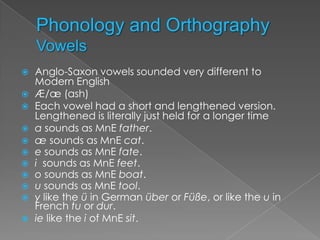
   Anglo-Saxon vowels sounded very different to
    Modern English
   Æ/æ (ash)
   Each vowel had a short and lengthened version.
    Lengthened is literally just held for a longer time
   a sounds as MnE father.
   æ sounds as MnE cat.
   e sounds as MnE fate.
   i sounds as MnE feet.
   o sounds as MnE boat.
   u sounds as MnE tool.
   y like the ü in German über or Füße, or like the u in
    French tu or dur.
   ie like the i of MnE sit.
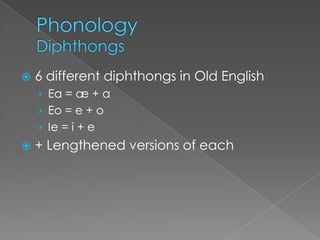
   6 different diphthongs in Old English
    › Ea = æ + a
    › Eo = e + o
    › Ie = i + e
   + Lengthened versions of each
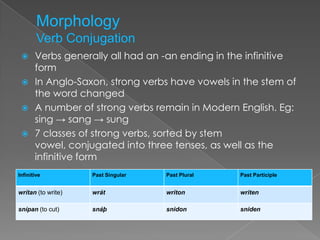
 Verbs generally all had an -an ending in the infinitive
   form
  In Anglo-Saxon, strong verbs have vowels in the stem of
   the word changed
  A number of strong verbs remain in Modern English. Eg:
   sing → sang → sung
  7 classes of strong verbs, sorted by stem
   vowel, conjugated into three tenses, as well as the
   infinitive form
Infinitive          Past Singular   Past Plural   Past Participle


wrítan (to write)   wrát            writon        writen

snípan (to cut)     snáþ            snidon        sniden
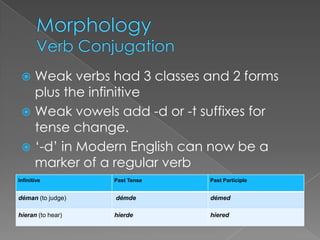
 Weak verbs had 3 classes and 2 forms
   plus the infinitive
  Weak vowels add -d or -t suffixes for
   tense change.
  ‘-d’ in Modern English can now be a
   marker of a regular verb
Infinitive         Past Tense   Past Participle


déman (to judge)   démde        démed

híeran (to hear)   híerde       híered
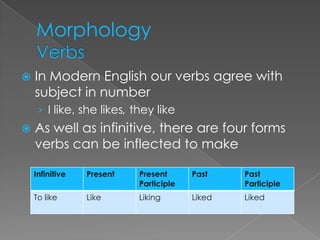
   In Modern English our verbs agree with
    subject in number
     › I like, she likes, they like
   As well as infinitive, there are four forms
    verbs can be inflected to make

    Infinitive   Present   Present      Past    Past
                           Participle           Participle
    To like      Like      Liking       Liked   Liked
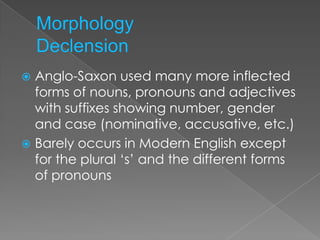
 Anglo-Saxon used many more inflected
  forms of nouns, pronouns and adjectives
  with suffixes showing number, gender
  and case (nominative, accusative, etc.)
 Barely occurs in Modern English except
  for the plural ‘s’ and the different forms
  of pronouns
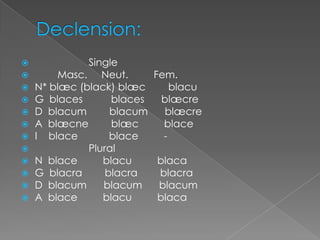
             Single
       Masc. Neut.       Fem.
   N* blæc (black) blæc      blacu
   G blaces       blaces   blæcre
   D blacum       blacum   blæcre
   A blæcne       blæc     blace
   I blace        blace    -
             Plural
   N blace      blacu     blaca
   G blacra      blacra   blacra
   D blacum     blacum    blacum
   A blace      blacu     blaca
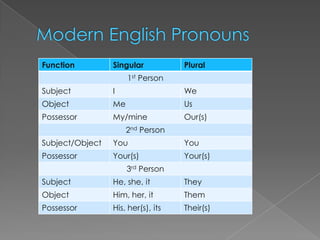
Function         Singular           Plural
                      1st Person
Subject          I                  We
Object           Me                 Us
Possessor        My/mine            Our(s)
                      2nd Person
Subject/Object   You                You
Possessor        Your(s)            Your(s)
                      3rd Person
Subject          He, she, it        They
Object           Him, her, it       Them
Possessor        His, her(s), its   Their(s)
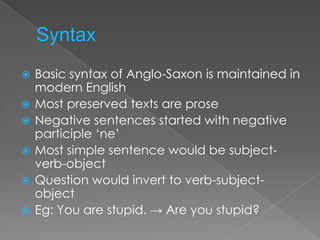
   Basic syntax of Anglo-Saxon is maintained in
    modern English
   Most preserved texts are prose
   Negative sentences started with negative
    participle ‘ne’
   Most simple sentence would be subject-
    verb-object
   Question would invert to verb-subject-
    object
   Eg: You are stupid. → Are you stupid?
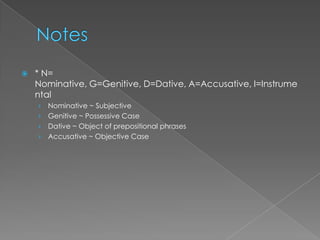
   * N=
    Nominative, G=Genitive, D=Dative, A=Accusative, I=Instrume
    ntal
    › Nominative ~ Subjective
    › Genitive ~ Possessive Case
    › Dative ~ Object of prepositional phrases
    › Accusative ~ Objective Case
   http://www.omniglot.com/writing/oldenglish.htm
   http://www.atsweb.neu.edu/hlittlefield/CourseDocs/HistE
    ng/HistLect6-OE-Phon.pdf
   http://mockingbird.creighton.edu/english/fajardo/teachin
    g/eng520/oldeng.htm
   http://www.wmich.edu/medieval/resources/IOE/pronunci
    ation.html
   http://www.jebbo.co.uk/learn-oe/contents.htm
   http://babaev.tripod.com/archive/grammar43.html
   H. Sweet, Sweet’s Anglo-Saxon primer, 9th edn, Oxford
    University Press, London, 1974, p. 2

Differences between old english and modern english

  • 2.
    Old English = Anglo-Saxon = OE › 500-1100 AD  Modern English = MnE
  • 3.
    Modern English retains almost all Anglo-Saxon consonant sounds, however a number of differences in orthography or pronunciation exist:  Ð/ð and Þ/þ (eth and thorn) both sounded as [ð], [θ]  Ƿ/ƿ (wynn) came from runes to make a [w] sound  C was only pronounced [k], [t∫] (before e or i) or [dʒ] (in ‘cg’)  [r] was rolled in OE  J, k, q, v, z added to regular use in Modern English spelling  the [x], [ç] and [ɣ] sounds are not found in Standard English anymore
  • 4.
    Anglo-Saxon vowels sounded very different to Modern English  Æ/æ (ash)  Each vowel had a short and lengthened version. Lengthened is literally just held for a longer time  a sounds as MnE father.  æ sounds as MnE cat.  e sounds as MnE fate.  i sounds as MnE feet.  o sounds as MnE boat.  u sounds as MnE tool.  y like the ü in German über or Füße, or like the u in French tu or dur.  ie like the i of MnE sit.
  • 5.
    6 different diphthongs in Old English › Ea = æ + a › Eo = e + o › Ie = i + e  + Lengthened versions of each
  • 6.
     Verbs generallyall had an -an ending in the infinitive form  In Anglo-Saxon, strong verbs have vowels in the stem of the word changed  A number of strong verbs remain in Modern English. Eg: sing → sang → sung  7 classes of strong verbs, sorted by stem vowel, conjugated into three tenses, as well as the infinitive form Infinitive Past Singular Past Plural Past Participle wrítan (to write) wrát writon writen snípan (to cut) snáþ snidon sniden
  • 7.
     Weak verbshad 3 classes and 2 forms plus the infinitive  Weak vowels add -d or -t suffixes for tense change.  ‘-d’ in Modern English can now be a marker of a regular verb Infinitive Past Tense Past Participle déman (to judge) démde démed híeran (to hear) híerde híered
  • 8.
    In Modern English our verbs agree with subject in number › I like, she likes, they like  As well as infinitive, there are four forms verbs can be inflected to make Infinitive Present Present Past Past Participle Participle To like Like Liking Liked Liked
  • 9.
     Anglo-Saxon usedmany more inflected forms of nouns, pronouns and adjectives with suffixes showing number, gender and case (nominative, accusative, etc.)  Barely occurs in Modern English except for the plural ‘s’ and the different forms of pronouns
  • 10.
    Single  Masc. Neut. Fem.  N* blæc (black) blæc blacu  G blaces blaces blæcre  D blacum blacum blæcre  A blæcne blæc blace  I blace blace -  Plural  N blace blacu blaca  G blacra blacra blacra  D blacum blacum blacum  A blace blacu blaca
  • 12.
    Function Singular Plural 1st Person Subject I We Object Me Us Possessor My/mine Our(s) 2nd Person Subject/Object You You Possessor Your(s) Your(s) 3rd Person Subject He, she, it They Object Him, her, it Them Possessor His, her(s), its Their(s)
  • 13.
    Basic syntax of Anglo-Saxon is maintained in modern English  Most preserved texts are prose  Negative sentences started with negative participle ‘ne’  Most simple sentence would be subject- verb-object  Question would invert to verb-subject- object  Eg: You are stupid. → Are you stupid?
  • 14.
    * N= Nominative, G=Genitive, D=Dative, A=Accusative, I=Instrume ntal › Nominative ~ Subjective › Genitive ~ Possessive Case › Dative ~ Object of prepositional phrases › Accusative ~ Objective Case
  • 15.
    http://www.omniglot.com/writing/oldenglish.htm  http://www.atsweb.neu.edu/hlittlefield/CourseDocs/HistE ng/HistLect6-OE-Phon.pdf  http://mockingbird.creighton.edu/english/fajardo/teachin g/eng520/oldeng.htm  http://www.wmich.edu/medieval/resources/IOE/pronunci ation.html  http://www.jebbo.co.uk/learn-oe/contents.htm  http://babaev.tripod.com/archive/grammar43.html  H. Sweet, Sweet’s Anglo-Saxon primer, 9th edn, Oxford University Press, London, 1974, p. 2