© Project SOUND
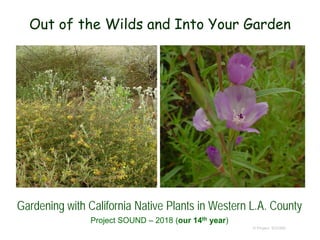
Out of the Wilds and Into Your Garden
Gardening with California Native Plants in Western L.A. County
Project SOUND – 2018 (our 14th year)
© Project SOUND
Gardening for Scent:
the importance of
scented plants for health
C.M. Vadheim, K. Dawdy (and T. Drake)
CSUDH (emeritus), CSUDH & City of Torrance
Madrona Marsh Preserve
April 7 & 12, 2018
2018 Season – Gardens that sooth
© Project SOUND
Gardens that heal
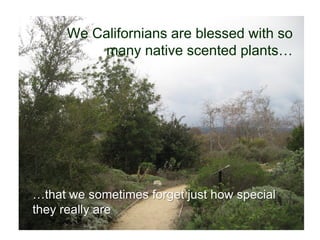
We Californians are blessed with so
many native scented plants…
…that we sometimes forget just how special
they really are
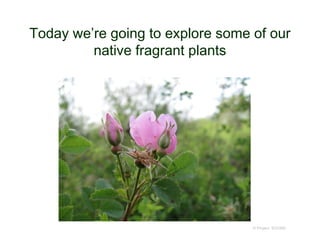
Today we’re going to explore some of our
native fragrant plants
© Project SOUND
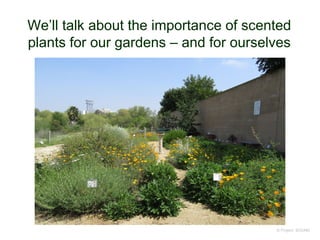
We’ll talk about the importance of scented
plants for our gardens – and for ourselves
© Project SOUND
© Project SOUND
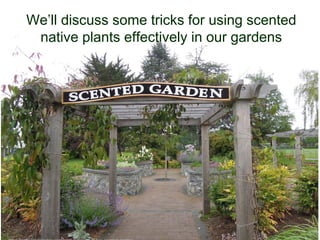
We’ll discuss some tricks for using scented
native plants effectively in our gardens
But first we need a little background on
people, animals and plants
© Project SOUND
Huge current interest in ‘scented
products’ right now
 Flavors & Fragrances: $30 billion industry (2016) and
growing rapidly each year
 Many of the scents are ‘plant-derived’
© Project SOUND
https://swiftnary.com/news/global-flavor-fragrance-market-2017-symrise-takasago-wild-flavors-mane-frutarom-2238.html
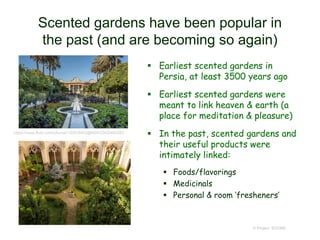
Scented gardens have been popular in
the past (and are becoming so again)
 Earliest scented gardens in
Persia, at least 3500 years ago
 Earliest scented gardens were
meant to link heaven & earth (a
place for meditation & pleasure)
 In the past, scented gardens and
their useful products were
intimately linked:
 Foods/flavorings
 Medicinals
 Personal & room ‘fresheners’
© Project SOUND
https://www.flickr.com/photos/130819462@N04/23420440283
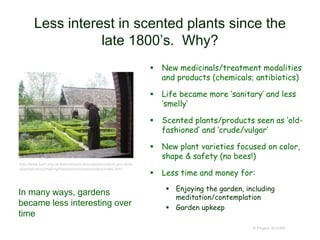
Less interest in scented plants since the
late 1800’s. Why?
 New medicinals/treatment modalities
and products (chemicals; antibiotics)
 Life became more ‘sanitary’ and less
‘smelly’
 Scented plants/products seen as ‘old-
fashioned’ and ‘crude/vulgar’
 New plant varieties focused on color,
shape & safety (no bees!)
 Less time and money for:
 Enjoying the garden, including
meditation/contemplation
 Garden upkeep
© Project SOUND
http://www.sath.org.uk/edscot/www.educationscotland.gov.uk/sc
otlandshistory/makingthenation/monasticorders/index.html
In many ways, gardens
became less interesting over
time
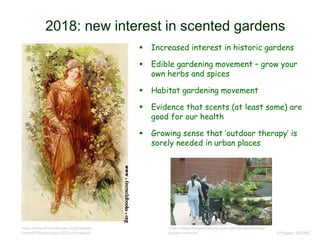
2018: new interest in scented gardens
 Increased interest in historic gardens
 Edible gardening movement – grow your
own herbs and spices
 Habitat gardening movement
 Evidence that scents (at least some) are
good for our health
 Growing sense that ‘outdoor therapy’ is
sorely needed in urban places
© Project SOUND
https://www.fromoldbooks.org/Edwards-
ForestOfArden/pages/000-xii-Rosalind/
https://designforgenerations.com/case-studies/therapy-
garden-merwick/
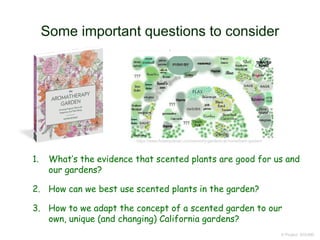
Some important questions to consider
1. What’s the evidence that scented plants are good for us and
our gardens?
2. How can we best use scented plants in the garden?
3. How to we adapt the concept of a scented garden to our
own, unique (and changing) California gardens?
© Project SOUND
https://www.flowerpotman.com/sensory-gardens-at-home/herb-garden/
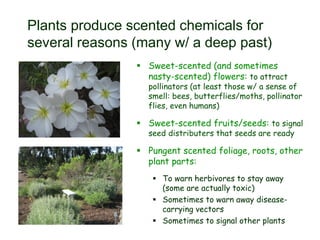
Plants produce scented chemicals for
several reasons (many w/ a deep past)
 Sweet-scented (and sometimes
nasty-scented) flowers: to attract
pollinators (at least those w/ a sense of
smell: bees, butterflies/moths, pollinator
flies, even humans)
 Sweet-scented fruits/seeds: to signal
seed distributers that seeds are ready
 Pungent scented foliage, roots, other
plant parts:
 To warn herbivores to stay away
(some are actually toxic)
 Sometimes to warn away disease-
carrying vectors
 Sometimes to signal other plants
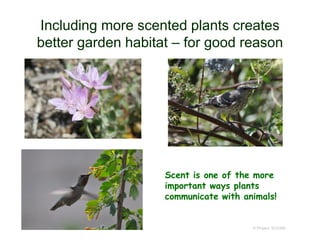
Including more scented plants creates
better garden habitat – for good reason
© Project SOUND
Scent is one of the more
important ways plants
communicate with animals!
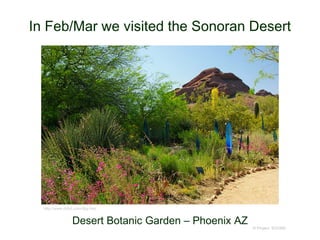
In Feb/Mar we visited the Sonoran Desert
© Project SOUND
Desert Botanic Garden – Phoenix AZ
http://www.ddtvl.com/dbg.htm
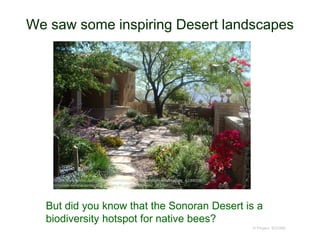
We saw some inspiring Desert landscapes
© Project SOUND
https://www.landscapingnetwork.com/pictures/southwestern-landscaping_42/88005-
nm-casa-serena-landscape-designs-llc-garden-walkway_2825/
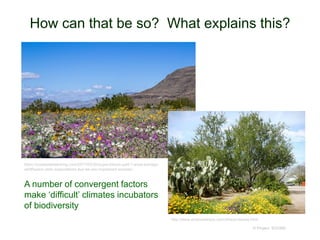
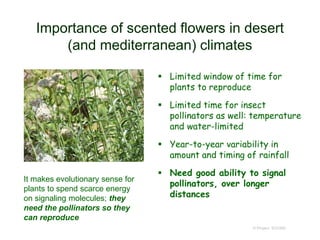
But did you know that the Sonoran Desert is a
biodiversity hotspot for native bees?
How can that be so? What explains this?
© Project SOUND
http://www.aridzonetrees.com/olneya-tesota.html
https://coastsideslacking.com/2017/03/30/super-bloom-part-1-anza-borrego-
wildflowers-defy-expectations-but-we-are-impressed-anyway/
A number of convergent factors
make ‘difficult’ climates incubators
of biodiversity
Importance of scented flowers in desert
(and mediterranean) climates
 Limited window of time for
plants to reproduce
 Limited time for insect
pollinators as well: temperature
and water-limited
 Year-to-year variability in
amount and timing of rainfall
 Need good ability to signal
pollinators, over longer
distances
© Project SOUND
It makes evolutionary sense for
plants to spend scarce energy
on signaling molecules; they
need the pollinators so they
can reproduce
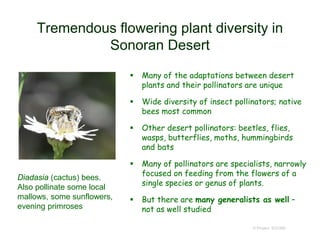
Tremendous flowering plant diversity in
Sonoran Desert
 Many of the adaptations between desert
plants and their pollinators are unique
 Wide diversity of insect pollinators; native
bees most common
 Other desert pollinators: beetles, flies,
wasps, butterflies, moths, hummingbirds
and bats
 Many of pollinators are specialists, narrowly
focused on feeding from the flowers of a
single species or genus of plants.
 But there are many generalists as well –
not as well studied
© Project SOUND
Diadasia (cactus) bees.
Also pollinate some local
mallows, some sunflowers,
evening primroses
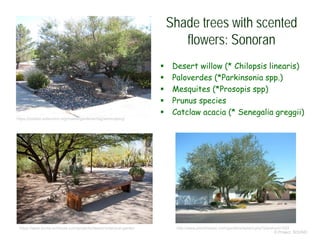
Shade trees with scented
flowers: Sonoran
 Desert willow (* Chilopsis linearis)
 Paloverdes (*Parkinsonia spp.)
 Mesquites (*Prosopis spp)
 Prunus species
 Catclaw acacia (* Senegalia greggii)
© Project SOUND
https://publish.extension.org/mastergardener/tag/xeriscaping/
https://www.forms-surfaces.com/projects/desert-botanical-garden http://www.plantmaster.com/gardens/eplant.php?plantnum=253
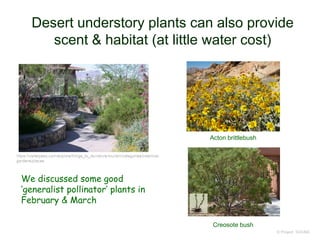
Desert understory plants can also provide
scent & habitat (at little water cost)
We discussed some good
‘generalist pollinator’ plants in
February & March
© Project SOUND
Acton brittlebush
Creosote bush
© Project SOUND
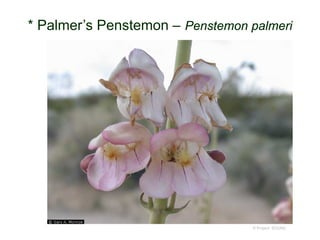
* Palmer’s Penstemon – Penstemon palmeri
© Project SOUND
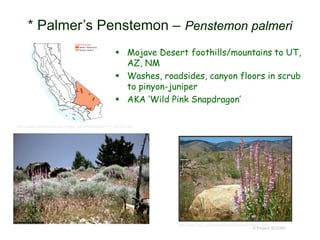
* Palmer’s Penstemon – Penstemon palmeri
http://ucjeps.berkeley.edu/cgi-bin/get_JM_treatment.pl?7177,7483,0,7541
http://www.flickr.com/photos/facilitybikeclub/3609173980/
 Mojave Desert foothills/mountains to UT,
AZ, NM
 Washes, roadsides, canyon floors in scrub
to pinyon-juniper
 AKA ‘Wild Pink Snapdragon’
© Project SOUND
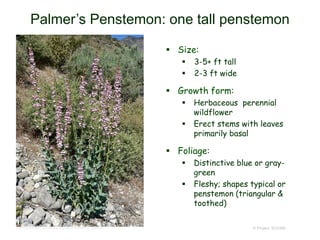
Palmer’s Penstemon: one tall penstemon
 Size:
 3-5+ ft tall
 2-3 ft wide
 Growth form:
 Herbaceous perennial
wildflower
 Erect stems with leaves
primarily basal
 Foliage:
 Distinctive blue or gray-
green
 Fleshy; shapes typical or
penstemon (triangular &
toothed)
http://commons.wikimedia.org/wiki/Penstemon_palmeri
© Project SOUND
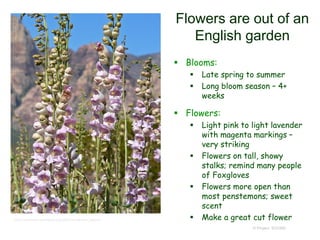
Flowers are out of an
English garden
 Blooms:
 Late spring to summer
 Long bloom season – 4+
weeks
 Flowers:
 Light pink to light lavender
with magenta markings –
very striking
 Flowers on tall, showy
stalks; remind many people
of Foxgloves
 Flowers more open than
most penstemons; sweet
scent
 Make a great cut flowerhttp://commons.wikimedia.org/wiki/Penstemon_palmeri
© Project SOUND
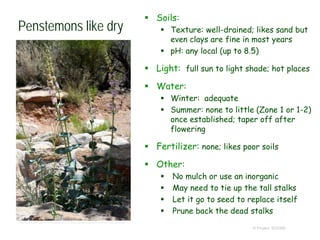
Penstemons like dry
 Soils:
 Texture: well-drained; likes sand but
even clays are fine in most years
 pH: any local (up to 8.5)
 Light: full sun to light shade; hot places
 Water:
 Winter: adequate
 Summer: none to little (Zone 1 or 1-2)
once established; taper off after
flowering
 Fertilizer: none; likes poor soils
 Other:
 No mulch or use an inorganic
 May need to tie up the tall stalks
 Let it go to seed to replace itself
 Prune back the dead stalks
http://www.fireflyforest.com/flowers/1874/penstemon-palmeri-palmers-penstemon/
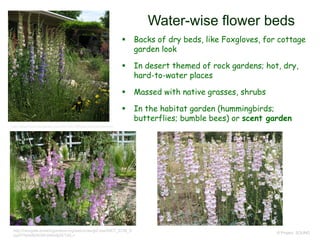
 Backs of dry beds, like Foxgloves, for cottage
garden look
 In desert themed of rock gardens; hot, dry,
hard-to-water places
 Massed with native grasses, shrubs
 In the habitat garden (hummingbirds;
butterflies; bumble bees) or scent garden
© Project SOUND
http://bloominrs.wordpress.com/2010/01/28/palmers-penstemon/
Water-wise flower beds
http://www.alplains.com/Catalog9.html
http://navigate.botanicgardens.org/weboi/oecgi2.exe/INET_ECM_D
ispPl?NAMENUM=8464&DETAIL=
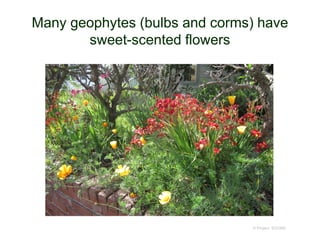
Many geophytes (bulbs and corms) have
sweet-scented flowers
© Project SOUND
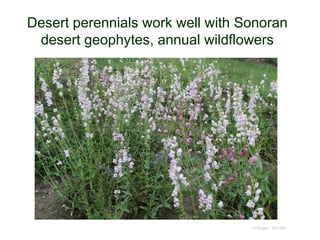
Desert perennials work well with Sonoran
desert geophytes, annual wildflowers
© Project SOUND
© Project SOUND
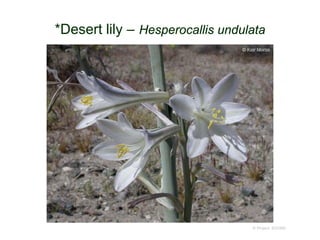
*Desert lily – Hesperocallis undulata
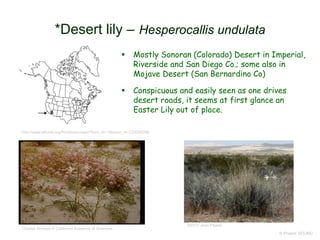
 Mostly Sonoran (Colorado) Desert in Imperial,
Riverside and San Diego Co.; some also in
Mojave Desert (San Bernardino Co)
 Conspicuous and easily seen as one drives
desert roads, it seems at first glance an
Easter Lily out of place.
© Project SOUND
*Desert lily – Hesperocallis undulata
Charles Webber © California Academy of Sciences
©2017 Jean Pawek
http://www.efloras.org/florataxon.aspx?flora_id=1&taxon_id=220006298
© Project SOUND
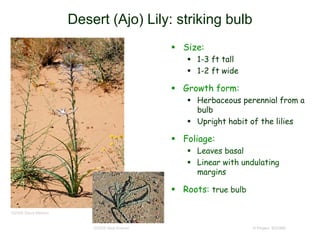
Desert (Ajo) Lily: striking bulb
 Size:
 1-3 ft tall
 1-2 ft wide
 Growth form:
 Herbaceous perennial from a
bulb
 Upright habit of the lilies
 Foliage:
 Leaves basal
 Linear with undulating
margins
 Roots: true bulb
©2008 Neal Kramer
©2008 Steve Matson
© Project SOUND
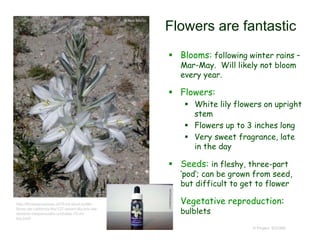
Flowers are fantastic
 Blooms: following winter rains –
Mar-May. Will likely not bloom
every year.
 Flowers:
 White lily flowers on upright
stem
 Flowers up to 3 inches long
 Very sweet fragrance, late
in the day
 Seeds: in fleshy, three-part
‘pod’; can be grown from seed,
but difficult to get to flower
 Vegetative reproduction:
bulblets
http://floressanadoras.cl/75-ml-stock-bottle-
flores-de-california-fes/127-desert-lily-lirio-del-
desierto-hesperocallis-undulata-75-ml-
fes.html
© Project SOUND
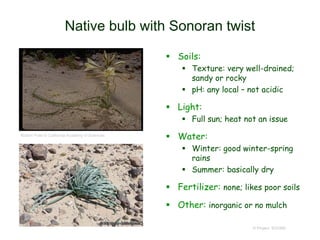
Native bulb with Sonoran twist
 Soils:
 Texture: very well-drained;
sandy or rocky
 pH: any local – not acidic
 Light:
 Full sun; heat not an issue
 Water:
 Winter: good winter-spring
rains
 Summer: basically dry
 Fertilizer: none; likes poor soils
 Other: inorganic or no mulch
Robert Potts © California Academy of Sciences
© Project SOUND
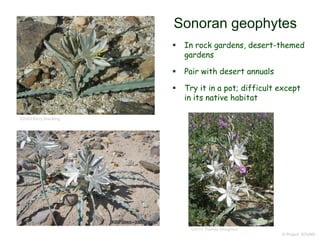
Sonoran geophytes
 In rock gardens, desert-themed
gardens
 Pair with desert annuals
 Try it in a pot; difficult except
in its native habitat
©2009 Barry Breckling
©2010 Thomas Stoughton
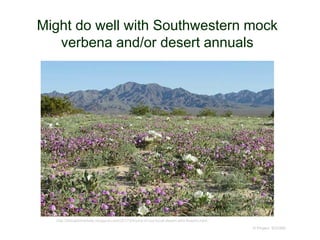
Might do well with Southwestern mock
verbena and/or desert annuals
© Project SOUND
http://dabaldoherbals.blogspot.com/2017/04/pics-of-our-local-desert-wild-flowers.html
© Project SOUND
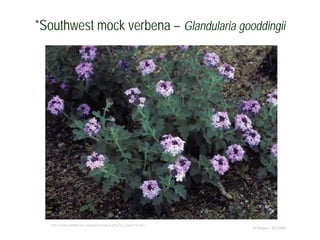
*Southwest mock verbena – Glandularia gooddingii
http://www.wildflower.org/plants/result.php?id_plant=GLGO
© Project SOUND
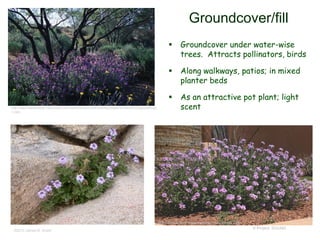
Groundcover/fill
 Groundcover under water-wise
trees. Attracts pollinators, birds
 Along walkways, patios; in mixed
planter beds
 As an attractive pot plant; light
scent
©2010 James M. Andre
http://www.amwua.org/pictures/gc-v-gooddingii-1.jpg
http://www.landscape-resources.com/portfolio/groundcoversx/pages/Verbena%20gooddingii-
1.htm
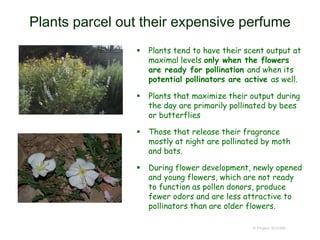
Plants parcel out their expensive perfume
 Plants tend to have their scent output at
maximal levels only when the flowers
are ready for pollination and when its
potential pollinators are active as well.
 Plants that maximize their output during
the day are primarily pollinated by bees
or butterflies
 Those that release their fragrance
mostly at night are pollinated by moth
and bats.
 During flower development, newly opened
and young flowers, which are not ready
to function as pollen donors, produce
fewer odors and are less attractive to
pollinators than are older flowers.
© Project SOUND
© Project SOUND
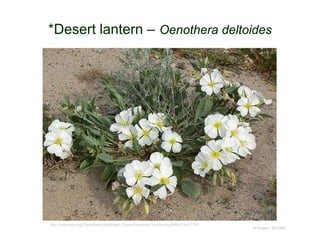
*Desert lantern – Oenothera deltoides
http://calscape.org/Oenothera-deltoides-(Dune-Primrose)?srchcr=sc5848d74a17797
© Project SOUND
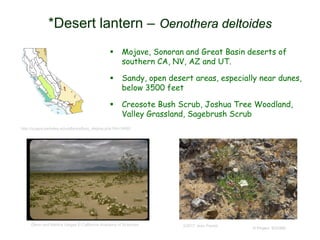
*Desert lantern – Oenothera deltoides
Glenn and Martha Vargas © California Academy of Sciences ©2017 Jean Pawek
 Mojave, Sonoran and Great Basin deserts of
southern CA, NV, AZ and UT.
 Sandy, open desert areas, especially near dunes,
below 3500 feet
 Creosote Bush Scrub, Joshua Tree Woodland,
Valley Grassland, Sagebrush Scrub
http://ucjeps.berkeley.edu/eflora/eflora_display.php?tid=34991
© Project SOUND
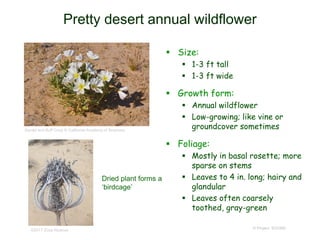
Pretty desert annual wildflower
 Size:
 1-3 ft tall
 1-3 ft wide
 Growth form:
 Annual wildflower
 Low-growing; like vine or
groundcover sometimes
 Foliage:
 Mostly in basal rosette; more
sparse on stems
 Leaves to 4 in. long; hairy and
glandular
 Leaves often coarsely
toothed, gray-green
©2017 Zoya Akulova
Gerald and Buff Corsi © California Academy of Sciences
Dried plant forms a
‘birdcage’
© Project SOUND
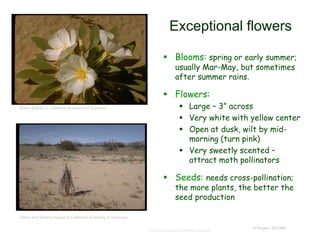
Exceptional flowers
 Blooms: spring or early summer;
usually Mar-May, but sometimes
after summer rains.
 Flowers:
 Large – 3” across
 Very white with yellow center
 Open at dusk, wilt by mid-
morning (turn pink)
 Very sweetly scented –
attract moth pollinators
 Seeds: needs cross-pollination;
the more plants, the better the
seed production
http://www.answers.com/topic/dudleya
Sherry Ballard © California Academy of Sciences
Glenn and Martha Vargas © California Academy of Sciences
© Project SOUND
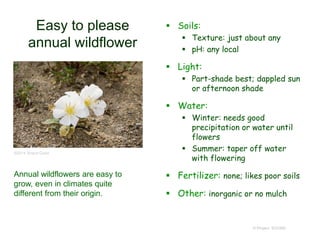
Easy to please
annual wildflower
 Soils:
 Texture: just about any
 pH: any local
 Light:
 Part-shade best; dappled sun
or afternoon shade
 Water:
 Winter: needs good
precipitation or water until
flowers
 Summer: taper off water
with flowering
 Fertilizer: none; likes poor soils
 Other: inorganic or no mulch
©2014 Sheryl Creer
Annual wildflowers are easy to
grow, even in climates quite
different from their origin.
© Project SOUND
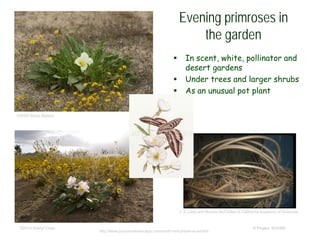
Evening primroses in
the garden
 In scent, white, pollinator and
desert gardens
 Under trees and larger shrubs
 As an unusual pot plant
©2006 Steve Matson
©2014 Sheryl Creer
J. E.(Jed) and Bonnie McClellan © California Academy of Sciences
http://www.joycesnativescape.com/north-mnt-preserve-exhibit
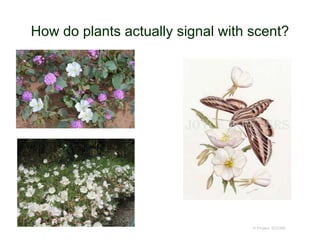
How do plants actually signal with scent?
© Project SOUND
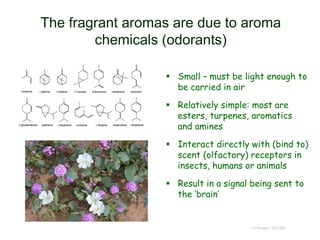
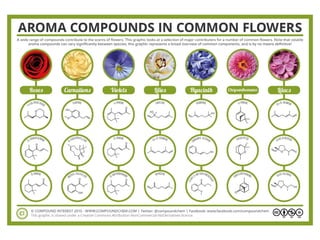
The fragrant aromas are due to aroma
chemicals (odorants)
 Small – must be light enough to
be carried in air
 Relatively simple: most are
esters, turpenes, aromatics
and amines
 Interact directly with (bind to)
scent (olfactory) receptors in
insects, humans or animals
 Result in a signal being sent to
the ‘brain’
© Project SOUND
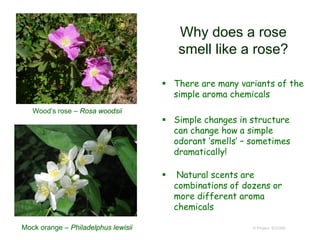
Why does a rose
smell like a rose?
 There are many variants of the
simple aroma chemicals
 Simple changes in structure
can change how a simple
odorant ‘smells’ – sometimes
dramatically!
 Natural scents are
combinations of dozens or
more different aroma
chemicals
© Project SOUND
Wood’s rose – Rosa woodsii
Mock orange – Philadelphus lewisii
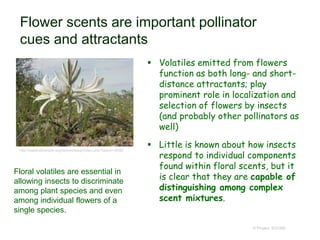
Flower scents are important pollinator
cues and attractants
 Volatiles emitted from flowers
function as both long- and short-
distance attractants; play
prominent role in localization and
selection of flowers by insects
(and probably other pollinators as
well)
 Little is known about how insects
respond to individual components
found within floral scents, but it
is clear that they are capable of
distinguishing among complex
scent mixtures.
© Project SOUND
http://swbiodiversity.org/seinet/taxa/index.php?taxon=3540
Floral volatiles are essential in
allowing insects to discriminate
among plant species and even
among individual flowers of a
single species.
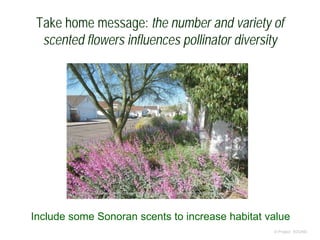
Take home message: the number and variety of
scented flowers influences pollinator diversity
© Project SOUND
http://az.audubon.org/newsroom/news-stories/2013/easy-ways-attract-wildlife-your-
yard
Include some Sonoran scents to increase habitat value
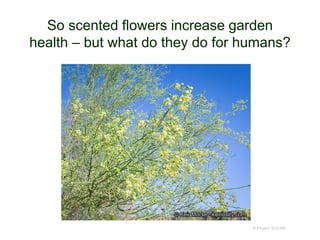
So scented flowers increase garden
health – but what do they do for humans?
© Project SOUND
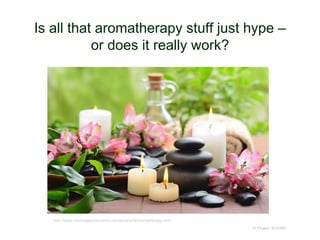
Is all that aromatherapy stuff just hype –
or does it really work?
© Project SOUND
http://www.massageandunwind.com/store/p25/Aromatherapy.html
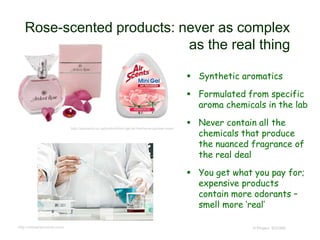
 Synthetic aromatics
 Formulated from specific
aroma chemicals in the lab
 Never contain all the
chemicals that produce
the nuanced fragrance of
the real deal
 You get what you pay for;
expensive products
contain more odorants –
smell more ‘real’
© Project SOUNDhttp://nishantaromas.com/
http://airscents.co.za/product/mini-gel-air-freshener-persian-rose/
Rose-scented products: never as complex
as the real thing
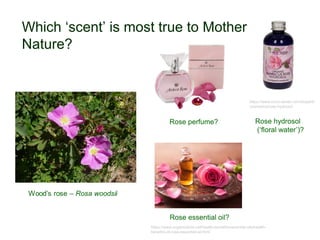
Rose essential oil?
https://www.organicfacts.net/health-benefits/essential-oils/health-
benefits-of-rose-essential-oil.html
Rose perfume?
Which ‘scent’ is most true to Mother
Nature?
Rose hydrosol
(‘floral water’)?
https://www.ecco-verde.com/biopark-
cosmetics/rose-hydrosol
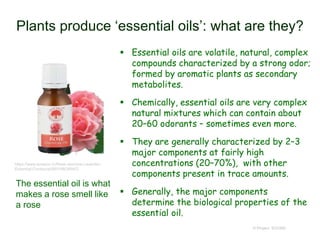
Plants produce ‘essential oils’: what are they?
 Essential oils are volatile, natural, complex
compounds characterized by a strong odor;
formed by aromatic plants as secondary
metabolites.
 Chemically, essential oils are very complex
natural mixtures which can contain about
20–60 odorants – sometimes even more.
 They are generally characterized by 2–3
major components at fairly high
concentrations (20–70%), with other
components present in trace amounts.
 Generally, the major components
determine the biological properties of the
essential oil.
© Project SOUND
The essential oil is what
makes a rose smell like
a rose
https://www.amazon.in/Rose-Jasmine-Lavender-
Essential-Combo/dp/B01HBGR95O
© Project SOUND
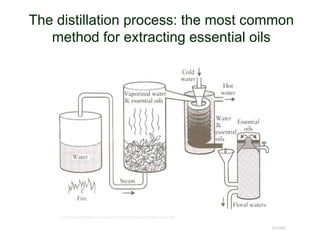
The distillation process: the most common
method for extracting essential oils
© Project SOUND
http://www.baldwins.co.uk/blog/2011/07/how-is-essential-oils-produced/
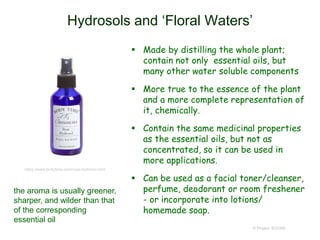
Hydrosols and ‘Floral Waters’
 Made by distilling the whole plant;
contain not only essential oils, but
many other water soluble components
 More true to the essence of the plant
and a more complete representation of
it, chemically.
 Contain the same medicinal properties
as the essential oils, but not as
concentrated, so it can be used in
more applications.
 Can be used as a facial toner/cleanser,
perfume, deodorant or room freshener
- or incorporate into lotions/
homemade soap.
© Project SOUND
the aroma is usually greener,
sharper, and wilder than that
of the corresponding
essential oil
https://www.bodytime.com/rose-hydrosol.html
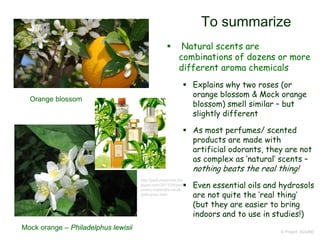
To summarize
 Natural scents are
combinations of dozens or more
different aroma chemicals
 Explains why two roses (or
orange blossom & Mock orange
blossom) smell similar – but
slightly different
 As most perfumes/ scented
products are made with
artificial odorants, they are not
as complex as ‘natural’ scents –
nothing beats the real thing!
 Even essential oils and hydrosols
are not quite the ‘real thing’
(but they are easier to bring
indoors and to use in studies!)
© Project SOUND
Orange blossom
Mock orange – Philadelphus lewisii
http://perfumeshrine.blo
gspot.com/2011/04/perf
umery-materials-neroli-
petit-grain.html
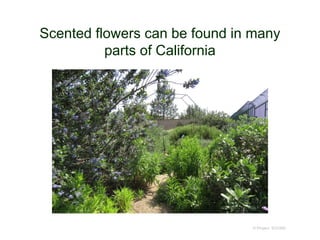
Scented flowers can be found in many
parts of California
© Project SOUND
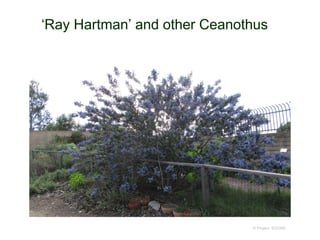
‘Ray Hartman’ and other Ceanothus
© Project SOUND
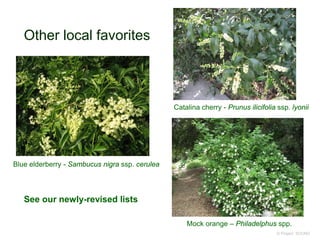
Other local favorites
© Project SOUND
Blue elderberry - Sambucus nigra ssp. cerulea
Catalina cherry - Prunus ilicifolia ssp. lyonii
Mock orange – Philadelphus spp.
See our newly-revised lists
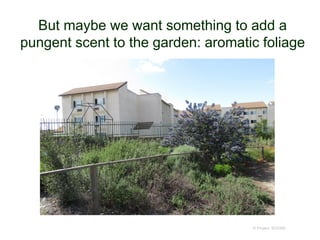
But maybe we want something to add a
pungent scent to the garden: aromatic foliage
© Project SOUND
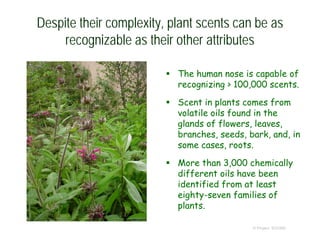
Despite their complexity, plant scents can be as
recognizable as their other attributes
 The human nose is capable of
recognizing > 100,000 scents.
 Scent in plants comes from
volatile oils found in the
glands of flowers, leaves,
branches, seeds, bark, and, in
some cases, roots.
 More than 3,000 chemically
different oils have been
identified from at least
eighty-seven families of
plants.
© Project SOUND
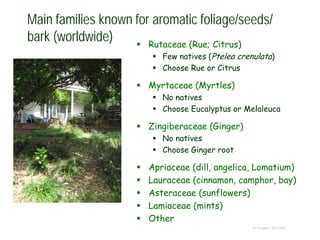
Main families known for aromatic foliage/seeds/
bark (worldwide)  Rutaceae (Rue; Citrus)
 Few natives (Ptelea crenulata)
 Choose Rue or Citrus
 Myrtaceae (Myrtles)
 No natives
 Choose Eucalyptus or Melaleuca
 Zingiberaceae (Ginger)
 No natives
 Choose Ginger root
 Apriaceae (dill, angelica, Lomatium)
 Lauraceae (cinnamon, camphor, bay)
 Asteraceae (sunflowers)
 Lamiaceae (mints)
 Other
© Project SOUND
© Project SOUND
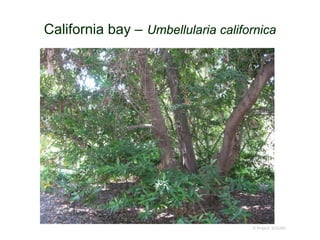
California bay – Umbellularia californica
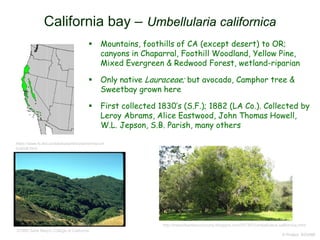
 Mountains, foothills of CA (except desert) to OR;
canyons in Chaparral, Foothill Woodland, Yellow Pine,
Mixed Evergreen & Redwood Forest, wetland-riparian
 Only native Lauraceae; but avocado, Camphor tree &
Sweetbay grown here
 First collected 1830’s (S.F.); 1882 (LA Co.). Collected by
Leroy Abrams, Alice Eastwood, John Thomas Howell,
W.L. Jepson, S.B. Parish, many others
© Project SOUND
California bay – Umbellularia californica
©1995 Saint Mary's College of California
https://www.fs.fed.us/database/feis/plants/tree/um
bcal/all.html
http://treesofsantacruzcounty.blogspot.com/2013/07/umbellularia-californica.html
© Project SOUND
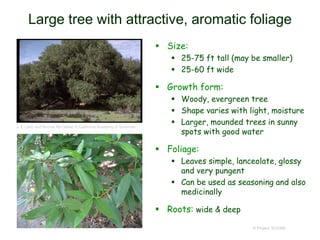
Large tree with attractive, aromatic foliage
 Size:
 25-75 ft tall (may be smaller)
 25-60 ft wide
 Growth form:
 Woody, evergreen tree
 Shape varies with light, moisture
 Larger, mounded trees in sunny
spots with good water
 Foliage:
 Leaves simple, lanceolate, glossy
and very pungent
 Can be used as seasoning and also
medicinally
 Roots: wide & deep
J. E.(Jed) and Bonnie McClellan © California Academy of Sciences
© Project SOUND
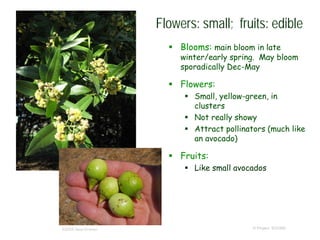
Flowers: small; fruits: edible
 Blooms: main bloom in late
winter/early spring. May bloom
sporadically Dec-May
 Flowers:
 Small, yellow-green, in
clusters
 Not really showy
 Attract pollinators (much like
an avocado)
 Fruits:
 Like small avocados
©2008 Neal Kramer
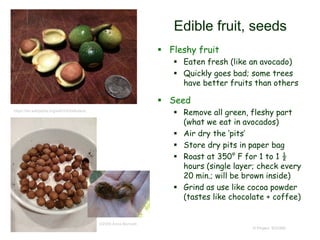
Edible fruit, seeds
 Fleshy fruit
 Eaten fresh (like an avocado)
 Quickly goes bad; some trees
have better fruits than others
 Seed
 Remove all green, fleshy part
(what we eat in avocados)
 Air dry the ‘pits’
 Store dry pits in paper bag
 Roast at 350° F for 1 to 1 ½
hours (single layer; check every
20 min.; will be brown inside)
 Grind as use like cocoa powder
(tastes like chocolate + coffee)
© Project SOUND
https://en.wikipedia.org/wiki/Umbellularia
©2009 Anna Bennett
© Project SOUND
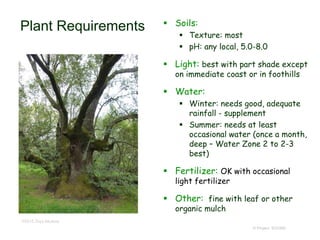
Plant Requirements  Soils:
 Texture: most
 pH: any local, 5.0-8.0
 Light: best with part shade except
on immediate coast or in foothills
 Water:
 Winter: needs good, adequate
rainfall - supplement
 Summer: needs at least
occasional water (once a month,
deep – Water Zone 2 to 2-3
best)
 Fertilizer: OK with occasional
light fertilizer
 Other: fine with leaf or other
organic mulch
©2015 Zoya Akulova
© Project SOUND
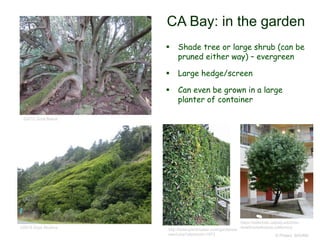
CA Bay: in the garden
 Shade tree or large shrub (can be
pruned either way) – evergreen
 Large hedge/screen
 Can even be grown in a large
planter of container
©2012 Scott Batiuk
©2015 Zoya Akulova
http://www.plantmaster.com/gardens/e
plant.php?plantnum=1673
https://selectree.calpoly.edu/tree-
detail/umbellularia-californica
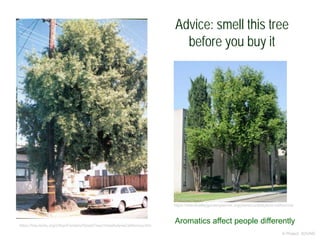
Advice: smell this tree
before you buy it
© Project SOUND
https://bss.lacity.org/UrbanForestry/StreetTree/UmbellulariaCalifornica.htm
https://inlandvalleygardenplanner.org/plants/umbelularia-californica/
Aromatics affect people differently
The human sense of smell is yet more
interesting – due to our complex bodies
 No two people smell the same
scent exactly the same
 People experience and remember
the same scent differently
 Some scents have powerful
effects on our physiology, our
emotions and our sense of well-
being. Some of those effects
are likely innate.
© Project SOUND
And scientific studies are revealing some tantalizing
clues about why
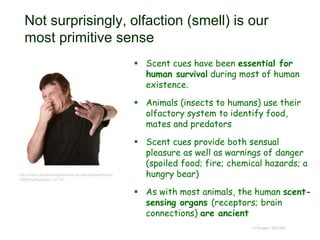
Not surprisingly, olfaction (smell) is our
most primitive sense
 Scent cues have been essential for
human survival during most of human
existence.
 Animals (insects to humans) use their
olfactory system to identify food,
mates and predators
 Scent cues provide both sensual
pleasure as well as warnings of danger
(spoiled food; fire; chemical hazards; a
hungry bear)
 As with most animals, the human scent-
sensing organs (receptors; brain
connections) are ancient
© Project SOUND
http://www.gardenandgreenhouse.net/articles/march-
2008/hydroponics-101-9/
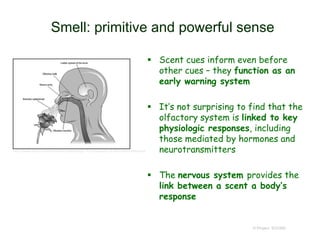
Smell: primitive and powerful sense
 Scent cues inform even before
other cues – they function as an
early warning system
 It’s not surprising to find that the
olfactory system is linked to key
physiologic responses, including
those mediated by hormones and
neurotransmitters
 The nervous system provides the
link between a scent a body’s
response
© Project SOUND
http://www.altmd.com/Articles/Aromatherapy--Encyclopedia-of-Alternative-Medicine
 The olfactory tract has
direct connections with at
least five areas of the brain
 These areas involved in:
 Perception of smell
 Memory and decoding of
individual scents
 Physiologic (visceral)
responses to a scent
 Emotional responses
 Complex scent memories
© Project SOUND
https://www.thoughtco.com/olfactory-system-4066176
https://oli.cmu.edu/jcourse/workbook/activity/page?context=21af2f2e80020ca6018edbaaeb4b8ee5
And it gets more interesting!
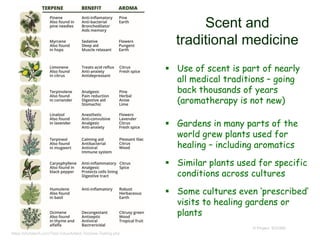
Scent and
traditional medicine
 Use of scent is part of nearly
all medical traditions – going
back thousands of years
(aromatherapy is not new)
 Gardens in many parts of the
world grew plants used for
healing – including aromatics
 Similar plants used for specific
conditions across cultures
 Some cultures even ‘prescribed’
visits to healing gardens or
plants
© Project SOUND
https://phytatech.com/Test-ValueAdded-Terpene-Testing.php
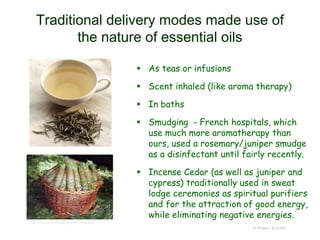
Traditional delivery modes made use of
the nature of essential oils
 As teas or infusions
 Scent inhaled (like aroma therapy)
 In baths
 Smudging - French hospitals, which
use much more aromatherapy than
ours, used a rosemary/juniper smudge
as a disinfectant until fairly recently.
 Incense Cedar (as well as juniper and
cypress) traditionally used in sweat
lodge ceremonies as spiritual purifiers
and for the attraction of good energy,
while eliminating negative energies.
© Project SOUND
http://siskiyouwildcrafting.com/cedar.html
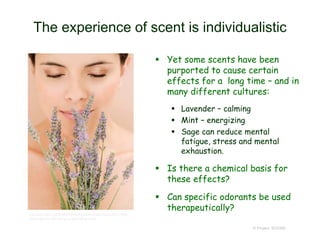
The experience of scent is individualistic
 Yet some scents have been
purported to cause certain
effects for a long time – and in
many different cultures:
 Lavender – calming
 Mint – energizing
 Sage can reduce mental
fatigue, stress and mental
exhaustion.
 Is there a chemical basis for
these effects?
 Can specific odorants be used
therapeutically?
© Project SOUND
http://www.allure.com/beauty-trends/blogs/daily-beauty-reporter/2011/10/the-
floral-fragrance-note-both-you-and-he-will-love.html
 Various essential oils have been used
medicinally at different periods in history.
 Medical applications for medicinal oils range
from skin treatments to remedies for cancer
 Often based solely on historical accounts of
use of essential oils for these purposes.
 Claims for the efficacy of medical treatments
and treatment of cancers in particular, are now
subject to regulation in most countries.
© Project SOUND
Unfortunately, good evidence is still
scanty for many aromatic treatments
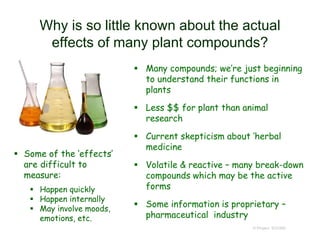
Why is so little known about the actual
effects of many plant compounds?
 Many compounds; we’re just beginning
to understand their functions in
plants
 Less $$ for plant than animal
research
 Current skepticism about ‘herbal
medicine
 Volatile & reactive – many break-down
compounds which may be the active
forms
 Some information is proprietary –
pharmaceutical industry
© Project SOUND
 Some of the ‘effects’
are difficult to
measure:
 Happen quickly
 Happen internally
 May involve moods,
emotions, etc.
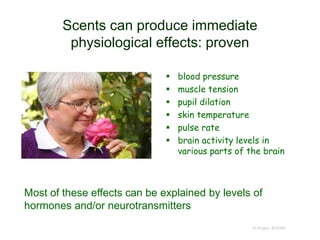
Scents can produce immediate
physiological effects: proven
 blood pressure
 muscle tension
 pupil dilation
 skin temperature
 pulse rate
 brain activity levels in
various parts of the brain
© Project SOUND
Most of these effects can be explained by levels of
hormones and/or neurotransmitters
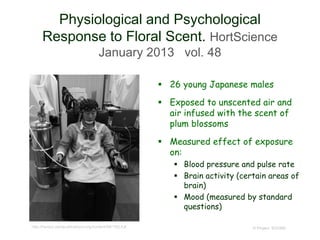
Physiological and Psychological
Response to Floral Scent. HortScience
January 2013 vol. 48
© Project SOUND
 26 young Japanese males
 Exposed to unscented air and
air infused with the scent of
plum blossoms
 Measured effect of exposure
on:
 Blood pressure and pulse rate
 Brain activity (certain areas of
brain)
 Mood (measured by standard
questions)
http://hortsci.ashspublications.org/content/48/1/82.full
Physiological and Psychological
Response to Floral Scent.
 Fragrance activated the cerebral areas in
charge of movement, speech, and memory
functions and stimulated the SNS activity in
ways related to excitement.
 Support findings that horticultural therapy
tended to promote speech, communication,
and thereby social interaction and helped
prevent deterioration of the mental abilities
of individuals with Alzheimer's disease in
long-term care
 Psychologically, plum blossom fragrance
enhanced vigor while reducing depressed
feelings and evoked cheerful, exciting, and
active images. This helps explain the common
experience that plant fragrances have a
positive effect on our mood and emotions.
© Project SOUND
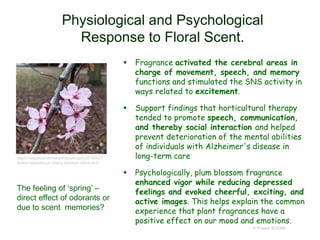
https://sequinsandcherryblossom.com/2016/02/1
5/plum-blossom-or-cherry-blossom-which-is-it/
The feeling of ‘spring’ –
direct effect of odorants or
due to scent memories?
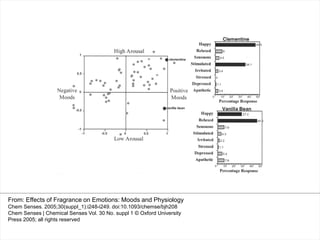
From: Effects of Fragrance on Emotions: Moods and Physiology
Chem Senses. 2005;30(suppl_1):i248-i249. doi:10.1093/chemse/bjh208
Chem Senses | Chemical Senses Vol. 30 No. suppl 1 © Oxford University
Press 2005; all rights reserved
Pleasant scents can even influence behaviors:
exactly how is still being worked out
 Make us want to spend
money or gamble
 Make workers more alert
and productive
 Make us more likely to
interact with others: this is
currently being applied in
nursing homes and with
dementia patients
© Project SOUND
https://www.saga.co.uk/magazine/health-wellbeing/mind/how-smell-
affects-your-body-and-mind.aspx
You don’t have to understand all the mechanisms before you apply a
‘treatment’. But you do have to provide good evidence of an effect.
When considering a plant for the garden,
experience the effect of its scent
 Visit the plant in a garden or
nursery (don’t just depend on
photos or descriptions)
 Experience the plant fully
 Tune out other distractions
 Close your eyes
 Smell the flower or foliage. Crush a
leaf.
 What is your immediate response ?
Like/dislike
 What effects does it have:
physiologic? Mental? Mood?
© Project SOUND
Fill sunny areas with fragrant foliage
plants you like: Sunflower family
 Artemisias
 Baccharis (esp. salicifolia)
 Ericamerias
 Grindelias
 Plucheas
 Pseudognaphalium
californicum
Consider the many other plants with
fragrant foliage: Mint family
 Native mints
 Agastache
 Clinopodium
 Lepechinia
 Mentha
 Monardella
 Pycnanthemum
 Salvia
 Stachys
 Trichostema
 Non-native mints
 Rosmarinus officinalis
 Thymus vulgaris
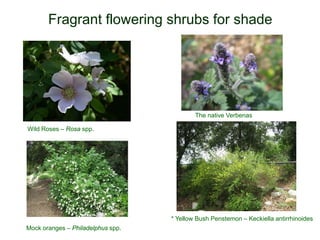
Fragrant flowering shrubs for shade
* Yellow Bush Penstemon – Keckiella antirrhinoides
Wild Roses – Rosa spp.
Mock oranges – Philadelphus spp.
The native Verbenas
© Project SOUND
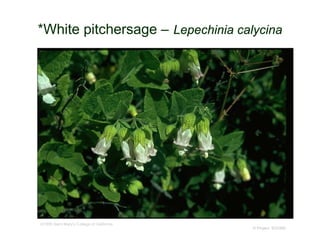
*White pitchersage – Lepechinia calycina
©1995 Saint Mary's College of California
© Project SOUND
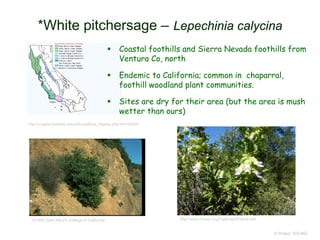
*White pitchersage – Lepechinia calycina
http://ucjeps.berkeley.edu/eflora/eflora_display.php?tid=30500
©1995 Saint Mary's College of California
 Coastal foothills and Sierra Nevada foothills from
Ventura Co, north
 Endemic to California; common in chaparral,
foothill woodland plant communities.
 Sites are dry for their area (but the area is mush
wetter than ours)
http://www.cnpsci.org/Calendar/Events.htm
© Project SOUND
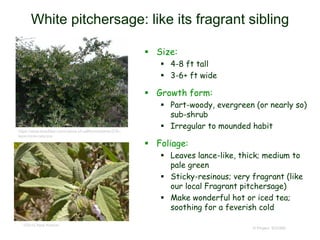
White pitchersage: like its fragrant sibling
 Size:
 4-8 ft tall
 3-6+ ft wide
 Growth form:
 Part-woody, evergreen (or nearly so)
sub-shrub
 Irregular to mounded habit
 Foliage:
 Leaves lance-like, thick; medium to
pale green
 Sticky-resinous; very fragrant (like
our local Fragrant pitchersage)
 Make wonderful hot or iced tea;
soothing for a feverish cold
©2015 Neal Kramer
https://www.laspilitas.com/nature-of-california/plants/379--
lepechinia-calycina
© Project SOUND
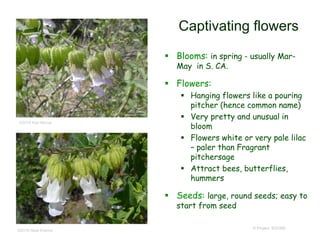
Captivating flowers
 Blooms: in spring - usually Mar-
May in S. CA.
 Flowers:
 Hanging flowers like a pouring
pitcher (hence common name)
 Very pretty and unusual in
bloom
 Flowers white or very pale lilac
– paler than Fragrant
pitchersage
 Attract bees, butterflies,
hummers
 Seeds: large, round seeds; easy to
start from seed
©2016 Keir Morse
©2016 Neal Kramer
© Project SOUND
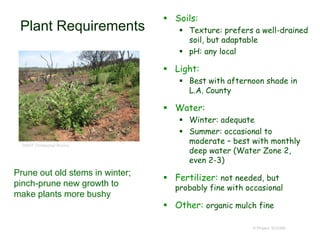
Plant Requirements
 Soils:
 Texture: prefers a well-drained
soil, but adaptable
 pH: any local
 Light:
 Best with afternoon shade in
L.A. County
 Water:
 Winter: adequate
 Summer: occasional to
moderate – best with monthly
deep water (Water Zone 2,
even 2-3)
 Fertilizer: not needed, but
probably fine with occasional
 Other: organic mulch fine
©2007 Christopher Bronny
Prune out old stems in winter;
pinch-prune new growth to
make plants more bushy
© Project SOUND
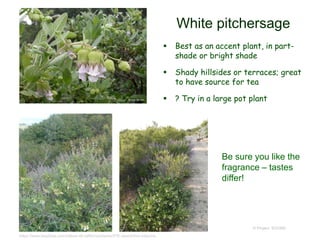
White pitchersage
 Best as an accent plant, in part-
shade or bright shade
 Shady hillsides or terraces; great
to have source for tea
 ? Try in a large pot plant
https://www.laspilitas.com/nature-of-california/plants/379--lepechinia-calycina
Be sure you like the
fragrance – tastes
differ!
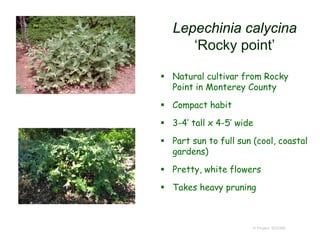
Lepechinia calycina
‘Rocky point’
 Natural cultivar from Rocky
Point in Monterey County
 Compact habit
 3-4’ tall x 4-5’ wide
 Part sun to full sun (cool, coastal
gardens)
 Pretty, white flowers
 Takes heavy pruning
© Project SOUND
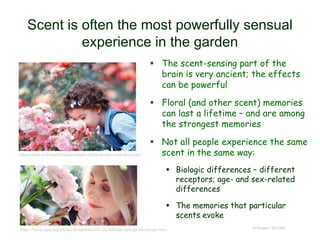
Scent is often the most powerfully sensual
experience in the garden
 The scent-sensing part of the
brain is very ancient; the effects
can be powerful
 Floral (and other scent) memories
can last a lifetime – and are among
the strongest memories
 Not all people experience the same
scent in the same way:
 Biologic differences – different
receptors; age- and sex-related
differences
 The memories that particular
scents evoke
© Project SOUND
https://www.workingmomsagainstguilt.com/stop-and-smell-the-roses/
https://travel.aarp.org/articles-tips/articles/info-2018/flower-and-garden-shows.html
© Project SOUND
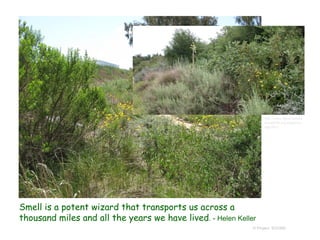
Smell is a potent wizard that transports us across a
thousand miles and all the years we have lived. - Helen Keller
http://www.sepulvedaba
sinwildlife.org/vegeman
age.html
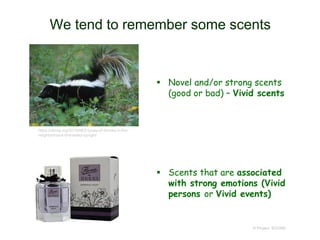
We tend to remember some scents
 Novel and/or strong scents
(good or bad) – Vivid scents
 Scents that are associated
with strong emotions (Vivid
persons or Vivid events)
© Project SOUND
https://obrag.org/2010/08/2-types-of-skunks-in-the-
neighborhood-one-walks-upright/
Practical applications:
Therapy gardens
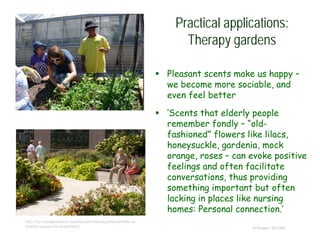
 Pleasant scents make us happy –
we become more sociable, and
even feel better
 ‘Scents that elderly people
remember fondly – “old-
fashioned” flowers like lilacs,
honeysuckle, gardenia, mock
orange, roses – can evoke positive
feelings and often facilitate
conversations, thus providing
something important but often
lacking in places like nursing
homes: Personal connection.’
© Project SOUND
http://my.chicagobotanic.org/education/therapy/the-benefits-of-
outdoor-spaces-for-the-elderly/
Some scented non-natives you might
want to consider
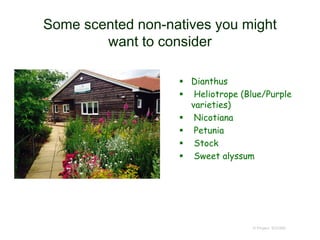
 Dianthus
 Heliotrope (Blue/Purple
varieties)
 Nicotiana
 Petunia
 Stock
 Sweet alyssum
© Project SOUND
Gardening for the
five senses
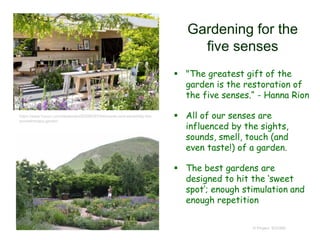
 "The greatest gift of the
garden is the restoration of
the five senses.“ - Hanna Rion
 All of our senses are
influenced by the sights,
sounds, smell, touch (and
even taste!) of a garden.
 The best gardens are
designed to hit the ‘sweet
spot’; enough stimulation and
enough repetition
© Project SOUND
https://www.houzz.com/ideabooks/83298297/list/scents-and-sensibility-the-
aromatherapy-garden
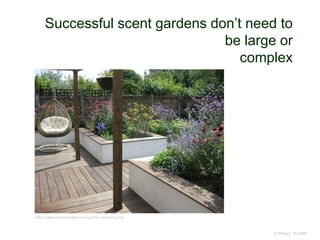
Successful scent gardens don’t need to
be large or
complex
© Project SOUND
http://www.wendystokes.com/garden-sensory.php
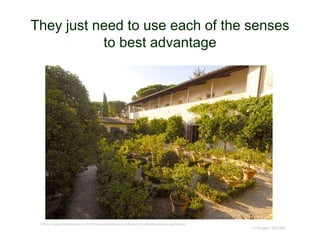
They just need to use each of the senses
to best advantage
© Project SOUND
https://www.fourseasons.com/magazine/discover/lorenzo-villoresi-italian-perfumes
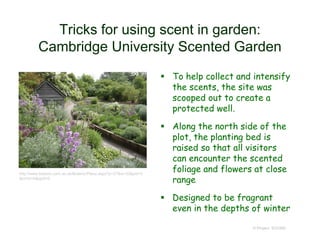
Tricks for using scent in garden:
Cambridge University Scented Garden
 To help collect and intensify
the scents, the site was
scooped out to create a
protected well.
 Along the north side of the
plot, the planting bed is
raised so that all visitors
can encounter the scented
foliage and flowers at close
range
 Designed to be fragrant
even in the depths of winter
© Project SOUND
http://www.botanic.cam.ac.uk/Botanic/Place.aspx?p=27&ix=33&pid=0
&prcid=0&ppid=0
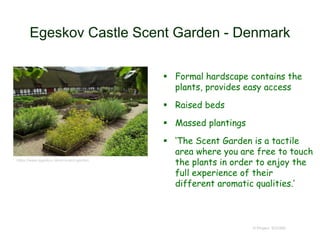
Egeskov Castle Scent Garden - Denmark
 Formal hardscape contains the
plants, provides easy access
 Raised beds
 Massed plantings
 ‘The Scent Garden is a tactile
area where you are free to touch
the plants in order to enjoy the
full experience of their
different aromatic qualities.’
© Project SOUND
https://www.egeskov.dk/en/scent-garden
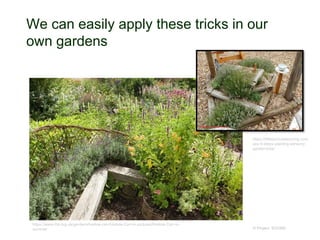
We can easily apply these tricks in our
own gardens
© Project SOUND
https://www.rhs.org.uk/gardens/harlow-carr/Harlow-Carr-in-pictures/Harlow-Carr-in-
summer
https://littlesproutslearning.co/e
asy-5-steps-planting-sensory-
garden-kids/
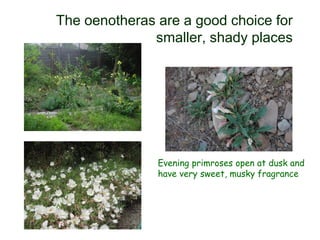
The oenotheras are a good choice for
smaller, shady places
Evening primroses open at dusk and
have very sweet, musky fragrance
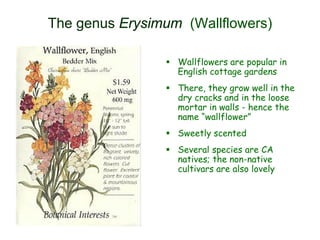
 Wallflowers are popular in
English cottage gardens
 There, they grow well in the
dry cracks and in the loose
mortar in walls - hence the
name “wallflower”
 Sweetly scented
 Several species are CA
natives; the non-native
cultivars are also lovely
The genus Erysimum (Wallflowers)
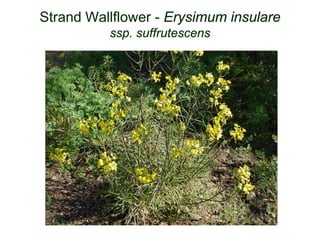
Strand Wallflower - Erysimum insulare
ssp. suffrutescens
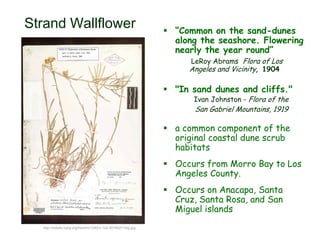
Strand Wallflower  “Common on the sand-dunes
along the seashore. Flowering
nearly the year round”
LeRoy Abrams Flora of Los
Angeles and Vicinity, 1904
 "In sand dunes and cliffs."
Ivan Johnston - Flora of the
San Gabriel Mountains, 1919
 a common component of the
original coastal dune scrub
habitats
 Occurs from Morro Bay to Los
Angeles County.
 Occurs on Anacapa, Santa
Cruz, Santa Rosa, and San
Miguel islands
http://sidsite.nybg.org/herbim/1240/v-124-00185211big.jpg
© Project SOUND
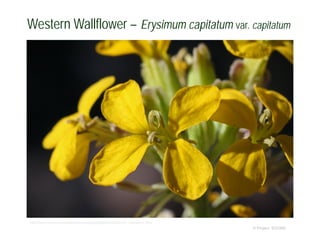
Western Wallflower – Erysimum capitatum var. capitatum
http://www.wnmu.edu/academic/nspages2/gilaflora/erysimum_capitatum.html
© Project SOUND
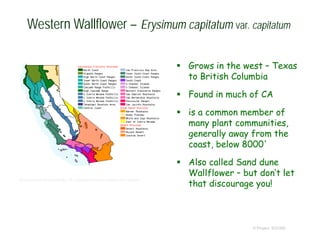
Western Wallflower – Erysimum capitatum var. capitatum
 Grows in the west – Texas
to British Columbia
 Found in much of CA
 is a common member of
many plant communities,
generally away from the
coast, below 8000'
 Also called Sand dune
Wallflower – but don’t let
that discourage you!
http://ucjeps.berkeley.edu/cgi-bin/get_JM_treatment.pl?Erysimum+capitatum+var.+capitatum
© Project SOUND
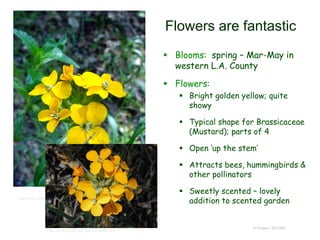
Flowers are fantastic
 Blooms: spring – Mar-May in
western L.A. County
 Flowers:
 Bright golden yellow; quite
showy
 Typical shape for Brassicaceae
(Mustard); parts of 4
 Open ‘up the stem’
 Attracts bees, hummingbirds &
other pollinators
 Sweetly scented – lovely
addition to scented gardenhttp://www.calflora.net/bloomingplants/westernwallflower.html
http://www.timetotrack.com/jay/wallfl3.htm
http://vtgcrec.ifas.ufl.edu/pages/Selby%20Gardens/Selby-03-BC7-wallflower.JPG
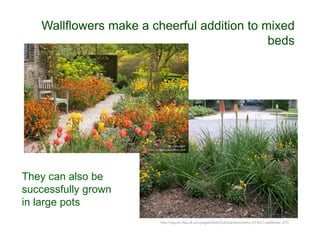
Wallflowers make a cheerful addition to mixed
beds
They can also be
successfully grown
in large pots
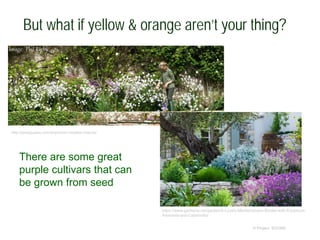
But what if yellow & orange aren’t your thing?
© Project SOUND
http://janetqueen.com/erysimum-bowles-mauve/
https://www.gardenia.net/garden/A-Lovely-Mediterranean-Border-with-Erysimum-
Artemisia-and-Calamintha
There are some great
purple cultivars that can
be grown from seed
© Project SOUND
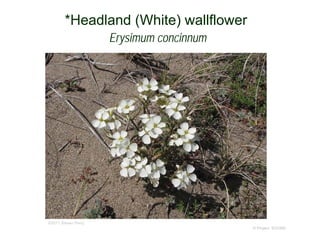
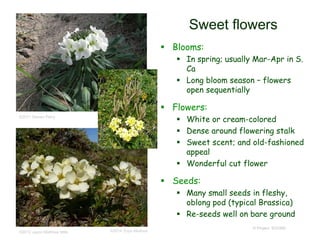
*Headland (White) wallflower
Erysimum concinnum
©2011 Steven Perry
© Project SOUND
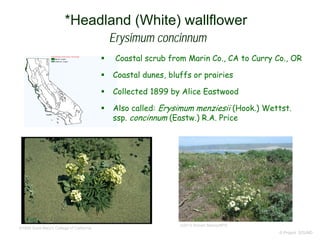
*Headland (White) wallflower
Erysimum concinnum
©1995 Saint Mary's College of California
©2013 Robert Steers/NPS
 Coastal scrub from Marin Co., CA to Curry Co., OR
 Coastal dunes, bluffs or prairies
 Collected 1899 by Alice Eastwood
 Also called: Erysimum menziesii (Hook.) Wettst.
ssp. concinnum (Eastw.) R.A. Price
© Project SOUND
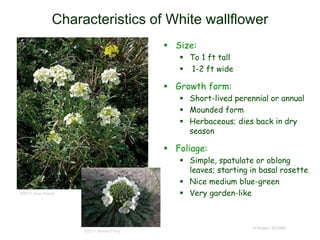
Characteristics of White wallflower
 Size:
 To 1 ft tall
 1-2 ft wide
 Growth form:
 Short-lived perennial or annual
 Mounded form
 Herbaceous; dies back in dry
season
 Foliage:
 Simple, spatulate or oblong
leaves; starting in basal rosette
 Nice medium blue-green
 Very garden-like
©2011 Steven Perry
©2015 Jean Pawek
© Project SOUND
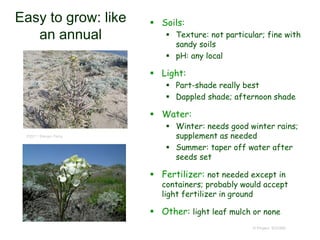
Sweet flowers
 Blooms:
 In spring; usually Mar-Apr in S.
Ca
 Long bloom season – flowers
open sequentially
 Flowers:
 White or cream-colored
 Dense around flowering stalk
 Sweet scent; and old-fashioned
appeal
 Wonderful cut flower
 Seeds:
 Many small seeds in fleshy,
oblong pod (typical Brassica)
 Re-seeds well on bare ground
©2011 Steven Perry
©2012 Jason Matthias Mills ©2014 Zoya Akulova
© Project SOUND
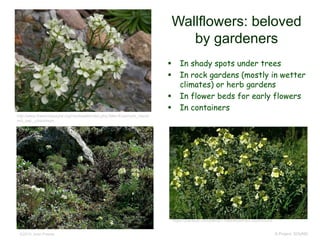
Easy to grow: like
an annual
 Soils:
 Texture: not particular; fine with
sandy soils
 pH: any local
 Light:
 Part-shade really best
 Dappled shade; afternoon shade
 Water:
 Winter: needs good winter rains;
supplement as needed
 Summer: taper off water after
seeds set
 Fertilizer: not needed except in
containers; probably would accept
light fertilizer in ground
 Other: light leaf mulch or none
©2011 Steven Perry
© Project SOUND
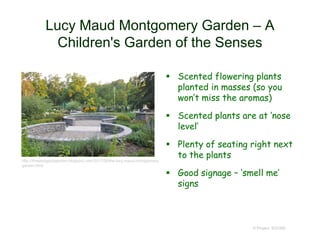
Wallflowers: beloved
by gardeners
 In shady spots under trees
 In rock gardens (mostly in wetter
climates) or herb gardens
 In flower beds for early flowers
 In containers
©2015 Jean Pawek
http://www.theodorepayne.org/mediawiki/index.php?title=Erysimum_menzi
esii_ssp._concinnum
https://plantlust.com/plants/11998/erysimum-concinnum/
Lucy Maud Montgomery Garden – A
Children's Garden of the Senses
 Scented flowering plants
planted in masses (so you
won’t miss the aromas)
 Scented plants are at ‘nose
level’
 Plenty of seating right next
to the plants
 Good signage – ‘smell me’
signs
© Project SOUND
http://threedogsinagarden.blogspot.com/2017/08/the-lucy-maud-montgomery-
garden.html
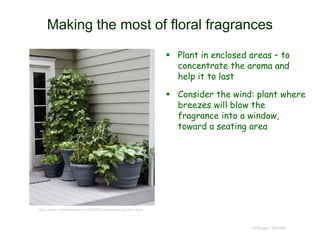
Making the most of floral fragrances
 Plant in enclosed areas – to
concentrate the aroma and
help it to last
 Consider the wind: plant where
breezes will blow the
fragrance into a window,
toward a seating area
© Project SOUND
https://www.marthastewart.com/337398/small-space-garden-ideas
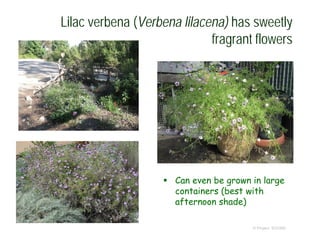
Lilac verbena (Verbena lilacena) has sweetly
fragrant flowers
 Can even be grown in large
containers (best with
afternoon shade)
© Project SOUND
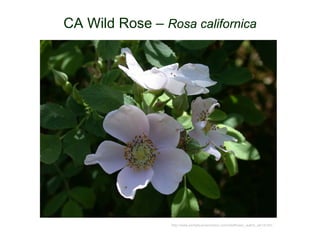
CA Wild Rose – Rosa californica
http://www.yerbabuenanursery.com/wildflower_watch_wk18.htm
© Project SOUND
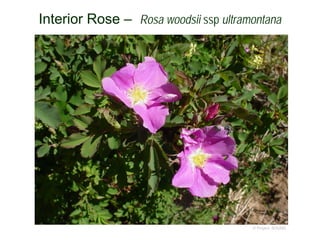
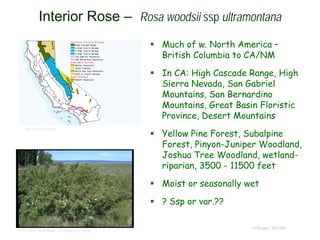
Interior Rose – Rosa woodsii ssp ultramontana
 Much of w. North America –
British Columbia to CA/NM
 In CA: High Cascade Range, High
Sierra Nevada, San Gabriel
Mountains, San Bernardino
Mountains, Great Basin Floristic
Province, Desert Mountains
 Yellow Pine Forest, Subalpine
Forest, Pinyon-Juniper Woodland,
Joshua Tree Woodland, wetland-
riparian, 3500 - 11500 feet
 Moist or seasonally wet
 ? Ssp or var.??
© Project SOUND
Interior Rose – Rosa woodsii ssp ultramontana
© Br. Alfred Brousseau, Saint Mary's College
http://archive.is/JkiE
© Project SOUND
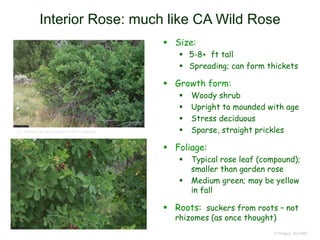
Interior Rose: much like CA Wild Rose
 Size:
 5-8+ ft tall
 Spreading; can form thickets
 Growth form:
 Woody shrub
 Upright to mounded with age
 Stress deciduous
 Sparse, straight prickles
 Foliage:
 Typical rose leaf (compound);
smaller than garden rose
 Medium green; may be yellow
in fall
 Roots: suckers from roots – not
rhizomes (as once thought)
J.S. Peterson @ USDA-NRCS PLANTS Database
© Project SOUND
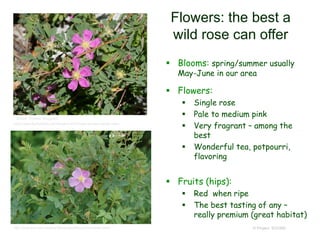
Flowers: the best a
wild rose can offer
 Blooms: spring/summer usually
May-June in our area
 Flowers:
 Single rose
 Pale to medium pink
 Very fragrant – among the
best
 Wonderful tea, potpourri,
flavoring
 Fruits (hips):
 Red when ripe
 The best tasting of any –
really premium (great habitat)
©2008 Thomas Stoughton
http://web.ewu.edu/ewflora/Rosaceae/Rosa%20woodsii.html
http://www.fireflyforest.com/flowers/3214/rosa-woodsii-woods-rose/
© Project SOUND
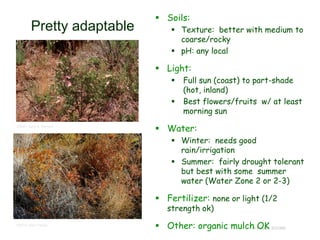
Pretty adaptable
 Soils:
 Texture: better with medium to
coarse/rocky
 pH: any local
 Light:
 Full sun (coast) to part-shade
(hot, inland)
 Best flowers/fruits w/ at least
morning sun
 Water:
 Winter: needs good
rain/irrigation
 Summer: fairly drought tolerant
but best with some summer
water (Water Zone 2 or 2-3)
 Fertilizer: none or light (1/2
strength ok)
 Other: organic mulch OK©2012 Jean Pawek
©2001 Gary A. Monroe
© Project SOUND
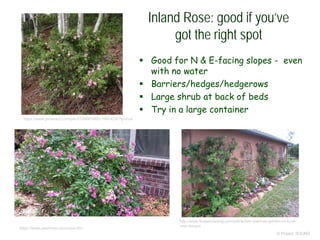
Inland Rose: good if you’ve
got the right spot
 Good for N & E-facing slopes - even
with no water
 Barriers/hedges/hedgerows
 Large shrub at back of beds
 Try in a large container
https://www.pinterest.com/pin/319966748511991424/?lp=true
https://www.seedman.com/rosa.htm
http://www.finegardening.com/article/ben-joannes-garden-in-rural-
new-mexico
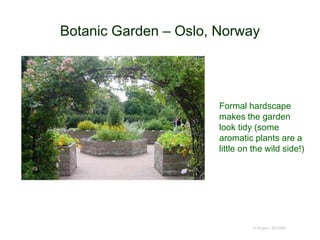
Botanic Garden – Oslo, Norway
© Project SOUND
Formal hardscape
makes the garden
look tidy (some
aromatic plants are a
little on the wild side!)
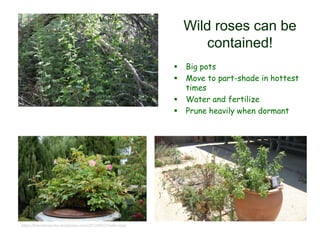
Wild roses can be
contained!
 Big pots
 Move to part-shade in hottest
times
 Water and fertilize
 Prune heavily when dormant
https://brendenstudio.wordpress.com/2012/05/21/wild-rose/
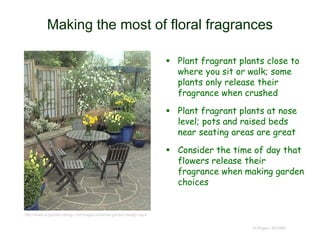
Making the most of floral fragrances
 Plant fragrant plants close to
where you sit or walk; some
plants only release their
fragrance when crushed
 Plant fragrant plants at nose
level; pots and raised beds
near seating areas are great
 Consider the time of day that
flowers release their
fragrance when making garden
choices
© Project SOUND
http://www.si-garden-design.com/page/container-garden-design.aspx
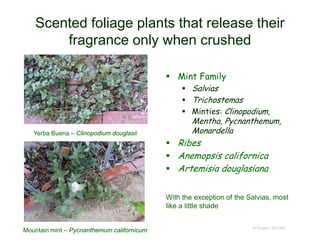
Scented foliage plants that release their
fragrance only when crushed
 Mint Family
 Salvias
 Trichostemas
 Minties: Clinopodium,
Mentha, Pycnanthemum,
Monardella
 Ribes
 Anemopsis californica
 Artemisia douglasiana
© Project SOUND
Yerba Buena – Clinopodium douglasii
Mountain mint – Pycnanthemum californicum
With the exception of the Salvias, most
like a little shade
© Project SOUND
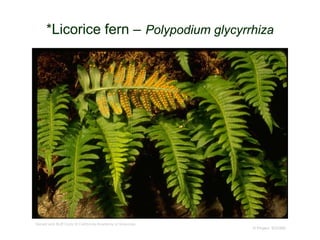
*Licorice fern – Polypodium glycyrrhiza
Gerald and Buff Corsi © California Academy of Sciences
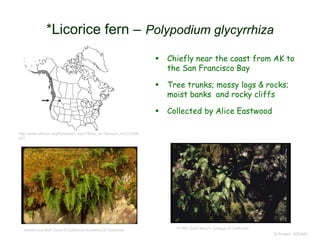
 Chiefly near the coast from AK to
the San Francisco Bay
 Tree trunks; mossy logs & rocks;
moist banks and rocky cliffs
 Collected by Alice Eastwood
© Project SOUND
*Licorice fern – Polypodium glycyrrhiza
Gerald and Buff Corsi © California Academy of Sciences ©1995 Saint Mary's College of California
http://www.efloras.org/florataxon.aspx?flora_id=1&taxon_id=233500
977
© Project SOUND
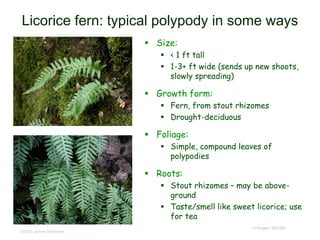
Licorice fern: typical polypody in some ways
 Size:
 < 1 ft tall
 1-3+ ft wide (sends up new shoots,
slowly spreading)
 Growth form:
 Fern, from stout rhizomes
 Drought-deciduous
 Foliage:
 Simple, compound leaves of
polypodies
 Roots:
 Stout rhizomes – may be above-
ground
 Taste/smell like sweet licorice; use
for tea
©2015 James Gonsman
© Project SOUND
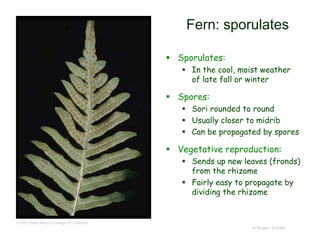
Fern: sporulates
 Sporulates:
 In the cool, moist weather
of late fall or winter
 Spores:
 Sori rounded to round
 Usually closer to midrib
 Can be propagated by spores
 Vegetative reproduction:
 Sends up new leaves (fronds)
from the rhizome
 Fairly easy to propagate by
dividing the rhizome
©1995 Saint Mary's College of California
© Project SOUND
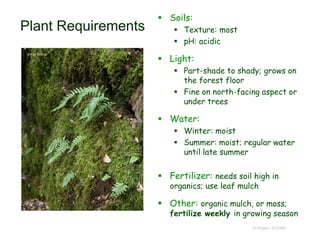
Plant Requirements
 Soils:
 Texture: most
 pH: acidic
 Light:
 Part-shade to shady; grows on
the forest floor
 Fine on north-facing aspect or
under trees
 Water:
 Winter: moist
 Summer: moist; regular water
until late summer
 Fertilizer: needs soil high in
organics; use leaf mulch
 Other: organic mulch, or moss;
fertilize weekly in growing season
© Project SOUND
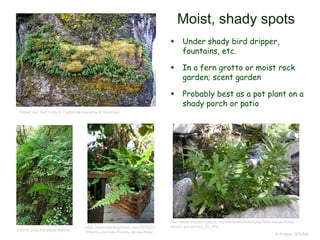
Moist, shady spots
 Under shady bird dripper,
fountains, etc.
 In a fern grotto or moist rock
garden; scent garden
 Probably best as a pot plant on a
shady porch or patio
Gerald and Buff Corsi © California Academy of Sciences
©2016 Julie Kierstead Nelson
http://www.theodorepayne.org/mediawiki/index.php?title=Image:Polyp
odium_glycyrrhiza_05.JPGhttps://www.eastbaytimes.com/2010/01/
19/ferns-arent-as-finnicky-as-we-think/
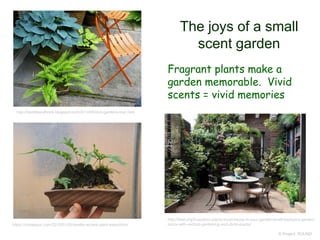
The joys of a small
scent garden
© Project SOUND
http://heddleandhook.blogspot.com/2014/05/dun-gardens-tour.html
https://crataegus.com/2010/01/25/seattle-accent-plant-expedition/
http://folat.org/5-outdoor-plants-must-haves-in-your-garden/small-backyard-garden-
decor-with-vertical-gardening-and-climb-plants/
Fragrant plants make a
garden memorable. Vivid
scents = vivid memories
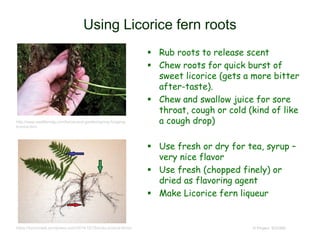
Using Licorice fern roots
 Rub roots to release scent
 Chew roots for quick burst of
sweet licorice (gets a more bitter
after-taste).
 Chew and swallow juice for sore
throat, cough or cold (kind of like
a cough drop)
 Use fresh or dry for tea, syrup –
very nice flavor
 Use fresh (chopped finely) or
dried as flavoring agent
 Make Licorice fern liqueur
© Project SOUND
http://www.seattlemag.com/home-and-garden/spring-foraging-
licorice-fern
https://tryoncreek.wordpress.com/2014/12/15/lucky-licorice-ferns/
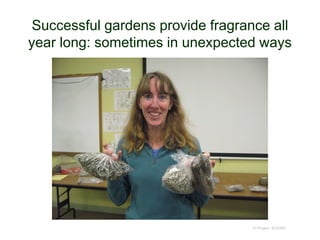
Successful gardens provide fragrance all
year long: sometimes in unexpected ways
© Project SOUND
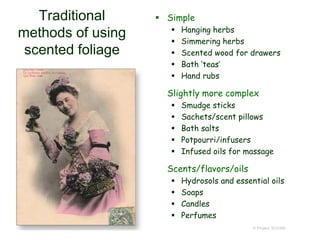
Traditional
methods of using
scented foliage
 Simple
 Hanging herbs
 Simmering herbs
 Scented wood for drawers
 Bath ‘teas’
 Hand rubs
 Slightly more complex
 Smudge sticks
 Sachets/scent pillows
 Bath salts
 Potpourri/infusers
 Infused oils for massage
 Scents/flavors/oils
 Hydrosols and essential oils
 Soaps
 Candles
 Perfumes
© Project SOUND
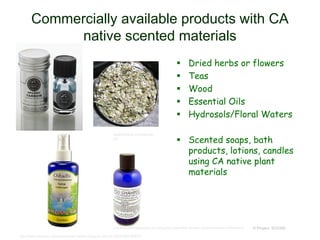
Commercially available products with CA
native scented materials
 Dried herbs or flowers
 Teas
 Wood
 Essential Oils
 Hydrosols/Floral Waters
 Scented soaps, bath
products, lotions, candles
using CA native plant
materials
© Project SOUND
http://www.nhrorganicoils.com/products.p
hp?id=2874
http://www.lalaessentialoils.com/yarrow-
essential-oil.html
http://www.aromatherapyoilsuk.co.uk/yarrow-essential-oil-blue-yarrow-achillea-millefolium/
http://www.amazon.com/Hydrosols-Yarrow-Organic-200-mL/dp/B006FXK87Q
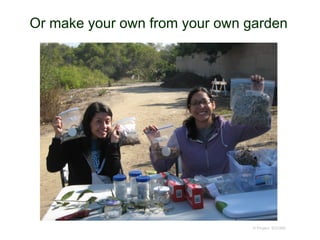
Or make your own from your own garden
© Project SOUND
Plants make powerful drugs. They work on our minds
and bodies in ways we’re just beginning to understand
Take home messages:
1. Each individual’s reaction to a
scent is unique
2. Some reactions are likely innate:
specific chemicals trigger
physiologic responses
3. Some reactions are likely mediated
– in complex ways – by an
individual’s scent memories
4. Pleasant scents – particularly
florals – make us feel happier (and
happy is important for health)
© Project SOUND
https://hecticparents.com/2015/11/21/is-being-spiritual-healthy/
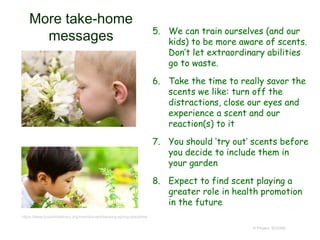
More take-home
messages 5. We can train ourselves (and our
kids) to be more aware of scents.
Don’t let extraordinary abilities
go to waste.
6. Take the time to really savor the
scents we like: turn off the
distractions, close our eyes and
experience a scent and our
reaction(s) to it
7. You should ‘try out’ scents before
you decide to include them in
your garden
8. Expect to find scent playing a
greater role in health promotion
in the future
© Project SOUND
https://www.brooklinelibrary.org/events/event/sensing-spring-storytime/
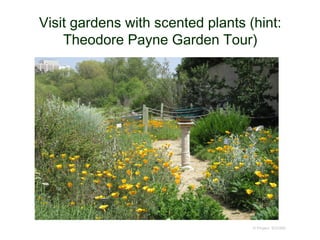
Visit gardens with scented plants (hint:
Theodore Payne Garden Tour)
© Project SOUND
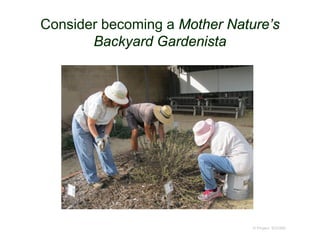
Consider becoming a Mother Nature’s
Backyard Gardenista
© Project SOUND
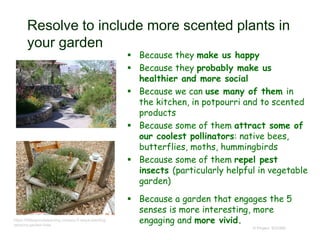
Resolve to include more scented plants in
your garden
 Because they make us happy
 Because they probably make us
healthier and more social
 Because we can use many of them in
the kitchen, in potpourri and to scented
products
 Because some of them attract some of
our coolest pollinators: native bees,
butterflies, moths, hummingbirds
 Because some of them repel pest
insects (particularly helpful in vegetable
garden)
 Because a garden that engages the 5
senses is more interesting, more
engaging and more vivid.
© Project SOUND
https://littlesproutslearning.co/easy-5-steps-planting-
sensory-garden-kids/

Scent gardens 2018

  • 1.
    © Project SOUND Outof the Wilds and Into Your Garden Gardening with California Native Plants in Western L.A. County Project SOUND – 2018 (our 14th year)
  • 2.
    © Project SOUND Gardeningfor Scent: the importance of scented plants for health C.M. Vadheim, K. Dawdy (and T. Drake) CSUDH (emeritus), CSUDH & City of Torrance Madrona Marsh Preserve April 7 & 12, 2018
  • 3.
    2018 Season –Gardens that sooth © Project SOUND Gardens that heal
  • 4.
    We Californians areblessed with so many native scented plants… …that we sometimes forget just how special they really are
  • 5.
    Today we’re goingto explore some of our native fragrant plants © Project SOUND
  • 6.
    We’ll talk aboutthe importance of scented plants for our gardens – and for ourselves © Project SOUND
  • 7.
    © Project SOUND We’lldiscuss some tricks for using scented native plants effectively in our gardens
  • 8.
    But first weneed a little background on people, animals and plants © Project SOUND
  • 9.
    Huge current interestin ‘scented products’ right now  Flavors & Fragrances: $30 billion industry (2016) and growing rapidly each year  Many of the scents are ‘plant-derived’ © Project SOUND https://swiftnary.com/news/global-flavor-fragrance-market-2017-symrise-takasago-wild-flavors-mane-frutarom-2238.html
  • 10.
    Scented gardens havebeen popular in the past (and are becoming so again)  Earliest scented gardens in Persia, at least 3500 years ago  Earliest scented gardens were meant to link heaven & earth (a place for meditation & pleasure)  In the past, scented gardens and their useful products were intimately linked:  Foods/flavorings  Medicinals  Personal & room ‘fresheners’ © Project SOUND https://www.flickr.com/photos/130819462@N04/23420440283
  • 11.
    Less interest inscented plants since the late 1800’s. Why?  New medicinals/treatment modalities and products (chemicals; antibiotics)  Life became more ‘sanitary’ and less ‘smelly’  Scented plants/products seen as ‘old- fashioned’ and ‘crude/vulgar’  New plant varieties focused on color, shape & safety (no bees!)  Less time and money for:  Enjoying the garden, including meditation/contemplation  Garden upkeep © Project SOUND http://www.sath.org.uk/edscot/www.educationscotland.gov.uk/sc otlandshistory/makingthenation/monasticorders/index.html In many ways, gardens became less interesting over time
  • 12.
    2018: new interestin scented gardens  Increased interest in historic gardens  Edible gardening movement – grow your own herbs and spices  Habitat gardening movement  Evidence that scents (at least some) are good for our health  Growing sense that ‘outdoor therapy’ is sorely needed in urban places © Project SOUND https://www.fromoldbooks.org/Edwards- ForestOfArden/pages/000-xii-Rosalind/ https://designforgenerations.com/case-studies/therapy- garden-merwick/
  • 13.
    Some important questionsto consider 1. What’s the evidence that scented plants are good for us and our gardens? 2. How can we best use scented plants in the garden? 3. How to we adapt the concept of a scented garden to our own, unique (and changing) California gardens? © Project SOUND https://www.flowerpotman.com/sensory-gardens-at-home/herb-garden/
  • 14.
    Plants produce scentedchemicals for several reasons (many w/ a deep past)  Sweet-scented (and sometimes nasty-scented) flowers: to attract pollinators (at least those w/ a sense of smell: bees, butterflies/moths, pollinator flies, even humans)  Sweet-scented fruits/seeds: to signal seed distributers that seeds are ready  Pungent scented foliage, roots, other plant parts:  To warn herbivores to stay away (some are actually toxic)  Sometimes to warn away disease- carrying vectors  Sometimes to signal other plants
  • 15.
    Including more scentedplants creates better garden habitat – for good reason © Project SOUND Scent is one of the more important ways plants communicate with animals!
  • 16.
    In Feb/Mar wevisited the Sonoran Desert © Project SOUND Desert Botanic Garden – Phoenix AZ http://www.ddtvl.com/dbg.htm
  • 17.
    We saw someinspiring Desert landscapes © Project SOUND https://www.landscapingnetwork.com/pictures/southwestern-landscaping_42/88005- nm-casa-serena-landscape-designs-llc-garden-walkway_2825/ But did you know that the Sonoran Desert is a biodiversity hotspot for native bees?
  • 18.
    How can thatbe so? What explains this? © Project SOUND http://www.aridzonetrees.com/olneya-tesota.html https://coastsideslacking.com/2017/03/30/super-bloom-part-1-anza-borrego- wildflowers-defy-expectations-but-we-are-impressed-anyway/ A number of convergent factors make ‘difficult’ climates incubators of biodiversity
  • 19.
    Importance of scentedflowers in desert (and mediterranean) climates  Limited window of time for plants to reproduce  Limited time for insect pollinators as well: temperature and water-limited  Year-to-year variability in amount and timing of rainfall  Need good ability to signal pollinators, over longer distances © Project SOUND It makes evolutionary sense for plants to spend scarce energy on signaling molecules; they need the pollinators so they can reproduce
  • 20.
    Tremendous flowering plantdiversity in Sonoran Desert  Many of the adaptations between desert plants and their pollinators are unique  Wide diversity of insect pollinators; native bees most common  Other desert pollinators: beetles, flies, wasps, butterflies, moths, hummingbirds and bats  Many of pollinators are specialists, narrowly focused on feeding from the flowers of a single species or genus of plants.  But there are many generalists as well – not as well studied © Project SOUND Diadasia (cactus) bees. Also pollinate some local mallows, some sunflowers, evening primroses
  • 21.
    Shade trees withscented flowers: Sonoran  Desert willow (* Chilopsis linearis)  Paloverdes (*Parkinsonia spp.)  Mesquites (*Prosopis spp)  Prunus species  Catclaw acacia (* Senegalia greggii) © Project SOUND https://publish.extension.org/mastergardener/tag/xeriscaping/ https://www.forms-surfaces.com/projects/desert-botanical-garden http://www.plantmaster.com/gardens/eplant.php?plantnum=253
  • 22.
    Desert understory plantscan also provide scent & habitat (at little water cost) We discussed some good ‘generalist pollinator’ plants in February & March © Project SOUND Acton brittlebush Creosote bush
  • 23.
    © Project SOUND *Palmer’s Penstemon – Penstemon palmeri
  • 24.
    © Project SOUND *Palmer’s Penstemon – Penstemon palmeri http://ucjeps.berkeley.edu/cgi-bin/get_JM_treatment.pl?7177,7483,0,7541 http://www.flickr.com/photos/facilitybikeclub/3609173980/  Mojave Desert foothills/mountains to UT, AZ, NM  Washes, roadsides, canyon floors in scrub to pinyon-juniper  AKA ‘Wild Pink Snapdragon’
  • 25.
    © Project SOUND Palmer’sPenstemon: one tall penstemon  Size:  3-5+ ft tall  2-3 ft wide  Growth form:  Herbaceous perennial wildflower  Erect stems with leaves primarily basal  Foliage:  Distinctive blue or gray- green  Fleshy; shapes typical or penstemon (triangular & toothed) http://commons.wikimedia.org/wiki/Penstemon_palmeri
  • 26.
    © Project SOUND Flowersare out of an English garden  Blooms:  Late spring to summer  Long bloom season – 4+ weeks  Flowers:  Light pink to light lavender with magenta markings – very striking  Flowers on tall, showy stalks; remind many people of Foxgloves  Flowers more open than most penstemons; sweet scent  Make a great cut flowerhttp://commons.wikimedia.org/wiki/Penstemon_palmeri
  • 27.
    © Project SOUND Penstemonslike dry  Soils:  Texture: well-drained; likes sand but even clays are fine in most years  pH: any local (up to 8.5)  Light: full sun to light shade; hot places  Water:  Winter: adequate  Summer: none to little (Zone 1 or 1-2) once established; taper off after flowering  Fertilizer: none; likes poor soils  Other:  No mulch or use an inorganic  May need to tie up the tall stalks  Let it go to seed to replace itself  Prune back the dead stalks http://www.fireflyforest.com/flowers/1874/penstemon-palmeri-palmers-penstemon/
  • 28.
     Backs ofdry beds, like Foxgloves, for cottage garden look  In desert themed of rock gardens; hot, dry, hard-to-water places  Massed with native grasses, shrubs  In the habitat garden (hummingbirds; butterflies; bumble bees) or scent garden © Project SOUND http://bloominrs.wordpress.com/2010/01/28/palmers-penstemon/ Water-wise flower beds http://www.alplains.com/Catalog9.html http://navigate.botanicgardens.org/weboi/oecgi2.exe/INET_ECM_D ispPl?NAMENUM=8464&DETAIL=
  • 29.
    Many geophytes (bulbsand corms) have sweet-scented flowers © Project SOUND
  • 30.
    Desert perennials workwell with Sonoran desert geophytes, annual wildflowers © Project SOUND
  • 31.
    © Project SOUND *Desertlily – Hesperocallis undulata
  • 32.
     Mostly Sonoran(Colorado) Desert in Imperial, Riverside and San Diego Co.; some also in Mojave Desert (San Bernardino Co)  Conspicuous and easily seen as one drives desert roads, it seems at first glance an Easter Lily out of place. © Project SOUND *Desert lily – Hesperocallis undulata Charles Webber © California Academy of Sciences ©2017 Jean Pawek http://www.efloras.org/florataxon.aspx?flora_id=1&taxon_id=220006298
  • 33.
    © Project SOUND Desert(Ajo) Lily: striking bulb  Size:  1-3 ft tall  1-2 ft wide  Growth form:  Herbaceous perennial from a bulb  Upright habit of the lilies  Foliage:  Leaves basal  Linear with undulating margins  Roots: true bulb ©2008 Neal Kramer ©2008 Steve Matson
  • 34.
    © Project SOUND Flowersare fantastic  Blooms: following winter rains – Mar-May. Will likely not bloom every year.  Flowers:  White lily flowers on upright stem  Flowers up to 3 inches long  Very sweet fragrance, late in the day  Seeds: in fleshy, three-part ‘pod’; can be grown from seed, but difficult to get to flower  Vegetative reproduction: bulblets http://floressanadoras.cl/75-ml-stock-bottle- flores-de-california-fes/127-desert-lily-lirio-del- desierto-hesperocallis-undulata-75-ml- fes.html
  • 35.
    © Project SOUND Nativebulb with Sonoran twist  Soils:  Texture: very well-drained; sandy or rocky  pH: any local – not acidic  Light:  Full sun; heat not an issue  Water:  Winter: good winter-spring rains  Summer: basically dry  Fertilizer: none; likes poor soils  Other: inorganic or no mulch Robert Potts © California Academy of Sciences
  • 36.
    © Project SOUND Sonorangeophytes  In rock gardens, desert-themed gardens  Pair with desert annuals  Try it in a pot; difficult except in its native habitat ©2009 Barry Breckling ©2010 Thomas Stoughton
  • 37.
    Might do wellwith Southwestern mock verbena and/or desert annuals © Project SOUND http://dabaldoherbals.blogspot.com/2017/04/pics-of-our-local-desert-wild-flowers.html
  • 38.
    © Project SOUND *Southwestmock verbena – Glandularia gooddingii http://www.wildflower.org/plants/result.php?id_plant=GLGO
  • 39.
    © Project SOUND Groundcover/fill Groundcover under water-wise trees. Attracts pollinators, birds  Along walkways, patios; in mixed planter beds  As an attractive pot plant; light scent ©2010 James M. Andre http://www.amwua.org/pictures/gc-v-gooddingii-1.jpg http://www.landscape-resources.com/portfolio/groundcoversx/pages/Verbena%20gooddingii- 1.htm
  • 40.
    Plants parcel outtheir expensive perfume  Plants tend to have their scent output at maximal levels only when the flowers are ready for pollination and when its potential pollinators are active as well.  Plants that maximize their output during the day are primarily pollinated by bees or butterflies  Those that release their fragrance mostly at night are pollinated by moth and bats.  During flower development, newly opened and young flowers, which are not ready to function as pollen donors, produce fewer odors and are less attractive to pollinators than are older flowers. © Project SOUND
  • 41.
    © Project SOUND *Desertlantern – Oenothera deltoides http://calscape.org/Oenothera-deltoides-(Dune-Primrose)?srchcr=sc5848d74a17797
  • 42.
    © Project SOUND *Desertlantern – Oenothera deltoides Glenn and Martha Vargas © California Academy of Sciences ©2017 Jean Pawek  Mojave, Sonoran and Great Basin deserts of southern CA, NV, AZ and UT.  Sandy, open desert areas, especially near dunes, below 3500 feet  Creosote Bush Scrub, Joshua Tree Woodland, Valley Grassland, Sagebrush Scrub http://ucjeps.berkeley.edu/eflora/eflora_display.php?tid=34991
  • 43.
    © Project SOUND Prettydesert annual wildflower  Size:  1-3 ft tall  1-3 ft wide  Growth form:  Annual wildflower  Low-growing; like vine or groundcover sometimes  Foliage:  Mostly in basal rosette; more sparse on stems  Leaves to 4 in. long; hairy and glandular  Leaves often coarsely toothed, gray-green ©2017 Zoya Akulova Gerald and Buff Corsi © California Academy of Sciences Dried plant forms a ‘birdcage’
  • 44.
    © Project SOUND Exceptionalflowers  Blooms: spring or early summer; usually Mar-May, but sometimes after summer rains.  Flowers:  Large – 3” across  Very white with yellow center  Open at dusk, wilt by mid- morning (turn pink)  Very sweetly scented – attract moth pollinators  Seeds: needs cross-pollination; the more plants, the better the seed production http://www.answers.com/topic/dudleya Sherry Ballard © California Academy of Sciences Glenn and Martha Vargas © California Academy of Sciences
  • 45.
    © Project SOUND Easyto please annual wildflower  Soils:  Texture: just about any  pH: any local  Light:  Part-shade best; dappled sun or afternoon shade  Water:  Winter: needs good precipitation or water until flowers  Summer: taper off water with flowering  Fertilizer: none; likes poor soils  Other: inorganic or no mulch ©2014 Sheryl Creer Annual wildflowers are easy to grow, even in climates quite different from their origin.
  • 46.
    © Project SOUND Eveningprimroses in the garden  In scent, white, pollinator and desert gardens  Under trees and larger shrubs  As an unusual pot plant ©2006 Steve Matson ©2014 Sheryl Creer J. E.(Jed) and Bonnie McClellan © California Academy of Sciences http://www.joycesnativescape.com/north-mnt-preserve-exhibit
  • 47.
    How do plantsactually signal with scent? © Project SOUND
  • 48.
    The fragrant aromasare due to aroma chemicals (odorants)  Small – must be light enough to be carried in air  Relatively simple: most are esters, turpenes, aromatics and amines  Interact directly with (bind to) scent (olfactory) receptors in insects, humans or animals  Result in a signal being sent to the ‘brain’ © Project SOUND
  • 49.
    Why does arose smell like a rose?  There are many variants of the simple aroma chemicals  Simple changes in structure can change how a simple odorant ‘smells’ – sometimes dramatically!  Natural scents are combinations of dozens or more different aroma chemicals © Project SOUND Wood’s rose – Rosa woodsii Mock orange – Philadelphus lewisii
  • 50.
    Flower scents areimportant pollinator cues and attractants  Volatiles emitted from flowers function as both long- and short- distance attractants; play prominent role in localization and selection of flowers by insects (and probably other pollinators as well)  Little is known about how insects respond to individual components found within floral scents, but it is clear that they are capable of distinguishing among complex scent mixtures. © Project SOUND http://swbiodiversity.org/seinet/taxa/index.php?taxon=3540 Floral volatiles are essential in allowing insects to discriminate among plant species and even among individual flowers of a single species.
  • 51.
    Take home message:the number and variety of scented flowers influences pollinator diversity © Project SOUND http://az.audubon.org/newsroom/news-stories/2013/easy-ways-attract-wildlife-your- yard Include some Sonoran scents to increase habitat value
  • 52.
    So scented flowersincrease garden health – but what do they do for humans? © Project SOUND
  • 53.
    Is all thataromatherapy stuff just hype – or does it really work? © Project SOUND http://www.massageandunwind.com/store/p25/Aromatherapy.html
  • 54.
     Synthetic aromatics Formulated from specific aroma chemicals in the lab  Never contain all the chemicals that produce the nuanced fragrance of the real deal  You get what you pay for; expensive products contain more odorants – smell more ‘real’ © Project SOUNDhttp://nishantaromas.com/ http://airscents.co.za/product/mini-gel-air-freshener-persian-rose/ Rose-scented products: never as complex as the real thing
  • 55.
    Rose essential oil? https://www.organicfacts.net/health-benefits/essential-oils/health- benefits-of-rose-essential-oil.html Roseperfume? Which ‘scent’ is most true to Mother Nature? Rose hydrosol (‘floral water’)? https://www.ecco-verde.com/biopark- cosmetics/rose-hydrosol
  • 56.
    Plants produce ‘essentialoils’: what are they?  Essential oils are volatile, natural, complex compounds characterized by a strong odor; formed by aromatic plants as secondary metabolites.  Chemically, essential oils are very complex natural mixtures which can contain about 20–60 odorants – sometimes even more.  They are generally characterized by 2–3 major components at fairly high concentrations (20–70%), with other components present in trace amounts.  Generally, the major components determine the biological properties of the essential oil. © Project SOUND The essential oil is what makes a rose smell like a rose https://www.amazon.in/Rose-Jasmine-Lavender- Essential-Combo/dp/B01HBGR95O
  • 57.
  • 58.
    The distillation process:the most common method for extracting essential oils © Project SOUND http://www.baldwins.co.uk/blog/2011/07/how-is-essential-oils-produced/
  • 59.
    Hydrosols and ‘FloralWaters’  Made by distilling the whole plant; contain not only essential oils, but many other water soluble components  More true to the essence of the plant and a more complete representation of it, chemically.  Contain the same medicinal properties as the essential oils, but not as concentrated, so it can be used in more applications.  Can be used as a facial toner/cleanser, perfume, deodorant or room freshener - or incorporate into lotions/ homemade soap. © Project SOUND the aroma is usually greener, sharper, and wilder than that of the corresponding essential oil https://www.bodytime.com/rose-hydrosol.html
  • 60.
    To summarize  Naturalscents are combinations of dozens or more different aroma chemicals  Explains why two roses (or orange blossom & Mock orange blossom) smell similar – but slightly different  As most perfumes/ scented products are made with artificial odorants, they are not as complex as ‘natural’ scents – nothing beats the real thing!  Even essential oils and hydrosols are not quite the ‘real thing’ (but they are easier to bring indoors and to use in studies!) © Project SOUND Orange blossom Mock orange – Philadelphus lewisii http://perfumeshrine.blo gspot.com/2011/04/perf umery-materials-neroli- petit-grain.html
  • 61.
    Scented flowers canbe found in many parts of California © Project SOUND
  • 62.
    ‘Ray Hartman’ andother Ceanothus © Project SOUND
  • 63.
    Other local favorites ©Project SOUND Blue elderberry - Sambucus nigra ssp. cerulea Catalina cherry - Prunus ilicifolia ssp. lyonii Mock orange – Philadelphus spp. See our newly-revised lists
  • 64.
    But maybe wewant something to add a pungent scent to the garden: aromatic foliage © Project SOUND
  • 65.
    Despite their complexity,plant scents can be as recognizable as their other attributes  The human nose is capable of recognizing > 100,000 scents.  Scent in plants comes from volatile oils found in the glands of flowers, leaves, branches, seeds, bark, and, in some cases, roots.  More than 3,000 chemically different oils have been identified from at least eighty-seven families of plants. © Project SOUND
  • 66.
    Main families knownfor aromatic foliage/seeds/ bark (worldwide)  Rutaceae (Rue; Citrus)  Few natives (Ptelea crenulata)  Choose Rue or Citrus  Myrtaceae (Myrtles)  No natives  Choose Eucalyptus or Melaleuca  Zingiberaceae (Ginger)  No natives  Choose Ginger root  Apriaceae (dill, angelica, Lomatium)  Lauraceae (cinnamon, camphor, bay)  Asteraceae (sunflowers)  Lamiaceae (mints)  Other © Project SOUND
  • 67.
    © Project SOUND Californiabay – Umbellularia californica
  • 68.
     Mountains, foothillsof CA (except desert) to OR; canyons in Chaparral, Foothill Woodland, Yellow Pine, Mixed Evergreen & Redwood Forest, wetland-riparian  Only native Lauraceae; but avocado, Camphor tree & Sweetbay grown here  First collected 1830’s (S.F.); 1882 (LA Co.). Collected by Leroy Abrams, Alice Eastwood, John Thomas Howell, W.L. Jepson, S.B. Parish, many others © Project SOUND California bay – Umbellularia californica ©1995 Saint Mary's College of California https://www.fs.fed.us/database/feis/plants/tree/um bcal/all.html http://treesofsantacruzcounty.blogspot.com/2013/07/umbellularia-californica.html
  • 69.
    © Project SOUND Largetree with attractive, aromatic foliage  Size:  25-75 ft tall (may be smaller)  25-60 ft wide  Growth form:  Woody, evergreen tree  Shape varies with light, moisture  Larger, mounded trees in sunny spots with good water  Foliage:  Leaves simple, lanceolate, glossy and very pungent  Can be used as seasoning and also medicinally  Roots: wide & deep J. E.(Jed) and Bonnie McClellan © California Academy of Sciences
  • 70.
    © Project SOUND Flowers:small; fruits: edible  Blooms: main bloom in late winter/early spring. May bloom sporadically Dec-May  Flowers:  Small, yellow-green, in clusters  Not really showy  Attract pollinators (much like an avocado)  Fruits:  Like small avocados ©2008 Neal Kramer
  • 71.
    Edible fruit, seeds Fleshy fruit  Eaten fresh (like an avocado)  Quickly goes bad; some trees have better fruits than others  Seed  Remove all green, fleshy part (what we eat in avocados)  Air dry the ‘pits’  Store dry pits in paper bag  Roast at 350° F for 1 to 1 ½ hours (single layer; check every 20 min.; will be brown inside)  Grind as use like cocoa powder (tastes like chocolate + coffee) © Project SOUND https://en.wikipedia.org/wiki/Umbellularia ©2009 Anna Bennett
  • 72.
    © Project SOUND PlantRequirements  Soils:  Texture: most  pH: any local, 5.0-8.0  Light: best with part shade except on immediate coast or in foothills  Water:  Winter: needs good, adequate rainfall - supplement  Summer: needs at least occasional water (once a month, deep – Water Zone 2 to 2-3 best)  Fertilizer: OK with occasional light fertilizer  Other: fine with leaf or other organic mulch ©2015 Zoya Akulova
  • 73.
    © Project SOUND CABay: in the garden  Shade tree or large shrub (can be pruned either way) – evergreen  Large hedge/screen  Can even be grown in a large planter of container ©2012 Scott Batiuk ©2015 Zoya Akulova http://www.plantmaster.com/gardens/e plant.php?plantnum=1673 https://selectree.calpoly.edu/tree- detail/umbellularia-californica
  • 74.
    Advice: smell thistree before you buy it © Project SOUND https://bss.lacity.org/UrbanForestry/StreetTree/UmbellulariaCalifornica.htm https://inlandvalleygardenplanner.org/plants/umbelularia-californica/ Aromatics affect people differently
  • 75.
    The human senseof smell is yet more interesting – due to our complex bodies  No two people smell the same scent exactly the same  People experience and remember the same scent differently  Some scents have powerful effects on our physiology, our emotions and our sense of well- being. Some of those effects are likely innate. © Project SOUND And scientific studies are revealing some tantalizing clues about why
  • 76.
    Not surprisingly, olfaction(smell) is our most primitive sense  Scent cues have been essential for human survival during most of human existence.  Animals (insects to humans) use their olfactory system to identify food, mates and predators  Scent cues provide both sensual pleasure as well as warnings of danger (spoiled food; fire; chemical hazards; a hungry bear)  As with most animals, the human scent- sensing organs (receptors; brain connections) are ancient © Project SOUND http://www.gardenandgreenhouse.net/articles/march- 2008/hydroponics-101-9/
  • 77.
    Smell: primitive andpowerful sense  Scent cues inform even before other cues – they function as an early warning system  It’s not surprising to find that the olfactory system is linked to key physiologic responses, including those mediated by hormones and neurotransmitters  The nervous system provides the link between a scent a body’s response © Project SOUND http://www.altmd.com/Articles/Aromatherapy--Encyclopedia-of-Alternative-Medicine
  • 78.
     The olfactorytract has direct connections with at least five areas of the brain  These areas involved in:  Perception of smell  Memory and decoding of individual scents  Physiologic (visceral) responses to a scent  Emotional responses  Complex scent memories © Project SOUND https://www.thoughtco.com/olfactory-system-4066176 https://oli.cmu.edu/jcourse/workbook/activity/page?context=21af2f2e80020ca6018edbaaeb4b8ee5 And it gets more interesting!
  • 79.
    Scent and traditional medicine Use of scent is part of nearly all medical traditions – going back thousands of years (aromatherapy is not new)  Gardens in many parts of the world grew plants used for healing – including aromatics  Similar plants used for specific conditions across cultures  Some cultures even ‘prescribed’ visits to healing gardens or plants © Project SOUND https://phytatech.com/Test-ValueAdded-Terpene-Testing.php
  • 80.
    Traditional delivery modesmade use of the nature of essential oils  As teas or infusions  Scent inhaled (like aroma therapy)  In baths  Smudging - French hospitals, which use much more aromatherapy than ours, used a rosemary/juniper smudge as a disinfectant until fairly recently.  Incense Cedar (as well as juniper and cypress) traditionally used in sweat lodge ceremonies as spiritual purifiers and for the attraction of good energy, while eliminating negative energies. © Project SOUND http://siskiyouwildcrafting.com/cedar.html
  • 81.
    The experience ofscent is individualistic  Yet some scents have been purported to cause certain effects for a long time – and in many different cultures:  Lavender – calming  Mint – energizing  Sage can reduce mental fatigue, stress and mental exhaustion.  Is there a chemical basis for these effects?  Can specific odorants be used therapeutically? © Project SOUND http://www.allure.com/beauty-trends/blogs/daily-beauty-reporter/2011/10/the- floral-fragrance-note-both-you-and-he-will-love.html
  • 82.
     Various essentialoils have been used medicinally at different periods in history.  Medical applications for medicinal oils range from skin treatments to remedies for cancer  Often based solely on historical accounts of use of essential oils for these purposes.  Claims for the efficacy of medical treatments and treatment of cancers in particular, are now subject to regulation in most countries. © Project SOUND Unfortunately, good evidence is still scanty for many aromatic treatments
  • 83.
    Why is solittle known about the actual effects of many plant compounds?  Many compounds; we’re just beginning to understand their functions in plants  Less $$ for plant than animal research  Current skepticism about ‘herbal medicine  Volatile & reactive – many break-down compounds which may be the active forms  Some information is proprietary – pharmaceutical industry © Project SOUND  Some of the ‘effects’ are difficult to measure:  Happen quickly  Happen internally  May involve moods, emotions, etc.
  • 84.
    Scents can produceimmediate physiological effects: proven  blood pressure  muscle tension  pupil dilation  skin temperature  pulse rate  brain activity levels in various parts of the brain © Project SOUND Most of these effects can be explained by levels of hormones and/or neurotransmitters
  • 85.
    Physiological and Psychological Responseto Floral Scent. HortScience January 2013 vol. 48 © Project SOUND  26 young Japanese males  Exposed to unscented air and air infused with the scent of plum blossoms  Measured effect of exposure on:  Blood pressure and pulse rate  Brain activity (certain areas of brain)  Mood (measured by standard questions) http://hortsci.ashspublications.org/content/48/1/82.full
  • 86.
    Physiological and Psychological Responseto Floral Scent.  Fragrance activated the cerebral areas in charge of movement, speech, and memory functions and stimulated the SNS activity in ways related to excitement.  Support findings that horticultural therapy tended to promote speech, communication, and thereby social interaction and helped prevent deterioration of the mental abilities of individuals with Alzheimer's disease in long-term care  Psychologically, plum blossom fragrance enhanced vigor while reducing depressed feelings and evoked cheerful, exciting, and active images. This helps explain the common experience that plant fragrances have a positive effect on our mood and emotions. © Project SOUND https://sequinsandcherryblossom.com/2016/02/1 5/plum-blossom-or-cherry-blossom-which-is-it/ The feeling of ‘spring’ – direct effect of odorants or due to scent memories?
  • 87.
    From: Effects ofFragrance on Emotions: Moods and Physiology Chem Senses. 2005;30(suppl_1):i248-i249. doi:10.1093/chemse/bjh208 Chem Senses | Chemical Senses Vol. 30 No. suppl 1 © Oxford University Press 2005; all rights reserved
  • 88.
    Pleasant scents caneven influence behaviors: exactly how is still being worked out  Make us want to spend money or gamble  Make workers more alert and productive  Make us more likely to interact with others: this is currently being applied in nursing homes and with dementia patients © Project SOUND https://www.saga.co.uk/magazine/health-wellbeing/mind/how-smell- affects-your-body-and-mind.aspx You don’t have to understand all the mechanisms before you apply a ‘treatment’. But you do have to provide good evidence of an effect.
  • 89.
    When considering aplant for the garden, experience the effect of its scent  Visit the plant in a garden or nursery (don’t just depend on photos or descriptions)  Experience the plant fully  Tune out other distractions  Close your eyes  Smell the flower or foliage. Crush a leaf.  What is your immediate response ? Like/dislike  What effects does it have: physiologic? Mental? Mood? © Project SOUND
  • 90.
    Fill sunny areaswith fragrant foliage plants you like: Sunflower family  Artemisias  Baccharis (esp. salicifolia)  Ericamerias  Grindelias  Plucheas  Pseudognaphalium californicum
  • 91.
    Consider the manyother plants with fragrant foliage: Mint family  Native mints  Agastache  Clinopodium  Lepechinia  Mentha  Monardella  Pycnanthemum  Salvia  Stachys  Trichostema  Non-native mints  Rosmarinus officinalis  Thymus vulgaris
  • 92.
    Fragrant flowering shrubsfor shade * Yellow Bush Penstemon – Keckiella antirrhinoides Wild Roses – Rosa spp. Mock oranges – Philadelphus spp. The native Verbenas
  • 93.
    © Project SOUND *Whitepitchersage – Lepechinia calycina ©1995 Saint Mary's College of California
  • 94.
    © Project SOUND *Whitepitchersage – Lepechinia calycina http://ucjeps.berkeley.edu/eflora/eflora_display.php?tid=30500 ©1995 Saint Mary's College of California  Coastal foothills and Sierra Nevada foothills from Ventura Co, north  Endemic to California; common in chaparral, foothill woodland plant communities.  Sites are dry for their area (but the area is mush wetter than ours) http://www.cnpsci.org/Calendar/Events.htm
  • 95.
    © Project SOUND Whitepitchersage: like its fragrant sibling  Size:  4-8 ft tall  3-6+ ft wide  Growth form:  Part-woody, evergreen (or nearly so) sub-shrub  Irregular to mounded habit  Foliage:  Leaves lance-like, thick; medium to pale green  Sticky-resinous; very fragrant (like our local Fragrant pitchersage)  Make wonderful hot or iced tea; soothing for a feverish cold ©2015 Neal Kramer https://www.laspilitas.com/nature-of-california/plants/379-- lepechinia-calycina
  • 96.
    © Project SOUND Captivatingflowers  Blooms: in spring - usually Mar- May in S. CA.  Flowers:  Hanging flowers like a pouring pitcher (hence common name)  Very pretty and unusual in bloom  Flowers white or very pale lilac – paler than Fragrant pitchersage  Attract bees, butterflies, hummers  Seeds: large, round seeds; easy to start from seed ©2016 Keir Morse ©2016 Neal Kramer
  • 97.
    © Project SOUND PlantRequirements  Soils:  Texture: prefers a well-drained soil, but adaptable  pH: any local  Light:  Best with afternoon shade in L.A. County  Water:  Winter: adequate  Summer: occasional to moderate – best with monthly deep water (Water Zone 2, even 2-3)  Fertilizer: not needed, but probably fine with occasional  Other: organic mulch fine ©2007 Christopher Bronny Prune out old stems in winter; pinch-prune new growth to make plants more bushy
  • 98.
    © Project SOUND Whitepitchersage  Best as an accent plant, in part- shade or bright shade  Shady hillsides or terraces; great to have source for tea  ? Try in a large pot plant https://www.laspilitas.com/nature-of-california/plants/379--lepechinia-calycina Be sure you like the fragrance – tastes differ!
  • 99.
    Lepechinia calycina ‘Rocky point’ Natural cultivar from Rocky Point in Monterey County  Compact habit  3-4’ tall x 4-5’ wide  Part sun to full sun (cool, coastal gardens)  Pretty, white flowers  Takes heavy pruning © Project SOUND
  • 100.
    Scent is oftenthe most powerfully sensual experience in the garden  The scent-sensing part of the brain is very ancient; the effects can be powerful  Floral (and other scent) memories can last a lifetime – and are among the strongest memories  Not all people experience the same scent in the same way:  Biologic differences – different receptors; age- and sex-related differences  The memories that particular scents evoke © Project SOUND https://www.workingmomsagainstguilt.com/stop-and-smell-the-roses/ https://travel.aarp.org/articles-tips/articles/info-2018/flower-and-garden-shows.html
  • 101.
    © Project SOUND Smellis a potent wizard that transports us across a thousand miles and all the years we have lived. - Helen Keller http://www.sepulvedaba sinwildlife.org/vegeman age.html
  • 102.
    We tend toremember some scents  Novel and/or strong scents (good or bad) – Vivid scents  Scents that are associated with strong emotions (Vivid persons or Vivid events) © Project SOUND https://obrag.org/2010/08/2-types-of-skunks-in-the- neighborhood-one-walks-upright/
  • 103.
    Practical applications: Therapy gardens Pleasant scents make us happy – we become more sociable, and even feel better  ‘Scents that elderly people remember fondly – “old- fashioned” flowers like lilacs, honeysuckle, gardenia, mock orange, roses – can evoke positive feelings and often facilitate conversations, thus providing something important but often lacking in places like nursing homes: Personal connection.’ © Project SOUND http://my.chicagobotanic.org/education/therapy/the-benefits-of- outdoor-spaces-for-the-elderly/
  • 104.
    Some scented non-nativesyou might want to consider  Dianthus  Heliotrope (Blue/Purple varieties)  Nicotiana  Petunia  Stock  Sweet alyssum © Project SOUND
  • 105.
    Gardening for the fivesenses  "The greatest gift of the garden is the restoration of the five senses.“ - Hanna Rion  All of our senses are influenced by the sights, sounds, smell, touch (and even taste!) of a garden.  The best gardens are designed to hit the ‘sweet spot’; enough stimulation and enough repetition © Project SOUND https://www.houzz.com/ideabooks/83298297/list/scents-and-sensibility-the- aromatherapy-garden
  • 106.
    Successful scent gardensdon’t need to be large or complex © Project SOUND http://www.wendystokes.com/garden-sensory.php
  • 107.
    They just needto use each of the senses to best advantage © Project SOUND https://www.fourseasons.com/magazine/discover/lorenzo-villoresi-italian-perfumes
  • 108.
    Tricks for usingscent in garden: Cambridge University Scented Garden  To help collect and intensify the scents, the site was scooped out to create a protected well.  Along the north side of the plot, the planting bed is raised so that all visitors can encounter the scented foliage and flowers at close range  Designed to be fragrant even in the depths of winter © Project SOUND http://www.botanic.cam.ac.uk/Botanic/Place.aspx?p=27&ix=33&pid=0 &prcid=0&ppid=0
  • 109.
    Egeskov Castle ScentGarden - Denmark  Formal hardscape contains the plants, provides easy access  Raised beds  Massed plantings  ‘The Scent Garden is a tactile area where you are free to touch the plants in order to enjoy the full experience of their different aromatic qualities.’ © Project SOUND https://www.egeskov.dk/en/scent-garden
  • 110.
    We can easilyapply these tricks in our own gardens © Project SOUND https://www.rhs.org.uk/gardens/harlow-carr/Harlow-Carr-in-pictures/Harlow-Carr-in- summer https://littlesproutslearning.co/e asy-5-steps-planting-sensory- garden-kids/
  • 111.
    The oenotheras area good choice for smaller, shady places Evening primroses open at dusk and have very sweet, musky fragrance
  • 112.
     Wallflowers arepopular in English cottage gardens  There, they grow well in the dry cracks and in the loose mortar in walls - hence the name “wallflower”  Sweetly scented  Several species are CA natives; the non-native cultivars are also lovely The genus Erysimum (Wallflowers)
  • 113.
    Strand Wallflower -Erysimum insulare ssp. suffrutescens
  • 114.
    Strand Wallflower “Common on the sand-dunes along the seashore. Flowering nearly the year round” LeRoy Abrams Flora of Los Angeles and Vicinity, 1904  "In sand dunes and cliffs." Ivan Johnston - Flora of the San Gabriel Mountains, 1919  a common component of the original coastal dune scrub habitats  Occurs from Morro Bay to Los Angeles County.  Occurs on Anacapa, Santa Cruz, Santa Rosa, and San Miguel islands http://sidsite.nybg.org/herbim/1240/v-124-00185211big.jpg
  • 115.
    © Project SOUND WesternWallflower – Erysimum capitatum var. capitatum http://www.wnmu.edu/academic/nspages2/gilaflora/erysimum_capitatum.html
  • 116.
    © Project SOUND WesternWallflower – Erysimum capitatum var. capitatum  Grows in the west – Texas to British Columbia  Found in much of CA  is a common member of many plant communities, generally away from the coast, below 8000'  Also called Sand dune Wallflower – but don’t let that discourage you! http://ucjeps.berkeley.edu/cgi-bin/get_JM_treatment.pl?Erysimum+capitatum+var.+capitatum
  • 117.
    © Project SOUND Flowersare fantastic  Blooms: spring – Mar-May in western L.A. County  Flowers:  Bright golden yellow; quite showy  Typical shape for Brassicaceae (Mustard); parts of 4  Open ‘up the stem’  Attracts bees, hummingbirds & other pollinators  Sweetly scented – lovely addition to scented gardenhttp://www.calflora.net/bloomingplants/westernwallflower.html http://www.timetotrack.com/jay/wallfl3.htm
  • 118.
    http://vtgcrec.ifas.ufl.edu/pages/Selby%20Gardens/Selby-03-BC7-wallflower.JPG Wallflowers make acheerful addition to mixed beds They can also be successfully grown in large pots
  • 119.
    But what ifyellow & orange aren’t your thing? © Project SOUND http://janetqueen.com/erysimum-bowles-mauve/ https://www.gardenia.net/garden/A-Lovely-Mediterranean-Border-with-Erysimum- Artemisia-and-Calamintha There are some great purple cultivars that can be grown from seed
  • 120.
    © Project SOUND *Headland(White) wallflower Erysimum concinnum ©2011 Steven Perry
  • 121.
    © Project SOUND *Headland(White) wallflower Erysimum concinnum ©1995 Saint Mary's College of California ©2013 Robert Steers/NPS  Coastal scrub from Marin Co., CA to Curry Co., OR  Coastal dunes, bluffs or prairies  Collected 1899 by Alice Eastwood  Also called: Erysimum menziesii (Hook.) Wettst. ssp. concinnum (Eastw.) R.A. Price
  • 122.
    © Project SOUND Characteristicsof White wallflower  Size:  To 1 ft tall  1-2 ft wide  Growth form:  Short-lived perennial or annual  Mounded form  Herbaceous; dies back in dry season  Foliage:  Simple, spatulate or oblong leaves; starting in basal rosette  Nice medium blue-green  Very garden-like ©2011 Steven Perry ©2015 Jean Pawek
  • 123.
    © Project SOUND Sweetflowers  Blooms:  In spring; usually Mar-Apr in S. Ca  Long bloom season – flowers open sequentially  Flowers:  White or cream-colored  Dense around flowering stalk  Sweet scent; and old-fashioned appeal  Wonderful cut flower  Seeds:  Many small seeds in fleshy, oblong pod (typical Brassica)  Re-seeds well on bare ground ©2011 Steven Perry ©2012 Jason Matthias Mills ©2014 Zoya Akulova
  • 124.
    © Project SOUND Easyto grow: like an annual  Soils:  Texture: not particular; fine with sandy soils  pH: any local  Light:  Part-shade really best  Dappled shade; afternoon shade  Water:  Winter: needs good winter rains; supplement as needed  Summer: taper off water after seeds set  Fertilizer: not needed except in containers; probably would accept light fertilizer in ground  Other: light leaf mulch or none ©2011 Steven Perry
  • 125.
    © Project SOUND Wallflowers:beloved by gardeners  In shady spots under trees  In rock gardens (mostly in wetter climates) or herb gardens  In flower beds for early flowers  In containers ©2015 Jean Pawek http://www.theodorepayne.org/mediawiki/index.php?title=Erysimum_menzi esii_ssp._concinnum https://plantlust.com/plants/11998/erysimum-concinnum/
  • 126.
    Lucy Maud MontgomeryGarden – A Children's Garden of the Senses  Scented flowering plants planted in masses (so you won’t miss the aromas)  Scented plants are at ‘nose level’  Plenty of seating right next to the plants  Good signage – ‘smell me’ signs © Project SOUND http://threedogsinagarden.blogspot.com/2017/08/the-lucy-maud-montgomery- garden.html
  • 127.
    Making the mostof floral fragrances  Plant in enclosed areas – to concentrate the aroma and help it to last  Consider the wind: plant where breezes will blow the fragrance into a window, toward a seating area © Project SOUND https://www.marthastewart.com/337398/small-space-garden-ideas
  • 128.
    Lilac verbena (Verbenalilacena) has sweetly fragrant flowers  Can even be grown in large containers (best with afternoon shade) © Project SOUND
  • 129.
    CA Wild Rose– Rosa californica http://www.yerbabuenanursery.com/wildflower_watch_wk18.htm
  • 130.
    © Project SOUND InteriorRose – Rosa woodsii ssp ultramontana
  • 131.
     Much ofw. North America – British Columbia to CA/NM  In CA: High Cascade Range, High Sierra Nevada, San Gabriel Mountains, San Bernardino Mountains, Great Basin Floristic Province, Desert Mountains  Yellow Pine Forest, Subalpine Forest, Pinyon-Juniper Woodland, Joshua Tree Woodland, wetland- riparian, 3500 - 11500 feet  Moist or seasonally wet  ? Ssp or var.?? © Project SOUND Interior Rose – Rosa woodsii ssp ultramontana © Br. Alfred Brousseau, Saint Mary's College http://archive.is/JkiE
  • 132.
    © Project SOUND InteriorRose: much like CA Wild Rose  Size:  5-8+ ft tall  Spreading; can form thickets  Growth form:  Woody shrub  Upright to mounded with age  Stress deciduous  Sparse, straight prickles  Foliage:  Typical rose leaf (compound); smaller than garden rose  Medium green; may be yellow in fall  Roots: suckers from roots – not rhizomes (as once thought) J.S. Peterson @ USDA-NRCS PLANTS Database
  • 133.
    © Project SOUND Flowers:the best a wild rose can offer  Blooms: spring/summer usually May-June in our area  Flowers:  Single rose  Pale to medium pink  Very fragrant – among the best  Wonderful tea, potpourri, flavoring  Fruits (hips):  Red when ripe  The best tasting of any – really premium (great habitat) ©2008 Thomas Stoughton http://web.ewu.edu/ewflora/Rosaceae/Rosa%20woodsii.html http://www.fireflyforest.com/flowers/3214/rosa-woodsii-woods-rose/
  • 134.
    © Project SOUND Prettyadaptable  Soils:  Texture: better with medium to coarse/rocky  pH: any local  Light:  Full sun (coast) to part-shade (hot, inland)  Best flowers/fruits w/ at least morning sun  Water:  Winter: needs good rain/irrigation  Summer: fairly drought tolerant but best with some summer water (Water Zone 2 or 2-3)  Fertilizer: none or light (1/2 strength ok)  Other: organic mulch OK©2012 Jean Pawek ©2001 Gary A. Monroe
  • 135.
    © Project SOUND InlandRose: good if you’ve got the right spot  Good for N & E-facing slopes - even with no water  Barriers/hedges/hedgerows  Large shrub at back of beds  Try in a large container https://www.pinterest.com/pin/319966748511991424/?lp=true https://www.seedman.com/rosa.htm http://www.finegardening.com/article/ben-joannes-garden-in-rural- new-mexico
  • 136.
    Botanic Garden –Oslo, Norway © Project SOUND Formal hardscape makes the garden look tidy (some aromatic plants are a little on the wild side!)
  • 137.
    Wild roses canbe contained!  Big pots  Move to part-shade in hottest times  Water and fertilize  Prune heavily when dormant https://brendenstudio.wordpress.com/2012/05/21/wild-rose/
  • 138.
    Making the mostof floral fragrances  Plant fragrant plants close to where you sit or walk; some plants only release their fragrance when crushed  Plant fragrant plants at nose level; pots and raised beds near seating areas are great  Consider the time of day that flowers release their fragrance when making garden choices © Project SOUND http://www.si-garden-design.com/page/container-garden-design.aspx
  • 139.
    Scented foliage plantsthat release their fragrance only when crushed  Mint Family  Salvias  Trichostemas  Minties: Clinopodium, Mentha, Pycnanthemum, Monardella  Ribes  Anemopsis californica  Artemisia douglasiana © Project SOUND Yerba Buena – Clinopodium douglasii Mountain mint – Pycnanthemum californicum With the exception of the Salvias, most like a little shade
  • 140.
    © Project SOUND *Licoricefern – Polypodium glycyrrhiza Gerald and Buff Corsi © California Academy of Sciences
  • 141.
     Chiefly nearthe coast from AK to the San Francisco Bay  Tree trunks; mossy logs & rocks; moist banks and rocky cliffs  Collected by Alice Eastwood © Project SOUND *Licorice fern – Polypodium glycyrrhiza Gerald and Buff Corsi © California Academy of Sciences ©1995 Saint Mary's College of California http://www.efloras.org/florataxon.aspx?flora_id=1&taxon_id=233500 977
  • 142.
    © Project SOUND Licoricefern: typical polypody in some ways  Size:  < 1 ft tall  1-3+ ft wide (sends up new shoots, slowly spreading)  Growth form:  Fern, from stout rhizomes  Drought-deciduous  Foliage:  Simple, compound leaves of polypodies  Roots:  Stout rhizomes – may be above- ground  Taste/smell like sweet licorice; use for tea ©2015 James Gonsman
  • 143.
    © Project SOUND Fern:sporulates  Sporulates:  In the cool, moist weather of late fall or winter  Spores:  Sori rounded to round  Usually closer to midrib  Can be propagated by spores  Vegetative reproduction:  Sends up new leaves (fronds) from the rhizome  Fairly easy to propagate by dividing the rhizome ©1995 Saint Mary's College of California
  • 144.
    © Project SOUND PlantRequirements  Soils:  Texture: most  pH: acidic  Light:  Part-shade to shady; grows on the forest floor  Fine on north-facing aspect or under trees  Water:  Winter: moist  Summer: moist; regular water until late summer  Fertilizer: needs soil high in organics; use leaf mulch  Other: organic mulch, or moss; fertilize weekly in growing season
  • 145.
    © Project SOUND Moist,shady spots  Under shady bird dripper, fountains, etc.  In a fern grotto or moist rock garden; scent garden  Probably best as a pot plant on a shady porch or patio Gerald and Buff Corsi © California Academy of Sciences ©2016 Julie Kierstead Nelson http://www.theodorepayne.org/mediawiki/index.php?title=Image:Polyp odium_glycyrrhiza_05.JPGhttps://www.eastbaytimes.com/2010/01/ 19/ferns-arent-as-finnicky-as-we-think/
  • 146.
    The joys ofa small scent garden © Project SOUND http://heddleandhook.blogspot.com/2014/05/dun-gardens-tour.html https://crataegus.com/2010/01/25/seattle-accent-plant-expedition/ http://folat.org/5-outdoor-plants-must-haves-in-your-garden/small-backyard-garden- decor-with-vertical-gardening-and-climb-plants/ Fragrant plants make a garden memorable. Vivid scents = vivid memories
  • 147.
    Using Licorice fernroots  Rub roots to release scent  Chew roots for quick burst of sweet licorice (gets a more bitter after-taste).  Chew and swallow juice for sore throat, cough or cold (kind of like a cough drop)  Use fresh or dry for tea, syrup – very nice flavor  Use fresh (chopped finely) or dried as flavoring agent  Make Licorice fern liqueur © Project SOUND http://www.seattlemag.com/home-and-garden/spring-foraging- licorice-fern https://tryoncreek.wordpress.com/2014/12/15/lucky-licorice-ferns/
  • 148.
    Successful gardens providefragrance all year long: sometimes in unexpected ways © Project SOUND
  • 149.
    Traditional methods of using scentedfoliage  Simple  Hanging herbs  Simmering herbs  Scented wood for drawers  Bath ‘teas’  Hand rubs  Slightly more complex  Smudge sticks  Sachets/scent pillows  Bath salts  Potpourri/infusers  Infused oils for massage  Scents/flavors/oils  Hydrosols and essential oils  Soaps  Candles  Perfumes © Project SOUND
  • 150.
    Commercially available productswith CA native scented materials  Dried herbs or flowers  Teas  Wood  Essential Oils  Hydrosols/Floral Waters  Scented soaps, bath products, lotions, candles using CA native plant materials © Project SOUND http://www.nhrorganicoils.com/products.p hp?id=2874 http://www.lalaessentialoils.com/yarrow- essential-oil.html http://www.aromatherapyoilsuk.co.uk/yarrow-essential-oil-blue-yarrow-achillea-millefolium/ http://www.amazon.com/Hydrosols-Yarrow-Organic-200-mL/dp/B006FXK87Q
  • 151.
    Or make yourown from your own garden © Project SOUND
  • 152.
    Plants make powerfuldrugs. They work on our minds and bodies in ways we’re just beginning to understand Take home messages: 1. Each individual’s reaction to a scent is unique 2. Some reactions are likely innate: specific chemicals trigger physiologic responses 3. Some reactions are likely mediated – in complex ways – by an individual’s scent memories 4. Pleasant scents – particularly florals – make us feel happier (and happy is important for health) © Project SOUND https://hecticparents.com/2015/11/21/is-being-spiritual-healthy/
  • 153.
    More take-home messages 5.We can train ourselves (and our kids) to be more aware of scents. Don’t let extraordinary abilities go to waste. 6. Take the time to really savor the scents we like: turn off the distractions, close our eyes and experience a scent and our reaction(s) to it 7. You should ‘try out’ scents before you decide to include them in your garden 8. Expect to find scent playing a greater role in health promotion in the future © Project SOUND https://www.brooklinelibrary.org/events/event/sensing-spring-storytime/
  • 154.
    Visit gardens withscented plants (hint: Theodore Payne Garden Tour) © Project SOUND
  • 155.
    Consider becoming aMother Nature’s Backyard Gardenista © Project SOUND
  • 156.
    Resolve to includemore scented plants in your garden  Because they make us happy  Because they probably make us healthier and more social  Because we can use many of them in the kitchen, in potpourri and to scented products  Because some of them attract some of our coolest pollinators: native bees, butterflies, moths, hummingbirds  Because some of them repel pest insects (particularly helpful in vegetable garden)  Because a garden that engages the 5 senses is more interesting, more engaging and more vivid. © Project SOUND https://littlesproutslearning.co/easy-5-steps-planting- sensory-garden-kids/