SESSION ID:SESSION ID:
#RSAC
Dr. Nicko van Someren
Collaborative Security:
Securing Open Source Software
ASD-W03
Chief Technology Officer
The Linux Foundation
#RSAC
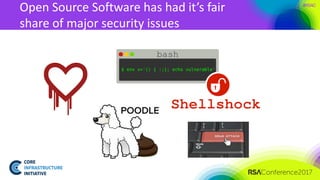
Open Source Software has had it’s fair
share of major security issues
#RSAC
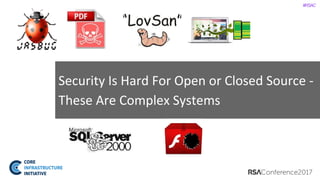
Security Is Hard For Open or Closed Source -
These Are Complex Systems
#RSAC
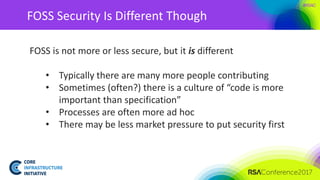
FOSS Security Is Different Though
FOSS is not more or less secure, but it is different
• Typically there are many more people contributing
• Sometimes (often?) there is a culture of “code is more
important than specification”
• Processes are often more ad hoc
• There may be less market pressure to put security first
#RSAC
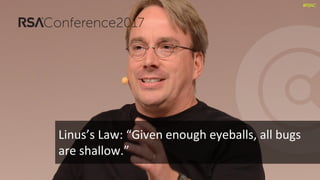
Linus’s Law: “Given enough eyeballs, all bugs
are shallow.”
#RSAC
But what if you don’t have
enough eyeballs?
#RSAC
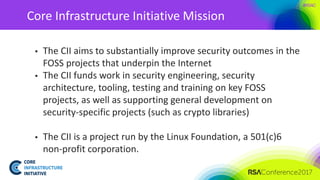
Core Infrastructure Initiative Mission
▪ The CII aims to substantially improve security outcomes in the
FOSS projects that underpin the Internet
▪ The CII funds work in security engineering, security
architecture, tooling, testing and training on key FOSS
projects, as well as supporting general development on
security-specific projects (such as crypto libraries)
▪ The CII is a project run by the Linux Foundation, a 501(c)6
non-profit corporation.
The Linux Foundation created the Core
Infrastructure Initiative with support from 19
Industry Giants
#RSAC
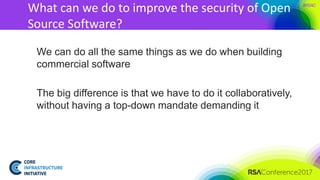
What can we do to improve the security of Open
Source Software?
We can do all the same things as we do when building
commercial software
The big difference is that we have to do it collaboratively,
without having a top-down mandate demanding it
#RSAC
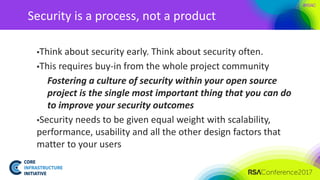
Security is a process, not a product
▪Think about security early. Think about security often.
▪This requires buy-in from the whole project community
Fostering a culture of security within your open source
project is the single most important thing that you can do
to improve your security outcomes
▪Security needs to be given equal weight with scalability,
performance, usability and all the other design factors that
matter to your users
#RSAC
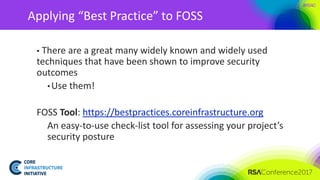
Applying “Best Practice” to FOSS
▪ There are a great many widely known and widely used
techniques that have been shown to improve security
outcomes
• Use them!
FOSS Tool: https://bestpractices.coreinfrastructure.org
An easy-to-use check-list tool for assessing your project’s
security posture
#RSAC
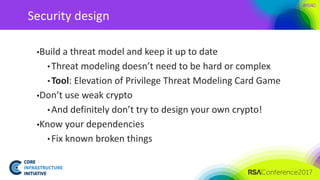
Security design
▪Build a threat model and keep it up to date
• Threat modeling doesn’t need to be hard or complex
• Tool: Elevation of Privilege Threat Modeling Card Game
▪Don’t use weak crypto
• And definitely don’t try to design your own crypto!
▪Know your dependencies
• Fix known broken things
#RSAC
Change control
▪Tracking who proposed changes, who reviewed those changes
and who released them is critical to security.
• This is often more complex in collaborative OS projects
• As it happens, failures here are how Heartbleed made it
into OpenSSL
▪As soon as your project has two or more people coding you
need a policy for how code will get reviewed
one
#RSAC
Change control
▪Use a version-controlled source repository
FOSS Tool: git, Mercurial, bazaar
▪Make code publicly visible between major releases
• Public code review before final release is valuable
▪Change logs are a must
• If other people rely on your code, you can break their
security by changing things in your code
#RSAC
Quality testing
Not all bugs represent vulnerabilities
… but all vulnerabilities are bugs, and…
It’s often very hard to tell the difference (at least until someone
publishes an exploit!)
#RSAC
Quality testing
▪Writing comprehensive tests is far less fun than writing new
code to solve new and interesting problems
▪But it’s a hell of a lot more fun than dealing with bugs after
they get released
▪Measure your test coverage and require collaborators to write
tests for all contributed code
FOSS Tools: gcov (C/C++), CodeCover (Java), CodeCoverage
(Python), and many more…
#RSAC
Security analysis tools
▪Fancy commercial static analysis tools are expensive
… Switching all of your compiler warnings on is not!
▪Use linters, code complexity checkers, fuzzers and other
analysis tools where you can; they all can help
▪The earlier in the project you start using these the less you will
have to deal with “low signal to noise ratio”
FOSS Tools: SonarCube, FramaC, AFL & many more
#RSAC
Bug reporting: Closing the SDL loop
▪Bugs happen; you need a process for dealing with them
▪Users need a way to report security vulnerabilities that
doesn’t broadcast them to the whole world!
▪Take reports of security vulnerabilities seriously
• Just because you can’t work out how to exploit a bug
doesn’t mean that it can’t be exploited
Tools: Bugzilla, Trac, GitHub Issues
#RSAC
What can users of Open Source Software do to
make themselves safer?
▪There are many things that consumers of Open Source
Software can do to make their deployments safer.
▪In general these come down to two key areas:
• Know your dependencies
• Don’t freeload
#RSAC
Know your dependencies
▪There are many ways that you might be running FOSS:
• You bought a supported distribution
• You downloaded a FOSS application
• You bought a commercial application which uses a FOSS
component internally
• One of your developers pulled a library from GitHub and
embedded it in your infrastructure
• … the list goes on.
#RSAC
Know your dependencies
▪In order to ensure that the FOSS that you use is safe you need
to know:
• What open source components you are using?
• What versions you are currently running, and where?
• How these components can be updated, where do you get
the update, what do you need to do to install them?
▪Only when you have all this can you consider monitoring the
vulnerability announcements
#RSAC
Know your dependencies
▪Supported distributions make their business by solving these
problems, but only for the bits that they supply
▪For commercial software, demand that your vendor disclose
the FOSS components in their applications.
▪For internal apps, there are commercial scanning tools
• In many cases proactive scanning with ‘fgrep –i copyright’
can be a useful first step
▪Remember, version numbers are important
#RSAC
Don’t Freeload!
#RSAC
Don’t freeload!
“Maybe part of the reason that the Heartbleed bug had such
a big impact is that more than $1 trillion per year of business
was being run on a project that had received only $3,000 in
support in the preceding year”
#RSAC
Don’t freeload!
▪Open Source projects rely on more than cash donations.
• They rely on a vibrant community forming around them.
▪You can support projects by providing:
• Detailed feedback and analysis of bugs you find
• Patches, both to fix bugs and add capabilities
• When you build a business around a project, engineers
• Engagement with the community to crowd-source support
and help share knowledge
#RSAC
Conclusions
▪Projects must think about security early & often and they must
be willing to prioritise it as highly as other features
▪Most of the ways that we can make open source software
more secure are common industry “best practices”. It is simply
a matter of choosing to adopt them.
▪For users, the most important factor is to track what FOSS
projects you use in your infrastructure
▪Contribute! Your feedback, time, engineers, and money!
#RSAC
Thank you.
https://www.coreinfrastructure.org

Collaborative security : Securing open source software

  • 1.
    SESSION ID:SESSION ID: #RSAC Dr.Nicko van Someren Collaborative Security: Securing Open Source Software ASD-W03 Chief Technology Officer The Linux Foundation
  • 2.
    #RSAC Open Source Softwarehas had it’s fair share of major security issues
  • 3.
    #RSAC Security Is HardFor Open or Closed Source - These Are Complex Systems
  • 4.
    #RSAC FOSS Security IsDifferent Though FOSS is not more or less secure, but it is different • Typically there are many more people contributing • Sometimes (often?) there is a culture of “code is more important than specification” • Processes are often more ad hoc • There may be less market pressure to put security first
  • 5.
    #RSAC Linus’s Law: “Givenenough eyeballs, all bugs are shallow.”
  • 6.
    #RSAC But what ifyou don’t have enough eyeballs?
  • 7.
    #RSAC Core Infrastructure InitiativeMission ▪ The CII aims to substantially improve security outcomes in the FOSS projects that underpin the Internet ▪ The CII funds work in security engineering, security architecture, tooling, testing and training on key FOSS projects, as well as supporting general development on security-specific projects (such as crypto libraries) ▪ The CII is a project run by the Linux Foundation, a 501(c)6 non-profit corporation.
  • 8.
    The Linux Foundationcreated the Core Infrastructure Initiative with support from 19 Industry Giants
  • 9.
    #RSAC What can wedo to improve the security of Open Source Software? We can do all the same things as we do when building commercial software The big difference is that we have to do it collaboratively, without having a top-down mandate demanding it
  • 10.
    #RSAC Security is aprocess, not a product ▪Think about security early. Think about security often. ▪This requires buy-in from the whole project community Fostering a culture of security within your open source project is the single most important thing that you can do to improve your security outcomes ▪Security needs to be given equal weight with scalability, performance, usability and all the other design factors that matter to your users
  • 11.
    #RSAC Applying “Best Practice”to FOSS ▪ There are a great many widely known and widely used techniques that have been shown to improve security outcomes • Use them! FOSS Tool: https://bestpractices.coreinfrastructure.org An easy-to-use check-list tool for assessing your project’s security posture
  • 12.
    #RSAC Security design ▪Build athreat model and keep it up to date • Threat modeling doesn’t need to be hard or complex • Tool: Elevation of Privilege Threat Modeling Card Game ▪Don’t use weak crypto • And definitely don’t try to design your own crypto! ▪Know your dependencies • Fix known broken things
  • 13.
    #RSAC Change control ▪Tracking whoproposed changes, who reviewed those changes and who released them is critical to security. • This is often more complex in collaborative OS projects • As it happens, failures here are how Heartbleed made it into OpenSSL ▪As soon as your project has two or more people coding you need a policy for how code will get reviewed one
  • 14.
    #RSAC Change control ▪Use aversion-controlled source repository FOSS Tool: git, Mercurial, bazaar ▪Make code publicly visible between major releases • Public code review before final release is valuable ▪Change logs are a must • If other people rely on your code, you can break their security by changing things in your code
  • 15.
    #RSAC Quality testing Not allbugs represent vulnerabilities … but all vulnerabilities are bugs, and… It’s often very hard to tell the difference (at least until someone publishes an exploit!)
  • 16.
    #RSAC Quality testing ▪Writing comprehensivetests is far less fun than writing new code to solve new and interesting problems ▪But it’s a hell of a lot more fun than dealing with bugs after they get released ▪Measure your test coverage and require collaborators to write tests for all contributed code FOSS Tools: gcov (C/C++), CodeCover (Java), CodeCoverage (Python), and many more…
  • 17.
    #RSAC Security analysis tools ▪Fancycommercial static analysis tools are expensive … Switching all of your compiler warnings on is not! ▪Use linters, code complexity checkers, fuzzers and other analysis tools where you can; they all can help ▪The earlier in the project you start using these the less you will have to deal with “low signal to noise ratio” FOSS Tools: SonarCube, FramaC, AFL & many more
  • 18.
    #RSAC Bug reporting: Closingthe SDL loop ▪Bugs happen; you need a process for dealing with them ▪Users need a way to report security vulnerabilities that doesn’t broadcast them to the whole world! ▪Take reports of security vulnerabilities seriously • Just because you can’t work out how to exploit a bug doesn’t mean that it can’t be exploited Tools: Bugzilla, Trac, GitHub Issues
  • 19.
    #RSAC What can usersof Open Source Software do to make themselves safer? ▪There are many things that consumers of Open Source Software can do to make their deployments safer. ▪In general these come down to two key areas: • Know your dependencies • Don’t freeload
  • 20.
    #RSAC Know your dependencies ▪Thereare many ways that you might be running FOSS: • You bought a supported distribution • You downloaded a FOSS application • You bought a commercial application which uses a FOSS component internally • One of your developers pulled a library from GitHub and embedded it in your infrastructure • … the list goes on.
  • 21.
    #RSAC Know your dependencies ▪Inorder to ensure that the FOSS that you use is safe you need to know: • What open source components you are using? • What versions you are currently running, and where? • How these components can be updated, where do you get the update, what do you need to do to install them? ▪Only when you have all this can you consider monitoring the vulnerability announcements
  • 22.
    #RSAC Know your dependencies ▪Supporteddistributions make their business by solving these problems, but only for the bits that they supply ▪For commercial software, demand that your vendor disclose the FOSS components in their applications. ▪For internal apps, there are commercial scanning tools • In many cases proactive scanning with ‘fgrep –i copyright’ can be a useful first step ▪Remember, version numbers are important
  • 23.
  • 24.
    #RSAC Don’t freeload! “Maybe partof the reason that the Heartbleed bug had such a big impact is that more than $1 trillion per year of business was being run on a project that had received only $3,000 in support in the preceding year”
  • 25.
    #RSAC Don’t freeload! ▪Open Sourceprojects rely on more than cash donations. • They rely on a vibrant community forming around them. ▪You can support projects by providing: • Detailed feedback and analysis of bugs you find • Patches, both to fix bugs and add capabilities • When you build a business around a project, engineers • Engagement with the community to crowd-source support and help share knowledge
  • 26.
    #RSAC Conclusions ▪Projects must thinkabout security early & often and they must be willing to prioritise it as highly as other features ▪Most of the ways that we can make open source software more secure are common industry “best practices”. It is simply a matter of choosing to adopt them. ▪For users, the most important factor is to track what FOSS projects you use in your infrastructure ▪Contribute! Your feedback, time, engineers, and money!
  • 27.