Semantic blockchains
in the supply chain
Christopher Brewster
Aston University
C.A.Brewster@aston.ac.uk
Outline
• Information integration in the agrifood supply chain
• Semantic web technologies
• Semantic Web technologies in the Food System: Linked
Pedigrees
• Some limitations
• Blockchain technologies
• Integrating Semantics and the Blockchain - some initial
thoughts
The Problem
The Food Supply Chain
• From Farm to Fork
• The agri-food system
includes much more
• More and more parts of
this supply chain and
agri-food system are
leaving digital trace … in
James Scott’s terms
becoming more “legible”.
Data - Information -
Knowledge
• The food supply chain involves hundred of
actors, thousands of processes, millions of
products and (potentially) billions of data points!
• Children believe milk comes from supermarkets!
• Too much or too little data?
• Why do we need it?
Characteristics of Supply Chain
• Large numbers of participants
• Heterogeneity of participants
• Huge variety in ICT uptake
• Poor information flow (need to know attitude)
• Only one up, one down data flow
• Solved by regulation and certification
Food supply chain is …
• A highly heterogenous loosely coupled large-scale
network of entities with variable but largely minimal
degrees of communication and trust between the actors
Drivers for Data Integration
• Need for transparency - tracking and tracing
• Desire for food awareness - on the part of
consumers, but not only
• Regulatory pressure - e.g.EU Regulation
1169/2011
• New business opportunities ….
Food Crises and Scandals
• Major driver for greater data integration (whether
open or closed).
• E. Coli in Germany in 2011 - spanish growers
lost over €200M
• Horsemeat scandal across Europe in 2013 -
impact very great on some supermarkets
Lack of Data Integration
• Both scandals suffered from lack of data and data
integration
• E. Coli - who affected? what purchased? where?
when? and who participated in the supply chain
• Horsemeat - six months for Irish FSA to map the
supply chain network
• Need for greater supply chain transparency =
need for data integration
Tracking, tracing and
Visibility
• Core demand is to make tracking and tracing
easy, AKA supply chain “visibility”
• “Visibility is the ability to know exactly where
things are at any point in time, or where they
have been, and why” — GS1
• Major challenge
http://www.gs1.org/docs/GS1_SupplyChainVisibility_WhitePaper.pdf
Trust - 1
Trust - 2
•More information, more data = more trust
What role semantic
technologies?
Key Features of Semantic
Technologies
• Unique identifiers (URIs) — enables consistency and data
accretion
• Common vocabularies/ontologies/data schemata — creates
a tendency towards standardisation WITHOUT losing
flexibility
• Linking and mappings - create a natural space for new
knowledge and data integration
• Logical rigour — rules for validation and quality control can
be written
AKTive Food (2005)
• A bit of history
• Paper on “Semantic Web based knowledge
conduits for the Organic Food Industry”
• Centred on decision support for a restaurant
based on data crawled from semantic web
marked up websites of food producers
• Nice vision …. but no implementation
Linked Pedigrees
• Based on “pedigree” concept common in
pharmaceutical industry - an audit trail which record
path of ownership
• Based on GS1 standards (pedigree standard +
EPCIS)
• “Linked pedigrees” use semantic web/linked data
principles
• Involves formalisation of EPCIS standard in two
ontologies
Linked Pedigrees
• Datasets described and accessed using linked data principles.
• Encapsulate the knowledge required to trace and track products in
supply chains on a Web scale.
• Facilitate the interlinking of a variety of related and relevant data,
i.e., GS1 product master data with event data PLUS other data
outside the GS1 system.
• Based on a domain independent data model for the sharing of
knowledge among Semantic Web/Linked data aware systems
deployed for the tracking, tracing and data capture.
• Product knowledge shared among partners as products physically
flow downstream or upstream in the supply chain.
Linked Pedigree Architecture
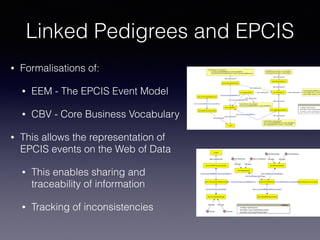
Linked Pedigrees and EPCIS
• Formalisations of:
• EEM - The EPCIS Event Model
• CBV - Core Business Vocabulary
• This allows the representation of
EPCIS events on the Web of Data
• This enables sharing and
traceability of information
• Tracking of inconsistencies
Socio-technical Limitations
• Heterogeneity of the food system - so many
different actors, in size and shape
• Continuous changes - actors entering and
leaving the market
• Lack of trust - actors (farmers, food producers)
do not trust overarching systems
• Cost - margins in the food system are very tight
Key Problems
• Any form of centralised
data runs into data control
issues. Who know what?
(cf. Uber as an example)
• If each actor must keep
their triple store up and
running - data access
issues (important in food
crises)
What role blockchain
technologies?
What is the blockchain?
• A file called The Blockchain is spread over
millions of machines
• Which use proof of work and byzantine
consensus
• To provide a set of chained hashes and digital
signatures
• To create an unforgeable record of …. (e.g.) who
owns how much bitcoin
Blockchain - another
definition
• “A blockchain is a magic computer that anyone
can upload programs to and leave the programs
to self-execute, where the current and all
previous states of every program are always
publicly visible, and which carries a very strong
cryptoeconomically secured guarantee that
programs running on the chain will continue to
execute in exactly the way that the blockchain
protocol specifies.” — Vitalik Buterin (founder of
Ethereum)
Blockchain
• Developed originally as part of Bitcoin
• Provides underlying distributed ledger for Bitcoin
• HOWEVER, quite separate from Bitcoin and has
potentially many other uses
• Lots of eager uptake with many startups being
founded around this technology (Ethereum,
Bitshares, Helloblock, Ripple Labs etc.)
Blockchain in the supply
chain
• Not my idea! Other people have thought of this!
• Startup provenance.org wants to use the blockchain to
“tell a story” about a product from producer to end
consumer. Currently focussing on certification data!
• Still working on on what data to represent ….
Semantic Blockchains
• Concept: Construct an architecture where some or all of
the data involved in Linked Pedigree is held on the block
chain
• Result:
• Distributed database would resolve some trust issues
• Guarantee of continuous uptime (so if an actor
disappears, their data is still accessible)
• Rules can be written as to who has access to data
using specific governance algorithms
Step 1: Basic Usage
Eliminate the
problems of data
centralisation
Step 2: More advanced Usage
Guarantee
accessibility of data
now and in future
Other potential
Consequences
• Disintermediation of GS1 for product data
• Product data, tracking and tracing and supply
chain visibility at very low cost. This could be
very important for small scale producers/
developing country producers
• Standardising supply chain data schemata/
ontologies by the back door
Conclusions
• We have argued for the importance of data
integration in the agrifood supply chain
• We showed the applicability of semantic
technologies in the supply chain and introduced
the concept of “linked pedigrees”.
• We then suggest that blockchain technologies
could further improve this technology stack and
solve some problems e.g.lack of trust in
centralised data control
Thanks
• Monika Solanki for all the technical work on
Linked Pedigrees, EEM, CBV and much else
• Vinay Gupta for conversations leading to the
Semantic Blockchain ideas
• Jessie Baker for explaining provenance.org
References
• Christopher Brewster, Hugh Glaser, and Barny Haughton. “AKTive Food: Semantic Web based knowledge conduits for the
Organic Food Industry.” In Proceedings of the ISWC Worskshop Semantic Web Case Studies and Best Practice for
eBusiness (SWCASE 05) , 4th International Semantic Web Conference, 7 November (Galway, Ireland, 2005). URL http://
www.cbrewster.com/papers/Brewster_SWCASE.pdf
• Monika Solanki and Christopher Brewster. “OntoPedigree: A content ontology design pattern for traceability knowledge
representation in supply chains.” Semantic Web – Interoperability, Usability, Applicability (2015). URL http://goo.gl/OdUPg0
• Monika Solanki and Christopher Brewster. “Enhancing visibility in EPCIS governing Agri-food Supply Chains via Linked
Pedigrees.” International Journal on Se- mantic Web and Information Systems 10 (2014). (Impact Factor 0.393), URL http://
www.ijswis.org/?q=node/52
• Monika Solanki and Christopher Brewster. “Consuming Linked data in Supply Chains: Enabling data visibility via Linked
Pedigrees.” In Proceedings of the Fourth Inter- national Workshop on Consuming Linked Data (COLD2013), held at the
Interna- tional Semantic Web Conference (ISWC 2013), 21-25 October 2013 (2013). URL http://www.cbrewster.com/papers/
Solanki_COLD13.pdf
• Monika Solanki and Christopher Brewster. “Representing Supply Chain Events on the Web of Data.” In Proceedings of the 3rd
International Workshop on Detection, Represen- tation, and Exploitation of Events in the Semantic Web (DeRiVE 2013), , held
at the International Semantic Web Conference (ISWC 2013), 21-25 October 2013 (2013). URL http://www.cbrewster.com/
papers/Solanki_DeRiVE13.pdf
• Monika Solanki and Christopher Brewster. “EPCIS event based traceability in pharmaceu- tical supply chains via automated
generation of linked pedigrees.” In International Semantic Web Conference 2014 (ISWC 2014) (Rivo di Garda, 2014). (ISWC
accep- tance rate: 21.1% 180 full submissions, 29 accepted, 9 conditionally accepted), URL http://www.cbrewster.com/
papers/Solanki_ISWC14.pdf

Semantic Blockchains in the Supply Chain

  • 1.
    Semantic blockchains in thesupply chain Christopher Brewster Aston University C.A.Brewster@aston.ac.uk
  • 2.
    Outline • Information integrationin the agrifood supply chain • Semantic web technologies • Semantic Web technologies in the Food System: Linked Pedigrees • Some limitations • Blockchain technologies • Integrating Semantics and the Blockchain - some initial thoughts
  • 3.
  • 4.
    The Food SupplyChain • From Farm to Fork • The agri-food system includes much more • More and more parts of this supply chain and agri-food system are leaving digital trace … in James Scott’s terms becoming more “legible”.
  • 5.
    Data - Information- Knowledge • The food supply chain involves hundred of actors, thousands of processes, millions of products and (potentially) billions of data points! • Children believe milk comes from supermarkets! • Too much or too little data? • Why do we need it?
  • 6.
    Characteristics of SupplyChain • Large numbers of participants • Heterogeneity of participants • Huge variety in ICT uptake • Poor information flow (need to know attitude) • Only one up, one down data flow • Solved by regulation and certification
  • 7.
    Food supply chainis … • A highly heterogenous loosely coupled large-scale network of entities with variable but largely minimal degrees of communication and trust between the actors
  • 8.
    Drivers for DataIntegration • Need for transparency - tracking and tracing • Desire for food awareness - on the part of consumers, but not only • Regulatory pressure - e.g.EU Regulation 1169/2011 • New business opportunities ….
  • 9.
    Food Crises andScandals • Major driver for greater data integration (whether open or closed). • E. Coli in Germany in 2011 - spanish growers lost over €200M • Horsemeat scandal across Europe in 2013 - impact very great on some supermarkets
  • 10.
    Lack of DataIntegration • Both scandals suffered from lack of data and data integration • E. Coli - who affected? what purchased? where? when? and who participated in the supply chain • Horsemeat - six months for Irish FSA to map the supply chain network • Need for greater supply chain transparency = need for data integration
  • 11.
    Tracking, tracing and Visibility •Core demand is to make tracking and tracing easy, AKA supply chain “visibility” • “Visibility is the ability to know exactly where things are at any point in time, or where they have been, and why” — GS1 • Major challenge http://www.gs1.org/docs/GS1_SupplyChainVisibility_WhitePaper.pdf
  • 12.
  • 13.
    Trust - 2 •Moreinformation, more data = more trust
  • 14.
  • 15.
    Key Features ofSemantic Technologies • Unique identifiers (URIs) — enables consistency and data accretion • Common vocabularies/ontologies/data schemata — creates a tendency towards standardisation WITHOUT losing flexibility • Linking and mappings - create a natural space for new knowledge and data integration • Logical rigour — rules for validation and quality control can be written
  • 16.
    AKTive Food (2005) •A bit of history • Paper on “Semantic Web based knowledge conduits for the Organic Food Industry” • Centred on decision support for a restaurant based on data crawled from semantic web marked up websites of food producers • Nice vision …. but no implementation
  • 17.
    Linked Pedigrees • Basedon “pedigree” concept common in pharmaceutical industry - an audit trail which record path of ownership • Based on GS1 standards (pedigree standard + EPCIS) • “Linked pedigrees” use semantic web/linked data principles • Involves formalisation of EPCIS standard in two ontologies
  • 18.
    Linked Pedigrees • Datasetsdescribed and accessed using linked data principles. • Encapsulate the knowledge required to trace and track products in supply chains on a Web scale. • Facilitate the interlinking of a variety of related and relevant data, i.e., GS1 product master data with event data PLUS other data outside the GS1 system. • Based on a domain independent data model for the sharing of knowledge among Semantic Web/Linked data aware systems deployed for the tracking, tracing and data capture. • Product knowledge shared among partners as products physically flow downstream or upstream in the supply chain.
  • 19.
  • 20.
    Linked Pedigrees andEPCIS • Formalisations of: • EEM - The EPCIS Event Model • CBV - Core Business Vocabulary • This allows the representation of EPCIS events on the Web of Data • This enables sharing and traceability of information • Tracking of inconsistencies
  • 21.
    Socio-technical Limitations • Heterogeneityof the food system - so many different actors, in size and shape • Continuous changes - actors entering and leaving the market • Lack of trust - actors (farmers, food producers) do not trust overarching systems • Cost - margins in the food system are very tight
  • 22.
    Key Problems • Anyform of centralised data runs into data control issues. Who know what? (cf. Uber as an example) • If each actor must keep their triple store up and running - data access issues (important in food crises)
  • 23.
  • 24.
    What is theblockchain? • A file called The Blockchain is spread over millions of machines • Which use proof of work and byzantine consensus • To provide a set of chained hashes and digital signatures • To create an unforgeable record of …. (e.g.) who owns how much bitcoin
  • 25.
    Blockchain - another definition •“A blockchain is a magic computer that anyone can upload programs to and leave the programs to self-execute, where the current and all previous states of every program are always publicly visible, and which carries a very strong cryptoeconomically secured guarantee that programs running on the chain will continue to execute in exactly the way that the blockchain protocol specifies.” — Vitalik Buterin (founder of Ethereum)
  • 26.
    Blockchain • Developed originallyas part of Bitcoin • Provides underlying distributed ledger for Bitcoin • HOWEVER, quite separate from Bitcoin and has potentially many other uses • Lots of eager uptake with many startups being founded around this technology (Ethereum, Bitshares, Helloblock, Ripple Labs etc.)
  • 27.
    Blockchain in thesupply chain • Not my idea! Other people have thought of this! • Startup provenance.org wants to use the blockchain to “tell a story” about a product from producer to end consumer. Currently focussing on certification data! • Still working on on what data to represent ….
  • 28.
    Semantic Blockchains • Concept:Construct an architecture where some or all of the data involved in Linked Pedigree is held on the block chain • Result: • Distributed database would resolve some trust issues • Guarantee of continuous uptime (so if an actor disappears, their data is still accessible) • Rules can be written as to who has access to data using specific governance algorithms
  • 29.
    Step 1: BasicUsage Eliminate the problems of data centralisation
  • 30.
    Step 2: Moreadvanced Usage Guarantee accessibility of data now and in future
  • 31.
    Other potential Consequences • Disintermediationof GS1 for product data • Product data, tracking and tracing and supply chain visibility at very low cost. This could be very important for small scale producers/ developing country producers • Standardising supply chain data schemata/ ontologies by the back door
  • 32.
    Conclusions • We haveargued for the importance of data integration in the agrifood supply chain • We showed the applicability of semantic technologies in the supply chain and introduced the concept of “linked pedigrees”. • We then suggest that blockchain technologies could further improve this technology stack and solve some problems e.g.lack of trust in centralised data control
  • 33.
    Thanks • Monika Solankifor all the technical work on Linked Pedigrees, EEM, CBV and much else • Vinay Gupta for conversations leading to the Semantic Blockchain ideas • Jessie Baker for explaining provenance.org
  • 34.
    References • Christopher Brewster,Hugh Glaser, and Barny Haughton. “AKTive Food: Semantic Web based knowledge conduits for the Organic Food Industry.” In Proceedings of the ISWC Worskshop Semantic Web Case Studies and Best Practice for eBusiness (SWCASE 05) , 4th International Semantic Web Conference, 7 November (Galway, Ireland, 2005). URL http:// www.cbrewster.com/papers/Brewster_SWCASE.pdf • Monika Solanki and Christopher Brewster. “OntoPedigree: A content ontology design pattern for traceability knowledge representation in supply chains.” Semantic Web – Interoperability, Usability, Applicability (2015). URL http://goo.gl/OdUPg0 • Monika Solanki and Christopher Brewster. “Enhancing visibility in EPCIS governing Agri-food Supply Chains via Linked Pedigrees.” International Journal on Se- mantic Web and Information Systems 10 (2014). (Impact Factor 0.393), URL http:// www.ijswis.org/?q=node/52 • Monika Solanki and Christopher Brewster. “Consuming Linked data in Supply Chains: Enabling data visibility via Linked Pedigrees.” In Proceedings of the Fourth Inter- national Workshop on Consuming Linked Data (COLD2013), held at the Interna- tional Semantic Web Conference (ISWC 2013), 21-25 October 2013 (2013). URL http://www.cbrewster.com/papers/ Solanki_COLD13.pdf • Monika Solanki and Christopher Brewster. “Representing Supply Chain Events on the Web of Data.” In Proceedings of the 3rd International Workshop on Detection, Represen- tation, and Exploitation of Events in the Semantic Web (DeRiVE 2013), , held at the International Semantic Web Conference (ISWC 2013), 21-25 October 2013 (2013). URL http://www.cbrewster.com/ papers/Solanki_DeRiVE13.pdf • Monika Solanki and Christopher Brewster. “EPCIS event based traceability in pharmaceu- tical supply chains via automated generation of linked pedigrees.” In International Semantic Web Conference 2014 (ISWC 2014) (Rivo di Garda, 2014). (ISWC accep- tance rate: 21.1% 180 full submissions, 29 accepted, 9 conditionally accepted), URL http://www.cbrewster.com/ papers/Solanki_ISWC14.pdf