Blockchains and Linked Data
for Agrifood Value Chains
Christopher Brewster
TNO, The Netherlands
Linked Open Data in Agriculture Workshop, Berlin, 27-28 Sept 2017
1
Outline
‣ The Challenge of Linked Data in the agrifood value
chain
‣ The need for tracking and tracing
‣ The potential of Blockchain Technology
‣ Linked Pedigrees
‣ Linked Pedigrees on the a Blockchain
‣ Conclusions
2
The Absence of Linked Data in the
Value Chain
‣ Linked Data is largely absent from the value chain (i.e. from
farm to consumer)
‣ Possible exception is Schema.org, and integration of the
GoodRelations Ontology/Product Types Ontology.
‣ A few academic attempts to use ontologies in the value chain
(See Tomic et al. 2015, Verhoosel et al. 2016, Solanki and Brewster 2015)
‣ Some limited application of Linked Data methods in value
chain (e.g. BigTU Project)
‣ but no real uptake. Is this the wrong question?
3
The need for tracking and tracing
‣ Core challenge in value chain is tracking and tracing, due
to food recall, food integrity issues and food crises.
‣ Major importance in cases such as E.Coli (EHEC) 2011,
horse meat 2013, or Italian Organic Food crisis 2011.
‣ EC’s General Food Law (178/2002) requires one up - one
down documentation (usually on paper, until relatively
recently)
‣ Very slow system — it took 6 months to map the horse
meat supply chain.
4
from Scholten et al. 2016
5
Current architecture
GS1 EPCIS
‣ Core standard in supply/value chain - used with barcodes and
RFID
‣ Event based, each time you scan an EPCIS event data occurs
‣ Beyond that allows “barcode (GTIN) —> master data” look up
Problems with EPCIS
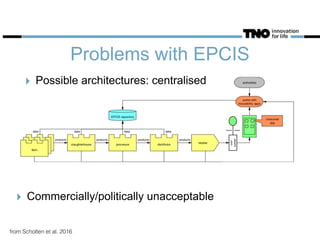
‣ Possible architectures: centralised
from Scholten et al. 2016
‣ Commercially/politically unacceptable
Linked Pedigrees
‣ Proposed 2-3 years ago (cf. Solanki and Brewster 2014/2015) - formalisation of
EPCIS as Linked Data - using two ontologies.
Result
PossibleTypical Queries
‣ Tracking ingredients: What were the inputs consumed during
processing in the batch of wine bottles shipped on date X?
‣ Tracking provenance: Which winery staff were present at the
winery when the wine bottles were aggregated in cases with
identifiers X and Y? 

‣ Tracking external data: Retrieve the average values for the
growth temperature for grapes used in the production of a
batch of wine to be shipped to Destination D on date X.
Blockchain Hype
http://thearea.org/gartner-hype-cycle-emerging-technologies-2017/
https://ww2.frost.com/news/press-releases/frost-sullivan-
identifies-2017-global-blockchain-startup-map/
Supposed Blockchain Benefits
basedonhttps://blog.bigchaindb.com/three-blockchain-benefits-ae3a2a5ab102#.2qi900pp9
12
‣ Decentralized / shared control - situations where
enemies need to work together for their mutual benefit,
e.g. banks, perhaps in agrifood supply chains
‣ Immutability / audit trail - situations where it is of prime
importance to have an immutable audit trail, where users
cannot change data post hoc, e.g. Everledger for
diamonds, perhaps for certification in agrifood
‣ Assets / exchanges - situations where the assets can live
on the blockchain e.g. stock exchanges, currency or
energy exchanges, perhaps for local agrifood
marketplaces.
Why blockchain in agrifood?
13
‣ Partly due to general hype that Blockchain is a
solution to everything
‣ Partly due to the perception that Blockchain is a
“universal database that all actors can transparently
read and write to”.
‣ Partly due to ignorance - e.g. belief that it would be
easy to put lots of data on the blockchain and
control access (neither are true)
Provenance.org:Tune Fish Example
14
Provenance.org technical approach
15
‣ Most information is stored on the digital platform.
‣ Ethereum blockchain is used to store snapshots of data
(e.g. food certification, or data from smart phone app).
‣ Blockchain provides immutable proof that the data was
true at a certain point in time, using hash of data placed on
public Ethereum blockchain.
‣ Data on platform can be queried and compared with hash.
Data on the blockchain can only be compared for integrity.
‣ Because current blockchain technology is very limited
Blockchains and Linked Data
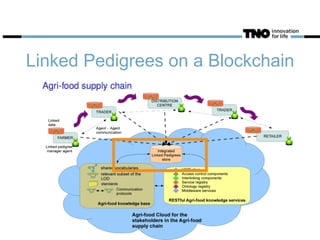
‣ Use GS1’s EPCIS standard to generate traceability
event data.
‣ Each actor has their own repository/database
‣ Expose RDF based Linked Pedigrees with URIs/
URNs
‣ Use a blockchain to store only URIs
Linked Pedigrees on a Blockchain
Not dissimilar to …
‣ Scholten et al. 2016 proposed but “unfeasible”
architecture
Linked Pedigrees on a blockchain
‣ Allows permanent recording of food product
trajectory
‣ Multiparty encryption can allow access only under
given conditions or roles
‣ Potentially overcomes trust and permanence issues
characteristic of food value chain.
‣ Remember the Italian organic scandal ….
Conclusions
‣ Blockchain technology is far more limited in its
application than most people allow
‣ One good use case is in food traceability
‣ Combination of lack of trust between participants
and need for permanent records creates and
opportunity for blockchain + linked data
Acknowledgements
‣ Research partially supported by the Dutch national Techruption Blockchain
project http://techruption.org/
‣ For TNO’s work on blockchains consult https://blockchain.tno.nl/

Blockchains and linked data for agrifood value chains

  • 1.
    Blockchains and LinkedData for Agrifood Value Chains Christopher Brewster TNO, The Netherlands Linked Open Data in Agriculture Workshop, Berlin, 27-28 Sept 2017 1
  • 2.
    Outline ‣ The Challengeof Linked Data in the agrifood value chain ‣ The need for tracking and tracing ‣ The potential of Blockchain Technology ‣ Linked Pedigrees ‣ Linked Pedigrees on the a Blockchain ‣ Conclusions 2
  • 3.
    The Absence ofLinked Data in the Value Chain ‣ Linked Data is largely absent from the value chain (i.e. from farm to consumer) ‣ Possible exception is Schema.org, and integration of the GoodRelations Ontology/Product Types Ontology. ‣ A few academic attempts to use ontologies in the value chain (See Tomic et al. 2015, Verhoosel et al. 2016, Solanki and Brewster 2015) ‣ Some limited application of Linked Data methods in value chain (e.g. BigTU Project) ‣ but no real uptake. Is this the wrong question? 3
  • 4.
    The need fortracking and tracing ‣ Core challenge in value chain is tracking and tracing, due to food recall, food integrity issues and food crises. ‣ Major importance in cases such as E.Coli (EHEC) 2011, horse meat 2013, or Italian Organic Food crisis 2011. ‣ EC’s General Food Law (178/2002) requires one up - one down documentation (usually on paper, until relatively recently) ‣ Very slow system — it took 6 months to map the horse meat supply chain. 4
  • 5.
    from Scholten etal. 2016 5 Current architecture
  • 6.
    GS1 EPCIS ‣ Corestandard in supply/value chain - used with barcodes and RFID ‣ Event based, each time you scan an EPCIS event data occurs ‣ Beyond that allows “barcode (GTIN) —> master data” look up
  • 7.
    Problems with EPCIS ‣Possible architectures: centralised from Scholten et al. 2016 ‣ Commercially/politically unacceptable
  • 8.
    Linked Pedigrees ‣ Proposed2-3 years ago (cf. Solanki and Brewster 2014/2015) - formalisation of EPCIS as Linked Data - using two ontologies.
  • 9.
  • 10.
    PossibleTypical Queries ‣ Trackingingredients: What were the inputs consumed during processing in the batch of wine bottles shipped on date X? ‣ Tracking provenance: Which winery staff were present at the winery when the wine bottles were aggregated in cases with identifiers X and Y? 
 ‣ Tracking external data: Retrieve the average values for the growth temperature for grapes used in the production of a batch of wine to be shipped to Destination D on date X.
  • 11.
  • 12.
    Supposed Blockchain Benefits basedonhttps://blog.bigchaindb.com/three-blockchain-benefits-ae3a2a5ab102#.2qi900pp9 12 ‣Decentralized / shared control - situations where enemies need to work together for their mutual benefit, e.g. banks, perhaps in agrifood supply chains ‣ Immutability / audit trail - situations where it is of prime importance to have an immutable audit trail, where users cannot change data post hoc, e.g. Everledger for diamonds, perhaps for certification in agrifood ‣ Assets / exchanges - situations where the assets can live on the blockchain e.g. stock exchanges, currency or energy exchanges, perhaps for local agrifood marketplaces.
  • 13.
    Why blockchain inagrifood? 13 ‣ Partly due to general hype that Blockchain is a solution to everything ‣ Partly due to the perception that Blockchain is a “universal database that all actors can transparently read and write to”. ‣ Partly due to ignorance - e.g. belief that it would be easy to put lots of data on the blockchain and control access (neither are true)
  • 14.
  • 15.
    Provenance.org technical approach 15 ‣Most information is stored on the digital platform. ‣ Ethereum blockchain is used to store snapshots of data (e.g. food certification, or data from smart phone app). ‣ Blockchain provides immutable proof that the data was true at a certain point in time, using hash of data placed on public Ethereum blockchain. ‣ Data on platform can be queried and compared with hash. Data on the blockchain can only be compared for integrity. ‣ Because current blockchain technology is very limited
  • 16.
    Blockchains and LinkedData ‣ Use GS1’s EPCIS standard to generate traceability event data. ‣ Each actor has their own repository/database ‣ Expose RDF based Linked Pedigrees with URIs/ URNs ‣ Use a blockchain to store only URIs
  • 17.
    Linked Pedigrees ona Blockchain
  • 18.
    Not dissimilar to… ‣ Scholten et al. 2016 proposed but “unfeasible” architecture
  • 19.
    Linked Pedigrees ona blockchain ‣ Allows permanent recording of food product trajectory ‣ Multiparty encryption can allow access only under given conditions or roles ‣ Potentially overcomes trust and permanence issues characteristic of food value chain. ‣ Remember the Italian organic scandal ….
  • 20.
    Conclusions ‣ Blockchain technologyis far more limited in its application than most people allow ‣ One good use case is in food traceability ‣ Combination of lack of trust between participants and need for permanent records creates and opportunity for blockchain + linked data
  • 21.
    Acknowledgements ‣ Research partiallysupported by the Dutch national Techruption Blockchain project http://techruption.org/ ‣ For TNO’s work on blockchains consult https://blockchain.tno.nl/