Dr. Miriam Palma Defensor Santiago
- She was born last July 15, 1945 in Iloilo City.
-- Daughter of Benjamin Defensor, a local judge, and Dimpna
Palma, a school teacher.
- She is the eldest among her siblings: Benjamin, Nenalyn, Linn,
and Paula Dimpna Beatriz.
- Defensor Santiago grew up in a middle-class erudite household with
both parents having higher educational attainments.
- She was married to Narciso "Jun" Santiago,with whom she had two
sons, Archie and Alexander; Alexander committed suicide in 2003.
- The couple adopted four children; Megan Santiago (now known as
Noelle Strickland), Mallory Santiago, Mackenzie Santiago, and
Santiago.
- She and her husband renewed their wedding vows on their 40th
wedding anniversary in 2011.
Academic Ecxellence
- She graduated valedictorian in grade school, high school,
undergraduate school. In 1965, Defensor Santiago graduated with
a Bachelor of Arts degree in political science, magna cum laude from
the University of the Philippines Visayas
- She graduated Bachelor of Laws, cum laude, from the University of the
Philippines College of Law in Diliman.
- went on a fellowship to the United States, and earned the
degrees Master of Laws and Doctor of Juridical Science degrees at
the University of Michigan, Ann Arbor.
- She earned the degree Master of religious studies (without thesis) at
the Maryhill School of Theology .
Professional Excellence
-Dr. Santiago holds an amazing record of excellence in all three branches
of government – judicial, executive, and legislative.
-In the judicial branch, she has been presiding judge of the Regional Trial
Court at Quezon City.
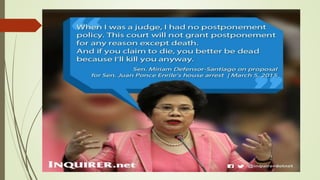
• As a RTC judge, she quickly proclaimed a "no postponement" policy.
At that time, cases were tried in segments that were usually a month
apart, resulting in trials that took years to finish.
• Defensor Santiago became nationally famous when she issued
perhaps the first decision to rule against martial law. At that time,
alleged illegal public assemblies were declared as crimes and were
punishable by death.
-she has been immigration commissioner; and a cabinet member, as agrarian
reform secretary.
Immigration commissioner
• After martial law, in 1988, President Corazon Aquino appointed Defensor
Santiago as commissioner of the Bureau of Immigration and Deportation.
• At that time, the BID was one of the most corrupt government agencies in
Southeast Asia. Defensor Santiago declared the Philippines as "the fake
passport capital of the world", and directed raids against criminal syndicates,
including the Yakuza. She filled the CID detention center with alien criminals,
and ordered construction of another detention center. She extended to legal
aliens protection from widespread extortion by requesting President Aquino
to issue an executive order that authorized the "alien legalization program“
• The Rockefeller Foundation named her a laureate of the Magsaysay Award
for government service – "for bold and moral leadership in cleaning up a
graft-ridden government agency."
Agrarian Reform Secretary
• President Corazon Aquino promoted Defensor Santiago to member
her cabinet, as secretary of the Secretary of Agrarian Reform.
• Under a controversial law passed by Congress and signed by
Aquino, all agricultural landholdings were taken by the government
and divided among the farmers. Each landowner was allowed to
only five hectares, and each farmer received three hectares. Payment
was in bonds of the Land Bank.
-In the legislative branch, she has now been a senator for three terms.
First term, 1995–2001
• Defensor Santiago was first elected senator in 1995. In 1997, her
presidential rival Fidel Ramos initiated a "people's campaign" for an
infinite presidential term. Defensor Santiago harshly criticized Ramos'
campaign and went to court. In a landmark case, Defensor Santiago vs
COMELEC, she won and preserved the people's mandate for term
limits. She again ran for president in the 1998 presidential elections,
with running-mate Francisco Tatad, but lost amidst heavy propaganda
concerning her mental health, which was later proven false.
• She was one of the few senators who were against the opening of the
brown envelope during the impeachment trial of then-
President Joseph Estrada, who was her foe in the 1998 presidential
elections.
Second and third term, 2004–2016
• Defensor Santiago ran for senator in 2004 and was elected. She
focused on creating significant laws that changed the country as a
whole.
• She ran again for senator in 2010 and won. During her three terms,
served as chair mostly of the foreign relations committee and the
constitutional amendments committee. She was elected as official
candidate of her party People's Reform Party, serving also as chair of
the Foreign Affairs Committee of the Commission on Appointments.
She exposed and named numerous jueteng (illegal gambling) lords
and illegal-logging lords throughout her terms
- Dr. Santiago worked abroad. She served as legal officer of
the United Nations in Geneva, Switzerland. She also served
as a consultant of the Philippine embassy in Washington,
D.C.
- Dr. Santiago was a U.P. law professor for some 10 years,
teaching evening class after office hours. She has written
some 30 books, many of which are very scholarly textbooks
in law and the social sciences, well advanced of our time.
During her initial battle with cancer, she continued to work
on the 2014 edition of all her law books. She is considered
the leading expert of her generation in constitutional law
and in international law.
• In 2011, Defensor Santiago was elected as a judge of the International
Criminal Court (ICC) which hears cases against humanity for former
heads of state. She was the first Asian from a third world country to be
elected to such a post. She resigned in 2014 after being diagnosed
with lung cancer. She was one of the senators who backed Supreme
Court Chief Justice Renato Corona during his impeachment trial; he
was ultimately impeached due to corruption.
• In December 2012, she exposed that the Senate president, Juan Ponce
Enrile, used Senate funds to give away as cash gifts. Every senator,
except Defensor Santiago and two others, received 2 million pesos as a
chunk of the Filipino population lived in poverty. This led to
the Priority Development Assistance Fund scandal, which put the
Senate president behind bars with charges of plunder. Defensor
Santiago's live Senate hearings in the case led to public outrage and
support for Defensor Santiago's call to abolish the pork-barrel system.
• In October 2015, Defensor Santiago announced her intention to run in
the 2016 Philippine presidential elections after her cancer was deemed
'stable' and 'receded' by doctors from the United States.She later
confirmed that Senator Bongbong Marcos would serve as her running
mate for vice president. Her campaign focused on the youth sector for
which she heavily advocated, making use of social media. She was a
landslide winner in numerous polls conducted in various public and
private universities and colleges in the country. Despite this, she lost in
the elections.Defensor Santiago was subsequently called "the greatest
president we never had", a title which had been associated with her
prior to her presidential run.
• She was the first Filipino elected as a commissioner for
the International Development Law Organization (IDLO) in 2016. Her
role in the organization was advisory to the international law
community.
Selected laws authored
The many laws that Defensor Santiago authored include:
- Reproductive Health Act of 2012, which instills reproductive health
education throughout the nation, and was backed by the majority of
the population while criticized by religious institutions in the
predominantly Roman Catholic country.
- Sin Tax Law, which improved the taxation of the country and led to the
economic revolutions that bolstered Philippine shares.
- Climate Change Act of 2009, which mandated the entire nation to
become a bastion for climate change responsiveness, mitigation,
adaptation, and management.
- Renewable Energy Act of 2008, which mandated the government to
shift the energy source of the country from coal and oil into solar,
wind, and other renewable sources – this became the foundation for
the establishment of numerous wind and solar plants in the country
which made the Philippines the 'Wind Energy Capital of Southeast
Asia'.
- Philippine Act on Crimes Against International Humanitarian Law,
which safeguarded human rights in the entire nation.[47]
Magna Carta of Women, which protected the rights of women
in the country.
- Unified Student Financial Assistance System for Tertiary Education
(Unifast) Act, which enhanced the educational system in the
country, paving way for the intellectual revolution in urban and
rural areas.
- Cybercrime Act of 2012, which protected the nation and its
people from cybercrimes which infested the country's
cyberspace.
- Department of Information and Communication Technology
Act, which established the Department of Information and
Communication Technology for better information dissemination
and better internet speed in the country
- Archipelagic Baselines Act of 2009, which became one of the
major basises for the country's claims on maritime sovereignty,
including the West Philippine Sea.
Political positions
Federalism
Although agreeing with Rodrigo Duterte's plans to shift the
government's form from unitary to federal, Defensor Santiago was
against it unless the Anti-Political Dynasty Bill which she authored and
sponsored was signed into law. She believed that a federal form of
government without an anti-dynasty law would immortalize political
dynasties and oligarchs in the country, extending the political lifespan of
families who controlled the country since the martial-law era.
Charter change
• to enhance foreign investments in the country
• to mandate that all high posts in government (senator,
congressperson, president, vice president, governor, mayor, vice
mayor, secretaries, undersecretaries, etc.) should have additional
qualifications which are 'a college graduate' and must pass a duly-
accredited government examination. Numerous politicians in the
country are only high school or elementary graduates, and most
college graduate officials have never passed the Civil Service
Examination for Professionals (CSE-P). She argues that positions in
government like administrative assistant must pass the CSE-P as a
qualification, 'why not higher posts too?'.
Anti-political dynasty
Defensor Santiago was the principal author of the Anti-Dynasty Bill in
the Senate and had been pushing for its immediate passage in Congress for
more than a decade. Unfortunately, most of the congresspersons in the House
of Representatives, which are the bulk of Filipino politicians, are not in favor of
its passage because they are part of political dynasties.
West Philippine Sea dispute
She stressed during a live debate that the West Philippine Sea is a
sovereign territory of the Philippines and that the country should have a better
military and police force and assets and should prioritize enhancing ties with
allied nations, especially in the Association of Southeast Asian Nations (ASEAN).
She was one of the international law experts who criticized China and aided in
the Philippine case against China. The case was won by the Philippines in 2016.
Despite this, China still does not recognize the ruling.
Mindanao
Defensor Santiago was against the Bangsamoro Basic Law, saying
it is unconstitutional because it specifies that Bangsamoro will become a
'sub-state' of the republic which is illegal under the law. She prefers a
more constitutional form of the Bangsamoro Basic Law which does not
create a 'sub-state' government.
North Borneo dispute
Defensor Santiago was in favor of appointing a third-party to conduct under
international law "inquiry and fact-finding" to resolve the North Borneo dispute, where
the third-party is approved by both the national governments of Malaysia and the
Philippines. She cited the 1907 Hague Convention for the Pacific Settlement of Disputes
as motivator of her legal position. She said that this can end the dispute as it did in the
1981 involvement of mercenaries in an invasion of the Seychelles, the 1987 use of
chemical weapons in the Gulf War between Iran and Iraq, and the 1988 destruction of
Korean Air Lines Boeing 747. She said that since no transfer of sovereignty was involved
in the 1878 Deed, no transfer of sovereignty has ever passed to Malaysia. She added
that the Philippines has never abandoned its claim over eastern Sabah.
Social policy
Divorce
Defensor Santiago publicly advocated for the passage of a divorce
law in the Philippines, saying, "Why would you force [couples] to be
together if they want to kill each other by mere sight?" With respect to
her position on divorce, she clarified that it should be restricted on two
grounds: "an attempt on the life of the spouse by the other" and "when
one spouse is already living with another person, that is adultery
or concubinage." In the 2016 Presidential campaign, despite being
unable to attend the second debate citing health concerns, she reiterated
on Twitter her position on divorce, leaving her as the only presidential
candidate to favor its legislation.
Abortion and contraception
Defensor Santiago was quoted as saying, "No to abortion, never.
am a very avid supporter of RH [Reproductive Health] Law, but I will
definitely fight to the death against abortion as a lawyer, not necessarily
as a religious person. I equate it properly with the crime of
murder."[While she maintained a firm pro-life position, Defensor
stressed the importance of the distribution of contraceptives, especially
in poverty-stricken areas. Defensor Santiago was a strong proponent of
the Philippines' Reproductive Health Law which guarantees universal
access to methods on contraception, maternal health and sex
According to her, the bill was shelved for more than 13 years, citing
the Catholic Church's opposition. Defensor Santiago expressed dismay
when the RH Law had suffered a one-billion peso budget cut before
the Congress in early 2016. She said if she will be elected, she will work
for a full and conscientious implementation of the law.
Abortion and contraception
Defensor Santiago was quoted as saying, "No to abortion, never.
am a very avid supporter of RH [Reproductive Health] Law, but I will
definitely fight to the death against abortion as a lawyer, not necessarily
as a religious person. I equate it properly with the crime of
murder."[While she maintained a firm pro-life position, Defensor
stressed the importance of the distribution of contraceptives, especially
in poverty-stricken areas. Defensor Santiago was a strong proponent of
the Philippines' Reproductive Health Law which guarantees universal
access to methods on contraception, maternal health and sex
According to her, the bill was shelved for more than 13 years, citing
the Catholic Church's opposition. Defensor Santiago expressed dismay
when the RH Law had suffered a one-billion peso budget cut before
the Congress in early 2016. She said if she will be elected, she will work
for a full and conscientious implementation of the law.
LGBT rights
Defensor Santiago magnified the issues concerning the LGBT
community before the Senate. In the wake of the 2016 Orlando
nightclub shooting incident in the United States, she said on a
post: "The mass shooting at a club in Orlando is appalling and
heartbreaking" and "I long for the day when the LGBT community no
longer has to live in fear of discrimination and hate crimes". Defensor
Santiago was one of the senators who advocated the immediate
investigation of the Jennifer Laude case, wherein the American
marine, Joseph Scott Pemberton, killed Laude, a
Filipina transgender woman, in Subic, Zambales. She also supported
the passage of the anti-discrimination bill which protects the rights
people of different sexual orientation, gender identity, and
Capital punishment
Defensor Santiago favored the death penalty but only for
crimes, while maintaining that the justice system should be
Environment
She believes mining is one of the greatest reasons why
local communities are impoverished as most of the profit
coming from mining are siphoned by mining companies
away from the local economy. In addition, mining has
numerous destructive advances in Philippine society and
ecosystems, destroying watersheds and agricultural lands,
as well as rivers and seas. According to an interview
conducted by Haribon Foundation during the 2016
Presidential Campaign, the organization voted her as the
"greenest" in all of the candidates. She was the main
of the Climate Change Law and the Renewable Energies
in the Senate.
Internet
Defensor Santiago advocated the establishment of the
Department of Information which is mandated to speed-
internet connectivity in the Philippines which she described
"the worst internet speed in Asia". She also advocated for
the passage of the Magna Carta for Philippine Internet
Freedom which protects the rights and freedoms of
in cyberspace, while defining and penalizing cybercrimes.
Transportation
Defensor Santiago advocated the establishment of a
completely new railway system from Manila to Sorsogon
and a new high-speed transit system connecting Metro
Manila to Pampanga, Bulacan. Rizal, Batangas, Laguna,
Cavite. She also advocated the establishment of a new
modernized airport and the establishment of new projects
in every province in the entire country.
Transportation
Defensor Santiago advocated the establishment of a
completely new railway system from Manila to Sorsogon
and a new high-speed transit system connecting Metro
Manila to Pampanga, Bulacan. Rizal, Batangas, Laguna,
Cavite. She also advocated the establishment of a new
modernized airport and the establishment of new projects
in every province in the entire country.
Awards and honors
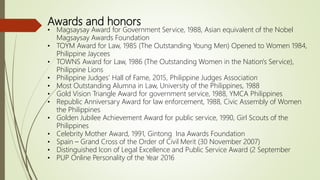
• Magsaysay Award for Government Service, 1988, Asian equivalent of the Nobel
Magsaysay Awards Foundation
• TOYM Award for Law, 1985 (The Outstanding Young Men) Opened to Women 1984,
Philippine Jaycees
• TOWNS Award for Law, 1986 (The Outstanding Women in the Nation's Service),
Philippine Lions
• Philippine Judges' Hall of Fame, 2015, Philippine Judges Association
• Most Outstanding Alumna in Law, University of the Philippines, 1988
• Gold Vision Triangle Award for government service, 1988, YMCA Philippines
• Republic Anniversary Award for law enforcement, 1988, Civic Assembly of Women
the Philippines
• Golden Jubilee Achievement Award for public service, 1990, Girl Scouts of the
Philippines
• Celebrity Mother Award, 1991, Gintong Ina Awards Foundation
• Spain – Grand Cross of the Order of Civil Merit (30 November 2007)
• Distinguished Icon of Legal Excellence and Public Service Award (2 September
• PUP Online Personality of the Year 2016
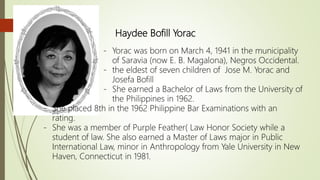
Haydee Bofill Yorac
- Yorac was born on March 4, 1941 in the municipality
of Saravia (now E. B. Magalona), Negros Occidental.
- the eldest of seven children of Jose M. Yorac and
Josefa Bofill
- She earned a Bachelor of Laws from the University of
the Philippines in 1962.
- She placed 8th in the 1962 Philippine Bar Examinations with an
rating.
- She was a member of Purple Feather( Law Honor Society while a
student of law. She also earned a Master of Laws major in Public
International Law, minor in Anthropology from Yale University in New
Haven, Connecticut in 1981.
- Very few public officials were like Haydee Yorac who could be held in
such high regard by her countrymen for her integrity and intelligence
in government service.
- Yorac was among the first batch of persons who were rounded up
upon the declaration of martial law. Released from Camp Crame after
several months, she thereafter distinguished herself as an exacting
professor at the University of the Philippines college of law. She also
volunteered her services to the Free Legal Assistance Group (FLAG),
staying in the background most of the time.
- Yorac taught and served in the Admissions Screening Committee of
the University of the Philippines College of Law. She was an Assistant
Vice President for Academic Affairs at the University of the Philippines
Diliman and a Senior Researcher of the University of the Philippines
Law Center. She also became the chief legal counsel of the University
of the Philippines for a few years.
- After the People Power Revolution, YORAC served seven years as a national
election commissioner, organizing elections in contested, far-flung areas of
the country and lending her considerable reputation to the hopeful project of
restoring integrity to the country’s electoral process. As chair of the National
Unification Commission in 1992 and 1993, she met face-to-face with the
government’s armed opponents and astutely identified grounds for
negotiation and peace; her commission’s insightful report became a trusted
blueprint for the country’s peace process.
- In 1986, President Corazon Aquino created the PCGG in her very first
executive order. Its mandate was to restore to the Philippines vast amounts
of wealth stolen by Marcos and his family and friends. This was a difficult
task. The commission launched case after case and the years passed. By the
time YORAC was named its eleventh chair, it had recovered only two billion
out of an estimated ten billion U.S. dollars of the Marcos hoard. Many people
said that the PCGG was on a fool’s errand. Yorac proved them wrong.
- On her watch, the PCGG recovered for the national treasury U.S.$683
million from Marcos’s Swiss bank accounts.
- She also won a decision that declared the coconut levy funds
(collected from farmers during the dictatorship) to be public money
and not privately-owned as claimed by Marcos crony Eduardo
Cojuangco Jr.
- Yorac received a Ramon Magsaysay Award for Government Service in
2004, and other marks of public recognition as well. (Ironically,
however, she lost when she ran for the Senate in 1998.)
Publications
- "Legal Status of Mercenaries“
- "Preventive Detention and Metaphysics of Repression“
- "Child Custody Determinations: A Reappraisal“
- "The Philippine Claim to the Spratly Island Group," Philippine Law
Journal”
- Philippine Treaty Series, Vols. 1-4, 6-7 (editor)
Professional and Civic Affiliations
- Integrated Bar of the Philippines
- Philippine Society of International Law
- American Society of International Law
- Free Legal Assistance Group (National Board Member)
- U.P. Alpha Phi Omega Sorority (Formerly U.P. Kappa Phi Omega
Sorority)
Presenter:
Cherrie Lou L. Mendoza

Miriam Defensor Santiago

  • 2.
    Dr. Miriam PalmaDefensor Santiago - She was born last July 15, 1945 in Iloilo City. -- Daughter of Benjamin Defensor, a local judge, and Dimpna Palma, a school teacher. - She is the eldest among her siblings: Benjamin, Nenalyn, Linn, and Paula Dimpna Beatriz. - Defensor Santiago grew up in a middle-class erudite household with both parents having higher educational attainments. - She was married to Narciso "Jun" Santiago,with whom she had two sons, Archie and Alexander; Alexander committed suicide in 2003. - The couple adopted four children; Megan Santiago (now known as Noelle Strickland), Mallory Santiago, Mackenzie Santiago, and Santiago. - She and her husband renewed their wedding vows on their 40th wedding anniversary in 2011.
  • 3.
    Academic Ecxellence - Shegraduated valedictorian in grade school, high school, undergraduate school. In 1965, Defensor Santiago graduated with a Bachelor of Arts degree in political science, magna cum laude from the University of the Philippines Visayas - She graduated Bachelor of Laws, cum laude, from the University of the Philippines College of Law in Diliman. - went on a fellowship to the United States, and earned the degrees Master of Laws and Doctor of Juridical Science degrees at the University of Michigan, Ann Arbor. - She earned the degree Master of religious studies (without thesis) at the Maryhill School of Theology .
  • 4.
    Professional Excellence -Dr. Santiagoholds an amazing record of excellence in all three branches of government – judicial, executive, and legislative. -In the judicial branch, she has been presiding judge of the Regional Trial Court at Quezon City. • As a RTC judge, she quickly proclaimed a "no postponement" policy. At that time, cases were tried in segments that were usually a month apart, resulting in trials that took years to finish. • Defensor Santiago became nationally famous when she issued perhaps the first decision to rule against martial law. At that time, alleged illegal public assemblies were declared as crimes and were punishable by death.
  • 6.
    -she has beenimmigration commissioner; and a cabinet member, as agrarian reform secretary. Immigration commissioner • After martial law, in 1988, President Corazon Aquino appointed Defensor Santiago as commissioner of the Bureau of Immigration and Deportation. • At that time, the BID was one of the most corrupt government agencies in Southeast Asia. Defensor Santiago declared the Philippines as "the fake passport capital of the world", and directed raids against criminal syndicates, including the Yakuza. She filled the CID detention center with alien criminals, and ordered construction of another detention center. She extended to legal aliens protection from widespread extortion by requesting President Aquino to issue an executive order that authorized the "alien legalization program“ • The Rockefeller Foundation named her a laureate of the Magsaysay Award for government service – "for bold and moral leadership in cleaning up a graft-ridden government agency."
  • 7.
    Agrarian Reform Secretary •President Corazon Aquino promoted Defensor Santiago to member her cabinet, as secretary of the Secretary of Agrarian Reform. • Under a controversial law passed by Congress and signed by Aquino, all agricultural landholdings were taken by the government and divided among the farmers. Each landowner was allowed to only five hectares, and each farmer received three hectares. Payment was in bonds of the Land Bank.
  • 8.
    -In the legislativebranch, she has now been a senator for three terms. First term, 1995–2001 • Defensor Santiago was first elected senator in 1995. In 1997, her presidential rival Fidel Ramos initiated a "people's campaign" for an infinite presidential term. Defensor Santiago harshly criticized Ramos' campaign and went to court. In a landmark case, Defensor Santiago vs COMELEC, she won and preserved the people's mandate for term limits. She again ran for president in the 1998 presidential elections, with running-mate Francisco Tatad, but lost amidst heavy propaganda concerning her mental health, which was later proven false. • She was one of the few senators who were against the opening of the brown envelope during the impeachment trial of then- President Joseph Estrada, who was her foe in the 1998 presidential elections.
  • 9.
    Second and thirdterm, 2004–2016 • Defensor Santiago ran for senator in 2004 and was elected. She focused on creating significant laws that changed the country as a whole. • She ran again for senator in 2010 and won. During her three terms, served as chair mostly of the foreign relations committee and the constitutional amendments committee. She was elected as official candidate of her party People's Reform Party, serving also as chair of the Foreign Affairs Committee of the Commission on Appointments. She exposed and named numerous jueteng (illegal gambling) lords and illegal-logging lords throughout her terms
  • 10.
    - Dr. Santiagoworked abroad. She served as legal officer of the United Nations in Geneva, Switzerland. She also served as a consultant of the Philippine embassy in Washington, D.C. - Dr. Santiago was a U.P. law professor for some 10 years, teaching evening class after office hours. She has written some 30 books, many of which are very scholarly textbooks in law and the social sciences, well advanced of our time. During her initial battle with cancer, she continued to work on the 2014 edition of all her law books. She is considered the leading expert of her generation in constitutional law and in international law.
  • 11.
    • In 2011,Defensor Santiago was elected as a judge of the International Criminal Court (ICC) which hears cases against humanity for former heads of state. She was the first Asian from a third world country to be elected to such a post. She resigned in 2014 after being diagnosed with lung cancer. She was one of the senators who backed Supreme Court Chief Justice Renato Corona during his impeachment trial; he was ultimately impeached due to corruption. • In December 2012, she exposed that the Senate president, Juan Ponce Enrile, used Senate funds to give away as cash gifts. Every senator, except Defensor Santiago and two others, received 2 million pesos as a chunk of the Filipino population lived in poverty. This led to the Priority Development Assistance Fund scandal, which put the Senate president behind bars with charges of plunder. Defensor Santiago's live Senate hearings in the case led to public outrage and support for Defensor Santiago's call to abolish the pork-barrel system.
  • 12.
    • In October2015, Defensor Santiago announced her intention to run in the 2016 Philippine presidential elections after her cancer was deemed 'stable' and 'receded' by doctors from the United States.She later confirmed that Senator Bongbong Marcos would serve as her running mate for vice president. Her campaign focused on the youth sector for which she heavily advocated, making use of social media. She was a landslide winner in numerous polls conducted in various public and private universities and colleges in the country. Despite this, she lost in the elections.Defensor Santiago was subsequently called "the greatest president we never had", a title which had been associated with her prior to her presidential run. • She was the first Filipino elected as a commissioner for the International Development Law Organization (IDLO) in 2016. Her role in the organization was advisory to the international law community.
  • 13.
    Selected laws authored Themany laws that Defensor Santiago authored include: - Reproductive Health Act of 2012, which instills reproductive health education throughout the nation, and was backed by the majority of the population while criticized by religious institutions in the predominantly Roman Catholic country. - Sin Tax Law, which improved the taxation of the country and led to the economic revolutions that bolstered Philippine shares. - Climate Change Act of 2009, which mandated the entire nation to become a bastion for climate change responsiveness, mitigation, adaptation, and management. - Renewable Energy Act of 2008, which mandated the government to shift the energy source of the country from coal and oil into solar, wind, and other renewable sources – this became the foundation for the establishment of numerous wind and solar plants in the country which made the Philippines the 'Wind Energy Capital of Southeast Asia'.
  • 14.
    - Philippine Acton Crimes Against International Humanitarian Law, which safeguarded human rights in the entire nation.[47] Magna Carta of Women, which protected the rights of women in the country. - Unified Student Financial Assistance System for Tertiary Education (Unifast) Act, which enhanced the educational system in the country, paving way for the intellectual revolution in urban and rural areas. - Cybercrime Act of 2012, which protected the nation and its people from cybercrimes which infested the country's cyberspace. - Department of Information and Communication Technology Act, which established the Department of Information and Communication Technology for better information dissemination and better internet speed in the country - Archipelagic Baselines Act of 2009, which became one of the major basises for the country's claims on maritime sovereignty, including the West Philippine Sea.
  • 15.
    Political positions Federalism Although agreeingwith Rodrigo Duterte's plans to shift the government's form from unitary to federal, Defensor Santiago was against it unless the Anti-Political Dynasty Bill which she authored and sponsored was signed into law. She believed that a federal form of government without an anti-dynasty law would immortalize political dynasties and oligarchs in the country, extending the political lifespan of families who controlled the country since the martial-law era.
  • 16.
    Charter change • toenhance foreign investments in the country • to mandate that all high posts in government (senator, congressperson, president, vice president, governor, mayor, vice mayor, secretaries, undersecretaries, etc.) should have additional qualifications which are 'a college graduate' and must pass a duly- accredited government examination. Numerous politicians in the country are only high school or elementary graduates, and most college graduate officials have never passed the Civil Service Examination for Professionals (CSE-P). She argues that positions in government like administrative assistant must pass the CSE-P as a qualification, 'why not higher posts too?'.
  • 17.
    Anti-political dynasty Defensor Santiagowas the principal author of the Anti-Dynasty Bill in the Senate and had been pushing for its immediate passage in Congress for more than a decade. Unfortunately, most of the congresspersons in the House of Representatives, which are the bulk of Filipino politicians, are not in favor of its passage because they are part of political dynasties. West Philippine Sea dispute She stressed during a live debate that the West Philippine Sea is a sovereign territory of the Philippines and that the country should have a better military and police force and assets and should prioritize enhancing ties with allied nations, especially in the Association of Southeast Asian Nations (ASEAN). She was one of the international law experts who criticized China and aided in the Philippine case against China. The case was won by the Philippines in 2016. Despite this, China still does not recognize the ruling.
  • 18.
    Mindanao Defensor Santiago wasagainst the Bangsamoro Basic Law, saying it is unconstitutional because it specifies that Bangsamoro will become a 'sub-state' of the republic which is illegal under the law. She prefers a more constitutional form of the Bangsamoro Basic Law which does not create a 'sub-state' government. North Borneo dispute Defensor Santiago was in favor of appointing a third-party to conduct under international law "inquiry and fact-finding" to resolve the North Borneo dispute, where the third-party is approved by both the national governments of Malaysia and the Philippines. She cited the 1907 Hague Convention for the Pacific Settlement of Disputes as motivator of her legal position. She said that this can end the dispute as it did in the 1981 involvement of mercenaries in an invasion of the Seychelles, the 1987 use of chemical weapons in the Gulf War between Iran and Iraq, and the 1988 destruction of Korean Air Lines Boeing 747. She said that since no transfer of sovereignty was involved in the 1878 Deed, no transfer of sovereignty has ever passed to Malaysia. She added that the Philippines has never abandoned its claim over eastern Sabah.
  • 19.
    Social policy Divorce Defensor Santiagopublicly advocated for the passage of a divorce law in the Philippines, saying, "Why would you force [couples] to be together if they want to kill each other by mere sight?" With respect to her position on divorce, she clarified that it should be restricted on two grounds: "an attempt on the life of the spouse by the other" and "when one spouse is already living with another person, that is adultery or concubinage." In the 2016 Presidential campaign, despite being unable to attend the second debate citing health concerns, she reiterated on Twitter her position on divorce, leaving her as the only presidential candidate to favor its legislation.
  • 20.
    Abortion and contraception DefensorSantiago was quoted as saying, "No to abortion, never. am a very avid supporter of RH [Reproductive Health] Law, but I will definitely fight to the death against abortion as a lawyer, not necessarily as a religious person. I equate it properly with the crime of murder."[While she maintained a firm pro-life position, Defensor stressed the importance of the distribution of contraceptives, especially in poverty-stricken areas. Defensor Santiago was a strong proponent of the Philippines' Reproductive Health Law which guarantees universal access to methods on contraception, maternal health and sex According to her, the bill was shelved for more than 13 years, citing the Catholic Church's opposition. Defensor Santiago expressed dismay when the RH Law had suffered a one-billion peso budget cut before the Congress in early 2016. She said if she will be elected, she will work for a full and conscientious implementation of the law.
  • 21.
    Abortion and contraception DefensorSantiago was quoted as saying, "No to abortion, never. am a very avid supporter of RH [Reproductive Health] Law, but I will definitely fight to the death against abortion as a lawyer, not necessarily as a religious person. I equate it properly with the crime of murder."[While she maintained a firm pro-life position, Defensor stressed the importance of the distribution of contraceptives, especially in poverty-stricken areas. Defensor Santiago was a strong proponent of the Philippines' Reproductive Health Law which guarantees universal access to methods on contraception, maternal health and sex According to her, the bill was shelved for more than 13 years, citing the Catholic Church's opposition. Defensor Santiago expressed dismay when the RH Law had suffered a one-billion peso budget cut before the Congress in early 2016. She said if she will be elected, she will work for a full and conscientious implementation of the law.
  • 22.
    LGBT rights Defensor Santiagomagnified the issues concerning the LGBT community before the Senate. In the wake of the 2016 Orlando nightclub shooting incident in the United States, she said on a post: "The mass shooting at a club in Orlando is appalling and heartbreaking" and "I long for the day when the LGBT community no longer has to live in fear of discrimination and hate crimes". Defensor Santiago was one of the senators who advocated the immediate investigation of the Jennifer Laude case, wherein the American marine, Joseph Scott Pemberton, killed Laude, a Filipina transgender woman, in Subic, Zambales. She also supported the passage of the anti-discrimination bill which protects the rights people of different sexual orientation, gender identity, and
  • 23.
    Capital punishment Defensor Santiagofavored the death penalty but only for crimes, while maintaining that the justice system should be
  • 24.
    Environment She believes miningis one of the greatest reasons why local communities are impoverished as most of the profit coming from mining are siphoned by mining companies away from the local economy. In addition, mining has numerous destructive advances in Philippine society and ecosystems, destroying watersheds and agricultural lands, as well as rivers and seas. According to an interview conducted by Haribon Foundation during the 2016 Presidential Campaign, the organization voted her as the "greenest" in all of the candidates. She was the main of the Climate Change Law and the Renewable Energies in the Senate.
  • 25.
    Internet Defensor Santiago advocatedthe establishment of the Department of Information which is mandated to speed- internet connectivity in the Philippines which she described "the worst internet speed in Asia". She also advocated for the passage of the Magna Carta for Philippine Internet Freedom which protects the rights and freedoms of in cyberspace, while defining and penalizing cybercrimes.
  • 26.
    Transportation Defensor Santiago advocatedthe establishment of a completely new railway system from Manila to Sorsogon and a new high-speed transit system connecting Metro Manila to Pampanga, Bulacan. Rizal, Batangas, Laguna, Cavite. She also advocated the establishment of a new modernized airport and the establishment of new projects in every province in the entire country.
  • 27.
    Transportation Defensor Santiago advocatedthe establishment of a completely new railway system from Manila to Sorsogon and a new high-speed transit system connecting Metro Manila to Pampanga, Bulacan. Rizal, Batangas, Laguna, Cavite. She also advocated the establishment of a new modernized airport and the establishment of new projects in every province in the entire country.
  • 28.
    Awards and honors •Magsaysay Award for Government Service, 1988, Asian equivalent of the Nobel Magsaysay Awards Foundation • TOYM Award for Law, 1985 (The Outstanding Young Men) Opened to Women 1984, Philippine Jaycees • TOWNS Award for Law, 1986 (The Outstanding Women in the Nation's Service), Philippine Lions • Philippine Judges' Hall of Fame, 2015, Philippine Judges Association • Most Outstanding Alumna in Law, University of the Philippines, 1988 • Gold Vision Triangle Award for government service, 1988, YMCA Philippines • Republic Anniversary Award for law enforcement, 1988, Civic Assembly of Women the Philippines • Golden Jubilee Achievement Award for public service, 1990, Girl Scouts of the Philippines • Celebrity Mother Award, 1991, Gintong Ina Awards Foundation • Spain – Grand Cross of the Order of Civil Merit (30 November 2007) • Distinguished Icon of Legal Excellence and Public Service Award (2 September • PUP Online Personality of the Year 2016
  • 30.
    Haydee Bofill Yorac -Yorac was born on March 4, 1941 in the municipality of Saravia (now E. B. Magalona), Negros Occidental. - the eldest of seven children of Jose M. Yorac and Josefa Bofill - She earned a Bachelor of Laws from the University of the Philippines in 1962. - She placed 8th in the 1962 Philippine Bar Examinations with an rating. - She was a member of Purple Feather( Law Honor Society while a student of law. She also earned a Master of Laws major in Public International Law, minor in Anthropology from Yale University in New Haven, Connecticut in 1981.
  • 31.
    - Very fewpublic officials were like Haydee Yorac who could be held in such high regard by her countrymen for her integrity and intelligence in government service. - Yorac was among the first batch of persons who were rounded up upon the declaration of martial law. Released from Camp Crame after several months, she thereafter distinguished herself as an exacting professor at the University of the Philippines college of law. She also volunteered her services to the Free Legal Assistance Group (FLAG), staying in the background most of the time. - Yorac taught and served in the Admissions Screening Committee of the University of the Philippines College of Law. She was an Assistant Vice President for Academic Affairs at the University of the Philippines Diliman and a Senior Researcher of the University of the Philippines Law Center. She also became the chief legal counsel of the University of the Philippines for a few years.
  • 32.
    - After thePeople Power Revolution, YORAC served seven years as a national election commissioner, organizing elections in contested, far-flung areas of the country and lending her considerable reputation to the hopeful project of restoring integrity to the country’s electoral process. As chair of the National Unification Commission in 1992 and 1993, she met face-to-face with the government’s armed opponents and astutely identified grounds for negotiation and peace; her commission’s insightful report became a trusted blueprint for the country’s peace process. - In 1986, President Corazon Aquino created the PCGG in her very first executive order. Its mandate was to restore to the Philippines vast amounts of wealth stolen by Marcos and his family and friends. This was a difficult task. The commission launched case after case and the years passed. By the time YORAC was named its eleventh chair, it had recovered only two billion out of an estimated ten billion U.S. dollars of the Marcos hoard. Many people said that the PCGG was on a fool’s errand. Yorac proved them wrong.
  • 33.
    - On herwatch, the PCGG recovered for the national treasury U.S.$683 million from Marcos’s Swiss bank accounts. - She also won a decision that declared the coconut levy funds (collected from farmers during the dictatorship) to be public money and not privately-owned as claimed by Marcos crony Eduardo Cojuangco Jr. - Yorac received a Ramon Magsaysay Award for Government Service in 2004, and other marks of public recognition as well. (Ironically, however, she lost when she ran for the Senate in 1998.)
  • 34.
    Publications - "Legal Statusof Mercenaries“ - "Preventive Detention and Metaphysics of Repression“ - "Child Custody Determinations: A Reappraisal“ - "The Philippine Claim to the Spratly Island Group," Philippine Law Journal” - Philippine Treaty Series, Vols. 1-4, 6-7 (editor)
  • 35.
    Professional and CivicAffiliations - Integrated Bar of the Philippines - Philippine Society of International Law - American Society of International Law - Free Legal Assistance Group (National Board Member) - U.P. Alpha Phi Omega Sorority (Formerly U.P. Kappa Phi Omega Sorority)
  • 37.