High Entropy Alloys
Chayon Mondal
Roll no.: 16142006
M.Tech – I [Alloy Technology]
Metallurgical Engineering
Indian Institute of Technology (Banaras Hindu University), Varanasi
Overview
Introduction – Operational Definition and Metallurgy
Core Effects
Mechanical Properties
Processing Routes
Applications
References
Introduction
5-13 principal elements
Composition of elements between 5% and 35%
Additional minor elements (if any) <5%
Density – 6.7-7.3 gm/cm3
 ∆Hmix between -10kj/mol and 5kj/mol
 ∆Sconfig >1.5R
Difference in atomic radii ∂ < 6.6%
Rely on the maximization of configurational entropy
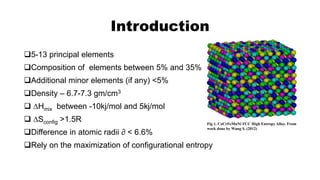
Fig 1. CoCrFeMnNi FCC High Entropy Alloy. From
work done by Wang S. (2012)
History of Development
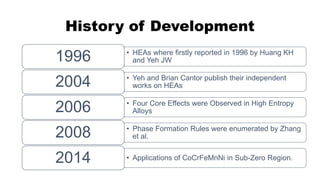
• HEAs where firstly reported in 1996 by Huang KH
and Yeh JW1996
• Yeh and Brian Cantor publish their independent
works on HEAs2004
• Four Core Effects were Observed in High Entropy
Alloys2006
• Phase Formation Rules were enumerated by Zhang
et al.2008
• Applications of CoCrFeMnNi in Sub-Zero Region.2014
Understanding the concept of HEAs
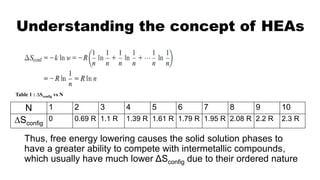
Thus, free energy lowering causes the solid solution phases to
have a greater ability to compete with intermetallic compounds,
which usually have much lower ΔSconfig due to their ordered nature
N 1 2 3 4 5 6 7 8 9 10
∆Sconfig
0 0.69 R 1.1 R 1.39 R 1.61 R 1.79 R 1.95 R 2.08 R 2.2 R 2.3 R
Table 1 : ∆Sconfig vs N
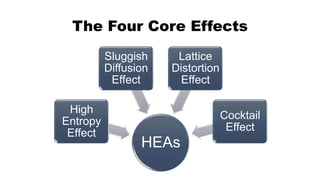
The Four Core Effects
HEAs
High
Entropy
Effect
Sluggish
Diffusion
Effect
Lattice
Distortion
Effect
Cocktail
Effect
High Entropy Effect
Fig.2. The XRD patterns of a series alloy designed by the sequential addition
of one extra element to the previous one. All the alloys have one or two major
phases that have simple structures.
Facilitates solid solution phases by
lowering Gibbs energy
Number of phases forming much less
than the maxm as per Gibbs Phase Rule
High ΔSconfig suppresses ordering,
especially at higher temperatures.
Inhibits compound formation as well as
intermetallics
Increased strength and ductility of due to
solution hardening.
Sluggish Diffusion Effect
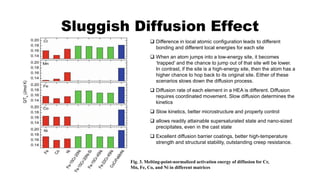
 Difference in local atomic configuration leads to different
bonding and different local energies for each site
 When an atom jumps into a low-energy site, it becomes
‘trapped’ and the chance to jump out of that site will be lower.
In contrast, if the site is a high-energy site, then the atom has a
higher chance to hop back to its original site. Either of these
scenarios slows down the diffusion process.
 Diffusion rate of each element in a HEA is different. Diffusion
requires coordinated movement. Slow diffusion determines the
kinetics
 Slow kinetics, better microstructure and property control
 allows readily attainable supersaturated state and nano-sized
precipitates, even in the cast state
 Excellent diffusion barrier coatings, better high-temperature
strength and structural stability, outstanding creep resistance.
Fig. 3. Melting-point-normalized activation energy of diffusion for Cr,
Mn, Fe, Co, and Ni in different matrices
Lattice Distortion Effect
High lattice strain due to
 Atomic Size Difference
 Difference in Bonding Energies
 Crystal Structure
Impedes dislocation
movement – Solid solution
strengthening
Increased scattering of
propagating electrons and
phonons, which translates to
lower electrical and thermal
conductivity
Fig 4. Distorted or Strained Lattice of
High Entropy Alloy
Fig 5. Hardness of the AlxCoCrCuFeNi
alloys as a function of Al content.
Cocktail Effect
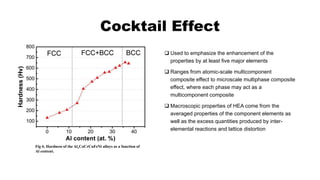
 Used to emphasize the enhancement of the
properties by at least five major elements
 Ranges from atomic-scale multicomponent
composite effect to microscale multiphase composite
effect, where each phase may act as a
multicomponent composite
 Macroscopic properties of HEA come from the
averaged properties of the component elements as
well as the excess quantities produced by inter-
elemental reactions and lattice distortion
Fig 6. Hardness of the AlxCoCrCuFeNi alloys as a function of
Al content.
Phase Formation and
Microstructure in HEAs
Tendency for solid solution will be greater for
equiatomic alloys
In case of non-equiatomic alloys, intermetallics
and solid solutions are competing processes.
Also different crystal structures can co-exist.
Non-equilibrium processes likely to give rise to
single phase solid solutions
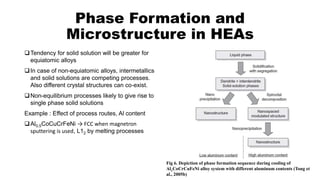
Example : Effect of process routes, Al content
Al0.5CoCuCrFeNi → FCC when magnetron
sputtering is used, L12 by melting processes
Fig 6. Depiction of phase formation sequence during cooling of
AlxCoCrCuFeNi alloy system with different aluminum contents (Tong et
al., 2005b)
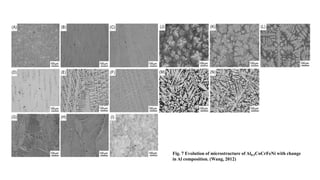
Fig. 7 Evolution of microstructure of Al0.5CoCrFeNi with change
in Al composition. (Wang, 2012)
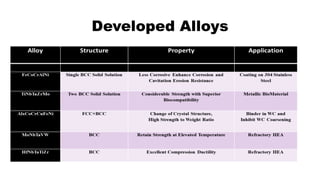
Developed Alloys
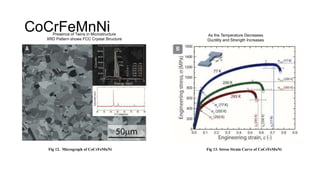
CoCrFeMnNiPresence of Twins in Microstructure
XRD Pattern shows FCC Crystal Structure
As the Temperature Decreases
Ductility and Strength Increases
Fig 12. Micrograph of CoCrFeMnNi Fig 13. Stress Strain Curve of CoCrFeMnNi
Processing routes
Schematic of Fabrication Process of High Entropy Alloys
Processing routes
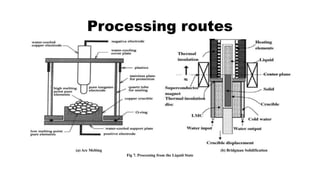
(a) Arc Melting (b) Bridgman Solidification
Fig 7. Processing from the Liquid State
Processing routes
Mechanical Alloying Sputter Deposition Process
Fig 8. Processing from the Solid State Fig 9. Processing from Gaseous State
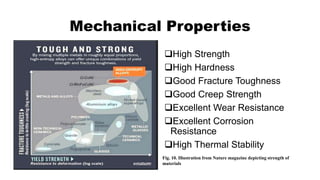
Mechanical Properties
High Strength
High Hardness
Good Fracture Toughness
Good Creep Strength
Excellent Wear Resistance
Excellent Corrosion
Resistance
High Thermal Stability
Fig. 10. Illustration from Nature magazine depicting strength of
materials
Applications
High Entropy
Alloy Coatings
High Entropy
Bulk Metallic Glass
Refractory
High Entropy Alloys
Carbides and Cermets
with HEA Binders
 HEA deposited on substrates for protection against wear, corrosion and heat.
 Thin film coating processes include CVD and PVD.
 Example : AlCrSiTiV HEA coating on Ti-6Al-4V substrate
Fig 11. Surface Morphology and SEM Micrograph of AlCrSiTiV HEA Coating on Ti-6Al-
4V substrate. From Huang C et al (2012)
Applications
High Entropy
Alloy Coatings
High Entropy
Bulk Metallic Glass
Refractory
High Entropy Alloys
Carbides and Cermets
with HEA Binders
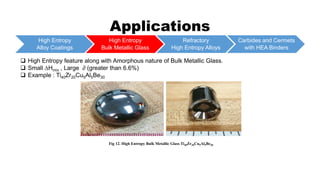
 High Entropy feature along with Amorphous nature of Bulk Metallic Glass.
 Small ∆Hmix , Large ∂ (greater than 6.6%)
 Example : Ti40Zr20Cu5Al5Be30
Fig 12. High Entropy Bulk Metallic Glass Ti40Zr20Cu5Al5Be30
Applications
High Entropy
Alloy Coatings
High Entropy
Bulk Metallic Glass
Refractory
High Entropy Alloys
Carbides and Cermets
with HEA Binders
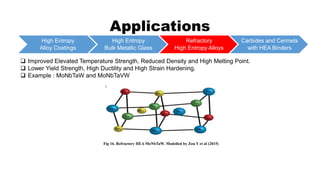
 Improved Elevated Temperature Strength, Reduced Density and High Melting Point.
 Lower Yield Strength, High Ductility and High Strain Hardening.
 Example : MoNbTaW and MoNbTaVW
Fig 16. Refractory HEA MoNbTaW. Modelled by Zou Y et al (2015)
Applications
High Entropy
Alloy Coatings
High Entropy
Bulk Metallic Glass
Refractory
High Entropy Alloys
Carbides and Cermets
with HEA Binders
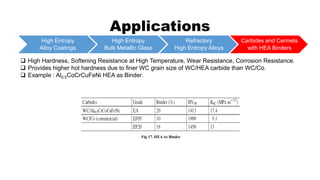
 High Hardness, Softening Resistance at High Temperature, Wear Resistance, Corrosion Resistance.
 Provides higher hot hardness due to finer WC grain size of WC/HEA carbide than WC/Co.
 Example : Al0.5CoCrCuFeNi HEA as Binder.
Fig 17. HEAAs Binder
References
 Ming-Hung Tsai & Jien-Wei Yeh (2014) High-Entropy Alloys: A Critical Review, Materials Research
Letters, 2:3, 107-123
 B. S. Murty, S. Ranganathan, J. W. Yeh, “High Entropy Alloys” Elsevier Inc. 2016
 S. Ranganathan, "Alloyed pleasures: Multimetallic cocktails," Curr. Sci. , vol. 85, pp. 1404-1406,
2003.
 J. Yeh, S. Chen, S. Lin, G. J.Y., T. Chin, T. Shun, T. C.H. and S. Chang, "Nanostructured high-
entropy alloys with multiple principal elements: Novel alloy design concepts and outcomes.," Adv.
Eng. Mater, vol. 6, no. 5, p. 299–303, 2004.
 B. Cantor, I. T. H. Chang, P. Knight and A. J. B. Vincent, "Microstructural development in equiatomic
multicomponent alloys," Mater. Sci. Eng. A, pp. 375-377,213-218, 2004.
 J. Yeh, "Physical metallurgy of high-entropy alloys," JOM, vol. 67, pp. 2254-2261, 2015.
Thank you
High entropy alloys

High entropy alloys

  • 1.
    High Entropy Alloys ChayonMondal Roll no.: 16142006 M.Tech – I [Alloy Technology] Metallurgical Engineering Indian Institute of Technology (Banaras Hindu University), Varanasi
  • 2.
    Overview Introduction – OperationalDefinition and Metallurgy Core Effects Mechanical Properties Processing Routes Applications References
  • 3.
    Introduction 5-13 principal elements Compositionof elements between 5% and 35% Additional minor elements (if any) <5% Density – 6.7-7.3 gm/cm3  ∆Hmix between -10kj/mol and 5kj/mol  ∆Sconfig >1.5R Difference in atomic radii ∂ < 6.6% Rely on the maximization of configurational entropy Fig 1. CoCrFeMnNi FCC High Entropy Alloy. From work done by Wang S. (2012)
  • 4.
    History of Development •HEAs where firstly reported in 1996 by Huang KH and Yeh JW1996 • Yeh and Brian Cantor publish their independent works on HEAs2004 • Four Core Effects were Observed in High Entropy Alloys2006 • Phase Formation Rules were enumerated by Zhang et al.2008 • Applications of CoCrFeMnNi in Sub-Zero Region.2014
  • 5.
    Understanding the conceptof HEAs Thus, free energy lowering causes the solid solution phases to have a greater ability to compete with intermetallic compounds, which usually have much lower ΔSconfig due to their ordered nature N 1 2 3 4 5 6 7 8 9 10 ∆Sconfig 0 0.69 R 1.1 R 1.39 R 1.61 R 1.79 R 1.95 R 2.08 R 2.2 R 2.3 R Table 1 : ∆Sconfig vs N
  • 6.
    The Four CoreEffects HEAs High Entropy Effect Sluggish Diffusion Effect Lattice Distortion Effect Cocktail Effect
  • 7.
    High Entropy Effect Fig.2.The XRD patterns of a series alloy designed by the sequential addition of one extra element to the previous one. All the alloys have one or two major phases that have simple structures. Facilitates solid solution phases by lowering Gibbs energy Number of phases forming much less than the maxm as per Gibbs Phase Rule High ΔSconfig suppresses ordering, especially at higher temperatures. Inhibits compound formation as well as intermetallics Increased strength and ductility of due to solution hardening.
  • 8.
    Sluggish Diffusion Effect Difference in local atomic configuration leads to different bonding and different local energies for each site  When an atom jumps into a low-energy site, it becomes ‘trapped’ and the chance to jump out of that site will be lower. In contrast, if the site is a high-energy site, then the atom has a higher chance to hop back to its original site. Either of these scenarios slows down the diffusion process.  Diffusion rate of each element in a HEA is different. Diffusion requires coordinated movement. Slow diffusion determines the kinetics  Slow kinetics, better microstructure and property control  allows readily attainable supersaturated state and nano-sized precipitates, even in the cast state  Excellent diffusion barrier coatings, better high-temperature strength and structural stability, outstanding creep resistance. Fig. 3. Melting-point-normalized activation energy of diffusion for Cr, Mn, Fe, Co, and Ni in different matrices
  • 9.
    Lattice Distortion Effect Highlattice strain due to  Atomic Size Difference  Difference in Bonding Energies  Crystal Structure Impedes dislocation movement – Solid solution strengthening Increased scattering of propagating electrons and phonons, which translates to lower electrical and thermal conductivity Fig 4. Distorted or Strained Lattice of High Entropy Alloy Fig 5. Hardness of the AlxCoCrCuFeNi alloys as a function of Al content.
  • 10.
    Cocktail Effect  Usedto emphasize the enhancement of the properties by at least five major elements  Ranges from atomic-scale multicomponent composite effect to microscale multiphase composite effect, where each phase may act as a multicomponent composite  Macroscopic properties of HEA come from the averaged properties of the component elements as well as the excess quantities produced by inter- elemental reactions and lattice distortion Fig 6. Hardness of the AlxCoCrCuFeNi alloys as a function of Al content.
  • 11.
    Phase Formation and Microstructurein HEAs Tendency for solid solution will be greater for equiatomic alloys In case of non-equiatomic alloys, intermetallics and solid solutions are competing processes. Also different crystal structures can co-exist. Non-equilibrium processes likely to give rise to single phase solid solutions Example : Effect of process routes, Al content Al0.5CoCuCrFeNi → FCC when magnetron sputtering is used, L12 by melting processes Fig 6. Depiction of phase formation sequence during cooling of AlxCoCrCuFeNi alloy system with different aluminum contents (Tong et al., 2005b)
  • 12.
    Fig. 7 Evolutionof microstructure of Al0.5CoCrFeNi with change in Al composition. (Wang, 2012)
  • 13.
  • 14.
    CoCrFeMnNiPresence of Twinsin Microstructure XRD Pattern shows FCC Crystal Structure As the Temperature Decreases Ductility and Strength Increases Fig 12. Micrograph of CoCrFeMnNi Fig 13. Stress Strain Curve of CoCrFeMnNi
  • 15.
    Processing routes Schematic ofFabrication Process of High Entropy Alloys
  • 16.
    Processing routes (a) ArcMelting (b) Bridgman Solidification Fig 7. Processing from the Liquid State
  • 17.
    Processing routes Mechanical AlloyingSputter Deposition Process Fig 8. Processing from the Solid State Fig 9. Processing from Gaseous State
  • 18.
    Mechanical Properties High Strength HighHardness Good Fracture Toughness Good Creep Strength Excellent Wear Resistance Excellent Corrosion Resistance High Thermal Stability Fig. 10. Illustration from Nature magazine depicting strength of materials
  • 19.
    Applications High Entropy Alloy Coatings HighEntropy Bulk Metallic Glass Refractory High Entropy Alloys Carbides and Cermets with HEA Binders  HEA deposited on substrates for protection against wear, corrosion and heat.  Thin film coating processes include CVD and PVD.  Example : AlCrSiTiV HEA coating on Ti-6Al-4V substrate Fig 11. Surface Morphology and SEM Micrograph of AlCrSiTiV HEA Coating on Ti-6Al- 4V substrate. From Huang C et al (2012)
  • 20.
    Applications High Entropy Alloy Coatings HighEntropy Bulk Metallic Glass Refractory High Entropy Alloys Carbides and Cermets with HEA Binders  High Entropy feature along with Amorphous nature of Bulk Metallic Glass.  Small ∆Hmix , Large ∂ (greater than 6.6%)  Example : Ti40Zr20Cu5Al5Be30 Fig 12. High Entropy Bulk Metallic Glass Ti40Zr20Cu5Al5Be30
  • 21.
    Applications High Entropy Alloy Coatings HighEntropy Bulk Metallic Glass Refractory High Entropy Alloys Carbides and Cermets with HEA Binders  Improved Elevated Temperature Strength, Reduced Density and High Melting Point.  Lower Yield Strength, High Ductility and High Strain Hardening.  Example : MoNbTaW and MoNbTaVW Fig 16. Refractory HEA MoNbTaW. Modelled by Zou Y et al (2015)
  • 22.
    Applications High Entropy Alloy Coatings HighEntropy Bulk Metallic Glass Refractory High Entropy Alloys Carbides and Cermets with HEA Binders  High Hardness, Softening Resistance at High Temperature, Wear Resistance, Corrosion Resistance.  Provides higher hot hardness due to finer WC grain size of WC/HEA carbide than WC/Co.  Example : Al0.5CoCrCuFeNi HEA as Binder. Fig 17. HEAAs Binder
  • 23.
    References  Ming-Hung Tsai& Jien-Wei Yeh (2014) High-Entropy Alloys: A Critical Review, Materials Research Letters, 2:3, 107-123  B. S. Murty, S. Ranganathan, J. W. Yeh, “High Entropy Alloys” Elsevier Inc. 2016  S. Ranganathan, "Alloyed pleasures: Multimetallic cocktails," Curr. Sci. , vol. 85, pp. 1404-1406, 2003.  J. Yeh, S. Chen, S. Lin, G. J.Y., T. Chin, T. Shun, T. C.H. and S. Chang, "Nanostructured high- entropy alloys with multiple principal elements: Novel alloy design concepts and outcomes.," Adv. Eng. Mater, vol. 6, no. 5, p. 299–303, 2004.  B. Cantor, I. T. H. Chang, P. Knight and A. J. B. Vincent, "Microstructural development in equiatomic multicomponent alloys," Mater. Sci. Eng. A, pp. 375-377,213-218, 2004.  J. Yeh, "Physical metallurgy of high-entropy alloys," JOM, vol. 67, pp. 2254-2261, 2015.
  • 24.

Editor's Notes

  • #11 This is partly because of the formation of a hard BCC phase, and partly due to the stronger cohesive bonding between Al and other elements, and its larger atomic size. Thus, the macroscopic properties of HEA not only come from the averaged properties of the component elements, but also include the effects from the excess quantities produced by inter-elemental reactions and lattice distortion.