Exploring the Cellular Basis of Life
 
Cell Theory: All living things are  made of one or more cells Cells are the basic units of structure and function in organisms All cells arise from existing cells
 
Development of the cell theory: Hooke in 1663, observed cork (plant): named the cell  Brown observed and named nucleus Schwann in 1800’s states: all animals are made of cells Schleiden in 1800’s states: all plants are made of cells Pasteur’s work with bacteria ~ 1860 disproved idea of spontaneous generation (living things from nonliving) Virchow observes cells dividing and states all cells come from preexisting cells
A cell is the simplest structural and functional unit of life. There are no smaller subdivisions of a cell or organism that,  in themselves, are alive. An organism’s structure and all of its functions are ultimately  due to the activities of its cells. Cells come only from preexisting cells, not from nonliving matter. All life, therefore, traces its ancestry to the same  original cells. Because of this common ancestry, the cells of all species have many fundamental similarities in their chemical composition  and metabolic mechanisms. Importance of Cell Theory
Cells are small
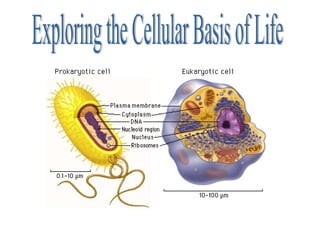
Small cells are more efficient Surface area to volume ratio must remain high
 
Features Common to All Cells
 
Prokaryotic Cell


Crossing the Membrane Cell Membrane  Structure and Transport
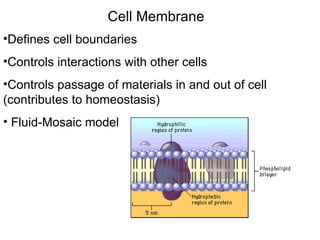
Cell Membrane Defines cell boundaries Controls interactions with other cells Controls passage of materials in and out of cell (contributes to homeostasis)  Fluid-Mosaic model
Fluid Mosaic Model of Membranes
Membrane Proteins
Membrane Fluidity
Membrane Permeability Cell membranes are selectively permeable (semi-permeable) Some solutes cross the membrane freely, some cross with assistance, and others do not cross at all.
 
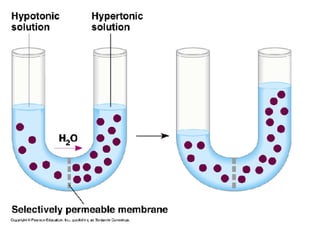
The diffusion of water molecules through a selectively permeable membrane Osmosis will continue as long as there are more water molecules on one side of the membrane (“osmotic pressure”) Water will continue to diffuse until there are equal numbers of molecules inside and outside the cell (“osmotic balance”) Osmosis
60% H 2 O 90% H 2 O
Water will move out of to the left across the membrane until osmotic balance has been reached
100% H 2 O 80% H 2 O
90% H 2 O 90% H 2 O
75% H 2 O 90% H 2 O Water leaves the cell and it shrinks. This is called  plasmolysis  in plant cells


Cell Biology

  • 1.
  • 2.
  • 3.
    Cell Theory: Allliving things are made of one or more cells Cells are the basic units of structure and function in organisms All cells arise from existing cells
  • 4.
  • 5.
    Development of thecell theory: Hooke in 1663, observed cork (plant): named the cell Brown observed and named nucleus Schwann in 1800’s states: all animals are made of cells Schleiden in 1800’s states: all plants are made of cells Pasteur’s work with bacteria ~ 1860 disproved idea of spontaneous generation (living things from nonliving) Virchow observes cells dividing and states all cells come from preexisting cells
  • 6.
    A cell isthe simplest structural and functional unit of life. There are no smaller subdivisions of a cell or organism that, in themselves, are alive. An organism’s structure and all of its functions are ultimately due to the activities of its cells. Cells come only from preexisting cells, not from nonliving matter. All life, therefore, traces its ancestry to the same original cells. Because of this common ancestry, the cells of all species have many fundamental similarities in their chemical composition and metabolic mechanisms. Importance of Cell Theory
  • 7.
  • 8.
    Small cells aremore efficient Surface area to volume ratio must remain high
  • 9.
  • 10.
  • 11.
  • 12.
  • 13.
  • 14.
  • 15.
  • 16.
  • 17.
  • 18.
  • 19.
  • 20.
  • 21.
  • 22.
  • 23.
  • 24.
  • 25.
  • 26.
  • 27.
    Crossing the MembraneCell Membrane Structure and Transport
  • 28.
    Cell Membrane Definescell boundaries Controls interactions with other cells Controls passage of materials in and out of cell (contributes to homeostasis) Fluid-Mosaic model
  • 29.
    Fluid Mosaic Modelof Membranes
  • 30.
  • 31.
  • 32.
    Membrane Permeability Cellmembranes are selectively permeable (semi-permeable) Some solutes cross the membrane freely, some cross with assistance, and others do not cross at all.
  • 33.
  • 34.
    The diffusion ofwater molecules through a selectively permeable membrane Osmosis will continue as long as there are more water molecules on one side of the membrane (“osmotic pressure”) Water will continue to diffuse until there are equal numbers of molecules inside and outside the cell (“osmotic balance”) Osmosis
  • 35.
    60% H 2O 90% H 2 O
  • 36.
    Water will moveout of to the left across the membrane until osmotic balance has been reached
  • 37.
    100% H 2O 80% H 2 O
  • 38.
    90% H 2O 90% H 2 O
  • 39.
    75% H 2O 90% H 2 O Water leaves the cell and it shrinks. This is called plasmolysis in plant cells
  • 40.
  • 41.
  • 42.
  • 43.
  • 44.
  • 45.